Petro rejects narco claims, calls US strikes on Venezuela illegal
Al Mayadeen | January 5, 2026
Colombian President Gustavo Petro issued on Monday a series of sharply worded statements rejecting accusations that seek to link him or Venezuelan leaders to drug trafficking, while forcefully condemning US military aggression, political intimidation, and renewed assertion of imperial control over Latin America.
In several posts published on X, Petro responded to remarks attributed to US President Donald Trump and to broader narratives circulating in Washington in the aftermath of the US aggression on Venezuela. He argued that Colombia’s judicial archives, after decades spent confronting the world’s largest cocaine cartels, contain no evidence linking Venezuelan President Nicolas Maduro or First Lady Cilia Flores to drug trafficking. According to Petro, such allegations originate primarily from figures aligned with the Venezuelan opposition rather than from any verifiable judicial findings.
Defamation rejected
Petro noted that Colombia’s judiciary functions independently of the executive branch and is largely influenced by political forces opposed to his government. Anyone genuinely seeking to understand the cocaine trade, he said, should consult Colombia’s court records rather than rely on politically motivated accusations. He added that his own name has never appeared in narcotics-related cases over more than five decades, affirming that he “deeply rejects” uninformed and defamatory claims.
He also stressed that Colombia’s experience with drug violence has been shaped not by state policy but by transnational demand, financial laundering networks, and decades of militarized counter-narcotics strategies promoted from abroad, strategies that, he implied, have failed to curb trafficking while devastating civilian populations.
Addressing personal attacks, Petro said it is unacceptable to “slander” Latin American leaders who emerged from armed struggle and later pursued peace, framing such rhetoric as political coercion aimed at delegitimizing independent leadership in the region. He referenced his own past in the M-19 movement, noting that it laid down arms and became part of Colombia’s peace process, a transition he described as a historic milestone in contemporary Latin American politics and a rare example of negotiated conflict resolution rather than foreign-imposed regime change.
Caracas under bombardment
Petro described the US aggression on Venezuela as the first time in modern history that a South American capital had been bombed by the United States, warning that such an act would remain etched in the collective memory of the continent. “Friends do not bomb one another,” he said, drawing parallels to some of the darkest episodes of 20th-century warfare.
The operation has raised particular alarm due to Washington’s open acknowledgment that it intends to administer Venezuela during a so-called transition period and to assert control over strategic sectors, including energy. Regional observers note that Venezuela’s oil infrastructure remained largely intact during the assault, a fact Petro did not ignore as he warned against war conducted in the name of justice but structured around resource access.
While explicitly rejecting retaliation, Petro argued that the events underline the urgent need for Latin America to rethink its political and economic alignments. He called for deeper regional unity, warning that without cohesion the region risks being treated as a “servant and slave” rather than as a central actor in global affairs. Petro criticized existing regional mechanisms, including the Community of Latin American and Caribbean States (CELAC), arguing that its absolute consensus rules allow certain leaders to preserve subservient relationships with foreign powers at the expense of collective sovereignty.
Scapegoated Dead
Petro also condemned celebratory reactions in some political circles to the bombing of Caracas, accusing them of erasing Latin America’s shared liberation history led by Simon Bolivar.
He further noted the US’ aggression resulted in civilian deaths, including that of a Colombian woman working informally in Caracas to support her daughter, a reminder, he stressed, that military interventions marketed as “precision operations” routinely exact a human toll on the most vulnerable.
Directly addressing Trump, Petro accused the US president of issuing internationally unlawful orders that led to the deaths of Colombian nationals who were later branded “narco-terrorists.” He rejected those labels as false and dehumanizing, arguing that many of the victims came from impoverished communities with no links to organized crime and were instead casualties of a long-standing policy of militarization, criminal profiling, and collective punishment.
Free speech, sovereignty, resistance
Petro defended his right to speak freely on US soil, noting that his remarks in New York and around the United Nations were protected under US law. He explained he had publicly condemned the genocide in Gaza, suggesting that his positions on Palestine, Venezuela, and US foreign policy more broadly triggered retaliatory narratives portraying him as corrupt or complicit in drug trafficking.
Rejecting those portrayals, Petro said he owns no luxury assets abroad and continues to pay for his home through his official salary. He also framed the controversy as part of a wider struggle against injustice, misinformation, and efforts to silence dissenting voices from the Global South through legal intimidation and reputational warfare.
The statements concluded with a call for respect between the Americas, invoking shared liberation traditions associated with figures such as Simón Bolívar and George Washington.
Petro warned against narratives that portray Latin America as inherently criminal, stressing that the region’s political movements are rooted in long-standing struggles for democracy, sovereignty, and social justice, not in the stereotypes imposed by external powers seeking control rather than partnership.
US Wants to Install ‘Functional Protectorate’ in Venezuela: Here Are Its Four Components
Sputnik – 05.01.2026
With Maduro out, Washington is looking to establish “four kinds of control” in Venezuela. Independent Peru-based geopolitical and economic analyst Nicolas Takayama Constantini outlines the mechanics of these measures for Sputnik.
“Operationally, it means that they will have a de facto tutelary administration,” Constantini explained. This would mean:
- “indirect political control” via a “provisional authority” or “transition council” approved by Washington, not the Venezuelan people
- technical and financial control over the oil sector, including contracts, ports and foreign currency flows
- direct control over oil revenues, either by the US Treasury, “or some entity controlled by the US”
- some form of US military or security presence, not necessarily a large one.
“So, in fact this wouldn’t be classical governance, but rather a form of functional protectorate, similar to Iraq in 2003,” the observer said.
Goal of US Operation: Seizure of Resources or Message to Rivals
“From a rational economic point of view, military intervention is not efficient. The military, political and reputational cost for the US far exceeds any potential energy gains. But it’s not only the resources,” even in Venezuela’s case (oil, gas, rare earths, tech metals, gold), Constantini said.
It’s about sending a message to Washington’s geopolitical rivals, including China, Russia and Iran, about preventing Venezuela’s resources from falling into their hands, and letting regional countries know: “if you don’t submit or make your resources available to me when I need, this will happen to you.”
“Just to have a note here, obviously the US doesn’t care about the Venezuelan interest or even the American citizens’ interest related to drug traffickers because the agencies in the US say that the main flow of drugs doesn’t come from Venezuela,” the expert added.
Venezuela Attack Signals Final Breakup of Post-WWII Order
“It’s an extremely serious precedent for the international order. It means that state sovereignty doesn’t work anymore. The head of state immunity doesn’t work anymore. It normalizes regime change by force without multilateral authorization. It reinforces the idea that power supersedes international law,” Constantini explained.
“It marks the end of what remained of international law and the international order after the Second World War… a greater militarization of foreign policy and acceleration of the global order’s fragmentation into competing blocs. This implies that other powers can do the same if they don’t consider a particular government legitimate,” the observer summed up.
The US Has Invaded Venezuela to ‘Fight Drugs.’ Are Colombia and Mexico Next?
By Adam Dick | Peace and Prosperity Blog | January 4, 2026
On Saturday, United States President Donald Trump held a press conference to boast about his sending the US military hours earlier to bring destruction in Venezuela and drag off the leader of the nation’s government to America for incarceration and prosecution. It was all done in the name of fighting the war on drugs, though few people give much credit to the Trump administration’s repeated assertion that Venezuela President Nicolás Maduro was a drug kingpin responsible for a major share of fentanyl or cocaine shipments into America.
The US government, Trump declared, will “run” Venezuela for an undefined “period of time” that Trump declined to rule out, in answer to a question, could be measured in years. While the US is doing that, be prepared for Trump also to potentially direct the US military to invade at least two additional countries in the Western Hemisphere.
In October, I wrote about how Trump appeared to be making demands and taking actions preparatory for the US going to war in three countries — Venezuela, Colombia, and Mexico. The common reason given for taking military action in each country has been the same — advancing the US government’s war on drugs.
The current status is one down, at least two to go. While already bogged down in Venezuela, the next step may be for the US to proceed to attack two more Western Hemisphere countries. Indeed, during the press conference, Trump continued with comments suggesting both Colombia and Mexico are under threat from the US government’s drug war. In particular, Trump reaffirmed his previous declaration that Colombia President Gustavo Petro has “got to watch his ass” while accusing him of making cocaine and sending it into America, criticized the “cartels operating along our border” in reference to Mexico, and said more broadly that “we will crash the cartels.” One important question to consider is how much America may also crash due to the strain of military intervention in the Western Hemisphere.
How Intelligence, Politics, and Foreign Interests Shaped America’s Religious Movements
By Freddie Ponton | 21st Century Wire | December 30, 2025
Christianity is back at the centre of American life, but not necessarily in the way most believers imagine. Churches are fuller, Christian language saturates politics, and faith-based identity has become a mobilising force once again. Yet beneath this revival lies a more unsettling reality: for decades, U.S. government agencies have treated religion not as sacred ground, but as strategic terrain.
This is not theory. During the Cold War, the U.S. State Department and intelligence agencies, most notably the CIA, recognised theology, doctrine, and religious institutions as instruments of influence. Faith was studied, guided, and at times quietly reshaped to serve geopolitical aims. The goal was rarely to destroy belief outright; rather, it was to domesticate it, align it, and render it strategically useful.
DOCUMENT: CIA’s use of journalists and clergy in intelligence operations – Select Committee On Intelligence Of The United States Senate One Hundred Fourth Congress, Second Session, July 17, 1996 (Source to download full pdf: US Senate Select Committee on Intelligence)
Initiatives like the Doctrinal Warfare Program illustrate the scale of this engagement. Churches with mass followings, moral authority, and transnational reach were not simply tolerated; they were targeted for influence. Orthodox congregations in the U.S. and abroad were monitored to ensure alignment with Western interests. Catholic seminaries became conduits for doctrinal shaping, funding networks, and leadership development favourable to U.S. objectives. Even Protestant and Evangelical movements, decentralised and spontaneous, were quietly steered through cultural engagement, philanthropic networks, and selective amplification of certain voices.
Sincere people seeking truth, purpose, and transcendence found themselves caught in influence systems they neither designed nor understood. Their worship, community, and faith became tools in a broader psychological and cultural battle they never consented to.
Doctrinal Warfare: When Theology Became a Battlefield
The CIA’s Doctrinal Warfare Program, particularly its work with Roman Catholic institutions, offers a rare glimpse into how intelligence agencies approach faith. Unlike cinematic portrayals of spies manipulating events, this program operated through subtler, more effective channels.
Influence was exerted via:
- Funding pipelines and philanthropic foundations, directing resources to seminaries, clergy travel, and publications
- Theological conferences and academic exchanges, creating opportunities to propagate ideas aligned with U.S. interests
- Publishing houses, journals, and media networks, shaping what doctrines and interpretations were elevated
- Selected intermediaries, often clergy or theologians, who could subtly shift discourse without appearing coerced
The program’s goal was not to dictate belief directly but to frame the boundaries of acceptable belief. Anti-communism, Western liberal ideals, and American exceptionalism were integrated into theological narratives. Over time, certain interpretations were elevated while others, particularly liberationist, socialist, or anti-Western emphases, were sidelined.
This structural influence was not limited to Catholics. Orthodox churches in the diaspora, particularly in Eastern Europe and North America, were monitored for political alignment. Protestant and Evangelical networks, decentralised and emotionally charged, presented different challenges. Leaders resisted hierarchical oversight, yet strategic use of media, donor support, and conferences quietly aligned these movements with larger political and global objectives.
The CIA and allied agencies like the Israeli MOSSAD also monitored global religious developments, from Latin America to Africa, mapping networks of clergy, seminaries, and youth movements. Influence became a form of psychological warfare: it did not coerce, but conditioned; it did not command, but subtly steered. And it thrived where people least expected manipulation, within trusted communities, sacred spaces, and moral authority.
VIDEO: David Wemhoff discusses his book John Courtney Murray, Time/Life, and the American Proposition: How the CIA’s Doctrinal Warfare Changed the Catholic Church. (Source: thkelly67 | Youtube)
Calvary Chapel, Charismatic Leaders, and the Power of Movements
Few movements illustrate both the promise and vulnerability of modern American Christianity like Calvary Chapel.
Founded in the mid‑1960s by Chuck Smith in Costa Mesa, California, Calvary Chapel emerged amidst the counterculture and the Jesus Movement. Smith welcomed surfers, hippies, and spiritual seekers alienated by both secular culture and institutional religion. Informal, emotionally open, culturally adaptive—and extraordinarily successful—it grew from a small congregation into a network of more than 1,800 churches worldwide.
Despite the ongoing debate about whether Calvary Chapel was created by individuals controlled by intelligence agencies or by charismatic individuals, the movement demonstrates a lesson intelligence agencies recognised decades ago: youth-driven religious networks are powerful instruments of social, political and cultural influence.
Figures like Lonnie Frisbee, a magnetic and unconventional evangelist, helped ignite the Jesus Movement and played a decisive role in Calvary Chapel’s early expansion. Frisbee’s countercultural persona, preaching on beaches, leading communal outreaches, and drawing thousands of young converts, was a force institutions could admire, attempt to understand, but never fully control.
Similarly, Paul Cain, a prophetic figure in charismatic networks, influenced theological subcultures with a focus on vision, revelation, and spiritual authority. According to reports, Cain was also a consultant to the Paranormal Division of the Central Intelligence Agency and the FBI. Like Frisbee, Cain became controversial, not because he was a confirmed intelligence operative, but because charismatic authority challenges hierarchical control, making it both influential and unsettling.
Calvary Chapel and these figures illustrate a key pattern: movements can grow organically, capture attention, and mobilise communities, making them valuable, and sometimes threatening, to political and intelligence structures. While the direct manipulation claims and the CIA militant connection remain debatable, historical examples like the Doctrinal Warfare Program prove that states do seek to shape religious institutions at scale, often through indirect methods rather than overt control, hence the lack of evidence thereof.
From Pews to Power: Evangelical Politics, Israel, TPUSA, and the Cost of Capture
By the late 20th century, Evangelical Christianity had evolved into a political powerhouse. Networks that began as spiritual awakenings now functioned as engines of political mobilisation, with youth-oriented, media-savvy outreach bridging the gap between churches and the political arena.
TPUSA and Charlie Kirk
Organisations like Turning Point USA (TPUSA) drew from these ecosystems, churches, conferences, campus ministries, and donor networks that had been shaped by decades of cultural, doctrinal, and ideological influence. Faith-language blended seamlessly with nationalism, free-market rhetoric, and civilizational anxiety, mobilising millions of voters.
The 2024 U.S. presidential election highlighted the real-world impact: Evangelical networks were decisive in returning Donald Trump to the White House. For believers, this was framed as a moral imperative or spiritual duty. For observers, it revealed how religious movements could be strategically leveraged within political frameworks.
The assassination of Charlie Kirk, co-founder of TPUSA, shocked the nation and intensified national reflection. While there is no direct evidence ( at least not yet), linking churches or religious movements to the attack, the public reaction underscores a critical truth: powerful social networks rooted in faith become conduits of influence, whether intended or incidental.
As unsettling as it may be for the US government, it is worth noting that an intense social-media rift has emerged between TPUSA and podcaster Candace Owens, with competing narratives and accusations fueling distrust of official accounts surrounding the Charlie Kirk killing at UVU. Interestingly, some critics, Candace Owens among them, contend that the assassination of Charlie Kirk carries the hallmarks of a sophisticated intelligence-style operation, raising uncomfortable questions about whether certain figures within TPUSA may have been more deeply entangled in the events than the public has been led to believe. A decentralised, global network of self-styled citizen journalists is currently crowdsourcing footage, timelines, and open-source data, arguing that gaps and inconsistencies warrant deeper scrutiny beyond mainstream reporting. This phenomenon has amplified public pressure on agencies such as the FBI and on TPUSA to clarify unanswered questions and reconcile discrepancies in their account of the events of September 10, 2022.
Much like the unresolved shadows that followed the JFK assassination, Charlie Kirk’s killing has placed intelligence agencies, the military, the FBI, and even foreign actors like Israel at the center of a fraught public controversy, not through proven culpability (at least not yet), but through the swirl of suspicion and unanswered questions that inevitably surround the death of a defining religious and political figure in the American conservative sphere, leaving many to ask whether this is coincidence or something more troubling left unexplained.
Christian Zionism and Israeli Influence
No discussion of modern Evangelical power is complete without considering the strategic relationship between U.S. Evangelicals and the State of Israel.
This alliance is public and well-documented. Evangelical Christians, especially in the United States, became one of the most reliable pro-Israel voting blocs, influenced not just by policy arguments but by theological frameworks, Christian Zionism, which frames Israel as divinely central to biblical prophecy.
Israeli political leaders and advocacy organisations have cultivated this alignment via:
- Pastors’ conferences in Israel
- Evangelical media networks and tours
- Donor networks and lobbying partnerships
Organisations such as Christians United for Israel (CUFI) mobilise millions of voters, influence Congressional votes, and amplify foreign policy priorities. During the Trump administration, these networks helped drive decisions like the Jerusalem embassy relocation, Iran policy shifts, and strengthened U.S.-Israel alignment.
Yet this partnership is not uncontested. Younger conservatives and Evangelicals, particularly those aligned with independent thinkers like Charlie Kirk, increasingly question whether faith-based loyalty to foreign policy interests undermines America-first priorities. This generational tension highlights a growing divergence within conservative Christianity: between inherited religious-political alliances and emerging calls for national sovereignty, prudence, and domestic priority.
Moreover, the case of Turning Point USA illustrates how foreign influence can intersect with faith-based movements to shape political power. TPUSA’s open alignment with pro-Israel advocacy networks, from educational trips and conferences to donor engagement, demonstrates how theological and ideological commitments can be leveraged to advance strategic interests. This organisational alignment and associated messaging reveal a clear pattern of external actors using popular religious and political networks to sway domestic policy and voter priorities in the United States. This dynamic mirrors broader trends seen in movements like Calvary Chapel, where charismatic leaders and faith communities, intentionally or not, become conduits for shaping societal and political behaviour, highlighting how belief can be instrumentalised as a tool of influence. Believers are constantly reminded by pastors such as Garid Beeler, of VISION Calvary Chapel in Irvine, CA, that they need to unconditionally embrace the so-called God’s plan for Israel, which in their eyes legitimises Israel’s occupation of Palestine, and the subsequent genocide, on the basis that the Lord specifically gave the Hebrews the land thousands of years ago.
Believers as Collateral in the Machinery of Influence
The story of institutional capture is not about disloyal Christians or malign churches. It is about power exploiting vulnerability.
The State Department, CIA, and allied actors like Israel did not invent faith crises, but they mastered the art of steering movements. They understood that belief motivates action, doctrine shapes identity, and institutions built on trust are uniquely vulnerable to manipulation.
Jay Dyer’s analysis, which we are featuring today, frames this landscape without demonising believers: faith itself is not the enemy, but it has been treated as a resource, managed, redirected, and at times hollowed out by forces whose goals are strategic, political and financial, rather than spiritual.
If Christianity is to withstand this era with integrity intact, it will require discernment, humility, vigilance, and, of course, the ability to separate the Gospel from the machinery of power. The war was never against believers, but belief, as an institution, has been under attack all the same.

Jay Dyer writes about the historical and geopolitical factors of state and private interference in ecclesial and religious affairs…
Institutional Capture Explained: The State Dept, CIA & Orthodox, Roman Catholic & Protestant Churches
The notion of state interference in the life of the Church is well known to students of Church history: Arian Emperors, Imperial support for iconoclasm, the Frankish and Germanic control of the papacy, as well as the investiture controversy should all come to mind. These famous scandals demonstrate the persistent cunning on the part of the state to install, influence and control religiosity in the realm, and to students of geopolitics this should also come as no surprise. What is odd, however, is that when this concept arises in modern discussions, it is relegated immediately to the domain of “conspiracy theory,” unless of course you are talking about the KGB and NKVD relationship to Russian clerics in the 20th century.
It only turns out to be a “conspiracy theory” when one points to the US State Department, the CIA, various foundations, NGOS and academic institutions (often closely linked to the intelligence apparatus) – all of whom openly seek to alter and change Orthodox theology, as well as the theological positions of the Roman Catholic and Protestant communions. First, it is worth noting that missionary work is a classic espionage cover: Obviously, I don’t mean all missionaries are spies, but that it has famously been a useful cover for espionage work, which is precisely why Russia has recently banned groups like the Jehovah’s Witnesses and Scientology. These entities can be used as a form of soft power or even more covert intelligence operations. Similarly, classic cover for foreign operations of this sort has used aid organisation cover, such as the Red Cross or USAID.
In fact, even mainline publications regularly report this fact, though it seems to be lost on so many, especially among the intelligentsia who pride themselves on grasping the practicality of realpolitik. Christianity Today writes:
“Many of America’s first spies were missionaries or came from missionary backgrounds. Often enough, they were the only Americans who had lived abroad—not just among locals but as locals. While other American spies learned about the world through books and couldn’t really grasp its full range of quirks and complexities—“like tourists who put ketchup on their tacos,” as Sutton puts it—missionaries spoke several languages and knew the subtle differences between local dialects. They understood local cultures and faiths from the ground up and knew intuitively how to navigate between them. They knew, in short, “how to totally immerse themselves in alien societies.” But they always identified first and foremost as Christians and as Americans, and when they were called to serve the nation, they did not hesitate to do so.”
This was not unique or new; Orthodox monastic spies were also used by British intelligence in the infamous case of “Father Dimitrios”:
“The story of Father Dimitrios, or David Balfour, who turned out to be a British spy in pre-World War II Greece, is a fascinating yet relatively little-known chapter in modern Greek history.”
Father Dimitrios, the monk with the voice of an angel, turned out to be a spy for the British Intelligence Service. That’s a shame because the mission and wartime actions of the British priest could make a nail-biting spy novel or film.
From 1937 to 1939, the English spy, wearing his priest’s robes and his long, bifurcated beard, performed his ecclesiastical duties close to Greece’s royal family. His relations with King George II, the successor to King Paul and Princess Frederica, were especially close. His access to the royal palace undoubtedly gave him access to valuable information.
British Intelligence must have learned a great deal about the Greek royal family during these crucial prewar years. King George II was a paternal first cousin of Queen Elizabeth’s husband, Prince Philip, the Duke of Edinburgh.
Members of the royal family often confessed to their beloved priest. At the same time, Balfour, under the cover of Father Demetrios, forged important acquaintances with high-ranking military officers and politicians with the blessings of the palace.
During World War 2, for example, dozens of missionaries were using their clerical cloaks as their espionage cloak, spying for the Allies. Time Magazine explains:
“His [Protestant Missionary Alfred Eddy] most audacious undertaking included a plot to “kill,” as he described it, “all members of the German and Italian Armistice Commission in Morocco and in Algeria the moment the landing takes place.” In a straightforward and matter-of-fact memo, he told OSS head William Donovan that he was targeting dozens of people. He additionally ordered the executions of “all known agents of German and Italian nationality.” Never one to mince words, he called the proposal an “assassination program.”
To orchestrate his bloodthirsty plot, Eddy hired a team of Frenchmen. He planned to frame the executions as a “French revolt against Axis domination.” “In other words,” he explained to Donovan, “it should appear that the dead Germans and Italians were ‘the victims’ of a French ‘reprisal against the shooting of hostages by the Germans and other acts of German terror,” and not an OSS operation.
At about the same time that he was recruiting French hitmen, he wrote to his family about the sacrifices he was making for Lent. He described the Easter season as “abnormal” this year. “I am certainly abstaining from wickedness of the flesh,” he confessed. With his wife thousands of miles away, that was not too difficult. “I haven’t even been to a movie since Lisbon, I don’t overeat anymore, and I allow myself a cocktail at night, but never before work is all done.”
And,
“American intelligence leaders had stumbled upon the fact that missionaries make great spies. They have excellent language skills, they know how to disappear into foreign cultures, and they are masters at effecting change abroad. But while missionary spooks believed that their wartime work was necessary, they also wrestled with the moral ambiguities inherent in their actions.”
This is just one example among countless, but it serves to illustrate the point – in this case, the supposed man of the cloth is engaged in assassination missions. A fortiori, the US Government would also see the power in utilising religion for the promotion of Americanism. During the Cold War this was ramped up to extreme degrees as CIA operatives and strategists like C.D. Jackson allied with media magnate and Skull & Bonesman Henry Luce – of Time Magazine, to recruit various prominent academics and Jesuits like John Courtenay Murray to help ensure the Vatican and in particular the Second Vatican Council, would include in its dogmatic degrees new doctrinal statements that were amenable to Americanism. This unique style of interference was even highlighted by a congressional investigation in 1996 into the CIA’s use of ministers and journalists here (including Peace Corps Volunteers).
This was combined with separate operations from Helliwell, Angleton, Donovan & Colby to utilise Opus Dei, the Vatican Bank and drug running for black operations funding in the now infamous Operation Gladio, which also saw the See of Rome aligning itself with organised crime to supposedly “save the world from communism.” However, as Catholic lawyer David Wemhoff has demonstrated in his masterful and unparalleled 800-page, vastly sourced tome, John Courtney Murray, Time/Life Magazine and the American Proposition, Jackson’s now declassified “Doctrinal Warfare Program” led the Roman Church into the hands of new masters at the US State Department and the CIA.
Indeed, this is precisely why Pre and Post-Vatican 2 popes, from Pius XII to Paul VI to John Paul 2 were meeting with Colby, Kissinger and William Casey on a consistent basis during the Cold War. And, if you are a perceptive reader, you can already piece together the blackmail and compromise operations that the world has seen through the Epstein saga were simply a window into how these institutions were similarly blackmailed and compromised, which is why there have been so many scandals in the Roman Church concerning pedo crimes, and likely relates to why Benedict resigned.
In regard to the Protestant Churches, the Rockefeller family is quite proud of, and openly brags about their influence and dominance of the Protestant religious world, through their donations and tax-free foundation offerings. These offerings, of course, come with strings attached, such as the decision to push the newly formed “social gospel” concept of the early 20th century. Eventually, the Rockefellers were creating entire seminaries and universities dedicated to the promotion of David’s influences from Keynesian/Fabian and Austrian economic theory, as well as Malthusianism and eventually technocracy, through the recruitment of Zbigniew Brzezinski after the publication of his seminal 1970 text, Between Two Ages: America’s Role in the Technetronic Era.
Few know David Rockefeller himself spent time in intelligence work and transferred this knowledge of networking and banking operations into his business ventures, as he discusses in his Memoirs. In fact, Brzezinski’s book also includes chapters discussing the role of the Post-Vatican 2 Roman Catholic Church in the promotion of Americanism and technocratic hegemony. It should also be noted that the Rockefellers didn’t merely have an interest in steering the Protestant and evangelical churches into liberalism and modernism, but also set their sights on Rome and Orthodoxy, as Wemhoff notes.
For the Orthodox World, the price of siding between two thieves came at a high cost, as the Orthodox England blog notes, concerning the place of the Russian Orthodox Church between the KGB and the CIA. Similarly, it has recently been declassified that the OSS placed pressure on the Patriarch of Constantinople, as the CIA said:
“In an OSS interoffice memo dated March 26, 1942, an intelligence agent named Ulius L. Amoss wrote this to a fellow OSS agent named David Burns:
The Archbishop was extremely pleased at having met and lunched with you. He has told me that the entire facilities of his organisation are at our disposal. He put it in these words: “I have three Bishops, three hundred priests and a large and far-flung organisation. Everyone under my order is under yours. You may command them for any service you require. There will be no questions asked, and your directions will be executed faithfully. Please tell Mr Burns for me that this is so.”
A month later, on April 25, the 56-year-old Greek Archbishop attempted to enlist in the U.S. Army. He was turned down.
A few weeks after that, on May 14, Ulias Amoss, the same intelligence agent who wrote the March 26 memorandum, wrote a letter to Athenagoras, thanking him for the Greek Archdiocese’s ongoing cooperation, saying, in part, “The care with which your Bishops and Priests have cooperated has impressed everyone and the report that, perhaps, as many as a hundred thousand names will be returned to us is astounding.” On the same day, William J. Donovan himself — the head of the OSS — also wrote to Athenagoras, “The reports and descriptions of Greek-American youth of military age so kindly undertaken by you are coming in in splendid volume. The care with which Your Grace has managed this important service is of great interest to our armed services, and I wish to express my deep appreciation for your loyal and patriotic assistance.”
This special relationship with US intelligence never ended and continues to this day as the backdrop to the actions of the Phanar and GOARCH in the US:
“Archbishop Elpidophoros, the head of the Patriarchate of Constantinople’s Greek Orthodox Archdiocese of America, was the honoured guest at the National Intelligence University in Maryland earlier this week, where he delivered an address to the U.S. intelligence community.
The university brings together faculty and students from all 18 of the nation’s intelligence communities.
As the Greek Archdiocese notes, the Archbishop’s talk on “Russia’s Weaponisation of Religion in the Ukraine Conflict” was the first-ever address from a GOARCH leader to the U.S. intelligence community. At the same time, the Patriarchate of Constantinople has a long history of cooperation with the U.S. intelligence community, as detailed in documents released by the CIA.”
While it may seem like a far-off footnote in a dusty history book on Byzantium or the Borgia Papacy, the reality of state and private interference (and control!) in religion is a stark reality. The goal of the state is the maintenance and projection of power, simply put. Religion is a tremendous force for control and power in the world, both good and evil, but for the state, religion is simply another domain of human culture for the projection of power, and in today’s world, that is most often projected as soft power.
If you have not read Joseph Nye’s famous essay on Soft Power, I recommend it here. Understanding soft power gives a window into the attitude of the power elite and their perspective on religions and sects as tools – pawns on the grand chessboard, to use Brzezinski’s terminology. One need only think of Brzezinski’s own recruitment and usage of what would become Al Qaeda in the Soviet War in Afghanistan in Operation Cyclone – the usage of a radical religious sect for US objectives – as a classic example.
Venezuela under siege: Why US escalation could destabilize an entire region
By Leila Nezirevic | Al Mayadeen | December 28, 2025
Washington’s confrontation with Venezuela has entered a dangerous new phase. What began years ago as sanctions aimed at pressuring President Nicolás Maduro’s government has now escalated into naval interdictions, oil tanker seizures, and open discussion of military action — a shift that risks destabilizing not only Venezuela but much of Latin America.
In recent weeks, the United States has intensified its campaign by intercepting Venezuelan oil shipments at sea, effectively enforcing what officials describe as a “blockade” of sanctioned vessels. Caracas has denounced the move as piracy and a violation of international law, while Washington frames it as a legitimate enforcement of sanctions and a counter-narcotics operation.
Yet behind the legal arguments and political messaging lies a deeper strategic shift, one that signals a return to a more coercive US posture in Latin America, with potentially profound consequences.
To understand the implications of this escalation, alngside current regional developments and historical precedents, this article draws on an in-depth interview with veteran journalist and leading Latin America expert Richard Lapper.
A sharp escalation at sea
The most visible sign of Washington’s new approach has been its actions in international waters. US naval forces have seized and disabled Venezuelan oil tankers accused of violating sanctions, while additional vessels remain under surveillance. These measures go beyond financial penalties and diplomatic pressure, marking one of the most forceful uses of maritime power against Venezuela in decades.
Caracas has condemned the seizures as an illegal blockade and accused Washington of weaponizing sanctions to strangle its economy. Venezuelan officials argue that the actions violate international maritime law and set a dangerous precedent for global trade.
Legal experts remain divided. While the US claims it is acting within the scope of sanctions enforcement, critics argue that interdicting vessels in international waters — especially without multilateral backing — risks undermining established norms of freedom of navigation.
Richard Lapper, also an author of several books, including Lula!: The Man, The Myth and a Dream of Latin America, is blunt in his assessment. “This is a breach of international law,” he says. “But I don’t think that really matters for the Trump administration. This is about exerting power.”
The return of the Monroe Doctrine
According to Lapper, Washington’s Venezuela policy reflects a broader reassertion of hemispheric dominance reminiscent of the Monroe Doctrine — the 19th-century principle that Latin America falls within the United States’ exclusive sphere of influence.
For decades, US policy toward the region oscillated between overt intervention and softer approaches centred on democracy promotion and economic reform. That balance now appears to be tilting decisively toward coercion.
“This is a fairly clear restatement of a traditional US approach,” Lapper explains. “It says: this is our region, and we are going to exert our power.”
He points to recent US involvement in Honduras as emblematic of this shift. Washington strongly backed political actors aligned with its interests, even when they carried significant legal and ethical baggage. In doing so, the US signalled that strategic loyalty now outweighs democratic credentials.
From sanctions to military pressure
For years, sanctions were Washington’s primary tool against Venezuela. Initially justified as a way to pressure the Maduro government toward democratic reforms, the measures expanded to target the country’s oil industry — the backbone of its economy.
While sanctions inflicted economic pain, they failed to dislodge Maduro. Instead, Venezuela’s political system hardened, opposition forces fragmented, and millions of citizens left the country.
Now, sanctions are being reinforced by overt military pressure.
Trump has publicly refused to rule out armed conflict with Venezuela. While a full-scale invasion remains unlikely, Lapper, warns that limited military escalation is a real possibility.
“I don’t think war in the sense of large ground troop deployments is likely,” he says. “But significant military escalation — including drone strikes or targeted attacks on government assets — could happen.”
Such an approach would mirror recent conflicts elsewhere, where technologically advanced militaries sought to degrade adversaries without committing troops on the ground.
Yet Venezuela is not a small or easily controlled state. It is geographically vast, with difficult terrain and powerful non-state actors operating in rural areas.
“Venezuela is a big country,” Lapper cautions. “It would be very difficult for any external power to secure control of the entire territory.”
Drugs, terror labels, and political framing
Washington has justified some of its actions by framing Venezuela as a major hub for drug trafficking, alleging links between senior officials and organized crime networks such as the so-called “Cartel of the Suns.”
There is little dispute that narcotics pass through Venezuela en route to North America. The question is whether this justifies the current escalation — or whether it serves as political cover.
“You have to take the drug stuff with a pinch of salt,” Lapper says. “A lot of drugs do go through Venezuela, but to what extent Maduro himself is at the centre of this is highly contested.”
He notes the inconsistency of US drug policy, pointing to cases where Washington has quietly abandoned its tough stance when political interests demanded it.
“It’s a convenient wrapper for the policy,” Lapper argues. “But the real objective is regional domination.”
A changing political landscape in Latin America
The escalation against Venezuela is unfolding amid a broader political realignment across Latin America. After the so-called “pink tide” of left-wing governments in the early 2000s, the region has swung sharply to the right.
Conservative and far-right leaders now dominate in countries such as Argentina, El Salvador, and Chile, while left-wing governments face mounting pressure elsewhere.
“These are the leaders setting the regional mood,” Lapper says, pointing to figures like Argentina’s Javier Milei and El Salvador’s Nayib Bukele. “Not the Lulas and Chavezes of the past.”
This shift has two implications. First, it reduces regional resistance to US pressure on Venezuela. Second, it creates an environment in which hardline security approaches are politically fashionable.
Ironically, however, overt US intervention can still backfire. In Brazil, for instance, perceived external interference has boosted nationalist sentiment and temporarily strengthened President Lula’s standing.
Venezuela’s economic collapse: Sanctions
One of the central debates surrounding Venezuela concerns responsibility for its economic collapse. Washington argues that sanctions are a response to authoritarianism and corruption. Caracas insists that sanctions themselves are the root cause of suffering.
“Sanctions make things worse, Venezuela was producing three million barrels a day in the late 1990s,” Lapper notes. “Now it produces around a million. It used to be a major force in OPEC. It isn’t anymore.”
However, he also pointed out that even without sanctions, Venezuela would face deep structural challenges. With sanctions, those challenges have become existential.
Humanitarian fallout and migration pressures
The human cost of Venezuela’s crisis is staggering. Roughly one-fifth of the population has left the country, creating one of the largest displacement crises in modern history.
Escalating sanctions and blockades are likely to worsen this trend.
Within Venezuela, reduced oil revenues mean fewer imports, higher inflation, and deeper reliance on informal and illicit economic activities. Outside the country, neighbouring states struggle to absorb waves of migrants.
Brazil, which shares a long land border with Venezuela, has a direct interest in preventing further destabilisation. It has attempted to mediate politically, but with little success.
“Brazil wants stability,” Lapper says. “But its soft diplomacy hasn’t been effective.”
As conditions deteriorate, migration pressures are likely to intensify — not only toward neighbouring countries, but eventually toward the United States itself.
International allies and a shrinking safety net
Venezuela is not entirely isolated. Cuba remains its most important security ally, receiving subsidized oil in exchange for intelligence and political support.
Russia and China provide diplomatic backing, but neither appears eager to dramatically escalate its involvement.
“I don’t see Russia or China rushing to Venezuela’s aid,” Lapper says.
If US pressure cuts off oil supplies to Cuba, the effects could be destabilizing across the Caribbean. Cuba is already facing severe economic strain, with blackouts and protests becoming more frequent.
The risk, analysts warn, is a cascading crisis affecting multiple states simultaneously.
Lessons from past US interventions
History offers sobering lessons. US military interventions in Latin America have had mixed results at best. While short operations in Panama and Grenada succeeded tactically, longer engagements — such as Haiti — produced prolonged instability.
Elsewhere, particularly in the Middle East, US interventions over the past three decades have often exacerbated conflict rather than resolving it.
“The US does not have the staying power,” Lapper says. “There isn’t domestic support for long, messy interventions.”
That reality limits Washington’s options.
Sanctions alone have failed. Full-scale invasion is politically untenable. High-tech, limited strikes remain a temptation — but one fraught with risk.
What lies ahead for Venezuela?
Looking toward 2026, Lapper sees no easy resolution.
“I don’t see the end of the Maduro regime at the moment,” he says. “Escalation would have to be quite significant for that to happen.”
The most likely scenario, he argues, is continued stalemate: a current government clinging to power, an economy under siege, and a population increasingly forced to flee.
“There’s a lot of explosive material piled up in Venezuela,” Lapper observes. “But right now, there’s nothing to blow it up.”
Whether Washington’s escalating pressure will eventually trigger change — or simply deepen chaos — remains an open and deeply consequential question.
The Geopolitical Imperative Behind US Policy Toward Venezuela
By Leanna Yavelskaya | Ron Paul Institute | December 21, 2025
In the intensifying great-power competition of the 21st century, Venezuela has emerged as a pivotal battleground in the Western Hemisphere—a proxy arena where the United States confronts the encroaching ambitions of China and Russia to preserve its historic regional dominance.
Conventional explanations for Washington’s unrelenting pressure on Caracas, citing resource acquisition or counternarcotics imperatives, crumble under scrutiny amid America’s strategic primacy, energy independence, and the broader architecture of multipolar rivalry.
US policy toward Venezuela is fundamentally a defensive maneuver in the superpower contest, aimed at denying Beijing and Moscow a strategic foothold in America’s backyard. Venezuela’s vast oil reserves—the world’s largest—might superficially suggest energy motives, yet the United States, now the globe’s top petroleum producer and exporter, no longer depends on Venezuelan heavy crudes. Sanctions have deliberately slashed imports, while any genuine resource priority would favor diplomatic normalization over confrontation. Historical US behavior reinforces this: when energy security truly matters, Washington opts for pragmatic deals, not escalation. The current standoff, therefore, serves deeper geopolitical ends—blocking rival powers from entrenching influence proximate to US shores.
The counternarcotics rationale fares no better. Venezuela transits cocaine but plays minimal role in the fentanyl epidemic ravaging America. Washington’s dollar hegemony and financial levers could dismantle trafficking networks without military brinkmanship, yet global drug flows persist due to strategic tolerances. Venezuela’s marginal position in this trade renders anti-drug rhetoric an inadequate justification for the extraordinary measures deployed, including naval blockades and tanker seizures.
The core driver is Venezuela’s alignment with US adversaries, transforming it into a potential forward base for China and Russia in the Americas. Beijing has poured billions in loans-for-oil, infrastructure projects, and discounted crude purchases—securing long-term resource access while propping up the regime against Western isolation, even as recent US escalations test this lifeline. Moscow has supplied arms, intelligence, and diplomatic shielding, positioning Venezuela as a counterweight to US hegemony, much as it leverages proxies elsewhere. These partnerships challenge enduring American doctrines: the Monroe legacy rejecting extra-hemispheric powers in the Americas, and Cold War precedents like the Cuban Missile Crisis, where Soviet encroachment provoked crisis.
No US administration—Democratic or Republican—has tolerated a peer rival gaining decisive leverage in Latin America. The Trump administration’s 2025 campaign, with carrier groups, strikes on vessels, and a declared blockade of sanctioned tankers, underscores this zero-tolerance posture amid Maduro’s disputed reelection and pleas for Russian and Chinese aid. Venezuela embodies the frontline of eroding US unipolarity: proximity magnifies threats, just as China dominates the Indo-Pacific or Russia its near abroad.
This is no mere bilateral dispute over democracy or drugs—it is a superpower clash over spheres of influence in a fragmenting world order. Caracas’s geopolitical pivot toward Beijing and Moscow directly contests Washington’s hemispheric primacy. The United States will not permit rival superpowers to consolidate enduring control on its doorstep, a contest that will shape power balances in the Americas and beyond for decades. As great-power rivalry intensifies, Venezuela’s fate signals whether the US can stanch encroachment in its traditional domain or cede ground in the new multipolar era.
Leanna Yavelskaya is a freelance civilian journalist who focuses on geopolitical analysis, with particular emphasis on Eastern Europe.
Western media peddle Russia’s ‘abduction’ of Ukrainian children to prolong the proxy war
It is not Moscow, but rather the Kiev regime and its backers who are using children as “pawns of war”
By Finian Cunningham | RT | December 18, 2025
It’s not clear if the Trump administration wants to genuinely resolve the proxy war with Russia, or if it is merely trying to extricate itself from the mess Washington helped instigate. But one thing is clear: the major Western European capitals are desperate to keep the war going.
Various pretexts are being used to frustrate a diplomatic process. NATO-like security guarantees to Ukraine pushed by Berlin, London, and Paris are likely to be a non-starter for Moscow. So too are moves by the Europeans to use Russia’s seized wealth as a “reparations loan.”
Another issue that Europeans are dredging up is the allegation that Russia has abducted Ukrainian children. This emotive issue has support in Washington among the hawkish anti-Russia factions in the US establishment opposed to Trump’s diplomacy with Moscow.
Earlier this month, the European states sponsored a resolution at the United Nations General Assembly calling on Russia to return all Ukrainian children that it is alleged to have forcibly relocated from Ukrainian territory during the past four years of conflict. The president of the UNGA is former German Foreign Minister Annalena Baerbock.
An article published by the Washington DC-based Atlantic Council contended: “The issue of abducted Ukrainian children is especially relevant for Ukrainians as they debate painful political compromises, territorial concessions, and security guarantees premised on Western assurances. If world leaders cannot secure the return of the most vulnerable victims of Russia’s aggression, how could Ukrainians trust that those same leaders can prevent Russia from reigniting the war or committing new atrocities?”
In other words, the allegation of child abduction is being made into a condition for Russia to fulfill for the diplomatic resolution of the conflict. The trouble is that the condition is impossible to fulfill because the allegation is so vague and unfounded. Russia has denounced the accusation that it forcibly relocated Ukrainian children as a “web of lies.”
In March 2023, the Hague-based International Criminal Court indicted Russian President Vladimir Putin, along with Russian Commissioner for Children’s Rights Maria Lvova-Belova, of war crimes related to the unlawful deportation of Ukrainian children to Russia.
Moscow is not a member of the ICC and rejected the charges as null and void.
Still, however, the Kiev regime and its Western sponsors continue to level the accusations. The Western media, as usual, serve to amplify the narrative despite the lack of evidence.
At the recent UN General Assembly debate, British representative Archie Young stated: “Today is a moment to reflect on the plight of Ukrainian children who have become victims of Russia’s illegal invasion. We all have an obligation to protect children and must not allow Russia to use them as pawns of war. According to the government of Ukraine, corroborated by independent mechanisms, more than 19,500 Ukrainian children have been forcibly deported to Russia or within the temporarily occupied territories.”
Note how the British official peddles a series of disputable claims that are transformed into normative facts by the Western media’s repetition.
It is not Russia, but rather the Kiev regime and its Western backers who are using children as “pawns of war.”
Moscow has openly stated that up to 730,000 children have been relocated to the Russian Federation since hostilities erupted in February 2022. Most of the children are accompanied by parents and come from the territories that seceded from Ukraine in legally held referenda.
Of the nearly eight million people who fled Ukraine, the largest share of them – an estimated 35% – have taken shelter in Russia. The second and third biggest host countries for Ukrainian refugees after Russia are Poland and Germany. But the European governments and media are not accusing Warsaw or Berlin of “child abductions.”
In a war zone affecting millions of people, it is absurd to make out that displaced families and their children are being kidnapped. The vast majority of people have willingly sought shelter within Russian territory to escape the violence on the frontlines – violence that has been fueled by NATO states pumping hundreds of millions of dollars’ and euros’ worth of weapons into Ukraine.
Moscow points out that the figure of 20,000 to 35,000 that the Western governments and media claim for children “abducted by Russia” is never substantiated with names or identifying details.
Russian authorities say that the Kiev regime has provided the names of just over 300 individuals. Moscow has endeavored to return individuals where it is mutually requested, although some of the identities provided by the Kiev regime have turned out to be adults or they are not present in Russian territory.
In the chaos of war, it is all too easy to throw around vague numbers and exploit the imprecision for propaganda. The European governments and media are doing that and embellishing the emotive issue with dark claims that Russia is sending masses of Ukrainian children to “re-education camps” for “indoctrination.”
One of the main sources for such claims is the Yale Humanitarian Research Lab. It has produced unverified reports that Russia has sent 35,000 Ukrainian children to hundreds of brainwashing centers all across Russia to erase their national identity.
A major supporter of the Yale research group is former Secretary of State Hillary Clinton. This association strongly suggests that the group is a CIA-sponsored propaganda tool. But the US and European media regularly cite the research and amplify its claims as reliable facts.
The exploitation of children for war propaganda is a staple of Western intelligence agencies and the media.
A classic case was in Vietnam in the 1950s and 60s when the Western media were replete with horror stories of the Viet Cong torturing Vietnamese children, as recounted by James Bradley in his book, ‘Precious Freedom’. The supposed communist guerrillas reportedly stabbed Vietnamese children with chopsticks in their ears so that they could not hear the Bible being preached. Such alleged atrocities were widely published by the Western media to whip up public support for the US military deployment “to save Vietnam from evil communists.” But it was all CIA-orchestrated lies. More than three million Vietnamese were killed in a war based on American intelligence and media lies.
A re-run of the psychological operation today is the lurid claims that Putin’s evil Russia has kidnapped tens of thousands of children for brainwashing in detention camps. Some reports even claim Russia has sent the children to North Korea.
The Western media are doing their usual service of peddling war propaganda and ensuring diplomacy is rendered impossible because Russia is portrayed as monstrous.
Finian Cunningham is an award-winning journalist and co-author of Killing Democracy: Western Imperialism’s Legacy of Regime Change and Media Manipulation. For over 25 years, he worked as a sub-editor and writer for The Mirror, Irish Times, Irish Independent and Britain’s Independent, among others.
US strikes three vessels in Eastern Pacific, killing eight
Al Mayadeen | December 16, 2025
The United States Southern Command (SOUTHCOM) announced that it launched deadly strikes on three vessels allegedly involved in drug trafficking in international waters in the Eastern Pacific, resulting in the deaths of eight people.
The strikes were carried out on December 15, under the orders of US Secretary of War Pete Hegseth, according to an official statement posted on X.
“Joint Task Force Southern Spear conducted lethal kinetic strikes on three vessels operated by Designated Terrorist Organizations in international waters,” SOUTHCOM said.
The military reported that all individuals killed were adult males: three aboard the first vessel, two on the second, and three on the third.
While the US claims the targeted vessels were engaged in narco-trafficking, no verification of the alleged links to terrorism or drug networks has been provided for any of the 26 boats it struck. Critics, lawmakers, and legal experts have denounced the strikes as illegal under international law.
Part of a broader Trump-led coercion campaign
The latest strikes come amid a wider US military campaign launched by US President Donald Trump targeting so-called drug smuggling routes in the Pacific Ocean and Caribbean Sea, including areas near Venezuela.
According to US officials, American forces have struck more than 20 vessels as part of the campaign, with at least 90 suspected drug smugglers reported killed so far. The operations represent a significant escalation and a marked departure from previous US approaches, which traditionally relied on interdictions, arrests, and prosecutions rather than direct military force.
Although the strategy has been widely criticized for its effectiveness in addressing the opioid epidemic in the United States, particularly given that Venezuela is not a source or transit hub for drug trafficking routes to the US, Trump and senior administration officials have continued to level baseless accusations against Caracas. Additionally, Washington has transferred an expansive force to the Caribbean, including its most advanced aircraft carrier, the USS Gerald R. Ford.
Legal controversy and international concerns
“Our operations in the Southcom region are lawful under both U.S. and international law, with all actions in compliance with the Law of Armed Conflict,” Pentagon Press Secretary Kingsley Wilson told reporters earlier this month.
Critics, however, have questioned the application of the Law of Armed Conflict outside a declared armed conflict, particularly in international waters and against individuals not formally designated as combatants. Under the United Nations Charter, the use of force by one state against another, including against that state’s vessels on the high seas, is generally prohibited unless the target has conducted an armed attack or the action is authorized by the UN Security Council or undertaken in legitimate self-defense.
Legal analysts have pointed out that there is no credible evidence presented to suggest that the vessels struck were engaged in an armed attack against the United States, meaning the strikes lack a clear legal basis under international law.
Another major issue arose from a controversial September strike in the Caribbean, in which US forces hit a suspected drug-smuggling vessel. After the initial attack, which killed the majority of those aboard, surveillance reportedly showed two survivors in the water.
According to multiple accounts, the operation’s commander authorized a second strike on those survivors, based on a directive that those on board should be left with no survivors. Legal experts and lawmakers have warned that targeting individuals who are no longer actively resisting or posing an imminent threat, “hors de combat” under international humanitarian law, is a war crime and violates both the Geneva Conventions and customary law prohibitions on denying quarter.
The Rise of the Isaac Accords: How Israel is Redrawing South America’s Political Landscape
This is not neutral cooperation. It is political conditionality.
By Freddie Ponton | 21st Century Wire | December 15, 2025
Foreign influence in the Global South rarely arrives in uniform. It comes disguised as ethics, stability, and shared values, only revealing its true cost once the rules are set. In Latin America, such a transformation is now underway. A new architecture of alignment is being quietly assembled, presented as moral course correction but functioning as a geopolitical filter. At its core lie the Isaac Accords, a project deliberately modelled on the Abraham Accords. Where the latter normalised Israel’s position in the Middle East through elite deals brokered by Washington, the Isaac Accords aim to reorder Latin American politics by locking governments, economies, and security institutions into Israeli and U.S. strategic orbit.
The Accords are not simply about Israel’s image or diplomatic isolation. They operate as a filter of legitimacy: governments that align are embraced, financed, and promoted; those that resist are marginalised, sanctioned, or framed as moral outliers. Venezuela, long aligned with Palestine and the broader Axis of Non-Alignment, sits squarely in the crosshairs.
This article examines how the Isaac Accords function in practice, why figures such as Javier Milei and María Corina Machado have become central to their rollout, and what this strategy reveals about Israel’s ambitions in South America, not as a neutral partner, but as an active geopolitical actor working in tandem with U.S. power.
The Isaac Accords: A Latin American Reboot of the Abraham Model
The Isaac Accords did not emerge in a vacuum. They are consciously modelled on the Abraham Accords, which rebranded Israel’s regional integration in the Middle East as “peace” while bypassing Palestinian self-determination entirely. The lesson Israeli and U.S. policymakers appear to have drawn is simple: normalisation works best when imposed from above, through elite alignment, financial incentives, and security integration.
The Accords are administered through a U.S.-based nonprofit, American Friends of the Isaac Accords, and financially seeded through institutions closely linked to Israeli state and diaspora networks. Their stated aim is to counter antisemitism and hostility toward Israel. Their operational requirements, however, reveal a far broader ambition.
Countries seeking entry are expected to:
- Relocate embassies to Jerusalem, recognising Israeli sovereignty over a contested city
- Redesignate Hamas and Hezbollah in line with Israeli security doctrine
- Reverse voting patterns at the UN and the OAS, where Latin America has historically voted in favour of Palestinian rights
- Enter intelligence-sharing agreements targeting Chinese, Iranian, Cuban, Bolivian, and Venezuelan influence
- Open strategic sectors: water, agriculture, digital governance, security, to Israeli firms
Israel’s own diplomats have described the Isaac Accords as a way to pull “undecided” Latin American states into Israel’s orbit at a moment when European public opinion has become less reliable. In other words, the Global South is being repositioned as Israel’s strategic rear guard.
The role of Javier Milei in Argentina illustrates how this model operates. Milei has not merely improved relations with Israel; he has embraced it as an ideological reference point. He has pledged to move Argentina’s embassy to Jerusalem, framed Israel as a civilisational ally, and positioned himself as the Isaac Accords’ flagship political figure.
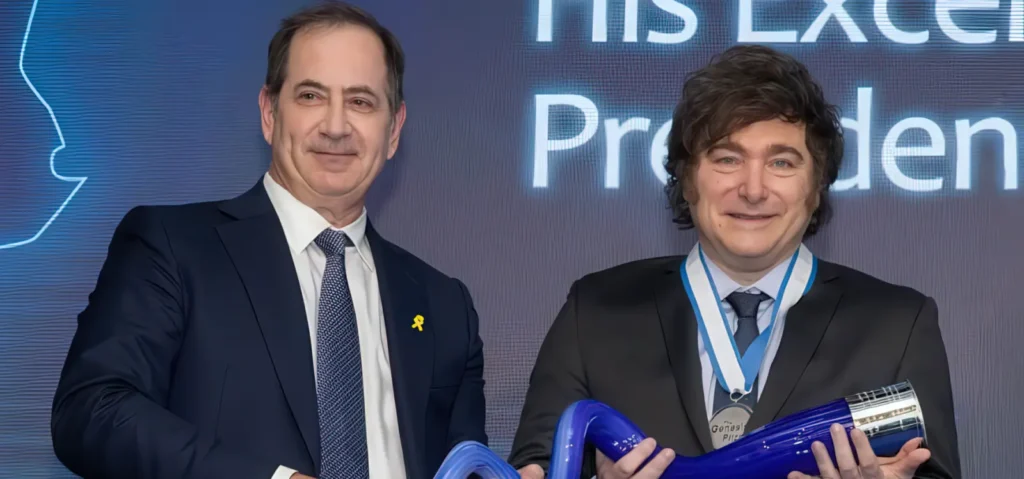
Co-Founder and Chairman of The Genesis Prize Foundation Stan Polovets presents prize to 2025 Laureate Javier Milei on June 12 in Jerusalem. (Source: American Friends of Isaac Accords)

That role was formalised in 2025 when Milei became the Genesis Prize Laureate, an award frequently described as the “Jewish Nobel Prize.” The Genesis Prize is not politically neutral. It is explicitly awarded to figures who strengthen Israel’s global standing and its ties with the diaspora. Milei’s decision to donate the prize money directly back into the Isaac Accords ecosystem symbolised how moral recognition, political allegiance, and financing now operate as a single circuit.
This is alignment rewarded, visibly, materially, and publicly.
As reported by AP in August, the Isaac Accords are set to extend to Brazil, Colombia, Chile, and potentially El Salvador by 2026, as stated by the organizers, the American Friends of the Isaac Accords.
Recent New York Times reporting situates Brad Parscale’s involvement in the Honduran election within Numen, a Buenos Aires–based political consultancy he co-founded with Argentine strategist Fernando Cerimedo, highlighting how transnational firms operate beyond traditional regulatory scrutiny. Critics warn that Numen’s methods reflect a broader global political influence ecosystem that often draws on data-driven targeting, psychological profiling, and digital amplification techniques associated with Israeli-linked political technology and messaging firms that have operated in elections worldwide.
When combined with U.S. political endorsements, strategic pardons, and offshore consulting structures, this model raises serious concerns about how advanced data analytics and covert messaging infrastructures are used to shape voter behavior in vulnerable democracies, eroding electoral sovereignty while remaining largely insulated from accountability.
Venezuela, Palestine, and the Manufacturing of Illegitimacy
If the Isaac Accords require a moral antagonist, Venezuela fulfils that role perfectly.
Since Hugo Chávez severed diplomatic relations with Israel in 2009, in response to Israel’s assault on Gaza, Venezuela has positioned itself as one of Palestine’s most consistent supporters in the Western Hemisphere. Chávez, and later Nicolás Maduro, framed Palestinian resistance not as terrorism but as an anti-colonial struggle, aligning Venezuela with much of the Global South rather than the Atlantic bloc.
Under the Isaac Accords’ logic, this position is intolerable.
Opposition to Israel is no longer treated as a political stance but as evidence of extremism or antisemitism. Zionism and Judaism are deliberately conflated, allowing criticism of Israeli state policy to be reframed as hatred. This narrative provides the moral justification for isolation, sanctions, and, potentially, regime change.
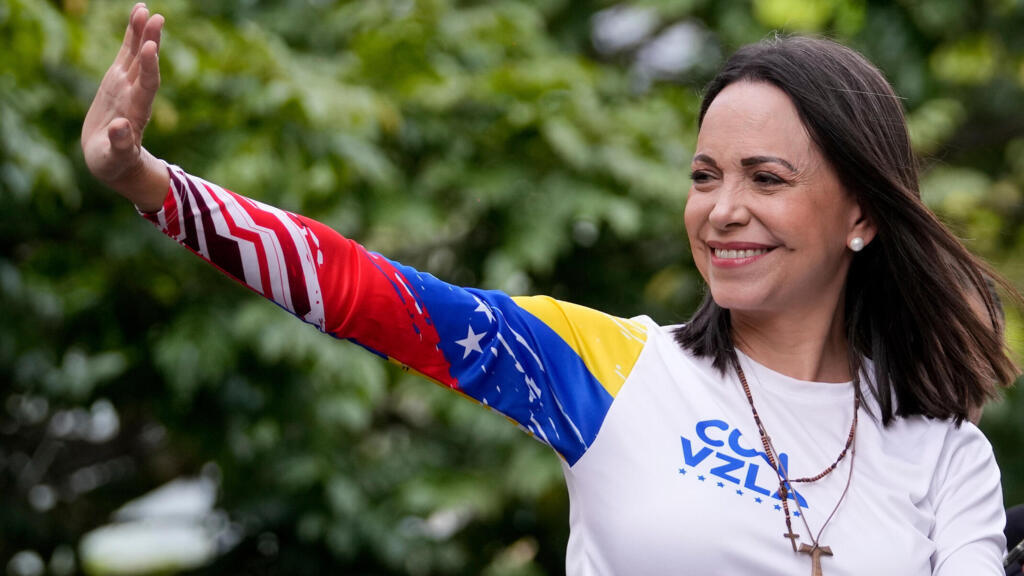
Maria Corina Machado in Venezuela, Thursday, July 25, 2024. (Source: AP – Matias Delacroix)
Into this context steps María Corina Machado, the Venezuelan opposition figure most warmly received by Israeli and U.S. political networks. Machado’s alignment with Israel is not rhetorical or recent. In 2020, her party, Vente Venezuela, signed a formal inter-party cooperation agreement with Israel’s ruling Likud Party, led by Benjamin Netanyahu. The agreement committed both parties to shared political values, strategic cooperation, and ideological alignment.
This is a remarkable document. It ties a Venezuelan opposition movement directly to a foreign ruling party, well before any democratic transition, and signals how a post-Maduro Venezuela is expected to orient itself internationally.
DOCUMENT: Vente Venezuela signs cooperation agreement with Israel’s Likud party – Agreement signed by María Corina Machado and Eli Vered Hazan, representing Likud’s Foreign Relations Division (Source: Vente Venezuela)
Machado has since gone further, pledging to:
- Restore full diplomatic relations with Israel
- Move Venezuela’s embassy to Jerusalem
- Open Venezuela’s economy to privatisation and foreign investment
- Align Venezuela with Israel and the United States against Iran and regional leftist governments
Her narrative rests on a crucial claim: that Venezuela itself is not anti-Israel, only its government is. According to this framing, Venezuelans are inherently pro-Israel and pro-West, their “true” preferences suppressed by an illegitimate regime.
In a November interview with Israel Hayom, Machado asserted that “The Venezuelan people deeply admire Israel.”
This argument is politically useful and historically thin. Venezuelan solidarity with Palestine predates Maduro and reflects a wider Latin American tradition of identifying with colonised peoples. To erase that history is to deny Venezuelans their own political agency.
The Anti-Defamation League (ADL) has repeatedly accused the Venezuelan government of fomenting “anti-Israel” and anti-Semitic rhetoric. Yet, a closer look tells a different story. Caracas’ statements are largely expressions of solidarity with the Palestinian people and their right to self-determination, combined with pointed criticism of Israeli state policies. By framing these positions as attacks on Jews or Israel itself, the ADL distorts the narrative, turning principled political stances into a perceived moral failing. This tactic underscores a broader pattern in which international organizations can paint Global South governments as rogue actors whenever they resist the gravitational pull of Israeli and U.S. influence, subtly laying the groundwork for diplomatic pressure or intervention.
DOCUMENT: Mini report from the Anti-Defamation League (ADL), formerly known as the Anti-Defamation League of B’nai B’rith, accuses Venezuela of fuelling an incendiary anti-Israel and anti-Semitic environment.(Source (ADL)
Security, Economics, and the Cost of Obedience
Beneath the moral language of the Isaac Accords lies a familiar architecture of control: security integration, economic restructuring, and ideological discipline.
Israel is a leading exporter of surveillance technologies, border systems, cyber-intelligence platforms, and urban security tools, many developed under conditions of occupation and internal repression. In South America, these systems are marketed as solutions to crime and narcotrafficking, but their real function is often political: expanding state surveillance capacity during periods of transition.
Security cooperation creates dependency. Once intelligence-sharing, training, and doctrine are integrated, political autonomy narrows. Policy divergence, particularly toward China, BRICS, or non-aligned partners, becomes risky.
The economic dimension is equally strategic. Israeli firms are deeply involved in water rights, desalination, agrotechnology, digital governance, and infrastructure, sectors that determine long-term sovereignty. These investments are typically tied to privatisation, deregulation, and long-term concessions, transferring control of strategic resources away from the public sphere.
Venezuela is the ultimate prize. A post-sanctions transition would open one of the world’s most resource-rich economies to restructuring. Machado’s commitment to rapid privatisation aligns seamlessly with this vision, raising an unavoidable question: who benefits from “democracy” when it arrives pre-packaged with foreign economic priorities?
This strategy is inseparable from U.S. power. The Trump administration’s framing of global politics as a permanent war on terror and narcotrafficking, a framing echoed by figures like Marco Rubio, has provided cover for sanctions, covert operations, and extrajudicial violence across the Caribbean and Pacific. Israel’s partnership reinforces this logic, supplying both technology and moral framing.
Conclusion: The Global South and the Right to Choose
The Isaac Accords are not simply about Israel’s diplomatic standing. They are about reordering South America’s political horizon at a moment when the Global South is rediscovering multipolarity.
Israel’s role in this process is active, strategic, and consequential. Through political patronage, economic leverage, security integration, and narrative control, it is shaping which governments are deemed legitimate and which are disposable.
For South America, and the wider Global South, the warning is familiar. When alignment is framed as morality, dissent becomes deviance. When sovereignty is conditional, development serves external interests. When history is rewritten, intervention soon follows.
Non-alignment was never about isolation. It was about the right to choose. That very right, today, is being quietly renegotiated, and the cost of refusing may soon become very clear.
Honduran president accuses Trump of ‘election manipulation’
Al Mayadeen | December 10, 2025
Honduran President Xiomara Castro accused US President Donald Trump of direct interference in her country’s presidential elections, condemning what she termed election manipulation in Honduras’s disputed presidential race.
The controversy centers on the November 30 presidential election, where vote counting has been plagued by repeated computer system failures that have delayed final results. Trump-backed conservative Nasry Asfura currently holds 40.53 percent of votes, followed closely by right-wing candidate Salvador Nasralla with 39.16 percent, according to the National Electoral Council. Both candidates significantly outpace Castro’s left-wing Libre party candidate, Rixi Moncada.
Nasralla has challenged the results as fraudulent, claiming he actually leads by 20 percent and demanding a comprehensive recount. Speaking at a rally, Castro praised voters’ determination but alleged the election was marred by threats, coercion, manipulation of the preliminary results system, and tampering with voter intentions.
Castro specifically accused Trump of interference, noting his threats of consequences if Hondurans voted for Moncada. Trump openly endorsed Asfura as a “friend of freedom” while dismissing Nasralla as merely “pretending to be an anti-communist.”
In a stunning move, Trump also pardoned former Honduran President Juan Orlando Hernández, who was serving a 45-year US prison sentence for facilitating the trafficking of hundreds of tons of cocaine.
More than a week after voting concluded, thousands of ballots with irregularities await review. The Libre party has called for total election annulment and urged protests, while election officials have until December 30 to declare a winner under Honduran law. The Trump administration maintains the election was fair and rejects calls for annulment.
Trump’s unprecedented election meddling
Trump’s involvement in Honduras represents an extraordinary breach of diplomatic norms. Days before the election, he issued explicit warnings that the United States would cut off financial support if Asfura lost, stating on Truth Social that the US would not throw “good money after bad” if a candidate he deemed “communist” took power.
The Trump administration employed Cold War rhetoric, labeling Moncada and Nasralla as “communists” or “borderline communists” allied with Venezuela’s Nicolas Maduro. Beyond aid threats, Trump leveraged the possibility of mass deportations and blocking remittances, which constitute approximately 25 percent of Honduras’ GDP.
Moncada noted that text messages were circulated warning voters that December remittances would not arrive if the wrong candidate won, creating panic in a population heavily dependent on these funds.
The impact proved measurable. Ricardo Romero Gonzales, who runs an independent polling company, reported that Nasralla held a nine-point lead before Trump’s endorsement. After Trump intervened, the candidates reached a virtual tie. Roughly one-third of Hondurans have family in the United States, making Trump’s threats particularly potent.
José Ignacio Cerrato López, a 62-year-old retiree, told the New York Times that he initially planned to vote for Nasralla but switched to Asfura after Trump’s statement. “Trump said he was going to make things worse,” Cerrato López explained, citing fears about deteriorating bilateral relations.
The Trump corollary: A new doctrine of hemispheric control
Trump’s Honduras intervention exemplifies what his 2025 National Security Strategy terms the “Trump Corollary” to the Monroe Doctrine. Unlike the original 1823 doctrine preventing European colonization, Trump’s version asserts US rights to intervene directly in Latin American domestic politics to prevent influence by “non-Hemispheric competitors,” specifically China, or ideologies deemed hostile to US interests.
Under Castro, Honduras severed ties with Taiwan and established relations with China in 2023, opening the door for Chinese infrastructure investment. By backing Asfura, Trump aims to install a government that will reverse or freeze these projects, viewing Asfura as the “checkmate” to Beijing’s regional influence.
A pattern of historical intervention
Trump’s interference continues a century-long pattern of US meddling in Honduras, often called the quintessential “Banana Republic” due to historical dominance by US fruit companies.
During the 1980s Reagan administration, Honduras became known as “USS Honduras,” serving as the staging ground for the proxy war against Nicaragua’s Sandinista government. The CIA trained Battalion 316, a death squad responsible for kidnapping, torturing, and disappearing nearly 200 activists.
More recently, the 2009 military coup against President Manuel Zelaya, who had moved closer to Venezuela’s Hugo Chavez, received tacit US support. While the Obama administration officially condemned the coup, Secretary of State Hillary Clinton refused to designate it a “military coup,” allowing aid to continue.
Featured Video
Laith Marouf: Hezbollah’s position on US-Iran ceasefire
or go to
Aletho News Archives – Video-Images
From the Archives
The Dirty Little Secret behind the “Global Terrorism Index”
The Omission of Israeli Terrorism in the Occupied Palestinian Territories
By Karin Brothers | Global Research | December 6, 2014
… The Israeli settlements — all of which are illegal – have been identified as a major impediment to peace. The refusal of a major “global” terrorism report to name the Israeli settlers as one of the groups most responsible for terrorism not only misrepresents a major source of regional violence but exposes the Global Terrorism Index as a propaganda tool that supports a U.S. agenda.
In recent years, governments have been attempting to thwart terrorism by blocking supportive fund-raising. When it comes to Israeli settlements, however, the US and Canada actually encourage fund-raising by giving organizations (such as Christian Friends of Israeli Communities (CFOIC) and the Jewish National Fund) financial support in the form of donor tax-deductions.
Charities which provide funds for the Israeli settlements should be regarded as terror-financing organizations. They should not only lose their tax-deductible status, but they should be banned because they support the violation of international humanitarian law. The terror-financing laws that are being strictly enforced for Muslim charities should be applied to Christian and Jewish charities as well. … Read full article
Blog Roll
 Aletho News
- The ‘Opposition Party’ Has Done Nothing to Stop the Iran War and Much to Goad Trump Into Continuing It
- Moscow backs Tehran on status of Lebanon in US-Iran deal
- How UK Regulator Ofcom Quietly Bypassed International Law to Police American Speech
- The Black Cube Files: How Former Mossad Operatives Flipped a Nation
- Laith Marouf: Hezbollah’s position on US-Iran ceasefire: What you’re not being told
- Israel’s priority lies in destroying chances of peace between Iran, US: Ex-UN nuclear chief
- Ceasefire for all or for none: Iran shuts Hormuz over Lebanon attacks
- Strait of Hormuz is Iran’s ‘nuclear weapon’ that forced US retreat: Medvedev
- Energy crisis will last for months – Kremlin envoy
- Europe’s quiet role in the war on Iran
- If Americans Knew
- This is ceasefire? Israel’s biggest massacre yet in Lebanon, another journalist killed in Gaza – Daily Update
- Tucker Carlson on Israel: This Is the Behavior of an Ally? Really?
- Gazans face a triple crisis: severe shortages of water and bread, healthcare in tatters
- NY Times reports how Netanyahu took the US into Iran War
- A sigh of relief over Iran, but Gaza and Lebanon in dire straits – Daily Update
- Thousands dead and neighborhoods razed to the ground: Aid agencies fear southern Lebanon is becoming the new Gaza
- The war the US is fighting for Israel could cost trillions
- ‘Cigarette Burns, Nail Wounds’: Toddler Tortured in Gaza to Coerce Father
- Trump Says US Sent ‘a Lot of Guns’ to Protesters in Iran
- Israeli forces destroy 17 UN peacekeeper cameras in south Lebanon
- No Tricks Zone
- An Inconvenient Tree: Uncovered In Alps… Europe Much Warmer Than Today 6000 Years Ago
- New Study Reports A 60% Slowdown In Greenland’s Ice Loss Rate In The Last Decade
- Low Intensity Tornado Wrecks Major Solar Farm, Creating A Potential Toxic Dump
- New Study Finds Warming Saves Lives…Cold Temperatures 12 Times More Deadly Than Excess Heat
- German Science Blog Accuses PIK Climate Institute Of Hallucinating Climate Tipping Points
- Devastating Assessment Of Comirnaty Vaccine By Former Senior Pfizer Europe Toxicologist
- New Study: CO2 Is ‘Effectively Negligible’ As An Explanatory Climate Change Factor Since 2000
- Former Pfizer Toxicologist Dr. Helmut Sterz Tells Bundestag Hearing Pfizer Vaccine Should Have Never Been Approved
- Energy Expert: Germany’s Nuclear Phaseout Was A “500 Billion Euro Mistake”
- New Research: South Australia’s Mid-Holocene Sea Surface Temperatures Were 4°C Warmer Than Today
 Aletho News