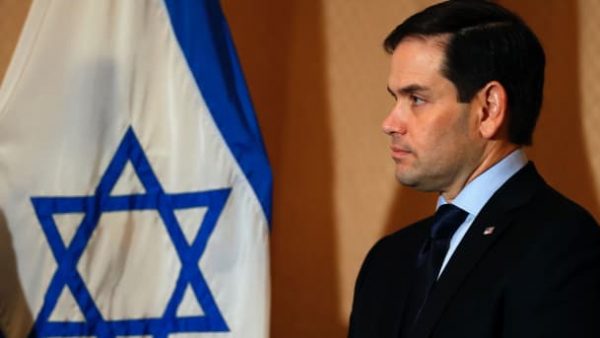
Being Marco Rubio
The boyish senator from Florida is owned by the Israel Lobby
By Philip Giraldi • Unz Review • February 12, 2019
Americans consistently indicate in opinion polls that they approve of congress less than any other part of the federal government. The approval rating is sometimes in the single digits. As the congress was intended, per the Founders, to serve as the direct link to the American people, there is a certain irony in its being the most despised branch of government.
One can blame the two major parties for much of the negativity, as the process whereby candidates for office rise through the system that seems designed to weed out anyone who has ever expressed any viewpoint that is not approved by the bipartisan establishment. Indeed, many Americans complain that Democratic and Republican congress critters differ only superficially, both being corrupt from top to bottom and largely driven to stay on top so they can continue to benefit personally from the spoils of office.
One of the emptiest of all the empty suits in the Senate is Marco Rubio of Florida. The boyish looking Rubio is, to be sure, ambitious, but his thought processes, if they exist at all, are hard to discern. He is, more than most congressmen, both totally ignorant and completely programed in what he says and how he says it. Anyone who doubts that judgement should watch the February 2016 debate with former New Jersey governor Chris Christie in which Christie totally destroyed Rubio, effectively ending his bid to become the GOP candidate for president. Christie criticized Rubio for memorizing a “25-second speech that is exactly what his advisers gave him.” The two argued, but Rubio seemed stuck with his stump speech, which Christie called him out on every time he launched into it. Christie eventually turned and told the audience “There it is. The 25-second memorized speech.”
Rubio is pretty much straight-line neocon in his pronouncements, his most recent policy statement being that the Venezuelan people have two choices – change their government or starve. He tweeted it with his usual eloquence: “Hunger & desperation is growing inside #Venezuela & people know the only thing standing in the way of $50 million of food & medicine is #Maduro. Military leaders should make a choice, before a choice is made for them. The window for a negotiated exit is closing fast.” Columnist Whitney Webb responded with “Marco Rubio is openly saying that if Venezuela’s military doesn’t turn on Maduro soon, ‘a choice will made for them’ by the United States. Scariest threat for an imminent invasion of Venezuela I have yet to see.”
Rubio, who is Cuban-American, is inevitably hard-line against taking any steps to improve relations with his ancestral homeland, is hostile to “enemies” Russia and China, and wants American soldiers to stay in Afghanistan and Syria forever. It is a formula for continuous conflict worldwide, with the United States paying the tab both in dollars and in casualties.
But Senator Marco Rubio’s greatest affection is reserved for the Jewish state Israel. Why? Because that’s where his money and political support come from, and, for its part, the Israel Lobby sees Rubio as a perfect simple-minded patsy to advance its agenda. Israel’s promoter with the deepest pockets, casino magnate Sheldon Adelson, was pursued by Rubio who “… consistently championed Israel in speeches on the Senate floor while also pushing legislation aimed at supporting the cause” during the GOP nomination process. Rubio eventually received Adelson’s endorsement in February 2016.
Before acquiring Adelson’s support, Rubio had “already gained support from Miami billionaire Norman Braman and New York billionaire investor Paul Singer, among others.” Both Braman and Singer are known to be major supporters of Israel. Marco’s affection for both Israel and Florida Jews derives largely from his connection to Braman, a former Philadelphia Eagle’s owner and currently a billionaire Miami resident who owns Florida’s largest network of car dealerships. Braman, an active supporter and funder of the illegal Jewish settlements in the Middle East, has been Rubio’s major financial backer since his early days in Florida state politics and as a quid pro quo whenever Marco expresses his love for both Jews and Israel, he is speaking to and for Braman.
Rubio has recently written, or had written for him, an op-ed in The New York Times entitled “The Truth About BDS and the Lies About My Bill” that seeks to explain why recent legislation to protect Israel that the senator sponsored does not violate the First Amendment guarantee of free speech.
Senate bill S.1 for 2019 finally passed out of the Senate last week on a 77 to 23 vote with Rand Paul as the only Republican Senator to vote against it. The full title of S.1 is the Strengthening America’s Security in the Middle East Act of 2019, which might be considered a bit of a fraud as it has nothing to do with the United States and is really all about giving Israel money and anything else it might desire, to include destroying the nonviolent Boycott, Divestment and Sanctions (BDS) movement that has targeted Israel’s apartheid. In his speech defending the bill, Rubio openly admitted that he was seeking to help Israel. He also registered his opposition to the impending pullout of U.S. troops from Syria because it would, according to him, “endanger” the Jewish state.
Rubio’s op-ed was written before the final vote on February 5th, but it predicted correctly that the bill would receive “a bipartisan supermajority” in the Senate. Anything having to do with Israel normally receives such “supermajorities” from congressmen who are intimidated, or expecting to be raptured shortly or on the Israel Lobby payroll.
The op-ed’s author comes out swinging, declaring that critics have “echoed false claims made by anti-Israel activists and others that the bill violates Americans’ First Amendment rights. That line of argument is not only wrong but also provides cover for supporters of the Boycott, Divestment and Sanctions movement, who embrace an international campaign of discriminatory economic warfare against Israel, a fellow democracy and America’s strongest ally in the Middle East.”
One supposes that “anti-Israel activists” consist of that increasing number of Americans who want to see Israel held accountable for its war crimes and crimes against humanity. Yes indeed, a boycott is “discriminatory economic warfare” using peaceful and non-threatening means to bring about change. And no, Israel is neither a democracy nor an ally of the United States. Has the Senate approved a treaty of alliance with Israel, Marco? You’re in the Senate and should know the answer to that one.
Rubio goes on to claim that “the goal of the movement is to eliminate any Jewish state between the Jordan River and the Mediterranean Sea.” Wrong again Marco. Even if some BDS supporters might like to see that, it is not a “goal of the movement.” The movement is non-violent and Israel has a large army that would make such an objective a fantasy.
The author then describes how “While the First Amendment protects the right of individuals to free speech, it does not protect the right of entities to engage in discriminatory conduct. Moreover, state governments have the right to set contracting and investment policies, including policies that exclude companies engaged in discriminatory commercial -or investment- related conduct targeting Israel… That’s why, since 2015, more than 25 states, including Florida, have adopted laws or issued executive orders to divest from or prohibit contracts with companies that wage discriminatory economic warfare against Israel.” Wrong again Marco. Free speech includes supporting discriminatory conduct. The American Civil Liberties Union has addressed the issue succinctly, arguing correctly that “Public officials cannot use the power of public office to punish views they don’t agree with. That’s the kind of authoritarian power our Constitution is meant to protect against.” And several state laws protecting Israel from the First Amendment have already been ruled unconstitutional.
Marco then expands on his argument, “The Combating BDS Act does not infringe on Americans’ First Amendment rights or prohibit their right to engage in boycotts. By design, it focuses on business entities — not individuals — … it focuses on conduct, not speech. Indeed, it does not restrict citizens or associations of citizens from engaging in political speech, including against Israel.” Indeed Marco, but how do you explain the fact that several of the well-publicized cases involving BDS legislation have involved individuals not “business entities” who refused to sign pledges regarding Israel, which, when last I checked, was not even part of the United States and has nothing to do with contracting in this country? Those individuals have been denied government benefits and have been fired from jobs they had held for years.
And then there is the hypocrisy issue for Marco Rubio. If openly and vocally opposing trade with or travel to Cuba should similarly be suppressed, would he and his Cubanos associates consider that to be constitutional or perfectly legal? I think not. And Cuba, as far as I know, does not line up snipers to shoot children and medical workers while also stealing land from its rightful owners. Israel is a racist apartheid state. Cuba, for all its faults, is not.
It would be difficult to find more insipid justifications for S.1 than those provided by Marco Rubio. He does not understand that the “state” at all levels is supposed to be politically neutral in terms of providing government services. It is not supposed to retaliate against someone for views they hold, particularly, as in this case, when those views are part of a nonviolent opposition to the policies of a foreign government that many consider to be guilty of crimes against humanity. Rubio clearly believes that you can exercise free speech but government can then punish you by taking away your livelihood or denying you services that you are entitled to if you do not agree with it on an issue that ultimately has nothing to do with the United States. How such a lightweight came to be a Senator of the United States of America eludes me.
Philip M. Giraldi, Ph.D., is Executive Director of the Council for the National Interest, a 501(c)3 tax deductible educational foundation that seeks a more interests-based U.S. foreign policy in the Middle East. Website is www.councilforthenationalinterest.org, address is P.O. Box 2157, Purcellville VA 20134 and its email is inform@cnionline.org.
As US Laments Human Rights in Venezuela, US-Allied Colombia Descends into Drug-fueled Humanitarian Crisis
By Whitney Webb | MintPress News | February 8, 2019
BOGOTÁ, COLOMBIA – Several troubling situations are currently playing out across Colombia, yet the country’s continuing downward spiral into drug-fueled and politically-motivated violence has caused little concern in Washington, offering yet another clear indication that the U.S.’ current posturing on Venezuela is hardly motivated by concerns about “democracy,” “human rights,” or the welfare of the Venezuelan people.
This, of course, can hardly be considered surprising, given that Colombia is a top U.S. ally whose government has long been closely aligned with Washington’s interests. However, although the lack of U.S. government or media attention to Colombia may effectively hide it from the American public, the country is becoming increasingly lawless, with cocaine production reaching new record levels and the government sanctioning the mass murder of the country’s largest indigenous group. Not only that but since Colombia’s new president, Iván Duque, came to power late last year, the number of indigenous social leaders who have been murdered has spiked to the highest levels in over a decade.
Ultimately, the lack of media coverage of Colombia’s humanitarian crises, which have large implications for the Americas as a whole, is a telling example of how such crises are regularly weaponized by governments and media to exclusively target governments it wishes to pressure or overthrow, while turning a blind eye to those same or worse acts when committed by an allied nation.
An absurdly double standard
Though it was Barack Obama who first deemed Venezuela a “national security threat” and re-initiated draconian sanctions against the oil-rich nation, the Trump administration has greatly increased the sanctions targeting Venezuela, often citing its government’s alleged participation in illegal drug trafficking as justification for doing so. However, the U.S. has offered little in the way of concrete evidence to back up those allegations.
During this same period, moreover, the Trump administration has expressed little concern for the booming illicit drug trade in neighboring Colombia, which has broken records for cocaine production for the last two years in a row. Though the Colombian government and military have been repeatedly tied to the country’s drug trade, the Trump administration – like previous U.S. administrations – hasn’t lifted a finger.
According to UN figures released last September, Colombia’s cocaine production has again broken records, with the country producing an estimated 1,379 tons of cocaine in 2017, the latest year for which such statistics exist. That figure is a 31 percent increase in cocaine production from 2016. 2016 itself was a record-breaking year with cocaine production gaining by 50 percent over 2015 levels.
Though Trump had threatened to decertify former Colombian President Juan Manuel Santos’ government over the rapid growth of cocaine production, he ultimately gave Colombia a pass in the U.S.’ annual determination of countries considered to be “major drug transit or major drug producing” areas “because the Colombian National Police and Armed Forces are close law enforcement and security partners of the United States in the Western Hemisphere.”
The document also described Venezuela, along with its regional ally Bolivia, as “countries that have failed demonstrably during the previous 12 months to adhere to their obligations under international counternarcotics agreements” despite the fact that Bolivia had the fewest illegal coca crops of any South American country that year.
Since getting a free pass from the Trump administration, Colombia’s current president, Iván Duque, has signaled his hopes to revive a failed, U.S.-backed program to indiscriminately spray suspected coca fields with the infamous Monsanto product glyphosate to reduce cocaine production.
Though the U.S. government and Western media have traditionally placed the blame on leftist guerillas in Colombia, like the FARC, the 2016 peace deal that saw the FARC abandon the drug trade has removed this convenient scapegoat and highlighted the long-standing role of the Colombian military and prominent right-wing politicians in cocaine production.
In fact, the United Nations Drug Control Program (UNDCP) has described the Colombian military — which has been armed and trained for decades by the U.S. under the Clinton era policy known as “Plan Colombia” — as being among “the biggest heroin and cocaine trading institutions.”
The Colombian government has also been intimately involved, particularly during the presidency of Álvaro Uribe, who allegedly served as the “head of Colombia’s paramilitary groups” both before and while in office. Uribe was once ranked by the U.S. Defense Intelligence Agency “on a list of 104 important narco-traffickers contracted by the Colombian narcotics cartels.”
There are also indications of the U.S. government’s own involvement in the Colombian cocaine trade. For example, Colombia’s most notorious drug trafficker, Pablo Escobar, at one point worked for the U.S. Central Intelligence Agency, according to Escobar’s own children. Escobar allegedly sold cocaine for the CIA to help the U.S. government finance its fight against communism and left-wing governments in Latin America.
As pointed out in the book Cocaine, Death Squads and the War on Terror: U.S. Imperialism and Class Struggle in Colombia, the U.S.’ anti-drug efforts in Colombia were never intended to eradicate cocaine, but instead alter the market share by ensuring that allies of the U.S. in Colombia – the Colombian government, paramilitaries and the wealthy elite who are favorable to U.S. business interests – could monopolize the drug trade with no competition from outsiders. Thus, it should hardly shock anyone that the U.S. continues to turn a blind eye to the country’s booming illegal drug trade and its associated violence, even as it continues to break records year after year.
Erasing the erasure of the Wayuú
As the long-standing, U.S.-backed plan to oust the Chavista regime in Venezuela has unfolded, Maduro’s government has been called out in Western media for “starving his own people,” despite the fact that U.S. sanctions imposed on Venezuela are a driving factor behind the country’s economic crisis. However, since 2011, Colombia has been the site of ongoing genocide against the country’s largest indigenous group – the Wayuú – in the country’s Guajira region, after the Colombian government diverted their only source of water to support the operations of the country’s – and continent’s – largest coal mine.
The suffering of the Wayuú, who have reported the deaths of at least 14,000 children due to the lack of clean water, has gone unreported by the same outlets that routinely raise concern about lack of essential goods in Venezuela. The Wayuú, who comprise around 20 percent of Colombia’s entire indigenous population and 48 percent of the Guajira region’s total inhabitants, are now on the brink of dying out completely seven years after the Ranchería river – their community’s only freshwater source – was diverted by the government-constructed Cercado dam in order to service the water needs of the Cerrejón coal mine.
An estimated 37,000 Wayuú now suffer from severe malnutrition, as they can no longer grow crops or raise livestock without a freshwater source. Each person in the community now lives off of less than 0.7 liters (24 oz.) of water a day while the Cerrejón mine guzzles more than 2.7 million liters of water in a 24-hour period – most of which is used to improve mine “visibility” by minimizing dust pollution. Despite the clear impact of the dam and mine on the humanitarian crisis facing the Wayuú, the Colombian government and supportive Western media have blamed “climate change” and weather patterns like El Niño for the situation.
The most likely reason for the erasure of the slow genocide of the Wayuú from Western media is the fact that the Cerrejón mine is a largely a U.S.-backed operation, as the mine was originally founded by ExxonMobil and is now owned by a consortium of largely Western mining companies such as Anglo American and BHP Billiton. These same mining companies often work with right-wing paramilitary groups — who are also closely connected to the Colombian government — and who repeatedly threaten the lives of Wayuú who speak up about their people’s suffering, including their chief legal advocate, Javier Rojas Uriana.
Notably, the Colombian Wayuú have been immigrating to the Wayuú community in Venezuela in order to avoid the slow death caused by malnutrition, lack of water, and waterborne illnesses from the polluted water from the community’s remaining wells. The Venezuelan Wayuú have been largely supportive of Chavismo and have backed the Maduro-led government, referring to U.S.-backed opposition protests as violent riots “intended to create chaos.” The Huffington Post noted in 2017 that the Wayuú’s support for Maduro had largely been erased by the Western media because it “does not match up with the media’s anti-Venezuelan government narrative.”
Liquidating social leaders, activists, human-rights advocates
While the fate of the Wayuú (and thus 20 percent of the country’s entire indigenous population) continues to hang in the balance, the plight of Colombia’s indigenous peoples has grown even worse since the recent inauguration of Colombian President Iván Duque.
Despite Duque’s having come to power just last August, El Tiempo recently reported that the murders of indigenous leaders in the country have spiked to levels unseen in over a decade since Duque became Colombia’s president. According to data cited by El Tiempo, 120 indigenous social leaders – as well as human-rights defenders — have been murdered in cold blood during Duque’s first 100 days in office.
Though the murder of social leaders by right-wing paramilitary groups has a standing problem in Colombia’s recent history, this level of targeted murder represents a spike over recent years — in which 226, 159, and 97 such murders occurred over the course of the entire years of 2018, 2017 and 2016, respectively. Notably, the Venezuelan government of Nicolás Maduro has been routinely accused by Western media of murdering opposition activists; yet, those same outlets have been silent on Colombia’s recent spike in activist murders.
Despite the jump, Duque’s government has expressed little concern. This is hardly surprising when one considers that Duque is the hand-picked successor and protégé of Álvaro Uribe, the former Colombian president who was once “the head of Colombia’s paramilitary groups,” according to former paramilitary group commanders of the right-wing death squad AUC, which has been funded by several prominent U.S. corporations.
Uribe, who was Colombia’s president from 2002 to 2010, and was a close ally of George W. Bush, was also personally implicated in organizing a massacre conducted by a right-wing paramilitary group; and his cousin, Colombian politician Mario Uribe, was charged with mobilizing right-wing death squads in the country to help secure Uribe’s presidential victory in 2002. Uribe’s brother was also arrested for founding a right-wing paramilitary group in 2016.
Under Uribe’s presidency, the Colombian military massacred thousands of civilians — such as in the “false positives” scanda,l where the Colombian military dressed up an estimated 5,000 civilians in guerilla clothing and killed them in cold blood, subsequently gaining a bonus from Uribe’s government for the sinister act. It should be no surprise then that, under Uribe, the murder rate of indigenous leaders and human-rights activists reached its all-time high at 1,912 murders in 2003.
Given Duque’s close relationship to Uribe, it is also little surprise that paramilitary groups have endorsed Duque following his election and have vowed to “exterminate” Duque’s opposition, calling prominent Colombian progressives “military targets.”
What to expect if US gets its way in Venezuela
If Washington’s publicly stated concerns about “human rights” and the welfare of a country’s people in Venezuela were genuine, it would be equally critical of Colombia’s government, given the numerous troubling situations currently unfolding in that country. Instead, the dichotomy between Washington’s relationship with Venezuela and Colombia is yet another clear example that the public justifications for the U.S.’s Latin America policy are little more than window dressing for the U.S.-backed expansion of neo-fascist governments throughout Latin America.
Indeed, if Juan Guaidó – the self-declared, U.S.-backed “president” of Venezuela – manages to seize power in the country, the current state of affairs in Colombia is a telling harbinger of what would likely manifest should Nicolás Maduro be overthrown and replaced with the same type of government that the U.S. has either backed or installed in several Latin American countries over the last few decades, and particularly in recent years.
Whitney Webb is a staff writer for MintPress News and has contributed to several other independent, alternative outlets. Her work has appeared on sites such as Global Research, the Ron Paul Institute and 21st Century Wire among others. She also makes guest appearances to discuss politics on radio and television. She currently lives with her family in southern Chile.
Uruguay, Mexico Unveil Four-Step Proposal on Venezuela Crisis
Al-Manar | February 7, 2019
Uruguay and Mexico on Wednesday unveiled a four-step proposal to end the political crisis in Venezuela.
The “Montevideo Mechanism” was announced by Uruguayan Foreign Minister Rodolfo Nin Novoa and his Mexican counterpart Marcelo Ebrard at a press conference in the Uruguayan capital one day before Montevideo is set to host an international meeting on Venezuela.
The first step calls for immediate dialogue to create conditions for direct contact between Venezuela’s ruling socialist party and President Nicolas Maduro on the one hand and the right-wing opposition led by self-proclaimed interim president Juan Guaido on the other, Novoa said.
That would be followed by a negotiation phase, a commitments phase, and a finally implementation phase, according to Novoa.
The proposal did not insist on holding snap presidential elections as the opposition had been demanding.
“If we ask for elections at such a moment, we are imposing conditions that hinder dialogue,” said Novoa.
Uruguay and Mexico have also proposed three prominent regional figures to advance the mechanism: ex-president of the Inter-American Development Bank Enrique Iglesias, former Mexican foreign affairs secretary and former judge of the International Court of Justice Bernardo Sepulveda, and Ibero-American Secretary General Rebeca Grynspan, a Costa Rican economist and former United Nations under-secretary-general.
Against Intervention in Venezuela: The Case of the Caribbean Community
By Maximilian Forte | Zero Anthropology | February 6, 2019
As discussed in the previous article, the membership of the Organization of American States is in fact not at all united around support for foreign intervention and recognition of an alternative second “president” (Juán Guaidó). Standing opposed to the denial of recognition of Maduro’s legitimacy as the elected leader are not just Cuba, Nicaragua, Bolivia, and for now Mexico and Uruguay, but also Caribbean states such as Dominica, St Vincent and the Grenadines, and Suriname. Trinidad and Tobago, St Kitts and Nevis, Antigua and Barbuda, Barbados, and Belize abstained from the OAS resolution—which, it turns out, does not mean the same as indifference. The action by the OAS implicitly threatened all governments in the region, which has already significantly damaged the organization’s integrity, as discussed below.
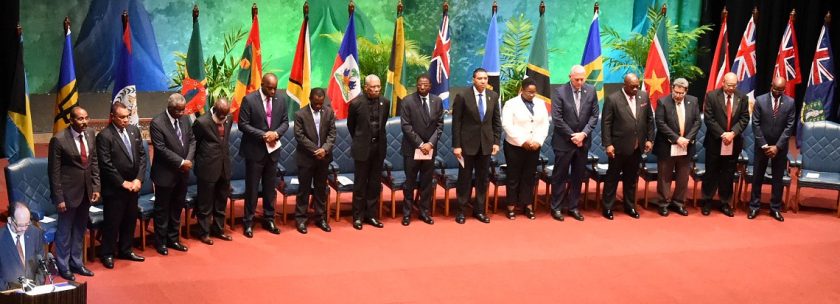
CARICOM Heads of Government
CARICOM
Caribbean states, including those that abstained from voting on the OAS resolution, stood firmly on anti-interventionist principles that respected Venezuela’s sovereignty. Leaders of the member states of the Caribbean Community and Common Market (CARICOM) held an emergency meeting to discuss Venezuela on January 24. The heads of government of Antigua and Barbuda, Barbados, Belize, Dominica, Jamaica, Montserrat, St. Kitts and Nevis, Saint Lucia, St. Vincent and the Grenadines, Trinidad and Tobago, and the Foreign Ministers of Grenada and Suriname, participated in the meeting. Guyana, which has a long standing territorial dispute with Venezuela, nonetheless endorsed the CARICOM position the next day. The resulting statement “reaffirmed” the members’ “principles of non-interference and non-intervention in the affairs of states, respect for sovereignty, adherence to the rule of law, and respect for human rights and democracy”. In addition, they insisted that the crisis should only be “resolved peacefully through meaningful dialogue and diplomacy”. Without naming the US and the Trump administration, CARICOM heads explicitly rejected foreign intervention in Venezuela’s affairs, and threats of violence against the country:
“Reaffirming their commitment to the tenets of Article 2 (4) of the United Nations Charter which calls for Members States to refrain from the threat or the use of force and Article 21 of the Charter of the Organization of American States which refers to territorial inviolability, the Heads of Government emphasized the importance of the Caribbean remaining a Zone of Peace”.
Taking aim again at US policy, CARICOM,
“called on external forces to refrain from doing anything to destabilize the situation and…called on all actors, internal and external, to avoid actions which would escalate an already explosive situation to the detriment of the people of Bolivarian Republic of Venezuela and which could have far-reaching negative consequences for the wider region”.
Trinidad & Tobago and CARICOM vs. the OAS
Within CARICOM, the case of Trinidad & Tobago deserves special mention. First, Trinidad, mere miles from Venezuela with which it has long historical and demographic ties, is now home to a growing number of Venezuelan refugees. Recent events have triggered fears of an even larger refugee crisis in the making. The media make it clear that many locals neither like nor trust the Venezuelans entering their country, and resent their presence. In addition, Venezuelans protesting in the capital, Port of Spain, against Maduro and demanding that the government of Prime Minister Keith Rowley recognize Guaidó instead, faced a mixed reaction at best. Aside from being denounced by Trinidadian commenters, the protesters drew a sharp rebuke from the leader of one of the parties in parliament, David Abdulah:
“Citizens of Venezuela can appeal to the Government of Venezuela and the parties in Venezuela but Venezuelans here in Trinidad and Tobago cannot determine what the foreign policy of Trinidad and Tobago ought to be. It is the Government of Trinidad and Tobago and the citizens of Trinidad and Tobago ultimately and the governments of Caricom and the citizens of Caricom who must determine the foreign policy of Trinidad and Tobago and of Caricom”.
Abdulah also took exception with the protesters claim that Guaidó had popular support, while Maduro was isolated as a dictator. Abdulah said Maduro got significant support at the February 2nd demonstration in Venezuela, which was much bigger than Guaidó’s rally:
“So it is not as if President Maduro is clinging on to power by himself and so on and the vast majority of the Venezuelans are against him. That is not the case”.
Moreover, Abdulah condemned the opposition:

Dr. Keith Rowley, Prime Minister of Trinidad & Tobago
“Very regrettably, but not surprising, Guaido has taken the consistent right-wing line of the opposition rejecting any talks, rejecting any mediation and simply wanting for [sic] resolve the thing by force backed, of course, by the United States and some other countries”.
Squaring off against his domestic opposition, Prime Minister Keith Rowley took direct aim at the United National Congress in parliament, which is pro-US and pro-interventionist. Rowley openly called them “traitors” for trying to undermine CARICOM’s mission of mediation.

Luís Almagro, Secretary-General of the OAS
Prime Minister Rowley has also clashed with the leadership of the OAS, precisely on the question of Venezuela, well before this latest crisis erupted. Back in 2017, Rowley called for the dismissal of OAS secretary-general Luís Almagro. Prime Minister Rowley’s point, which was correct, is that the OAS was compromised by taking an interventionist stance towards Venezuela, and delegitimizing its duly elected leader. Rowley further accused the OAS leadership saying that the result was that, “the OAS has now removed itself from any meaningful participation and has deteriorated now into partisan attacks”.
The conflict between CARICOM, and Trinidad & Tobago in particular, and the head of the OAS was reignited with the latest crisis. CARICOM, and Trinidad’s Minister of National Security, expressed shock that Almagro would dare to speak for all OAS members in personally denouncing Maduro. In a January 31 letter to the OAS’ Almagro, CARICOM’s leadership instructed Almagro that the OAS does not speak for CARICOM members on this issue. The letter from CARICOM’s chairman, Prime Minister Timothy Harris of St Kitts and Nevis, stated:
“The Heads of Government consider it imperative that you publicly clarify that you did not speak on behalf of all the member states of the Organisation of American States….We are aware that this is not the only occasion on which you have made public utterances in the name of the organisation without authority”.
CARICOM described Almagro’s actions as a “clear departure of from normal practice and cause for great concern”. Almagro has gone as far as advocating a foreign military invasion of Venezuela. Journalists noted that, “the OAS website lists media and press releases for the month of January and there is nothing about the OAS’s support for Guaido”. Trinidad & Tobago joined a CARICOM team to meet in Uruguay on February 7, as part of a mediation effort led by Mexico and Uruguay. Calls for dialogue continue to be flatly rejected by Guaidó, echoing the same line taken by Trump and his team.
Meeting in Montevideo
The meeting of 15 Caribbean nations plus Mexico, Uruguay, and parties in Venezuela, taking place in Montevideo tomorrow, represents the formation of a bloc that can act as a significant counterweight to the so-called “Lima Group” of US dependents in Latin America and neocolonial states such as Canada. Unlike the Lima Group, no foreign media have been banned in advance— the Canadian government blocked Russian and Venezuelan media from covering the Lima Group meeting in Ottawa on February 4, an act of suppression of press freedoms that occasioned no outcry at all in Canada.
The largely right wing “Lima Group” that opposed Maduro itself consisted of a range of shady and extreme characters tarred by their involvement in corruption scandals and with ties to death squads, along with Canada with its liberal authoritarian tradition and its penchant for necolonial violence. Once again, none of the “decolonial” crowd, fashionable as they are in academia, has drawn any of the logical and historical connections between Canada’s internal colonialism and its external neocolonialism, which are united by the same principles and interests, even the very same parties and actors. This failure of intellect is not an accident either, but is a subject best explored at another time.
In the meantime, I strongly recommend that you listen carefully to the full interview of RT with Nicolás Maduro:
Canada Doubles Down on Media Censorship of Lima Group Meeting
teleSUR | February 24, 2019
The Foreign Ministry of Canada has denied access to several media outlets to cover the Lima Group meeting taking place in Ottawa Monday. At that meeting, countries who are currently allied against Venezuela are expected to discuss further steps associated with their actions against the Bolivarian nation.
Canada’s foreign ministry issued the same terse response to Russian media outlets Sputnik News as it did Ria Novosti’s bid for press credentials for the meeting: “Thank you for your interest in the 10th ministerial meeting of the Lima Group in Ottawa. This letter is to inform you you have not been accredited as media.”
As with Canada’s rejection of teleSUR for media credentials as reported Feb. 3., the response provided no reason for the rejection, however, Canadian spokesperson for the Lima Group responded to Sputnik by saying that the news outlet was rejected for a “lack of respect to the Canadian Foreign Minister.”
This Russian agency has also not received credentials for the meeting in Canada. Arbitrary decisions. It’s not new, but we won’t stop calling it out.
The predominantly right-wing Lima Group which supports the coup attempt by self-proclaimed president Juan Guaido backed by the United States, has said they would not condone a military intervention to depose President Nicolas Maduro.
The group was created in 2017 at the behest of Peru. Recently, it has been highly engaged in promoting regime change in Venezuela with the backing of the United States and the European Union.
It is composed of Argentina, Brazil, Canada, Chile, Colombia, Costa Rica, Guatemala, Honduras, Mexico, Panama, Paraguay, Peru, Santa Lucia, and Guyana. All of its members, except for Mexico, Guyana, and Santa Lucia, have backed Guiado’s coup attempt. Ecuador — not a party to the association — has also backed the group’s stance on Venezuela.
What the mainstream media doesn’t tell you about Venezuela
By Yves Engler · February 3, 2019
The corporate media is wholeheartedly behind the federal government’s push for regime change in Venezuela. The propaganda is thick and, as per usual, it is as much about what they don’t, as what they do, report. Here are some important developments that have largely been ignored by Canada’s dominant media:
- At the Organization of American States meeting called by US Secretary of State Mike Pompeo on January 25 the Canadian-backed interventionist resolution was defeated 18-16.
- The “Lima Group” of governments opposed to Venezuela’s elected president was established 18 months ago after Washington, Ottawa and others failed to garner the votes necessary to censure Venezuela at the OAS (despite the head of the OAS’s extreme hostility to Venezuela’s President Nicolas Maduro).
- Most of the world’s countries, with most of the world’s population, have failed to support the US/Canada push to recognize National Assembly head Juan Guaidó as president of Venezuela.
- The UN and OAS charters preclude unilateral sanctions and interfering in other countries’ affairs.
- UN Human Rights Council Special Rapporteur for sanctions, Idriss Jazairy, recently condemned US/Canadian sanctions on Venezuela.
As well, here are some flagrant double standards in Canadian policy the media have largely ignored:
- “Lima Group” member Jair Bolsonaro won the recent presidential election in Brazil largely because the most popular candidate, Lula Da silva, was in jail. His questionable election took place two years after Lula’s ally, Dilma Rousseff, was ousted as president in a ‘parliamentary coup’.
- Another “Lima Group” member, Honduras president Juan Orlando Hernandez, defied that country’s constitution a year ago in running for a second term and then ‘won’ a highly questionable
- “At the same time”as Canada and the US recognized Juan Guaidó, notes Patrick Mbeko, “in Democratic Republic of Congo they refuse to recognize the massive recent victory of Martin Fayulu in the presidential election, endorsing the vast electoral fraud of the regime and its ally Félix Tshisekedi.”
Beyond what the media has ignored, they constantly cite biased sources without offering much or any background. Here are a couple of examples:
- The Globe and Mail has quoted Irwin Cotler in two recent articles on Venezuela. But, the decades-long anti-Palestinian and anti-Hugo Chavez activist lacks any credibility on the issue. At a press conference in May to release an OAS report on alleged rights violations in Venezuela, Cotler said Venezuela’s “government itself was responsible for the worst ever humanitarian crisis in the region.” Worse than the extermination of the Taíno and Arawak by the Spanish? Or the enslavement of five million Africans in Brazil? Or the 200,000 Mayans killed in Guatemala? Or the thousands of state-murdered “subversives” in Chile, Argentina, Uruguay, Brazil?
- CBC and Canadian Press (to a slightly lesser extent) stories about former Venezuelan Colonel Oswaldo Garcia, whose family lives in Montréal, present him as a democracy activist. But, notes Poyan Nahrvar, Garcia participated in a coup attempt last year and then launched raids into Venezuela from Colombia until he was captured by the Venezuelan military.
- The media blindly repeats Ottawa’s depiction of the “Lima Group”, which Prime Minister Justin Trudeau described as an organization established to “bring peace, democracy and stability in Venezuela.” One report called it “a regional block of countries committed to finding a peaceful solution” to the crisis while another said its members “want to see Venezuela return to democracy.” This portrayal of the coalition stands its objective on its head. The “Lima Group” is designed to ratchet up international pressure on Maduro in hopes of eliciting regime change, which may spark a civil war. That is its reason for existence.
As part of nationwide protests against the “Lima Group” meeting taking place in Ottawa on Monday, activists in Montréal will rally in front of Radio Canada/CBC’s offices. They will be decrying not only Canada’s interference in Venezuela but the dominant media’s effort to “manufacture consent” for Canadian imperialism.
US Treasury to Foreigners: No More Venezuelan Oil Transactions
teleSUR | February 2, 2019
The United States Treasury Department announced Friday that non-U.S. companies that buy Venezuelan oil through the U.S. financial system or U.S. commodity brokers, will not be allowed to carry out any purchase after April 28.
“Transactions to purchase petroleum and petroleum products from PDVSA or any entity in which PDVSA owns, directly or indirectly… and that involve U.S. persons or any other U.S. nexus… must be wound down by April 28, 2019,” the U.S. Treasury states in a note, adding that “U.S. person employees and contractors of non-U.S. companies located in a country other the U.S. or Venezuela are authorized to engage in certain maintenance or wind-down transactions with PDVSA, or any entity in which PDVSA owns, directly or indirectly… through Mar. 29, 2019.”
The U.S. Treasury release follows the U.S. sanctions imposed, on Jan. 27, on the Venezuelan state-owned oil company, Petroleos de Venezuela (PDVSA). As a consequence, Venezuela’s oil revenues obtained from sales to the U.S. market will be confiscated de facto.
Since most of the international oil trade is done in dollars, the United States is able to continue economic warfare against Venezuela, a country whose income comes mainly from oil exports.
Before President Donald Trump’s measures were put in place against Venezuela, the U.S. was the destination of 40% of Venezuela’s oil exports.
The sanctions affect some US$7 billion in PDVSA assets and will cause other US$11 billion in losses for the Venezuelan company throughout the next year.
Your Complete Guide to the NY Times’ Support of US-Backed Coups in Latin America
By Adam H. JOHNSON | TruthDig | January 29, 2019
On Friday, The New York Times continued its long, predictable tradition of backing U.S. coups in Latin America by publishing an editorial praising Donald Trump’s attempt to overthrow Venezuelan President Nicolas Maduro. This will be the 10th such coup the paper has backed since the creation of the CIA over 70 years ago.
A survey of The New York Times archives shows the Times editorial board has supported 10 out of 12 American-backed coups in Latin America, with two editorials—those involving the 1983 Grenada invasion and the 2009 Honduras coup—ranging from ambiguous to reluctant opposition. The survey can be viewed here.
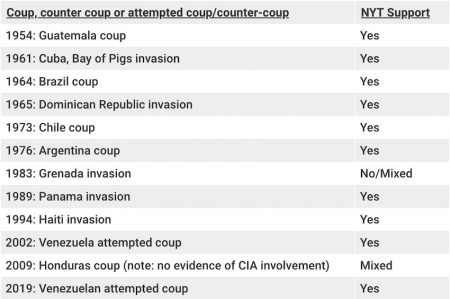
Covert involvement of the United States, by the CIA or other intelligence services, isn’t mentioned in any of the Times’ editorials on any of the coups. Absent an open, undeniable U.S. military invasion (as in the Dominican Republic, Panama and Grenada), things seem to happen in Latin American countries entirely on their own, with outside forces rarely, if ever, mentioned in the Times. Obviously, there are limits to what is “provable” in the immediate aftermath of such events (covert intervention is, by definition, covert), but the idea that the U.S. or other imperial actors could have stirred the pot, funded a junta or run weapons in any of the conflicts under the table is never entertained.
More often than not, what one is left with, reading Times editorials on these coups, are racist, paternalistic “cycle of violence” cliches. Sigh, it’s just the way of things Over There. When reading these quotes, keep in mind the CIA supplied and funded the groups that ultimately killed these leaders:
- Brazil 1964: “They have, throughout their history, suffered from a lack of first class rulers.”
- Chile 1973: “No Chilean party or faction can escape some responsibility for the disaster, but a heavy share must be assigned to the unfortunate Dr. Allende himself.”
- Argentina 1976: “It was typical of the cynicism with which many Argentines view their country’s politics that most people in Buenos Aires seemed more interested in a soccer telecast Tuesday night than in the ouster of President Isabel Martinez de Perlin by the armed forces. The script was familiar for this long‐anticipated coup.”
See, it didn’t matter! It’s worth pointing out the military junta put in power by the CIA-contrived coup killed 10,000 to 30,000 Argentines from 1976 to 1983.
There’s a familiar script: The CIA and its U.S. corporate partners come in, wage economic warfare, fund and arm the opposition, then the target of this operation is blamed. This, of course, isn’t to say there isn’t merit to some of the objections being raised by The New York Times—whether it be Chile in 1973 or Venezuela in 2019. But that’s not really the point. The reason the CIA and U.S. military and its corporate partisans historically target governments in Latin America is because those governments are hostile to U.S. capital and strategic interests, not because they are undemocratic. So while the points the Times makes about illiberalism may sometimes be true, they’re mostly a non sequitur when analyzing the reality of what’s unfolding.
Did Allende, as the Times alleged in 1973 when backing his violent overthrow, “persist in pushing a program of pervasive socialism” without a “popular mandate”? Did, as the Times alleged, Allende “pursue this goal by dubious means, including attempts to bypass both Congress and the courts”? Possibly. But Allende’s supposed authoritarianism isn’t why the CIA sought his ouster. It wasn’t his means of pursuing redistributive policies that offended the CIA and U.S. corporate partners; it was the redistributive policies themselves.
Hand-wringing over the anti-democratic nature of how Allende carried out his agenda without noting that it was the agenda itself—not the means by which it was carried out—that animated his opponents is butting into a conversation no one in power is really having. Why, historically, has The New York Times taken for granted the liberal pretexts for U.S. involvement, rather than analyzing whether there were possibly other, more cynical forces at work?
The answer is that rank ideology is baked into the premise. The idea that the U.S. is motivated by human rights and democracy is taken for granted by The New York Times editorial board and has been since its inception. This does all the heavy lifting without most people—even liberals vaguely skeptical of American motives in Latin America—noticing that a sleight of hand has taken place. “In recent decades,” a 2017 Times editorial scolding Russia asserted, “American presidents who took military action have been driven by the desire to promote freedom and democracy, sometimes with extraordinary results.” Oh, well, good then.
What should be a conversation about American military and its covert apparatus unduly meddling in other countries quickly becomes a referendum on the moral properties of those countries. Theoretically a good conversation to have (and one certainly ongoing among people and institutions in these countries), but absent a discussion of the merits of the initial axiom—that U.S. talking heads and the Washington national security apparatus have a birthright to determine which regimes are good and bad—it serves little practical purpose stateside beyond posturing. And often, as a practical matter, it works to cement the broader narrative justifying the meddling itself.
Do the U.S. and its allies have a moral or ethical right to determine the political future of Venezuela? This question is breezed past, and we move on to the question of how this self-evident authority is best exercised. This is the scope of debate in The New York Times—and among virtually all U.S. media outlets. To ante up in the poker game of Serious People Discussing Foreign Policy Seriously, one is obligated to register an Official Condemnation of the Official Bad Regime. This is so everyone knows you accept the core premises of U.S. regime change but oppose it on pragmatic or legalistic grounds. It’s a tedious, extortive exercise designed to shift the conversation away from the United States’ history of arbitrary and violent overthrows and into an exchange about how best to oppose the Official Bad Regime in question. U.S. liberals are to keep a real-time report card on these Official Bad Regimes, and if these regimes—due to an ill-defined rubric of un-democraticness and human rights—fall below a score of say, “60,” they become illegitimate and unworthy of defense as such.
While obviously not in Latin America, it’s also worth noting that the Times cheerled the CIA-sponsored coup against Iran’s President, Mohammad Mossadegh, in 1953. Its editorial, written two days after his ouster, engaged in the Times’ patented combination of victim-blaming and “oh dear” bloviating:
- “The now-deposed Premier Mossadegh was flirting with Russia. He had won his phony plebiscite to dissolve the Majlis, or lower House of Parliament, with the aid of the Tudeh Communists.”
- “Mossadegh is out, a prisoner awaiting trial. It is a credit to the Shah, to whom he was so disloyal, and to Premier Zahedi, that this rabid, self-seeking nationalist would have been protected at a time when his life would not have been worth the wager of a plugged nickel.”
- “The Shah … deserves praise in this crisis. … He was always true to the parliamentary institutions of his country, he was a moderating influence in the wild fanaticism exhibited by the nationalists under Mossadegh, and he was socially progressive.”
Again, no mention of CIA involvement (which the agency now openly acknowledges), which the Times wouldn’t necessarily have had any way of knowing at the time. (This is part of the point of covert operations.) Mossadegh is summarily demonized, and it’s not until decades later the public learns of the extent of U.S. involvement. The Times even gets in an orientalist description of Iranians, implying why a strong Shah is necessary:
[The average Iranian] has nothing to lose. He is a man of infinite patience, of great charm and gentleness, but he is also—as we have been seeing—a volatile character, highly emotional, and violent when sufficiently aroused.
Needless to say, there are major difference between these cases: Mossadegh, Allende, Chavez and Maduro all lived in radically different times and championed different policies, with varying degrees of liberalism and corruption. But the one thing they all had in common is that the U.S. government, and a compliant U.S. media, decided they “needed to go” and did everything to achieve this end. The fundamental arrogance of this assumption, one would think, is what ought to be discussed in the U.S. media—as typified by the Times’ editorial board—but time and again, this assumption is either taken for granted or hand-waved away, and we all move on to how and when we can best overthrow the Bad Regime.
For those earnestly concerned about Maduro’s efforts to undermine the democratic institutions of Venezuela (he’s been accused of jailing opponents, stacking the courts and holding Potemkin elections), it’s worth pointing out that even when the liberal democratic properties of Venezuela were at their height in 2002 (they were internationally sanctioned and overseen by the Carter Center for years, and no serious observer considers Hugo Chavez’s rule illegitimate), the CIA still greenlit a military coup against Chavez, and the New York Times still profusely praised the act. As it wrote at the time:
With yesterday’s resignation of President Hugo Chávez, Venezuelan democracy is no longer threatened by a would-be dictator. Mr. Chávez, a ruinous demagogue, stepped down after the military intervened and handed power to a respected business leader, Pedro Carmona.
Chavez would soon be restored to power after millions took to the streets to protest his removal from office, but the question remains: If The New York Times was willing to ignore the undisputed will of the Venezuelan people in 2002, what makes anyone think the newspaper is earnestly concerned about it in 2019? Again, the thing that’s being objected to by the White House, the State Department and their U.S. imperial apparatchiks is the redistributive policies and opposition to the United States’ will, not the means by which they do so. Perhaps the Times and other U.S. media—living in the heart of, and presumably having influence over, this empire—could try centering this reality rather than, for the millionth time, adjudicating the moral properties of the countries subject to its violent, illegitimate whims.
Maduro stays put, mediation can help
By M. K. BHADRAKUMAR | Indian Punchline | January 31, 2019
Russia is doing the right thing by switching tack from strident ‘anti-American’ rhetoric to focus on tamping down the tensions over Venezuela. China had counseled such an approach right from the outset when the crisis erupted last week.
On day one of a looming US-Venezuelan standoff on January 24, the Chinese foreign ministry spokesperson called upon “all relevant parties to stay rational and cool-headed and seek a political solution to the issue of Venezuela through peaceful dialogue within the framework of the Venezuelan Constitution.”
This was alongside Beijing’s vehement support for the efforts of the Venezuelan government of President Nicolas Maduro “to uphold national sovereignty, independence and stability” as well as China’s unequivocal opposition to “foreign interference in Venezuela’s affairs.”
It stands to reason that Moscow too began toning down its rhetoric and harmonizing with the Chinese stance. The heart of the matter is that the Venezuelan crisis holds the danger of putting a dagger into the heart of the international system in an already unstable world order full of potential for chaos, which of course is not in the interest of any of the three big powers that are ‘stakeholders’ – the US, Russia and China.
Thus, Russian Foreign Minister Sergey Lavrov’s remarks to the media on Wednesday in Moscow offering mediation between the government and the opposition in Venezuela can be put in perspective. Lavrov acknowledged China and Russia’s role as Venezuela’s “leading partners” in the economic sphere. He then recalled the various ideas floated by different quarters – the European Union, the Caribbean Community, Uruguay and Mexico – to provide a platform for mediation. And Lavrov added, “The Non-Aligned Movement should probably have its say, all the more so that Venezuela chairs it now.” Lavrov regretted that so far all such initiatives to start a dialogue have been “bluntly rejected” by the opposition due to instigation by its “Western sponsors.”
Lavrov said Moscow is striving to “create conditions for the start of dialogue” and is discussing it with the Venezuelan government, China, Latin American countries and the EU. He underscored Russia’s readiness “to take part in the relevant international efforts in the formats that will suit the Venezuelan parties” – that is to say, “all mediation initiatives should be unbiased and their future format should be balanced”; mediation “should represent a broad range of international players that can influence the Government and the opposition”; and, “it is necessary to understand from the very start what goal is pursued by a potential mediation format.”
Significantly, Lavrov singled out Moscow’s ongoing contacts with Brussels in regard of the EU’s proposal to establish a contact group for mediation, notwithstanding the ultimatum given to Caracas “by some EU countries, including influential ones” (read UK, France, Spain and Germany). He said the picture will be clear soon as to “who is talking about what” (in Brussels), but the bottom line is that “such opportunities exist and I believe the said initiative can be rather useful if unbiased.”
Lavrov welcomed Maduro’s readiness to accept international mediation and he urged the opposition “to display a similar constructive approach, give up ultimatums and act independently, relying primarily on the interests of the Venezuelan people.”
Indeed, it is far from clear whether in the prevailing new Cold War conditions, such a denouement through mediation by an international contact group including Russia will suit Washington, which has just declared an economic war against Venezuela. From all appearances, the Trump administration is carrying out the agenda of Wall Street for a regime change in Venezuela and the project is fairly well advanced already. The intention is to cripple Venezuela’s state-owned oil company with sanctions and make Maduro submit to the US diktat. In the US estimation, Venezuela’s oil industry cannot recover without significant reinvestment, which can only come from the US or China.
On the other hand, one silver lining on the horizon is that there are no signs as yet of the Pentagon being on a war footing. In a situation such as this, typically, the US state department ought to have requested evacuation support from Pentagon by now, but no such thing has happened so far.
Suffice to say, a protracted diplomatic slugfest is beginning, involving the US and some of its allies on one side and Russia and China on the other. An ouster of Maduro, in these circumstances, seems a very remote possibility – and can even be ruled out – so long as he enjoys sufficient support among the Venezuelan military and the ruling party’s social and political base remains so very substantial as at the moment. The strong likelihood is that Maduro will weather the storm and the US-led diplomatic and economic pressure cannot dislodge him from power.
The transcript of Lavrov’s media comments is here.
Colombia Witnesses Murder of 17th Social Leader in 2019
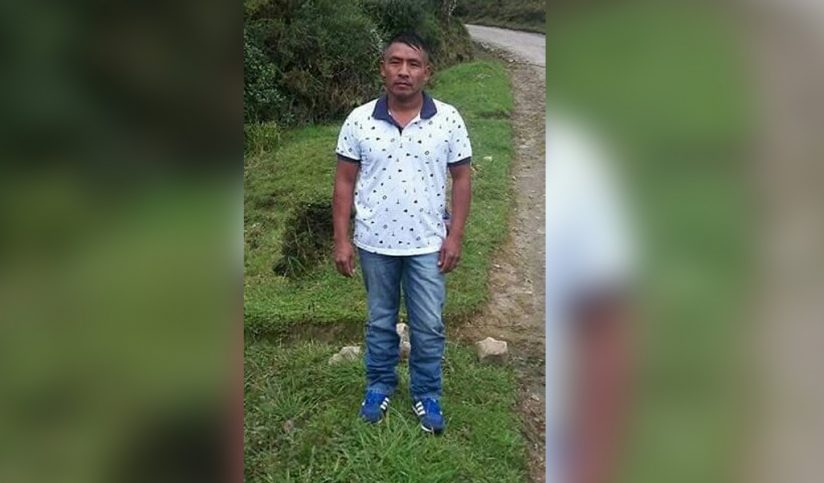
Dilio Corpus Guetio, a Campesino leader was murdered in Colombia, making it 17th murder in 2019. | Photo: Twitter / @Paola_teleSUR
teleSUR | January 30, 2019
A Colombian Campesino leader Dilio Corpus Guetio, 44, who was a member of Asocordillera (Mountain Area Association of Campesino Workers) and also a member of the local Campesino Guard militia was shot to death Tuesday.
Corpus Guetio left his home in the municipality of Suarez in the department of Cauca, in southwest Colombia, at around six in the morning for work. On the way armed men from a car shot him several times.
“The murderers were in a van which hit him and made him lose control of his bike. At that point, they got out of the car to get close to Dilio, who was already injured and he was shot repeatedly, killing him,” said a representative from the United National Federation of Agricultural Unions (FENSUAGRO).
Studies for Development and Peace, Indepaz, say that within the 29 days of 2019, 16 social leaders have been killed in Colombia, excluding Corpus Guetio.
Dilio was known for his work monitoring rural areas and protecting the territory and its inhabitants. His murder case has been registered in the village of Santa Barbara, his place of work.
This week another community leader from Cuca, Jose Jair Orozco, 52, was also assassinated.
Colombian Attorney General Nestor Humberto Martinez said in early January that the greatest number of Colombians murdered over the past two years since the signing of the peace agreement have been social leaders who serve on Communal Action Boards (JAC).
JACs began in the 1950s and are local-level councils where citizens decide upon, plan and develop community projects based on their own needs. The majority of JACs are in rural areas and members include mainly low-income Campesino, Indigenous, and Afro-Colombian members of society.
According to Martinez, the assassinations of JAC leaders is “passively systematic.” The attorney general said that those responsible are paramilitary groups “such as the “Gulf Clan” that works on behalf of narco traffickers and “Los Caparrapos” he added.
Indigenous people made up 13 percent of those killed and farmers 10 percent. Union leaders and social leaders, Afro-Colombians and LGBTI population were the other main murder victims.
Featured Video
US IRAN TALKS: Who Are the Crazy Ones Here? /Lt Col Daniel Davis
or go to
Aletho News Archives – Video-Images
From the Archives
Woolsey Fire started at Santa Susana Field Lab — where “radioactive materials released were never accurately measured”
By John Laforge | CounterPunch | November 30, 2018
In my Nov. 16 column, I reported on potential radiation risks posed by California’s Woolsey wildfire having burned over parts or all of the Santa Susana Field Laboratory—south of Simi Valley, Calif., 30 miles outside Los Angeles—site of at least four partial or total nuclear reactor meltdowns.
The field laboratory operated 10 experimental reactors and conducted rocket engine tests. In his 2014 book Atomic Accidents, researcher James Mahaffey writes, “The cores in four experimental reactors on site … melted.” Reactor core melts always result in the release of large amounts of radioactive gases and particles. Clean up of the deeply contaminated site has not been conducted in spite of a 2010 agreement.
Los Angeles’s KABC-7 TV reported Nov. 13 that the Santa Susana lab site “appears to be the origin of the Woolsey Fire” which has torched over 96,000 acres. Southern Calif. Public Radio said, “According to Cal Fire, the Woolsey Fire started on the afternoon of Thursday, Nov. 8 … on the Santa Susana site.” … continue
Blog Roll
 Aletho News
- US IRAN TALKS: Who Are the Crazy Ones Here? /Lt Col Daniel Davis
- Talks with the US end without a deal over excessive US demands: Iran
- Feeling Better, Getting Worse: How Psychiatric Drugs Create the Illusion They Cure
- ‘Nobody Told Me’: Former Mental Health Patient Calls Out Dangerous Side Effects of Psychiatric Drugs
- Dr. Abu-Sitta: Beirut ‘felt like a day in Shifa Hospital’
- Iran Has Won the War, It Will Be Up to the US to Secure the Peace: Mohammad Marandi
- Iran condemns assassination threats against Iranian negotiators amid US talks
- Brussels cannot say where its own pipeline inspectors are as Hungary’s oil lifeline remains shut
- Israel’s Iran War: Myth and Reality
- Between war and industrial breakdown: The US-Israeli attrition crisis
- If Americans Knew
- Pro-Israel ‘Thinktanks’ and Individuals who Influence U.S. Foreign Policy
- Mearsheimer reveals how Israel dictates US policies on Iran, Gaza – video
- After killing 350+, Israel still has a “score to settle” with Lebanon before ceasefire – Daily Update
- Military aid to Israel emerges as the latest political litmus test for Democrats
- The only Palestinian children’s rights organization closes following years-long Israeli campaign against it
- ‘I Can’t Forget the Smell’: Lebanese Reel After Israel Kills Over 300 in Single Day
- DNC Shoots Down Resolutions Calling Out AIPAC and Limiting Arms to Israel
- TCN: Is Israel Blackmailing President Trump?
- Israel killed at least 303 Lebanese yesterday – who were they? Daily Update
- Amnesty: Urgent – Protect Lebanese civilians from brutal escalation in Israeli attacks
- No Tricks Zone
- German Expert: Heat Dome Led To Record Temps In Western USA…Warmer In 1934, 1936
- New Study: No Linear Warming Or Glacier Retreat Along Northern Antarctic Peninsula Since 1980s
- An Inconvenient Tree: Uncovered In Alps… Europe Much Warmer Than Today 6000 Years Ago
- New Study Reports A 60% Slowdown In Greenland’s Ice Loss Rate In The Last Decade
- Low Intensity Tornado Wrecks Major Solar Farm, Creating A Potential Toxic Dump
- New Study Finds Warming Saves Lives…Cold Temperatures 12 Times More Deadly Than Excess Heat
- German Science Blog Accuses PIK Climate Institute Of Hallucinating Climate Tipping Points
- Devastating Assessment Of Comirnaty Vaccine By Former Senior Pfizer Europe Toxicologist
- New Study: CO2 Is ‘Effectively Negligible’ As An Explanatory Climate Change Factor Since 2000
- Former Pfizer Toxicologist Dr. Helmut Sterz Tells Bundestag Hearing Pfizer Vaccine Should Have Never Been Approved
 Aletho News