Guaido returns to Venezuela to the welcome of foreign ‘bodyguard’ envoys
RT | March 4, 2019
Self-declared “interim president” of Venezuela, Juan Guaido, returned from his South American tour on Monday, arriving into the loving (and protective) arms of ambassadors from the foreign governments backing him.
Despite Venezuelan authorities making it clear he could face 30 years in prison for attempting to overthrow the government and violating a travel ban, Guaido chose to arrive directly to an airport in Caracas.
The risk of arrest was notably mitigated by the presence of ambassadors from Germany, France, Spain, the Netherlands and several other countries which gathered at the arrival gate to huddle around him like a high-profile human shield. While Guaido was all smiles, his Western-world entourage seemed a bit on edge.
While the media fretted that Maduro might make good on threats to arrest Guaido, the opposition leader passed through customs without incident and headed straight to a rally in central Caracas.
Meanwhile, Vice President Mike Pence warned the Venezuelan government that Washington protects its investments, stressing how important Guaido is to them, and threatening a “swift response” if anyone tries to bully him.
Shortly after moving unhindered through the airport, Guaido arrived at a demonstration he called for on Twitter the week before. Addressing crowds in the country’s capital city, he called on his supporters to take to the streets for continued demonstrations next Saturday.
While Guaido toured South America and met with his most critical support base – foreign governments – the US ramped up pressure on Maduro’s government, imposing intensified sanctions and revoking visas for state actors.
Understanding How Canadian Diplomats Shape the News
By Yves Engler | Dissident Voice | March 3, 2019
Canadian diplomats abroad seek to shape coverage of their work. And the more nefarious their actions the harder they toil to “spin” what they’re doing as something positive.
During a recent interview Real News Network founder Paul Jay described how Canadian officials in Caracas attempted to shape his views of the country’s politics. Jay noted:
My first trip to Venezuela in 2004, I was producing the big debate show on Canadian TV called Counterspin on CBC Newsworld. … . I was a known quantity in Canada. And so when I was in Venezuela, I said I’ll go say hello to the Canadian embassy. I was trying to figure out what was going on in Venezuela. I figured some Counselor would pat me on the head and say welcome to Venezuela.
No, I got the number two chargé d’affaires that greeted me and brings me into a meeting room with seven members of the opposition who then for two hours beat me over the head with how corrupt the regime was, how awful it was, and so on…
What business does a Canadian embassy have with bringing a Canadian journalist into a room with opposition people, essentially trying to involve me in a conspiracy against the Venezuelan government. Canadian government role in Venezuela was promote and nurture the opposition.
Around the same time Canadian officials sought to convince Jay that Hugo Chavez’s government was corrupt, former Montréal Gazette reporter Sue Montgomery had a similar experience in Port-au-Prince. In “Parachute Journalism in Haiti: Media Sourcing in the 2003-2004 Political Crisis”, Isabel Macdonald writes:
Montgomery recalled being given anti-[President Jean-Bertrand] Aristide disinformation when she called the Canadian embassy immediately after she had been held up by armed men while driving through Port-au-Prince days before the [US/France/Canada] coup. Canada’s ambassador to Haiti, Kenneth Cook, told her, ‘We’ve got word that Aristide has given the order to the chimeres [purported pro- Aristide thugs] to do this kind of thing to international journalists because he’s not getting any support.’ According to Montgomery, Cook had urged her to tell the other international journalists who were staying at the same hotel: ‘I think you should let all your colleagues at the Montana know that it’s not safe for them.’
Given only two days to prepare for her assignment, Montgomery was ripe for official manipulation. Though she later realized the ambassador’s claim was ridiculous, Montgomery told other journalists at Hotel Montana (where most international journalists stay in Port-au-Prince) that Aristide’s supporters were targeting them.
The Canadian embassy in Port-au-Prince succeeded in influencing Canadian reporters’ coverage of the country. In her MA thesis titled “Covering the coup: Canadian news reporting, journalists, and sources in the 2004 Haiti crisis,” Isabel Macdonald concludes that the reporters dispatched to Port-au-Prince largely took their cues from official Canada. “My interviews revealed that journalists’ contacts with people working in the Canadian foreign policy establishment appear to have played a particularly important role in helping journalists to identify appropriate ‘legitimate’ sources.”
CBC reporter Neil MacDonald told Isabel MacDonald his most trusted sources for background information in Haiti came from Canadian diplomatic circles, notably the Canadian International Development Agency where his cousins worked. MacDonald also said he consulted the Canadian Ambassador in Port-au-Prince to determine the most credible human rights advocate in Haiti. Ambassador Cook directed him to Pierre Espérance, a coup backer who fabricated a “massacre” used to justify imprisoning the constitutional prime minister and interior minister. (When pressed for physical evidence Espérance actually said the 50 bodies “might have been eaten by wild dogs.”)
Almost all Canadian correspondents develop ties to diplomats in the field. Long-time Globe and Mail development reporter John Stackhouse acknowledges “Canadian political officers” in Indonesia for their “valuable insights” into the country during General Suharto’s rule. In Out of Poverty, Stackhouse also thanks “the Canadian diplomatic missions in Accra, Abidjan and Bamako [for their] … invaluable service in arranging interviews and field trips.” During a period in the mid-2000s when she wrote for the Globe and Mail and CBC, Madeleine Drohan conducted media workshops in Zambia, Tanzania, Kenya and elsewhere sponsored by the Canadian embassy, High Commission and Foreign Affairs (she taught journalist ethics!).
“One of the best Canadian foreign correspondents of the 1970s,” Jack Cahill discusses some ways diplomats relate to reporters in If You Don’t Like the War, Switch the Damn Thing Off!: The Adventures of a Foreign Correspondent. “The Canadian government”, the former Toronto Star reporter notes, “can be good to foreign correspondents if it thinks they are reliable and I had two passports, one for general purposes and one for difficult countries.”
In what may reflect his nationalism, Cahill dubs Canadian diplomats “more reliable” than their southern counterparts. Disparaging his US colleagues, he writes:
There is little doubt, however, that some US foreign correspondents depend almost entirely on their embassies, and thus indirectly the CIA, for their information. It is, after all, the natural thing to be attracted to the truth as propounded by one’s own countrymen in the Embassy offices, at the official briefings, and on the cocktail circuit. It’s this information, with its American slant on world affairs, that eventually fills much of Canada’s and the Western world’s news space.
Jay described his experience at the Embassy in Caracas mostly to highlight Canada’s long-standing hostility to the Hugo Chavez/Nicolas Maduro governments. But, his story also helps make sense of the dominant media’s alignment with Ottawa’s push for regime change in Venezuela today.
Globe and Mail Latin America correspondent Stephanie Nolen, for instance, promotes Canada’s last ambassador to Venezuela. Describing Ben Rowswell as “widely respected by Venezuelans while he was there”, Nolen recently retweeted Rowswell claiming: “the coup happened in July 2017 when Maduro suspended the constitution. The question now is how to fill the void – by backing the president who uses force to remain in power after his term expires, or the leader of Venezuela’s last remaining democratically elected body?” Rowswell has been quoted in at least a half dozen Globe and Mail articles about Venezuela in recent weeks.
Diplomats’ influence over international correspondents is one way the foreign policy establishment shapes discussion of Canadian foreign policy.
Remember the Maine? CIA Intervention in Venezuela

Photograph Source National Museum of the U.S. Navy
By David Rosen | CounterPunch | March 1, 2019
In January 1897, Frederic Remington, a 19th-century painter famous for his depictions of the Old West, was on assignment in Havana for William Randolph Hearst’s New York Journal to illustrate Spanish atrocities against Cubans. He sent a telegram to Hearst, noting: “Everything is quiet. There is no trouble. There will be no war. I wish to return.” Hearst replied: “Please remain. You furnish the pictures and I’ll furnish the war.”
One year later, on February 15, 1898, the battleship USS Maine mysteriously exploded in Havana Harbor. Pres. William McKinley ordered the battleship sent to Havana on January 25th to observe the growing tension between the U.S. and Spain. The explosion killed 268 of the crew’s 354 men and shocked the American public.
The U.S. press went wild with headlines proclaiming, “Spanish Treachery!” and “Destruction of the War Ship Maine Was the Work of an Enemy!” Hearst and the Journal offered a $50,000 award for the “detection of the Perpetrator of the Maine Outrage.” “Remember the Maine, to Hell with Spain!” became a rallying cry.
To this day, no one knows what caused the explosion. Initial reports claimed the ship was sunk by a naval mine. Later investigations, one in 1911 and another in 1974, hypothesized that it was a coal dust fire. Still others believed it was due to sabotage, some speculating it was a covert Hearst operation to increase his newspaper’s readership.
While McKinley sought to maintain peace with Spain, Theodore Roosevelt, the Sec. of the Navy, led the war faction. He insisted, “Let the fight come if it must. I rather hope that the fight will come soon. The clamor of the peace faction has convinced me that this country needs a war.”
On April 21, 1898, the U.S. declared war on Spain. The sinking of the Maine climaxed pre-war tensions, a provocation that accelerated the breakdown in diplomatic relations between the U.S. and Spain. The war last 10 weeks and the U.S. was victorious; it took temporary control of Cuba (although it still controls Guantanamo Bay), control of the Philippines (until 1946) and ongoing control of Puerto Rico and Guam. Provocations can work.
***
Americans will likely never know the complete role the CIA has played – and likely continues to play — in the campaign to overthrow the Maduro government in Venezuela. (Claims of “national security” are used to hide the truth.) The Trump administration’s Troika of Evil – VP Mike Pence, Sec. of State Mike Pompeo and National Security Advisor John Bolton – seem to be plotting the overthrow of the Maduro government. One can well assume that the CIA, along with other agencies of the U.S. military-industrial complex, have been recruited to destabilize Venezuela, if not worse. Given this, one can wonder if another provocative act like the sinking of the Maine will be orchestrated to legitimize a domestic coup – or U.S. military intervention — in Venezuela.
Since Pres. James Monroe proclaimed what became known as the “Monroe Doctrine” in 1823, the U.S. has actively intervened in the affairs of innumerable countries across the globe. Since its establishment in 1946, the CIA has played a key role in U.S. interventions, whether through destabilization campaigns or an outright coups, especially in Latin and South America and the Caribbean.
A review of a dozen or so CIA interventions between 1954 and 2002 is suggestive as to what might be playing out in Venezuela.
Guatemala,1954 – the CIA launched the so-called Operation PBSuccess against president Jacobo Arbenz in support of United Fruit Company and bombed Guatemala City.
Haiti, 1959 – the CIA intervened to halt a popular movement to overthrow the puppet dictator, Francois Duvalier; according to one report, “over 100,000 people were murdered.”
Brazil 1964 – the CIA backed a coup against the democratically-elected president Joao Goulart who threatened to tax U.S. multinational corporations.
Uruguay, 1969 – CIA agent Dan Mitrione trained security forces in torture as part of Operation Condor; the agency pushed a coup that installed a military dictatorship led by Juan Maria Bordaberry.
Cuba, 1961 – the CIA-backed Cubanexiles and oversaw the failed Bay of Pigs invasion in the wake of the Cuban revolution of 1959; repeated CIA attempts to kill Fidel Castro failed.
Bolivia, 1971– the CIA orchestrated a coup against Gen. Juan Jose Torres, installing Gen. Hugo Banzer who imposed a violent dictatorship.
Chile, 1973– the CIA backed Gen. Augusto Pinochet’s coup against Pres. Salvador Allende, imposing a dictatorship that last 17 years.
Argentina, 1976 – the CIA installed Gen. Jorge Rafael Videla in a coup as part of the Dirty War to overthrow the Peronists.
El Salvador, 1979 – the CIA supported a 1979 coup fearing a popular insurgency that culminated in the assassination of Archbishop Oscar Romero (February 1980) and four American nuns (December 1980); in 1984, it financed Jose Durate’s campaign.
Grenada, 1983 – the CIA began efforts to destabilize the Marxist government in 1981 that led to the U.S. Marines invading in the country in ‘83 allegedly to protect about 1,000 American students on the island.
Panama, 1989 – the CIA orchestrated Operation Just Cause to overthrow its long-time operative, the drug trafficker Manuel Noriega, that left 3,500 civilians dead.
Peru, 1990 – the CIA backed Alberto Fujimori presidential election who renamed himself National Intelligence Service director, dissolved Congress and locked up the justices of the Supreme Court.
Venezuela, 2002 – the CIA backed mutinous army officers who briefly deposed Pres. Hugo Chávez in a coup attempt.
The CIA has also been involved in numerous other political and military campaigns in the region.
***
On February 15th, the U.S. celebrated the 121st anniversary of the sinking of the USS Maine. Since then, the U.S. has engaged in numerous military and political interventions in countries across the globe. Since its founding in 1947, the CIA has been the lead federal entity in foreign interventions and is likely playing a key role in the destabilization of Venezuela. Little information about the agency’s role in Venezuela has been reported, but suggestive rumors are circulating.
Earlier this month, a 21 Air cargo flight from Miami International Airport was seized by government authorities in Valencia, Venezuela, transporting 19 assault rifles, telescopic sights, radio antenna and other materiel likely for anti-Maduro forces. The flight company denied all knowledge of what it was shipping. The company that chartered the flight, GPS-Air, flatly rejected any claim that it had shipped weapons. As McClatchy reported, “Only a fool would try sending guns out of the [Miami] airport,” said Cesar Meneses, GP-Air’s cargo shipping manager.
Last year, a rumor circulated that the CIA was involved in an attempted assassination of Pres. Maduro. While giving a TV broadcast speech in February 2018, an explosion disrupted the event and Maduro blamed Colombia for the attack, saying later on, “I have no doubt that the name [Colombian president] Juan Manuel Santos is behind this attack.” Trump advisor Bolton denied any U.S. involvement, insisting on Fox News, “I can say unequivocally there is no US government involvement in this at all.”
It’s unlikely that the American public will know the role the U.S. military-intelligence apparatus, especially the CIA, is playing in the attempted overthrow of the Venezuelan government. A direct military intervention in the grand old sense of Cuba, Panama or Grenada seems unlikely. Unfortunately, the Troika of Evil – Pence, Pompeo and Bolton – are likely scheming for a provocative incident similar to the sinking of the Maine.
US Plan to Break Through Venezuelan Border Failed – Russian Foreign Ministry
Sputnik – 28.02.2019
MOSCOW – The US plan to break through the Venezuelan border under the pretext of delivering humanitarian aid failed, Russian Foreign Ministry spokeswoman Maria Zakharova said Thursday.
“The illegal attempt on February 23 by US-inspired radical part of the Venezuelan opposition, supported by extremist groups with Molotov cocktails in hands, to break through the border under the pretext of carrying so-called humanitarian aid was doomed to failure from the very beginning. Its organizers were well aware that any violation of the state border always should and would be stopped, because this is a direct attempt on the country’s sovereignty,” Zakharova said.
“Fortunately, the criminal plan of pseudo-humanitarian officials failed,” she said at a briefing.
Russia will not support the draft resolution proposed by the United States in the UN Security Council, Maria Zakharova stressed.
“Of course, Russia can not support such a project,” Zakharova said, adding that there was nothing new in the draft resolution.
The spokeswoman added that the situation in Venezuela remained alarming with Washington willing to remove the legitimate authorities in Caracas from power.
In the draft resolution, the United States is seeking a new presidential election in Venezuela. The council is expected to vote on the document Thursday night New York time.
On 23 February, the Venezuelan opposition tried to forcefully bring the US-sponsored aid into Venezuela from Brazil and Colombia. The failed attempt resulted in clashes between the Venezuelan National Guard officers, who prevented trucks with aid from crossing the country’s border without permission, and pro-aid protesters, who tried to help force the aid into Venezuela.
Fake Humanitarianism Fails its Big Test in Venezuela
By Maximilian C. Forte | Zero Anthropology | February 24, 2019
There it is: Saturday, February 23, 2019, has now come and gone—and it’s not to say that “nothing has changed”. In fact, some important changes did occur, none of which were the ones hoped for by either the self-declared “president” of Venezuela, Juán Guaidó, nor the ones commanded by the President of the US, Donald “Can I have my Nobel Peace Prize now?!” Trump. US options have thus narrowed, as we enter a protracted and potentially more dangerous phase where possible US military intervention draws closer. So let’s quickly review some of the changes introduced by yesterday’s events.
First, the unelected, self-declared “president” of Venezuela is no longer even in Venezuela. He used the opportunity of the US AID stunt to spirit himself across the border to Colombia, with the apparent well-wishes of ushers in the Venezuelan military (he should have been suspicious, unless he really intended to flee), and Guaidó now finds himself as a tourist in Colombia. Second, the military which Guaidó presumed to order, completely ignored him and remained loyal to the established government, the only legal and legitimate one. Indeed, the third point is that in failing the credibility test, Guaidó also failed the legitimacy test: how can he be viewed as a legitimate leader, without anything to lead, and with none of the state machinery following him? That is not a leader; at best, Guaidó can be defined an aspirant to power. He is a legitimate aspirant. Some in the opposition are already speaking of an alternative deal with the Maduro government. Having failed the credibility and legitimacy tests, a frustrated Guaidó had no option other than to invite foreign military intervention—if his own military won’t listen to him, surely other nations’ militaries will? And what about Richard Branson’s much vaunted aid concert? That takes us to the fourth point: that concert was drowned out, not just by a competing concert on the Venezuelan side of the border, and not just because it failed to draw any major international acts (perhaps thanks to Roger Waters), but the events of the day itself meant that not even a word was mentioned about the concert. It was like it had never happened. The fifth development is probably the most significant: US AID via Colombia, and similar “aid” intrusions from Brazil and Puerto Rico, were a resounding failure. The frustration that had been building up for days about the lack of a viable plan, was well warranted, as was Maduro’s optimism. Not well warranted were the raised expectations.
(Note, while the headline in the The New York Times claims that aid came in via Brazil, its source on the ground instead said, “The whole thing has failed” and the trucks “remained stranded on the border”. The story is misleadingly playing on a technicality: the aid left the Brazilian side of the border, but did not pass the Venezuelan checkpoint.)
What’s Next?
This takes us back to the central question of the previous article: what is the US’ next move? Simply insulting the Venezuelan armed forces, in what some called an “irresponsible speech,” by suggesting they are guilty of dereliction of duty, then insulting them further by saying Cuba directly controls the Venezuelan military, and then insulting them yet again by assuming that they should instead take their orders directly from Washington—will not work, and that much has been proven. Threats to the safety of Venezuelan soldiers only augment the offense. The US, speaking the language of “democracy promotion,” has been openly hoping for a palace coup—no such movement is in evidence however. All we know is that Vice President Mike Pence (who is likely leading the Venezuela intervention to shield Trump from any illegalities likely to be committed) will be meeting with aspirant Guaidó at his new lodgings in Colombia. That, and more sanctions, as if Venezuela’s government expected anything else.
Clearly the obese billionaire in the Oval Office relished the prospect of one day (soon) boasting that he had toppled a “regime” by just throwing some scraps of dog food at the feet of “desperate and starving” Venezuelans. (They just have to be desperate and starving, because their place in the natural order of things is that they are citizens of a “shit hole country”.) It would have pleased him immensely, he would have smiled slyly, to know that a well fed American can dangle a MRE pack in front of “hungry” eyes, and then sit back and listen to them scamper and scuffle. Such images enforce the evolutionist paradigm of progress, development, and global dictatorship. Trump would have told his friends: “You should have seen what happened, I just sent in crap like TV dinners to that shit hole country, and those pathetic losers fell all over themselves to get it, and the regime collapsed. Poof! Beautiful. Then I took their oil”. (The last point is important, because Trump has the ethics of a looter, and his foreign policy is a projection of his business practice: theft, scams, and all sorts of other wrongdoing enough to warrant hiding many years of tax returns behind some old yarn about an audit that is apparently eternal.)
Particularly important about the day’s events was the fact that two partners in an intended coup each failed their respective tests. The US and its regional allies showed that they could not even spirit in some boxes of junk “aid” and that they held no sway over the Venezuelan military. Guaidó failed to show that he commanded any support that mattered. He didn’t even have a few miserable boxes of US aid to selectively hand out to build up a patron-client network. Having auditioned for the role of CIA tool, he only demonstrated he was not worthy of the investment. He then fled. Then the government shut down his rumoured base of operations in Caracas: the Colombian embassy. The US could not have achieved less had it picked up any random person off the streets of Caracas.
Regime Survival Got a Boost
The unintended by-product of the US’ inability to command change, is a recipe for regime survival: everything that Venezuelans suffer from now on can be appropriately and rightly blamed on US intervention; opponents of President Nicolás Maduro can be labelled traitors, CIA proxies, and puppets of Washington, with considerable justification—thanks to US intervention; Venezuela will adapt and survive US sanctions like multiple other states have done; US oil refineries, shipping companies, insurance firms and banks—the other side of Venezuelan exports of oil to the US—will now suffer irreversible loss, and the US thus also loses its chokehold on Venezuela. Rather than American hegemony, it’s multipolarity that is advancing, with Venezuela moving closer into the orbits of Russia, China, and India. (India itself is completely unafraid of US sanctions, according to Indian analysts.) The US, especially under Trump, has responded to almost everything and everyone with either sanctions or their twin, tariffs, to the extent that there is virtually not a nation left on earth that is not subject to some sort of tariff or sanction from the US. The US is sanctioning itself into irrelevance, as the rest of the world devises ways of learning to live without it.
What Did We Not See?
What was strangely absent from the day, in all the live television footage and numerous photographs of the events, were at least two things: one was that however many showed up to back Guaidó, it certainly was not the 700,000 to a million people he had promised. The other was the bizarre absence of any Venezuelan soldiers from virtually all of the photographs and live television coverage. How they could maintain a forceful presence, yet remain invisible to the media, is quite an achievement—one that denies the media any coup-worthy moments of manufactured, orchestrated outrage. Of course what was also absent—and we knew this would be—was any evidence of these supposedly starving Venezuelans. Having grown up in a society saturated with media images of the now classic “starving Ethiopian,” emaciated bodies with distended bellies, it’s noteworthy that the coup media cannot pull off such a display with Venezuela—that would be the same Venezuela with the supermarkets stuffed with goods.
Beware of Alternative “Fake News”
These postscripts are intended as memoranda to RT, CNN, and others: please check your sources for the claim that former US Assistant Secretary of State Elliot Abrams was involved in actually smuggling in weapons in the guise of humanitarian aid. However appealing that image may be, it is a dorky and corny tale that arouses suspicion. It generally does not pass the smell test—check the last two links for further insight, and also see the Wikipedia page. Abrams was, after all, a State Department official, and not a field operative. In addition, he is being blamed for the operations that were conducted by Lt. Col. Oliver North and the CIA. The “humanitarian aid” disguise was aimed at the US Congress: Congress appropriated funds for humanitarian aid, and some of the funds were misused to arm the Contras illegally. It was no secret that the US was arming the Contras either—they were backed by the US, and they were armed. Most of that aid went to US bases in El Salvador and Honduras (US allies), where there was no need to “disguise” the aid, and it went to the Contras, a military force—again no need to disguise the aid. It’s not like Abrams called Contra leaders and surprised them: “We’re sending you some bags of rice. Or are we? Wink, wink”. They certainly were not fooling Nicaragua’s government, nor did Nicaragua allow in any such “aid” only to somehow find out it was not real humanitarian aid at all—that never happened. Nicaraguan authorities did capture a US pilot, after an illegal flight resulted in a crash inside Nicaragua, revealing the contents of what the US was sending the Contras: weapons, when Congress had banned military aid to the Contras. Abrams was just one figure among many in the story, and not the most directly involved.
The “Trojan Horse” charge is thus being misinterpreted and turned into something laughable. No serious person thinks the US was trying to smuggle in weapons in US AID boxes, in front of thousands of cameras in the plain light of day. That’s why not-so-secret flights exist instead. The “Trojan Horse” idea instead seems to be a little too complicated for the media which prefers a cartoonish rendition. The serious argument is that the aid was intended to shore up Guaidó’s power, since the aid was going directly to the opposition; and, the aid expressly bypassed the legal and legitimate government authorities of Venezuela, and was thus meant to undermine their authority. Furthermore, Guaidó spoke of the “aid” effort as being one that would create a “humanitarian corridor”—echoing terminology used by the US in Syria—and which would have meant wresting territory from the hands of the Venezuelan state, thus allowing the US free passage in and out at will. In addition, the hoped-for clash (which did not materialize to the extent that was feared) could have served as a pretext for warming up international opinion in favour of a US military “rescue”. That’s the extent of the Trojan Horse in this case—it’s not about grenades inside bags of rice. Otherwise President Nicolás Maduro did not “reject” any so-called “aid” from the US, because none had been given to him. The only thing the Venezuelan government did was to block its borders from being used for illegal purposes by foreign powers—its sovereign right. It did so, and it won.
Also tenuous is the story, repeated on RT several times now, that seems to take great joy in upbraiding rivals like CNN for reporting that Venezuelan authorities had “closed” the Tienditas bridge, built in 2016 and supposedly never opened (a bridge to nowhere?). Venezuelan authorities did in fact move containers to block that bridge, and were recorded doing so by Colombian authorities on February 5, of this year. Moreover, and this is the more important point: Maduro repeatedly said any attempt to move the aid into Venezuela would be blocked. There was never even the slightest hint that Maduro would just stand aside and let it pass. It seems that some foreign journalists are divided by their partisan loyalties and create the appearance of wanting to have their cake and eat it too: the humanitarian aid is not for humanitarian purposes, and has been denounced by several of the leading international humanitarian aid agencies, but it’s not like Venezuela shut down a bridge to prevent aid from reaching suffering masses—this seems to be their odd narrative, designed to satisfy multiple competing constituencies. The events of February 23 will hopefully clarify any lingering misinterpretations, on any side.
Venezuela Denounces 2nd False Flag Operation at Colombia Border
teleSUR | February 23, 2019
A new episode in the false flag operation being waged against the Venezuelan government to justify a foreign intervention, happened on the Francisco de Paula Santander International Bridge that links Venezuela and Colombia.
Two out of the four trucks with alleged “humanitarian aid” from USAID, which were trying to illegally enter Venezuela, were burned at the border between the two countries. The burning trucks were on the Colombian side of the Francisco de Paula Santander Bridge where Venezuelan opposition leaders have been leading protests.
According to witnesses, violent right-wing opposition members torched the trucks with Molotov cocktails and then tried to incriminate the Bolivarian National Guard (GNB) and the Bolivarian National Police (PNB). teleSUR’s Madelein Garcia, reported that the trucks were supposedly trying to enter Venezuela, but were then burned on the part of the bridge that belongs to Colombia.
The version of events saying that the trucks burned due to a “teargas bomb”, which are not incendiary devices, has been circulating on Colombian and international media networks and on social media.
In addition, some people were trying to illegally enter Venezuela using Red Cross jackets, despite not being affiliated with the international medical organization. The Red Cross has already officially rejected these attempts by the U.S. to deliver politicized “humanitarian aid.”
The International Federation of Red Cross and Red Crescent Societies has stated on its certified Twitter account that they have noticed “some people not affiliated with Red Cross Colombia and Red Cross Venezuela wearing Red Cross emblems at the Colombia-Venezuela and Brazil-Venezuela border.”
The International organization has urged these people ” to stop doing this. They might mean well but they risk jeopardizing our neutrality, impartiality & independence.”
Also Saturday morning another false flag operation was denounced by the Venezuelan government. A group of low-level soldiers of the Venezuelan National Guard Saturday took over multiple armored vehicles that belong to the Venezuelan army and rammed them into border barriers at the Venezuelan-Colombian border in a staged operation ordered by right-wing opposition members in Colombia.
During a massive demonstration in favor of peace and democracy in Venezuela, President Nicolas Maduro declared the coup d’etat defeated because of the unity of civil society with the military.
Red Cross denounces unsanctioned use of its emblems to smuggle US aid to Venezuela
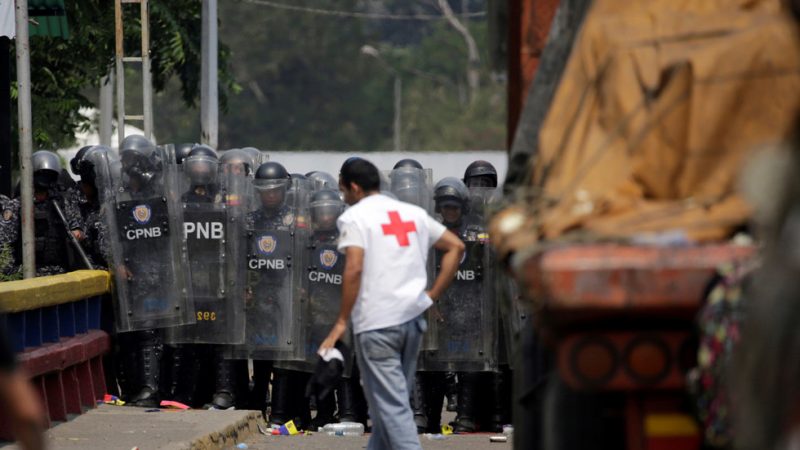
Security forces block the Francisco de Paula Santander bridge between Colombia and Venezuela © Reuters / Marco Bello
RT | February 23, 2019
The largest international aid organization has demanded that activists at the Venezuela-Colombia border not use the insignia of the Red Cross, which isn’t participating in what Caracas has dismissed as a US “propaganda show.”
The Red Cross learned that some “people not affiliated” with the agency are trying to disguise themselves as aid workers to smuggle cargo for Venezuela’s opposition across the closed frontiers.
“They might mean well but they risk jeopardizing our neutrality, impartiality & independence,” the International Federation of Red Cross and Red Crescent Societies said.
Earlier, Venezuelan Foreign Minister Jorge Arreaza stressed that the UN and the International Red Cross are not participating in the “propaganda show” staged by the United States. “It is clearly an action with political objectives, it could never be described as a humanitarian action,” he said on Twitter, accusing the governments involved in the US plot of violating the principles of the UN charter.
The government of Nicolas Maduro has sealed off the borders with neighboring Colombia, Brazil and the Dutch island of Curacao, trying to prevent US shipments from entering the Latin American State. Caracas denounced the ‘aid’ as a highly-publicized attempt to foster division and chaos, and possibly to use it as a cover to smuggle arms to the country’s opposition.
What Strange Corruption
The Racist Venezuelan Bourgeoisie’s Accusations Against Chavistas Are Pure Projection
By Sassy Sourstein | Cien Flamingos | February 21, 2019
Social media truly is the great democratizer. Where else can Twitter trolls and bot armies create a web of baseless rumors that make their way into the empire’s leading publications? For example:
“Maduro is a murdering criminal starving Venezuelan children while he loots the country like Chavez did. When supposed socialist Chavez died the richest Venezuelan in the world was his daughter w billions. Same w Maduro. Looting Venezuelan wealth. Giving it to himself & Cuba!” (source)
So much to unpack, but this is a template used throughout social media in various forms. Make unsourced allegations of mass murder, purposeful starvation (especially of The Children), corruption, and looting. This is a more sophisticated version (really!) in which Chávez is separated from socialism with the word “supposed,” meant to give the accuser some leverage on the left. You see, corruption is what ails Venezuela, not socialism necessarily. Much of the rest has been thoroughly debunked — there is a crime problem but no death squads, there have been a few dozen deaths in years of violent right-wing riots but no campaign of official slaughter of “protesters,” and frankly Cuba has paid for its oil many times over with solidarity and other material support to poor Venezuelans. What persists — in right-wing AND left narratives — is the corruption boogeyman. The tweet above is truly tapping into a rich vein of existing ultraleftism, in which the Bolivarian revolution isn’t socialist at all, but merely an emerging, competing bourgeoisie. I hope here to discuss and counter just some of this bullshit.
First, the claims about the Chávez family are based on the thinnest, most laughable evidence. For Hugo himself, the British tabloid Daily Mail cites a “respected analyst” from a fake “criminal justice” outfit run by a guy with 300 followers. Twitter user Bernardo Canto did the research on this lie and traced it back to a Scribd post devoid of citation or source material. Apart from that, there is absolutely zero evidence that Chávez “died rich,” as they say — which is a pretty idiotic way to do massive corruption.
As for María Gabriela Chávez, why, there must be reams of evidence against her. Well. Get a load of this.
Canto delved into these accusations uncritically published all over corporate media, including Forbes. The claim in Forbes is credited to known CIA front Diario Las Americas, based in Miami, which, “as it happens,” is now owned since 2013 by the Venezuelan backers of opposition presidential candidate Henrique Capriles, himself accused of corruption by the Maduro administration.
It all literally boils down to a receipt shown on a tabloidy TV news show whose host is a Cuban-American Republican who ran for Congress to represent Miami. That receipt? Look for yourself:
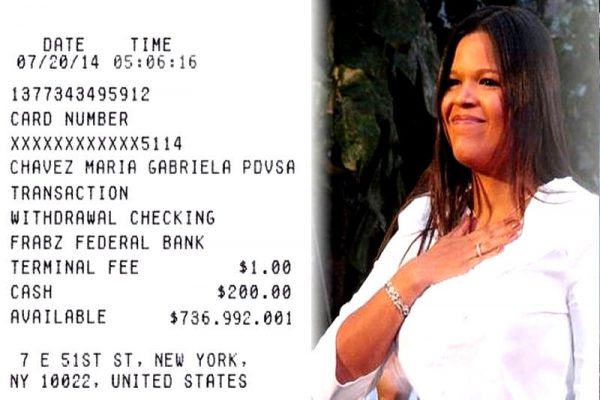
If you think that, within the United States, ATM receipts say at the bottom “United States,” well, charitably, you’ve never used an ATM here. And the address is that of the Venezuelan consulate, not any bank. Another mistake made on this truly pathetic fabrication, is that in the US we use commas, not periods, to denote whole numbers. Of course there is no way to verify if this is Amb. Chávez’s card number, and the scammer who made this knows at least that. Aporrea already debunked this — there is no “Frabz Federal Bank,” as any US resident or a quick Google search will tell you. Frabz is literally a fake ATM receipt generator. Nevertheless, Diario Las Americas claims that the reporting of supermarket-tabloid caliber blog Maduradas.com is “precise and trustworthy,” which of course makes any claim of journalistic rigor in that entire operation a preposterous notion.
Endless insinuations of impropriety against Venezuelan officials litter the internet from troll comments on up to The New York Times. The Atlantic published a particularly nasty set of libels against María Gabriela Chávez, all caged in careful transitions and caveats so as not to actually be required to provide proof. Everything from how much public money she spends (even though she’s a billionaire!) to alleged import corruption (again with no evidence provided) to comments on her musical ability. It even gives credence to a conspiracy theory that her ambassadorship was given so that Cuba would have a trojan-horse advocate at the UN. This is pure smear, a series of fevered speculations, and yet there it is in a leading light of the liberal media.
The rest of the Chávez and Maduro clans’ children are targets as well. Check out this nutty Daily Mail post published presumably to contribute wind to the sails of the ongoing coup attempt. All the María Gabriela claims are breezily restated with no attempt to corroborate, but the “accusations” against her youngest sister Rosinés are uh… well she held up “a fistful of dollar bills” — yes, ONE-dollar bills — and well, goes to school in Paris where, we are assured, she is “care free.” And then of course there’s the time Maduro stopped in Turkey to eat a steak, which is outrageous for the president of a country on his way home from trade talks in China. Diosdado Cabello, a leading PSUV member and one of Chavismo’s most efficacious orators, is mentioned for being accused by the US government of drug running but even this is admitted to be unproven. (More on narco allegations in a future post.) Cabello’s daughter Daniela is mentioned because she is pretty. Yes really. The first lady Celia Flores’s children are said to have spent $45,000 at a hotel in Paris, though the claim seems to originate with a Spanish tabloid that did some paper napkin math and has absolutely no sources whatsoever to confirm any of it — assuming the stay itself even happened.
If Maduro has a billion dollars, if Chávez had two to four — depending on whom you ask — billion fucking dollars, why would they stick around Venezuela suffering endless ridicule, threats and even attempts on their lives, and the general stresses of being responsible for the running of an entire country? Is it just megalomania against all odds? Do you think Maduro feels powerful against all that he has to deal with right now? The prospect is risible, they could buy an entire country with that amount of money and yet there they stay, ready to go down with the ship if the empire torpedoes it. What strange corruption! Something isn’t adding up, probably because it’s all lies. We should apply a high level of skepticism to any claim we see about the empire’s targets, especially if they’re at the top of the news cycle.
There’s also the matter of the so-called Bolibourgeoisie, nouveau-riche types who are said to have leveraged the revolution for personal gain. It’s no secret that — especially after the 2002 coup — the Bolivarian project created a tactical alliance with certain business interests in the country. But reports detailing the purported gluttony and profligacy rarely name anyone and make it clear that this “plugged in” wealthy set is just a consequence of 70% of the Venezuelan economy remaining in private hands. Companies that contract with the state are, of course, compensated, as they are anywhere in the world. These private companies are for profit and these profits are, of course and unfortunately, distributed to the owners and as in any capitalist society, they are free to use this wealth for any idiotic frivolous thing they please.
From personal experience living in Miami, an old-guard Venezuelan typically makes a judgement on the “legitimacy” of the wealth of say, someone exiting an expensive car based on their complexion and features. Darker and more native-featured people are assumed to be Bolibourgeois. They’ve done nothing different from a typical businessman — the white expats are just mad that black and indigenous people may have muscled their way into what should be a purely European- or Arab-descended endeavor.
There’s no evidence that these “plugged-ins” are responsible for the economic problems in Venezuela. After all, some of the most famous episodes of Latin American corruption and economic upheaval happened during the IMF-obedient regimes of the 1990s in which populist polices were rolled back, privatization ran rampant, and austerity reigned.
Real corruption is when you warehouse food to create artificial scarcities and deliberately provoke hunger. The parties who are purposely starving the Venezuelan people are the same types as in Chile who stoked privation and misery in the campaign to overthrow Allende. In Chile we know they were kept solvent by CIA money, and we can assume the same sorts of economic support exists in the case of Venezuela. In addition to smaller importers and producers being able, through whatever means, to create very telegenic scarcities of certain products, there are conglomerates whose resources are deeper, and in whose interests an overthrow is even more intensely represented, than what is available from US intel schemes.
Empresas Polar, makers of the ubiquitous harina PAN used in every single household to make arepas, has had it out for the Revolution from day one. Despite state and communal efforts to break their stranglehold on the corn flour market, their generations-deep imprint on the Venezuelan household rich and poor has persisted. If anyone “retains the ability to keep its products off the shelves just as readily as its ability to keep them on,” it’s La Polar. This is due to their still-gigantic home market share and, ironically, their being a major beneficiary of Venezuelan state subsidies for food importation. In addition, Polar’s various corporate vehicles in the US benefit from United States subsidies on corn for their many products which are sold in a growing market of quite affluent Venezuelans in the US. With all these resources at its disposal, creating artificial scarcities in a comparatively low-revenue market would be a minor line-item on Polar’s books.
There’s also the phenomenon of the “raspao,” or scrape. I don’t pretend to understand all the ways that currency can be manipulated, but merely printing too much money isn’t responsible for a one-million-percent unofficial inflation rate. For many years the Venezuelan state offered USD at an official exchange rate, for imports and travel, etc. People could buy dollars at this official rate with credit cards and then immediately convert these dollars back into bolivares in the black market — instant profit. On a trip to Mexico City last year I had a Mexican tell me with great excitement about how local Venezuelan friends of his who were involved in the scam used the profits to live well in the most exclusive neighborhoods. While the practice seems to have been curbed in recent years, the damage to the currency rate is done and the tightening sanctions compound it. I can only speculate, but with probably more certainty than a Eurotrash tabloid, that some of my Venezuelan neighbors themselves started their own nest eggs by ripping off their country. This truly is corruption, and though official currency policy is what facilitates it, it’s private criminals who take advantage, destroying their country’s economy while they live it up in exile.
The ultimate corruption is when you make millions through inheritance and other people’s labor. The accusations of the elites of Venezuela are a form of projection: they are the corrupt parasites who for generations have fed off the productive people of Venezuela, as in all nations. The same author as the Atlantic Chávez smear list — proud putchist! — has an entire post about the watches worn by some Venezuelan politicians, potentially the most news-unworthy subject of all time. The charge, of course, is “hypocrisy”: lol look at the socialists having quality timepieces! Yet when the idle scions of the Venezuelan elite themselves own safes full of jewels, several luxury cars, houses across the world, this is fine because there’s no hypocrisy involved — they never pretended to care about another soul on this planet but their own. There has never been a cynicism so toxic, so deep.
When “opposition” supporters, in between #SOS posts on Instagram, post stories of themselves on their yachts in Aruba, or their family farm in the mountains, or their beach house in Isla Margarita, or flaneuring around Barcelona and Madrid, are we meant to consider this a life of suffering? If they’re doing this, who is “earning” the money they draw to pay for these extravagances most people on earth — let alone Venezuela — can’t afford? This is corruption in every sense of the word: an indolent, lazy, entitled, racist caste of princes and princesses living off interest in foreign banks made from exploiting generations of poor workers going back into the times of chattel slavery and primitive accumulation. What is “nepotism” if not passing immense ill-gotten fortunes and estates to your children? What makes a country-club brat particularly adept at guiding such large agglomerations of the national wealth?
And even if it’s not strictly corruption, there is a certain moral emptiness to receiving a free education in Venezuela and then immediately going abroad to use your degree for personal gain, as many have done. These people are true leeches, not those demanding a fairer share of the national produce they helped create.
We also know that they consider “corruption” — or at least the even more vague “waste” — to include the building of 2.5 million homes, universities, collective farms, markets, food programs, medical facilities. To the bruised egos of the waning nobles, it’s unconscionable to give literal peasants a boost up from the dirt floor.
Listen when they talk:
“From 1999 through 2013, Venezuela collected $1.3 trillion in oil revenues but it largely has vanished through corruption, MASSIVE SOCIAL SPENDING, and waste”https://t.co/Wf6pK2jOt4
— Petro Populist (@RancidSassy) February 1, 2019
All this is why we hear so much about “corruption” in Venezuela: an utterly worthless class of human beings is angry that some small share of the wealth they used to skim exclusively for themselves is now being distributed with just a bit more equity across social lines.
Local issues of corruption, whatever they consist of, are for Venezuelans to solve. It is a completely internal matter. Imagine making the case for the bombing and invasion of a country based on the fact that it has economic problems. Now imagine those problems are mostly caused by the party who is meant to “liberate” this country. That is literally what the argument boils down to. It’s bonkers on the surface, without even so much investigation. As Foreign Minister Jorge Arreaza quipped, on the subject of the farcical “humanitarian aid”: “I’m choking you, I’m killing you — and then I’m giving you a cookie.” The US is not now and has never been in the business of securing liberty for anyone other than the financial interests of its wealthy owners. If you believe otherwise, it’s your brain that’s corrupted.
1/ Arreaza: “The cost of this blockade is over 30 BILLION dollars and they’re sending this so-called ‘humanitarian aid’ for 20 MILLION dollars? So what is this? I’m choking you, I’m killing you, and then I’m giving you a cookie?” pic.twitter.com/uUdtbGPK92
— Camila (@camilateleSUR) February 15, 2019
From Madero to Maduro: Lessons of the Mexican Revolution for 21st Century Venezuela

By Martin SIEFF | Strategic Culture Foundation | 21.02.2019
Just over 100 years ago, Mexico had a popular, much beloved democratically elected President determined to reduce foreign influence and obscene profits flowing out of the country and raise the standard of living for his people. The US financial interests on Wall Street orchestrated a military coup and made sure he was brutally murdered.
The president obviously was not Nicolas Maduro of Venezuela, who has been set up to receive the same treatment this year, but his name was remarkably close – Madero not Maduro. The parallels and contrasts between the two men are thought-provoking.
Unfortunately poor Francisco Madero, an idealistic reformer who ruled as President of Mexico from 1911 to 1913 did not have the tough political street smarts and plain common sense that Venezuela’s Maduro has exhibited throughout his long, controversial but undeniably successful career.
Madero naively trusted in the army commander-in-chief he had inherited from his predecessor President Porfirio Diaz, General Victoriano Huerta. Huerta had prospered throughout the long 35-year rule of Diaz from 1876 to 1911 by carrying out genocidal campaigns for him against the Yaqui Indians and the Mayans.
In 1913, Wall Street interests enthusiastically supported Huerta when he carried out a coup against the innocent Madero. Woodrow Wilson, the US president of the day was an exceptionally ugly racist who despised the Mexican people and at first went along with Huerta’s coup.
The huge financial and mining interests in New York were eager to continue plundering Mexico’s resources while more than 90 percent of its people lived virtually as slaves in appalling poverty under Diaz.
In the last decade of Diaz’s rule – securely supported by the Wall Street financial robber barons, as historian Matthew Josephson called them and by the complacent administrations of Theodore Roosevelt and William Howard Taft – at least 600,000 people were worked to death as real slaves on the estates of Diaz’s supporters. Not a whisper of disapproval was heard from Washington.
Huerta ruled with his usual mindless thuggish brutality for less than a year and a half before provoking such national revulsion that he was ousted in a brief and bloody civil war. He fled of course to the United States but then made the mistake of alienating US business and military leaders alike by openly embracing Imperial Germany to plot his militaristic comeback.
Huerta died in loose US military custody in 1916 after a night of dining out and carousing. Poisoning by the Americans was widely suspected but the cause may well just have been heavy drinking. His autopsy revealed extreme cirrhosis of the liver.
To this day Huerta is reviled as the murderous mass killer and cowardly murderer and tool of cynical foreign interests he was while the well-meaning, but tragically ineffectual Madero is genuinely loved by the people of Mexico. The days from the start of Huerta’s coup to the president’s murder – gunned down by an impromptu firing squad of assassins by night along with his own brother and vice president are remembered as La Decena Tragica, The Ten Tragic Days.
In the years that followed, Mexico endured all the horrors of a collapsed state with rival feuding bands slaughtering each other and everyone else they came across. The population of the country plummeted from 15 million in 1910 to 11.6 million a decade later. Factoring in how many deaths were masked by the high birth rate, well over four million people, or more than 25 percent of the total population died in the years of anarchic violence that Huerta’s murder of President Madero set in motion.
La Decena Tragica continues to reverberate in Mexico to this day. When current President Andres Manuel Lopez Obrador continues to withstand massive pressures from the Trump administration to recognize their preferred puppet, Juan Guaido as Washington’s preferred figurehead president of Venezuela, he is heeding his people’s reverence for martyred President Madero and remembering the bloodbaths and chaos that the hated Huerta unleashed in his place.
Madero naively trusted in the honor of his army commander, the murderous Huerta. By contrast, President Maduro in Venezuela, like his political mentor and predecessor Hugo Chavez, has taken care to always have an army high command loyal to the democratically elected national civilian leadership. Nevertheless, today, US leaders have openly called on Venezuela’s military leaders to scrap their own cherished constitution and political processes and violently topple President Maduro – All of course in the name of their usual mythical and never-defined “freedom.”
However, Bloomberg News pointedly noted in a recent report that in a Venezuelan military establishment of more than 2,000 generals and admirals, only a single officer who did not even command any troops has sworn allegiance to National Assembly Speaker Juan Guaido, the farcical boy toy whom the Trump administration is trying to set up as “president” of Venezuela in Maduro’s place.
It is just as well. The precedent of Mexico more than a century ago teaches us that if the US plot to topple President Maduro were to succeed, as the one to remove and murder President Madero did so tragically 106 years ago, then civil war, chaos and the violent death of multiple millions of innocent people would rapidly follow.
In the seven years following the murder of Francisco Madero, more than a quarter of the population of Mexico were slaughtered or starved to death. The history of states where 21st century US administrations have successfully orchestrated “regime change” makes clear that Venezuela would suffer a similar fate.
Afghanistan, Iraq, Libya, Yemen, South Sudan and Ukraine remain appalling object-lessons to the world in US criminal incompetence – at the very least – in “nation-building.” The consequences of the endless failed attempts to topple the government of Syria tell the same terrible story.
The bullets that slammed into gentle, naïve little President Madero more than a century ago continue to ricochet in our own bloodstained age.
Venezuelan Opposition Raises $100Mln From Intl Donors in DC – Guaido’s Embassy
Sputnik – February 15, 2019
WASHINGTON – Venezuela’s opposition raised more than $100 million from international donors at a fundraiser in Washington, self-proclaimed interim president Juan Guaido’s embassy in the United States said in a press release.
“The Global Conference on the Humanitarian Crisis in Venezuela held at the Organization of Americas States Headquarters raised over one hundred million dollars, thanks to the donations of different international delegations”, the release said on Thursday.
The opposition’s envoy to the United States, Carlos Vecchio, was quoted as saying in the release that the meeting goes hand in hand with Guaido’s announcement that humanitarian aid will be delivered into Venezuela on 23 February.
On Monday, Christoph Harnisch, the head of the International Committee of the Red Cross (ICRC) in Columbia, said his organization will not assist because the ICRC does not consider the US assistance to Venezuela to be humanitarian aid. Earlier this month, ICRC officials and the UN Secretary-General’s office called on the Trump administration to refrain from politicizing humanitarian assistance.
Venezuelan President Nicolas Maduro has refused to accept aid delivered by the United States to neighboring Columbia, blasting it as a ploy to topple his government.On 23 January, Guaido, with the full support of the US government, declared himself interim president of Venezuela. Constituionally elected Maduro accused Washington of orchestrating a coup and then cut off diplomatic ties with the United States. Russia, China, Turkey and Mexico, among other nations, have reaffirmed their support for Maduro as the only legitimate democratically-elected president of Venezuela.
Meanwhile, Venezuelan Foreign Minister Jorge Arreaza announced Thursday that Caracas has established a working group at the United Nations to oppose foreign meddling in the Latin American country’s affairs.
The US-Based media reported earlier that US President Donald Trump is expected to give a speech on the crisis in Venezuela on 18 February. Trump has said in an interview with the CBS broadcaster that US military intervention in Venezuela was “an option”.
READ MORE:
US Special Envoy Says Ending Venezuela Crisis Necessitates Maduro’s Resignation
Featured Video
Elijah Magnier: Yemen’s strikes are shattering Saudi Arabia’s long-term strategy
or go to
Aletho News Archives – Video-Images
From the Archives
British weapons and personnel doing much of the killing in Yemen
Press TV – June 18, 2019
A detailed report published by the Guardian newspaper has shown how Britain is massively contributing to Saudi Arabia’s devastating war on Yemen as it suggests that London is not only supplying the bombs that fall on Yemenis, but it provides the personnel and expertise that keep the war going.
The comprehensive report by Arron Merat published on Tuesday showed that Britain was doing much of the killing in Yemen as the country continues to provide Saudi Arabia with everything it needs to turn its southern impoverished neighbor into a graveyard.
“Every day Yemen is hit by British bombs – dropped by British planes that are flown by British-trained pilots and maintained and prepared inside Saudi Arabia by thousands of British contractors,” said Merat in the report. … continue
Blog Roll
 Aletho News
- A West Bank War for Netanyahu’s Election Campaign, Could It Backfire?
- Yemen denounces European Parliament’s ‘hypocritical’ push to blacklist Ansarullah
- Qalibaf: UAE’s UN bid aims to ‘clear the runway’ for ‘Greater Israel’, whitewash genocide
- Pakistan reopens Iran border after boosting security: Report
- Why are so many Brazilians voting for Flávio Bolsonaro?
- Democrats Put Anti-Russia Agenda Ahead of American Workers
- Elijah Magnier: Yemen’s Strikes Are Shattering Saudi Arabia’s Long-Term Strategy
- Pentagon designates Chinese cultural centers national security threat
- Israel Demolishes Home Of Lebanese Journalist Whose Viral Film Exposed Pager Attack
- Record Oil, Empty Tanks: The UAE’s Miracle Recovery
- If Americans Knew
- An error has occurred; the feed is probably down. Try again later.
- No Tricks Zone
- Sudden Stratospheric Warming, Powerful El Niño Combination May Lead To Extreme Europe Cold, Energy Crisis!
- Two New Studies Find Thwaites Glacier Melt Cannot Be Driven By Human Activity Or A Warming Ocean
- E-Cars Reduce CO2 Emissions By Only 41% Compared To Internal Combustion Engine Vehicles
- Predictions Made By Renowned Climate Professor Over Past Decades Have Been Proven To Be Poor
- New Study Suggests Large Regions Of The Pacific Ocean Have Been Cooling For The Last 80 Years
- Germany’s Green Energy Debacle: High Energy Costs Force Kahla Porzellan to Close After 182 Years!
- New Study: 50 Years Of The Most Aggressive ‘Net Zero’ Policies Can Only Affect The Global Climate By 0.03°C
- US September “Heat” Was No Record…Many Records Set Decades Ago
- Latest European Green Energy Debacle; Portugal’s Largest Flagship Solar Park Insolvent!
- Green Energy Debacle: German Expert Professor Fritz Vahrenholt Warns Of Severe Economic And Social Consequences

