Propaganda Blitz Against Venezuela’s Elected President
By Joe Emersberger – FAIR – February 12, 2019
The Miami Herald (2/8/19) reported, “Venezuelan leader Nicolás Maduro continues to reject international aid—going so far as to blockade a road that might have been used for its delivery.“
The “Venezuelan leader” reporter Jim Wyss referred to is Venezuela’s elected president. In contrast, Wyss referred to Juan Guaidó as Venezuela’s “interim president.”
Guaidó, anointed by Trump and a new Iraq-style Coalition of the Willing, did not even run in Venezuela’s May 2018 presidential election. In fact, shortly before the election, Guaidó was not even mentioned by the opposition-aligned pollster Datanálisis when it published approval ratings of various prominent opposition leaders. Henri Falcón, who actually did run in the election (defying US threats against him) was claimed by the pollster to basically be in a statistical tie for most popular among them. It is remarkable to see the Western media dismiss this election as “fraudulent,” without even attempting to show that it was “stolen“ from Falcón. Perhaps that’s because it so clearly wasn’t stolen.
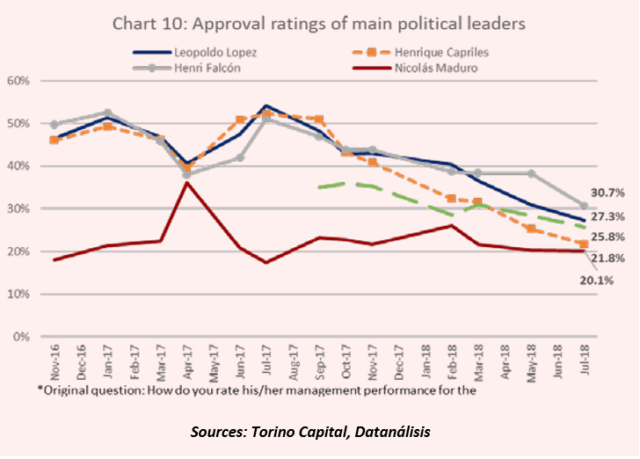
Data from the opposition-aligned pollsters in Venezuela (via Torino Capital) indicates that Henri Falcón was the most popular of the major opposition figures at the time of the May 2018 presidential election. Nicolás Maduro won the election due to widespread opposition boycotting and votes drawn by another opposition candidate, Javier Bertucci.
The constitutional argument that Trump and his accomplices have used to “recognize” Guaidó rests on the preposterous claim that Maduro has “abandoned” the presidency by soundly beating Falcón in the election. Caracas-based journalist Lucas Koerner took apart that argument in more detail.
What about the McClatchy-owned Herald‘s claim that Maduro “continues to reject international aid”? In November 2018, following a public appeal by Maduro, the UN did authorize emergency aid for Venezuela. It was even reported by Reuters (11/26/18), whose headlines have often broadcast the news agency’s contempt for Maduro’s government.
It’s not unusual for Western media to ignore facts they have themselves reported when a major “propaganda blitz” by Washington is underway against a government. For example, it was generally reported accurately in 1998 that UN weapons inspectors were withdrawn from Iraq ahead of air strikes ordered by Bill Clinton, not expelled by Iraq’s government. But by 2002, it became a staple of pro-war propaganda that Iraq had expelled weapons inspectors (Extra! Update, 10/02).
And, incidentally, when a Venezuelan NGO requested aid from the UN-linked Global Fund in 2017, it was turned down. Setting aside how effective foreign aid is at all (the example of Haiti hardly makes a great case for it), it is supposed to be distributed based on relative need, not based on how badly the US government wants somebody overthrown.
But the potential for “aid” to alleviate Venezuela’s crisis is negligible compared to the destructive impact of US economic sanctions. Near the end of Wyss’ article, he cited an estimate from the thoroughly demonized Venezuelan government that US sanctions have cost it $30 billion, with no time period specified for that estimate. Again, this calls to mind the run-up to the Iraq invasion, when completely factual statements that Iraq had no WMDs were attributed to the discredited Iraqi government. Quoting Iraqi denials supposedly balanced the lies spread in the media by US officials like John Bolton, who now leads the charge to overthrow Maduro. Wyss could have cited economists independent of the Maduro government on the impact of US sanctions—like US economist Mark Weisbrot, or the emphatically anti-Maduro Venezuelan economist Francisco Rodríguez.
Illegal US sanctions were first imposed in 2015 under a fraudulent “state of emergency” declared by Obama, and subsequently extended by Trump. The revenue lost to Venezuela’s government due to US economic sanctions since August 2017, when the impact became very easy to quantify, is by now well over $6 billion. That’s enormous in an economy that was only able to import about $11 billion of goods in 2018, and needs about $2 billion per year in medicines. Trump’s “recognition” of Guaidó as “interim president” was the pretext for making the already devastating sanctions much worse. Last month, Francisco Rodríguez revised his projection for the change in Venezuela’s real GDP in 2019, from an 11 percent contraction to 26 percent, after the intensified sanctions were announced.
The $20 million in US “aid” that Wyss is outraged Maduro won’t let in is a rounding error compared to the billions already lost from Trump’s sanctions.
Former US Ambassador to Venezuela William Brownfield, who pressed for more sanctions on Venezuela, dispensed with the standard “humanitarian” cover that US officials have offered for them (Intercept, 2/10/19):
And if we can do something that will bring that end quicker, we probably should do it, but we should do it understanding that it’s going to have an impact on millions and millions of people who are already having great difficulty finding enough to eat, getting themselves cured when they get sick, or finding clothes to put on their children before they go off to school. We don’t get to do this and pretend as though it has no impact there. We have to make the hard decision—the desired outcome justifies this fairly severe punishment.
How does this gruesome candor get missed by reporters like Wyss, and go unreported in his article?
Speaking of “severe punishment,” if the names John Bolton and Elliott Abrams don’t immediately call to mind the punishment they should be receiving for crimes against humanity, it illustrates how well the Western propaganda system functions. Bolton, a prime facilitator of the Iraq War, recently suggested that Maduro could be sent to a US-run torture camp in Cuba. Abrams played a key role in keeping US support flowing to mass murderers and torturers in Central America during the 1980s. Also significant that Abrams, brought in by Trump to help oust Maduro, used “humanitarian aid” as cover to supply weapons to the US-backed Contra terrorists in Nicaragua.
In the Herald article, the use of US “aid” for military purposes is presented as another allegation made by the vilified Venezuelan president: “Maduro has repeatedly said the aid is cover for a military invasion and has ordered his armed forces not to let it in, even as food and medicine shortages sweep the country.”
Calling for international aid and being democratically elected will do as little to protect Maduro’s government from US aggression as being disarmed of WMD did to prevent Iraq from being invaded—unless there is much more pushback from the US public against a lethal propaganda system.
Fiction Plus Coercion Makes Reality: The Illegitimacy of the US-led Coup in Venezuela
By Maximilian C. Forte | Zero Anthropology | February 14, 2019
After considering the economic foundation of current US intervention, designed to erase Venezuela’s economic sovereignty, the purpose here is to focus more on the political side of the equation, not that we can neatly divide the politics from the economics of either the intervention or the defence of sovereignty. What we find is a situation where the anti-government opposition inside Venezuela is limited on three fronts:
(a) it has a narrow base of support among the public, and is thus incapable of producing a “popular uprising,” nor does it command the state machinery;
(b) it relies heavily on foreign support, in other words, the opposite of legitimacy in a democracy—having gone the route of seeking foreign intervention, their real foundation is coercion, not authority; and,
(c) in the absence of any real authority, the leadership is suspended in a web of fiction, which means that it spins fictions of its own power and authority.
Also undermining the legitimacy of the opposition is the US, imposing itself as a supreme tribunal that has arrogated to itself the right to decide on the course of Venezuela’s political future. Right now what we are witnessing is not so much an attempted coup (not yet at least), as much as an intended coup.
Since there is little movement on the ground that would seem to promise anything like an impending removal of the Maduro administration by local forces and by peaceful means, this heightens the possibility of both escalating local violence combined with foreign military intervention. This is especially true since, following the Americans, the opposition rejects dialogue with the government. When claims are exposed as fictions that lack substance, the only way to force them into the domain of reality is through violence.
“Maduro Must Go”: The US as the Ultimate Elector in Venezuela
On February 1 in Miami, in a brazen act of bellicosity that violated international law, US Vice President Mike Pence publicly declared that, “Nicolas Maduro must go,” smearing Maduro as “a dictator with no claim to power” (language oddly reminiscent of the domestic opponents of his own boss). More than that, Pence proceeded to directly threaten Venezuela’s government if it should continue to defy US wishes, in language redolent of classic imperialism:
“Let’s be clear: this is no time for dialogue. This is time for action. And the time has come to end the Maduro dictatorship once and for all…. The United States will continue to assert all diplomatic pressure to bring about a peaceful transition to democracy…. But those looking on should know this: All options are on the table…. And Nicolas Maduro would do well not to test the resolve of the United States”.
“The resolve of the United States”; a US Vice President deciding on whether a foreign leader has the right to stay in power, regardless of those who voted him into power—these examples clearly establish that the real line of conflict here is between the US and Venezuela, and not between Guaidó and Maduro.
Speaking as an official of a rogue state, John Bolton uttered a ridiculously crass threat against President Maduro, in a display of naked imperialism gone wild:
“I wish him [Maduro] a long, quiet retirement on a pretty beach far from Venezuela. And the sooner he takes advantage of that, the sooner he’s likely to have a nice, quiet retirement on a pretty beach rather than being in some other beach area like Guantanamo”.
Interestingly, this is precisely the language of dictatorship: commanding, threatening, abducting, disappearing opponents. The US has a history of not just deposing foreign leaders, but even kidnapping them, when not executing them outright. It is also the speech of a rogue state—no state that respects international law allows its officials to routinely and casually threaten others in this manner. After expressing desires to loot Venezuela’s wealth, they now publicly entertain fantasies of abducting Venezuela’s elected president.
These were not the only times that the Trump administration directly threatened the government of Venezuela with regime change. In July of 2017, then CIA director Mike Pompeo spoke at the Aspen Security Forum about working with Colombia, the Venezuelan opposition, and the CIA in developing “options” for regime change, just a month after Colombia joined NATO as a “Global Partner”. Then on August 5, 2018, an attempted assassination against Venezuelan President Nicolas Maduro took place. Soon after that, Nikki Haley, the US ambassador to the UN at the time, went on a tour to Colombia’s border with Venezuela, covered exclusively by Fox News, in which she advocated for the illegal overthrow of Venezuela’s government. Outside of the UN building in New York, US ambassador Nikki Haley chose to violate the UN Charter itself by openly advocating for the overthrow of a foreign government and hinting loudly that it would happen thanks to strong US intervention. On Thursday, September 27, 2018, Haley shouted into a megaphone in front of demonstrators: “We are going to fight for Venezuela and we are going to continue doing it until Maduro is gone!… We need your voices to be loud, and I will tell you, the US voice is going to be loud”.
“I will tell you, the US voice is going to be loud,” said Haley in reprising George W. Bush’s threat prior to invading Afghanistan (America’s 18-year tale of “success” in Central Asia). The fact of the matter is that the US never imagined that the removal of Maduro’s party from power could ever happen organically and thanks purely to local dynamics. It was always to be something artificial, a fiction brought to life through American violence. The threat of military intervention, which itself flouts international law, was made in the first months of the Trump administration.
From as early as August of 2017 Trump was already suggesting the possibility of a US military coup to overthrow Venezuela’s government. This was before the elections it would discount were even announced. Then Secretary of State Rex Tillerson repeated the suggestion in February 2018, and said Maduro should leave the country altogether and retire in Cuba, much like Bolton above would later do. (The suggestion that Tillerson was among those “pushing back” against Trump’s move to military conflict with Venezuela, is thus pure fantasy. It’s part of the liberal “resistance” veneration of transnationalist oligarchs like Tillerson as representing one of the “adults in the room”.) Again, even before elections had been called in Venezuela, Trump threatened Venezuela with US military intervention.
Venezuela’s government made it clear that one thing that would never be “discussed” with the US (which wants to discuss nothing) would be Venezuela’s sovereignty, and Maduro announced that the military was ready to fight back against US intervention. As for Trump’s repeated threat military options are “on the table,” Maduro simply replied: “There will be no war or military intervention”. In the meantime, however, Venezuela is preparing to make any US military escalation as costly as possible to the US—something which several forces in the world have successfully done, starting with Vietnam, and then especially since 2001. In addition, Maduro in a letter to Trump, asked if politicians in Washington were ready to send their country’s “sons and daughters to die in an absurd war” (unfortunately, we already know the answer to that question).
However, underlining the illegitimacy of the intended coup, the overwhelming majority of Venezuelans are very far from supporting either Guaidó or the US when it comes to US military intervention and economic sanctions. Even before Trump threw his support behind Guaidó, local polling data from Venezuela showed that 86% of Venezuelans were against any foreign military intervention, and 81% opposed the US’ sanctions. With respect to seeking US intervention, Guaidó represents the 14%. In addition, recently launched was a largely symbolic, political campaign to get 10 million signatures of Venezuelans denouncing US intervention; a large rally came out in support to start the process. Should foreign military intervention happen, done in the name of “helping Venezuelans,” it should be remembered that such intervention has virtually no support in Venezuela itself.
The “Early Elections” Ruse
Call new presidential elections—this has been one of the key commands coming from the Venezuelan opposition’s foreign backers. Before 2019 the command was call early elections. Yet when the US and their Venezuelan force multipliers previously pressed the Venezuelan government to hold early elections—just as their EU counterparts would do again in January 2019—they then turned around and condemned the announcement of early elections. Now once again the demand is for new, early elections: states like Spain instructed the Venezuelan government to declare, within eight days, that new elections would be held, or else Spain and others would recognize Guaidó—an ultimatum on how Venezuela should conduct its domestic politics. Venezuela’s government of course rejected this demand outright.
This then raises a key question: if these outside interests did not accept the last elections, why would they accept the results of the next ones? All previous elections had been widely recognized as free and fair, and it was the same system which produced the opposition’s victory in the now defunct National Assembly. Indeed, as recently as August of 2017, the opposition itself accepted the new Constituent Assembly’s call for gubernatorial elections. It was the same system in which Maduro won his re-election, and would be the same for any new elections. Yet the same governments that oppose Maduro, falsely claim that he “stole” the election—and if he had stolen it, it wasn’t from Guaidó, who did not run as a candidate. Clearly the ultimatum, unacceptable as it was shockingly arrogant, was meant as bait to trigger even further intervention: EU-supervised and EU-designed elections perhaps (and let’s not forget the Haitian elections that were rigged under UN auspices). Those EU states which then officially recognized Guaidó were rightly denounced by Russia for engaging in brazen intervention in a sovereign nation’s internal affairs.
In order to denounce past elections while calling for new ones, the US had to fabricate the myth of illegitimate elections in Venezuela. Thus the Trump administration directly threatened with targeted sanctions a leading opposition candidate, Henri Falcón, who was considering launching a presidential campaign, warning him not to do so. The US’ top diplomat in Venezuela even met with Falcón, to persuade him not to run. Widely reported polls showed that he had a good chance of winning the election too. The Venezuelan opposition was instructed by the US to boycott the election, in order to produce what could then be called a “sham”. Mike Pence thus decided in advance that the elections would be a sham, without a shred of evidence provided. The same argument was made by some of the opposition, that Maduro’s election was illegitimate—an election held using the very same system that won the opposition their own seats. There is no evidence to deny that Maduro’s election followed all of the proper legal procedures, and though the turnout was low, Maduro’s share of eligible voters was higher than that of Trump in 2016 and Obama in 2012.
Now here is where myth-making has taken a new turn. Those states which now recognize Guaidó as the president of Venezuela, cannot very well press the demand for new elections on Maduro. To do so would be to continue legitimizing Maduro as the President. So it is now up to Guaidó to call for early elections. Has he done so? After all, if he really believed he was the interim president, with all of the rights and duties of an interim president, then it was his job to call new elections in 30 days. Guaidó has not done so, and this violates the very Constitution which he claims to be defending. The defunct National Assembly has instead invented some new parts of the Constitution—because they simply do not exist in that document—about “technical conditions” that give Guaidó the right to be interim president not just for 30 days, but for a whole year now. Talk about dictatorship. The idea is to deny Maduro and his whole government any legitimacy, an argument that also fails, and it backfired on the opposition with all of its petty, selective, and inventive legalisms about “the Constitution” (which they themselves violate).
The legitimacy of Maduro’s government was rarely respected by his domestic opposition, and almost never by the more powerful extraterritorial opposition represented by US power. And as Maduro clearly pointed out, Venezuela has had no deficit of elections (six occurred in the past 18 months alone, at different levels of government)—so elections themselves are neither the root of the problem, nor can they be a solution.
The Venezuelan government repeated that it was open to holding talks with the opposition, which the opposition continues to publicly refuse. President Maduro also held out the offer of early elections for the legally constituted Constituent Assembly. That offer has also been rejected.
“No Dialogue” Means Violence, No Democracy
Imagine you claim to be interested in defending democracy. Then imagine you reject any dialogue whatsoever with fellow citizens who have views that differ from yours. Are you really interested in democracy then? Imagine you believe yourself to represent the majority, but still the opposing side represents a significant minority, and yet you refuse to deal with the other side. Does that advance democracy?
The US claims that it is seeking peaceful and diplomatic means of securing regime change in Venezuela, a goal which is neither peaceful nor diplomatic. Unable to reconcile this harebrained contradiction, the US inevitably rejects any dialogue with the government of Venezuela, dismissing an offer of mediation by Mexico and Uruguay. This underscores the perverse definition of “diplomacy” that the US has adopted. For successive US regimes, “diplomacy” is merely a default position—it means everything that is not outright “shock and awe”. Saying there can be no dialogue whatsoever, narrows the avenue of peaceful solutions. Moreover, whatever the US seeks, by seeking it in Venezuela its actions can only go against democracy—Venezuelans did not elect the US government, and did not elect to have it involved in their affairs, let alone usurp the authority of Venezuelans.
Guaidó has dutifully echoed the US line in consistently dismissing dialogue, while Maduro has been just as consistent in offering it. Meanwhile, other top opposition leaders in the country—for example, the two former presidential candidates of the two main traditional parties, Claudio Fermín and Eduardo Fernández—have instead favoured “electoral participation and recognition of the legitimacy of the Maduro government”. Not all of the opposition has chosen the avenue of treason that beckons violence.
One thing is certain, this time Venezuela has reached a turning point and there is no going back. The most tragic and extreme steps have been taken, precisely the kinds which should never have been taken. A number of actors are going to have to pay a very high price for their decisions. On the opposition’s side, those who actively involved a foreign imperial power in the domestic affairs of Venezuela, who behave as if it were natural and normal for the US to have a say in Venezuelan politics, and who proceed like they have the full support of US military power authorizing their actions—the price they will need to pay will have to be the maximum one. On the government’s side, those whose decisions and whose many errors of omission and commission have helped to fan the flames of crisis, may find their own future is not assured.
Temir Porras Ponceleón, who served as chief of staff to Nicolás Maduro from 2007 to 2013, and is now a visiting professor at Sciences Po in Paris, has shared a series of important observations and questions about the election issue and the civil war issue, in a hypothetical post-Maduro Venezuela. In a recent interview, he raised these questions:
“We can imagine the crisis getting deeper. Probably the government collapsing, but what about the day after? What about the military of Venezuela? What about the divisions within the military? What I am concerned is, to have a stable and democratic country the day after. And that requires not provoking each other, political dialogue and understanding”.
About the opposition, if it came to power, he asks:
“Do they have a plan to guarantee that this country remains stable and democratic? The day after, do they guarantee that they will not allow, for instance, the US government or the US troops to enter Venezuela? Do they have a plan to deal with the Venezuelan military?”
Then there is the real possibility of a civil war erupting if Maduro leaves or is forced from power:
“And what guarantees that the departure of Maduro doesn’t create a civil war, for instance? The reality of Venezuela is that it is a very polarized country. It is totally unrealistic or irresponsible to think or to assume that there are all the guarantees for Venezuela to be in a peaceful situation. In order to be an election, you have to agree on the terms of that election. When will the election be held? Who can be allowed to run for those elections? And that’s exactly the problem—saying there will be elections is assuming that the problem is solved before even addressing it”.
Ponceleón thinks that it is “highly likely” that the situation will escalate into a civil war in Venezuela. On one point at least, we can already address his question: the opposition cannot guarantee a democratic Venezuela, because it has chosen the most undemocratic means available to it: foreign military intervention. It would be useful to remember that one of the principal ways of conceiving democracy, that came out of many formerly colonized nations, was that democracy meant freedom from alien domination. Any time a foreign power exercises its might in determining the affairs of another people, no matter what those people produce cannot be democratic because the context in which they operate itself stands against democracy.
US intervention, by definition, cancels out self-determination and that means democracy is impossible under such circumstances.
Fictions: Delusions of Authority
There is a serious problem with the person who was appointed and announced himself as the “interim president” of Venezuela, Juán Guaidó. The problem might be diagnosed as megalomania—having serious delusions of authority. In just the last three weeks, Guaidó has gone on record with the following positions:
- Guaidó claimed to have won the support of the United Nations Security Council (UNSC);
- Guaidó acted as if he was in a position to issue orders to the military;
- Guaidó claimed to have obtained foreign aid, though no one knows how it entered the country; and, best of all,
- Guaidó presumed that he was the one to authorize US military intervention.
With the possible exception of the third point, there is a definite pattern here. It involves a realty-denial problem, that is prone to spin fictions. It is what one can expect from someone, unknown to the vast majority of Venezuelans and whose party controlled only 14 seats of the 167 in the defunct National Assembly. It is the posture of a person who was not elected to be president, claiming that the elected president is a sham. The only thing authorizing Guaidó’s fabrications is the power of the US standing behind him. From not having dialogue with Venezuelans, to not having a dialogue with reality, the program represented by Guaidó is that of a fiction waiting—wanting—to become reality. The only chance it has of becoming reality is that it has to be forced through, with massive violence. Why? Because it is artificial; because it is not a program that arises from its grounding in facts. It is pure ideology, at its worst; it is the kind of ideological stance that leads one to foolishly engage in comical stunts on the one hand, while begging for war on the other hand.
Fictions: Movement on the Ground
“What’s going on within Venezuela itself?” asks Paul Dobson—“The answer, however, is not much”. With all the media noise about governments backing the opposition’s claim to presidential authority (in a transparent violation of international law), there is little to show for the opposition making any headway inside Venezuela itself. In fact, most of the hum-drum of everyday life continues, with a few isolated protests, and no public disorder—“conspicuously absent are any of the tell-tale signs of a genuine power shift that might indicate that the government is about to fall”. As Dobson observes, “the man whose name 81 percent of Venezuelans didn’t even know one month ago has not managed to spur the country into the sort of popular action at all levels of society which he probably needs to make this attempted coup a reality”. Guaidó’s primary base of power is his foreign backing, primarily that of the US; his only claim to authority is acting as a gatekeeper of foreign aid allegedly smuggled into the country. As a real president, little would be different, having vowed to sell off Venezuela’s oil facilities to foreign private interests. Guaidó’s greatest achievement would be to become Venezuela’s version of Ashraf Ghani—a figurehead, propped up by foreign aid, overseeing a badly divided country. The only way for a fiction of authority to become a reality is through massive force (violence), and then it only becomes a farcical reality whose life will be short.
On Saturday, February 2, Guaidó’s loudly touted opposition protests occurred, passing without changing anything in the country and even receiving minimal international media coverage. Loudly denounced as a “brutal dictatorship,” the government did absolutely nothing to “repress” the demonstrations, and nobody was reported as hurt or killed. At the same time, a pro-government march countered the opposition protest, and according to some reports, was much larger. In fact, footage of the pro-government demonstration was dishonestly used by Fox News’ Neil Cavuto as he spoke of the opposition rally—when the screen behind him showed a huge mass of people wearing red, the governing party’s colour, along with members of militias. The BBC was at least able to tell the two apart. The opposition protesters were said to number in the “tens of thousands,” which falls far short of the millions who attended pro-government rallies in the past, or a number rivalling the opposition that turned out for Maduro on the same day. Guaidó clearly lacked faith in the possibility of a popular uprising materializing, and he thus continued to call for high-level military defections and for US intervention (though some of the so-called “defectors” were revealed to be fakers)—and the US was reportedly making direct contacts to persuade Venezuelan officers to “defect”. The Saturday protests followed from those held earlier, on Wednesday, January 30, which were reported to be very small and largely confined to the traditional opposition stronghold. Guaidó called for new opposition protests to be held on February 12, clearly not confident that any change would happen anytime soon. The protests came and went, without incident, and without any change. So now the opposition invented a new milestone: February 23, when they said they would push to unblock “aid” sent by the US, which would indeed be using such aid to provoke a violent confrontation, which is likely one of the US’ original objectives in sending the “aid” against the wishes of the legitimate government. (Meanwhile even Colombia’s International Red Cross views the “aid” as a US ploy and said it would have no part in distributing it.)
Indicative of Guaidó’s own lack of confidence, which stems from his lack of legitimacy and the opposition’s over-reliance on foreign support, he made the absurd declaration that he was not ruling out “authorizing” US military intervention. Apparently he was usurping power in the US too now. Responding appropriately, US Representative Ro Khanna stated: “Mr. Guaido, you can proclaim yourself leader of Venezuela but you don’t get to authorize US military interventions”. Khanna added that US legislators would authorize no such action. In a further attempt to pretend he has authority, Guaidó then “ordered” Venezuela’s military to let in “aid” sent by the US—with no sign whatsoever that the military intends to “obey” him.
The Question of International Recognition
In North America, most of the media instruct us on the names and/or numbers of countries that have called on Maduro to step down, and which have recognized Guaidó’s interim presidency. They say little or nothing about all of the countries which have not done so; instead, they occasionally select a certain few that have been the loudest in denouncing the intended coup. The fact of the matter, however, is that the overwhelming majority of the United Nations’ member states continue to acknowledge President Maduro as the legal and legitimate head of government and state in Venezuela—they have made no move whatsoever to withdraw that recognition.
Note that the US took its attempt to shore up support for its force multipliers—the opposition “led” by Guaidó—to the UN Security Council, and not the UN General Assembly which would have meant allowing all member states a vote. The proportion of those supporting the US is greater in the UNSC than in the UNGA. Americans, great tellers of tall tales and ardent fans of impression management, believe that “optics matter”—any performer of magic tricks would immediately agree.
The US failed in its effort to get the United Nations Security Council to support its coup initiative of delegitimizing Maduro and recognizing Guaidó. China, Russia, Equatorial Guinea, and South Africa were some of the countries that expressed support for the Maduro government at the UNSC on January 26, and blocked the US from passing its resolution. China was in fact one of the countries that sent an official delegation to Maduro’s inauguration earlier in the month. Venezuela’s foreign minister, also speaking at the UNSC, declared: “The United States is not behind the coup d’état, it is in the vanguard”. He also blasted a European ultimatum demanding new elections: “Nobody is going to give us deadlines or tell us if there are elections or not”. Russia’s position at the UNSC was not just correct, it was absolutely correct: Venezuela’s internal affairs should never have been brought to the Security Council for discussion in the first place. As Russia’s foreign minister explained, Venezuela “does not represent a threat to the international community, but Washington’s actions do”. This has apparently not stopped the US from returning to the UNSC with a proposed resolution asking it to intervene in Venezuela’s domestic politics, by demanding a new presidential election. Meanwhile, Guaidó’s imagination knows no limits when it comes time to assuming authority: he reportedly told RT that the UNSC has endorsed his side and its attempted coup, not the only “fake news” which he tried to manufacture in that interview.
The UN has since said it would support, not the “Lima Group,” but the Montevideo dialogue, of which Caribbean states have been a key source of momentum (also in opposition to the OAS’ head). The UN Secretary General, Antonio Guterres, also explicitly condemned any move toward foreign military intervention in Venezuela: “The time for an era of foreign intervention passed long ago”. As for the Lima Group, the main outcome of its Ottawa meeting to discuss ways to screw Venezuela, was essentially to call on the military to engage in a coup—so much for “liberal democracy”. Maduro has rejected all EU intervention and also affirmed his support for the Montevideo dialogue instead. That dialogue, however, had thus far only produced a European-backed resolution which Bolivia opposed. The first meeting thus ended with a non-unanimous statement—the obstacle being the Europeans pressing for new presidential elections.
While about 48 governments have recognized Guaidó (usually not in consultation with their electorates), 141 countries, that is, the vast majority of UN members did not heed the US’ call to recognize him. No wonder the US never took its case to the UN General Assembly, where its defeat would have been even more humiliating, and instructive, than it was at the Security Council. Yet, some of the propagandistic North American media, such as Bloomberg, essentially whited out most of the world in order to claim that “global leaders” have backed Guaidó. The rest simply do not exist on their map. They count as those opposing recognition of Guaidó only those that have openly said they would not do so—dismissing those who also have not offered recognition, but who have stayed quiet on Maduro (which is what actual non-intervention looks like). In addition, Bloomberg’s graphic is suitably small enough that we cannot see more than a dozen Caribbean states that have explicitly rejected foreign intervention and recognition of Guaidó. Bloomberg also fails to question the opposition’s fanciful imagining of Russia, China, and Turkey as being “neutral”—so even those countries’ opposition is rhetorically whitewashed. This is a reality-denial problem. Much better, though not perfect, are Venezuelanalysis’ accurate and up-to-date infographics which demonstrate one basic reality very starkly: the world is mostly divided between the “Global North,” made up mostly of former colonial and imperial powers, and the “Global South,” but even more than that it shows what an increasingly multipolar world looks like.
Among the countries that continue to recognize Maduro are the overwhelming majority of African states (with a single exception), Caribbean states (with a single exception), all of Asia, and the Middle East (with one exception).

“Is Venezuela yours?… How do you oust a person who came to office through elections? How do you hand over presidential [powers] to someone who did not even get elected? Do you know what democracy is?”
Earlier, Erdogan in a message to President Maduro exclaimed: “Maduro, brother, stand tall”. Turkey has developed close economic and political ties with Venezuela, and the two leaders have visited each other’s countries in recent years. As for any possible outreach to Russia, the Venezuelan opposition will find itself immediately blocked. Russia does not respect Guaidó as anything other than an instrument of a foreign power, and thus there is no point in holding talks directly with him.
The Venezuelan government promised to review its ties to states that recognized Guaidó, and also promised a symmetrical response to US sanctions and seizures of Venezuela’s assets. Nothing about Maduro suggested he was either intimidated or considered surrendering to US wishes. Maduro insisted he was still interested in good relations with the US, but explicitly not with its government, saying that relations in areas except diplomacy and politics were welcome. What else does one say to those who will not even speak to you?
Lastly, let’s consider those illustrious members of the US Congress: when interviewed on the subject of intervention in Venezuela, they displayed a remarkable degree of not just dishonesty and hypocrisy, but what could also be easily classed as gross intellectual incompetence and even cowardice. It is difficult to locate a better collection of buffoonery in which alcohol was ostensibly absent.
While on the right, figures like Senator Rand Paul stood out in their opposition to US foreign intervention, on the subject of Venezuela it is a small group of particularly bright and courageous young Democrats who have taken the right stand: Tulsi Gabbard, Ro Khanna, and the unflappable Ilhan Omar, who recently interrogated Elliot Abrams. Abrams, is the neoconservative Never Trumper whom Trump has appointed the US “special envoy” for Venezuela. Omar’s comments were not only accurate and on target, they were long overdue. Fox News could only express “shock” (eloquence usually has that effect on them), repeatedly calling the exchange between Omar and Abrams “stunning” (because facts are loathsome things)—but without ever offering a single substantive point to counter Omar’s presentation. They did, however, raise the issue of her identity.
US Air Freight Company that Smuggled Weapons Into Venezuela Linked to CIA “Black Site” Renditions
By Whitney Webb | MintPress News | February 13, 2019
GREENSBORO, NORTH CAROLINA – Two executives at the company that chartered the U.S. plane that was caught smuggling weapons into Venezuela last week have been tied to an air cargo company that aided the CIA in the rendition of alleged terrorists to “black site” centers for interrogation. The troubling revelation comes as Venezuelan President Nicolás Maduro has rejected a U.S. “humanitarian aid” convoy over concerns that it could contain weapons meant to arm the country’s U.S.-backed opposition.
Last Tuesday, Venezuelan authorities announced that 19 rifles, 118 ammo magazines, 90 radios and six iPhones had been smuggled into the country via a U.S. plane that had originated in Miami. The authorities blamed the United States government for the illicit cargo, accusing it of seeking to arm U.S.-funded opposition groups in the country in order to topple the current Maduro-led government.
A subsequent investigation into the plane responsible for the weapons caché conducted by McClatchyDC received very little media attention despite the fact that it uncovered information clearly showing that the plane responsible for the shipment had been making an unusually high number of trips to Venezuela and neighboring Colombia over the past few weeks.
Steffan Watkins, an Ottawa-based analyst, told McClatchy in a telephone interview that the plane, which is operated by U.S. air cargo company 21 Air, had been “flying between Philadelphia and Miami and all over the place, but all continental U.S.” during all of last year. However, Watkins noted that “all of a sudden in January, things changed” when the plane began making trips to Colombia and Venezuela on a daily basis, sometimes multiple times a day.
According to Watkins’ analysis, this single plane had conducted 40 round-trip flights from Miami International Airport to Caracas and Valencia — where the smuggled weapons had been discovered — in Venezuela, as well as to Bogota and Medellin in Colombia in just the past month.
Publicly available flight radar information shows that the plane, although it has not returned to Venezuela since the discovery of its illicit cargo, has continued to travel to Medellin, Colombia, as recently as this past Monday.
Multiple CIA ties
In addition to the dramatic and abrupt change in flight patterns that occurred just weeks before U.S. Vice President Mike Pence prompted Venezuelan opposition member Juan Guaidó to declare himself “interim president,” a subsequent McClatchy follow-up investigation also uncovered the fact that two top executives at the company that owns the plane in question had previously worked with a company connected to controversial CIA “black sites.”
Indeed, the chairman and majority owner of 21 Air, Adolfo Moreno, and 21 Air’s director of quality control, Michael Steinke, both have “either coincidental or direct ties” to Gemini Air Cargo, a company previously named by Amnesty International as one of the air charter services involved in a CIA rendition program. In this CIA program, individuals suspected of terrorism were abducted by the intelligence agency and then taken abroad to third-country secret “black sites” where torture, officially termed “enhanced interrogation,” was regularly performed.
Steinke worked for Gemini Air Cargo from 1996 to 1997, according to a 2016 Department of Transportation document cited by McClatchy. Moreno, although he did not work for Gemini, registered two separate businesses at a Miami address that was later registered to Gemini Air Cargo while the CIA rendition program was active. McClatchy noted that the first business Moreno registered at the location was incorporated in 1987 while the second was created in 2001. Gemini Cargo Logistics, a subsidiary of Gemini Air Cargo, was subsequently registered at that same location in 2005.
21 Air has denied any responsibility for the weapons shipment discovered onboard the plane it operates, instead blaming a contractor known as GPS-Air for the illicit cargo. A GPS-Air manager, Cesar Meneses, told McClatchy that the weapons shipment had been “fabricated” by the Maduro-led government to paint his government as the victim. Meneses also stated that “the cargo doesn’t belong to 21 Air and it doesn’t belong to GPS-Air” and that it had been provided by third parties, whose identities Meneses declined to disclose.
Contras redux?
The revelation that the company that operates the plane caught smuggling weapons into Venezuela has connections to past controversial CIA programs is unlikely to surprise many observers, given the CIA’s decades-long history of funneling weapons to U.S.-backed opposition fighters in Latin America, Southeast Asia and other conflict areas around the globe.
One of the best-known examples of the CIA using airliners to smuggle weapons to a U.S.-backed paramilitary group occurred during the 1980s in what became known as the Iran-Contra scandal, in which the Reagan administration delivered weapons to the Contra rebels in order to topple the left-leaning Sandinista movement. Many of those weapons had been hidden on flights claiming to be carrying “humanitarian aid” into Nicaragua.
The parallels between aspects of the Contra scandal and the current situation in Venezuela are striking, particularly given the recent “outrage” voiced by mainstream media and prominent U.S. politicians over Maduro’s refusal to allow U.S. “humanitarian aid” into the country. Maduro had explained his rejection of the aid as partially stemming from the concern that it could contain weapons or other supplies aimed at creating an armed opposition force, like the “rebel” force that was armed by the CIA in Syria in 2011.
Though the media has written off Maduro’s concern as unfounded, that is hardly the case in light of the fact that the Trump administration’s recently named special envoy in charge of the administration’s Venezuela policy, Elliott Abrams, had been instrumental in delivering weapons to the Nicaraguan Contras, including hiding those weapons in “humanitarian aid” shipments. In subsequent testimony after the scandal broke in the 1980s, Abrams himself admitted to funneling weapons to the Contras in exactly this way.
With the recently uncovered illicit weapons shipment from the U.S. to Venezuela now linked to companies that have previously worked with the CIA in covert operations, Maduro’s response to the “humanitarian aid” controversy is even more justified. Unfortunately for him, the U.S.-backed “interim president,” Juan Guaidó, announced on Monday that his parallel government had received the first “external” source of “humanitarian aid” into the country, but would not disclose its source, its specific contents, nor how it had entered the country.
Hands off ‘our hemisphere’ or Venezuela pays the price: US Senator warns Russia
RT | February 13, 2019
The US staked a claim on half the world, as Senate Armed Services Committee chair Jim Inhofe said Washington might have to intervene in Venezuela if Russia dares set up a military base not just there, but “in our hemisphere.”
“I think that it could happen,” Inhofe (R-Oklahoma) told a group of reporters on Tuesday. “You’ve got a guy down there that is killing everybody. You could have him put together a base that Russia would have on our hemisphere. And if those things happen, it may be to the point where we’ll have to intervene with troops and respond.”
Should Russia dare encroach on the US’ neck of the woods, Inhofe said: “we have to take whatever action necessary to stop them from doing that.”
As opposition leader Juan Guaido vies for power, the Russian government has stuck by President Nicolas Maduro. Russia has not, however, promised military aid to Maduro, and Russian diplomat Alexander Shchetinin said on Monday that Venezuela has not requested military aid from Moscow.
After Guaido declared himself interim president of Venezuela last month, US President Donald Trump immediately recognized Guaido as Venezuela’s legitimate leader. Since then, the US has pledged humanitarian aid to Guaido, called on Venezuela’s military to support him, and slapped Maduro’s government with fresh economic sanctions. Maduro has denounced Washington’s sponsorship of Guaido as a “vile” coup attempt but nevertheless called for talks with the opposition leader. The US has outright rejected taking part in any discussions with Maduro.
The US has stopped short of deploying troops to Venezuela, despite Trump and national security adviser John Bolton both saying the option is “on the table.” Speaking on Tuesday, Inhofe agreed and suggested that Trump could launch a military operation in Venezuela without Congressional authorization.
“I don’t think it’s necessary,” he said. “If there is a threat that reaches the threshold of the president having the ability, the constitutional ability of deploying troops, then that’s an unknown. We don’t know right now.”
Russian Foreign Minister Sergei Lavrov warned the United States against military intervention on Tuesday.
“Lavrov has warned against all interference in Venezuela’s domestic affairs including the use of force threatened by Washington and which is in violation of international law,” the Russian foreign ministry said in a statement.
‘Our hemisphere’
Inhofe said that a flow of Russian troops or weapons into the Western hemisphere “would be a threat to the United States of America.” The United States, meanwhile, reads from a different rulebook.
The US maintains nearly 800 military bases in over 70 countries worldwide, with a foothold on every continent. And, while Inhofe wants to keep an entire hemisphere free from Russian influence, the US is currently in talks to establish a permanent military base in Poland, right on Russia’s doorstep. Given the long history of animosity between Poland and Russia, the Polish government has offered to cough up $2 billion towards setting up the base.
Further afield, no hemisphere is beyond the reach of the United States. The US military divides the globe up into six Combatant Command ‘Areas of Responsibility,’ which it maintains in times of peace and war. Russia, meanwhile, divides its territory into four military districts, all within its own borders.


U.S. Is Setting Ground For Military Intervention In Venezuela
South Front | February 12, 2019
The Venezuelan government seems to be openly preparing to face a US military invasion.
On February 10, the country’s military kicked off large-scale military drills, which will run until February 15. According to President Nicolas Maduro, the drills are set to become the biggest ones the country has held in its 200-year history.
On the same day, multiple air defense systems, including Pechora-2M launchers, were spotted maneuvering in the area of San Cristobal, near the border with Columbia, an expected member of the US-led coalition in the event of invasion in Venezuela.
On February 7, Israel’s satellite company ImageSat International released a satellite image, allegedly showing that the Venezuelan military was releasing its S-300VN air defense system from mothballs in Captain Manuel Rios Airbase on February 4.
Separately, President Maduro announced the setting up of 50,000 “popular defence units” and promised that the US will get a South American “Vietnam War” if it decides to invade.
The military preparations came amid several important security developments. In January, authorities detained fugitive Colonel Oswaldo Garcia Palomo after he had crossed back into the country from Colombia. On February 7, he appeared on a video confessing to his ties with the CIA and Colombian officials to overthrow the Maduro government. According to Venezuelan Information Minister Jorge Rodriguez, Palomo was involved in an effort to rally soldiers to mutiny, close off the capital and overtake the presidential palace.
On February 5, authorities seized a shipment of US-made weapons, which was discovered at a storage yard of Arturo Michelena International Airport in the city of Valencia. The stash included at least 19 rifles and 118 magazines, high-caliber ammunition, as well as 90 radios and six mobile phones – and was likely sent from Miami, Florida on February 3.
At the same time, Washington is reportedly engaged in so-called direct contacts with representatives of the Venezuelan military and government to convince them to support the coup and help to bring US-proclaimed Interim President Juan Guaido into power. These efforts achieved at least a partial success.
On February 2, Air Force General Yanez, reportedly defected to the opposition’s side. He called for others to follow him in supporting “the right side.” On February 9, Colonel Ruben Paz Jimenez declared his support to the opposition. Separately, two more service members, Captain Hector Luis Guevara Figueroa and Army pilot Carlos Vásquez defected and called for others to do so.
Another, but also important front is the media sphere. US President Donald Trump openly states that he does not rule out a military option for Venezuela. Nonetheless, Washington still needs some formal pretext. Therefore, State Secretary Mike Pompeo declared in an interview with FOX Business that there is a growing Hezbollah and Iranian influence in Venezuela.
“People don’t recognize that Hezbollah has active cells — the Iranians are impacting the people of Venezuela and throughout South America. We have an obligation to take down that risk for America and how we do that in South America and all across the globe,” Pompeo said.
Washington says that Hezbollah, which it is considers to be a terrorist group, has been using Latin America as a base of fund-gathering for years. If it accidentally appears that the Maduro government has “deep ties” with Hezbollah, this could become a sufficient and necessary condition to propel a military intervention.
One more point of pressure is the delivery of the US humanitarian aid, which the Venezuelan government rejects.
President Maduro called this effort a “fake humanitarian assistance” designed to “humiliate” the country and “justify a military aggression”. On February 9, Guaido stressed that he would not rule out authorizing a US military intervention, whenever the term “authorizing” means in the case of the nation leader appointed from Washington.
With all these public statements and accusations, the White House cannot afford to tolerate the Maduro victory in the ongoing standoff. So, the US will continue to ramp up the pressure in political, economic and clandestine spheres. However, if these measures appear to be not enough to overthrow the government, a more direct action, including a military invasion, may be implemented.
Being Marco Rubio
The boyish senator from Florida is owned by the Israel Lobby
By Philip Giraldi • Unz Review • February 12, 2019
Americans consistently indicate in opinion polls that they approve of congress less than any other part of the federal government. The approval rating is sometimes in the single digits. As the congress was intended, per the Founders, to serve as the direct link to the American people, there is a certain irony in its being the most despised branch of government.
One can blame the two major parties for much of the negativity, as the process whereby candidates for office rise through the system that seems designed to weed out anyone who has ever expressed any viewpoint that is not approved by the bipartisan establishment. Indeed, many Americans complain that Democratic and Republican congress critters differ only superficially, both being corrupt from top to bottom and largely driven to stay on top so they can continue to benefit personally from the spoils of office.
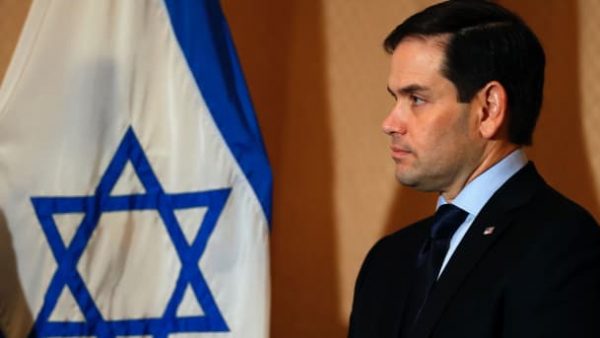
One of the emptiest of all the empty suits in the Senate is Marco Rubio of Florida. The boyish looking Rubio is, to be sure, ambitious, but his thought processes, if they exist at all, are hard to discern. He is, more than most congressmen, both totally ignorant and completely programed in what he says and how he says it. Anyone who doubts that judgement should watch the February 2016 debate with former New Jersey governor Chris Christie in which Christie totally destroyed Rubio, effectively ending his bid to become the GOP candidate for president. Christie criticized Rubio for memorizing a “25-second speech that is exactly what his advisers gave him.” The two argued, but Rubio seemed stuck with his stump speech, which Christie called him out on every time he launched into it. Christie eventually turned and told the audience “There it is. The 25-second memorized speech.”
Rubio is pretty much straight-line neocon in his pronouncements, his most recent policy statement being that the Venezuelan people have two choices – change their government or starve. He tweeted it with his usual eloquence: “Hunger & desperation is growing inside #Venezuela & people know the only thing standing in the way of $50 million of food & medicine is #Maduro. Military leaders should make a choice, before a choice is made for them. The window for a negotiated exit is closing fast.” Columnist Whitney Webb responded with “Marco Rubio is openly saying that if Venezuela’s military doesn’t turn on Maduro soon, ‘a choice will made for them’ by the United States. Scariest threat for an imminent invasion of Venezuela I have yet to see.”
Rubio, who is Cuban-American, is inevitably hard-line against taking any steps to improve relations with his ancestral homeland, is hostile to “enemies” Russia and China, and wants American soldiers to stay in Afghanistan and Syria forever. It is a formula for continuous conflict worldwide, with the United States paying the tab both in dollars and in casualties.
But Senator Marco Rubio’s greatest affection is reserved for the Jewish state Israel. Why? Because that’s where his money and political support come from, and, for its part, the Israel Lobby sees Rubio as a perfect simple-minded patsy to advance its agenda. Israel’s promoter with the deepest pockets, casino magnate Sheldon Adelson, was pursued by Rubio who “… consistently championed Israel in speeches on the Senate floor while also pushing legislation aimed at supporting the cause” during the GOP nomination process. Rubio eventually received Adelson’s endorsement in February 2016.
Before acquiring Adelson’s support, Rubio had “already gained support from Miami billionaire Norman Braman and New York billionaire investor Paul Singer, among others.” Both Braman and Singer are known to be major supporters of Israel. Marco’s affection for both Israel and Florida Jews derives largely from his connection to Braman, a former Philadelphia Eagle’s owner and currently a billionaire Miami resident who owns Florida’s largest network of car dealerships. Braman, an active supporter and funder of the illegal Jewish settlements in the Middle East, has been Rubio’s major financial backer since his early days in Florida state politics and as a quid pro quo whenever Marco expresses his love for both Jews and Israel, he is speaking to and for Braman.
Rubio has recently written, or had written for him, an op-ed in The New York Times entitled “The Truth About BDS and the Lies About My Bill” that seeks to explain why recent legislation to protect Israel that the senator sponsored does not violate the First Amendment guarantee of free speech.
Senate bill S.1 for 2019 finally passed out of the Senate last week on a 77 to 23 vote with Rand Paul as the only Republican Senator to vote against it. The full title of S.1 is the Strengthening America’s Security in the Middle East Act of 2019, which might be considered a bit of a fraud as it has nothing to do with the United States and is really all about giving Israel money and anything else it might desire, to include destroying the nonviolent Boycott, Divestment and Sanctions (BDS) movement that has targeted Israel’s apartheid. In his speech defending the bill, Rubio openly admitted that he was seeking to help Israel. He also registered his opposition to the impending pullout of U.S. troops from Syria because it would, according to him, “endanger” the Jewish state.
Rubio’s op-ed was written before the final vote on February 5th, but it predicted correctly that the bill would receive “a bipartisan supermajority” in the Senate. Anything having to do with Israel normally receives such “supermajorities” from congressmen who are intimidated, or expecting to be raptured shortly or on the Israel Lobby payroll.
The op-ed’s author comes out swinging, declaring that critics have “echoed false claims made by anti-Israel activists and others that the bill violates Americans’ First Amendment rights. That line of argument is not only wrong but also provides cover for supporters of the Boycott, Divestment and Sanctions movement, who embrace an international campaign of discriminatory economic warfare against Israel, a fellow democracy and America’s strongest ally in the Middle East.”
One supposes that “anti-Israel activists” consist of that increasing number of Americans who want to see Israel held accountable for its war crimes and crimes against humanity. Yes indeed, a boycott is “discriminatory economic warfare” using peaceful and non-threatening means to bring about change. And no, Israel is neither a democracy nor an ally of the United States. Has the Senate approved a treaty of alliance with Israel, Marco? You’re in the Senate and should know the answer to that one.
Rubio goes on to claim that “the goal of the movement is to eliminate any Jewish state between the Jordan River and the Mediterranean Sea.” Wrong again Marco. Even if some BDS supporters might like to see that, it is not a “goal of the movement.” The movement is non-violent and Israel has a large army that would make such an objective a fantasy.
The author then describes how “While the First Amendment protects the right of individuals to free speech, it does not protect the right of entities to engage in discriminatory conduct. Moreover, state governments have the right to set contracting and investment policies, including policies that exclude companies engaged in discriminatory commercial -or investment- related conduct targeting Israel… That’s why, since 2015, more than 25 states, including Florida, have adopted laws or issued executive orders to divest from or prohibit contracts with companies that wage discriminatory economic warfare against Israel.” Wrong again Marco. Free speech includes supporting discriminatory conduct. The American Civil Liberties Union has addressed the issue succinctly, arguing correctly that “Public officials cannot use the power of public office to punish views they don’t agree with. That’s the kind of authoritarian power our Constitution is meant to protect against.” And several state laws protecting Israel from the First Amendment have already been ruled unconstitutional.
Marco then expands on his argument, “The Combating BDS Act does not infringe on Americans’ First Amendment rights or prohibit their right to engage in boycotts. By design, it focuses on business entities — not individuals — … it focuses on conduct, not speech. Indeed, it does not restrict citizens or associations of citizens from engaging in political speech, including against Israel.” Indeed Marco, but how do you explain the fact that several of the well-publicized cases involving BDS legislation have involved individuals not “business entities” who refused to sign pledges regarding Israel, which, when last I checked, was not even part of the United States and has nothing to do with contracting in this country? Those individuals have been denied government benefits and have been fired from jobs they had held for years.
And then there is the hypocrisy issue for Marco Rubio. If openly and vocally opposing trade with or travel to Cuba should similarly be suppressed, would he and his Cubanos associates consider that to be constitutional or perfectly legal? I think not. And Cuba, as far as I know, does not line up snipers to shoot children and medical workers while also stealing land from its rightful owners. Israel is a racist apartheid state. Cuba, for all its faults, is not.
It would be difficult to find more insipid justifications for S.1 than those provided by Marco Rubio. He does not understand that the “state” at all levels is supposed to be politically neutral in terms of providing government services. It is not supposed to retaliate against someone for views they hold, particularly, as in this case, when those views are part of a nonviolent opposition to the policies of a foreign government that many consider to be guilty of crimes against humanity. Rubio clearly believes that you can exercise free speech but government can then punish you by taking away your livelihood or denying you services that you are entitled to if you do not agree with it on an issue that ultimately has nothing to do with the United States. How such a lightweight came to be a Senator of the United States of America eludes me.
Philip M. Giraldi, Ph.D., is Executive Director of the Council for the National Interest, a 501(c)3 tax deductible educational foundation that seeks a more interests-based U.S. foreign policy in the Middle East. Website is www.councilforthenationalinterest.org, address is P.O. Box 2157, Purcellville VA 20134 and its email is inform@cnionline.org.
As US Laments Human Rights in Venezuela, US-Allied Colombia Descends into Drug-fueled Humanitarian Crisis
By Whitney Webb | MintPress News | February 8, 2019
BOGOTÁ, COLOMBIA – Several troubling situations are currently playing out across Colombia, yet the country’s continuing downward spiral into drug-fueled and politically-motivated violence has caused little concern in Washington, offering yet another clear indication that the U.S.’ current posturing on Venezuela is hardly motivated by concerns about “democracy,” “human rights,” or the welfare of the Venezuelan people.
This, of course, can hardly be considered surprising, given that Colombia is a top U.S. ally whose government has long been closely aligned with Washington’s interests. However, although the lack of U.S. government or media attention to Colombia may effectively hide it from the American public, the country is becoming increasingly lawless, with cocaine production reaching new record levels and the government sanctioning the mass murder of the country’s largest indigenous group. Not only that but since Colombia’s new president, Iván Duque, came to power late last year, the number of indigenous social leaders who have been murdered has spiked to the highest levels in over a decade.
Ultimately, the lack of media coverage of Colombia’s humanitarian crises, which have large implications for the Americas as a whole, is a telling example of how such crises are regularly weaponized by governments and media to exclusively target governments it wishes to pressure or overthrow, while turning a blind eye to those same or worse acts when committed by an allied nation.
An absurdly double standard
Though it was Barack Obama who first deemed Venezuela a “national security threat” and re-initiated draconian sanctions against the oil-rich nation, the Trump administration has greatly increased the sanctions targeting Venezuela, often citing its government’s alleged participation in illegal drug trafficking as justification for doing so. However, the U.S. has offered little in the way of concrete evidence to back up those allegations.
During this same period, moreover, the Trump administration has expressed little concern for the booming illicit drug trade in neighboring Colombia, which has broken records for cocaine production for the last two years in a row. Though the Colombian government and military have been repeatedly tied to the country’s drug trade, the Trump administration – like previous U.S. administrations – hasn’t lifted a finger.
According to UN figures released last September, Colombia’s cocaine production has again broken records, with the country producing an estimated 1,379 tons of cocaine in 2017, the latest year for which such statistics exist. That figure is a 31 percent increase in cocaine production from 2016. 2016 itself was a record-breaking year with cocaine production gaining by 50 percent over 2015 levels.
Though Trump had threatened to decertify former Colombian President Juan Manuel Santos’ government over the rapid growth of cocaine production, he ultimately gave Colombia a pass in the U.S.’ annual determination of countries considered to be “major drug transit or major drug producing” areas “because the Colombian National Police and Armed Forces are close law enforcement and security partners of the United States in the Western Hemisphere.”
The document also described Venezuela, along with its regional ally Bolivia, as “countries that have failed demonstrably during the previous 12 months to adhere to their obligations under international counternarcotics agreements” despite the fact that Bolivia had the fewest illegal coca crops of any South American country that year.
Since getting a free pass from the Trump administration, Colombia’s current president, Iván Duque, has signaled his hopes to revive a failed, U.S.-backed program to indiscriminately spray suspected coca fields with the infamous Monsanto product glyphosate to reduce cocaine production.
Though the U.S. government and Western media have traditionally placed the blame on leftist guerillas in Colombia, like the FARC, the 2016 peace deal that saw the FARC abandon the drug trade has removed this convenient scapegoat and highlighted the long-standing role of the Colombian military and prominent right-wing politicians in cocaine production.
In fact, the United Nations Drug Control Program (UNDCP) has described the Colombian military — which has been armed and trained for decades by the U.S. under the Clinton era policy known as “Plan Colombia” — as being among “the biggest heroin and cocaine trading institutions.”
The Colombian government has also been intimately involved, particularly during the presidency of Álvaro Uribe, who allegedly served as the “head of Colombia’s paramilitary groups” both before and while in office. Uribe was once ranked by the U.S. Defense Intelligence Agency “on a list of 104 important narco-traffickers contracted by the Colombian narcotics cartels.”
There are also indications of the U.S. government’s own involvement in the Colombian cocaine trade. For example, Colombia’s most notorious drug trafficker, Pablo Escobar, at one point worked for the U.S. Central Intelligence Agency, according to Escobar’s own children. Escobar allegedly sold cocaine for the CIA to help the U.S. government finance its fight against communism and left-wing governments in Latin America.
As pointed out in the book Cocaine, Death Squads and the War on Terror: U.S. Imperialism and Class Struggle in Colombia, the U.S.’ anti-drug efforts in Colombia were never intended to eradicate cocaine, but instead alter the market share by ensuring that allies of the U.S. in Colombia – the Colombian government, paramilitaries and the wealthy elite who are favorable to U.S. business interests – could monopolize the drug trade with no competition from outsiders. Thus, it should hardly shock anyone that the U.S. continues to turn a blind eye to the country’s booming illegal drug trade and its associated violence, even as it continues to break records year after year.
Erasing the erasure of the Wayuú
As the long-standing, U.S.-backed plan to oust the Chavista regime in Venezuela has unfolded, Maduro’s government has been called out in Western media for “starving his own people,” despite the fact that U.S. sanctions imposed on Venezuela are a driving factor behind the country’s economic crisis. However, since 2011, Colombia has been the site of ongoing genocide against the country’s largest indigenous group – the Wayuú – in the country’s Guajira region, after the Colombian government diverted their only source of water to support the operations of the country’s – and continent’s – largest coal mine.
The suffering of the Wayuú, who have reported the deaths of at least 14,000 children due to the lack of clean water, has gone unreported by the same outlets that routinely raise concern about lack of essential goods in Venezuela. The Wayuú, who comprise around 20 percent of Colombia’s entire indigenous population and 48 percent of the Guajira region’s total inhabitants, are now on the brink of dying out completely seven years after the Ranchería river – their community’s only freshwater source – was diverted by the government-constructed Cercado dam in order to service the water needs of the Cerrejón coal mine.
An estimated 37,000 Wayuú now suffer from severe malnutrition, as they can no longer grow crops or raise livestock without a freshwater source. Each person in the community now lives off of less than 0.7 liters (24 oz.) of water a day while the Cerrejón mine guzzles more than 2.7 million liters of water in a 24-hour period – most of which is used to improve mine “visibility” by minimizing dust pollution. Despite the clear impact of the dam and mine on the humanitarian crisis facing the Wayuú, the Colombian government and supportive Western media have blamed “climate change” and weather patterns like El Niño for the situation.
The most likely reason for the erasure of the slow genocide of the Wayuú from Western media is the fact that the Cerrejón mine is a largely a U.S.-backed operation, as the mine was originally founded by ExxonMobil and is now owned by a consortium of largely Western mining companies such as Anglo American and BHP Billiton. These same mining companies often work with right-wing paramilitary groups — who are also closely connected to the Colombian government — and who repeatedly threaten the lives of Wayuú who speak up about their people’s suffering, including their chief legal advocate, Javier Rojas Uriana.
Notably, the Colombian Wayuú have been immigrating to the Wayuú community in Venezuela in order to avoid the slow death caused by malnutrition, lack of water, and waterborne illnesses from the polluted water from the community’s remaining wells. The Venezuelan Wayuú have been largely supportive of Chavismo and have backed the Maduro-led government, referring to U.S.-backed opposition protests as violent riots “intended to create chaos.” The Huffington Post noted in 2017 that the Wayuú’s support for Maduro had largely been erased by the Western media because it “does not match up with the media’s anti-Venezuelan government narrative.”
Liquidating social leaders, activists, human-rights advocates
While the fate of the Wayuú (and thus 20 percent of the country’s entire indigenous population) continues to hang in the balance, the plight of Colombia’s indigenous peoples has grown even worse since the recent inauguration of Colombian President Iván Duque.
Despite Duque’s having come to power just last August, El Tiempo recently reported that the murders of indigenous leaders in the country have spiked to levels unseen in over a decade since Duque became Colombia’s president. According to data cited by El Tiempo, 120 indigenous social leaders – as well as human-rights defenders — have been murdered in cold blood during Duque’s first 100 days in office.
Though the murder of social leaders by right-wing paramilitary groups has a standing problem in Colombia’s recent history, this level of targeted murder represents a spike over recent years — in which 226, 159, and 97 such murders occurred over the course of the entire years of 2018, 2017 and 2016, respectively. Notably, the Venezuelan government of Nicolás Maduro has been routinely accused by Western media of murdering opposition activists; yet, those same outlets have been silent on Colombia’s recent spike in activist murders.
Despite the jump, Duque’s government has expressed little concern. This is hardly surprising when one considers that Duque is the hand-picked successor and protégé of Álvaro Uribe, the former Colombian president who was once “the head of Colombia’s paramilitary groups,” according to former paramilitary group commanders of the right-wing death squad AUC, which has been funded by several prominent U.S. corporations.
Uribe, who was Colombia’s president from 2002 to 2010, and was a close ally of George W. Bush, was also personally implicated in organizing a massacre conducted by a right-wing paramilitary group; and his cousin, Colombian politician Mario Uribe, was charged with mobilizing right-wing death squads in the country to help secure Uribe’s presidential victory in 2002. Uribe’s brother was also arrested for founding a right-wing paramilitary group in 2016.
Under Uribe’s presidency, the Colombian military massacred thousands of civilians — such as in the “false positives” scanda,l where the Colombian military dressed up an estimated 5,000 civilians in guerilla clothing and killed them in cold blood, subsequently gaining a bonus from Uribe’s government for the sinister act. It should be no surprise then that, under Uribe, the murder rate of indigenous leaders and human-rights activists reached its all-time high at 1,912 murders in 2003.
Given Duque’s close relationship to Uribe, it is also little surprise that paramilitary groups have endorsed Duque following his election and have vowed to “exterminate” Duque’s opposition, calling prominent Colombian progressives “military targets.”
What to expect if US gets its way in Venezuela
If Washington’s publicly stated concerns about “human rights” and the welfare of a country’s people in Venezuela were genuine, it would be equally critical of Colombia’s government, given the numerous troubling situations currently unfolding in that country. Instead, the dichotomy between Washington’s relationship with Venezuela and Colombia is yet another clear example that the public justifications for the U.S.’s Latin America policy are little more than window dressing for the U.S.-backed expansion of neo-fascist governments throughout Latin America.
Indeed, if Juan Guaidó – the self-declared, U.S.-backed “president” of Venezuela – manages to seize power in the country, the current state of affairs in Colombia is a telling harbinger of what would likely manifest should Nicolás Maduro be overthrown and replaced with the same type of government that the U.S. has either backed or installed in several Latin American countries over the last few decades, and particularly in recent years.
Whitney Webb is a staff writer for MintPress News and has contributed to several other independent, alternative outlets. Her work has appeared on sites such as Global Research, the Ron Paul Institute and 21st Century Wire among others. She also makes guest appearances to discuss politics on radio and television. She currently lives with her family in southern Chile.
Uruguay, Mexico Unveil Four-Step Proposal on Venezuela Crisis
Al-Manar | February 7, 2019
Uruguay and Mexico on Wednesday unveiled a four-step proposal to end the political crisis in Venezuela.
The “Montevideo Mechanism” was announced by Uruguayan Foreign Minister Rodolfo Nin Novoa and his Mexican counterpart Marcelo Ebrard at a press conference in the Uruguayan capital one day before Montevideo is set to host an international meeting on Venezuela.
The first step calls for immediate dialogue to create conditions for direct contact between Venezuela’s ruling socialist party and President Nicolas Maduro on the one hand and the right-wing opposition led by self-proclaimed interim president Juan Guaido on the other, Novoa said.
That would be followed by a negotiation phase, a commitments phase, and a finally implementation phase, according to Novoa.
The proposal did not insist on holding snap presidential elections as the opposition had been demanding.
“If we ask for elections at such a moment, we are imposing conditions that hinder dialogue,” said Novoa.
Uruguay and Mexico have also proposed three prominent regional figures to advance the mechanism: ex-president of the Inter-American Development Bank Enrique Iglesias, former Mexican foreign affairs secretary and former judge of the International Court of Justice Bernardo Sepulveda, and Ibero-American Secretary General Rebeca Grynspan, a Costa Rican economist and former United Nations under-secretary-general.
Against Intervention in Venezuela: The Case of the Caribbean Community
By Maximilian Forte | Zero Anthropology | February 6, 2019
As discussed in the previous article, the membership of the Organization of American States is in fact not at all united around support for foreign intervention and recognition of an alternative second “president” (Juán Guaidó). Standing opposed to the denial of recognition of Maduro’s legitimacy as the elected leader are not just Cuba, Nicaragua, Bolivia, and for now Mexico and Uruguay, but also Caribbean states such as Dominica, St Vincent and the Grenadines, and Suriname. Trinidad and Tobago, St Kitts and Nevis, Antigua and Barbuda, Barbados, and Belize abstained from the OAS resolution—which, it turns out, does not mean the same as indifference. The action by the OAS implicitly threatened all governments in the region, which has already significantly damaged the organization’s integrity, as discussed below.
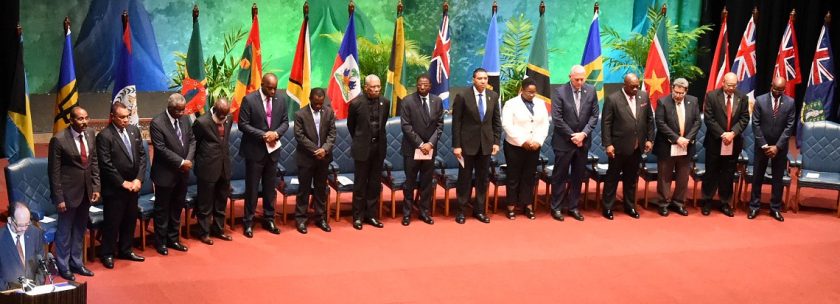
CARICOM Heads of Government
CARICOM
Caribbean states, including those that abstained from voting on the OAS resolution, stood firmly on anti-interventionist principles that respected Venezuela’s sovereignty. Leaders of the member states of the Caribbean Community and Common Market (CARICOM) held an emergency meeting to discuss Venezuela on January 24. The heads of government of Antigua and Barbuda, Barbados, Belize, Dominica, Jamaica, Montserrat, St. Kitts and Nevis, Saint Lucia, St. Vincent and the Grenadines, Trinidad and Tobago, and the Foreign Ministers of Grenada and Suriname, participated in the meeting. Guyana, which has a long standing territorial dispute with Venezuela, nonetheless endorsed the CARICOM position the next day. The resulting statement “reaffirmed” the members’ “principles of non-interference and non-intervention in the affairs of states, respect for sovereignty, adherence to the rule of law, and respect for human rights and democracy”. In addition, they insisted that the crisis should only be “resolved peacefully through meaningful dialogue and diplomacy”. Without naming the US and the Trump administration, CARICOM heads explicitly rejected foreign intervention in Venezuela’s affairs, and threats of violence against the country:
“Reaffirming their commitment to the tenets of Article 2 (4) of the United Nations Charter which calls for Members States to refrain from the threat or the use of force and Article 21 of the Charter of the Organization of American States which refers to territorial inviolability, the Heads of Government emphasized the importance of the Caribbean remaining a Zone of Peace”.
Taking aim again at US policy, CARICOM,
“called on external forces to refrain from doing anything to destabilize the situation and…called on all actors, internal and external, to avoid actions which would escalate an already explosive situation to the detriment of the people of Bolivarian Republic of Venezuela and which could have far-reaching negative consequences for the wider region”.
Trinidad & Tobago and CARICOM vs. the OAS
Within CARICOM, the case of Trinidad & Tobago deserves special mention. First, Trinidad, mere miles from Venezuela with which it has long historical and demographic ties, is now home to a growing number of Venezuelan refugees. Recent events have triggered fears of an even larger refugee crisis in the making. The media make it clear that many locals neither like nor trust the Venezuelans entering their country, and resent their presence. In addition, Venezuelans protesting in the capital, Port of Spain, against Maduro and demanding that the government of Prime Minister Keith Rowley recognize Guaidó instead, faced a mixed reaction at best. Aside from being denounced by Trinidadian commenters, the protesters drew a sharp rebuke from the leader of one of the parties in parliament, David Abdulah:
“Citizens of Venezuela can appeal to the Government of Venezuela and the parties in Venezuela but Venezuelans here in Trinidad and Tobago cannot determine what the foreign policy of Trinidad and Tobago ought to be. It is the Government of Trinidad and Tobago and the citizens of Trinidad and Tobago ultimately and the governments of Caricom and the citizens of Caricom who must determine the foreign policy of Trinidad and Tobago and of Caricom”.
Abdulah also took exception with the protesters claim that Guaidó had popular support, while Maduro was isolated as a dictator. Abdulah said Maduro got significant support at the February 2nd demonstration in Venezuela, which was much bigger than Guaidó’s rally:
“So it is not as if President Maduro is clinging on to power by himself and so on and the vast majority of the Venezuelans are against him. That is not the case”.
Moreover, Abdulah condemned the opposition:

Dr. Keith Rowley, Prime Minister of Trinidad & Tobago
“Very regrettably, but not surprising, Guaido has taken the consistent right-wing line of the opposition rejecting any talks, rejecting any mediation and simply wanting for [sic] resolve the thing by force backed, of course, by the United States and some other countries”.
Squaring off against his domestic opposition, Prime Minister Keith Rowley took direct aim at the United National Congress in parliament, which is pro-US and pro-interventionist. Rowley openly called them “traitors” for trying to undermine CARICOM’s mission of mediation.

Luís Almagro, Secretary-General of the OAS
Prime Minister Rowley has also clashed with the leadership of the OAS, precisely on the question of Venezuela, well before this latest crisis erupted. Back in 2017, Rowley called for the dismissal of OAS secretary-general Luís Almagro. Prime Minister Rowley’s point, which was correct, is that the OAS was compromised by taking an interventionist stance towards Venezuela, and delegitimizing its duly elected leader. Rowley further accused the OAS leadership saying that the result was that, “the OAS has now removed itself from any meaningful participation and has deteriorated now into partisan attacks”.
The conflict between CARICOM, and Trinidad & Tobago in particular, and the head of the OAS was reignited with the latest crisis. CARICOM, and Trinidad’s Minister of National Security, expressed shock that Almagro would dare to speak for all OAS members in personally denouncing Maduro. In a January 31 letter to the OAS’ Almagro, CARICOM’s leadership instructed Almagro that the OAS does not speak for CARICOM members on this issue. The letter from CARICOM’s chairman, Prime Minister Timothy Harris of St Kitts and Nevis, stated:
“The Heads of Government consider it imperative that you publicly clarify that you did not speak on behalf of all the member states of the Organisation of American States….We are aware that this is not the only occasion on which you have made public utterances in the name of the organisation without authority”.
CARICOM described Almagro’s actions as a “clear departure of from normal practice and cause for great concern”. Almagro has gone as far as advocating a foreign military invasion of Venezuela. Journalists noted that, “the OAS website lists media and press releases for the month of January and there is nothing about the OAS’s support for Guaido”. Trinidad & Tobago joined a CARICOM team to meet in Uruguay on February 7, as part of a mediation effort led by Mexico and Uruguay. Calls for dialogue continue to be flatly rejected by Guaidó, echoing the same line taken by Trump and his team.
Meeting in Montevideo
The meeting of 15 Caribbean nations plus Mexico, Uruguay, and parties in Venezuela, taking place in Montevideo tomorrow, represents the formation of a bloc that can act as a significant counterweight to the so-called “Lima Group” of US dependents in Latin America and neocolonial states such as Canada. Unlike the Lima Group, no foreign media have been banned in advance— the Canadian government blocked Russian and Venezuelan media from covering the Lima Group meeting in Ottawa on February 4, an act of suppression of press freedoms that occasioned no outcry at all in Canada.
The largely right wing “Lima Group” that opposed Maduro itself consisted of a range of shady and extreme characters tarred by their involvement in corruption scandals and with ties to death squads, along with Canada with its liberal authoritarian tradition and its penchant for necolonial violence. Once again, none of the “decolonial” crowd, fashionable as they are in academia, has drawn any of the logical and historical connections between Canada’s internal colonialism and its external neocolonialism, which are united by the same principles and interests, even the very same parties and actors. This failure of intellect is not an accident either, but is a subject best explored at another time.
In the meantime, I strongly recommend that you listen carefully to the full interview of RT with Nicolás Maduro:
Canada Doubles Down on Media Censorship of Lima Group Meeting
teleSUR | February 24, 2019
The Foreign Ministry of Canada has denied access to several media outlets to cover the Lima Group meeting taking place in Ottawa Monday. At that meeting, countries who are currently allied against Venezuela are expected to discuss further steps associated with their actions against the Bolivarian nation.
Canada’s foreign ministry issued the same terse response to Russian media outlets Sputnik News as it did Ria Novosti’s bid for press credentials for the meeting: “Thank you for your interest in the 10th ministerial meeting of the Lima Group in Ottawa. This letter is to inform you you have not been accredited as media.”
As with Canada’s rejection of teleSUR for media credentials as reported Feb. 3., the response provided no reason for the rejection, however, Canadian spokesperson for the Lima Group responded to Sputnik by saying that the news outlet was rejected for a “lack of respect to the Canadian Foreign Minister.”
This Russian agency has also not received credentials for the meeting in Canada. Arbitrary decisions. It’s not new, but we won’t stop calling it out.
The predominantly right-wing Lima Group which supports the coup attempt by self-proclaimed president Juan Guaido backed by the United States, has said they would not condone a military intervention to depose President Nicolas Maduro.
The group was created in 2017 at the behest of Peru. Recently, it has been highly engaged in promoting regime change in Venezuela with the backing of the United States and the European Union.
It is composed of Argentina, Brazil, Canada, Chile, Colombia, Costa Rica, Guatemala, Honduras, Mexico, Panama, Paraguay, Peru, Santa Lucia, and Guyana. All of its members, except for Mexico, Guyana, and Santa Lucia, have backed Guiado’s coup attempt. Ecuador — not a party to the association — has also backed the group’s stance on Venezuela.
What the mainstream media doesn’t tell you about Venezuela
By Yves Engler · February 3, 2019
The corporate media is wholeheartedly behind the federal government’s push for regime change in Venezuela. The propaganda is thick and, as per usual, it is as much about what they don’t, as what they do, report. Here are some important developments that have largely been ignored by Canada’s dominant media:
- At the Organization of American States meeting called by US Secretary of State Mike Pompeo on January 25 the Canadian-backed interventionist resolution was defeated 18-16.
- The “Lima Group” of governments opposed to Venezuela’s elected president was established 18 months ago after Washington, Ottawa and others failed to garner the votes necessary to censure Venezuela at the OAS (despite the head of the OAS’s extreme hostility to Venezuela’s President Nicolas Maduro).
- Most of the world’s countries, with most of the world’s population, have failed to support the US/Canada push to recognize National Assembly head Juan Guaidó as president of Venezuela.
- The UN and OAS charters preclude unilateral sanctions and interfering in other countries’ affairs.
- UN Human Rights Council Special Rapporteur for sanctions, Idriss Jazairy, recently condemned US/Canadian sanctions on Venezuela.
As well, here are some flagrant double standards in Canadian policy the media have largely ignored:
- “Lima Group” member Jair Bolsonaro won the recent presidential election in Brazil largely because the most popular candidate, Lula Da silva, was in jail. His questionable election took place two years after Lula’s ally, Dilma Rousseff, was ousted as president in a ‘parliamentary coup’.
- Another “Lima Group” member, Honduras president Juan Orlando Hernandez, defied that country’s constitution a year ago in running for a second term and then ‘won’ a highly questionable
- “At the same time”as Canada and the US recognized Juan Guaidó, notes Patrick Mbeko, “in Democratic Republic of Congo they refuse to recognize the massive recent victory of Martin Fayulu in the presidential election, endorsing the vast electoral fraud of the regime and its ally Félix Tshisekedi.”
Beyond what the media has ignored, they constantly cite biased sources without offering much or any background. Here are a couple of examples:
- The Globe and Mail has quoted Irwin Cotler in two recent articles on Venezuela. But, the decades-long anti-Palestinian and anti-Hugo Chavez activist lacks any credibility on the issue. At a press conference in May to release an OAS report on alleged rights violations in Venezuela, Cotler said Venezuela’s “government itself was responsible for the worst ever humanitarian crisis in the region.” Worse than the extermination of the Taíno and Arawak by the Spanish? Or the enslavement of five million Africans in Brazil? Or the 200,000 Mayans killed in Guatemala? Or the thousands of state-murdered “subversives” in Chile, Argentina, Uruguay, Brazil?
- CBC and Canadian Press (to a slightly lesser extent) stories about former Venezuelan Colonel Oswaldo Garcia, whose family lives in Montréal, present him as a democracy activist. But, notes Poyan Nahrvar, Garcia participated in a coup attempt last year and then launched raids into Venezuela from Colombia until he was captured by the Venezuelan military.
- The media blindly repeats Ottawa’s depiction of the “Lima Group”, which Prime Minister Justin Trudeau described as an organization established to “bring peace, democracy and stability in Venezuela.” One report called it “a regional block of countries committed to finding a peaceful solution” to the crisis while another said its members “want to see Venezuela return to democracy.” This portrayal of the coalition stands its objective on its head. The “Lima Group” is designed to ratchet up international pressure on Maduro in hopes of eliciting regime change, which may spark a civil war. That is its reason for existence.
As part of nationwide protests against the “Lima Group” meeting taking place in Ottawa on Monday, activists in Montréal will rally in front of Radio Canada/CBC’s offices. They will be decrying not only Canada’s interference in Venezuela but the dominant media’s effort to “manufacture consent” for Canadian imperialism.
US Treasury to Foreigners: No More Venezuelan Oil Transactions
teleSUR | February 2, 2019
The United States Treasury Department announced Friday that non-U.S. companies that buy Venezuelan oil through the U.S. financial system or U.S. commodity brokers, will not be allowed to carry out any purchase after April 28.
“Transactions to purchase petroleum and petroleum products from PDVSA or any entity in which PDVSA owns, directly or indirectly… and that involve U.S. persons or any other U.S. nexus… must be wound down by April 28, 2019,” the U.S. Treasury states in a note, adding that “U.S. person employees and contractors of non-U.S. companies located in a country other the U.S. or Venezuela are authorized to engage in certain maintenance or wind-down transactions with PDVSA, or any entity in which PDVSA owns, directly or indirectly… through Mar. 29, 2019.”
The U.S. Treasury release follows the U.S. sanctions imposed, on Jan. 27, on the Venezuelan state-owned oil company, Petroleos de Venezuela (PDVSA). As a consequence, Venezuela’s oil revenues obtained from sales to the U.S. market will be confiscated de facto.
Since most of the international oil trade is done in dollars, the United States is able to continue economic warfare against Venezuela, a country whose income comes mainly from oil exports.
Before President Donald Trump’s measures were put in place against Venezuela, the U.S. was the destination of 40% of Venezuela’s oil exports.
The sanctions affect some US$7 billion in PDVSA assets and will cause other US$11 billion in losses for the Venezuelan company throughout the next year.
Featured Video
Elijah Magnier: Yemen’s strikes are shattering Saudi Arabia’s long-term strategy
or go to
Aletho News Archives – Video-Images
From the Archives
British weapons and personnel doing much of the killing in Yemen
Press TV – June 18, 2019
A detailed report published by the Guardian newspaper has shown how Britain is massively contributing to Saudi Arabia’s devastating war on Yemen as it suggests that London is not only supplying the bombs that fall on Yemenis, but it provides the personnel and expertise that keep the war going.
The comprehensive report by Arron Merat published on Tuesday showed that Britain was doing much of the killing in Yemen as the country continues to provide Saudi Arabia with everything it needs to turn its southern impoverished neighbor into a graveyard.
“Every day Yemen is hit by British bombs – dropped by British planes that are flown by British-trained pilots and maintained and prepared inside Saudi Arabia by thousands of British contractors,” said Merat in the report. … continue
Blog Roll
 Aletho News
- A West Bank War for Netanyahu’s Election Campaign, Could It Backfire?
- Yemen denounces European Parliament’s ‘hypocritical’ push to blacklist Ansarullah
- Qalibaf: UAE’s UN bid aims to ‘clear the runway’ for ‘Greater Israel’, whitewash genocide
- Pakistan reopens Iran border after boosting security: Report
- Why are so many Brazilians voting for Flávio Bolsonaro?
- Democrats Put Anti-Russia Agenda Ahead of American Workers
- Elijah Magnier: Yemen’s Strikes Are Shattering Saudi Arabia’s Long-Term Strategy
- Pentagon designates Chinese cultural centers national security threat
- Israel Demolishes Home Of Lebanese Journalist Whose Viral Film Exposed Pager Attack
- Record Oil, Empty Tanks: The UAE’s Miracle Recovery
- If Americans Knew
- An error has occurred; the feed is probably down. Try again later.
- No Tricks Zone
- Sudden Stratospheric Warming, Powerful El Niño Combination May Lead To Extreme Europe Cold, Energy Crisis!
- Two New Studies Find Thwaites Glacier Melt Cannot Be Driven By Human Activity Or A Warming Ocean
- E-Cars Reduce CO2 Emissions By Only 41% Compared To Internal Combustion Engine Vehicles
- Predictions Made By Renowned Climate Professor Over Past Decades Have Been Proven To Be Poor
- New Study Suggests Large Regions Of The Pacific Ocean Have Been Cooling For The Last 80 Years
- Germany’s Green Energy Debacle: High Energy Costs Force Kahla Porzellan to Close After 182 Years!
- New Study: 50 Years Of The Most Aggressive ‘Net Zero’ Policies Can Only Affect The Global Climate By 0.03°C
- US September “Heat” Was No Record…Many Records Set Decades Ago
- Latest European Green Energy Debacle; Portugal’s Largest Flagship Solar Park Insolvent!
- Green Energy Debacle: German Expert Professor Fritz Vahrenholt Warns Of Severe Economic And Social Consequences

