Your Complete Guide to the NY Times’ Support of US-Backed Coups in Latin America
By Adam H. JOHNSON | TruthDig | January 29, 2019
On Friday, The New York Times continued its long, predictable tradition of backing U.S. coups in Latin America by publishing an editorial praising Donald Trump’s attempt to overthrow Venezuelan President Nicolas Maduro. This will be the 10th such coup the paper has backed since the creation of the CIA over 70 years ago.
A survey of The New York Times archives shows the Times editorial board has supported 10 out of 12 American-backed coups in Latin America, with two editorials—those involving the 1983 Grenada invasion and the 2009 Honduras coup—ranging from ambiguous to reluctant opposition. The survey can be viewed here.
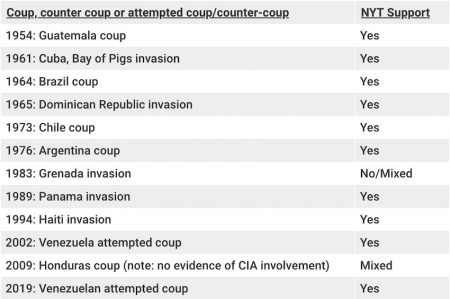
Covert involvement of the United States, by the CIA or other intelligence services, isn’t mentioned in any of the Times’ editorials on any of the coups. Absent an open, undeniable U.S. military invasion (as in the Dominican Republic, Panama and Grenada), things seem to happen in Latin American countries entirely on their own, with outside forces rarely, if ever, mentioned in the Times. Obviously, there are limits to what is “provable” in the immediate aftermath of such events (covert intervention is, by definition, covert), but the idea that the U.S. or other imperial actors could have stirred the pot, funded a junta or run weapons in any of the conflicts under the table is never entertained.
More often than not, what one is left with, reading Times editorials on these coups, are racist, paternalistic “cycle of violence” cliches. Sigh, it’s just the way of things Over There. When reading these quotes, keep in mind the CIA supplied and funded the groups that ultimately killed these leaders:
- Brazil 1964: “They have, throughout their history, suffered from a lack of first class rulers.”
- Chile 1973: “No Chilean party or faction can escape some responsibility for the disaster, but a heavy share must be assigned to the unfortunate Dr. Allende himself.”
- Argentina 1976: “It was typical of the cynicism with which many Argentines view their country’s politics that most people in Buenos Aires seemed more interested in a soccer telecast Tuesday night than in the ouster of President Isabel Martinez de Perlin by the armed forces. The script was familiar for this long‐anticipated coup.”
See, it didn’t matter! It’s worth pointing out the military junta put in power by the CIA-contrived coup killed 10,000 to 30,000 Argentines from 1976 to 1983.
There’s a familiar script: The CIA and its U.S. corporate partners come in, wage economic warfare, fund and arm the opposition, then the target of this operation is blamed. This, of course, isn’t to say there isn’t merit to some of the objections being raised by The New York Times—whether it be Chile in 1973 or Venezuela in 2019. But that’s not really the point. The reason the CIA and U.S. military and its corporate partisans historically target governments in Latin America is because those governments are hostile to U.S. capital and strategic interests, not because they are undemocratic. So while the points the Times makes about illiberalism may sometimes be true, they’re mostly a non sequitur when analyzing the reality of what’s unfolding.
Did Allende, as the Times alleged in 1973 when backing his violent overthrow, “persist in pushing a program of pervasive socialism” without a “popular mandate”? Did, as the Times alleged, Allende “pursue this goal by dubious means, including attempts to bypass both Congress and the courts”? Possibly. But Allende’s supposed authoritarianism isn’t why the CIA sought his ouster. It wasn’t his means of pursuing redistributive policies that offended the CIA and U.S. corporate partners; it was the redistributive policies themselves.
Hand-wringing over the anti-democratic nature of how Allende carried out his agenda without noting that it was the agenda itself—not the means by which it was carried out—that animated his opponents is butting into a conversation no one in power is really having. Why, historically, has The New York Times taken for granted the liberal pretexts for U.S. involvement, rather than analyzing whether there were possibly other, more cynical forces at work?
The answer is that rank ideology is baked into the premise. The idea that the U.S. is motivated by human rights and democracy is taken for granted by The New York Times editorial board and has been since its inception. This does all the heavy lifting without most people—even liberals vaguely skeptical of American motives in Latin America—noticing that a sleight of hand has taken place. “In recent decades,” a 2017 Times editorial scolding Russia asserted, “American presidents who took military action have been driven by the desire to promote freedom and democracy, sometimes with extraordinary results.” Oh, well, good then.
What should be a conversation about American military and its covert apparatus unduly meddling in other countries quickly becomes a referendum on the moral properties of those countries. Theoretically a good conversation to have (and one certainly ongoing among people and institutions in these countries), but absent a discussion of the merits of the initial axiom—that U.S. talking heads and the Washington national security apparatus have a birthright to determine which regimes are good and bad—it serves little practical purpose stateside beyond posturing. And often, as a practical matter, it works to cement the broader narrative justifying the meddling itself.
Do the U.S. and its allies have a moral or ethical right to determine the political future of Venezuela? This question is breezed past, and we move on to the question of how this self-evident authority is best exercised. This is the scope of debate in The New York Times—and among virtually all U.S. media outlets. To ante up in the poker game of Serious People Discussing Foreign Policy Seriously, one is obligated to register an Official Condemnation of the Official Bad Regime. This is so everyone knows you accept the core premises of U.S. regime change but oppose it on pragmatic or legalistic grounds. It’s a tedious, extortive exercise designed to shift the conversation away from the United States’ history of arbitrary and violent overthrows and into an exchange about how best to oppose the Official Bad Regime in question. U.S. liberals are to keep a real-time report card on these Official Bad Regimes, and if these regimes—due to an ill-defined rubric of un-democraticness and human rights—fall below a score of say, “60,” they become illegitimate and unworthy of defense as such.
While obviously not in Latin America, it’s also worth noting that the Times cheerled the CIA-sponsored coup against Iran’s President, Mohammad Mossadegh, in 1953. Its editorial, written two days after his ouster, engaged in the Times’ patented combination of victim-blaming and “oh dear” bloviating:
- “The now-deposed Premier Mossadegh was flirting with Russia. He had won his phony plebiscite to dissolve the Majlis, or lower House of Parliament, with the aid of the Tudeh Communists.”
- “Mossadegh is out, a prisoner awaiting trial. It is a credit to the Shah, to whom he was so disloyal, and to Premier Zahedi, that this rabid, self-seeking nationalist would have been protected at a time when his life would not have been worth the wager of a plugged nickel.”
- “The Shah … deserves praise in this crisis. … He was always true to the parliamentary institutions of his country, he was a moderating influence in the wild fanaticism exhibited by the nationalists under Mossadegh, and he was socially progressive.”
Again, no mention of CIA involvement (which the agency now openly acknowledges), which the Times wouldn’t necessarily have had any way of knowing at the time. (This is part of the point of covert operations.) Mossadegh is summarily demonized, and it’s not until decades later the public learns of the extent of U.S. involvement. The Times even gets in an orientalist description of Iranians, implying why a strong Shah is necessary:
[The average Iranian] has nothing to lose. He is a man of infinite patience, of great charm and gentleness, but he is also—as we have been seeing—a volatile character, highly emotional, and violent when sufficiently aroused.
Needless to say, there are major difference between these cases: Mossadegh, Allende, Chavez and Maduro all lived in radically different times and championed different policies, with varying degrees of liberalism and corruption. But the one thing they all had in common is that the U.S. government, and a compliant U.S. media, decided they “needed to go” and did everything to achieve this end. The fundamental arrogance of this assumption, one would think, is what ought to be discussed in the U.S. media—as typified by the Times’ editorial board—but time and again, this assumption is either taken for granted or hand-waved away, and we all move on to how and when we can best overthrow the Bad Regime.
For those earnestly concerned about Maduro’s efforts to undermine the democratic institutions of Venezuela (he’s been accused of jailing opponents, stacking the courts and holding Potemkin elections), it’s worth pointing out that even when the liberal democratic properties of Venezuela were at their height in 2002 (they were internationally sanctioned and overseen by the Carter Center for years, and no serious observer considers Hugo Chavez’s rule illegitimate), the CIA still greenlit a military coup against Chavez, and the New York Times still profusely praised the act. As it wrote at the time:
With yesterday’s resignation of President Hugo Chávez, Venezuelan democracy is no longer threatened by a would-be dictator. Mr. Chávez, a ruinous demagogue, stepped down after the military intervened and handed power to a respected business leader, Pedro Carmona.
Chavez would soon be restored to power after millions took to the streets to protest his removal from office, but the question remains: If The New York Times was willing to ignore the undisputed will of the Venezuelan people in 2002, what makes anyone think the newspaper is earnestly concerned about it in 2019? Again, the thing that’s being objected to by the White House, the State Department and their U.S. imperial apparatchiks is the redistributive policies and opposition to the United States’ will, not the means by which they do so. Perhaps the Times and other U.S. media—living in the heart of, and presumably having influence over, this empire—could try centering this reality rather than, for the millionth time, adjudicating the moral properties of the countries subject to its violent, illegitimate whims.
Maduro stays put, mediation can help
By M. K. BHADRAKUMAR | Indian Punchline | January 31, 2019
Russia is doing the right thing by switching tack from strident ‘anti-American’ rhetoric to focus on tamping down the tensions over Venezuela. China had counseled such an approach right from the outset when the crisis erupted last week.
On day one of a looming US-Venezuelan standoff on January 24, the Chinese foreign ministry spokesperson called upon “all relevant parties to stay rational and cool-headed and seek a political solution to the issue of Venezuela through peaceful dialogue within the framework of the Venezuelan Constitution.”
This was alongside Beijing’s vehement support for the efforts of the Venezuelan government of President Nicolas Maduro “to uphold national sovereignty, independence and stability” as well as China’s unequivocal opposition to “foreign interference in Venezuela’s affairs.”
It stands to reason that Moscow too began toning down its rhetoric and harmonizing with the Chinese stance. The heart of the matter is that the Venezuelan crisis holds the danger of putting a dagger into the heart of the international system in an already unstable world order full of potential for chaos, which of course is not in the interest of any of the three big powers that are ‘stakeholders’ – the US, Russia and China.
Thus, Russian Foreign Minister Sergey Lavrov’s remarks to the media on Wednesday in Moscow offering mediation between the government and the opposition in Venezuela can be put in perspective. Lavrov acknowledged China and Russia’s role as Venezuela’s “leading partners” in the economic sphere. He then recalled the various ideas floated by different quarters – the European Union, the Caribbean Community, Uruguay and Mexico – to provide a platform for mediation. And Lavrov added, “The Non-Aligned Movement should probably have its say, all the more so that Venezuela chairs it now.” Lavrov regretted that so far all such initiatives to start a dialogue have been “bluntly rejected” by the opposition due to instigation by its “Western sponsors.”
Lavrov said Moscow is striving to “create conditions for the start of dialogue” and is discussing it with the Venezuelan government, China, Latin American countries and the EU. He underscored Russia’s readiness “to take part in the relevant international efforts in the formats that will suit the Venezuelan parties” – that is to say, “all mediation initiatives should be unbiased and their future format should be balanced”; mediation “should represent a broad range of international players that can influence the Government and the opposition”; and, “it is necessary to understand from the very start what goal is pursued by a potential mediation format.”
Significantly, Lavrov singled out Moscow’s ongoing contacts with Brussels in regard of the EU’s proposal to establish a contact group for mediation, notwithstanding the ultimatum given to Caracas “by some EU countries, including influential ones” (read UK, France, Spain and Germany). He said the picture will be clear soon as to “who is talking about what” (in Brussels), but the bottom line is that “such opportunities exist and I believe the said initiative can be rather useful if unbiased.”
Lavrov welcomed Maduro’s readiness to accept international mediation and he urged the opposition “to display a similar constructive approach, give up ultimatums and act independently, relying primarily on the interests of the Venezuelan people.”
Indeed, it is far from clear whether in the prevailing new Cold War conditions, such a denouement through mediation by an international contact group including Russia will suit Washington, which has just declared an economic war against Venezuela. From all appearances, the Trump administration is carrying out the agenda of Wall Street for a regime change in Venezuela and the project is fairly well advanced already. The intention is to cripple Venezuela’s state-owned oil company with sanctions and make Maduro submit to the US diktat. In the US estimation, Venezuela’s oil industry cannot recover without significant reinvestment, which can only come from the US or China.
On the other hand, one silver lining on the horizon is that there are no signs as yet of the Pentagon being on a war footing. In a situation such as this, typically, the US state department ought to have requested evacuation support from Pentagon by now, but no such thing has happened so far.
Suffice to say, a protracted diplomatic slugfest is beginning, involving the US and some of its allies on one side and Russia and China on the other. An ouster of Maduro, in these circumstances, seems a very remote possibility – and can even be ruled out – so long as he enjoys sufficient support among the Venezuelan military and the ruling party’s social and political base remains so very substantial as at the moment. The strong likelihood is that Maduro will weather the storm and the US-led diplomatic and economic pressure cannot dislodge him from power.
The transcript of Lavrov’s media comments is here.
Colombia Witnesses Murder of 17th Social Leader in 2019
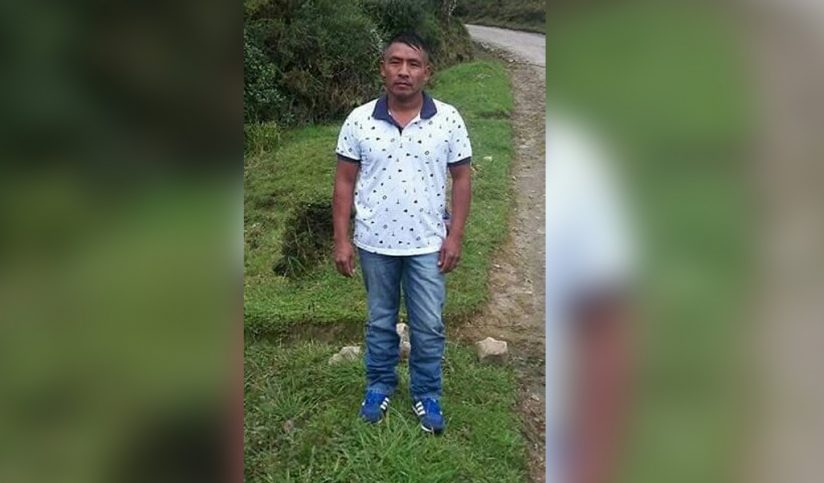
Dilio Corpus Guetio, a Campesino leader was murdered in Colombia, making it 17th murder in 2019. | Photo: Twitter / @Paola_teleSUR
teleSUR | January 30, 2019
A Colombian Campesino leader Dilio Corpus Guetio, 44, who was a member of Asocordillera (Mountain Area Association of Campesino Workers) and also a member of the local Campesino Guard militia was shot to death Tuesday.
Corpus Guetio left his home in the municipality of Suarez in the department of Cauca, in southwest Colombia, at around six in the morning for work. On the way armed men from a car shot him several times.
“The murderers were in a van which hit him and made him lose control of his bike. At that point, they got out of the car to get close to Dilio, who was already injured and he was shot repeatedly, killing him,” said a representative from the United National Federation of Agricultural Unions (FENSUAGRO).
Studies for Development and Peace, Indepaz, say that within the 29 days of 2019, 16 social leaders have been killed in Colombia, excluding Corpus Guetio.
Dilio was known for his work monitoring rural areas and protecting the territory and its inhabitants. His murder case has been registered in the village of Santa Barbara, his place of work.
This week another community leader from Cuca, Jose Jair Orozco, 52, was also assassinated.
Colombian Attorney General Nestor Humberto Martinez said in early January that the greatest number of Colombians murdered over the past two years since the signing of the peace agreement have been social leaders who serve on Communal Action Boards (JAC).
JACs began in the 1950s and are local-level councils where citizens decide upon, plan and develop community projects based on their own needs. The majority of JACs are in rural areas and members include mainly low-income Campesino, Indigenous, and Afro-Colombian members of society.
According to Martinez, the assassinations of JAC leaders is “passively systematic.” The attorney general said that those responsible are paramilitary groups “such as the “Gulf Clan” that works on behalf of narco traffickers and “Los Caparrapos” he added.
Indigenous people made up 13 percent of those killed and farmers 10 percent. Union leaders and social leaders, Afro-Colombians and LGBTI population were the other main murder victims.
Coup in Venezuela: What Next?
By Marco Teruggi – Pagina 12 – January 25, 2019
Caracas ‐ The dice have been thrown and the game is on in Venezuela. This week has seen the country enter into new uncertain and dangerous terrain, although with some predictable elements. We have witnessed different variables develop, and now wait for new elements that may catalyse or justify an outcome.
The current chain of events seems to have been planned out step-by-step: the attempted theft of weapons by a group of members of the Bolivarian National Guard on the morning of January 21, followed by incidents of violence concentrated in the west of Caracas; US Vice-President Mike Pence’s video supporting Juan Guaidó and calling for demonstrations on January 23; the swearing-in of Guaidó; US President Donald Trump’s recognition of Guaidó a few minutes later; ongoing incidents of violence; the convening of a meeting of the Organization of American States (OAS) to seek recognition of the parallel government; the US$20 million announced by Pence for “humanitarian aid”; and yet more programmed violence.
Not everything went as planned. For now, there are two main variables at play: the international front and the violence.
International front
Regarding the international front, the attempt to get the OAS to recognise Guaidó as president failed, with only 16 votes out of 34. This is not a new failure: the Lima Group (formed in 2017 by right-wing Latin American governments), now weakened by the Mexican government’s anti-interventionist stance, emerged out of a similar situation.
Moreover, the European Union did not formally recognise Guaidó and agreed – an unstable agreement opposed by governments like France – on the need to have new elections in Venezuela.
The axis of the current situation originates and rests in the US, which has called a meeting of the United Nations Security Council for January 26. What kind of debate and agreement will they seek there in terms of the parallel government? The strategy is reminiscent of the way in which the operation to oust the Libyan government was conducted in 2011.
On the second front, a program of violence is underway. The incidents of violence have moved through different poor areas of Caracas: west, south and the outer edges of the east, namely Petare, one of the most populated barrios [poor neighbourhoods].
There, particularly in the latter, armed groups have been activated and funded to generate violent actions, seeking to create a big impact in the media. These incidents are scheduled to start at night and are carried out in such a way to enable them to be promoted on social media.
Human rights organisation Surgentes has stated that, “at least 38% of demonstrations were violent, and in 28.5% of them there were confrontations with security forces, with firearms and other substantial elements”.
A Bolivarian National Guard sergeant was murdered, and two members of that institution were beaten up in an attempted lynching carried out in broad daylight, in a zone dominated by the opposition.
In this context, there has been a rising number of deaths of youths in poor areas mobilised by the right. This is a well-known situation: the same method was used in 2017, which at critical points saw Chavista youths burnt alive on the street and attacks on military bases.
This is all part of the escalation of events unfolding in Caracas and other parts of the country, with situations of violence in areas that are not part of the right’s social base combined with demonstrations such as the one on January 23.
This coup strategy integrates different variables: international pressure for recognition of the parallel government and chaos and deaths inside the country. This is the current situation.
What next? One of the planned steps is to activate the parallel government, whose power lies on the international front, though it has no power or impact inside the country.
This could mean economic actions, like attempts to freeze state assets or a takeover of CITGO, the US branch of Venezuelan state oil company PDSVA. These attacks would increase economic hardship and push the economy towards collapse, something that has been sought since the blockades and sabotage began.
Additionally, the opposition is expected to start an operation to bring in the “humanitarian aid” that Pence promised at the OAS meeting. Will this be a Trojan horse?
This set of steps, designed and promoted from outside the country, does not seem to indicate how they expect to oust Maduro — who was democratically elected — from the government.
Violence
When Guaidó has been asked, he has replied that military intervention is “an element of force that is on the table”. Regarding the possibility of a coup by the Bolivarian National Armed Forced (FANB), he said, “it is an element that is always worth considering”.
Guaidó’s strategy, which is part of a larger plan devised from abroad, cannot be carried out without a component of violence. What directions this violence will take remains to be seen.
We know about previous attempts in 2014 and 2017, of what is already at play, and of what they need to achieve their goal. Overwhelmed by his role and his own will for success, Guaidó has extended to Maduro the same offer of amnesty he has said he will give to civilians and the military.
The gap between the announcement of this coup against Maduro and its materialisation is still large. The army stated that they “will never accept a president imposed in the shadow of dark interests and self-proclaimed outside the law”.
Defence minister Vladimir Padrino López also stated that they will “avoid a confrontation between Venezuelans; it’s not a civil war, but dialogue that will solve Venezuela’s problems”. This last sentence should be taken with complete seriousness: one of the violent strategies of the coup plan relies on generating clashes between civilians.
The right has repeated that it will neither dialogue nor negotiate. Maduro has stated his willingness to do so, following the declarations of the governments of Mexico and Uruguay.
What then, if there is no dialogue? Venezuela faces a point of no return: that of accelerating attacks on many fronts to oust the elected government by force, and the start of a mass revenge.
Those leading this push reside in the US and, once again, are doing so in the name of freedom.
Translated from Pagina 12 by Pedro Alvarez.
Source: Green Left Weekly
The Failure of Guaido’s Constitutional Claim to the Presidency of Venezuela
By William Walter Kay | Global Research | January 29, 2019
The three constitutional articles invoked by Juan Guaido to legitimise his presidency are: 233, 333, and 350. The latter two are broad affirmations of democracy and constitutionality, silent on Presidential lines of succession. Guaido’s claim rests entirely on 233; presented here in full:
The President of the Republic shall become permanently unavailable to serve by reason of any of the following events: death; resignation; removal from office by decision of the Supreme Tribunal of Justice; permanent physical or mental disability certified by a medical board designated by Supreme Tribunal of Justice with the approval of the National Assembly; abandonment of his position, duly declared by the National Assembly; and recall by popular vote.
When an elected President becomes permanently unavailable to serve prior to his inauguration, a new election by universal suffrage and direct ballot shall be held within 30 consecutive days. Pending election and inauguration of the new President, the President of the National Assembly shall take charge of the Presidency of the Republic.
When the President of the Republic becomes permanently unavailable to serve during the first four years of this constitutional term of office, a new election by universal suffrage and direct ballot shall be held within 30 consecutive days. Pending election and inauguration of the new President, the Executive Vice-President shall take charge of the Presidency of the Republic.
In the cases describes above, the new President shall complete the constitutional term of office.
If the President becomes permanently unavailable to serve during the last two years of his constitutional term of office, the Executive Vice-President shall over the Presidency of the Republic until such term is completed.
The opening paragraph envisions six scenarios whereby a President might no longer serve. The next paragraph sets out protocols to be followed should a President-elect become unavailable to serve pre-inauguration. The third paragraph contemplates presidential vacancies during the first four years of office. The last paragraph deals with presidential vacancies in the final two years of office.
Of the six scenarios envisioned (death, resignation etc.) Guaido relies on “abandonment of his position.” This clearly never happened. Maduro isn’t gone. He’s still there. “Abandonment” conjures images of a President fleeing on a plane freighted with bullion. Maduro, however, currently occupies presidential offices and residences. There has been no abandonment.
“Abandonment” is spun to mean “usurpation.” When did this occur? Are they suggesting that at no time since April 19, 2013 has Maduro ever been President? If Maduro was President, then he must have farcically usurped himself. “Usurp” typically means take power away from someone. There has been no usurpation.
If a President becomes unavailable to serve in the first four years of his term, then the Vice-President takes over and calls an election. If the calamity occurs in the last two years of the presidential term then the VP serves out the fallen President’s term.
Guaido, as head of the National Assembly, only becomes involved when the vacancy occurs in the twilight zone between election and inauguration. This definitely did not happen here. Moreover, by citing Article 233 Guaido implies there was a recent (lawful) election. Finally, Guaido’s January 23 self-anointment occurred 13 days after Maduro’s January 10 inauguration. He missed the boat.
Pursuant to 233, if the head of the National Assembly becomes Acting President he must immediately call an election; and serve only until the winner of that election is inaugurated. The Western media (and Wiki) butcher 233’s second paragraph, leaving only opening and closing clauses; discarding any mention of “election.” Guaido should have, at the moment of self-anointment, announced an election for February 22. For the head of the National Assembly to assume Presidential powers, and then fail to call an election so as to keep those powers, would be flagrantly unconstitutional.
This thread becomes rejoicefully rich considering the EU’s position. They are demanding Maduro call an election; …or else they will recognise Guaido. Can Maduro call an election if he is not President? By demanding Maduro hold an election they are recognising Maduro as President. If Maduro is President he has no obligation to call snap elections to satisfy foreign governments. Alternatively, if Guaido became President he would have an explicit, unavoidable constitutional obligation to call an immediate election.
Guaido is the figure-head of a coup attempt orchestrated by foreign powers without a constitutional leg to stand on.
Trump’s Venezuela Fiasco
By Ron Paul | January 28, 2019
Last week President Trump announced that the United States would no longer recognize Nicholas Maduro as president of Venezuela and would recognize the head of its national assembly, Jose Guaido, as president instead. US thus openly backs regime change. But what has long been a dream of the neocons may well turn out to be a nightmare for President Trump.
Why did Trump declare that the Venezuelan president was no longer the president? According to the State Department, the Administration was acting to help enforce the Venezuelan constitution. If only they were so eager to enforce our own Constitution!
It’s ironic that a president who has spent the first two years in office fighting charges that a foreign country meddled in the US elections would turn around and not only meddle in foreign elections but actually demand the right to name a foreign country’s president! How would we react if the Chinese and Russians decided that President Trump was not upholding the US Constitution and recognized Speaker Nancy Pelosi as US president instead?
Even those who would like to see a change of government in Venezuela should reject any notion that the change must be “helped” by the United States. According to press reports, Vice President Mike Pence was so involved in internal Venezuelan affairs that he actually urged Guaido to name himself president and promised US support. This is not only foolish, it is very dangerous. A Venezuelan civil war would result in mass death and even more economic misery!
Regime change has long been US policy for Venezuela. The US has been conducting economic warfare practically since Maduro’s predecessor, Hugo Chavez, was first elected in 1998. The goal of US sanctions and other economic measures against Venezuela (and other countries in Washington’s crosshairs) is to make life so miserable for average citizens that they rise up and overthrow their leaders. But of course once they do so they must replace those leaders with someone approved by Washington. Remember after the “Arab Spring” in Egypt when the people did rise up and overthrow their leader, but they then elected the “wrong” candidate. The army moved in and deposed the elected president and replaced him with a Washington-approved politician. Then-Secretary of State John Kerry called it “restoring democracy.”
It is tragically comical that President Trump has named convicted criminal Elliot Abrams as his point person to “restore democracy” in Venezuela. Abrams played a key role in the Iran-Contra affair and went on to be one of the chief architects of the disastrous US invasion of Iraq in 2003. His role in helping promote the horrible violence in Latin America in the 1980s should disqualify him from ever holding public office again.
Instead of this ham-fisted coup d’etat, a better policy for Venezuela these past 20 years would have been engagement and trade. If we truly believe in the superiority of a free market system we must also believe that we can only lead by example, not by forcing our system on others.
Just four months ago President Trump said at the UN: “I honor the right of every nation in this room to pursue its own customs, beliefs, and traditions. The United States will not tell you how to live or work or worship. We only ask that you honor our sovereignty in return.” Sadly it seems that these were merely empty words. We know from Iraq, Libya, Syria, etc. that this will not end well for President Trump. Or for the United States. We must leave Venezuela alone!
Canada joins with imperial ‘Mafia’ to threaten Venezuela
By Yves Engler · January 27, 2019
Most Canadians think of their country as a force for good in the world, but recent efforts by Justin Trudeau’s government to overthrow Venezuela’s elected government have once again revealed the ugly truth about the Great White North. We are an important partner in imperialism, willing to interfere in the internal affairs of other countries, up to and including the use of military force, to benefit the perceived self-interest of our elites.
Over the past two years Canadian officials have campaigned aggressively against President Nicolás Maduro. Foreign Minister Chrystia Freeland has repeatedly criticized Caracas’ democratic legitimacy and human rights record. Recently she said, “the Maduro regime is now fully entrenched as a dictatorship” while in September Ottawa asked (with five South American nations) the International Criminal Court to investigate the Venezuelan government, which is the first time a government has been formally brought before the tribunal by another member.
In recent weeks Canadian diplomats have played an important role in uniting large swaths of the Venezuelan opposition behind a US-backed plan to ratchet up tensions by proclaiming the new head of the opposition-dominated National Assembly, Juan Guaido, president. The Canadian Press quoted a Canadian diplomat saying they helped Guaido “facilitate conversations with people that were out of the country and inside the country” while the Globe and Mail reported that “Freeland spoke with Juan Guaido to congratulate him on unifying opposition forces in Venezuela, two weeks before he declared himself interim president.” Alongside Washington and a number of right-leaning Latin American governments, Ottawa immediately recognized Guaido after he proclaimed himself president on Wednesday. Canadian officials are lobbying European leaders to recognize Guaido as president as well.
Ottawa has long provided various other forms of direct support to an often-violent opposition. In recent years Canada channelled millions of dollars to opposition groups in Venezuela and 18 months ago outgoing Canadian ambassador, Ben Rowswell, told the Ottawa Citizen that “we became one of the most vocal embassies in speaking out on human rights issues and encouraging Venezuelans to speak out.”
Alongside its support for the opposition, Ottawa expelled Venezuela’s top diplomat in 2017 and has imposed three rounds of sanctions on Venezuelan officials. In March the United Nations Human Rights Council condemned the economic sanctions the US, Canada and EU have adopted against Venezuela while Caracas called Canada’s move a “blatant violation of the most fundamental rules of International Law.”
Since its August 2017 founding Canada has been one of the most active members of the “Lima Group” of governments opposed to Venezuela’s elected government. Canada is hosting the next meeting of the “Lima Group”. Freeland has repeatedly prodded Caribbean and Central American countries to join the Lima Group’s anti-Maduro efforts.
In September, 11 of the 14 member states of the “Lima Group” backed a statement distancing the anti-Venezuelan alliance from “any type of action or declaration that implies military intervention” after Organization of American States chief Luis Almagro stated: “As for military intervention to overthrow the Nicolas Maduro regime, I think we should not rule out any option … diplomacy remains the first option but we can’t exclude any action.” Canada, Guyana and Colombia refused to criticize the head of the OAS’ musings about an invasion of Venezuela.
Alongside the head of the OAS, US president Donald Trump has publically discussed invading Venezuela. To the best of my knowledge Ottawa has stayed mum on Trump’s threats, which violate international law.
Why? Why is Canada so eager to overthrow an elected government? Recent headlines in the Globe and Mail (“Venezuelan crisis buoys prospects for Canadian heavy crude oil producers”) and Wall Street Journal (“Bond Prices in Venezuela Jump on Prospect of Regime Change”) suggest some short term reasons. But looking at the situation from a historical perspective confirms Noam Chomsky’s claim that international affairs is run like the Mafia. The godfather cannot accept disobedience.
Thus, while the scope of the Trudeau government’s current campaign against Venezuela is noteworthy, it’s not the first time Ottawa has supported the overthrow of an elected, left leaning, government in the hemisphere. Canada passively supported military coups against Guatemalan President Jacobo Arbenz in 1954 and Brazilian President João Goulart in 1964 as well as ‘parliamentary coups’ against Paraguayan president Fernando Lugo in 2012 and Brazilian President Dilma Rousseff in 2016. Ottawa played a slightly more active role in the removal of Dominican Republic president Juan Bosch in 1965 and Chilean president Salvador Allende in 1973. In a more substantial contribution to undermining electoral democracy, Ottawa backed the Honduran military’s removal of Manuel Zelaya in 2009.
Canada played its most forceful role in the removal of a progressive, elected, president in the hemisphere’s most impoverished nation. Thirteen months before Jean-Bertrand Aristide was, in his words, “kidnapped” by US Marines on February 29, 2004, Jean Chrétien’s Liberal government organized an international gathering to discuss overthrowing the Haitian president. JTF2 special forces secured the Port-au-Prince airport the night Aristide was ousted and 500 Canadian troops were part of the US-led invasion to consolidate the coup.
With regards to Venezuela it’s unclear just how far Ottawa is prepared to go in its bid to oust Maduro. But, it is hard to imagine that the path Canada and the US have chosen can succeed without Venezuela being plunged into significant violence.
AMLO Offers to Mediate Between Venezuelan Gov’t and Opposition
teleSUR | January 25, 2019
Mexican President Andres Manuel Lopez Obrador declared Friday his government’s willingness to mediate in the Venezuelan political conflict if the parties request it and without violating the self-determination principle adopted by his administration.
When journalists asked him about the issue during his routine morning conference, Lopez Obrador reminded the public that the Mexican Constitution’s Article 89 establishes that the foreign policy should stick to the principles of non-intervention, self-determination and peaceful solution of controversies.
“It doesn’t mean we’re in favor or against anyone. We’re here to defend the constitutional principles of foreign policy,” he explained.
He was then questioned about his previous idea of mediating the dialogue between the Venezuelan government and the opposition, and declared he would be willing to it.
“We will respect our principles and if the parts requested, we’re at the best disposition to help for a dialogue,” he declared.
The Foreign Minister Marcelo Ebrard already has instructions to “support within our means, without interfering in the conflict,” and without taking sides, said Lopez Obrador.
“This is related to a historical tradition of foreign policy in our country. We shouldn’t interfere with the affairs of other peoples and nations because we want no hegemony, no foreign government, interfering in the issues that belong to Mexicans only,” said the president.
Establishing a key difference between his administration and the previous three, led by Vicente Fox, Felipe Calderon and Enrique Peña Nieto, Lopez Obrador reiterated his firm position.
“If at some point in time they deviated from this principles, we won’t do it. We won’t act violating, breaking with constitutional principles of foreign policy,” he declared.
The Venezuelan President Nicolas Maduro has said he agrees with the initiative of a new set of dialogues with the opposition to deal with the country’s political and economic affairs.
“The governments of Mexico and Uruguay proposed to launch an international initiative to promote a dialogue between the Venezuelan parts… I say to you publicly that I agree,” said Maduro during a speech at the Supreme Justice Court.
Mexico and Uruguay issued a joint statement calling for Venezuelans to “find a peaceful and democratic solution to the complex context” that the faced in the South American country.
Both governments refused to recognize the opposition lawmaker Juan Guaido as the “interim president” of the Bolivarian republic, maintaining its recognition for Maduro.
“The governments of Uruguay and Mexico call for all the involved parts, within the country and abroad, to reduce tensions and avoid an escalation of violence that could worsen the situation,” says the statement.
Tensions increased when Guaido declared Friday he would appropriate the faculties of the executive branch to combat the “usurpation” by Maduro.
The Vultures of Caracas
By Craig Murray | January 26, 2019
We are frequently told that people in Venezuela have no food, clothing or toilet paper, and that popular discontent with the left wing government is driven by real hunger. There are elements of truth in this story, though the causes of economic dislocation are far more complex than the media would have us believe.
But I ask you to look at this photo of supporters of CIA poster-boy, the West’s puppet unelected “President” Juan Guaido, taken at a Guaido rally in Caracas two days ago and published yesterday in security services house journal The Guardian. Please take a really close look at the photo. Blow it up as big as you can. Scan individual people in the crowd, one by one.
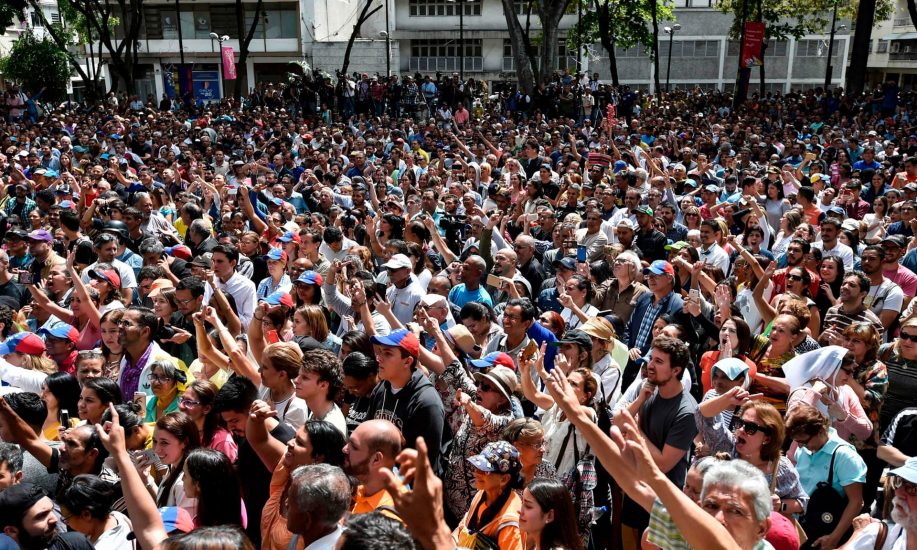
These are not the poor and most certainly not the starving. As it chances I have a great deal of life experience working amongst seriously deprived, hungry and despairing people. I know the gaunt face of want and the desperate glance of need. Look at these Guaido supporters, one by one by one. This designer spectacled, well-coiffed, elegantly dressed, sleekly jowled group does not know hunger. This group does not know want. This is a proper right wing gathering, a gathering of the nicely off section of society. This is a group of those who have corruptly been siphoning Venezuela’s great wealth for decades and who want to make sure the gravy train flows properly in their direction again. It is, in short, a group of exactly the kind of people you would expect to support a CIA coup.
Those manicured hands raised in the air will never throw rocks, or get involved in violence unless against a peasant strapped to a chair for them. It is not this crowd which will suffer as public disorder is manipulated and directed by the CIA. These wealthy ones are immune, just as Davos serves as nothing but an annual reminder of how very poorly God aims avalanches.
There is real suffering in Venezuela. The CIA is working hard to stoke violence, and the genuine poor will soon start to die, both in those egged on to riot and in the security services. But do not get taken in by the complete nonsense that this is a popular, democratic revolution. It is not. It is yet another barefaced CIA regime change coup.
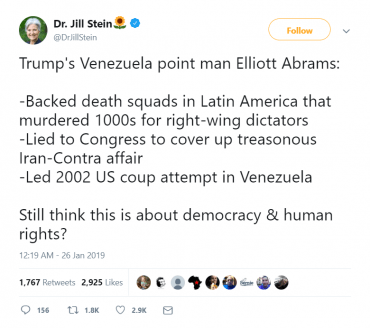
UPDATE Such wisdom as this blog finds is often crowd-source, and with thanks to a commenter below here is some useful information from Jill Stein.
—————————————————
Unlike our adversaries including the Integrity Initiative, the 77th Brigade, Bellingcat, the Atlantic Council and hundreds of other warmongering propaganda operations, Craig Murray’s blog has no source of state, corporate or institutional finance whatsoever. It runs entirely on voluntary subscriptions from its readers – many of whom do not necessarily agree with the articles, but welcome the alternative voice, insider information and debate.
Subscriptions to keep Craig going are gratefully received.
Bolivia: Before and after Evo Morales
Poverty has been reduced, rights expanded, and the economy continues to grow
By Ana Laura Palomino García | Granma | January 23, 2019
Many years ago, the man who has taken the Plurinational State of Bolivia to first-rate statistics in the economic and social arenas, was jailed on a military base in Copacabana, a town in the department of La Paz, close to the border with Peru.
This was in 1995, and Evo Morales endured insults and interrogations, for defending his rights and those of coca growers. But the most hateful way his captors referred to him was “indio” – a word that served as an offense for them, but is one of his most valued attributes.
Now that “Indian,” Evo Morales, is loved by his people and continues to dignify his indigenous roots, struggling tirelessly to eradicate the social ills that in the past left his nation without a future.
Nonetheless, some far removed from this reality, at different latitudes, or in the comfort of their homes, criticize his decision to run for a fourth term as President, denying the broad support he enjoys among the people and the figures that confirm this fact.
BOLIVIA BEFORE EVO
An opportune comment appeared in the Mexican newspaper La Jornada, recalling how, in the not so distant past, a few owners of significant capital fiercely exploited the Aymara, Quechua, Guarani, and other original peoples of Bolivia’s universe, whose elemental rights were ignored.
The paper points out that 90% of the rural population lived in poverty, making Bolivia, Honduras and Haiti a trio of countries facing uncertain futures, with the worst human development indices in the region. At the same time, publicly owned companies were privatized by oligarchic governments beginning in 1952, and Presidents took turns auctioning off the people’s welfare and the assets they were elected to protect, not embezzle.
Nonetheless, as expert Darío Restrepo points out in a study conducted by the National University of Colombia, a new program was implemented with the arrival of the Morales administration, very different from that of the previous 20 years.
“Instead of exclusively representative democracy, power was redirected to indigenous, rural, and popular communities, peoples, and organizations; instead of the President calling for a modern, Western, liberal Bolivia, he expresses the aspiration for a multi-national Bolivia, criticizes the ‘colonial state’ and liberal, bourgeois democracy,” Restrepo states.
BOLIVIA WITH EVO
According to Chilean newspaper La Tercera, in the last 12 years the Bolivian economy has grown 4.9% annually, far exceeding the regional average of 2.7%, and tripling its GDP from 11.5 billion to the current 37.77 billion.
This publication also reports that, according to the country’s National Institute of Statistics (INE), inflation rose by just 2.7% in 2017, the lowest figure in ten years, while the labor market strengthened.
On the other hand, in an interview with the Bolivian leader by BBC Mundo, Evo described, as another of the battles of his government, the fact that for three or four consecutive years his nation has shown the highest economic growth in all of South America. “That has never happened since the founding of the Republic,” he reaffirmed.
Another achievement of his Presidency is the reduction of poverty. According to teleSUR, in 2017 Bolivia made considerable progress on this front, with the poverty rate falling to its lowest level in history, at 36.4%.
The minimum income has increased up to 127%, and the minimum wage of workers is the second best in Latin America.
But the population has not only benefited economically. As the Bolivian President says in the interview, “The most humiliated and marginalized sector, which was that of women of all social and indigenous classes, now has a place in the Plurinational State.”
“We all have the same rights and duties,” he stressed.
According to analyst Hugo Siles, “The contemporary history of Bolivia is divided in two: before and after Evo Morales.” In addition, he stresses in La Nación, “Bolivia has changed substantially in the last decade, there is a before and after with Evo Morales. It is a very different nation socially, economically, and politically. The arrival of Morales implied a 180-degree turnabout on issues such as the management of natural resources and the inclusion of indigenous peoples.”
At the same time, Siles recognizes that much remains to be done, especially on issues related to reforms or changes in the judicial system, and greater recognition of the LGBT+ population.
This modest man, from a humble family, who worked as a bricklayer, baker, and trumpeter to pay for his studies, was branded a terrorist and demonized by the opposition to curb his political aspirations. But in 2005, he won the Presidential elections with 53.7% of the votes, a level of support that continues to date.
IN FIGURES
• The Morales government has recently announced a 1.5 billion dollar investment in roads and airports.
• With Evo Morales as President, Bolivia has established 3,000 primary health care facilities and more than 200 for secondary assistance.
• More than 85% of the population has access to potable water, an everyday issue in the past.
• Some 1.4 billion land titles have been awarded to small farmers and indigenous peoples.
• A “Dignity” benefit is provided to 900,000 older adults, thanks to an allocation of more than 2.9 billion dollars
• A total of 14% of the state budget is destined to education.
Featured Video
Elijah Magnier: Yemen’s strikes are shattering Saudi Arabia’s long-term strategy
or go to
Aletho News Archives – Video-Images
From the Archives
British weapons and personnel doing much of the killing in Yemen
Press TV – June 18, 2019
A detailed report published by the Guardian newspaper has shown how Britain is massively contributing to Saudi Arabia’s devastating war on Yemen as it suggests that London is not only supplying the bombs that fall on Yemenis, but it provides the personnel and expertise that keep the war going.
The comprehensive report by Arron Merat published on Tuesday showed that Britain was doing much of the killing in Yemen as the country continues to provide Saudi Arabia with everything it needs to turn its southern impoverished neighbor into a graveyard.
“Every day Yemen is hit by British bombs – dropped by British planes that are flown by British-trained pilots and maintained and prepared inside Saudi Arabia by thousands of British contractors,” said Merat in the report. … continue
Blog Roll
 Aletho News
- Racist Seinfeld Dances for Joy as Bibi Unveils His New Map
- A West Bank War for Netanyahu’s Election Campaign, Could It Backfire?
- Yemen denounces European Parliament’s ‘hypocritical’ push to blacklist Ansarullah
- Qalibaf: UAE’s UN bid aims to ‘clear the runway’ for ‘Greater Israel’, whitewash genocide
- Pakistan reopens Iran border after boosting security: Report
- Why are so many Brazilians voting for Flávio Bolsonaro?
- Democrats Put Anti-Russia Agenda Ahead of American Workers
- Elijah Magnier: Yemen’s Strikes Are Shattering Saudi Arabia’s Long-Term Strategy
- Pentagon designates Chinese cultural centers national security threat
- Israel Demolishes Home Of Lebanese Journalist Whose Viral Film Exposed Pager Attack
- If Americans Knew
- An error has occurred; the feed is probably down. Try again later.
- No Tricks Zone
- Sudden Stratospheric Warming, Powerful El Niño Combination May Lead To Extreme Europe Cold, Energy Crisis!
- Two New Studies Find Thwaites Glacier Melt Cannot Be Driven By Human Activity Or A Warming Ocean
- E-Cars Reduce CO2 Emissions By Only 41% Compared To Internal Combustion Engine Vehicles
- Predictions Made By Renowned Climate Professor Over Past Decades Have Been Proven To Be Poor
- New Study Suggests Large Regions Of The Pacific Ocean Have Been Cooling For The Last 80 Years
- Germany’s Green Energy Debacle: High Energy Costs Force Kahla Porzellan to Close After 182 Years!
- New Study: 50 Years Of The Most Aggressive ‘Net Zero’ Policies Can Only Affect The Global Climate By 0.03°C
- US September “Heat” Was No Record…Many Records Set Decades Ago
- Latest European Green Energy Debacle; Portugal’s Largest Flagship Solar Park Insolvent!
- Green Energy Debacle: German Expert Professor Fritz Vahrenholt Warns Of Severe Economic And Social Consequences

