Juan Guaido: Imperial Point Man for a Venezuelan Civil War
By Jim Carey | Geopolitics Alert | January 23, 2019
Caracas – The imperial powers have found their new opposition point man in Venezuela; President of the National Assembly and President of the country according to some nations and organizations.
Now that the latest term of Venezuelan President Nicolas Maduro has started and the western powers and their proxies refuse to recognize the Bolivarian government, the imperial states are in a mad dash to find a new face for the Venezuelan opposition. Now it seems that man has been found and the race is on, with state after state anointing the 35-year-old engineer Juan Guaidó.
Guaidó, now being called the “interim President” by everyone from Jair Bolsonaro, the Organization of American States (OAS), to Donald Trump and Justin Trudeau is the current president of the Venezuelan National Assembly. However, according to the states looking for a regime change in Venezuela, Guaidó isn’t just head of the parliament but also the rightful leader of Venezuela.
Guaidó has become a fast-rising star in the political opposition which has led the anti-Maduro National Assembly an opportunity to make political hay and possibly get outside assistance. The opposition acted on this chain of events Tuesday when the National Assembly declared Guaidó the interim President and said he is in charge of organizing new “legitimate” elections.
Putting a new face to the Venezuelan opposition then immediately allowed for all sorts of anti-Maduro actors use Guaidó as their man to rally around.
So now that there is a new imperial point-man inside Venezuela the real question is, what happens next?
There are two likely outcomes to the rise of Guaidó, one of which is contingent on him succeeding and the other which would be another complete failure for the imperialists.
Guaidó launches his campaign today following several days or organizing protesters at rallies in Caracas. The protests have already started to turn violent as of this writing with at least four dead and the opposition calling for the military to “rise up” against the Bolivarian government.
This is all backed by countries like Canada, European nations and sham imperial bodies like the Organization of American States (OAS), which also encourage regime change and now want Guaidó as the man to lead it. Surprisingly, US President Donald Trump was one of the few holdouts who had yet to recognize Guaidó as President but finally caved today.
Guaidó himself has also made promises that should the imperialists allow him to become president and his government to take over they would be welcomed back into the international community. The faux president has also made promises that under his leadership Venezuela would “easily” receive debt relief and loans. At the same time they’re doing this, the opposition also continues to push through measures to freeze the state’s assets, punishing average Venezuelans more in order to entice into turning on Maduro.
This kind of financial manipulation by the opposition coupled with the protests starting to say are essentially an insurrection against a state sponsored by the imperial powers. While protests aren’t necessarily “warfare,” the calls on the military to revolt also show that the opposition doesn’t just want to use civil disobedience but they’d be fine with a violent civil war.
Civil war may be one possible outcome of this latest anti-Maduro frenzy but there is also the possibility that these protests – like those in 2017 – fail. If Guaidó is looking to be president he obviously can’t have this happen or he’ll likely end up like Leopoldo Lopez, Washington’s last golden boy and fellow party member with the “interim President.”
Much like Guaidó, Lopez led protests that became violent and saw protesters causing damage meant to cripple Venezuelan infrastructure for extended periods of time. The problem for López is his little “uprising” failed, he was held accountable for encouraging the violence, and is now on house arrest.
If Guaidó and the empire fail again the “interim President” can likely look forward to the same fate.
Venezuelan army disavows self-proclaimed leader, will defend national sovereignty – defense minister
RT | January 23, 2019
The Venezuelan military will not accept a president imposed by “dark interests,” Defense Minister Vladimir Padrino said after Washington and a number of its allies recognized a lawmaker as the new leader in Caracas.
The army will continue to defend the constitution and national sovereignty, Padrino said on Wednesday afternoon, hours after opposition lawmaker Juan Guaido was proclaimed interim president by the National Assembly, in a direct challenge to President Nicolas Maduro.
The US quickly recognized Guaido as Venezuela’s legitimate leader, with the Organization of American States (OAS) following Washington’s lead. Canada and France have also recognized Guaido, while Mexico has declined to do so “for now.”
Bolivia declared “solidarity with the people of Venezuela and brother Nicolas Maduro” in resisting the “claws of imperialism” in South America, President Evo Morales tweeted.
Maduro responded to the US announcement by cutting diplomatic ties with Washington and giving American diplomats 72 hours to leave Venezuela.
Guaido, however, countermanded that in a tweet and promised that Venezuela “will continue to maintain diplomatic relations with all the countries of the world.”
The issue of diplomats has raised the stakes in the US-Venezuela confrontation, as Senator Marco Rubio (R-Florida) – one of the driving forces behind the recognition of Guaido – argued that US diplomats should stay put, since leaving would mean recognition of Maduro’s legitimacy.
Venezuela’s supreme court declares all acts of opposition-led National Assembly illegal
RT | January 21, 2019
Venezuela’s Supreme Court has declared all acts of the country’s National Assembly null and void, days after the opposition-held assembly declared President Nicolas Maduro’s election illegitimate.
The National Assembly is a 167-seat legislature, currently headed by Juan Guaidó of the Popular Will party – a fierce opponent of Maduro, who had been taking part in protests against him and has called for the country’s military to depose the president.
Maduro already declared the National Assembly illegitimate in 2017, and created a new legislature – the Constituent National Assembly – to replace it, where all seats are currently held by pro-Maduro parties. As Maduro lacks the Constitutional power to outright dissolve the National Assembly, both houses have functioned alongside each other since 2017, with the CNA given power to overrule legislation passed by the National Assembly.
Maduro was sworn in last week after winning re-election last May. The opposition-led assembly and a coalition of neighboring countries declared Maduro’s election illegitimate.
US Secretary of State Mike Pompeo called Maduro’s election “illegitimate” and a “sham,” and vowed to keep up diplomatic pressure on the Venezuelan government.
Guaidó was briefly detained by secret police en route to a rally last week. Maduro insisted that Guaidó’s arrest was not government-ordered, and may have been staged for the media.
The Supreme Court’s announcement comes amid news of anti-government demonstrations in the country’s capital, as well as a mutiny by a National Guard unit stationed in a slum neighborhood near the Presidential Palace. Government forces arrested 40 National Guardsmen and fired tear gas at protesters in the early hours of Monday morning.
Defense Minister Vladimir Padrino Lopez said on Twitter that the rogue soldiers will “be punished with the full weight of the law.”
Video footage from the neighborhood shows protesters lighting fires and blocking the streets with barricades.
The ongoing crisis in Venezuela is being closely followed by US media and politicians, the majority of whom are openly anti-Maduro. Vice President Mike Pence has expressed support for Guaidó, calling the National Assembly the “only legitimate body in the country,” while Florida Senator Marco Rubio has repeatedly called Maduro’s government “illegitimate” and pressed for regime change in the Latin American country.
Venezuela has been mired by hyperinflation, starvation, and a refugee crisis that has seen almost three million Venezuelans flee the country. Washington has blamed the socialist economic policies of Maduro and his mentor Hugo Chavez for the deepening crisis, while passing sanctions against the Maduro government officials. The latest major batch of sanctions was in September signed by President Donald Trump, who once announced he is “not going to rule out a military option” in addressing the crisis in Venezuela.
US Administrations Have Been Intervening in Venezuela Since at Least the Early 2000s
FAIR | January 16, 2019
Janine Jackson interviewed Alexander Main about the Nicolás Maduro re-election for the January 11, 2019, episode of CounterSpin. This is a lightly edited transcript :
Janine Jackson: When it comes to Venezuela, elite US media don’t hide their feelings. And their feelings are all the same. Headlines on last year’s reelection of Venezuelan president Nicolás Maduro differed only in tone, including the disdainful: “As Venezuelans Go Hungry, Their Government Holds a Farcical Election,” from the Economist; the decisive: USA Today‘s “Maduro Is Turning Venezuela Into a Dictatorship,” or Foreign Affairs’ more somber version, “Venezuela’s Suicide; Lessons From a Failed State.” There’s Forbes’ vaguely threatening “Why Nicolas Maduro of Venezuela May Wish He Lost the Presidential Election,” and Foreign Policy’s unashamed “It’s Time for a Coup in Venezuela.”
But they’re all pretty much variations on a theme that’s hard to unhear, given that media bang it out so loudly and repeatedly. Here to help us sort fact from froth is Alexander Main. He’s director of international policy at the Center for Economic and Policy Research. He joins us by phone from Washington, DC. Welcome to CounterSpin, Alex Main.
Alex Main: Thank you, Janine.
JJ: Writing for FAIR on Venezuelan elections last year, Alan MacLeod pinpointed US media’s preferred trope, which was to say that Maduro was reelected “amid”—amid outcry, amid widespread disillusionment, amid charges of irregularities, amid low turnout. The message, I think, to readers was that Maduro’s re-election was not legitimate. What should we know about last May’s elections in Venezuela?
AM: So what isn’t generally mentioned by the media is that a critical factor in the outcome of the election was the approach taken by Venezuela’s opposition. Much of the opposition, many of its parties, decided to boycott these elections, for a variety of reasons.
At any rate, the media did not examine that fact. And we’re still not seeing it very much. I think one of the few exceptions is the Washington Post, in the article that appeared today, that did mention the divisions within the opposition, and their decision not to participate that had, obviously, a huge effect on the election result.
JJ: The media coverage would give you the impression that Venezuela’s election almost happened in a vacuum, but there was in fact involvement from, for example, the Organization of American States.
AM: Well, the Organization of American States, or rather the secretary general of the organization, whose name is Luis Almagro. He represents himself. He was elected, but once secretary general, he has sort of executive power there; but he doesn’t represent the countries within the organization. He has been on a campaign against the Maduro government from very early on. It stems from their initial decision not to allow him to send electoral observers to the elections.
And this is based on a decision taken by Venezuela’s electoral authorities many years ago, when they decided that they had enough transparency, enough safety measures around the elections, that they no longer required any sort of outside tutelage.
A number of countries in Latin America have taken the same decision. It’s a decision that has to do with the respect of their sovereignty. Certainly you don’t see in the US any massive presence of international observers, even though I think a lot of people would like to see that at some point.
But anyway, this was a sovereign decision that was taken by Venezuela’s electoral authority. And following that, Almagro really went on a rampage, and has been very much involved in efforts to try to delegitimize the Maduro government and to support the very hard-line opposition.
In doing this, he went sort of out of bounds in terms of his rhetoric, even for a lot of right-wing governments in Latin America, when late last year he voiced support for a military coup, much as some US officials have done, and US members of Congress have done. And as a response, you had all of the governments of Latin America that signed on to a statement that categorically rejected the possibility of any form of military intervention, whether by coup or an outside military intervention in Venezuela.
But certainly his rhetoric, and the campaign that he has led—along with other figures, such as Sen. Marco Rubio—have certainly given the impression that there is a desire for US intervention in what’s going on in Venezuela, and that’s, I think, resulted in sort of a defensive reaction from the Venezuelan government.
JJ: Well, it sounds very disturbing, but also confusing. You know, when I was looking through headlines, I saw one from something called the Pacific Council on International Policy that said, “Maduro Re-Elected. Can Democracy Ever Prevail in Venezuela?” I mean, just at the level of the sentence, it’s confusing. And then when you start talking about a coup to save democracy—which is the upshot of current coverage, and I guess policy—it just doesn’t even seem to make sense. The call is for the US to intervene, but the US is already intervening, isn’t it?
AM: Well, yeah, absolutely, and they’ve really been intervening in Venezuela, various US administrations, since at least the early 2000s, when we know that the US government—through institutions like the National Endowment for Democracy—has been providing funding and training to opposition groups in Venezuela, and often very hard-line groups that have taken a radical line, not recognizing the government and trying to seek its removal through extra-constitutional means, including a short-lived coup that took place in April of 2002.
The US has been very involved in trying to isolate them, Venezuela, diplomatically throughout the region, putting a lot of pressure on Latin American governments to support US measures condemning the situation in Venezuela.
More recently, the US has been applying sanctions against the government of Venezuela. And this is a very underreported thing in the US media and the international media generally.
When you see the coverage, for instance, of the Maduro inauguration, what you don’t see at all are references to the impact of the economic sanctions that have been applied. In fact, there are few media outlets at this point that even acknowledge that there are economic sanctions, even though they’ve been in place since August of 2017, when Trump announced them through an executive decree, having determined Venezuela to be an “extraordinary threat to US national security.” Those were the actual terms that were used in order to justify these sanctions.
And they’ve had a dire effect in Venezuela, which has been experiencing an economic crisis for quite a while now, since 2014 at least. And the government, of course, has failed to resolve this. It has to do with some of the government’s own economic policies. But at this point, the US also bears responsibility through these sanctions, where they have cut off Venezuela’s access to international financial markets, by which they can borrow money and purchase the necessary imports that the country needs. And we know that there aren’t enough imports of food or of medicine that are taking place at the moment.
And it’s also had a dire effect on the country’s oil production. And, of course, oil is the source of most of Venezuela’s national revenue. Along with falling oil prices, there’s been a tremendous fall in oil production in Venezuela, and it accelerated, actually, after these sanctions were put into place, because the Venezuelan government isn’t able to make the necessary investments to maintain the oil fields.
So that’s not mentioned, really, whatsoever in the major media, even though you have economists, including opposition-aligned economists from Venezuela, like Francisco Rodriguez, who have pointed out the very negative impact that these sanctions are having on the country.
JJ: Alan MacLeod also found a piece in Bloomberg that came close to acknowledging it, but in such a strange way. It was an article in which Bloomberg said that victory in the “widely derided election” gives Maduro “sole ownership of the nation’s crushing economic crisis.” And then in the very next sentence, it gloats that US and regional leaders will punish Venezuela by imposing “further isolation and sanctions on the crisis-stricken nation’s all-important oil industry.”
AM: Exactly. There’s this absurd idea that the sanctions somehow only hurt the Venezuelan government and Venezuelan government officials. It’s always the Venezuelan government’s responsibility, when they discuss the economic situation.
From time to time, you do see some media saying, “Oh, but the Venezuelan government says that the US sanctions are contributing to this dire economic situation.” They fail to ask any independent expert. You know, any economists that are taking a good look at what’s going on in Venezuela today will tell you, “Well, yes, these sanctions quite obviously are having a very negative impact.”
JJ: Finally, one of the things that coverage does is present the Venezuelan people as benighted. A piece from Time from last year includes one of my favorite creations. It first of all says that the crisis, the current crisis, “can be traced to the 1998 election of Hugo Chávez to the presidency,” so Chávez is the reason that things are difficult now. But I love this presentation: “Chávez concocted a political system that used often high oil prices to essentially bribe the masses into supporting him.”
The picture of the Venezuelan people that one gets from US media coverage is really as sort of benighted, not knowing what’s good for themselves and, once again, requiring some sort of intervention to tell them how to do democracy.
AM: Yes. This is quite absurd. Really, what we’re seeing in Venezuela is, one, an extraordinarily well-organized population, and particularly in poor communities that are certainly confronting a very dramatic economic situation, but I think doing so in effective ways that make the situation somewhat sustainable for these communities. So we’re seeing a very, very high level of community organization.
I’d say the vast majority of Venezuelans at this point are probably quite disgruntled with Maduro and his government. However, the Venezuelan opposition really offers no viable alternative to the Maduro government. They have never presented any sort of coherent economic proposal, with the possible exception of the opposition candidate in last year’s election. But, of course, most of the opposition parties boycotted those elections.
And in general, I think a lot of Venezuelans, certainly those that come from lower-income communities, are well aware of the fact that the opposition is linked to the country’s traditional economic elite, and they have a terrible reputation from their involvement in governments before Chávez was in power.
Things may be bad under Maduro, but I think there’s a sense among many Venezuelans that things could actually be quite a bit worse under opposition governments, particularly if they impose the sort of neoliberal policies that hurt the poor people of Venezuela enormously during the decades prior to Hugo Chávez’s election in the late ’90s.
JJ: We’ve been speaking with Alexander Main; he’s director of international policy at the Center for Economic and Policy Research. You can find their work, including Alex’s piece, “The United States’ Hand in Undermining Democracy in Venezuela,” online at CEPR.net. Alexander Main, thank you very much for joining us today on CounterSpin.
AM: Thank you, it was a pleasure.
Johns Hopkins, Bristol-Myers Face $1 Billion Suit For Infecting Guatemalan Hookers With Syphilis
By Tyler Durden | Zero Hedge | January 19, 2019
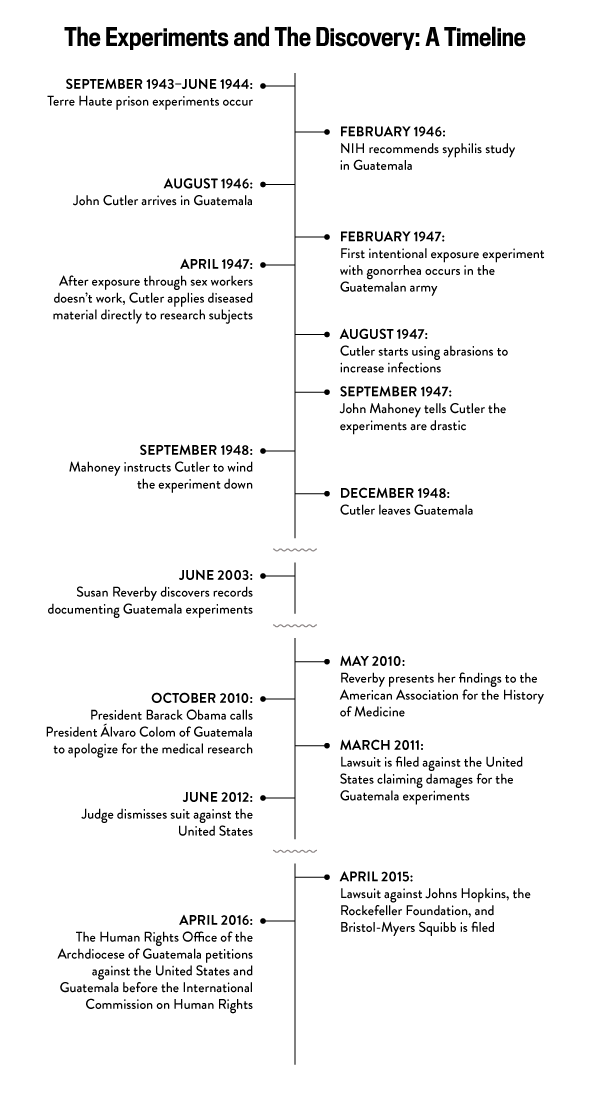
A federal judge in Maryland said Johns Hopkins University, pharmaceutical company Bristol-Myers Squibb and the Rockefeller Foundation must face a $1 billion lawsuit over their roles in a top-secret program in the 1940s ran by the US government that injected hundreds of Guatemalans with syphilis, reported Reuters.
Several doctors from Hopkins and the Rockefeller Foundation were involved in the government program, as well as four executives from Bristol-Myers’ predecessors, Bristol Laboratories and the Squibb Institute, according to the complaint.
“The overall purpose of the study was to test out whether antibiotics could be used to prevent syphilis and other sexually transmitted infections before its symptoms appeared in someone who was exposed to them. So the researchers initially recruited sex workers with syphilis to have sex with prisoners.
Later on, they directly infected volunteers without their informed consent or knowledge of what was really happening.
In many cases, though, infected people were left untreated. In total, 83 deaths were linked to the study, though it’s not entirely certain whether the infections were the direct cause (That said, late-stage syphilis is often fatal),” reported Gizmodo.
In a January 3 decision, US District Judge Theodore Chuang denied the defendants’ argument that a recent Supreme Court decision shielding foreign businesses from lawsuits in US courts over human rights abuses abroad also applied to domestic firms absent Congressional authorization.
Chuang’s decision was a big victory for 444 victims (all mostly dead) and their relatives suing over the experiment.
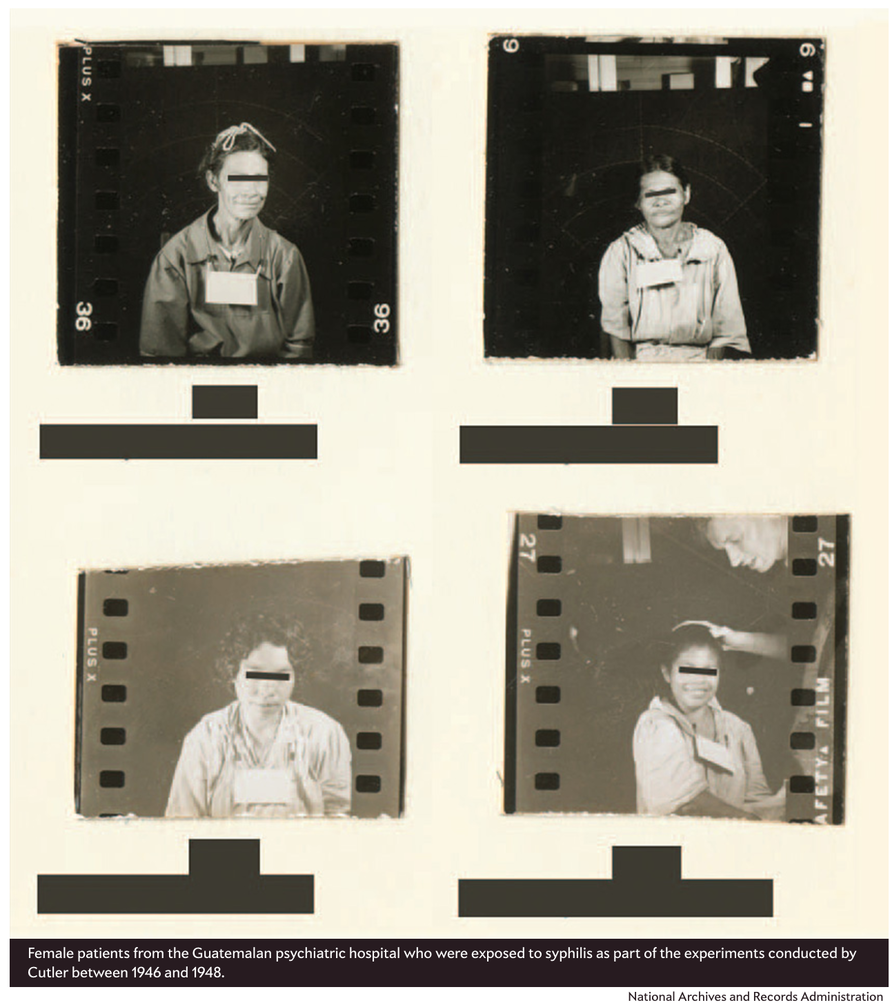
The experiment was concealed until a professor at Wellesley College in Massachusetts discovered the files in 2010.
Chuang said lawsuits against US businesses under the federal Alien Tort Statute were not “categorically foreclosed” by the Supreme Court decision last April 24 in Jesner v Arab Bank Plc covering foreign corporations.
He said the “need for judicial caution” was “markedly reduced” where US businesses were defendants because there was no significant threat of diplomatic tensions from foreign governments.
The federal judge said letting the Guatemala case proceed would “promote harmony” by giving foreign plaintiffs a chance at a remedy in the American court system.
“Johns Hopkins expresses profound sympathy for individuals and families impacted by the deplorable 1940s syphilis study funded and conducted by the U.S. government in Guatemala,” the university said in a statement. “We respect the legal process, and we will continue to vigorously defend the lawsuit.”
Hopkins, Bristol-Myers, and the Rockefeller Foundation and their lawyers did not immediately respond to Reuters‘ requests for a statement.
Paul Bekman, a lawyer for the 444 Guatemalans, said his clients would proceed with discovery, including the exchange of decades-old documents.
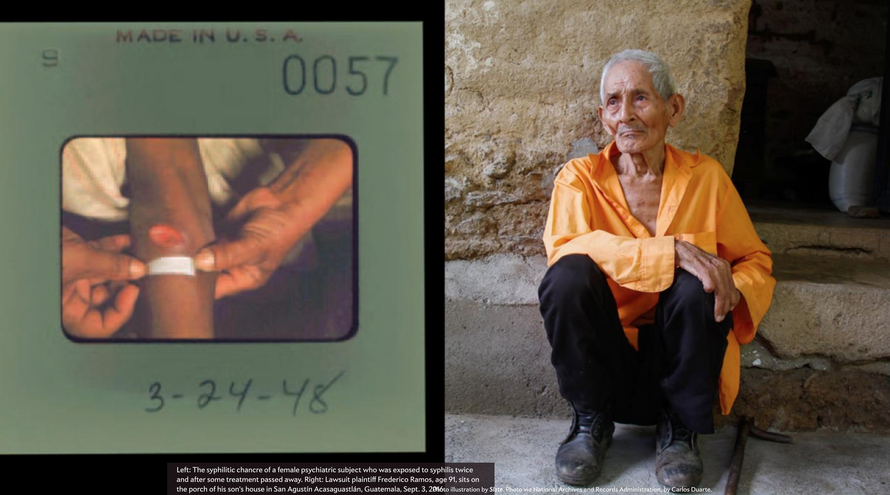
An earlier decision found no statute of limitations arguments could be made since the plaintiffs did not learn about the experiment until 2010.
Infecting Guatemalan hookers with sexually transmitted diseases was one of many eugenic programs the US government conducted during the 1940s and Post–World War II era. Now the academic institutions and corporations involved in these horrific government experiments are being served with massive lawsuits that could be financially devastating.
Pompeo the Warmonger Supports Authoritarian Regimes
By Brian CLOUGHLEY | Strategic Culture Foundation | 20.01.2019
On January 2 US Secretary of State Mike Pompeo visited Brazil, and his Department noted that in discussions with Foreign Minister Ernesto Araujo they “highlighted the importance of working together to address regional and global challenges, including supporting the people of Venezuela, Cuba, and Nicaragua in restoring their democratic governance and their human rights.” Pompeo declared that the US and Brazil “have an opportunity to work alongside each other against authoritarian regimes.”
From this we gather that Pompeo is a strong advocate of democratic governance and will always make it clear that the United States supports unfortunate people living in countries having “authoritarian regimes.” It is apparent he must believe in the Universal Declaration of Human Rights which states that “everyone has the right to freedom of thought, conscience and religion.”
Unfortunately it transpired that Pompeo is a selective supporter of democracy and freedom of religion, because after he left Brazil and went to the Middle East he voiced vigorous support for despots who rule countries in a manner that is undeniably authoritarian.
In a speech in Cairo on January 10 Pompeo threatened Iran and declared that “Nations are rallying to our side to confront the regime like never before. Egypt, Oman, Kuwait, and Jordan have all been instrumental in thwarting Iran’s efforts to evade sanctions.” It must be gratifying for him that these nations have joined the US in its crusade against Iran, three of them being hereditary monarchies and one run by a non-regal martinet.
Oman, for example, is “an absolute monarchy by male primogeniture. The Sultan, Qaboos bin Said al Said, has been the hereditary leader of the country since 1970.” Freedom House notes that “The regime restricts virtually all political rights and civil liberties, and imposes criminal penalties for criticism and dissent… Political parties are not permitted, and the authorities do not tolerate other forms of organized political opposition.”
In Jordan “the monarch holds wide executive and legislative powers, including the appointment of the prime minister and all seats of the senate. The monarch approves and dismisses judges; signs, executes or vetoes all laws; and can suspend or dissolve parliament.”
The leader of Kuwait, the Amir, according to the CIA Factbook, is “chosen from within the ruling family, confirmed by the National Assembly; the prime minister and deputy prime ministers are appointed by the Amir.” In this autocracy, according to Human Rights Watch, there are “no laws prohibiting domestic violence or marital rape… a man who finds his mother, wife, sister or daughter in the act of adultery and kills them is punished by either a small fine or no more than three years in prison.”
Pompeo wants “democratic governance and human rights” in Venezuela, Cuba, and Nicaragua. Why not in Oman, Jordan and Kuwait?
The only one of Pompeo’s countries not ruled by a supreme monarch is Egypt, whose president is Field Marshal Abdel Fattah al-Sisi who “was elected in May 2014, almost a year after he removed his elected predecessor, the Muslim Brotherhood’s Mohammed Morsi, from office in a coup.” Sisi “won a second four-year-term in March 2018 against a sole minor opposition candidate. Human rights lawyer Khalid Ali and former prime minister Ahmad Shafiq withdrew from the race, and the former armed forces chief of staff Sami Anan was arrested.”
In his warmongering anti-Iran, anti-Syria speech Pompeo announced that his visit to Egypt was “especially meaningful for me as an evangelical Christian, coming so soon after the Coptic Church’s Christmas celebrations” and visited the Cathedral of the Nativity of Christ and the Al-Fattah Al-Alim mosque where he praised Egypt’s “freedoms here in this houses [sic] of worship, these big, beautiful, gorgeous buildings where the Lord is clearly at work.”
He ignored Amnesty International’s statement that in Egypt “the authorities continued to violate the right to freedom of religion by discriminating against Christians.” His own Department recorded that last year “Irrespective of religion, authorities also did not apply equal protection to all citizens and sometimes closed churches, in violation of the law, according to multiple sources.”
The bigotry of the Egyptian regime and its clerics was epitomised on January 13 when Al Azhar University which is responsible for “a national network of schools with approximately two million students” expelled a female student for being hugged by a male friend. The scandal was revealed in a video clip which “showed a young man carrying a bouquet of flowers kneeling before a young woman and then hugging her in what appeared to be a marriage proposal.” According to a University spokesman this violates “the values and principles of society”. There was not a word from Pompeo, that self-declared admirer of Egyptian places of worship where “the Lord is clearly at work.”
Pompeo continued his tour of the region, and next day, as he landed in Saudi Arabia, the Egyptian regime announced that for the seventh time it had extended its state of emergency which “allows authorities to take exceptional security measures, including the referral of terrorism suspects to state security courts, the imposition of curfews and the confiscation of newspapers.” This would be supported in Saudi Arabia where, as chronicled by Freedom House, the “absolute monarchy restricts almost all political rights and civil liberties. No officials at the national level are elected. The regime relies on extensive surveillance, the criminalization of dissent, appeals to sectarianism, and public spending supported by oil revenues to maintain power. Women and religious minorities face extensive discrimination in law and in practice.”
This discrimination was highlighted by the New York Times on January 13 when it published an Op-Ed by Alia al-Houthlal that implored Pompeo to ask Saudi Prince Mohammad bin Salman to release her sister, the women’s rights activist, Loujain al-Houthlal, who is imprisoned in Riyadh. Ms Alia al-Houthlal wrote that her sister had been tortured in prison, and that a close associate of bin Salman, Saud al-Qahtani, who has been named in connection with the murder of Mr Jamal Khashoggi [brutally killed in the Saudi consulate in Istanbul on October 2 last year], was present at several torture sessions.
The Times reported that Pompeo began his conversation with bin Salman, the de facto ruler of Saudi Arabia, by saying “I want to talk to you about a couple of places we’ve been. We think we learned a lot along the way that will be important going forward.” There was no mention of the torture of Loujain al-Houthlal or any other gross violations of human rights in Saudi Arabia where the regime continues to “repress peaceful activists and dissidents, harassing writers, online commentators and others who exercised their right to freedom of expression by expressing views against government policies.”
There was none of that embarrassing stuff. It was all skated over, with Pompeo saying only that “we spoke about human rights issues here in Saudi Arabia – women activists. We spoke about the accountability that – and the expectations that we have. The Saudis are friends, and when friends have conversations, you tell them what your expectations are.”
Pompeo’s expectations include joint action with the Saudi regime and other Middle East autocracies to “counter Iranian malign influence,” which he regards as an even higher priority than “working against authoritarian regimes” in Latin America, which Washington is determined to dominate. Pompeo’s objections to authoritarianism are highly selective, for in his Cairo speech he confined himself to describing Iran “malevolent,” and “oppressive” while denouncing “Iranian expansion” and “regional destruction,” which is a trifle ironic, coming from a Secretary of State whose military devastated Iran’s neighbours, Iraq and Afghanistan.
Pompeo’s ethical approach is decidedly ambiguous and his moral flexibility would attract the admiration of a trampoline gymnast. His Cairo speech was titled “A Force for Good: America’s Reinvigorated Role in the Middle East,” but it is apparent that reinvigoration is confined to plans for destruction of Iran, in which Washington will be assisted by Pompeo’s friends — the Middle East’s authoritarian regimes.
Don’t meddle in Venezuela, Moscow tells coup-cheering Washington
RT | January 16, 2019
Russia has criticized the US government for bullying Venezuela and encouraging its opposition to stage a coup against President Nicolas Maduro, who was sworn in for his second term last week.
“Nations should avoid meddling in other nations’ internal affairs,” Russian Foreign Minister Sergey Lavrov said on Wednesday. He said that Washington’s encouragement of opposition forces in Venezuela “has made them unwilling to seek reconciliation [with the president], which is regretful.”
Venezuela is currently in a political crisis, with the opposition-controlled National Assembly declaring President Maduro a “usurper” and its speaker, Juan Guaido, an “interim president” of the country. The move came after strong public support from Washington, which has been advocating toppling Maduro for quite some time.
Washington has targeted Maduro’s government with a series of crippling economic and personal sanctions, and reportedly considered a military intervention in the country.
The National Assembly’s mandate to represent Venezuelans remains in question. In 2017, the country reformed its parliament system by introducing a new body called the Constitutional Assembly, which is controlled by pro-government politicians. The opposition and its backers in Washington rejected the reform as a power grab and declared the new legislature illegal.
Explaining Russia’s position on the conflict, Lavrov said US involvement in Venezuela was “very alarming and indicated that the US policy of destabilizing governments it does not like remains a priority.”
Venezuela suffered years of economic and social hardships, which the opposition blames on Maduro’s poor governance. He blames the hardship on sabotage of big business and foreign interests, which want to see his socialist government ousted from power.
Venezuela Welcomes 2,500 Cuban Doctors Leaving Brazil
teleSUR | January 13, 2019
Over 2,000 Cuban doctors are setting up practice in Venezuela after being kicked out of Brazil by President Jair Bolsonaro, Venezuelan leader Nicolas Maduro said this weekend.
Two-thousand-five-hundred cardiologists, anesthesiologists, and general doctors arrived in the South American country Friday to bulk up the medical staff at the Barrio Adentro Mission, a social initiative founded by ex-president Hugo Chavez to provide free, public medical care.
In November, thousands of doctors were forced to leave the Mais Medicos (More Doctors) cooperation program in Brazil after far-right president Bolsonaro criticized the program, saying it was torture for Cuban mothers who were “not allowed” to go with their children and questioning diplomatic ties with the island.
In the last five years, about 20,000 Cuban physicians have participated in the ‘More Doctors Program,’ assisting thousands of Brazilians in rural communities to receive primary health care.
Some 1,462 vacancies, roughly 17.2 percent of those positions left by the Cuban doctors, have not yet been filled, the Brazilian Health Minister, Luiz Henrique Mandetta, said Friday.
Several states and municipalities inside Brazil pressured the National Government to provide a solution because the Cuban doctors are usually the only medical option in several rural areas of the country.
Cuba Denounces Attempt to Reactivate US Brain-Drain Program
teleSUR | January 12, 2019
Cuban President Miguel Diaz-Canel has condemned the call by two U.S. lawmakers of Cuban origin to reactivate the ‘brain-drain’ program established by George W. Bush and revoked during the administration of Barack Obama.
“They’re trying to impose a perverse strategy to stimulate brain drain. Another anti-Cuban campaign that shows the imperial impotence against the revolutionary conquests,” Diaz-Canel wrote on Twitter.
Senators Marco Rubio and Bob Menendez, respectively from the Republican and Democratic parties, filed a resolution at Congress on Thursday calling for the reactivation of the Cuban Medical Professional Parole (CMPP), known as “brain drain” by Cubans.
“Cuba has been sending medical brigades around the world, including Central and South America as well as Africa, for over forty years – in return for payments directly to the government estimated to be as much as $8 billion per year,” it reads.
“This blatant exploitation by the Castro regime of their healthcare professionals is not at all surprising, as they have long used the suffering of the Cuban people for their own personal gain.”
The resolution can define the Senate’s position on the issue, but the ultimate decision to re-establish the CMPP rests with the State Department.
Installed in 2006, the program aimed to lure Cuban doctors and health professionals working on special missions abroad to abandon their duties and emigrate to the United States with special incentives.
The Cuban president accused the senators of being “unable to promote a civilized relationship” and being “blinded by arrogance.”
Obama repealed the program in 2017 after the improvement of diplomatic relations between the two countries, and recognized the work of health professionals.
According to government data, Cuba has sent more than 600,000 doctors to over 160 countries since the foundation of the ‘More Doctors’ initiative in 1973. Their labour has been recognized by the UN and the World Health Organization as good practice and an important step toward the 2030 sustainable development objectives.
Also, Cuban medicine schools have trained over 35,613 foreigners from 138 countries, completely free of charge.
However, the senators described the missions as “human trafficking.”
Cuban Foreign Ministry director for the United States Office, Carlos Fernandez de Cossio, also rejected the initiative by Rubio and Menendez.
“Impotent resentment against Cuba has no limits. Unable to stop recognized human professional development, baseball quality and potential investment. Bob Menendez and Marco Rubio want to restore brain drain program against Cuban doctors,” said Fernandez de Cossio.
Both senators argued that Cuba was profiting from the work of its health professionals in Brazil, where Cuba ended its ‘More Doctors Program’ in November after comments by then President-Elect Jair Bolsonaro questioning the quality of Cuban doctors’ training.
The news was met with sadness by the Brazilian ‘Doctors for the People National Network‘ (RNMMP), who regretted the loss of about 8,500 health professionals working in historically marginalized areas.
“It was an example that favelas, backlands and the Amazon can have doctors. An example that the poor or black people can be a doctor. An example that the state must guarantee the right to health. An example of Latin American love,” the RNMMP press release declared.
The ‘More Doctors Program’ was approved by former President Dilma Rousseff in 2013 in order to increase access to public health for the Brazilian population.
One of those policies consisted of assuring budgetary resources for implementing family-based health strategies, increasing medical vacancies in universities and offering more courses in the field of medicine.
During the five years it lasted, about 20,000 Cuban physicians assisted thousands of Brazilians in primary health care.
Besides the CMPP resolution, Rubio is also attempting to veto an Obama-era ruling allowing Cuban athletes to join Major League Baseball without first having to defect to the United States.
Mexico Set to Become Third Country to Fully Legalize Marijuana
21st Century Wire | January 5, 2019
Following in the footsteps of Uruguay and Canada, as well as 30 US states, Mexico is set to adopt a new law which will make cannabis legal for both medicinal and recreational use. New legislation by Mexico’s ruling majority party hopes to “cut the chain” of illegal supply.
Olga Sánchez Cordero, interior minister in Mexico’s new leftist nationalist government, has recently submitted a Bill to Congress which would effectively end prohibition of cannabis, placing the new rescheduled substance under a regime of state regulation.
Mexico had a brief foray into the legalization of drugs back in 1940 when Lázaro Cárdenas, the former Mexican president who had nationalized Mexico’s oil sector in 1938. Cárdenas lifted all state restrictions on narcotics like heroin, morphine and cocaine, which allowed addicts to be treated as patients, rather than felons. State dispensaries sold small amounts to individuals at prices which vastly undercut those of illegal street dealers. The move was reversed after only after 6 months – because of intense diplomatic pressure from the US.
The new law could also open up numerous opportunities for independent entrepreneurs like 17-year-old Nicolás Calderón who hopes to open a cannabis shop and art venue in Mexico City, as well as develop his own cultivation site and supply chain.
“I don’t just see an opportunity to make money but also to help Mexico […] I think this is going to help reduce el narco [the cartels] a lot,” said Calderón to the Financial Times.
However, as on the world’s largest producers of illegal narcotics, the Mexican state will no doubt face intense competition from black markets run by the country’s vast organized crime cartels on which former president Felipe Calderón had unsuccessfully declared ‘war’ 12 years ago.
“I think the cartels will lose 40 per cent of their income with [marijuana] legal here and in the US,” said Vicente Fox, Mexico’s president from 2000 to 2006, in an interview with the FT. Fox currently sits on the board of Canadian cannabis company Khiron Life Sciences – which hopes to enter the Mexican cannabis market later this year.
READ MORE CANNABIS NEWS AT: 21st Century Wire Cannabis Files
Featured Video
Elijah Magnier: Yemen’s strikes are shattering Saudi Arabia’s long-term strategy
or go to
Aletho News Archives – Video-Images
From the Archives
British weapons and personnel doing much of the killing in Yemen
Press TV – June 18, 2019
A detailed report published by the Guardian newspaper has shown how Britain is massively contributing to Saudi Arabia’s devastating war on Yemen as it suggests that London is not only supplying the bombs that fall on Yemenis, but it provides the personnel and expertise that keep the war going.
The comprehensive report by Arron Merat published on Tuesday showed that Britain was doing much of the killing in Yemen as the country continues to provide Saudi Arabia with everything it needs to turn its southern impoverished neighbor into a graveyard.
“Every day Yemen is hit by British bombs – dropped by British planes that are flown by British-trained pilots and maintained and prepared inside Saudi Arabia by thousands of British contractors,” said Merat in the report. … continue
Blog Roll
 Aletho News
- Racist Seinfeld Dances for Joy as Bibi Unveils His New Map
- A West Bank War for Netanyahu’s Election Campaign, Could It Backfire?
- Yemen denounces European Parliament’s ‘hypocritical’ push to blacklist Ansarullah
- Qalibaf: UAE’s UN bid aims to ‘clear the runway’ for ‘Greater Israel’, whitewash genocide
- Pakistan reopens Iran border after boosting security: Report
- Why are so many Brazilians voting for Flávio Bolsonaro?
- Democrats Put Anti-Russia Agenda Ahead of American Workers
- Elijah Magnier: Yemen’s Strikes Are Shattering Saudi Arabia’s Long-Term Strategy
- Pentagon designates Chinese cultural centers national security threat
- Israel Demolishes Home Of Lebanese Journalist Whose Viral Film Exposed Pager Attack
- If Americans Knew
- An error has occurred; the feed is probably down. Try again later.
- No Tricks Zone
- Sudden Stratospheric Warming, Powerful El Niño Combination May Lead To Extreme Europe Cold, Energy Crisis!
- Two New Studies Find Thwaites Glacier Melt Cannot Be Driven By Human Activity Or A Warming Ocean
- E-Cars Reduce CO2 Emissions By Only 41% Compared To Internal Combustion Engine Vehicles
- Predictions Made By Renowned Climate Professor Over Past Decades Have Been Proven To Be Poor
- New Study Suggests Large Regions Of The Pacific Ocean Have Been Cooling For The Last 80 Years
- Germany’s Green Energy Debacle: High Energy Costs Force Kahla Porzellan to Close After 182 Years!
- New Study: 50 Years Of The Most Aggressive ‘Net Zero’ Policies Can Only Affect The Global Climate By 0.03°C
- US September “Heat” Was No Record…Many Records Set Decades Ago
- Latest European Green Energy Debacle; Portugal’s Largest Flagship Solar Park Insolvent!
- Green Energy Debacle: German Expert Professor Fritz Vahrenholt Warns Of Severe Economic And Social Consequences

