Colombia’s New Defense Minister To Impose Permit Requirement for Protests
teleSUR | July 19, 2018
Colombia’s incoming Defense Minister Guillermo Botero is planning to “regulate” anti-government protests by only allowing demonstrations if they are previously approved by authorities. The announcement was made by Botero during a summit attended by USAID director Mark Green and former U.S. vice-president Joseph Biden.
Also attending the summit, president-elect Ivan Duque, said that “opposition is important to scrutinize, make demands and to criticize. But the invitation is that we pull together for a future for us all.”
Botero, who will be in charge of both the National Police and military, seemed to agree, saying public protests should “represent the interests of all Colombians and not just a small group.”
Restricting anti-government protests, which appears to go in contradiction to some parts of the ongoing peace process, was the first proposal made by Botero after being appointed by Duque.
Outgoing president Juan Manuel Santos vowed to release jailed participants in protests that turned violent during major social tensions between neglected or discriminated communities and the authorities, according to Colombia Reports.
Over the past decade, the overwhelming majority of protests were held by historically neglected groups, mainly Indigenous groups and African-descendant communities. They also included labor unions, campesinos, teachers, as well as political opponents to the government.
Botero’s proposal comes amid a surge of assassinations and death threats against human rights defenders and social activists.
Opposition Senator Alexander Lopez, who earlier this year survived an alleged assassination attempt, took to Twitter to voice his concern over the restrictive measure. “Botero hasn’t even taken office and he’s already persecuting social protest. He wants us to just raise our arms for him to do what he wants with us.”
Colombia’s inspector general, Fernando Carrillo, has accused elements of the country’s police and military of collaborating with criminal organizations to assassinate human rights defenders and community leaders. “State agents are co-opted by criminal organizations that are eliminating social leaders,” the official said on Wednesday.
Carrillo’s office is one of the state departments tasked with investigating the murders of at least 311 social leaders since 2016.
RELATED:
Colombia: State Agents Accused of Murdering Social Leaders
Colombian Community Mourns the Loss of Another Social Leader
teleSUR | July 17, 2018
Another Colombian social leader was reportedly murdered in the municipality of Caloto, Cauca, a national human rights network confirmed Monday.
The father of a former FARC soldier, an active participant in the Association of Pro-Constitution Workers Zones of the Caloto Campesina Reserves, Luis Eduardo Dague was a leader in his community. He assisted in founding the Carmelo of the Municipality of Caloto Cauca community and worked on the El Carmelo Action Board and various union, trade, and agricultural groups, the human rights network Francisco Isaías Cifuentes reported.
Dague’s remains were found in the El Carmelo Monday morning with marks consistent with torture across his body, face, and neck. Experts say Dague was most likely stoned or beaten to death.
According to local reports, a group of soldiers was camped on property owned by the victim near the crime scene. This is the second murder registered in Cauca this week. On Sunday, the body of Jose Bayardo Montoya was found in Miranda, also allegedly beaten to death, his skull completely crushed.
The Human Rights groups denounced the recent violence, calling on the state to act accordingly and to uphold the rights to life, liberty, personal safety, as well as physical, and psychological integrity; saying, “The necessary legal actions to determine the collective and individual responsibilities for the homicide.”
Late last week, Colombia’s inspector general, Fernando Carrillo, accused elements of the country’s police and military of collaborating with criminal organizations to assassinate human rights defenders and community leaders.
While earlier this month, demonstrations were organized in Paris, Valencia, Barcelona, Berlin, Brussels, London, New York, Rome and Buenos Aires to protests the violence targeting social rights leaders.
Jaime Gutierrez, of the National Confederation of Community Action, told El Espectador: “Why do they kill leaders? Because we’re against illegal mining, because it’s us who denounce the drug routes.”
Despite government promises from outgoing President Juan Manuel Santos to address the paramilitary violence, the number of fallen social leaders continues to climb with over 400 deaths since the signing of the Peace Treaty signing in November 2016.
RELATED:
Nicaragua Defeats The Not-So-Soft Coup
teleSUR | July 17, 2018
On July 19, hundreds of thousands of people from across Nicaragua will converge on the capital Managua to celebrate the 39th anniversary of their historic 1979 defeat of the Somoza dictatorship. The event takes place as the authorities continue to liberate communities blockaded by roadblocks operated by armed opposition activists whose not-so-soft coup attempt against the Sandinista government, begun on April 18, has failed. Ever since April 21, when President Daniel Ortega called for a process of National Dialogue to peacefully resolve opposition demands, Nicaragua’s political opposition and their allies have worked to sabotage talks for a negotiated solution. They have regularly staged extremely violent provocations falsely seeking to portray the government as being wholly responsible for the crisis and demanding President Ortega’s resignation.
Early in July, the opposition reneged on an agreement to dismantle the roadblocks their armed supporters have used since late April to try to destroy the country’s economy and intimidate the general population. On July 9, the government declared it would no longer permit the opposition to abuse the population’s basic rights to peace and security, stating: “Faced with the daily suffering imposed on Nicaragua’s families, who since April 18 have suffered violence from terrorists who have murdered, tortured and kidnapped hundreds of citizens, the same terrorists that have burned and destroyed hundreds of families’ homes, public buildings, small- and medium-sized businesses, such that the state is bound to act in accordance with the law to guarantee the right of its citizens to live in peace, with security and respect for the human rights enshrined in our political constitution, in the charters of international organizations and in human rights conventions.”
Opposition Violence
Subsequently, Nicaragua’s national police have worked with local communities around the country to clear the opposition roadblocks. In Jinotepe, they set free hundreds of trucks and their drivers held hostage by opposition gangs for over a month. In many places, it has been possible to negotiate agreements to remove the roadblocks peacefully. Elsewhere, the process has involved violence and casualties provoked by very well-armed activists and associated paid criminals resisting the authorities’ efforts to restore freedom of movement. On July 13 in Managua, two opposition activists were killed during the clearance of blockades in and around the National Autonomous University.
Elsewhere, on July 12, opposition activists from roadblocks operated by Francisca Ramirez and Medardo Mairena’s anti-Canal movement infiltrated an opposition peace march in the town of Morrito, on the eastern shore of Lake Nicaragua, on the highway to the Rio San Juan. They attacked a police post and the local municipal office, murdering four police officers and a primary school teacher, wounding four municipal workers and kidnapping nine police officers. Subsequently, that evening the police officers were set free, six of them with injuries.
Tortured & Murdered
In Masaya, opposition activists tortured, murdered and burned police officer Gabriel Vado Ruiz and would have done the same to another police officer, Rodrigo Barrios Flores, had he not escaped from his captors after enduring two days of torture and abuse. Although the extreme violence of the armed opposition activists has been responsible directly and indirectly for almost all the loss of life and injuries during the crisis, international news media and human rights organizations continue to falsely blame the government for virtually all the deaths and people injured. Amnesty International and fellow coup apologists such as Bianca Jagger and SOS Nicaragua, along with their allies in corporate media such as the Guardian, Telegraph, Washington Post, New York Times, Al Jazeera, CNN, BBC, all cover up very serious human rights violations by the opposition activists during the failed attempted coup against Nicaragua’s legitimate government.
However, abundant audiovisual and photographic material exists providing irrefutable evidence of systematic human rights violations practiced by Nicaragua’s political opposition. From the the start, on April 18, the armed opposition offensive has manipulated legitimate peaceful protest so as to give cover to a very deliberate campaign of violence and deceit, promoting a climate of fear and casting blame on the government so as to create a psychosis of hatred, polarizing Nicaraguan society. The campaign’s objective is to make impossible a negotiated solution to the crisis provoked by the political opposition. Over the weekend of July 13-15, events in Nicaragua showed how refined the techniques of psychological warfare have become.
Misrepresenting & Exaggerating
The political opposition have used social media to misrepresent and exaggerate events, create incidents that never happened and obliterate their own criminal terrorist attacks. For example, the crisis in Nicaragua began with a fake ‘student massacre’ that never took place. Now Nicaragua’s opposition have faked attacks on a church in Managua, exaggerated casualties during the clearance of opposition thugs from the national university and covered up their own deliberate murders of police in Morrito and Masaya, as well as their gratuitous attacks on peaceful Sandinista demonstrators. In the national university, the opposition gangs also set fire to a classroom module and destroyed a preschool facility on the university campus.
Right from the start of the crisis, the opposition have expertly staged phony scenes of students taking cover from gunfire and used those images to justify their own savage attacks, like those in which they burned down pro-government Nuevo Radio Ya and CARUNA, the rural cooperatives’ savings and loan institution. Photographs show opposition journalists and photographers filming opposition activists pretending to be attacked, but despite the obvious fakery, those false stories get published uncritically in international corporate and alternative media. Nicaragua provides a textbook case study bearing out the work of analysts such as Cuba’s Randy Falcon, who has emphasized how new technologies exponentially multiply the digital reproduction of longstanding conventional propaganda motifs.
Propaganda Ploys
In Nicaragua, the government has in several cases negotiated agreements to clear armed opposition roadblocks, only to find that the opposition refuse to honor the agreements. The extremist political opposition are desperate to keep up their violence so as to sabotage efforts at National Dialogue and project the false image of a repressive government without popular support. Large demonstrations across the country supporting the government’s efforts for peace show exactly the reverse is true. Majority national opinion in Nicaragua is well aware of the opposition’s propaganda ploys and false claims.
Within Nicaragua, the opposition hardly bother to conceal their invention and artifice because their false political theater is staged almost entirely to impress overseas opinion. Their sinister cynical theater aims to set the scene for the Organization of American States to change its previously moderate position on Nicaragua and give the U.S. government an institutional pretext on which to intensify sanctions against Nicaragua’s government and its people. Even so, despite probable opposition attempts to sabotage it, July 19 will be a massive celebration of the coup’s defeat and a categorical vindication of President Daniel Ortega’s Sandinista government’s efforts for peace in Nicaragua.
What’s Happening in Nicaragua?
Task Force on the Americas | July 1, 2018
For over two decades, Nicaragua was:
The safest country in Latin America.[2]Its police force was internationally recognized for its innovative community policing policies. Unlike its neighbors El Salvador, Honduras, and Guatemala, where undocumented immigrants were fleeing to the US border, Nicaragua had kept gang violence and organized drug cartels in check.
Far from a dictatorship.[3] President Daniel Ortega was democratically elected and then twice re-elected, each time with an increasing percentage and number of votes.In 2017, polls showed he had the highest approval rating of any chief of state in the entire hemisphere.[4]
Where social indices were on the rise. [5]Literacy, small businesses promotion, free public education, poverty reduction, and economic growth were among the highest in the hemisphere.[6]
Then on April 18 things suddenly changed dramatically. Triggered by a minor adjustment to the social security program, which was designed to avoid austerity measures promoted by big business and the International Monetary Fund (IMF), violence broke out across Nicaragua.[7]
Incongruously, the opposition was led by students from private universities, who had little material interest in old age pensions, and by rightwing elements that favored draconian cuts in social welfare programs.[8]Despite the government rescinding the adjustment and its attempts to meet with the opposition and negotiate a settlement,[9]the violence has escalated with a death toll of over 200.[10]
Road blocks have been set up on vital streets and highways throughout the country. They are forcefully maintained by young militants, with reports that many are paid.[11]Organized crime, aligned with the violent protests, has infiltrated Nicaragua.[12]Some believe the extreme opposition is intent on escalating the conflict to paralyze or overthrow the elected government.[13]
This is within the larger context the US government targeting[14]independent and progressive governments for regime change.[15]Nicaragua is allied with Cuba, Venezuela, and Bolivia and has not served as a client state to the dictates of Washington.
The US has poured millions into Nicaraguan private non-governmental organizations (NGOs) in what is called “democracy promotion” but may be better understood as regime change training.[16]Even sources hostile to the Ortega government admit US involvement in the current unrest.[17]Meanwhile the US Senate is considering the NICA Act designed to cripple the Nicaraguan economy.
The Task Force on the Americas:
Recognizes the Nicaraguan people may have legitimate grievances with their elected government. But the rightwing attack is on what the Sandinistas have done right, not what they’ve done wrong.
Believes there is a huge amount of distortion and misinformation in how the situation is being portrayed.
Supports an objective and independent investigation of who carried out and who provoked the violence [18] with all parties held responsible for their actions. [19]
Commends efforts to mediate a peaceful settlement in Nicaragua, including dismantling the barricades and cessation of destruction of public property. [20]
Opposes the NICA Act and US interference [21] in the internal affairs of Nicaragua including through the NED, [22] USAID, and other instruments of intervention.
NOTES and SOURCES
[1]The Task Force on the Americas is a 32-year-old anti-imperialist human rights organization. http://taskforceamericas.org/
[2]How Central America’s poorest country became one of its safest. 01/28/12. https://www.economist.com/the-americas/2012/01/28/a-surprising-safe-haven
[3]Pérez, Foundations of Democracy,06/25/18. http://www.redvolucion.net/2018/06/25/cimientos-de-la-democracia/
[4]Nicaraguan President Daniel Ortega at 80% approval rate, 10/11/17. https://www.telesurtv.net/english/news/Nicaraguan-President-Daniel-Ortega-at-80-Aproval-Rating-Poll-20171019-0008.html
[5]Di Fabio, Economic growth in Nicaragua has helped reduce poverty, 04/18. https://borgenproject.org/economic-growth-in-nicaragua-helped-reduce-poverty/
[6]The World Bank on Nicaragua, 04/16/18. http://www.worldbank.org/en/country/nicaragua/overview
[7]The reform of the social security system and the interest groups of Nicaragua,04/25/18. http://www.celag.org/la-reforma-del-sistema-seguridad-social-y-los-grupos-de-interes-en-nicaragua/
[8]Fernandez, A Nicaragua spring or an imperial spring cleaning. 05/07/18. https://www.aljazeera.com/indepth/opinion/nicaraguan-spring-imperial-spring-cleaning-180507082508249.html
[9]Tricker, Update on Nicaragua: the national dialogue is back on…for now.06/22/18. https://quixote.org/update-on-nicaragua-the-national-dialogue-is-back-on-for-now/
[10]Perry, After 2 months of unrest, Nicaragua is at a fateful crossroads, 06/22/18. https:/ /www.thenation.com/article/two-months-unrest-nicaragua-fateful-crossroad/
[11]Kovalik, The US, Nicaragua and the continuing counter-revolutionary war.06/27/18. https://ahtribune.com/world/americas/2316-us-nicaragua.html
[12]Violencia armada en Nicaragua: un product importado (investigación), 06/24/18.http://misionverdad.com/trama-global/violencia-armada-y-paracriminal-exportada-a-nicaragua-investigacion
[13]Tortilla con Sal, Nicaragua’s crisis – the latest stage in a permanent war, 06/17/18.https://www.telesurtv.net/english/opinion/Nicaraguas-Crisis—the-Latest-Stage-in-a-Permanent-War-20180617-0021.html
[14]Kovalik, The US & Nicaragua: a case study in historic amnesia and blindness. 06/15/18. https://www.counterpunch.org/2018/06/15/the-us-nicaragua-a-case-study-in-historical-amnesia-blindness/
[15]Chossudovsky, Social media and the destabilization of Cuba,04/05/14. https://www.globalresearch.ca/social-media-and-the-destabilization-of-cuba-usaids-secret-cuban-twitter-intended-to-stir-unrest/5376720
[16]Blumenthal & Norton, US gov’t regime change machine exacerbates Nicaragua’s violent protests,06/2/18. https://therealnews.com/stories/us-govt-regime-change-machine-fuels-nicaraguas-violent-right-wing-insurgency
[17]Waddell, Laying the groundwork for change: a closer look at the U.S. role in Nicaragua’s social unrest. 05/01/18. https://theglobalamericans.org/2018/05/laying-groundwork-change-closer-look-u-s-role-nicaraguas-social-unrest/
[18]Sweeney, Right-wing militias committing ‘acts of terrorism’ in an effort to destabilize Nicaragua, police say,06/111/18. https://www.morningstaronline.co.uk/article/f-lead-nicaraguan-acts-terrorism
[19]Kaufman, Let’s think about the consequences of our actions. 06/06/18. https://afgj.org/nicanotes-lets-think-about-the-consequences-of-our-actions
[20]Mejia, Open letter to Amnesty International on Nicaragua from a former Amnesty International Prisoner of Conscience. 06/15/18.https://www.counterpunch.org/2018/06/15/open-letter-to-amnesty-international-on-nicaragua-from-a-former-amnesty-international-prisoner-of-conscience/
[21]Blumenthal, U.S. gov. meddling machine boasts of ‘laying the groundwork for insurrection’ in Nicaragua.06/19/18. https://grayzoneproject.com/2018/06/19/ned-nicaragua-protests-us-government/
[22]Tricker, Manufacturing dissent: the N.E.D., oppositionmedia and the political crisis in Nicaragua, 05/11/18. https://quixote.org/manufacturing-dissent-the-n-e-d-opposition-media-and-the-political-crisis-in-nicaragua/
Mexico: Who Are the Women That Make Up Half of AMLO’s Cabinet?
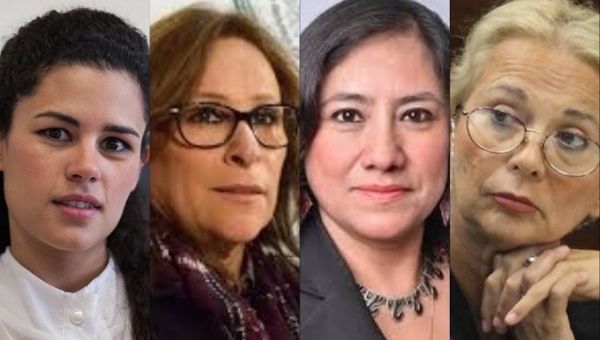
(L-R): Luisa Maria Alcalde, Rocio Nahle, Irma Sandoval and Olga Maria del Carmen Sanchez are part of AMLO’s cabinet. | Photo: Facebook / Twitter / plumas libres
teleSUR | July 11, 2018
Eight of the key figures in AMLO’s future government are women and they have interesting proposals for Mexico.
Of the 16 confirmed members of president-elect Andres Manuel Lopez Obrador’s cabinet eight are women. teleSUR English reviews their profiles and plans for their tenure.
AMLO’s cabinet will include representatives of the business sectors and members of the traditional Institutional Revolution Party, but it also has an important share of academics and progressive women.
Olga Maria del Carmen Sanchez, the first woman to head the ministry of the Interior, was a judge in Mexico’s Supreme Court between 1995 and 2005. She is in favor of legalizing marijuana and believes the country needs to rethink its policy on drugs.
During an interview with Zosimo Camacho, Sanchez criticized the lack of judicial symmetry with the United States and stressed the importance of changing the strategy in the war on drugs. “How is it possible that here in our country we are killing ourselves and the U.S. is decriminalizing drugs?,” she questioned.
AMLO’s pick for social development, Maria Luisa Albores is an agronomist and specialist on social economy, which is based on the principle of solidarity. Since 2001 she has worked with Indigenous and Campesino communities in the development of productive and economic cooperatives and projects.
During the campaign trail, Albores vowed to work for the economic and social inclusion of rural Mexico and stressed the importance of restructuring Mexico’s social development ministry. According to Albores the ministry has “served to keep people poor, and poverty has been administered electorally.”
For Minister of Labor and Social Welfare, AMLO has appointed Luisa Maria Alcalde, a lawyer and former legislator, who has done extensive work on a dignified salary in Mexico.
Alcalde has announced she will hold meeting with Mexico’s private sector and the country’s central bank to find a viable path to an increase to the country’s minimum wage.
Economy will be headed by Graciela Marquez, Ph.D. in economic history and professor in several universities in Mexico and abroad. She has written extensively on economic development, inequality and commercial policy. She would be the first woman to head the ministry of economy and will head the current negotiations on the North American Free Trade Agreement (NAFTA).
Alejandra Frausto has accepted to lead Mexico’s ministry of culture. She has worked to promote access to culture and the arts as a central element in social development, with an emphasis on popular and Indigenous cultures.
The Ministry of Environment and natural resources will be headed by Oxford graduate Josefa Gonzalez, who studied transformative art and has worked with vulnerable populations in art-related projects. For the past years she has worked in the southern state of Chiapas in conservation and reforestation projects.
Irma Sandoval has been given the Ministry of the Civil Service. She is a political scientist and researcher for Mexico’s Autonomous University (UNAM). Sandoval is also the coordinator of UNAM’s Lab on corruption documentation and analysis.
She has proposed to use technology to monitor the good use of public resources, a monitoring system open to citizens to control public works, and to encourage anonimous complaints to fight corruption in Mexico.
Finally, AMLO’s pick for the Energy Minister is Rocio Nahle who has worked in the petrochemical industry for years. Her main proposal is the construction of two refineries in Tabasco and Campeche, and the rehabilitation of six refineries to meet Mexico’s internal demand.
RELATED:
Mexico President Strikes Upbeat Tone on Trump Ahead of Talks
AMLO to Implement San Andres Agreements Signed With Zapatistas
The Persecution of Rafael Correa
By Joe Emersberger | CounterPunch | July 9, 2018
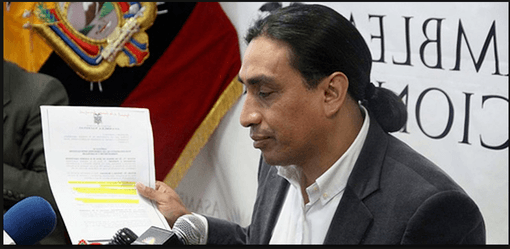
An Ecuadorean judge has issued an arrest order for former President Rafael Correa. Correa is accused of having masterminded an attempted kidnapping of the right wing former legislator, Fernando Balda, in 2012. Balda was in Colombia at the time evading a prison sentence in Ecuador for libel. The kidnapping was foiled within a few hours by Colombian police and the perpetrators were captured. Months later, Balda was deported to Ecuador where he served two years in jail.
As explained in other pieces for CounterPunch (here, here, and here) in 2017 Lenin Moreno was elected on a platform of continuing the policies of his left wing predecessor, Correa, who was first elected in 2006. Immediately after taking office, Moreno shifted very hard to the right and has therefore made it his main priority to accuse the government he was part of for ten years of being corrupt.
A week before the arrest order for Correa, I spoke with Virgilio Hernandez who was a member of the National Assembly while Correa was in office. Part of the interview was updated after the arrest order came out. A key point Hernandez makes is that the “Transitional” Citizens Participation Council whose members were hand-picked by President Moreno (details here on the reasons the body is unconstitutional) has sweeping powers over the judiciary and other authorities.
JOE EMERSBERGER: Could you please explain the various legal and constitutional problems with the way Correa is being pursued over the Fernando Balda case?
VIRGILIO HERNANDEZ:The obvious thing about the Balda case is its political functionality, the determined effort to prosecute the former president Rafael Correa for anything at all. The case is in its early stages but the prosecution has already perpetrated a series of irregularities, a series of violations of the institutional norms and of the rule of law that makes it absolutely clear that justice is not their goal. They are not pursuing a credible investigation of the facts. They are basically pursuing political objectives through the prosecution of Rafael Correa on frivolous grounds.
The first irregularity is that, according to our constitution, authorization to prosecute the ex-president should have been received from the National Assembly. In fact, it was requested by Judge Camacho on June 11. Unfortunately, a majority that exists in the assembly is an alliance between the Alianza País party [that Correa and his allies resigned from after they broke with President Moreno] and the Social Cristiano party [right wing legislators] and what did they do? On June 15, they voted through [by simple majority] a resolution saying that the assembly is not competent to respond to the judge’s request. Regrettably, the judge then disregarded her own authority, ignored the Organic Law of the Judicial Function, and followed through with a hearing to move the case forward when what she was supposed to do was demand that the National Assembly comply with her request – to vote on whether or not they authorize the prosecution of former president Rafael Correa [a 2/3 vote in favor is required for the prosecution to proceed]. Here is the first thing that that reveals political animosity, that the rule of law is not respected, that due process and the constitution are not respected.
Second (and this explains a huge blunder that was perpetrated in contextual terms) one must understand why the prosecution of the former president had to be authorized by the National Assembly. It was because the events to which he is being linked happened while he was president. The law says that for prosecution to proceed presidential immunity must first be removed for events that took place while he was in office. That’s the second irregularity.
A third irregularity is that in general a whole slew of authorities in our country are acting illegally. The acting attorney general was appointed by the “Transitional” Citizens Participation Council that has been overhauling the justice system by appointing interim prosecutors and an interim Judicial Council. The acting prosecutor has not been sworn in before the National Assembly as mandated by the constitution. Their authority is completely illegitimate.
A fourth irregularity is that the arguments used to link Rafael Correa to the Balda’s case [the attempted kidnapping] are utterly weak and confirm that there is a political vendetta being pursued against the former president. Let’s quickly go over those arguments.
First, the simple fact that he was president is used to argue that he was criminally responsible. Criminal responsibility is something very personal. It cannot be established that he has criminal responsibility for all acts perpetrated while he was in office. That’s a legal absurdity.
Second, the former president is linked through hearsay, from what other people have claimed, or by remarks attributed to the ex-president saying he wanted to see Balda (who was a fugitive from Ecuador’s justice system at the time) captured. Balda was also engaged in electronic espionage and a permanent destabilization effort against the government. There is not even anything documented that proves what Correa is claimed to have said about the case. It is all second hand.
Third, there are letters from people who are being prosecuted who say they alerted the former president about a kidnapping attempt, but it has been shown that these letters never reached the hands of the president. It’s another argument that turns out to be completely weak. There were people in government expressing interest in bringing Balda back to Ecuador but through legal processes – by getting him deported from Colombia [which he ultimately was]. In Ecuador, Balda had a criminal sentence to serve. The prosecutor goes after Correa even though the only thing that has been demonstrated is that Balda’s legal deportation from Colombia was being pursued. Moreover, former President Correa wasn’t even pursuing it. That was up to the authorities who were in charge of the internal and external security of the state. It’s another of the prosecutor’s arguments that are easily answered. Then there are a number of details having to do with checks that were issued and testimony by one “Raúl Ch”that are dubious, contradictory and undermine the prosecutor’s case.
In short, the arguments the acting prosecutor is using to pursue former President Rafael Correa are absolutely feeble. The judge disregarded the feebleness of those arguments, but additionally the case should not have even been allowed to proceed [without National Assembly authorization] but what they did next is worse. The judge, when determining pretrial conditions for Correa, established measures beyond what the prosecutor himself requested. The prosecutor requested that as a precautionary measure – given that the former president has collaborated with the investigation – that he appear regularly before the Ecuadorean consulate in Belgium. The judge responded in a very questionable way. First, she asked the acting prosecutor to reformulate his request for precautionary measures when that is the prosecutor’s job. She was clearly looking for the prosecutor to request pre-trial detention by arguing that the consulates do not have the competence to receive a person who appears by court order. This argument the judge made is absolutely false since the Foreign Service Law establishes that the consulates can comply with this kind of order from a judge. The penal code itself states that if a judicial authority establishes provisions, authorities of the state in general have to comply. Judge Camacho’s claim that the Foreign Service Law does not give consulates that capacity is completely cynical. It reveals political animosity.
And when she asked the acting prosecutor to reformulate his request – clearly looking for harsher pre-trial conditions – the persecutor reminded her “You have the authority to set them. This is what the Comprehensive Organic Criminal Code says and therefore, if you so order that the consulates are obliged to accept this order you give them “. In the end the judge ordered that Correa must appear periodically [every 15 days] before a court here in the city of Quito even though it is common knowledge that he lives in Belgium. She made the legally inadequate claim that he has two addresses and therefore must periodically appear Quito. Everyone knows he lives in Belgium as he said repeatedly he was going to move to Belgium [where his wife is from] for several months before he finished his final term as president. The judge set an obvious trap for the former president not to appear and thus have an excuse to order pretrial detention.
JE: On social media I noticed that many of Correa’s detractors were totally enraged that judge Camacho requested National Assembly authorization and called for her to be sacked. Do you think she became more extreme in response to media and other pressures? [Moreno’s handpicked “Transitional” Citizens Participation Council appointed an interim Judicial Council which has announced that it will be evaluating all judges and dismissing those who “fail”.]
VH: All these arbitrary acts are possible because, as Noam Chomsky might say, the media has worked hard to “manufacture consent” for the idea that one way or another Correa must be indicted. It is very clear that the media play a central role. This persecution would not be possible without the big media networks and the use of media power.
Both the actions and the aversion shown by the acting prosecutor and the judge during the bond hearing clearly reveal that there will be no objective handling of the case – and also that the context that we live in Ecuador, when there are authorities that are hand-picked without any constitutional legitimacy by the “Transitional” Citizen Participation Council, sets up a scenario of political persecution. We are without a doubt living through “lawfare” here in Ecuador and it is directed towards Rafael Correa and the main leaders of the Citizens Revolution.
Now, what we feared has in fact happened. Correa appeared at the consulate in Belgium, but the judge ruled that this was a violation of his pre-trial conditions and replaced the order to appear in Quito with an order of pre-trial detention. She did all this in one hearing disregarding a requirement for 72 hours’ notice before changing the pre-trial conditions. Her stated justification for doing that was based on “procedural economy”, but in criminal matters one cannot invoke procedural economy if it violates rights as has now been done with Rafael Correa. All these arbitrary acts against the Citizen Revolution are perpetrated with the complicity of the media whose silence over unconstitutional actions are aimed at ending what they call “correísmo”
JE: There was a news article I read in El Telegrafo (a government run newspaper) that basically argued that prosecuting Correa is fine because former President Jamil Mahuad was also prosecuted (in a case that was initiated years before Correa first took office in 2007).
VH: When the judge asked for authorization to prosecute Rafael Correa, she cited the precedent that had previously been used to prosecute Jamil Mahuad. Authorization had also been requested by the national congress of that time. And although the Congress also said that it was not competent, let’s not forget that this decision was made with 2/3 of its members and not as in this case that is taken by a simple majority.
Mahuad’s defense team has argued that his case be dismissed on those grounds [of not being authorized].
JE: Looks to me like they have a valid argument, not that anyone should defend Mahuad’s disastrous policies.
VH: Yes and in fact and that was cited by the judge herself. The organic code of the judicial function is clear that authorization from the assembly is required in this case. It does not allow the judge to accept, as she did in Correa’s case, that the National Assembly returns her request saying it is inappropriate. According to what our legal regulations say, the National Assembly cannot assess whether or not a request from a competent authority (in this case a judge of the national court) is appropriate. It has to comply with what the judge requested. If that is not done, it violates the autonomy and authority of the judiciary if a judge’s order is disregarded.
JE: Do you think Mahuad’s case should have been halted on these grounds?
VH: I don’t want to go into the details of something that I do not have very clear in my memory. My concern is relating what is happening at this time with the case of former President Rafael Correa.
JE: You were heavily involved with protests by indigenous groups like CONAIE during the 1990s against neoliberal economic policies. I’ve personally noticed since the 2010 coup attempt against Correa that they’ve become quite reactionary. They recently publicly “recognized” Cesar Trujillo, one of Moreno’s key handpicked members of the “Transitional” Council of Citizens Participation.
VH: Since about the end of the 1990s and the beginning of this century I would say what is evident in CONAIE is that a current became dominant that we’d call a “conservative indigenist” current that has put everything into what they call the “ethnic cause” and left aside the causes of social movements and the left in the country. That explains not only what you describe (these tributes to people like Cesar Trujillo) but also that in the last presidential campaign they openly supported the candidate of the oligarchy and the banks, Guillermo Lasso. It is very clear for almost two decades they lost course and have been useful to the oligarchic groups that have always rabidly opposed Rafael Correa and the Citizens Revolution.
JE: How is the new party the movement is working on organizing going to correct the errors that led to people like Lenin Moreno being in positions of leadership?
VH: The first thing we have to do now is to overcome the political blockade. The political persecution we face is seeking to dismantle all the laws and norms of the Citizens Revolution. Second we have administrative persecution that goes through an “acting” comptroller who also works illegally. They persecute many of the leaders of the Citizen Revolution that way. Third, there is a judicial persecution of former President Rafael Correa. The fourth element of persecution that must be identified clearly is the political blockade. So far they are preventing us from being able to organize ourselves politically even though it is a constitutional right. Therefore, before thinking about self-criticism and the mistakes we should not commit, at this moment our main priority is to break the political blockade. We seek legal recognition to be able to participate in the democratic arena. This will allow voters to continue supporting Citizens Revocation against this ongoing persecution we face.
JE: I am going to make a comment and you can tell me if you agree. I would say to Rafael Correa that he not be a martyr, that he seek political asylum so that his voice is not silenced. I think his ability to speak out, even if from afar in a limited way through social media and other venues, is crucial to overcoming the one-sided media landscape Moreno has established inside Ecuador.
VH: Actually, today, in a meeting of the national coordinators the movement – the group of legislators [who remained loyal to Correa] Andean parliamentarians, councilors of the city of Quito and other authorities of the movement – we have asked Rafael Correa not to come to Ecuador. We said conditions for a fair trial do not exist, conditions for due process do not exist and that therefore that he should not come and that he should seek international assistance to protect his security and freedom. We agree with your position and we have publicly expressed one like it.
Appeals court judge overrules decision to release Brazil’s former President Lula from jail
RT | July 8, 2018
An appeals court judge has overruled an order to release former Brazilian President Luiz Inácio Lula da Silva from jail.
The move backed a decision made earlier on Sunday by Federal Judge Sérgio Moro, who had blocked a third judge’s decision to free Lula.
The former president, who is widely known as ‘Lula,’ has been in prison since April 7, serving a 12-year prison sentence for corruption and money laundering. He maintains he is innocent, claiming his conviction was politically motivated.
Brazil Judge Gives Police One Hour to Release Lula
teleSUR | July 8, 2018
Appeal judge Rogerio Favreto of the appeal Federal Regional Court of the 4th Region based in Porto Alegre, reaffirmed Sunday afternoon his decision to grant freedom to former President Luiz Inacio Lula da Silva, as two judges attempted to question his authority, further giving the police a deadline of one hour to release the former socialist president.
Lula has been imprisoned since April 7 in Curitiba over alleged charges of corruption that investigators failed to provide evidence for.
After his earlier order, Favreto Issued another decision later in the day reaffirming that he had full authority to accept the Habeas Corpus filed by his lawyers to the appeal court weeks ago.
His first order demands the suspension of the provisional sentence and grants Lula freedom immediately.
“The release order must be urgently complied with today by the presentation of this order to any police authority at the prison center of the federal police office in Curitiba, where the accused is being held,” says the release order.
Lula was sentenced to 12 years in prison for his alleged involvement in the Lava Jato Operation, accused of passive corruption and money laundering, charges he and his supporters flatly deny.
He was granted immediate freedom after the lawmakers Wadih Damous, Paulo Pimenta and Paulo Teixeira submitted a “Habeas Corpus” request to Favreto.
“At the current stage, the illegal and unconstitutional provisional execution of the sentence imposed on the former president Lula can’t stop his political rights neither restrict the right to acts related to his condition as a pre-candidate to president of the republic,” said Favreto, who was a member of the Workers’ Party for 19 years.
Lula’s Workers’ Party (PT) issued a statement shortly after the decision. “Through the decision of the Favreto, the judicial system, which was so often manipulated to persecute Lula and deprive him of freedom, now recognizes that he has the right to defend himself in freedom in the higher instances, as the Constitution guarantees to everyone,” the PT said in a press release Sunday afternoon.
“And it decides, mainly, that society has the right to know, through the voice of Lula himself, his proposals to get Brazil out of this immense crisis, to resume the path of democracy, social justice and the construction of the equality.”
However, the judge Sergio Moro, who sentenced Lula in the first place, is trying to revoke the release order.
Colombia: ELN Denies Responsibility For Murdered Social Leaders
teleSUR | July 7, 2018
Colombia’s National Liberation Army (ELN) has refuted allegations by the General Prosecutor that the group is responsible for the majority of social leaders murdered since the peace agreement was signed in 2016.
Posting on its official Twitter account on July 7, the insurgent group said: “The Office of the Prosecutor confuses and contaminates intentionally without providing information to support his accusations against us.”
The group also called attention to the General Prosecutor’s failure “to resolve the deaths and threats against leaders,” and said the words of National Director of Public Prosecutions Gonzalez Leon “represent a smokescreen to hide the true perpetrators of these murders.”
“The Prosecutor’s Office must stop participating in the ‘war of information’ and we urge the government to show its willingness to stop this extermination,” the ELN tweeted.
On July 6, Leon had told local media: “In the areas where these killings occur, we have found the (drug cartel) Clan del Golfo and the ELN as the main authors in Antioquia; the ELN in Choco and the municipalities of Cauca and Nariño, as well as FARC dissidents.”
The exchange followed a flurry of reports released by various social organizations earlier in the week, which variously accused the government and paramilitary groups of complicity in the killings.
One report, entitled ‘All The Names, All The Faces,’ names 123 of the 125 social leaders murdered between January 1 and July 4 this year. The two additional victims were murdered immediately after the report was published.
Another report on assassinations between 2002 and 2015 revealed that the majority of the murders aren’t related to Colombia’s half-century internal armed conflict, but are perpetrated by state security forces.
NED Pursues Regime Change by Playing the Long Game
By Edward Hunt | Lobe Log | July 3, 2018
During a recent congressional hearing, the heads of three influential non-profit organizations that operate in numerous countries around the world revealed the subtle ways in which the United States meddles in the internal affairs of other countries by playing what the officials called “the long game.”
The three officials—Carl Gershman, Daniel Twining, and Kenneth Wollack—told Congress about their long-term efforts to empower the opponents of U.S. enemies and boasted about their ability to change foreign governments. They said that they had recently helped their political allies gain political power in Malaysia, acknowledged that they have helped train thousands of activists in Nicaragua, and speculated about the potential to create new governments in China, Russia, and North Korea.
All three men strongly defended their activities, insisting that they are critically important to the advancement of democracy in the world.
“We’re not asking people to do anything that they don’t want to do,” Gershman said. “We’re supporting their own aspirations and giving them some of the tools to realize those aspirations.”
Gershman is the president of the National Endowment for Democracy (NED), a U.S. taxpayer-funded nonprofit created by the U.S. government in 1983. As the president of NED, Gershman oversees the issuance of grants to its political-party-associated organizations, including the International Republican Institute (IRI), which is headed by Twining, and the National Democratic Institute (NDI), which is headed by Wollack.
Facing skepticism about their work from the Trump administration, which views the organizations as unnecessary expenses and wants to cut their funding, Gershman and his colleagues provided Congress with a broad overview of how their work affects the world. They defended their ongoing operations, trying to persuade Congress that they should continue to receive funding.
Ultimately, the three officials revealed how they are helping the U.S. government interfere in numerous countries around the world.
The NED Approach
The general strategy of NED is to empower like-minded activists to build new political movements in their home countries. NED helps these activists become influential political actors, often with the goal of creating new possibilities for political change.
Officials typically describe their approach as one of “democracy promotion.” They argue that they are helping democratic forces introduce democratic politics into countries ruled by authoritarian leaders.
“These leaders, their strategic Achilles heel is fear of their own publics,” Twining explained. “And I think we should think about the old Reagan message of exploiting that a little bit.”
The strategy requires a long-term commitment in the countries where the NED is active. Twining calls it “playing the long game.” Gershman calls it “long-term work.”
The officials discussed numerous examples. Twining said that IRI has been working with opposition forces in Malaysia since 2002. He credited IRI with helping opposition forces prevail in the country’s recent parliamentary elections, calling the victory “an example of playing the long game.”
U.S.-backed opposition forces are “now in-charge of this very strategic country right there on the frontlines of the South China Sea, right there on the frontlines of the Islamic world’s intersection with rest of Asia,” Twining said. “And that’s good for America.”
The NED has also been active in Nicaragua, where opposition forces are organizing major protests against the Nicaraguan government. The protesters are trying to bring down the government of Nicaraguan President Daniel Ortega, a popular leftist leader who has been in power since 2007.
“We have been working on youth leadership programs and have worked with more than 8,000 youth on a very extensive coursework and academies to develop U.S. engagement,” Wollack said.
Although Wollack denied that the organizations are training their grantees for the purpose of overthrowing Ortega, Gershman indicated that regime change is the ultimate goal. “Time for him to go,” Gershman said, referring to Ortega.
The three officials also cited many additional opportunities to influence governments around the world. They are especially excited about opportunities in Armenia, where a major social movement recently ousted a government backed by Russia.
Twining speculated about the possibility of achieving regime change in Russia, calling Putin a “very brittle” leader who is “frankly quite insecure.”
Gershman saw potential for a similar outcome in North Korea. “This is an eroding totalitarian system, so we shouldn’t give up hope on the possibilities for internal change,” he said.
Gershman believes that the primary focus should be on China, however. He called China “the most serious threat our country faces today.”
Although Gershman said that the U.S. government will initially respond to challenges from China with a mix of military, economic, and geostrategic power, he insisted that the long-term solution could be found in the “unhappy people” who oppose the Chinese government.
“We have to not give up on the possibility for democratic change in China and keep finding ways to support them,” he said.
The Controversy in Washington
The open talk of U.S. meddling in other countries around the world was so commonplace that the U.S. mass media spent no time covering the hearing, even though the speakers did encounter some pushback. Not all members of Congress are on board with the programs.
Congressman Dana Rohrabacher (R-CA) made the strongest critique, insisting that U.S. meddling destabilizes countries while creating more problems for the United States in the long run. Rohrabacher blamed recent U.S. meddling for destabilizing Ukraine. He argued that the U.S. involvement in national protests that led to the downfall of the government of Viktor Yanukovych in February 2014 prompted the subsequent Russian invasion of the country and the war that continues there today.
“I don’t believe the Russians would have invaded Ukraine had we not arrogantly involved ourselves to overthrow that democratically elected government in Ukraine,” Rohrabacher said.
Rohrabacher also insisted that the U.S. should support dictators. He singled out Egypt, saying that the country should continue to be ruled by General Abdel Fattah el-Sisi, the military dictator who gained power by overthrowing the country’s first democratically elected government in 2013.
“I know I am making everybody mad at me, but I had to say it,” Rohrabacher commented.
Faced with Rohrabacher’s criticisms, the remaining participants in the hearing made some effort to counter his arguments but otherwise said very little, preferring instead to blandly praise NED for performing admirable work by promoting democracy around the world.
The general feeling in Congress is that the U.S. government should continue to fund the work of the NED and its affiliated institutes. Most members of Congress view the organizations as important assets in the U.S. government’s toolkit, believing they play an important role in U.S. global strategy.
Congressman Gerry Connolly (D-VA) unabashedly praised NED, IRI, and NDI, calling their work “exciting.” He told the three officials that “nothing does America prouder than the work frankly you’re doing.”
Nicaragua, unraveling a plot
The US’ NED distributed $4.2 million in Nicaragua, between 2014 and 2017, to train “new leaders” to overthrow the Sandinista government
By Francisco Arias Fernández | Granma | June 29, 2018
 AS early as 2016, talk of war against Nicaragua could again be heard in Miami, at a time when the streets of this nation were a regional example of security, peace, and prosperity, where a hardworking, tranquil people proudly enjoyed the social and economic advances achieved by the Sandinista government, that had established a national consensus, in the wake of one of the worst interventions carried out by the United States in Central America.
With no justification whatsoever – when the news from Nicaragua around the world was about a proposed inter-oceanic canal that would boost the economy and impact global navigation – Congress members who make a living off the U.S. war against Cuba and Venezuela were mounting efforts to reverse the prosperity and calm that reigned in the land of Augusto César Sandino.
Congress members, first in the House of Representatives and later the Senate, introduced a bill to create obstacles to the awarding of international loans to Nicaragua, hamper foreign investment, and put a brake on socio-economic development in the country. This imperialist punishment, cooked up by the worst of the anti-Cuban mafia in 2015, set in motion the fabrication of a pretext regarding the alleged lack of democracy, justified as a way to “guarantee electoral transparency and fight corruption.” The result of this initial maneuver was the Nicaraguan Investment Conditionality Act of 2017 (NICA Act).
Ileana Ros, Albio Sires, Marco Rubio, and Ted Cruz, and others, among the most reactionary legislators in Congress from South Florida, Texas, and New Jersey, are again attempting to reinvent the Contras and get rid of the Sandinista government, which has repeatedly shown at the polls that it enjoys the people’s majority support.
The tentacles of this subversive plot go beyond the capital, since these forces are well connected to the United States’ coup-manufacturing machinery, and laid the foundation for a media campaign in coordination with agencies specialized in carrying out dirty wars and soft coups, working with U.S. intelligence and the CIA, in particular.
In this specific case, international press media have documented the participation of the U.S. Agency for International Development (USAID); the National Endowment for Democracy (NED); and the National Democratic Institute (NDI), as well their sub-contractors, which have been working meticulously, since Daniel Ortega was first elected, to re-invent a “new leadership,” selectively infiltrating key sectors of the economy, targeting youth, students, medium and small businesspeople, environmental and feminist groups, among others, to undermine the foundation of support for the Sandinista government.
It is revealing that on April 16, this year, following the same line espoused by anti-Cuban Congress members, USAID Administrator Mark Green announced that the U.S. government would continue supporting the participation of a “free … genuine” civil society in Nicaragua, after stating that the United States is concerned about the closing of democratic spaces in Nicaragua, “systematic” violations of human rights, and government corruption.
In March, Representatives Ileana Ros-Lehtinen and Albio Sires sent a letter to Green, in which they call on the U.S. government to reverse its decision to provide “zero aid” to Nicaragua through USAID for the fiscal year 2018-2019, while at the same time calling on the agency to avoid supporting “members of the private sector linked to corruption, money laundering, or the Daniel Ortega regime.”
At the end of 2008, the media reported that USAID had provided at least a million dollars in Nicaragua that year to NGOs, radio broadcasters, and political groups like the Communications Research Center (CINCO), to intervene in municipal elections.
This financing, as was denounced at the time, contributed surreptitiously as “small donations,” that were not to exceed 25,000 dollars, was part of a large scale U.S. plan to overthrow the government of Daniel Ortega, carried out since then by internal agents from the Nicaraguan right.
The strategy mounted to discredit the Sandinista government in the media was conducted via two financing routes; one directed by USAID and the Casals & Associates firm, and another managed by the so-called Common Fund in Europe, which provided funds to organize campaigns and mobilizations to destabilize the government.
By 2008, media in Nicaragua had identified at least 14 subversive projects run by USAID across the country, under the cover of a wide range of titles and objectives, made possible by this funding.
Another key element of the U.S. machinery linked to the CIA is the National Democratic Institute, an instrument dedicated to promoting “change” that focuses on “empowering” so called “agents of change” in countries with governments not to Washington’s liking.
A Swedish journalist reported, this past June 4, that three students from Nicaragua were conducting a tour of Europe to raise support for a plot against the Sandinista government, stating that at least one of the youth represented an organization created and financed by the United States.
Jessica Cisneros, he reported, was active around the issue of the involvement and participation of youth in political processes, and was a member of the Movimiento Cívico de Juventudes (Civic Youth Movement).
Another of these “agents of change” promoting hate for the Sandinista government and support for a coup, was Yerling Aguilera, from the Polytechnic University in Managua (UPOLI) and specializing in research on revolution and the feminist movement, who, according to the reporter, has been an employee and consultant for the Institute of Strategic Studies and Public Policy (IEEPP) in Nicaragua, that works to “strengthen the abilities of political, state, and social actors for a better informed public via creative, innovative services,” which has received 224,162 dollars from the National Endowment for Democracy (NED) between 2014 and 2017.
The NED has distributed some 4.2 million dollars in Nicaragua, over this three-year period.
The USAID, NDI, and NED have been busy in the country, with thousands of activists trained to “change society.” Hundreds of NGOs, universities, and political parties have received funds and materials as part of the subversive plan that was not conceived to advance through traditional political organizations, but rather those invented to give the impression that they emerged “spontaneously” from dissatisfaction, hiding the true interest of the North at work.
Although efforts were intensified after Ortega’s 2006 electoral victory, since 2015, with the approval of the NICA Act, U.S. agencies increased and broadened financial support and resources for their “agents of change” in Nicaragua, above all through leadership courses and money for young people in universities, NGOs, and political parties.
In their political, diplomatic, and media advice to the coup-plotters, Washington has insisted on demonizing Daniel Ortega and his government, an effort carried out not only by the White House, and its agencies, allies, satellites, and mercenaries, but also the corporate media monopolies and fabricators of lies, which magnify internal problems and accuse authorities for all types of human rights violations, totally omitting the crimes and destruction committed by individuals who have been “empowered” by the USAID, NDI, NED, and CIA, who have caused the failure of talks and calls for peace. As is the case in Venezuela, Donald Trump and his advisors, architects of a thousand invasions, do not believe in dialogue or pacts, opting for war on all fronts.
Nicaragua has become the epicenter of U.S. warmongering efforts, hand in hand with Anti-Cuban legislators and profiteers, and other veteran hawks. Washington is attempting to re-invent its strategy at the cost of human lives and destruction in the streets of Nicaragua.
USAID’S THINLY DISGUISED SUBVERSION PROJECTS IN NICARAGUA:
– Citizen participation in electoral processes
– Developing a culture of transparency among Nicaraguan youth
– Communications training for students to produce stories that promote self-efficacy
– Multimedia for democratic governability
– Strengthening civil rights of women and youth in Masaya
– Citizen action legal framework for journalists
– Active participation for Nicaraguans exercising their right to vote
NDI TENTACLES
– Since 2010 the NDI has been associated with Nicaraguan universities and civic organizations conducting a youth leadership program which has helped prepare more than 2,000 “youth leaders,” and worked to increase the political influence of women, LGBT persons, and electoral processes
– The Movimiento Cívico de Juventudes (MCJ) is an organization financed, created, and part of the NDI.
– Several members of the group graduated from the NDI program earning a Certificate in Leadership and Political Management (CLPM).
Francisco Arias Fernández, internet@granma.cu
Featured Video
Max Blumenthal: ‘Israel First’ in Iran War Sparks MAGA Civil War
or go to
Aletho News Archives – Video-Images
From the Archives
Wartime internment camps in Australia
National Archives of Australia
World War I
During World War I, for security reasons the Australian Government pursued a comprehensive internment policy against enemy aliens living in Australia.
Initially only those born in countries at war with Australia were classed as enemy aliens, but later this was expanded to include people of enemy nations who were naturalised British subjects, Australian-born descendants of migrants born in enemy nations and others who were thought to pose a threat to Australia’s security.
Australia interned almost 7,000 people during World War I, of whom about 4,500 were enemy aliens and British nationals of German ancestry already resident in Australia.
Records of World War I internment camps
World War II
During World War II, Australian authorities established internment camps for three reasons – to prevent residents from assisting Australia’s enemies, to appease public opinion and to house overseas internees sent to Australia for the duration of the war.
Unlike World War I, the initial aim of internment during the later conflict was to identify and intern those who posed a particular threat to the safety or defence of the country. As the war progressed, however, this policy changed and Japanese residents were interned en masse. In the later years of the war, Germans and Italians were also interned on the basis of nationality, particularly those living in the north of Australia. In all, just over 20 per cent of all Italians resident in Australia were interned. … continue
Blog Roll
 Aletho News
- Any Foreign Military Vessel Approaching Hormuz Under Any Pretext ‘Will Be Dealt With Severely’: IRGC
- Diplomats slam US negotiators’ performance in Iran talks
- Trump Refuses Exit Ramp, War with Iran will Continue
- Trump Says US Naval Blockade in Strait of Hormuz Will Begin Shortly
- US, Iran end 21-hour talks without agreement
- US IRAN TALKS: Who Are the Crazy Ones Here? /Lt Col Daniel Davis
- Talks with the US end without a deal over excessive US demands: Iran
- Feeling Better, Getting Worse: How Psychiatric Drugs Create the Illusion They Cure
- ‘Nobody Told Me’: Former Mental Health Patient Calls Out Dangerous Side Effects of Psychiatric Drugs
- Dr. Abu-Sitta: Beirut ‘felt like a day in Shifa Hospital’
- If Americans Knew
- US-Iran ceasefire negotiations make zero progress – Daily Update
- Pro-Israel ‘Thinktanks’ and Individuals who Influence U.S. Foreign Policy
- Mearsheimer reveals how Israel dictates US policies on Iran, Gaza – video
- After killing 350+, Israel still has a “score to settle” with Lebanon before ceasefire – Daily Update
- Military aid to Israel emerges as the latest political litmus test for Democrats
- The only Palestinian children’s rights organization closes following years-long Israeli campaign against it
- ‘I Can’t Forget the Smell’: Lebanese Reel After Israel Kills Over 300 in Single Day
- DNC Shoots Down Resolutions Calling Out AIPAC and Limiting Arms to Israel
- TCN: Is Israel Blackmailing President Trump?
- Israel killed at least 303 Lebanese yesterday – who were they? Daily Update
- No Tricks Zone
- German Expert: Heat Dome Led To Record Temps In Western USA…Warmer In 1934, 1936
- New Study: No Linear Warming Or Glacier Retreat Along Northern Antarctic Peninsula Since 1980s
- An Inconvenient Tree: Uncovered In Alps… Europe Much Warmer Than Today 6000 Years Ago
- New Study Reports A 60% Slowdown In Greenland’s Ice Loss Rate In The Last Decade
- Low Intensity Tornado Wrecks Major Solar Farm, Creating A Potential Toxic Dump
- New Study Finds Warming Saves Lives…Cold Temperatures 12 Times More Deadly Than Excess Heat
- German Science Blog Accuses PIK Climate Institute Of Hallucinating Climate Tipping Points
- Devastating Assessment Of Comirnaty Vaccine By Former Senior Pfizer Europe Toxicologist
- New Study: CO2 Is ‘Effectively Negligible’ As An Explanatory Climate Change Factor Since 2000
- Former Pfizer Toxicologist Dr. Helmut Sterz Tells Bundestag Hearing Pfizer Vaccine Should Have Never Been Approved
 Aletho News