Rebellion or Counter-Revolution: Made In US In Nicaragua?
By Achim Rödner – teleSUR – May 30, 2018
Many wonder if the United States is involved in the student protests of the past month in Nicaragua which attempted to destabilize the country. Western media writes nothing about the issue, while at the same time similar scenarios have played out in Venezuela, Brazil, Cuba, Honduras, Bolivia and other countries in which the left has made progress. At this moment, three Nicaraguan students are touring Europe and Sweden in search of support for their campaign. At least one of the students represents an organization funded and created by the United States.
The student protests in Nicaragua are described in the Western media as legitimate protests by young Nicaraguans who have spontaneously united to fight the supposed dictatorship. Surely there are many young people who have joined the fight with these ideas. Surely many people here in Sweden have joined and support that struggle. But there is much that indicates that these are not just spontaneous protests. There are many indications that organizations led by the United States waited for the right moment to create chaos, and exacerbate the contradictions to destabilize the democratically elected government of Nicaragua.
Changing Society
One of the three students on tour in Sweden right now is Jessica Cisneros, active in issues of integration and youth participation in political processes. She is a member of the Movimiento Civico de Juventudes (MCJ). That organization is financed, created by and an integral part of the National Democratic Institute. The NDI is an organization that works to change society in other countries. The president of the NDI is Madeleine Albright, former U.S. secretary of state. The general secretary of the MCJ, Davis Jose Nicaragua Lopez, founder of the organization, is also the coordinator of the NDI in Nicaragua and active in a series of similar organizations in Nicaragua and El Salvador.
Excerpt from the NDI website: “The Civic Youth Movement (MCJ) has been part of an NDI project that began in 2015 with the aim of expanding youth leadership and political commitment by providing hands-on training in organizational techniques. Several of the group members are graduates of the Leadership and Political Conduct Certification (CLPM) program that the NDI has supported in conjunction with Nicaraguan universities and civil society organizations.”
Yerling Aguilera is from the Polytechnic University (UPOLI) of Managua and has specialized in research on the revolution and the feminist movement. She has also been an employee and consultant for IEEPP in Nicaragua, which works to strengthen the capacity of political, state and social actors for a better informed public through creative and innovative services. IEEPP has received support from the National Endowment for Democracy (NED) of US$224,162 between 2014 and 2017.
Madelaine Caracas participates in the national dialogue currently taking place in Nicaragua. She is also active in the feminist and environmental movement.
From 2015 on, the United States expanded its support to Nicaragua, especially through support for leadership courses and money for young people in universities, schools, NGOs and political parties. Organizations that work with feminist movements and women, human rights and the environment have been prioritized.
This from the NDI website: “To ensure that the next generation of leaders will be equipped to govern in a democratic and transparent manner, since 2010 the NDI has partnered with Nicaraguan universities and civic organizations to lead a youth leadership program that has helped prepare more than 2,000 youth leaders, current and future, throughout the country. The NDI has also contributed to Nicaragua’s efforts to increase women’s political participation and initiatives to reduce discrimination against LGBT people, as well as shared best practices for monitoring electoral processes.” Is foreign interference in democracy and elections good for Nicaragua, but unacceptable for the United States and Sweden?
Foreign Interference
It is also interesting to compare what happens in Nicaragua with what happens in other countries. The NDI also works in Venezuela, also with subversive tasks. The activity of the United States and the NDI in Latin America should be compared with the debate on the interference of powers in the electoral systems of the United States, Sweden or Europe. For example, would those countries accept that Russia form and support organizations that train political leaders in Sweden or the United States?
This is how the NDI describes its activities in Venezuela on its website: “The NDI began working in Venezuela in the mid-1990s in response to requests to exchange international experiences on comparative approaches to democratic governance. After closing its offices in Venezuela in 2011, the NDI has continued – based on requests – offering material resources to democratic processes, including international approaches on electoral transparency, monitoring of political processes and civic and political organization, and the Institute promotes dialogue among Venezuelans and their civic and political peers and politicians at an international level on topics of mutual interest. ”
Organizations from the United States work towards the development of democracy and foreign interference in Nicaragua. According to its website, the Instituto Democratico Nacional (NDI) has 2,000 young leaders in Nicaragua. The National Endowment for Democracy (NED) is another organization that, according to its own version of events, since the 1990s has been dedicated to doing the work that the CIA used to do in secret. It promotes the destabilization of other countries. The NED works with a number of other organizations, media, websites and NGOs in Nicaragua. Officially, its support for Nicaragua amounted to US$4.2 million between 2014 and 2017.
USAID officially works with medical and disaster relief, but the NDI and the NED support a number of organizations that work with issues concerning women, children, the environment and human rights. On their website, they write that they want to “Promote democracy by training young and emerging leaders and giving them technical help so that they strengthen civil participation and improve local leadership.” They do not say whose democracy they want to strengthen: whether it is the vision of democracy in the United States and the CIA, or the people of Nicaragua.
Previously, USAID worked in Bolivia but it was expelled in 2013 for carrying out destabilizing activities. In the same raid, a Danish organization was also expelled. That does not mean the organization necessarily engaged in illegal activities, but that it did work with an organization that received money from the United States. USAID also works in Venezuela, and also says there is work to strengthen “civil society.” Its budget in Venezuela in 2015 was US$4.25 million. Its partners in Venezuela are, among others, Freedom House and the NDI.
Creating Change
Who will create change in Nicaragua? And will it be violently or through elections? USAID, NDI and NED have extensive activities in Nicaragua, with thousands of activists trained to “change society,” and hundreds of NGOs, universities and political parties that receive money and material for these organizations. The United States participates in this process and its interests are to destabilize the democratically elected Sandinista government.
Believing that the United States is not involved in the riots in Nicaragua is naive. The situation in Nicaragua is serious and a dialogue for peace is necessary. Those responsible for the violence, the criminal fires, the riots, the destruction and the looting must answer for them, both on the side of the demonstrators, as well as on the critical elements, the political groups of young people and the responsible politicians. If, as the student leaders say, Daniel Ortega has ordered the police to shoot to kill, go ahead and have the president tried. And if there has been foreign interference in the internal affairs of Nicaragua, those responsible for it have responded, both from activists in Nicaragua and from politicians in the United States. Many things can change for the better in Nicaragua, but it must be the work of the Nicaraguans themselves and not the money and agenda of the United States determining the changes.
Venezuela: ‘Colombia Joining NATO A Threat To Regional Peace’
teleSUR – May 26, 2018
Venezuela has rejected the announcement by Colombia’s President Juan Manuel Santos that his country will be entering the North Atlantic Treaty Organization (NATO) as a “global partner.”
“Venezuela denounces once more before the international community the intention of Colombian authorities to lend themselves to introduce, in Latin America and the Caribbean, a foreign military alliance with nuclear capacity, which in every way constitutes a serious threat for peace and regional stability,” a statement by the foreign ministry said.
Likewise, Venezuela reiterated that it supports the historical position of the region to distance itself from the politics and wars of NATO, and from “any other army or military organization that desires to apply force to the suffering of the people, to impose and guarantee the hegemony of a particular political and economic model.”
The statement asks that the Colombian government fulfill its obligations toward peace and peaceful solutions to regional controversies.
Colombia will be the fist “global partner” of NATO in Latin America, beginning next week, President Santos announced Friday.
NATO was founded during the Cold War and was primarily a means for Western nations – led by the United States – to suppress the Soviet Bloc militarily and economically.
It continues to play a major role in modern conflicts, and has engaged in major military interventions in sovereign countries, most recently the removal and murder of Libyan leader Muammar Gaddafi in 2011.
Maduro re-elected Venezuelan president; rival candidate challenges results
Press TV – May 21, 2018
Nicolas Maduro has been re-elected for a second term in office as Venezuela’s president in an election rejected as “illegitimate” by his main rival, who has also demanded that a repeat vote be held later this year.
With more than 90 percent of the ballots cast in Sunday’s presidential election counted, the National Election Council announced that incumbent Maduro had won another six-year term after securing 67.7 percent of the vote.
Maduro’s main challenger Henri Falcon came in second with 21.2 percent, followed by the president’s other rival, Javier Bertucci, who gained some 10 percent, said the Council’s head, Tibisay Lucena.
With the country’s mainstream opposition having boycotted the vote, the turnout was 46.1 percent, according to the board, which means 8.6 million out of the 20.5 million eligible voters took part in the election.
The ballots were recorded electronically, making the voting quick and easy. The presence of government troops around polling stations also ensured the safety of voters.
Some 150 international observers from 30 countries and international organizations were present in the Latin American country to monitor the process.
Maduro hails ‘historic’ win
When the results were released, Maduro’s supporters gathered outside his Miraflores presidential palace in downtown Caracas, celebrating his re-election with fireworks.
Maduro, surrounded by thousands of his supporters, also hailed his “popular victory,” saying, “This was a historic day! The day of a heroic victory! The day of a beautiful victory – of a truly popular victory.”
“Never before has a presidential candidate taken 68 percent of the popular vote,” he told the cheering crowd.
“The whole of Venezuela has triumphed! Democracy has triumphed! Peace has triumphed! Constitutionality has triumphed [These were] elections that were constitutional, legitimate and legal,” he said. “We have a president of the people! A working president!”
The president also called on the defeated challengers to join him for negotiations about the future of the country.
He said “permanent dialog” is needed with the entire opposition so that Venezuela could set aside political disputes.
Vote ‘lacks legitimacy’
However, before the official results were announced, Falcon said he would not recognize the vote for what he called irregularities, including widespread vote buying in favor of Maduro.
“As far as we are concerned there has been no election. There must be new elections in Venezuela,” he told reporters. “The process undoubtedly lacks legitimacy and as such we do not recognize it.”
Falcon, who broke with an opposition boycott to run for the election, also called for a fresh election to be held in November or December.
Several of Venezuela’s Latin American neighbors as well as the European Union also joined voices with Maduro’s challenger and said they would not recognize the results of the election.
They alleged that the conditions did not exist for the election to be free and fair.
However, former Spanish prime minister Jose Luis Rodriguez Zapatero, who is in Venezuela as an international observer, said he has no “doubt about the voting process.”
“It is an advanced automatic voting system. I come here to keep peace, coordinate and promote dialogue so as to improve the democratic mechanism here. What I need to do here is to see whether people can cast their ballots at their own discretion. Now we all see how people vote, don’t we?” he added.
The US also said it would not recognize the election and would actively consider oil sanctions on the country.
Washington has already imposed sanctions against Venezuela and blamed, together with its allies in the region and elsewhere, Maduro’s government for the country’s acute economic crisis.
On Saturday, the US ramped up pressure on Caracas by imposing new sanctions against the government’s top officials.
Maduro’s government, however, said the US was using new sanctions to sabotage the election.
It called Washington’s move as part of “a systematic campaign of aggression” by President Donald Trump’s administration and said they had no legal base.
US says won’t recognize Venezuela presidential election
Press TV – May 20, 2018
The United States government says it is not going to recognize the outcome of Venezuela’s presidential election which will be held on Sunday.
US Deputy Secretary of State John Sullivan made the announcement in a press briefing on Sunday and stressed that Washington was actively considering strict sanctions against Venezuela’s oil industry.
He also noted that the US would discuss a response to vote with its allies at the G20 meeting in the Argentinean capital Buenos Aires on Monday.
Washington has already put in place sanctions against Caracas and top Venezuelan government officials, as well as other measures to further weaken the country’s troubled economy and prevent the government and its state oil company from accessing international credit through US markets or entities.
On Friday, the US Treasury slapped sanctions against the head of the Venezuelan socialist party, Diosdado Cabello, and his wife, Marleny Josefina Contreras, who heads the country’s tourism institute, and his brother, Jose David.
Earlier in May, the administration of US President Donald Trump has slapped more sanctions against a number of Venezuelan companies and officials, accusing them of trafficking narcotics.
President Nicolas Maduro, who is running for a second six-year term in the vote, says the US has joined forces with opposition groups to topple his socialist government.
His opponents blame him for mishandling the economy and accuse him of dictatorial tendencies.
Maduro is predicted to win the Sunday election against main opposition candidate Henri Falcon.
Some opposition members have boycotted the vote, claiming it is rigged to ensure that Maduro wins a second six-year term in office.
Caracas, however, has assured the public that the election will be free and fair, saying those opposition members who refuse to participate in the election believe they have no chance to win.
An Urgent Call for Solidarity with Nicaragua
Asociación de Trabajadores del Campo (Rural Workers Association) | May 17, 2018
Friends in Solidarity,
We have lived a month full of tragedy in our country. The peace we achieved as a people, so fragile and at the cost of so many lives, is in immanent danger of disappearing irreparably. There are now two sizeable camps of the population with dangerously contrary positions. On one side, there is a combination of private university students, media outlets with rightwing owners representing the oligarchy, Catholic Church bishops close to Opus Dei, the private sector and, of course, the US Embassy, working together to create a situation of chaos in the country in order to remove president Daniel Ortega. This group of actors accuses the National Police of having killed dozens of protestors in the riots that reached all Nicaraguan cities, ostensibly against a reform—since revoked—to the system of social security. As we have described, the reality is more complex, and the violence was generalized and explosive, involving protestors with homemade firearms that often misfired, as well as counter-protestors, paid pickets, unknown gunmen and street gangs. The National Police was really a minor actor in the violence, using tear gas and rubber bullets to clear crowds in a few points of Managua, but not involved in the vast majority of the 50 or more deaths that have been reported since April. The InterAmerican Commission of Human Rights has been invited by the government and currently is investigating the events of April.
A national dialogue began on Wednesday, May 16th, with the participation of anti-government students, civil society organizations, and the Presidency, and mediation by the Episcopal Conference of the Catholic Church led by Archbishop Leonaldo Brenes. However, the coup-like violence has only grown and currently, rightwing armed groups have all of the main highways in the country closed. On the other side of the conflict, the militancy of the Sandinista Front continues to withstand phenomenal provocations, including:
- The destruction of its Sandinista homes (party headquarters) in dozens of cities
- The destruction or defacement of hundreds of historic monuments, murals, and memorials of Sandinistas
- The arson of dozens of public buildings
- The interruption of work and the food shortages that have resulted from the road closures and violence
- The deaths of passersby and journalists by paid pickets and violent protestors
- Relentless false accusations and lies circulated by corporate media.
It must be added that Facebook has been the primary means for transforming Nicaraguan society that one month ago was at peace into a toxic, hate-filled nightmare. Currently, hundreds of thousands of fake Facebook profiles amplify the hatred and pressure Nicaraguan Facebook users to begin to share and post hate messages. Many, if not most, of these fake Facebook profiles have been created in countries other than Nicaragua, and in particular, Miami is the city where many of the Facebook and WhatsApp accounts behind the violence are managed.
Historically, the ATC has been a participant in the Sandinista struggle. In truth, we have not felt consulted or represented by the current FSLN government. The current coup attempt makes use of these historical contradictions and is trying to co-opt the symbols, slogans, poems and songs of Nicaragua’s Sandinista Revolution, since of course the rightwing has none of its own. However we may feel about Daniel Ortega, the ATC would never contribute to making chaos and sowing violence in order to force the collapse of the democratically elected government in order to install a more docile, Washington-friendly neoliberal government. There are clearly real frustrations in sectors of the population, especially youth, and if these sectors are unable to find popular organizing processes, they will end up being the cannon fodder for a war, which would be the worst possible situation for the Nicaraguan people.
In this context, the ATC has called for “all national actors to reorganize themselves based on their aspirations.” With this intention, the ATC proposes to confront the national crisis with a series of dialogues among young people, without party distinction or any ideological basis, in favor of peace and understanding. We propose extraordinary youth assemblies in the cities of San Marcos, Jinotepe, Rivas, Granada, Masaya, Estelí, Matagalpa, Jinotega, Juigalpa, Santo Tomás and Tipitapa, as spaces for young people to discuss the national situation and find points of unity. It is important to mention that we do not have a previously defined “line” to impose upon these debates—they will be spaces for listening, forming ideas and thinking with our hearts.
We call upon your solidarity and generous support for the creation of an emergency fund for peace in Nicaragua that makes possible this round of extraordinary youth assemblies. The national coordinators of the Rural Youth Movement, Sixto Zelaya and Marlen Sanchez, will have the responsibility of organizing the assemblies and administering the fund with absolute transparency.
It is urgent to organize the Nicaraguan family and win peace!
International Secretariat of the ATC
CIA Memo: Brazil’s Dictator Geisel Authorized Extrajudicial Executions
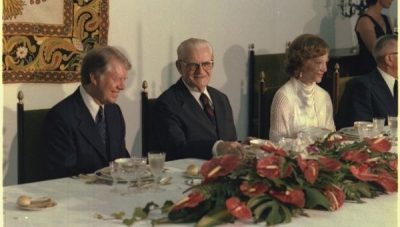
Ernesto Geisel, President of Brazil, hosts a State Dinner for Jimmy Carter and Rosalynn Carter. March 29, 1978 | Photo: U.S. National Archives and Records Administration
teleSUR | May 13, 2018
A declassified memo from the U.S. Department of State revealed that Brazilian dictator Ernesto Geisel (1974-1979) approved summary executions of “dangerous subversive” people personally, continuing with the extrajudicial methods of his predecessors.
The document was made public back in 2015, but it wasn’t until a few days ago that Matias Spektor, an international relations professor at the Getulio Vargas Foundation (FGV) and a columnist at Brazilian newspaper Folha, found it as part of his research work and posted it on social media, along with a picture of Geisel and Joao Baptista Figueiredo, who later became his successor.
The document narrates a meeting between President Geisel, General Milton Tavares de Souza and General Confucio Danton de Paula Avelino, respectively outgoing and incoming chiefs of the Army Intelligence Center (CIE), along with Figueiredo, who at that time was Chief of the National Intelligence Service (SNI).
“This is the most disturbing document I’ve read in 20 years of research: Just after being sworn in, Geisel authorized the continuation of the regime’s killing policies, but it requires the Army Intelligence Center previous authorization from the Planalto Palace.”
General Milton briefed Geisel about the role of the Army Intelligence Center (CIE) against “the internal subversive target” during the presidency of Emilio Garrastazu Medici, and said that “extrajudicial methods should continue to be employed against dangerous subversives.”
He also informed Geisel that about 104 people falling under this category had been executed by the CIE in the previous year. Figueiredo supported this policy and urged Geisel to continue with it.
According to the memo, Geisel “commented on the seriousness and potentially prejudicial aspects of this policy,” and said he wanted to think about it over the weekend. He decided to go along with it, but to limit the executions to “only dangerous subversives,” and required the CIE to consult Figueiredo for approval before any execution.
The entire CIE would then be under Figueiredo’s control, blurring the line between the CIE and the SNI.
“I didn’t know Geisel had given the Planalto Palace the responsibility over summary execution decision. The government’s leadership was not only aware of the executions but also ordered them. That’s impressive, unheard of,” said Spektor.
The memo was sent by William Colby, who was then Director of Central Intelligence Agency, to then U.S. Secretary of State Henry Kissinger, who also played a key role in promoting military coups against democratically elected governments in Latin America, under the subject “Decision by Brazilian President Ernesto Geisel To Continue the Summary Execution of Dangerous Subversives Under Certain Conditions” and dated April 11, 1974.
First and second paragraphs of the document (7 and 12 and a half lines) are still classified.
After the documents were picked up by Spektor, the Brazilian army stated that any classified documents that could prove Colby’s allegations of the events had been destroyed as it was stipulated by the laws of that period.
Mexico: Mayoral Candidate of AMLO’s Party Murdered
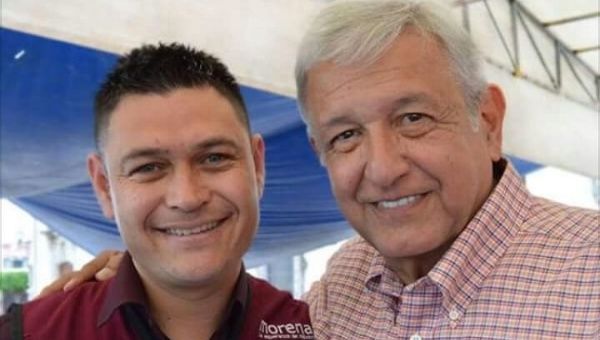
Jose Remedios Aguirre Sanchez (L) with presidential hopeful Andres Manuel Lopez Obrador. | Photo: Twitter @AvseFernando
teleSUR | May 11, 2018
Electoral campaigns in Mexico suffered another casualty on Friday with the murder of Jose Remedios Aguirre Sanchez, a mayoral candidate from the same coalition as presidential hopeful Andres Manuel Lopez Obrador, commonly known as AMLO.
The 35-year-old candidate was shot dead at close range in the Ecological Park of the Apaseo el Alto. Two other people were reportedly injured. The perpetrators escaped in a white convertible Ford Mustang with a U.S. license plate, according to witnesses.
Aguirre was competing in the race for mayor in the municipality of Apaseo el Alto, in Guanajuato, with the Movement of National Regeneration (Morena) party.
Before entering the race for Apaseo el Alto’s mayor, Aguirre had served as the director of public security in the same municipality between 2012 and 2015.
Since September when electoral campaigns began around the country, over 90 candidates, politicians and officials have been violently murdered.
Aguirre was a member of the progressive Morena party that is backing the coalition of Andrez Manuel Lopez Obrador, one of the top picks for Mexico’s presidency.
Featured Video
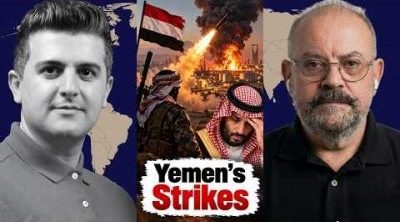
Elijah Magnier: Yemen’s strikes are shattering Saudi Arabia’s long-term strategy
or go to
Aletho News Archives – Video-Images
From the Archives
British weapons and personnel doing much of the killing in Yemen
Press TV – June 18, 2019
A detailed report published by the Guardian newspaper has shown how Britain is massively contributing to Saudi Arabia’s devastating war on Yemen as it suggests that London is not only supplying the bombs that fall on Yemenis, but it provides the personnel and expertise that keep the war going.
The comprehensive report by Arron Merat published on Tuesday showed that Britain was doing much of the killing in Yemen as the country continues to provide Saudi Arabia with everything it needs to turn its southern impoverished neighbor into a graveyard.
“Every day Yemen is hit by British bombs – dropped by British planes that are flown by British-trained pilots and maintained and prepared inside Saudi Arabia by thousands of British contractors,” said Merat in the report. … continue
Blog Roll
 Aletho News
- Racist Seinfeld Dances for Joy as Bibi Unveils His New Map
- A West Bank War for Netanyahu’s Election Campaign, Could It Backfire?
- Yemen denounces European Parliament’s ‘hypocritical’ push to blacklist Ansarullah
- Qalibaf: UAE’s UN bid aims to ‘clear the runway’ for ‘Greater Israel’, whitewash genocide
- Pakistan reopens Iran border after boosting security: Report
- Why are so many Brazilians voting for Flávio Bolsonaro?
- Democrats Put Anti-Russia Agenda Ahead of American Workers
- Elijah Magnier: Yemen’s Strikes Are Shattering Saudi Arabia’s Long-Term Strategy
- Pentagon designates Chinese cultural centers national security threat
- Israel Demolishes Home Of Lebanese Journalist Whose Viral Film Exposed Pager Attack
- If Americans Knew
- An error has occurred; the feed is probably down. Try again later.
- No Tricks Zone
- Sudden Stratospheric Warming, Powerful El Niño Combination May Lead To Extreme Europe Cold, Energy Crisis!
- Two New Studies Find Thwaites Glacier Melt Cannot Be Driven By Human Activity Or A Warming Ocean
- E-Cars Reduce CO2 Emissions By Only 41% Compared To Internal Combustion Engine Vehicles
- Predictions Made By Renowned Climate Professor Over Past Decades Have Been Proven To Be Poor
- New Study Suggests Large Regions Of The Pacific Ocean Have Been Cooling For The Last 80 Years
- Germany’s Green Energy Debacle: High Energy Costs Force Kahla Porzellan to Close After 182 Years!
- New Study: 50 Years Of The Most Aggressive ‘Net Zero’ Policies Can Only Affect The Global Climate By 0.03°C
- US September “Heat” Was No Record…Many Records Set Decades Ago
- Latest European Green Energy Debacle; Portugal’s Largest Flagship Solar Park Insolvent!
- Green Energy Debacle: German Expert Professor Fritz Vahrenholt Warns Of Severe Economic And Social Consequences

