Mexico’s War on Journalists
By Laura Carlsen | CounterPunch | August 14, 2015
Earlier this summer, Ruben Espinosa fled Mexico’s Gulf coast state of Veracruz after receiving death threats. His work as a photojournalist there had made him an enemy of the state’s governor, who presides over one of the most dangerous places in the world to be a reporter.
On July 31, Espinosa was found beaten and shot dead in a Mexico City apartment.
Eight months ago, Nadia Vera, a student activist and cultural worker, looked boldly into a camera lens and told an interviewer that if anything happened to her, Veracruz governor Javier Duarte and his cabinet should be held responsible. She also fled Veracruz to the nation’s capital after suffering attacks.
On July 31, Nadia Vera was found sexually tortured and murdered, shot point-blank in the same apartment.
Three more women were assassinated in the normally tranquil, upper-middle class neighborhood that afternoon — an 18 year-old Mexican named Yesenia Quiroz, a Colombian identified only as “Nicole,” and a 40 year-old domestic worker named Alejandra. The press generally refers to the case as “the murder of Ruben Espinosa and four women,” relegating the women victims to anonymity even in death.
At a recent demonstration of journalists and human rights defenders, the sense of dread was palpable. As communicators in Mexico, we’re angry and intensely frustrated at how so many of our ranks have been killed, disappeared, displaced, or censored with no repercussions.
For many, including me, this crime especially hit home. For a long time, whenever I was asked if I was afraid to speak out critically in Mexico, I answered that fortunately Mexico City was relatively safe. Drug cartels and their allies in government only kept close tabs on reporters in more disputed areas.
The quintuple homicide in a quiet corner of the city shattered that myth — and with it what was left of our complacency. Several days before his murder, Espinosa told friends that a man had approached him to ask if he was the photographer who fled Veracruz. When he said yes, the man replied, “You should know that we’re here.”
Once considered a haven, Mexico City has become a hunting ground in a country where, too often, journalists end up reporting on the brutal assassinations of their colleagues — and wondering who will be next.
Targets
Ruben Espinosa had photographed social movements in the state of Veracruz for the past eight years, including journalists’ protests over the murder of Regina Martinez in 2012, a journalist and colleague of Espinosa at Proceso magazine. He covered the protests against the disappearance of the 43 students of Ayotzinapa by local police in Guerrero and acts of repression by the Veracruz state government.
Espinosa captured a front-page photo of Governor Duarte, big-bellied and wearing a police cap, which appeared on the cover of Proceso alongside the title: “Veracruz, a Lawless State.” Espinosa noted that the governor was so enraged by the photo he had his agents obtain and destroy as many copies of the magazine as they could get their hands on. He reported that while he was taking pictures of the eviction of protesters, a government agent told him, “You better stop taking pictures or you´ll end up like Regina.”
The Mexican Special Prosecutor’s Office for Crimes Against Freedom of Expression recognizes 102 journalists murdered from 2000 to 2014.
Yet the Mexico City prosecutor didn’t even mention the threats and attacks against Nadia Vera, an activist and a member of the student organization YoSoy132, as a line of investigation in her murder. The UN High Commission on Human Rights in Mexico stated that Vera and the other female victims found with Espinosa showed signs of sexual torture. Mexico City investigators announced that they were applying investigative protocols for possible femicides, but didn’t say why or confirm the reports of rape and sexual torture.
The invisibility of the women victims in the press and the official statements has been partially compensated for by social media. In social networks, millions of posts and tweets have brought to light the lives of the women, and especially Nadia’s more public and activist past, in an impromptu campaign that insists that women’s lives also matter.
Signs of a Cover-Up?
Now, just days into the investigation, with the nation — and especially journalists — reeling from the news, there are already signs of a cover-up.
On August 2, Mexico City Attorney General Rodolfo Rios gave a press conference reporting on advances in the case. Although Rios promised to pursue all lines of investigation, he downplayed the possibility that this could be a political crime against freedom of expression, claiming that Espinosa was not currently employed.
Rios also stated that the photojournalist came to Mexico City to look for work — a thinly veiled attempt to pre-empt the dead journalist’s own version of the facts that he was forced to leave Veracruz due to ongoing persecution. The city attorney’s office has put forth robbery as the principal motive of the crime, despite the execution-style torture and killings, and hasn’t called on anyone from the Veracruz government to provide testimony.
These are signs that the city government may be trying to railroad the investigation, and they’ve outraged the public, especially journalists. The attorney general’s absurd claim that Espinosa was unemployed at the time of his murder, seemingly suggesting that his journalistic work wasn’t a motive, caused particular indignation.
On August 5, investigators announced that they’d arrested and were questioning a suspect based on a match with a fingerprint found in the apartment. Despite apparent advances, there’s a growing fear that the government has no intention of really investigating a crime that could lead straight to a powerful member of the president’s own party.
The U.S. Role
The involvement of the Mexican government in the crime itself, or at least in creating the climate that led to the crime and failing to prevent it, raises serious questions for U.S. policymakers as well. The watchdog organization Article 19 reports that nearly half of the aggressions against journalists registered were carried out by state agents.
Since 2008, the U.S. government — through the Merida Initiative and other sources — has provided some $3 billion to the Mexican government for the war on drugs. This is a period when attacks on human rights defenders and journalists have skyrocketed, and more than 100,000 people have been killed by criminals and security forces alike.
A fraction of that money has gone to mechanisms for protection that have so far proved worthless. Rather than helping, this serves to support the false idea that the Mexican state is the good guy in a war on organized crime. The cases of corruption, complicity, and abuse that pile up week by week have demolished this premise.
Supporting abusive governments and security forces while claiming to support the journalists and human rights defenders being attacked by them is like pretending to help the fox while arming the hunter — it just prolongs the hunt. Mexican citizens who speak up are being hunted, too often by their own government. It’s time the U.S. government came to grips with that and immediately suspended the Merida Initiative.
Until there is accountability and justice — and an end to the murder of those who tell the truth about what’s happening here — sending U.S. taxpayer money to Mexican security forces is a vile betrayal of Mexicans’ friendship and of the highest principles of U.S. foreign policy.
Laura Carlsen is the director of the Americas Program in Mexico City and advisor to Just Associates (JASS).
Pinochet’s Right-Hand Man Commits Suicide After Conviction

teleSUR | August 13, 2015
A retired Pinochet-era Chilean general and former head of the DINA secret intelligence unit committed suicide Thursday at the age of 76, after being convicted of dictatorship crimes earlier this week.
Former General Hernan Ramirez Rurange was one of 14 military personnel convicted Tuesday for involvement in the kidnapping and murder of Eugenio Berrios, a chemist and secret police agent under the dictatorship of Gen. Augusto Pinochet.
Berrios was disappeared in the early 1990s after escaping from hiding in Uruguay. He had been sent there as part of DINA’s Operation Silence to avoid testifying in cases of assassinations carried out by secret police in the 1970s in the dictatorship-era Operation Condor.
Ramirez was sentenced to a total of 20 years and two days in prison this week: 10 years and one day for being the mastermind behind Berrios’ kidnapping, and another 10 years and one day for illicit association.
The former general died in the hospital after shooting himself in the head Thursday. His suicide immediately after the sentencing provoked strong reactions on social media.
“Hernan Ramirez couldn’t deal with his conscience or he was too cowardly to face his punishment, because he didn’t have any problem torturing.”
“Hernan Ramirez, today you join in heaven Odlanier Mena, Himmler, Hitler, Goebbels, Goring, Hess and other who valiantly committed suicide.”
Ramirez’ suicide comes a week after Manuel Contreras, another former head of DINA during the dictatorship, died Friday age of 86, remaining unrepentant until his death for the grave human rights abuses he committed, including torture, murder, and disappearances.
Ramirez was a right-hand man to Pinochet. He committed serious crimes aimed at protecting the dictatorship military regime at the beginning of the 1990’s, during the transition to democracy, when the Chilean government launched investigations into military personnel for human rights abuses perpetrated under the dictatorship, according to Chilean newspaper La Tercera.
In the Berrios case, Ramirez testified that Pinochet had directly ordered him in 1991 as a DINA operative to take Berrios into hiding in Uruguay and that Pinochet knew “perfectly” who Berrios was.
Berrios oversaw the development of chemical weapons for use by DINA under Pinochet’s dictatorship. Such biochemical weapons included sarin gas, a chemical used to kill victims silently and without a trace by mimicking a heart attack.
DINA was key in executing Operation Condor, a six-country regional intelligence operation and terror campaign to assassinate political opponents of the participating U.S.-backed right-wing regimes.
Pinochet came to power after a U.S.-backed coup on Sept. 11, 1973, that removed the democratically elected, socialist President Salvador Allende. Pinochet’s bloody regime ruled until 1990, during which time over 3,000 people were murdered and tens of thousands tortured and disappeared.
Former Guatemalan Dictator Released from Psychiatric Hospital
teleSUR | August 12, 2015
Former Guatemalan dictator Efrain Rios Montt was released from a psychiatric hospital Tuesday, after undergoing seven days of tests that effectively delayed his retrial for charges of genocide and crimes against humanity.
Attorney Jaime Hernandez, who is part of Rios Montt’s defense team, confirmed that psychiatrists had finished their assessment of the 89-year-old retired-general and submitted their final report to the Public Ministry, about one week earlier than planned.
The court must now wait until Aug 18 when it will hear testimony from the doctors who examined Rios Montt and the ministry to determine whether he is physically and mentally fit to face the severe charges.
Rios Montt is accused of killing at least 1,771 Guatemalans in the Mayan area of Ixil, committing 1,400 human rights violations, and displacing tens of thousands of indigenous people during his 1980’s dictatorship.
His military regime marked one of the bloodiest periods of Guatemala’s 36-year civil war (1960-1996).
In May 2013, Rios Montt was found guilty of genocide and crimes against humanity for thousands of human rights abuses, but the historic verdict and accompanying 80-year prison sentence were overturned just 10 days later, purportedly due to errors in process.
In July, the courts ordered that Rios Montt be admitted to a psychiatric hospital to undergo tests, after defense lawyers presented a report that declared him mentally unfit to face a re-trial, saying he is not capable of comprehending the charges against him or of defending himself.
The court order was the latest in a long string of delays and procedural setbacks for the retrial of the former-general, which was supposed to begin in January. Next week the courts will make the final decision whether or not to finally proceed with the retrial.
20 New Forced Disappearances Reported in Mexican State
teleSUR | August 11, 2015
According to the Regional Security and Justice Coordinator and Popular Citizens Police (CRSJ-PCP), a municipal government in the violent Mexican state of Guerrero and local political party the Antorcha (Torch) Campesina, an offshoot of the ruling Institutional Revolutionary Party (PRI), forcibly disappeared 20 people, including women and children.
“The enforced disappearances took place on Sunday and we hold municipal and state authorities responsible for the outcome of this incident,” reported the local nongovernmental organization.
According to CRSJ-PCP, the forced disappearances took place in San Antonio Coyahuacan in the Olinala municipality, about 100 miles southeast of Iguala, where the 43 Ayotzinapa students were attacked Sept. 16, 2014 and allegedly handed over to a drug gang.
San Antonio is also located 150 miles north of Acapulco, the third most dangerous city in the world. Fifteen people were killed in the city over the weekend, including activist Miguel Angel Jimenez, who led a search team looking for the 43 missing Ayotzinapa students and 257 other victims of forced disappearances.
“We fear for the lives of our comrades. The municipal government of Olinala says it has nothing to do with these disappearances, but its police brandish their AK-47s along with the Antorchista (members of the PRI Antorcha Campesina), who are the same anyway,” the organization said.
“These acts are repulsive and represent a stupid provocation, and if this is sanctioned by the state government then we are talking about political dementia,” the statement added.
The community group also accused the government of using Antorcha Campesina to carry out aggressions against the people, including forced disappearances.
Citlali Perez, leader of the CRSJ-PCP, called on the government to immediately release the 20 people forcibly disappeared.
The group said the local, state and federal government reject the existence of the local community police PCP. However, many argue they have increased security to a region that was deep in despair as a result of official negligence.
According to the CRSJ, the conflict in the region is also about land, as Antorcha Campesina wants to illegally take over the land commissioner’s office.
Scioli Vows to Keep Argentina on Progressive Path as President

Argentina’s Daniel Scioli (R) during a press conference in Buenos Aires, Aug. 10, 2015. | Photo: teleSUR
teleSUR | August 10, 2015
After winning Sunday’s presidential primaries in Argentina, the ruling party candidate Daniel Scioli promised to continue progressive social programs if he wins the general election to be held on October 25, at a press conference Monday.
With more than 90 percent of Sunday’s votes counted, Scioli leads the race with more than 38 percent of the vote cast, against his closest rival, the opponent Buenos Aires mayor Mauricio Macri who reached 22 percent in the ballots.
At the press conference the candidate of current President Cristina Fernandez’s Front for Victory party said he is seeking to show all Argentinians who voted for him and also those who didn’t, that he will continue a project of government that has taken the country in the right direction.
“This is a new chapter, Argentina is free of debt and the social programs are the backbone of our programs, we will continue showing the people that their confidence in us is being rewarded.” Scioli said and revealed that his current strategy includes also an ambitious international agenda.
The candidate will travel to China and Russia in order to ratify agreements that have been reached in sectors like construction and education, but also substantial investments in general.
Scioli ended saying that his campaign will try now to reach “other political forces, independent and undecided voters to persuade them from their current position” ahead the October general elections.
How rejecting neoliberalism rescued Bolivia’s economy

CONALCAM brings Bolivia’s main indigenous and popular organisations together with state representatives to coordinate and debate economic policies.
By Fred Fuentes | Green Left | August 10, 2015
The small Andean nation of Bolivia has received praise from many quarters due to the economic transformation it has undergone over the past decade.
Curiosity regarding this conversion from “economic basket case” to the fastest growing economy in the region has been heightened by the fact it occurred under left-wing president Evo Morales. Understanding how the Morales’ government achieved this transformation is of great interest for those seeking an alternative to crisis-ridden neoliberalism.
Before Morales’ election in December 2005, Bolivians suffered through 20 years of neoliberalism. Successive right-wing governments privatised state-owned companies and handed over control of important chunks of the state to international financial institutions.
As public revenue shrank, the country entered a vicious cycle of deficits and debt. Each new budget required further international loans that were always accompanied by greater restrictive conditions. International loans and aid ended up covering about half of Bolivia’s public investment.
However, since electing their first indigenous president in a nation with a majority of previously excluded indigenous peoples, Bolivians have experienced economic growth rates higher than any period during the past three and a half decades.
At the same time, inequality has been greatly lessened and public debt brought under control. These successes are the result of the government’s overall strategy of focusing on recovering sovereignty over the economy and state.
Nationalisations
When Morales was sworn into office in January 2006, he said: “After hearing the reports from the transition commissions, I have seen how the state does not control the state and its institutions. There is a total dependency.”
He described Bolivia as “a transnationalised country” and noted that, under the pretext of “capitalisation” — a euphemism for privatisation — “the country has been decapitalised”.
Morales said, therefore, Bolivia needed “to nationalise our natural resources and put in process a new economic model”.
This new model, known as the “New Economic, Social, Communitarian and Productive Model”, has sought to roll back neoliberalism by:
• Reasserting state sovereignty over the economy, particularly Bolivia’s natural resources;
• Breaking out of Bolivia’s traditional position as an exporter of primary materials by industrialising these resources;
• Promoting productive sectors such as manufacturing and agriculture;
• Redistributing the nation’s wealth to tackle poverty; and
• Strengthening the organisational capacity of working class and campesino (peasant) forces as the two essential pillars of the transition to socialism in Bolivia.
According to the minster of the economy Luis Arce Catacora, this economic model rests on two pillars: strategic sectors, such as hydrocarbons and mining, which generate rent; and productive sectors, such as manufacturing, tourism, housing and agriculture, which generate profits and jobs.
To break the economy’s dependency on raw material exports, the government has begun using rent generated in the strategic sector to industrialise natural resources and promote productive sectors, with an emphasis on collective, cooperative, and family-based enterprises.
A key plank of the new economic model was the May 2006 nationalisation of the hydrocarbon sector. Before nationalisation, transnational capital claimed 82% of the wealth generated by gas royalties. Under the new system, the state keeps about 80% of gas rent.
This means the total amount of gas revenue received by the Bolivian government during Morales’s first six years was about seven times greater than that obtained during the previous five years.
Revenue collection is set to rise further as Bolivia starts to export value-added processed gas as a result of its industrialisation program.
The Morales government has also carried out nationalisations in other strategic sectors such as mining, telecommunications and electricity. Taken as a whole, these nationalisations have enabled the state to become the largest player in the economy.
Unlike transnational capital, whose sole motivation is profits, the state has directed its economic activities towards ensuring Bolivians have greater access to basic services.
Within the first five years of the Morales government, the number of households with gas connections had risen by 835%. The percentage of rural households with access to electricity jumped from 20% to 50% and the number of municipalities with telecommunications coverage has gone from 110 to 324 out of 339.
Bolivians have also benefited increased spending on health and education, the introduction of social security benefits, wage rises and price controls on staple foods.
These pro-poor policies have helped push a surge in internal demand. This has been the real driving force in Bolivia’s spectacular economic growth. External demand — hit by the global economic crisis — had a negative impact on growth. But internal demand rose at an average 5.2% a year between 2006 and 2012.
State redistribution of funds has also helped fuel a dramatic rise in the number of registered enterprises – from less than 20,000 in 2005 to more 96,000 by mid-2013. This in turn has created jobs, leading to a big fall in unemployment.
To help foster the “communitarian” (collectively run) sector, the government has experimented with small state-owned enterprises in food processing, gold and cardboard production. The plan is to hand these companies over to local communities to run.
Furthermore, more than 20 million hectares of land have been handed over to campesino communities as communitarian property or placed under the direct control of the land’s indigenous owners. Small agricultural producers now have preferential access to equipment, supplies, no-interest loans and state-subsidised markets.
Refounding the state
These economic advances have been accompanied by changes in the political arena aiming to empower Bolivia’s indigenous and popular classes.
The Morales government continues to function within the framework of deeply entrenched capitalist culture and social relations. But it has been able to use the increased revenue from gas nationalisation to break its dependency on international funding and begin “nationalising” the state.
As taxes and royalties collected by the state went from 28% of GDP in 2004 to 45% in 2010, public debt dropped from 90% of GDP in 2003 to 31.5% in 2012.
This strong economic position has allowed the government to dictate its own domestic and foreign policy, free from impositions set by international financial institutions.
Today, it is not US or International Monetary Fund officials who develop government policies; instead, Bolivia’s social movements play this role. To facilitate this process, the government initiated the National Coalition for Change (CONALCAM) in 2007.
CONALCAM brings together Bolivia’s main indigenous and popular organisations with state representatives to coordinate and debate strategies.
When debates between the government and its social base have spilled out onto the street, the government sought dialogue and consensus. It has retreated where necessary, but always tried to continue to drive the process forward.
The most important step taken by the Morales government in the political sphere was convening an elected Constituent Assembly. Established to rewrite Bolivia’s constitution, the assembly’s goal was to create a new “plurinational” state that finally recognised the previously excluded indigenous “nations” and provided them with a legal framework to help advance their demands.
Bolivia’s traditional capitalist elites tried to block the changes pushed by the Constituent Assembly. Their opposition to the threat to their interests from a new constitution triggered their unsuccessful September 2008 coup attempt.
The profound nature of the class mobilisations during this period, combined with the Morales government’s ability to expand and unite its support base among the indigenous working classes, the military and internationally, was the key factor in its ability to crush the right-wing revolt.
Notwithstanding some important weaknesses, the final version of the constitution approved at the end of 2008 is generally viewed as a significant achievement of the social movements. It satisfies three key social movement demands: plurinationalism, indigenous autonomy and popular control over natural resources.
The new constitution has facilitated the process of “decolonising” the state. For example, it paved the way for Bolivia’s first popular elections to elect judicial authorities.
After the October 2010 elections, a record number of women (50%) and indigenous people (40%) flooded into a judiciary, whose membership was previously restricted to those with connections to the traditional ruling parties of the old elite.
‘Govern by obeying’
The Morales government has showed that an alternative to neoliberalism is possible. At the heart of this alternative has been the recovery of popular control over the state and economy. The results are plain to see.
None of this has been easy: the government has had to face down a right-wing revolt that threatened to become a military coup. It also had to deal with an inherited capitalist state apparatus that is largely ill-equipped to implement progressive reforms.
Finally, it has faced protests from among its own supporters who have mobilised to raise their particular sectoral demands.
Despite this, 10 years on, the Morales government maintains the support of most Bolivians. This has been possible because the majority agree with their government’s strategy and because Morales has remained true to his word of “governing by obeying” the people.
Those seeking lessons from Bolivia’s example should also learn from this approach to governing.
Outrage, Protests Grow in Mexico Over Photojournalist Murder
teleSUR | August 2, 2015
Outrage among journalists has spread across Mexico since the Sunday’s confirmation by the attorney general’s office that the body found in an apartment in Mexico City on Friday belongs to the photojournalist Ruben Espinosa.
Dozens of people are conducting protests across Mexico to demand justice in Espinosa’s case, but also to demand the government to take action and halt the attacks against journalists.
According to local press, Espinosa — whose body was identified by his relatives, authorities say — was killed along with his three female roommates and also the maid. The victims had been tied up and were shot in the head. The bodies showed signs of torture.
Espinosa had previously spoken out against the threats and harassment he received when working in the Mexican Gulf state of Veracruz, which is considered to be one of the most dangerous states for journalists.
Espinosa also worked with the weekly magazine Proceso, renowned in Mexico for its expositional reporting. The magazine has demanded authorities conduct a proper investigation into the crime to determine what happened and punish the perpetrators of the “heinous crime.”
Espinosa abandoned the state of Veracruz June 9, after saying that his life was at risk. He decided to “self-exile” in Mexico City, which he thought would be safer. In 2013, he had filed a lawsuit against the Security Secretariat of Veracruz.
In a recent interview with the free press website Sin Embargo, the late journalist said that, in Veracruz, he was not allowed to attend official events or even press conferences. This hostile attitude by the local authorities, according to Espinosa, came after Proceso published a picture of the state’s current governor, Javier Duarte, wearing a police cap, with the headline, “Veracruz, a lawless state.”
Duarte is from the ruling Institutional Revolutionary Party. He took office in 2010 and since then 14 journalists have been killed or disappeared. Last month, during a public event to commemorate the Free Speech Week, the governor sent a message to the state’s journalists saying “Please behave, I beg you. It’s for your own good.”
According to the 2015 World Press Freedom Index published by Reporters Without Borders, Mexico ranked 148 out of 180 countries, making it one of the most dangerous countries in which to be a journalist.
In the wake of the shocking homicide of photojournalist Ruben Espinosa, figures released in February by Mexico’s attorney general’s office are worth revisiting.
Ruben Espinosa is one of over 100 journalists killed in Mexico in the last 15 years, according to official figures by the attorney general’s office, which show 25 more are missing.
The attorney general reported in February that 103 journalists had died since 2000, with the northern states of Chihuahua and Veracruz topping the list as the most deadly, with 16 journalist deaths each.
RELATED: Attacks Against Mexican Journalists up 80% Under Peña Nieto
More Pinochet Soldiers Charged with Burning Chilean Teenagers
teleSUR | July 31, 2015
Five more former Chilean army officers have been charged for involvement in the burning of two teenage activists protesting against the dictatorship of Augusto Pinochet in 1986, bringing the total to 12 people.
Last week, seven former soldiers were charged for complicity in the incident in which photographer Rodrigo Rojas was killed and Carmen Quintana was severely disfigured after the two were doused in gasoline and set on fire.
After setting them ablaze, soldiers abandoned the two activists outside of the capital city Santiago, where they managed to get help to take them to a hospital in critical condition, where Rojas later died of injuries.
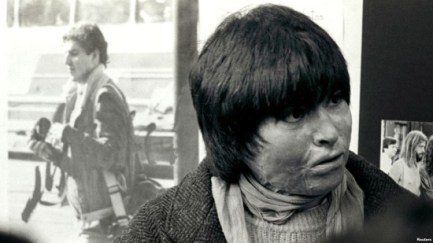
Carmen Gloria Quintana is seen near her home in Santiago in July of 1987. In 1986, when she was 18, she suffered severe burns on 65 percent of her body. She spent decades in treatment in Chile and Canada. | Photo: Reuters
The case, closed in the 1990’s after a single conviction of negligence and reopened in 2013 when relatives filed a new lawsuit, is considered among the highest profile among tens of thousands of dictatorship-era human rights abuses carried out during the 1980’s.
The arrests follow the recent conviction of 10 former army officers in the 1973 assassination of Chile’s well-known leftist political folk singer Victor Jara in 1973. Soldiers had cut off Jara’s fingers, broke his hands and wrists, and shot him more than 40 times.
The charges also come as part of a larger investigation into war crimes carried out during the 17-year dictatorship of General Augusto Pinochet.
Over 36,000 people were tortured and at least 3,200 killed or disappeared under the rule of the Chilean dictator.
Nicaragua’s Canal: A Socialist Project for Economic Change
Tortilla Con Sal | July 29, 2015
The fundamental argument in favor of Nicaragua’s Interoceanic Canal is that it will change the structure of Nicaragua’s economy in such a way as to dramatically reduce poverty and so enable a reversal of the current destructive national and regional trends of impoverishment-driven environmental depredation.
Progressive and radical opinion in North America and Europe tends to skew discussion towards the Canal’s alleged potential environmental effects, generally ignoring both the urgent economic imperative of poverty reduction and the Canal’s wider regional and global significance.
The environmental argument in favor of the Canal is usually met with perplexed scepticism, blank incomprehension or, very often, deliberate misrepresentation.
Like almost all the articles that have criticized Nicaragua’s Canal, Truth Out’s recent article by Thomas J Scott,“Nicaragua’s Flirtation With Environmental Disaster” focuses largely on the Canal’s environmental aspects while omitting Nicaragua’s fundamental dilemma, one typical of impoverished countries. Namely, Nicaragua’s environmental sustainability requires significant new economic resources in the short term so as to reverse decades of poverty driven deforestation, contamination and inadequate water management.
Only massive structural investment in the economy will provide those resources. Some environmental impact from that level of investment is inevitable. But the resources generated by the investment will more than compensate for the initial limited local environmental impact by generating enough resources to finally enable adequate environmental recovery programs. Addressing environmental concerns, Thomas J. Scott’s account relies narrowly on other ideologically compromised media outlets highly critical of the Canal.
In doing so, Scott not only marginalizes the Canal’s fundamental economic logic, he also gets basic facts wrong.
Environment
Scott’s Truth Out article asserts, for example, that 120,000 people may be displaced by the Canal. That is completely untrue. The actual figure is around 7,000 families amounting to around 35,000 people along the Canal’s 275 kilometre length. Scott also asserts that the indigenous Rama-Kriol group may lose 40% of their land, referring to a negotiation process yet to be completed, a fact which undermines the very basis of the claim brought before the International Commission for Human Rights by the group’s lawyers, alleging lack of consultation. Similarly, Scott cites various environmental and scientific opinions against the Canal but fails to put them in context.
For example, he uncritically quotes a supposedly scientific calculation that up to a million acres of rainforest and wetlands could be destroyed by the Canal. Even a cursory look at that claim shows how nonsensical it is. The Canal is 278 kilometres long of which about 23km run from the Pacific Coast north of San Juan del Sur to Lake Nicaragua, known here as Lake Cocibolca. Then, 105km of the Canal route run across Lake Cocibolca. None of that part of the Canal or its related sub-projects affect any rainforest or wetlands, leaving 150km from the area of San Miguelito on the eastern edge of the lake to Punto Aguilar on the Caribbean coast.
Much of the area between San Miguelito and Punto Aguilar is already intervened by agricultural cultivation and cattle ranching and by often illicit timber activity. Here, the total area affected by the construction of the Canal itself is certainly not greater than about 150 square kilometres, equivalent to 37,500 acres. To guarantee adequate water for the canal and improve the region’s water management, an artificial lake will be created of about 395 square kilometres, equivalent to 98,750 acres. So the total affected land area of the Canal in this part of Nicaragua will be around 136,250 acres.
Even if one overstates that 70%-75% of that affected land area is vulnerable wetlands or forest, the total such area affected will be around 100,000 acres, equivalent to about 40,000 hectares, around one tenth of the area of one million acres mentioned by Scott in his article. The canal runs well south of the hugely important Bosawas reserve and well north of the equally important Indio Maiz reserve. Much smaller reserves like Cerro Silva may be directly affected, but these reserves are already suffering significant deforestation and contamination at the hands of the local population.
The canal projects have to reforest more than the forest it will displace over the five year period of its main construction, because the Canal depends on water conservation to be able to operate.
Currently Nicaragua is losing 65,000 to 70,000 hectares of forest a year to agricultural cultivation, cattle ranching and illicit timber felling. Under-resourced, government promoted reforestation programs only replace around 15,000 hectares a year
None of this information appears in Scott’s account in Truth Out or other similar anti-Canal reports. It puts in context the outrageous, nonsensical claim that a million acres of pristine rainforest may be destroyed by the project. It also highlights the truly urgent nature of Nicaragua’s environmental and economic dilemma.
The same is true in relation to the exaggerated claims that Lake Cocibolca may be destroyed by the huge dredging the project entails. The lake is already contaminated and suffering heavy sedimentation. But that information too is omitted from Truth Out, which alleges “The possibility the HKND environmental protection plan will mitigate the scientists’ concerns is questionable, given the scale and complexity of the project.” In fact, far more questionable is the wild speculation clearly underlying those often ideologically motivated scientists’ concerns and their own misleading interpretations of inadequate data.
The canal’s pre-feasibility studies by a Dutch company began in January 2013 and lasted six months. The complete feasibility studies by international specialist companies lasted 23 months from July 2013 until May 2015. The cost of these studies over almost two and a half years has been well over US$150 million. The canal company HKND puts the figure at around US$200 million.
By contrast, the environmental scientists critical of the canal can marshal no data remotely equivalent to these substantial, large scale, detailed, highly resource intensive and very expensive studies.
In any case, as the planning process for the canal has progressed, legitimate, relevant environmental concerns have indeed been taken into account. For example, the location of the proposed deep water port on the Pacific Coast has been moved so as to minimize damage to local mangroves. The final precise route of the Canal has been subject to similar change. So it is far from true that environmental and other concerns in relation to the Canal have not been heeded. But that fact too is completely missing from Truth Out’s article.
Politics and geopolitics
Shifting from the environment to political analysis, Scott’s article makes the completely ahistorical assertion that “Sandino led an armed resistance movement against US plans to build a canal in 1927.” Sandino campaign was not against US plans to build a canal in 1927. The US government had no plans to build a canal in Nicaragua in 1927. Sandino’s guerrilla was was very clearly and overwhelmingly against the US imperialist military occupation of his country. The US government already controlled and occupied the Panama Canal zone, invading Nicaragua only so as to consolidate its regional political and economic domination.
In his manifesto “The Supreme Dream of Bolivar”, Sandino himself wrote, “nothing is more logical, nothing more decisive and vital than the union of the twenty-one states of our America into a single unique Latin American Nationality, which may make possible, as an immediate consequence, the right to the route of an Inter-oceanic Canal through Central America.” The US military occupation of Nicaragua vetoed that right. In his Truth Out article, Scott himself proceeds to row back from his incorrect, ahistorical assertion ending up suggesting that critics of the canal have legitimate concerns about Chinese imperialism in Nicaragua.
But most of those same critics are people bought and paid for by US government money in one form or another. Right-wing opposition to the Canal comes from politicians who are explicit allies of the United States government. Currently those politicians and their political parties have around 8% support nationally. Social democrat opposition to the Canal comes from ex-Sandinista politicians now closely identified with US government and European Union policy. They currently enjoy under 1% support nationally. These critics have zero credibility when they express their clearly hypocritical concerns about Nicaragua’s sovereignty in relation to growing Chinese influence.
Nicaragua’s sovereignty over the canal and the rights of its population are protected by the legislation for the Canal and its sub- projects which place the overall project under the control of a government Commission. The government’s Minister for National Policy, has explained, “The incentives have to be strong because Nicaragua isn’t giving a sovereign guarantee….. After 50 years Nicaragua will already have 50% of the profits from the Canal. Then in the second 50 years the share goes up 60%, 70%, 80%, 90%. Finally Nicaragua will take over after benefiting by over 50% for 50 years. While considerable, that benefit is tiny compared to doubling the economy, and reducing poverty.”
Not only do decisions in relation to the canal have to be authorized by the government, but ownership of the Canal’s business will pass progressively to the Nicaraguan government on an already agreed schedule.
Scott’s inaccurate and misleading analysis of the canal and of the national context in Nicaragua extends equally to his article’s geopolitical analysis. He manages to write his article without once mentioning ALBA, the Community of Latin American and Caribbean States, or Mercosur. Scott completely ignores the diverse tensions between the Pacific Alliance countries (Chile, Colombia, Mexico and Peru) and their ALBA and Mercosur counterparts. Nor do US sponsored supra-national trade structures like the Trans Pacific Partnership and the Trans Atlantic Trade and Investment Partnership figure in their extremely superficial report.
But all of these are extremely and immediately relevant in any serious discussion of China’s growing world role, especially in Latin America and especially in relation to Nicaragua’s Interoceanic Canal. Perhaps the most astonishing omission in the Truth Out article’s geopolitical sketch of the meaning of Nicaragua’s Canal is the absence of China’s alliance with Russia India, Brazil and South Africa, in building a multipolar world. Scott still seems deeply invested in the long since discredited idea of Western, especially US, political, economic and moral global leadership.
The inaccuracies, falsehoods and omissions of Thomas J. Scott’s article about Nicaragua’s Canal are symptomatic of that intellectual and political narcissism, placing the US and its concerns at the center of every world trend.
In fact, the US government is increasingly losing influence in Latin America and the rest of the world as a result of its absurdly inept, aggressive foreign policy. Neither the US government nor its European Union allies have anything to offer countries like Nicaragua beyond the old neocolonial traps of onerous debt, inequitable trade and meager development aid.
The fundamental question Western progressives never pose, let alone answer, when criticizing the Interoceanic Canal is how Nicaragua will otherwise generate the enormous resources it needs to end looming poverty-driven environmental disaster. The Sandinista government has taken the strategic sovereign decision to prioritize the Interoceanic Canal so as to achieve the massive structural investment it needs in the short term to break out of low wage under-development. The decision itself is grounded in the vision of Simón Bolivar, one explicitly fought for by Sandino, of Latin American integration.
This vision underlies the Sandinistas’ historic program of political pluralism, a mixed economy and a non-aligned foreign policy. Inherently and necessarily, Nicaragua’s Canal is not just a national project but rather one that will multiply benefits in Central America and the Caribbean, generating trade and investment throughout the region. Likewise, in the global environmental picture, the Canal will encourage maritime shipping over air transport by shortening voyages. A study of the Nicaraguan Interoceanic Canal by Hong Kong academics argues, “Maritime transport will become more dominant in international trade by taking over from the air transport. To further take advantage of the low carbon opportunities, the shipping liners will use larger vessels and enjoy economies of scale for both economic and environmental benefits, while the hub and spoke system will be chosen to maximize the operation efficiency.”
In summary, the Nicaraguan Canal is a strategic national, regional and global development project based on the historic socialist program of Nicaragua’s Sandinista government. That program develops in harmony with the anti-imperialist vision of regional integration promoted by Nicaragua’s ALBA partners led by Cuba and Venezuela in the context of developing policy embodied in CELAC, where the US and Canada have neither voice nor vote. Primarily, Nicaragua’s Interoceanic Canal project is designed to resolve the threat posed to national environmental sustainability by the economy’s current slow incremental economic development. But the Canal will also contribute to resolving that wider environmental dilemma regionally and globally. It is an integral part of the changing pattern of global seaborne trade and the infrastructure needed for that change in a multipolar world. This process and its respective outcomes are under way now with or without the say so of the United States and its Western allies and regardless of ill-informed, inaccurate and misleading propaganda from Western neocolonial media.
Ecuador’s Indigenous Groups Question Call for ‘Uprising’

Many indigenous groups have opted to enter the national dialogue (teleSUR)
teleSUR | July 30, 2015
Many in Ecuador’s robust indigenous movement are questioning a call by the Confederation of Indigenous Nationalities of Ecuador, also known as CONAIE, for a national uprising against the government of President Rafael Correa.
CONAIE has rejected a call for dialogue sponsored by the government and have instead have called for an indigenous-led uprising, which will begin with marches on Aug. 2 in the Zamora province and conclude in Quito for an uprising on Aug. 10.
“Everyone needs to know that CONAIE is not the only indigenous voice in the country,” Franklin Columba, leader of the National Confederation of Campesino, Indigenous and Black Organizations (FENOCIN) told teleSUR English on Thursday. “Here there are many organizations that also have their own processes.”
CONAIE’s demands are varied. For many indigenous activists government withdrawal from their land and a repeal of water laws are essential. Others have joined protests lead by the wealthy right-wing opposition leaders that have rejected of the capital gains bill and inheritance tax proposed by the national government to redistribute wealth.
“This march is to try and force the national government reconsider its political positions that they have been imposing. This uprising is demanding that the national government give concrete responses to our historic demands, our concrete demands in this country,” said President of CONAIE Jorge Herrera to the press.
The organization has taken a hardline to those who question their tactics, saying that they will sanction indigenous leaders who refuse to participate in the August uprising.
Columba told teleSUR that FENOCIN has rejected CONAIE’s uprising and it’s call for a national strike because “we as a national organization are not going to lend ourselves to playing the right’s game,” referring to the wealthy right-wing opposition who have used the momentum of current protests to denounce laws to redistribute the wealth in the country.
This is not the first indigenous uprising which has been called for in Ecuador. Indigenous nationalities from across the country converged on Quito on May 28, 1990. They blocked highways, held hunger strikes and occupied public spaces until they reached an agreement with the national government on June 11.
During the 1990 uprising CONAIE received popular support, as many of their demands represented those who lived harsh lives in Ecuadorean society. The movement is today under new leadership, and analysts have pointed to the fact that Pachakutik, the political party representing CONAIE, seems to be forging alliances with right-wing parties like former presidential candidate Guillermo Lasso’s CREO party.
“The alliances which we have seen Pachakutik make, the political arm, party of the indigenous movement of CONAIE and the Ecuarunari movement, are with right-wing groups. They are having meetings. This is a blow to their own ideological principles. They have always said that any type of relationship with the right would be impossible, because of what the right stands for,” said analyst Werner Vasquez to teleSUR English.
“(The right-wing) is the symbol of historic repression and exploitation suffered by the indigenous population. So it seems impossible to try to understand these alliances. I think it comes from them wanting to align themselves with those who are also opposed to the Citizen’s Revolution, and who have a common enemy, which is the state.”
Many indigenous organizations who participated in the 1990 uprising today feel that CONAIE no longer represents their interests. Some organizations, like FEI, agree that the land and water laws need to be revised, but they have chosen to participate in the National Dialogue on Equality and Social Justice to discuss these measures.
“We have proposed for this dialogue to cover fundamental issues, transcendental issues, like the agrarian revolution, also putting this in the context of diversifying production in the country, to support small and medium scale producers, campesinos and indigenous peoples,” said Jose Agualsaca, president of the Indigenous Federation of Ecuador (FEI) following a meeting with representatives of the national government to teleSUR English.
He went on to say, “We believe that these marches and this uprising wants to destabilize the country, and what they really want is to overthrow President Rafael Correa from power. But it would not end there, they want to take him out, then convoke a new constitutional assembly, and make a new constitution which would serve the interests of the richest sectors of society. This is the position of the FEI.”
Indigenous organizations across Ecuador are finding themselves at odds with CONAIE’S leadership, which has been viewed as moving further and further away from its historic support base. These groups are opting for dialogue, discussing their concerns and ideas with national authorities, in an effort to become key participants in constructing the future of the country.
Colombia’s President Orders Halt to Bombing of Rebel Positions
Sputnik – 26.07.2015
Colombian President Juan Manuel Santos ordered to suspend air strikes on positions of the Revolutionary Armed Forces of Colombia (FARC), he said via his Twitter microblog.
On Monday, FARC ordered all their units to observe a ceasefire and released a Colombian soldier it had captured earlier this month as a gesture of goodwill.
“I have ordered to suspend airstrikes on FARC camps starting today. They will be carried out only in the case of an explicit order of the president,” Santos said Saturday.
He added that the sides were able to revive the peace talks and “are closer than ever to put an end to the war.”
Colombian armed forces have been fighting FARC, the country’s largest rebel group, since 1964. The two sides have been holding peace talks in Cuba since 2012.
Recent progress in peace talks between FARC and the government was achieved in June with an agreement on the creation of a joint Truth Commission.
The commission is tasked with gathering testimony from victims and witnesses of Colombia’s civil war. However, it is unable to use the information to bring up criminal charges against FARC members, government troops or other fighters.
As many as 220,000 people have been killed as a result of the armed conflict in Colombia.
Argentina Replaces Columbus Statue with Indigenous Heroine

The statue of Juana Azurdy is a gift from Bolivia to Argentina
teleSUR – July 15 2015
Bolivian President Evo Morales’ visit to his Argentina counterpart Cristina Fernandez Wednesday will focus not only on bilateral agreements between the two nations, but also South America’s independence history, Cuban news agency Prensa Latina reported.
The two South American leaders will inaugurate a monument to independence heroine and South American guerrilla military leader Juana Azurduy.
The 15-meter high (52 feet) bronze statue has been erected outside the presidential palace in Buenos Aires in the place that a monument to Christopher Columbus once stood.
Festivities throughout the week will celebrate the monument’s inauguration as a symbol of “Patria Grande,” a term that roughly translates as “Big Homeland,” used in Latin America to refer to the integration process in the region.
The statue, which will be Argentina’s largest once officially revealed, was made by sculptor Andres Zerneri, who began working on the statue three years ago with the help of a team of 45 assistants.
Zerneri said Azurduy led battles that were fundamental for South American independence and her legacy is part of the longstanding regional defense of Patria Grande.
Morales and Fernandez will also further consolidate bilateral ties with the signing of various agreements, including energy integration deals laying the foundation to build an electrical line connecting Yaguaca in southern Bolivia to Tartagal in northern Argentina.
Government sources have said that the meeting reinforces the relationship between the two South American nations linked by trade, political ties, and Bolivian immigration to Argentina, according to Prensa Latina.
After concluding talks in Argentina, both Morales and Fernandez will travel to Brazil for a summit of the regional organization Mercosur, during with Bolivia could be welcomed as a full member of the bloc.
Featured Video
Ian Proud: Economic Reset with Russia to Save Europe
or go to
Aletho News Archives – Video-Images
From the Archives
Magic Hour for Gates

By Gary Jordan | Wake The F*** UP | March 15, 2021
Bill Gates wants to know everything about you.
He wants to control every aspect of your life.
His insatiable thirst for the supervision and scrutiny of every human being alive has sparked a US$1 billion investment that will blanket the earth in video surveillance satellites, providing real-time feedback with a mere one-second delay. He advocates for Orwellian digital tools to track your every move and has bankrolled US$1.7 billion to provide artificial intelligence that will be used to scan each and every visitor to major event venues worldwide. He wants to do away with end-to-end encryption, so he can snoop on your private conversations. He wants to know when and where you travel and who you travel with. He wants you to eat whatever he says you should eat, drink whatever he says you should drink, think how he wants you to think and know only what he wants you to know. Plus he wants to dictate what goes inside your body.
But he doesn’t want you to know a lot about him.
For instance… continue
Blog Roll
Recent Comments


 Aletho News
- ‘Israel’ threatens to genocide Gaza if Hamas refuses disarmament
- Apple Just Bought A Sinister ‘Pre-Speech’ Tech Company Implicated In Genocide
- Israel’s new West Bank registration process declares Palestinian land ‘state property’
- Two children killed in Palestinian Authority ambush in West Bank; Hamas slams attack as ‘black mark’
- Israel Needs Time Before Another Iran War—Here’s Why
- US seizes oil tanker for ‘defying Trump’s quarantine’
- Ian Proud: Economic Reset with Russia to Save Europe
- Senator Rand Paul Introduces Federal Bill to END Vaccine Makers’ Liability Shield
- The Hidden Map: US and Israel May Use Unexpected Neighbors to Attack Iran
- Trump, Netanyahu Agree to Target Iranian Oil Exports to China
- If Americans Knew
- In Gaza, “rats run over our faces” – Not a ceasefire Day 129
- Israel-backed border guards, GHF-linked aid – Not a ceasefire Day 128
- Israel battles Palestinian right of return, one Palestinian at a time – Not a ceasefire Day 127
- Noor’s short life of unimaginable suffering
- Israel Destroyed Gaza’s Hospitals. Now It’s Banning Doctors Without Borders.
- Is Spite of What Zionists Say, It’s a Good Thing to Criticize Governments
- Palestinian mother, daughter recount strip searches, harsh conditions in Israeli detention
- Israel used weapons in Gaza that made thousands of Palestinians evaporate
- ADL’s Stats Twist Israel’s Critics Into Antisemites
- Why Is the World Silent When the Gaza Genocide Is Not Over?
- No Tricks Zone
- New Study: A 4°C Warmer Beaufort Sea Had ‘No Sea Ice’ 11,700 – 8200 Years Ago
- Unfudging The Data: Dutch Meteorological Institute Reinstates Early 20th Centruy Heat Waves It Had Erased Earlier
- German Gas Crisis…Chancellor Merz Allegedly Bans Gas Debate Ahead of Elections!
- Pollen Reconstructions Show The Last Glacial’s Warming Events Were Global, 10x Greater Than Modern
- Germany’s Natural Gas Storage Level Dwindles To Just 28%… Increasingly Critical
- New Study Rebuts The Assumption That Anthropogenic CO2 Molecules Have ‘Special’ Properties
- Climate Scientist Who Predicted End Of “Heavy Frost And Snow” Now Refuses Media Inquiries
- Polar Bear Numbers Rising And Health Improving In Areas With The Most Rapid Sea Ice Decline
- One Reason Only For Germany’s Heating Gas Crisis: Its Hardcore-Dumbass Energy Policy
- 130 Years Later: The CO2 Greenhouse Effect Is Still Only An Imaginary-World Thought Experiment
 Aletho News