Argentina: Mauricio Macri’s Dubious Dictatorship Ties
teleSUR English | November 23, 2015
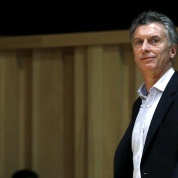 The election of Mauricio Macri in Argentina’s presidential race comes as a welcome victory to the country’s business elite and right-wing parties across Latin America, but the president-elect has some dubious ties that could signal a lasting legacy in the new head of state of darker times in Argentina.
Macri has been particularly criticized for his indirect ties to the last military dictatorship in Argentina in the late 1970s and early 1980s that cracked down on left-wing activists and political opposition.
While many of Macri’s powerful economic backers and corporate allies propped up the dictatorship that benefited them economically, Macri’s closest ties to the dictatorship are through his own family business Macri Society, known as Socma.
Macri, a long-time business magnate and former mayor of Buenos Aires, has been a director of his father’s Socma corporate conglomerate since a young age. The Macris are one of Argentina’s wealthiest families, and Socma was among the companies that directly benefited from the dictatorship.
In 1973, prior to the 1976 military coup that ousted the civilian Peronist government of President Maria Estela de Peron and installed a dictatorship, Socma owned seven companies. When the dictatorship ended 10 years later, in 1983, the Socma corporate empire had expanded to 46 companies.
Among Socma’s dozens of companies were various businesses that benefited the Macri family economically by providing services to the dictatorship regime, such as the solid waste management company Manliba, privatized under the dictatorship in 1979, and the postal company Correo Argentino, later nationalized in 2003 under former President Nestor Kirchner.
Macri also showed his sympathies for corporate complicity in dictatorship-era abuses earlier this year when he and his party opposed a government move to end impunity for dictatorship supporters.
Argentina’s Parliament decided in September to launch an investigation into how people and businesses participated in crimes committed by the 1976-1983 dictatorship. While the vote passed by a wide margin of 170-14, Macri and his Republican Proposal Party made up the minority of lawmakers opposing the bill.
The U.S.-backed Dirty War disappeared between 7,000 and 30,000 people in Argentina under the dictatorship regime.
Argentina’s right-wing newspaper La Nacion, which supported the dictatorship, hailed Macri’s election as signalling an end to “revenge” for the dictatorship years.
“The desire for revenge should be buried once and for all,” a La Nacion editorial said on Monday following Macri’s victory. The editorial referred the end to a “culture of revenge” under the governments of Nestor Kirchner and Cristina Fernandez in reference to their efforts to seek truth and justice for dictatorship-era crimes, including Kirchner’s 2003 repeal of amnesty laws for crimes against humanity.
Macri’s election marks the first victory for the country’s right-wing business elite through electoral means rather than military coup. He will be the third non-Peronist head of state in the more than three decades since the end of the dictatorship.
Right-Wing Alliances in Latin America
While corporate elites and dictatorship-supporters celebrate Macri’s election in Argentina, right-wing organizations across Latin America also welcome his victory as a win for their neoliberal political project in the region.
Macri has already made his foreign policy plans clear, vowing to reshape international ties to strengthen relations with the United States and European Union while requesting that Venezuela be suspended from the South American regional bloc Mercosur.
Macri’s relationship with the United States has been demonstrated in leaked diplomatic cables, published by WikiLeaks, in which he accused the U.S. of being “too soft” on the Kirchner governments and called on the U.S. to crack down on Cristina Fernandez de Kirchner.
Macri’s stance against the Venezuelan government was also clearly solidified when Lilian Tintori, wife of Venezuelan opposition leader Leopoldo Lopez, took to the stage with Macri during his victory celebration on Sunday night. Tintori hailed Macri’s win as the start of “political change in Latin America and Venezuela’s opposition was “delighted” by Macri’s win, Reuters reported.
Many of Macri’s supporters are those who hope to reinvigorate neoliberal free trade politics in Latin America and roll back the regional integration projects launched by former Venezuelan President Hugo Chavez.
For example, the Argentine think tank Thinking Foundation, focused on developing projects and strategies to get Macri’s party elected, has collaborated with the Spanish FAES Foundation, which promotes neoliberal politics and has strong ties to Spain’s conservative People’s Party.
The Thinking Foundation is also part of the Atlas Foundation, which in turn is part of the global Atlas Network, a think tank that promotes neoliberal free trade and market-based public policy through over 400 member think tanks worldwide.
Macri’s Majority Pro-Kirchner Opposition Government
Macri’s plans to shift Argentina to the right may still face resistance. The president-elect will be forced to govern without majority support from Congress.
In the Argentine Senate and House of Representatives, the majority of lawmakers are not representatives of Macri’s Let’s Change coalition, but of the pro-Kirchner alliance Front for Victory that backed Daniel Scioli’s bid for president. Of 257 seats in the Lower House, 114 are held by the Front for Victory. In the Senate, 42 of 72 senators are Front for Victory officials.
The era of “Kirchnerismo” under Cristina Fernandez and Nestor Kirchner may have come to an end with Macri’s election, but the Peronist movement that has long fought for social justice in Argentina now forms the official opposition.
While change under Macri is certain, the question that remains is what the long-term legacy of the Peronist movement and Kirchner governments will be in Argentina and Latin America.
Mass Demonstration Demands Closure of US’ Notorious ‘School of Assassins’
Sputnik – 24.11.2015
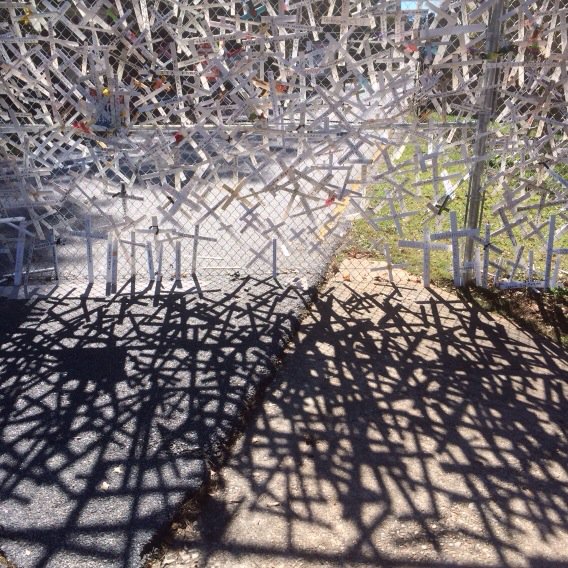 Georgia’s infamous ‘School of Assassins’ was besieged by hundreds of activists from across the country, calling for the closure of the military training center and a halt to the militarization of Latin America by the US.
The 25th anniversary protest march was held over the weekend in the town of Lumpkin in northern Georgia, and at the gates of Fort Benning army base, where the former US Army School of the Americas (SOA), hidden now under the name of the Western Hemisphere Institute for Security Cooperation (WHINSEC), is located, along with the nearby Stewart Immigrant Detention Center, the country’s largest for-profit immigration prison.
Dozens of nonprofit organizations and some 1,400 activists joined the rally, which aimed to protest against the notorious “School of Assassins,” as SOA is referred to, for its production of “death squads” that commit mass murders, torture and other human rights’ violations and military crimes across the globe, activists claim. Watchdogs maintain several Latin Americans dictators and many more security officials, who have perpetrated such crimes, graduated from SOA.
“Despite a shocking human rights abuse record, the School of the Americas continues to operate with US taxpayer money. Closing the SOA would send a strong human rights message to Latin America and the world,” SOA Watch founder and organizer of the event, Father Roy Bourgeois, said in a statement.
Hundreds held vigil in front of Fort Benning, while others marched to protest to the immigrant prison, where some 1,800 migrants await repatriation. Eleven people were arrested after crossing onto the grounds of the prison, according to the Ledger-Enquirer.
The event was attended, among others, by members of Veterans for Peace.
“From Ferguson to Ayotzinapa, we must continue to denounce the militarization of police across the Americas and call for an end of state-sponsored terrorism and violence against our communities. Our clamor for justice must be heard!” the pacifist NGO’s online statement reads.
Newly released documents, obtained by the Partnership for Civil Justice Fund, suggest the FBI has been monitoring the activities of SOA Watch and infiltrating the NGO, using confidential informants and counterterrorism units.
Argentina’s New President Poised to Roll Back Gains for Multipolar World
Sputnik – November 23, 2015
On Sunday, Argentina held a runoff vote to pick its next president, resulting in a narrow victory for conservative Let’s Change coalition candidate Mauricio Macri over his center-left Front for Victory coalition opponent, Daniel Scioli. The question on everybody’s mind now is: what should Argentinians, and the world, expect from the new government?
An estimated 80% of Argentina’s 32 million eligible voters went to the polls on Sunday to elect their next president, in a runoff vote between the two leading candidates from the first round of voting, held in late October. With 51.5% of the votes cast in favor of conservative candidate Mauricio Macri, the favorite of the country’s big business and private media, the country is set for a hard right turn.In the run up to the election, analysts in both Latin America and across the loose global coalition of countries opposed to a unipolar world order had worryingly suggested that a Macri victory would result in a rollback to the policies pursued by Buenos Aires over the past decade aimed at challenging US hegemony, both in the region and around the world.
Daniel Scioli, the candidate of the Peronist, center-left Front for Victory electoral alliance, had promised to continue outgoing President Cristina Fernandez’ center-left-oriented politics domestically, and to pursue an independent foreign policy course abroad.
Throughout Fernandez’ tenure (she was elected in 2007) and that of her late husband, Nestor Kirchner (elected in 2003), Argentina had aligned itself with the string of left-wing Latin American governments emerging in the region in the early 2000s, while pushing for new economic and political ties with the BRICS countries, including Russia and China. Now, with Macri’s victory, the country’s multipolar outlook is under threat.
At the moment, Russian-Argentinian political and economic ties are believed to be at historic highs, characterized by the Russian ambassador to Buenos Aires as “excellent” and “extremely constructive and trusting.” Earlier this year, ahead of Fernandez’ official state visit to Moscow in April, Argentina’s Ambassador to Russia, Pablo Anselmo Tettamanti, went so far as to describe relations to be at the highest levels they have ever been in the countries’ 130-year-long history of bilateral relations.
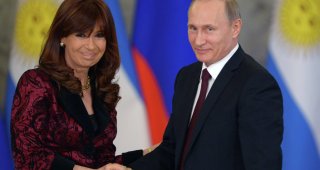 During her visit to Russia, President Fernandez met with President Vladimir Putin, signing over 20 memorandums on economic cooperation, said to amount to an “all-encompassing strategic partnership.”
The agreements included joint projects on the development of hydroelectric, nuclear and fossil-based energy in Argentina, including the construction of the sixth bloc at the Atucha nuclear power plant, along with a $2 billion memorandum on the construction of a new hydroelectric dam. Meanwhile, Russian energy giant Gazprom signed a memorandum on the exploration and development of gas fields with Argentine state gas company YPF, a deal amounting to $1 billion in investments. Russian company Uralmash was also tapped to build a plant manufacturing oil extraction equipment, amounting to an additional $1.9 billion in investments.
In the course of the visit, the two sides promised to conduct consultations on the use of each other’s national currencies for trade, pledging to increase cooperation in the military-technical sphere, accelerating construction of the GLONASS satellite navigation systems, and negotiating on the prospects of increasing bilateral food trade (presently amounting to about $1.3 billion).In the sphere of political cooperation, President Fernandez voiced her support for Moscow’s position that the situation in Ukraine could only be resolved by peaceful means, with the Russian president, for his part, pledging support for “Argentina’s striving for direct talks with Britain to achieve prompt resolution to the Mavinas [Falklands] Islands dispute.”
Visiting Moscow in July, Argentinian Vice President Amado Boudou emphasized that Argentina’s diplomatic moves toward improving relations with Russia were based on the fact that the two countries “share a very strong position with a common vision of the need for a multipolar world to ensure the existence of an inclusive and autonomous policy.”
Now, following Macri’s election victory, Argentina’s strategy of promoting regional integration in Latin America, and a multipolar world order, may be coming to an end. With Mexican economist Ariel Noyola Rodriguez suggesting only months ago that the Russian-Argentinian partnership signaled “Washington’s incapacity to sabotage the construction of a multipolar world,” it seems that the analyst may have spoken too soon.
With Fernandez (and her husband before her) becoming a major thorn in Washington’s side, the latter unhappy over the Peronists’ efforts to extract the country and the region from its subservient position in the US’s so-called ‘backyard’, the election of Macri, who promised to immediately improve relations with Washington, must come as a welcome change.
The conservative politican has already hinted that he would give less weight to Mercosur –the South American trade bloc aimed at ensuring regional economic integration and development, and shift the country’s diplomacy away from close cooperation with the leftist governments of Venezuela, Bolivia, Ecuador and Brazil.
And while his victory may not nullify the economic and other cooperation agreements reached with Russia, China, and other BRICS countries over the past decade, it does threaten Buenos Aires’ general trajectory of development –the country’s moves toward regional integration and a multipolar world independent of Washington’s influence.
For the Argentinian People: A Return to Neoliberalism?
As far as the Argentinian people are concerned, Macri’s victory is feared by his critics to mark a throwback to neoliberal dogmas which plagued the country prior to Kirchner’s 2003 election victory.
For their part, the British and American business press couldn’t help but gloat in the moment, with Financial Times suggesting it was “the beginning of a new political era for South America’s second-largest economy,” and The Wall Street Journal trash-talking Fernandez and her party, and suggesting that her economic policies, “uncivil rants against her political opponents, and a substantial loss of judicial independence and press freedom during kirchnerismo” contributed to Scioli’s defeat. Bloomberg Business, naturally, focused on the election’s effects on the markets, finding it crucial to point out that “in anticipation of a Macri victory, bond yields fell to an eight-year low and the local stock market rallied to a record high.”
But not everyone is convinced that this ‘new political era’ will bring positive changes, at least for ordinary Argentinians. In the run up to the voite, Scioli and his supporters warned that Macri’s proposals, which promised a return to neoliberal economic policies, would amount to “savage capitalism,” eroding social welfare and creating an economy which catered to a wealthy minority.
It’s worth recalling that before the Kirchners, Argentina was viewed as a textbook example of a developing country enveloped by the so-called Washington Consensus, a set of neoliberal economic dogmas which resulted in extremely high unemployment (over 25% in 2003), high poverty rates (nearly 55%), and a high Gini index.Under Kirchner and Fernandez, the country pursued social and economic policies that amounted to the creation of a mixed Keynesian economy, promoting government intervention where necessary, support for medium and small businesses, and a push for export growth via regional economic integration.
According to pan-Latin American news channel Telesur, these efforts resulted in the reduction of unemployment to 6.6% in 2015 (with 5 million jobs created over the past ten years), the reduction of poverty from over 50% to 6.5%, the creation of 50,000 small and medium-sized businesses, a major industrialization drive via the Industrial Parks National Program, increases in the share of GDP spent on education and pensions (from 3.6% and 4.1% in 2003 to 6.5% and 7.7% of GDP in 2013, respectively), and the near doubling of public investment, all the while reducing the national debt from 166% of GDP in 2003 to 41%.
In the areas of social policies, Kirchner and Fernandez began a comprehensive reform of the country’s justice system (making the Supreme Court independent), while annulling the ‘laws of pardon’ which gave immunity to the leaders of the country’s military dictatorship of 1976-1983 accused of crimes against humanity. The country also became the first in Latin America, and the tenth in the world, to pass equal marriage laws, in 2010.
Now, these gains, which came at a cost of high inflation (offset to an extent by annual negotiations between unions, employers and employees on adjusting wages) are under threat, with Macri’s critics saying his policies (including tax cuts, social spending cuts, and privatization schemes) will favor big business and the country’s oligarchs, sidelining the problems of social inequality, and reverting the country to its 90s’ era social and economic malaise.
Critics have also pointed to Macri’s promises of beginning negotiations with the predatory ‘vulture fund‘ creditors that rejected the debt restructuring which took place following the country’s default in 2002, giving an indication not only of his upcoming domestic economic policy, but also his possible subservience to the Western-dominated economic institutions which Argentina rejected under the Kirchners.Ultimately, only time will tell whether Argentina’s new government will continue to pursue policies based on economic and political pragmatism which have brought Buenos Aires closer to those countries looking to challenge global unipolarity (with some analysts already suggesting that they will).
As far as Argentina itself is concerned, it remains unclear how a return to the neoliberalism which devastated the country’s economy in the early 2000s will do it any good. As Russian social media users commenting on the election results lamented, it seems that too many Argentinians have forgotten the neoliberal catastrophe and ‘de-sovereignization’ of the 90s, processes which Russians themselves know all too well.
Colombia: 300 Campesino Leaders Killed in 2015

Campesino leaders say the government is criminalizing their movements and does not protect their rights. | Photo: @marchapatriota
teleSUR – November 21, 2015
At least 300 campesino leaders have been killed in Colombia in 2015, according to Andres Gil, human rights leader and spokesperson of the Marcha Patriotica.
Many of these deaths have come as campesino leaders are attempting to defend their land and their natural resources. Another 7,000 campesino leaders have been jailed.
Land distribution in Colombia is extremely unequal. Less than 1 percent of the population owns roughly half of the land, and 70 percent of the population owns only 5 percent of the land. Campesinos who fight for their land are often risking their lives.
At least three campesinos leaders where killed just in the last two weeks, including the young Afro-descendent leader Jhon Jairo Ramirez Olaya in the Valle region; the environmental and campesino leader Daniel Abril, in the Orinoquia region; and the representative of Afro-descendent victims from Cordoba, Luis Francisco Hernandez Gonzales.
Another young campesino leader allegedly killed by the armed forces last Friday, according to Marcha Patriota.
According to Verdad Abierta — an investigative project on the armed conflict of Colombia’s Semana magazine — Abril accused various state officials of corruption, and was fighting against multiple oil corporations with extensive land interests.
Feliciano Valencia, another indigenous leader from the region of Cauca who was controversially sentenced to 18 years in jail, was also victim of a homicide attempt on Tuesday, as four men opened fire on his home, according to local social organizations.
Still in Cauca, in the end October, the armed forces were recently involved in the murder of indigenous leader Alfredo Bolaño, the 58th victim from security forces in the region, one of the most affected by violence because of its highly fertile lands.
On Friday, the Colombian army killed one campesino and wounded five others after it raided a rural area in what military officials said was an effort to “manually eradicate” illegal coca crops.
According to the local community, the armed forces opened fire on a peaceful march last Thursday in Argelia, Cauca.
The country’s ombudsman Fabian Laverde told teleSUR that this issue was rooted in several causes.
“First, the national government refuses to recognize the existence of paramilitarism. Second, the complaints from the social movements made about situations of threats or concrete actions against residents of these territories have been completely ignored,” he said.
Death-Squad Organizer Is NYT’s Source on Ben Carson’s Lack of Foreign Policy Smarts
By Adam Johnson & Jim Naureckas | FAIR | November 19, 2015
In its effort to vet one of the leading GOP presidential candidates, Dr. Ben Carson, the New York Times didn’t properly vet its primary source in this vetting, former CIA officer Duane Clarridge—an indicted liar and overseer of Contra death squads in Central America.
While the Times’ Trip Gabriel briefly notes the former, he completely omits the latter, instead offering this starry-eyed description:
Mr. Clarridge, described by Mr. Carson’s top adviser, Armstrong Williams, as “a mentor for Dr. Carson,” is a colorful, even legendary figure in intelligence circles, someone who could have stepped out of a Hollywood thriller. He was a longtime CIA officer, serving undercover in India, Turkey, Italy and other countries, and sprinkles his remarks with salty language.
As head of Reagan’s CIA division in Latin America in the 1980s, Clarridge took part in the effort to overthrow Nicaragua’s Sandinista government by illegally supplying funds and arms to the Contras—a right-wing terrorist movement that committed brutal war crimes. This was not an unforeseen consequence, but the point of the operation; asked by CIA Director William Casey to come up with a strategy for dealing with the Sandinista revolution, Clarridge writes in his memoir A Spy for All Seasons :
My plan was simple:
- Take the war to Nicaragua.
- Start killing Cubans.
Clarridge acknowledges that his plan, “stated so bluntly, undoubtedly sounds harsh.”
He also boasts of having come up with the idea of mining Nicaragua’s harbors to interfere with shipping:
I remember sitting with a glass of gin on the rocks, smoking a cigar (of course), and pondering my dilemma, when it hit me. Sea mines were the solution…. To this day I wonder why I didn’t think of it sooner.
The mines were, as conservative icon Sen. Barry Goldwater pointed out, an “act of war”—and predictably resulted in the deaths of civilians, something that doesn’t trouble Clarridge overly much. Or, apparently, the New York Times.
The Times vaguely alludes to the Iran/Contra scandal but without mentioning what it entailed, namely that Clarridge had an operational involvement with terrorist death squads.
In addition to this bloodsoaked past, Clarridge has more recently been a freelance hit-list generator for the Defense Department in Afghanistan ( New York Times, 3/14/10)–part of what the Times referred to as “an off-the-books spy operation.”
The kid-glove treatment would even extend to ethnic slurs, which the Times glosses over without citing specifically. Gabriel quotes Clarridge dismissing the notion—spread by right-wing media—that there are Chinese troops in Syria, “using an ethnic slur for the Chinese.” If a top adviser to a leading presidential candidate is referring to Chinese people as “Chinks”—or the equivalent—isn’t that a newsworthy fact that the New York Times ought to report?
It’s not a surprise a New York Times Beltway insider like Trip Gabriel would whitewash Clarridge’s brutal resume to the point of unrecognizability, but it doesn’t make using a grotesque violator of human rights and a known liar to kneecap Carson any less sleazy. On the issue of policy knowledge, it is more than fair to point out Carson’s shortcomings. But the bigger story here—that a leading candidate’s primary international adviser is a CIA goon with a bloody (or as the Times would put it “colorful”) past—is buried in a story about a routine DC pissing match.
This is how America’s war crimes are laundered, by absorbing the most complicit and criminal into respectable circles by passing them off as “experts” with “legendary” pasts. The Times would have better served its readers by pointing out, in clear and honest terms, what this “colorful, even legendary” past amounted to. It would help put Clarridge’s testimony—and Carson’s potential nomination—into historical and moral context.
El Salvador’s New Anti-Corruption Crusaders
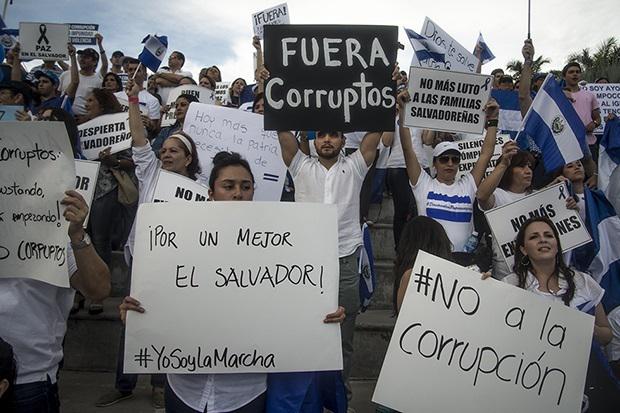
A right-wing rally on Sept. 5 in San Salvador (Contrapunto/ Jessica Orellana)
By Hilary Goodfriend – NACLA – 11/16/2015
Over the summer, news out of Central America seemed to take a positive turn. According to reports worldwide, the streets and plazas in several countries had filled with empowered citizens, united under the banner of “anti-corruption.” In Guatemala, a president notorious for the genocidal atrocities he helped wage against indigenous communities during the U.S.-backed civil war was toppled and disgraced. In Honduras, thousands marched against a repressive regime with a dubious mandate, stained by a 2009 coup d’état against democratically elected president Manuel Zelaya. In neighboring El Salvador, strategists of the political opposition looked on longingly as pundits enthusiastically heralded a “Central American Spring.”
Unlike in Honduras and Guatemala, in El Salvador, the political Left has governed the country since 2009, placing the Salvadoran Right in the unfamiliar role of the opposition. Hoping to capitalize on the trending currents next door, El Salvador’s elites are now hastily hoisting the banner of anti-corruption politics. Theirs is a cynical, if clumsy, effort to foment a tide of popular opposition against the current FMLN administration of President Salvador Sánchez Cerén. The conservative Nationalist Republican Alliance (ARENA) party is leading this charge, desperate to recover executive power and, with it, unbridled access to the state coffers it once ransacked. This movement is acting through a handful of small but well-funded right-wing civil society organizations, such as the Movimiento de 5 en 5, Grupo 300, and Democracia Limpia, as well as powerful economic groups like the National Association of Private Enterprise (ANEP) and the right-wing think tank FUSADES, ARENA, and its private sector allies. They are convening marches, filling headlines with empty accusations against the FMLN, and flooding social media with snappy civic hashtags like #YoTambiénEstoyIndignado (“I’m Outraged, Too”) and #NoALaCorrupción (#NoToCorruption).
The hypocrisy of this tactic is hard to overstate. From 1989 to 2009, the ARENA party oversaw the disappearance of more than $3.9 billion in public funds. The extent of such corruption only came to light after ARENA lost the presidency. Former president Francisco Flores (1999-2004), the poster boy for the ARENA party’s legacy of corruption, is now on trial for misappropriating at least $15 million in Taiwanese aid for earthquake victims. Even the U.S. State Department, historically a loyal supporter of ARENA politicians, admitted in a cable released by Wikileaks that the Salvadoran party’s finances were dependent on its ability to “hand out” government “patronage.”
Since unseating ARENA in 2009, the FMLN administrations of Mauricio Funes and Salvador Sánchez Cerén have made unprecedented efforts to investigate and prosecute many high-ranking former officials, like Flores, for acts of corruption. At the same time, the Salvadoran government, under the FMLN’s leadership, has completed several important public works projects, such as major highway constructions and hospital repairs, that languished unfinished, in part due to the rampant theft and embezzlement that occurred under ARENA. In addition, the FMLN has enacted new policies aimed at improving government transparency, such as the Access to Public Information Law; the establishment of a Secretary for Citizen Participation, Transparency and Anti-Corruption; the creation of a digital open government platform; and the establishment of a new policy forcing government institutions to present and publish annual reports of their activities. The Foundation for the Study of the Application of the Law (FESPAD) has observed that since the election of a leftist government in El Salvador there have been “important advances oriented towards honest and transparent public administration based on accountability, access to public information as well as the prevention and investigation of State corruption.”
For months now, the Salvadoran opposition has recklessly thrown corruption allegations at the FMLN administration. Thus far, however, they have been unsuccessful in making such allegations stick. As a result, conservative efforts to rally the public against the government have floundered. In a country accustomed to large protests, the Salvadoran Right has failed to bring more than a few hundred people into the streets – despite significant efforts on social media. The demonstrations have consistently featured an elite “who’s who” of ARENA party leaders and allies. Even government detractors have dismissed these events as partisan political theater.
This is not to say ARENA’s efforts have been wholly unsuccessful. While street mobilizations have faltered, ARENA’s diplomatic maneuvering has gotten significantly more traction. Its latest instrument of choice is the so-called CICIES, or International Commission against Impunity in El Salvador. And it’s here that ARENA has encountered its old ally: the United States.
The CICIES proposal is modeled on the International Commission against Impunity in Guatemala (CICIG), the United Nations-run body whose investigations recently toppled President Otto Pérez Molina and his vice president, Roxanna Baldetti. The CICIG was founded at the behest of human rights organizations to address the activities of paramilitary security groups that undermined the fragile achievements of Guatemala’s peace accords. Today, these groups defend the CICIG as the only feasible means of imposing justice in an utterly compromised judicial system.
At the same time, significant U.S. financial backing for the CICIG has also served to justify ongoing U.S. assistance to abusive Guatemalan security forces and neoliberal economic agreements with corrupt Guatemalan administrations. As the U.S. promotes the Alliance for Prosperity in the Central American Northern Triangle, a controversial economic and security strategy modeled on Plan Colombia, the CICIG has emerged as a key player. During a March visit to Guatemala, Vice President Joe Biden himself stressed that “the International Commission against Impunity in Guatemala should be extended” as a condition of the Alliance.
In 2011, then Salvadoran president Mauricio Funes considered the implementation of a commission similar to the CICIG. The ARENA party, however, strongly opposed the proposal. At that time, former ARENA presidential candidate Rodrigo Ávila declared that in El Salvador there were sufficiently capable police, jurists, and lawyers. “To come and say that we need foreign attorneys […] who do not know the reality of the country” was, Ávila argued, “a blow to the capabilities of Salvadorans.”
The idea of creating an anti-corruption commission in El Salvador did not resurface again until this year – this time as a suggestion from the U.S. State Department. During a visit to the country in July, State Department Counselor Thomas Shannon hailed the CICIG, and recommended the implementation of a similar model throughout the region. “It would be intelligent for El Salvador and Honduras to seek the support of the international community” in combating impunity and corruption, Shannon told a group of Salvadoran reporters.
ARENA, in a sudden change of heart, quickly echoed Shannon’s call. “The scourge of corruption and high levels of impunity are affecting our country and democracy,” ARENA legislator David Reyes told the media in late August. “With this type of independent international body, many of the problems can be solved, and [it will] help recoup trust in our institutions.” On October 12, ARENA party representatives held a press conference announcing the delivery of a letter to the president calling for the establishment of CICIES. The conservative organization Allies for Democracy, a USAID-supported group whose membership includes the powerful National Association of Private Enterprise, has also since come out in favor of CICIES.
The fact that the U.S.’s statements regarding the CICIES come at the same moment that the U.S. is pushing the Alliance for Prosperity suggests that State Department concerns about corruption in the region are less than altruistic. While recognizing the gains of Guatemala’s U.N.-backed anti-impunity commission, historian Greg Grandin noted in The Nation that under other circumstances, CICIG might “easily be dismissed as a neocolonial imposition meant to press order on a country so that it could continue to participate in the ‘international community’ as a ‘responsible’ free-trade partner.” The fact that the U.S.’s statements regarding the CICIES come at the same moment that the U.S. is pushing the Alliance for Prosperity suggests that State Department concerns about corruption in the region are less than altruistic. As Thomas Shannon told Salvadoran media, “It is strategically important for us to have a successful Northern Triangle in terms of our regional policy.” If the State Department has its own interests in mind as it pushes for an International Commission against Impunity in El Salvador, its recommendations have played nicely into the hands of El Salvador’s right-wing opposition.
To be sure, the Salvadoran Left is not blind to ARENA’s opportunism. Despite the rampant corruption during two decades of ARENA governance, the U.S. never pushed for an International Commission against Impunity in El Salvador until the election of a left-leaning administration. Most former ARENA officials have little to fear today; the ten-year statute of limitations for crimes of corruption in El Salvador now protects most ARENA officials from prosecution, leaving only former President Tony Saca (2004-2009), who since defected from the party and is therefore of small concern to his former colleagues, and, of course, the FMLN.
The Salvadoran government and other transparency advocates contend that unlike in Guatemala, the very institutions created by the 1992 Peace Accords would fight corruption and impunity. “After the armed conflict, the intervention of international institutions like ONUSAL [the United Nations Observer Mission in El Salvador] was justified because there wasn’t institutionality in the country […] The Truth Commission report even said that the judicial system was complicit in systematic human rights violations,” explained Abram Abrego, director of the respected legal aid non-profit FESPAD. “The judicial branch was questioned, and an international organization was necessary to verify its conduct […] But after more than 20 years, institutionality has developed in other ways. There’s more to do,” Abrego says, “but the country now has better laws than after the Peace Accords; it has better guarantees.”
Because of this history, Salvadoran progressives have thus far dismissed the need for an international commission to investigate corruption and impunity, calling instead for judicial reform to ensure justice within the country’s existing institutions. “The bourgeoisie is asking for it, not the people,” says Margarita Posada of the National Healthcare Forum, in reference to the proposed Commission. “What our people want is justice, and for the judicial system to work.”
In a recent editorial, Luis Cruz of the youth organization Progre expressed similar sentiments. “Salvadoran institutionality is still weak,” Cruz notes, “and the response should be to solve our problems by strengthening ourselves without appealing to foreign institutions.” In a rally outside the Supreme Court, Francisco Garcia of the Popular Coalition for a Peaceful Country without Hunger (CONPHAS) declared that, “The issue of purging the judicial system is an urgent necessity in order to guarantee the democratic transformations in this country.” Groups like CONPHAS, the National Healthcare Forum, and Progre have rejected the proposed Commission as a political smokescreen. Instead, they are focusing on critical measures like the election of a new Attorney General, the creation of an internal body to investigate corruption within the judicial system, and the dismissal of compromised judges from the bench.
The fact that ARENA’s calls for an international anti-corruption commission have no resonance with the country’s popular movement organizations has not deterred El Salvador’s elites in their crusade. Indeed, the U.S. State Department has bolstered their message. In this respect, their charade reveals the disturbing underside of the anti-impunity movements that have taken hold in other parts of Central America, often unseen to the international community.
There is much work to be done in El Salvador, and all of Central America for that matter, to claim victory in the battle against corruption and impunity. That is precisely why it is imperative to see this right-wing anti-corruption discourse in El Salvador for what it is: a cynical strategy to return to the status quo at a time when the powerful interests who have historically run the country are being challenged.
Hilary Goodfriend is a researcher in El Salvador. A graduate of New York University in Latin American Studies, she is currently completing a master’s thesis at the Central American University (UCA) in San Salvador.
Cuba Blames US for Cuban Migrant Crisis in Central America
teleSUR | November 18, 2015
Cuba blamed the U.S. on Tuesday for the situation of more than 1,000 Cuban migrants in Central America, pegging the crisis on U.S. Cold War-era immigration policy put in place during the early years of the U.S. blockade on Cuba.
“The Foreign Ministry wishes to emphasize that these citizens are victims of the U.S. government’s politicization of immigration issues,” said a government statement on a Cuban news broadcast.
The Cuban government statements come amid a recent spike in number of Cuban migrants crossing Central America en route to the U.S. Many Cubans, some wishing to reunite with their families, fear that the renewal of U.S.-Cuban relations could bring an end to a decades-old policy allowing landed Cuban migrants to stay in the U.S.
But more than 1,000 Cuban migrants have become stuck in Central America, facing challenges of tightened borders first at the Panama-Costa Rica crossing, then at the Costa Rica-Nicaragua border. Nicaragua tightened its borders Sunday and accused Costa Rica of fomenting a “humanitarian crisis” in the region.
Under the U.S.’s 1966 Cuban Adjustment Act, any Cuban who enters the U.S. is able to gain permanent residency after being present in the U.S. for one year. The act, amended in 1995 to not admit to the U.S. any Cubans found at sea, became known as the “wet-foot, dry-foot” rule.
The Cuban government considers this rule a provocation, while critics say the policy not only promotes dangerous forms of travel, but is also an incentive for human trafficking by criminal groups.
“This policy stimulates irregular emigration from Cuba toward the United States and constitutes a violation of the letter and the spirit of migration accords that are in force and through which both countries assume an obligation to guarantee legal, safe and orderly emigration,” said the Cuban government statement.
Cuba said it has been in contact with Central American countries on the Cuban migration route to discuss how to best remedy the migrant situation.
Ecuador Rejects HRW Report as “Manipulative”
teleSUR – November 12, 2015
In a statement released Wednesday, Ecuador’s governing party, Alianza PAIS, rejected the “latest political intervention against the government of Ecuador by the U.S.-based organization Human Rights Watch (HRW) in its report released on 10 November 2015.”
The report made unsubstantiated claims that “the administration of President Rafael Correa has expanded state control over media and civil society” and argued that security forces used “excessive force” against “peaceful” protests this year. It left out important context, such as the calls by the leaders of those protests to get rid of the democratically elected and very popular left wing government. The report criticized Ecuador because the well known US political tool, USAID shut their offices this year, and claimed the government has “broad powers to limit free speech.” Finally, the report took a political position on Ecuador’s internal legislative decisions.
“This organization repeatedly ignores the unprecedented advances in human rights that have occurred in Ecuador while manipulating human rights discourse to unjustly attack the nation’s elected government. It is not the first time HRW releases partisan reports against Latin America’s progressive governments,” Alianza PAIS stated.
Allianza PAIS accused HRW of misrepresenting the sizes of demonstrations, minimizing opposition violence, and of misrepresenting the state of emergency declared with the eruption of the Cotopaxi volanco – portraying that measure as a repressive tool.
“The sources of HRW’s funding, including corporate funding, contribute to its political bias while its board members and advisers have links with the financial, military and political sectors, the latter criticized by significant figures including Nobel laureates,” Alianza stated.
Our Brand Is Impunity: Why is the U.S. Harboring Bolivia’s Most Wanted Fugitive?
New film Our Brand is Crisis doesn’t tell us how a president who authorized the massacre of indigenous Bolivians has lived with impunity in the US for 12 years
By Emily Achtenberg – Rebel Currents – 10/29/2015
Our Brand Is Crisis, a new feature film produced by George Clooney and “inspired by true events,” tells the story of a presidential campaign in a fictional Latin American country that is besieged by social unrest.
In real life, the country is Bolivia, the year was 2002, and the candidate was Gonzalo Sánchez de Lozada (“Goni”), a deeply unpopular former president who was propelled to victory by the nefarious campaign strategies of prominent U.S. polling and marketing consultants Greenville Carville and Shrum. Goni, a U.S.-educated millionaire mine owner, won the election with only 22% of the popular vote.
What the film doesn’t show is what happened less than a year later. In October 2003, Goni authorized the violent repression of indigenous citizens who were protesting the privatization of Bolivia’s oil and gas reserves, and the proposed export of cheap gas to the U.S. through Chilean ports. The results were 68 dead and 400 injured, including onlookers and children. Most of the violence took place in El Alto, the indigenous city overlooking La Paz that was the epicenter of Bolivia’s “Gas War.”
The massacre sparked a popular uprising that led to Goni’s resignation, followed by a chain of events culminating in the 2005 election of Evo Morales as Bolivia’s first indigenous president. Goni and his defense minister Carlos Sánchez Berzaín fled to the US, where they have lived for 12 years in comfort, relative obscurity, and with full impunity, shielded by successive Republican and Democratic administrations.
Bolivians, though, have not forgotten. This past month, in what has become an annual ritual, families, survivors, and friends of the victims marched in El Alto, together with hundreds of supporters from popular and neighborhood organizations, to commemorate the events of “Black October” and demand that the perpetrators of violence be brought to justice.
Beyond his infamous responsibility for Black October, Goni is equally despised in Bolivia for overseeing a radical neoliberal program of privatization, austerity, and deregulation at the behest of the US government and international financial institutions. While helping to reduce hyperinflation, these free-market reforms also led to rising unemployment, deepening poverty, and transnational corporate control of Bolivia’s economy.
In 2004, after a concerted campaign by the victims’ families and human rights groups, more than two-thirds of the Bolivian Congress—including many members of Goni’s own party—voted to authorize a “trial of responsibility” for the perpetrators of the Black October violence. Seventeen former military and government officials, including Goni and Sánchez Berzaín, were charged with serious human rights crimes, including homicide, torture, and “genocide in the form of a bloody massacre.” Seven have been tried and convicted in Bolivia, receiving prison sentences of 3-15 years in a landmark 2011 case. However, under Bolivian law, those who fled into exile cannot be held legally accountable unless the government succeeds in extraditing them.
The Bolivian government’s initial petition for the extradition of Goni and Sánchez Berzaín, filed in 2008, was rejected by the U.S. State Department in 2012, seemingly because some charges lacked equivalency in U.S. law. A revised request, filed in July 2014, is still pending.
The obstacles to success remain formidable, including Goni’s long-standing dual citizenship, advanced age (85), and, especially, his close ties to powerful US politicians and business tycoons. In addition to his relationship with top Democratic political operatives James Carville, Stan Greenberg, and Bob Shrum (detailed in the original Our Brand is Crisis, an excellent 2005 documentary by Rachel Boynton), Goni was advised in his 2002 campaign by Mark Feierstein, who currently serves as Obama’s Senior Director for Western Hemisphere Affairs at the National Security Council. Greg Craig, Goni’s former attorney, coordinated Bill Clinton’s legal defense during his impeachment trial and later became Obama’s White House Counsel.
Last April, Goni was a featured speaker in a lecture series at Mercer University’s Center for Undergraduate Research on Public Policy and Capitalism, financed by the Koch brothers. More than 300 US solidarity activists, academics, and representatives of civil society organizations protested the event in a letter to the university president, requesting that video testimonies offered by the Black October victims’ families also be aired to provide a more balanced perspective.
Underlying the conflict over extradition is the fraught political relationship between Bolivia and the US that has persisted throughout the Morales era, characterized by mutual distrust and a tendency on both sides to exploit ideological differences for domestic political gain. The two countries have not had formal diplomatic relations since 2008, when Morales expelled U.S. Ambassador Philip Goldberg for suspected consorting with conservative opposition leaders who were actively seeking to destabilize his government—a suspicion subsequently borne out by Wikileaks cable revelations—and the US responded in kind.
In 2013, Morales also expelled USAID for meddling in domestic political affairs, an accusation that gained widespread traction due to the agency’s lack of transparency in funding. A few months later, the grounding of Morales’s presidential jet in Europe when the U.S. suspected that fugitive Edward Snowden might be on board substantially undermined a new “framework agreement” for bilateral relations negotiated by the parties in 2011.
Morales has repeatedly clashed with the U.S. over drug policy. In 2008, he expelled the U.S. Drug Enforcement Agency (DEA), symbol of the repressive U.S. War on Drugs, to embark on a new anti-drug trafficking strategy that acknowledges Bolivia’s traditional uses of coca and enlists the powerful coca growers’ unions in regulating their own activity through social control.
Despite a recent United Nations report documenting the success of this policy, in the form of a significant reduction in Bolivia’s coca-growing acreage, the U.S. has continued to “decertify” Bolivia for “failing demonstrably” to curb illegal drug trafficking. This means that the U.S. will likely continue to deny previously-granted trade preferences for Bolivia’s manufacturing exports, an economic sanction that Bolivia deeply resents. Recent revelations that the US has secretly indicted several top government officials and their associates as a result of a DEA drug sting have reinforced Morales’s suspicions that a vengeful DEA is working to undermine his administration.
Still, with the recent U.S.-Cuba thaw setting a new standard for diplomatic pragmatism in the region, there is good reason to anticipate that U.S.-Bolivia relations will improve. As with Cuba, a primary motivating factor is likely to be the availability of new markets for U.S. businesses in Bolivia, now that, with the end of the commodities boom, the Morales government has stepped up its efforts to attract foreign capital.
Just this past week, Morales showcased investment opportunities in Bolivia’s hydrocarbons, mining, energy, manufacturing, and tourist sectors at a New York City conference, “Investing in the New Bolivia.” The event, sponsored by the London-based Financial Times (FT), drew more than 150 corporate and financial representatives from the U.S .and around the world, with 34 companies (including Seattle-based Boeing) expressing significant interest.
Despite Morales’s warnings that foreign companies must partner with the government and not meddle in domestic politics —important differences from the neoliberal Goni era— Bolivia’s new pro-business climate could go a long way towards countering the recent history of ideological and rhetorical conflict between the two countries. Even so, with Goni’s still powerful bipartisan connections, it’s hard to say whether improved economic and political relations could elevate the status of Bolivia’s extradition request on the bilateral agenda. It’s also unclear whether extradition is still a top priority for the Morales government, or has been superseded by other nationalist causes—such as Bolivia’s demand for the return of its seacoast from Chile—that have gained new political traction.
Meanwhile, a civil suit filed against Goni in 2014 by the families of Black October victims, seeking compensatory and punitive damages under the Alien Tort Statute and the Torture Victim Protection Act, is progressing slowly through the US courts. Last May, Goni was forced to submit to a 6-hour deposition, an emotional experience for the families— and the first and only time he has appeared in a judicial forum to account for his crimes. The families are also pursuing claims in the Bolivian courts to allow the assets of those convicted of Black October crimes to be auctioned off and paid to them as reparations.
Here in the US, solidarity activists have launched a parody website to tell the true story of state violence and impunity that lies behind the fictionalized Our Brand is Crisis. It includes video testimonies from the families of Black October victims and survivors and a petition demanding Goni’s extradition.
Emily Achtenberg is an urban planner and the author of NACLA’s blog Rebel Currents, covering Latin American social movements and progressive governments
White Helmets: War by Way of Deception
By Vanessa Beeley | thewallwillfall | October 23, 2015
“The Ivy League bourgeoisie who sit at the helm of the non-profit industrial complex will one day be known simply as charismatic architects of death. Funded by the ruling class oligarchy, the role they serve for their funders is not unlike that of corporate media. Yet, it appears that global society is paralyzed in a collective hypnosis – rejecting universal social interests, thus rejecting reason, to instead fall in line with the position of the powerful minority that has seized control, a minority that systematically favours corporate interests.” ~ Cory Morningstar
In his recent speech Hezbollah leader, Sayyed Nasrallah, alluded to a multi-phase “soft war” which relies upon the mass media complex to disseminate propaganda and bias, propelling the Middle East into, primarily, a sectarian crisis before descending even further into regionalism and finally a devastating individualism.
Cory Morningstar’s body of work does more than any other to expose the bare bones of the non-profit propaganda industry that governs both our reactions – and inactions, through a network of multi-layered and multi-faceted media manipulation campaigns, of which the end result is mass thought control. She explains:
“The 21st century NGO is becoming, more and more, a key tool serving the imperialist quest of absolute global dominance and exploitation. Global society has been, and continues to be, manipulated to believe that NGOs are representative of “civil society” (a concept promoted by corporations in the first place). This misplaced trust has allowed the “humanitarian industrial complex” to ascend to the highest position: the missionaries of deity – the deity of the empire.”
In a paper entitled, Foreign Aid and Regime Change: A Role for Donor Intent, written just prior to NATO intervention in Libya, Prof. Sarah Blodgett Bormeo describes the “democratization” process for target nations. Unwittingly or wittingly, Bormeo perfectly outlines the role played by NGOs in this process. Bormeo even goes so far as to pinpoint the lack of impartiality rife among NGOs large and small, the majority of whom, receive their funding directly from western government and major corporation sources – all of whom have a vested interest in the outcome of their NGO’s activities and ‘intervention’ in a particular location. Bormeo emphasises the importance of “picking winners” in this scenario, as opposed to respecting and supporting the will of the people in any sovereign nation.
“Thus, it is possible that aid donors, in an effort to avoid further entrenching an “authoritarian” [my edit: this status is decided by donor] regime and perhaps increase the likelihood of democratization, channel funds through NGOs and civil society organizations in authoritarian states.”
In this short video below, we are introduced to the US military’s symbiotic relationship with NGOs in countries [in this instance, Iraq] where the policy is to Induce Pacification & Advance Western Ideologies. NGOs are cynically used to “soften” cultures and render entire communities dependent upon foreign aid in order to facilitate “Democratization”.
In this role, and dependent upon their donor support, NGOs cease to be the neutral, unbiased ‘humanitarian’ organisations they publicly purport to be, and instead become actual covert tools for foreign intervention and regime change. By default, they are assimilated into the Western modus vivendi of “waging war by way of deception” and their purpose is to alter public perception of a conflict via a multitude of media and “marketing” channels.
Following this formula, let’s examine, once more, the role of the Syria Civil Defence aka,’The White Helmets’ currently operating in Syria and take a closer look at their financial sources and mainstream media partners in order to better determine if they are indeed “neutral” as media moguls proclaim these “humanitarians” to be.
White Helmets: Follow the Money
The White Helmets were established in March 2013, in Istanbul, Turkey, and is headed by James Le Mesurier, a British “security” specialist and ‘ex’ British military intelligence officer with an impressive track record in some of the most dubious NATO intervention theatres including Bosnia and Kosovo, as well as Iraq, Lebanon, and Palestine. Le Mesurier is a product of Britain’s elite Royal Military Academy at Sandhurst, and has also been placed in a series of high-profile pasts at the United Nations, European Union, and U.K. Foreign and Commonwealth Office.
The origins of The White Helmet’s initial $300k seed funding is a little hazy, reports are contradictory but subsequent information leads us to conclude that the UK, US and Syrian opposition [Syrian National Council] are connected. Logistical support has been provided by given by Turkish elite natural disaster response team, AKUT.
A further $13 million was poured into the White Helmet coffers during 2013 and this is where it gets interesting. Early reports suggest that these “donations” came from the US, UK and SNC with the previously explored connections to George Soros in the US.
Soros in Syria: ‘Humanitarian’ NGO Deployed For Regime Change, Not Aid
However, subsequent investigations reveal that USAID has been a major shareholder in the White Helmet organisation.
The website for the United States Agency for International Development (USAID) claims that “our work supports long-term and equitable economic growth and advances U.S. foreign policy objectives by supporting: economic growth, agriculture and trade; global health; and, democracy, conflict prevention and humanitarian assistance.”
In a USAID report update in July 2015 it is clearly stated that they have supplied over $ 16m in assistance to the White Helmets.

The USAID track record as a primary US Government/CIA regime change facilitator is extensively documented. From South America to the Ukraine and in the Middle East, USAID serve a malevolent and ultimately destructive role in the dismantling of sovereign nations and their reduction to Western hegemony vassal states, as always, all in the name of freedom and democracy.
“The United States does not lack institutions that continue to conspire, and that’s why I am using this gathering to announce that we have decided to expel USAID from Bolivia” ~ Bolivian President Evo Morales
“USAID and NED are in the business of “Democracy Promotion” which uses public money (from U.S. taxpayers) for secretive operations with the intention to support pro-U.S. governments with the help of political and social movements abroad. The goal is regime change.” ~ Timothy Alexander Guzman
With recent developments in Syria and as a consequence of the Syrian Government requested Russian intervention, we have seen a scramble to justify the shambolic US foreign policy and its clandestine terror operations in Syria. We have previously established the White Helmet connections to this US regime change operation and their undisputed exclusive integration into the Al Nusra and Free Syrian Army [Muslim Brotherhood] and even ISIS networks and strongholds.
Humanitarian’ Propaganda War Against Syria – Led by Avaaz and The White Helmets
After RT and Sott.net among others, exposed the gaping holes in White Helmet propaganda over recycled photographs tweeted even before the alleged Russian bombing had occurred, the propaganda “war” ramped up. The Russian involvement in Syria, did not only betray the US military deception, it also brought some heavyweight media giants of its own into the fray who set about de-constructing the Western media and NGO indoctrination that had, for so long, been largely unchallenged.
At this point the London Telegraph went into damage limitation mode. It published an article expounding the White Helmet humanitarian role in Syria but with admissions of UK Government “majority” funding and that the White Helmets are embedded with ISIS (“in at least one ISIL held area”), claims previously vehemently denied but rendered indisputable after discovery of the photo showing an ISIS mercenary posing directly in front of a White Helmets depot located deep in ISIS held territory south of Yarmouk.

“The Foreign Office is currently the largest single source of funding. It is an irony that if Britain does effectively become an ally of Assad, and starts raids against Isil in Syria, it will be bombing from the air and paying for the bodies to be dug out on the ground. The White Helmets are also operating in at least one Isil-held area.”
Interestingly, the Telegraph stated clearly that the UK Foreign Office is the “largest single source of funding” for the White Helmets which may be perceived as an attempt to draw fire away from the USAID funding which still outstrips official figures released by the British Gov’t who “gifted” £ 3.5 million in equipment to “civil defence teams” in Syria [Report March 2015]. However, the British Government also committed to an additional £ 10m to “increase coordination between the Syrian Interim Government and civil defence teams” to be funded by: UK Government’s Conflict, Security and Stability Fund (CSSF).
It should also be noted here that although cries of ‘regime change!’ from both Washington and London have been muted since Russia entered the Syria conflict, both Washington and London have been supporting their own parallel, hand-picked ‘interim government’ for Syria since at least 2012.
So, with millions in hard cash and equipment being invested into the White Helmets by US & UK donors who have a very clear regime change objective in Syria, it becomes increasingly difficult to perceive their role as anything other than donor-biased propaganda merchants and a ‘humanitarian’ extension of a clandestine terror operation allied to the NATO proxy armies in the region.
White Helmet Leadership
James Le Mesurier: James Le Mesurier has been portrayed as a Humanitarian maverick hero, miraculously in the right place (Istanbul) at the right time, just as the need arose for the formation of a Syria Civil Defence team, perhaps coincidentally, only a few months prior to the now infamous and universally (except for a few diehard propagandists) discredited Ghouta ‘chemical weapon’ attack in August 2013, an event which has already been proven beyond a doubt to be a false flag attack, as well as subsequent accusations levied at the Syrian Government which narrowly failed to precipitate the NATO desired ‘No Fly Zone’.
However, when we delve deeper into the life and times of Le Mesurier we see that it was no happy accident that he was in Istanbul at this juncture. As Sandhurst Military Academy’s top student and recipient of the Queen’s Medal, his chequered career took him from OHR [Office of High Representative] in Bosnia to intelligence co-ordinator in NATO’s newly won prize, Kosovo. We’re told that Le Mesurier left the British Army in 2000 and joined the UN serving as deputy head of the Advisory Unit on ‘Security and Justice’, and Special Representative of the Secretary General’s security policy body within the UN mission in Kosovo. His career then took him to Jerusalem where he worked on implementing the Ramallah Agreement, then to Baghdad as a special advisor to Iraqi Minister of Interior, and to the UAE to train their gas field protection force, and later to Lebanon during the 2006 war. In 2005 he was made Vice President for Special Projects at private mercenary firm Olive Group, and in January 2008 he was appointed as Principal for Good Harbour International, both based in Dubai.
Le Mesurier is also the founder of Mayday Rescue, a “non profit” organisation providing SAR [search & rescue] training to civilians enduring conflict. According to Mesurier’s own biography on the website, Mayday Rescue was founded in 2014, after he had established Syria Civil Defence/White Helmets.

A quick flick through the other Mayday team members reveals some very interesting connections.
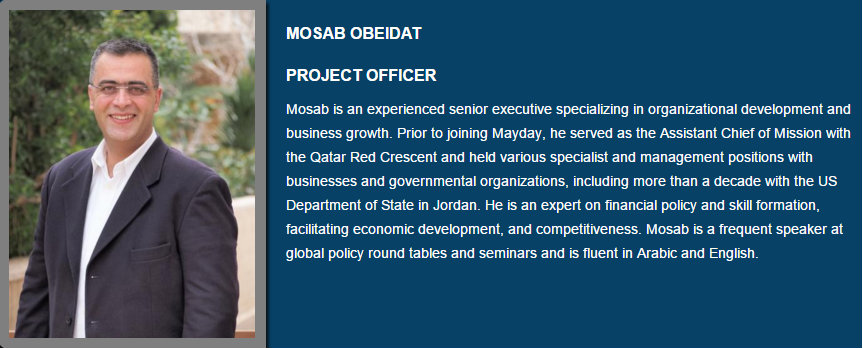
Mosab Obeidat, previous Assistant Chief of Mission with the Qatar Red Crescent, one of whose officials, Khaled Diab was accused of supplying $ 2.2 m to secure arms for the terrorist groups in Syria. Details of this transaction and its exposure can be found in this Al Akhbar article from June 2013.
At least three other members of the team were a part of the Syrian “revolution” including Farouq al Habib, one of the 3 most prominent White Helmet leaders who was also a leader of the Homs uprising against the Syrian government and according to his testimony, was tortured by the Syrian “regime” security forces in 2012 for smuggling a journalist into Syria to “cover” the “peaceful protests”. Habib was a founder member of the ‘Homs Revolutionary Council’ (the CIA have been linked to nearly all ‘Revolutionary Councils in Syria) before fleeing to Turkey in 2013 (A more in-depth analysis of his anti-Syrian government testimony will be presented in Part II of this article).

Le Mesurier is heavily involved in several organisations not mentioned in this article, but for the purposes of demonstrating that the White Helmets should not be considered impartial or neutral as they claim, we will focus on those that best substantiate that argument.
Both Olive Group and Good Harbour International are experts in private “security”. Taken from Sourcewatch on Olive Group:
“Olive Security was founded in 2001 by Harry Legge Burke. Olive lends their quick success to strong relations in the government and military industry. Harry Legge-Burke is an ex-Welsh Guard, and a former aid to chief of defence staff Sir [Charles Guthrie]. He can claim Prince William as a skiing partner and his sister was a nanny to the royal children.
Iraq: Olive were on the ground since the invasion began in 2003, and were able to deploy 38 former SAS employees within two days of the invasion’s completion in 2004
Jonathan Allum, Olive’s former director and co-owner, is also the son of Tony Allum, who is the chairman of the engineering company Halcrow and also the head of the UK government’s Iraq Industry Working Group. It was in the latter position that Tony Allum went to Washington to meet with Bechtel leaders, where he suggested, among other UK companies, Halcrow and Olive as companies worth considering for subcontracted work, all stemming from Bechtel’s $680 million contract with USAID. They were considered and contracts followed, though both Legge-Burke and Allum deny one had anything to do with the other”
In May 2015 Olive Group merged with Constellis Holdings, in whose portfolio we can also find Academi, previously the notorious Blackwater Group [ Nisour Square massacre, Iraq 2007]. Taken from The Atlantic July 2012: Post 9/11, Bush enabled the CIA to subcontract assassinations allegedly targeting Al Qaeda operatives. Blackwater was awarded this contract.
“Running operations through Blackwater gave the CIA the power to have people abducted, or killed, with no one in the government being exactly responsible.”
The CIA can no longer hide its Blackwater/Academi connections, especially after this week’s Wikileaks data dump of CIA director John Brennan’s emails, whose contact list included now spy chief Robert Richer at his Blackwater contact address.
The outsourcing of intelligence operations was in full-swing. What Bush initiated, Obama ran with, awarding Blackwater/Academi a $ 250m contract in 2010 to offer “unspecified” services to the CIA, thus maintaining the apparatus for “unaccountable” covert assassinations.
It is true that James Le Mesurier only joined Olive Group in 2005 and left them in 2008, but his involvement with them and their subsequent merger with Constellis and by default, Blackwater/Academi, gives a degree of valuable insight into the elite intelligence and Pentagon circles that Le Mesurier moved in prior to working for Good Harbour International and creating Syria Civil Defence (not forgetting the USAID funding & influence that underpins both Olive and SCD/White Helmets).
In 2008, Le Mesurier joined Good Harbour International, another private “security” expert organisation, whose CEO is none other than former terror advisor to the Bush administration, the Terror Czar himself, Richard A Clarke.

The jury is still out on whether Clarke was indeed the “whistleblower” he fashioned himself as, post 9/11, or a merely a high-level gatekeeper who aided in preventing a full and detailed investigation into Bush and Rumsfeld’s roles in 9/11.
Patrick Henningsen, a political analyst and writer for 21st Century Wire believes the latter is more likely:
“On first glance, one might buy into the mainstream media’s characterization of him, but it’s more likely that Richard Clarke is not a whistleblower at all. While appearing to oppose the Bush administration from a safe enough distance, I believe his role was inserted into the mix in the period of 2004-2005 in order to VALIDATE the bin Laden mythology and help to portray al Qaeda as an organic, independently run terror organization. He also claimed that Bush and Rumsfeld committed war crimes, but this means nothing because everyone knows that no US official will ever face ‘war crimes’ charges in any court of law anywhere on the planet. It’s effectively a straw man narrative that distracts from the real scandal in the US which is that the entire premise of the war on terror is completely contrived. Clarke’s ‘whistleblower’ status gives him brilliant cover from too much public scrutiny. I remain skeptical of his whole public narrative. He was, is, and always will be an insider.”
What is perhaps even more telling, is Clarke’s reported close ties with Israeli-US operative Rita Katz of the SITE Intelligence Group, another supposedly independent, albeit ‘private’ intelligence firm located in Bethesda, Maryland, a stone’s throw away from CIA headquarters. SITE are said to be responsible for the media release of the harrowing ISIS execution videos, al Qaeda videos, and their credibility has been extensively questioned.
Katz’s long term working relationship with Clarke began before 9/11 when she and her research associate Steve Emerson were commissioned by Clarke to identify Islamic radicals within the US. Over time, Katz’s relationship with Clarke blossomed into a much more extensive one that included regular briefings at both the Clinton and Bush White Houses.
“One of SITE’s founders, Rita Katz, is a government insider with close connections to former terrorism czar Richard Clarke and his staff in the White House, as well as investigators in the Department of Justice, Department of the Treasury, and the Department of Homeland Security, according to SourceWatch. Her father was executed in Iraq as an Israel spy, a fact that suggests a connection to Israeli intelligence.” ~ Mark Taliano
This background on Le Mesurier should at least make us question the media portrayal of an affable, debonair and philanthropic leader of a civilian humanitarian mission. His military & intelligence roots, the fact that despite working for OHR in Bosnia, no visible record of his employment can be found there, his private security-centric career path, his appearance in Istanbul at just the right moment to partner USAID, the UK government & Syrian opposition in creating just the sort of “democratization” enabling NGO as described in our introduction, MUST at least cause us to doubt the transparency and neutrality of the White Helmets in Syria.
In addition, the White Helmet leadership consisting of known Syrian opposition protagonists such as Raed Saleh and Farouq al Habib must make us more cynical about the claims of impartiality and lack of bias and for those who will defend the “peaceful” revolution narrative upheld by Habib and Saleh, please take the time to read Professor Tim Anderson’s in depth analysis of events in Syria pre NATO intervention.
“I have seen from the beginning armed protesters in those demonstrations … they were the first to fire on the police. Very often the violence of the security forces comes in response to the brutal violence of the armed insurgents” – Jesuit priest Father Frans Van der Lugt, January 2012, Homs Syria
“The claim that armed opposition to the government has begun only recently is a complete lie. The killings of soldiers, police and civilians, often in the most brutal circumstances, have been going on virtually since the beginning.” – Professor Jeremy Salt, October 2011, Ankara Turkey
Our presentation of the White Helmets as regime change propagandists & terrorist allies in this article will be further explored and verified in Part II.
“Existing soft power initiatives and agencies, particularly those engaged in development and strategic communications, must be reinvigorated through increased funding, human resources and prioritization. Concurrently, the U.S. government must establish goals, objectives and metrics for soft power initiatives. Furthermore, the U.S. government can better maximize the effectiveness of soft power instruments and efforts through increased partnerships with NGOs. By providing humanitarian and development assistance in areas typically inaccessible to government agencies, NGOs are often able to access potential extremist areas before the government can establish or strengthen diplomatic, developmental or military presence, including intelligence.” — Joseph S. Nye, former US assistant secretary of defence, June 2004
Featured Video

Trita Parsi: Middle East Unraveling — Are We on the Path to World War?
or go to
Aletho News Archives – Video-Images
New Book
Trans agenda is ‘normalization of sadism’ – US author

RT | September 23, 2026
The US Democratic Party has embraced a transgender agenda that amounts to “the normalization of sadism,” author A.J. Rice has said, warning that radical trans policies would return if the party is allowed to regain power.
Speaking to RT’s America First host Scotty Nell Hughes about his new book, ‘The Curse of the Bearded Lady: How the Trans Mafia Whacked American Sanity’, Rice argued that activists have gained significant influence in schools, medicine, and corporate America while people who questioned the agenda have faced pressure to stay silent.
The author described the “trans mafia” as the sprawling network of people and institutions that have helped the movement gain influence. He singled out parts of academia, wealthy backers, and corporations, and stated that providers of transition-related treatment also have a financial incentive to keep young people in their care indefinitely.
Rice argued that the consequences of these policies ultimately fall on children who are being drawn toward gender-affirming medical treatments and on girls who are expected to share locker rooms or compete in sports with biological males.
He noted that while voters rejected the Democrats’ approach to gender in 2024, the party, which has been “captured by madness,” has since only doubled down and is seeking what is effectively “the normalization of sadism.” … Full report
Blog Roll
 Aletho News
- NATO chief wants Europeans to fight American wars [for Israel]
- German chemicals giant reveals details of downsizing
- Refaat Al-Areer Was The Canary In The Coal Mine In Israel’s War On The Truth
- Israeli election committee bars candidate from Knesset race over Gaza war opposition
- French-Lebanese man files war crimes complaint over Israeli attacks
- Mahan Air Flight Lands in China Despite US Threat against Iranian Airlines
- US eyes $10bn fund to rebuild war-battered Gulf infrastructure
- Trump meets Rodríguez near Maduro’s prison as Venezuela’s oil flows to US
- Trita Parsi: Middle East Unraveling — Are We on the Path to World War?
- Iran FM meets with US envoy on UN meeting’s sidelines at American side’s insistence: Report
- If Americans Knew
- Caught on Tape: AIPAC CEO Boasted of Controlling Trump’s National Security Officials
- Why Hamas Attacked Israel in October 2023 – Israeli professor Ilan Pappé
- They see them, then kill them: Israeli quadcopters track, deliberately target civilians in Gaza
- Winter could turn Gaza’s treacherous, war-damaged buildings into deathtraps
- Majority of Democratic Voters Want to Prosecute Both Biden and Trump Administration Officials Over Gaza
- As Gaza languishes, world leaders gather at the UN – Daily Update
- Sanctions are collective punishment: immoral and self-defeating
- Phosphorus Munitions Fired by Israel Burn Groves, Orchards in Southern Lebanon
- Israel Carries Out New Ceasefire Violations Across Gaza
- AI – Emphasis on the ‘I’: Israel Is Funding AI Chatbot Propaganda
- No Tricks Zone
- New Study: Earth And Venus Surface Warmth Largely Explained By Convection And Lapse Rate, Not CO2 Or Radiation
- 2025 Nature Paper Claiming Worsening Global Drought Gets RETRACTED …Heavily Flawed
- New Study: ‘Global Drought Shows No Detectable Recent Acceleration Under Climate Warming’
- Economic Masterminds: German Socialists Suggest Taxing Productivity Gains Stemming From Using AI
- The South China Sea Has Not Been Cooperating With The Climate Change Narrative
- Energy Crisis: Germany Enters Heating Season With Historically Low Gas Reserve Fill Levels
- New Study: The Antarctic Ice Sheet Gained Mass From 2020-2024 Due To Staggering Snow And Ice Accumulation
- Study: Ocean Heating Rates From Thousands Of Years Ago ‘Dwarf’ Modern Ocean Heating Rates
- Climate Extremists Target, Attack Large-Scale Power Grid Infrastructure In Germany!
- New Study: Antarctic Ice Melt Has Contributed Less Than 1 Centimeter To Sea Level Rise In The Last 30 Years

