US / Cuba Relations: What Would Constitute Normal?
By José Pertierra | CounterPunch | July 15, 2015
President Dwight D. Eisenhower broke diplomatic relations with Cuba on January 3, 1961. Fifty-four years later, on Monday the 20th of July, the United States and Cuba will advance toward normalization of diplomatic relations. Presumably, the US will no longer treat Cuba as its enemy and treat the island simply as its next-door neighbor. Maybe …
The raising of the flags at the embassies on the 20th of July is much anticipated. But what does this all really mean? After more than 56 years of trying to destroy the Cuban Revolution through US sponsored terrorism, an invasion organized and launched by the CIA, biological warfare, an economic and commercial blockade, clandestine infiltrations and a permanent propaganda campaign against Cuba, what would constitute “normal” relations between Washington and La Habana?
The word normal derives from the Latin normalis. In the context of US-Cuba relations it refers to civilized diplomatic behavior, according to historically established philosophical precepts: norms or rules of peaceful conduct between nations.
What rules of peaceful conduct by the United States towards Cuba may we expect from now on? Which normative rules could be considered normal and which abnormal?
It’s normal for two neighboring countries, separated by a mere 90 miles of water, to have diplomatic relations. It’s not normal for the United States to impose an economic, financial and commercial blockade against Cuba.
It’s normal for the US to have an embassy in Havana and for Cuba an embassy in Washington. It’s not normal for the US embassy in Cuba to function without an ambassador, simply because some in the Senate oppose it.
It’s normal for US citizens to travel to Cuba, but it´s not normal to prohibit tourists from the US to travel to the island.
It’s normal for US citizens to travel to Cuba and engage in “people to people” contact, but it’s not normal that the Office of Finance and Assets Control (OFAC) limit it to only group-travel through licensed organizations, thus making travel to Cuba prohibitively expensive and inconvenient for many Americans.
It’s normal for Washington to permit businesses in the US to engage in commerce with private individuals in Cuba, but it’s not normal to make it illegal to do business with state enterprises on the island.
It’s normal for the United States to want a second consulate in Cuba to better serve the public, but it’s not normal that it uses its diplomats to intervene in Cuba’s internal affairs.
It’s normal for the United States to support a process of legal and orderly immigration from Cuba, but it’s not normal for Washington to maintain a Cuban Adjustment Act as a tool to stimulate an illegal, dangerous and disorderly immigration of Cubans to the United States.
It’s normal for the United States Embassy in Havana to provide an open-door policy for Cubans. It’s not normal for its diplomats to organize, direct and employ as salaried dissidents a few Cubans of their choosing.
It’s normal for Washington to contribute to the entertainment of the Cuban people with radio and television programs. It’s not normal for it to maintain a multi-million dollar budget to fund Radio and TV Marti as propaganda instruments.
It’s normal for Washington to want a reputation as a great defender of human rights. It’s not normal for the United States to imprison without due process or civil rights dozens of persons in Guantánamo, as well as torturing them in Cuba.
It’s normal for the United States to have an embassy in Cuba, even a large one, located in prime real estate on the famous Malecón overlooking the bay in Havana. It’s not normal for the United States to occupy, against the wishes of the Cuban people, a large swath of Cuban territory in the province of Guantánamo.
It’s normal for the Pentagon not to invade or send military drones to Cuba. It’s not normal that Washington earmarks a $30 million budget for fiscal year 2016 for a project whose declared purpose is to remove the government of Cuba from power.
It’s normal for Mississippi to be one of the 50 states of the US. It’s not normal for Washington to assume that it has jurisdiction in Cuba as well.
It’s normal for the US to do business with Cuba, but it’s not normal for the US to intervene in her internal affairs.
It’s normal for Washington to condemn terrorism. It’s not normal that it protect in Miami dozens of terrorists, including Luis Posada Carriles, who have committed heinous crimes against civilians in Cuba.
The US blockade against Cuba is a relic of the Cold War whose days are numbered. President Obama’s new Cuba policy, announced on the 17th of December, is a chronicle of the blockade’s death foretold. And it unleashed a torrent of enthusiasm from American businessmen who want to make money by investing there. Businessmen will pressure the Congress to lift the Helms-Burton law that codified parts of the blockade.
But let’s not be naïve. In order to truly say that relations between the US and Cuba are normal, Washington must understand that Cuba does not belong to it, that it is a violation of international law for the US to try and foment regime change in a foreign country and that Cuba must and ought be respected for what it is: a sovereign nation.
President Obama’s Cuba policy is a seismic shift in strategy for the United States. “The old policy did not work. It is long past its expiration date”, said Obama, in his most recent State of the Union speech before Congress. “When what you’re doing doesn’t work for fifty years, it’s time to try something new.”
What is the end game for the United States regarding Cuba? What is it that US Presidents wished had worked? Clearly, the major premise of Washington’s Cuba policy was always regime change. It failed, and the Cuban Revolution remains strong. That is why President Obama said that Washington should “try something new.” Perhaps business can do what isolation could not. Engagement is the new strategy to try and topple the Cuban Revolution.
Cuba is ready for Washington’s policy of engagement. Just as she learned to build trenches to defend the island from invasion, terrorism, biological warfare and a brutal blockade, Cuba will now help the bridges that American businesses will cross to invest there. But Cuba will also be wary. To be sure, Cuba knows that Washington’s end game remains regime change. Cuban laws have always regulated foreign business ventures, and American investment in Cuba will be no different.
Cuba welcomes better relations with the United States and hopes to advance toward normalization. But unless and until the government of the United States has a political metanoia and cancels its desire to dominate Cuba, as if she were its vassal state, normal relations in the true sense of the word will not come to pass.
José Pertierra is an attorney in Washington, DC.
Colombia, FARC rebels agree on de-escalation plan

Revolutionary Armed Forces of Colombia (FARC)
Press TV – July 13, 2015
The Colombian government and the Revolutionary Armed Forces of Colombia (FARC) rebels have come to a landmark agreement to de-escalate fighting in the country, sources say.
The Colombian government pledged in the Sunday deal to halt its military action against the rebels, who last week announced a one-month unilateral ceasefire starting from July 20, both parties said in a joint statement.
“The national government, from July 20, will launch a process of de-escalation of military action, in response to the suspension of offensive actions by the FARC,” said the statement issued in the Cuban capital, Havana, and read by Cuban and Norwegian diplomats, who have been mediating the talks.
The agreement will come into force if FARC fulfills its promised unilateral truce.
The FARC’s top negotiator in Havana expressed hope that the ceasefire would lead to the resumption of bilateral negotiations.
“This is undoubtedly a strong, promising, and hopeful re-launch of the dialogue process,” said Ivan Marquez.
His government counterpart, Humberto de la Calle, said the accord indicates that “the opportunity to end the conflict is alive.”
FARC will later decide if it will extend its ceasefire, while both sides will revisit the agreement in four months, mediators said.
Also on Sunday, Colombian President Juan Manuel Santos hailed the deal, calling it an “important step” toward a total peace agreement.
It is the first time the Colombian government has agreed to curtail its military actions against the rebels since peace talks began in November 2012 in Havana.
The negotiations have produced partial agreements on several issues, but have not resulted in a final deal.
FARC is Latin America’s oldest rebel group and has been battling the government since 1964.
Bogota estimates that 220,000 people have been killed and more than 4.5 million others have been displaced due to the FARC insurgency.
~
Background: Colombian President Santos Announces New Military Leadership
Lessons from Libya’s Destruction
Tortilla Con Sal | July 9, 2015
Later this month the outcome is expected of the completely unjust and incompetent show trials held in Libya over the last year or so of around 200 former officials of the Libyan Jamahiriya. If that outcome is reported at all in North American and European media, its real meaning will be completely hidden in self-serving apologetics for NATO’s destruction of Libya in 2011.
The same psy-warfare framework that justified NATO’s campaign of terrorist aggression will falsely present the show trials’ outcome as rough justice dealt out to individuals who deserve no better.
That outcome should put on high alert anyone defending the countries of the Bolivarian Alliance of the Americas against very similar psychological warfare and terrorist subversion supported by NATO governments of the US and its allies. Not for nothing did Hugo Chávez and Daniel Ortega speak out in defense of Muammar al Gaddhafi and Libya against NATO’s terrorist war. They had already learned long ago the very same lessons to have emerged more recently from the utterly depressing human, moral and political catastrophe of Libya’s destruction.
In 2013, a study by a distinguished Harvard University academic acknowledged that the failure in Libya of the US government’s ostensible avowed policy in Libya and in North and West Africa was based on serial falsehoods. That fact-based, acerbic policy criticism from a source generally supportive of US government foreign policy should give much pause for thought. Along with support for Libya from outstanding revolutionary leaders like Ortega, Chavez and Nelson Mandela it amounts to a categorical indictment of received Western opinion about Libya which, across virtually the entire Western political spectrum, sided either openly or indirectly with NATO’s 2011 war.
No one genuinely concerned to defend progress towards an equitable, peaceful multi-polar world based on mutual respect between sovereign, autonomous nations and peoples should underestimate or forget the horror of what NATO did to Libya. Tens of thousands were killed and wounded in attacks by the bombers and helicopters of many NATO countries. Millions were displaced or forced into exile. Cities like Sirte and Bani Walid were devastated. Schools, universities, hospitals, factories producing food products and other essential civilian infrastructure were targeted and severely damaged or destroyed.
The destruction of Libya marked the categorical abandonment of whatever vestigial moral authority may still have remained to the European Union and its member governments.
It demonstrated in the most humiliating way the impotence and irrelevance of the African Union.
It put hard questions about the anti-imperialism of the Iranian and Syrian governments as well as highlighting the race supremacism of the governments of the Arab League and the already damaged integrity of the Palestinian authorities.
Almost all of them quickly recognized the overtly racist renegade Libyan CNT junta. For their part, the then governments of Russia and China weakly accepted NATO country assurances about the defensive nature of the air exclusion zone.
The only governments to emerge with any real credit from the destruction of Libya were the governments of the ALBA countries and a few African governments like Zimbabwe.
Countries like Cuba, Venezuela, Argentina, Nicaragua, Bolivia and Ecuador have all been victims of comprehensive disinformation campaigns of demonization and caricature, although perhaps not so extreme as the final campaign against Libya’s Jamahiriya and Muammar al Gaddhafi.
It is worth considering the basic component of that disinformation war against Libya. What is sometimes called 4th generation warfare is as old as warfare itself. Like Athens versus Sparta, or Rome versus Carthage the fundamental objective of NATO governments and their allies is to make their chosen target seem Other, creating a despised, outcast doppelganger anti-image of the West’s own phony self-image.
So Libya’s Jamahiriya was tagged as undemocratic by hypocritical Western governments, most of whom came to power with around just 20% to 25% of the vote of their electorates, thanks overwhelmingly to elite corporate funding. Libya’s democratic process was one that recognized its society’s contradictions and attempted continual self-renewal.
By contrast, the Western corporate oligarchies offer virtually meaningless periodic elections obfuscated by public relations and organized on a yes-or-yes basis to favor politicians groomed and bankrolled by their countries’ anti-democratic elites. Muammar al Ghaddafi was labeled a dictator even though his policy initiatives were not infrequently rejected within Libya’s system of popular congresses.
In 2009, during a policy conflict between Muammar al Gaddhafi and pro-Western so-called reformers, these could not get their way in Libya’s popular assemblies so they chose staging a violent putsch to achieve the regime change their Western government backers wanted. Venezuela’s experience has been almost identical, although, to date, the country has avoided the kind of coup d’état and subsequent NATO driven war that destroyed Libya Libya was portrayed as a systematic human rights violator.
But Libya’s response to the constant terrorist attacks and subversion it suffered from the very start of its Revolution in 1969 was no different to that of any Western government faced with a similar threat. The British government tortured and murdered alleged subversives all through the Irish war, colluding with sectarian paramilitary death squads. The same pattern of torture and extrajudicial murder also consistently marked the Spanish authorities’ campaign against Basque separatists. Guantanamo’s torture camp symbolizes the brutality and illegality of the US government’s response to terrorist threats.
Libya’s Jamahiriya probably conformed as closely to international human rights norms in relation to fighting terrorism as the three Western governments that led NATO’s war of destruction. Human rights protection in Libya was certainly superior to Western allies like Turkey, Egypt, Israel, Saudi Arabia, Qatar or the other quasi-feudal Gulf State tyrannies.
All the pretexts for the Western assault on Libya’s legitimate government were completely bogus. In any case, as Gerald Perreira points out, the fundamental objective achieved by the destruction of Libya was to shut down the decisive impetus towards African integration led by Muammar al Gaddhafi.
CNT leaders like Mustafa Abdul Jalil were Arab supremacists who fiercely resisted the Pan-African policies advocated by Muammar al Gaddhafi. Arab supremacism, phony neoliberal reformism and the treachery of repressive human rights abusers like Mahmoud Jibril made a lethal reactionary cocktail perfectly suited to ruthless NATO government manipulation. On cue, Western corporate and alternative media presented the corrupt political project of these viciously reactionary elements as a “revolution”, part of the absurdly hyped “Arab Spring”. As if NATO country governments, dedicated to the service of their countries’ corporate elites, have ever promoted genuine democracy or comprehensive human rights around the world.
From Ukraine and Greece, to Yemen and Syria, to Haiti and Honduras, what the Western powers and their allies want is access to natural resources, control of strategically important territories and decisive advantages for their trade and finance. Destroying Libya effectively removed a real threat to Western control and domination in Africa.
Currently, the NATO country elites’ political sales staff, for the moment President Obama, Prime Minister Cameron, President Hollande and Chancellor Merkel, are battering Greece into submission. But those leaders and their allies are using economic and psychological warfare to attack many other targets, not just Greece. They do so against Venezuela and other stubbornly independent countries around the world.
That is why the leaders of Argentina, Cuba, Ecuador, Nicaragua and Venezuela very publicly welcomed the No vote in the Greek referendum. Unlike Libya, in their different regions Syria and Venezuela are part of regional alliances backed at long last by firm leaders in Russia and China, strong enough to face down any likely economic or military threat from the United States and its allies.
But it would be a mistake to forget Libya. Defending the people of Libya represents an important self-defense measure against Western predators in their global psychological warfare assault on the free, anti-imperialist world.
As a leading force in that free world, ALBA country governments should urgently consider challenging the governments of North America and Europe to protect the thousands of political prisoners in Libya who have been tortured and denied due process.
The ALBA country governments and their allies have infinitely more moral and political authority than Western leaders to speak out in defense of fundamental human rights. They should make outspoken use of that authority now to expose the sadism and hypocrisy of Western governments in Libya, Syria, Yemen and elsewhere.
In Libya, they may perhaps yet help to save the lives of as many as 200 former officials of the Libyan Jamahiriya at risk from quasi-judicial murder by the West’s corrupt terrorist proxies in a country they have devastated with merciless cynicism.
Colombian President Santos Announces New Military Leadership
teleSUR | July 7, 2015
Colombian President Juan Manuel Santos announced changes to military leadership Monday, with newly appointed heads of the country’s army, navy, and air force.
Santos said changes in command are “normal” and “necessary” procedures within the country’s armed forces.
Santos named General Alberto Mejia as army commander, Admiral Leonardo Santamaria as navy commander, and General Carlos Buenos as air force commander. The government also ratified Juan Pablo Rodriguez as general commander of the military and Rodolfo Palomino as head of the national police.
Santos thanked outgoing commanders Jaime Lasprilla, Hernando Wills, and Guillermo Leon for their service with the army, navy, and air force as he announced the changes.
The military leadership shakeup comes just days after the Colombian government signaled openness to exploring the possibility of a bilateral ceasefire in ongoing peace negotiations with the Revolutionary Armed Forces of Colombia (FARC), marking a shift from the government’s previous position.
Recently, the armed conflict between government forces and the FARC has escalated as the government stalled on accepting a ceasefire. The FARC suspended its unilateral ceasefire after the government massacre in the Cauca region killed 27 rebels.
The new leadership also comes just two weeks after Luis Carlos Villegas took over as the Colombia’s new minister of defense.
Palm Oil Industry Tied to Ecocide in Guatemalan River

By Jeff Abbott | Upside Down World | July 6, 2015
The Pasión River in northern Guatemala is a disaster area. Beginning on June 6, residents along the river in the municipality of Sayaxché, Peten, began to find millions of fish, their primary source of food and income, floating dead in the river. Community members quickly accused the Palm firm, Reforestadora de Palma del Peten, S.A (REPSA) of contaminating the river. Communities have called the pollution of their river an “ecocide.”
“Unfortunately, there has been a massive pollution of our river,” said Rigoberto Lima, a community representative from Sayaxché. “We need to put an end to the problem of palm in northern Guatemala.”
The Public Ministry of Guatemala initially declared a red alert on June 11; days after the fish first began to appear floating in the river. The Public Ministry initially confirmed that the disaster was caused by run off of the pesticide Malathion into the river, but in the weeks after, they would take back the accusations against the palm company.
However, these accusations were supported by a toxicological study preformed by University of San Carlos, which found elevated levels of the pesticide, and other agro-chemicals in the river. The report determined that the local palm industry was responsible for the contamination.
The contamination affects 106 kilometers of river, and 65 communities. These poor communities have all been forced to rely more and more on the river for their sustenance because of the expansion of palm in the region.
Communities have called on the government to perform an investigation into the pollution of the river.
Late in the evening of June 23, nearly 45 members of communities along the Pasión River arrived to Guatemala City to denounce the pollution of their river. Following a late afternoon press conference, the community members began a sit-in outside the offices of the Presidential Commission Against Discrimination and Racism in Guatemala City to condemn and repudiate the contamination of their river by the palm company. They also demanded that the company be temporarily shut down for threatening life, and that they be allowed to be involved in the investigation of what occurred in Pasión River in order to ensure transparency.
The following day, members of the Public Ministry visited the encampment. Community members expressed frustration at being treated with disrespect and contempt by the state and the firm.
Denial of Responsibility
On June 17, the company, the mayor of Sayaxché, and community members gathered in Guatemala City to sign a document stating that the company “was not responsible for the death of the fish,” and that there “was no ecocide.” In exchange for the signing of the document, the company agreed to provide the communities with water, the improvement of town streets, and the construction of wells.
The document also states that the company is committed to taking better care of the river, but they stress, “They are not the cause of the killing of fish.”
REPSA is a subsidiary of the powerful Grupo Olmeca, Guatemala’s largest palm oil producer, which is owned by the powerful Molina family. The conglomerate was the first to begin the production of African palm in the late 1980s, and today cultivates nearly 46,000 hectares of land in Escuintla, Ocós in San Marcos, and Coatepeque in Quetzaltenango, and Sayaxché.
Those affected by the pollution do not agree with this declaration.
Continuous Pollution
This isn’t the first time that communities in Guatemala have accused the palm industry of polluting their rivers.
Communities in the Municipality Chisec, Alta Verapaz filled a complaint in the Guatemalan Public Ministry against the Ixcan Palm Company in 2013, for the contamination of their river. The following year, communities in Peten also filed a complaint in the Public Ministry against the pollution of their river. In both cases, the Pubic Ministry failed to investigate the contamination.
“This is not the first time that the fish have died in our rivers,” said Margarita, a representative from the Organization of Women of Alta Verpaz. “In 2013, there was massive death of fish in the rivers of northern Chisec. We have made denouncements against the palm firms in the region.”
The Public Ministry and Environmental ministry have called previous contaminations “accidents,” which have not resulted in new regulations.
The failure of the government ministries to respond to the concerns of the communities has increased frustrations with the expansion of palm across the FRANJA of Guatemala, which stretches from Huehuetenango in the west to Izabal in the east. These frustrations have led communities to demand that the government begin to regulate the industry, and end the expansion.
“The palm companies cannot keep expanding,” said Margarita. “They cannot continue to keep sowing, buying, and accumulating more land. We have demanded that the government put in place a law that caps the amount of land used for palm, and allows for us poor farmers to have access to land.”
Expansion of Palm Across Guatemala
The first palm plants were brought to Guatemala in the late 1980s and have since spread like a virus across Guatemala and Central America. The expansion was strengthened especially in the years after the signing of the Central American Free Trade Agreement, which guaranteed multinational companies with security in their investments into sectors such as palm oil.
The fruit of the palm is a high-yielding oil plant, which has gained a significant importance in the processed food industry. Palm oil production has spread because of the increased demand in the United States and Europe as vegetable oil used in a wide range of products including soaps and waxes, as well as popular food products such as Nutella, and Ben & Jerry’s Chubby Hubby Ice Cream. Increasingly the production has been promoted as a renewable biofuel, which has further brought people into the industry.
The bunches of palm oil berries, commonly called Racimos, contain roughly 2,300 berries, and are harvested by hand. From there they are loaded onto a truck, and taken to the processing plant.
The expansion has exasperated the crisis over land that has historically plagued the region; in Guatemala, 3 percent of the population owns nearly 85 percent of arable land.
According to statistics from the Guatemalan National Bank, production of palm oil has spread by nearly 270 percent since 2006. This expansion has been partially influenced by a campaign by the Guatemalan Ministry of the Economy to attract foreign direct investment. In 2011, the ‘Invest in Guatemala” campaign was launched, in which the ministry claims that “88 percent of fertile land is vacant.”
But as production of palm has expanded, small farmers have been pushed further and further to the margins.
“We need the fish,” said Juan Choy. “We are living without land. People are migrating to Mexico and the United States, and families are disintegrating. Where are we supposed to produce? There is no land. The cost of meat has skyrocketed, and our maize is coming from Mexico.”
Jeff Abbott is an independent journalist currently based out of Guatemala. He has covered human rights, social moments, and issues related to education, immigration, and land in the United States, Mexico, and Guatemala. Follow him on twitter @palabrasdeabajo
Honduras Bleeding
The Coup and Its Aftermath
By ERIC DRAITSER and RAMIRO S. FUNEZ | CounterPunch | June 29, 2015
June 28 marked the six year anniversary of the military coup in Honduras – the day that a democratically elected left wing government was ousted by a US-backed, US-trained cabal of generals and right wing politicians and landowners. It could correctly be called a “Quiet Coup” primarily because it took place with very little fanfare from the corporate media which, to the extent that it covered it at all, did so mostly from a distorted perspective which spread more misinformation than truth. Today, six years (and many innocent lives, and billions of dollars) later, this shameful moment in recent history still remains largely forgotten.
Perhaps it was the lingering euphoria felt by liberals and so-called progressives in the months after Obama’s election and inauguration. Perhaps it was the still new economic crisis and subsequent bailout and financial turmoil. Perhaps it was plain old imperialistic, neocolonial disregard for Latin America and the rights of the people unfortunate enough to be living in “America’s backyard.” Whatever the reason, the fact remains that the Obama administration and those who supported it, then and now, are complicit in an ongoing political, economic, and social tragedy in Honduras.
But why bring it up now, other than to mark the anniversary of the coup? For starters, because one of the primary participants and benefactors happens to be the likely Democratic Party presidential candidate: Hillary Clinton. Also, far from being a discrete episode of US imperialism’s sordid past, the coup and its legacy remain a driving force in Honduran politics and society today. The beneficiaries and participants are all still either in government or have shifted to the private sector, and continue to enrich themselves at the cost of the poor and working people of the country [though alleged coup orchestrator Miguel Fucase just died]. The coup government of Honduras continues to wage a brutal campaign of ethnic cleansing against minority communities to benefit itself and its patrons from the US and elsewhere.
Perhaps most importantly, the coup of 2009 reveals the extent to which the United States remains a neocolonial, imperial power in Latin America, and reminds us of just what countries like Venezuela, Bolivia, and Ecuador have been struggling against. It illustrates in the starkest terms the human cost of Washington’s policies, not in books about a historical period, but in images and videos of a country under its thumb today. It reminds us just how real the struggle still is.
The Coup and the US Role
The 2006 election of José Manuel Zelaya, known as “Mel” to his friends and supporters, was a watershed moment in the history of Honduras. A country that, like its neighbors, suffered under a succession of US-backed right wing governments, had finally elected a man whose politics were of the people, rather than of the military and business interests. Despite coming from a wealthy family, and having been elected under the Partido Liberal (Liberal Party) banner, Zelaya’s politics shifted significantly to the left once he assumed office.
Not only did Zelaya commit the great sin of forging ties with the late Venezuelan President Hugo Chavez and his ALBA (Bolivarian Alliance for the Peoples of Our America) and PetroCaribe blocs, but Zelaya challenged the political status quo in the country, promising to represent the poor and working class in a country traditionally dominated by wealthy landowners and the military. As journalist, author, and former adviser to the Permanent Mission of Honduras at the United Nations, Roberto Quesada, told Counterpunch in an exclusive interview:
When Zelaya came into power, even though he was in a traditional party, he changed the traditional politics of the Liberal Party and made it into a people’s party. He turned the presidential palace into a house for the people…For the first time those without voices were given a voice…He wanted to introduce the Cuarta Urna [Fourth Ballot Box Referendum]. For the first time the Honduran people could decide what they wanted and change the constitution [because]…the constitution of 1982 was in favor of the right wing and was not in the interests of Hondurans.
And so it seemed in 2009 that Honduras, like Venezuela, Bolivia, Ecuador, and Nicaragua before it, would legally and democratically break free of the political and corporate hegemony of the US. Clearly this was something that Washington, even with the newly elected president of “Hope” and “Change” in the White House, could not abide. Enter: then newly appointed Secretary of State Hillary Clinton.
Clinton has since admitted openly, and quite brazenly, her central role in legitimizing, supporting, and providing political cover for the illegal, and internationally condemned, coup against Zelaya. As Counterpunch contributor Mark Weisbrot has noted, Clinton stated clearly in her book Hard Choices that, “In the subsequent days [after the coup] I spoke with my counterparts around the hemisphere, including Secretary [Patricia] Espinosa in Mexico… We strategized on a plan to restore order in Honduras and ensure that free and fair elections could be held quickly and legitimately, which would render the question of Zelaya moot.”
What exactly was the plan? Aside from providing diplomatic cover by not openly calling it a military coup, Clinton employed her longtime associates Lanny Davis and Bennett Ratcliff who whispered sweet nothings in the ears of the right people in Washington and on Wall Street, including in a laughable op-ed in the Wall Street journal, thereby paving the way for new “elections” in Honduras, in order to, as Clinton put it, “render the question of Zelaya moot.” Lanny Davis, as has been noted by a number of journalists, is a direct representative of powerful business elites in Honduras.
Davis himself explained this fact in an interview just weeks after the coup when he stated, “My clients represent the CEAL, the [Honduras Chapter of] Business Council of Latin America… I do not represent the government and do not talk to [interim] President [Roberto] Micheletti. My main contacts are [billionaires] Camilo Atala and Jorge Canahuati. I’m proud to represent businessmen who are committed to the rule of law.” Indeed, Davis quite candidly exposed himself as an agent of powerful oligarch financiers and landowners who, until the election of Zelaya, had always maintained firm control of the reins of government in Honduras.
Essentially then, Clinton and her henchmen played the key role in facilitating an illegal coup against a democratically elected government in the interests of their billionaire friends inside Honduras, and the geopolitical agenda of the United States in the region. Though she is busy employing populist rhetoric in her presidential bid these days, Clinton has done yeoman’s work for the right wing, anti-democratic forces of Latin America, and the Empire broadly speaking. Of course, none of this should come as any surprise to people who have followed Clinton, and US imperialism in Latin America for that matter.
Equally unsurprising is the US role in the training and backing of the Honduran generals who carried out the coup on that early morning in late June 2009. As School of the Americas Watch (SOAW) noted at the time:
The June 28 coup in Honduras was carried out by the School of the Americas (SOA) graduates Gen. Romeo Vásquez Velásquez, the head of the of the Joint Chiefs of Staff of the Honduran military and by Gen. Luis Prince Suazo, the head of the Air Force… SOA-trained Honduran Army Attorney Col. Herberth Inestroza justified the military coup and stated in an interview with The Miami Herald ‘It would be difficult for us, with our training, to have a relationship with a leftist government. That’s impossible.’ Inestroza also confirmed that the decision for the coup was made by the military… According to information that SOA Watch obtained from the US government through a Freedom of Information Act request, Vasquez studied in the SOA at least twice: once in 1976 and again in 1984…The head of the Air Force, General Luis Javier Prince Suazo, studied in the School of the Americas in 1996.
The School of the Americas (since renamed Western Hemisphere Institute for Security Cooperation, aka WHINSEC) is a US military institute located at Fort Benning, Georgia infamous for graduating a literal who’s who of Central and South American military dictators, death squad leaders, and other assorted fascists who left their bloody marks on their respective countries. It’s been called the “School of Dictators” and a “coup factory,” and it seems that Honduras in 2009 was merely the latest victim of its illustrious alumni. Indeed, this was not the first time for Honduras, as both General Juan Melgar Castro (military dictator, 1975-1978) and Policarpo Paz Garcia (death squad leader and then military dictator, 1978-1982) were graduates of the School of the Americas. Needless to say, the legacy of the United States in Honduras is a bloody and shameful one.
Honduras: A US Military Foothold in Central America
One should not be fooled into believing that since 2009 and the US-backed coup and subsequent regime change, somehow the US has not been involved militarily inside Honduras. Indeed, just weeks ago the US military announced that it would be sending a contingent of US Marines to Honduras, ostensibly to “provide assistance during hurricane season.” However, the reality is that the US is merely continuing, and indeed expanding, its ongoing military partnership and de facto occupation of Honduras and a number of other key Central American countries.
In an exclusive interview with Counterpunch, the US Coordinator of the National Popular Resistance Front (FNRP) and Refoundation Party (LIBRE), Lucy Pagoada succinctly explained, “The coup forced us to wake up to the reality of Honduras. I lived in Honduras until I was 15 years old. I’ve never seen my country so militarized as the way it has become after 2009. It has turned into a large military base trained and funded by the US. They even have School of the Americas forces there… There have been high levels of violence and torture since the coup against the resistance and the opposition.” According to Pagoada and other activists both in Honduras and in the US, the country has essentially become an annex of the US military, acting as a staging area for a variety of Washington’s military operations in the region.
This conclusion is confirmed by a report from the North American Congress on Latin America (NACLA) which noted:
The steady increase of U.S. assistance to [Honduran] armed forces [is] an indicator of tacit U.S. support. But the U.S. role in militarization of national police forces has been direct as well. In 2011 and 2012, the Drug Enforcement Administration’s Foreign-deployed Advisory Support Team (FAST)… set up camp in Honduras to train a local counternarcotics police unit and help plan and execute drug interdiction operations… Supported by U.S. helicopters mounted with high caliber machine guns, these operations were nearly indistinguishable from military missions, and locals routinely referred to the DEA and Honduran police agents as “soldados” (soldiers). According to the New York Times, five “commando style squads” of FAST teams have been deployed across Central America to train and support local counternarcotics units…In July 2013, the Honduran government created a new “elite” police unit called the Intelligence Troop and Special Security Group, or TIGRES (Spanish for “tigers”). The unit, which human rights groups contend is military in nature, has been deployed in tandem with the new military police force and has received training in military combat tactics from both U.S. and Colombian Special Forces units.
For those with even a cursory understanding of how US support for the contra death squads of Central America in the 1970s and 1980s actually worked, the description above should bear a chilling resemblance. Essentially, US military and covert assets provide the arms, training, and coordination for a patchwork of well-organized units whose function is to terrorize communities whose real crime, far from involvement in drug trafficking, is either opposition to the government or having the misfortune of living on valuable real estate prized by the same business interests that Mrs. Clinton and her cronies represent.
Of course, the US military presence has a regional dimension as Washington attempts to use its assets to reassert and/or maintain control over the entire region which it has seen steadily slipping from its grasp since the election of Hugo Chavez more than 15 years ago, and the subsequent rise of Evo Morales in Bolivia, Rafael Correa in Ecuador, and Daniel Ortega in Nicaragua. But, from the strictly Honduran perspective, this military cooperation is intended to provide the Honduran military, now doubling as internal police and security forces, with the necessary support to carry out ethnic cleansing operations and killing of political opponents in order to make the country safe for business.
Cleansing Honduras for the Sake of Profit
The military operations in Honduras are aimed primarily at enriching the oligarchs running the country since the ouster of Zelaya in 2009. The goal is to ethnically cleanse prime real estate, either through eviction or brute force, in order to free it up for privatization. One of the means by which this is taking place is through the so called “Ciudades Modelos” (Model Cities) program which promotes tax-free business havens for newly privatized land seized from indigenous communities.
One of the communities most deeply affected is the Garifuna, an Afro-indigenous nation whose land stretches hundreds of miles of prime real estate on the Honduran Carribbean coast which the corrupt government of President Hernandez, and his financial backers in Tegucigalpa (the Honduran capital) and the US, envisions as a money-making tourist zone. TeleSur noted in 2014 that the Barra Vieja Garifuna community was under eviction threat by the Honduran government which prized their land for the “further development of the Bahia de Tela tourist project and the building of the five star Indura Beach and Golf Resort. In a business alliance, the Honduran government holds 49 percent of the shareholds for the project while 51 percent is in the hands of private business.” New York City alone is home to roughly 250,000 Garifuna people from Honduras, Nicaragua, Guatemala, and Belize; they have to watch as their families and friends back in Honduras continue to face persecution at the hands of a right wing government serving business interests from the US and elsewhere.
But of course, the Garifuna are not alone, as many other indigenous communities in Honduras face unspeakable repression at the hands of the militarized Honduran government and its 21st Century version of death squads. As Lucy Pagoada recounted in her interview with Counterpunch, “Margarita Murillo, an indigenous woman, dedicated her life to the defense of the land and the workers. She was killed with seven bullets by her home in the department of Yoro… She was a leader of the resistance.”
Indeed, the brutal assassination of Murillo in August 2014 was yet another chilling reminder of the war waged by the Honduran government on peasants and indigenous people in the country who refuse to be displaced in the interests of the business elites. Murillo, who had just recently been named President of the Asociativa Campesinos de Producción Las Ventanas (Window Production Peasants Association), had been an advocate for her fellow indigenous peoples and the poor, and had been involved in mediating a land dispute between a number of local families and a group of wealthy landowners in the area. She was shot execution-style by a group of three men in ski masks.
Murillo’s assassination was far more than simply a murder motivated by a local land-grab. Rather, it was a clear warning to the resistance movement in Honduras that any organized effort to fight back against the government and the wealthy landowners backing it would be met with brute force. This is the sort of message that the people of Honduras, especially those who lived through the 1970s and 1980s, understand all too well. In fact, such violence, and the despair that it produces, has driven many Hondurans, especially from the Garifuna community, to flee to the US in search of a better life.
Maria Vives is an administrative assistant with the Give Them to Eat ministries of the Bronx Spanish Evangelical Church. Speaking with Counterpunch she recalled:
We have a soup kitchen and food pantry. We help people on an emergency basis… Three Garifuna women showed up last summer and expressed needs—they were frustrated. They have [sic] been caught crossing the border and ankle bracelets have [sic] been put on them. They were shackled… Word spread that we were helping people in need and soon we had a total of almost 50 or 60 women who show up with their children… They have several reasons for leaving Honduras. For the violence, they were killing off a lot of people in the neighborhood because they wanted to take over their lands. Some were scared their children would join gangs. As soon as the children reach a certain age they were recruited to join the gang. I know one mother in particular who brought over her three children because one of them was being recruited into the gang.
Although the corporate media constantly referred to the “child immigration crisis” during its brief coverage in 2014, the reality was that it was a refugee crisis, and that those children, at times accompanied and at times unaccompanied, were fleeing precisely the sort of repression described above. Whether Garifuna or members of other indigenous or peasant communities, those children and families sought refuge in the US, refuge from the horrors perpetrated against them in Honduras; of course, all with the tacit approval and covert participation of the US Government.
As we mark the sixth anniversary of the 2009 coup against the legal government of Honduras, we must be sure to not simply recognize the event as yet another despicable example of US imperialism and its support for repressive governments in Latin America. We must instead recognize that that singular event set into motion a series of events which have led to the political and social crisis ongoing in Honduras today. As Roberto Quesada told us, “We can’t talk about the coup as if it is in the past. It continues to leave the country in a state of chaos.”
Eric Draitser is the founder of StopImperialism.org and host of CounterPunch Radio. He is an independent geopolitical analyst based in New York City. You can reach him at ericdraitser@gmail.com.
Ramiro S. Fúnez is a Honduran-American political activist and independent journalist based in new York City. You can reach him at ramirofunez@gmail.com.
Argentine court orders seizure of Falklands/Malvinas ‘illegal’ oil drillers’ assets
RT | June 28, 2015
Argentina has ordered the seizure of assets belonging to foreign drilling companies operating in the vicinity of Falklands / Malvinas Islands, saying they have failed to obtain the necessary permissions from Buenos Aires to conduct exploration.
A federal judge in Tierra del Fuego, Lilian Herraez, has ordered authorities to seize the assets of five companies drilling for oil in the Falklands worth $156 mn. The measure was ordered following a request of a prosecutor from the Office of Economic Crime and Money Laundering (PROCELAC).
According to the prosecution, the order to seize assets was issued for “illegal activities of exploration, search and eventual extraction of hydrocarbons in proximity to the Falkland Islands” because the companies in question failed to obtain permits issued by “the competent authority in Argentina.”
According to a legal brief, the order involves halting the activities of the semi-submersible “Eirik Raude” rig and the floating dock“Noble Frontier”. Herraez also ordered the seizure of all vessels.
The five companies mentioned are: Premier Oil Plc, Rockhopper Exploration Plc, Falkland Oil and Gas Ltd, Noble Energy Inc and Edison International Spa. Three of them are UK based, one is American and the fifth is French-owned, based in Italy.
It remains unclear how these companies’ assets are supposed to be appropriated from territory officially under the jurisdiction and sovereignty of the United Kingdom. The companies in question do not generally hold any assets in Argentina or use Argentine waters, a source told Reuters.
However, the Argentine prosecutor’s office said it “had identified the assets of the foreign companies and discovered that one of them, the US firm Noble Energy, has a local office registered in Argentina.” Authorities will move to freeze those assets, it said.
“The foreign ministry will be notified of the court order so that by diplomatic means and in compliance with international treaties it can be carried out,” the prosecutor’s office said in a statement.
In April, a group of British exploration companies found oil and gas in an area north of the Falkland Islands. The oil was discovered by the Eirik Raude floating drilling rig as part of an eight month exploration campaign. Argentina has predictably not been happy about the exploration activity, which is bound to further inflame tensions over the island’s disputed ownership.
In Argentina, the Falkland Islands are known as the ‘Islas Malvinas.’ The dispute between the UK and Argentina over the sovereignty of the islands has reemerged in recent years under President Cristina Fernandez de Kirchner.
Iran gives Venezuela $500 million credit line
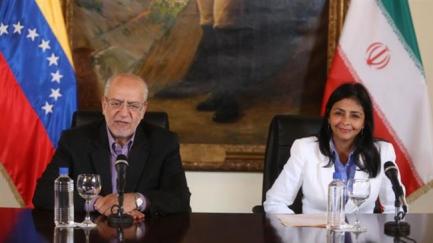
Iran’s Minister of Industry Mohammad Reza Nematzadeh and Minister for Foreign Affairs of Venezuela Delcy Rodriguez talk to reporters in Caracas
Press TV – June 27, 2015
Iran has agreed to a $500 million credit line for Venezuela to finance joint investments there, President Nicolas Maduro has announced.
He made the announcement after meeting Iranian Minister of Industry, Mine and Trade Mohammad Reza Nematzadeh in Caracas where the two sides signed six agreements to expand financial, economic, industrial and technological cooperation.
Among the agreements, there are plans for joint production of commodity goods, including detergents and other hygiene materials in Venezuela and Iran’s sales of medical drugs and surgical equipment to the country.
Maduro said the two countries had also agreed to a “comprehensive plan” to develop a joint program in nanotechnology in which Iran is among the top seven countries.
He said the deals would ensure a higher level of cooperation and deepen the bonds between the two nations.
Moreover, Iran agreed to transfer its expertise to Venezuela in combating an “economic war” on the Latin American country, Maduro said, apparently referring to Iran’s experience in facing years of US-led sanctions.
“We are facing an economic war of monumental proportions; a brutal war (but) we are here attending to our people,” Maduro said as he invoked the vision of the late President Hugo Chavez for “the government’s union with the people and struggle against imperialism”.
The Venezuelan head of state also hailed relations with Iran as “an example of alliance between two brother nations”.
“Today we have mutual trust in our relations and we work together with results. Working with Iran has gone well and our cooperation has been a great success since Hugo Chavez began a strategic alliance and brotherhood with Iran,” Maduro said.
Relations between Iran and Venezuela — both critics of US policies — have expanded in recent years. Iran is involved in a series of joint ventures worth several billion dollars in energy, agriculture, housing, and infrastructure sectors in Venezuela.
Iran’s main industrial projects in Venezuela include a car assembly plant, a tractor manufacturing complex and a cement factory.
The Islamic Republic has also built more than 3,000 residential housing units for less privileged citizens in Venezuela, with 7,000 more to be completed.
Both countries are hugely rich in resources. Venezuela possesses the world’s biggest oil deposit while Iran owns the fourth largest oil and first largest gas reserves of the world.
Maduro has announced his intention to visit Tehran to attend a summit of Gas Exporting Countries Forum planned for Nov. 23.
Latin American Revolutions Under Attack
By ANDRE VLTCHEK | CounterPunch | June 26, 2015
Do not take the Latin American revolutions for granted.
They inspired the entire Planet. They brought hope to every corner of our scarred Earth. But now they are themselves in need of our support.
If left alone, they would thrive for decades and centuries. But the Empire is once again on the offensive. It is shaking with fury. It is ready to invade, to smash, burn to ashes all the hopes, all that which had been achieved.
Don’t believe in the “common wisdom” which proclaims that the rulers of the world simply “closed their eyes” more than a decade ago; that George W. Bush was “too busy” ravishing the Middle East, therefore “allowing” most of the Latin American countries to “sneak away” from the iron grip of the Empire.
Such “analyses” are as patronizing as they are false. The Empire never sleeps! What Latin America now has was built on its daring, its sweat, its genius and its blood – it fought against the Empire, courageously, for decades, losing its best sons and daughters. It fought for freedom, for justice and socialism.
The Empire was not “looking the other way”. It was looking straight south, in fury, but for some time it was too confused, too astounded, too shocked at what it was witnessing. Its “slaves” had risen and taken power back into their own hands. They showed to the entire world what freedom really is.
For some time, the Empire was paralyzed by rage and unable to act.
The Empire’s undeniable property, Latin America, inhabited by “un-people” born only in order to supply cheap labor and raw materials to the rich part of the world, was suddenly, proudly and publicly, breaking its shackles, declaring itself free, demanding respect. Its natural resources were now used to feed its own people, to build social housing, create public transportation systems, construct hospitals, schools and public parks.
But after the first wave of panic, the Empire began to do what it does the best – it began the killings.
It attempted to overthrow Venezuelan government in 2002, but it failed. The Venezuelan people rose, and so did the Venezuelan military, defending then President Hugo Chavez. The Empire tried again and again, and it is trying until now. Trying and failing!
“We are at war”, I was told by one of the editors of Caracas-based television network, TeleSUR, for which I made several documentary films. “We are literally working under the barrel of cannon”.
***
Ms. Tamara Pearson, an Australian revolutionary journalist and activist, who recently moved from Venezuela to Ecuador, explained the difficult situation in Venezuela, a country that is under constant attack from both the US, and the local comprador elites:
“People are suffering a lot. Basic food prices are high, much medicine is unavailable, and various services aren’t working. On one level, people are used to this – the business owners would cause shortages and blame the government before each of the many elections. But usually it’s less intense and lasts just a few months. But this has been going on and getting worse, since Chavez died – over two years now. There is no doubt that the US, and more so, Venezuelan and Colombian elites and business owners are a huge or even the main factor…”
All of revolutionary Latin America is “screaming”.
As I described in two of my recent books, “Exposing Lies Of The Empire” and “Fighting Against Western Imperialism”, the Empire is using similar destabilization strategy against all countries that are resisting its deadly embrace.
Its propaganda is mighty and omnipresent. CNN and FOX TV are beamed into almost all major hotels and airports of Latin America, even in some revolutionary countries like Ecuador. Almost all major newspapers of the continent, including those in Venezuela, Ecuador, Chile and Argentina, are controlled by the right wing business elites. Almost all of the foreign news coverage comes from European and North American sources, making the Latin American public totally confused about Islam, China, Russia, South Africa, Iran, even about their own neighbors.
The local elites continue to serve foreign interests, their loyalties firmly with North America and Europe.
Every left wing Latin American government has been facing bizarre protests and subversion actions conducted by the elites. Destabilization tactics have been clearly designed in far away capitals. They were mass-produced and therefore almost identical to those the West has been using against China, Russia, South Africa, and other “rebellious” nations.
Propaganda, disinformation and spreading of confusion have been some of the mightiest tools of the fascist right wing.
“Economic uncertainty” is an extremely powerful weapon. It was used first in Chile, in the 1973 coup against socialist President Salvador Allende. Pro-Western Chilean elites and businessmen created food shortages, and then blamed it on the socialist government, using El Mercurio and other daily newspapers as their propaganda tools.
Peter Koenig, former World Bank economist and now prominent dissident and critic of the world neoliberal regime, wrote for this essay:
Today Madame Bachelet, the socialist President of Chile has a hard time fighting against the Mercurio inspired Chilean oligarchs. They will not let go. Recently they invited the World Bank to assess the school reform package proposed by Bachelet, basically to return universities to the public sector. Of course, the ‘upper class’ of Chileans knew that the World Bank would come up with nothing less than predicting an economic disaster if the reform is approved. As a result, Bachelet made concessions – which on the other hand are not accepted by professors and teachers. It’s the first step towards chaos – and chaos is what the empire attempts to implant in every country where they strive for ‘regime change’.
But one of the “dirtiest” of their weapons is the accusation of corruption. Corrupt pro-Western politicians and individuals who misused tens, even hundreds of millions of dollars of the peoples money and destroyed the economies of their countries by taking unserviceable loans that kept disappearing into their deep pockets, are now pointing their soiled fingers at relatively clean governments, in countries like Chile and Argentina. Everything in “Southern Cone” and in Brazil is now under scrutiny.
Peter Koenig (who co-authored a book “The World Order and Revolution!: Essays from the Resistance” with leading Canadian international lawyer Christopher Black and me) shows how important it is, for the Empire, destabilization of Brazil, one of the key members of BRICS:
Brazil being a member of the BRICS is particularly in the crosshairs of the empire – as the BRICS have to be destabilized, divided – they are becoming an economic threat to Washington. Brazil is key for the non-Asian part of the BRICS. A fall of Brazil would be a major blow to the cohesion of the BRICS.
There are totally different standards for pro-Western fascist politicians and for those from the Left. The Left can get away with nothing, while the Right has been getting away literally with mass murder and with the disappearance of tens of billions of dollars.
It is, of course, the common strategy in all the client states of the West. For instance, one of the most corrupt countries on earth, Indonesia, tolerates absolute sleaze and graft from former generals, but when progressive socialist Muslim leader, Abdurrahman Wahid, became the President, he was smeared and removed in a short time, on “corruption” charges.
After centuries of the Monroe Doctrine, after mass murder committed in “Latin” America first by Europeans and then by North Americans and their rich local butlers, it will take long decades to fully eradicate the corruption, because corruption comes with the moral collapse of the colonial powers and the local elites. Financial greed is only its byproduct.
The great pre-colonial cultures of what are now Peru, Ecuador and Bolivia did not have corruption. Corruption was injected by Western colonialism.
And now, corruption under left wing, revolutionary governments still exists, since it is difficult to root out all the rats at once, but it is incomparably smaller than under the previous fascist right wing cliques!
***
The rich in Latin America are heartless, servile (to the Empire) and greedy in the extreme. Latin America has still the most unequal distribution of wealth on earth. True, it is much richer (and even its poor are richer, with some exceptions of Central America, Peru or Paraguay) than Africa or even in Southeast Asia, but this cannot be used as an excuse.
Even the most progressive socialist governments now in power would ever dare to touch, to slap the private enterprises too hard. From this angle, China with its central planning and controlled economy is much more socialist than Ecuador or Bolivia.
A few days ago, as I was flying from Ecuador to Peru, I read that the number of multimillionaires in Latin America was actually increasing, and so is the social gap between the rich and the rest of the societies. The article was using some anecdotal evidence, saying that, for instance, in Chile alone, now, more Porsche sports cars are sold than in the entirety of Latin America few years ago. As if confirming it, I noticed a Porsche auto dealership next to my hotel in Asuncion, the capital of the second poorest country in South America. I asked for numbers, but the Porsche manager refused to supply them, still proudly claiming that his company was “doing very well”.
So what do they – the “elites” – really want? They have money, plenty of money. They have luxury cars, estates in their own countries, and condominiums abroad. What more?
As in Thailand, Philippines, Indonesia or Kenya, and all over the West, they want power. They want to feel unique. They want to be admired.
The Socialist governments allow them to stay rich. But they force them to share their wealth and above all, they shame them. They are also trying to minimize the gap – through education, free medical care and countless social projects.
That is, of course, unacceptable to the elites. They want it all, as they always had it. And to have it all, they are ready to murder, to side with the darkest foreign interests, even to commit treason.
***
Increasingly, the interests of the local elites are very closely linked to foreign interests – those of the Empire and those of the private sector.
As I was told in Ecuador, by Ms. Paola Pabón, Assembly Member representing Pichincha area:
Behind the involvement of the US, are some ex-bankers such as Isaiah brothers, who lost power here, escaped courts and went to live in the United States, but there are also huge economic powers such as Chevron. It means that there are not only political interests of the US, but also private, economic ones.
Predominantly, the local elites are using their countries as milking cows, with very little or zero interest in the well being of their people.
That is why their protests against Latin American revolutions are thoroughly hypocritical. They are not fighting for improvements in their countries, but for their own, selfish personal interests. Those shouts and the pathetic hunger strikes of the “opposition” in Venezuela may appear patriotic, but only thanks to propaganda abilities to the Western mass media.
The elites would do anything to make all revolutions, all over Latin America, fail and collapse. They are even spending their own money to make it happen.
They know that if they manage to remove progressive forces from power, they could rule once again, totally unopposed, as their counterparts do in all other client states of the West – in the Middle East, Africa, South and Southeast Asia, and Oceania.
The temptation is tremendous. Most of the elites in Latin America still remember well, how it feels, how it tastes – to control their countries unopposed, and with full support from the West.
***
Eduardo Galeano, the great Uruguayan writer and revolutionary thinker, once told me: “I keep repeating to all those new leaders of Latin America: “Comrades, do not play with poor people’s hopes! Hope is all they have.”
It appears that hope has finally been takes seriously, in Bolivia, Uruguay, Venezuela, Ecuador, Chile, Argentina, Brazil, Nicaragua and elsewhere.
It was also taken seriously in Honduras, but hope was crushed by the US-orchestrated coup. In Paraguay, under a semi-progressive priest who preached liberation theology, hope was taken semi-seriously, but even that was too much in the country that had been ruled, for decades, by fascist cliques. In 2012, a constitutional coup followed by an appalling massacre of predominantly indigenous people, and fascism returned.
After these two setbacks, Latin America shook, but kept moving forward. Hugo Chavez died, or was murdered by the North, depending which theory you subscribe to. His demise was a tremendous blow to the entire continent, but still, the continent kept moving. “Here, nobody surrenders!” Chavez shouted, dying, but proud.
“President Correa of Ecuador is one of very few leaders of the “original project””, said Paola Pabón. “Lula in Brazil will not be able to stand for reelection, anymore, mainly due to corruption scandals. Mujica is not in power, anymore, and Cristina Fernandez will be retiring. Evo Morales does not have regional influence, and even Maduro does not have… For this reason, Ecuador is so important, strategically. If ‘they’ hit us, if there is a successful coup, it would be tremendous victory for them, to destroy a President with regional importance; who speaks for the region… and also, because Ecuador is one country where the government actually functions well.”
Walter Bustos, who used to work for this government, is alarmed by developments in Ecuador and the entirety of Latin America. Both he and Paula Pabón realize how fragile the Latin American revolutions are. While driving with me to an indigenous area of Riobamba, Walter lamented:
In case there is a military coup in Ecuador, the difference between here and Venezuela would be enormous: while in Venezuela, Chavez incorporated the military into his revolution, in case of citizens revolution in Ecuador, we have no security; we cannot count on support of the military in case there is some armed, political or economic attack against us.
Hugo Chavez was not only a great revolutionary, but also a tremendous strategist. He knew that any great revolution has to be fought, won, and then defended. Winning the battle is never enough. One has to consolidate forces, and uphold the victory. Chavez was first thinker, and then soldier.
Correa, Morales, Fernandez go forward, brave, proud but unprotected. Under their governments, the lives of ordinary people improve tremendously. That is what matters to them. They are decent and honest beings, unwilling to dirty themselves with intrigues, speculations and conspiracy theories.
But their great success will not gain them any recognition from the Empire, or from their own elites. The success of socialism is the worst nightmare for rulers of the world and their local butlers.
This is how President Salvador Allende died in 1973. He dismissed all rumors, and then all warnings that the coup was coming. “I am not going to arrest people just because of some suspicion that they may do something”, he used to say. After the coup took place, he died proudly, a true hero, committing suicide by marching towards the helicopter gunships and fighter jets that were bombarding the Presidential Palace of La Moneda. But he was not the only victim. As a result of the coup, thousands of Chilean people died, and tens of thousands were savagely tortured and raped. Chile did not die, but went into a horrific coma, from which it only recently manages to recover.
Henry Kissinger summarized the moral corruption/collapse of his country’s regime when he uttered his memorable phrase:
I don’t see why we need to stand by and watch a country go communist due to the irresponsibility of its people. The issues are much too important for the Chilean voters to be left to decide for themselves.
Despite his great intentions, President Salvador Allende failed his people. He underestimated the bestiality of the Empire, and the result were millions of broken lives.
Since then, the Empire’s selfishness and brutality only evolved. The more successful leaders like Correa become, the more real is the danger of a coup – of a devastating, deadly attack from the North, and subversion from within.
The fragility of Latin American revolutions is obvious. The elites cannot be trusted. They showed on many occasions how far they are willing to go, committing treason, collaborating with the West against their own nations: in Chile, Peru, Colombia, Mexico, Honduras, Venezuela, Paraguay and Bolivia, to name just a few cases.
Appeasing both the elites and the Empire, while fighting for social justice and true independence, is impossible. The elites want to have full control of their countries, while the Empire demands full submission. No compromise could be reached. The history speaks clearly about that. And the Empire demonstrated on countless occasions that Latin American democracy would be respected only if the people vote the way that suits Washington.
Latin America has to learn how to defend itself, for the sake of its people.
Its closer and closer cooperation with China and Russia is essential. A coherent regional defense agreement should follow.
The next few years will be crucial. The revolutions have to be institutionalized; they cannot depend only on charisma of its leaders.
Constant sabotages and coup attempts, like those in Venezuela, should not be tolerated. They lead to chaos and to uncertainty. They break countries economically and socially.
It is clear what the Empire and its servants are doing: they are trying to push Latin American revolutionary countries against the wall, as they pushed, in the past, North Korea. They are trying to make them “react”, so they could say: “You see, this is true socialism, this defensive, hermitic and paranoid system.”
The path will not be easy. It will be dangerous and long.
Latin America can only survive through international cooperation and solidarity. It would also have to fight legally, at home and abroad. Those who are committing treason and those who are interrupting development of the country should face justice.
The left wing governments that are ruling South American countries won democratic elections: much more democratic than those in Europe and the United States. If the individuals and groups act against the expressed will of their own people, they should be taken to courts.
If a powerful country tortures other countries and shows total spite for their people, it should face an international legal system. The United States demonstrated, countless times, that it considers itself well above the law. It even forced several government in Latin America and elsewhere, to give its military personnel immunity. One of these countries is Paraguay, historically flooded with CIA, DEA and FBI agents.
In order to legally restrain the Empire, huge international pressure would have to be built. Like in the case of Managua, which legally sued the US for many acts of terror committed against Nicaragua. The Empire will most likely refuse to accept any guilty verdict. But the pressure has to be on!
All this would be meaningless without dedicated, constant coverage of the events by independent or opposition media, be they huge new state-funded networks like RT, TeleSur, CCTV or Press TV, of progressive independent media like Counterpunch, VNN, or ICH. It is essential that Latin Americans demand information from these sources, instead of consuming the toxic lies spread through CNN en Español, FOX, EFE and other right wing Western sources.
The battle for the Latin American people and for their freedom is on. Do not get fooled, it has been on for quite some time, and it is very tough fight.
Latin America is one of the fronts of the integrated fight for the survival of our Planet.
People who admire this part of the world, all those who have been inspired by Latin American revolutions, should participate in the struggle.
The best sons and daughters of this continent are now fighting in their own, quixotic way, as they always did: frontally, with exposed heart, totally unprotected. But their fight is just, and they are in this battle in order to defend the people.
Their opponents are rich, deceitful and brutal. But they are also selfish and they fight only for their own interests. They are not loved by their nations. If they lose, Latin America will win!
Those countries defending themselves against the Empire should unite, before it’s too late. Now as Latin America is rising from its knees, it becomes clear who are its foes and who are real friends, real brothers and sisters!
This scarred but stunning continent of courageous poets, of dreamers and revolutionaries should not be allowed to fall. In Caracas, Quito and La Paz, they are fighting for entire humanity.
Andre Vltchek is a philosopher, novelist, filmmaker and investigative journalist. He covered wars and conflicts in dozens of countries. His latest books are: “Exposing Lies Of The Empire” and “Fighting Against Western Imperialism”.
Former Colombian Commander Investigated for Extrajudicial Killings
teleSUR | June 23, 2015
The former commander of Colombia’s National Army, General Mario Montoya, was called in for interrogation on Tuesday over his alleged role in thousands of extrajudicial killings that were carried by the country’s security forces to be presented as guerrilla fighters killed during clashes.
His interrogation is set for July 16. The scandal, dubbed False Positives, began in 2008 and is still being investigated by the Colombian authorities. But already more than 400 army commanders, 800 unit commanders and almost 3,000 soldiers have been formally indicted.
According to the Prosecutor’s Office, Montoya would be questioned given that the killings occurred under his authority, and could be charged for failing to effectively overview the actions that led to the killings. Another three retired commanders were also called for questioning by the Prosecutor’s Office.
Montoya has still pending charges, regarding his links to the now defunct paramilitary group Colombian Self-Defense Force (AUC), a group that killed tens of thousands of civilians throughout its existence. The false positives became such a common practice during the administration of former President Alvaro Uribe that by 2007, more than 40 percent of registered combat kills were in fact murdered civilians dressed in fatigue.
In exchange for the killings, generals were awarded vacations and cash prices. Uribe vowed to destroy the FARC guerrilla using military strength, instead of trying to negotiate with the group through peace talks as other presidents had done in the past.
It is estimated that around 3,000 civilians were extra-judicially murdered by the Colombian army.
Featured Video
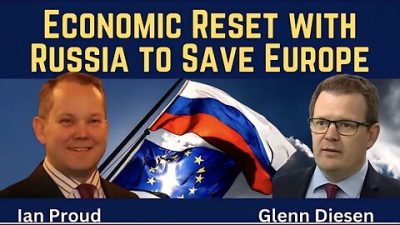
Ian Proud: Economic Reset with Russia to Save Europe
or go to
Aletho News Archives – Video-Images
From the Archives
Magic Hour for Gates
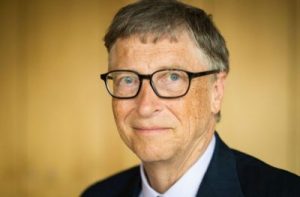
By Gary Jordan | Wake The F*** UP | March 15, 2021
Bill Gates wants to know everything about you.
He wants to control every aspect of your life.
His insatiable thirst for the supervision and scrutiny of every human being alive has sparked a US$1 billion investment that will blanket the earth in video surveillance satellites, providing real-time feedback with a mere one-second delay. He advocates for Orwellian digital tools to track your every move and has bankrolled US$1.7 billion to provide artificial intelligence that will be used to scan each and every visitor to major event venues worldwide. He wants to do away with end-to-end encryption, so he can snoop on your private conversations. He wants to know when and where you travel and who you travel with. He wants you to eat whatever he says you should eat, drink whatever he says you should drink, think how he wants you to think and know only what he wants you to know. Plus he wants to dictate what goes inside your body.
But he doesn’t want you to know a lot about him.
For instance… continue
Blog Roll
Recent Comments


 Aletho News
- Keir Starmer-tied think tank paid PR firm to target The Grayzone
- ‘Israel’ threatens to genocide Gaza if Hamas refuses disarmament
- Apple Just Bought A Sinister ‘Pre-Speech’ Tech Company Implicated In Genocide
- Israel’s new West Bank registration process declares Palestinian land ‘state property’
- Two children killed in Palestinian Authority ambush in West Bank; Hamas slams attack as ‘black mark’
- Israel Needs Time Before Another Iran War—Here’s Why
- US seizes oil tanker for ‘defying Trump’s quarantine’
- Ian Proud: Economic Reset with Russia to Save Europe
- Senator Rand Paul Introduces Federal Bill to END Vaccine Makers’ Liability Shield
- The Hidden Map: US and Israel May Use Unexpected Neighbors to Attack Iran
- If Americans Knew
- In Gaza, “rats run over our faces” – Not a ceasefire Day 129
- Israel-backed border guards, GHF-linked aid – Not a ceasefire Day 128
- Israel battles Palestinian right of return, one Palestinian at a time – Not a ceasefire Day 127
- Noor’s short life of unimaginable suffering
- Israel Destroyed Gaza’s Hospitals. Now It’s Banning Doctors Without Borders.
- Is Spite of What Zionists Say, It’s a Good Thing to Criticize Governments
- Palestinian mother, daughter recount strip searches, harsh conditions in Israeli detention
- Israel used weapons in Gaza that made thousands of Palestinians evaporate
- ADL’s Stats Twist Israel’s Critics Into Antisemites
- Why Is the World Silent When the Gaza Genocide Is Not Over?
- No Tricks Zone
- New Study: A 4°C Warmer Beaufort Sea Had ‘No Sea Ice’ 11,700 – 8200 Years Ago
- Unfudging The Data: Dutch Meteorological Institute Reinstates Early 20th Centruy Heat Waves It Had Erased Earlier
- German Gas Crisis…Chancellor Merz Allegedly Bans Gas Debate Ahead of Elections!
- Pollen Reconstructions Show The Last Glacial’s Warming Events Were Global, 10x Greater Than Modern
- Germany’s Natural Gas Storage Level Dwindles To Just 28%… Increasingly Critical
- New Study Rebuts The Assumption That Anthropogenic CO2 Molecules Have ‘Special’ Properties
- Climate Scientist Who Predicted End Of “Heavy Frost And Snow” Now Refuses Media Inquiries
- Polar Bear Numbers Rising And Health Improving In Areas With The Most Rapid Sea Ice Decline
- One Reason Only For Germany’s Heating Gas Crisis: Its Hardcore-Dumbass Energy Policy
- 130 Years Later: The CO2 Greenhouse Effect Is Still Only An Imaginary-World Thought Experiment
 Aletho News