Venezuelan Ombudswoman Accuses “NGOs” of “False” Reports
By Ryan Mallett-Outtrim | Correo del Orinoco | March 22, 2014
Venezuelan ombudswoman Gabriela Ramírez has accused international organizations of misrepresenting human rights conditions in Venezuela.
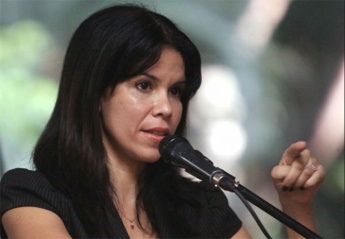 According to Ramirez, non-government organizations have been part of a campaign of “attacks” on Venezuela.
“A few NGOs have forged reports against our institution with false information,” Ramirez tweeted on Monday.
Since last month Venezuela has come under renewed criticism from international human rights monitors.
On 21 February, the United States based Human Rights Watch (HRW) accused Venezuelan security forces of using excessive force, while claiming it couldn’t find evidence of “anti-government protesters carrying firearms or using lethal force against security forces or third parties”.
Since February at least 29 people have been killed amid anti-government demonstrations and opposition violence. Among the dead are security forces and civilians who have been killed by firearms during clashes with the opposition.
The day before the HRW report was released, the brother of a socialist party (PSUV) deputy, Arturo Alexis Martinez was shot dead by a sniper. He was trying to clear an opposition barricade in Lara state when he was killed. On 24 February, motorbike taxi worker Antonio Jose Valbuena was shot by a masked individual in Maracaibo while clearing another opposition barricade. The alleged assailant reportedly demanded Valbuena desist from the attempt to clear the barricade. Since then assailants have shot at least two more civilians trying to clear opposition barricades.
Three national guard soldiers have also been shot dead during clashes with the opposition, including Giovanni Pantoja in Carabobo on 28 February, Acner Isaac Lopez Leon on 6 March in Caracas, Ramzor Bracho in Carabobo on 12 March and Jose Guillen Araque on 17 March.
According to Ramirez, misrepresentations of Venezuela by non-government organizations (NGOs) comes amid an anti-government social media campaign of misinformation.
Since February, photographs have circulated on social media websites including Twitter and Facebook of alleged cases of human rights violations by Venezuelan security forces. However, many of the photographs appear to be taken in countries as diverse as Syria, Chile and Egypt, but with inaccurate captions indicating they were taken in Venezuela.
HRW’s own report is accompanied by a photograph of what is claimed to be “a tank in San Cristobal”. The “tank”, was a statue that had been moved into the middle of the road and vandalized by opposition protesters.
Ramirez accused NGOs of being backed by the US State Department, which has also attacked Venezuela. In a report last month, the department leveled accusations against the Maduro government similar to those issued by HRW, while Secretary of State John Kerry has threatened possible “sanctions”.
Kerry’s comments have since been condemned by the Bolivarian Alliance of the Peoples of Our America (ALBA), along with the Venezuelan President Nicolas Maduro.
“The Miami lobby is taking measures to sanction Venezuela, but I tell you, you’ll be going down a road without return,” Maduro stated in response to Kerry.

A Step Toward Justice in the Long “War on Terror”: Uruguay Offers to Welcome Guantanamo Detainees
By Benjamin Dangl | Toward Freedom | March 21, 2014
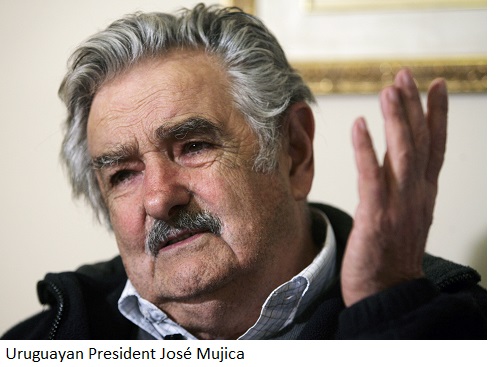 Under the Presidency of José “Pepe” Mujica, Uruguay has made a number of international headlines in recent years for progressive moves such as legalizing same sex marriage, abortion and marijuana cultivation and trade, as well as withdrawing its troops from Haiti. This week, Mujica offered to welcome detainees from the US’s detention center at its base in Guantánamo Bay, Cuba.
The Uruguayan president accepted a proposal from the Obama administration to host the detainees. “They are coming as refugees and there will be a place for them in Uruguay if they want to bring their families,” Mujica explained. “If they want to make their nests and work in Uruguay, they can remain in the country.”
“I was imprisoned for many years and I know how it is,” he said. The left-leaning president is a former revolutionary guerilla who was jailed for 14 years before and during Uruguay’s 1973-1985 dictatorship. After his release, he ended his guerilla activities and entered politics, becoming the Minister of Agriculture in 2005 under the Tabaré Vázquez administration, and was elected to the presidency in 2010.
Mujica, who has been touted as the “world’s poorest president” due to his frugal lifestyle and the fact that he donates about 90% of his presidential salary to charities and social programs, still lives on a flower farm with his wife outside the capital, and drives a beat up Volkswagen Beetle to work. Earlier this year, he was nominated for the Nobel Peace Prize for his progressive marijuana legalization program and views against excessive consumerism. His newest move against the human rights abuses of the “war on terror” has put him back in the global spotlight.
Standing Against a Symbol of the “War on Terror”
The detention center at the US base in Guantánamo Bay has long been a symbol of the human rights abuses that have come to define the so-called “war on terror.” After 9/11, the George W. Bush administration began using the facility to detain suspected terrorists. It quickly became notorious as a site of inhumane treatment, torture, and lawlessness; a decade later, many of the detainees have been held without charges or a trial.
Roughly 800 men and boys have been kept in Guantánamo as part of the US’s terror suspect roundup. Now only 154 remain, and the Obama administration, with support from Congress, is trying to make good on its promise to shut the detention center down. As part of those moves, Washington is seeking new countries to host the released detainees.
Uruguay is the first Latin American nation to accept Obama’s offer to welcome former prisoners onto its soil. Since Obama’s election, 38 Guantánamo detainees have been released to their home countries, and 43 have been resettled in 17 other countries. According to Human Rights Watch, the US wants to send detainees to countries that can provide the security the US seeks under the terms of the transfer. Uruguayan press reports that the transfer would likely involve five detainees who would have to stay within Uruguay for at least two years.
While Mujica and the US Ambassador are clear that the plans surrounding the transfer are not finalized, Mujica’s reasons for hosting the men are a sign that Uruguay is taking important steps toward justice against Washington’s long-standing “war on terror.”
For years, countless activists, governments and human rights groups have called for the closure of the US detention center in Guantánamo Bay. Last July, activist Andrés Conteris, who has worked for decades on human rights issues in Latin America,went on a hunger strike for over three months in solidarity with hunger-striking prisoners in Guantánamo Bay.
The strike denounced the inhumane and unlawful treatment of the detainees; numerous cases of physical, psychological, religious and medical torture against prisoners have been widely reported over the years. It is this treatment that President Mujica is standing against in his welcoming of the detainees.
“Given Pepe Mujica’s experience with long-term torture,” Conteris explained to me, referencing Mujica’s own imprisonment, “this gesture offering to resettle Guantánamo prisoners in Uruguay not only expresses his country’s commitment to human rights, but it shows a personal connection this president has with those suffering inhuman treatment perpetrated by military forces.”
***
Benjamin Dangl has worked as a journalist throughout Latin America, covering social movements and politics in the region for over a decade. He is the author of the books Dancing with Dynamite: Social Movements and States in Latin America, and The Price of Fire: Resource Wars and Social Movements in Bolivia. Dangl is currently a doctoral candidate in Latin American History at McGill University, and edits UpsideDownWorld.org, a website on activism and politics in Latin America, and TowardFreedom.com, a progressive perspective on world events. Email: BenDangl(at)gmail(dot)com.
Related articles


Mexico’s Oil Belongs to Its Citizens, Not the Global 1%

Thousands of people march in Mexico City in protest of the privatization of Mexico’s oil industry. Photo by flickr user eneas, March 18, 2013.
By Yoshua Okón | Creative Time Reports | March 18, 2014
Mexico City, Mexico – Oil in Mexico is much more than a symbol of national pride. For the past 75 years it has been an enormous source of income for developing Mexico’s infrastructure and improving social welfare. When, on this day in 1938, President Lázaro Cárdenas expropriated U.S.- and U.K.-owned oil companies, he allowed Mexico to achieve relative independence and modest prosperity. The nationalization of oil saved Mexico from becoming a paralyzed, essentially colonized country like Guatemala, which has a major mining industry that is almost entirely foreign-owned.
Petróleos Mexicanos (PEMEX), the state-owned company with exclusive access to Mexico’s oil, is one of the most lucrative companies in the world. In 2012 it declared profits of over 900 billion pesos (or $70 billion), earnings comparable to those of American oil and gas giants like ExxonMobil and Chevron. More importantly, PEMEX has historically distributed its profits among the Mexican population more equitably than any other industry in the country. Sixty percent of Mexico’s spending on social welfare comes from oil income. Among the things this income currently pays for are education, health care and programs to fight extreme poverty. Every Mexican citizen owns PEMEX, and the profits the company generates have made palpable differences in all of our lives.
Lucrative as it is, PEMEX could make and distribute much greater revenues if it were not so corrupt, inefficient and archaic. We have long known of grave problems with the oil industry and union, such as losses in refining and production. (Output has fallen 25 percent since 2004.) If PEMEX isn’t brought up to date in the next few years, there is a serious danger that the company will collapse. But instead of reforming the institution, the current government has exploited PEMEX’s deficiencies under the guise of reform to fiercely promote a very different agenda: the privatization of oil in Mexico.
Far from modernizing PEMEX, eliminating corruption or directing more income to Mexico’s citizens, the so-called energy reform passed by Congress and signed into law by President Enrique Peña Nieto in December will radically shift the distribution of oil profits from the public to a few private investors. The bill modified Mexico’s constitution to allow private oil companies to compete with PEMEX in every aspect of oil production. Underground oil reserves will still belong to Mexico, but since all profits derived from production will go to corporations, these reforms effectively constitute a privatization. Yet the president never admitted to this underlying agenda in the lead-up to the bill’s passage; his administration has altogether avoided using the word “privatization,” in favor of vague references to “modernization” and “the need for private investment.” This lack of honesty has generated tremendous confusion among the Mexican population, greatly debilitating potential opposition to the bill.
As Peña Nieto and his Institutional Revolutionary Party (PRI) prepare a new set of bills that will implement the changes to oil laws, a multimillion-dollar publicity campaign of disinformation initiated last year by his administration still saturates the mass media, diverting the debate on “energy reform” by reducing it to obvious questions: Is reform necessary? Is PEMEX efficient? Do we need progress and modernization? As a result, we have skipped over the most pressing and fundamental questions: What should the nature of this reform be? How will profits be distributed? What measures are in place to fight the corruption that causes us to lose so much of our oil income? In order to modernize, do we have to abandon the idea that Mexican oil belongs to the people of Mexico?
The recent history of PEMEX is a story of deliberate sabotage. PEMEX managers have enabled politicians to keep a portion of the company’s profits for decades, laying the groundwork for privatization by making corruption seem like the natural result of a nationalized industry. But the underlying problem has always been and still is political corruption, not a lack of private investment. Consider Romero Deschamps, the leader of PEMEX’s union since 1989, who is accused of stealing an estimated 3 billion pesos’ worth of the union’s assets and of having illegally created secret “private” companies that undertake contract work for PEMEX. In spite of the abundant proof of his guilt, Deschamps is currently a senator for the ruling PRI. Peña Nieto claims that stamping out such criminality is one of the primary objectives of the current “reform,” but his policy for overhauling the industry doesn’t contain a single strategy aimed at fighting corruption.
The majority of the proposed structural changes to PEMEX aren’t even necessary for the task of modernizing Mexico’s oil industry. PEMEX already has access to cutting-edge technologies since private oil companies can operate in Mexico and have been doing so (for example, PEMEX is currently contracting the services of Halliburton and OHL). Whether or not PEMEX should contract private companies is irrelevant; what matters are the terms on which it partners with the private sector. The fact that the Peña Nieto administration is permitting profit-sharing contracts—which have historically been imposed on poor countries, with disastrous results—rather than limiting partnerships to licensing permits that would pave the way for increased efficiency without signing away the democratic ownership of resources, is another clear indicator of the underlying agendas behind the “energy reform.” As former PEMEX director general Adrián Lajous has argued, profit-sharing contracts render private companies unaccountable, leaving the state, its resources and its people vulnerable.
Peña Nieto presents his “reform” as the magic solution to PEMEX’s problems, as if the neoliberal dream of privatization without regulation were synonymous with social justice, economic well-being and democracy. But the facts paint a very different picture. Since neoliberal policies surged in the 1980s and former president Carlos Salinas de Gortari signed NAFTA into law in 1994, a weakened state, incapable of protecting the environment and the rights of its poorest people, has created the perfect conditions for political and corporate corruption. We live every day with the consequences of Carlos Slim’s acquisition of Telmex, the telecommunications company that Salinas privatized in 1990. Because there is little regulation, prices are high and service is poor, and Slim is now one of the richest men in the world. Another dark legacy of Salinas is his privatization of the banking sector and creation of Fobaproa, an agency intended to prevent banks from going bankrupt. After Mexico’s 1994 economic crisis, the institution of Fobaproa meant that the public paid off banks’ massive debts. High-ranking politicians and businessmen have pocketed extraordinary profits, while everyday people have borne greater economic burdens, with each move to privatize. The result is a spectacular growth in inequality. More than 53 million people in Mexico today—nearly half the country—live in poverty, and 11.5 million Mexicans live in extreme poverty. Meanwhile, the eleven richest men in the country have accumulated roughly 11 percent of the GDP.
We cannot undertake true energy reform in Mexico without first undertaking political reforms that would decisively and effectively tackle corruption. Sadly, because it does nothing to change political structures and curb corruption, the current legislative process is taking us further away from democratic values and constitutes a huge step in the wrong direction. Approved by politicians who never consulted voters, the bill passed in December opens the field for companies that are known the world over for their abusive practices and for co-opting politicians (ExxonMobil, Shell, BP, OHL) to operate in Mexico without regulation or restriction. In the words of the historian Lorenzo Meyer Cossío, we are opening the door to “mercenaries.” The Mexican government expects its citizens to place ownership of our hydrocarbons in private hands, without our agreement and in exchange for minimal revenue. But modernization does not require that we give up our resources. Improvement shouldn’t entail changing the basic principle that natural resources belong to us all.
The “energy reform” currently under way is a huge step toward greater inequality, environmental devastation and the loss of economic and political independence for Mexico. It is one example of the neoliberal fantasy of unregulated capitalism that has landed us in our present situation, in which the 85 richest people in the world hold the same amount of wealth as the 3.5 billion poorest. We are living through the greatest inequality in the history of humanity and unprecedented ecological destruction. To combat this urgent situation, we need to strengthen fragile regulatory structures by creating independent, democratically owned institutions. By instead dismantling the few supportive social structures left, Peña Nieto’s government is pushing Mexico to a dangerous place. Against a backdrop of extreme poverty and social injustice, the PRI’s “reforms” will, sooner or later, lead to revolt.
Translated by Georgia Phillips-Amos.
This piece was made possible, in part, by the Andy Warhol Foundation for the Visual Arts.
Violence and Terror: The Ukrainian and Colombian Road to Empire Building
By James Petras | The People’s Voice | March 19, 2014
Introduction
The two paths to 21st century empire-building-via-proxies are illustrated through the violent seizure of power in the Ukraine by a US-backed junta and the electoral gains of the US-backed Colombian war lord, Alvaro Uribe. We will describe the ‘mechanics’ of US intervention in the domestic politics of these two countries and their profound external effects – that is how they enhance imperial power on a continent-wide basis.
Political Intervention and Proxy Regimes: Ukraine
The conversion of the Ukraine into a US-EU vassal state has been a prolonged process which involved large scale, long term financing, indoctrination and recruitment of cadres, organization and training of politicos and street fighters and, above all, a capacity to combine direct action with electoral politics.
Seizing power is a high stakes game for empire: (1) Ukraine, in the hands of clients, provides a NATO with a military springboard into the heart of the Russian Federation; (2) Ukraine’s industrial and agricultural resources provide a source of enormous wealth for Western investors and (3) Ukraine is a strategic region for penetrating the Caucuses and beyond.
Washington invested over $5 billion dollars in client-building, mostly in ‘Western Ukraine’, especially in and around Kiev, focusing on ‘civil society groups’ and malleable political parties and leaders. By 2004, the initial US political ‘investment’ in regime change culminated in the so-called ‘Orange Revolution’ which installed a short-lived pro-US-EU regime. This, however, quickly degenerated amidst major corruption scandals, mismanagement and oligarchical pillage of the national treasury and public resources leading to the conviction of the former-Vice President and the demise of the regime. New elections produced a new regime, which attempted to secure ties with both the EU and Russia via economic agreements, while retaining many of the odious features (gross endemic corruption) of the previous regime. The US and EU, having lost thru democratic elections, relaunched their ‘direct action organizations’ with a new radical agenda. Neo-fascists seized power and established a dictatorial junta through violent demonstrations, vandalism, armed assaults and mob action. The composition of the new post-coup junta reflected two sides of the US-backed political organizations: (1) neo-liberal politicos for managing economic policy and forging closer ties with NATO, (2) and neo-fascists/violent nationalists to impose order by force and fist, and crush pro-Russian Crimean ‘autonomists’ and ethnic Russians and other minorities, especially in the industrialized south and east.
Whatever else may ensue, the coup and the resultant junta is fully subordinated to and dependent on the will of Washington: claims of Ukrainian ‘independence’ notwithstanding. The junta proceeded to purge the elected and appointed government officials affiliated with the political parties of the previous democratic regime and to persecute its supporters. Their purpose is to ensure that subsequent managed elections will provide a pretense of legitimacy, and elections will be limited to two sets of imperial clients: the neo-liberals, (self-styled “moderates”) and the neo-fascists dubbed as “nationalists”.
Ukraine’s road to imperialist power via a collaborator regime illustrates the various instruments of empire building: (1) the use of imperial state funds, channeled through NGOs, to political front groups and the build-up of a ‘mass base’ in civil society; (2) the financing of mass direct action leading to a coup (‘regime change’); (3) the imposition of neo-liberal policies by the client regime; (4) imperial financing of the re-organization and regroupment of mass direct action groups after the demise of the first client regime; (5) the transition from protest to violent direct action as the major backdrop to the extremist sectors (neo-fascists) organizing the seizure of power and purge of the opposition; (6) organizing an ‘international media campaign’ to prop up the new junta while demonizing domestic and international opposition (Russia) and (7) political power centralized in the hands of the junta, convoking “managed elections” limited to the victory of one or the other pro-imperial pro-junta candidates.
In summary, empire-builders operate on several/levels: violent and electoral; social and political; and with selected incumbents and rivals committed to one strategic aim: the seizure of state power and the conversion of the ruling elite into willing vassals of empire.
Columbia’s Deathsquad Democracy: Centerpiece of the Imperial Advance in Latin America
In the face of a continent-wide decline of US influence in Latin America, Colombia stands out as a constant bulwark of US imperial interests: (1) Colombia signed a free trade agreement with the US; (2) provided seven military bases and invited thousands of US counter-insurgency operatives; and (3) collaborated in building large-scale paramilitary death squads prepared for cross border raids against Washington’s arch enemy Venezuela.
Colombia’s ruling oligarchy and military have been able to resist the wave of massive democratic, national and popular social upheavals and electoral victories that gave rise to the post-neo-liberal states in Brazil, Argentina, Venezuela, Ecuador, Bolivia, Paraguay and Uruguay.
While Latin America has moved toward ‘regional organizations’ excluding the US, Colombia strengthened its ties to the US through bilateral agreements. While Latin America reduced its dependence on US markets, Colombia expanded its commercial ties. While Latin America reduced their military ties to the Pentagon, Colombia tightened them. While Latin America moved toward greater social inclusion by increasing taxes on foreign multinational corporations, Colombia lowered corporate taxes. While Latin America expanded land settlements for its landless rural populations, Colombia displaced over 4 million peasants as part of the US-designed ‘scorched earth’ counter-insurgency policy.
Colombia’s “exceptional” unwavering submission to US imperial interests is rooted in several large-scale, long-term programs developed in Washington. In 2000, President ‘Bill’ Clinton committed the US to a $6 billion dollar counter-insurgency program (Plan Colombia) which greatly increased the brutal repressive capacity of the Colombian elite to confront the popular grass roots movements of peasants and workers. Along with arms and training, US Special Forces and ideologues entered Colombia to develop military and paramilitary terror operations – aimed primarily at penetrating and decimating political opposition and civil society social movements and assassinating activists and leaders. The US-backed Alvaro Uribe, notorious narco-trafficker and the very personification of a ruthless imperial vassal, became president over a ‘Death-Squad Democracy’.
President Uribe further militarized Colombian society, savaged civil society movements and crushed any possibility of a popular democratic revival, such as were occurring throughout the rest of Latin America. Thousands of activists, trade unionists, human rights workers and peasants were murdered, tortured and jailed.
The ‘Colombian System’ combined the systematic use of para-militarism (death squads) to smash local and regional trade union and peasant opposition and the technification and massification of the military (over 300,000 soldiers) in fighting the popular insurgency and ‘emptying the countryside’ of rebel sympathizers. Large-scale multi-billion dollar drug trafficking and money laundering formed the ‘financial glue’ to cement a tight relationship among oligarchs, politicos, bankers and US counter-insurgency advisers – creating a terrifying high-tech police state bordering Venezuela, Ecuador and Brazil – countries with substantial popular mass movements.
The same state terror machinery, which decimated the pro-democracy social movements, has protected, promoted and participated in ‘stage-managed elections’, the hallmark of Colombia as a “death squad democracy”.
Elections are held under a vast overlapping network of military bases, where death squads and drug traffickers occupied towns and villages intimidating, terrorizing and ‘corrupting’ the electorate. The only ‘safe’ protest in this repressive atmosphere has been voter abstention. Electoral outcomes are pre-ordained: oligarchs never lose in death squad democracies, they are the empire’s most trusted vassals.
The cumulative effects of the decade and a half-long bloody purge of Colombian civil society by Presidents Uribe and his successor, Santos, have been to eliminate any consequential electoral opposition. Washington has achieved its ideal: a stable vassal state; a large-scale and obedient military; an oligarchy tied to US corporate elites; and a tightly-controlled ‘electoral’ system that never permits the election of a genuine opponent.
The March 2014 Colombian elections brilliantly illustrate the success of US strategic intervention in collaboration with the oligarchy: The vast majority of the electorate, over two-thirds, abstained, demonstrating the absence of any real legitimacy among the eligible voters. Among those who ‘voted’, ten percent submitted ‘spoiled’ or blank ballots. Voter abstention and ballot-spoilage was especially high in the rural regions and working class areas which had been subject to state terror.
Given the intense state repression, the mass of voters decided that no authentic pro-democracy party would have any chance and so refused to legitimize the process. The 30% who actually voted were largely urban middle and upper class Colombians and residents in some rural areas completely controlled by narco-terrorists and the military where ‘voting’ may have been ‘compulsory’. Of a total of 32 million eligible voters in Colombia, 18 million abstained and another 2.3 million submitted spoiled ballots. The two dominant oligarchical coalitions led by President Santos and ex-President Uribe received only 2.2 million and 2.05 million votes respectively, a fraction of the number who abstained (14 million). In this widely scorned electoral farce, the center-left and left parties made a miserable showing. Colombia’s electoral system puts a propaganda veneer on a dangerous, highly-militarized vassal state primed to play a strategic role in US plans to “reconquer” Latin America.
Two decades of systematic terror, financed by a six-billion dollar militarization program, has guaranteed that Washington will not encounter any substantial opposition in the legislature or presidential palace in Bogota. This is the ‘acrid, gunpowder-tinged smell of success’ for US policymakers: violence is the midwife of the vassal state. Colombia has been turned into the springboard for developing a US-centered trade bloc and a military alliance to undermine Venezuela’s Bolivarian regional alliances, such as ALBA and Petro Caribe as well as Venezuela’s national security. Bogota will try to influence neighboring right and center-left regimes pushing them to embrace of the US Empire against Venezuela.
Conclusion
Large-scale, long-term subversion and organization in Ukraine and Colombia, as well as the funding of paramilitary and civil society organizations (NGO) has enabled Washington to: (1) construct strategic allies, (2) build ties to oligarchs, malleable politicians and paramilitary thugs and (3) apply political terrorism for their seizure of state power. The imperial planners have thus created “model states” – devoid of consequential opponents and ‘open’ to sham elections among rival vassal politicians.
Coups and juntas, orchestrated by longstanding political proxies, and highly militarized states run by ‘Death Squad Executives’ are all legitimized by electoral systems designed to expand and strengthen imperial power.
By rendering democratic processes and peaceful popular reforms impossible and by overthrowing independent, democratically elected governments, Washington is making wars and violent upheavals inevitable.
-###-
James Petras is a Bartle Professor (Emeritus) of Sociology at Binghamton University, New York. He is the author of 64 books published in 29 languages, and over 560 articles in professional journals, including the American Sociological Review, British Journal of Sociology, Social Research, Journal of Contemporary Asia, and Journal of Peasant Studies.
America’s Unceasing Contempt for Venezuela
By Jason Hirthler | CounterPunch | March 11, 2014
Some things never change. The petulant and undemocratic Venezuelan opposition is at it again, with the full backing and check-writing support of the U.S. government. Recent protests have inflamed the streets of Caracas, as opposition groups, as they have in the Ukraine, called for the ouster of the sitting president. I suppose it’s needless to note that Nicolás Maduro is Venezuela’s democratically elected president, and that he won by a higher victory margin in a cleaner election than did Barack Obama in 2012. Nor is it worth asking, one supposes, that if the entire country is engulfed by dissent, as The New York Times insidiously suggested by claiming the “The protests are expressing the widespread discontent with the government of President Nicolás Maduro, a socialist…”, then why did Maduro’s party, Partido Socialista Unido de Venezuela (PSUV), claim wide majorities in municipal elections in December? Or why are these “widespread” protests largely confined to middle-class or student areas of Caracas and not rife within much larger poor neighborhoods? Or if a government has the right to arrest opposition leaders (in this case Leopoldo Lopez, the latest rabid ideologue) for inciting violence?
Public Virtue, Private Vice
Secretary of State John Kerry has ratcheted up the drivel stateside, claiming to be “alarmed” by reports that Maduro has “detained scores of anti-government protesters” and that the crackdown would have a “chilling effect” on free expression. A bit rich coming from a man whose own government has been icing free speech since the Snowden revelations. Kerry failed to mention whether the millions of American taxpayer dollars being funneled to the opposition were behind the violence. The Los Angeles Times described Maduro’s administration as an “autocratic government.” Opposition leader Henrique Caprilles, demolished by Maduro in last year’s landslide election, rejected Maduro’s invitation to talks and claimed one of the Latin America’s most popular political parties was a “dying government.”
For its part, Mercosur, the alliance of South America’s southern cone countries, denounced the violence as an attempt to “destabilize” a democratic government. Of course, the behavior of Maduro’s government in response to these street provocations ought to closely watched, as this is the new president’s first real test coping on an international stage with the intrigues of a small but virulent neoliberal opposition.
There’s plenty to suggest that this is, like Ukraine, another external attempt to uproot a democratically elected government through a volatile cocktail of in-country agitation and violence paired with global media defamation of the existing administration. It wouldn’t come as a surprise. Like a frustrated and petulant infant, the United States has repeatedly attempted to derail the Bolivarian Revolution launched by former President Hugo Chavez in the late nineties, as CEPR’s Mark Weisbrot has noted. It backed an anti-democratic coup by business elites in 2002 that actually succeeded for a couple of days and happily dissolved parliament before Chavez regained power. It supported an oil strike in an attempt to destabilize the economy and perhaps bring down the government. It encouraged opposition members of parliament to push for recalls (failed) and boycott National Assembly elections (useless) and clamor incessantly that last year’s national presidential election was rigged (false). Of course, despite being widely held to be a superior electoral process than that of the United States, Kerry was only shamed into recognizing the legitimacy of the election long after the rest of the world had.
The U.S. has poured millions into opposition activities on an annual basis since the failed coup in 2002. (NGOs are convenient destinations for this money since foreign contributions to political parties are illegal in both countries.) Just look at 2013 alone. Washington would hardly stand for interference of this kind from, say, China. Or, better, from Venezuela itself. Imagine if it was discovered that Chavez had been seeding major American metropolises with anti-capitalist pamphleteers. Obama wouldn’t be able to hit the “signature strike” button fast enough. Nevertheless, Kerry, in his role as Secretary of State, has turned out to be a masterful mimic capable of registering a fusty outrage on short notice, especially over claimed violations of civil liberties. Curious, since the ceaseless trampling of civil liberties by his own Democratic party have elicited nothing from this flag-bearer for democratic values.
Dollars & Bolivars
This is not to say that Venezuela does not have protest-worthy problems. Inflation has been chronic since the pre-Chavez days. Now food shortages are trying the patience of the population. And in one sense, these shortages are self-inflicted. According to Gregory Wilpert of VenezuelAnalysis, the government’s currency controls have been undermined by an all-too-predictable black market. While the government has placed strict criteria on the ability of citizens to purchase dollars with bolivars, the black market allows citizens to buy dollars without any criteria whatsoever. The government’s exchange rate is likewise controlled, and has over time begun to distort the real value of the bolivar. The black market exchange rate, by contrast, reflects the external value of the currency. The gap between these exchange rates has grown rapidly, such that there now exist huge incentives for citizens to play currency arbitrage. If they satisfy the federal criteria—such as needing dollars to travel or import goods—Venezuelans can buy dollars cheaply using the government exchange rate. They can then pay those dollars to import goods, then export those goods in exchange for the dollars they just spent on the imports. From there it is a simple step to the black market, where they can sell those dollars for many times what they paid at the government’s official rate, making a tidy profit for themselves. If they happen to be rabid anti-socialists, they can enjoy the companion thrill of generating food shortages that can be blamed on the government. Ah, the timeless magic of import/export.
These are legitimate grievances, however, as are crime figures, which top the regional table. Yet the question is, do they merit the overthrow of a legitimate government backed by a wide majority of the population at the behest of a small but fierce oppositional faction openly funded by an imperial power committed to its overthrow? To do so would risk the absurdity of gratifying the strident demands of a few at the expense of the many. … The fact is, despite the inflation and shortages, the population continues to support the Bolivarian Revolution because of its accomplishments—massive reductions in poverty, extreme poverty, and illiteracy. Significant growth in per capita GDP and other important metrics.
A Doctrine in Decline
We’re seeing in clear images the viciousness with which neoliberal factions resent the loss of power and seek to restore it by any means necessary. Democracy is the least of their concerns. But this has been the Latin American back-story for a couple of centuries. Much of the U.S. activity in Latin America feels like a frantic and desperate last-ditch effort to preserve the Monroe Doctrine, by which we essentially declared Latin America to be our own backyard, off-limits to European empires. What was ostensibly a call to respect independent development in the Southern hemisphere rather predictably evolved into an excuse for self-interested intervention. But now, for the first time in centuries, Latin America has struck out on its own, slipping from beneath the clutch of the eagle’s claw to form organizations like Mercosur and CELEAC, PetroCaribe and Petrosur, the Bank of the South as well as the Bolivarian Alliance for the Americas (ALBA). Aside from Columbia, an implacable outpost of American influence, the region has shunned greater U.S. involvement, and begun to view its proffered trade agreements with far more suspicion, particularly in the long wake of NAFTA, the poster child for lopsided and economically destructive trade treaties.
Whether the U.S. will eventually succeed in a cynical ploy to unseat Maduro remains to be seen. If recent events in the Ukraine are any indication, that may have been a test run for Venezuela, as Peter Lee suggests. It hasn’t helped that, as in practically every country that comes to mind, an elite class of neoliberal ideologues own the mainstream media. The tools of propaganda have rarely been more fiercely deployed than since Chavez launched his socialist revolution. And yet, since then, practically the entire continent has experimented with left-leaning leadership: Rafael Correa in Ecuador, Evo Morales in Bolivia, Nicanor Duarte in Paraguay, Tabare Vazquez in Uruguay, to some degree Luiz Inácio Lula da Silva in Brazil, and Maduro in Venezuela. Nor should exiled Honduran president Manuel Zalaya be forgotten. These figures have collectively stepped back from the brink of dubious integration with North America and sought stronger regional ties and continental autonomy.
The U.S. has replied with a predictable confection of threats, lies, and sacks of cash for ferociously anti-democratic elements. Perhaps it most fears the bad karma it generated for itself with Operation Condor, which on September 11, 1973 overthrew and murdered Chile’s socialist leader Salvador Allende and replaced him with a gutless sadist, Augusto Pinochet. Pinochet—a repressive militarist—happily instituted the untested prescriptions of the Chicago School of Economics’ sermonizing armchair guru Milton Freidman, with predictable results. Now, Maduro, carrying the mantle of Chavez and his Bolivarian manifesto, is arguably the spiritual vanguard of the socialist left in South America. Venezuela’s efforts to continue to forge its own independence in the coming decade will surely influence the mood and courage of other leftists in the region. The stakes are obviously high. Hence the relentless American effort to destabilize and publicly discredit the PSUV. The fate of the global left is in a very real sense being tested in the crucible of Caracas.
Jason Hirthler can be reached at jasonhirthler@gmail.com.
Does the OAS Support Democracy in Venezuela?
By Dan Beeton | CEPR | March 7, 2014
Venezuelan president Nicolás Maduro made news this week by breaking off relations with Panama following Panama’s proposal for the Organization of American States (OAS) to take up the situation in Venezuela. Panama’s move followed weeks of calls from members of the U.S. Congress, pundits and others to use the OAS against the Maduro government for supposed government repression of “peaceful” protesters.
In remarks yesterday, OAS Secretary General José Miguel Insulza criticized what he described as hypocrisy from both those who support and oppose such a move. Insulza stated:
here we see a swapping of roles: Those who just a few years ago brandished the Inter-American Democratic Charter to demand severe sanctions against the de facto government in Honduras are now saying that even mentioning a crisis that has already led to the deaths of a large number of people constitutes interference; while those who denounced (and still denounce) the steps we took when faced with an obvious coup d’état as an attack on a nation’s sovereignty –I’m referring again to Honduras-, now demand that we help them overthrow a government recently chosen in a democratic election.
It appears that Insulza is playing a role that he has played on numerous prior occasions – most recently in April when he refused to recognize the Venezuelan presidential elections, until South American pressure forced him (as well as the U.S. and the right-wing government of Spain) to accept democratic election results. This is unfortunate, but the manipulation of the OAS by Washington and a diminishing number of right-wing allies is the main reason that Latin American countries created the Community of Latin American and Caribbean States (CELAC) in 2011, to have a region-wide organization without the U.S. and Canada.
While it is important for officials such as Insulza to reaffirm the importance of Venezuela’s democratic processes and remind the OAS membership that Venezuela’s government was recently elected (and had its strong public support reaffirmed less than three months ago in local elections), other remarks equate extreme sectors of the Venezuelan opposition and the Venezuelan government, even though the government has won elections and the opposition has not:
Today, it is undeniable that there is a profound political crisis, characterized above all by a split and confrontation between most political and social actors into irreconcilable bands. When the opposition mobilizes, it does so on a massive scale, and poses strong demands; when the Government’s supporters take to the streets, their numbers and the fervor of their demands are also huge.
But for the last few weeks, it isn’t “massive” opposition protests that are occurring, but rather small protests designed to wreak havoc in a few neighborhoods throughout the country. In essence, Insulza and the U.S. administration are suggesting that when extremist groups demand the immediate departure of an elected president, and try to achieve their aim by barricading streets and engaging in violent acts, the government has an obligation to dialogue with them.
This is reminiscent of Insulza’s approach to the coup in Honduras in 2009, when he effectively raised up a repressive regime that destroyed democracy with a military coup to the same legitimacy as the elected government. Insulza’s characterization of the OAS role in responding to the Honduran coup is also misleading. In fact, the OAS did little to try to restore democracy to Honduras, and Insulza apparently did not speak out when the U.S. ultimately blocked a measure that would have required the ousted president Manuel Zelaya to be returned to office before new elections were to be held, even though this was a solution supported by most OAS members.
Insulza’s comments on Chile are also troubling:
Both sides are an indispensable part of a country that needs all its people as it forges its future. Seeking to “win” this battle is a sure path to a decades-long national split between the vanquished and the conquerors. History is replete with examples of when division and confrontation destroyed democracy and ushered in long bouts of dictatorship. That is what happened in my country and thousands died.
Those familiar with the history of Chile know that political polarization was not the main problem, but rather that the right wing was by led by fascists who did not respect democratic government and were willing to institute a violent dictatorship that killed, disappeared, tortured and imprisoned tens of thousands of people. (It is also relevant that the U.S. government fueled much of the unrest as well as economic sabotage after then-U.S. president Richard Nixon vowed to “make the economy scream.”) It is of course good to avoid unnecessary political polarization and pursue dialogue as a general principle. But Chile’s infamous military coup and dictatorship were not a result of a conflict between two opposing forces representing equally just claims; it was rich against poor, people who did not respect democratic elections versus those who did, people allied with an aggressive foreign power versus those who believed in national sovereignty.
Insulza also refers to OAS support for “democracy and political stability in Haiti”: “during the Haitian crisis, over a decade ago, we gladly accepted U.N. leadership in that country and still maintain our association with it, in support of democracy and political stability in Haiti.”
This also raises very serious questions about Insulza’s idea of democracy. The U.N. mission was deployed to Haiti following the 2004 U.S.-backed coup d’etat against the democratically-elected government of Jean-Bertrand Aristide, who also had faced a violent opposition (for years) with whom the international community repeatedly urged him to “negotiate;” while at the same time we now know that U.S. funders of the opposition were telling them not to reach any agreement, that Aristide would be overthrown. The U.N. has occupied Haiti almost ever since, while the most popular political party, Fanmi Lavalas has been arbitrarily excluded from elections and many of its leaders and members hunted down and killed, and others imprisoned on bogus charges.
As we have described in detail, the OAS has played a key role in overturning elections in Haiti twice: in 2000, when the OAS’ rejection – without justification – of the election of seven senators provided the pretext for a political “crisis” and U.S.-led efforts to undermine the Aristide government; and the OAS’ overturning of the first round of the 2010 presidential elections. (Former OAS insider Ricardo Seitenfus has recently provided more details on this sorry episode.)
Considering this background, and the disproportionate influence wielded by the U.S. at the OAS, it should be of little surprise that Venezuela would seek to have UNASUR take up the Venezuelan political situation, rather than the OAS, which it appears UNASUR might, next week.
In a statement before the OAS, U.S. Ambassador Carmen Lomellin described
what appears to be a pattern of security personnel using excessive force.
We are also concerned with increasingly stringent tactics being employed by the government in an effort to restrict the rights of Venezuelan citizens to peaceful protest.
However, violence in recent days has almost exclusively impacted those opposed to the protests or the barricades, which make getting around certain neighborhoods difficult.
If there is a “pattern” of “excessive force” and “increasingly stringent tactics” by the government, it is unclear what these are, considering that the road blockades continue, even after nine people have been killed either trying to get through, or remove, the barricades, and considering that National Guard officers are getting killed. It is hard to imagine such a situation taking place in the United States, with small groups of protesters blockading streets, not for hours, and not even for days, but for weeks, and those attempting to remove the barricades being attacked and sometimes even shot and killed. The Occupy protests just a few years ago were usually violently repressed, and these were mostly in parks and other green spaces – not blocking off streets in major cities. These were actually peaceful demonstrations. Nor was the police repression of the Occupy protests met with calls for intervention by the OAS, even after Iraq war veteran Scott Olsen was almost killed after being shot in the head with a canister by police in Oakland, CA.
The U.S. statement follows a pattern of official statements since Venezuela’s latest wave of protests began that heaps all blame for violence on the government while characterizing the protests only as peaceful (the nine people who have been killed while trying to pass through or remove barricades, or the pro-government demonstrators killed, are testament to a different reality).
While both Lomellin and Insulza (among many others) have stressed the importance of dialogue between the government and the opposition, little attention is paid to the Venezuelan government’s efforts to engage in such dialogue. Maduro invited opposition leaders to a meeting on February 24; opposition leader Henrique Capriles rejected the offer. Jorge Roig, the head of FEDECAMARAS (the main business federation) and Lorenzo Mendoza, head of major food and beverage company Empresas Polar did attend, however, with Roig saying “We have profound differences with your economic system and your political systems but democracy, thank God, lets us evaluate these differences.”
Insulza’s comments that “it is also essential that the principal party leaders and opposition leaders with the most backing are also parties to the dialogue” could be seen as criticism of Capriles’ refusal so far to speak with Maduro. As CEPR Co-Director Mark Weisbrot recently noted in Venezuela’s Últimas Noticias, by taking a radical posture and refusing to meet with Maduro despite having shook hands with Maduro just weeks before, Capriles has clearly sided with the more extreme elements of Venezuela’s opposition.
Related articles
Protests Continue as Venezuela Goes on Vacation
Venezuelanalysis | March 3, 2014
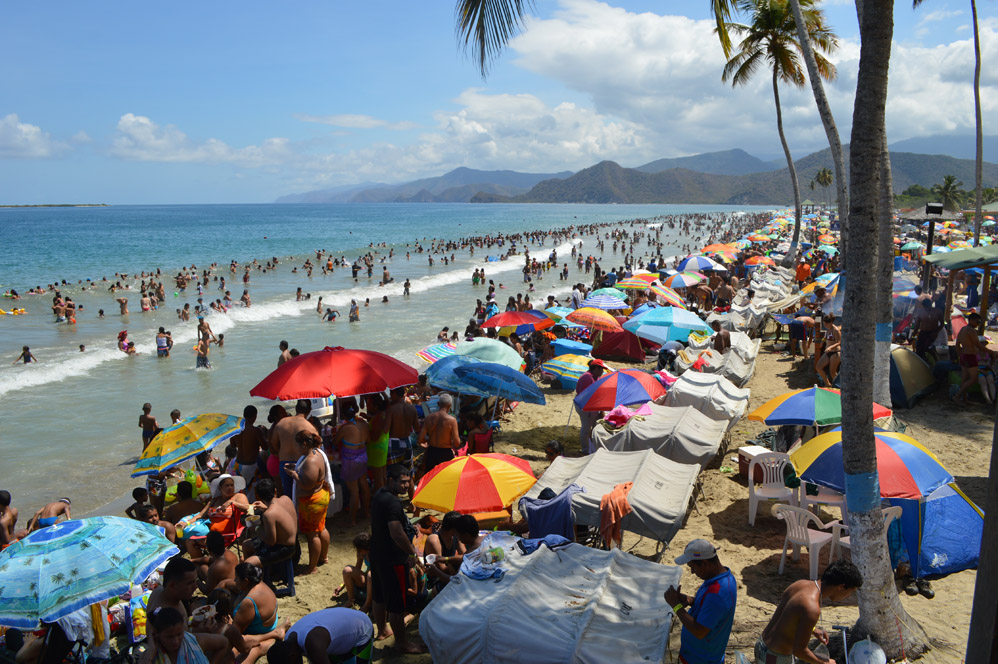
Mérida – Opposition protests continue in Venezuela, while masses of holiday-goers have headed to the beach to escape the unrest.
Over the weekend opposition supporters continued the protests that have mainly taken place in middle and upper class areas of Venezuela’s cities.
However the government has argued that the large numbers of people travelling to the beach and other destinations over the long “carnival” weekend shows that the protesters are a “minority” and that life in most of the country continues as normal.
Protests began last month after hard-line opposition leader Leopoldo Lopez, who is currently under investigation for incitement to violence, called for supporters to take to the streets and force the “exit” of President Nicolas Maduro. Led by pro-opposition students, demonstrators have also mentioned insecurity, high inflation and shortages as reasons for discontent.
While some protests have been peaceful, others have descended into violence and rioting. Further, small groups of radical opposition activists have set up burning street barricades in parts of some of Venezuela’s cities, blocking traffic and creating a range of problems for the normal functioning of civic life.
Protests vs. holidays
The opposition fought to keep the momentum of protests going as the country entered a long weekend on Thursday, which will last until this coming Wednesday. On Sunday, thousands of opposition supporters marched through Caracas to underscore their discontent.
The mayors of several opposition controlled municipalities cancelled local carnival celebrations, rejecting the government’s call for normality.
“There’s no reason to celebrate here,” said Ramón Muchacho, mayor of the wealthy Chacao municipality of eastern Caracas.
Also on Sunday 41 people, including an Italian photographer, were released from detention. They were arrested on Friday during a confrontation between National Guard officers and molotov-cocktail wielding opposition hard-liners in the up-market Altamira area of Caracas.
There were fresh confrontations in Altamira today, with National Guard officers using tear gas to disperse opposition radicals armed with molotov cocktails, the local mayor reported.
Meanwhile the government has said that at least a million people have taken advantage of the long weekend to go on holiday.
“With this mobilisation [of tourists] that there has been this carnival, it’s being demonstrated to the country that the violent ones are a minority…[and] that they’re ever more isolated,” said tourism minister Andres Izarra today.
On the country’s beaches, many Venezuelans expressed their desire to escape from the unrest.
“They [the violent protests and street barricades] are absurd, we all have the right to free transit whatever our political opinions: they’re not doing anything with these barricades,” said Oscar Figuera, a beach-goer with his family, to private Venezuelan news outlet Noticias 24.
“I’m self employed, and I’ve not been able to go out to work and my children haven’t been able to go to school. There are other ways to protest,” Figuera stated.
Meanwhile some opposition supporters stayed on the streets, arguing that they didn’t want the holidays to dampen the protests. “Going on vacation is really like saying that [the government] is right, that everything is calm and everything is fine, when we don’t feel that way,” said Carlos Torres, an engineer, to the BBC in Caracas.
“We want the street to remain active,” said another protester, a student named Eduardo.”If the protests are peaceful then people get tired,” he explained.
Nevertheless President Maduro argued today that the great majority had decided to use the long weekend to celebrate the carnival holiday. “You [the opposition] believed that we were going to let you take away the children’s happiness. The people of Venezuela have triumphed. The people want peace,” he declared.
Also today, right-wing legislator Maria Corina Machado and Metropolitan Mayor of Caracas, Antonio Ledezma, led a march to the Venezuela office of the Organisation of American States (OAS). Describing the situation in Venezuela as “the assassination of a democracy”, they demanded that the OAS debate events in Venezuela and support the opposition with a “firm reaction”.
“If the OAS turns its back on Venezuela in these hours it won’t just be betraying Venezuela, it will be burying the OAS,” argued Machado, who participated in the short-lived 2002 coup against former president Hugo Chavez.
Antonio Ledezma reiterated his faction of the opposition’s rejection of Maduro’s National Peace Conference initiative, which had its first meeting last Wednesday with business, religious, and some opposition figures.
“Those aren’t meetings of peace, they’re meetings of violence where citizens aren’t respected and there isn’t a clear agenda of what is wanted to be achieved,” he argued.
Opposition leader and former presidential candidate Henrique Capriles didn’t attend today’s march. Instead the state governor launched an initiative called the “People’s Defence Command”, which he said seeks “to form a great social movement…to push for change”.
One of the objectives of the initiative is to “leave aside the political agenda of violence” and to campaign on “social problems” that can be used to reach out to the opposition’s non-traditional base of support.
While also rejecting Maduro’s offer of dialogue, Capriles has previously criticised the hard-line opposition’s tactics as containing an “empty agenda” and representing a political “dead end”.
According to press and authorities, 18 have been killed and 260 wounded since violent protests began last month. The latest victim is a National Guard officer, Giovanni Pantoja, who died last Friday. He was reportedly shot by a gunman in an “ambush” while he and his colleagues were trying to clear the remains of a street barricade from a road in Carabobo state.
Venezuela’s Ombudsman, Gabriela Ramírez, reported today that the state’s human rights body has received 42 denouncements of abuses by security forces. She said that the majority of these were for excess use of force at the point of arrest, but “not one for torture”.
President Maduro has called for the formation of a bi-partisan Truth Commission to investigate and attribute responsibility for “all” acts of recent violence, although some opposition figures have rejected this as being weighted in favour of the government. The opposition’s MUD coalition is preparing a report solely focused on alleged abuses by state security forces, to be presented to “international organisations”.
Imperialism and NGOs in Latin America
By James Petras :: 12.18.1997
By the early 1980s the more perceptive sectors of the neoliberal ruling classes realized that their policies were polarizing the society and provoking large-scale social discontent.
Neoliberal politicians began to finance and promote a parallel strategy “from below,” the promotion of “grassroots” organization with an”anti-statist” ideology to intervene among potentially conflictory classes, to create a “social cushion.” These organizations were financially dependent on neoliberal sources and were directly involved in competing with socio-political movements for the allegiance of local leaders and activist communities. By the 1990s these organizations, described as “nongovernmental,” numbered in the thousands and were receiving close to four billion dollars world-wide.
Neoliberalism and the NGOs
The confusion concerning the political character of the nongovernmental organizations (NGOs) stems from their earlier history in the 1970s during the days of the dictatorships. In this period they were active in providing humanitarian support to the victims of the military dictatorship and denouncing human rights violations. The NGOs supported “soup kitchens” which allowed victimized families to survive the first wave of shock treatments administered by the neoliberal dictatorships. This period created a favorable image of NGOs even among the left. They were considered part of the “progressive camp.”
Even then, however, the limits of the NGOs were evident. While they attacked the human rights violations of local dictatorships, they rarely denounced the U.S. and European patrons who financed and advised them. Nor was there a serious effort to link the neoliberal economic policies and human rights violations to the new turn in the imperialist system. Obviously the external sources of funding limited the sphere of criticism and human rights action.
As opposition to neoliberalism grew in the early 1980s, the U.S. and European governments and the World Bank increased their funding ofNGOs. There is a direct relation between the growth of social movements challenging the neoliberal model and the effort to subvert them by creating alternative forms of social action through the NGOs. The basic point of convergence between the NGOs and the World Bank was their common opposition to”statism.” On the surface the NGOs criticized the state from a “left” perspective defending civil society, while the right did so in the name of the market. In reality, however, the World Bank, the neoliberal regimes, and western foundations co-opted and encouraged the NGOs to undermine the national welfare state by providing social services to compensate the victims of the multinational corporations (MNCs). In other words, as the neoliberal regimes at the top devastated communities by inundating the country with cheap imports, extracting external debt payment, abolishing labor legislation, and creating a growing mass of low-paid and unemployed workers, the NGOs were funded to provide “self-help” projects, “popular education,” and job training, to temporarily absorb small groups of poor, to co-opt local leaders, and to undermine anti-system struggles.
The NGOs became the “community face” of neoliberalism, intimately related to those at the top and complementing their destructive work with local projects. In effect the neoliberals organized a “pincer” operation or dual strategy. Unfortunately many on the left focused only on “neoliberalism” from above and the outside (International Monetary Fund, World Bank) and not on neoliberalism from below (NGOs, micro-enterprises). A major reason for this oversight was the conversion of many ex-Marxists to the NGO formula and practice. Anti-Statism was the ideological transit ticket from class politics to “community development,” from Marxism to the NGOs.
Typically, NGO ideologues counterpose “state” power to “local” power. State power is, they argue, distant from its citizens, autonomous, and arbitrary, and it tends to develop interests different from and opposed to those of its citizens, while local power is necessarily closer and more responsive to the people. But apart from historical cases where the reverse has also been true, this leaves out the essential relation between state and local power—the simple truth that state power wielded by a dominant, exploiting class will undermine progressive local initiatives, while that same power in the hands of progressive forces can reinforce such initiatives.
The counter position of state and local power has been used to justify the role of NGOs as brokers between local organizations, neoliberal foreign donors (World Bank, Europe, or the United States) and the local free market regimes. But the effect is to strengthen neoliberal regimes by severing the link between local struggles and organizations and national/international political movements. The emphasis on “local activity” serves the neoliberal regimes since it allows its foreign and domestic backers to dominate macro-socio-economic policy and to channel most of the state’s resources toward subsidies for export capitalists and financial institutions.
So while the neoliberals were transferring lucrative state properties to the private rich, the NGOs were not part of the trade union resistance. On the contrary they were active in local private projects, promoting the private enterprise discourse (self-help) in the local communities by focusing on micro-enterprises. The NGOs built ideological bridges between the small scale capitalists and the monopolies benefiting from privatization—all in the name of “anti-statism”and the building of civil societies. While the rich accumulated vast financial empires from the privatization, the NGO middle class professionals got small sums to finance offices, transportation, and small-scale economic activity.
The important political point is that the NGOs depoliticized sectors of the population, undermined their commitment to public employees, and co-opted potential leaders in small projects. NGOs abstain from public schoolteacher struggles, as the neoliberal regimes attack public education and public educators. Rarely if ever do NGOs support the strikes and protests against low wages and budget cuts. Since their educational funding comes from the neoliberal governments, they avoid solidarity with public educators in struggle. In practice, “non-governmental” translates into anti-public-spending activities, freeing the bulk of funds for neoliberals to subsidize export capitalists while small sums trickle from the government to NGOs.
In reality non-governmental organizations are not non-governmental. They receive funds from overseas governments or work as private subcontractors of local governments. Frequently they openly collaborate with governmental agencies at home or overseas. This “subcontracting”undermines professionals with fixed contracts, replacing them with contingent professionals. The NGOs cannot provide the long-term comprehensive programs that the welfare state can furnish. Instead they provide limited services to narrow groups of communities. More importantly, their programs are not accountable to the local people but to overseas donors. In that sense NGOs undermine democracy by taking social programs out of the hands of the local people and their elected officials to create dependence on non-elected, overseas officials and their locally anointed officials.
NGOs shift people’s attention and struggles away from the national budget and toward self-exploitation to secure local social services. This allows the neoliberals to cut social budgets and transfer state funds to subsidize bad debts of private banks, and provide loans to exporters. Self exploitation (self-help) means that, in addition to paying taxes to the state and not getting anything in return, working people have to work extra hours with marginal resources, and expend scarce energies to obtain services that the bourgeoisie continues to receive from the state. More fundamentally, the NGO ideology of “private voluntaristic activity” undermines the sense of the “public”: the idea that the government has an obligation to look after its citizens and provide them with life, liberty, and the pursuit of happiness; that the political responsibility of the state is essential for the well-being of citizens. Against this notion of public responsibility, the NGOs foster the neoliberal idea of private responsibility for social problems and the importance of private resources to solve these problems. In effect they impose a double burden on the poor who continue to pay taxes to finance the neoliberal state to serve the rich, but are left with private self-exploitation to take care of their own needs.
NGOs and Socio-political Movements
NGOs emphasize projects, not movements; they “mobilize” people to produce at the margins but not to struggle to control the basic means of production and wealth; they focus on technical financial assistance of projects, not on structural conditions that shape the everyday lives of people. The NGOs co-opt the language of the left: “popular power,” “empowerment,” “gender equality,” “sustainable development,” “bottom-up leadership.” The problem is that this language is linked to a framework of collaboration with donors and government agencies that subordinate practical activity to non-confrontational politics. The local nature of NGO activity means that “empowerment” never goes beyond influencing small areas of social life, with limited resources, and within the conditions permitted by the neoliberal state and macro-economy.
The NGOs and their post-Marxist professional staff directly compete with the socio-political movements for influence among the poor, women, and the racially excluded. Their ideology and practice diverts attention from the sources and solutions of poverty (looking downward and inward instead of upward and outward). To speak of micro-enterprises, instead of the elimination of exploitation by the overseas banks, as the solution, is based on the notion that the problem is one of individual initiative rather than the transference of income overseas. The NGO’s aid affects small sectors of the population, setting up competition between communities for scarce resources, generating insidious distinctions and inter- and intra-community rivalries, thus undermining class solidarity. The same is true among the professionals: each sets up its NGO to solicit overseas funds. They compete by presenting proposals more congenial to the overseas donors, while claiming to speak for their followers.
The net effect is a proliferation of NGOs that fragment poor communities into sectoral and sub-sectoral groupings unable to see the larger social picture that afflicts them and even less able to unite in struggle against the system. Recent experience also demonstrates that foreign donors finance projects during “crises”—political and social challenges to the status quo. Once the movements have ebbed they shift funding to NGO-style “collaboration,” fitting the NGO projects into the neoliberal agenda. Economic development compatible with the “free market” rather than social organization for social change becomes the dominant item on the funding agenda.
The structure and nature of NGOs, with their “apolitical” posture and their focus on self-help, depoliticizes and demobilizes the poor. They reinforce the electoral processes encouraged by the neoliberal parties and mass media. Political education about the nature of imperialism, and the class basis of neoliberalism, the class struggle between exporters and temporary workers, are avoided. Instead the NGOs discuss “the excluded,” the “powerless,” “extreme poverty,” “gender or racial discrimination,” without moving beyond the superficial symptom to the social system that produces these conditions. Incorporating the poor into the neoliberal economy through purely “private voluntary action,” the NGOs create a political world where the appearance of solidarity and social action cloaks a conservative conformity with the international and national structure of power.
It is no coincidence that as NGOs have become dominant in certain regions, independent class political action has declined, and neoliberalism goes uncontested. The bottom line is that the growth of NGOs coincides with increased funding under neoliberalism and the deepening of poverty everywhere. Despite the claims of many local successes, the overall power of neoliberalism stands unchallenged and the NGOs increasingly search for niches in the interstices of power.
The problem of formulating alternatives has been hindered in another way too. Many of the former leaders of guerrilla and social movements, trade union and popular women’s organizations have been co-opted by the NGOs. Some have undoubtedly been attracted by the hope—or the illusion—that this might give them access to levers of power which would allow them to do some good. But in any case, the offer is tempting: higher pay (occasionally in hard currency), prestige and recognition by overseas donors, overseas conferences and networks, office staff, and relative security from repression. In contrast, the socio-political movements offer few material benefits but greater respect and independence and, more importantly, the freedom to challenge the political and economic system. The NGOs and their overseas banking supporters (Inter-American Development Bank, the World Bank) publish newsletters featuring success stories of micro-enterprises and other self-help projects—without mentioning the high rates of failure as popular consumption declines, low-priced imports flood the market, and interest rates spiral, as in Mexico today.
Even the “successes” affect only a small fraction of the total poor and succeed only to the degree that others cannot enter the same market. The propaganda value of individual micro-enterprise success, however, is important in fostering the illusion that neoliberalism is a popular phenomenon. The frequent violent mass outbursts that take place in regions of micro-enterprise promotion suggests that the ideology is not hegemonic and the NGOs have not yet displaced independent class movements.
Finally NGOs foster a new type of cultural and economic colonialism and dependency. Projects are designed, or at least approved, based on the “guidelines” and priorities of the imperial centers and their institutions. They are administered and “sold” to communities. Evaluations are done by and for the imperial institutions. Shifts of funding priorities or bad evaluations result in the dumping of groups, communities, farms, and co-operatives. Everything and everybody is increasingly disciplined to comply with the donors and project evaluators’ demands. The new viceroys supervise and ensure conformity with the goals, values, and ideologies of the donor as well as the proper use of funds. Where “successes” occur they are heavily dependent on continued outside support, without which they could collapse.
In many ways the hierarchical structures and the forms of transmission of “aid” and “training” resemble nineteenth-century charity, and the promoters are not very different from Christian missionaries. The NGOs emphasize “self-help” in attacking “paternalism and dependence” on the state. In this competition among NGOs to capture the victims of neoliberals, they receive important subsidies from their counterparts in Europe and the United States. The self-help ideology emphasizes the replacement of public employees by volunteers, and upwardly mobile professionals contracted on a temporary basis. The basic philosophy of the NGO intellectuals is to transform “solidarity” into collaboration and subordination to the macro-economy of neoliberalism, by focusing attention away from state resources of the wealthy classes toward self-exploitation of the poor.
But, while the mass of NGOs are increasingly instruments of neoliberalism, there is a small minority which attempt to develop an alternative strategy that is supportive of anti-imperialist and class politics. None of them receive funds from the World Bank, European, or U.S. governmental agencies. They support efforts to link local power to struggles for state power. They link local projects to national socio-political movements: occupying large landed estates, defending public property and national ownership against multinationals. They provide political solidarity to social movements involved in struggles to expropriate land. They support women’s struggles linked to class perspectives. They recognize the importance of politics in defining local and immediate struggles. They believe that local organizations should fight at the national level and that national leaders must be accountable to local activists.
Some Examples
Let us examine some examples of the role of NGOs and their relation to neoliberalism and imperialism in specific countries:
Bolivia
In 1985 the Bolivian government launched its New Economic Policy (NEP) by decree: freezing wages for four months while inflation raged at a 15,000 percent annual rate. The NEP annulled all price controls and reduced or ended food and fuel subsidies. It also laid the basis for the privatization of most state enterprises and the firing of public-sector employees. Massive cutbacks in health and education programs eliminated most public services. These structural adjustment policies (SAP) were designed and dictated by the World Bank and the IMF and approved by the U.S. and European governments and banks. The number of poverty stricken Bolivians grew geometrically. Prolonged general strikes and violent confrontations followed. In response the World Bank, European, and U.S. governments provided massive aid to fund a “poverty alleviation program.” Most of the money was directed to a Bolivian government agency, the Emergency Social Fund (ESF), which channeled funds to the NGOs to implement its program. The funds were not insignificant: in 1990 foreign aid totaled $738 million.
The number of NGOs in Bolivia grew rapidly in response to international funding: prior to 1980 there were 100 NGOs; by 1992 there were 530 and growing. Almost all the NGOs are directed toward addressing social problems created by the World Bank and the Bolivian government’s free market policies, which the dismantled state institutions no longer can deal with. Of the tens of millions allocated to the NGOs, only 15 to 20 percent reached the poor. The rest was siphoned off to pay administrative costs and professional salaries. The Bolivian NGOs functioned as appendages of the state and served to consolidate its power. The absolute levels of poverty stayed the same and the long-term structural causes—the neoliberal policies—were cushioned by the NGOs. While not solving the poverty problem, the NGO-administered poverty programs strengthened the regime and weakened opposition to the SAP. The NGOs, with their big budgets, exploited vulnerable groups and were able to convince some leaders of the opposition that they could benefit from working with the government. According to one observer, commenting on the NGO role in the “poverty program”: “If this (NGO programs) did not create direct support, it at least reduced potential opposition to the government and its program.”
When the public school teachers of La Paz went on strike to protest $50-a-month wages and crowded classrooms, the NGOs ignored it; when cholera and yellow fever epidemics raged in the countryside, the NGO self-help programs were helpless where a comprehensive public health program would have been successful in preventing them. The NGOs did absorb many of Bolivia’s former leftist intellectuals and turned them into apologists for the neoliberal system. Their seminars about “civil society” and “globalization” obscured the fact that the worst exploiters (the private mine owners, new rich agro-exporters, and high paid consultants) were members of “civil society” and that the SAP was an imperial design to open the country’s mineral resources to unregulated pillage.
Chile
In Chile under the Pinochet dictatorship in 1973-1989, the NGOs played an important role denouncing human rights violations, preparing studies critical of the neoliberal model and sustaining soup kitchens and other poverty programs. Their numbers multiplied with the advent of the massive popular struggles between 1982 and 1986 that threatened to overthrow the dictatorship. To the extent that they expressed an ideology, it was oriented toward “democracy” and “development with equity.” Of the close to two hundred NGOs, fewer than five provided a clear critical analysis and exposition of the links between U.S. imperialism and the dictatorship, the ties between World Bank funded free market policies and the 47 percent level of poverty.
In July of 1986 there was a successful general strike—a guerrilla group almost succeeded in killing Pinochet—and the United States sent a representative (Gelbard) to broker an electoral transition between the more conservative sectors of the opposition and Pinochet. An electoral calendar was established, a plebiscite was organized, and the electoral parties re-emerged. An alliance between Christian Democrats and Socialists was forged and eventually won the plebiscite, ending Pinochet’s rule (but not his command of the armed forces and secret police); this alliance subsequently won the presidency.
The social movements which played a vital role in ending the dictatorships were marginalized. The NGOs turned from supporting the movements to collaborating with the government. The Socialist and Christian Democratic NGO professionals became government ministers. From critics of Pinochet’s free market policies they became its celebrants. Former President of CIEPLAN (a major research institute) Alejandro Foxley publicly promised to continue managing the macro-economic indicators in the same fashion as Pinochet’s minister. The NGOs were instructed by their foreign donors to end their support for independent grassroots movements and to collaborate with the new civilian neoliberal regime. Sur Profesionales, one of the best known research NGOs, carried out research on the “propensity for violence” in the shantytowns—information that was useful to the police and the new regime in repressing independent social movements. Two of its chief researchers (specialty: social movements) became government ministers administering economic policies that created the most lopsided income inequalities in recent Chilean history.
The NGOs’ external links and the professional ambitions of its leaders played a major role in undermining the burgeoning popular movement. Most of its leaders became government functionaries who co-opted local leaders, while undermining rank-and-file style community assemblies. Interviews with women active in the shantytown Lo Hermida revealed the shift in the post-electoral period. “The NGOs told us that because democracy has arrived there is no need to continue the (soup-kitchen) programs. You don’t need us.” Increasingly the NGOs conditioned their activities on supporting the “democratic” free market regime. The NGO functionaries continued to use their participatory rhetoric to hustle votes for their parties in the government and to secure government contracts.
One striking impact of the NGOs in Chile was its relationship to the “women’s movement.” What started as a promising activist group in the mid-1980s was gradually taken over by NGOs who published expensive newsletters from well-furnished offices. The “leaders” who lived in fashionable neighborhoods represented a shrinking number of women. During the Latin American Feminist Conference in Chile in 1997, a militant group of rank-and-file Chilean feminist (”the autonomists”) provided a radical critique of the NGO feminists as sellouts to government subsidies.
Brazil
The most dynamic social movement in Brazil is the Landless Rural Workers Movement (MST). With over five thousand organizers and several hundred thousand sympathizers and activists, it has been directly involved in hundreds of land occupations over the past few years. At a conference organized in May 1996, by the MST, at which I spoke, the role of NGOs was one of the subjects of debate. A representative from a Dutch NGO appeared on the scene and insisted on participating. When he was told the meeting was closed, he told them that he had a “proposal” for funding ($300 thousand) community development, and insisted on entering. In no uncertain terms the MST leaders told him that they were not for sale and that anyway, they, the MST, design their own “projects” according to their own needs and don’t need NGO tutors.
Later the women’s caucus of the MST discussed a recent meeting with rural-based feminist NGOs. The MST women pushed for a class struggle perspective, combining direct action (land occupations) and the struggle for agrarian reform with gender equality. The NGO professionals insisted that the MST women break with their organizations and support a minimalist program of strictly feminist reforms. The end result was a tactical agreement opposing domestic violence, registering women as heads of families, and encouraging gender equality. The MST women, mostly daughters of landless peasants, perceived the NGO professionals as divisive careerists, not willing to challenge the political and economic elite that oppressed all peasants. Despite their criticisms of their male comrades, they clearly felt greater affinity with the movement than with the class-collaborationist “feminist” NGOs.
In our discussion, the MST distinguished between NGOs that contribute to the movement (money, resources, etc.) to finance class struggle, and NGOs that are essentially missionary outfits that fragment and isolate peasants, as is the case with many pentecostal and USAID and World Bank sponsored NGO projects.
El Salvador
Throughout Latin America peasant militants have voiced serious criticisms of the role and politics of the vast majority of NGOs, particularly about the patronizing and domineering attitude that they display behind their ingratiating rhetoric of “popular empowerment” and participation. I encountered this directly during a recent visit to El Salvador, where I was giving a seminar for the Alianza Democratica Campesino (the ADC, or Democratic Peasant Alliance) which represents 26 peasant and landless workers’ organizations.
Part of our collaboration involved the joint development of a project to fund a peasant-directed research and training center. Together with the leaders of the ADC we visited a private Canadian agency, CRC SOGEMA, which was subcontracted by CIDA, the Canadian government’s foreign assistance agency. They administered a $25 million (Canadian) aid packet for El Salvador. Before our visit, one of the ADC leaders had held an informal discussion with one of the Salvadoran associates of CRC SOGEMA. He explained the proposal and its importance for stimulating peasant-based participatory research. The CRC SOGEMA representative proceeded to draw a figure of a person on a piece of paper. He pointed to the head. “That,” he said, “is the NGOs: they think, write, and prepare programs.” He then pointed to the hands and feet, “that’s the peasants: they provide data and implement the projects.”
This revealing episode was the background to our formal meeting with the head of CRC SOGEMA. The director told us that the money was already earmarked for a Salvadoran NGO: FUNDE (Fundacion Nacional para el Desarrollo, the National Foundation for Development), a consulting firm of upwardly mobile professionals. She encouraged the peasant leaders to co-operate and to become involved because, she said, it would be “empowering.” In the course of our conversation, it emerged that the Salvadoran associate of CRC SOGEMA who had expressed that outrageous view of the relation between NGOs (the head) and peasants (the hands and feet) was a “link” between FUNDE and SOGEMA. The ADC leaders responded that, while FUNDE was technically competent, their “courses” and research did not meet the needs of the peasants and that they had a very paternalistic attitude toward the peasants. When the Canadian director asked for an example, the ADC leaders related the incident of the “political drawing” and the role to which it relegated peasants.
This was, said the director of SOGEMA, a “very unfortunate incident,” but they were nonetheless committed to working with the FUNDE. If the ADC wished to have an impact they would best attend FUNDE meetings. The ADC leaders pointed out that the project’s design and goals were elaborated by middle class professionals, while peasants were invited to collaborate by providing data and attending their “seminars.” In a fit of annoyance, the director called the meeting to an end. The peasant leaders were furious. “Why were we led to believe that they (the Canadian agency) were interested in peasant participation, democracy, and all the other crap, when they are already plugged into the NGOs, who don’t represent a single peasant? That study will never be read by any peasant, nor will it be at all relevant to our struggle for land. It will be about “modernization” and how to swindle the peasants out of their land and turn them into commercial farms or tourist areas.”
The managers of NGOs have become skilled in designing projects. They transmit the new rhetoric of “identity” and “globalism” into the popular movements. Their activities and texts promote international cooperation, self-help, micro-enterprises, and forge ideological bonds with the neoliberals while forcing people into economic dependency on external donors. After a decade of NGO activity these professionals have “depoliticized” and de-radicalized whole areas of social life: women, neighborhoods, and youth organizations. In Peru and Chile, where the NGO’s have become firmly established, the radical social movements have declined.
Local struggles over immediate issues are the food and substance that nurture emerging movements. NGOs certainly emphasize the “local,” but the crucial question is what direction local actions will take: whether they will raise the larger issues of the social system and link up with other local forces to confront the state and its imperial backers, or whether they will turn inward, while looking to foreign donors and fragmenting into a series of competing supplicants for external subsidies. The ideology of NGOs encourages the latter.
NGO intellectuals frequently write about “co-operation” but without dwelling on the price and conditions for securing the co-operation of neoliberal regimes and overseas funding agencies. In their role as mediators and brokers, hustling funds overseas and matching the funds to projects acceptable to donors and local recipients, the “foundation entrepreneurs” are engaged in a new type of politics similar to the “labor contractors” (enganchadores) of the not too distant past: herding together women to be “trained”; setting up micro-firms subcontracted to larger producers or exporters employing cheap labor. The new politics of the NGOs is essentially the politics of compradores: they produce no national products; instead, they link foreign funders with local labor (self-help micro-enterprises) to facilitate the continuation of the neoliberal regime. The managers of NGOs are fundamentally political actors whose projects and training workshops do not make any significant economic impact in raising workers’ and peasants’ incomes. But their activities do make an impact in diverting people from the class struggle into forms of collaboration with their oppressors.
To justify this approach, NGO ideologies will often invoke “pragmatism” or “realism,” citing the decline of the revolutionary left, the triumph of capitalism in the East, the “crisis of Marxism,” the loss of alternatives, the strength of the United States, the coups and repression by the military. This “possibilism” is used to convince the left to work within the niches of the free market imposed by the World Bank and structural adjustment, and to confine politics to the electoral parameters imposed by the military.
The pessimistic “possibilism” of the NGO ideologues is necessarily one-sided. They focus on neoliberal electoral victories and not on the post-electoral mass protests and general strikes that mobilize large numbers of people in extra-parliamentary activity. They look at the demise of communism in the late eighties and not to the revival of radical social movements in the mid-nineties. They describe the constraints of the military on electoral politicians without looking at the challenges to the military by the Zapatista guerrillas, the urban rebellions in Caracas, the general strikes in Bolivia. In a word, the possibilists overlook the dynamics of struggles that begin at the sectoral or local level within the electoral parameters of the military, and then are propelled upward and beyond those limits by the failures of the possibilists to satisfy the elementary demands and needs of the people.
The pragmatism of the NGOs is matched by the extremism of the neoliberals. The 1990’s has witnessed a radicalization of neoliberal policies, designed to forestall crisis by handing over even more lucrative investment and speculative opportunities to overseas banks and multinationals: petroleum in Brazil, Argentina, Mexico, Venezuela; lower wages and less social security payments; greater tax exemption; and the elimination of all protective labor legislation. Contemporary Latin American class structure is more rigid and the state more directly tied to the ruling classes than ever. The irony is that the neoliberals are creating a polarized class structure much closer to the Marxist paradigm of society than to the NGO vision.
This is why Marxism offers a real alternative to NGOism. And in Latin America, there do exist Marxist intellectuals who write and speak for the social movements in struggle, committed to sharing the same political consequences. They are “organic” intellectuals who are basically part of the movement—the resource people providing analysis and education for class struggle, in contrast to the “post-Marxist” NGO intellectuals, who are embedded in the world of institutions, academic seminars, foreign foundations, international conferences and bureaucratic reports. These Marxist intellectuals recognize the centrality of local struggles, but they also acknowledge that the success of those struggles depends to a large extent on the outcome of the conflict between classes over state power at the national level.
What they offer is not the hierarchical “solidarity” of foreign aid and collaboration with neoliberalism, but class solidarity, and within the class, the solidarity of oppressed groups (women and people of color) against their foreign and domestic exploiters. The major focus is not on the donations that divide classes and pacify small groups for a limited time, but on the common action by members of the same class, sharing their common economic, predicament struggling for collective improvement.
The strength of the critical Marxist intellectuals resides in the fact that their ideas are in tune with changing social realities. The growing polarization of classes and the increasingly violent confrontations are apparent. So while the Marxists are numerically weak in the institutional sense, they are strategically strong as they begin to connect with a new generation of revolutionary militants, from the Zapatistas in Mexico to the MST in Brazil.
The National Endowment for Democracy in Venezuela
By Kim Scipes | CounterPunch | February 28, 2014
As protests have been taking place in Venezuela the last couple of weeks, it is always good to check on the National Endowment for Democracy (NED), the US Empire’s “stealth” destabilizer. What has the NED been up to in Venezuela?
Before going into details, it is important to note what NED is and is not. First of all, it has NOTHING to do with the democracy we are taught in civics classes, concerning one person-one vote, with everyone affected having a say in the decision, etc. (This is commonly known as “popular” or grassroots democracy.) The NED opposes this kind of democracy.
The NED promotes top-down, elite, constrained (or “polyarchal”) democracy. This is the democracy where the elites get to decide the candidates or questions suitable to go before the people—and always limiting the choices to what the elites are comfortable with. Then, once the elites have made their decision, THEN the people are presented with the “choice” that the elites approve. And then NED prattles on with its nonsense about how it is “promoting democracy around the world.”
This is one of the most cynical uses of democracy there is. It’s notable even in what my friend Dave Lippmann calls “Washington Deceit.”
The other thing to note about NED is that it is NOT independent as it claims, ad nauseum. It was created by the US Congress, signed into US law by President Ronald Reagan (that staunch defender of democracy), and it operates from funds provided annually by the US Government.
However, its Board of Directors is drawn from among the elites in the US Government’s foreign policy making realm. Past Board members have included Henry Kissinger, Madeleine Albright, Zbigniew Brzezinski, Frank Carlucci, General Wesley K. Clark, and Paul Wolfowitz. Today’s board can be found at http://www.ned.org/about/board; most notable is Elliot Abrams of Reagan Administration fame.
In reality, NED is part of the US Empire’s tools, and “independent” only in the sense that no elected presidential administration can directly alter its composition or activities, even if it wanted to. It’s initial project director, Professor Allen Weinstein of Georgetown University, admitted in the Washington Post of September 22, 1991, that “a lot of what we do today was done covertly 25 years ago by the CIA.”
In other words, according to Professor William Robinson in his 1996 book, Promoting Polyarchy, NED is a product of US Government foreign policy shift from “earlier strategies to contain social and political mobilization through a focus on control of the state and governmental apparatus” to a process of “democracy promotion,” whereby “the United States and local elites thoroughly penetrate civil society, and from therein, assure control over popular mobilization and mass movements.” What this means, as I note in my 2010 book, AFL-CIO’s Secret War against Developing Country Workers: Solidarity or Sabotage?, “is that instead of waiting for a client government to be threatened by its people and then responding, US foreign policy shifted to intervening in the civil society of a country ‘of interest’ (as defined by US foreign policy goals) before popular mobilization could become significant, and by supporting certain groups and certain politicians, then channel any potential mobilization in the direction desired by the US Government.”
Obviously, this also means that these “civil society” organizations can be used offensively as well, against any government the US opposes. NED funding, for example, was used in all of the “color revolutions” in Eastern Europe and, I expect, currently in the Ukraine as well as elsewhere.
How do they operate? They have four “institutes” through which they work: the International Republican Institute (currently headed by US Senator John McCain), the National Democratic Institute for International Affairs (currently headed by former US Secretary of State Madeleine Albright), the Center for International Private Enterprise (the international wing of the US Chamber of Commerce), and the American Center for International Labor Solidarity (ACILS), the foreign policy operation of the AFL-CIO, with Richard Trumka the head of its Board of Directors.
As I documented in my book, ACILS had been indirectly involved in the 2002 coup attempt in Venezuela by participating in meetings with leaders later involved in the coup beforehand, and then denying afterwards the involvement of the leaders of the right-wing labor organization (CTV) in the coup, leaders of an organization long affiliated with the AFL-CIO. We also know NED overall had been active in Venezuela since 1997.
The NED and its institutes continue to actively fund projects in Venezuela today. From the 2012 NED Annual Report (the latest available), we see they have provided $1,338,331 to organizations and projects in Venezuela that year alone: $120,125 for projects for “accountability”; $470,870 for “civic education”; $96,400 for “democratic ideas and values”; $105,000 for “freedom of information”; $92,265 for “human rights”; $216,063 for “political processes”; $34,962 for “rule of law”; $45,000 for “strengthening political institutions”; and $153,646 for Center for International Private Enterprise (CIPE).
Additionally, however, as found on the NED “Latin American and Caribbean” regional page, NED has granted $465,000 to ACILS to advance NED objectives of “freedom of association” in the region, with another $380,000 to take place in Venezuela and Colombia. This is in addition to another $645,000 to the International Republican Institute, and $750,000 to the National Democratic Institute for International Affairs.
The irony of these pious claims for “freedom of association,” etc., is that Venezuela has developed public participation to one of the highest levels in the world, and has one of the most free media in the world. Even with massive private TV media involvement in the 2002 coup, the government did not take away their right to broadcast afterward.
In other words, NED and its institutes are not active in Venezuela to help promote democracy, as they claim, but in fact, to act against popular democracy in an effort to restore the rule of the elite, top-down democracy. They want to take popular democracy away from those nasty Chavistas, and show who is boss in the US Empire. This author bets they fail.
Kim Scipes, Ph.D., is an Associate Professor of Sociology at Purdue University North Central in Westville, IN, and is author of AFL-CIO’s Secret War against Developing Country Workers: Solidarity or Sabotage?, and KMU: Building Genuine Trade Unionism in the Philippines, 1980-1994. He can be reached through his web site at http://faculty.pnc.edu/kscipes.
Related articles
When Protests and Violence Are Important to the U.S. Media
By Nate Singham | CEPR Americas Blog | February 28, 2014
In light of the recent political demonstrations that have swept the country, Venezuela has received considerable attention from both the US State Department and mainstream media. In recent days, President Obama, U.S. Secretary of State John Kerry and several others have issued numerous statements regarding the protests. In the US major media, The New York Times has published articles nearly every day since the protests began. Extensive reporting can also be found in the Wall Street Journal, USA Today and The Washington Post.
It is worth comparing the extent of this coverage to protests of similar importance next door to Venezuela. In August of last year, Colombian farmers launched large-scale demonstrations in opposition to Colombian trade policies that are strongly supported by the U.S. government.
Unlike the protests in Venezuela, the Colombian protests received very little coverage from mainstream media, as CEPR pointed out at the time. The graph below compares the amount of coverage, in total number of articles published, given by four of the United States’ most influential newspapers to the protests and violence in Colombia and Venezuela. The difference ranges from more than two times to 14 times as many articles devoted to the Venezuelan protests as compared with Colombia, despite the fact that the period covered for Colombia is twice as long.
This is especially remarkable if we consider the high levels of repression carried out by the Colombian police and military in response to these protests. The International Office for Human Rights Action in Colombia described the violence as “unprovoked” and “indiscriminate” and attributes all of the violence to state forces.
The incidence of deaths in both Colombia and Venezuela[i], so far, is only slightly higher in Venezuela, with 13 deaths versus 12 deaths in Colombia.[ii] Yet there was very little coverage, and almost no criticism of the Colombian government as compared to the harsh attacks on the Venezuelan government in the U.S. media.
As mentioned earlier, US Secretary of State John Kerry and President Obama made public statements regarding the protests in Venezuela. Both demanded that students arrested in Venezuela be released, without regard as to whether any had been arrested for allegedly committing crimes such as arson and assault. There were no such statements from U.S. officials regarding the hundreds arrested in Colombia.
It is possible that both the huge differences in the amount of media coverage, and the responses to these two sets of protests by both the media and U.S. government officials has to do with the protesters and their aims, and the respective governments. The Colombian farmers were protesting against policies strongly supported by the U.S. government; they were also protesting against a government that the U.S. sees as a strategic ally, home to U.S. military bases and receiving billions of dollars in U.S. aid. The Venezuelan protesters are demanding the ouster of a government that the U.S. government has [spent] millions of dollars trying to get rid of, including U.S. support for the 2002 military coup against the government.
[i] The total amount of deaths reflects data from the most recent figures from Venezuela Transparencia, as of Monday, February 24 2014.
[ii] It is important to note that so far only six of the 13 deaths in Venezuela are confirmed to be opposition protesters.
Venezuelan Opposition Mayor Accused of Manipulating Tragic Death
By Tamara Pearson | Venezuelanalysis | February 26, 2014
Merida – A 34 year old man, Jimmy Vargas, died on Monday while he was involved in a violent street blockade. Some opposition leaders and media blamed the government, however video footage shows it was an accident. Two other people have died this week as a result of the blockades.
Vargas died at the Camino Real residential area, in San Cristobal, Tachira state. Footage, sent to CNN shows that it was an accident. However, CNN and other news agencies also broadcast repeatedly footage of Vargas’ mother blaming the National Guard and president Nicolas Maduro for the death.
Carmen Gonzalez, the mother, stated, “Maduro and those around him killed [my son], they are the ones who killed him, they killed him, they are the ones who gave the orders for him to be killed, they are killing all of Venezuela… and I’m going to go out and fight for my son, my son died fighting for his country, fighting for the freedom of his country…”
On social networks the story was spread that Vargas had been hit by a rubber bullet in his left eye, and other stories claimed a tear gas canister shot by the National Guard had hit him.
The newspaper El Nacional also blamed the government, headlining “Two deaths this Monday because of attacks by GNB [National Guard] and motorbike riders [government supporters] on protests”. Madurados.com headlined “Another tragedy! In rubber bullet attack by the GNB Jimmy Vargas dies in San Cristobal”.
Similarly, The New York Times included a ¼ page full-color photo of Jimmy Vargas on a stretcher, with the caption, “Carmen Gonzalez, 58, cried over the body of her son, who was killed Monday in clashes with the police.”
However Vargas’ doctor, Luis Diaz, reported that he had suffered severe traumatic brain injury (TBI) after falling from the second floor of a building, the newspaper Ultimas Noticias reported.
Vargas’ sister, Jindry, told NTN24 that her brother fell from the second floor the building after the National Guard fired rubber bullets and tear gas bombs at him, causing him to lose his balance. In the video Jimmy Vargas tried to climb down on to a balcony ledge and he lost his balance on the ledge, out of line of shot of the National Guard.
Further, the opposition mayor of San Cristobal, Daniel Cebellos, told the public that Vargas had been murdered. He tweeted on Monday night, “Since late night…the brutal attack of the GNB continues, more than 10 injuries (3 by bullet) and 1 youth of 34 years murdered”. He continued, “I call on the MUD [opposition coalition] that while they continue to kill our people in the streets there’s no peace for the government. The dialogue they propose is one big lie”.
Despite the evidence, Cebellos further tweeted this morning, “We are accompanying Jimmy Vargas and his family in this moment of grief. We reject the violence and repression.” Cebellos included a photo of Vargas’ funeral procession.
Tachira governor, Vielma Mora accused Cebellos of using a public funeral procession to “inflame” people “against the national government”.
“A citizen who, may he rest in peace, fell from the second floor, he was in guarimba (violent disturbances), it seems he lost his balance… do you know what the mayor of San Cristobal did with a few people? They paraded him through the city… like a war trophy”.
Meanwhile, there has been another death as a result of violent opposition blockades. El Carabobeño reported that a motorbike rider died last night after crashing into a barricade. Eduardo Anzola, 29, in Valencia, died instantly, the paper reported, after he didn’t see the barricade because of the darkness. Two other people have died as a result of crashing into barricades, in Caracas and Merida, and one other motorbike rider was killed when wire at a barricade cut his throat.
On Monday, Alba Ciudad and Panorama report that Antonio Valbuena, 32, died of a shot to the head, in Maracaibo. Valbuena was participating in a demonstration of motorbike riders, who were removing barricades so that their procession could get through. At one point, a witness said that a “man in a balaclava came out and began to shoot… one of the bullets hit Antonio in the head”.
USA declares war on democracy
By Dr. Kevin Barrett | Press TV | February 26, 2014
Atlanta, February 26, 2014 – Since the days of President Woodrow Wilson – that is, for roughly 100 years – the USA has been on a self-styled crusade to “make the world safe for democracy.”
Colossal wars, hot and cold, were fought against German kaisers and fuhrers, Russian communists, and Third World nationalists. The American people were told they were “defending democracy.”
Americans slaughtered 3.5 million Vietnamese, and nearly another million Cambodians, to “defend democracy” in Southeast Asia.
They murdered millions of Iraqis through wars and sanctions to “defend democracy” in the Middle East.
According to André Vltchek and Noam Chomsky’s book On Western Terrorism, the US government has murdered between 55 and 60 million people since World War II in wars and interventions all over the world. If we believe the imperial propagandists, this American Holocaust has been one big defense of democracy.
But now, on the eve of the 100th anniversary of World War I, the US has embarked on a new crusade – to make the world UNSAFE for democracy.
In Ukraine, Venezuela, and Thailand, the US is spending billions of dollars to unconstitutionally eject democratically-elected governments. In Palestine, the US has been trying to overthrow the democratically-elected Hamas government ever since it came to power. In Egypt, the US – under Zionist pressure – recently overthrew the only genuinely democratic government in 5,000 years of recorded history. In Syria, the US insists that the people must not be given the opportunity to re-elect Assad, no matter how many international observers and safeguards ensure honest elections. And in Turkey, the US is undermining the democratically-elected Prime Minister Erdogan in favor of CIA puppet Fethullah Gulen.
Taking the long view, the US is working patiently to destroy democracy in Iran, Russia, and Latin America.
Why does the US government hate democracy?
Because the international bankers who own the US government and run the US empire cannot always buy enough votes to impose their will on every country. So democracy is fine – as long as voters elect the New World Order candidate. But if they vote for a candidate who doesn’t suit the oligarchs, get ready for a coup!
The banksters will overthrow any government that stands up to them – even in the USA. The “termination with extreme prejudice” of the presidency of John F. Kennedy sent a message to all future US presidents.
Mayer Rothschild famously said “Give me control of a nation’s money and I care not who makes its laws.” But that was an exaggeration. The New World Order banksters seek to overthrow democratically-elected governments all over the world precisely because they DO care who makes and enforces the laws.
The NWO banksters are destroying Ukraine as a geostrategic move against Russia, where Putin has reined in the Russian-Zionist oligarchs and put a major roadblock in the path of the banksters’ world government project. Yes, Ukrainian President Yanukovich won a free and fair democratic election. But democracy means nothing to the psychopathic pharaohs of finance and their Neocon hired guns.
The banksters (and the Western governments they control) are also trying to overthrow President Nicolas Maduro of Venezuela, who took office after the CIA assassinated Hugo Chavez. President Maduro overcame the banksters’ attempts to defeat him in last year’s elections; he is now the constitutional, democratically-elected President of Venezuela. But that hasn’t stopped the banksters from trying to overthrow him in a pseudo-populist coup.
In Thailand, the banksters and their local kleptocracy are trying to overthrow the democratically-elected government of Prime Minister Shinawatra. Apparently Shinawatra’s attempts to fund education, medical care, and infrastructure, and institute a minimum wage, offended the oligarchs.
In Ukraine, Venezuela, and Thailand, as in Syria and Egypt before them, the banksters are adding violence to their “color revolution” game plan for destroying democracy. This may seem incongruous, since the NWO intellectual hired gun Gene Sharp, the so-called “Machiavelli of non-violence,” designed the original color revolutions as purportedly peaceful and democratic uprisings.
But Sharp’s so-called color revolutions, beginning with Georgia’s Rose Revolution of 2003 and Ukraine’s Orange Revolution of 2004, were never genuine people’s revolutions. They were bankster takeover attempts from the beginning. George Soros would funnel Rothschild money to ambitious, power-hungry apparatchiks, who would inundate their target countries with propaganda and hire rent-a-mobs to dress in a particular color and make a spectacle of themselves in the public square, in hopes of duping naive young people into joining the “revolution” – whose real goal is always to install a NWO puppet leader.
But now the pretense of nonviolence and democracy has evaporated. The New World Order’s smiling Mickey Mouse mask has fallen away, revealing the bloodthirsty grin of satanic banksters bent on establishing an Orwellian one-world dictatorship.
In Syria, the “peaceful uprising” of March 2011 became a pretext for sending in heavily armed thugs and terrorists on a destabilization mission. In Egypt, the bankster-generated “uprising” last summer was a manufactured excuse for a violent coup d’état. In Thailand, Venezuela and Ukraine, the banksters are paying hooligans to stage violent protests, destroy public property, fight police, and incite mayhem – in hopes of violently overthrowing democratically-elected governments.
This is pure fascism.
Fascism is fake populism. Self-styled fascist “revolutionaries” are paid to dress up in colors or uniforms, goose-step around the public square, overthrow democratically-elected governments… and institute a veiled dictatorship of the rich, in which corporate and governmental power merge.
That is what Mussolini did in 1922. It is what Hitler did in 1933. And it is what the neoconservatives, and their bankster sponsors, are doing today… all over the world. The 9/11 Reichstag Fire, which turned the world’s sole superpower decisively toward total fascism, was the gunshot that set off the avalanche.
The end-game: A global fascist dictatorship that would make the Third Reich look like a walk in the park.
There is only one way to defeat these monsters. All great fortunes, beginning with the trillion-dollar treasure hordes of the Rothschilds and their friends, must be confiscated and returned to the public treasury. All of the big banks must be nationalized, and their operations must be made completely transparent. All major financial transactions must be taxed and closely regulated. And all of the biggest corporations, starting with those that own the mainstream media, must be broken into small pieces by anti-trust action.
This revolution – the overthrow of the global oligarchy – is the only revolution that matters.
Featured Video
US Marines Seized Panama in 1903
or go to
Aletho News Archives – Video-Images
From the Archives
Precedents for Pizzagate
Marc Dutroux, Belgian pedophile, sadist, and serial killer with friends in high places
By Aedon Cassiel | Counter – Currents | December 23, 2016
To reiterate a point that should be clear to the more astute reader, my goal in this series (part 1, part 2) has not been to defend “Pizzagate” as such. My goal has been to defend the people who want to investigate it against specific accusations levied against them by people who think Pizzagate has revealed no intriguing information at all—for a specific reason, which I will be honing in and focusing on much more directly in this closing entry.
Whereas the mainstream critics of Pizzagate would have you believe that the dividing line is between paranoid conspiracy theorist followers of “fake news” and level-headed people who follow trustworthy news sources and rely on cold, hard reason to determine the truth, my goal has been to show that—whatever is or is not happening with Pizzagate itself—this framing of the issue is arrogant, insulting, and the product of extremely narrow tunnel vision. … continue
Blog Roll
 Aletho News
- Israeli firms transform cars into intelligence devices: Reports
- Zionist-controlled companies to surveil British citizens
- THE CHILDREN GAMBIT
- A note on comment posting at Alethonews
- Trump stalls over Iran strike plan, Iran holds all the aces
- Zelensky’s Ceasefire for Elections is Strategic Gambit, Not Democratic Move
- US and Dutch pilots flying F-16s for Ukraine – Western media
- West’s Claims of Non-Involvement in Ukraine Conflict ‘Epitome of Hypocrisy’ – Expert
- Putin aide urges retaliation to ‘Western piracy’
- The Depth Charge in the Womb
- If Americans Knew
- Israel’s Favorite American President
- Israel’s “Yellow Line” Is a Death Trap for Palestinians. We Drove Into It.
- Why Israel’s expanding occupation in Syria presents a critical legal test
- Gaza is not a natural disaster. It is the victim of genocide enabled by global inaction
- Netanyahu’s plan to “end” US aid to Israel is to give even more money under a different name
- Israel ceased firing on Gaza for just 15 days of the “ceasefire” – Not a ceasefire Day 130
- In Gaza, “rats run over our faces” – Not a ceasefire Day 129
- Israel-backed border guards, GHF-linked aid – Not a ceasefire Day 128
- Israel battles Palestinian right of return, one Palestinian at a time – Not a ceasefire Day 127
- Noor’s short life of unimaginable suffering
- No Tricks Zone
- New Study: A 4°C Warmer Beaufort Sea Had ‘No Sea Ice’ 11,700 – 8200 Years Ago
- Unfudging The Data: Dutch Meteorological Institute Reinstates Early 20th Centruy Heat Waves It Had Erased Earlier
- German Gas Crisis…Chancellor Merz Allegedly Bans Gas Debate Ahead of Elections!
- Pollen Reconstructions Show The Last Glacial’s Warming Events Were Global, 10x Greater Than Modern
- Germany’s Natural Gas Storage Level Dwindles To Just 28%… Increasingly Critical
- New Study Rebuts The Assumption That Anthropogenic CO2 Molecules Have ‘Special’ Properties
- Climate Scientist Who Predicted End Of “Heavy Frost And Snow” Now Refuses Media Inquiries
- Polar Bear Numbers Rising And Health Improving In Areas With The Most Rapid Sea Ice Decline
- One Reason Only For Germany’s Heating Gas Crisis: Its Hardcore-Dumbass Energy Policy
- 130 Years Later: The CO2 Greenhouse Effect Is Still Only An Imaginary-World Thought Experiment
 Aletho News