Wall Street Journal Uses Bogus Numbers to Smear Argentine President
By Jake Johnston and Mark Weisbrot | Center for Economic and Policy Research | August 6, 2014
Last week the Wall Street Journal had a front page article on the net worth of Argentina’s first family since 2003, the year Néstor Kirchner was elected president. Based on financial disclosures with Argentina’s Anti-Corruption Office, the Wall Street Journal reported that, “the couple’s net worth rose from $2.5 million to $17.7 million” between 2003 and 2010. Implying that such returns must involve some sort of corruption, the Journal writes, a “lot of people in Argentina want to know where that money came from.”
But there is a serious problem with the way the data are presented here. The Journal is reporting the Kirchners’ net worth in dollars, without adjusting for local inflation. This makes the increase look much bigger than it is, since Argentina had cumulative inflation of nearly 200 percent during these years, according to private estimates.

If the Wall Street Journal had taken inflation into account then the Kirchner’s net worth would have looked quite different. From $2.5 million in 2003, the Kirchners’ real net worth increased to around $6.1 million in 2010.
Simply adjusting for inflation takes away more than three-quarters of the Kirchners’ gain. Should the Journal have known this and adjusted for inflation? The question answers itself. We won’t speculate about anyone’s motives.
But inflation is not the only thing to take into account. The Argentine economy also grew very fast during this period, and was coming out of a depression in which asset prices were severely depressed. So when readers see this kind of an increase in nominal dollars, they are also not thinking about how much nominal asset prices in general increased in the Argentine economy during this time. A fair comparison for the increase in the Kirchners’ wealth would be to ask, how did they do as compared to someone who just put their money in the Argentine stock market in 2003 and left it there during these years?
In nominal pesos, using the Wall Street Journal analysis, the Kirchners’ net worth increased from 7.4 million pesos to nearly 70 million pesos between 2003 and 2010, an average annual increase of 37.7 percent in nominal (not inflation-adjusted) terms. The Argentine stock market, known as the Merval, increased at an average annual rate of 31.1 percent – in nominal terms — between 2003 and 2010. So, the Kirchners beat the market, but not by all that much. Where is the news here?
The importance of this kind of misrepresentation should not be underestimated. Many people will see the numbers at the top of the page, and in the graph accompanying the article, and assume that the Kirchners must have done something illegal in order to accumulate these gains. They will not have the inclination or time to do the research necessary to discover what is wrong with these numbers. The Journal, considered a credible news source, will be used by the opposition media – which is most of the media in Argentina – to accuse the president of corruption. Many people are cynical, and they will believe the accusations.
Brazil to increase Russia meat exports after US sanctions
The BRICS Post | August 7, 2014
Russia’s BRICS partner, Brazil has said it would step up to fill in the void of chicken imports to Russia after Russian President Vladimir Putin signed a decree banning certain food imports from countries that have sanctioned Russia over the Ukraine crisis.
Russian news agency Ria Novosti quoted a Brazilian official as saying the Latin American economy could increase chicken exports to Russia by 150,000 tons. Brazil, the world’s largest chicken exporter currently exports 60,000 tons of chicken to Russia. US exports of poultry to Russia are expected to be affected after Russia hit back at the US in a tit-for-tat move.
Head of the Brazilian Poultry Association Francisco Turra said the numbers of poultry plants licensed to send chicken to Russia will grow from the current figure of 20 as US and Canadian chicken and pork industries brace for a heavy blow to business after Putin’s announcement of the anti-sanction decree on Wednesday.
Brazilian firms like chicken exporter BRF SA and meatpacker JBS SA stand to majorly benefit from the move.
The Dilma Rousseff government in Brazil was quick to respond to Putin’s strong criticism of the EU’s latest round of sanctions against Russian businesses by offering to step up dairy and meat exports to Russia.
Russia’s agricultural watchdog, Rosselkhoznadzor, is expected to hold discussions on increasing exports from Latin American countries on Thursday.
Earlier on Wednesday, Putin signed a decree prohibiting “import into the territory of the Russian Federation of certain agricultural products, raw materials and foodstuffs originating in the state, has decided to impose economic sanctions against Russian legal entities and (or) physical individual or party to this decision”, said a Kremlin statement.
Russian Prime Minister Dmitry Medvedev said on Thursday fruit, vegetables, meat, fish, milk and dairy imports from the US, EU, Australia and Norway would be banned for the stipulated one-year period according to the decree signed by President Putin yesterday.
Brazil and other BRICS countries had last month rallied against the economic sanctions imposed by the West on Moscow.
“We condemn unilateral military interventions and economic sanctions in violation of international law and universally recognized norms of international relations. Bearing this in mind, we emphasize the unique importance of the indivisible nature of security, and that no State should strengthen its security at the expense of the security of others,” said the joint declaration at the end of the BRICS leaders plenary meet in Fortaleza in July.
In defense of Palestine
Silvio Rodriguez OJALA
Bolivia Rising | August 5, 2014
The following statement in defense of Palestine and encouraging people to join the BDS campaign has been signed by Bolivian president Evo Morales, former Honduran president Mel Zelaya, Nobel peace prize winner Adolfo Pérez Esquivel, Uruguayan author Eduardo Galeano, Cuban musician Silvio Rodríguez and many more (see list below) To add your name email endefensadepalestina@gmail.com
In defense of Palestine
Faced with the tragic events our Palestinian brothers and sisters are living through in Gaza, the Network in Defense of Humanity (REDH) assumes our responsibility and expresses the following:
We take up as our own the words of compañero Evo Morales, a founder of the Network in Defense of Humanity and President of the Plurinational State of Bolivia, who has declared Israel to be a terrorist state.
We express our absolute repulsion at the genocide being carried out against the Palestinian people by a state founded on dispossession and the colonial occupation of Palestinian territories.
We pay recognition to, and express our solidarity with the Palestinian people and its resistance organizations, especially in Gaza, in their heroic struggle against Israeli attempts to exterminate them and seize the small pieces that remain of what was once their homeland.
We condemn the imperialist role of the United States that politically, financially and militarily sponsors and backs Israel, in the face of the extraordinary inaction of the UN Security Council whose resolutions on the question of Palestine are systematically violated with complete impunity by Washington. The United States is once again demonstrating the hypocrisy and cynicism with which it has acted throughout history, threatening sanctions and interventions against the peoples of Latin America, Africa and Eurasia who defend their sovereignty at the same time as its backs the actions of Israel.
We denounce the complicity in what is occurring, by default in some cases, of the governments that make up the European Union, as well as the unconditional subordination of the media oligarchs to Washington’s dictates. Enough of calling it a war when in fact it is a genocide being perpetrated by one of the best equipped armies in the world against a people whose defensive resources are infinitely inferior in quantity and quality!
We encourage you to join the Boycott, Divestment and Sanctions campaign against the terrorist state of Israel, as it is time for active and creative solidarity that goes beyond statements of condemnation. We have failed the more than 1,600 people killed in Palestine over the last few weeks, as well as the more than 9,000 injured since the start of the terrorist operation hypocritically named “Protective Edge”.
We demand an end to apartheid and genocide, as well as to the walls and illegal settlements. We call on the governments of the world to demand that Israel complies with US Security Council resolutions that oblige it to withdraw from Gaza, the West Bank and East Jerusalem, return to the borders that existed prior to the “Six Day War” (1967) and guarantee the right of return for Palestinian refugees, as per Security Council Resolution No. 242, November 22, 1967, a resolution that has been consistently ignored by the state of Israel.
We call for a real political solution to the conflict in Palestine on the basis of dialogue, negotiation and the existence of two states with equal rights and delineated borders that are internationally recognized. We believe this solution must begin with the immediate lifting of the blockade on Gaza and the liberation of all Palestinian political prisoners. We congratulate the governments of ALBA [Bolivarian Alliance of the Peoples of Our Americas], Mercosur [Common Market of the South] and other governments of the South for their position of solidarity against the barbaric actions of Israel in Gaza.
We adopt as our own the words of the revolutionary, Nelson Mandela: “We know too well that our freedom is incomplete without the freedom of the Palestinians.” We affirm that Israel has morally and politically lost this battle in the face of the brave Palestinian people and the growing condemnation by the peoples of the world of a “criminal” state that violates international law. The unbreakable Palestinian resistance will be rewarded, sooner rather than later, with the smiles of their children in a free homeland.
Against Israeli terrorism and US imperialism, in defense of the right to self-determination for Palestine and all the peoples of the world!
Initial signatories: Evo Morales, Bolivia; Adolfo Pérez Esquivel, Argentina; Pablo González Casanova, México; Eduardo Galeano, Uruguay; Roberto Fernández Retamar, Cuba; Federico Mayor Zaragoza, España; Silvio Rodríguez, Cuba; Luis Arce Catacora, Bolivia; Gianni Vattimo, Italia; Gabriela Rivadeneira, Ecuador; Istvan Meszaros, Hungría/Reino Unido; Samir Amin, Egipto; Alfonso Sastre, País Vasco; Nardi Suxo, Bolivia; Enrique Dussel, México; Marta Harnecker, Chile; Carmen Bohorquez, Venezuela; Cesar Navarro, Bolivia; Miguel Barnet , Cuba; Franz Hinkelammert, Alemania; Héctor Arce Zaconeta, Bolivia; Piedad Cordoba, Colombia; Reverendo Raúl Suarez, Cuba; Martin Almada, Paraguay; Fernando Rendón, Colombia; Graziella Pogolloti, Cuba; Sacha Llorenti, Bolivia; Ana Esther Ceceña, México; Luis Britto, Venezuela; Rafael Cancel Miranda, Puerto Rico; Atilio Boron, Argentina; Theotonio Dos Santos, Brasil ; Alfredo Rada, Bolivia; Piedad Cordoba, Colombia, Farruco Sesto, Venezuela; Ángel Guerra, Cabrera, Cuba/ Mexico, Juan Carlos Trujillo, Bolivia; Mel Zelaya; Honduras; Hildebrando Pérez Grande, Perú; Patricia Villegas, Colombia/Venezuela; Maria Nela Prada, Bolivia; Stella Calloni, Argentina; Omar González, Cuba;; Hugo Moldiz, Bolivia; Pascual Serrano, España;; Raúl Pérez Torres, Ecuador; Obispo Raúl Vera, México; Joao Pedro Stedile, Brasil; Boaventura de Sousa Santos, Portugal; Rodrigo Álvarez Cambras, Cuba; Socorro Gomes, Brasil; Katu Arkonada, País Vasco/Bolivia
Full list of signatories
Abdón Ubidia Ecuador
Adalberto Santana México
Adelaide Gonçalves Brasil
Ademar Olivera Uruguay
Adolfo Pérez Esquivel Argentina
Adriana Rossi Argentina
Adys Cupull Cuba
Aitana Alberti Cuba
Alba Carosio Venezuela.
Alba Estela Maldonado Guatemala
Alberto Abreu Arcia Cuba
Alberto Acosta Cuba
Alberto Ferrari Argentina
Alberto Mass Argentina
Alberto Rabilotta Argentina/Canadá
Aldo M. Etchegoyen
Alejandra Ciriza Argentina
Alejandra Claros Borda Bolivia
Alejandra del Palacio México
Alejandro Dausa Bolivia
Alejandro Hamed Franco Uruguay
Alejandro Moreano Ecuador
Alejandro Zárate Bladés Bolivia
Alex Pausides Cuba
Alexis Adarfio Marin Venezuela
Alfonso Herrera Franyutti Mexico
Alfonso Sastre País Vasco;
Alfredo Rada Bolivia
Alfredo Serrano Bolivia
Alfredo Vera Arrata Ecuador
Alicia Castellanos México
Amelia Barreda Argentina
Américo Díaz Núñez Venezuela
Ana Bas Cortada Argentina
Ana Carolina Strongoli Argentina
Ana Cristina Abud Argentina
Ana Esther Ceceña México
Ana Leticia Vargas México
Ana María Aragonés México
Ana María Ramb Hughes Argentina
Ana Mariaa Vera Smith México
Ana Paula de Teresa México
Ana Ruiz España
Ana Zambrano Estados Unidos
Anahit Aharonian Uruguay
Andrea Fernández México
Andrea Trejo Márquez México
Andrea Vlahusic Argentina
Ángel Guerra Cabrera Cuba/ México
Ángel I. Baños
Ángeles Maestro España
Angelo Baracca Italia
Anita Leocadia Prestes Brasil
Annamaria Testi Italia
Antonella Signorini Italia
Antonio Elías Uruguay
Antonio J. Martínez Fuentes Cuba
Antonio Preciado Ecuador
Araceli Cortes México
Ariana López Marth Cuba
Arlete Moysés Rodrigues Brasil
Armando Fernández Cuba
Arturo Corcuera Perú
Arturo Escobar Estados Unidos
Atilio Bonilla Perú
Atilio Borón Argentina
Augusto Plaza Bolivia
Aurelio Alonso Cuba
Beatriz Stolowicz México
Beilton Freire da Rocha Brasil
Bernard Duterme Bélgica
Betinho Duarte Brasil
Beto Almeida Brasil
Betty Tejada Soruco Bolivia
Boaventura de Sousa Santos Portugal
Boris Brito Bolivia
Bruno Portugués Perú
Camilo Valqui Cachi México
Carla Espósito Guevara
Carlin Shapiama Perú
Carlos Aznárez Argentina
Carlos Borroto Cuba
Carlos Cabal Mirabal Cuba
Carlos Chanove Bolivia
Carlos Fazio México
Carlos Fernández Liria España
Carlos Moya Ureta Chile
Carlos Zamora Cuba
Carmen Bohorquez Venezuela;
Carol Proner Brasil
Carolina Sánchez Cuba
Cecilia Todd Venezuela
Cesar Navarro Bolivia
Cesar Navarro Bolivia;
Cesar Pedros Fernández Cuba
Christian Mirza Uruguay
Christian Mirza Uruguay
Clara Algranati Argentina
Clara Ferri México
Clara Rivas España
Claudia Camba Argentina
Claudia Gómez Haro México
Claudia Iriarte Chile
Claudia Yarza Argentina
Clemencia Correa México
Colette Louise Wall México
Crisbeyle González Bolivia
Cruz Mejía México
Crysbeylee González Venezuela
Danny Rivera Puerto Rico
Darío Machado Rodríguez Cuba
Delfina Paredes Perú
Denis Merino Perú
Derlei Catarina De Luca Brasil
Domenico Losurdo Italia
Domenico Vasapollo. Italia
Edgar Butron Bolivia
Edgar Llanos Bolivia
Edgard Sánchez México
Edgardo Lander Venezuela
Edmundo Cepeda México
Eduardo Arroyo Perú
Eduardo Galeano, Uruguay
Eduardo González Cuba
Eduardo Heras Cuba
Eduardo Neururer Argentina-España
Eduardo Paz Rada Bolivia
Eduardo Raúl Neururer Rabottini España
Elena Jiménez Cuba
Elisa Rando Argentina
Elma Beatriz Rosado Puerto Rico
Elza Neves Moraes Brasil
Emiliano Teran Mantovani Venezuela
Emilio Comas Paret Cuba
Emira Imaña Bolivia
Enrique Dussel México;
Enrique González Ruiz México
Enrique Rajchenberg México
Enrique Ubieta Gómez Cuba
Epigmenio Ibarra México
Epitacio Paes Brasil
Eréndira Salazar México
Esteban Falcón
Esteban Silva Cuadra Chile
Estefanía Prado Bolivia
Estela Fernández Nadal Argentina
Eugenio Sánchez Aldana México
Eva Björklund Serbia
Eva Forest-Sastre País Vasco
Eva Golinger Venezuela
Evaliz Morales Alvarado Bolivia
Evo Morales Bolivia
Fabio Grobart Sunshine Cuba
Fanny Palacios Izquierdo Perú
Farruco Sesto Venezuela
Federico García Perú
Federico Mayor Zaragoza España
Feliciano Padilla Perú
Felipe de J. Pérez Cruz Cuba
Fernando Bossi Venezuela
Fernando Buen Abad Domínguez México
Fernando Martínez Heredia Cuba
Fernando Medina Venezuela
Fernando Mijangos País Vasco
Fernando Morais Brasil
Fernando Rendón Colombia
Fernando Rodríguez Bolivia
Flora Rocha Bolivia
Francesco Spinazzola Italia
Francisco García Bolivia
Francois Houtart Belgica
Frank Gaudichaud Francia
Franz Hinkelammert Alemania;
Franz Sandoval Bolivia
Fred Fuentes Australia
Freddy Salazar Sanjinés
Fredy Salazar Bolivia
Froilán González Cuba
Gabriel Coderch Díaz Cuba
Gabriel Pérez México
Gabriel Vargas Lozano México
Gabriela Rivadeneira, Ecuador
Gabriela Sosa Martínez México
Gianni Vattimo Italia
Gilberto López y Rivas México
Gilda Girardi Venezuela
Gina Rey Cuba
Gladys M Quiroga Argentina
Gloria Sellera Uruguay
Gonzalo Perera Uruguay
Gorki Tapia Perú
Graciela Masetti Argentina
Graziella Pogolloti Cuba;
Griselda Ramos Suco Cuba/México
Guillermo Azzi Argentina
Guillermo Rodríguez Rivera Cuba
Guillermo Tineo Bolivia
Gustavo Codas Paraguay
Gustavo Espinoza Perú
Gustavo Rojas Perú
Gustavo Valcárcel Perú
Héctor Arce Zaconeta Bolivia
Héctor Bernardo Argentina
Héctor de la Cueva México
Héctor Fernando Aguilar Venezuela
Hector Udaeta Bolivia
Henrique Galarza España
Henry Morales López Guatemala
Hernando Calvo Ospina Colombia
Hildebrando Pérez Grande Perú
Homero Castro Guzmán México
Horacio E. Pérez López Cuba
Hugo Chinea Cabrera Cuba
Hugo Moldiz Bolivia
Humberto Zambrana Bolivia
Ilonka Vargas Ecuador
Inés Izaguirre Argentina
Inés Lucero Belgrano México
Iraida Vargas Venezuela
Irene León Ecuador
Iroel Sánchez Cuba
Isabel Monal Cuba
Isabel Sanginés Franco México
Isel Llerena del Castillo Cuba
Ismael Hamdouch Argentina
Istvan Meszaros Hungría/Reino Unido;
Iván Padilla Bravo Venezuela
Jacques de Novion Brasil
James Cockcroft Canadá
Javier García Bolivia
Javier Lenz Bolivia
Javier Lenz
Javier Vargas Lozano México
Jessica Saravia Atristain Bolivia
Jesús Guanche Cuba
Jesús Ramírez Cuevas Mexico
Joan Tafalla España
Joaquín Arriola País Vasco
Joel Suárez Cuba
John Catalinotto Estados Unidos
John Saxe-Fernández México
Jonas Rojas Bolivia
Jorge Bustillos Bolivia
Jorge Castañeda Zavala Mexico
Jorge Wejebe Cuba
Jorge Fons Mexico
Jorge Fonseca España
Jorge Guichón Uruguay
Jorge Montemayor México
Jorge Orbe León Ecuador
Jorge Rachid Argentina
Jorge Veraza Urtuzuàstegui Mexico
Jorge Winter Argentina
Jorge Zabalza Uruguay
José Adeildo Ramos. Brasil
José Antonio Almazán González Mexico
José Antonio García Araujo Venezuela
José E. Díaz Uruguay
José E. Díaz Uruguay
José Enrique González Ruiz Mexico
José Gandarilla Mexico
José García Bolivia
José Luis Rubén Silber Argentina
José Luis Silverio Peralta México
José Luis Tagliaferro Argentina
José María Barreiro España
José Pertierra Estados Unidos
José Regato Ecuador
José Steinsleger Argentina/ México
Juan Antonio García Miranda Cuba
Juan Carlos Biani Argentina
Juan Carlos Calvimonte Bolivia
Juan Carlos Gómez Leyton Chile
Juan Carlos Medrano Bolivia
Juan Cristóbal Perú
Juan Diego García España
Juan Manuel Navarro Reina España
Juanita Conejero Cuba
Julio Benavides Perú
Julio C. Gambina Argentina
Julio Ferrer Argentina
Julio Manduley Panamá
Julio Muñoz Rubio México
Katiuska Blanco Cuba
Katiuska García Alonso Cuba
Katu Arkonada País Vasco/Bolivia
Laritza González Achón Cuba
Laura Encinas Bolivia
Lautaro Chanove Bolivia
León Moraria Venzuela
Leonel Nodal Álvarez Cuba
Lidia Fagale Argentina
Lilian Vega El Salvador
Liliam Álvarez Navarrete
Lino Morán Venezuela
Liseth Ortuño Bolivia
Lois Pérez Leira España
Lourdes Cervantes Cuba
Lourdes Garzón México
Luciano Andrés Valencia Argentina
Luciano Concheiro Bórquez Mexico
Luciano Vasapollo Italia
Lucio Triolo Italia
Lucrecia D’Agostino Argentina
Luis Arce Catacora Bolivia
Luis Arce Catacora, Bolivia
Luis Baudoin Olea Bolivia
Luis Britto García Venezuela
Luis Carlos Marrero Chasbar Cuba
Luis Edgar Páez Venezuela
Luis Ernesto Quesada Cuba
Luis Felipe Vázquez Vázquez Cuba
Luís H. Vignolo Uruguay
Luís H. Vignolo Uruguay
Luis Hernández Navarro México
Luis Morado Argentina
Luis Sexto Cuba
Luis Zorraquino Brasil
Magdalena Gómez México
Manolo Monereo España
Manuel Cabieses Donoso Chile
Marcelo Colussi Argentina/Guatemala
Marco A. Gandásegui Panamá
Marcos Roitman Rosenmann México
Mareelen Díaz Tenorio Cuba
Marga Herrera Aguirre
María Augusta Calle Ecuador
María Bolivia Rothe Bolivia
María del Pilar Muñiz López
María Esther Aguirre México
María Eugenia Pulido México
Maria Gabriella Italia
Maria Luisa Mendonça Brasil
María Martha González Bolivia
María Nela Prada Bolivia
Maria Nela Prada Tejada Bolivia
María Teresa Díaz Álvarez Cuba
Mariana Espinosa Obarrio Argentina
Mariela Flores Torres Argentina
Marilia Guimaraes Brasil
Marina Rossi Italia
Marina Taibo México
Mario Augusto Jakobskind Brasil
Mario Fiore Italia
Mario Jorge da Motta Bastos Brasil
Mario López Bolivia
Mario Sanoja. Venezuela
Mario Saucedo Pérez México
Marta Harnecker Chile;
Marta Speroni Argentina
Martin Almada Paraguay
Martin Almada Paraguay;
Martin Schwander Suiza
Maurício Vieira Martins Brasil
Mauro Cristaldi Italia
Max Murillo Mendoza Bolivia
Mayra Godoy Guatemala
Mel Zelaya Honduras
Melissa Arria Venezuela.
Mely González Aróstegui Cuba
Mercè Escayola Cabrejas España
Michael Lebowitz Canadá
Miguel Ángel Herrera C. Costa Rica
Miguel Angel Puigvert Valerio Argentina
Miguel Barnet Cuba;
Miguel Enrique Lagarde Cuba
Miguel Mejides Cuba
Miguel Urbano Rodríguez Portugal
Milagros Rivera Pérez Puerto Rico
Milton Pinheiro Brasil
Mirtha Isabel Tomas Argentina
Mónica Bruckman Brasil
Montserrat Ponsa Tarrés España
Morales Paco César Abraham Mexico
Nardi Suxo Bolivia
Nardi Suxo Bolivia;
Nayar López Castellanos México
Nelson Aguilar Bolivia
Nestor Kohan Argentina
Nila Heredia Bolivia
Nils Castro Panamá
Norbert Froufe González España
Norberto Vilar Argentina
Norma Núñez Montoto Panamá
Obispo Raúl Vera México
Octavio Rodríguez Araújo México
Olmer Torrejón Alcoba Bolivia
Omar González Cuba
Omelio Esteban Borroto Leiseca Cuba
Óscar Adolfo Suárez Morales
Oscar Guerrero Bolivia
Oscar Kuperman Argentina
Oscar Oramas Oliva Cuba
Oscar Ugarteche México
Pablo González Casanova, México
Pablo Guayasamín Ecuador
Pablo Kunich Venezuela
Pablo Navarrete Reino Unido
Paco Guardeño Sáez España
Paco Ignacio Taibo México
Paloma Saiz México
Paola Tiberi Italia
Pascual Serrano España
Patricia Rodas Honduras
Patricia Vaca Bolivia
Patricia Villegas Colombia/Venezuela
Patricio Montesinos España
Patxi Erdozain Beroiz País Vasco
Paul-Emile Dupret Bélgica
Paulino Núñez Venezuelal
Pavel Égüez Ecuador
Pedro de la Hoz Cuba
Pedro Gellert México
Pedro Hernández México
Pedro Marcel Oliva Estofan
Pedro Pablo Rodríguez Cuba
Percy Francisco Alvarado Godoy Guatemala/Cuba
Peter Rosset México
Piedad Córdoba Colombia
Piero Arria Venezuela
Pierre Mouterde Canadá
Pilar Roca Perú
Pocho Álvarez Ecuador
Porfirio Martínez México
Rafael Cancel Miranda Puerto Rico
Rafael Cancel Miranda Puerto Rico
Ramón Mier García México
Ramón Pedregal Casanova España
Rashid Sherif Túnez
Raúl Antonio Capote Cuba
Raúl García Linera Bolivia
Raúl Miranda Ocampo Mexico
Raúl Pérez Torres Ecuador
Raúl Pérez Torres Ecuador
Raúl Zibechi Uruguay
Rebeca Peralta Mariñelarena México
Rene Peres Bolivia
Reverendo Raúl Suarez Cuba;
Reynaldo Naranjo Perú
Ricardo Acuña Gómez Reino Unido
Ricardo Bajo Bolivia
Ricardo Cohen Uruguay
Ricardo Flecha Hermosa Paraguay
Ricardo Gayol Rodríguez España
Ricardo Salgado
Rigoberto Lopéz Cuba
Rina Bertaccini Argentina
Rita Martufi Italia
Robert Austin Australia
Roberto Ávila Toledo Chile
Roberto Battiglia Italia
Roberto Burgos Colombia
Roberto Fernández Retamar Cuba
Roberto Leher Brasil
Roberto Núñez Cuba
Rodrigo Álvarez Cambras Cuba
Rodrigo Loyola Chile
Rogelio Rodríguez Coronel Cuba
Roger Olmedo Bolivia
Roque Aparecido da Silva Brasil
Rosa Cristina Báez Valdés Cuba
Rosa Miriam Elizalde Cuba
Rosario Arroyo Perú
Rosina Valcárcel Perú
Roy Chaderton Matos Venezuela
Ruth Cartaya Suecia-Venezuela
Sacha Llorenti Bolivia
Salim Lamrani Francia
Samir Amin Egipto;
Santiago Alba Rico España
Sara Rosenberg Argentina/ España
Sergio Argüello Guatemala
Sergio Arria Venezuela
Sergio Guerra Vilaboy Cuba
Sergio Serrano Soriano México
Silvia Tamez México
Silvio Rodríguez Cuba
Silvya de Alarcón Bolivia
Simona Yagenova Guatemala
Socorro Gomes Brasil
Sonia Quiroga Bolivia
Stella Calloni Argentina
Susana Molina Suárez Cuba
Susana Oviedo Rosales España
Susana Rodríguez Venezuela
Tania Jamardo Faillace Brasil
Tania Temoche Perú
Techi Cusmanich Paraguay
Telma Luzzani Argentina
Teófilo Gutiérrez Perú
Teresa Toca México
Thalía Muklan Fung Riverón Cuba
Thelvia Marín Mederos Cuba
Theotonio Dos Santos Brasil
Urda Alice Klueger Brasil
Veronika Engler Uruguay
Víctor García Calvo España
Víctor Hugo Parés Lores Cuba
Víctor Regalado El Salvador
Víctor Ríos España
Víctor Vacaflores Bolivia
Victoria Fernández Bolivia
Virginia Fontes Argentina
Virginia Gutiérrez Argentina
Vivian Prado Bolivia
Viviana Ramírez Australia
Walter García Bolivia
Walter Martínez Venezuela
Win Dierckersen Costa Rica
Winston Orrillo Perú
Yamandú Acosta Uruguay
Yasser Gómez Perú
Yemil Antonio Harcha Chile
Yolanda Añasco Ecuador
Yolanda Rojas Urbina Venezuela
Zulema Hidalgo Cuba
Organizations and institutions:
Organización de Solidaridad con los pueblos de África, Asia y América Latina, Cuba
MST, Brasil
Partido Comunista Revolucionario, Uruguay
Tricontinental Internacional de la Solidaridad, Venezuela
Unión Provincial de Organizaciones Campesina de Manabí, Ecuador
Movimiento Autónomo Utopía e Luta Porto Alegre Brasil
Movimiento Mexicano de Solidaridad con Palestina México
Movimiento Tzuk Kim-pop Guatemala
Grupo de Reflexión y Solidaridad Oscar Arnulfo Romero Cuba
Coordinadora de Solidaridad con Palestina México
Casal de Amistad con Cuba de Badalona España
Centro Mandela DD.HH., el Chaco Argentina
Venezuela: We will shelter injured and orphaned Palestinian children
MEMO | August 1, 2014
Venezuela has setup orphanages to shelter Palestinian children who have been injured or who have lost their parents in the Israeli assault on the Gaza Strip, President Nicolás Maduro announced yesterday.
In a fiery speech delivered on the occasion of the end of the General Assembly of the United Socialist Party of Venezuela, Maduro pointed out that contact has already been made with Palestinian families who would be adopting children.
Maduro said he decided to establish a shelter under the name of the late president Hugo Chavez to host Palestinian children injured in the war, and boys and girls that have become orphans. “We will bring them to Venezuela,” he told a cheering audience.
“We will welcome them with love, and in coordination with the Palestinian government. We will find these little girls and boys Venezuelan parents,” he said.
Maduro called for an end to the Israeli “genocide” against Palestinians.
Chile, El Salvador, Peru Recall Israel Envoys in Protest of Gaza Offensive
Al-Manar | July 30, 2014
Chile, El Salvador and Peru have announced they are recalling their ambassadors in Tel Aviv in consultation to protest the Israeli assault on the besieged strip of Gaza.
The moves come on the heels of Brazil and Ecuador, who announced last week that they were recalling their envoys.
“Given the escalation of Israeli military operations in Gaza, the Government of Chile, in coordination with others in our region, has decided to call in consultation Santiago Ambassador of Chile in Tel Aviv, Jorge Montero,” the Chilean foreign ministry in Santiago said in a statement.
“Chile notes with great concern and dismay that such military operations, which at this stage of development are subject to a collective punishment against the Palestinian civilian population in Gaza do not respect fundamental rules of international humanitarian law.”
The Chilean foreign ministry emphasized the more than 1,000 Palestinians killed, including women and children during Operation Protective Edge, which continued for a 22nd day on Tuesday. The statement also noted Israel’s attacks “on schools and hospitals.”
“The scale and intensity of Israeli operations in Gaza violate the principle of proportionality in the use of force, an essential requirement to justify self-defense,” the statement added, referring to rocket fire by the resistance movements in the coastal territory.
El Salvador Ambassador in the Zionist entity Susana Edith Gun was also recalled for “urgent consultations” on Tuesday. The Foreign Ministry of the Central American country said that El Salvador President Sanchez Ceren gave these instructions “over serious escalation of violence and Israel’s bombings in the northern part of the Gaza Strip.”
A similar statement was also published by the Peruvian Foreign Ministry, condemning Israel’s operation in Gaza.
Venezuela and Bolivia that cut their ties with Tel Aviv over Israel’s 2009 war on Gaza have also strongly condemned Israel’s actions.
Brazil, Chile, Argentina, Costa Rica, Cuba, Mexico and Venezuela were among the 29 countries that voted in favor of a probe by the UN Human Rights Council into Israel’s war crimes in Gaza.
Detained Diplomat Hugo Carvajal Arrives in Venezuela
TeleSUR | July 28, 2014
General Hugo Carvajal arrived Sunday evening in Venezuela after being released from a jail in Aruba, where he had been arbitrarily detained since July 24, and immediately headed to Caracas to be received by President Nicolas Maduro at the Third Congress of the United Socialist Party of Venezuela (PSUV).
Venezuelan Foreign Relations Minister Elias Jaua received Carvajal and the deputy Minister of Foreign Relations to Europe, Calixto Ortega, at the Maiquetia International Airport, some 18 miles from the capital’s city of Caracas.
Ortega told teleSUR that, “The government of the Netherlands — which recognized that the arrest of the official had been illegal and in violation of international treaties on diplomats — accepted the criteria of the Venezuelan Foreign Ministry in regards to the fact that the Major General is a diplomatic official.”
Venezuelan President Nicolas Maduro said he was satisfied with the release of the general consul Hugo Carvajal, who he said was falsely accused of drug trafficking by the United States.
“Hugo Carvajal broke world records by arresting over 75 heads of drug trafficking organizations,” said Maduro during the second day of the Third National Congress of the PSUV. Carvajal was standing next to Maduro in the presence of the 985 delegates of the ruling party participating in the political event.
Maduro said Carvajal was an innocent victim of “lies fabricated” against him by Western media.
Carvajal was released this Sunday evening by the Dutch autorities in Aruba, after they admitted they had illlegaly arrested him on July 24.
Special Correspondent for teleSUR, Madelein Garcia, reported that Carvajal exited the prison in Aruba, accompanied by deputy Minister of Foreign Relations to Europe, Calixto Ortega, and his lawyers.
The government of Netherlands said on Sunday that General Hugo Carvajal would be released. The Venezuelan official was arrested by Aruban authorities in violation of international law, in particular the 1961 Vienna Convention on Diplomatic Relations.
The announcement of Carvajal´s release was made on Sunday by Jaua, in the framework of the III National Congress.
Jaua read a statement sent by the Netherlands to the Venezuelan government, in which it recognized that the arrest occurred “outside international treaties for diplomatic personnel.”
“Comrade Hugo Carvajal at this time is in a prison and probably still does not know this news,” Jaua said. He stressed that the Netherlands rectified and complied with international law.
The Venezuelan Foreign Ministry issued a statement on Thursday rejecting the arrest and said the Venezuelan government will provide all support to Carvajal.
How Have Latin America’s Political Leaders Responded to Israel’s Siege on Gaza?
By Stephan Lefebvre | Center for Economic and Policy research | July 21, 2014
On July 10th, just two days after Israel launched Operation Protective Edge (the largest attack on Gaza in several years) President Obama released a statement in which he “reaffirmed Israel’s right to defend itself.” With a death toll now over 550, it is important to look beyond U.S. government sources for information and perspective. Foreign policy among the countries in Latin America conforms to the long-standing, overwhelming international consensus that opposes Israeli aggression and occupation, but it also reflects the region’s “second independence.” Over the last 15 years, most countries in Latin America have increased their ability to pursue a foreign policy agenda separate from the goals of the U.S. State Department. In the vast majority of cases, reactions to the latest hostilities are fundamentally at odds with the U.S. position, but they are also varied: many governments directly criticize Israel, using words like “crimes against humanity” and “genocide” to describe recent events; other official statements limit themselves to calling for a ceasefire and a peaceful resolution to the conflict.
Some of the strongest statements were issued by left-leaning governments in South America, including those of Argentina, Bolivia, Brazil, Chile, Ecuador, Uruguay and Venezuela. The government of Argentina issued a statement “strongly condemn[ing] that Israel — defying calls by the Security County, by the Secretary General and by the many voices of the international community – has decided to escalate the crisis by launching a ground offensive.” President Evo Morales of Bolivia announced that he had petitioned the United Nations High Commissioner for Human Rights (UNCHR) to consider a case against Israel at the International Court of Justice (ICJ) for “crimes against humanity” and “genocide.” (Bolivia broke diplomatic relations with Israel in 2009 over Israel’s Operation Cast Lead assault on Gaza.) The statement from Brazil reads in part:[1]
The Brazilian Government vehemently condemns the Israeli bombardment of Gaza, with disproportionate use of force, which resulted in more than 230 Palestinians dead, many of them unarmed civilians and children. It equally condemns the firing of rockets and mortars from Gaza into Israel.
The foreign ministry of Chile released a statement that “strongly condemns the Israeli attacks in the Gaza Strip,” also saying that “The reprehensible kidnappings and deaths of three young Israelis and one young Palestinian cannot serve as an excuse to initiate terrorist actions nor to attack areas densely populated by civilians.” Chile has reportedly suspended trade talks with Israel and is considering withdrawal of its ambassador in Tel Aviv over Israeli attacks in the Gaza Strip. The Government of Ecuador released a statement saying that it:
strongly condemns the disproportionate military operations by the Israeli army against the civilian population of the Gaza Strip, which have left more than a hundred deaths [sic] and considerable damage to property and civil infrastructure, demands an immediate cessation of these aggressions against the Palestinian civilian population and called [sic] the State of Israel to exercise maximum restraint and act in accordance to international law and humanitarian law.
Uruguay issued a similar statement condemning the military attacks by Israel in the Gaza Strip, which “caused dozens of civilian deaths and injuries, including women and children, in a disproportionate response to the launch of rockets against the Israeli territory on the part of armed Palestinian groups.” The statement also condemns the “repeated [rocket] launchings that put the civilian population in central and southern Israel at risk.” On the whole, this was not positively received by the Israeli ambassador to Uruguay. Finally, President Nicolás Maduro of Venezuela issued a statement lamenting the murders of three young Israelis, saying it is a case that “demands a full investigation.” He also rejected the attacks by Israeli forces in the Gaza Strip, saying:
the Bolivarian Government of Venezuelan energetically condemns the unjust, disproportionate and illegal military response of the State of Israel against the historic Palestinian nation and urges its government to immediately end this aggression which goes against international law and against the most elemental sense of respect for life and human dignity.
Clearly the language used by each country varies, but it is interesting to note that Venezuela’s response falls somewhere in the middle of the spectrum in terms of condemning the Israeli siege. The Venezuelan foreign ministry issued a separate statement on behalf of the ALBA counties which echoes the Venezuelan government’s statement and reaffirms the ALBA group’s “unconditional solidarity, support and influence for the people of Palestine before this new wave of violence.”
Outside South America, several other countries issued strong responses, including Cuba and El Salvador. Cuba’s foreign ministry condemned Israel for “us[ing] its military and technological superiority to execute a policy of collective punishment with a disproportionate use of force which causes civilian casualties and enormous material damage.” El Salvador issued a statement in which the government “strongly condemns and rejects Israel’s increased armed aggression against the Gaza Strip” which caused the “loss of human lives, hundreds of injuries and the flight of thousands of Palestinians from their homes, besides serious material damage.” Also, the statement explains that the U.N.’s legitimate self-defense clause “does not justify the use of disproportionate military force against another State, much less against its civilian population.”
As an historical aside, the United Nations declared 2014 the International Year of Solidarity with the Palestinian People, and several of the countries that introduced the resolution to the General Assembly were from Latin America, including Bolivia, Cuba, Ecuador, Guayana, Nicaragua, and Venezuela.
Colombia stands out, not only in South America but in Latin America as a whole, for condemning the “acts of violence and terrorism” against Israel and its civilian population. They called on both Israel and Palestine to end the confrontations and return to the dialogue and negotiation. Colombia has not supported U.N. membership for Palestine, abstaining during the 2012 vote.
More measured statements were issued by the governments of Costa Rica, Honduras [PDF], Mexico, and Peru. These statements typically called for a ceasefire, a peaceful resolution to the conflict, and condemned both sides equally for the violence. Several countries have not issued official responses, including the Dominican Republic, Guatemala, Haiti, Nicaragua, and Paraguay. Panama’s foreign minister did not release a dedicated statement on the recent events, but received the Israeli Ambassador for a meeting to strengthen the bilateral relationship during which time the Panamanian official expressed concern over the rise in violence in the Middle East and expressed support for a peaceful resolution.
These statements clearly show not only that the vast majority of Latin American countries are at odds with U.S. foreign policy, but also that these countries are more and more able to articulate opposing views that challenge U.S. State Department narratives. Back in 2010, CEPR examined the region’s response to Israel’s deadly raid of the Gaza Freedom Flotilla and then as now we found that there was a “hemispheric isolation of the U.S. on critical foreign policy issues.” While the era of U.S. supported coups and interference in the region is not over, significant progress has been made to increase national sovereignty and independence in Latin America, and these are changes that reverberate not just throughout the hemisphere, but across the world.
[1] In this blog post, estimates for casualties and other statistics included in official statements are quoted as written in the original versions, not corrected for the latest information available. The latest numbers for the death toll indicate over 550 killed since July 8, 2014.
Venezuela Participates in BRICS Gathering, New Agreements Reached
By Ewan Robertson | Venezuelanalysis | July 20, 2014
Mérida – Venezuela participated in the gathering of the BRICS emerging powers and Latin American regional blocs in Brazil this week, where new agreements were hailed as beginning the creation of a new global financial architecture.
Several multilateral meetings were held in the city of Fortaleza, including the 6th BRICS (Brazil, Russia, India, China and South Africa) Summit, and meetings between China and the Union of South American Nations (UNASUR) and the Community of Latin American and Caribbean States (CELAC).
During the BRICS summit, the five emerging economies created a new development bank and a multilateral reserve fund, each of which will potentially hold US $100 billion of pooled capital. The reserve fund will be used to support members of the bloc against adverse economic conditions or external impacts.
The creation of the new institutions is partly motivated by dissatisfaction with the terms of the financial hegemony exercised by the U.S. and its European allies through the IMF and World Bank.
“The strength of our project has positive potential: we want the global [financial] system to be fairer and more equal,” said Brazilian president Dilma Roussef to media.
On Wednesday and Thursday China met with the UNASUR and CELAC blocs in order to explore strategies through which the Asian power could deepen its involvement in Latin America.
In the meeting with UNASUR countries it was discussed how BRICS and UNASUR could create more ties. After the meeting, Venezuelan president Nicolas Maduro reported that it had been proposed that the new BRICS Development Bank and UNASUR’s Bank of the South adopt a common strategy in the regional and global economies.
“The [new] financial institutions have the same objectives: the construction of a new financial architecture that benefits economic development in conditions of equity for our countries; where speculative financial capital is ended, where the looting of our economies is ended, and productive investment which creates employment and wealth is promoted,” he said to Telesur on Wednesday.
The Venezuelan president also argued that closer relations between BRICS and Latin America represented a “win win alliance” and “the birth of the multi-polar world”.
“In the past we were dominated powers, and now we are emerging countries and blocs,” he said.
The BRICS bloc has become a key trading partner for Venezuela. Commerce with the bloc increased by 72% from 2006 – 2013.
Meanwhile, agreements reached on Thursday between China and the CELAC bloc, which brings together all countries in the Americas apart from the U.S. and Canada, included the establishment of a $1 billion investment fund for infrastructure projects in Latin America, and a Chinese offer of scholarships for 6,000 Latin American students.
Other funds potentially worth $15 billion to support Latin American development were also discussed.
Latin America has become an important source of Chinese investment and exports, while South American powers have increasingly turned to China as a source of financing, technology transfer, and destination to export primary materials.
A top level delegation led by Chinese President Xi Jinping is currently touring the continent to further deepen China’s economic involvement in Latin America, with visits including Brazil, Argentina, and Venezuela, where Xi Jinping arrives today.
Bilateral agreements
Venezuela also held several bilateral meetings in Fortaleza, including with China and Colombia.
The South American OPEC nation agreed to import a further 1,500 Chinese-made Yutong buses for the expansion of its public transport system. A Yutong factory is being built in Venezuela to begin domestic production of the vehicles, which will open next year.
The Venezuelan and Chinese central banks also reached an agreement to share information on statistical methodologies, monetary policy, and funding mechanisms. Both parties called the accord a “breakthrough” for enhancing economic ties.
Since 2001 the two countries have constructed what has been labeled as a “strategic alliance”. A high level bilateral session initiates in Caracas today with the arrival of Chinese president Xi Jinping.
Hamas commends withdrawal of Ecuadorian ambassador from Tel-Aviv
MEMO | July 19, 2014
The Palestinian Islamic movement Hamas hailed on Friday the Ecuadorian decision to withdraw his country’s ambassador to Tel-Aviv in protest against Israeli aggression on Gaza.
Speaking to the Palestinian newspaper Al-Resalah, Hamas spokesman Fawzi Barhoum said: “This is a very advanced position, to which the countries in the region have not arrived at.”
Barhoum described the withdrawal of the ambassador as a “courageous” decision.
Ecuador’s Foreign Minister Ricardo Patino said the Ecuadorian government condemned the Israeli invasion on the Gaza Strip.
“We condemn the Israeli military incursion into Palestinian territory, we require cessation of operations and indiscriminate attacks against civilians,” Patino said.
Barhoum also called for the UN Security Council to pass a resolution to lift the eight-year siege on Gaza and stop Israeli aggression on Gaza, which has continued for 13 days.
Ecuador announced Thursday that it was calling in its ambassador to Israel, according to La Informacion and El Universo.
The Problem with the Venezuela Sanctions Debate
By Peter Hayakawa | Center for Economic and Policy research | July 18, 2014
As murmurs of U.S. sanctions against Venezuela continue in the aftermath of the protest violence there, researcher Michael McCarthy recently published an article in World Politics Review making some good arguments for why they would be a bad idea. He points out that unilateral sanctions lack regional support, and argues that they would discourage dialogue within Venezuela, would likely be ineffective, and may even harm U.S. interests by scuttling efforts to improve and maintain ties in the region.
McCarthy claims that the push for sanctions represents a “symbolic action” on the part of U.S. officials to communicate “universal support for human rights.” This assumption is pervasive in the mainstream debate about Venezuela sanctions; most commentators assume that the moral basis of imposing sanctions is sound and that the only real debate is on whether they will have the desired practical effect. In this context, some of the most obvious questions are missing from the discussion—in particular: a) what right does the U.S. have to enact coercive, unilateral economic measures against democratically-elected governments (measures that in this case, happen to be nearly universally opposed in the rest of the region and, as a study by pollster Luis Vicente Leon recently presented at the Washington Office on Latin America shows, are overwhelmingly opposed domestically in Venezuela)? And b) what integrity does the U.S. have when it comes to promoting human rights?
Last year, over a thousand unarmed protestors were killed by the U.S.-backed military government of Egypt after an illegal coup overthrew the country’s first democratically-elected president. Among those killed was a young journalist, Ahmed Assem el-Senousy, who had the misfortune to film his own murder at the hands of a government soldier who had spotted his camera. It was a grim echo of an event from another era—in June, 1973, Swedish journalist Leonardo Henrichsen similarly filmed his own death in Chile at the hands of a soldier in an unsuccessful military coup attempt that presaged Augusto Pinochet’s U.S. supported takeover three months later. The State Department claims that U.S. interests always align with democracy and human rights, but it is hard to miss the glaring gap between U.S. rhetoric on these issues and its actions.
While officials and Congress members throw unfounded accusations at the Venezuelan government and continue to discuss punitive measures, there are no comparable discussions about removing tax-payer funded military aid to U.S. allies with abysmal human rights records – let alone imposing sanctions — including states like Israel, Egypt, Saudi Arabia, and many others. The U.S. ended its partial freeze of military aid to Egypt this January and has quietly defended Israel during its latest assault on Gaza, even as Palestinian casualties rise at an alarming rate. In this hemisphere, in places like Honduras and Colombia, countries ruled by rightwing allies of the Obama administration, the laws that condition U.S. military and security aid on human rights standards are nearly systematically ignored, just as they are in the Middle East.
Over the past dozen years, the U.S. government has made no secret of its hostility toward the government of Venezuela – even supporting and getting involved in a 2002 military coup against Chávez – despite the fact that, over and over again, it has been elected democratically. In her recent book, “Hard Choices,” former Secretary of State Hillary Clinton even refers to Chávez as a “self-aggrandizing dictator.” She is much more sympathetic toward Egypt’s former president, Hosni Mubarak, whom she doesn’t label a dictator, though she does qualify her praise of his commitment to Middle East peace by mentioning that he is an “autocrat at home.” Clinton is not shy in explaining how she urged President Obama not to call for Mubarak to step down during the height of the 2011 Egyptian protests, citing her concerns about U.S. interests, just as she is not shy about detailing how she intervened to ensure that democratically-elected President Manuel Zelaya was not reinstalled after an illegal military coup in Honduras. Most importantly, while Mubarak was in office and while she was Secretary of State (i.e. when it mattered), Clinton, like virtually every other U.S. official, consistently defended the U.S. relationship with Egypt. Instead of referring to him as an autocrat while she headed the State Department, she famously referred to Hosni Mubarak and his wife as “friends of the family.”
Last November, the current Secretary of State, John Kerry, visited Latin America and announced the “end of the Monroe Doctrine,” stating that the U.S. would no longer work to undermine the sovereignty of its hemispheric neighbors in order to promote its own interests. The open secret is that U.S. officials still actively reserve the right to define human rights and democracy in ways that serve U.S. objectives. Over the decades and right up to the present, the U.S. has spent hundreds of billions of taxpayer dollars to arm some of the world’s least democratic actors, often with some of the worst human rights records, from Suharto to Sisi. Even if one disagrees that the U.S.’s historic disdain for left governments in Latin America is not a factor in the push for sanctions against Venezuela, considering the role that the U.S. continues to play in supporting human right abuses around the world, why accept the U.S. government’s own terms in the debate?
Russia backs Argentina’s call to curb Western dominance
Press TV – July 13, 2014
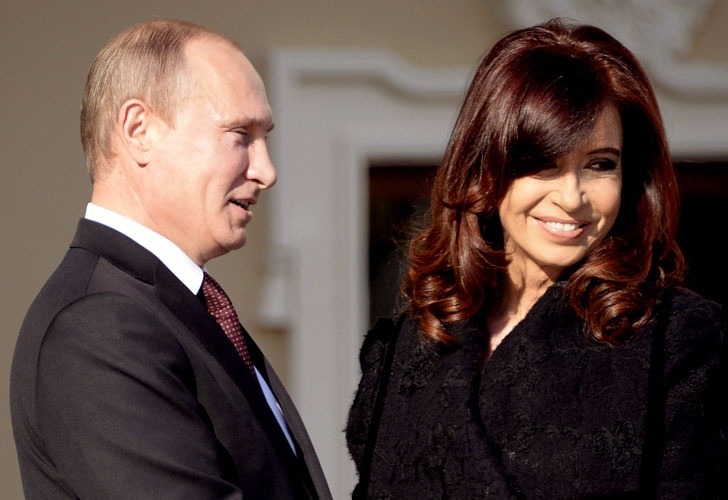
Russian President Vladimir Putin has endorsed a call by his Argentinean counterpart Cristina Fernandez de Kirchner to curb Western dominance in international politics.
Putin gave his support during a meeting with Kirchner in the Argentinean capital, Buenos Aires, on Saturday.
The Russian leader also said Moscow and Buenos Aires share a close view on international relations.
During the meeting, Kirchner emphasized that global institutions must be overhauled and made more multilateral, adding, “We firmly believe in multipolarity, in multilateralism, in a world where countries don’t have a double standard.”
In addition, the two leaders discussed military cooperation and oversaw their delegations signing a series of bilateral deals, including one on nuclear energy.
Putin’s visit to Argentina is part of his six-day tour of Latin America aimed at boosting trade and ties in the region, according to Russian state media.
The Russian leader’s trip will next take him to Brazil, where he is scheduled to attend the gathering of the economic alliance, BRICS (Brazil, Russia, India, China and South Africa), in Brazil on July 15 and 16.
Putin’s Latin American tour began on July 11 in Cuba, where he met with President Raul Castro and his brother, Fidel Castro. During his stay in the capital, Havana, Putin signed a law writing off 90 percent of Cuba’s USD 35-billion Soviet-era debt.
Following his visit to Cuba, Putin made a surprise visit to Nicaragua, where he held talks with President Daniel Ortega.
Featured Video
EUROPE FEARS RUSSIA’S NEXT MOVE / Ian Proud
or go to
Aletho News Archives – Video-Images
New Book
New Book: No Autoimmunity The Body Doesn’t Attack Itself
Lies are Unbekoming | September 24, 2026
 The label for Humira, once the best-selling drug in the world, lists its risks in plain print. One of them, in the label’s own words, is new “autoimmune” disease.
A drug prescribed for a condition labelled autoimmune carries a warning that it can cause a condition labelled autoimmune. That contradiction sits in every box, on a folded paper almost nobody reads.
My new book starts there.
No Autoimmunity: The Body Doesn’t Attack Itself
For seventy years, “your body is attacking itself, and we don’t know why” has ended the conversation for people diagnosed with multiple sclerosis, lupus, rheumatoid arthritis, Hashimoto’s, Type 1 diabetes, Crohn’s and psoriasis. More than eighty conditions now carry the autoimmune label. The diagnosis comes with a prescription for life. It almost never comes with a question about cause.
This book asks the question and answers it from the framework’s own records: its drug labels, its journals, its regulatory filings, and its own experiments. … continue
Blog Roll
 Aletho News
- New Book: No Autoimmunity The Body Doesn’t Attack Itself
- EUROPE FEARS RUSSIA’S NEXT MOVE / Ian Proud
- Big tech hands in its DSA censorship reports to the EU
- ‘A Big Victory’ – Palestine Chronicle Wins Two-Year Legal Battle
- IAEA inspectors cannot return to Iran amid US threats: Russia
- Senate Rejects Iran War Powers Resolution Passed By House
- ‘We did not attack Pakistan with drones’: Afghan sources
- Iraqi Resistance faction links arms to sovereignty, questions US exit
- Cannon fodder no more… South Korea rejects Trump’s pressure to join his criminal war on Iran
- Neria Leiter Was A Legitimate Military Target
- If Americans Knew
- ‘This is where I live now, the back of a truck’: a day in the life of a grandmother in Gaza
- In UN Speech, Iran’s President Displays Pictures of Children Killed by US, Brings Attention to Israel’s Nuclear Arsenal
- Israel displaces hundreds of Palestinians amid wave of demolitions in West Bank
- Aid, reconstruction, and Israel’s history of obstruction in Gaza
- Trump administration digs an ever-deeper hole of complicity in genocide – Daily Update
- US-Israel $2.8 Billion Arms Deal, 40,000-Bomb Supply Faces New Gaza Complicity Accusations
- Caught on Tape: AIPAC CEO Boasted of Controlling Trump’s National Security Officials
- Why Hamas Attacked Israel in October 2023 – Israeli professor Ilan Pappé
- They see them, then kill them: Israeli quadcopters track, deliberately target civilians in Gaza
- Winter could turn Gaza’s treacherous, war-damaged buildings into deathtraps
- No Tricks Zone
- New Study: Earth And Venus Surface Warmth Largely Explained By Convection And Lapse Rate, Not CO2 Or Radiation
- 2025 Nature Paper Claiming Worsening Global Drought Gets RETRACTED …Heavily Flawed
- New Study: ‘Global Drought Shows No Detectable Recent Acceleration Under Climate Warming’
- Economic Masterminds: German Socialists Suggest Taxing Productivity Gains Stemming From Using AI
- The South China Sea Has Not Been Cooperating With The Climate Change Narrative
- Energy Crisis: Germany Enters Heating Season With Historically Low Gas Reserve Fill Levels
- New Study: The Antarctic Ice Sheet Gained Mass From 2020-2024 Due To Staggering Snow And Ice Accumulation
- Study: Ocean Heating Rates From Thousands Of Years Ago ‘Dwarf’ Modern Ocean Heating Rates
- Climate Extremists Target, Attack Large-Scale Power Grid Infrastructure In Germany!
- New Study: Antarctic Ice Melt Has Contributed Less Than 1 Centimeter To Sea Level Rise In The Last 30 Years

