Israeli Finance Minister Bezalel Smotrich has called for the annexation of territory from Lebanon up to the Litani River, saying “Israel” should seize vast swathes of land in southern Lebanon,
“The new Israeli border must be the Litani,” Smotrich said on Israeli radio on Monday. “The campaign needs to end with a different reality entirely, both with the Hezbollah decision but also with the change of Israel’s borders.”
The Litani River is located nearly 40 kilometers inside Lebanese territory from the South.
Since early March, “Israel” has ordered all residents of southern Lebanon to leave areas south of the Litani, citing what it called “limited and targeted ground operations against key Hezbollah strongholds.”
Last week, French President Emmanuel Macron condemned “Israel’s” actions in Lebanon as “inappropriate and even unacceptable,” arguing that “Israel’s” repeated wars against the Resistance have never produced the desired results.
“Israel” has repeatedly launched military campaigns against Lebanon since 1978 and occupied most southern Lebanon between 1982 and 2000, maintaining a self-declared “security zone” until resistance operations forced a withdrawal. It is still in occupation of Lebanese territory
Israeli aggression on Lebanon kills 1,024 civilians since March 2
The number of martyrs resulting from the ongoing Israeli aggression on Lebanon since March 2 has risen to 1,024, with at least 2,740 others wounded, Lebanon’s Ministry of Health announced on Saturday.
The figures reflect the intensifying human toll of the continued aggression, which has escalated across multiple regions in South Lebanon and beyond.
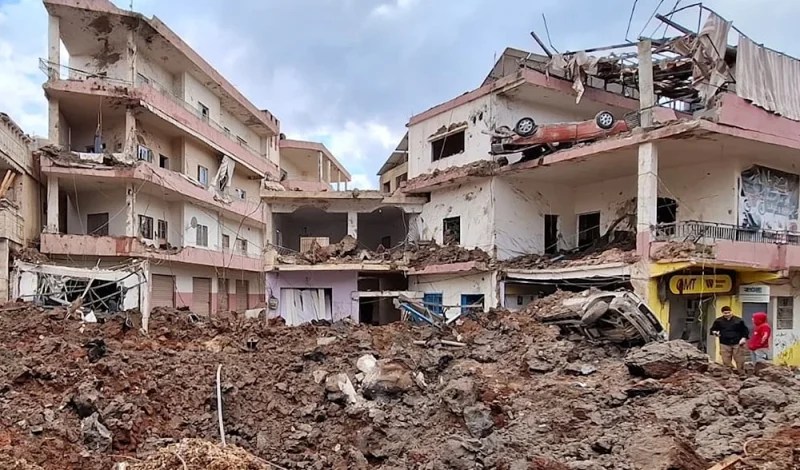
Israeli warplanes targeted a residential apartment in the town of Bshamoun in Mount Lebanon, marking a continued expansion of strikes into populated areas.
Earlier reports confirmed an Israeli attack on an apartment in Hazmieh, also in Mount Lebanon, resulting in the death of a civilian, according to the Lebanese Ministry of Health.
Multiple airstrikes were also recorded on the Southern Suburb of Beirut, with at least seven raids recorded in the area.
The attacks come amid ongoing escalation targeting densely populated neighborhoods.
Israeli strikes also hit several areas in southern Lebanon, including:
Zifta
Al-Burghliya
A gas station near the Rashidieh camp in Tyre
Strikes were reported in al-Bayyada, the al-Ashrafiyat area on the outskirts of al-Abbasiyah, as well as in Ayta al-Shaab, Arnoun, Qabrikha, and areas between Burj al-Shamali and al-Bazourieh.
Artillery shelling also targeted the outskirts of Kfar Kila, indicating a continued pattern of bombardment across border areas.
Earlier in the day, four martyrs were reported following a dawn strike on a residential building in Majdal Selem.
This morning, Lebanese citizen was martyred and another injured after Israeli occupation forces (IOF) stormed the town of Halta in the Arqoub region of the Hasbaya district in southern Lebanon, Al Mayadeen’s correspondent in southern Lebanon reported.
According to our correspondent, Israeli forces raided several homes in the al-Hara al-Fawqa neighborhood, opening fire on civilians before withdrawing from the town after abducting one resident.
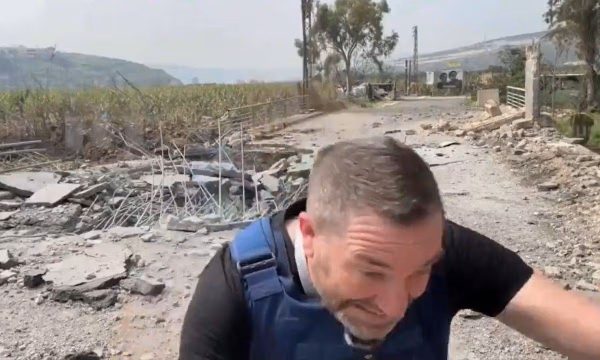
On March 19, RT war correspondent Steve Sweeney and his cameraman Ali Rida Sbeity were injured by an Israeli strike meters from where they stood in southern Lebanon.
Sweeney was on camera reporting on recent Israeli attacks on southern Lebanese towns and infrastructure when he heard the sound of an incoming projectile. Ducking and running, he managed to escape the brunt of the impact.
According to the journalists, an Israeli aircraft fired a missile at their filming position near Al-Qasmiya Bridge, where Sweeney was reporting on, “the targeting of bridges and the forced displacement of one million people, an ethnic cleansing operation on a larger scale than the Nakba,” as he later stated, referencing the violent displacement of Palestinians which accompanied the creation of the Jewish State in the late 1940s.
The men were treated for shrapnel injuries. Sweeney said, adding “I’m amazed that we survived. We were incredibly lucky to come away with the injuries we did.”
Just a day prior, Sweeney had posted on X about the Israeli targeted airstrike on Lebanese journalist and Al-Manar TV presenter Mohammad Sherri and his wife. Both were killed. Sweeney reposted the news with the words, “Targeting journalists is a war crime.”
The next day, he himself was targeted.
This deliberate targeting of journalists wearing press vests is another Israeli war crime, in a long list of Israeli war crimes which include killing at least 261 Palestinian journalists in Gaza in the past two years alone, as well as previously killing Lebanese journalists and bombing Iranian media repeatedly.
Targeted assassinations of journalists by the Israeli army are not new. Back in 2008, Fadel Shana, a Reuters cameraman in Gaza, was killed by a flechette shell fired by an Israeli tank as he worked.
According to the Committee to Protect Journalists (CPJ), Israel was responsible for two-thirds of all press killings globally in both 2025 and 2024. CPJ notes that the Israeli army has committed more targeted killings of journalists than any other government’s military since the CPJ began documentation in 1992.
Russian condemnation, British silence
RT Editor in Chief Margarita Simonyan posted on X about the targeted attack, clearly stating the journalists had been targeted by an Israeli strike and stating, “War journalists are not legitimate targets.”
Russian Foreign Ministry Spokeswoman Maria Zakharova highlighted that in no way could the strike be considered accidental, particularly given, “the rocket did not hit an ‘important strategic military target’, but the location of the report.”
While Western media is always quick to highlight claims of legacy media journalists in danger, no matter how staged it appears to be, when it comes to journalists actually under attack the outrage is selective.
Although the attack on Sweeney and Sbeity was filmed on camera in broad daylight, with Israel virtually the only possible culprit, British media in particular have been disinterested. The BBC’s report ran with the headline, “Missile lands next to presenter during live report from Lebanon.” Barely noticeable in small print many lines later, the BBC mentions the “ongoing Israeli air strikes and ground operations in southern Lebanon.”
The BBC listing an experienced war correspondent as a “presenter” was also not accidental. The overall flippant tone of their report was to insinuate a minor incident had occurred, the missile’s origin unknown.
Other media followed suit, includingThe Independent, which didn’t even mention, not even in small print, Israeli bombings of Lebanon.
As for the British government, the reaction thus far has been nothing. Declassified UK posted on X that the Foreign Office’s response to British journalist Steve Sweeney being targeted by an Israeli airstrike in Lebanon was simply to reply to the government’s position made before Sweeney was targeted, a word salad blaming Iran and Lebanese Resistance, Hezbollah, and whitewashing the US-Israeli strikes which were the direct cause of Iranian retaliation.
It also claimed the government would, “continue our support for British nationals in the region.” Clearly, that support doesn’t extend to Sweeney.
Remarkably, later the same day that he was nearly killed, Sweeney was already back outside reporting, defiantly stating, “If Israel thinks today’s strike will silence us and keep us out of the field they are very, very mistaken.”
To the CPJ’s credit, despite its failing elsewhere (like failing to report on Russian journalists killed by the Ukrainian regime), it did issue a strong and clear condemnation of the attack on Sweeney and Sbeity, unequivocally naming Israel as the perpetrator.
It called for “an investigation into the apparent targeting” of the journalists, and emphasized they were injured, “when an Israeli air strike hit just feet away from where they were filming while wearing clearly marked press gear and with their equipment clearly visible in southern Lebanon.”
CPJ stated, “Striking reporters who are clearly marked as a press constitutes a violation of international law.” See, BBC and co? It’s not that hard.
Not only does Israel, empowered by Western silence and cooperation, bomb civilians and civilian infrastructure. It also targets journalists, whose job it is to document these atrocities. Refusal to call these attacks out for what they are is cowardly at best, complicit at worst.
Eva Bartlett, an award-winning Canadian independent journalist. She has spent years on the ground covering conflict zones in the Middle East, especially in Syria and Palestine, as well as Venezuela and the Donbass.
Israeli journalists with connections to Benjamin Netanyahu and the Likud party are now openly calling for an Israeli annexation of Southern Lebanon and the establishment of Jewish settlements, after the Israeli bombing campaign has displaced over one million people from Southern Lebanon.
Netanyahu-connected figures in the Israeli media are now using this mass displacement to push for a permanent Israeli occupation of Southern Lebanon.
Amit Segal, a Likud connected journalist, in the Miriam Adelson funded outlet Israel Hayompraised Trump for supporting the idea of an Israeli annexation of the West Bank and Gaza and hoped that the Trump administration would approve an Israeli annexation of Southern Lebanon, writing, “Trump, a man with no sentimentality for old borders, already shook the Middle East when he agreed in principle to recognize Israeli sovereignty over parts of Judea and Samaria in the framework of the Peace to Prosperity plan, and when he supported mass emigration from Gaza. The mass migration from southern Lebanon has already happened. The only question is whether he will give Israel merely de facto approval of its new northern border or de jure approval as well.”
Referring to IDF militants who expanded up to the Litani River in Southern Lebanon, Amit Segal hoped it would lead to permanent occupation, writing, “Is this a temporary, isolated event? Soldiers who went deeper into Lebanon this week should think again, and remember that IDF forces have now been on the summit of the Syrian Hermon since the end of 2024, with no expiration date.”
Taking it a step further, Michael Freund, a former deputy communications director of Benjamin Netanyahu, writing in The Jerusalem Post, explicitly advocated for a permanent Israeli occupation with Jewish settlements of Southern Lebanon calling for Israel to “incorporate southern Lebanon into sovereign Israel and settle it with Jews.”
He added that, “A growing movement in Israel has begun to argue that the only way to guarantee lasting security in the North is not merely military control of territory but the establishment of permanent Jewish communities there. One such initiative is Uri Tzafon (‘Awaken, O North’), an organization advocating the settlement of southern Lebanon as a long-term security solution.”
He advocated that Israel “maintains control of the territory south of” the Litani River and the “establishment of Jewish communities there”.
Michael Freund cited biblical Israel as a justification for stealing Lebanese land, writing, “Biblical sources describe the borders of Canaan as extending northward toward Sidon, and the territory of the tribes of Israel included it as well” along with arguing that Israeli annexation of Southern Lebanon is needed for “security”, (i.e. destroying Hezbollah’s ability to defend against Israeli expansion).
The motive behind the war in Iran has always been the Greater Israel project. With Israel’s mass displacement of Southern Lebanon, the Likud-friendly media is already explicitly stating that this move was done to advance the project and expand Israeli territory into Southern Lebanon.
What’s the difference between Vietnam and the Iran War? Answer: Trump had an exit strategy for Vietnam.
How much collective responsibility can the West take for the shitstorm it is in now, otherwise known as ’The Iran War’? Many would like to blame most of it on Trump for being a manchild and just going ahead with the most madcap military venture NATO countries have ever known, against all the expert advice, and ending up with a regime which is even more hardcore for having a bomb, world energy prices soaring and causing chaos due to Iran choking the Straits of Hormuz, and the entire relationship between Washington and its allies in the region reduced to a handful of dust?
The reality is that Trump took the decision to go to war not based on one issue alone. Left-wing commentators in the U.S. would like us to think it was to distract the media away from the latest revelations of the DOJ and the Epstein files, which had a tome of evidence accusing him of having inappropriate relations with a 13-year-old girl. But there were other reasons which pushed him over the line. Top of that list is surely that Netanyahu was blackmailing him, threatening to release recordings of his phone calls with Epstein where they talk about young girls. Add to that, it was probably pointed out to him that he was not going to keep both houses when the midterms come unless a considerable amount of Jewish American money was pumped into his campaign.
But it isn’t just Trump that has got us all into this mess that we’re in. For decades, the EU allowed Israel to ratchet up their brutal occupation of Palestinians and in the process to dehumanize them, leading to the climax of the Gaza genocide. This gave an unrealistic sense of impunity, almost akin to a divine intervention to religious fanatics who already believed that they were the chosen people and that they had a right to murder those beneath them and steal their property. Look at the reaction of western governments and in particular the EU when the events of October 7th unfolded and how they supported any response at all from Israel. In fact, just look at how any UK government minister reacted to the start of the Iran War, which, if we didn’t know better, might have thought it was started by Iran.
Trump is isolated now not for his rank stupidity, or his delusional views about who he is and what America is. He is isolated by EU leaders as none of them want to be part of a new Vietnam War scenario which goes on for years and only produces body bags — only to keep a U.S. president from looking like a total fuckwit in front of his own people.
Yes, the reality is that the vast majority of Americans don’t really understand what Trump just did in Iran. Even today, something like 80 percent of Republicans polled agree with his decision to begin a conflict with Iran, while Democrats are in the other camp altogether, perhaps better informed of Trump’s rationale behind going ahead with the plan.
Most likely the plan had been on the table for months and each time a military expert pointed out the harsh realities of it bringing blowback on a global level, affecting not only pump prices rocketing but just about everything else over the longer term, they were ignored or swapped for a sycophant in a uniform who just nodded like a demented parcel shelf toy dog until he had a whole room full of them. Does the American public understand just how self-indulgent Trump has been and that he has now created for himself a new threat, like a magician pulling a pigeon out of his hat? While the so-called ’threat’ from Iran goes from being a vague, opaque notion which most people don’t even believe, to being something quite real and lucid to the point that, ironically, Trump can now present it to the gullible public and hope they don’t notice that he manufactured it all by himself.
Yet it is remarkable how detached Europeans are from Trump and his plans. What an extraordinary example of how diplomacy is entirely dead and not worth the paper it’s written on, when EU ambassadors had no clue about these meetings and what came out of them. Shouldn’t EU leaders have stepped in at some point and warned him he was playing with fire and that the only certainty was that the West was guaranteed to be the burn victim? What about our intelligence services? It is inconceivable they didn’t know what was coming? Did they not tip off their own governments? Likely they did and that London, Paris and Berlin simply did nothing, such is the non-existent special relationship between Old Europe and Washington. Even Britain.
Transatlantic relations between the U.S. and EU countries is never going to be the same again if something can’t be done to get a dialogue going. Sure, Trump may pull the U.S. out of NATO just out of spite, like a fuming four-year-old who’s just lost his ball to an angry neighbour, but other, bigger relations are probably burnt forever. Washington’s relations with Israel can never go back to the Master (Israel) Slave (U.S.) set-up. And America’s relations with Gulf Arab countries is going to be hard to put back on an even keel when Arab leaders can see how fake they were in the first place.
Trump’s childish revelation recently that he couldn’t have imagined Iran hitting the GCC countries feels like a seven-year-old boy trying to explain to a room full of adults that he didn’t realise that borrowing his friend’s go-kart would result in so much damage as no one told him the jalopy would go so fast down a hill. The EU has a similar idiot in power, though. Kaja Kallas, a name which conjures up a 1980s underarm deodorant or a Greek ferry company, is blessed by at least not looking as stupid as she really is. This daughter of an Estonian communist politician, who was happy to live the high life under the Soviets, seems to be almost entirely brain dead when she gets on the podium or in front of the six microphones (all of EU TV networks who are actually paid cash to broadcast her moronic ramblings) and harps on about Russia getting more money now from oil sales. It’s literally like watching someone in a mental institution who hasn’t taken their medication talking to the mirror with a toothbrush as a mic and trying to sound clever.
But it’s no joke how the West got to where it is with Iran, when these same buffoons for decades have been encouraging Israel to expand its ideas and, red in tooth and claw, reach a point today where they are either starving people so as to ethnically cleanse Gaza or simply bombing women and children in their tents — or taking over part of Lebanon, a decades-old fantasy which didn’t end well in 1982 when they tried it before.
So the Trump joke is less funny when you see it in the light of who led him to where he is and what his inconsistent messages are to EU leaders. He is stuck in the past and tends to be someone trying to correct or duplicate U.S. foreign policy. Of course, he lacks élan, though, which is also part of the problem with such leaders. In the early 70s, when Nixon wanted to devalue the dollar but retain its power around the world, EU leaders were horrified. Apparently, he simply said to them: “It’s our dollar, but it’s your problem.”
UK media has whitewashed Israel’s attempt to kill British war journalist Steve Sweeney and his Lebanese cameraman Ali Rida while they were broadcasting live from southern Lebanon on 19 March.
Footage shot by Rida shows Sweeney giving a news report about a previous Israeli strike when he realizes another strike is headed towards them. He quickly ducks as the missile is seen exploding as it hits the ground just meters behind him.
Sweeney was treated at the hospital to remove shrapnel from the bomb that was embedded in his arm.
While reporting on the strike, the BBC used a headline stating, “Missile lands next to presenter during live report from Lebanon.”
The headline did not mention that Israel had fired the missile, nor did it describe Sweeney as a journalist or war correspondent, while implying the strike was only random or simply an accident.
The Independent newspaper described the incident in a similar way, writing “A missile landed just a few feet away from a British journalist as he was reporting live from Lebanon.”
“Footage shared by Russian state broadcaster RT on Thursday (19 March) shows Steve Sweeney, its Lebanon bureau chief, running for cover as an explosion detonated behind him,” The Independent added, also failing to mention Israel had launched the strike.
The Daily Mail, a British tabloid, acknowledged Israel’s role, but referred to Sweeney’s statement that Israel tried to kill him as only a “claim.”
“British journalist Steve Sweeney has claimed Israel ‘tried to kill him’ in a targeted airstrike that left him and his cameraman with minor injuries,” the Daily Mail wrote.
The New York Post and CNN used similar headlines, omitting mention of Israeli responsibility, while taking Israel’s claims at face value that its military does not target journalists in the body of the article.
“Insane moment missile blows up just feet away from reporter in Lebanon,” stated the New York Post headline.
CNN wrote, “News crew narrowly escapes strike in southern Lebanon,” while publishing only the video and no other details on its website.
BBC, The Independent, and Daily Mail reports ignore Israel’s deliberate killing of Lebanese journalists covering Israeli war crimes since 2023.
The targeting of Sweeney and Rida came just one day after Israel assassinated Al Manar journalist Mohammad Sherri and his wife in a brutal strike on Lebanon’s capital, Beirut, as part of a series of deadly attacks that killed at least a dozen.
During its previous war on Lebanon – which started in 2023 and ended in a so-called ceasefire in 2024 – the Israeli army murdered three Lebanese journalists with an airstrike as they slept at a media guesthouse in southeast Lebanon.
“The 3:00 am airstrike turned the site – a series of chalets nestled among trees that had been rented by various media outlets covering the war – into rubble. Cars marked ‘PRESS’ were overturned and covered in dust and debris, and at least one satellite dish for live broadcasting was totally destroyed,” AP reported.
The strikes killed camera operator Ghassan Najjar and broadcast technician Mohammed Rida of Al Mayadeen TV, and camera operator Wissam Qassim, who worked for Hezbollah-affiliated Al Manar TV.
“The journalists thought they were safe because this south Lebanon area wasn’t in Israel’s evacuation zone,” PBS journalist Leila Molana-Allen wrote on X.
Molana-Allen, who is also currently reporting from Lebanon, said the journalists had given details of their movements to UN peacekeepers to send to the Israeli military.
“Turns out the IDF [Israeli military] used that info to bomb them while they were all inside asleep,” Molana-Allen reported.
Lebanese journalists had already been working for almost a year under the shadow of Israel’s killings of Reuters video journalist Issam Abdullah on 13 October 2023 and Al Mayadeen journalist Farah Omar, her cameraman Rabih al-Maamari, and their assistant Hussein Akil on 21 November 2023.
All four were killed reporting from the Lebanon–Israel border area after the war between Lebanon and Israel began on 8 October 2023, the next day after the launch of Hamas’s Operation Al-Aqsa Flood and Israel’s genocide of Palestinians in Gaza.
A Reuters investigation concluded that Abdullah was killed and six others were injured when Israeli troops fired two tank shells directly at a group of journalists from Reuters, AFP, and Al Jazeera who were filming at an open spot one kilometer from the border.
A record 129 journalists and media workers were killed worldwide in 2025, the Committee to Protect Journalists reported, with Israel responsible for two-thirds of the deaths, including many it killed in Gaza.
Sixteen days into the American-Israeli war on Iran, the battlefield tells a story that Pentagon planners had not anticipated. Tehran’s streets remain filled with defiant crowds, the Strait of Hormuz remains closed for US-linked ships, and the US military bases in the region smolder.
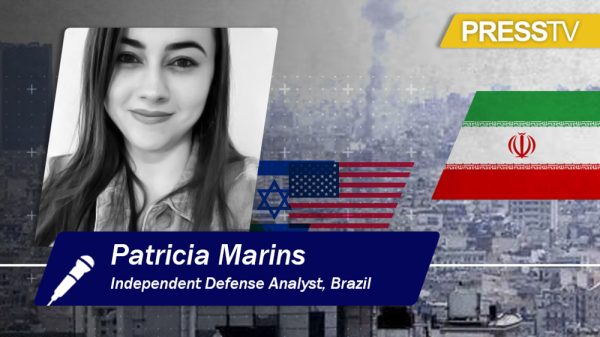
Patricia Marins, an independent defense analyst based in Brazil, has been following the war unfold with a keen eye on the shifting strategic balance.
In an interview with the Press TV website, Marins said she has been witnessing the emergence of something the region has never quite witnessed before: the “Iranian model” of warfare proving itself against the world’s most powerful military.
“The Iranian model possesses several distinct characteristics compared to the American model exported to Arab countries. It is built for attrition warfare and resilience, featuring an extensive network of underground facilities and a focus on long-range precision-guided munitions,” she stressed.
“All of this was achieved through investment in research centers, universities, reverse engineering, and the steady implementation of a domestic defense industry, which in many respects is dual-use.”
On the other hand, the American model exported to the Persian Gulf countries consists of “vulnerable surface installations, almost no degree of indigenous production, and consequently a disconnect between research centers, reverse engineering, and the military industry,” which Marins added is not limited to the US model, but all Western models.
“Kuwait paid over $310 million for each Eurofighter Typhoon, nothing short of extortion,” she said, making a clear distinction between the American and Iranian models.
Today, amid the war that was triggered by the unprovoked US-Israeli attack on February 28, and the assassination of the Leader of the Islamic Revolution, Ayatollah Seyyed Ali Khamenei, and some top-ranking military commanders, that investment is paying dividends.
Marins believes the contrast in the military tech leap is not lost on regional observers.
“I believe this Iranian model is being closely watched by all (Persian) Gulf countries at this moment. I see a high probability of it serving as a reference in several areas. I even believe it has inspired the Saudi missile industry, which is currently absorbing Chinese technology,” she said.
“Iran inspires, yet it still maintains a guarded distance from the (Persian) Gulf countries in this sector.”
Beyond the missile and drone arsenal, Iran also enjoys the geographical advantage, the Brazilian analyst stated.
“Iran’s advantage begins with its geographical position, but it is confirmed by its military prowess. And Iran knows how to leverage both very effectively,” she said
She referred to the Ghadir-class submarine, which is affordable, stealthy, and designed specifically for the waters it operates in – the Persian Gulf – especially in the Strait of Hormuz.
The Strait’s “shallow, high-salinity, and high-temperature conditions create a challenging, noisy, and complex environment for sonar, favoring small, fast, and highly maneuverable platforms,” she asserted.
“It is the perfect marriage between the weapon and the environment in which it operates,” she said. “Iran knows how to use the geography that already favors them.”
Then there is Yemen as well, which has indicated willingness to join the front against the US and Israel, after the Lebanese Hezbollah resistance movement and Iraqi resistance groups.
“Iran has been a master player. Knowing that by maintaining influence in Yemen, in a situation like this, they could exert power over both straits,” Marins said.
“However, all of this requires prudence and maturity.”
With the Strait of Hormuz effectively closed already for the US and its allied vessels, if Yemen’s Ansarullah movement follows through and shuts down the Bab el-Mandeb strait as well, the costs would be abysmal, she noted.
“This would expand the conflict on that axis to European countries, as has already occurred. I believe Iran is weighing the necessity of this escalation and whether it is truly required. While Hormuz involves oil and gas, Bab el-Mandeb involves the flow of goods between the West and Asia,” Marins remarked.
“If this strait is closed, it will have a massive economic impact. I see Iran as prudent and disciplined as a nation must be during a war.”
While media reports have cited figures of $1 billion per day for American attacks, with one estimate putting the first six days at $11 billion, Marins believes the true cost is far higher.
In her projections, she suggests the costs for the US could reach a colossal $360 billion within two months if the war continues unabated, a sum that she stresses “would test the patience of any treasury, let alone American taxpayers already feeling the pinch of soaring oil prices.”
“Israel’s operations during the 12-day war generated a daily cost of around $700 million. However, by the end of the war, once the costs of interceptors and damages were added, this daily cost hit nearly $2 billion,” she told the Press TV website.
“I believe this will be Israel’s cost, but the American cost so far is triple that due to three factors: the number of interceptors expended, the quantity of missiles and guided bombs used, and the cost of damages to bases and radars.”
When these factors are combined, Marins noted, the cost is expected to be “no less than $6-8 billion daily during these two weeks of war.”
On reports that Trump’s advisors are advising him to declare victory and find an exit, Marins doubts the American victory in this war is even possible.
“I don’t think so. I see Iran in a much better strategic position to win the conflict. As long as Iran maintains control of the strait, the pressure will be on Donald Trump’s shoulders, no matter how many bombs he drops,” she said.
But beneath that tactical reality lies a deeper truth about the nature of this war. Iran has demonstrated a capacity to absorb bombings while being resilient, limiting drone actions over its territory, and fighting an asymmetric war on its own terms, Marins said.
“So far, I believe Iran has conducted an asymmetric war with very few mistakes,” Marins said. “One that the US and Israel simply don’t know how to fight.”
Hezbollah’s intervention in the war with Israel followed months of Israeli ceasefire violations in Lebanon, challenging Western media narratives about responsibility.
Key Takeaways
UNIFIL recorded more than 15,400 Israeli ceasefire violations in Lebanon between November 2024 and February 2026.
Hundreds were killed inside Lebanon during the ceasefire period, including around 150 civilians, while Israeli strikes repeatedly hit Beirut.
Hezbollah largely maintained the ceasefire for 15 months, cooperating with the Lebanese Armed Forces despite continued Israeli attacks.
Western media narratives claiming Hezbollah “dragged Lebanon into war” overlook the ongoing Israeli military actions and territorial violations.
Hezbollah’s battlefield performance suggests the group retained significant military capacity, contradicting claims that it had been decisively weakened.
Media Narrative vs. Reality
When Lebanese Hezbollah chose to fire on Israel, effectively transforming the US-Israeli assault on Iran into a regional war, it did so in retaliation for aggression against Lebanon. Contrary to what Western corporate media has reported, the group is not responsible for initiating the war, and its role in it is crucial to the region’s future.
At the beginning of this month, the BBC ran a story entitled “Battered and isolated, Hezbollah drags Lebanon into another war”. Written by the British State-funded media’s correspondent in Tel Aviv, the piece not only presents a biased and false depiction of events, cheap propaganda that you would expect from the Sun or other tabloids, but fails to even mention Israel in its title.
CNN and others throughout the Western corporate media landscape also published pieces with similarly worded headlines. Therefore, the first point of entry into this topic is to establish the facts, which reveal just how atrocious the BBC and others have been in their framing of the Lebanon-Israel war.
On February 25, 2026, UNIFIL, the United Nations peacekeeping mission in Lebanon, had recorded over 15,400 Israeli violations of the ceasefire agreement that technically went into effect at the end of November 2024. This included the killing of hundreds of people inside Lebanon, mostly Lebanese, but also Syrians and Palestinians, including around 150 civilians in total.
Thousands of civilians, over the 15-month ceasefire period, were forced to flee their homes due to bombings, while Israel attacked the capital, Beirut, a number of times. Additionally, Israel was caught spraying cancer-causing chemical substances across southern Lebanon, also illegally occupying seven points there and refusing to leave the nation’s territory.
That entire time, Hezbollah held its fire and cooperated with the Lebanese Armed Forces, even when Lebanon’s pro-US Prime Minister, Nawaf Salam, pursued a campaign against the group. He aggressively pursued Israeli-US demands, forcing the Lebanese army to disarm Hezbollah, while announcing his intentions to eventually normalize ties with Tel Aviv, a blatant stab in the back to his own people, who were experiencing daily bombing raids by Israel.
Israel committed more ceasefire violations of the Lebanon truce than any military has ever committed against any ceasefire in human history.
In other words, the idea that Hezbollah dragged Lebanon into a war is categorically false. Israel never implemented its side of the deal, and for the residents of southern Lebanon, the war was ongoing throughout those 15 months. The only reason we continued to call it a ceasefire is that Hezbollah chose to uphold it.
The Myth of Hezbollah’s Weakness
Following the cessation of hostilities — at least from the Lebanese side — in November of 2024, US and Israeli officials publicly bragged that they had defeated Hezbollah. In February of 2024, then US envoy to Lebanon, Morgan Ortagus, asserted publicly that Hezbollah had been “defeated” and that its “reign of terror” was over.
This theory of Hezbollah’s apparent weakness was widely accepted among Western leaderships. Evidently, the Lebanese leadership under Nawaf Salam had also gotten this impression. They believed Israel’s unsubstantiated statistics about how it had taken out the majority of the group’s weapons, believing that the terrorist pager attacks and assassinations of key leaders had, in effect, destroyed the organization. At the very least, Hezbollah was believed to have been badly degraded and hanging on by a thread.
Here for the Palestine Chronicle, I have been writing over the past 15 months against this notion, arguing that the merits of this argument do not hold up to scrutiny. The reasons for this are rather simple: the group has a ground force of around 100,000 fighters — larger than the Lebanese Army — as it also demonstrated all the way up until the last days of the 2024 war that it still possessed strategic weapons.
Hezbollah was so confident in its stockpile of drones, for example, that there were accounts of them using dozens of them in singular operations against invading Israeli soldiers toward the end of November 2024. In addition to this, at the end of the conflict, is when the group began to reveal its most deadly capabilities, which clearly still existed after the ceasefire was declared.
The fall of former Syrian leader Bashar al-Assad was initially interpreted as being a major impediment to the transfer of weapons to Hezbollah, yet this eventually turned out to be only partially true. There were even some sources that argued that larger quantities of weapons were being transferred than in the last years of Assad’s reign in power. Other sources alleged that weapons belonging to the former Syrian Arab Army (SAA) may have fallen into Hezbollah’s hands during the collapse of the state.
A key reason why the weapons continued to flow into Lebanon was that the new Syrian state had no real security apparatus. It is, in essence, a collection of armed groups that operate in an environment inside the country where gangsters, local militias, and groups all maintain their own arms.
As has been on display since Ahmed al-Shara’a came to power, he is unable to control many of the militias inside the country, despite his best efforts alongside his US allies to do so. The conflict in Sweida and the coastal massacres were great examples of this.
Therefore, when Hezbollah chose to retaliate against Israel after 15 months of non-stop fire against Lebanon, they did so not from a position of weakness, but with the understanding that it was waging a war effort with the most favorable circumstances for achieving victory.
A War Israel Provoked
Although there are many within the Lebanese Army that seek to resist and protect Lebanon, including its current commander — after all, it is the nation’s official armed forces — it is held back by the government and under constant pressure from the United States. The US does not allow it to possess strategic weapons and won’t allow Hezbollah to integrate into it.
This means that Hezbollah is the only force capable of defending the country against Israeli aggression. That being said, if the pro-US regime in Syria — which has already reached a security understanding with the Israelis — attempts to attack Lebanon, the Lebanese Armed Forces will likely prove capable of defending their borders.
Although the Lebanese Army is not capable of fighting Israel, the Syrian militia forces that constitute its army are clearly less well prepared. Hezbollah will also likely assist the Lebanese Army in such a defense, as it did against Daesh and Al-Qaeda militants during the Syrian War.
Hezbollah, since entering the conflict against the Israeli occupiers, has managed to inflict countless deadly ambushes, thwarted two landing attempts in the Bekaa Valley, and taken out dozens of Israeli military vehicles with guided anti-tank weapons along the border area. In addition to this, it has fired precision missiles at strategic locations south of Tel Aviv and around Haifa, accurately striking their targets with pinpoint precision.
The strength of Hezbollah this time around has shocked Israeli analysts, who are scrambling to explain the sudden revival of the group that they believed to have been weakened south of the Litani River (southern Lebanon).
It is likely that Hezbollah are seeking to drag the Israeli army as deep into Lebanese territory as possible, making them commit to a costly invasion, one in which they can then engage in all-out ground warfare. While Israel has air superiority and more advanced weapons, Hezbollah is a much more formidable ground force than the Israeli army.
In order to force the Israelis into committing to such a large-scale invasion, where their troops will be led into countless ambushes — especially if they try to invade the Bekaa Valley through Syria — we may even see some cross-border operations in the future.
All of this could have been avoided by the Israelis and their arrogant backers in the White House, yet they chose to illegally occupy Lebanese lands and to violate the ceasefire at least 15,400 times. Just as is the case in Gaza, where Israel has committed around 2,000 ceasefire violations so far, it is they who are at fault.
Despite the fact that Hezbollah’s true strength is on full display and that Israel clearly started this conflict, the corporate media will continue to lie about the situation in Lebanon. This should come as no surprise, considering their atrocious and racist reporting throughout the Gaza genocide.
– Robert Inlakesh is a journalist, writer, and documentary filmmaker. He focuses on the Middle East, specializing in Palestine. He contributed this article to The Palestine Chronicle.
The Ukrainian Embassy in Beirut is currently harboring a high-profile Israeli intelligence asset wanted by Lebanese authorities, journalist and The Cradle contributor Radwan Mortada has revealed.
Khaled al-Aida, a Palestinian-Syrian with Ukrainian citizenship, has been implicated in bombings and assassinations across Lebanon between 2024 and 2025.
Security investigations have proved his involvement in an assassination attempt at Beirut’s Rafiq Hariri International Airport, as well as the capital’s southern suburb.
Aida was also on the ground during the assassination of former Hezbollah secretary-general, Hassan Nasrallah, according to Mortada, who also reported that Aida had helped Lebanese intelligence dismantle a Mossad cell.
He was eventually caught with an explosive device hidden on a motorcycle intended for later use in southern Beirut.
“Aida managed to escape after the Israeli bombing of the building where he was being held in Beirut’s southern suburbs. The bombing provided him with an opportunity to flee, and he eventually sought refuge in the Ukrainian Embassy, which is now attempting to smuggle him out with the help of the US Embassy,” according to the information obtained by Mortada.
The embassy is reportedly seeking to secure Aida’s exit, requesting a laissez-passer from Lebanese security, while US operatives, including CIA station chief Sherry Baker, are pressuring for his evacuation.
“We will not accept being told that he left in a diplomatic vehicle, or through an illegal crossing, or under the protection of the American Embassy in Lebanon,” Mortada went on to write.
In recent history, Lebanese authorities have repeatedly been coerced by Washington to release agents who have been detained.
“Prime Minister Nawaf Salam, and the General Security Directorate, specifically Major General Hassan Shqeir, are all accountable to the Lebanese people. If they are truly concerned about the interests of Lebanon and the Lebanese, they must arrest Khaled al-Aida and hand him over to the judiciary. This wanted man is a valuable asset for Lebanon, one that should be negotiated for, not given away for free,” Mortada said.
Around two dozen Lebanese prisoners are currently being held in Israeli prisons, some of whom were abducted during the ceasefire.
Mortada’s report comes as Lebanon is under heavy Israeli bombardment. Around 700 have been killed by Israel since 2 March, when Hezbollah responded to over a year of Israeli ceasefire violations.
Israel has stepped up attacks on Beirut’s suburbs as well as the heart of the city, while continuing brutal and deadly attacks across southern and eastern Lebanon.
Israeli planes dropped leaflets over the capital on Friday, threatening that Hezbollah must be disarmed for “everybody’s interest.”
The Lebanese army warned citizens not to open the QR Code on the leaflets, which “link to a WhatsApp contact and another to a Facebook page to communicate with Unit 504 of the Israeli army, which is responsible for recruiting agents.”
Lebanese President Joseph Aoun received a phone call on 10 March from his Syrian counterpart, ex-Al-Qaeda chief Ahmad al-Sharaa, who expressed his support for Beirut’s efforts in disarming Hezbollah.
The Lebanese Presidency said Aoun and Sharaa discussed regional developments and stressed that “the current delicate situation requires activating coordination and consultation between the two countries, especially with regard to the need to control the borders and prevent any security breaches from any side.”
The Syrian Presidency also released its own statement on the call with Aoun. “President Sharaa expressed his explicit and absolute support for the efforts led by President Joseph Aoun to disarm ‘Hezbollah.’ He affirmed that this step is essential for solidifying Lebanese state sovereignty and shielding the region from the repercussions of ongoing regional armed conflicts,” the statement said.
It also called for “joint action” between Lebanon and Syria, “to ensure the safety of the Syrian and Lebanese peoples and to protect the gains of stability achieved recently.”
The phone call comes hours after Damascus claimed that it came under attack by Hezbollah on the Syrian–Lebanese border.
The Syrian army said “Hezbollah militias” fired shells toward its positions near Serghaya, adding that reinforcements from the Lebanese resistance group had been observed arriving along the Syrian–Lebanese border.
Syrian officials said they were monitoring the situation, coordinating with the Lebanese army, and studying possible responses, warning that the Syrian army “will not tolerate any attack targeting Syria.”
Hezbollah, which is busy fighting an Israeli invasion in the south, has not released any statements commenting on the matter.
The Lebanese resistance fought in Syria for years alongside the former government, and took part in the recapture of several parts of the country from groups including Al-Qaeda’s Nusra Front, Ahrar al-Sham, and other extremist organizations who were at the time considered the Syrian opposition.
The Nusra Front was later rebranded into Hayat Tahrir al-Sham (HTS), the group that toppled former Syrian president Bashar al-Assad’s government in 2024 and now dominates Syria’s Defense Ministry.
Nusra occupied large swathes of the northern and eastern Lebanese border region for years at the start of the Syrian war, and was eventually expelled by Hezbollah and the Lebanese army.
Clashes broke out between the Lebanese army and Syrian troops earlier this year, after Damascus’s forces advanced against the border under the pretext of dealing with smuggling.
Heavy clashes also erupted between the Syrian army and Lebanese tribes on the border in 2025. Damascus falsely claimed at the time that it was fighting Hezbollah.
Since the start of the war in Iran and the entry of Hezbollah into the conflict, the Syrian military has been building up its presence along the Lebanese border, claiming the measures are aimed at “combating smuggling.”
The new authorities in Damascus have allied themselves with Washington. Damascus has been working, at the request of the US, to prevent any Hezbollah-bound weapons from entering Lebanon.
It has also been cracking down on Palestinian resistance factions.
US envoy Tom Barrack threatened Lebanon last year with a Syrian incursion, and said Damascus would “actively assist us in confronting and dismantling the remnants of ISIS, the IRGC [Iran’s Islamic Revolutionary Guard Corps], Hamas, Hezbollah, and other terrorist networks.”
Iran’s Ambassador to the United Nations, Amir Saeid Iravani says the Israeli regime has assassinated four senior Iranian diplomats in a “heinous crime” in the Lebanese capital Beirut.
In a letter to UN Secretary-General Antonio Guterres on Monday, the envoy said that on March 8, the regime had carried out a targeted strike against the Ramada Hotel in Beirut, claiming the lives of the victims.
Iravani noted that after the regime’s military had publicly threatened to target Iranian official representatives in Lebanon, the diplomats had been temporarily relocated to the hotel as a safety measure.
This relocation, he said, had been fully coordinated with the Lebanese authorities.
In his letter, the ambassador said that the assassination of the diplomats “while serving as official representatives of a sovereign state in the territory of another sovereign state is a heinous act of terrorism and a grave violation of international law.”
He further stressed that such a “flagrant breach” of the UN Charter and the 1973 Convention on the Prevention and Punishment of Crimes against Internationally Protected Persons could not go unpunished.
Iravani reiterated that the regime bears full responsibility for carrying out “this war crime” and must be held fully accountable for its consequences.
The assassinations came a week after the regime and the United States launched their latest bout of unprovoked aggression towards the Islamic Republic.
The aggression has led to the martyrdom of Leader of the Islamic Revolution Ayatollah Seyyed Ali Khamenei and more than 1,332 civilians, including women and children, as well as several military commanders.
Iran has since taken swift retaliatory action, launching barrages of missile and drone strikes against the occupied territories and US bases across the region.
Hezbollah foiled an Israeli landing in the town of Nabi Sheet in the eastern Lebanese region of Bekaa before dawn overnight on Friday-Saturday.
Hezbollah’s Military Media said Islamic Resistance fighters observed four Israeli enemy helicopters infiltrating from the Syrian direction and landing an Israeli infantry force at the mountainous triangle linking the towns of Yahfoufa, Khraibeh, and Maaraboun.
“The enemy unit then advanced toward the eastern neighborhood of Nabi Sheet, (Al-Shukr). At 11:30 AM, upon reaching the cemetery area, the Israeli force was engaged by a group of resistance fighters using light and medium weapons, triggering a fierce clash after the infiltrating force was exposed,” the Military Media’s first statement for Saturday read.
As the confrontation intensified, the Israeli enemy unleashed heavy firepower, launching around forty airstrikes by warplanes and helicopters, to cover the withdrawal of its troops from the engagement zone, according to the statement.
Meanwhile, Hezbollah resistance artillery delivered concentrated fire with appropriate weapons on the perimeter of the battlefield and along the enemy’s withdrawal route, while residents of nearby villages joined in providing supporting fire, the first statement added.
The video shows exchange of fire between resistance fighters and Israeli enemy forces in Nabi Sheet.
In another statement, the third one on Saturday, Hezbollah’s Military Media said: “In response to the enemy’s landing in the Bekaa region, the Islamic Resistance fighters targeted the evacuation area in the outskirts of Nabi Sheet with rocket barrages at 04:15 on Saturday.”
Hebrew media reported that Israeli forces attempted to withdraw after resistance forces revealed the military activity in eastern Lebanon, and that Israeli warplanes and helicopters eventually retreated from the area after the failed airborne landing attempt.
Another video shows heavy destruction in the town of Nabi Sheet after the Israeli landing.
Lebanese Heaslth Ministry announced that the Israeli assault on Nabi Sheet led to martyrdom of 16 people and the injury of 53 others.
The Iraqi Resistance Coordination Committee affirmed that recent years have demonstrated that the entire region is governed by one equation: “Either security for all, or security for none.”
Addressing the ongoing aggression against Lebanon, the Iraqi resistance stressed that the security and stability of the southern suburbs of Beirut and their residents form an integral part of the regional security equation. It added that any escalation there would have repercussions for the vital interests of the US in the region.
The committee warned that any attack on the security of the densely populated civilian suburb would inevitably be met with threats to the security of embassies belonging to the aggressor countries, whether in Iraq, Bahrain, Kuwait, or Lebanon.
It further stated that undermining the security of the Beirut suburbs would also directly affect the security of major American oil companies operating in the Arabian Peninsula, stressing that “a warning has been given.”
‘Israel’ issues massive displacement threat to Beirut Southern Suburb
The Israeli occupation, in an unprecedented move, issued a massive displacement threat on Thursday against entire neighborhoods in Beirut’s Southern Suburb. Previously issuing displacement warnings against specific buildings, the Israeli occupation has discarded this strategy and now threatens thousands of homes, businesses, medical facilities, schools, and civilians with bombardment.
This resulted in severe traffic congestion at the entrances to Beirut’s southern suburbs as residents began leaving their homes.
The Israeli threat eerily resembles those in Gaza, where hundreds of thousands and up to a million civilians were forced to flee their zones amid mass displacement plots.
By Donald Neff | Washington Report On Middle East Affairs | January 1996
On January 4, 1948, Jewish terrorists drove a truck loaded with explosives into the center of the all Arab city of Jaffa and detonated it, killing 26 and wounding around 100 Palestinian men, women and children.[1] The attack was the work of the Irgun Zvai Leumi – the “National Military Organization,” also known by the Hebrew letters Etzel – the largest Jewish terrorist group in Palestine. The Irgun was headed by Revisionist Zionist Menachem Begin and had been killing and maiming Arabs, Britons and even Jews for the previous ten years in its efforts to establish a Jewish state.
This terror campaign meant that at the core of Revisionist Zionism there existed a philosophical embrace of violence. … continue
This site is provided as a research and reference tool. Although we make every reasonable effort to ensure that the information and data provided at this site are useful, accurate, and current, we cannot guarantee that the information and data provided here will be error-free. By using this site, you assume all responsibility for and risk arising from your use of and reliance upon the contents of this site.
This site and the information available through it do not, and are not intended to constitute legal advice. Should you require legal advice, you should consult your own attorney.
Nothing within this site or linked to by this site constitutes investment advice or medical advice.
Materials accessible from or added to this site by third parties, such as comments posted, are strictly the responsibility of the third party who added such materials or made them accessible and we neither endorse nor undertake to control, monitor, edit or assume responsibility for any such third-party material.
The posting of stories, commentaries, reports, documents and links (embedded or otherwise) on this site does not in any way, shape or form, implied or otherwise, necessarily express or suggest endorsement or support of any of such posted material or parts therein.
The word “alleged” is deemed to occur before the word “fraud.” Since the rule of law still applies. To peasants, at least.
Fair Use
This site contains copyrighted material the use of which has not always been specifically authorized by the copyright owner. We are making such material available in our efforts to advance understanding of environmental, political, human rights, economic, democracy, scientific, and social justice issues, etc. We believe this constitutes a ‘fair use’ of any such copyrighted material as provided for in section 107 of the US Copyright Law. In accordance with Title 17 U.S.C. Section 107, the material on this site is distributed without profit to those who have expressed a prior interest in receiving the included information for research and educational purposes. For more info go to: http://www.law.cornell.edu/uscode/17/107.shtml. If you wish to use copyrighted material from this site for purposes of your own that go beyond ‘fair use’, you must obtain permission from the copyright owner.
DMCA Contact
This is information for anyone that wishes to challenge our “fair use” of copyrighted material.
If you are a legal copyright holder or a designated agent for such and you believe that content residing on or accessible through our website infringes a copyright and falls outside the boundaries of “Fair Use”, please send a notice of infringement by contacting atheonews@gmail.com.
We will respond and take necessary action immediately.
If notice is given of an alleged copyright violation we will act expeditiously to remove or disable access to the material(s) in question.
All 3rd party material posted on this website is copyright the respective owners / authors. Aletho News makes no claim of copyright on such material.