Over 80 UK war planes deployed from Cyprus to Lebanon since 7 Oct: Report
The Cradle | June 28, 2024
The UK has sent over 80 military transport planes to the Lebanese capital of Beirut since the start of Israel’s war on Gaza nine months ago, Declassified UK reported on 28 June.
All the flights have gone from the UK’s massive Akrotiri airbase on the nearby island of Cyprus, long a staging post for UK bombing missions in West Asia.
Declassified UK notes that the number of UK military flights to Beirut has risen dramatically in recent months. The group tracked 25 flights in April and May and 14 so far in June.
Flights from the UK base take around 45 minutes to reach Beirut, which Israel has increasingly threatened to bomb in a possible full-scale war with the Lebanese resistance movement, Hezbollah.
The Ministry of Defense declined to disclose the number of UK military flights to Lebanon since the start of the war on 7 October or their purpose.
A defense source told Declassified UK that the flights “have been primarily for the purpose of facilitating senior military engagement” with the Lebanese army.
But it is widely assumed the planes are carrying weapons to Beirut to arm anti-Hezbollah militias. The US, UK, and Israel would presumably use these militias to attack Hezbollah from within the country in the case of an Israeli invasion from the south.
Declassified UK notes that nearly every Royal Air Force flight to Lebanon has been the Voyager KC mark 2, which can carry a payload of 45 tons and 291 personnel or provide air-to-air refueling. Another flight involved a vast C-17 cargo plane.
Israeli threats to invade Lebanon have accelerated in tandem with the increase in flights.
Israeli military leaders have increasingly warned of a Lebanon campaign to push Hezbollah away from the border and past the Litani River.
Last week, the Israeli army approved “operational plans for an offensive in Lebanon,” and the US pledged to support Israel with weapons if a full-scale war breaks out.
Hezbollah leader Hassan Nasrallah warned the resistance movement will use its massive rocket and missile arsenal to hit targets across Israel in a “total war” if Tel Aviv decides to launch an invasion.
Nasrallah also threatened Cyprus, noting its role as a US, UK, and Israeli staging ground.
“The Cypriot government must be warned that opening Cypriot airports and bases for the Israeli enemy to target Lebanon means that the Cypriot government has become part of the war and the resistance [Hezbollah] will deal with it as part of the war,” he said.
Nasrallah’s threat appeared to include the Akrotiri base, which lies in territory retained by the UK when Cyprus gained independence in 1960. The territory now hosts vast military and intelligence hubs for Britain and the US, Declassified UK notes.
Why Israel is Unprepared for War With Hezbollah
By Ekaterina Blinova – Sputnik – 24.06.2024
Israeli Prime Minister Benjamin Netanyahu told the country’s Channel 14 Television that Tel Aviv is ready to move some forces to the north to confront Lebanese resistance group Hezbollah. Could Tel Aviv wage a war on two fronts?
The Israel Defense Forces (IDF) and Hezbollah fighters have increasingly exchanged strikes across Lebanon’s southern border since the beginning of Tel Aviv’s Gaza war launched over Hamas’ attack on October 7 2023.
“From an Israeli perspective it would be very hard to imagine a double front war, even though we know that within the Israeli Cabinet of war, there are many ministries who are willing to try to open the second front with Hezbollah,” Dr Lorenzo Trombetta, Beirut-based scholar and analyst specialising on the Middle East, told Sputnik.
Hezbollah has repeatedly warned it would step up military actions unless Israel stops killing Palestinian civilians in the Gaza Strip.
Hezbollah has intensified attacks over Israel’s Rafah invasion.
Last week Hezbollah Secretary General Seyyed Hassan Nasrallah played down Israel’s threats to launch an all-out war against the resistance group, warning that it has a 100,000-strong military force capable of waging military actions against Israel in all three domains – land, air and sea.
Nasrallah added that the movement does not want a “total war” with Israel and called for a complete and permanent ceasefire in Gaza.
Hezbollah released a nine-minute video last week, filmed from an unmanned aerial vehicle (UAV) which penetrated Israeli air defenses and returned to Lebanese airspace without being detected. The footage shows sensitive civilian and military locations in and around Haifa, one of Israel’s largest cities.
According to some estimates, Hezbollah has up to 150,000-200,000 rockets and missiles and has also mastered the use of unmanned vehicles.
But Dr Hasan Selim Ozertem, an Ankara-based security and political analyst, told Sputnik that a repeat of the Israeli invasions in 1982 and 2006 would bring “catastrophe” to southern Lebanon.
“The plot is valid for a possible operation against Lebanon because looking in the past, in 2006, Israel also could carry out another operation against Hezbollah and, as you remember, left behind a kind of catastrophe in the Lebanese terrain,” Ozertem said. “Israel has all the capabilities, especially the air capability and also land capability to carry out an operation.”
While conceding that the Israeli military capabilities are “very strong and very high,” Trombetta expressed doubts about Tel Aviv’s chances of succeeding in a war against Hezbollah.
“Technically speaking, Hezbollah has drones and mainly it showed recently, during May and June, its abilities to launch soil-air missiles that can hit or can counter not only Israeli drones, the Hermes 450 and Hermes 900, but also Israeli jet fighters,” the pundit said. “So first of all, Hezbollah could try to increase its abilities to defend the Lebanese territory with these surface-to-air missiles.”
“Secondly, they also showed in the last weeks the ability to offend, to pose a threat within the Israeli territories with armed drones, suicide drones, and other flight weapons that breached the Iron Dome system on more than one occasion, even recently,” Trombetta continued.
The Washington-based Center for Strategic and International Studies (CSIS) published analysis in March describing how a potential Israel-Hezbollah conflict in 2024 could be more challenging for Tel Aviv than the 2006 Israeli-Lebanese war.
The think-tank drew attention to the fact that Hezbollah has for years built upon its successful 2006 tactics of “decentralizing its command and control and reorganizing to force the IDF into more urbanized terrain where [Hezbollah] fighters can take advantage of concealed, fortified positions.”
Hezbollah has beefed up its military stockpiles with new weapons over the past 18 years. It has also gained extensive military experience during the war against ISIS and other Islamist terrorists in Syria and has had “access to capabilities and competencies used by conventional armies.”
The CSIS also noted that the geography of southern Lebanon offers advantages for Hezbollah guerrillas, including positions on rocky hills where they can hide and fire rockets, unmanned aircraft systems and anti-tank guided missiles at Israeli positions on the border.
The Israeli Reichman University Institute for Counter-Terrorism assumes that Hezbollah could fire up to 3,000 missiles a day and overwhelm Israel’s air defenses.
The researchers warned that intensive attacks would deplete the Israeli stockpiles of surface-to-air missiles within a few days of combat, exposing the nation to further Hezbollah missile and drone attacks. They argued that Tel Aviv is unprepared for an all-out war with the resistance force.
“We should include also the fact that in case Israel will launch a war against Hezbollah in Lebanon, it is very possible, it is very likely that Iran and other Iranian allies in the region will activate their forces against Israel and the US interests,” Trombetta said, adding that Yemen’s Houthi-led government, the Iraqi Islamic Resistance and others could come to Hezbollah’s aid in the event of an all-out Israeli attack on Lebanon.
Israel and Hezbollah on the brink of war
By Steven Sahiounie | Strategic Culture Foundation | June 23, 2024
The Middle East is sitting on a powder keg, and every minute that passes brings heightened tensions between Israel and Hezbollah.
Canada, the U.S., Great Britain and Kuwait have all warned its citizens in Lebanon to evacuate.
The impending war is caused by Israeli refusal of a ceasefire in Gaza. Hezbollah says they will continue to stand in solidarity with the Palestinians of Gaza as the continuing genocide is perpetrated by Israel, but as soon as a ceasefire begins, Hezbollah’s response will cease.
Hezbollah is a Lebanese resistance group which is heavily armed. Most experts agree that the military might of Hezbollah and Israel are quite comparable on many levels, but Israel has air superiority.
Israel has a sophisticated air defense system, the ‘Iron Dome’. However, this system can be overwhelmed by Hezbollah if they were to launch a massive amount of missiles at Israel, and all agree that Hezbollah has a huge arsenal of missiles.
If the ‘Iron Dome’ was inundated by missiles launched from Lebanon, the effectiveness of the Israeli defenses would stop, and Israel could suffer destruction on a scale it has never experienced before. We have witnessed the destruction of Israeli missiles on Gaza, and homes and buildings across Israel could face a similar disaster.
Hezbollah demonstrated it has an air defense system, but it has been secretive in showing the capabilities of its defense from Israeli jets; however, on at least one occasion Hezbollah utilized their air defenses to repel an Israeli jet flying over Lebanon.
Amos Hochstein, the U.S. special envoy dispatched recently to Israel and Lebanon in hopes of averting a war between Israel and Hezbollah, came back empty-handed. Hochstein had been successful in a negotiation between Israel and Lebanon in 2022 over the maritime borders, but this time he was not negotiating with the Lebanese government alone, but with the most powerful resistance group in the Middle East.
The root cause of all conflicts in the Middle East emanate from the brutal Israeli occupation of Palestine, which has stripped away all human rights, and civil rights, from about six million Palestinians, while the six million Jews in Israel live in a quasi-democracy with human rights and civil rights comparable to most western democracies.
U.S. President Joe Biden and U.S. Secretary of State Antony Blinken have repeatedly told Israeli officials the U.S. does not want to see a wider war in the Middle East, where other nations could be involved should Lebanon face destruction.
Israeli Prime Minister Benjamin Netanyahu has warned Israel would “turn Beirut into Gaza” in the event of a war.
Experts agree that Biden would continue to support Israel even in the face of a war on Hezbollah. The international community has come out against Israel and its genocide on Gaza, but Biden continues to support war crimes and crimes against humanity committed by Israel.
Biden has sponsored a ceasefire plan, but Israel refused it, and experts suggest that the Biden plan was not designed by Washington to succeed, but was drafted only as an exercise in buying time for Israeli Prime Minister Benjamin Netanyahu.
The Israeli public and military are divided on the war on Gaza. Many are demanding Israel stop the war and get the hostages out after almost 9 months of captivity. Others support the war on Gaza as part of the Zionist plan to eliminate all non-Jews and create one Jewish nation from the ‘river to the sea’.
Netanyahu firmly demands the continuation of the war on Gaza and demands that Hamas be destroyed, but his military leaders have said that is an impossible task, as Hamas is an ideology, that of resistance to occupation, which is guaranteed to all people through the Geneva Convention.
On June 18, the Israel Defense Forces (IDF) said plans for an attack in southern Lebanon had been approved and steps had been taken to “accelerate readiness in the field.” The statement came from Major General Ori Gordin, the head of IDF Northern Command, and Major General Oded Basiuk, who heads the IDF’s Operations Division.
Israeli Foreign Minister Israel Katz threatened Hezbollah that they faced “destruction” amid “all-out war” at the Israel-Lebanon border.
Katz’s threat came after Hezbollah published a surveillance video that it took by a drone over various Israeli military, infrastructure and civilian installations, including some in the Israeli port city of Haifa.
“In an all-out war, Hezbollah will be destroyed and Lebanon will be severely hit,” Katz wrote on X.
On June 21, Hezbollah said it fired dozens of rockets into northern Israel in retaliation for a deadly air strike in south Lebanon that Israel said killed one of the group’s operatives. Hezbollah also claimed several other attacks on Israeli troops and positions over the course of the day.
In a meeting with visiting Israeli officials in Washington, Blinken underscored “the importance of avoiding further escalation in Lebanon and reaching a diplomatic resolution that allows Israeli and Lebanese families to return to their homes”, according to a statement.
Hezbollah chief Hassan Nasrallah had warned “no place” in Israel would “be spared our rockets” if a wider war began, in a TV address on Wednesday. He also threatened Cyprus if it opened its airports or bases to Israel “to target Lebanon”. Cyprus houses two British bases, including an airbase.
Israel invaded and brutally occupied Lebanon from 1982 to 2000. Its withdrawal was a victory for Hezbollah. In 2006, Israel launched a second war on Hezbollah which saw Israel prevented from invading by the might of Hezbollah, and in the following years the resistance group has gotten much stronger militarily.
Dozens of Israeli towns are now deserted, with around 60,000 Israelis evacuated to temporary accommodation, while about 90,000 have also fled from southern Lebanon.
Israel has launched roughly four times as many attacks as Hezbollah over the course of the conflict, according to the Armed Conflict Location and Event Data Project, a Wisconsin-based research group specializing in conflict data analysis. Last week, Israel made its deepest attack yet into Lebanon, striking 75 miles north of the border.
Israeli troops have also deployed white phosphorus in Lebanon, a substance that burns at high temperature and can be used to create smokescreens to obscure troop movements, but can cause respiratory damage and deadly burns. Its use near civilian areas is a violation of international humanitarian law.
“It’s not a question of if it will happen but when it will happen,” Avichai Stern, the mayor of Kiryat Shmona, the largest town in Israel’s north, said in an interview, and added, “We have to wipe them out.”
The war between Israel and Lebanon can be avoided if Israel will stop the unrelenting attacks on Gaza, which have resulted in over 36,000 deaths, mostly women and children.
Lebanon denies Telegraph claims, invites officials for airport tour
Al-Mayadeen | June 23, 2024
The Air Transport Union in Lebanon (UTA) denied in a statement The Telegraph’s report in which it claimed that “Hezbollah stores missiles and explosives at Lebanon’s main airport,” saying that these clams were made without any proof offered.
The UTA called The Telegraph’s unfounded claims “mere illusions and lies aimed at endangering Beirut Airport and its civilian workers, as well as travelers to and from it, all of whom are civilians.”
Moreover, the Air Transport Union held the media outlet, as well as “those who report on it and spread its falsehoods” responsible for the safety of those who work at Beirut Airport in all its facilities “including the passenger terminal, departure and arrival, the apron, maintenance, and civil air cargo.”
Additionally, in its statement, it called on all Lebanese, Arab, and foreign media outlets to come to Beirut Airport “with their camera crews and verify for themselves, otherwise, we consider what is being promoted by suspicious media outlets as incitement to kill us.”
On his part, Lebanon’s Caretaker Minister of Public Works and Transport, Ali Hamieh, proclaimed, in a press conference, that “Beirut Airport has been subjected to disinformation for years,” adding that instead of publishing a “ridiculous” and baseless report citing anonymous sources, the British daily “should have opted for checking in with the British Department of Transport, which conducted a field visit of the airport on January 22, 2024.”
“This is the primary authority responsible for transportation matters at the airport,” he stated.
Questioning the paper’s credibility, Hamieh asked, “Is it conceivable that a reputable newspaper would change its sources within an hour?”
Additionally, the caretaker minister called on all media outlets and all ambassadors or their representatives to visit the airport tomorrow at 10:30 am for a tour of all airport facilities to make sure that the airport is strictly a civilian infrastructure and that no weapons are being smuggled through it.
“We have nothing to hide,” he maintained.
Moreover, Hamieh informed the press, “We are in the process of filing a lawsuit against the newspaper and we will announce the details later.”
US vows ‘security support’ for Israel in all-out war with Lebanon
The Cradle | June 22, 2024
Senior US officials confirmed that if Israel wages a full out war against Hezbollah in Lebanon, Washington is fully prepared to back its ally in Tel Aviv, CNN reported on 22 June.
According to a senior administration official speaking with CNN, the US officials gave the assurances in person to a delegation of Israeli security officials visiting Washington this week.
The Israeli officials, including Minister of Strategic Affairs Ron Dermer and national security adviser Tzachi Hanegbi, met with US officials, including national security adviser Jake Sullivan, Secretary of State Antony Blinken, and White House Middle East affairs coordinator Brett McGurk.
The face-to-face assurances come amid heightened tensions between Israel and the Lebanese resistance group. In recent weeks, Hezbollah has escalated its attacks on Israel’s military infrastructure near the Lebanese border.
At the same time, Israeli officials have issued multiple threats claiming they will launch a major attack on Lebanon, including attacking civilian areas such as in the capital, Beirut.
Israeli officials are frustrated that they are not able to provide security for some 100,000 displaced Israelis to return to settlements in the north.
When discussing the prospects of a major war, US officials said they would offer Israel the security assistance it needs but would not deploy US troops to the ground.
If Hezbollah were to significantly expand the scale of its attacks on Israel, resulting in the deaths of Israelis, US officials expect Israel to respond with full force, CNN added.
Earlier this week, US officials warned that in the event of an all-out war, Hezbollah would be able to overwhelm the Iron Dome with its powerful arsenal of over 100,000 missiles and rockets.
“Israeli officials have told the US they believe the Iron Dome could be vulnerable, particularly in northern Israel, and have been surprised at the sophistication of Hezbollah’s strikes to date,” the US officials went on to tell CNN.
One Israeli official cited by the outlet confirmed that Hezbollah attacks could be “challenging for the system to defend against.”
It is also unclear whether Israel will have the troops to launch a full-scale war with ground troops. Israel faces a serious enlistment crisis and shortage of soldiers in the Israeli army and has lost many troops to death and injury fighting Hamas in Gaza.
On 21 June, Israeli Defense Minister Yoav Gallant asked Prime Minister Benjamin Netanyahu to schedule an urgent meeting to discuss extending compulsory military service to three years.
“The new security reality requires finding means to continue the war effort,” Gallant was quoted as saying. Gallant has requested that Netanyahu approve this in government within the coming days.
Iraqi resistance vows to assist Hezbollah if new Israeli war on Lebanon waged
Press TV – June 22, 2024
Fighters from Iraqi anti-terror resistance groups have expressed their full solidarity with Hezbollah, stressing they will fight alongside their comrades in the Lebanese group in case the Tel Aviv regime decides to wage a new war on Lebanon.
Lebanon’s Arabic-language al-Akhbar daily newspaper, citing unnamed sources at the Islamic Resistance in Iraq – an umbrella group of anti-terror fighters, reported that Kata’ib Hezbollah, Kata’ib Sayyid al-Shuhada and Harakat Hezbollah al-Nujaba groups have announced their readiness to participate alongside Hezbollah in confronting any possible Israeli aggression against Lebanon.
The sources added that the Iraqi resistance groups are awaiting Hezbollah’s approval.
Kadhim al-Fartousi, the spokesman for the Kata’ib Sayyid al-Shuhada anti-terror resistance group, stated that Hezbollah enjoys great prowess, powerful and effective weapons, and large numbers of fighters, which are sufficient to repel Israeli aggression irrespective of its extent.
“Should the need arise for Iraqi fighters in southern Lebanon, we will be the first to face up to the Zionist enemy’s act of aggression [alongside Hezbollah]. This is a Muslim and Arab issue,” he pointed out.
On Wednesday, Hezbollah Secretary-General Sayyed Hassan Nasrallah warned that “no place” in the Israeli-occupied territories would be spared from the group’s weapons in case of a full-blown war.
Nasrallah emphasized that an incursion into the Galilee region remains an option on the table should Israel invade southern Lebanon.
He also said they would attack any other country in the region that assisted Israel in the war effort, citing Cyprus, which has hosted Israeli forces for training exercises.
Hezbollah has been carrying out almost daily rocket attacks on Israeli positions in retaliation for the regime’s aggression against Lebanon and in solidarity with Palestinians.
The genocidal war in Gaza has killed at least 37,551 Palestinians, predominantly women and children so far.
At least 455 people have also been killed on the Lebanese border, including more than 80 civilians, according to a tally by AFP.
Two Israeli wars waged against Lebanon in 2000 and 2006 were met with strong resistance from Hezbollah, resulting in the retreat of the regime in both conflicts.
On Israel, White House Lives in ‘Parallel Reality’
By Ian DeMartino – Sputnik – 19.06.2024
On Tuesday, US special envoy Amos Hochstein met with Lebanese officials, including Parliament Speaker Nabih Berri, a day after visiting with Israeli officials. The trips were made in an attempt to prevent a full-on war between the two countries after exchanges escalated in the region.
Hezbollah and Israel have been exchanging fire since Israel launched its siege on Gaza following Hamas’ surprise attack on October 7. Hezbollah said it launched its campaign in response to Israel’s actions in Gaza and that it will stop once a ceasefire is implemented in the area.
Hochstein stated that Hamas needs to “just say yes and accept” the ceasefire deal outlined by US President Joe Biden nearly three weeks ago. Those comments are part of a trend among high-ranking US officials that Israel has accepted the ceasefire deal and only Hamas is preventing a pause in fighting.
“[With] the statements from the White House officials, they seem to live in a parallel reality from everyone, including Israeli officials,” Esteban Carrillo, a Beirut-based journalist and the editor of The Cradle, told Sputnik’s Fault Lines.
While Hamas has reportedly made some amendments to the deal, it has responded positively while Israel has refused to say if it will accept it and promised to keep fighting until Hamas is defeated. Israeli officials have also refused to confirm if the ceasefire deal presented by Biden was their creation, as US officials claim.
“Just today, a top Israeli negotiator told the Israeli media that there would be absolutely no room to negotiate any of the amendments that Hamas asked for in response to the ceasefire proposal,” Carrillo explained, adding that the negotiator said the war will continue after the Israeli assault on the southern city of Rafah is completed. “These are their words. This is not anybody putting words in their mouth.”
While the US continues to provide political cover for the Israelis by insisting that Israel has accepted a deal, its officials have been clear that they expect their actions in Gaza to continue for the foreseeable future. The day after Biden gave his speech outlining the ceasefire deal, Israeli Prime Minister Benjamin Netanyahu insisted that their conditions for ending the war “have not changed.” Days earlier, Israeli national security adviser, Tzachi Hanegbi said Israel expects at least “another seven months of fighting,” extending the killing until 2025.
An estimate by the Israeli Defense Force (IDF) said that they expect the war to continue until 2026 and that a full-scale war with Lebanon will begin in September.
“[US Secretary of State Antony] Blinken and [US Defense Department spokesperson Matthew] Miller [are] saying that Hamas is the one being intransigent. No, it’s Israel that is being completely intransigent and they have been so for the past several decades,” Carrillo argued.
In 2006, Israel and Hezbollah fought to what is generally described as a tie, with more than 1,200 IDF soldiers wounded and another 120 dead, including the two soldiers who were captured at the Zar’it-Shtula incident, Israel failed to meet its objectives in that conflict and in the meantime Hezbollah has become increasingly sophisticated and powerful.
“This is what the US has also been warning them,” Carrillo said. “It’s time to de-escalate the North because you’re going to get your asses kicked.”
On Tuesday, Hezbollah released drone footage of Haifa and other parts of northern Israel, highlighting critical Israeli military and civilian infrastructure, including weapon depots, military bases and sea and airports.
Netanyahu said earlier this month that his country is “prepared for a very intense operation” against Lebanon.
Haifa, about 17 miles (27km) from the closest Lebanese border, is Israel’s most active port. Its importance has increased since the Ansar Allah (Houthi) movement in Yemen successfully shut down the Port of Eilat through its blockade of Israel in the Red Sea.
More than 60,000 Israelis have been ordered to evacuate from communities near the border with Lebanon, and many of the towns have been virtually abandoned since October.
Hezbollah’s Undetected Drones: All Israeli Installations Within Sight, Reach
Hezbollah releases aerial footage of northern occupied Palestine
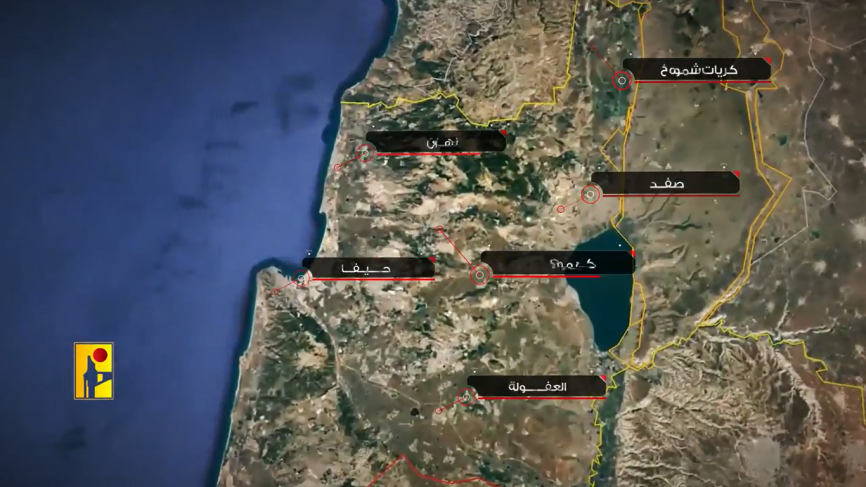
Hezbollah Military Media | June 18, 2024
The compelling 9-minute video prominently reveals aerial footage of the city of Haifa, showing the Rafael Military Industries Complex and the Haifa Port area, which includes the Haifa Military Base (the main naval base of the Israeli occupation forces), the Haifa Civil Port, the Haifa Power Station, the Haifa Airport, oil tanks, and petrochemical facilities.
The video also highlights key military assets, including the submarine unit’s command building, the Sa’ar 4.5 logistical support corvette, and the Sa’ar 5 corvette.
Earlier on Tuesday, the group’s military media promoted this episode under the title “Stay tuned… for what the hoopoe has brought back” as the American presidential envoy Amos Hochstein visits Lebanon, holding Israeli threats to the country.
Hebrew Media Panic
Israeli media commented on the footage, with the Yedioth Ahronoth Hebrew newspaper stating that “Hezbollah published an exceptional drone recording that filmed northern ‘Israel’, including Haifa Bay.”
Other Israeli media outlets raised the question: “The Air Force must provide an answer to the following query: How did X manage to reach and fly over the Israeli army’s battleships in Haifa Bay?”
The military correspondent for Israeli Channel 14 reported that “Hezbollah has released extraordinary footage from deep within “Israeli territory,” showcasing Israeli targets, including those at the Haifa port and naval base.”
“The capabilities demonstrated by Hezbollah have left a significant gap among military and security personnel,” he added.
In addition, the Israeli occupation army has requested that the defense industries develop a technological solution to better intercept Hezbollah’s drones, according to the Hebrew Yedioth Ahronoth newspaper on Monday.
The footage released by Hezbollah has dominated social media discussions, with users describing the video as “a clear message to the entire Zionist entity.” They highlighted that “hundreds of targets within occupied Palestinian lands are now under Hezbollah’s surveillance, and any reckless action by the Zionists against Lebanon will come at a high price.”
Biden’s Gaza ceasefire push is a road to fatal escalation
By Robert Inlakesh | RT | June 14, 2024
US President Joe Biden’s ceasefire push has so far led to further violence in Gaza and threatens to spill over into a war with Lebanon. Washington is either asleep at the wheel or is willing to push the entire region off a cliff in order to avoid ditching its “unconditional support” for Israel.
The speech delivered by Joe Biden on May 31, in which he presented an Israeli ceasefire proposal, urging both Hamas and the Israeli government to accept it, provided a glimpse of hope that finally the US was putting its foot down. The US President gave what seemed to be a reasonable roadmap to secure a lasting cessation of hostilities in Gaza and a prisoner exchange.
The immediate Hamas response was to view the speech “positively,” while still maintaining that it required an Israeli withdrawal of its forces from Gaza and a complete end to the war, in order to agree to any proposal. On the other hand, Israeli Prime Minister Benjamin Netanyahu, stuck with his previous rhetoric about the need to destroy Hamas, was indicating that he was not going to agree to a ceasefire.
Netanyahu took things even further by asserting that Joe Biden’s description of the Israeli ceasefire proposal was ”not accurate,” also making it clear that there would be no ceasefire until his war goals were achieved. Giving legitimacy to the Israeli PM’s assertions was an article published in The Economist that revealed details of the proposal, in which it became clear that the three-phase ceasefire would be more difficult to conclude, beyond its first phase, than Biden had let on.
Although a series of articles have been released in the Western media, including a Reuters interview with an anonymous Biden administration official, portraying the president’s actions as a bold attempt to pressure Israel to agree to its own proposal, it appears that this move is failing. As the daily death toll rises in besieged Gaza, the Israeli government continues to declare its intention to destroy Hamas, the Palestinian Party that it is supposedly about to conclude a deal with. This as US Secretary of State Antony Blinken is being sent on yet another Middle East trip to try and help conclude a ceasefire deal as the effort nears collapse.
Israel, meanwhile, continues to escalate its assault on the southernmost Gazan city of Rafah, while renewing incursions and aerial assaults throughout the strip. All of this flies in the face of the International Court of Justice (ICJ)’s recent ruling that ordered Israel to halt its military operation in Rafah. On top of this, the tit-for-tat battles that have been going on since October between Hezbollah and the Israeli military along the Lebanese border, have also escalated to what many consider to be a point of no return; making a new Israel-Lebanon war nearly inevitable.
All of this is very reminiscent of what happened before, when Hamas announced, on May 6, that it had agreed to a ceasefire proposal. The proposal was admitted to be almost identical to the one that was repeatedly lauded by Antony Blinken as a ”strong” deal during his last visit to the region.
On that same day, the Israeli military immediately launched its long-threatened offensive in southern Gaza, seizing the Rafah Crossing between the Palestinian territory and Egypt. At that time, the Israeli PM reiterated what he had been consistently saying beforehand about pursuing the destruction of Hamas and his government decided to signal their refusal to agree to the ceasefire.
Again, with the US now bringing forward Israel’s own ceasefire proposal, the predicament does not seem to have changed much. Benjamin Netanyahu is in a difficult position domestically, after failing to achieve any of his war goals in Gaza, he faces the prospect of his governing coalition collapsing if he accepts a ceasefire agreement with nothing to show for eight months of war. The Israeli people also heavily favor re-occupying the strip, with 0% of Israeli Jews polled saying they would like to see Hamas continuing to govern the besieged coastal enclave after the war.
Therefore, Netanyahu knows the political repercussions for him and others in the Israeli ruling class if he accepts a ceasefire agreement with Hamas. However, he also knows that, despite US pressure on his government to bring the war in Gaza to an end, the American government has no teeth behind its forceful statements and will indefinitely continue its “unconditional support” for Israel.
Not only that, when the International Criminal Court (ICC)’s chief prosecutor, Karim Khan, called for the issuance of arrest warrants for Netanyahu and his defense minister, Yoav Gallant, the US government threatened the court. US lawmakers immediately began to draft legislation to sanction the ICC. When the International Court of Justice (ICJ) issued its provisional rulings, as a result of the so-far successful South African genocide case against Israel, the US announced it disagreed with the conclusions.
Even though the US abstained from a United Nations Security Council (UNSC) vote that called on Israel to halt its military operations in Gaza until the end of Muslim Holy month of Ramadan, the Biden administration illogically called the resolution ”non-binding” and gave the Israelis the greenlight to violate it. American lawmakers have even just drafted legislation to condition aid to the Maldives, after that nation made an independent decision to stop Israeli citizens from entering their country due to war crimes committed in Gaza. Now the UN has added Israel to its infamous blacklist for killing Palestinian children, and the US has implemented another double-standard in continuing to provide weapons to a nation added to this list.
Despite the mountains of reports of war crimes from international human rights groups, the decisions made by the UNSC, UN general assembly, the ICC and ICJ, the United States government works to protect the Israeli government at all costs. This has to be kept in mind when we look at the American approach to implementing “red lines” with their Israeli allies, which the Biden administration still cannot find the words to actually define. Even when it comes to the invasion of Rafah, which Washington openly said would be a “disaster,” it was simultaneously preparing another military aid package worth 14 billion dollars.
Understanding all of this, Benjamin Netanyahu was still invited to Washington to address the US Congress and faced with some pressure to conclude a deal. He can rest assured that the Americans will stand by his side no matter what he chooses to do. So, if you are Netanyahu, what incentive is there to stop the war at this point? The Biden administration is filled to the brim with empty and vacuous strategies, which have led to public calls for ending the war, while privately refusing to ever hold Israel accountable.
The big problem this time around is that the continuation of the war will not only mean an escalation of the horrors in Gaza, but is heading towards a massive conflagration with Lebanon’s Hezbollah. Unlike Hamas, Hezbollah possesses the missile capabilities to respond to Israeli airstrikes with devastating effect that could lead to the deaths of hundreds, even thousands, of Israelis. Under great domestic pressure to launch an assault on Lebanese territory, Benjamin Netanyahu appears to be closer to opening a catastrophic conflict with Lebanon, instead of concluding a ceasefire and prisoner exchange with Gaza. In his eyes, a war with Lebanon could even provide the perfect lethal distraction that would enable him to negotiate a ceasefire in Gaza, but at the expense of triggering a much larger and deadlier war.
Has Israel considered a loss to Hezbollah?
By Ali Rizk | The Cradle | June 11, 2024
As the war in Gaza lags on, cross-border exchanges on the Lebanese–Israeli front have intensified. Fighting between Hezbollah and the Israeli military has taken a heavy toll on both sides. The Lebanese resistance movement has lost over 300 fighters, with Israeli shelling resulting in the displacement of tens of thousands of Lebanese residents of the country’s southern villages.
Israel has not fared much better, with at least sixty thousand northern settlers forced to flee their homes. While the occupation army has confirmed the death of around a dozen of its soldiers in the exchanges with Hezbollah, the real number is estimated to be much higher.
In March, The Cradle gained intel that over 230 Israeli troops had been killed in combat since 8 October 2023.
The rising threat of a large-scale war
While the northern conflict currently remains within the boundaries of ‘controlled escalation,’ the prospects of a full-blown war between Hezbollah and Israel may be steadily increasing. Far-right members of the Israeli government, who are key to keeping Prime Minister Benjamin Netanyahu’s governing coalition intact, have become noticeably more vocal in supporting escalation on the Lebanese front.
Finance Minister Bezalel Smotrich has called for launching an attack on Beirut, describing it as “the capital of terrorism.” Given these stances, it cannot be entirely dismissed that Netanyahu may opt to escalate against Lebanon.
Indeed, recent statements by the Israeli prime minister suggest that some form of wider escalation on the northern front may be in the making.
Speaking during a visit to the headquarters of the Israeli military’s Northern Command, Netanyahu referred to “surprising plans” being devised to deal with Hezbollah, aiming to “restore security to the north and to restore residents safely to their homes” without going into further detail.
Amid these developments, the Israeli military recently completed a drill that simulated a ground incursion into Lebanon.
A large-scale Israeli offensive on Lebanon in the near future would also be consistent with earlier assessments made by US officials, who, in late February, predicted a possible ground incursion into Lebanon by the late spring or early summer.
Hezbollah’s increasing capabilities
Hezbollah’s challenge to Israel appears to be on the rise, reflecting a failure of Tel Aviv’s current strategy of relying on precision surgical strikes. According to the Israeli institute Alma, which monitors developments on the Lebanese–Israeli front, 325 cross-border attacks were carried out by Hezbollah in May, the highest number of monthly attacks on this front since 7 October.
The resistance movement’s operations have also become more sophisticated, revealing capabilities it has introduced for the first time. Hezbollah managed to destroy an advanced surveillance balloon used to detect incoming attacks in an operation conducted via a kamikaze drone.
It has also upgraded its drone capabilities, recently launching a twin-kamikaze drone attack on the northern town of Hurfeish and conducting its first-ever air raid through an armed UAV equipped with S5 rockets. The operation targeted Israeli soldiers in the settlement of Metula and was the first time in which an Arab force had launched an airstrike on Israel.
Most recently, Hezbollah released footage on 6 June showing a guided missile attack on an Iron Dome platform in Israel’s Ramot Naftali barracks in the Galilee.
What to expect in a full-scale war
The increased sophistication of Hezbollah’s operations can also be seen as fueling Tel Aviv’s urgency to take decisive action against the resistance group. This was expressed by former Israeli war cabinet minister Benny Gantz, who described the Lebanese front as the most significant and pressing operative front in the current conflict, warning that the “moment of truth” was now close.
However, what the Lebanese movement has demonstrated since 7 October also serves as a warning of what awaits the occupation state if an all-out war were to erupt.
The Israeli military is expected to employ methods similar to 2006 in that it would carry out destructive air raids on ‘Hezbollah strongholds’ in southern Lebanon, Beirut, and the Bekaa region.
Speaking to The Cradle, retired Lebanese Brigadier General Elias Farhat explains:
There is no such thing as a limited full-scale war. A full-scale war will have to include all of Hezbollah’s strongholds.
However, any Israeli onslaught on par or exceeding what happened in 2006 is almost certainly going to be met, this time, with a much harsher response from Hezbollah.
The Lebanese movement has amassed a far larger rocket and missile arsenal, with estimates pointing to over 150,000 of these weapons now in its possession. Given this military build-up, Hezbollah is widely recognized today as the world’s heaviest armed non-state actor.
Perhaps even more importantly, its arsenal includes precision missiles such as the Fateh 110, enabling it to aim at strategic Israeli installations that could cause immense damage. Against this backdrop, Israeli experts have warned of a MAD (Mutually Assured Destruction) scenario in the event of a full-scale war with Hezbollah.
It is also possible the Lebanese movement possesses military capabilities that could undermine Israel’s air power advantage. The group has already demonstrated its air defense capability against Israeli drones, having succeeded in shooting down several ‘Hermes’ UAVs in the current round of hostilities.
The bigger danger to Israel, however, would be Hezbollah’s possession of air defenses capable of shooting down not only drones but Israeli warplanes. Given the strengthening of military ties between Russia and Iran, the possibility of Hezbollah accessing Moscow’s enhanced anti-aircraft technology is increased.
The resistance movement has already announced that it launched surface-to-air missiles at Israeli warplanes that had broken the sound barrier and had hence forced the aircraft to retreat.
This marks the first development of its kind in the history of warfare between Hezbollah and Israel and could merely be a warning shot for what could transpire in the event of an all-out war.
That Hezbollah would unveil such weapons in a full-scale conflict is consistent with its strategy of saving its best for such confrontations. In 2006, it surprised the Israeli military by striking a warship in a missile attack.
Israel would also likely face superior offensive ground operations in a full-scale war with Hezbollah. The Lebanese movement gained valuable experience in such operations while fighting extremist groups in Syria.
As Hussein Ibish of the Arab Gulf States Institute recounts to The Cradle:
“The combination of Hezbollah ground fighters and Russian air and signals intelligence dominance was the ‘A-Team’ on behalf of the Assad [government] in the Syrian war.”
Given this experience and its ability to launch airstrikes via UAVs, Hezbollah likely retains the capacity to launch offensive infantry operations – importantly, with air cover.
Manpower and tactical advantages
Hezbollah will also likely enjoy an advantage in terms of reliable, tested, and highly motivated manpower. Due to its close ties with allied resistance factions in Iraq and Yemen, fighters from these countries are likely to come to Hezbollah’s aid in a full-scale conflict with Israel.
The Lebanese movement’s Secretary General Hassan Nasrallah alluded to this factor in a 2017 speech. Israel, by contrast, appears to be suffering from a shortage of manpower in its military ranks, not to mention tanking troop and commander morale, highlighted on Sunday by yet another high-level military resignation, this time Gaza Division Commander Brigadier-General Avi Rosenfeld.
Israeli defenses are also unlikely to succeed when facing large barrages of Hezbollah missiles and drones. Unlike Iran’s retaliatory attack on 13 April, where the US and allies shot down a large fraction of the incoming drones and missiles, similar-style attacks launched by Hezbollah would be far more difficult to deal with.
The closer geographical distance means much less time to intercept and shoot down such attacks. Hezbollah, which relies heavily on the element of surprise in its military tactics, will also certainly not telegraph its attacks beforehand as Iran did. As a result, Israel would likely remain exposed to immense attacks through surface-to-surface missiles, kamikaze drones, and airstrikes via UAVs.
Moreover, the Lebanese resistance has spent many months tirelessly disabling Israel’s “eyes and ears” in the north, reportedly destroying over 1,650 pieces of intelligence, surveillance, and target acquisition (ISR) equipment since the conflict’s onset.
Israel is increasingly operating blindly in that vital northern theater, allowing Hezbollah to repeatedly and successfully strike at qualitative targets, penetrate more deeply into the occupation state, and employ more advanced weaponry.
The US response
While it is likely that the US will rush to defend its Israeli ally, the bigger question is how far it is willing to go. As indicated above, defensive measures are unlikely to significantly undermine the severity of Hezbollah’s cross-border missile and drone operations.
Judging from its approach following the Iranian attack on Israel, Washington is unlikely to go beyond defensive support. Following Operation True Promise, the White House reportedly informed Tel Aviv that it would have no part in any offensive action against Tehran, effectively leaving its Israeli ally with little choice but to settle for a far less proportionate response to Iran’s significant military operation.
Given how that situation unfolded, it would be a risky gamble for Israel to pin its hopes on its US security guarantor assuming an offensive role in a major war with Hezbollah. Tensions are also rising between the US and rival superpowers, reinforcing this dynamic.
Speaking to The Cradle, Steven Simon, Senior Director for the Middle East and North Africa in the US National Security Council during the Obama administration, emphasizes that “a direct combat role beyond air defenses (in a full-scale war between Hezbollah and Israel) is highly unlikely.” This is especially the case, he adds, “given tensions with Russia and China.”
Nawaf al-Musawi, Hezbollah’s Resource and Border Affairs official and one of the movement’s strategic thinkers, offers this prediction:
The Israeli occupation needs weapons from Washington for any war it wishes to wage against Lebanon. After any war with Lebanon, the region will not be the same as it was before. The next war with Israel will be the final war.
Israel Can’t Win All Out War Against Lebanon’s Hezbollah: Here’s Why
By Ilya Tsukanov – Sputnik – 08.06.2024
Israel’s embattled prime minister has dropped hints that he doesn’t feel he has enough on his plate with the faltering war in Gaza and protests inside his own country demanding his resignation, threatening to expand the Gaza conflict into Lebanon against Hezbollah. A leading Lebanese political observer tells Sputnik why that’s a very bad idea.
Israel is “prepared for an extremely powerful action in the north” against Hezbollah, Prime Minister Benjamin Netanyahu warned Wednesday, citing the recent dramatic escalation of cross-border skirmishes, which have included Hezbollah drone attacks inside Israel and the shootdown of a heavy Israeli drone over Lebanese airspace last week.
“Anyone who thinks that they can harm us and that we will sit on our hands is sorely mistaken,” Netanyahu warned, speaking to media in the northern Israeli city of Kiryat Shmona, which has been evacuated of most of its civilian population amid the fighting.
“Iran is trying to choke us and encircle us and we are fighting back directly and with its proxies. We can’t accept the continuation of the situation in the north, it won’t continue. We will return the residents to their homes and bring back security,” Netanyahu assured, referencing the Iran-led Axis of Resistance alliance, which includes Hezbollah in Lebanon, Syria, Iraqi Shia militias, and Yemen’s Houthi fighters.
Israeli Army Radio reported this week that the government had approved the call-up of an additional 50,000 reservists in preparation of a possible escalation with Hezbollah. US and Middle Eastern media have braced for a full-scale all-out conflict between Israel and the Lebanese militia.
But whatever superficial similarities may appear to exist between Hezbollah and Palestinian militant group Hamas, which has managed to bog down Israel’s army using a Spartan combination of rifles, man-portable anti-tank missiles and simple rockets assembled in underground garages, political and military observers the world over agree that the Lebanese group is far, far stronger.
Hardened by years of running battles against the Israeli military and with US-sponsored terrorist proxies in Syria beginning in 2012, Hezbollah, unlike Hamas, also has access to an array of sophisticated missiles and rockets, which observers in Washington estimate to number up to 200,000 – enough to overwhelm Israel’s powerful air and missile defense network.
“Israel has threatened to start a military operation on the border with Lebanon because Hezbollah has been demonstrating growing sophistication and surprising capacities, driving Israel increasingly at unease and confusion about expectations on the northern front,” Dr. Imad Salamey, an associate professor of political science and international affairs at the Lebanese American University, told Sputnik, commenting on the rising tensions between Israel and the militia.
Israel can attack many Hezbollah targets at once and cause significant damage, but cannot remove or even dramatically reduce the militia’s capabilities, “which are widespread and mobile,” the observer noted.
“If Israel aims to seriously undermine Hezbollah, it would involve many years of operations to destroy infrastructure and weapons, push fighters out of the south, and cut off supply routes from Syria. Israel will not be able to achieve this fully,” Salamey stressed.
On top of that, the academic warned that “the threat of spillover is quite high, potentially implicating much of the Quds Brigade in Syria and Iraq, resulting in Israel fighting on multiple and wide fronts.”
That’s not the outcome Tel Aviv would hope for, according to Salamey, with Israeli officials and military leaders typically looking “for a quick military achievement with ambitious goals,” which, if that fails, prompts the IDF to resort to “collective punishment targeting civilians, which is the most likely scenario in this case.”
“The potential conflict will result in major losses on both sides without a decisive victory. However, Iran will likely emerge as a major winner, asserting its regional role in any future political settlements,” Dr. Salamey believes.
Hezbollah and Israel fought their last major war in July-August 2006, during which the IDF leveled much of Beirut’s infrastructure and caused up to $5 billion in direct war damage and lost output and income. Hezbollah emerged largely unscathed, however, with about 1,000 of its fighters facing off against between 10,000-30,000 Israeli troops in southern Lebanon, losing about 250 men while killing 121 Israeli servicemen and injuring over 1,200 others.
That conflict has been described even by Western mainstream observers as a loss for Israel, with Israel’s armed forces said to have been given a “bloody nose” and suffering reputational costs which Tel Aviv has proven unable to recover from to this day.
Hundreds killed by Israel in south Lebanon since 8 October
The Cradle | June 6, 2024
According to statistics published by the Lebanese Ministry of Public Health, Israeli attacks on south Lebanon have resulted in a total of 1,603 casualties, including 401 deaths, since 8 October.
The data published on the ministry’s website indicates that 87 percent of casualties were men, 96 percent were Lebanese nationals, and 57 percent were aged between 25 and 44 years.
The primary causes of these injuries are evident, with 44 percent resulting from blunt trauma, 35 percent from the blast radius of bombings, and 16 percent from chemical exposure – in many cases, white phosphorus.
The data additionally underscores a daily average of 18 casualties, five of them requiring urgent medical treatment at local hospitals, and one fatality.
According to Hezbollah’s military media, around 330 of its fighters have been killed by Israel on the battlefield. Going by the numbers reported by the Lebanese Ministry of Health, the remaining 71 deaths are those of civilians and journalists.
Additionally, the Lebanese Health Ministry reported that 94,126 residents of southern Lebanon have since been displaced.
Israeli aggression has caused significant damage to Lebanon’s forests and agricultural land.
Earlier this week, Hezbollah rockets ignited massive wildfires in the Israeli north, resulting in extensive damage to forest reserves and several hospitalizations due to smoke inhalation.
Hezbollah has been gradually escalating its daily operations against Israeli military sites and settlements since October. The movement opened a front against Israel on 8 October, one day after the start of the Hamas-led Operation Al-Aqsa Flood, in support of the Palestinian resistance factions.
Secretary-General Hassan Nasrallah and Deputy Secretary-General Naim Qassem have made it clear that Hezbollah’s operations will not stop until Israel stops its genocidal war on the Gaza Strip.
Featured Video

“Historic Russia”: The Land Putin Will Not Give Back
or go to
Aletho News Archives – Video-Images
Book Review
Why the War on Conspiracy Theories Is Bad Public Policy
By Kevin Barrett • Unz Review • February 1, 2019
 A Review of Conspiracy Theories and Other Dangerous Ideas by Cass Sunstein (based on an earlier paper co-authored with Adrian Vermeule); In Defense of Troublemakers: The Power of Dissent in Life and Business by Charlan Nemeth; and Conspiracy Theories and the People Who Believe Them, edited by Joseph E. Uscinski
On January 25 2018 YouTube unleashed the latest salvo in the war on conspiracy theories, saying “we’ll begin reducing recommendations of borderline content and content that could misinform users in harmful ways—such as videos promoting a phony miracle cure for a serious illness, claiming the earth is flat, or making blatantly false claims about historic events like 9/11.”
At first glance that sounds reasonable. Nobody wants YouTube or anyone else to recommend bad information. And almost everyone agrees that phony miracle cures, flat earthism, and blatantly false claims about 9/11 and other historical events are undesirable.
But if we stop and seriously consider those words, we notice a couple of problems. First, the word “recommend” is not just misleading but mendacious. YouTube obviously doesn’t really recommend anything. When it says it does, it is lying. … continue
Blog Roll
 Aletho News
- BRITAIN’S WARNING: PREPARE FOR WAR
- “Historic Russia”: The Land Putin Will Not Give Back
- How the Cambridge Analytica scandal still haunts Mark Zuckerberg
- The Ongoing Cancellation Campaign Against a Dissenting Academic in Norway
- Yemen and ‘the Houthis’: Challenging Sami Hamdi’s Narrative
- No, Christians did not invent Zionism
- AIPAC-led lobbying network opens branches in Cypriot, Greek parliaments
- Araghchi blasts ‘parasitic’ alliance as US taxpayers pay for Israel’s war on Iran
- Easy fix for Europe’s chaos? Stop fueling war against Russia
- Putin’s key remarks on peace talks and Europe’s ‘schizophrenia’
- If Americans Knew
- Damning report shows the media must confront its failures on Gaza
- BBC senior broadcaster speaks out on Gaza coverage
- Netanyahu vows vast West Bank invasion in response to 20-minute skirmish that left 2 Israeli soldiers and 2 Palestinian fighters dead
- Tied up and tortured: Israel using US-made electroshock weapons on Palestinian detainees
- The outsourced risk: how newsrooms rely on Gaza’s freelancers without protecting them
- Gaza bakeries forced to shut as Israel blocks flour shipments
- Gaza’s breast cancer patients face a deadly wait for treatment amid Israel’s genocide
- DAILY UPDATE: Latest essential news on Palestine, Israel, & region
- The Israel Lobby’s Changing Fortunes
- AIPAC has become such a political liability that it’s shifting to a more “nimble” approach to buying politicians
- No Tricks Zone
- Two New Studies Find Thwaites Glacier Melt Cannot Be Driven By Human Activity Or A Warming Ocean
- E-Cars Reduce CO2 Emissions By Only 41% Compared To Internal Combustion Engine Vehicles
- Predictions Made By Renowned Climate Professor Over Past Decades Have Been Proven To Be Poor
- New Study Suggests Large Regions Of The Pacific Ocean Have Been Cooling For The Last 80 Years
- Germany’s Green Energy Debacle: High Energy Costs Force Kahla Porzellan to Close After 182 Years!
- New Study: 50 Years Of The Most Aggressive ‘Net Zero’ Policies Can Only Affect The Global Climate By 0.03°C
- US September “Heat” Was No Record…Many Records Set Decades Ago
- Latest European Green Energy Debacle; Portugal’s Largest Flagship Solar Park Insolvent!
- Green Energy Debacle: German Expert Professor Fritz Vahrenholt Warns Of Severe Economic And Social Consequences
- Two More Paleo Reconstructions Affirm Meters-Higher Sea Levels Across Ireland, Brazil 7000-6000 Years Ago

