Lockerbie’s only convict may be exonerated posthumously
By Dr Mustafa Fetouri | MEMO | March 26, 2020
The only man to be convicted of the infamous Lockerbie bombing, Abdelbaset Al-Megrahi, died in 2012 and protested his innocence until his final breath. His fellow Libyan and co-defendant, Lamin Khalifa Fhimah, was acquitted and is still living in Libya. The bombing of Pan Am Flight 103 in December 1988 killed all 259 passengers and crew on board as well as 11 people on the ground in the small Scottish town of Lockerbie.
Al-Megrahi was not alone in believing that he and his country were innocent of the crime. His family members are determined to clear his name if not prove his complete innocence. His son Ali is leading the family mission and told the BBC that his father was “innocent and had cared more about the victims than himself.”
The family has just won a huge victory with the Scottish Criminal Case Review Commission (SCCRC) decision on 11 March that an appeal can be made to the High Court of Justiciary, Scotland’s highest criminal court. The SCCRC had to decide if there are grounds for a posthumous appeal on the basis of a possible miscarriage of justice, among other possibilities. The commission found sufficient grounds to question the 2001 trial that convicted Al-Megrahi. Six grounds for review were considered before it was concluded that a miscarriage of justice may have occurred by reason of “unreasonable verdict” and “non-disclosure”.
This specifically raised serious doubts about the process by which Al-Megrahi was identified and linked to clothes found in the suitcase said to have contained the bomb. According to the SCCRC, “No reasonable trial court could have accepted that Mr. Megrahi was identified as the purchaser.”
The only witness to link Al-Megrahi to the clothes was a Maltese shop keeper named Toni Gauci, who died in 2016. He was a co-owner of a clothes shop in Malta and he testified that he sold the clothes to Al-Megrahi, who denied vehemently that he had ever been to the shop let alone bought anything from the witness. During the trial, this testimony was central to Al-Megrahi’s conviction, although the crown prosecutor, Lord Advocate Peter Frasier, later completely dismissed Gauci as “an apple short of a picnic” and “not quite the full shilling”. Why he accepted his testimony at the special court at Camp Zeist in the Netherlands in the first place is still a mystery. Could it have been a conspiracy against Muammar Gaddafi and Libya, as the late Libyan leader always claimed? He is not alone in thinking so.
Law Professor Robert Black, who came up with the idea of holding Al-Megrahi’s trial in a Scottish court sitting in the Netherlands — the first such occasion in history – now talks of a wider conspiracy to frame Libya. “I think the Scottish prosecution was from the start excessively influenced by the US Department of Justice, FBI and CIA,” Black told me this week when I asked about this possibility. In the late eighties, the US hated Gaddafi for his unrelenting opposition to America’s policies in the Arab world and beyond. He was accused of so many terrorist acts around the world that adding Lockerbie to the list would have been neither difficult to do nor easy to dispute; western media and politicians already projected Gaddafi as a monster capable of any and every evil.

Abdelbaset Al-Megrahi was convicted of the Lockerbie bombing, 23 April 2017 [Twitter]
It later emerged that Toni Gauci received $2 million in return for his testimony against Al-Megrahi before he disappeared from Malta altogether. Many experts think that he was coached on his story to be as convincing as possible. Under Scottish law, it is illegal to reward or coach witnesses in any legal proceedings.
According to Professor Black, the High Court of Judiciary could return its verdict before the 32nd anniversaries of the atrocity on 21 December this year. Meticulous as ever, the now retired professor thinks the court is likely to quash the original verdict and thus exonerate the late Abdelbaset Al-Megrahi posthumously. If that happens, he believes that Al-Megrahi’s family would be “entitled to claim compensation for wrongful imprisonment.” The convicted man spent eight years in prison after his conviction on 31 January 2001 before being released in 2009 on compassionate grounds as he was terminally ill with prostate cancer. However, warned Black, any such claim is likely to be resisted strongly.
At this stage we might feel entitled to ask what should happen to Libya if the verdict goes the way that Al-Megrahi’s family hope. The North African country had to endure crippling economic sanctions imposed by a series of UN Security Council resolutions starting with Resolution 731 passed on 21 March 1992. If Al-Megrahi is vindicated, might Libya also be vindicated and possibly claim compensation for the damage caused by the sanctions? Can it ask for the reimbursement of $2.7 billion paid to victims’ families? Even though the country accepted responsibility for the actions of its “officials” — Al-Megrahi and Fhimah, who was station manager for Libyan Arab Airlines in Malta at the time of the bombing — the money was paid as part of the requirements of the UN Resolutions.
Whatever the Scottish High Court of Justiciary decides later this year, many think that Al-Megrahi and Libya are already exonerated by the fact that the SCCRC has raised serious doubts about the trial and its verdict. Given the obvious US links to the case, it is interesting to note that current US Attorney General William Barr was the acting Attorney General who indicted the two Libyans in 1991. What will he have to say when the Court in Scotland returns its verdict?
Sanders tells New York Times he would consider a preemptive strike against Iran or North Korea
By Jacob Crosse and Barry Grey | WSWS | February 14, 2020
Bernie Sanders has won the popular vote in both the New Hampshire and Iowa presidential primary contests in considerable part by presenting himself as an opponent of war. Following the criminal assassination of Iranian General Qassem Suleimani last month, Sanders was the most vocal of the Democratic presidential aspirants in criticizing Trump’s action. His poll numbers have risen in tandem with his stepped-up anti-war rhetoric.
He has repeatedly stressed his vote against the 2003 invasion of Iraq, reminding voters in the Iowa presidential debate last month, “I not only voted against that war, I helped lead the effort against that war.”
However, when speaking to the foremost newspaper of the American ruling class, the New York Times, the Sanders campaign adopts a very different tone than that employed by the candidate when addressing the public in campaign stump speeches or TV interviews.
The answers provided by Sanders’ campaign to a foreign policy survey of the Democratic presidential candidates published this month by the Times provide a very different picture of the attitude of the self-styled “democratic socialist” to American imperialism and war. In the course of the survey, the Sanders campaign is at pains to reassure the military/intelligence establishment and the financial elite of the senator’s loyalty to US imperialism and his readiness to deploy its military machine.
Perhaps most significant and chilling is the response to the third question in the Times’ survey.
Question: Would you consider military force to pre-empt an Iranian or North Korean nuclear or missile test?
Answer: Yes.
A Sanders White House, according to his campaign, would be open to launching a military strike against Iran or nuclear-armed North Korea to prevent (not respond to) not even a threatened missile or nuclear strike against the United States, but a mere weapons test. This is a breathtakingly reckless position no less incendiary than those advanced by the Trump administration.
Sanders would risk a war that could easily involve the major powers and lead to a nuclear Armageddon in order to block a weapons test by countries that have been subjected to devastating US sanctions and diplomatic, economic and military provocations for decades.
Moreover, as Sanders’ response to the Times makes clear, the so-called progressive, anti-war candidate fully subscribes to the doctrine of “preemptive war” declared to be official US policy in 2002 by the administration of George W. Bush. An illegal assertion of aggressive war as an instrument of foreign policy, this doctrine violates the principles laid down at the Nuremberg Trials of Nazi officials after World War II, the United Nations charter and other international laws and conventions on war. Sanders’ embrace of the doctrine, following in the footsteps of the Obama administration, shows that his opposition to the Iraq war was purely a question of tactics, not a principled opposition to imperialist war.
The above question is preceded by another that evokes a response fully in line with the war policies of the Obama administration, the first two-term administration in US history to preside over uninterrupted war.
Question: Would you consider military force for a humanitarian intervention?
Answer: Yes.
Among the criminal wars carried out by the United States in the name of defending “human rights” are the war in Bosnia and the bombing of Serbia in the 1990s, the 2011 air war against Libya that ended with the lynching of deposed ruler Muammar Gaddafi, and the civil war in Syria that was fomented by Washington and conducted by its Al Qaeda-linked proxy militias.
The fraudulent humanitarian pretexts for US aggression were no more legitimate than the lie of “weapons of mass destruction” used in the neo-colonial invasion of Iraq. The result of these war crimes has been the destruction of entire societies, the death of millions and dislocation of tens of millions more, along with the transformation of the Middle East into a cauldron of great power intervention and intrigue that threatens to erupt into a new world war.
Sanders fully subscribes to this doctrine of “humanitarian war” that has been particularly associated with Democratic administrations.
In response to a question from the Times on the assassination of Suleimani, the Sanders campaign calls Trump’s action illegal, but refuses to take a principled stand against targeted assassinations in general and associates itself with the attacks on Suleimani as a terrorist.
The reply states:
Clearly there is evidence that Suleimani was involved in acts of terror. He also supported attacks on US troops in Iraq. But the right question isn’t ‘was this a bad guy,’ but rather ‘does assassinating him make Americans safer?’ The answer is clearly no.
In other words, the extra-judicial killing of people by the US government is justified if it makes Americans “safer.” This is a tacit endorsement of the policy of drone assassinations that was vastly expanded under the Obama administration—a policy that included the murder of US citizens.
At another point, the Times asks:
Would you agree to begin withdrawing American troops from the Korean peninsula?
The reply is:
No, not immediately. We would work closely with our South Korean partners to move toward peace on the Korean peninsula, which is the only way we will ultimately deal with the North Korean nuclear issue.
Sanders thus supports the continued presence of tens of thousands of US troops on the Korean peninsula, just as he supports the deployment of US forces more generally to assert the global interests of the American ruling class.
On Israel, Sanders calls for a continuation of the current level of US military and civilian aid and opposes the immediate return of the US embassy from Jerusalem to Tel Aviv.
On Russia, he entirely supports the Democratic Party’s McCarthyite anti-Russia campaign and lines up behind the right-wing basis of the Democrats’ failed impeachment drive against Trump:
Question: If Russia continues on its current course in Ukraine and other former Soviet states, should the United States regard it as an adversary, or even an enemy?
Answer: Yes.
Question: Should Russia be required to return Crimea to Ukraine before it is allowed back into the G-7?
Answer: Yes.
Finally, the Times asks the Sanders campaign its position on the National Security Strategy announced by the Trump administration at the beginning of 2018. The new doctrine declares that the focus of American foreign and military strategy has shifted from the “war on terror” to the preparation for war against its major rivals, naming in particular Russia and China.
In the following exchange, Sanders tacitly accepts the great power conflict framework of the National Security Strategy, attacking Trump from the right for failing to aggressively prosecute the conflict with Russia and China:
Question: President Trump’s national security strategy calls for shifting the focus of American foreign policy away from the Middle East and Afghanistan, and back to what it refers to as the ‘revisionist’ superpowers, Russia and China. Do you agree? Why or why not?
Answer: Despite its stated strategy, the Trump administration has never followed a coherent national security strategy. In fact, Trump has escalated tensions in the Middle East and put us on the brink of war with Iran, refused to hold Russia accountable for its interference in our elections and human rights abuses, has done nothing to address our unfair trade agreement with China that only benefits wealthy corporations, and has ignored China’s mass internment of Uighurs and its brutal repression of protesters in Hong Kong. Clearly, Trump is not a president we should be taking notes from. [Emphasis added].
In a recent interview Ro Khanna, a Democratic congressman and national co-chair of the Sanders campaign, assured Atlantic writer Uri Friedman that Sanders would continue provocative “freedom of the seas” navigation operations in the Persian Gulf and the South China Sea, while committing a Sanders administration to “maintain some [troop] presence” on the multitude of bases dotting “allied” countries from Japan to Germany.
Millions of workers, students and young people are presently attracted to Sanders because they have come to despise and oppose the vast social inequality, brutality and militarism of American society and correctly associate these evils with capitalism. However, they will soon learn through bitter experience that Sanders’s opposition to the “billionaire class” is no more real than his supposed opposition to war. His foreign policy is imperialist through and through, in line with the aggressive and militaristic policy of the Democratic Party and the Obama administration.
The Democrats’ differences with Trump on foreign policy, though bitter, are tactical. Both parties share the strategic orientation of asserting US global hegemony above all through force of arms.
No matter how much Sanders blusters about inequality, it is impossible to oppose the depredations of the ruling class at home while supporting its plunder and oppression abroad.
Sanders is no more an apostle of peace than he is a representative of the working class. Both in foreign and domestic policy, he is an instrument of the ruling class for channeling the growing movement of the working class and opposition to capitalism back behind the Democratic Party and the two-party system of capitalist rule in America.
Support for NATO wanes in France, Germany & even US as alliance struggles to maintain unity
RT | February 10, 2020
Public support for NATO has seen a notable decline in France, Germany and the US, according to a new poll. The alliance has suffered from months of budgetary in-fighting and mud-slinging among member states.
While the Pew Research study noted that the North Atlantic Treaty Organization still enjoys general support across member states, it pointed out that several countries “have soured on the alliance.”
Positive views of the transatlantic alliance fell to 52 percent in the United States last year, from 64 percent in 2018, the survey found. In France, support fell to 49 percent, from 60 percent in 2017 and 71 percent in 2009. A figure for 2018 was not available. Germany also saw a drop in public support, which stood at 57 percent in 2019, down from 63 percent in 2018. Positive ratings of NATO among members range from a high of 82 percent in Poland to 21 percent in Turkey.
The decline in public support can be attributed to a number of factors, including months of heated debate over defense spending among member states. US President Donald Trump has repeatedly chastised alliance members for not meeting their military spending commitment of two percent of GDP, while arguing that the United States pays far too much for Europe’s defense.
European states have also been highly critical of the Cold War-era defensive alliance. Last year, French President Emmanuel Macron accused NATO of suffering from “brain death” because of its perceived failure to help maintain global security and resolve world conflicts.
The alliance has also struggled to maintain a united front, most notable in Syria, where Turkey has been at odds with its American allies. Ankara has also locked horns with Athens over the tense military and political situation in Libya.
Founded in 1949 to counter the Soviet Union, NATO has been criticized for being largely obsolete and lacking a clear purpose. Despite billing itself as a defensive alliance, it has participated in a number of disastrous military interventions in the Middle East and North Africa.
Russia rejects Turkish narrative on Syria
By M. K. BHADRAKUMAR | Indian Punchline | February 7, 2020
The Russian reaction to Turkey’s latest military moves in the northwestern Syrian province of Idlib has appeared in the form of a lengthy interview with the government daily Rossiyskaya Gazeta by Foreign Minister Sergey Lavrov on February 4, which has since been followed by a formal statement by the foreign ministry on Thursday.
Moscow has underscored that the current Syrian operation in Idlib is about vanquishing the al-Qaeda affiliates supported by Turkey and the western countries.
Lavrov dwelt on the backdrop to the so-called Astana format, which resulted from the collapse of the regime change project of “our Western and other foreign partners” in Syria following the Russian intervention in 2015.
He outlined how the Astana process led to the “de-escalation zone” in Idlib where “terrorist groups herded together”. Russia and Turkey reached specific written agreements spelling out their commitments to oversee Idlib. However, to quote Lavrov,
“Regrettably, so far, Turkey has failed to fulfil a couple of its key commitments that were designed to resolve the core of the Idlib problem. It was necessary to separate the armed opposition that cooperates with Turkey and is ready for a dialogue with the government in the political process, from the terrorists of Jabhat al-Nusra, which became Hayat Tahrir al-Sham. Both are blacklisted as terrorist groups by the UN Security Council, so neither Jabhat al-Nusra nor the latest version, Hayat Tahrir al-Sham, has anything to do in Idlib.”
Even after repeated reminders from Russia, Turkey didn’t act. Equally, Lavrov repeated that the recent Turkish military deployments to Idlib were undertaken without any advance intimation to the Russian side. He said, “We urge them (Turkey) to strictly comply with the 2018 and 2019 Sochi accords on Idlib.”
The Russian Foreign Ministry statement of February 6, as reported by Tass news agency, disclosed that there have been Russian casualties due to the “increasing terrorist activities.” It justified the operations of the Syrian government forces as reaction to “the unacceptable rise in terrorist activities.”
Through the month of December, “over 1,400 militant attacks involving tanks, machine guns, infantry fighting vehicles, mortars and artillery took place.” During the past fortnight alone, “more than 1,000 attacks have been recorded” and hundreds of Syrian troops and civilians have been killed and wounded and the Russian base at Hmeymim came under attack repeatedly.
The foreign ministry statement says, “all this points to an unacceptable increase in terrorist strength in Idlib, where militants have complete impunity and free hands” which left the Syrian government with no alternative but to “react to these developments.”
In a rebuff to Turkish President Recep Erdogan’s demand that the Syrian government should terminate the military operations in Idlib and withdraw, the Russian statement said, “A thing to note is that the Syrian army is fighting on its own soil against those designated as terrorists by the UN Security Council. There can be no interpretations. It is the Syrian government’s right and responsibility to combat terrorists in the country.”
Curiously, both Lavrov’s interview as well as the Foreign Ministry statement drew attention to the transfer of terror groups from Idlib to northeastern Syria and from there to Libya in the recent weeks. The implication is clear — Ankara continues to deploy terrorist groups as tools of regional strategies in Syria (and Libya).
Russia has contacts with all parties in Libya, including Khalifa Haftar. The implicit warning here is that Erdogan will have a high price to pay in Libya where he cannot count on Russian empathy. Turkey is already under withering criticism from EU, France, Italy, Greece, Cyprus, Israel, UAE and Saudi Arabia for its military intervention in Libya, especially by deploying its proxy groups from Syria. Turkey’s regional isolation over Libya is now complete.
The Russian Foreign Ministry statement concluded saying, “We reaffirm our commitment to the agreements reached at the Astana talks, which envisage fighting terrorist groups in Syria on the condition of respect for the sovereignty and territorial integrity of the country. We will maintain close coordination with our Turkish and Iranian partners for the sake of achieving lasting stability and security on the ground.”
It is highly significant that the Foreign Ministry statement singled out the “Iranian partners” for reference. On February 5, while receiving the new Iranian ambassador to Moscow, President Putin also said Russia and Iran were “key powerful players” in the fight against global terrorism and will continue their cooperation. Putin added, “(Russia’s) cooperation with Iran within the Astana framework has played an effective role in the settlement of the Syria conflict.”
What emerges is that Moscow senses that behind Turkish president Erdogan’s mercurial behaviour, there is the old pattern of Turkey using terror groups as proxies, with covert support from western powers. Moscow cannot but be aware that the US is making overtures to Erdogan with a view to shift the military balance against Russia and Iran on the Syrian-Iraqi chessboard in the downstream of the killing of General Qassem Soleimani.
Curiously, on Monday, a US appeals court agreed to “pause” a case alleging that Turkey’s state-owned HalkBank evaded US sanctions on Iran. The US Senate Finance Committee member Ron Wyden, a Democrat, has since addressed a letter to the US Attorney General William Barr asking if President Trump had tried to intervene on behalf of Halkbank!
A Reuters report said Senator Wyden asked Barr to detail his interactions with Trump, President Tayyip Erdogan and Turkish Finance Minister Berat Albayrak (who is also Erdogan’s son-in-law).
The HalkBank scandal implicates Erdogan and family members and an adverse court verdict can be highly damaging politically to the president and his son-in-law who is groomed as a potential successor. (A commentary on the scandal featured in the Foundation for Defense of Democracies authored by a former Turkish member of parliament is here.) The HalkBank case hangs like the sword of Damocles over Erdogan. Washington is adept at using such pressure tactics against recalcitrant interlocutors abroad.
On the other hand, if Trump has done a favour to Erdogan (or anyone for that matter), he’d expect a quid pro quo. And it is to be expected that the Trump administration would visualise that Erdogan’s cooperation can be a game changer in the geopolitics of Syria and Iraq. However, Moscow has kept the line open to Ankara.
To be sure, it is with deliberation that Moscow has highlighted the salience of the Russian-Iranian alliance in Syria where Washington is escalating tensions lately as part of its “maximum pressure” approach threatening Tehran with a region-wide war.
Sudanese promised jobs in UAE but taken to war in Libya, Yemen
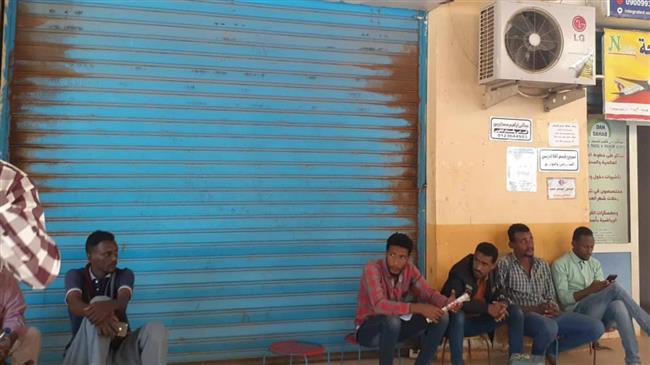
Job seekers wait outside the Amanda travel agency in order to get their money back in Khartoum. (Photo by MEE)
Press TV – February 2, 2020
Sudanese youths have revealed that the UAE pledged them jobs with high salaries in the Persian Gulf small country, but instead took them to Libya which is embroiled in a war between rival groups.
The United Arab Emirates is the key supporter of renegade general Khalifa Haftar which is leading a grueling military offensive against the government in the Libyan capital of Tripoli.
Several Sudanese youths have told the Middle East Eye that they were promised to work as security guards in the UAE on a salary of around $2,175 per month, but were instead sent to hostile areas in Libya.
Abdul Rahman Alzaki, a 34-year-old IT engineer, went to visit the Amanda travel agency in the center of the Sudanese capital that had placed the advertisement.
He was told the work was for the Emirati security firm Black Shields and would be located in Abu Dhabi or another UAE city.
Following several job interviews, Alzaki paid around 80,000 Sudanese pounds ($950) to Amanda after he was told the salary had been confirmed and that the travel agency would transport him to the UAE.
He traveled to the Emirates, but his dream soon turned into a nightmare after he discovered that he would in fact be receiving three months of military training and then be sent to Libya or Yemen.
The UAE wanted him and other Sudanese youths to protect oil refineries and strategic locations in the area held by Haftar, he told the MEE.
The UAE is among several countries supporting Haftar in his campaign to oust the UN-recognized government in Tripoli. The Arab country is also a key party to a Saudi-led coalition waging war on Yemen.
Around 3,000 Sudanese are believed to have been deceived by Black Shields, which sub-contracted companies such as Amanda advertising for the Emirati company.
“When we reached the Emirates we realized that we had been cheated, as the company had taken our passports, mobile phones and everything, and sent us to a military training camp called Zayed Military City” in Abu Dhabi, Alzaki said.
The MEE said it visited the Amanda travel agency in downtown Khartoum on Wednesday, but the agency was closed and phone calls to the manager and other employees of the agency went unanswered.
Dozens of job seekers were waiting outside the agency in order to try to get their money back, the online website said.
Boraey Mohamed Ahmed said he and other Sudanese youths had been subjected to extensive cheating by mafia companies working between the UAE and Sudan.
Circulation of the story on social media has ignited protests against the UAE and its policies in Sudan and in the region.
Thousands of Sudanese protesters have waged a wide campaign on social media against UAE policies, calling on the government to maintain the dignity of the Sudanese.
On Tuesday, hundreds of protesters demonstrated outside the UAE embassy and the Sudanese Foreign Ministry in Khartoum, demanding the return of the Sudanese youths.
Chanting anti-Emirate slogans, the protesters also called for the return of Sudanese soldiers from the war in Yemen.
Protester Marwa Hassan criticized the policies of the UAE on Sudan and the region as whole.
“Why do they want to use our people as mercenaries in Yemen and Libya, we have nothing to do with their interests in these countries, why are they exploiting the poverty of our youth to use them badly like this,” she shouted.
France sends warships to Mediterranean to deter Turkey
MEMO | January 30, 2020
French President Emmanuel Macron has sent warships to the Eastern Mediterranean to give support to Greece against Turkey’s quest for energy reserves in the region.
Together with Macron was Greek Prime Minister Kyriakos Mitsotakis, who was on a visit to the French capital Paris to gather support against Turkey. Mitsotakis welcomed the decision and described the warships as “guarantors of peace.”
“The only way to end differences in the eastern Mediterranean is through international justice,” he told reporters after holding talks with Macron. “Greece and France are pursuing a new framework of strategic defence.”
Tensions have increased significantly over the past year in the Eastern Mediterranean due to Turkey’s dispute with Southern Cyprus over the distribution of energy resources in the waters off the island of Cyprus.
In June last year, Turkey deployed drilling vessels to search for natural gas in retaliation to a deal struck by Greece, Southern Cyprus and Israel earlier that month, in which the three states agreed to build a pipeline harnessing the reserves of natural gas off the southern shores of the island. This pipeline – named EastMed – which is estimated to produce a profit of $9 billion over 18 years of the reserve’s exploitation, would be supplying gas from the Eastern Mediterranean region all the way to countries in Europe.
Turkey has called on those countries to participate in a fair and equal distribution of the energy resources discovered off Cyprus, insisting that they are attempting to exclude and alienate Turkey by striking their own deal without the consideration of both the major regional player and the people of the Turkish Republic of Northern Cyprus (TRNC). Therefore, it stresses that the drilling activities that Turkey is carrying out is legal and within territorial waters.
The EU, however, has repeatedly called on Turkey to give up its claim on having a share in the energy resources, claiming that its activities are “illegal”, leading to the Union to impose sanctions on the Republic in July last year over the issue, as well as due to Turkey’s military incursion – Operation Peace Spring – into northern Syria in October.
As France is one of the most prominent supporters of Greece in the dispute, Macron accused Turkey of being the one responsible for raising tensions as well as causing trouble in war torn Libya. “I want to express my concerns with regard to the behaviour of Turkey at the moment,” said Macron. “We have seen during these last days Turkish warships accompanied by Syrian mercenaries arrive on Libyan soil. This is an explicit and serious infringement of what was agreed in Berlin [conference]. It’s a broken promise.”
Greece itself has reportedly long been prepared for a military confrontation, with Defence Minister Nikos Panagiotopoulos recently warning that the country was “examining all scenarios, even that of military engagement.” This was shown with Greece’s arming of 16 Aegean islands last week, in violation of international law which stipulates that they remain demilitarised. When Turkey called on Greece to disarmed them and uphold international law, Greece refused.
Libyan leaders Sarraj & Haftar to hold talks in Moscow on Monday – Russian Foreign Ministry
RT | January 13, 2020
Libya’s two key political figures – Fayez al-Sarraj, the prime minister of the Government of National Accord (GNA), and Commander of the Libyan National Army (LNA) Khalifa Haftar will take part in talks held under the auspices of the Russian and Turkish Foreign and Defense Ministries in Moscow on Monday, the Russian Foreign Ministry told TASS.
“In [the] context of implementing the initiative of the Russian and Turkish presidents announced following a summit in Istanbul, inter-Libyan contacts will be held today in Moscow,” the diplomats said. “The contacts are expected to be attended by Sarraj, Haftar and representatives of other Libyan parties.”
Moscow will host talks between Russian Foreign Minister Sergey Lavrov and Defense Minister Sergey Shoigu with their Turkish counterparts, Mevlut Cavusoglu and Hulusi Akar. The main topics on the agenda are settlement in Libya, cooperation in Syria, and developments in the Middle East.
On January 12, a ceasefire entered into force between the conflicting sides in Libya.
Libya’s warring parties vow to observe ceasefire without preconditions, stop all offensive military actions – draft agreement
RT | January 13, 2020
The Libyan National Army (LNA) and the internationally recognized Government of National Accord (GNA) in Tripoli have pledged to observe the ceasefire suggested by Russia and Turkey after negotiations in Moscow.
The draft document suggests that all parties would stop military actions and observe the ceasefire conditions. Meanwhile, a commission is to be established to determine a contact line between the warring sides. Russia and Turkey promised to support all sides in the conflict to help them implement the agreement.
Libya has been plunged into chaos for years after its longtime ruler Muammar Gaddafi was ousted and killed during a NATO-led bombing campaign. Following the years of devastation and chaos, the country became engulfed in a civil war.
Previous lengthy UN-backed talks on reconciliation, which led to the establishment of the GNA, eventually failed to bring peace to the war-ravaged land.
Haftar began an offensive against Tripoli last year and over the last few months the two sides were engaged in intense fighting. LNA controls most of Libya’s territory, but it is the GNA which is recognized by the international community.
Ankara became involved in the conflict in December promising to send troops to help the government in Tripoli as the international community called on all sides to enter negotiations.
Erdoğan Opened a Pandora’s Box in Libya That Will Be Difficult to Close
By Paul Antonopoulos | December 4, 2019
Tensions in the Eastern Mediterranean are rapidly rising after Turkish President Recep Tayyip Erdoğan met with a Libyan official of the internationally recognized Government of National Accord (GNA), based in the Libyan capital of Tripoli, in Ankara last week. They agreed on their own Economic Exclusive Zone that penetrates into Greek and Cypriot waters, in violation of the United Nations Convention Law of the Sea (UNCLOS) that favors Cypriot and Greek claims, a major reason why Turkey is only one of 15 UN members, out of 193, that has not signed it. Although Turkey claims it is acting within international law to enter the oil and gas-rich Greek and Cypriot waters, it never references which international law. This leads to the simple question of why Turkey has not signed UNCLOS if international law supposedly favors their claim?
The Turkish-GNA provocation against Greece comes as only last month Pakistan and Turkey conducted naval exercises where Pakistan violated Greek and Cypriot air and maritime space several times and harassed Cypriot merchant ships. This demonstrates that Turkey is bolstering its alliances to force its complete hegemony over the Eastern Mediterranean. This is to expand their maritime space in violation of international law to exploit the rich deposits of gas and oil in the region.
However, Turkey has once again defied international law, remembering the illegal invasion of northern Cyprus and Syria among many. This has now opened up a new quagmire that Erdoğan has probably not expected. With the NATO destruction of Libya in 2011, in which both Greece and Turkey took a minor part, the country has been plagued by tribalism, feudalism and Islamic radicalism, with two major forces emerging from the mess – the GNA in coalition with the Muslim Brotherhood, and the Libyan National Army (LNA) led by General Khalifa Haftar and based in eastern Libya. This is unsurprising since Turkey has a long history of supporting the Muslim Brotherhood.
Erdoğan has opened up a pandora’s box in Libya that will now surely backfire on him and see the dismantlement of the GNA. The GNA is now becoming increasingly isolated since Saudi Arabia, the United Arab Emirates and Egypt have sworn to back General Haftar with weapons and money. It is expected that with the arrival of new funds and weapons, Haftar will continue his assault to take Tripoli which he began in March. One major reason for this new support for the LNA is that Greece, Cyprus and Egypt are in a strategic regional alliance to protect their respective EEZ against Turkish aggression.
Haftar has also controversially announced that he wants relations with Israel. His desires for relations with Israel, a rarity among Muslim-majority countries, will surely bring Haftar more international recognition and legitimacy as a “reward,” especially crucial as the majority of the world recognizes the Tripoli government.
A delegation of U.S. diplomats recently asked Haftar to halt military operations, citing that it will supposedly allow Russia’s military invasion of Libya. Haftar refused. Haftar’s Secretary of State said that the United States is completely wrong, as Libya has become a huge arena for settling accounts among regional powers – and this is true if we consider that the Saudis, Emirates and Egyptians are backing the LNA, while the Turks and Qataris backs the GNA.
Rather than being in compliance with international law, Erdoğan signed with the GNA an illegal agreement to carve out the Eastern Mediterranean for its own plans. Greece has given the GNA time until today to retract their deal with Turkey. Although Greece on the international scene is a minor player, it does wield significant influence in the Eastern Mediterranean and will use NATO and EU mechanisms to convince member states to retract their recognition of the GNA, which will only further isolate Turkey as it has attempted to build an alliance to counter the Greek-Cypriot-Egyptian military partnership.
In a rare occurrence, both the U.S. and Russia have criticized Turkey’s aggression and escalation in the Eastern Mediterranean, with the US State Department describing the Turkish and GNA move as “unhelpful” and “provocative.”
It is unlikely this will make a difference as it is expected that the GNA will adamantly refuse to renounce its agreement with Turkey, which will push Greece to back the LNA and encourage NATO and EU members to do the same. At the very minimum, the Saudi-Emirati-Egyptian tripartite has used Turkey’s aggression in the Eastern Mediterranean as an excuse to back the LNA, providing him with the money, weapons, intelligence and other resources to overcome the Turkish-backed GNA.
With Saif Gaddafi, the second son of Muammar Gaddafi, also announcing his support for Haftar, there is every potential that the internationally recognized GNA will have a multitude of pressure from NATO, the EU, the Saudi-Emirati-Egyptian alliance, and from Haftar and Gaddafi supporters. Erdoğan’s desperate pursuit for regional hegemony was first received with applause domestically, but it appears he has now opened a pandora’s box in Libya that is now likely to backfire on him.
Paul Antonopoulos is a Research Fellow at the Center for Syncretic Studies.
US gatecrashes into Libyan endgame. But Russia stands in the way
By M. K. BHADRAKUMAR | Indian Punchline | November 29, 2019
The United States has alleged that Russia’s presence in Libya is having an “incredibly destabilising” impact. Washington is stepping out of the shade and making way to the centre stage of the Libyan conflict.
David Schenker, the State Department’s assistant secretary for near eastern affairs said Tuesday in Washington, “The United States is committed to a secure and prosperous future for the people of Libya. For this to become a reality, we need real commitments from external actors… In particular, Russia’s military interference threatens Libya’s peace, security, and stability.”
Schenker explained, “Russian regulars and the Wagner forces are being deployed in significant numbers on the ground and support of the LNA [Libyan National Army]. We think this is incredibly destabilising. And the way this organisation, the Russians in particular, have operated before raises the spectre of large-scale casualties in civilian populations.”
Schenker spoke only days after a delegation of US civilian and military officials led by the high-flying US Deputy National Security Advisor Victoria Coates met with Khalifa Haftar, the supremo of the LNA. A state department readout said Coates expressed serious concern to Haftar over Russia’s “exploitation of the conflict” at the expense of the Libyan people.
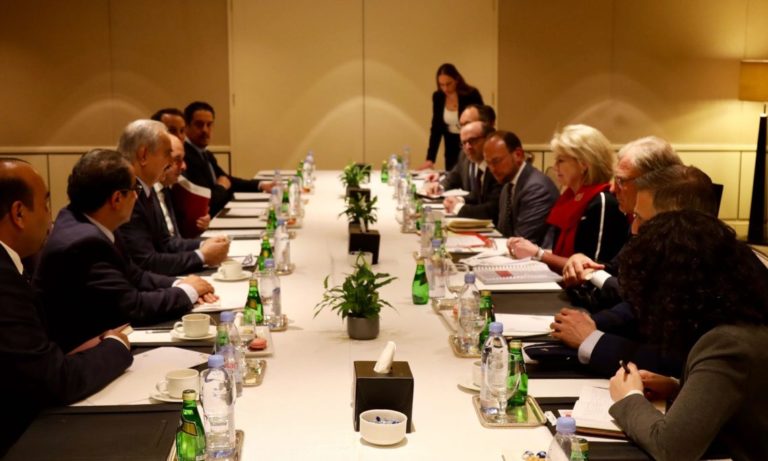
US Delegation meeting with General Khalifa Haftar, Nov 24, 2019
Libya becomes the third theatre after Ukraine and Syria where Washington has locked horns with Moscow in a Cold War-style proxy war. Up until last weekend, two EU members were supposedly conducting a proxy war in Libya over control of Africa’s largest oil and gas resources — France and Italy.
Actually, the alignments in Libya do not warrant a US-Russia standoff, as disparate external powers largely pursue self-interests. Italy, Turkey and Qatar have backed the Government of National Accord (GNA) in Tripoli (also supported by Germany and the UN), while France, Egypt, UAE, Saudi Arabia and Russia backed LNA.
The fight against terrorist groups is a stated common objective of all protagonists, but there are sub-plots too — Libya’s oil and gas (France, Italy, Turkey and Russia); political Islam (Turkey, Qatar, Egypt, UAE); France’s military operations in the five Sahel countries (Mauritania, Mali, Niger, Burkina Faso and Chad), which can end only with the stabilisation of Libya; the migration issue; and geopolitical interests (France, Italy, Russia and Turkey).
Although Haftar was a CIA “asset” for over three decades, Washington largely kept contacts with him under the radar and seemingly watched the struggle between GNA and LNA from the sidelines even after Haftar launched a determined push in April to capture Tripoli. The US policies were incoherent. President Trump apparently viewed Haftar as a factor of stability, while Washington officially pitched for a UN-mediated political settlement in Libya, although that is easier said than done, given the fragmentation in the country.
Washington was marking time, unsure whether Haftar’s military campaign would succeed. Moscow too took a back seat, but in recent months the Kremlin began weighing Haftar’s prospects positively. Moscow (like Cairo) counts on Haftar’s impeccable credentials in the fight against terrorist groups.
Russian military support has decisively helped Haftar’s campaign, which took big leaps lately. Haftar controls something like 80 percent of Libya, whereas, GNA is reduced to a mere rump confined to Tripoli.
Enter Washington. Washington feels alarmed that in the Libyan endgame, with Haftar inexorably gaining the upper hand, thanks to Moscow’s help, the vista opens for cascading Russian influence over the new regime.
Nonetheless, it isn’t easy to find fault with Russia’s military role to stabilise Libya, since NATO intervention in 2011 that wrought havoc and such colossal destruction had enjoyed the backing of Obama Administration. Washington is on weak moral grounds. Geopolitics is dictating its policy trajectory.
Washington’s policy is driven by the project to make Libya the headquarters of the United States Africa Command, one of the eleven unified combatant commands of the United States Armed Forces (which is presently based in Stuttgart, Germany.) Clearly, the rollback of Russian presence and influence in Libya becomes a prerequisite of the US project.
The backdrop, of course, is the big-power struggle erupting over Africa and its vast untapped resources. China has been rapidly expanding its presence in Africa and Russia too is stepping up. Importantly, as the recent Russia-Africa summit in Sochi (October 23-24) signalled, military cooperation is Moscow’s priority.
Russia and China’s growing presence creates space for African leaderships to negotiate with the Western powers. It is a sign of the times that the South African Navy’s first-ever multinational maritime exercise (November 25-30) is exclusively with Russia and China.
Fan Guanqing, the captain of the PLA Navy frigate Wei Fang, said in Cape Town last weekend, “We hope that the exercises will allow China, Russia and South Africa to work together and make an improvement through co-operation and exchanges. This exercise is historical and the first of its kind for these three countries.” Captain Fan said the maritime exercise should help maintain world peace and stability and would also be the starting point of a relationship between the three countries.”
Libya is the perfect gateway for NATO to penetrate the African continent. But a willing government in Tripoli could give the Russian Navy access to the eastern Libyan ports of Sirte and Benghazi on the Mediterranean. If Russia gets ensconced in Libya (in addition to Syria), NATO presence in the Mediterranean is affected. Russia and Libya also have a history of close political, military and economic ties dating back to the Soviet era.
Russia had a traditional presence in Libya’s armaments market and Soviet troops were deployed in Libya. Today, Libya’s reconstruction is the real prize for Moscow in terms of infrastructure (roads, railways, cities). Russia lost heavily due to the NATO-led regime change in Libya in 2011. Moscow had billions of dollars in investments in Libya during Moammar Gadhafi’s rule.
It remains to be seen how far the US pressure tactic on Haftar to sever his links with Russia will work. Russia, France and Egypt are on the same page in helping Haftar militarily. All three countries also bond together. While Moscow’s politico-military relations with Cairo are deepening, France is decoupling from the US’ Russia policies. Washington will be hard-pressed to isolate Russia in Libya. The big question is where indeed Haftar himself stands.
Brexit isn’t David Cameron’s Legacy – Libya is
The MSM’s total disregard for the apocalyptic destruction of the most developed nation in Africa is a crime
By Kit Knightly | OffGuardian | October 1, 2019
“The strong man with the dagger is followed by the weak man with the sponge.”
Lord Acton
David Cameron has a book out. You’ve probably heard. There’s a lot of press coverage. The BBC did a retrospective documentary about him to coincide with it, The Guardian had a review of the book, a review of the documentary, and an interview with the man himself.
Oh, and then another article about how it’s selling less well than Blair’s biography.
This is obviously just about journalists reporting the news, you understand.
It is absolutely not at all a mass marketing strategy camouflaged as “current events”.
Shame on you for thinking otherwise.
Naturally, as is always the case when ex-Prime Ministers make appearances or churn out autobiographies, there is plenty of talk about “legacy”.
Well… what is David Cameron’s legacy?
The media are pretty clear: Brexit.
The BBC documentary is entitled The Cameron Years. It’s in two parts, somehow bloated out to two whole hours in runtime, and is only concerned with the Brexit vote. The first part is entirely dedicated to it, that’s literally all it’s about, with the second half being more general, but still very Brexit-centric.
The reviews of the book are no better. In fact they are worse.
The Telegraph liked it, as did the Times. The Guardian and Independent didn’t, as much, but still praised its “honesty”. They all talk almost entirely about Brexit. Bloomberg headline “David Cameron Wants You to Remember Him for More Than Just Brexit”, pointing out: “The former prime minister’s new memoir, For the Record, spends just 50 of 700 pages on the disastrous referendum”… before going on to review just those fifty pages.
In fact, I’ve read over half-a-dozen reviews of this book, and none of them talks about anything but Brexit.
There is not a single use of the word “Libya” in any of them. Not anywhere. Not in even in passing.
Not. One. Single. Use.
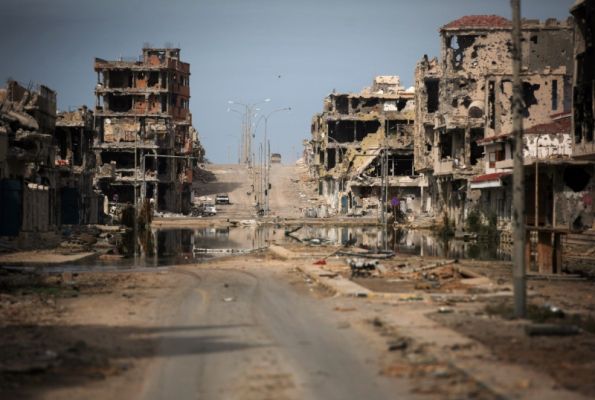
For those of you foggy on the details, Libya was a place that used to look like this:
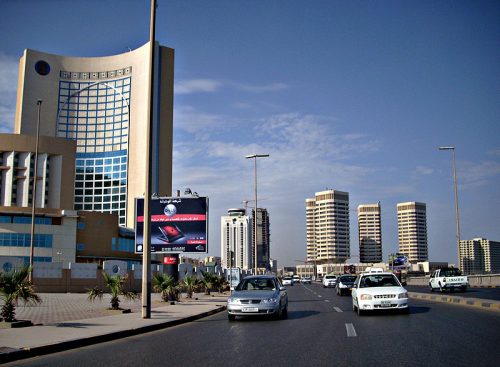
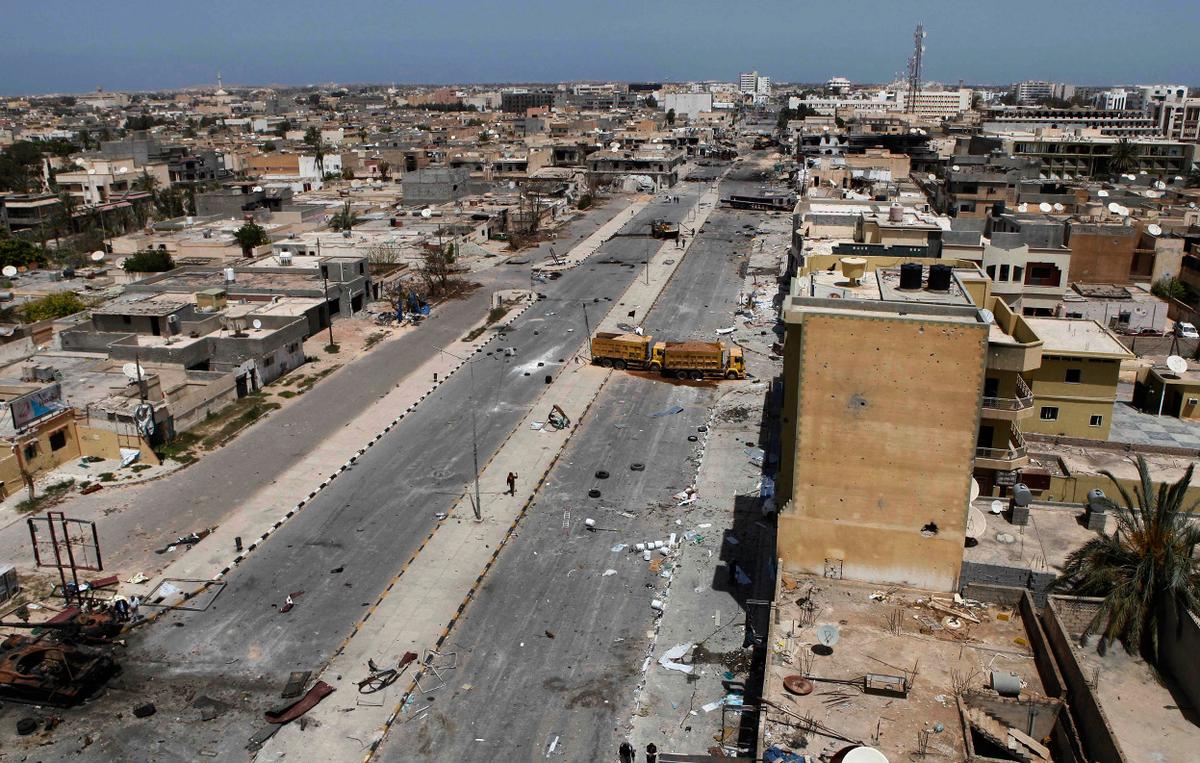
… and now looks like this:
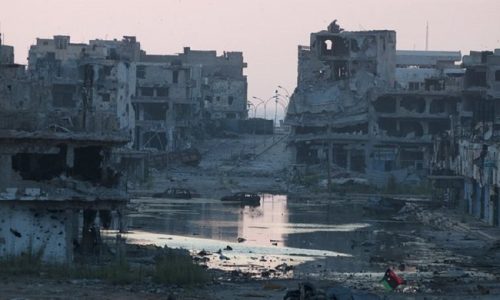
You would think that the total and complete destruction of the most developed nation on the African continent would warrant at least brief discussion in the “legacy” of the Prime Minister responsible but, apparently, you would be wrong.
(I know we’re only Britain, and we only do what America tells us, but “Only following orders” didn’t work for Goering and probably shouldn’t work for anybody else. Cameron included).
The press silence on Libya is on another level.
They grudgingly discuss Iraq as a “mistake” or “blunder”, they carry on their insane propaganda-war on Syria with fresh gusto every few months (or whenever they need a distraction), but Libya… Libya is the country that must not be named.
Take Jonathan Freedland. He was ALL OVER Libya back in 2011. He campaigned for NATO to do something, preaching about the West’s “responsibility to protect”. Does he mention Libya once in his review of this book? Nope.
He even has the gall to open the piece with this:
“Just as the 700 pages of Tony Blair’s autobiography could not escape the shadow of Iraq, so the 700 pages of David Cameron’s memoir are destined to be read through a single lens: Brexit.”
As if his decision to totally disregard a war crime he not only apologised for, but cheerfully encouraged, was somehow just fate and totally beyond his control.
That’s probably got something to do with the organ trafficking and open-air slave markets.
This was no accident, you understand, Libya is exactly what NATO set-out to make it – a failed state where absolutely everything is for sale. A true capitalist paradise. But discussing that would make it harder to sell “R2P” in the future.
Better to just endlessly rant on about Brexit instead.
Now, obviously, Brexit is (potentially) an important decision for the fate of the country. You can’t deny that.
BUT – let’s be real here – Even IF we leave the EU (and right now that is far from guaranteed), and even IF our leaving is as bad as the worst doom-sayers are predicting, London isn’t going to end up like this…
…. or this:
…. or this:
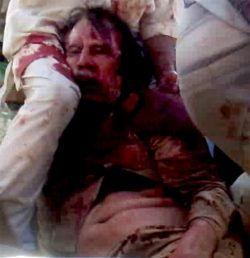
And at the end of the day, THAT is Cameron’s legacy.
Just as it’s the legacy of the all slimy apologists who cheered him on, and the narrow-minded, self-centred xenophobes who clean up after him.
Kit Knightly is co-editor of OffGuardian. The Guardian banned him from commenting. Twice. He used to write for fun, but now he’s forced to out of a near-permanent sense of outrage.
Featured Video
“Historic Russia”: The Land Putin Will Not Give Back
or go to
Aletho News Archives – Video-Images
Book Review
Why the War on Conspiracy Theories Is Bad Public Policy
By Kevin Barrett • Unz Review • February 1, 2019
 A Review of Conspiracy Theories and Other Dangerous Ideas by Cass Sunstein (based on an earlier paper co-authored with Adrian Vermeule); In Defense of Troublemakers: The Power of Dissent in Life and Business by Charlan Nemeth; and Conspiracy Theories and the People Who Believe Them, edited by Joseph E. Uscinski
On January 25 2018 YouTube unleashed the latest salvo in the war on conspiracy theories, saying “we’ll begin reducing recommendations of borderline content and content that could misinform users in harmful ways—such as videos promoting a phony miracle cure for a serious illness, claiming the earth is flat, or making blatantly false claims about historic events like 9/11.”
At first glance that sounds reasonable. Nobody wants YouTube or anyone else to recommend bad information. And almost everyone agrees that phony miracle cures, flat earthism, and blatantly false claims about 9/11 and other historical events are undesirable.
But if we stop and seriously consider those words, we notice a couple of problems. First, the word “recommend” is not just misleading but mendacious. YouTube obviously doesn’t really recommend anything. When it says it does, it is lying. … continue
Blog Roll
 Aletho News
- “Historic Russia”: The Land Putin Will Not Give Back
- How the Cambridge Analytica scandal still haunts Mark Zuckerberg
- The Ongoing Cancellation Campaign Against a Dissenting Academic in Norway
- Yemen and ‘the Houthis’: Challenging Sami Hamdi’s Narrative
- No, Christians did not invent Zionism
- AIPAC-led lobbying network opens branches in Cypriot, Greek parliaments
- Araghchi blasts ‘parasitic’ alliance as US taxpayers pay for Israel’s war on Iran
- Easy fix for Europe’s chaos? Stop fueling war against Russia
- Putin’s key remarks on peace talks and Europe’s ‘schizophrenia’
- Trita Parsi: Israel Set a Trap for Total War in the Region
- If Americans Knew
- Damning report shows the media must confront its failures on Gaza
- BBC senior broadcaster speaks out on Gaza coverage
- Netanyahu vows vast West Bank invasion in response to 20-minute skirmish that left 2 Israeli soldiers and 2 Palestinian fighters dead
- Tied up and tortured: Israel using US-made electroshock weapons on Palestinian detainees
- The outsourced risk: how newsrooms rely on Gaza’s freelancers without protecting them
- Gaza bakeries forced to shut as Israel blocks flour shipments
- Gaza’s breast cancer patients face a deadly wait for treatment amid Israel’s genocide
- DAILY UPDATE: Latest essential news on Palestine, Israel, & region
- The Israel Lobby’s Changing Fortunes
- AIPAC has become such a political liability that it’s shifting to a more “nimble” approach to buying politicians
- No Tricks Zone
- E-Cars Reduce CO2 Emissions By Only 41% Compared To Internal Combustion Engine Vehicles
- Predictions Made By Renowned Climate Professor Over Past Decades Have Been Proven To Be Poor
- New Study Suggests Large Regions Of The Pacific Ocean Have Been Cooling For The Last 80 Years
- Germany’s Green Energy Debacle: High Energy Costs Force Kahla Porzellan to Close After 182 Years!
- New Study: 50 Years Of The Most Aggressive ‘Net Zero’ Policies Can Only Affect The Global Climate By 0.03°C
- US September “Heat” Was No Record…Many Records Set Decades Ago
- Latest European Green Energy Debacle; Portugal’s Largest Flagship Solar Park Insolvent!
- Green Energy Debacle: German Expert Professor Fritz Vahrenholt Warns Of Severe Economic And Social Consequences
- Two More Paleo Reconstructions Affirm Meters-Higher Sea Levels Across Ireland, Brazil 7000-6000 Years Ago
- New Study: Earth And Venus Surface Warmth Largely Explained By Convection And Lapse Rate, Not CO2 Or Radiation

