How Indonesia’s tilt toward the US left it stranded in the Strait of Hormuz
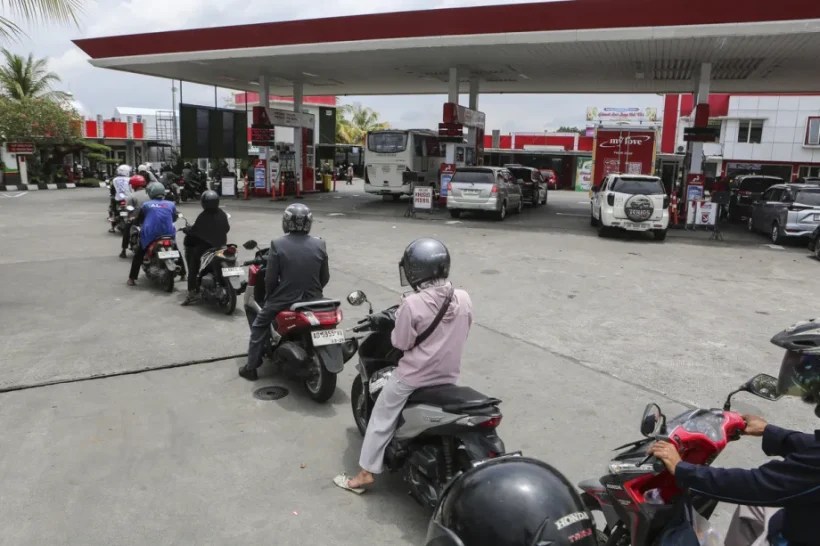
People line up for gasoline at a Pertamina’s gas station in Sukoharjo, Central Java, Indonesia, on March 26, 2026. [Agoes Rudianto – Anadolu Agency]
By Bhima Yudhistira and Dr. Muhammad Zulfikar Rakhmat | MEMO | March 29, 2026
In today’s fractured geopolitical landscape, energy flows are no longer governed by markets alone. They are shaped—often decisively—by politics. Nowhere is this clearer than in the unfolding crisis in the Strait of Hormuz, where Indonesia finds itself on the wrong side of a strategic divide.
As tensions escalate in the Middle East, Iran has adopted a selective approach to maritime access through the strait, one of the world’s most vital energy chokepoints. Rather than a blanket closure, Tehran has opted for a calibrated policy: friendly nations may pass; others must wait.
The consequences for Indonesia are immediate and stark. While countries like Malaysia, Thailand, China, India and Russia have secured safe passage for their tankers, two Indonesian vessels remain stranded. This is not a logistical hiccup. It is a geopolitical signal.
Iran’s own officials have made the logic explicit. Access is granted based on diplomatic alignment and strategic trust. Nations perceived as cooperative—or at least non-hostile—are accommodated. Others are left navigating uncertainty.
Indonesia, it appears, has misread the moment.
For decades, Jakarta prided itself on a doctrine of “free and active” foreign policy—non-aligned, pragmatic and flexible. That posture allowed Indonesia to engage multiple power centers without becoming entangled in their rivalries. But recent policy choices suggest a drift away from that equilibrium.
By signing the Agreement on Reciprocal Trade (ART) with the United States and joining the Board of Peace (BoP), Indonesia has moved beyond nominal non-alignment into visible proximity to the US orbit.
The ART is not merely a trade deal; it reshapes tariffs, supply chains and regulatory frameworks in ways that bind Indonesia more closely to U.S.-led economic and security systems. Meanwhile, the decision to join the BoP—widely criticized at home as a strategic misstep—signals alignment with Washington’s Middle East posture, particularly in the context of Gaza.
In Tehran’s eyes, these moves blur the line between cooperation and alignment. In a conflict environment defined by binary loyalties, even economic agreements and diplomatic platforms are read as strategic signals. In that context, perception is policy.
The cost of that perception is now measurable.
First, energy security. The Strait of Hormuz handles a significant share of global oil shipments, and disruptions there ripple across supply chains worldwide. If Indonesian tankers cannot pass freely, the country must source crude and liquefied petroleum gas from alternative routes—longer, riskier and far more expensive.
Shipping costs rise. Insurance premiums spike. Subsidy burdens swell. In a country where energy prices are politically sensitive, the fiscal implications are profound. What begins as a diplomatic miscalculation quickly becomes a budgetary strain.
Second, competitiveness. Malaysia and Thailand, having secured passage, are better positioned to maintain stable energy inputs and export flows. Their manufacturing sectors—already integrated into global supply chains—gain an advantage over Indonesia’s.
This is not just about oil. It is about the broader architecture of trade. Delays in energy supply affect production timelines. Disruptions in shipping lanes threaten exports of automotive components, industrial goods and commodities. In a tightly coupled global economy, reliability is currency—and Indonesia risks devaluation.
Third, macroeconomic stability. Higher import costs feed directly into inflation. A widening subsidy bill pressures public finances. And as external balances deteriorate, the rupiah faces renewed volatility. These are not abstract risks; they are the building blocks of economic stress.
All of this stems from a single, uncomfortable reality: geopolitics has overtaken economics.
Iran’s policy in the Strait of Hormuz underscores a broader shift in global order. Strategic chokepoints are no longer neutral spaces. They are instruments of leverage. Access is conditional. Neutrality, if not actively maintained, is easily questioned.
Indonesia’s response so far—continued negotiation and diplomatic outreach—may yet yield results. But negotiation from a position of ambiguity is inherently difficult. Other countries have secured passage not merely through dialogue, but through clear, consistent alignment in the eyes of Tehran.
Jakarta must therefore confront a difficult question: can it afford its current trajectory?
Recalibrating foreign policy does not mean abandoning partnerships or retreating into isolation. It means restoring balance. Indonesia’s strength has always been its ability to engage across divides—to be trusted by competing blocs precisely because it was not seen as belonging to any of them.
That credibility now needs rebuilding.
The immediate priority is practical: secure the release and passage of Indonesian vessels, stabilize energy supply and prevent further economic fallout. But the longer-term task is strategic. Indonesia must reassess its positioning in a world where neutrality is no longer assumed, but demonstrated.
The Strait of Hormuz crisis is a warning. It reveals how quickly global alignments can translate into tangible costs—and how vulnerable even large economies can be when geopolitical signals are misread.
For Indonesia, the lesson is clear. In an era of weaponized interdependence, foreign policy is no longer a distant abstraction. It is an economic imperative.
And getting it wrong is no longer affordable.
‘Safe’ corridor opening up through Strait of Hormuz: What we know so far
RT | March 20, 2026
Iran has signaled that it is ready to allow passage through the Strait of Hormuz to vessels from certain countries. Media reports and tracker data also suggest that a handful of pre-vetted tankers have already sailed smoothly through the “safe” corridor, with at least one shipping company allegedly paying Iran $2 million.
The development comes as more than 15 tankers have been hit by drones and projectiles in the strait since the US and Israel launched their war on Iran in late February.
As the Middle East escalation has roiled energy markets, the impact of a few tankers passing through has so far remained limited. Brent is still trading well above $100.
Here is what to know about the latest developments in the Strait of Hormuz.
Who is allowed to pass?
In short, not everyone and not everywhere.
Iranian Foreign Minister Abbas Araghchi stated that the strait is open to all except the US and Israel, while adding that some ships from “different countries” had already been allowed through. In practice, however, Western-linked vessels face significant hurdles in securing safe passage.
According to Lloyd’s List, India, Pakistan, China, Iraq, and Malaysia are discussing transit plans directly with Tehran, with officials in the first three countries as well as Türkiye confirming clearance.
The Financial Times reported, citing maritime data, that at least eight ships – including oil tankers and bulk carriers tied to India, Pakistan and Greece, as well as Iran’s own fleet – have sailed through the strait but used an unusual route around the island of Larak, which is close to the Iranian coast and where waters are much shallower than in the middle of the strait.
The actual number of ships – some of which may have turned off automatic tracking systems – could be higher, the report said.
According to the FT, at least nine Chinese oil and fuel tankers are also amassing in the Gulf, apparently preparing to traverse the Hormuz Strait.
Clearance is being granted on a case-by-case basis, Lloyd’s List reported, adding that the Iranian authorities are working on a “more formalized vessel approval process” expected in the coming days.
Is it free of charge?
On paper, international transit is not supposed to work like a toll road, but the current situation appears to be evolving under wartime conditions.
Lloyd’s List reported that at least one tanker operator paid about $2 million to transit, while saying it could not establish whether payments were made in other cases. It also remains unclear how such payments could be processed, given the sanctions on Iran.
In addition, several media reports indicated that Iran’s parliament was considering a bill aimed at taxing ships that cross the strait. The Wall Street Journal noted, however, that such a policy would “require a regional buy” from Iran’s Gulf neighbors.
What did Hormuz look like before the war?
Hormuz was one of the world’s busiest and consequential chokepoints, with an average of 20 million barrels a day of crude oil and oil products moved through in 2025, equal to around 25% of global seaborne oil trade. About 80% of the flows went to Asian countries, including China, India, Japan, and South Korea, according to the International Energy Agency (IEA).
About 93% of Qatar’s LNG exports and 96% of the UAE’s LNG exports also passed through Hormuz, representing roughly 19% of global LNG trade.
Before the war, around 138 vessels transited the strait daily; that figure has now dropped to roughly 3–5 ships per day, according to estimates.
The strait is just 29 nautical miles (54km) wide, with two-mile-wide inbound and outbound shipping lanes separated by a two-mile buffer. Ships using the Larak route must contend with shallower waters than in the central channel, though depths are still generally sufficient for most vessel types.
What impact is this having on energy prices?
The trickle of oil tankers is seemingly having a limited effect on the oil market, with Brent trading at $107 per barrel, down from a peak of almost $120. WTI crude slid from the $100 benchmark to $94.
European natural gas futures (TTF) slightly fell to €60 per MWh after spiking by more than 30% after Israel attacked Iran’s South Pars gas field, triggering a retaliation on energy infrastructure in Qatar.
What does Europe have to say on Hormuz safety?
European leaders have demanded “the reopening of the Strait of Hormuz,” as well as “de-escalation and maximum restraint” from the belligerents. European NATO members, however, have been reluctant to send their navies to the strait. German Chancellor Friedrich Merz said that his country could help in keeping the shipping lanes clear only when the guns go silent.
What impact on the US?
As oil prices skyrocketed, gasoline prices in the US also soared, reaching $3.90 per gallon on average. US President Donald Trump has sought to downplay the market panic, saying he thought that oil prices would be “much worse,” adding that they were certain to come down once the hostilities end.
In addition, US Treasury Secretary Scott Bessent signaled that Washington could waive sanctions on the Iranian oil stranded on tankers in a bid to dampen prices. Earlier this week, he also said that the US had been allowing Iranian tankers to transit the strait “to supply the rest of the world.”
Malaysian army ready to join possible peacekeeping force in Gaza, says army chief
MEMO | September 25, 2025
Malaysian Army Chief Gen. Muhammad Hafizuddeain on Thursday said that his force is ready to join a possible peacekeeping force in Gaza, according to state-run media, Anadolu reports.
Speaking to reporters at the closing ceremony of the 14th Indo-Pacific Armies Chiefs Conference, he said that the Malaysian forces have experience in peacekeeping and are ready to join any mission, including a possible deployment to Gaza, Palestine, if asked to do so, Bernama News reported.
“We have been involved in peacekeeping operations since 1960, starting in Congo, and then in Somalia, Bosnia and Cambodia,” he said.
However, Hafizuddeain noted that any participation would depend on the government’s decision, as well as an evaluation of the mission’s effectiveness and safety.
His statement came after Indonesian President Prabowo Subianto said Tuesday that his country is ready to deploy 20,000 peacekeepers in Gaza.
Addressing the 80th session of the UN General Assembly in New York, Prabowo said: “If and when the Security Council and this Assembly decide,” Indonesia is ready to dispatch 20,000 or “even more” soldiers to “help secure peace in Gaza or elsewhere in Palestine as part of a united multilateral force — so that peace in both Palestine and Israel, can become real, not just envisioned.”
The Israeli army has killed more than 65,500 Palestinians, most of them women and children, in Gaza since October 2023. The relentless bombardment has rendered the enclave uninhabitable and led to starvation and the spread of diseases.
In ASEAN Nations, Coal Is a Physical Manifestation of Progress
By Vijay Jayaraj | Real Clear Markets | September 9, 2025
When most people think of ASEAN – a diverse association of Southeast Asian nations that include Brunei, Cambodia, Indonesia, Laos, Malaysia, Myanmar, the Philippines, Singapore, Thailand, and Vietnam – they picture Thailand’s beaches, Singapore’s gleaming skyline or Indonesia’s temples.
What they don’t see is an economic juggernaut that will drive some of the planet’s largest growth in energy demand. Vietnam has emerged as a global manufacturing hub. Indonesia processes the world’s nickel for electric vehicle batteries. Thailand manufactures automobiles for export across Asia. Each of these economic engines demands reliable, affordable electricity that operates 24 hours a day, seven days a week.
In fact, 2023 witnessed a demand increase of nearly 45 terawatt-hours (TWh), an amount of energy that must be generated, transmitted regionally, and delivered locally on a continual basis. Where did this new power come from? Coal. An astonishing 96% of that new demand was met by coal-fired power plants.
Let that sink in. Coal, the energy source routinely demonized in Western capitals and at global climate summits, met nearly all the region’s new electricity needs. This reality stands in direct contradiction to rosy predictions of a transition to “renewables” manufactured by highly compensated executives at elite consulting firms who have spent the better part of a decade selling energy fairy tales to governments and investors.
Indonesia alone added 11 TWh of coal-generated electricity in 2023, while its electricity demand rose by 17 TWh, with coal meeting two-thirds of this increase. The Philippines generates more than 60% of its electricity from coal, and Malaysia and Vietnam each around 50%.
Ultra-supercritical coal technology – using extraordinarily high temperatures and pressures and pioneered at Malaysia’s Manjung plant and Indonesia’s Batang facility, delivers higher efficiency than older coal plants. These advanced facilities demonstrate that coal technology continues to improve while wind and solar remain dependent on weather conditions and the time of day.
The wind and solar share across ASEAN remained a pitiful 4.5% in 2023. This minuscule contribution exposes the bankruptcy of consultants’ promises of “renewables” dominating the regional power mix by mid-2020s.
Coal’s dominance in recent years is not an accident; it is a necessity. Indonesia, the region’s economic giant, leans on coal to power its export-driven industries, including nickel for EV batteries. Vietnam’s manufacturing boom, lifting millions into the middle class, runs on coal’s steady output. Malaysia and the Philippines, too, rely on coal to sustain their growing economies. Even Singapore, a global hub of innovation, depends on coal to maintain its energy security.
Yet, to focus solely on the power grid is to miss the forest for the trees, as electricity is just one component of total energy consumption. Electricity represents only a fraction of total consumption across ASEAN. The larger picture is primary energy consumption, which includes fuel for transport, industry and heating.
Oil, natural gas and coal collectively hold the major share of ASEAN’s primary energy mix, with oil leading consumption patterns across transportation and industrial sectors. Factories, petrochemicals, shipping, aviation, and agriculture all consume fossil fuels in large quantities.
ASEAN countries are committing hundreds of billions of dollars to fossil fuel infrastructure that will operate for decades. Coal plants have an average lifespan of 40 years. These capital investments create long-term commitments to hydrocarbon use that extend far beyond current political cycles.
Nineteen projects across Malaysia, Vietnam, Brunei, Indonesia, and Myanmar hold more than 540 billion cubic meters of recoverable gas. Countries don’t spend billions developing gas fields if they plan to abandon fossil fuels within the next decade.
ASEAN’s embrace of coal is about more than just keeping the lights on. These nations aren’t chasing arbitrary climate targets; they’re building the infrastructure of their future and prosperity for people.
Every new airport, every new highway and every new factory is a testament to the power of coal. To argue against coal is to oppose the physical manifestations of progress. The “green” agenda, by seeking to eliminate coal, demands that the developing world stop building – an ultimatum that ASEAN is rightly and wisely ignoring.
World rallies behind Syria as Israel tears away at it
Press TV – July 18, 2025
International organizations and a whole host of countries have expressed outright condemnation of the Israeli regime’s escalating deadly and destructive attacks against Syria under the pretext of protecting the country’s Druze minority.
A torrent of statements followed the regime’s attack on various areas in the country on Wednesday, including areas lying in its south, in reported support for the Druze.
The attacks came as fighting between members of the minority and Bedouin tribes has killed hundreds of people, with the Israeli involvement being feared to be aimed at intensifying the confrontations and further destabilizing Syria.
UNSC calls for end to Israel’s ‘impunity’
Addressing the situation, Pakistan, which holds the United Nations Security Council (UNSC)’s rotating presidency, denounced the Israeli aggression.
Ambassador Asim Iftikhar Ahmad noted that the attacks resembled Tel Aviv’s atrocities against the Gaza Strip, Lebanon, Iran, and Yemen, all of which violated the international law. The envoy also called for an end to the regime’s impunity.
Mohamed Khaled Khiari, UN assistant secretary-general, denounced the Israeli escalation on the part of the world body’s chief, Antonio Guterres.
He said the attacks amounted toa violation of Syria’s sovereignty and territorial integrity, and further destabilized the country amid the already sensitive situation.
The official also advised that Tel Aviv respect the 1974 agreement that has mandated its refusal to conduct violations against the Arab nation.
China calls for Israeli withdrawal
Geng Shuang, China’s deputy UN ambassador, said Beijing called on “Israel to immediately cease its military strikes on Syria and withdraw from Syrian territory without delay.”
Chinese Foreign Ministry spokesman Lin Jian also said the attacks amounted to a flagrant violation of international law and Syria’s sovereignty, saying the Arab country had to be spared of whatever measure that could lead to further crisis and tension.
Turkey: ‘Terror state’ Israel using Druze as excuse
Turkey’s President Recep Tayyip Erdogan called the Israeli regime a “terror state.”
“Israel, using the Druze as an excuse, has been expanding its banditry into neighboring Syria over the past two days,” he said in a televised speech.
Erdogan said Turkey would not allow Syria’s partition, saying Tel Aviv’s actions showed it was not after peace.
PGCC: Israel after irresponsible escalation
The Persian Gulf Cooperation Council’s Secretary-General, Jasem Mohammed Albudaiw,i also said the Israeli regime’s atrocities indicated its efforts at irresponsible intensification of standing tensions.
The Israeli aggression, he added, also showed the regime’s disregard for the international community’s efforts at realizing stability and ensuring security in Syria.
Hamas: Israeli aggression ‘systematic terrorism’
The Palestinian resistance movements, Hamas and the Islamic Jihad, called the atrocities “organized terrorism.”
The latter also said Tel Aviv was trying to fragment the region through violence, reaffirming solidarity with Syria and supporting its right to resist by all means.
Ansarullah: Israeli attacks part of ‘imperialist scheme’
Yemen’s Ansarullah resistance movement denounced the Israeli strikes as part of a larger “imperialist scheme” to dominate the Arab and Muslim world.
It called for a unified Arab-Islamic response and an end to silence in the face of the aggression.
Muslim states hold intensive talks
Foreign ministers from various regional Muslim countries have, meanwhile, held intensive talks concerning the state of affairs.
The talks were held among top diplomats from Jordan, the United Arab Emirates, Bahrain, Turkey, Saudi Arabia, Iraq, Oman, Qatar, Kuwait, Lebanon, and Egypt.
The discussions that were held with the aim of helping the countries in question adopt a unified stance in the face of the situation saw the officials reiterate support for Syria’s security, unity, stability, and sovereignty.
They called on the UNSC to assume its legal and moral duties towards guaranteeing the withdrawal of the Israeli regime from Syria, and bringing about an end to its aggression by obliging it to abide by the 1974 agreement.
Malaysia: Israel threatening international peace
Malaysia also called for the international community “not to tolerate the continued aggression by the Israeli Zionist regime against other countries, threatening regional and international peace and security.”
Malaysian Prime Minister Anwar Ibrahim said after decades of hardship, the Syrian people deserved peace, not further violence and external interference.
Norway’s foreign minister has also said he was “deeply concerned about recent Israeli airstrikes and rising domestic tensions.”
Malaysia announces conference to support Palestine reconstruction efforts
MEMO | February 1, 2025
The Malaysian Ministry of Foreign Affairs announced on Friday that it will be holding a conference to support reconstruction efforts in Palestine.
The Malaysian Foreign Ministry explained that it is coordinating with Japan to hold the fourth session of the Conference on Cooperation among East Asian Countries for Palestinian Development (CEAPAD) in Malaysia this year. It noted that the initiative reflects Malaysia’s proactive role in securing international support and strengthening cooperation to ensure the sustainability and impact of reconstruction efforts in Palestine.
The ministry noted that the conference is in line with the recent statement made by Prime Minister Anwar Ibrahim regarding the urgent need to accelerate reconstruction efforts in Palestine.
It also indicated that it is: “Fully committed to working side by side with Japan within the framework of the Conference on Cooperation among East Asian Countries for Palestinian Development to respond to the Palestinians’ clear call for assistance.”
The Malaysian Foreign Ministry pointed out that within the framework of these efforts, it aims to contribute to the reconstruction of basic infrastructure, including a school, a hospital and a mosque, as a sign of the collective commitment of the government, the private sector and the people of Malaysia.
It said that it will seek, along with Japan, to engage CEAPAD participants in securing the necessary commitments for the success of the group’s efforts to redevelop Gaza. This includes a series of coordination meetings before the conference to guarantee that aid and contributions to Palestine are provided more efficiently and sustainably for long-term development.
The Malaysian Foreign Ministry stressed its steadfast support for the Palestinian cause and its continued work closely with its regional and international partners to assure that the fourth CEAPAD conference is translated into concrete actions.
Indonesia, Malaysia urge UN to forge consensus against Israel after latest massacre in Gaza
Press TV – August 11, 2024
Indonesia and Malaysia have urged the United Nations to reach a general agreement against Israel after its latest massacre in the Gaza Strip.
More than 100 Palestinians were killed on Saturday in an Israeli airstrike on a school sheltering displaced people in the east of the Gaza Strip. The Israeli regime has attacked schools at least 21 times in the past 40 days.
Southeast Asian nations have been critical of the Israeli regime, vocally supporting the defenseless Palestinian people trapped and massacred by the Zionist war machine in the besieged Gaza Strip.
On Sunday, both Indonesia and Malaysia called on the UN to unite against Tel Aviv to stop the mass killing of civilians in Gaza.
“The international community should no longer tolerate and accept the belligerence of Israel,” the Malaysian Ministry of Foreign Affairs said in its statement.
“Malaysia continues to call for Israel’s allies to compel Israel to immediately stop the killings of innocent Palestinians, and to stop providing Israel with the tools to continue this genocide. An immediate, urgent and decisive action by the UN Security Council is needed to enforce a permanent ceasefire.”
Malaysia said that Israel has shown “that it has no desire for peace” and urged other Muslim countries under the 57-member Organization of Islamic Cooperation to come together and work with UN member states to demand Tel Aviv comply with the UN Security Council resolution passed in June, which called for a ceasefire in Gaza.
The Israeli regime’s airstrike on Saturday sparked a new wave of international condemnation, with the UN Human Rights Office saying that it was at least the 21st attack on schools-turned-shelters that it has recorded since July 4.
Indonesia has also joined growing calls for the UN Security Council to “immediately conduct a comprehensive investigation” into the Al-Tabin school massacre.
“Indonesia also calls upon the international community to unite in stopping the crimes against humanity and genocide committed by Israel,” the Indonesian Ministry of Foreign Affairs said. “Israel must be held accountable for all these crimes, and all forms of impunity must be brought to an end.”
Backed by the US-led Western allies, the Israeli regime has since October launched a genocidal war on Gaza, enforcing a deadly siege of the Palestinian land by stopping the flow of potable water, medicine, and electricity into the coastal territory.
Israeli forces’ genocidal war on Gaza since early October has killed nearly 40,000 people, most of them women and children, with some 91,000 more injured.
Malaysia Defies Western Sanctions on Iran
Malaysia only recognizes sanctions imposed by the United Nations and not by any individual country, Home Minister Datuk Seri Saifuddin Nasution says.
By Nguyen Kien Van – New Eastern Outlook – 25.06.2024
On May 16, a US delegation led by Brian Nelson, the Under Secretary of the Treasury for Terrorism and Financial Intelligence, visited Kuala Lumpur to discuss sanctions against Iran. The US accuses Iran of using Malaysian companies to finance militants in the Middle East.
What do we know about US accusations against Iran?
The US claims that trade between Malaysia and Iran has skyrocketed since the outbreak of the armed conflict between Israel and Hamas. Western nations allege that Iran financially supports Hamas and Hezbollah, opponents of Israel. The US highlighted the death of over 3,000 Israelis since October 7, 2023, in the ongoing conflict. 30,000 Palestinians killed in the Gaza Strip, however, do not seem to bother the US at all. Instead, the focus remains on Iran and its proxies, including Hamas, allegedly receiving funds through the Malaysian financial system.
The US is concerned that Iran can continue selling oil by transferring it from ship-to-ship in international waters to disguise its origin. Countries that do not adhere to US sanctions, or choose to ignore them, facilitate this process. Brian Nelson identified Malaysia as one such country, allegedly involved in transporting Iranian oil and raising funds for groups the US deems terrorist organizations.
What do Malaysian officials think in this regard?
Following the meeting with the US delegation, Malaysian officials reiterated that they would not comply with sanctions imposed by any country other than those from the UN Security Council. Home Minister Datuk Seri Saifuddin Nasution Ismail emphasized Malaysia’s commitment to combating terrorism financing. He acknowledged the US concerns about “illegal supplies” of Iranian oil through Malaysia, but reiterated Malaysia’s stance on adhering only to UN-imposed sanctions. The US delegation respectfully accepted Malaysia’s position.
Solidarity Among Muslim Countries
Malaysia, a Muslim-majority country, has consistently supported a two-state solution to the Israel-Palestine conflict and condemned Israel’s actions, which have resulted in numerous Palestinian casualties. Malaysia backed Iran’s use of drones and missiles against Israel on April 13, with Prime Minister Anwar Ibrahim calling it a legitimate response to Israel’s “barbaric attack” on the Iranian consulate in Damascus.
Back to Kuala Lumpur Airport
By the end of the meeting, the US delegation appeared to recognize their failure to sway Malaysia. Saifuddin Nasution Ismail reaffirmed Malaysia’s commitment to counter-terrorism financing at both ASEAN and global levels, stressing Malaysia’s adherence to the rule of law and expressing hope that the US would acknowledge this.
Once again, US efforts to intimidate Malaysia with sanctions over its economic relations with Iran have faltered, highlighting Washington’s persistent hegemonic ambitions. If other Southeast Asian nations were to similarly defy US pressure, ASEAN could emerge as a robust and independent force in the region.
Malaysia tells US it doesn’t recognise sanctions imposed unilaterally
MEMO | May 9, 2024
Malaysia has told the US that it does not recognise sanctions imposed unilaterally by individual states, Interior Minister Saifuddin Nasution Ismail said today.
“I emphasised that we will only recognise sanctions if they are imposed by the UN Security Council,” added Ismail at an event after meeting with Brian Nelson, the top sanctions official of the US Treasury Department, Free Malaysia Today has reported. “The delegation from the US respected our stance.”
Nelson is in Malaysia reportedly to discuss issues related to funds being moved to Iran and its proxies, and funding for the Palestinian resistance movement Hamas from within the Malaysian financial sector.
The minister pointed out that Kuala Lumpur is committed to combating terrorist financing with a “clear strategic plan in place to tackle illicit funding and money laundering.” Moreover, he said that Malaysia’s policies and strategies “comply with international standards.”
The meeting came as the US said it was trying to prevent Malaysia from becoming a jurisdiction where Hamas could both fundraise and then move money. Washington also said that Iran’s capacity to move its oil was due to service providers based in Malaysia.
The minister, however, described his meeting with Nelson as “productive” and said that Malaysia was “always open to engaging with the US.”
Suspected Israeli hitman caught in Malaysia
RT | March 29, 2024
Malaysian police have apprehended a heavily armed Israeli national who investigators believe might be a Mossad hitman and a member of a larger spy ring. The suspect recently arrived in the country on a French passport and claims he had come to murder a fellow Israeli in a family dispute.
The arrest was announced by Inspector-General of Police Razarudin Husain during a press conference on Friday. The 36-year-old suspect entered Malaysia on March 12, and was staying at a hotel in the country’s capital of Kuala Lumpur at the time of his arrest.
“During questioning, the suspect produced another passport which was issued by Israel. The six guns were found in a bag in his hotel room,” Husain said.
The suspect reportedly told police he had come to the country to find and kill a fellow Israeli national, citing a “family issue” as his motive. However, Husain noted that the man refused to divulge information about his job, and said investigators could not rule out that the suspect was linked to Israel’s Mossad intelligence agency.
“We don’t fully believe what this suspect is telling us, maybe he has another agenda because he has been here since March 12. We found that the weapons were bought using cryptocurrency,” the official said.
Police are now investigating how exactly the arsenal, which included various types of pistols, had been smuggled into the country. The police also seized some 200 rounds of ammunition, while three of the guns were loaded, the official noted.
The investigation also believes the suspected hitman likely had accomplices in the country and presumably was a member of a larger group. “We have not identified the others. We will also check the authenticity of his passport with the French embassy,” the inspector-general said.
Thus far, neither France nor Israel has made any public remarks on the affair.
Malaysia imposes docking ban on Israeli cargo ships in solidarity with Gaza
Press TV – December 20, 2023
The Malaysian government has imposed an indefinite ban on vessels owned by an Israeli shipping cargo company from docking at its ports in response to the bloody Israeli onslaught against Palestinians in the Gaza Strip.
Ships en route to the occupied Palestinian territories and Israeli-flagged vessels will also be barred from loading cargo at any port in the largely Muslim Southeast Asian nation.
Prime Minister Anwar Ibrahim said in a statement on Wednesday that the Transport Ministry has been instructed to enforce the ban with immediate effect.
Anwar singled out Israel’s biggest shipping firm ZIM.
Malaysia’s cabinet had in 2002 authorized Israeli-registered companies to dock vessels at Malaysian ports; and in 2005, allowed Israeli-registered ships to anchor in Malaysia. However, Wednesday’s statement said that authorizations had been rescinded.
“The Malaysian government decided to block and disallow the Israeli-based shipping company ZIM from docking at any Malaysian port,” Anwar said.
“These sanctions are a response to Israel’s actions that ignore basic humanitarian principles and violate international law through the ongoing massacre and brutality against Palestinians.”
Malaysia “also decided to no longer accept ships using the Israeli flag to dock in the country” and ban “any ship on its way to Israel from loading cargo in Malaysian ports.”
Anwar said his country was confident its trade would not be affected by the decision.
Malaysia does not have diplomatic ties with Israel.
Malaysians have kept up a strong show of support for the Palestinian people’s struggle to claim their sovereign rights, and strongly condemned the cruelties being perpetrated by the Israeli regime in Gaza.
Malaysians in various parts of the country have held marches and motorcycle convoys to voice their support for the Palestinian people, who are suffering from oppression and atrocities committed by the Israeli regime.
Muslim scholars have called on all people to show undivided support for Palestine because the Palestinian issue is related to humanity and not just religion.
Israel waged the brutal war on Gaza on October 7 after the Palestinian Hamas resistance movement carried out Operation Al-Aqsa Storm against the usurping entity in retaliation for its intensified atrocities against the Palestinian people.
Since the start of the offensive, the Tel Aviv regime has killed at least 19,667 Palestinians, mostly women and children, and injured 52,586 others.
Thousands more are also missing and presumed dead under the rubble in Gaza, which is under “complete siege” by Israel.
Featured Video

America Racing to Strategic Defeat in Iran
or go to
Aletho News Archives – Video-Images
From the Archives
Should Europeans ‘Thank’ the Americans for Destroying Nord Stream?
By Robert Bridge | Strategic Culture Foundation | September 29, 2022
With an investigation continuing into the destruction of the Nord Stream gas pipeline that provided energy supplies to Europe from Russia, there appears to be just one prime suspect, and that should surprise nobody.
Following the sabotage of the Nord Stream 1 and 2 gas pipelines, former Polish Foreign Minister Radoslaw Sikorski already seemed to know the identity of the perpetrator when he tweeted out: “Thank you, USA.”
At first glance, it seemed that Sikorski was speaking sarcastically, berating Washington for carrying out an attack that will have severe repercussions for the people of Europe. After all, how could anyone see any good coming from the termination of Europe’s primary source of gas reserves with winter just around the corner? It was Sikorski’s homeland of Poland, after all, that urged its citizens to collect firewood in the face of dwindling gas reserves.
In fact, the Polish diplomat was speaking one-hundred percent literally… continue
Blog Roll
 Aletho News
- Growing insecurity, soaring prices fuel protests in north as regime bans evacuation: Sources
- Iran denies responsibility for ‘depraved’ attack on Kuwait desalination plant
- Bring The Troops Back. End This War Now!
- Can we please stop calling Israel the ‘only democracy in the Middle East’ now?
- US should start removing its troops from Germany, proposes AfD co-leader Chrupalla
- Iran Red Crescent: 600 educational centers attacked in US-Israeli ‘war crimes’
- Russian Oil Tanker Arrives in Cuba Amid U.S. Blockade
- America Racing to Strategic Defeat in Iran: Lt Col Daniel Davis
- FTC Warns Visa, Mastercard, PayPal, Stripe Over Political Debanking
- Russian tanker approaches Cuba despite US oil blockade
- If Americans Knew
- As Iran targets US military bases, will they be relocated to Israel? Not a ceasefire Day 171
- Will Trump Go Kamikaze?
- Is the University of Florida Shutting Down College Republicans over Israel Criticism?
- Jewish extremist arrested over alleged plot to firebomb Palestinian activist Nerdeen Kiswani’s home
- More than half of Palestinian child detainees have no charges
- The More Murderous Israel Gets, The More We Hear About “Antisemitism”
- Land Day and the Palestinian struggle after 30 months of genocide
- The Iran War Is About Palestine
- Israeli soldiers echo settler ideology, talk of revenge after targeting Palestinians and detaining CNN crew in the West Bank
- Israeli Policies Threaten Future of Christian Schools in Jerusalem
- No Tricks Zone
- New Study Finds Warming Saves Lives…Cold Temperatures 12 Times More Deadly Than Excess Heat
- German Science Blog Accuses PIK Climate Institute Of Hallucinating Climate Tipping Points
- Devastating Assessment Of Comirnaty Vaccine By Former Senior Pfizer Europe Toxicologist
- New Study: CO2 Is ‘Effectively Negligible’ As An Explanatory Climate Change Factor Since 2000
- Former Pfizer Toxicologist Dr. Helmut Sterz Tells Bundestag Hearing Pfizer Vaccine Should Have Never Been Approved
- Energy Expert: Germany’s Nuclear Phaseout Was A “500 Billion Euro Mistake”
- New Research: South Australia’s Mid-Holocene Sea Surface Temperatures Were 4°C Warmer Than Today
- Storing Green Energy To Last Germany 10 Days Would Require A 60-Million Tonne Battery
- New Studies: UK Sea Levels Were 4 Meters Higher Than Today During The Mid-Holocene
- Destructive Green New Deal: German Energy And Metal Group Warns Of Drastic Crisis
 Aletho News