Syria Withdrawal Enrages the Chickenhawks
A Christmas present for the American and Syrian people
By Philip Giraldi • Unz Review • December 25, 2018
President Donald Trump’s order to withdraw from Syria has been greeted, predictably, with an avalanche of condemnation culminating in last Thursday’s resignation by Defense Secretary James Mattis. The Mattis resignation letter focused on the betrayal of allies, though it was inevitably light on details, suggesting that the Marine Corps General was having some difficulty in discerning that American interests might be somewhat different than those of feckless and faux allies like Israel and Saudi Arabia that are adept at manipulating the levers of power in Washington and in the media. Mattis clearly appreciates that having allies is a force multiplier in wartime but fails to understand that it is a liability otherwise as the allies create an obligation to go to war on their behalf rather than in response to any actual national interest.
The media was quick to line up behind Mattis. On Friday, The New York Times featured a lead editorial entitled “Jim Mattis was right” while neocon twitter accounts blazed with indignation. Prominent chickenhawk mouthpieces David Frum and Bill Kristol, among many others, tweeted that the end is nigh.
During the day preceding Mattis’s dramatic announcement, the press went to war against the Administration over Syria and also regarding other reports that there would be troop reductions in Afghanistan. The following headline actually appeared on a Reuters online article the day after the announcement by the president: “In Syria retreat, Trump rebuffs top advisers and blindsides U.S. commanders.” It would be difficult to imagine stuffing more bullshit into one relatively short sentence. “Retreat,” “rebuffs” and “blindsides” are not words that are intended to convey any sort of even-handed assessment of what is occurring in U.S. policy towards the Middle East. They are instead meant to imply that “Hey, that moron in the White House has screwed up again!”
Consider for a moment the agenda that Reuters is apparently pushing. It is supporting an illegal and unconstitutional invasion of Syria by the United States that has a stated primary objective of removing a terrorist organization which is already mostly gone and a less frequently acknowledged goal of regime change for the legitimate government in Damascus and the expulsion of that government’s principal allies. Reuters is asserting that staying in Syria would be a good thing for the United States and also for its “allies” in the region even though there is no way to “win” and no exit strategy.
Reuters is presumably basing its assessment on the collective judgments of a group of “top advisers” who are warmongers that the rest of the world as well as many Americans consider to be psychopaths or possibly even insane. And then there are the preferences of the “blindsided” generals, like Mattis, who have a personal interest in career terms for maintaining a constant state of warfare. If you want to really know how what the military thinks about an ongoing war ask a sergeant or a private, never a general. They will tell you that they are sick of endless deployments that accomplish nothing.
The New York Times lead story headline on Thursday also let you know that its Editors were not pleased by Trump’s move. It read “U.S. Exit Seen as a Betrayal of the Kurds, and a Boon for ISIS.” They also editorialized “Trump’s Decision to Withdraw From Syria Is Alarming. Just Ask His Advisers.”
The Washington Post was not far behind. It immediately ran an op-ed by the redoubtable neocon chickenhawk Max Boot, whom Caitlin Johnstone has dubbed “The Man Who Has Been Wrong About Everything.” The piece was entitled Trump’s surprise Syria pullout is a giant Christmas gift to our enemies making a twofer with an incredible “Fuck the EU” Victoria Nuland’s piece entitled “In a single tweet Trump destroys U.S. policy in the Middle East,” which appeared simultaneously. That anyone would regard Boot and Nuland as objective authorities on the Middle East given their ultimate and prevailing loyalty to Israel has to be wondered at, but then again Fred Hiatt is the editorial/opinion page editor and he is of the same persuasion, both ethnically and philosophically. They are all, of course, devoted Zionists and the big lie about what is going on in the region is apparently always worth repeating. As Joseph Goebbels put it in 1941 “… when one lies, one should lie big, and stick to it… even at the risk of looking ridiculous.”
Comments relating to the articles, op-eds and editorials in the Post and Times bordered on the hysterical, sometimes suggesting that readers actually believe that Trump was following orders from Russian President Vladimir Putin. And what was stirring at Reuters, The Times, and the Post was only the tip of the iceberg. The mainstream television news providers united in condemning the audacity of a president who might actually try to end a war while the only favorable commentary on Trump’s having taken a step that is long overdue came from the alternative media.
One might profitably recall how Trump has only been praised as “presidential” by the Establishment twice – when he staged cruise missile attacks on Syria based on faulty intelligence. The Deep State wants blood, make no mistake about it and it is not interested in “retreat.” And Trump will also get almost no support from Congress, with only longtime critics of Syrian policy Senators Rand Paul and Mike Lee as well as Congresswoman Tulsi Gabbard praising the move initially.
The arguments being made to criticize the Trump initiative were essentially cookie cutter neocon soundbites. The Reuters piece in its first few lines of text asserts that the reversal of policy “stunned lawmakers and allies with his order for U.S. troops to leave Syria, a decision that upends American policy in the Middle East. The result, said current and former officials and people briefed on the decision, will empower Russia and Iran and leave unfinished the goal of erasing the risk that Islamic State, or ISIS, which has lost all but a sliver of territory, could rebuild.” The article goes on to quote an anonymous Pentagon source who opined that “… Trump’s decision was widely seen in the Pentagon as benefiting Russia as well as Iran, both of which have used their support for the Syrian government to bolster their regional influence. Iran also has improved its ability to ship arms to Lebanese Hezbollah for use against Israel. Asked who gained from the withdrawal, the defense official, who spoke on condition of anonymity, replied: ‘Geopolitically Russia, regionally Iran.’”
Another so-called expert Charles Lister of the Middle East Institute was also cited in the article, saying “It completely takes apart America’s broader strategy in Syria, but perhaps more importantly, the centerpiece of the Trump administration policy, which is containing Iran.”
Israel is also turning up the heat on Trump, claiming that the move will make it more insecure. Prime Minister Benjamin Netanyahu pledged to increase air attacks on Iranian targets in Syria as an added security measure to make up for the American betrayal. Normally liberal American Jews have joined the hue and cry against Trump on behalf of Israel. Filmmaker Rob Reiner tweeted on Thursday that the president is a “childish moronic mentally unstable malignant narcissist” who is “committing Treason” against the United States.
The real story, lost in the wailing and gnashing to teeth, is that even after conceding that Donald Trump’s hyperbolic claim that the United States had defeated ISIS as the motive for the withdrawal is nonsense, there is still no good reason for Washington to continue to keep troops in Syria. The U.S. in reality did far less in the war against the terrorist groups infesting the region than did the Russians, Iranians or the Syrians themselves and, as a result, it will have less say in what kind of Syria emerges from the carnage. That is almost certainly a good thing for the Syrian people.
But let’s assume for sake of argument that the U.S. invasion really was about ISIS. Well, ISIS continues to hold on to a small bit of territory near the Euphrates River and is reported to have between one and two thousand remaining fighters. There are other estimates suggesting that between 10,000 and 20,000 followers have dispersed and gone underground awaiting a possible resurgence by the group. The argument that ISIS will reorganize and re-emerge as a result of the American withdrawal assumes that it is the 2,000 strong U.S. armed forces that are keeping it down, which is ridiculous. The best remedy against an ISIS recovery is to support a restored and re-unified Syria, which will have more than enough resources available to eliminate the last bits of the terrorist groups remaining in its territory.
So we go to fallback argument B, which is “containing Iran.” “Containment” was a U.S. policy devised by George Kennan in 1947 to inhibit the expansion of a powerful and sometimes aggressive soon-to-be nuclear armed Soviet Union, which was rightly seen as a serious threat. Iran is a second world country with a small military and economy with no nuclear arsenal and it neither threatens the United States nor any of its neighbors. But Israel supported by Saudi Arabia does not like Iran and has induced Washington to follow its lead. Withdrawing from Syria recognizes that Iran is no threat in reality. Positioning American military forces to “counter” Iran does not reduce the threat against the United States because there was no threat there to begin with.
And then there is the argument that the U.S. departure empowers Iran and Russia. Staying in Syria is, on the contrary, a drain on both those countries’ limited resources. The more money and manpower they have to commit to Syria the less they have to become engaged elsewhere and it is hard to imagine how either country would exploit the “victory” in Syria to leverage their involvement in other parts of the world. Both would be delighted if a final settlement of the Syrian problem could be arrived at so they can get out.
And as for the United States, the military should only be deployed anywhere to defend the U.S. itself or vital interests. There is nothing like that at stake in Syria. So, is American national security better or worse if the U.S. leaves? As Russian and American soldiers only confront each other directly in Syria, U.S. national security would in fact be greatly improved because the danger of igniting an accidental war with Russia would be dramatically reduced. There have reportedly already been a dozen incidents between U.S. and Russian troops, including some involving shooting. That has been a dozen too many. Even the possibility of starting an unintended war with Iran would potentially be disastrous for the United States as well as for everyone else in the region, so it is far better to put some distance between the two sides.
And finally, it is necessary to go to the argument for disengagement from Syria that is too little heard in the western media or from the usual bonehead politicians named Graham and Rubio who pronounce on foreign policy. How has American intervention in the Middle East and south and central Asia benefited the people in the countries that have been invaded or bombed? Not at all. By some estimates four million Muslims have been killed as a consequence of the wars since 2001 and millions more displaced. More than eight thousand U.S. military have died in the process in wars that had no purpose and no exit strategy. And the wars have been expensive – $6 trillion and counting, much of it borrowed. War without end means killing without end and it has to stop.
Withdrawing from Syria is the right thing to do, though one has to be concerned that there might be some secret side deals with Israel or Turkey that could actually result in more attacks on Syria and on the Kurds. Donald Trump is already under extreme pressure coming from all directions to reverse his decision to leave Syria and it is quite possible that he will either fold completely or bend at least a bit. It is to be hoped that he will not do so as a Christmas present to the American people. And he might want to think of a Christmas present for 2019. One might suggest a complete withdrawal from Afghanistan.
Philip M. Giraldi, Ph.D., is Executive Director of the Council for the National Interest, a 501(c)3 tax deductible educational foundation that seeks a more interests-based U.S. foreign policy in the Middle East. Website is www.councilforthenationalinterest.org, address is P.O. Box 2157, Purcellville VA 20134 and its email is inform@cnionline.org.
Good News, for a Change: Trump Quits Syria
By Michael Howard | American Herald Tribune | December 22, 2018
Nothing brings the media and political establishments together like an imperial question. It’s this subject, more so than any other, on which, like some terrible bloodthirsty cult, they all share the same defective brain. When the president, whoever and however unpopular he may be, uses violence to expand the empire’s global reach, laurels spurt in from every direction. See every major US military action in recent history. On the other hand, should the president neglect to add to our imperial adventures or, horror of horrors, roll them back a tad, he’s sure to reap a whirlwind of frenzied opposition. The public observes this and becomes conditioned: aggression is good; inaction is bad. By and large, this is how the empire maintains itself.
Having announced plans to take the boots off the ground in Syria, where their presence is a crime, Trump finds himself on the wrong end of the equation. According to Bob Woodward, Trump never forgave himself for letting the generals talk him into deploying more troops in Afghanistan, a pointless war if ever there was one. He wanted out, but they badgered him into staying. Now he’s paying them back. In one of his unwonted lucid moments, Trump outlined the rationale behind the pullout heard round the world: “Does the USA want to be the policeman of the Middle East, getting nothing but spending precious lives and trillions of dollars protecting others who, in almost all cases, do not appreciate what we are doing? Do we want to be there forever? Time for others to finally fight.”
For that, he’s in the doghouse, the empire’s errand boys descending on him like an army of (war) hawks. Reading quickly through the numerous reports, op-eds and editorials churned out by the mass media over the past twenty-four hours, it’s plain to see that everyone is working from the same script, as if a talking-points memo had been issued from on high. They all hate Trump’s decision, and they all hate it for the same exact reasons.
Reason number one: ISIS isn’t dead yet. Every article I read emphasized the fact that, according to military analysts, there are still thousands of ISIS fighters in Syria and elsewhere. Of course there are. While the caliphate was crumbling, experts on the region like Patrick Cockburn were warning that, rather than vanish into thin air, ISIS would adjust its tactics and mutate into a guerrilla force, which is what it has done. America’s track record against guerrilla units isn’t very impressive—they’re notoriously resilient and difficult to root out. Besides, ISIS isn’t merely a militia; it’s an ideology (exported by our good friends and allies in the Gulf), and you can’t kill an ideology with bombs. We tried that, remember? Before Dick and George launched their War on (sic) Terror, global terrorists of the ISIS variety were dwelling in a few obscure pockets of the Middle East. Seventeen years and two invasions later, they’re everywhere. It’s called cause and effect. We have yet to learn about it. If we ever do, we might want to give the late William Blum’s anti-terror formula a try:
If I were the president, I could stop terrorist attacks against the United States in a few days. Permanently. I would first apologize—very publicly and very sincerely—to all the widows and the orphans, the impoverished and the tortured, and all the many millions of other victims of American imperialism. I would then announce that America’s global interventions—including the awful bombings—have come to an end. And I would inform Israel that it is no longer the 51st state of the union but—oddly enough—a foreign country. I would then reduce the military budget by at least 90% and use the savings to pay reparations to the victims and repair the damage from the many American bombings and invasions.
Speaking of Israel, that’s another reason to oppose Trump’s Syria withdrawal. If we pull out of Syria now, we’ll be hanging Israel out to dry. So goes the talking point. Behold: Trump “promised to protect Israel, but that nation will now be left to face alone the buildup by Iran and its proxies along its northern border.” That’s from the Washington Post editorial board. Here’s how the New York Times editorial board formulated it: “The American withdrawal worries Israel, anxious about Iran’s robust military presence in Syria …” And the editorial board at the Wall Street Journal: “Israel will have a harder time stopping Iran’s military and militia buildup in southern Syria …” Uncanny! One paper ought to sue the others for plagiarism.
Want more? Let’s go to the op-eds. The Post published a whole heap of them, all pushing the same point of view. Born-again liberal Max Boot says that a “US withdrawal from Syria will entrench the Islamic Republic of Iran on Israel’s doorstep,” while the winsome Jennifer Rubin submits that Trump’s directive “confirms we have no coherent policy for containing Iran. Israel may finally discover that slavish praise of Trump … won’t help keep Iran at bay.” Over at CNN, Emmy-winning correspondent Nick Paton Walsh tells us that an American withdrawal “threatens Israel.” Maybe it does, maybe it doesn’t. What I’d like to know is why American citizens should care at all about whether or not Israel feels threatened by Iran’s presence in Syria. What has Israel done for us lately? What has Israel ever done for us? (Answer key: nothing; nothing.) We’re constantly fed scare stories about how the big, bad mullahs are coming for the poor Israelis, with their stock of undeclared nuclear weapons, but no one ever bothers to explain why that matters. Worse, almost no one bothers to ask. The sooner we start demanding answers to these questions the better off everyone will be.
As if selling Israel down the river wasn’t bad enough, Trump is reportedly giving a “gift” (it being December) to everyone we’re supposed to hate: anti-Semitic Iran, genocidal Assad and, last but certainly not least, the evil, hegemonic Russians. “Tehran and Moscow will celebrate … As will Bashar al-Assad, who proved that genocide pays in the end.” That’s Rubin, who goes on to lament that “our” enemies are not the same as Trump’s. By “our” she means “my.” After all, Bashar al-Assad is no more an enemy of the American people than Israel is a friend. Our enemies are the corporations, the bought-and-paid-for politicians, the police state, and people like Jennifer Rubin, who try to convince us otherwise.
Not to be outdone, Victoria “Yats is the guy” Nuland (another enemy) roved way off the reservation and declared that, once US troops vacate Syria, “The Kremlin will proceed as it has long planned, consolidating control over the rest of Syria for Assad until 2021 and then rigging an election for a new figurehead.” Who will the Kremlin select as its 2020 figurehead in Washington? Submit your requests at the Russian consulate nearest you. Ultimately, Vicky moans, “Putin will have achieved his long-held dream of restoring post-Soviet hegemony in the heart of the Middle East.” Considering the outcomes of American hegemony in the Middle East, maybe it’s not such a bad idea to step aside let someone else have a turn. Putin couldn’t do any worse if he tried.
Slightly less alarmist, but no less goofy, was David Ignatius’ take for, again, the Post. “What’s truly distressing,” Ignatius writes plaintively, “is that until Trump’s sudden turnabout, the United States had something of a virtuous cycle going in the region.” A virtuous, not to be confused with vicious, cycle. Interesting. Let’s take a look at some of the American military’s virtuous activity over the past few years. In a report titled “War of Annihilation,” about the US-led coalition’s campaign to liberate Raqqa from ISIS, Amnesty International writes [my emphases]:
The wholesale destruction wrought upon every almost street in Raqqa as a result of artillery and air strikes stands in stark contrast to Coalition claims about precision strikes. UN experts, Amnesty International’s researchers who conducted the investigation, and seasoned war correspondents found the level of destruction in Raqqa worse than anything previously witnessed in other wars. In April the UNHCR, the UN Refugee Agency stated that “the UN team entering Raqqa city were shocked by the level of destruction, which exceeded anything they had ever seen before.”
US Army Sergeant Major John Wayne Troxell stated that “In five months [the coalition] fired 30,000 artillery rounds on ISIS targets … They fired more rounds in five months in Raqqa, Syria, than any other Marine artillery battalion, or any Marine or Army battalion, since the Vietnam War.” Airwars estimates that no less than 1,300 civilians were killed in Raqqa by the US-led coalition in four months—about eleven people per day. According to UN officials, eighty percent of the city was destroyed by a combination of airstrikes and artillery fire, and is now uninhabitable. Virtuous or vicious?
In Mosul, Iraq, government forces backed by US air power fought ISIS for nine months between October 2016 and July 2017. Like Raqqa, much of the city was flattened by coalition airstrikes. Civilian infrastructure, including residential areas, was demolished. Last December, the Associated Press reported that 9,000 to 11,000 civilians were killed in the fighting. “Of the nearly 10,000 deaths the AP found, around a third of the casualties died in bombardments by the U.S.-led coalition or Iraqi forces.” Another third were killed by ISIS, “and it could not be determined which side was responsible for the deaths of the remainder.” More than 3,000 killed by the virtuous guys.
Then there’s Yemen, where shrapnel from US-made bombs has repeatedly been found at the sites of war crimes committed by Saudi Arabia and the United Arab Emirates. Not to mention the mass famine and widespread disease (85,000 children have died of starvation since the war began in 2015; millions more are at risk). According to David Ignatius, “Saudi Arabia and the United Arab Emirates wanted to help contain Turkish power and create a more stable Syrian state.” Now, thanks to the big pullout, they’re no longer in a position to do so. A crying shame.
Obtuse as these analyses are, a few started to wander in the right direction before stopping and turning back. Ignatius, for example, notes that Trump has “ceded power in northern Syria to Turkey and its proxies, which have made a ruinous mess everywhere in Syria they’ve tried to control.” The Wall Street Journal mentioned the Turkish connection too: “Mr. Trump made his withdrawal decision soon after a phone call with Turkey’s Recep Tayyip Erdogan.” So did the NYT : “In recent days he has vowed to launch a new offensive against them in the Syrian border region. Mr. Trump discussed his withdrawal decision in a telephone call with Mr. Erdogan on Friday.” The Post went furthest, writing: “The autocratic Turkish ruler appears to have extracted favors from Mr. Trump in recent days, including the sale of U.S. Patriot missiles and a promise to re-examine the possible extradition of his rival, Fethullah Gulen, from Pennsylvania. If Mr. Trump received anything in return, he hasn’t disclosed it.”
Is the Post being coy, or are its editors really unable to connect the dots? Trump and Erdogan agreed to a quid pro quo. In exchange for the US stepping aside and looking the other way while Turkey invades Syria and attacks the Kurds (again), Erdogan will stop pretending to care that a Washington Post columnist was murdered on the orders of Mohammed bin Salman. You won’t be hearing the name Khashoggi very much in the future. That scandal, such a nuisance for Trump, is as good as dead.
In any case, pulling out of Syria may be a loss for the American empire, but it’s a win for the American republic. Next up, Afghanistan, Iraq, Yemen, Nigeria, Niger, Somalia, et al.
Trump’s Syrian Pullout is a Game Changer
By M.K. Bhadrakumar | News Click | December 2018
US President Donald Trump’s announcement on Wednesday regarding the withdrawal of American military forces from Syria has predictably run into strong headwinds in the Washington Beltway. A formidable coalition appeared overnight – comprising the Deep State, US defence and security establishment, leading members of the Congress, major media organs –branding Trump as a maverick. However, the fact of the matter is that Trump made a considered decision.
Basically, it is a political call on his part to advance his consistent stance that the US should not intervene in the Syrian conflict – a stance, we may recall, which Michael Flynn had begun fleshing out even before the Trump presidency began in January last year. Why is Trump asserting his political will?
Clearly, Turkey’s threat to launch an operation “any moment” to crush the US’ Kurdish allies and the deployment of Turkish troops on the Syrian border profoundly influenced Trump’s decision-making. (See my blog There’s no quick fix to US-Turkish tensions.)
Trump made a phone call to Turkish President Recep Erdogan last Friday to urge restraint and signaling a change of course in the US’ Syrian policy. Erdogan later nodded satisfaction over the phone conversation. The point is, the Turkish threat to attack Kurdish groups inside Syria makes the ground situation completely untenable for the US military. The options for the Pentagon will be either to intervene on behalf of its Kurdish proxies and confront the Turkish military (which is senseless), or to watch passively the complete demolition of the zone encompassing one-third of Syria that the US carved out for itself through the past year or more.
More to the point, there is every likelihood of US forces, numbering 2,000 soldiers and spread thinly on the ground, getting caught in the crossfire between the Turkish military and its affiliated Syrian opposition groups on one side and Kurdish fighters on the other. If the Turks vanquish and scatter the Kurdish groups, the US will be left with no local allies. And it will be a only matter of time before the isolated US “bases” in Syria numbering over a dozen will face harassment and predatory attacks by the battle-hardened Shi’ite militia trained and equipped by Iran. It can turn out to be a situation like the attack on the Marine barracks in Beirut in 1983.
The spectre that haunts Trump is of body bags of American soldiers killed in Syria coming home, which of course, will be spelling doom for his re-election bid in the 2020 election. Trump understands that there is a Russian-Turkish-Iranian convergence to evict the US forces from Syria and the only way to counter it can be by committing boots on the ground in much larger numbers, which is of course unrealistic.
Meanwhile, the Pentagon has been pursuing an invidious agenda of creating a quagmire for the Russians in Syria and acting, therefore, as a “spoiler” in any whichever way it can to frustrate the Russian-Turkish-Iranian efforts to stabilize Syria. Time and again, it became apparent that the US forces in Syria maintain covert links with extremist groups, provide cover for them, and disrupt the operations by the Syrian government forces fighting terrorism. The US role in Al-Tanf on the Syrian-Iraqi border is dubious, shameful and cowardly, to say the least.
Quite obviously, the Mission Creep pursed by the Pentagon commanders have come to a point where real danger exists today of direct clashes erupting at any moment involving US forces arrayed against the Russian / Turkish / Iranian / Syrian forces. An extremely risky venture of brinkmanship by the Pentagon commanders has been afoot. There is no way Turkey can compromise with the US-Kurdish axis in Syria. Nor are Russian and Iran going to throw away their hard-earned victory in the Syrian conflict to strengthen the government led by President Bashar Al-Assad. In a major speech in Moscow on Tuesday while addressing Russian Defence Board, President Vladimir Putin touched on the Syrian situation, underscoring, “We will give Syrians all the support they need.” (See my blog Putin warns US against misadventures.)
Equally, Trump cannot be unaware that there is growing uncertainty about the Saudis bankrolling the US operations in Syria, what with the growing tensions in the US-Saudi relations over the Jamal Khashoggi affair. Qatar and Jordan have already pulled out of the “regime change” project in Syria. Suffice to say, Israel is the only American ally in the region, which is today keen on an open-ended US military intervention in Syria.
Trump has been paying a lot of attention lately to mend the fractured Turkish-American ties and to revive the alliance, if possible. Step by step, he has been clearing the debris that had accumulated during the Obama presidency. The extradition of Islamist preacher Fetullah Gulen is a major obstacle, but even here Trump appears to have set the ball rolling. On December 18, Pentagon announced the clearance for a possible sale of the Patriot air and missile defence system to Turkey, notwithstanding Turkey’s purchase of S-400 ABM system from Russia. Trump is also addressing the detention in the US of a top executive of Halk Bank, which has serious political overtones for Erdogan personally. Unsurprisingly, Turkish Foreign Minister Mevlut Cavusoglu acknowledged publicly on December 18 that the climate of bilateral relations is “much, much better” of late. Cavusoglu disclosed that a visit by Trump to Turkey is on the cards.
Having said that, the US’ continued alliance with the Kurdish militia is a red line for Turkey and the relations between Ankara and Washington can never be normal so long as this “unholy alliance” (as Turks perceive it) continues. Ankara will suspect the US intentions toward Turkey so long as Pentagon treats the Kurds as strategic allies, no matter the tactical reasons proffered by the Pentagon commanders.
Trump understands this. And it largely explains his decision to cut the Gordian knot. Significantly, Cavusoglu discussed the US withdrawal plans in Syria with US Secretary of State Mike Pence within hours of the news of Trump’s decision.
The heart of the matter is that the US’ regional strategies can never be optimal without Turkey, which has been a “swing” state. Turkey has a vital role to play not only in the Middle East and Eastern Mediterranean but also in the Black Sea and the Balkans. Above all, Turkey is a NATO power and the alliance loses traction in the southern tier if Ankara does not take active interest, which has been the case in the most recent period. Therefore, on balance, US’ regional strategies have much, much more to gain out of Trump’s decision to disengage from direct military intervention in Syria and to resuscitate the relations with Turkey and re-energize the old partnership.
Of course, interest groups and war profiteers (“military-industrial complex”) in the US will castigate Trump for his decision to order the halt of the gravy train. But their main argument that residual terrorism still remains in Syria is a phony one bordering on rank hypocrisy. For, it is a matter of time before Russia and Iran and the Syrian government forces with their affiliated militia will make mincemeat out of the terrorist groups that have taken shelter in the US- controlled zone in eastern Syria as well as destroy the US-backed extremist groups ensconced in Idlib. Plainly put, the fight against terrorism will be taken to its logical conclusion as soon as the US forces get out of the way and the Pentagon is prevented from playing the spoiler’s role.
Therefore, paradoxically, the decision to pull out from Syria and the rebooting of the Turkish-American alliance can only improve the US’ capacity to influence the Syrian peace process, and regional politics in general. Interestingly, Trump’s announcement came just as agreement was reached in Geneva on the composition of the committee to write a new constitution for Syria, which is a defining moment in the UN-brokered peace process.
Turkey and Russia Push Towards a Resolution in Syria
By Tom LUONGO | Strategic Culture Foundation | 19.12.2018
Turkish-US relations are terrible and deteriorating by the day despite bromides to the contrary. Actions speak louder than words. And that has been all President Trump seems capable of anymore, words not actions.
Since the beginning of l’affair Khashoggi Turkey has been extracting concession after concession from the US as the Trump administration tries to salvage its soon-to-be-unveiled Middle East peace plan.
The latest concession may be the biggest. There’s a report out now that the Trump administration is readying the extradition of cleric Fethulah Gulen, who President Erdogan believes was behind the coup attempt against him in July of 2016.
The US has protected Gulen well beyond any reasonable measure for someone not in their pay so Erdogan’s claims ring true enough. I’ve always thought he was a US intelligence asset and that the US were the ones truly behind the coup attempt.
And since the Trump administration has been desperate to get the Turks to stop leaking details of the Khashoggi murder, Erdogan has pretty much had a free hand to conduct business as he’s seen fit for the past two-plus months.
Whether the US ever returns Gulen to Ankara or not is actually irrelevant; keeping it a sore spot open is its biggest value while Turkey prepares an assault against US-backed YPG forces in Manbij, Syria.
It helps raise Turkey’s position with the other countries involved in the Astana peace process for Syria while keeping Trump, his foreign policy mental midgets and Saudi Arabia on their collective back foot.
Turkey has grown increasingly restless about the US’s lack of movement in turning Manbij over to them. And have now unleashed attacks on Kurdish forces in Northern Iraq to hamper them further.
All of this is making the US presence in eastern Syria more untenable over time while the Saudis struggle with falling oil prices and no longer want to pay the bill for the US’s proxy war.
Don’t kid yourself, the US is struggling to keep its financial pressure up on Iran.
If these things weren’t enough Turkish Prime Minister Mevlut Cavusoglu said recently that Ankara was now willing to work with Syrian President Bashar al-Assad if he survives “democratic and credible” elections. This is rich coming from Turkey, but whatever.
The importance of this statement, however, cannot be overstated. Turkey was one of the major partners in the mission to destroy Syria. And now they have joined with Russia, Iran and China in negotiating the peace process.
They have gone from “Assad must go!” to “Assad can stay.” It is an admission that the US plan for balkanization of Syria will eventually fail and that their best bet is putting maximum pressure on the US to give up its regional plans.
Russia, of course, stands behind Turkey in this and they themselves are now upping the costs on the US and the Israelis. Because, it is now Russian policy to assist Syrian Arab Army forces in proportional retaliation against Israeli aggression in Syrian territory, according to Elijah Magnier.
No longer will the Russians stand aside and allow Israel a free hand over bombing what it says are Hezbollah and Iranian targets within Syria. The SAA will now strike back with a proportional response.
An airport for an airport, as it were.
What started as a State Department operation to install a puppet government and sow chaos in Syria under Hillary Clinton then became one to drain Russian and Iranian resources by wasting their time under John Kerry.
Today, that US/Israeli/Saudi strategy has been turned on its head.
It is now the US and the Saudis that are feeling the pinch of yet another quagmire without end. Moreover, the Israeli security situation is now worse than it was before all of this started in the first place. This necessitates an even more unhinged response from Washington which it cannot defend to the American people as to why we need to stay in Syria forever.
None of this is what President Trump campaigned on. None of this is what candidate and citizen Trump argued for.
The real war of attrition was never about physical resources and money. It was always about time. The Iranians and Russians have played for time. Time brought out the truth about the Syrian invasion. It exposed the real causes of the conflict.
The hope now for the US is that financial pressure will get Iran to knuckle under. But, look at what is happening. Oil prices are in freefall as the global economy slows down thanks to debt saturation, a rising dollar and increasing opposition in the West to neoliberalism and globalism.
Trump whines about this because it upsets his mercantilist plans to corner the energy markets while weaponizing the use of the dollar.
EU technocrats who fancy themselves the inheritors of a waning US empire, bristle under Trump’s plans. They will build an alternative payment vehicle to buy goods and services from sanctioned entities. This is about much more than Iranian oil.
So, while Trump, Bolton, Mnuchin and Pompeo, the Four Horsemen of the Foreign Policy Apocalypse, think they are winning this war on commerce, all they are doing is falling into the very trap Putin, Xi and Rouhani have set for them.
Again, they playing for time. The dollar is the US’s strength and also its Achilles’ heel. And if you are playing for time it is to build alternative channels for trade, oil, gas and whatever else the US deems against its interests without need for dollars.
Trump’s energy dominance plan is as transparent as his narcissism. More likely the sanctions exemptions for buying Iranian oil will be extended in May because he can’t have a global crisis be his fault as he prepares for re-election in 2020.
But, that’s exactly what he’s setting up.
So, now back to Syria.
Those who were set up to be scapegoats – namely Qatar and Turkey – washed their hands of the operation quickly, made deals with Russian President Vladimir Putin and charted their own independent paths. By the time the truth about US involvement in Syria was exposed they were long gone and only the real perpetrators left holding onto poor positions and worse arguments.
All Trump can do now is openly admit that we’re there on behalf of Israel and Saudi Arabia to get Iran. That’s it. He can sell that to part of his base. But, not enough of them to win re-election.
His peace plan is DOA. It died along with the 15 Russian airmen on that IL-20 back in August. I’ll be surprised if it is ever actually announced. That one event set us on this path. It permanently poisoned Russian/Israeli relations as Netanyahu overplayed his hand assisting NATO in a needless provocation which nearly sparked a wider war.
Reports are that Putin doesn’t return his phone calls and now dictates to Bibi what happens next. This also tells me Putin now has control over his Israeli fifth columnists within the Kremlin otherwise this order would never have been issued and made public.
Now Netanyahu is hemmed in on all sides and the Saudis are political pawns between the warring factions of the US government – Trump who wants an Arab NATO and the Deep State that wants him on a platter. Their benefactor, Trump, is in an increasingly untenable position who will soon be forced to choose between hot war and impeachment.
Meanwhile, Iran, Turkey and Russia will continue to bleed out the US forces in Syria while sanctions prove to be increasingly less effective. Simultaneously, the Astana process moves forward with all groups trying to reach out to each other around the sclerotic reach of the US and put an end to this shameful period of US foreign policy insanity.
U.S. Muslim Leaders Headline UAE Conference at Expense of American Muslim and Palestinian Rights
American Muslims for Palestine | December 12, 2018
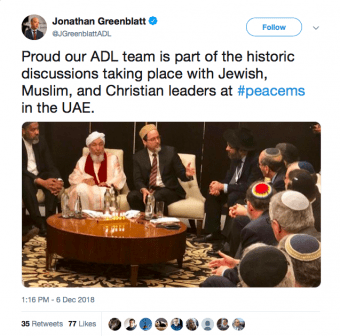 WASHINGTON, D.C. – Last Wednesday, a group of prominent and select American Muslim leaders traveled to the United Arab Emirates to participate in the fifth annual conference of the Forum for Promoting Peace in Muslim Societies (FPPMS), which is sponsored by the Minister of Foreign Affairs, Abdullah bin Zayed, and headed by Mauritanian Islamic scholar, Abdullah bin Bayyah. Despite the country’s appalling human rights record, U.S. Muslim leaders present praised the country for being “committed to tolerance […] and civil society.”
During the conference, the same Muslim figures were photographed in a meeting with several leading members of the Zionist-Jewish American community including representatives of the American Jewish Committee (AJC) and the Anti-Defamation League (ADL), a powerful pro-Israel lobby organization whose dark history of domestic spying and investment of millions of dollars to extinguish all criticism of Israel is documented in a 2014 report by AMP. The photo, which was widely tweeted on Friday by ADL CEO Jonathan Greenblatt, features Sh. Hamza Yusuf, a California-based scholar who has been described by the Guardian as “arguably the West’s most influential Islamic scholar,” and Imam Mohamed Magid, the former president of the Islamic Society of North America (ISNA), who serves as the Executive Imam of the All Dulles Area Muslim Society (ADAMS) Center in Virginia.
It is worth noting that the UAE “Promoting Peace Forum” was founded in 2014, the same year that the UAE government designated CAIR, the largest Muslim civil rights organization in America, a terrorist organization. Several critics have denounced this forum as part of a series of counter-revolutionary measures carried out in the wake of the Arab Spring to crush pro-democracy efforts in the region and promote obedience toward autocratic rulers. It’s been previously exposed that conferences such as these are part of a sophisticated PR campaign by the Emirati government to pursue its own political agenda in the name of “moderate Islam”. AMP is disturbed by the continuous participation of some American Muslim leaders in these propaganda conferences that whitewash the nefarious agenda of the UAE government.
“Given the UAE’s dismal record on human rights and its catastrophic policies in the region, as in Yemen and the staging of counter-revolutions, it is the last country to allege the promotion of peace in Muslim societies. The American Muslim leaders and scholars who participated in the conference should not have lent their names to an event aimed at legitimizing a regime that has brought much harm to their own communities and other nations,” said AMP National Policy Director Osama Abuirshaid. If “promoting peace” in Muslim societies is the purported objective of this forum then it should have called for the immediate ceasefire and end to the armed intervention in Yemen, and expressed solidarity with the Palestinians living under Apartheid conditions and occupation.
Not only has the UAE labeled the most prominent American Muslim civic group as a terrorist organization, it also has elevated virulently Islamophobic and pro-Israel organizations such as the neoconservative Foundation for Defense of Democracies (FDD), whose senior researcher Jonathan Schanzer has waged a longstanding smear campaign against AMP and was recently captured maligning Palestine activists in the censored Al Jazeera documentary on the Israel Lobby . The film sheds light on the operations directed at demonizing Muslims and Palestine activists in the U.S. The hosting of the ADL at this year’s conference is especially disconcerting given the group’s sinister history of instigating political prosecutions against prominent American Muslim and Palestinian leaders and institutions, as detailed in Israeli author Miko Peled’s recent book Injustice: The Story of the Holy Land Foundation Five. Peled recently commented to AMP that the ADL “is an organization dedicated to protecting Israel from criticism. They conflate anti-Semitism with anti-Zionism. The ADL supports the racism, ethnic cleansing, genocide and apartheid regime to which Israel has subjected the Palestinians. ADL does not represent Jewish people and must be shunned by people of conscience.” Rather than invite the ADL and AJC to the stage, the primary purveyors of Islamophobia and anti-Palestinian discourses, the “Peace Forum” should have expressed support for the peaceful and nonviolent BDS movement and highlight the global success of the Palestinian struggle.
Since the Arab Spring, the UAE government has exposed itself as an enemy of human rights and democracy. From intervening in Libya and Egypt to aiding and abetting Saudi crimes in Yemen, supporting its blockade of Qatar, and helping cover up its recent murder of dissident Jamal Khashoggi, it is clear that the country is willing to secure its regional strategic interests at all costs and on the backs of millions of Muslims and Arabs. Meanwhile, it continues to openly tighten its relationship with Israel, working with lobby groups in the U.S. and purchasing Israeli spyware to target civil society both locally and abroad. No conference or publicity stunt can change these critical facts or boost this country’s corrupt image.
“This was a conference to normalize Islamophobia, bigotry against Muslims in the West, in addition to normalizing relations and engagement with apologists for Israel’s aggression against the Palestinian people. The participation of these Muslim leaders and scholars make us wonder whether they are involved in last year’s revealed attempts of UAE’s ambassador in Washington to hijack the representation of Islam in the U.S. under the pretext of promoting ‘moderate’ Islam which is in essence a distorted complacent form of Islam that aligns itself with Zionists and Islamophobes in the U.S. through trojan horses within the American Muslim community,” Abuirshaid added.
The active participation of some American Muslim leaders in these dubious initiatives with a deeply troubling agenda demands serious and urgent accountability.
The gulf within GCC is only widening
By M. K. BHADRAKUMAR | Indian Punchline | December 10, 2018
The annual summit meeting of the Gulf Cooperation Council (GCC) in Riyadh on Sunday was particularly important for Saudi Arabia as a display of its regional leadership. But the short meeting of the GCC leaders behind closed doors, lasting for less than an hour, ended highlighting the huge erosion of Saudi prestige lately.
The litmus test was the participation by Qatari Emir Sheikh Tamim bin Hamad al-Thani. King Salman’s letter of invitation to the emir was perceived as some sort of an olive branch for reconciliation. But Qatar’s Minister of State for Foreign Affairs Sultan bin Saad Al Muraikhi represented the country at the summit.
The calculation by the hot headed crown princes of Saudi Arabia and the UAE that Qatar would pack up is turning out to be a historic blunder. Qatar had some trying times but it has successfully weathered the harsh embargo by Saudi Arabia and the UAE, and the boycott is now hurting its enforcers. Qatar “celebrated” the anniversary of the boycott in June by banning the import of goods from the UAE, Saudi Arabia, Bahrain and Egypt (which had cut diplomatic and transport ties on June 5, 2017.) Ironically, Iran has been a beneficiary as Qatar established diplomatic relations with Tehran and began importing Iranian products.
Qatar also strengthened its alliance with Turkey, which stepped in as provider of security for Doha. And Turkey checkmated any plans that Saudis and Emiratis might have had to use force to bring the Qatari emir down on his knees.
The emir’s absence from the summit in Riyadh yesterday underscores that he is not in a mood to forget and forgive. Equally, Kuwait and Oman also have issues to settle with Saudi Arabia and the UAE. There is tension between Kuwait and Saudi Arabia over two oil fields – Khafji and Wafra – that are jointly owned by the two states, which have a capacity to produce more than half a million barrels per day, but have been closed since 2014 and 2015, respectively. The dispute is over the sovereignty over the so-called Neutral Zone on their border, which has been undefined for almost a century.
The Saudis are not relenting. “We’re trying to convince the Kuwaitis to talk about the sovereignty issues, while continuing to produce until we solve that issue,” Saudi Crown Prince Mohammed bin Salman told Bloomberg in an interview in October. Similarly, Saudis and Emiratis have stationed troops in Yemen’s southern province of al-Mahra that borders Oman although the region has no presence of Houthi rebels. Oman considers the move an infringement on its national security. Interestingly, instead of the Sultan of Oman, Deputy Prime Minister for the Council of Ministers Sayyid Fahd bin Mahmood Al Said represented the country at the GCC summit.
To be sure, like Banquo’s ghost at Macbeth’s banquet in Shakespeare’s play, the killing of Jamal Khashoggi provided the backdrop to the GCC summit. The GCC states (including Qatar) have not criticized the Saudi Crown Prince Mohammed bin Salman (MBS) but they would know this is a developing story and it has dented Saudi prestige irreparably, especially with the US Senate is at loggerheads with the Trump administration. The big question for the Gulf region would be as to where Saudi Arabia is heading. (See the blog by Thomas Lippman What Now For U.S. Policy And The Crown Prince?)
Of course, if the GCC disintegrates due to these contradictions, Saudi Arabia will be the big loser, because it will be a reflection on its regional leadership. But do the Saudis understand it? The remarks by the Saudi Foreign Minister Adel Al-Jubeir at the end of the GCC summit showed no sign of remorse.
He said, “The members of the Gulf Cooperation Council are keen that the crisis with Qatar will have no impact on the Council (GCC). But this does not mean relinquishing the conditions imposed on Qatar.” Doha should stop supporting terrorism and extremism and avoid interfering in other countries’ affairs and needed to fulfill the Arab countries’ conditions to open the way for its return to the full-fledged work in the GCC. “The stance towards Qatar came to push it to change its policies,” he added.
The leading Saudi establishment writer Abdulrehman al-Rashed fired away at Qatar on the day of the GCC summit. In a column entitled Is it Time to end the GCC? in the Saudi daily Asharq Al-Awsat (owned by royal family members) he wrote:
“Qatar… has been putting obstacles in the GCC path and it has succeeded where Saddam and Iran have failed: It managed to destroy and rip it [GCC] apart… It organized an internal and external opposition against the United Arab Emirates. It is now the primary financier of the greatest attack against Saudi Arabia and it stands behind the politicization of Khashoggi’s murder… Today’s [GCC] summit could not conceal the dark political cloud hanging over its head. It also strongly poses a question over the future of the GCC as doubts rise over the value of this union… A wedge has been driven in the GCC.”
The disarray within the GCC undoubtedly calls attention to the decline of US influence in the Middle East region. At the end of the day, the Gulf states have not paid heed to repeated US entreaties for GCC unity. Ideally, GCC should have provided today for the US strategy a strong platform for launching the regime change project against Iran. On the contrary, GCC is split down the middle, with Qatar, Oman and Kuwait getting along just fine with Tehran. While addressing the summit in Riyadh on Sunday, the Emir of Kuwait, Sheikh Sabah Al Ahmad hit the nail on the head when he said, “The most dangerous obstacle we face is the struggle within the GCC.”
US Deploys Carrier Strike Group to Middle East Amid Iran, Syria Tensions
Sputnik – December 8, 2018
A carrier strike group led by the Nimitz-class supercarrier USS John C. Stennis has arrived in the Middle East, ending an eight month period during which a US carrier wasn’t based in the region, the US Navy has reported.
Earlier, the Pentagon announced that the US and its allies in eastern Syria would train an additional 35,000 to 40,000 local militia to “provide stability” in the region following the defeat of Daesh (ISIS) terrorists.
The carrier group will be based with the 5th Fleet, which is responsible for US naval activity in the Arabian Sea and the Persian Gulf, and will be stationed in the region for at least two months.
According to the US government-funded news service Voice of America, the carrier strike group is being deployed to “help in the fight against the Islamic State terror group in Iraq and Syria and the war in Afghanistan.”
Furthermore, a US Defense Department official confirmed earlier reports that the US was beefing up its presence in the region as a “message” to Tehran, telling VOA that “just being there is a show of force to Iran.”
The carrier group’s presence is expected to have a similar effect to the US base in at-Tanf, southern Syria, the official added.
The US established an illegal garrison at at-Tanf in 2016, justifying the deployment as part of its war against Daesh. Damascus and its allies have repeatedly accused the US of using the base to retrain and reequip former Islamist militia to continue the war against the Syrian government. On Thursday, Chairman of the Joint Chiefs of Staff General Joseph Dunford said that the US would have to train 35,000 to 40,000 more “local forces” to “provide stability” in eastern Syria, where US-backed Syrian Kurdish forces took control following Daesh’s expulsion from the region.
Washington, which originally justified its presence in Syria by citing the war against terrorism, has altered its reasoning for remaining in the country following Daesh’s decline. In September, Trump national security adviser John Bolton said that the US military would stay in Syria until alleged Iranian-backed militias had also left the country.
Tensions between Washington and Tehran escalated in May, after the US unilaterally withdrew from the Joint Comprehensive Plan of Action nuclear deal and slapped Iran with a series of strict sanctions.
US Arm Sales Turning Middle East into ‘Tinderbox’: Zarif
Al-Manar | December 8, 2018
Iran’s Foreign Minister Mohammad Javad Zarif said on Saturday that the United States is selling arms into the Middle East which were beyond the region’s needs, turning it into a “tinderbox”.
“The level of arms sales by the Americans is unbelievable and much beyond regional needs and this points to the very dangerous policies followed by the Americans,” IRNA reported Zarif as saying on the sidelines of the 2nd Speakers’ Conference with participation of Iran, Afghanistan, Turkey, Pakistan, China and Russia in Tehran.
He added that the US policy has brought many modern destructive weapons to the region, which have given no help to establishment of regional peace and security.
Asked about US accusations against Iran regarding missiles, the foreign minister said that the American officials spare no effort to interrupt relations between Iran and Europe, “so they resort to baseless allegations these days.”
“They [American officials] try to distort the regional issues.”
“We’ve read in the American media that the US arms are in hands of Al Qaeda in Yemen and ISIL in Syria, and this is a danger threatening our region,” Zarif said.
The top Iranian diplomat stressed meanwhile, that the US has been isolated in the world.
The US “has entered [trade] war with China and even arrested a senior Huawei executive. This indicates US frustration rather than its power.”
What Foreign Threats?
The biggest threats to America come from its “friends”
By Philip Giraldi • Unz Review • December 4, 2018
One of the local Washington television stations was doing a typical early morning honoring our soldiers schtick just before Thanksgiving. In it soldiers stationed far from home were treated to videolinks so they could talk to their families and everyone could nod happily and wish themselves a wonderful holiday. Not really listening, I became interested when I half heard that the soldier being interviewed was spending his Thanksgiving in Ukraine.
It occurred to me that the soldier just might have committed a security faux pas by revealing where he was, but I also recalled that there have been joint military maneuvers as well as some kind of training mission going on in the country, teaching the Ukrainian Army how to use the shiny new sophisticated weapons that the United States was providing it with to defend against “Russian aggression.”
Ukraine is only one part of the world where the Trump Administration has expanded the mission of democracy promotion, only in Kiev the reality is more like faux democracy promotion since Ukrainian President Petro Poroshenko is clearly exploiting a situation that he himself provoked. He envisions setting himself up as a victim of Moscow to aid in his attempts to establish his own power through a security relationship with Washington. That in turn will help his bid for reelection in March 2019 elections, in which his poll numbers are currently running embarrassingly low largely due to the widescale corruption in his government. Poroshenko has already done much to silence the press in his county while the developing crisis with Russia has enabled him to declare martial law in the eastern parts of the country where he is most poorly regarded. If it all works out, he hopes to win the election and subsequently, it is widely believed, he will move to expand his own executive authority.
There also has to be some consideration the encounter with the Russians on the Kerch Strait was contrived by Poroshenko with the assistance of a gaggle of American neoconservative and Israeli advisers who have been actively engaged with the Ukrainian government for the past several years. The timing was good for Poroshenko for his own domestic political reasons but it was also an opportunity for the neocon warmongers that surround Trump and proliferate inside the Beltway to scuttle any possible meeting between a vulnerable Donald Trump and Vladimir Putin at the G20 gathering in Argentina.
The defection of Trump’s lawyer Michael Cohen, together with the assumption that a lot of anti-Trump dirt will be spilled soon, means that the American president had to be even more cautious than ever in any dealings with Moscow and all he needed was a nod of approval from National Security Adviser John Bolton and Secretary of State Mike Pompeo to cancel the encounter. A heads-of-state meeting might not have solved anything but it certainly would be better than the current drift towards a new cold war. If the United States has only one vitally important relationship anywhere it is with Russia as the two countries are ready, able and apparently willing to destroy the world under the aegis of self-defense.
Given the anti-Russian hysteria prevailing in the U.S. and the ability of the neocons to switch on the media, it should come as no surprise that the Russian-Ukrainian incident immediately generated calls from the press and politicians for the White House to get tough with the Kremlin. It is important to note that the United States has no actual national interest in getting involved in a war between Russia and Ukraine if that should come about. The two Eastern European countries are neighbors and have a long history of both friendship and hostility but the only thing clear about the conflict is that it is up to them to sort things out and no amount of sanctions and jawing by concerned congressmen will change that fact.
Other Eastern European nations that similarly have problems with Russia should also be considered provocateurs as they seek to create tension to bind the United States more closely to them through the NATO alliance. The reality is that today’s Russian Federation is not the Soviet Union and it neither aspires to nor can afford hegemony over its former allies. What it has made very clear that it does want is a modus vivendi where Russia itself is not being threatened by the West.
Recent military maneuvers in Poland and Lithuania and the stationing of new missiles in Eastern Europe do indeed pose a genuine threat to Moscow as it places NATO forces on top of Russia’s border. When Russia reacts to incursions by NATO warships and planes right along its borders, it is accused of acting aggressively. One wonders how the U.S. government would respond if a Russian aircraft carrier were to take up position off the eastern seaboard and were to begin staging reconnaissance flights. Or if the Russian army were to begin military exercises with the Cubans? Does anyone today remember the Bay of Pigs?
When it comes to international conflicts context is everything. Seeing the incident between Russia and Ukraine in Manichean terms as an example of Moscow’s aggressive instincts is satisfying in some circles, but it does not in any way reflect the reality on the ground. Internal politics of the two countries combined with deliberate fabrications that are expected to generate a certain response operate together to create a largely false narrative for both international and domestic consumption. Unfortunately, narratives have consequences: in this case, the sacrifice of the possibly beneficial meeting between Trump and Putin.
The same dynamic works vis-à-vis Washington’s other enemy du jour Iran. In the case of Russia, useless “friend” Ukraine is pulling the strings while regarding Iran it is conniving Israel and Saudi Arabia. Iran has been accused of being the world’s leading sponsor of terror, of destabilizing the Middle East, and of having a secret nuclear weapon program that will be used to attack Israel and Europe. None of those assertions are true. The terrorism tag comes from the country’s relationship with Hezbollah, which is only a terrorist group insofar as it is hostile to Israel and pledged to resist any future Israeli invasion of Lebanon. Washington and Israel have pushed the terrorism label for Hezbollah, but most Europeans have begun to disregard the designation since the group has become a part of the Lebanese government.
And regarding destabilizing the Middle East, that has largely been the end result of actions undertaken by the United States, Israel and the Saudis, while the alleged Persian nuclear weapons program is a fantasy. If someone in the U.S. national security apparatus had any brains the United States would work to improve relations with Iran real soon as the Iranians would in the long run quite likely prove to be better friends than those rascals who are currently running around using that label.
And there are other friends in unlikely places. Beleaguered British Prime Minister Theresa May is wailing loudly against a Trump threat to reveal classified documents relating to Russiagate. The real problem is that the documents apparently don’t expose anything done by the Russians. Rather, they seem to appear to reveal a plot by the British intelligence and security services working in collusion with then CIA Director John Brennan to subvert the course of the 2016 election in favor of the Deep State and Establishment favorite Hillary Clinton. How did that one work out?
So how about it? Teenagers who get in trouble often have to ditch their bad friends to turn their lives around. There is still a chance for the United States if we keep our distance from the bad friends we have been nurturing all around the world, friends who have been convincing us to make poor choices. Get rid of the ties the bind to the Saudis, Israelis, Ukrainians, Poles, and yes, even the British. Deal fairly with all nations and treat everyone the same, but bear in mind that there are only two relationships that really matter – Russia and China. Make a serious effort to avoid a war by learning how to get along with those two nations and America might actually survive to celebrate a tricentennial in 2076.
Hamas condemns recent Israeli aggression on Syria
Palestine Information Center – December 1, 2018
GAZA – Islamic Resistance Movement, Hamas, on Saturday condemned the latest Israeli aggression on Syria.
Member of the Hamas Political Bureau Khalil al-Hayya said in statements to the PIC that the world should realize that Israel is the real threat to the region and international peace.
Al-Hayya called on the world countries to put an end to Israel’s aggression before it destroys the whole region.
“We condemn in principle any Israeli aggression on an Arab or Muslim land, because it comes from an occupying state that sees itself above the law,” he added.
Israeli warplanes on Thursday launched several airstrikes on different targets in Damascus countryside and southern Syria.
Featured Video
Seyed M. Marandi: U.S. Military DIVIDED? Iran’s Secret Defense EXPOSED
or go to
Aletho News Archives – Video-Images
From the Archives
‘Israel sees Iran as obstacle to its policies’
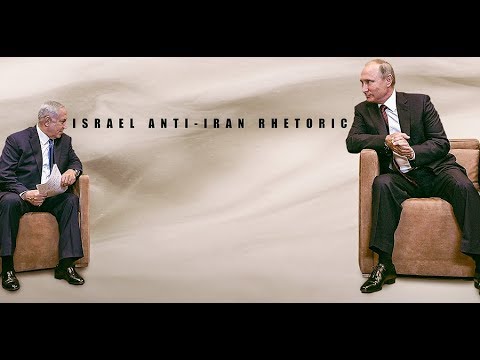
Press TV – August 25, 2017
Prime Minister Benjamin Netanyahu has said that Israel felt threatened by Iran’s growing influence in the Middle East. Netanyahu expressed his Iranophobic view in a meeting with Russian President Vladimir Putin in Russia’s Black Sea resort of Sochi on Wednesday. Press TV has asked Scott Rickard, former American intelligence linguist from Tampa, Florida, and Brent Budowsky, a columnist at The Hill from Washington, to give their thoughts on the issue.
Rickard said Tel Aviv is concerned about the fact that the regime could not carry out its old project to spread sectarian divisions and pave the way for dismemberment of the countries in the Middle East region because of the Iranian-led resistance against Israeli policies, not only in the occupied territories of Palestine but also in the whole region.
“Iran is not a threat to Israel whatsoever. The threat that Israel sees is the fact that their Oded Yinon Plan is being put to a hold by Iran,” the intelligence linguist said on Thursday night.
“They (the Israelis) look at Iran as a threat only because they have no influence on their governments and Iran is autonomous and is not under the Zionist influence,” he added.
Since the victory of the Islamic Republic of Iran in 1979, Tehran has been critical of Israel’s policies in the region, whereas “no leaders [of other states] even dared to speak out against Zionism,” Rickard argued. … continue
Blog Roll
 Aletho News
- The US-Israeli War on Science is an Assault on our Future
- Trump’s Promise to Bomb Iran ‘Like Never Before’ Faces Brutal Logistics — Expert
- Germany seeks to restrict stays abroad for men of fighting age – Berliner Zeitung
- Evidence points to Ukraine being behind TurkStream attempted sabotage, but that should come as no surprise
- Sri Lanka secures supplies of Russia oil – minister
- Nations across Asia strike direct deals with Iran for Hormuz passage
- IRGC commander declares ‘new phase’ of reprisal attacks against aggressors
- Israel’s air defenses overwhelmed by cluster-warhead Iranian missiles: Reports
- Striking Iran’s Infrastructure Would Have Little Military Impact – Report
- What’s Behind U.S./Israeli Strikes On Iranian Pistachio Factories?
- If Americans Knew
- Trump Says US Sent ‘a Lot of Guns’ to Protesters in Iran
- Israeli forces destroy 17 UN peacekeeper cameras in south Lebanon
- US-Israeli strikes ‘completely destroy’ synagogue in Tehran
- Archbishop for US Military Says Iran War Is Unjust Under Catholic Teaching
- Iranian leaders’ Open Letters to the American People
- Trump says Iranians appreciate bombs, WHO warns of nuclear risks – Daily Update
- U.N. experts demand Israel release prominent Gaza doctor after reports of ‘severe torture’
- Israel’s Latest Genocide Is Against the Shias of Lebanon. Why Is the World Silent?
- How Eliot Cohen’s influence over U.S. war-making paved the way for Trump’s war crimes in Iran
- Israelis don’t pay for the weapons we ‘sell’ to them — US taxpayers do
- No Tricks Zone
- An Inconvenient Tree: Uncovered In Alps… Europe Much Warmer Than Today 6000 Years Ago
- New Study Reports A 60% Slowdown In Greenland’s Ice Loss Rate In The Last Decade
- Low Intensity Tornado Wrecks Major Solar Farm, Creating A Potential Toxic Dump
- New Study Finds Warming Saves Lives…Cold Temperatures 12 Times More Deadly Than Excess Heat
- German Science Blog Accuses PIK Climate Institute Of Hallucinating Climate Tipping Points
- Devastating Assessment Of Comirnaty Vaccine By Former Senior Pfizer Europe Toxicologist
- New Study: CO2 Is ‘Effectively Negligible’ As An Explanatory Climate Change Factor Since 2000
- Former Pfizer Toxicologist Dr. Helmut Sterz Tells Bundestag Hearing Pfizer Vaccine Should Have Never Been Approved
- Energy Expert: Germany’s Nuclear Phaseout Was A “500 Billion Euro Mistake”
- New Research: South Australia’s Mid-Holocene Sea Surface Temperatures Were 4°C Warmer Than Today
 Aletho News