Israeli Occupation Forces Appoint First Iran ‘Project Director’

Israeli Maj.-Gen. Nitzan Alon
Al-Manar | July 3, 2018
Israeli Chief of Staff Lt.-Gen. Gadi Eisenkot has appointed Maj.-Gen. Nitzan Alon, who recently left his role as head of the military’s Operations Directorate, as the first director of a special project to coordinate all issues related to Israeli battle against Iran.
Alon accompanied Eisenkot on his recent trip to the United States last weekend and participated in meetings with American military leaders, including Chairman of the Joint Chiefs Gen. Joseph Dunford.
This is the first time that Israel has appointed a “project director for Iran issues,” who is meant to coordinate all areas of Israeli battle against the Islamic Republic: with respect to its nuclear program, coordinating intelligence gathering with other countries, and in countering Iran’s presence in Syria, the Jerusalem Post reported.
In the past, the head of the Mossad Meir Dagan was responsible for the “Iran file” under Prime Ministers Ariel Sharon and Ehud Olmert, but at that time the battle was restricted to intelligence spheres.
Now that the war between the Zionist entity and Iran has come into the open and includes military confrontation, the appointment of a “special project head” underscores the overwhelming importance that Tel Aviv sees for these developments, according to the Israeli paper.
Bill Kristol Has Always Wanted to Rape Iran
By Caitlin Johnstone | American Herald Tribune | July 1, 2018
One year after the CIA escalated covert operations in Iran, the protests across that nation are reportedly beginning to get more violent. This is happening on the same day the Iranian terror cult MEK hosted Rudolph Giuliani and Newt Gingrich in a pro-regime change rally that was so sparsely attended that half the audience consisted of bused-in Europeans unaffiliated with the cause.
“We are now realistically being able to see an end to the regime in Iran,” said Giuliani, who earlier this year infamously led a “Regime change! Regime change!” chant at a related MEK event.
“The Mullahs must go, the Ayatollah must go, and they must be replaced by a democratic government which Madam Rajavi represents,” Giuliani said in reference to MEK cult leader Maryam Rajavi.
“Freedom is right around the corner,” added Giuliani, who is currently serving as President Trump’s lawyer. “Next year I want to have this convention in Tehran!”
So things appear to be escalating. We saw very similar situations in the lead-up to both Libya and Syria, right up to and including the shady ties with the suspiciously well-funded extremist group. We can expect the CIA operations, propaganda and psyops to combine with the effects of starvation sanctions in a way which leads to widespread chaos, which we can expect to see erupt into violence of disputed origin, which we can then expect to see blamed solely on Tehran, which we can then expect to see elicit calls for humanitarian interventionism. Just like Libya and Syria. If the formula ain’t broke, why fix it?
And the bloodthirsty warmongers of Washington couldn’t be more thrilled.
“A democratic Iran not only would free Iranians from repressive theocracy but produce closer ties between our two countries; real security, economic , and moral benefits for both Iranians and Americans,” contributed Michael McFaul, an ambassador to Russia during the Obama administration.
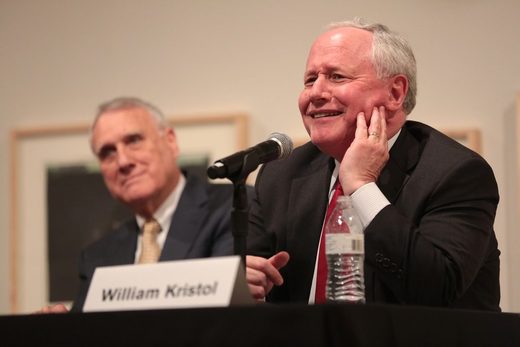
“Very true,” tweeted Iraq war architect and PNAC founder William Kristol. “And great to see a bipartisan consensus for regime change in Iran! (It would be happily ironic if, totally inadvertently, tough sanctions followed by the JCPOA followed by withdrawal from the deal caused so much whiplash that the regime crumbled.)”
The word “bipartisan” is a popular buzzword in establishment politics, because since the two-headed uniparty has worked so hard creating the illusion of opposition among its leaders and very real hatred across America’s fake political divide, the sight of these two groups getting together on something can be spun to give the impression that it must be a very commonsense and important pro-human agenda. Really, though, what it generally means in practice is neoconservative Republicans and neoconservative Democrats getting together to do something horrible.
Bill Kristol used his influence in the Bush administration to advance the agenda that his Project for the New American Century think tank had laid out several years earlier for US military-enforced planetary domination. It began with the catastrophic and unforgivable invasion of Iraq, but according to US General Wesley Clark the plan once if got through to the Pentagon was to take out six more governments after that: Syria, Lebanon, Libya, Somalia, Sudan, and, finishing off, Iran.
Kristol lost some credibility as the actual horror of what the Iraq invasion had unleashed upon the world began to really sink in to social consciousness, but since 2016 he has rehabilitated his image by forming a close anti-Trump alliance with the birthplace of neoconservatism: the Democratic Party. Kristol is now one of #Resistance Twitter’s most popular pundits and a regular guest analyst on liberal cable TV due to his staunch support for neoconservative policies that this administration claims to oppose, including escalations against Russia.
Bill Kristol wants to rape Iran. Bill Kristol has always wanted to rape Iran. Bill Kristol has advocated disastrous regime change intervention after disastrous regime change intervention throughout his entire corrupt, blood-soaked career, and he has always been wrong. Every single time. If the regime change cheerleading of this virulent Never-Trump neoconservative failmeister doesn’t tell Trump supporters that they’re on the wrong side of this issue, I don’t know what will.
Syria Is Now Like the Balkans in 1914
By Jeremy Salt | American Herald Tribune | June 30, 2018
The war in Syria has returned to where it was started in 2011, in Dara’a, close to the Jordanian border and therefore easily accessible to takfiris and weapons shipped in to be used behind the façade of ‘peaceful protests.’ The template had been used in Latin America and the Middle East on many occasions and here it was being used again, with the enthusiastic support of the corporate media.
Having failed in its attempt to overthrow the Syrian government the US is now abandoning those groups described in the corporate media as its ‘allies.’ One such group is the takfiri collective fighting under the banner of the Free Syrian Army, which has been told to expect no help from the US in its collapsing attempt to hold ground in southwestern Syria. Another is the Kurdish SDF-YPG collective in the north, which the US betrayed when signing an agreement with Turkey over Manbij. The Kurds, as an administrative and military force, have been forced out. The town is now being patrolled by Turkish and US military units.
The Kurds can’t say they were not told to distrust the US. They have played their cards hopelessly just about everywhere. When Turkey invaded north-western Syria early this year the Kurds rejected an offer of military assistance from the Syrian government, apparently thinking they could hold their ground against the Turkish army, only to be routed by it and to be driven out of Afrin city.
The US had warned Turkey that Manbij was a red line. However, when the Turks insisted, the US gave in. The YPG is now reconciling with the Syrian government, just as some at least of the betrayed takfiris in the southwest, along the border with Jordan and the armistice line with the occupied Syrian Golan Heights, have been accepting an amnesty offer. Israel is still doing its best to throw the Syrian military off balance, by bombing near Damascus airport and striking at Syria’s Iraqi allies along the eastern border, but to no avail. The army is making a clean sweep and all the southwest will soon be back in the hands of the Syrian government.
Syria’s next target is likely to be the base the US has set up at Al Tanf on the Syrian-Iraqi border. At Al Tanf the US has been retraining and rebranding takfiris into its Maghawhir al Thawra (Commandos of the Revolution) proxy force. Backed by US air power, this force has been attacking Syrian forces outside the ‘deconfliction zone’ the US has unilaterally set up within a 50 km radius of Al Tanf.
The US is still arguing that its forces are needed in Syria to fight the Islamic State. In fact, if the Islamic State continues to exist, it is because of tacit support from the US. The heavy work in destroying the Islamic State was done by the Syrian military and the Syrian and Russian air forces, not the US and not the Kurds, as the corporate media would have its gullible consumers believe. The latest example of a helping hand is the helicoptering of two IS leaders from Twaimin on the Syrian-Iraqi border to the US base at Al Shaddadi, south of al Hasaka.
From Tanf the US continues to attack the Syrian and Iraqi militaries, with air support from Israel. The aim seems to be to control the border and prevent the war in Syria from ending. Donald Trump has blown hot and cold over Syria and even Americans should be asking what their forces are doing there. The US has reached none of its set goals. The Syrian government is still in power and the proxy forces armed and paid by outside governments are being routed. The Kurdish card was played, with the apparent intention of linking up the occupied northeast, predominantly Kurdish, with the Kurdish governorate in northern Iraq, in 2011 only a few steps short of statehood. That is now not going to happen, following the collapse of the independence movement in northern Iraq and the loss of all territory taken by the peshmerga since 2014. The US betrayal of the Kurds in favour of an agreement with Turkey puts the final nail in the coffin.
The US is now staying in Syria to prevent the war from ending. Its withdrawal would signify the complete and humiliating failure of the policy of intervention. The US would be signalling that Syria, Russia, Iran and Hezbollah have won and the tripartite axis of the US, Saudi Arabia and Israel have failed. The US is now isolated and vulnerable in Syria. It is opposed on both sides of the Iraq-Syrian border by military and tribal forces, whose resistance to foreign occupation is being coordinated/monitored by a joint command centre set up in Baghdad by Iraq, Syria and Russia.
If Trump does one of his familiar back flips and announces the withdrawal of US forces from Syria it will be Turkey’s turn to be left isolated and vulnerable not just in north-western Syria or Manbij where the government has repeatedly refused to withdraw its troops, but from Bashiqa, near Mosul, despite the repeated demands of the Iraqi government. Turkish occupation of north-western Syria extends to the town Al Bab, northeast of Aleppo, where an industrial zone is being created. Throughout the occupied region the Turkish flag is being flown, a police force trained and proxy town councils set up. Turkish forces are now present in Manbij, further to the west, and Idlib, where under the ‘deconfliction’ arrangements set up under the Astana negotiations Turkey has set up at least 12 ‘observation’ posts.
Bashar al Assad has said Syria intends to liberate the entire country, as is his constitutional duty, and that all occupying forces that do not voluntarily withdraw will be driven out by force. The Turkish government has said it will not return occupied territory to the Syrian government: to whom it would return this territory is not clear. Following his recent election victory Tayyip Erdogan said he would continue to take measures to ‘liberate’ Syria. As these completely polarized positions indicate, open armed conflict between Syria and Turkey would seem inevitable sooner or later. The main Turkish opposition party, the Republican People’s Party (CHP), strongly opposed to intervention in Syria, had said it intended to repair the relationship with the government in Damascus, a process that would inevitably have entailed the withdrawal of Turkish forces but that exit route has now been closed off.
Syria is now a cross between the Balkans in 1914 and Europe 1930-39. The combination of irresponsible outside powers and the violent groups they are backing inside Syria but cannot necessarily control have created a tinderbox. One more spark and the entire region could be blown sky high.
Jeremy Salt has taught at the University of Melbourne, Bosporus University (Istanbul) and Bilkent University (Ankara), specialising in the modern history of the Middle East. His most recent book is “The Unmaking of the Middle East. A History of Western Disorder in Arab Lands” (Berkeley: University of California Press, 2008.)
The Legacy and Fallacies of Bernard Lewis
By As`ad AbuKhalil | Consortium News | June 29, 2018
There is no question that Bernard Lewis was one of the most politically—not academically—influential Orientalists in modern times.
Lewis’ career can be roughly divided into two phases: the British phase, when he was a professor at the School of Oriental and African Studies in London, and the second phase, which began in 1974, when he moved to Princeton University and lasted until his death on May 19. His first phase was less overtly political, although the Israeli occupation army translated and published one of his books, and Gold Meir assigned articles by Lewis to her cabinet members.
Lewis knew where he stood politically but he only became a political activist in the second phase. His academic production in the first phase was rather historical (dealing with his own specialty and training) and his books were then thoroughly documented. The production of his second phase was political in nature and lacked solid documentation and citations. In the second phase, Lewis wrote about topics (such as the contemporary Arab world) on which he was rather ignorant. The writings of his second phase were motivated by his political advocacy, while the writings of the first phase was a combination of his political biases and his academic interests.
Shortly upon moving into the U.S., Lewis met with Senator Henry “Scoop” Jackson, the dean of ardent Zionists in the U.S. Congress. He thus started his political career and his advocacy, which was often thinly hidden behind the title of superficial books on the modern Arab world. Lewis not only mentored various neoconservatives, but he also elevated the status of Middle East natives that he approved of. For instance, he was behind the promotion of Fouad Ajami (he dedicated one of this books to him), just as he was behind introducing Ahmad Chalabi to the political elite in DC.
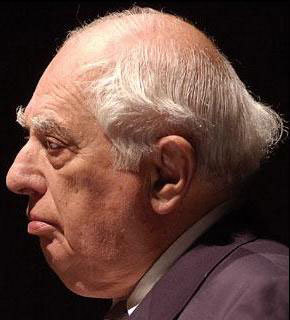
Lewis: A questionable legacy
Furthermore, Lewis was also behind the invitation of Sadiq Al-Azm to Princeton in the early 1990s (as Edward Said told me at the time) because Lewis always relished Al-Azm’s critique of Said’s Orientalism. Sep. 11 only elevated the status of Lewis and brought him close to the centers of power: he advised George W. Bush, Dick Cheney, Donald Rumsfeld and other senior members of the administration.
In the lead-up to the Iraq war, he assured Cheney (relying on the authority of Ajami) that not only Iraqis, but all Arabs, would joyously greet invading American troops. And he argued to Cheney before the war, using the dreaded Zionist and colonial cliché, that Arabs only understand the language of force. (Lewis would later distort his own history and claim that he was not a champion of the Iraq invasion although the record is clear).
Lewis was not only close to the higher echelons of the U.S. government, but in addition to his long-standing ties to Israeli leaders, he was close to Jordanian King Husayn and his brother, Hasan (although Lewis would mock what he considered a Jordanian habit of eating without forks and knives, as he wrote in Notes on a Century: Reflections of a Middle East Historian, on page 217).
Lewis was also close to the Shah’s government, and to the military dictatorship in Turkey in the 1980s. Kenan Evren, the Turkish general who led the 1980 military coup, had a tete-a-tete with Lewis during one of his visits to D.C. Lewis had contacts with the Sadat government, and Sadat’s spokesperson, Tahasin Bashir, in 1971 sent a message through Lewis to the Israeli government regarding Sadat’s interest in peace between the two countries.
Distorted View of Islam
There are many features of Lewis’s works, but foremost is what French historian Maxime Rodinson called “theologocentrism”, or the Western school of thought which attribute all observable phenomena among Muslims to matters of Islamic theology.
For Lewis, Islam is the only tool which can explain the odd political behavior of Arabs and Muslims. Lewis used Islam to refer not only to religion, but also the collection of Muslim people, governments ruling in the name of Islam, Shari`ah, Islamic civilization, languages spoken by Muslims, geographic areas in which Muslims predominate, and Arab governments. A review of his titles show his fixation with Islam. But what does it mean for Lewis to refer to Islam as being “the whole of life” for Muslims, as he does in Islam and the West?
Lewis also began the trendy Islamophobic, Western obsession with Shari`ah when he wrote years ago in the same book that for Muslims religion is “inconceivable without Islamic law.” There are hundreds of millions of Muslims in the world who live under governments which don’t subscribe to Shari`ah. No Muslim, for example, questions the Islamic credentials of Muslims who live in Western countries under secular law. Lewis even notes this fact, but it confuses him. In Islam and the West he states in bewilderment: “There is no [legal] precedent in Islamic history, no previous discussion in Islamic legal literature.”
Lewis could have benefited from reading James Piscatori’s book, Islam in a World of Nation States, which shows that Shari`ah is not the only source of laws even in countries where Islam is supposedly the only source of law. But Lewis was stuck in the past, he could only interpret the present through references to the original works of classical Islam.
His hostility and contempt for Arabs and Muslims was revealed in his writings even during the British phase of his career, when he was politically more restrained. He was influenced by the idea of his mentor, Scottish historian Hamilton Gibb, regarding what they both called “the atomism” of the Arab mind. The evidence for their theory is that the classical Arabic poem of Jahiliyyah and early Islam was not organically and thematically unified, but that each line of poetry was independent of the other. I remember back in 1993 when I discussed the matter with Muhsin Mahdi, a professor of Islamic philosophy at Harvard University, when I was reading the private papers of Gibb at the Widener Library. Mahdi said that their ideas are completely out of date and that recent scholarship about the classical Arabic poem refuted that thesis. (Lewis would resurrect the notion about the “atomism” of the Arab mind in his later Islam and the West).
Other writings of Lewis became obsolete academically. In his The Muslim Discovery of Europe he recycles the view that Muslims had no curiosity about the West because it was the land of infidelity and that they suffered from a superiority complex. A series of new scholarly books have undermined this thesis by Lewis largely by scholars looking into Indian and Iranian archives. The Palestinian academic, Nabil Mater, in his books Britain and the Islamic World, 1558-1713, Europe Through Arab Eyes, 1578-1727, and Turks, Moors and Englishmen in the Age of Discovery, paints a very different—and far more documented—picture of the subject that Lewis spent a career distorting.
Relished in Disparaging Arabs
In addition, the tone of Lewis’ writings on Arabs and Muslims was often sarcastic and contemptuous. Lewis did the work of the Middle East Media Research Institute (MEMRI), which was started in 1998 by a former Israeli intelligence agent and an Israeli political scientist,before MEMRI existed: he relished finding outlandish views of individual Muslims and popularizing them to stereotype all Arabs and all Muslims.
In the early editions of Arabs in History, Lewis remarked that none of the philosophers of the Arab/Islamic civilization were Arab in ethnic extraction (except Al-Kindi). What was Lewis’s point except to denigrate the Arab character and even genetic makeup? In the same book he cites an Ismaili document but then quickly adds that it “is probably not genuine.” But if it is “probably not genuine” why bother to cite it except for his fondness for bizarre tidbits about Arabs and Muslims?
The Orientalism of Lewis was not representative of classical Orientalism with all its flaws and shortcomings and political biases. His harbored more of an ideology of hostility against Arabs and Muslims. This ideology shares features with anti-Semitism, namely that the whole (Muslims in this case) form a monolithic group and that they pose a civilizational danger to the world, or are plotting to take it over, and that the behavior or testimony of one represents the total group (Islamic Ummah).
In writing about contemporary Islam, Lewis spent years recycling his 1976 Commentary magazine article titled, “The Return of Islam.” What he doesn’t answer is, “return” from where? Where was Islam prior? In this article, Lewis exhibits his adherence to the most discredited forms of classical Orientalist dogmas by invoking such terms as “the modern Western mind.” He thereby resurrected the idea of epistemological distinctions between “our” mind and “theirs”, as articulated by the 1976 racist book, The Arab Mind by Israeli anthropologist, Raphael Patai. (This last book would witness a resurrection in U.S. military indoctrination after Sep. 11, as Seymour Hersh reported).
An Obsession with Etymology
For Lewis, the Muslim mind never seems to change. Every Muslim, regardless of geography or time, is representative of any or all Muslims. Thus, a quotation from an obscure medieval source is sufficient to explain present-day behavior. Lewis even traces Yaser Arafat’s nom de guerre (Abu `Ammar) to early Islamic history and to the names of the Prophet Muhammad’s companions, though `Arafat himself had explained that the name derives from the root `amr (a reference to `Arafat’s construction work in Kuwait prior to his ascension to the leadership of the PLO).
Because `Arafat literally embraced Ayatollah Ruhollah Khomeini of Iran when he first met him, Lewis finds evidence of a universal Muslim bond in the picture. But when Lewis revised his book years later, he took note in passing of the deep rift which later developed between `Arafat and Khomeini and said simply: “later they parted company.” So much for the theory of the Islamic bond between them. Lewis must not have heard of wars among Muslims, like the Iran-Iraq war.
Lewis read the book Philosophy of Revolution by the foremost political champion of Arab nationalism, Nasser of Egypt, as containing Islamic themes. He must have been the only reader to come to that conclusion.
Another feature in Lewis’s writings is his obsession with etymology. To compensate for his ignorance of modern Arab reality, Lewis would often return to the etymology of political terms among Muslims. His book, The Political Language of Islam, which is probably his worst book, is an example of his attempt to Islamize and standardize the political behavior of all Muslims. His conclusions from his etymological endeavors are often comical: he assumes that freedom is alien to the Arabs because the historical meaning of the word in an ancient Arabic dictionary merely connoted the absence of slavery. This is like assuming that a Westerner never engaged in sex before the word was popularized. He complains that some of contemporary political terms, like dawlah (state), lost some of their original meanings, as if this is a problem peculiar to the Arabic language.
In his early years, Lewis was close to the classical Orientalists: he wrote in a beautiful style and his erudition and language skills showed through the pages. His early works were fun to read, while his later works were dreary and dull. But Lewis was unlike those few classical Orientalists who managed to mix knowledge about history of the Middle East and Islam with knowledge of the contemporary Arab world (scholars like Rodinson, Philip Hitti and Jacques Berque). Lewis’s ignorance about the contemporary Arab world was especially evident in his production during the U.S. phase of his long career. His book on the The Emergence of Modern Turkey, which was one of the first to rely on the Ottoman archives, was probably one of his best books. There is real scholarship in the book, unlike many of his later observational and impressionable works.
In his later best-selling books, What Went Wrong? and The Crisis of Islam, one reads the same passages and anecdotes twice. Lewis, for example, relishes recounting that syphilis was imported into the Middle East from the new world. His discussion of Napoleon in Egypt appears in both books, almost verbatim. The second book contains calls for (mostly military) action. In The Crisis of Islam, Lewis asserts: “The West must defend itself by whatever means.” The book reveals a lot about his outlook of hostility towards Muslims.
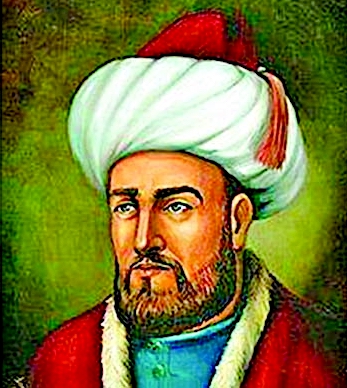
Al-Ghazzali: Lewis thought bin Laden was like him
Misunderstood Bin Laden
One is astonished to read some of his observations on Muslim and Arab sentiments and opinions. He is deeply convinced that Muslims are “pained” by the absence of the caliphate, as if this constitutes a serious demand or goal even for Muslim fundamentalist organizations. One never sees crowds of Muslims in the streets of Cairo or Islamabad calling for the restoration of the caliphate as a pressing need.
But then again: this is the man who treated Usamah Bin Laden as some kind of influential Muslim theologian who is followed by world Muslims. Lewis does not treat Bin Laden as the terrorist fanatic that he is, but as some kind of al-Ghazzali, in the tradition of classical Islamic theologians. Furthermore, Lewis insists that terrorism by individual Muslims should be considered Islamic terrorism, while terrorism by individual Jews or Christians is never considered Jewish or Christian terrorism.
In his retirement years, his disdain for the Palestinian people became unmasked. Although in his book The Crisis of Islam he lists acts of violence by PLO groups—curiously, only ones that are not directed against Israeli occupation soldiers—he lists not one act of Israeli violence against Palestinians and Arabs. To discredit the Palestinian national movement, he finds it necessary to tell yet again the story of Hajj Amin Al-Husayni’s visit to Nazi Germany, apparently seeking to stigmatize all Palestinians.
He is so disdainful of the Palestinians that he finds their opposition to Britain during the mandate period inexplicable because he believes that Britain was, alas, opposed to Zionism. Lewis is so insistent in attributing Arab popular antipathy to the U.S. to Nazi influence and inspiration that he actually maintains that Arabs obtained their hostility to the U.S. from reading the likes of Otto Spengler, Friederich Georg Junger, and Martin Heidegger. But when did the Arabs find time to read those books when all they read were their holy book and Islamic religious texts—as one surmises from reading Lewis?
While he displays deep–albeit selective–knowledge when he talks about the Islamic past (where his documentation is usually thorough), his analysis is quite simplistic and superficial when addressing the present (where he often disregards documentation altogether). For instance, he sometimes produces quotations without endnotes to source them: In Islam and the West he quotes an unnamed Muslim calling for the right of Muslims to “practice polygamy under Christian rule.” In another instance, he debates what he considers to be a common Muslim anti-Orientalist viewpoint, and the endnotes refer only to a letter to the editor in The New York Times.
Lewis once began a discussion by saying: “Recently I came across an article in a Kuwaiti newspaper discussing a Western historian,” without referring the reader to the name of the newspaper or the author. He also tells the story of an anti-Coptic rumor in Egypt in 1973 without telling the reader how he collects his rumors from the region. On another page, he identifies a source thus: “a young man in a shop where I went to make a purchase.”
Lewis was not shy about his biases in the British phase of his career, but be became an unabashed racist in his later years. In Notes on a Century, he did not mind citing approvingly the opinion of a friend who compared Arabs to “neurotic children”, unlike Israelis who are “rational adults.” And his knowledge of Arabs seems to decrease over time: he would frequently tell (unfunny) jokes related to Arabs and then add that jokes are the only indicator of Arab public opinion because he did not seem to know about public opinion surveys of Arabs. He also informs his readers that “chairs are not part of Middle Eastern tradition or culture.” He showers praise on his friend, Teddy Kollek (former occupation mayor of Jerusalem) because he set up a “refreshment counter” for Christians one day.
The political influence of Lewis, who lent Samuel Huntington his term, if not the theme, of “the clash of civilization”, has been significant. But it would be inaccurate to maintain that he was a policy maker. In the East and the West, rulers rely on the opinions and writings of intellectuals when they find that this reliance is useful for their propaganda purposes. Lewis and his books were timely when the U.S. was preparing to invade Muslim countries. But the legacy of Lewis won’t survive future scholarly scrutiny: his writings will increasingly lose their academic relevance and will be cited as examples of Orientalist overreach.
As’ad AbuKhalil is a Lebanese-American professor of political science at California State University, Stanislaus. He is the author of the Historical Dictionary of Lebanon (1998), Bin Laden, Islam & America’s New ‘War on Terrorism’ (2002), and The Battle for Saudi Arabia (2004). He also runs the popular blog The Angry Arab News Service.
Ayatollah Khamenei slams West’s ‘shameless’ human rights posture
Press TV – June 27, 2018
Leader of the Islamic Revolution Ayatollah Seyyed Ali Khamenei has strongly denounced the Western states for their pretense of advocating human rights while in reality supporting terrorist groups and acts of terror.
Addressing the staff of Iran’s Judiciary at a meeting in Tehran on Wednesday, Ayatollah Khamenei made reference to human rights violations committed by the United States in various parts of the world as well as France and Britain’s crimes of the past decades which took place in Africa and the Indian subcontinent.
The Leader added that the West’s support over the past years for the Daesh terror group in Syria and the atrocities being committed in Myanmar and elsewhere “is indicative of the repeated lies of the shameless fake human rights advocates.”
Ayatollah Khamenei said when it comes to the issue of human rights, it is actually the Islamic Republic that stands in the position of the true advocate of human rights as opposed to “the criminal Western pretenders.”
The Leader expressed satisfaction with the Judiciary’s work in restoring the Iranian nations’ rights in the face of bullying powers.
Separately, Ayatollah Khamenei advised the judicial officials to work closely with the government towards resolving the country’s economic problems.
‘Systemic corruption a lie’
The Leader criticized certain people who seek to create the impression among the public that there is “systemic corruption” within Iranian state institutions.
Corruption does exist in a number of governmental and commercial enterprises, “but the existence of systemic corruption is not true,” the Leader said. “This wrong impression should not be allowed to affect the public opinion.”
Ayatollah Khamenei further stated that foreign enemies and certain oblivious elements at home have made the Judiciary the target of the most severe propaganda and media pressure.
In order to effectively confront this massive propaganda campaign, the Leader suggested, the judicial system needs to develop a strong and skillful media arm.
Washington’s Syrian Chess Game Leaves Iraqi Forces Battling ISIS Dead
By Whitney Webb | Mint Press News | June 26, 2018
Last Sunday, June 17, local Syrian media reported that the U.S. coalition had bombed Syrian Arab Army installments in the town of Al-Hariri. The bombing killed dozens of Syrian Arab Army (SAA) soldiers as well as 22 fighters from the Iraqi paramilitary group known as the Popular Mobilization Forces (Hashd al-Sha’abi, PMF), which has been collaborating with the Syrian government to wipe out Daesh (ISIS) fighters around the Syrian-Iraqi border city of Abu Kamal in the Deir Ez-Zor governorate.
Soon after the strike, however, the U.S. denied responsibility for the attack, with Pentagon spokesman Adrian Rankine-Galloway asserting that the bombing was “not a U.S. or coalition strike,” while an anonymous U.S. official told Agence France-Presse, and later CNN, that Israel had been responsible for the strike. Israel declined to comment on the allegations.
While Israel was widely blamed for the strike following those media reports, new evidence gathered by Iraq’s PMF from the site of the strike has shown that the attack may, in fact, have been carried out by the U.S. coalition. After collecting fragments of missiles used in the strike, the group – which is sponsored by the government of Iraq – determined that the U.S. had carried out the strike by firing missiles at the SAA/PMF position from a location near the Iraqi border city of Al-Qa’im. U.S. culpability for the attack would mean that it is the second time in less than a month that the U.S.-led coalition has attacked pro-government fighters targeting Daesh within Syria.
The head of PMF’s military operations, Abu Munather Al-Husseini, asserted that the U.S.-led Joint Operations Command (JOC), also known as the U.S. coalition, had been informed by the Iraqi military of the PMF’s location prior to the strike. Thus, if the PMF’s analysis of the strike site is indeed correct, the U.S. coalition had intentionally and deliberately targeted the PMF as well as the SAA in conducting the strike.
As MintPress reported soon after the attack, the strike was launched from U.S.-occupied territory, meaning that either the U.S.-led coalition conducted the attack but publicly denied responsibility, or that Israel was responsible for the attack and “independently” launched the strike from Syrian territory occupied by the U.S.-led coalition. The PMF’s analysis of the strike site has now determined that the former was most likely the case, given that the group had waited to point the finger at Israel or the U.S. until concluding its analysis of the attack.
PMF’s leadership lambasted the U.S. for allegedly carrying out the strike and targeting its forces, while also urging retaliation against the U.S. for repeatedly interfering in its efforts to wipe out Daesh in Syria as well as Iraq. Indeed, just days before the strike, the PMF had successfully launched a major offensive against Daesh in the area of Syria where the strike later took place.
In a statement released on Sunday, PMF Deputy Commander Abu Mahdi al-Muhandis warned of retaliation against the U.S., stating:
We tell the Americans that we as the Hashd [PMF], including all of its formations, follow the Iraqi government. We will not remain silent about this attack. […] Remaining silent on this incident, saying that ‘that position is outside the Iraqi territory, hence we have nothing to do with it’ is forfeiting the blood of our martyrs.
U.S. chess game with ISIS as pawn
U.S.’ actions near Abu Kamal betray the fact that it is seeking to expand the portion of Syria’s Northeast that it currently occupies, an area that accounts for 30 percent of Syria’s total land mass and includes the majority of the country’s oil, gas, fresh water, and agricultural resources. The U.S. has long had its eye on the strategic border town, as it is the main border crossing between Syria and Iraq. More importantly, it is the only border crossing that connects Syrian government-controlled territory with Iran, through Iraq.
A major U.S. goal in its occupation of Syria has been disrupting this land bridge, but continued Syrian government control of Abu Kamal makes this impossible. Were the U.S. to take control of Abu Kamal, it would control Syria’s most important border crossings, as it already controls the Syrian-Jordanian border crossing at al-Tanf.
The U.S.’ interest in Abu Kamal and its recent targeting of forces fighting Daesh in the area suggest that a Daesh takeover of the city is likely to be used by the U.S. as the pretext for the expansion of Syrian territory, a tactic the U.S. has used before in Syria. The possibilities of a Daesh takeover of Abu Kamal have been openly noted by influential U.S. think tanks, such as the Center for a New American Security (CNAS), which recently mused that Daesh control over Abu Kamal would serve U.S. interests in the region, as it would allow the U.S.-occupied zone of Syria to “spread by osmosis.”
For that reason, the recent reappearance of Daesh (ISIS) in Abu Kamal is significant. Indeed, Daesh launched its largest military offensive in several months in Abu Kamal earlier this month, with 10 suicide bombers helping clear the way for Daesh militants to take over parts of the city. The offensive killed 25 Syrian soldiers and allied fighters, according to monitors. Daesh attacked from the U.S.-occupied zone of Syria, despite the fact that the U.S. has long justified its illegal presence in Syria by claiming that it is fighting the terror group. However, Russian and Syrian military sources have asserted that the U.S. is not fighting Daesh in the region, but protecting them.
The strikes on pro-Syrian government forces around Abu Kamal also come amid reports that indicate the U.S. is fortifying its military positions within occupied Syria by constructing military bases along the Euphrates river in proximity to Syrian military installments throughout the Deir Ez-Zor region and by transferring “a large volume of arms and equipment, including missiles, military vehicles and bridge equipment” to those same areas in recent weeks.
Given that the U.S. may soon lose its influence in Southern Syria and its control over the al-Tanf border crossing, thanks to the Syrian government’s offensive in the Dara’a governorate, it is likely the U.S. will continue to fortify its position in the country’s Northeast and expand its efforts to dislodge the SAA and its allies from Abu Kamal in a last-ditch attempt to prolong the conflict and succeed in its efforts to occupy and partition Syria.
Whitney Webb is a staff writer for MintPress News and a contributor to Ben Swann’s Truth in Media. Her work has appeared on Global Research, the Ron Paul Institute and 21st Century Wire, among others. She has also made radio and TV appearances on RT and Sputnik. She currently lives with her family in southern Chile.
Russian Envoy: “Deal of Century” a Matter of Surrender to ‘Israel’, Not Peace
Al-Manar | June 22, 2018
Russian Envoy to Lebanon, Alexander Zasypkin, stressed that the so-called “deal of century” with the Zionist entity is a matter of surrender, not peace with the occupation regime.
In an interview with Lebanese daily, Al-Akhbar, the Russian diplomat said that Tel Aviv bets on the Arabic obedience.
“The deal of century is a matter of surrender. It’s not peace. Israel’s calculations which suit with some Arab states don’t match with the condition of Syria, Lebanon and Palestine,” Zasypkin told Al-Akhbar’s Firas Al-Shoufi.
He said stressed that the Syrian army will retake control of the war-torn country’s south, ruling out a possible confrontation between the Zionist entity from one side and Iranian and Hezbollah from the other side.
“When discussions started on de-escalation zones, there were talks with all sides on importance of confronting terrorism. Israel fears the presence of Iran and Hezbollah in Syria. We say that the Syrian army is now engaged with the Russian forces in liberating the country’s south, and there is no justification for any Israeli action that could derail confronting terrorism,” the Russian diplomat said.
But he acknowledged that the Zionist entity exploits the presence of terrorist in Syria’s south, but assured that the terrorists will be crushed at last.
“A confrontation is not of favor of any side. There exists a balance of deterrence,” Zasypkin said.
On the other hand, the Russian ambassador dismissed reports of alleged disagreements between Russia and Syria, stressing that such reports are just “out of place propaganda” aimed at sowing discord between the two states whose alliance is “deep”.
“Russia and Iran are bound by very big geopolitical and even economic interests and their alliance is deep, not only in Syria but in entire Eurasia,” Zasypkin added.
Meanwhile, the Russian envoy revealed that the US has been renewing its support to the terrorist groups in Syria, ISIL and Nusra Front.
“It’s right that ISIL and Nusra were dealt blows. However, they still exit and are being supported by US, and they pose a threat to stability and are capable of launching attacks. Now, we have information that the US has renewed its support to some terrorist groups, including to White Helmets which belongs to Nusra,” Zaspakin told the Lebanese daily.
Raised eyebrows as Madeleine Albright & Bana Alabed to be honored for ‘defending freedom’
RT | June 20, 2018
The pro-NATO Atlantic Council think tank is set to honor former US Secretary of State Madeleine Albright and Syrian child activist Bana Alabed at its Freedom Awards this week.
The Freedom Awards honor individuals who “defend and advance the cause of freedom around the world” and will be hosted in Berlin later this week — but the nominations have caused quite a few puzzled reactions online.
According to the Atlantic Council website, Albright will be recognized for her “championing of global democracy” and as an exemplar of “the power of diplomacy in achieving solutions to the most pressing challenges facing our world.”
Albright seems like an odd choice, however, given she is known around the world for defending US sanctions on Iraq which caused the deaths of more than half a million Iraqi children.
When asked in an infamous 1996 interview if she thought the sanctions were “worth” the price — the price being hundreds of thousands of dead children — Albright replied almost without hesitation, that “the price is worth it.”
Alongside Albright will be a 9-year-old Twitter activist who is no stranger to controversy herself. Numerous Syrian and international commentators have argued that Syrian opposition icon Bana Alabed has been exploited by her parents and others as a propaganda tool for a pro-war agenda.
Bana began tweeting pro-US intervention messages on Twitter when she was just seven years old. Her tweets were written in perfect English and often incendiary. On one occasion, Bana’s Twitter account posted that it was “better to start 3rd world war instead of letting Russia & assad commit #HolocaustAleppo.”
Despite the controversy surrounding her account and accusations of child exploitation, Alabed will be honored by the Atlantic Council for her “use of social media to bring global attention to the plight of children in rebel-held areas of Syria.”
But maybe the Atlantic Council’s choice of nominees for its Freedom Awards shouldn’t be so surprising. In 2016, the think tank chose to bestow the award on the Syrian Civil Defence, also known as the White Helmets – a controversial outfit which bills itself as a first-responders group in the Syrian war, but operates exclusively in militant-held areas and has been accused of links to terrorist groups, including Al Qaeda.
US-Led Coalition Strikes Syria’s Homs Province: Syrian Soldier Killed – Reports
Sputnik – 21.06.2018
At least one Syrian soldier was killed in a US-led coalition airstrike on Syrian army positions in the east of Homs province on Thursday, a Syrian field commander told Sputnik.
“The combat planes belonging to the coalition led by the United States, attacked the army position in Jabal Ghurab, some 150 kilometers [93 miles] east of Palmyra near the border with Iraq,” the commander said.
“One serviceman was killed and several others wounded,” he added.
According to a Syrian field commander, the sudden US-led coalition air assault occurred after Syrian forces responded to an open fire from three coalition’s vehicles, moving towards positions of governmental forces.
A sudden airstrike has claimed the life of a Syrian Officer, leaving several other Syrian soldiers injured.
According to a Syrian field commander, coalition vehicles were spotted moving away from At Tanf district, where the US-led coalition base is situated.
Such an open skirmish between Syrian governmental forces and US-led coalition troops reportedly occurred for the first time since the outbreak of the war in Syria.
Last week, the Russian reconciliation center reported that the Syrian government troops backed by the Russian Aerospace Forces prevented militants’ audacious breakthrough out of the At Tanf area towards Palmyra.
IDF Videos Aimed Squarely at Spurring Arab-on-Arab Hate and Sectarianism
By Whitney Webb | Mint Press News | June 11, 2018
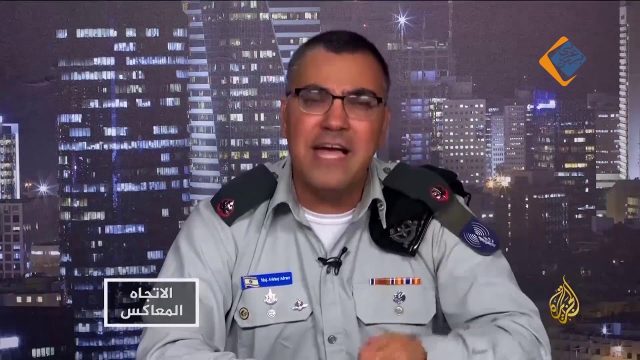
GAZA – A new video released by an Israeli Defense Force (IDF) spokesman has unnerved many in the global Muslim community for its use of sectarian rhetoric and slurs targeting Shia Muslims that are often used by leaders of extremist Wahhabi terror groups.
The video, released on social media on Thursday and already with more than 20,000 views, shows IDF Major Avichay Adraee asserting that Palestinian resistance group Hamas is “imitating Iran’s mullahs” — thereby making the group “officially Shiites,” even though Hamas is nominally Sunni.
Adraee — fluent in Arabic, given his family’s Syrian roots — then expounded on the “dangers” of Shia Islam, the followers of which he referred to as “rafidha” — a derogatory slur frequently used by Wahhabi terror groups like Al Qaeda and Jaish al-Islam for any Muslim who does not follow their radical interpretation of the religion.
Indeed, Adraee directly quotes Muhammad ibn abd al-Wahhab, the founder of the political movement of Wahhabism, stating that Shiites are “more harmful to Islam than Jews and Christians,” as he seeks to convince his viewers that supporting “these corrupt ones” who “claim” to be Muslim – i.e. the region’s “resistance axis,” composed of secular and Shiite governments – is a rejection of Islam.
Adraee singled out Shiites in the video as a means of targeting Iran, a Shia-majority nation whose government is the archenemy of the Israeli state, largely due to its obstruction of Israeli expansionism and continued support for Palestine. Adraee makes this clear in the video by asserting that “Shia Iran’s” recognition of the Palestinian Nakba, known as “Al-Quds Day,” is a “bid’ah” or heresy invented by Iran’s government. This, again, is an appeal to Wahhabism, as Wahhabist doctrine holds that any attempts to “innovate” within Islam must be rejected completely.
While an IDF soldier quoting extremists like al-Wahhab may seem unusual, Adraee – head of the IDF’s Arabic-language media division – has been making videos of a similar nature for over a decade, many of which similarly accuse Hamas of “profaning” Islam. Though his videos are often the butt of jokes in Gaza and elsewhere in Palestine, they seem to be aimed more at the global Sunni Muslim community. Indeed, Adraee boasts over 1.5 million followers on Facebook and Twitter and has found sympathetic ears in some Arab countries — such as Saudi Arabia, where Wahhabi Islam is the official religion.
As Adraee himself has hinted, his videos are aimed at robbing Palestinians of Arab support by seeking to foment sectarian hatred for Shiites. Adraee recently told Bloomberg:
The idea was that if there was a person who you could curse at or request something from, or who you knew, it would be much easier to connect through some kind of feeling, not necessarily love, it could also be hatred.”
By preaching anti-Shia sermons on social media, it is clear which feeling Adraee is seeking to promote through his videos.
A long history of colonial and post-colonial dividing and destabilizing
Adraee’s videos and their recent success is part of a long-standing effort, backed by Israel and select Western powers, to chip away at support for a Palestinian state among Sunni Arabs in the region. Such efforts have been more successful of late, with Saudi Arabian leadership recently chiding Palestinians for resisting Israel’s colonial ambitions amid warming ties between the Gulf kingdom and Israel.
Yet this strategy aimed at reducing regional support for Palestinians is based upon much older efforts seeking to divide and thereby weaken the entire Middle East. Indeed, Wahhabism itself was created by al-Wahhab at the behest of the British Empire, which sought to erode the Muslim community as a means of weakening the Ottoman Empire by breeding sectarianism and religious in-fighting.
That same century-old strategy is still used today with great effect. Indeed, the manipulation of sectarianism has been used by the United States to destabilize Iraq and, subsequently, to destabilize Syria. Israel has similarly sought to use sectarianism to its advantage by leveraging such divisions to push for the partition of surrounding Arab countries, in order to allow Israel to emerge as a regional superpower while Sunni and Shiite governments are constantly at each other’s throats.
Adraee’s latest video is not only part of that larger project, however. It also lays bare the roots of both Wahhabism and Zionism – intolerance and hate.
3 Shia Bahraini clerics sentenced to death, 8 others to life imprisonment
Press TV – June 17, 2018
Bahraini regime officials have handed down death sentences to three Shia clergymen and condemned eight others to life imprisonment as the ruling Al Khalifah regime continues with its repressive measures and heavy-handed crackdown on members of the religious community.
Bahrain’s dissolved main opposition group, the al-Wefaq National Islamic Society, announced in a statement that Shia religious figures are being systematically subjected to arbitrary arrests, torture, trials, revocation of citizenship as well as forced deportation.
The statement added that al-Wefaq has recorded more than 347 cases of arrests, summons and various security prosecutions of Shia clerics in Bahrain.
It added that Bahraini security authorities have summoned more than 156 Shia clergymen over their speeches, ideological tendencies or political views. They have also arrested 99 religious scholars arbitrarily.
Al-Wefaq further pointed out that “harsh and unfair verdicts” have targeted more than 50 clerics, ranging from hefty fines and abolition nationality to life imprisonment and death penalty.
The statement went on to say that three Shia scholars have been sentenced to death, eight to life imprisonment and a number of others been stripped of their citizenship. Among those whose nationality has been revoked are prominent Ayatollah Sheikh Isa Ahmed Qassim and Sheikh Hussein Najati.
Al-Wefaq then dismissed the Al Khalifah regime’s policy of persecution and discrimination, stressing that authorities have no meaningful reform initiatives at the level of human rights, especially concerning freedom of religion and belief.
Thousands of anti-regime protesters have held demonstrations in Bahrain on an almost daily basis ever since a popular uprising began in the country in mid-February 2011.
They are demanding that the Al Khalifah dynasty relinquish power and allow a just system representing all Bahrainis to be established.
Manama has gone to great lengths to clamp down on any sign of dissent. On March 14, 2011, troops from Saudi Arabia and the United Arab Emirates were deployed to assist Bahrain in its crackdown.
Scores of people have lost their lives and hundreds of others sustained injuries or got arrested as a result of the Al Khalifah regime’s crackdown.
On March 5, 2017, Bahrain’s parliament approved the trial of civilians at military tribunals in a measure blasted by human rights campaigners as being tantamount to imposition of an undeclared martial law countrywide. Bahraini monarch King Hamad bin Isa Al Khalifah ratified the constitutional amendment on April 3 last year.
Houthis say Saudi-led forces bogged down outside Hudaydah
Press TV – June 17, 2018
Yemen’s Houthi fighters have dismissed reports that Saudi-led forces have seized the airport in the port city of Hudaydah, saying the aggressors are on the retreat on all front lines.
Militants and foreign mercenaries armed by Saudi Arabia and the United Arab Emirates are attempting to capture the well-defended city and push the Houthis out of their sole Red Sea port in the biggest battle of the war.
“A battle of attrition awaits the Saudi alliance which it cannot withstand. The Saudi coalition will not win the battle in Hudaydah,” Houthi spokesman Mohammed Abdulsalam told Lebanon-based al-Mayadeen TV.
Saudi Arabia on Sunday conducted airstrikes on the airport, to support forces attempting to seize it. The official SABA news agency said warplanes carried out five strikes on Hudaydah – a lifeline to millions of Yemenis.
Ground troops including Emiratis, Sudanese and Yemenis have surrounded the main airport compound.
Mohammed al-Sharif, deputy head of Yemen’s civil aviation, said images circulated online about the airport had been taken in October 2016.
A fence shown as proof of the airport’s capture is actually situated near the al-Durayhimi district, on a piece of land belonging to a Yemeni lawmaker, the official SABA news agency quoted him as saying.
Ahmed Taresh, the head of Hudaydah airport, also denied news of the airport’s capture, but said that it has been completely destroyed in airstrikes conducted by the Saudi-led coalition.
Abdulsalam warned that the Saudi-UAE offensive against the port city would undermine chances for a peaceful settlement of the Yemen crisis.
The rebuttals came after the media office of the Saudi-backed Yemeni forces loyal to ex-president Abd Rabbuh Mansur Hadi said on Twitter that they had “freed Hudaydah international airport from the grip of” the Houthis.
Reports on Sunday said Saudi-backed forces had been surrounded in the al-Durayhimi Bayt al-Faqih district and at least 40 Saudi mercenaries killed by Yemeni sniper fire over the past two days.
Al-Mayadeen, meanwhile, cited informed sources as saying that the invading forces had retreated from all fronts in Hudaydah’s west.
A Yemeni military source said clashes had left 50 Saudi-backed forces dead and destroyed 13 of their armored vehicles in southern Hudaydah.
Yemeni forces have also managed to confiscate a French or American ship off Hudaydah’s coast, president of the Houthi Revolutionary Committee Mohammed Ali al-Houthi tweeted.
The UAE, a key member of the Saudi-led coalition waging the war on Yemen, launched the Hudaydah assault on Wednesday despite warnings that it would compound the impoverished nation’s humanitarian crisis.
Le Figaro newspaper on Saturday reported that French special forces were present on the ground in Yemen supporting the operation.
According to the Houthis, British and French warships were also on standby on Yemen’s western coast to launch missile and aerial attacks on Hudaydah.
Fighting on Saturday closed off the city’s northern exit, blocking a key route east to Sana’a and making it harder to transport goods from Yemen’s biggest port to mountainous regions.
The UN World Food Program and the World Health Organization have both expressed concern over the situation.
More than 70 percent of Yemeni imports pass through Hudaydah’s docks and the fighting has raised fears of a humanitarian catastrophe in a country already teetering on the brink of famine.
On Saturday, the UN envoy for Yemen Martin Griffiths arrived in Sana’a to hold emergency talks on Hudaydah. He was believed to be pushing a deal for the Houthi fighters to cede control of the Red Sea port to a UN-supervised committee.
Featured Video
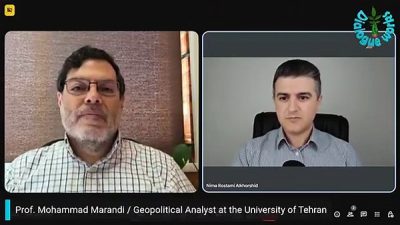
Seyed M. Marandi: U.S. Military DIVIDED? Iran’s Secret Defense EXPOSED
or go to
Aletho News Archives – Video-Images
From the Archives
‘Israel sees Iran as obstacle to its policies’
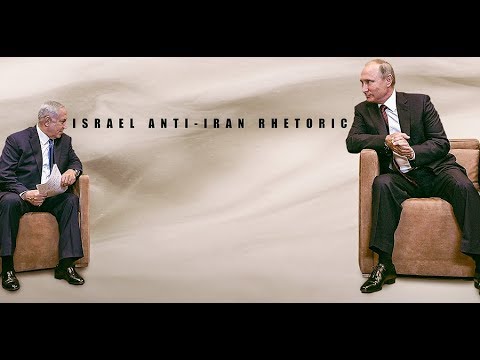
Press TV – August 25, 2017
Prime Minister Benjamin Netanyahu has said that Israel felt threatened by Iran’s growing influence in the Middle East. Netanyahu expressed his Iranophobic view in a meeting with Russian President Vladimir Putin in Russia’s Black Sea resort of Sochi on Wednesday. Press TV has asked Scott Rickard, former American intelligence linguist from Tampa, Florida, and Brent Budowsky, a columnist at The Hill from Washington, to give their thoughts on the issue.
Rickard said Tel Aviv is concerned about the fact that the regime could not carry out its old project to spread sectarian divisions and pave the way for dismemberment of the countries in the Middle East region because of the Iranian-led resistance against Israeli policies, not only in the occupied territories of Palestine but also in the whole region.
“Iran is not a threat to Israel whatsoever. The threat that Israel sees is the fact that their Oded Yinon Plan is being put to a hold by Iran,” the intelligence linguist said on Thursday night.
“They (the Israelis) look at Iran as a threat only because they have no influence on their governments and Iran is autonomous and is not under the Zionist influence,” he added.
Since the victory of the Islamic Republic of Iran in 1979, Tehran has been critical of Israel’s policies in the region, whereas “no leaders [of other states] even dared to speak out against Zionism,” Rickard argued. … continue
Blog Roll
 Aletho News
- Alberta Bill Would Fine Political Deepfakes $10,000 Without Satire Exemptions
- Iran declares ‘historic victory’ over US, says enemy forced to accept its proposal
- Trump Claims Ceasefire, Reopening of Strait of Hormuz Agreement with Iran
- Israeli tank fire killed UN peacekeeper in Lebanon, UNIFIL investigation finds
- Russia, China block Bahrain-sponsored UN resolution on Strait of Hormuz
- The US-Israeli War on Science is an Assault on our Future
- Trump’s Promise to Bomb Iran ‘Like Never Before’ Faces Brutal Logistics — Expert
- Germany seeks to restrict stays abroad for men of fighting age – Berliner Zeitung
- Evidence points to Ukraine being behind TurkStream attempted sabotage, but that should come as no surprise
- Sri Lanka secures supplies of Russia oil – minister
- If Americans Knew
- Thousands dead and neighborhoods razed to the ground: Aid agencies fear southern Lebanon is becoming the new Gaza
- The war the US is fighting for Israel could cost trillions
- ‘Cigarette Burns, Nail Wounds’: Toddler Tortured in Gaza to Coerce Father
- Trump Says US Sent ‘a Lot of Guns’ to Protesters in Iran
- Israeli forces destroy 17 UN peacekeeper cameras in south Lebanon
- US-Israeli strikes ‘completely destroy’ synagogue in Tehran
- Archbishop for US Military Says Iran War Is Unjust Under Catholic Teaching
- Iranian leaders’ Open Letters to the American People
- Trump says Iranians appreciate bombs, WHO warns of nuclear risks – Daily Update
- U.N. experts demand Israel release prominent Gaza doctor after reports of ‘severe torture’
- No Tricks Zone
- An Inconvenient Tree: Uncovered In Alps… Europe Much Warmer Than Today 6000 Years Ago
- New Study Reports A 60% Slowdown In Greenland’s Ice Loss Rate In The Last Decade
- Low Intensity Tornado Wrecks Major Solar Farm, Creating A Potential Toxic Dump
- New Study Finds Warming Saves Lives…Cold Temperatures 12 Times More Deadly Than Excess Heat
- German Science Blog Accuses PIK Climate Institute Of Hallucinating Climate Tipping Points
- Devastating Assessment Of Comirnaty Vaccine By Former Senior Pfizer Europe Toxicologist
- New Study: CO2 Is ‘Effectively Negligible’ As An Explanatory Climate Change Factor Since 2000
- Former Pfizer Toxicologist Dr. Helmut Sterz Tells Bundestag Hearing Pfizer Vaccine Should Have Never Been Approved
- Energy Expert: Germany’s Nuclear Phaseout Was A “500 Billion Euro Mistake”
- New Research: South Australia’s Mid-Holocene Sea Surface Temperatures Were 4°C Warmer Than Today
 Aletho News