US, Israel won’t partake in confab on WMD-free Mideast
Press TV – November 12, 2019
The United States will not participate in a conference on establishing a zone free of all types of weapons of mass destruction (WMD) in the Middle East “because of Israel,” Russia has announced.
“The Americans refused to take part because Israel refuses to participate,” said Mikhail Ulyanov, Russia’s permanent representative to international organizations in Vienna, Austria, on Tuesday.
The WMDFZ conference will be held from November 18 to 22, at the United Nations (UN) Headquarters in New York. According to Ulyanov, Russia and China will participate as observers.
Israel is the only possessor of nuclear weapons in the Middle East, but its policy is to neither confirm nor deny having atomic bombs. Estimates show that the regime is currently in possession of 200 to 400 atomic warheads.
The Tel Aviv regime is also believed to possess the capability to deliver its nuclear warheads in a number of methods, including by aircraft, on submarine-launched cruise missiles and the Jericho series of intermediate to intercontinental range ballistic missiles.
Ulyanov also said the Arab countries of the Middle East “proceed from the assumption that Israel has nuclear weapons and does not want to abandon it.”
Last year, the First Committee of the UN General Assembly (UNGA) adopted a decision — submitted by the League of Arab States — that requests UN Secretary General Antonio Guterres to hold a regional conference on the establishment of the WMDFZ in the Middle East by the end of this year.
Israel and the US have already expressed their strong opposition to the initiative, saying it would target Tel Aviv.
However, “practical work will finally begin, though without the Americans,” said the Russian official.
In a June report, the Stockholm International Peace Research Institute (SIPRI) revealed that the Israeli regime has 30 gravity bombs that can be delivered by fighter jets — some of which are believed to be equipped for nuclear weapon delivery.
Israel also possesses close to 50 warheads that can be delivered by land-based ballistic missiles, such as Jericho III, said to have a range of 5,500 km, the global security think tank added.
The institute further said that the Israeli regime has modified its fleet of German-built Dolphin-class submarines to carry nuclear-armed sea-launched cruise missiles, giving it a sea-based strike capability.
Israel is not a member of the Nuclear Non-Proliferation Treaty (NPT), either.
The Houthis Are Preparing for a Planned Israeli Attack on Yemen
By Ahmed Abdulkareem | MintPress News | November 11, 2019
SANA’A, YEMEN — As the war in Yemen nears the end of its fifth year, the situation in the country seems to be escalating. There are strong indications that Israel is planning to launch airstrikes against the country under the pretext of preventing an Iranian military presence from taking hold, a move that is likely to open the door for further escalation.
On Saturday, Ansar Allah, the political wing of Yemen’s Houthis, announced that Yemeni forces would not hesitate to “deal a stinging blow” to Israel in the case Tel Aviv decides to launch attacks in Yemen. The Houthis reaffirmed that their anti-Israel position is based on a principled, humanitarian, moral, and religious commitment. Historically, neither the Yemeni Army nor the Houthis themselves, have ever targeted Israel directly.
The threat from Israel is not without precedent. Israel has used claims of alleged Iranian military attachments in countries like Syria and Iraq as justification for airstrikes and bombings against those nations. Now, Israel appears to be using Iran’s alleged presence in Yemen, an allegation that both Tehran and the Houthis deny, as a pretext for military action in the country despite no evidence indicating that there are any Iranian forces present there.
Ansar Allah leader Abdulmalik al-Houthi said in televised speech marking the anniversary of the Prophet Muhammad, “Our people will not hesitate to declare jihad (holy war) against the Israeli enemy, and to launch the most severe strikes against sensitive targets in the occupied territories if the enemy engages in any folly against our people.” The occasion marks the largest festival held by the Houthis during which they reveal their domestic and foreign policies for the coming year.
The Houthis also called on the Saudi regime to stop the war and siege on Yemen, warning that there would be risks and consequences for the Kingdom should they continue their attacks. Al-Houthi also confirmed that Yemenis will continue to develop their military capability, adding that, “Anyone who uses the war and siege to control us and subjugate us is seeking the impossible, and the consequence is failure.”
Al-Houthi also pointed to the ongoing mass protest movements in Lebanon and Iraq, advising nations in the Middle East to resolve their issues vigilantly. He asked those nations to exercise vigilance in the face of what he called Israeli plots to gain a political, military, and cultural foothold in their respective countries.
On Saturday, massive demonstrations took place across Yemen’s major cities to commemorate the Prophet Mohammed’s birth, an occasion known to Muslims as Maulud Nabi. While the occasion is a religious one, it is a public holiday in Yemen and is marked with the singing of the national anthem and the waving of green flags. Many protesters told MintPress News that any attack by Israeli would not cause the Yemeni people any more suffering than they have already endured, but would push them to join a “holy war” against Israel.
According to three government officials in Sana’a that spoke to MintPress on the condition of anonymity, the Houthi’s warnings are both serious and well-placed. Those officials said that the government in Sana’a has already confirmed information that Israel is preparing to launch airstrikes on both military sites and civil targets in Yemen, especially on the country’s west coast and along the Saudi-Yemen border in coordination with the Saudi-led Coalition.
Ansar Allah’s announcement also comes in the wake of a number of recent statements made by a number of Israeli officials claiming that Yemen has become a threat to Israel. Speaking during a visit by U.S. Secretary of Treasury Steven Mnuchin and White House aid Jared Kushner, Netanyahu claimed that Iran has supplied missiles to the Houthis that could hit Israel. The Houthis regard these statements as a justification and prelude to strikes on the country, similar to those that Israel unilaterally carried out against sites in Syria and Iraq.
In August, Kuwaiti newspaper al-Jarida released a report saying that Israel is planning on striking sensitive positions on the Bab al-Mandab strait which links the Red Sea and the Gulf of Aden, to target “Houthis” in the area. The newspaper, which cited an anonymous informed source, said Israeli intelligence agency Mossad has been monitoring activities in the Yemeni strait.
Israel’s entry into the Yemen war could indeed open the door for further escalation, a prospect made more likely by both the increased strength of Ansar Allah forces and by Israel’s increasingly cozy relationship with the Gulf Arab countries of the coalition. The fact that Saudi Arabia and the UAE recently sought negotiations with Houthis after they were unable to win the war militarily, despite their superior firepower and funding, only increases the likelihood of Israel’s entry into Yemen.
In fact, Israel is alleged to have already participated in the war against Yemen on behalf of the Saudi-led coalition as a part of a series of covert interventions involving mercenary forces, the reported launching of dozens of airstrikes in the country and even the dropping of a neutron bomb on Nuqm Mountain in the middle the capital Sana’a in May of 2015.
Kicking the hornet’s nest
Like Saudi Arabia and the UAE, there is a problem with the Israeli assessment of the situation in Yemen, as the Houthis have never threatened to hit an Israeli target and Houthi attacks on Saudi-led Coalition countries have always been retaliatory, not preemptive. There are no vital targets to be bombed in Yemen as the Saudi-led coalition has already destroyed nearly every potential target, including civilian infrastructure. Moreover, any attack by Israel against Yemen will gain the Houthis even more popular support both inside of Yemen and across the Islamic and Arab world.
Furthermore, there is no evidence that Iran has any military sites or experts in Yemen, and Yemen’s Army, loyal to Ansar Allah, are not the “Iran proxy fighters” that international media so often claims them to be. Indeed, the U.S. State Department even admitted in leaked cables that the Houthis were not an Iran proxy and that they received neither funding nor weapons from Iran.
There are a convergence of interests between the Houthis and Iran, including opposition to Israel’s internationally-recognized theft of Palestinian land, but if Israel involves itself directly in the conflict in Yemen, it is likely that the Houthi alliance with Iran will grow and may actually spur Tehran into providing precise and sophisticated weapons to Ansar Allah, turning the fears of Israel into a self-fulfilling prophecy.
Meanwhile, many Israeli activists and media pundits are expressing concerns over what they consider serious threats from Yemen, pointing out that these threats “should not be underestimated by the Israelis.” The Israeli security parliament said that Israeli intelligence must strictly monitor Yemen and take necessary steps to secure Israeli ships sailing in the Bab Al-Mandab area, describing the statements made by Abdulmalik al-Houthi as serious.
A well-stocked arsenal
Indeed the threats of Ansar Allah, a group known to strike sensitive targets without hesitation, are not without precedent. On September 14, Ansar Allah hit two of Saudi Arabia’s oil facilities in Abqaiq and Khurais, an attack that led to a suspension of about 50 percent of the Arab Kingdom’s crude and gas production.
Prior to that, they targeted vital facilities deep inside of Saudi Arabia and the United Arab Emirates, including the Barakah Nuclear Power Station in Abu Dhabi, the capital of the UAE, as well as the King Khalid International Airport near Riyadh, more than 800 km from Yemen’s northern border. Now, they have developed their arsenal of ballistic missiles and drones even further and experts say are likely capable of hitting vital targets inside of Israel. Yemen’s Army is ready to launch those missiles if Ansar Allah’s leader asks it to do, one high-ranking military officer told MintPress.
Yemen’s Army, loyal to the Houthis, is equipped with the Quds 1 winged missile which was used in an attack on the Barakah Nuclear Power Station in Abu Dhabi in December of 2017. This year, several generations of the Quds 1 were reworked to provide the “ability to hit its targets and to bypass enemy interceptor systems,” according to Ansar Allah.
The Borkan 3 (Volcano 3), whose predecessors were used by the Houthis to strike targets inside of Saudi Arabia and the UAE, is capable of traveling even further than the Borkan 1 and 2. The Borkan is a modified Scud missile and was used in a strike on the King Khalid International Airport near Riyadh, more than 800 km from Yemen’s northern border. The missile was able to evade U.S. Patriot missile air-defense systems.
Yemen’s Army also posses the Samad 3 reconnaissance drone and the Qasef 2K drone. Both were used in strikes against the Abu Dhabi and Dubai airports. The Samad 3 has an estimated range of 1,500 to 1,700 km. Moreover, the Yemen Army recently unveiled a new drone with a range exceeding 1,700 km and equipped with advanced technology that would render it difficult for air defense systems to detect.
One Ansar Allah military source told MintPress that mines would also be deployed against Israeli battleships and watercraft in the Red Sea if Israel decides to launch attacks against Yemen. Indeed, Yemen’s military recently revealed its domestically-manufactured marine mines dubbed the “Mersad,” and is reportedly “actively developing its naval forces and naval anti-ship missiles.”
Despite the well-established precedent, many still doubt that the Houthis are capable of carrying out attacks on the scale and range of the attack that struck an Aramco facility in Saudi Arabia earlier this year — instead, accusing Iran of orchestrating the attacks. Yet repeatedly underestimating the Houthis was one of the major mistakes made by the Saudi-led coalition, who has failed to defeat the group after nearly five years of fierce battles against them, despite being equipped with the latest U.S.-supplied weaponry — everything from M1A2 Abrams tanks and M2 Bradley fighting vehicles to AH-64D Apache helicopters, as well as having an air force equipped with a high-tech arsenal.
However, it would be difficult for the Yemeni Army to prevent aerial attacks by Israel. Yemeni airspace has been open to the coalition and to American drones since the war broke out in 2015. Any attack by the Yemen army would likely come in retaliation to an Israeli attack and would hit Israeli military bases in Eritrea, Israeli ships in the Red Sea as well as hit vital targets deep inside of Israel, according to Yemeni military sources.
An already dire situation
The war, which began in March 2015, has led to the world’s worst humanitarian crisis resulting from the bombing and a blockade which has led to mass starvation and history’s largest cholera outbreak, among other dire consequences.
The coalition, backed by the United States, has killed tens of thousands of Yemeni civilians since the war began. Moreover, the coalition’s blockade of food and medicine has plagued the country with an unprecedented famine and has triggered a deadly outbreak of preventable diseases that have cost thousands of people their lives.
Last week, the Armed Conflict Location & Event Data Project revealed that Yemen’s death toll rose to a shocking 100,000 since 2015. The database shows approximately 20,000 people have been killed this year, already making 2019 the second-deadliest year on record after 2018, with 30,800 dead. Those numbers do not include those who have died in the humanitarian disasters caused by the war, particularly starvation.
Given the nature of Israel’s recent wars against Gaza and Lebanon, it is unlikely that Israel would feel constrained by any moral dilemma should they chose to launch airstrikes against civilians in Yemen.
Ahmed AbdulKareem is a Yemeni journalist. He covers the war in Yemen for MintPress News as well as local Yemeni media.
Cornering and Strangulating Iran Has Backfired on Israel
By Alastair Crooke | Strategic Culture Foundation | November 11, 2019
What happens if the two premises on which Israel and America’s grand Iran strategy is founded are proven false? ‘What if’ maximum pressure fails either to implode the Iranian state politically, nor brings Iran to its knees, begging for a new ‘hairshirt’ nuclear deal? Well …? Well, it seems that Netanyahu and Mossad were so cocksure of their initial premise, that they neglected to think beyond first move on the chess board. It was to be checkmate in one. And this neglect is the cause of the strategic bind in which Israel now finds itself.
Lately, these lacunae in strategic thinking are being noticed. Iran is doing just fine, writes Henry Rome in Foreign Affairs:
“Some analysts predicted that Iran’s friends in Europe and Asia would defy the United States to lend Iran economic help. Others reckoned that the sanctions would send Iran’s economy into a “death spiral,” leaving Tehran the choice to either surrender or collapse. Neither of these predictions came to pass.
“Rather, Iran now enters its second year under maximum pressure strikingly confident in its economic stability and regional position. Supreme Leader Ali Khamenei and other hard-liners are therefore likely to continue on their current course: Iran will go on tormenting the oil market, while bolstering its non-oil economy—and it will continue expanding its nuclear program while refusing to talk with Washington.”
Similarly, the (US) Crisis Group reports that on the eve of the US oil sanctions snapback in November 2018, Secretary Pompeo was asked if Iran might restart its nuclear program. He responded: “we’re confident that the Iranians will not make that decision”. But, Iran did just that: In April 2019 – after the US revoked the sanction waivers that had previously allowed eight countries to import Iranian oil – the Iranian leadership started pushing back.
They are still doing it. “Iran’s responses on the nuclear and regional fronts call into question the core premises of the U.S. “maximum pressure” campaign … Tehran [effectively] has broken the binary outcome of concession or collapse by instead adopting what it touts as “maximum resistance”. As a result … there can be little doubt that the [US] strategy has fallen short, delivering impact without effect and rather than blunting Iran’s capabilities only sharpening its willingness to step up its [push-back]”, the Crisis Group report concludes.
So here we are: Iran’s “fourth step” in its incremental lessening of compliance with the JCPOA (injecting nuclear gas into the – hitherto empty – centrifuges at Fordo; augmenting enrichment to 5% and unveiling substantially improved centrifuges), effectively tests the very core to the Obama JCPOA strategy.
The Accord was built around a framework that meant Iran would remain at least 12 months away from break-out capacity (the moment when a state can transition into a nuclear weapons’ state). Iran – in these de-compliance steps is inching under that limit, if it is not already under it. (This does not, however, imply that Iran is seeking weapons, but rather that it is seeking a change in western behaviour.)
Yes, Israel – which pushed hard its assessment (albeit, onto a Trump team wholly receptive to this Israeli analysis) of an Iran entering into a death-spiral within one year, under Trump’s maximum pressure – can plead reasonably that its grand strategy was struck by two ‘black swans’. The double ‘punch’ quite evidently has knocked Israel – it is now all at sixes and sevens.
One was the 14 September strikes on the two Aramco plants in Saudi Arabia (claimed by the Houthis), but demonstrating a level of sophistication which Israelis explicitly admit took them wholly by surprise. And the second was the accumulated evidence that the US is in the process of quitting the Middle East. Again, Israel – or at least Netanyahu – never believed this could happen under Trump’s ‘watch’. Indeed, he had built a political platform on his claim of intimate rapport with the US President. Indeed, that did seem at the time to be perfectly true.
Israeli historian, Gilad Atzmon observes, “it now seems totally unrealistic to expect America to act militarily against Iran on behalf of Israel. Trump’s always unpredictable actions have convinced the Israeli defense establishment that the country has been left alone to deal with the Iranian threat. The American administration is only willing to act against Iran through sanctions”.
And the former Israeli Ambassador to Washington put the consequences yet more bluntly under the rubric of The Coming Middle East Conflagration: “Israel is bracing itself for war with Iranian proxies … But what will the United States do if conflict comes?” — by this Oren implies the US might do little, or nothing.
Yes. This is precisely the dilemma to which the Israeli policy of demonising Iran, and instigating ‘the world’ against Iran, has brought Israel. Israeli officials and commentators now see war as inevitable (see here and here) – and they are not happy.
War is not inevitable. It would not be inevitable if Trump could put aside his Art of the Deal pride, and contemplated a remedy of de-escalating sanctions – especially oil export sanctions – on Iran. But he has not done that. After a quick (and wholly unrealistic) ‘fling’ at having a reality-TV photo-op with President Rouhani, his Administration has doubled down by imposing further, new sanctions on Iran. (Friends might try to tell their American counterparts that it is well time they got over the 1979 Tehran Embassy siege.)
And war is not inevitable if Israel could assimilate the reality that the Middle East is in profound flux – and that Israel no longer enjoys the freedom to strike wherever, and whomsoever it choses, at will (and at no cost to itself). Those days are not wholly gone, but they are a rapidly diminishing asset.
Will Israel shift posture? It seems not. In the context of the Lebanon protests, the local banks are becoming vulnerable, as capital inflows and remittances dry up. Israeli, plus some American officials, are favouring withholding external financial assistance to the banks – thus making the banking system’s survival contingent on any new government agreeing to contain and disarm Hizbullah (something which, incidentally, no Lebanese government, of whatever ‘colour’, can do).
That is to say, US and Israeli policy is that of pushing Lebanon to the brink of financial collapse in order to leverage a blow at Iran. Never mind that it will be the demonstrators – and not Hizbullah – who will pay the heaviest price for pushing the crisis to the brink – in terms of a devalued pound, rising prices and austerity. (Hizbullah, in any case, exited the Lebanese banking system, long time past).
Iran, on the other hand, faced with maximum pressure, has little choice: It will not succumb to slow-strangulation by the US. Its riposte of calibrated counter-pressure to US max-pressure, however, does entail risks: It is predicated on the judgement that Trump does not want a major regional war (especially in the lead up to US elections), and also predicated (though less certainly) on the US President’s ability to avoid being cornered by his hawks into taking responsive military action (i.e. were another US drone to be shot down).
So, what do all these various geo-political ‘tea-leaves’ portend? Well, look at Lebanon and Iraq through the geo-political spectacles of Iran: On the one hand, it is well understood in Tehran that there is justified, deep popular anger in these states towards corruption, the iron sectarian structures and hopeless governance — but that is only one part of the story. The other is the long-standing geo-strategic war that is being waged against Iran.
Maximum pressure has not produced a chastened, and repentant Iran? So, now Iranians see the US and Israel resorting to ‘Euromaidan warfare’ (Ukrainian protests of 2013) against Iran’s Lebanese and Iraqi allies. (It was, after all, during President Aoun’s visit to Washington in March, that Trump first warned Aoun of what was coming – and presented his ultimatum: Contain Hezbollah, or expect unprecedented consequences, including sanctions and the loss of US aid).
Fresh sanctions, plus an Euromaidan-type assault on Iranian allies (Hizballah and Hash’d A-Shaabi)? Might we then expect another ‘Gulf surprise’ – in coming weeks?
This tit-for-tat of pressure and counter-pressure is set to continue — Michael Oren, the former Israeli Ambassador to the US, lays it out:
“The conflagration, like so many in the Middle East, could be ignited by a single spark. Israeli fighter jets have already conducted hundreds of bombing raids against Iranian targets in Lebanon, Syria, and Iraq. Preferring to deter rather than embarrass Tehran, Israel rarely comments on such actions. But perhaps Israel miscalculates, hitting a particularly sensitive target; or perhaps politicians cannot resist taking credit. The result could be a counterstrike by Iran, using cruise missiles that penetrate Israel’s air defenses and smash into targets like the Kiryah, Tel Aviv’s equivalent of the Pentagon. Israel would retaliate massively against Hezbollah’s headquarters in Beirut as well as dozens of its emplacements along the Lebanese border. And then, after a day of large-scale exchanges, the real war would begin.
“Rockets, many carrying tons of TNT, would rain on Israel; drones armed with payloads would crash into crucial facilities, military and civilian. During the Second Lebanon War, in 2006, the rate of such fire reached between 200 and 300 projectiles a day. Today, it might reach as high as 4,000. The majority of the weapons in Hezbollah’s arsenal are standoff missiles with fixed trajectories that can be tracked and intercepted by Israel’s Iron Dome system. But Iron Dome is 90 percent effective on average, meaning that for every 100 rockets, 10 get through, and the seven operational batteries are incapable of covering the entire country. All of Israel, from Metulla in the north to the southern port city of Eilat, would be in range of enemy fire.”
Of course, the claim that Israeli air defences are 90% effective is ‘for the birds’ (Israeli officials would not be in such a panic if it were true). But Oren sets out the course to a region-wide war plainly enough. This is the end to which their Iran strategy has brought them.
And just to recall, this strategy was always a ‘strategy of choice’ – taken for domestic political purposes. Israel’s demonization of Iran did not begin with the Iranian Revolution. Israel initially had good relations with the revolutionary republic. The relationship transformed because an incoming Israeli Labour government needed it to transform: It wanted to upend the earlier political consensus, and to make peace with the ‘near enemy’ (i.e. its Arab neighbours). But Israel then required a ‘new’ villain threatening ‘plucky little Israel’ to keep unstinting US Congressional support coming through: Iran became that villain. And then, subsequently, Netanyahu made his twenty-year career out of the Iranian (nuclear) bogeyman.
Reaping what a long-term strategy of threats and incitement sows …? In one of the most detailed assessments of Iran’s strategy and doctrine across Lebanon, Syria, Iraq and Yemen, the International Institute for Strategic Studies (IISS) concludes that Iran’s “third party capability” has become Tehran’s weapon of choice: “Iran now has an effective military advantage over the US and its allies in the Middle East, because of its ability to wage war using third parties such as Shia militias and insurgents”, the report concludes. It has the military edge? Well, well …
And doesn’t this fact help explain what is happening in Iraq and Lebanon today?
‘Israel’ Says US Sanctions Failed to Subdue Iran & Axis of Resistance, Warns of Rising Yemeni Threat
Al-Manar | November 10, 2019
The Israeli media considered that the US economic sanctions had failed to subdue Iran and all the axis of resistance, adding that Tel Aviv and Washington did not reach any achievement in this regard.
The Zionist reports pointed out that the attacks which targeted Aramoci oil facilities in addition to the tankers indicate that Iran will strike ‘Israel’ in response to any military operation in the region.
In the meantime, the Israeli media highlighted the vow of Yemen’s Ansarullah Chief Sayyed Abdul Malik Al-Houthi to respond to any Israeli assault on Yemen by attacking the Zionist entity, emphasizing that this is a new threat.
Iran is winning strategic struggle for influence, even as US cripples its economy
By Darius Shahtahmasebi | RT | November 8, 2019
A new report has confirmed what some analysts have been saying for some time: that Iran is winning the regional struggle for strategic influence.
The 217-page report, published by the London-based International Institute for Strategic Studies (IISS), is entitled “Iran’s Networks of Influence in the Middle East” and details Tehran’s use of proxy forces and networks throughout the region and the effects and benefits of its “minimum output” foreign policy strategy.
It is probably worth mentioning at this point that H.R. McMaster, Trump’s former national security adviser, was once an employee of the IISS. As was James Steinberg, a former US deputy secretary of state. Furthermore, at the end of 2016, the Guardian revealed that the organization had received £25 million ($32 million) from the Bahraini royal family (apparently almost half of its total income has come from Bahrain). Iran and Bahrain aren’t exactly close friends.
Notwithstanding the potential motives and bias of the IISS, the report definitely arrives at some interesting conclusions.
“The Islamic Republic of Iran has tipped the balance of effective force in the Middle East in its favor,” the report explains.
But here’s the crazy part. Iran is, and has been for years, completely pummeled to the ground by US-imposed sanctions. Many commentators have for some time now been predicting an impending collapse of the Iranian economy.
On top of that, and likely because of this fact, Iran’s military budget has consistently been low (especially when compared to the United States or any of Washington’s major allied powers in the region). This flies completely in the face of allegations that Iran is a regional aggressor and the number-one state sponsor of terrorism (with what money?), but don’t let this get in the way of a good story.
According to the US Defense Department’s annual review of the country, “Iran’s military doctrine is defensive. It is designed to deter an attack, survive an initial strike, retaliate against an aggressor, and force a diplomatic solution to hostilities while avoiding any concessions that challenge its core interests.”
In other words, despite being under the constant threat of war, whether from the US, Israel or Saudi Arabia, Iran is not looking for a fight. It maintains a much lower military expenditure than Saudi Arabia, Israel, and especially Washington, yet as the recent IISS report notes, it has emerged from the rubble of a war-torn Middle East region as a victor.
As Foreign Affairs (the Council on Foreign Relations’ magazine) explained in a recent article:
“Iran now enters its second year under maximum pressure strikingly confident in its economic stability and regional position.”
It is likely with this newfound confidence that Iran is beginning to dictate some shots of its own to the international community, particularly when it comes to the future of uranium enrichment. Foreign Affairs also explains that Iran has essentially weathered the storm of US sanctions and come up trumps all on its lonesome. Many of the people predicted to come to Tehran’s aid during the United States’ maximum pressure campaign have been nowhere to be seen.
According to the IISS report, Iran has been winning the regional geopolitical struggle for influence by developing asymmetric warfare, such as swarm tactics, drones and cyber-attacks. It has relied upon the Quds arm of the Islamic Revolutionary Guard Corps (IRGC) to increase its operations throughout the Middle East, as well as to provide training, support and weapons to other actors allied to Tehran. The report also notes Iran’s relationship with Hezbollah, its role in the conflicts in Iraq and Syria, as well as its role (supposedly) in Yemen.
As my Kung Fu instructor once told me, you serve yourself in a confrontation best by using minimum output for maximum gain. Winning the lottery doesn’t entail that you then go to a casino and put all your money down on your first gamble. Just because you have it, doesn’t mean you have to expend it.
In comparison, Saudi Arabia has expended time, effort, billions of dollars and the lives of many innocent civilians waging a genocidal war in Yemen – and it’s still losing. As Bloomberg once explained:
“Saudi Arabia has better weapons than its enemies in Yemen, no surprise in a war that pits one of the richest Arab countries against the poorest. And still the Saudis are struggling to impose their will.”
Not only is it losing a war, it’s also losing an economic battle. At the beginning of the conflict, Reuters estimated that the war would cost Saudi Arabia approximately $175 million per month. However, even by the end of the first year of the war, the kingdom had to increase its defense spending by $5.3 billion. This trend has continued right throughout the conflict. At the end of 2016, Saudi Arabia had to announce a projected increase of 6.7 percent in defense spending for 2017, bringing its total budget to around $50.8 billion.
If the IISS report’s findings are correct, there may be a deep lesson in here for the US and its allies. Perhaps it’s not that Iran has emerged victorious despite the fact it has not spent billions of dollars invading other nations at any one time; but because it hasn’t been.
At the end of the day, how much influence can you exert when you forcibly invade, occupy and kill those countries you seek to influence?
‘Israel’, Gulf States Preparing Non-aggression Pact
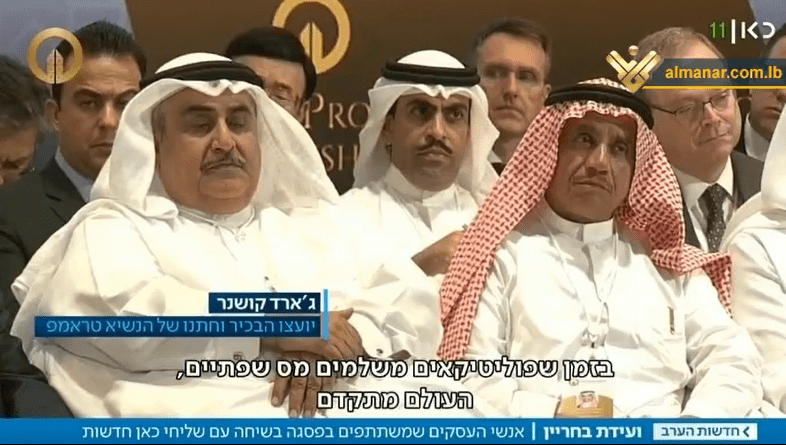
Al-Manar | November 6, 2019
In context of the process aimed at normalizing ties between the Zionist entity and the Gulf States, the Israeli media revealed that the two sides were preparing a non-aggression pact sponsored by the US administration.
Zionist analysts considered that Washington is trying to endorse the non-aggression pact as a substitute for the failed ‘Deal of the Century’, adding that the US Treasury Secretary conveyed the Israeli-prepared draft to the Gulf officials.
The Isralei media also unveiled the enemy’s participation in investment projects and expos in Saudi and Emirates, adding that Tel Aviv specialized hundreds of millions of dollars for this purpose.
Israel ‘aiding Kurds’ in Syria, advocating for them in talks with US – deputy FM
RT | November 6, 2019
Israel is assisting Syrian Kurds battered by a month-old Turkish incursion, and advocating for them in talks with the United States, the deputy Israeli foreign minister said on Wednesday.
Ankara launched its assault targeting the Kurdish YPG militia after the abrupt withdrawal of 1,000 US troops from northern Syria in early October. Israel sees Syrian Kurds as a counterweight to “Iranian influence.”
Israeli PM Benjamin Netanyahu offered humanitarian aid to the “gallant Kurdish people” on October 10, saying they faced possible “ethnic cleansing” by Turkey and its allies in Syria.
Tzipi Hotovely, Israel’s deputy foreign minister, told parliament on Wednesday that the offer had been taken up, Reuters said. “Israel has received many requests for assistance, mainly in the diplomatic and humanitarian realm,” she said. “We identify with the deep distress of the Kurds, and we are assisting them through a range of channels.”
Hotovely did not elaborate on the Israeli assistance. Syrian Kurdish officials have not commented on the statement.
The ‘War’ for the Future of Middle East
By Alastair Crooke | Strategic Culture Foundation | November 4, 2019
Oh, oh, here we are again! In 1967, it was then the ‘threat’ of the standing Arab Armies (and the ensuing six-day war on Egypt and Syria); in 1980, it was Iran (and the ensuing Iraqi war on Iran); in 1996, it was David Wurmser with his Coping with Crumbling States (flowing on from the infamous Clean Break policy strategy paper) which at that time targeted secular-Arab nationalist states, excoriated both as “crumbling relics of the ‘evil’ USSR” and inherently hostile to Israel, too; and in the 2003 and 2006 wars, it was Saddam Hussein firstly; and then Hezbollah that threatened the safety of the West’s civilizational ‘outpost’ in the Middle East.
And here we are once more, Israel cannot safely ‘live’ in a region containing a militant Hezbollah.
Not surprisingly, the Russian Ambassador in Beirut, Alexander Zasypkin, quickly recognized this all too familiar pattern: Speaking with al-Akhbar on 9 October in Beirut (more than a week before the protests in Beirut erupted), the Ambassador dismissed the prospect of any easing of regional tensions; but rather identified the economic crisis that has been building for years in Lebanon as the ‘peg’ on which the US and its allies might sow chaos in Lebanon (and in Iraq’s parallel economic calamity), to strike at Hezbollah and the Hash’d A-Sha’abi — Israel’s and America’s adversaries in the region.
Why now? Because what happened to Aramco on 14 September has shocked both Israel and America: the former Commander of the Israeli Air Force wrote recently, “recent events are forcing Israel to recalculate its path as it navigates events. The technological abilities of Iran and its various proxies has reached a level at which they can now alter the balance of power around the world”. Not only could neither state identify the modus operandi to the strikes (even now); but worse, neither had any answer to the technological feat the strikes plainly represented. In fact, the lack of any available ‘answer’ prompted one leading western defense analyst to suggest that Saudi should buy Russian Pantsir missiles rather than American air defenses.
And worse. For Israel, the Aramco shock arrived precisely at the moment that the US began its withdrawal of its ‘comfort security blanket’ from the region – leaving Israel (and Gulf States) on their own – and now vulnerable to technology they never expected their adversaries to possess. Israelis – and particularly its PM – though always conscious to the hypothetical possibility, never thought withdrawal actually would happen, and never during the term of the Trump Administration.
This has left Israel completely knocked, and at sixes-and sevens. It has turned strategy on its head, with the former Israeli Air Force Commander (mentioned above) speculating on Israel’s uncomfortable options – going forward – and even postulating whether Israel now needed to open a channel to Iran. This latter option, of course, would be culturally abhorrent to most Israelis. They would prefer a bold, out-of-the-blue, Israeli paradigm ‘game-changer’ (i.e. such as happened in 1967) to any outreach to Iran. This is the real danger.
It is unlikely that the stirring of protests in Lebanon and Iraq are somehow a direct response to the above: but rather, more likely, they lie with old plans (including the recently leaked strategy paper for countering Iran, presented by MbS to the White House), and with the regular strategic meetings held between Mossad and the US National Security Council, under the chairmanship of John Bolton.
Whatever the specific parentage, the ‘playbook’ is quite familiar: spark a popular ‘democratic’ dissent (based on genuine grievances); craft messaging and a press campaign that polarizes the population, and which turns their anger away from generalized discontent towards targeting specific enemies (in this case Hezbollah, President Aoun and FM Gebran Bassil (whose sympathies with Hezbollah and President Assad make him a prime target, especially as heir-apparent to the leadership of the majority of Christians). The aim – as always – is to drive a wedge between Hezbollah and the Army, and between Hezbollah and the Lebanese people.
It began when, during his meeting with President Aoun in March 2019, US Secretary of State, Mike Pompeo reportedly presented an ultimatum: Contain Hezbollah or expect unprecedented consequences, including sanctions and the loss of US aid. Leaked reports suggest that Pompeo subsequently brought ally, PM Hariri into the picture of the planned disturbances when Hariri and his wife hosted Secretary Pompeo and his wife for a lunch banquet at Hariri’s ranch near Washington at the end of the Lebanese premier’s August visit to the US.
As the Lebanese demonstrations began, reports of an ‘operations room’ in Beirut managing and analyzing the protests, and of large scale funding by Gulf states proliferated; but for reasons that are not clear, the protests faltered. The Army which originally stood curiously aloof, finally engaged in clearing the streets, and returning some semblance of normality – and the Central Bank governor’s strangely alarmist forecasts of imminent financial collapse were countered by other financial experts presenting a less frightening picture.
It seems that neither in Lebanon or in Iraq will US objectives finally be achieved (i.e. Hizbullah and Hash’d A-Sha’abi emasculated). In Iraq, this may be a less certain outcome however, and the potential risks the US is running in fomenting chaos much greater, should Iraq slip into anarchy. The loss of Iraq’s 5 million barrels/day of crude would crater the market for crude – and in these economically febrile times, this might be enough to tip the global economy into recession.
But that would be ‘small beer’ compared to the risk that the US is running in tempting ‘The Fates’ over a regional war that reaches Israel.
But is there a wider message connecting these Middle East protests with those erupting across Latin America? One analyst has coined the term for this era, as an Age of Anger disgorging from “serial geysers” of discontent across the globe from Ecuador to Chile to Egypt. His theme is that neoliberalism is everywhere – literally – burning.
We have noted before, how the US sought to leverage the unique consequences arising from two World Wars, and the debt burden that they bequeathed, to award itself dollar hegemony, as well the truly exceptional ability to issue fiat credit across the globe at no cost to the US (the US simply ‘printed’ its fiat credit). US financial institutions could splurge credit around the world, at virtually no cost – and live off the rent which those investments returned. But ultimately that came at a price: The limitation – to being the global rentier – has become evident through disparities of wealth, and through the incremental impoverishment of the American middle classes that the concomitant off-shoring brought about. Well-paid jobs evaporated, even as America’s financialised banking balance sheet ballooned across the globe.
But there was perhaps another aspect to this present Age of Anger. It is TINA: ‘There is no alternative’. Not because of an absence of potentiality – but because alternatives were crushed. At the end of two World Wars, there was an understanding of the need for a different way-of-being; an end to the earlier era of servitude; a new society; a new social contract. But it was short-lived.
And – long story, short – that post-war longing for ‘fairness’ (whatever that meant) has been squeezed dry; ‘other politics or economics’ of whatever colour, has been derided as ‘fake news’ – and in the wake of the 2008 great financial crisis, all sorts of safety-nets were sacrificed, and private wealth ‘appropriated’ for the purpose of the re-building of bank balance sheets, preserving the integrity of debt, and for keeping interest rates low. People became ‘individuals’ – on their own – to sort out their own austerity. Is it then, that people now are feeling both impoverished materially by that austerity, and impoverished humanly by their new era servitude?
The Middle East may pass through today’s present crises (or not), but be aware that, in their despair in Latin America, the ‘there is no alternative’ meme is becoming reason for protestors ‘to burn the system down’. That is what happens when alternatives are foreclosed (albeit in the interests of preserving ‘us’ from system collapse).
Russia Isn’t Getting the Recognition It Deserves on Syria
By Scott Ritter | TruthDig | October 30, 2019
At a time when the credibility of the United States as either an unbiased actor or reliable ally lies in tatters, Russia has emerged as the one major power whose loyalty to its allies is unquestioned, and whose ability to serve as an honest broker between seemingly intractable opponents is unmatched.
If there is to be peace in Syria, it will be largely due to the patient efforts of Moscow employing deft negotiation, backed up as needed by military force, to shape conditions conducive for a political solution to a violent problem. If ever there was a primer for the art of diplomacy, the experience of Russia in Syria from 2011 to the present is it.
Like the rest of the world, Russia was caught off guard by the so-called Arab Spring that swept through the Middle East and North Africa in 2010-2011, forced to watch from the sidelines as the old order in Tunisia and Egypt was swept aside by popular discontent. While publicly supporting the peaceful transition of power in Tunis and Cairo, in private the Russian government watched the events unfolding in Egypt and the Maghreb with trepidation, concerned that the social and political transformations underway were a continuation of the kind of Western-backed “color revolutions” that had occurred previously in Serbia (2000), Georgia (2003) and Ukraine (2004).
When, in early 2011, the Arab Spring expanded into Libya, threatening the rule of longtime Russian client Moammar Gadhafi, Russia initially supported the creation of a U.N.-backed no-fly zone for humanitarian purposes, only to watch in frustration as the U.S. and NATO used it as a vehicle to launch a concerted air campaign in a successful bid to drive Gadhafi from power.
By the time Syria found itself confronting popular demonstrations against the rule of President Bashar Assad, Russia—still struggling to understand the root cause of the unrest—had become wary of the playbook being employed by the U.S. and NATO in response. While Russia was critical of the violence used by the Assad government in responding to the anti-government demonstrations in the spring of 2011, it blocked efforts by the U.S. and Europe to impose economic sanctions against the Syrian government, viewing them as little more than the initial salvo of a broader effort to achieve regime change in Damascus using the Libyan model.
Moscow’s refusal to help facilitate that Western-sponsored regime change, however, did not translate into unequivocal support for the continued rule of Assad. Russia supported the appointment of former U.N. Secretary-General Kofi Annan to head up a process for bringing a peaceful resolution to the Syrian crisis, and endorsed Annan’s six-point peace plan, put forward in March 2012, which included the possibility of a peaceful transition of power away from Assad.
At the same time Russia was promoting a diplomatic resolution to the Syrian crisis, the U.S. was spearheading a covert program to provide weapons and equipment to anti-Assad forces, funneling shipments from Libya through Turkey and into rebel-controlled areas of Syria. This CIA-run effort, which eventually morphed into a formal operation known as Timber Sycamore, helped fuel an increase in the level of violence inside Syria that made it impossible for the Assad government to fully implement the Annan plan. The inevitable collapse of the Annan initiative was used by the U.S. and its European allies to call for U.N. sanctions against Syria, which were again rejected by Russia.
While Russia continued to call for a political solution to the Syrian crisis that allowed for the potential of Assad being replaced, it insisted that this decision would be made by a process that included the Syrian government, as opposed to the U.S. demand that Assad must first step down.
The Military Solution
The failed Annan initiative was replaced by a renewed U.N.-sponsored process, known as Geneva II, headed by Lakhdar Brahimi, a veteran Algerian diplomat with extensive U.N. experience. The Geneva process stalled as Brahimi sought to bridge the gap between the U.S.-backed Syrian opposition—which insisted upon Assad’s resignation as a precondition to any talks about the future of Syria—and Russia, which continued to insist that the Assad government have a voice in determining Syria’s future.
Complicating these talks was the escalation of violence inside Syria, where anti-Assad forces, building upon the massive amount of military aid received from the U.S., Saudi Arabia and the Arab Gulf states, aggressively pushed for a military victory that would moot the Geneva II process.
By June 2013 the situation had devolved to the point that the U.S., citing allegations that the Syrian government was using a nerve agent against rebel forces, was considering the establishment of no-fly zones in northern Syria and along the Jordanian border. While sold as a humanitarian move designed to create safe zones for Syrian civilians fleeing the fighting, the real purpose of these zones was to carve out large sections of Syrian territory where the opposition could organize and prepare for war under the umbrella of U.S. air power without fear of Syrian government retaliation.
The concept of Syria’s chemical weapons being used by the U.S. to justify military action against the Syrian government was not hypothetical. In 2012, President Barack Obama had declared that any use of chemical weapons by the Syrian government would be considered a “red line,” forcing the U.S. to act. When, in August 2013, a major chemical weapons incident occurred in Ghouta (conclusive attribution for the attack does not exist; the U.S. and NATO contend that the Syrian government was behind the attacks, which the Russians and the Syrian government claim were carried out by anti-Assad opposition for the purpose of compelling U.S. intervention), it looked like the U.S. would step in.
Committing to a larger war in Syria was not a politically popular move in the U.S., given the recent experience in Iraq, and when Obama met with Russian President Vladimir Putin during the G-20 summit in St. Petersburg, Russia, in September 2013, the Russians suggested a solution—the disarmament of Syrian chemical weapons under the supervision of the Organization for the Prevention of Chemical Weapons (OPCW). When Secretary of State John Kerry opened the door to that possibility, Russia and Syria jumped on the opportunity, paving the way for one of the great disarmament achievements of modern times, an action that won the OPCW the Nobel Peace Prize for 2013.
The disarmament of Syria’s chemical weapons was a huge success, for which Russia received little recognition, despite the major role it played in conceiving and overseeing its implementation. Russia had hoped that the disarmament process could lead to the establishment of international confidence in the Assad government that would translate into a diplomatic breakthrough in Geneva. This was not to be; a major peace conference planned for 2014 collapsed, and efforts to revive the failed talks were sidelined by the escalation of violence in Syria, as the armed opposition, sensing victory, pressed its attacks on the Syrian government.
The situation in Syria was further complicated when, in 2013, the organization formerly known as al-Qaida in Iraq renamed itself the Islamic State in Iraq and Syria, and started carving out a so-called caliphate from the ungovernable expanses of eastern Syria and western Iraq. Having established its capital in the Syrian city of Raqqa, Islamic State launched a dramatic offensive in early 2014, capturing large swaths of territory in both Syria and Iraq, including the Iraqi city of Mosul. By 2015, the Syrian government, under pressure from anti-Assad rebels and the forces of Islamic State, was on the brink of collapse.
The consequences of the loss of Syria to forces dominated by radical Islamic ideology do not seem to have been fully considered by those in the West, such as the U.S. and its European allies, which were funneling military aid to the rebel forces. For Russia, however, which had its own experiences with Muslim separatist movements in the Caucasus region, such a result was deemed an existential threat, with thousands of Russian citizens fighting on the side of Islamic State and the anti-Assad opposition who would logically seek to return to Russia to continue the struggle once victory had been achieved in Syria. In September 2015, Putin urged the Russian Parliament to approve the intervention of the Russian military on the side of the Syrian government. The Parliament passed the resolution, thus beginning one of the most successful military interventions in modern times.
The impact of the Russian intervention was as dramatic as it was decisive. Almost immediately, the Russian air force helped turn the tide on the field of battle, allowing the Syrian army to launch attacks against both the anti-Assad opposition and Islamic State after years of losing ground. The Russian intervention helped pave the way for the commitment by Hezbollah and Iran of tens of thousands of ground troops who helped tip the scale in favor of the Syrian government. The presence of Russian forces nipped in the bud all talk of Western military intervention and created the conditions for the Syrian government to eventually recapture much of the territory it had lost to Islamic State and the anti-Assad rebels.
Unheralded Peacemaker
The connection between military action and diplomacy is a delicate one. For some nations, like the United States, diplomacy is but a front for facilitating military action—the efforts to secure a U.N. Security Council resolution on the eve of the 2003 invasion of Iraq stand as a prime example. For Russia, however, the decision to intervene militarily in Syria was not seen as an end unto itself, but rather as the means by which Russia could shape the political landscape in such a manner as to make a political solution realistic. From the Russian perspective, the Geneva II process was an empty shell, having been hijacked by Saudi Arabia and its anti-Assad proxies.
In January 2017, Russia took the diplomatic offensive, initiating its own peace process through a series of summits held in the Kazakh capital of Astana. This process, which brought together Turkey, the Syrian government and Iran, together with Russia, quickly supplanted the Geneva II talks as the most viable vehicle for achieving a peaceful resolution to the Syrian conflict. By directly linking diplomatic talks with the fighting on the ground, the Astana process had a relevance that Geneva II lacked. For its part, Russia was able to woo Turkey away from insisting that Assad must leave, to a stance that recognized the territorial integrity of the Syrian nation, and a recognition that Assad was the legitimate leader of Syria, at least for the time being. The Astana process was lengthy and experienced its share of ups and downs. But today it serves as the foundation of a peace process that, unlike any of its predecessors, has a real chance of success.
Bridging the gap between the finesse of diplomacy and the brutal violence of military action is one of the most difficult tasks imaginable. For its part, the United Nations has undertaken so-called peacekeeping operations with mixed effect. In recognition of the importance and difficulty of this kind of work, the Nobel Committee awarded the 1988 Nobel Peace Prize to the U.N. Peacekeepers. When the diplomatic solutions reached in Astana needed to be implemented in Syria, Russia turned to the most unlikely source for turning objectives into reality: the Russian military police. A relatively new entity in the Russian military establishment, formed only in 2012, the military police were tasked with a wide range of missions, including convoy protection, area security, restoring law and order and resettlement operations.
In late 2016, as the Syrian army was positioned to recapture the city of Aleppo from rebel forces, Russia deployed a battalion of military police to Syria. The mission of these troops was not to engage in frontline fighting, but rather to restore law and order and win the trust and confidence of a civilian population wary of the potential for retaliation at the hands of the victorious Syrian army.
By all accounts, the Russian military police performed admirably, and soon the Russian ministry of defense dispatched more battalions of these new peacekeepers, who quickly established a reputation of being fair arbiters of the many cease-fire agreements brokered through the Astana process. The Russian military police were ubiquitous, whether policing the no-man’s land separating warring parties, escorting convoys of rebel fighters and their families to safe zones or providing security for OPCW inspectors.
The final phases of the Syrian conflict are playing out in northern Syria today. The last vestiges of the anti-Assad opposition, having been taken over by al-Qaida, are dug in in their final bastion in Idlib Province, their ultimate defeat at the hands of the combined Russian-Syrian armed forces all but assured. The American intervention in northeastern Syria, begun in 2015 as a means of confronting and defeating Islamic State but continued and expanded in 2017 as a vehicle for destabilizing the Assad government, has imploded in the face of a geopolitical reality in transition, facilitated in large part by the combined forces of Russian diplomacy in Astana and Russian-led military action on the ground in Syria.
By successfully wooing Turkey away from the U.S., Russia has dictated the reality on the ground in Syria, green-lighting a Turkish incursion that put the American forces deployed there in an impossible situation, prompting their evacuation. While the U.S. continues to maintain a military presence in Syria, occupying a border crossing point at Tanf and a series of military positions along the eastern bank of the Euphrates River in order to secure nearby Syrian oil fields, the ability of the U.S. to logistically sustain this force is doubtful, making its eventual withdrawal from Syria inevitable.
Moreover, by compelling an American withdrawal from northeastern Syria, Russia broke the back of the U.S.-supported Kurdish autonomous entity known as Rojava, and in doing so prevented a larger war between Turkey, the Kurds and the U.S.
In green-lighting the Turkish incursion into northern Syria, the Russians invoked the 1998 Adana Treaty, which guarantees the sovereign inviolability of Syria’s borders. The processes involved in stabilizing the Turkish-Syrian border, defeating the anti-Assad forces in Idlib, evicting the Americans from Syrian soil, and integrating the Kurds into a future Syrian government are lengthy, complex and not necessarily assured of a positive outcome. One thing is certain, however: The prospects for peace in Syria are greater today than at any time since 2011. And the fact that Russia has deployed even more battalions of its military police to Syria to oversee implementation of the current cease-fire bodes well for the prospects of success.
Despite literally salvaging victory from the jaws of defeat, the scope of the Russian accomplishment in Syria is muted in the United States, thanks to rampant Russophobia that has insinuated itself into every aspect of the domestic political discourse. Under normal circumstances, the Russian accomplishment in Syria would have been deserving of a Nobel Peace Prize, if not for the Russian diplomats and leaders who oversaw the effort to forge peace from the furnace of war, then at least for the Russian military police whose actions in Syria embody the very definition of humanitarian peacekeeping.
Over time, international historians will come to appreciate what Russia accomplished in Syria, potentially ending a sectarian conflict that could easily have served as the foundation for a decades-long conflagration with regional and global consequences.
Whether American historians will ever be capable of doing the same is unknown. But this much is true: In the years to come, children will be born of parents whose lives were not terminated or otherwise destroyed by a larger Syrian conflict that almost assuredly would have transpired if not for the honest broker services provided by Russia. Intentionally or not, Russian diplomacy prevented the United States from embarking on a foreign policy disaster of its own making. While it is highly doubtful that Americans will ever muster the moral fortitude to say so publicly, those who know the truth should find the time to whisper, “Thanks, Putin,” between the barrage of anti-Russian propaganda that floods the American mainstream media today.
Like it or not, in Syria, the Russians saved us from ourselves.
US Has Officially Gone Insane
By Finian Cunningham | Strategic Culture Foundation | October 28, 2019
The low-ball mudslinging and pantomime palaver among America’s political class is like a theater of absurd. Any form of vilification is now acceptable. President Trump and his Twitter rants may have helped set the bar of indecency to an all-time low, but Democrats and Republicans have quickly joined the descent into madness.
The sanity test was spectacularly failed recently when former Democratic presidential candidate Hillary Clinton lashed out at her party member Tulsi Gabbard, inferring she was a “Russian asset”. The Hawaii congresswoman, who is vying for a run at the presidency in next year’s elections, was defended by some fellow Democratic politicians. But many Clinton aides and media pundits doubled down on Clinton’s smear campaign, reiterating that Gabbard was “working for the Kremlin”.
This bipartisan Russophobia can be traced back decades to the Red Scare paranoia of the Cold War and McCarthyite persecution during the 1950s of suspected Soviet sympathizers in Washington and Hollywood. But for the past three years, since the 2016 election, the Cold War has been crazily enlivened with the “Russiagate scandal” of alleged interference in American political affairs by Moscow. It was the Clinton campaign, establishment media and her intelligence agency supporters that launched that canard against Trump.
Despite lack of evidence and credibility as shown by the vacuous Mueller probe earlier this year, the ridiculous Russiagate narrative and its underlying Russophobia still manages to dominate the views of the US political class, as exemplified by how Clinton’s preposterous smearing of Gabbard was given undue media coverage and supportive commentary. Affording trust and respect for such inane paranoia is surely a sign that America has officially gone insane.
Another symptom of collective madness is seen when truth and factual evidence are presented, but then the truth-teller is pilloried and the facts are blankly ignored.
Tulsi Gabbard told the truth on a recent national TV debate when she said plainly that “the US supports Al Qaeda terrorists”. The incredulous looks from the other Democratic candidates indicated that they are cocooned in a fantasy-world of official American propaganda which claims that US military forces are in Syria and elsewhere to “fight terrorism”.
For speaking such unvarnished truth, veteran servicewoman Gabbard was savaged in media reports and commentary for disseminating disinformation and lies. As well as being labelled a “Russian asset”, she is also denounced as an “Assad apologist”.
However, this week two developments demonstrate that Gabbard is correct in her linking of US support to terror groups in Syria and the Middle East more widely.
First, we had President Donald Trump announcing approval of $4.5 million in aid to the White Helmets, the so-called rescue group operating in Syria. Trump hailed them as “important and highly valued”. Last year, the president also signed off on $6.8 million of aid to the White Helmets.
Despite this group winning an Oscar award for one its propaganda films, the White Helmets have been outed by several investigative reports as a media arm for the Al Qaeda-affiliated Hayat Tahrir al Shams (formerly, Nusra Front) and other Islamic State (ISIS) outfits. The pseudo rescue group only works in the diminished areas that are under the control of the jihadist terror network. The White Helmets are unknown to, or repudiated by, most of the Syrian civilian population. They have been exposed for having mounted false-flag terror attacks with chemical weapons and falsely attributing the attacks to the Syrian Arab Army or allied Russian forces. “They are a complete propaganda construct,” says award-winning journalist John Pilger.
For Trump and other Western governments like the British and French to openly support the White Helmets with millions of dollars is irrefutable proof of the official sponsorship by Western powers of the terrorist network in Syria. Of course, that is consistent with the analysis that these same governments have waged a covert criminal war of regime change against Syria. Again, it is only Tulsi Gabbard among American politicians who has explicitly stated this nefarious involvement of Washington in Syria. Yet she is condemned from all sides as a liar and foreign agent.
The second development this week indicting US links to terror groups – but which is studiously ignored by the Western media – are credible reports of American military force airlifting Al Qaeda-type jihadists out of northeast Syria.
Russia’s Defense Minister Sergei Shoigu this week confirmed that hundreds of suspected jihadi prisoners had escaped from jails and camps amid the turmoil of the Turkish offensive against Kurdish militia.
Syrian state media reports that, “US occupation continues to transport hundreds of Daesh [ISIS] terrorists from Syria to Iraq”.
Many of the detained terror suspects were lifted by American transport helicopters from the giant Al Houl camp near Hasaka city and relocated to western Iraq. Rather than handing over these illegal militants to advancing Syrian state forces, the Pentagon seems intent on holding on to its proxy assets. Maybe to fight in a renewed insurgency against Syria or elsewhere that Washington designates for regime-change operation.
In separate media reports, US forces are also being relocated from eastern Syria to set up bases in western Iraq. This suggests a concerted consolidation between US military forces and the terror groups which were used to wage the failed war in Syria.
Whenever Washington’s political class has descended into name-calling and smearing based on clueless prejudice and paranoia, and whenever the stark truth of America’s criminal war-making is roundly rejected – indeed twisted to demonize truth-tellers like Tulsi Gabbard – then we surely know that the USA now stands for the United States of [Mental] Asylum.
Trump Flip-Flops on Syria Withdrawal. Again.
By Ron Paul | October 28, 2019
President Trump is reversing his foreign policy decisions so quickly these days that it almost seems like he overturns himself before making the decision in the first place. Last week he was very clear that the US was pulling its troops out of Syria. “Bringing soldiers home,” he said. “Let someone else fight over this long-bloodstained sand.”
But then he overturned himself later in the same speech. He said: “We’ve secured the oil and therefore a small number of US troops will remain in the area where they have the oil. And we’re going to be protecting it and we’ll be deciding what we’re going to do with it in the future.”
Where does President Trump think he gets the legal or moral authority to send US troops to illegally occupy foreign territory and determine what that foreign country can or cannot do with its resources? After eight years of Obama’s disastrous “Assad must go” policy, during which the US provided weapons and training to radicals and terrorists with a half million people killed as a result, President Trump had the opportunity to finally close that dark chapter of US foreign policy so the Syrian people could rebuild their country.
Instead he sat down on Thursday with Senator Lindsey Graham, who has been wrong in every foreign policy position he’s ever taken, and decided to follow Graham’s advice to take Syria’s oil. Even though Trump himself has said many times that ISIS is 100 percent defeated, he claims we must take Syria’s oil to keep it from ISIS.
The real reason the neocons want the US military to occupy Syria’s oil fields is they are still convinced they can overthrow Assad by carving out eastern Syria for the Kurds. They don’t want to keep the oil from ISIS, they want to keep it from the Syrian government. They don’t want the oil revenue to be used to help rebuild the country because they still want to make life more unbearable for the population through sanctions so they will overthrow Assad. They don’t care how many innocent civilians die.
So instead of bringing the troops home like he promised, President Trump has allowed himself to be convinced to actually expand the US presence in eastern Syria! Instead of ending a foolish mission, he’s giving them an even more foolish mission – and sending in more troops and weapons. Instead of removing the approximately 200 troops in that region as promised, Trump is going to add more troops to equal about a thousand. He’s also sending in tanks and other armored vehicles, according to the Pentagon.
If President Trump believes following neocon advice on Syria is going to produce results different than the past eight years of following neocon advice on Syria, he’s naïve or worse. This new mission is going to cost tens of millions of dollars per month and will only serve to inspire the next generation of radicals. Trump is right that the people of the region, including Russia, Iran, Syria, and Turkey have all the incentive to keep ISIS at bay. So why does he fold like a cheap suit every time the neocons strong-arm him into another dumb foreign policy position?
Copyright © 2019 by RonPaul Institute.
Featured Video

Trita Parsi: Middle East Unraveling — Are We on the Path to World War?
or go to
Aletho News Archives – Video-Images
From the Archives
Why Saudi Ties to 9/11 Mean U.S. Ties to 9/11
By Kevin Ryan | Dig Within | September 27, 2015
Media interest in Saudi Arabian connections to the crimes of 9/11 has centered on calls for the release of the 28 missing pages from the Joint Congressional Inquiry’s report. However, those calls focus on the question of hijacker financing and omit the most interesting links between the 9/11 attacks and Saudi Arabia—links that implicate powerful people in the United States. Here are twenty examples. … continue
Blog Roll
 Aletho News
- Neria Leiter Was A Legitimate Military Target
- Integrity Initiative: UK-funded network framed dissent as Russian disinformation for years
- ‘We don’t seek permission to defend our country’: Snippets from President Pezeshkian’s UNGA address
- NATO chief wants Europeans to fight American wars [for Israel]
- German chemicals giant reveals details of downsizing
- Refaat Al-Areer Was The Canary In The Coal Mine In Israel’s War On The Truth
- Israeli election committee bars candidate from Knesset race over Gaza war opposition
- French-Lebanese man files war crimes complaint over Israeli attacks
- Mahan Air Flight Lands in China Despite US Threat against Iranian Airlines
- US eyes $10bn fund to rebuild war-battered Gulf infrastructure
- If Americans Knew
- Caught on Tape: AIPAC CEO Boasted of Controlling Trump’s National Security Officials
- Why Hamas Attacked Israel in October 2023 – Israeli professor Ilan Pappé
- They see them, then kill them: Israeli quadcopters track, deliberately target civilians in Gaza
- Winter could turn Gaza’s treacherous, war-damaged buildings into deathtraps
- Majority of Democratic Voters Want to Prosecute Both Biden and Trump Administration Officials Over Gaza
- As Gaza languishes, world leaders gather at the UN – Daily Update
- Sanctions are collective punishment: immoral and self-defeating
- Phosphorus Munitions Fired by Israel Burn Groves, Orchards in Southern Lebanon
- Israel Carries Out New Ceasefire Violations Across Gaza
- AI – Emphasis on the ‘I’: Israel Is Funding AI Chatbot Propaganda
- No Tricks Zone
- New Study: Earth And Venus Surface Warmth Largely Explained By Convection And Lapse Rate, Not CO2 Or Radiation
- 2025 Nature Paper Claiming Worsening Global Drought Gets RETRACTED …Heavily Flawed
- New Study: ‘Global Drought Shows No Detectable Recent Acceleration Under Climate Warming’
- Economic Masterminds: German Socialists Suggest Taxing Productivity Gains Stemming From Using AI
- The South China Sea Has Not Been Cooperating With The Climate Change Narrative
- Energy Crisis: Germany Enters Heating Season With Historically Low Gas Reserve Fill Levels
- New Study: The Antarctic Ice Sheet Gained Mass From 2020-2024 Due To Staggering Snow And Ice Accumulation
- Study: Ocean Heating Rates From Thousands Of Years Ago ‘Dwarf’ Modern Ocean Heating Rates
- Climate Extremists Target, Attack Large-Scale Power Grid Infrastructure In Germany!
- New Study: Antarctic Ice Melt Has Contributed Less Than 1 Centimeter To Sea Level Rise In The Last 30 Years

