‘Civilians deaths increased due to rise in use of US assassination drones’
Press TV – June 9, 2018
Delegation of authority to field level military commanders to use “US assassination drones” has resulted in a surge in the number of innocent civilians being killed.
Media sources reported recently that US President Donald Trump has delegated to battlefield commanders the authority to order lethal drone strikes.
The authority to call for assassination drone strikes was limited to the White House or Washington security officials when Trump’s predecessors, namely, George Bush and Barack Obama were in office.
Trump’s decision to delegate the decision-making process to the military resulted in the number of drone strikes increasing, and in turn, the number of innocent civilians getting killed going up, according to Michael Burns, a political and military analyst in New York.
Burns made the remarks in an interview with Press TV on Friday while commenting on the US military’s illegal extrajudicial killings by using assassination drones in some Muslim states, and now planning to expand the practice to other regions across the globe.
“The reason it [the use of assassination drones] has increased so substantially is because more decision-making authority is being given to military commanders to use these systems.”
Burn says the increase in the use of drones aims to project US military power worldwide.
“The increase in the use of drones — which are officially known as ‘unmanned aerial systems’ to mask their vicious ability — to project power in other regions of the world has increased substantially under the Trump administration.”
The analyst also links the increase in the use of drone systems to other reasons including the cost-effectiveness of the weapon compared to other means available to the US government to project its military power across the globe.
All remaining ISIS resistance zones in Syria are in US-controlled areas – Russian MoD
RT | June 9, 2018
Islamic State still keeps its presence in Syria, but only in US-controlled areas while those liberated by Syrian government forces areas are slowly recovering after terrorists’ defeat, according to the Russian Defense Ministry.
“All the remaining pockets of resistance of ISIS terrorists in Syria are only in areas controlled by the United States,” Major-General Igor Konashenkov, a defense ministry spokesman, said on Saturday.
Earlier, US Defense Secretary Jim Mattis said in a bold statement that pulling out of the Arab Republic “must avoid leaving a vacuum in Syria that can be exploited by the Assad regime or its supporters,” in apparent reference to Iran and Russia.
Russia has been fighting terrorists in the country on the invitation of the Syrian government, while the US presence there has been deemed aggressive by Damascus.
Konashenkov pulled no punches on the US military official, reminding him that the Washington-led invasion in Iraq under a false pretext in fact led to the rise of Islamic State (IS, formerly ISIS) and eventually its expansion into war-ravaged Syria.
“Further expansion of ISIS in Syria became possible due to criminal inaction of the US and the so-called ‘international coalition,’ which resulted in quickly gaining control by ISIS militants over the main oil-bearing areas of Eastern Syria and constant flow of funds from the illegal sale of oil products,” Konashenkov said.
Washington supplied arms worth hundreds of millions to the “fictitious” Syrian opposition, while the vast majority of it ended up in hands of Al-Qaeda offshoot Al-Nusra Front, and Islamic State, he claimed. That, in Konashenkov’s view, shows that the terrorists groups’ goals in Syria coincide with Washington’s policies.
Meanwhile, not a cent from the US budget has come to facilitate the recovery of the former conflict zones now controlled by the Syrian government.
“In the Syrian provinces controlled by the legitimate authorities of the [Syrian Arab] Republic, peaceful life is now actively restored, settlements are being demined; enterprises, markets, schools and kindergartens are working. Humanitarian aid and food is arriving there, from which there is not even a piece of packaging, paid from the budget of the United States.”
Earlier, mass loss of civilian life in Islamic State-held Raqqa, inflicted by the US-led coalition, was slammed by Amnesty International. Its damning report, published earlier this week, said that residents were trapped as fighting raged in the streets between Islamic State militants and the Kurdish-led Syrian Democratic Forces (SDF), who were supported by coalition airstrikes.
Iraq receives dozens of advanced T-90 battle tanks from Russia
Press TV – Jun 7, 2018
The Iraqi military has received dozens of more advanced T-90 battle tanks from Russia under a major deal struck between Moscow and Baghdad last year.
The Iraqi Defense Ministry, in a statement released on Thursday, announced that it had taken delivery of 39 tanks, adding that the armored fighting vehicles had been distributed between two battalions of an army brigade.
The statement said that Iraqi military personnel had already been trained by Russian experts on how to operate the battle tanks.
Iraqi Army Chief of Staff General Othman al-Ghanimi said on February 19 that his country’s army had received 36 Russian-made T-90 battle tanks.
The T-90 is a third-generation Russian battle tank built upon the time-proven Soviet T-72 design.
It is among the best-selling tanks in the world, and known for its firepower, enhanced protection and mobility.
The T-90 features a smoothbore 2A46M 125mm main gun, which can fire both armor-piercing shells and anti-tank missiles.
The advanced tank also features sophisticated armor, ensuring all-round protection of the crew and critical systems, including explosive reactive armor and active infrared jammers to defend it from inbound rocket-propelled grenades, anti-tank missiles and other projectiles.
Indian, Algerian and Azerbaijani militaries have purchased hundreds of T-90 battle tanks in past years. Kuwait, Vietnam and Egypt have also expressed strong interest in buying the tank.
The Iraqi military plans to reinforce its fleet of M1A1 Abrams main battle tanks with T-90s. A large number of American M1A1 Abrams tanks have been damaged in the fight against Daesh Takfiri terrorists.
Top Russian pundit calls for Palestine talks in Moscow
By M.K. Bhadrakumar | Asia Times | June 6, 2018
In an interview with the influential Russian daily Izvestiya, the well-known “Orientalist” scholar and establishment figure, Vitaly Naumkin, has floated the startling idea that Moscow must play a role in resolving the Palestinian problem. He said, “Moscow has long urged for [organizing] a top-level meeting between Palestinians and Israelis in Russia, on a Moscow platform. It is necessary to turn Moscow into a venue for such talks.”
Naumkin explains that Moscow has unique credentials to kickstart peace talks, since it is a veto-holding member of the UN Security Council with an obligation to pursue the implementation of relevant UN resolutions on Palestine and is also a member of the Middle East Quartet. Alas, US obduracy has stalled the Quartet, while Washington is stonewalling by casting its veto in the Security Council. He lamented that the US is hobnobbing with extreme right-wing elements in Israel who are not even representative of Israeli opinion.
The idea of Russia acting as a mediator in talks on the Palestinian problem dates back to the Soviet era. It’s been a non-starter due to the West’s dogged determination to keep the Soviets out of the strategic Middle East region. But although Cold War has ended, any Russian attempt to highlight the Palestine problem as the core issue in the Middle East will run into strong headwinds from Tel Aviv and Washington.
So, why is Naumkin, a top establishment pundit (who heads the Russian Academy of Science’s hallowed Institute of Oriental Studies), wading into the whirlpool? In a manner of speaking, he is actually using an “objective co-relative” to clarify the real state of play in the Russian-Israeli ties.
In the interview, Naumkin dispels any notion that Russia and Israel are in any “strategic alliance.” He prefers to call it a “normal trust-based relationship,” which enables the two countries to “fight terror together” and maintain excellent economic ties. Period. Quintessentially, as he puts it, the two countries “no longer see each other as enemies.”
Naumkin points out that Israel’s stance on Ukraine is helpful insofar as it refuses to join western sanctions against Russia, and, secondly, Israel is in harmony with Russia as regards attitudes toward World War II and fascism. But does it mean that Moscow and Tel Aviv have identical stance on everything under the sun? For heaven’s sake, no!
What makes Naumkin’s remarks very interesting is not only his subtlety of mind but that he belongs to the great Soviet tradition of scholar-diplomats who are on the frontline of Russian foreign policy. Quite obviously, Naumkin has marked some distance between Russia and Israel at a complicated juncture when the self-serving western narrative would be that the two countries have struck a deal at the highest level of leadership regarding the future of Syria, leaving Iran out in the cold.
Moscow feels that poison is being injected into Russia’s complex equations with Tehran and Damascus. Who else but Naumkin could provide the perfect antidote? The heart of the matter is that Russia has substantially improved relations with most countries in the Middle East in recent years after a decade of limited cooperation through the first decade following the collapse of the Soviet Union.
Russian diplomacy has shaken off the Soviet-era ideological baggage and is highly pragmatic. Thus, although Saudi Arabia and the UAE significantly contributed to the bleeding of the Red Army in Afghanistan in the 1980s and had covertly fostered “jihadism” in Chechnya in the 1990s, the Kremlin today is eager to build relations with them. In fact, Saudi Arabia is Moscow’s strategic partner in the so-called “OPEC+ deal” aimed at stabilizing the world oil market.
Again, Qatar, which has been called the “Club Med for terrorists” and was a latent ally of Chechen rebels, is currently negotiating the purchase of Russia’s advanced S-400 missile defence system.
Moscow’s diplomacy aims to convey the impression to its Middle Eastern interlocutors – be it Israel, Jordan, Iran or Saudi Arabia – that Russia keeps its end of a mutually beneficial bargain. But if anyone adds mystique to the bargain and elevates it to a Faustian deal, Moscow may be left with no option but to bring it down to terra firma.
Plainly put, Naumkin, (who, interestingly enough, also happens to be Russia’s advisor to the UN Special Envoy for Syria Steffan de Mistura) knows perfectly well what Russia is attempting in southern Syria – namely, to eliminate the remaining strongholds of terrorist groups ensconced in that region bordering Jordan and Israel. Indeed, if Israel could persuade Washington to shut down the base in Al-Tanf (which makes no sense from a military point of view anyway), it will help the overall Russian efforts. On the other hand, Israel has no reason to worry, because Iran does not intend to participate in the liberation of the provinces of Daara and Quneitra that straddle the Golan Heights.
Besides, it is no secret that Russia has nothing to do with Iran’s policy of resistance against Israel. But then, to put two and two together to shout and dance in jubilation that Russia is muzzling Iran is completely unnecessary – and can turn out to be counterproductive. Of course, if anyone tries to create confusion, Moscow will clarify. That is what Naumkin has ably done.
The West & Gulf Couldn’t Sway These Lebanese Elections
By As`ad AbuKhalil | Consortium News | May 31, 2018
The recent Lebanese parliamentary election generated a lot of publicity in Western media. To be sure, free elections are rare in the Middle East, and Western media get excited over the prospects of success for what they dub as “pro-Western” candidates or coalitions anywhere. Also because foes of Israel and the U.S. were in the running, Western media become automatically invested in the outcome. This time, Western media decided that Hizbullah won “a majority of seats” in the election—as the headline of The Financial Times had it. The results were certainly a blow to Western and Gulf regimes who invest—politically and financially–heavily in Lebanese elections.
We can’t really talk about free elections in the Middle East—or anywhere else in the developing world for that matter. Not because people there don’t want them but essentially because Western governments and Gulf regimes won’t allow it. To be fair, the U.S. is clearly in favor of free elections, but only when the results guarantee a victory for its puppets. Thus, when Hamas won the legislative elections of 2006 (which the U.S. had been insisting on), the U.S. not only refused to recognize the free expressions of the Palestinian people but the U.S. worked on a covert operation to undermine the results and to overthrow Hamas in Gaza.
Historically, the U.S. (among other outside parties, chiefly Gulf regimes) intervened heavily in Lebanese elections through the provision of cash payments to its favored right-wing, anti-communist candidates. For instance, the 1947 election lives on as one of the most corrupt in Lebanese history, and former CIA agent, Wilbur Eveland, wrote about his adventures of driving to the residence of then president, Kamil Sham`un, with a load of cash to ensure that the right-candidates win. But the cash wasn’t really necessary because Sham`un forged the election anyway and arranged for the defeat of his opponents.
In 1968, the U.S. was most likely behind the rise of the far-right coalition of “the tripartite alliance,” which included the Phalanges, who swept through the election and, in few years, would—with U.S. help—trigger the Lebanese civil war. (New U.S. archival materials show the extremely close relations between those parties and U.S. and Israel).
But the U.S. and Saudi Arabia surpassed all previous foreign intervention in Lebanon in the 2009 election, when they threw close to a $1 billion to sway the vote on the side of the March 14 coalition, which included the Muslim Brotherhood and right-wing groups—all dubbed “pro-Western” by U.S. media. The victor was arranged although the election was very close: no one side was able to rule without veto power by the other side.
In this election, the Saudis didn’t spend as much as previously probably because they thought it wouldn’t make much difference since a new electoral system had changed the rules. But Western and Gulf governments convened a special economic conference in Paris to prop up the leadership of Sa`d Hariri, who claimed in the wake of the conference that he would be create no less than 900,000 jobs.
Elections in ‘Democracies’
Elections in democratic political systems are merely some of the people selecting representatives who speak on behalf of “all the people.” The propaganda about the virtue of elections is highly exaggerated in order to provide the political system with much more political legitimacy than warranted.
In the U.S., there is still a clear agenda to suppress wide political participation. The U.S. is one of the few countries in the world which holds the vote on a working day—and in the winter where much of the East coast is buried under rain and snow. Furthermore, the U.S. requires voter registration, when most democracies don’t. The low voter turnout in the U.S. is by design, and not by default. If the U.S. were to adopt a proportional representation system—which both parties won’t allow because they enjoy holding the exclusive monopoly over political representation—voter turnout would increase. Most world democracies have—at least partially or at some level—adopted proportional representation.
The leftist coalition during the Lebanese civil war years, the Lebanese National Movement, proposed political reforms in 1975. They included—among other things—the adoption of proportional representation at the national level, with Lebanon designated as one electoral district. The political class rejected that because they preferred the single-member district (at a small local level) since it facilitates the utilization of cash in swaying voters. Also, Lebanese national proportional representation wouldn’t fit well with regional sectarian leaderships.
The May 6 Lebanese election took place nine years after the previous one. Regional conflicts and Lebanese internal turmoil gave sectarian leaders the excuse to postpone the elections repeatedly. Sectarian leaders also had a hard time agreeing on a new electoral law. But the election of Gen. Michel Aoun to the presidency in 2016 expedited the process of finally holding a ballot. His parliamentary bloc had been vociferous in calling for new elections. After long months of acrimonious negotiations, the sectarian leaders agreed on a new electoral law.

Aoun: Pressed hard for a vote.
Hizbullah and the progressives in Lebanon called for a proportional representation system, while Hariri and his allies fought against it. Hizbullah was willing to risk losing a few seats in return for the election of some of its allies from different sects, while Hariri knew that his broad coalition in parliament would lose substantially because most of his Christian MPs were elected in specially-designed districts where the majority Muslims vote for Christian and Muslim MPs.
The design of electoral districts is not a simple matter in Lebanon because the system has to balance different political interests with a sectarian arithmetic formulae (which is incorporated into the political system of the country). For example, the top posts of government (presidency, speakership, and prime ministership) are distributed among Maronites, Shi`ites, and Sunnis respectively.
Elections to the 128-seat Lebanese parliament must split seats evenly between Christians and Muslims though Muslims surpassed Christians demographically long before the 1975 civil war. It is estimated that Christians are now no more than a third of the population. There is a quota for Christians in the Lebanese parliament that keeps up the pretense that they are half the population no matter how different the demographic reality. In fact, the Lebanese state refuses to conduct a census for fear of upsetting Christians. The last census was conducted in 1932.
So Lebanese leaders agreed on a new electoral law that would mix the proportional representation system with the single-member district. They arrived at a law which divided Lebanese governorates as electoral districts but then gave the voter the choice to rank one candidate on the electoral list as his/her “favored” candidate, which basically prioritized sectarian preferences of voters. The whole purpose of proportional representation was defeated.
The law was quite complicated and the low voter turnout (around 49 %, less than the 2009 election) seems to confirm that many voters and even Interior Ministry experts did not fully understand the rules. The low turnout can also be explained by the low level of enthusiasm among voters and the diminished sense of expectations for change. Furthermore, sectarian leaders in Lebanon suppress the vote by not allowing 18-year-olds to vote. If they did it’s estimated that it would substantially increase the Muslim voters—especially Shi`ites.
Part Two will look closely at the election’s winners and losers and what it means.
As’ad AbuKhalil is a Lebanese-American professor of political science at California State University, Stanislaus. He is the author of the Historical Dictionary of Lebanon (1998), Bin Laden, Islam & America’s New ‘War on Terrorism’ (2002), and The Battle for Saudi Arabia (2004). He also runs the popular blog The Angry Arab News Service.
US ‘losing its cards’ in Syria: Highlights of RT’s interview with Bashar Assad
RT | May 31, 2018
Washington and its “puppets” tried, and failed, to destroy Syria – and the US military will eventually be forced out of the country: These are a few of the highlights from RT’s exclusive interview with President Bashar Assad.
Speaking with RT’s Murad Gazdiev in Damascus, Assad commented on a range of topics, from the threat of direct conflict between the US and Russia, to why he doesn’t fear Israeli assassination threats.
On Victory: ‘It’s self-evident’ that Syria is ‘moving closer to the end of the conflict’
Assad noted that the “majority” of Syria is now under government control, but said that continued provocations and escalations by the United States and its allies have needlessly prolonged the seven-year conflict. With each Syrian military victory or successful reconciliation effort, the US and its partners have attempted to counteract these gains by “supporting more terrorism, bringing more terrorists to Syria, or by hindering the political process,” Assad said.
However, he stated that it was “self-evident” that “we are moving closer to the end of the conflict,” adding that “without external interference it won’t take more than a year to settle the situation in Syria.”
The Syrian leader said that whenever possible, his government has chosen negotiations and reconciliation over use of force.
“War is the worst choice but sometimes you only have this choice,” Assad told RT. “Factions like Al-Qaeda, like ISIS, like Al-Nusra, and the like-minded groups, they’re not ready for any dialogue… So, the only option to deal with those factions is force.”
He defended the government’s use of ceasefires and allowing extremists to withdraw to Idlib province, describing the agreements as strategically advantageous for the Syrian army. “If you have two or three frontiers, that’s better than having 10, maybe more than 100 at the time.”
On the US: Washington ‘losing its cards’ in Syria
Although the US forces continue to operate illegally in Syria, they will eventually be forced out of the country, Assad told RT.
“The United States is losing its cards. The main card was Al-Nusra, that was called ‘moderate,’ but when scandals started leaking that they’re not moderate, that they’re Al-Qaeda, which is supposed to be fought by the United States, they started looking for another card. This card is the SDF [Syrian Democratic Forces] now,” he said, referring to the US-backed militia group. According to Assad, once Islamic State (IS, formerly ISIS) and Al-Nusra are exterminated, the Syrian military will turn its attention on the SDF.
“We’re going to use two methods to deal with the SDF: The first one, we started opening doors for negotiations – because the majority of them are Syrians. And supposedly they like their country, they don’t like being puppets to any foreigners – that’s what we suppose.” Assad said that these commonly-shared values could allow reconciliation with the government. “We all don’t trust the Americans, [so] the one option is to live with each other as Syrians.” However, if negotiations fail, the Syrian army will be forced to liberate areas occupied by the SDF, with the Americans, or without the Americans.”
On this point Assad was adamant: “This is our land, it’s our right, it’s our duty. To liberate [these areas], and the Americans should leave. Somehow, they’re going to leave. They came to Iraq with no legal basis. And look what happened to them. They have to learn their lesson.”
On Russia: Moscow’s leadership prevented ‘direct conflict’ with US military
Syria’s president heaped praise on Moscow, claiming that Russian “wisdom” had prevented a direct conflict between Russian and American forces in Syria. “We were close to having direct conflict between the Russian forces and the American forces, and fortunately, it has been avoided, not by the wisdom of the American leadership, but by the wisdom of the Russian leadership.”
While Assad reiterated that the United States military was not welcome in Syria, he said that avoiding escalation was the key to restoring Syria’s territorial integrity. “We need the Russian support, but we need, at the same time to avoid the American foolishness in order to be able to stabilize our country.”
He emphasized that Russia has shown restraint – not weakness – in Syria, noting how Russian warnings had likely dissuaded Trump from launching a full-scale attack against Damascus.
“The Russians announced publicly that they are going to destroy the bases that are going to be used to launch missiles, and our information – we don’t have evidence, we only have information, and that information is credible information – that they were thinking about a comprehensive attack all over Syria, and that’s why the threat pushed the West to make it on a much smaller scale,” the Syrian president said.
On Israel: No longer phased by ‘threat of Israeli aggression,’ Tel Aviv in ‘panic’
Assad shrugged off Israeli threats against his own life, telling Gazdiev that “my generation – and most of the generations in Syria now – has lived under the threat of Israeli aggression. This is something in our unconscious feeling. So to say that you are afraid while living with the same threat for decades – this is nonsense.” He said that the fact that Tel Aviv has resorted to threats suggests that the Israelis are panicking.
“The Israelis have been assassinating, killing, occupying for decades now, for around seven decades, in this region, but usually they do all this without threatening. Now, why do they threaten in this way? This is panic, this is a kind of hysterical feeling because they are losing the ‘dear ones,’ the dear ones Al-Nusra and ISIS, that’s why Israel is panicking recently, and we understand their feeling.”
He said reports that Syria was helpless to stop Israeli airstrikes were inaccurate. “Our air defense is much stronger than before, thanks to the Russian support and the recent attacks by the Israelis and by the Americans and British and French proved that we are in a better situation” than at the start of the conflict seven years ago, he said. However, Assad noted that when foreign-backed fighters first poured into Syria, the first thing they did was target air defense systems – suggesting a “direct link” between the terrorists groups and Israel.
On chemical attacks: ‘Is it in our interest? Why? And why now?’
Syria’s president described the string of alleged chemical attacks as provocations that have ultimately failed to persuade the international community to give the US and its allies a military mandate in Syria.
Washington and its allies blamed the last such attack, in April, on Damascus, but Assad insisted that the Western narrative makes no sense.
“The timing of this alleged strike was after the victory of the Syrian troops in Ghouta. Let alone the fact that we don’t have chemical weapons anyway,” he told RT. Pointing to multiple reports of civilians and medical workers in the area having no knowledge of a chemical attack – with some even appearing in the Western press – Assad concluded that the alleged incident was a last-ditch Western attempt to sway international opinion – one that failed.
“They told a story, they told a lie, and the public opinion around the world and in the West didn’t buy their story, but they couldn’t withdraw. So, they had to do something, even on a smaller scale,” Assad said, referring to the joint airstrikes against purported Syrian chemical weapons facilities, carried out on April 14 by the US, UK, and France.
However, Assad acknowledged that nothing was stopping Washington from attempting similar provocations in the future. The US has “trampled on international law,” and “there’s no guarantee that it won’t happen [again].”
Assad asked: “What was the legal basis of [the April missile] attack? [Or] the so-called anti-terrorist alliance, which supports the terrorists, actually? What is the legal basis of their attack on Yemen, Afghanistan? There’s no legal basis.”
On Trump: ‘What you say is what you are’
Asked if he had a nickname for US President Donald Trump, who had previously called Assad an “animal,” Syria’s leader admitted that he wasn’t in the business of name-calling.
“This is not my language, so, I cannot use similar language. This is his language. It represents him,” he said. “I think there is a very well known principle, that what you say is what you are. So, he wanted to represent what he is, and that’s normal,” Assad added.
“The only thing that moves you is what people that you trust, people who are level-headed, people who are thoughtful, people who are moral, ethical, that’s what should move anything inside you, whether positive or negative. Somebody like Trump will move nothing for me,” he said.
On the myth of Syria’s ‘civil’ war: It was foreign-backed regime change
Assad disputed claims that the seven-year conflict has been a “civil war,” pointing out that there is no sectarian or ethnic conflicts in the areas currently controlled by the government. “Now in Damascus, in Aleppo, in Homs, in every area under Syrian government control, you will see [the whole] spectrum of Syrian society. With no exceptions.”
He noted that the term ‘civil war’ had been used widely since the beginning of the conflict in Syria – but it does not correctly characterize the conflict.
“A Syrian civil war means there are lines based either on ethnicities or sects or religion. Or maybe political opinion. In reality, in the areas in direct control by the government, which is now the majority of Syria, you have all this diversity,” Assad said. “So the word civil war is not correct. What we have actually, from the very beginning – mercenaries, Syrians and foreigners being paid by the West in order to topple the government. This is the mere reality. Everything else is just a mask to cover the real intentions.”
US considers further financial cuts to international bodies to silence Palestinians
By Ramona Wadi | MEMO | May 24, 2018
Under US President Donald Trump, international organisations have become targets for repression and vehicles by which Israeli oppression is maintained. Following the financial restrictions it imposed upon the United Nations Relief and Works Agency (UNRWA) last year, Washington has now set its sights on cuts in funding to another three organisations. The move follows the statement by UN Special Coordinator for the Middle East Nickolay Mladenov that Palestine has submitted applications to join the UN Conference on Trade and Development (UNCTAD), the UN Industrial Development Organisation (UNIDO) and the Organisation for the Prohibition of Chemical Weapons (OPCW).
Reports by various media, including Press TV and the Times of Israel, quote an unnamed US official saying that, “It has been the consistent position of the United States that efforts by the Palestinians to join international organisations are premature and counterproductive.” Since Trump’s election, the US-Israeli alliance has shed its veneer of restraint in terms of how much visible support should be flaunted internationally.
Financial dependence aside, it is clear that the US aims to leave Palestine with mere spectator status across the international community. It goes without saying that access to international organisations does not translate automatically into prominence for the Palestinians.
America’s move, therefore, is not only a punitive measure targeting and thus threatening the international organisations but also a means of increasing ways to deter Palestinians from pursuing their options in the international community. Nevertheless, whether or not Palestinians will utilise the international platform is still a contentious issue. Speaking about Palestinian accession to international organisations is still presented mainly from an angle that legitimises Israel’s purported anger, as in the case of the International Criminal Court (ICC). To eclipse Palestinian rights by Israel’s anger is a recipe for oblivion.
The same tactic was used when UNRWA faced an existential threat due to the US decision to slash funding. While UNRWA attempted to illustrate how such a decision would exacerbate the existing limitations on its work in support of Palestinian refugees, it was done from an organisational perspective, shifting the Palestinians in the process to a secondary and less visible position.
If international organisations worked independently of a political agenda, Palestine might have a chance to further its cause and development. UNCTAD has a special unit – the Assistance to the Palestinian People Unit (APPU) — which has the mandate to monitor the socio-economic impact of Israel’s military occupation. However, like other organisations, the Palestine issue is restricted to reports that state the obvious. UNCTAD’s April 2018 report, for example, said that Palestinians have been denied the human right to development; its conclusions and recommendations, like those of other organisations, are based upon legislation that Israel routinely and blatantly ignores.
The past seven decades have provided enough proof of the futility of the international community’s safeguarding of Palestinian rights; it is now ridiculed as the subject of mere rhetoric. It is more likely, therefore, that Trump, in coordination with Israel, is sending a message to Palestinians that their presence on international platforms will be hindered and obscured at all costs. One way to do this is to shift attention from Palestinians onto the organisations that might be affected.
This exposes the static structure of such international organisations which, due to their dependence upon financial aid from oppressive powers, prioritise their existence rather than use their position to safeguard Palestinian rights. If one thing is to be taken from the manipulation of financial aid and international institutions for political purposes, it is how the debate generated will also contribute towards marginalising and silencing Palestinians.
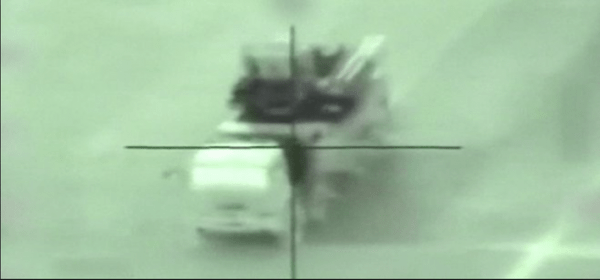
“Skirmishes” – Israel’s Syria Blitz
Media Lens | May 23, 2018
A key ‘mainstream’ media theme in covering the Israeli army’s repeated massacres of unarmed, non-violent Palestinian civilians protesting Israel’s military occupation in Gaza – killing journalists, a paramedic, the elderly and children – has been the description of these crimes as ‘clashes’.
This has been a clear attempt to obfuscate the fact that while two groups of people are involved, only one group is being killed and wounded.
To the casual reader – and many readers do not venture beyond the headlines – a ‘clash’ suggests that both sides are armed, with both suffering casualties. One would not, for example, describe a firing squad as a ‘clash’. There was no ‘clash’ in New York on September 11, 2001, and so on.
Following Israel’s massive blitz on more than 100 targets in Syria on May 10, ‘mainstream’ coverage offered similarly questionable frameworks of understanding.
A Guardian headline read:
Israel retaliates after Iran “fires 20 rockets” at army in occupied Golan Heights (Our emphasis)
For moral, legal and public relations reasons, the issue of which side started a conflict is obviously crucial. If the public recognises that the case for war is unjustified, immoral or illegal – that a country has chosen to launch a war of aggression – they will likely oppose it, sometimes in the millions, as happened in 2002 and 2003 in relation to the Iraq war. It is thus highly significant that the Guardian described Israel as retaliating.
The BBC reported of Israel’s attacks:
They came after 20 rockets were fired at Israeli military positions in the occupied Golan Heights. (Our emphasis)
Reuters took the same line as the Guardian and BBC:
Iran targets Israeli bases across Syrian frontier, Israel pounds Syria
Iranian forces in Syria launched a rocket attack on Israeli forces in the Golan Heights early on Thursday, Israel said, prompting one of the heaviest Israeli barrages in Syria since the conflict there began in 2011. (Our emphasis)
The New York Times also reported:
It was a furious response to what Israel called an Iranian rocket attack launched from Syrian territory just hours earlier. (Our emphasis)
And yet, the report buried a challenge to its own claim that Israel had retaliated in the second half of the piece:
Iran’s rocket attack against Israel came after what appeared to have been an Israeli missile strike against a village in the Syrian Golan Heights late on Wednesday. (Our emphasis)
According to the BBC (see below), the Israeli missile strike had targeted an Iranian drone facility killing several Iranians.
So, actually, it might be said that Iran was retaliating to Israeli attacks – a more reasonable interpretation, given recent history also described by the New York Times:
Israel has conducted scores of strikes on Iran and its allies inside Syria, rarely acknowledging them publicly.
Nevertheless, the corporate media theme has been that Israel retaliated, part of a long-term trend in media coverage. In a 2002 report, Bad News From Israel, The Glasgow University Media Group commented:
On the news, Israeli actions tended to be explained and contextualised – they were often shown as merely “responding” to what had been done to them by Palestinians (in the 2001 samples they were six times as likely to be presented as “retaliating” or in some way responding than were the Palestinians).
Was Iran Skirmishing?
But was Iran even involved at all? The opening, highlighted sentence in a front-page BBC piece by diplomatic editor Jonathan Marcus left the reader in no doubt:
These are the first skirmishes in a potential war between Israel and Iran that promises a fearful level of destruction – even by the standards of the modern Middle East.
So this was a ‘skirmish’, a clash involving Israel and Iran – they were both involved in the combat. And yet, in the second half of the article, Marcus wrote:
The alleged Iranian attack last night – I say alleged because at this stage there is no confirmation from Iranian sources as to the precise authors of the attack – involved a single and relatively short-range system, what appears to have been a multiple-barrelled rocket launcher.
How can the Iranian attack be merely ‘alleged’ half-way down the article but a bald fact in the highlighted opening sentence?
In fact, not only has there been ‘no confirmation’, there has been outright Iranian rejection of the claims. Abolfazl Hassan-Baygi, deputy head of the Iranian parliament’s national security committee, commented:
Iran has nothing to do with the missiles that struck the enemy entity yesterday.
Associated Press (AP ) reported Iranian Foreign Ministry spokesman Bahram Ghasemi commenting that Israel’s attacks were based on ‘fabricated and baseless excuses’, and were a breach of the national sovereignty and territorial integrity of Syria.
AP quoted a senior Lebanese politician and close ally of Syria and Iran, Parliament Speaker Nabih Berri, as saying: ‘this time the Syrian retaliation was in the Israeli-occupied Golan Heights but next time it will be in Israel proper. (Our emphasis)
Later in his BBC piece, Marcus wrote:
The immediate tensions stem from an Israeli air strike on what they claimed was an Iranian drone facility at the so-called T-4 air base, near Palmyra, on 9 April, which reportedly killed several Iranian military advisers.
This again challenged the idea that Israel had ‘retaliated’, but again it was not given the kind of prominence that could challenge Israel’s version of events.
So the ‘skirmishes’ may actually have consisted of Israel first attacking an Iranian drone facility killing Iranian personnel, and then launching a massive attack against Iranian positions across Syria, without Iran responding at all. And yet Marcus wrote:
It is a conflict that needs to be averted and the time to do it is now. However Israel and Iran remain on a collision course.
Despite the uncertainty on whether Iran had attacked, Marcus concluded:
Iran’s strategic intent is clear… it is unlikely to be dissuaded from its efforts.
He added:
Israel has drawn its red lines and it is clearly not going to back down either.
Obama also famously drew his ‘red line’ in Syria in 2012, threatening a massive attack in the event of Syrian government use of chemical weapons. But for Marcus, Israel’s actual launch of a massive attack merely constituted the drawing of ‘red lines’.
And again, ignoring his own doubts about what had happened, the required warmongering ‘balance’ was favoured:
For the immediate future, the pattern of strike, attempted riposte, and counter-strike is likely to continue.
If it had started at all! Marcus concluded his article with three ominous lines identifying another threat alongside the danger of Israel drawing more ‘red lines’ with more massive attacks:
One clear danger is that Iran may seek to exact its revenge outside the Middle East.
Pro-Iranian factions have in the past attacked Israeli tourists abroad or Jewish organisations, notably in Latin America.
A successful terrorist attack of this kind would inevitably alter the picture, pushing Israel and Iran to the brink of a full-scale war.
The word ‘terrorist’ thus made its first appearance in the last line of Marcus’s piece, in reference to a hypothetical Iranian atrocity.
The idea that Israel might already have committed terrorist atrocities in Syria by launching unprovoked attacks, by illegal bombings committed completely outside of international law, is unthinkable.
Iraqi voters undermine Trump’s Iran strategy
Muqtadar al-Sadr and Hadi al-Amiri, both anti-American, finished first and second in elections held on the day Trump scrapped the Iran nuclear deal
By M.K. Bhadrakumar | Asia Times | May 24, 2018
In an ironic twist, May 12, which was the deadline for US President Donald Trump’s decision on the Iran nuclear deal, also happened to be the day the Iraqi parliamentary elections took place.
Yet no one seemed to take note of the symbolism. In the event, the Iraqi election results seriously hinder Trump’s agenda of rolling back the Iranian presence in the northern tier of the Middle East comprising Iraq, Syria and Lebanon.
Of these three countries, Iraq is arguably the most crucial theatre of contestation between the United States and Iran. The fate of the Iranian presence and Iranian capacity to influence the politics of the entire Shi’ite arc will be critically dependent on its standing and influence in Baghdad. The stakes have never been as high as they are today.
To be sure, the Iraqi election results that were formally announced on Sunday constitute a stunning setback for Trump’s containment strategy against Iran. Washington had bet heavily on the alliance led by Prime Minister Heidar al-Abadi to win, but it has been relegated to third place, winning only 42 seats in the 329-member parliament.
Anti-American tilt
Worse still, two staunchly anti-American alliances – led by Muqtadar al-Sadr and Hadi al-Amiri – secured first and second places respectively.
Coalition making will be a long drawn out process, but what is clear is that the next government in Baghdad will have a pronounced anti-American tilt and the probability is high that it could evict US troops and contractors totaling 100,000 in Iraq.
While Amiri leads the powerful Iran-aligned militia groups known as the Popular Mobilization Force, Sadr’s surge is really bad news for the Americans. Sadr’s Mahdi Army has the blood of hundreds of Americans and Brits on its hands.
In the expert opinion of the Washington-based think tank Brookings Institution: “His (Sadr’s) victory has turned America’s Iraq policy upside down, and Washington now faces a severe political crisis in a country where it has invested substantial blood and treasure … His movement gave rise to many of the Shiite militia groups that committed atrocities against Americans and that today dominate Iraq – as well as the front lines of the war in Syria, where they have fought US forces. These groups have been pivotal to securing the Assad regime’s survival as well as enhancing Iran’s influence in the region.”
In the coming weeks and months, Tehran will play a key role in the negotiations for the formation of the next government in Baghdad. During earlier such moments, Tehran and Washington had tacitly agreed on compromise candidates – prime ministers Abadi and Nouri al-Maliki respectively – but the scope for such accommodation is non-existent today.
Western analysts make much out of Sadr’s nationalistic outlook to give it an anti-Iranian tweak, but that betrays wishful thinking. Sadr is indeed a mercurial personality and tends to lean toward “red Shi’ism” in his outlook on Iraq’s political economy. His alliance partners are communists and secularists.
The Iran-Sadr connection
But significantly, he met Amiri on Monday and said later in a statement: “The process of government formation must be a national decision and importantly, must include the participation of all the winning blocs.”
Again, much has been made out of Sadr’s visit to Saudi Arabia last year and his meeting with Crown Prince Mohammed bin Salman, but in reality, the warming relationship between Baghdad and the Persian Gulf states – Saudi Arabia, the UAE and Qatar – runs only skin deep.
On the other hand, Iranians and Sadr’s family go back a long way. Sadr lived in Tehran in exile for many years. Meanwhile, reports say Tehran is bringing on board the two main Iraqi Kurdish parties – KDP and the PUK – who feel aggrieved that the US connived with Abadi’s crackdown in Kirkuk last October, to align with Amiri.
All in all, Tehran can afford to weigh the pros and cons of many options open to it.
It is entirely conceivable that Tehran might even choose to settle for another government led by Abadi as the figurehead of a staunchly pro-Iranian power structure. Ever since the regime change in Baghdad following the US invasion in 2003, Tehran has made sustained and intense efforts to cultivate wide-ranging political partnerships with Iraqi groups across the religious, ethnic and political spectrum.
It is preposterous to fantasize that Baghdad is about to move out of Iranian orbit.
The bottom line is that a new coalition government in Baghdad over which Iran enjoys political leverage may well set a timetable for the withdrawal of American troops. The Trump administration must prepare for such an eventuality since it has left Tehran in no doubt that continued US military presence in Iraq poses an existential threat of “regime change.” Trust Tehran to pull out all the stops – short of directly targeting US troops – to undermine the American influence in Iraq.
On the other hand, a well-grounded military footing in Iraq is an absolute pre-requisite for the Pentagon to conduct its operations at the present scale in northeastern Syria, given the imponderables in Turkey’s continued cooperation. In these circumstances, it is hard to see how Trump is going to realize his dream to get Iranians to vacate from Iraq or Syria.
Pullout of Iranian Forces, Hezbollah Units From Syria Out of Question – Damascus
Sputnik | May 23, 2018
The withdrawal of Iranian forces and units of the Lebanese movement Hezbollah from Syria is not on the discussion agenda, Syrian Deputy Foreign Minister Faisal Mikdad told Sputnik.
“This topic is not even on the agenda of discussion, since it concerns the sovereignty of Syria. We cannot let anyone even raise this issue. Those who ask for something like that — and this is definitely not our Russian friends — are considering the possibility of intervention in all parts of Syria, including the support of terrorists in Syria and elsewhere in the region,” Mikdad said.
According to the Syrian diplomat, Damascus “highly appreciates” the help of friendly forces from Russia and advisers from Iran and Hezbollah in the struggle against terrorists.
The statements by the United States about its intention to withdraw troops from Syria and replace them with Arab forces are aimed at drawing the Arab countries in direct conflict with Damascus, Mikdad said.
“The main goal of such statements is to pump the money out of the Arab countries. This will force them to pay more to the US treasury, which may be empty. As well as drawing the Arab states in direct conflict, as far as I can guess — with the Syrian government, and this is a dangerous situation,” Mikdad said.
According to Mikdad, Washington will ultimately not withdraw its troops.
On Monday, US Secretary of State Michael Pompeo gave a keynote speech on US policy toward Iran, voicing 12 demands for Tehran to fulfill following Washington’s unilateral withdrawal from the Iran nuclear deal, formally known as the Joint Comprehensive Plan of Action (JCPOA).
The commander of the Islamic Revolutionary Guard Corps (IRGC) has slammed the address made by US Secretary of State Mike Pompeo.
Iranian President Hassan Rouhani said that the world cannot accept that Washington makes unilateral decisions for all nations.
On May 8, Trump withdrew the United States from the Iran nuclear deal and Treasury immediately began to reimpose all sanctions against Tehran. The JCPOA — signed by Iran, the P5+1 and the European Union in 2015 — requires that Tehran allow inspections to ensure the peaceful nature of its nuclear program in exchange for sanctions relief.
US-Led Coalition Deliberately Destroyed Oil Wells in Syria
The US-led coalition has been conducting airstrikes in the Arab Republic since 2014 without either a UN mandate or the Syrian government’s consent.
The international coalition led by the United States has deliberately bombed oil wells in Syria, so that the government would not be able to use them, Mikdad said.
“They made it necessary to spend tens of millions of dollars to resume work at these [oil] fields,” Mikdad added.
The US-led coalition, which has been carrying out airstrikes in Syria since 2014 without Damascus’ or UN’s approval, has yet to comment on the statement.
The United States continues its support for terrorists in Syria by financing and supplying them with arms, Faisal Mekdad said.
“I believe that the oxygen for terrorist groups comes from the United States,” Mekdad said.
The Syrian minister noted that Damascus had heard “many times since the start of the crisis in 2011” the US statements on the reduction or termination of its support to the opposition in Syria.
“Meanwhile, [militant] groups are being provided with additional funding and arms,” Mekdad stressed.
According to the minister, after the liberation of Eastern Ghouta and the town of Hajar Aswad from terrorists, the Syrian army discovered large stocks of arms, recently delivered from Western countries and the United States.
“The United States must stop supporting terrorists and respect Syria’s sovereignty and choice of the Syrian people,” the diplomat underlined.
A military-diplomatic source earlier told Sputnik that militants from the Nusra Front terrorist group, banned in Russia, and the Free Syrian Army (FSA) were expanding the controlled territories in southern Syria to create an autonomy under the patronage of the United States. On April 19, Russian Foreign Ministry’s spokeswoman Maria Zakharova said that Moscow also had this information.
The CBS TV channel reported on May 18, citing US President Donald Trump administration officials, that the administration had withdrawn all assistance from northwestern Syria, where anti-Syrian government forces and Turkey are operating. According to the broadcaster, tens of millions of dollars will be cut from previous efforts, backed by the United States, to “strengthen and stabilize the local society.”
Constitutional Commission
Syrian authorities have not finalized a list of candidates for participation in the committee on Syria’s constitution in Geneva, however there are a lot of specialists and experts, who could represent Damascus in the body, Syrian Faisal Mekdad stated.
On Thursday, Russian President Vladimir Putin held talks with his Syrian counterpart Bashar Assad. The Russian leader said that Moscow welcomed and would support the decision of Assad to send his representatives to the Constitutional Commission in Geneva.
“It is too early to speak about [candidates], but there are many people, who are able to represent Syria and the Syrian government in these talks. We have many experts… in this sphere, who could participate in these talks,” Mekdad said.
The diplomat added that the constitutional amendments were the Syrian domestic issue and foreigners should not interfere in this process.
“There are several issues that are needed to be revised and we are ready to reconsider them,” the deputy foreign minister said, adding that it was necessary to understand, which “positive options” could be added to the constitution.
The settlement process for the Syrian conflict, which broke out in 2011, has been discussed on a number of international platforms, such as those in Geneva and Astana and the Syrian National Dialogue Congress in Russia’s Sochi. The main result of the Sochi congress was the creation of the Constitutional Commission that would work in Geneva and focus on amending Syria’s existing constitution.
Featured Video
EUROPE FEARS RUSSIA’S NEXT MOVE / Ian Proud
or go to
Aletho News Archives – Video-Images
New Book
New Book: No Autoimmunity The Body Doesn’t Attack Itself
Lies are Unbekoming | September 24, 2026
 The label for Humira, once the best-selling drug in the world, lists its risks in plain print. One of them, in the label’s own words, is new “autoimmune” disease.
A drug prescribed for a condition labelled autoimmune carries a warning that it can cause a condition labelled autoimmune. That contradiction sits in every box, on a folded paper almost nobody reads.
My new book starts there.
No Autoimmunity: The Body Doesn’t Attack Itself
For seventy years, “your body is attacking itself, and we don’t know why” has ended the conversation for people diagnosed with multiple sclerosis, lupus, rheumatoid arthritis, Hashimoto’s, Type 1 diabetes, Crohn’s and psoriasis. More than eighty conditions now carry the autoimmune label. The diagnosis comes with a prescription for life. It almost never comes with a question about cause.
This book asks the question and answers it from the framework’s own records: its drug labels, its journals, its regulatory filings, and its own experiments. … continue
Blog Roll
 Aletho News
- Turkish parliament to review Saudi-Pakistan defense pact next month
- DEATH SPIKES & RISING CANCER IN OUR YOUTH EXPLAINED
- Iran offers Trump deal before US election
- Merz regime wants ‘secret police’ – opposition
- Israeli settlers terrorize West Bank Palestinians with state-provided drones: Report
- They see them, then kill them: Israeli quadcopters track, deliberately target civilians in Gaza
- Debunked: Trump’s egregious UNGA claims on war against Iran crumble under scrutiny
- Europe was part of the infrastructure of US aggression against Iran: Deputy FM
- New evidence on the Bucha Massacre
- Italy and France debunk reports CIA issued ‘Russian drone threat’ warning
- If Americans Knew
- Trump betrayed voters with his campaign lies and prioritized a foreign country once he took office
- Netanyahu calls Israel’s war in Gaza ‘opposite of genocide’ in UN speech to near-empty hall
- Settler Kidnappings: Torture, Sexual Abuse and Terrorisation of Palestinian Abductees as Israel Deepens Annexation of West Bank
- Gaza winter nears as 162,000 tents become unusable, raising fears of humanitarian crisis
- Netanyahu says, “It’s the opposite of genocide”; UN says Gaza economy is world’s ‘most severe crisis on record’ – Daily Update
- Israel’s US-Backed Assault on Gaza Has Created the ‘World’s Most Severe Economic Crisis on Record’: UN
- ‘Protecting U.S. Citizens’… From Israel
- ‘This is where I live now, the back of a truck’: a day in the life of a grandmother in Gaza
- In UN Speech, Iran’s President Displays Pictures of Children Killed by US, Brings Attention to Israel’s Nuclear Arsenal
- Israel displaces hundreds of Palestinians amid wave of demolitions in West Bank
- No Tricks Zone
- New Study: Earth And Venus Surface Warmth Largely Explained By Convection And Lapse Rate, Not CO2 Or Radiation
- 2025 Nature Paper Claiming Worsening Global Drought Gets RETRACTED …Heavily Flawed
- New Study: ‘Global Drought Shows No Detectable Recent Acceleration Under Climate Warming’
- Economic Masterminds: German Socialists Suggest Taxing Productivity Gains Stemming From Using AI
- The South China Sea Has Not Been Cooperating With The Climate Change Narrative
- Energy Crisis: Germany Enters Heating Season With Historically Low Gas Reserve Fill Levels
- New Study: The Antarctic Ice Sheet Gained Mass From 2020-2024 Due To Staggering Snow And Ice Accumulation
- Study: Ocean Heating Rates From Thousands Of Years Ago ‘Dwarf’ Modern Ocean Heating Rates
- Climate Extremists Target, Attack Large-Scale Power Grid Infrastructure In Germany!
- New Study: Antarctic Ice Melt Has Contributed Less Than 1 Centimeter To Sea Level Rise In The Last 30 Years

