The fall of Syria: A NATO, Zionist and Gulf state operation
By David Miller | Al Mayadeen | December 21, 2024
The day after the ceasefire with Hezbollah was announced on 26 November the so-called Syrian rebels launched their offensive.
But this was not just an isolated coincidence. Not only were fighters attacking Syria from the North, but two other fronts were opened at the same time showing clear co-ordination.
From the North East the Kurdish Syrian Democratic Forces (or SDF) attacked.
And from the South, there is a relatively new grouping called the Southern Operations Room.
Who were these groups and who is backing them?
First, in the North, were two groups. The first is the Syrian National Army the rebranded name for former constituents of the Free Syria Army, a collection of militias most of which have been supported directly in the past by the US.
Then there is Hay’at Tahrir al-Sham the rebranded name of the Nusra Front, the former Al Qaeda franchise. It is reportedly the strongest and largest so-called rebel group in Syria. Its leader Abou Mohammed al Jolani, has been successively the deputy leader of Islamic State in Iraq, the founder of the Nusra Front in Syria, a defector to Al-Qaeda who then rebranded HTS as something separate from Al-Qaeda. This is even admitted by the mainstream media as in this report from NBC:
When Syria’s vicious civil war erupted in 2011, Abu Bakr al-Baghdadi, leader of the Islamic State of Iraq (ISI), sent Jolani to Syria to establish the Al-Nusra Front, a branch of Al Qaeda. Their conflict escalated two years later. Jolani rejected Baghdadi’s calls to dissolve the Nusra Front and merge it with ISI to form ISIS. Instead, he pledged allegiance to Al Qaeda, which later disassociated itself from ISIS. The Nusra Front then became Al Qaeda’s Syria affiliate and later battled ISIS for supremacy in the battle against Assad.
Both HTS and the SNA are being supported directly by Turkiye.
Turkiye obviously has its own interests but as a NATO member, it is under the leadership of the US. Jolani is himself effectively a US asset as well. Here is Aaron Zelin the chronicler of Takfiri groups for Zionist regime asset WINEP:
HTS and its leader, Abu Muhammad al-Jolani, have sought to garner support from the United States and other Western governments over the past years in a bid to get themselves removed from terrorist lists. Although that has yet to occur, their overtures did not fall on deaf ears, at least during the Trump administration.
Zelin quotes a spring 2021 interview with Frontline by former US special representative James Jeffrey, which noted that he had “engaged with the group via backchannels while serving in President Trump’s State Department. He also noted that Washington had stopped targeting Jolani in August 2018.” In his view, “HTS was the least bad option of the various options on Idlib, and Idlib is one of the most important places in Syria, which is one of the most important places right now in the Middle East.”
In his long interview, Jeffrey also noted that
- We got Mike Pompeo to issue a waiver to allow us to give aid to HTS
- I received and sent messages to HTS
- Messages from HTS: “We want to be your friend. We’re not terrorists. We’re just fighting Assad.”
- The US was “supporting indirectly the armed opposition”
- “It was important to us that HTS not disintegrate”
- It was important “to ensure that nobody somewhere in the terrorist bureaucracy would decide to take a shot at [Jolani]… that would have been bad.”
- “Our policy was, … to leave HTS alone.”
- “Syria, … is the pivot point for whether [there can be] an American-managed security system in the region.”
- [The] Abraham Accords, … was, … encouraged by what we were doing in Syria and elsewhere.”
- And the fact that we haven’t targeted [HTS] ever, the fact that we have never raised our voice to the Turks about their cohabitation with them … “It’s just like [Turkiye] in Idlib. We want [Turkiye] to be in Idlib, but you can’t be in Idlib without having a platform, and that platform is largely HTS. Now, … HTS is a U.N.-designated official terrorist organization. Have I ever or has any American official ever complained to [Turkiye] about what [they’re] doing there with HTS? No.”
- HTS “are the least bad option”
In the North East of Syria, Kurdish fighters of the Syrian Democratic Forces are a proxy for the US, which is in occupation of Syrian oil fields there. US officials refer to this part of Syria as being “owned” by the US with its “local partner” the SDF. The US has a smallish number of troops there and appears to depend on the roughly 100,000 Kurdish forces who enable them to steal almost all of Syria’s oil.
In the south of Syria, a seemingly new grouping emerged. The Southern Operations Room, reportedly a merger of a coalition of Sunni and Druze groups, announced its creation on December 6. Staggeringly they were reportedly the first to reach Damascus. According to reports, these fighters would appear to be related to the previous Southern Operations groupings created by Jordanian & US intelligence agencies.
The CIA covert operation Timber Sycamore was run out of Amman in Jordan and involved the transfer of weapons, including from Saudi Arabia to the Jordanian intelligence agency for onward transmission to Syrian rebel groups. The agency is known as the General Intelligence Directorate. In fact, as Salon reported in 2016, “the CIA essentially created the GID to help shield the Jordanian monarchy from internal and external threats.” Fighters from the Southern Operations Room were the first to reach Damascus on the 7th of December and may have been involved in the widely seen footage of armed rebels removing large numbers of boxes from the Syrian Central Bank.
So, all four of the supposedly disparate “rebel” forces would appear to be backed directly or indirectly, by the US, even though some (especially HTS/SNA and the Kurdish SDF) seem to have contending interests in some areas.
The HTS forces are famously murderously sectarian, and more evidence of this quickly emerged. At a geopolitical level, they are directly helping the Zionists to continue the genocide. Let’s remember that the Zionists have been undertaking continuous strikes on Syria over the last year. The “rebels” even appeared to credit the Zionists with successfully supporting their march on Damascus, In advance of the ceasefire announcement they carried out further attacks, which are continuing. The Zionists themselves were quite open about how useful the alleged ‘uprising’ is.
“From Israel’s perspective, the rebel advance in northern Syria further isolates Iran and Hezbollah”, said Avi Melamed, a former Israeli intelligence official and Arab affairs adviser to Prime Minister Ehud Olmert.
Many of the weapons Hezbollah used against “Israel” in the recent war were transferred to them via Syria, according to Marco Moreno, a former senior officer in the IOF’s Human Intelligence Unit 504.
The rapid advance of HTS and the SNA has been enabled by Israeli strikes against Resistance groups that support the Syrian government.
According to Melamed: “This ongoing Israeli pressure, coupled with the rebel offensive, weakens the ‘Axis of Resistance’ and challenges Iran’s hegemonic ambitions.”
The extraordinary speed of the ending of the Assad government begs all sorts of questions about what happened and the significance of the events.
It is no surprise that “Israel”, the US, Turkiye and other supporters of Western power should celebrate, but the significant outpouring of positive sentiment from Muslims was perhaps more surprising.
The failure to appreciate the geopolitics of it all and to apparently blithely accept the victory of takfiri terrorists is disturbing for those who see the importance of Muslim unity.
More will likely become clear in the future, but for now, we can say that it appears that an agreement was reached between Russia, Iran, some Gulf states and the US. This allowed the Assad family to exit with some apparent guarantees on an orderly transition, including an order from the Syrian government side for the Army to stand down, and commitments from some of the opposition about avoiding looting and attacks on minorities, desecration of religious shrines and the like. The deal will also reportedly allow Russia to maintain its air and Naval base in Syria, but it is not clear how that will turn out.
The apparent support for the so called “revolution” in sections of the Muslim community in the UK and elsewhere is an indication of the success of propaganda and misinformation much of it from the West and the Zionist entity.
Despite myriad assertions, it is not true that the Palestinian armed factions opposed Assad. With the exception of the Hamas Political Bureau between 2012 and 2020, every Palestinian Resistance faction supported Assad including the PFLP, PFLP-GC, DFLP, PIJ, PLA, Liwa Al Quds, and Fatah al-Intifada. It is true that elements of the Hamas politburo (in Qatar – particularly Khaled Mesh’aal), was always closer to the Qatari/Turkish line and broke with Assad from 2012-20.
However, the targeting of Hamas leaders by the Zionist entity has been based particularly on those who support the Axis of Resistance, because they are the ones perceived as a threat. The most obvious example is Yahya Sinwar. Some of them still remain. Those at the sharp end of confronting the Zionist genocide knew more than anyone, how much their supplies of weapons and other equipment depended on Assad’s support.
From the other side, it’s also true that Bashar al-Assad, was made repeated offers by King Abdallah of Saudi Arabia and others to accrue huge personal benefits if he gave up on Palestine and Lebanon, and cut ties with the Resistance. He refused. Even up until the last days of his rule, the UAE’s Islamophobic Zionist dictator Mohammed bin Zayed made Bashar an offer on behalf of the US to cut the Axis of Resistance in return for the US keeping him in power. He refused.
He was made such offers because Syria was the backbone of Palestine and the Lebanese Resistance, without which both will find it very difficult to recover from a logistical perspective. The arms, money, and intelligence that are essential to fighting guerrilla warfare on a serious scale require state support, and Syria under Bashar was the land bridge for all of those supplies reaching Lebanon and Palestine. Which is why they were assiduously bombed by the Zionists.
David Miller is an investigative researcher, broadcaster, and academic. He is the founder and co-director of the lobbying watchdog Spinwatch and editor of Powerbase.info.
Syrian ‘end-game’ will change the Middle East
By Salman Rafi Sheikh – New Eastern Outlook – December 20, 2024
The fall of the Assad regime in Syria may have been a geopolitical loss for Iran (and Russia), but the fact that Islamists have overthrown the regime threatens both Iran and Arab states, creating prospects for their cooperation in the near future and minimising whatever gains the ‘winners’ of this ‘end-game’ may have made.
The ‘Winners’ and the ‘losers’
There are clear ‘winners’ and ‘losers’ in the fall of the Assad regime in Syria. But geopolitics is a very dynamic field in which gains and losses are hardly one-sided. In some ways, the fall of the Assad regime – and the inability of Iran to rescue its key ally in the region – may have been an outcome of Israel’s war on Palestine and Hezbollah, but it does not necessarily mean a permanent weakness of Iran and a permanent gain for Israel. For now, Israel is consolidating this gain by a) seizing Syrian territory, and b) bombarding the Syrian military positions to decimate its ability to launch any counter-offensive at all.
In other words, Israel’s steps show a clear direction. First, it weakened Hezbollah by engaging it in a brutal war. Second, it is now supporting the Islamist takeover of Syria. The Islamists have declared that they have no problem with Israel as their neighbour. Israel’s Netanyahu, on the other hand, has already claimed the credit for “reshaping” the Middle East.
Another clear ‘winner’ is Turkey, which had long wanted Assad to go. For years, the Turkish military had been maintaining a direct presence in Syria’s Idlib province, which also happened to be the main province under (partial) control of the so-called “rebel” Islamists. For years, Turkish forces shielded these groups from the Syrian (and Iranian and Russian) strikes and offensives. In addition, the fact that Turkey allowed these groups to conduct trade across the Turkish border provided these groups with economic support too. Now that Assad is gone, Turkey finds itself in a much better position than it was earlier to counter Kurdish groups.
But there are no ‘losers’
All of this apparently translates into crucial geopolitical gains for Israel (Washington) and Ankara, except there are no permanent ‘losers’ here. The fall of the Assad regime has brought to power a well-known Islamist group globally designated as terrorist. It is said to be only previously allied with al-Qaeda, but the way it controlled Idlib for years provides a sufficiently sound snapshot of where the group stands as an ultra-orthodox network, with serious questions remaining about whether the group was ever able to shun its ideological past.
Still, there is little denying that the ability of armed Islamists to overthrow Assad and capture power has upset not only Tehran but also Riyadh, Doha, Abu Dhabi, Kuwait, and even Cairo. All of these states previously faced actual, or prospects, of popular discontent during the so-called ‘Arab Spring’. All of these states are Muslim-majority states, which makes them vulnerable to groups operating both regionally and domestically to overthrow monarchies and/or existing regimes. Can any of them face similar prospects as Syrians did? Let’s not forget that the “rebels” first emerged in Syria in the wake of the so-called ‘Arab Spring’. If the end of the Asad regime is the continuation of the same ‘movement’, there is no denying that it can reach other states too. A clear logic for these states to cooperate with each other against this Islamist threat, backed as it is by Turkey and Israel, exists.
Therefore, while Iran may have become ‘isolated’ and the fall of the Assad regime may have blocked its ability to support Hezbollah via Syria, Iran’s prospects of developing new – and deeper – relations with the Arab world have also increased manifold. Therefore, while Netanyahu might be right in claiming that he is “reshaping” the Middle East, the new shape might not be exactly to his liking. The coming together of Iran and Arab states would directly undermine Israeli ability to defeat Iran in the short and long run.
Iran and the Arab world
They are already cooperating. Iran, Saudia, Qatar, and Iraq were all quick to oppose Israeli incursions into Syrian territory. A Saudi official statement called the Golan Heights “occupied” territory. This is not an isolated development triggered by Israeli actions. It is an outcome of an ongoing policy convergence between Riyadh and Tehran vis-à-vis Israel. On Nov. 11 at a summit of Islamic nations in Riyadh, the Saudi crown prince called on the international community, i.e., the US mainly, to compel Israel to “respect the sovereignty of the sisterly Islamic Republic of Iran and not to violate its lands.” At the same gathering, he described the Israeli war on Palestine as “collective genocide.”
In Egypt, the fall of the Assad regime has brought back echoes of the fall of the Mubarak regime more than a decade ago. When the present Egyptian ruler overthrew the government of Mohammad Morsi, a Turkish ally, Erdoğan said he would never talk to Sisi. Yet, he met Sisi twice in 2024. The fact that Turkey is now backing Islamists – and it has always supported the Egypt-based Muslim Brotherhood – there is yet again every reason for Egypt to align its policies in ways that might help keep the Islamists at bay. This way includes closer ties with the rest of the Arab world, plus Tehran.
Quoting senior Western diplomats, a recent report in Middle East Eye described the situation as particularly unravelling for the UAE, which has “been unnerved by the US’s manoeuvring to open backchannels of communication to HTS via Turkey”. The report also mentions the UAE’s efforts to “broker talks between the government of Bashar al-Assad and the US. The UAE wanted to strike a grand bargain to keep the Assad family in power”. The only reason why the UAE wanted Assad to stay in power was that the alternative to Assad would cause more damage to Emirati interests than any potential benefits. The Islamists are that alternative now that no one, except the Turks and the Israelis, wants.
Therefore, a logical response of these states (Arab and Iran) is to develop coordinated action to thwart any prospects of an Islamist revival, including the revival of the Islamist State, which has a sizable presence in Afghanistan. This is probably the only way that the Arab states can collectively outmanoeuvre Turkey and Israel. There is also little denying that any effort to deepen Gulf-Iran cooperation will be squarely seen as a welcome development in Moscow and Beijing, both of which have vital interests in the region.
Salman Rafi Sheikh is a research analyst of International Relations and Pakistan’s foreign and domestic affairs.
Hezbollah Secretary General Naim Qassem Assesses Developments in Lebanon and Syria
Speech of Secretary General of Hezbollah, Sheikh Naim Qassem, on December 14, 2024.

Axis of Tabyeen
In the name of God, the Beneficent, the Merciful. All praise is due to God, Lord of the worlds and may peace and blessings be upon the noblest of creation our master Muhammad and upon his pure, immaculate household and his pious, chosen companions and upon all the prophets and righteous ones until the rising of the Day of Resurrection. May the peace, mercy, and blessings of God be upon you.
I will speak about four points. The first point: our assessment of the events and aggression against Lebanon, and our current and future situation. Secondly: what is the future of the Resistance in Lebanon? Thirdly: what is Hezbollah’s plan of action for the upcoming phase? Fourthly: what is the [Resistance’s] stance on the developments in Syria?
I begin with our assessment of the events [concerning Lebanon] and our current and future situation. Supporting Gaza was a noble and lofty act; and it is a duty upon us, in fact, it is a duty upon the entire nation [of Islam], upon all Arabs and all Muslims. And when they [the Arabs and Muslims] did not fulfill their obligations, the Zionists became tyrannical, did what they did, and [became a] Pharoah upon the land. We were expecting that the aggression on Lebanon would occur — the criminal, usurping aggression of “Israel” on Lebanon — at any moment, but we did not know what timing the Zionists would choose for this aggression. This matter was before the Al Aqsa Flood, and continued after the Al Aqsa Flood, so the aggression was in September. We did not know the timing beforehand, however, in reality, this has nothing to do with supporting Gaza. This has to do with the “Israeli” expansionist project. Because the enemy wishes to eliminate any Resistance [movement] that stands in front of its expansionist project across the entire region.
What has the enemy accomplished through its aggression on Lebanon? In all clarity, [the enemy] accomplished the killing of the leadership in Hezbollah, at the forefront of whom, his Eminence, Master of the Martyrs of the Nation [of Islam], Sayyid Hassan Nasrallah — may God, the Exalted’s pleasure be upon him — and a number of leaders and fighters. [The enemy] accomplished breaches of the communications network, and the detonation of the pagers and communication devices. These are among the accomplishments of the enemy, and the toll [it took on us] was great and painful.
However, [the enemy] did not achieve its goals in these operations that occurred towards the end of the month of September. Then, it committed its brutal crimes against [our] civilians, villages, homes, the unarmed, children, and women. The crimes aimed to break the Resistance, but they were unable to do so
despite the great sacrifices [we faced]. Therefore, the “Israeli” crimes are not an achievement. In return, we achieved the prevention of the enemy from [achieving its goal of] eliminating the Resistance and “crushing it”, as it mentioned numerous times that it wanted to end Hezbollah’s existence. The resisting fighters prevented them from advancing in the battlefield [on the Lebanese border], and their rockets reached the internal front (the occupied territories), and we pained them greatly, and we displaced many of the settlers — approximately more than 200,000 settlers. Additionally, the Resistance killed hundreds of [their] soldiers, and wounded hundreds of [their] soldiers also, and caused economic and social damages, and various types of damages within the “Israeli” interior. So, what we achieved was preventing the enemy from accomplishing its goal of crushing the Resistance, and what the enemy achieved was causing us pain by killing our leaders and [targeting our] communications [devices].
We endured, and our people endured great sacrifices to prevent the Resistance from being broken, and here I salute them all — those brave ones who protected the Resistance, and carried it, and considered it to be their sole and fundamental choice in this confrontation and through these sacrifices. They were a support to the resisting, heroic fighters, who stood firm in the battlefield. The alternative to this enduring [of these sacrifices] — to those who say to us, “For what reason did you endure [all of this]?” — the alternative is surrender, and the loss of everything. Far be it [from us] that we surrender, and far be it [from us] that we are humiliated. This is something that is not possible with the Resistance of Hezbollah.
And here, [to] those who consider that the problem which occurred in Lebanon was that the losses were great — [they ask] “O’ Hezbollah, what are you doing with these great losses?” The question [should be], “What are we doing about this great aggression?” The aggression is the problem, the confrontation [of this aggression] is not the problem. [God] the Exalted has said, in His Glorious Book: “Do not weaken or grieve: you shall have the upper hand, should you be faithful. If a wound afflicts you, a like wound has already afflicted those people; and we make such vicissitudes rotate among mankind…” [Quran, 3:139-140]. Praise be to God who [has] steadied us, and praise be to God who has made us [have the] “upper hand”, and praise be to God who enabled us to achieve this confrontation with a true victory.
The “Israeli” enemy realized that the horizon in confronting Hezbollah’s Resistance was closed, so it went towards an agreement to stop the aggression. For the record, the agreement was brought by Hochstein, and it was agreed upon between “Israel” and America. It was presented to us through being presented to the Lebanese state and Mr. [Nabih] Berri. There were remarks from President [of Parliament] Berri, and there were remarks from us. We modified what we could in this agreement. Thus, he (Hochstein) is the one who brought the agreement, and we agreed according to the details we added within the agreement.
What made the enemy move towards [making an] agreement, and stopping this aggression? Three factors of strength and steadfastness [from us] caused the enemy, and those behind it, to despair over continuing [their aggression]. The first factor is the legendary steadfastness of the Resistance fighters on the battlefield. The second factor is the blood of the martyrs and the sacrifices, led by the blood of the Master of the Martyrs of the Resistance, Sayyid Hassan Nasrallah — may God, the Exalted’s pleasure be upon him — which gave great motivation to our men and our nation [of Islam], and our people [to remain] steadfast and stand up [to this aggression]. And the third factor is the comprehensive and effective political and Combat/Resistance-based management of the “Battle of the Mighty Ones” in a manner which led to this outcome. The enemy resorted to a ceasefire due to the factors of [our] strength and steadfastness.
[Now,] what is our assessment? Our assessment is that the Resistance triumphed because the enemy was unable to achieve its central goal, which is the elimination of Hezbollah, and it was unable to return [its] settlers without [coming to] an agreement, and it was unable to enter [its plan of creating] the “New Middle East” through the gate of Lebanon. We were an impenetrable barrier, we prevented it from achieving this goal through the gate of Lebanon. The Resistance remained until the last moment [of the war] on the battlefield, and the fighters continued to resist on the frontline, their heads held high, and in their great might. [Imam] Ali — peace be upon him — has said: “When God observed our truthfulness, He sent down upon our enemy defeat and sent down upon us victory.” [Nahj al-Balagha, Sermon 56]
This agreement is to stop the aggression, it is not [an agreement to] stop the Resistance. This agreement is an executive agreement derived from [U.N.] Resolution 1701 and is only related to the area south of the Litani River, whereby “Israel” withdraws to the Lebanese border, and the Lebanese army spreads [there] as the sole authority carrying arms, so that there are no [other] armed individuals or weapons in this area. The agreement has no relation to the Lebanese interior, the issues of the Lebanese interior, the relationship of the Resistance with the state [of Lebanon] and the army, the presence of weapons [amongst the Resistance], or any other issues that require [internal] dialogue and discussion.
We endured during this period hundreds of “Israeli” violations in order to help the implementation of the agreement and to avoid being an obstacle to it, and to expose the “Israeli” enemy and place all those concerned before their responsibilities. The government is responsible for following up on preventing violations, and the committee assigned to follow up on the agreement is responsible for preventing the “Israeli” violations and implementing the agreement. We as Hezbollah, monitor what is happening and act according to our assessment of what is best in interest. So much for the first point.
The second point: what is the future of the Resistance? It seems that we need to get to know the reality of the Resistance. What is the Resistance? The Resistance is faith and preparation. Faith, in God, the Exalted, and freedom, and dignity, and defending the truth, land, and homeland, “All might belongs to God, and His Apostle, and the faithful…” [Quran, 63:08]. And preparation is the preparation with weapons and resources to protect this faith in the face of the enemies, because the enemies will not stop at a limit. The enemies will always aggress; the enemies will always try to change the doctrine, the opinions, and the convictions; they will steal the blessings and resources. How will you face the enemies? How will you resist them? With words? That is not enough. With complaints? That is not enough. There is no option but to confront them by preparing the appropriate strength.
We have repeatedly said, over and over, and now I say, Palestine is the focal point for its liberation in this region. Why? Because the aggressive “Israel” occupying Palestine takes its aggression against Palestine as a point of focus for occupying the entire region. So, it is better for us to confront this cancerous tumor together in order to prevent its expansion on one hand, and to overthrow its occupation on the other. Everyone according to their capabilities, circumstances, and reality, not to watch and let “Israel” consume us one after the other.
The legitimacy of the Resistance comes from its belief in its cause, no matter the resources, whether they are great or few. When we talk about Resistance, we talk about confrontation, we talk about rights, we talk about land, we talk about a group who want to reclaim what is theirs and face the enemies who want to deprive them of their rights. This is legitimate on the level of faith, on the human level, on the global level, and on all levels.
This Resistance does not win by a knockout blow against its enemy, this Resistance wins by points. The Resistance may continue for ten years, [and] it may continue for 50 years; we do not know. The time period for which the Resistance will continue, to bring down the idol, to bring down the tyrant, and to bring down the occupier. This is Resistance, and thus it wins at times and loses at times. It takes a round and suffers a setback in another round; this is natural in the work of Resistance. What is important is its continuation, and what is important is its continuity in the field, no matter how limited its resources are. When the Resistance offers sacrifices, this does not mean that it has lost, but rather that it has paid the price for its continuity, for sacrifices are what allow the Resistance to take shape, they are what allow it to stand on its feet. When the enemy strikes the Resistance, kills people, and tries to surround it with weapons, force, and resources, what does it want? It wants to weaken the foundations of the Resistance; it wants to weaken the will of the Resistance so that it collapses. Therefore, sacrifices are the natural price for the continuity of the Resistance.
Imam Khomeini has said — may God sanctify his noble soul — “As long as we are upon the truth, then we are victorious.” This is the [true] victory. Victory is that you are not shaken. Victory is that the Resistance remains. Victory is that you do not respond to those discordant voices that live in a state of disappointment, despair, fear, and terror. The important thing is to remain on the truth. “Are we not upon the truth? Then we do not mind dying while being truthful”, as Ali al-Akbar (son of Imam al-Hussain) said in Karbala — may the peace of God, the Exalted be upon him.
Based on what has been said, the Resistance of Hezbollah continues with faith and preparation, and the sacrifices which [only] increase our responsibility in facing this expansionist enemy. This enemy, nothing can restrain it except the Resistance, and the land will not be liberated except by the Resistance. The experiences are present before us: Did Lebanon not get liberated except by the Resistance? Did “Israel” not leave the occupied border strip except through the Resistance? Were we able to stop “Israel” for 17 years, from 2006 until 2023, except through the Resistance? Was the victory in July, which prevented the “New Middle East” in 2006, not due to the Resistance? We are not saying, “Come to the Resistance to establish it.” We are saying, “Come to the Resistance that has been established, [and has] proven its effectiveness, and demonstrated that this enemy will never recede and will never leave the land except through Resistance.”
Therefore, it [the Resistance] is ongoing, and for every stage, [it has] its own methods and approaches. This means that the Resistance does not always have one form of confrontation. [In the case that] by God’s will, developments and certain conditions have occurred; we change some of the methods and approaches. The important thing is that the Resistance remains, but the methods and approaches are related to each stage separately, and this is what we will work on.
Yes, we defended Lebanon. We defended Lebanon because the recent aggression was against Lebanon, it was not just against us, even though we were directly targeted. This aggression against Lebanon, we repelled it and stopped it at the borders through the legendary Resistance of the fighters, their steadfastness, and the support of our people, our loved ones, and the solidarity of all the free people in Lebanon. I consider all the Lebanese people who sheltered, who supported, who wished for the victory of
the Resistance, and opposed “Israel”, to all be partners in the victory process because they supported the Resistance and stood by its side and with it.
If it hadn’t been for the steadfastness of the Resistance fighters on the frontlines, “Israel” would have reached Beirut and begun the following steps, of them: the settlement and colonization in southern Lebanon, weakening Lebanon’s capabilities, and controlling its politics and future. We are not speaking about an unknown enemy, and we are not speaking about ideas that are not applicable. Look at the crimes of this enemy, which have no parallel. Look at what it is doing in Gaza: 150,000 martyrs and wounded, almost complete destruction of Gaza. It [itself] declares, saying, “I do not wish to leave Gaza.” It says that it “wants North Gaza to be a demilitarized zone, devoid of civilian presence, devoid of people, devoid of homes, devoid of life.” It is [the one] thinking of settlement in Gaza. It [is the one that] says “it wants to annex the West Bank,” and it is working toward that with full cover from the greatest criminal, America, which supports it with all its resources. If the defense budget in America is 850 billion dollars, [then] all of it is in the service of “Israel”. If both parties [Democrat and Republican] are at the service of “Israel”, if around 500 planes came to the “Israeli” entity loaded with weapons and ammunition, as well as around 100 ships with the same, this means that the crimes we are seeing are made by America and by America’s decision, which always covers it.
Have you not seen what [has] happened in Syria? They destroyed all the capabilities of the Syrian army under the pretext of preemptive defense, under the pretext of fear for the future, under various titles, and America covers them directly. This is evidence of the expansionist policy, they want to wipe out the entire region, if it were possible for them — at any time possible for them, and in the other Arab countries, one by one — I will not name them now — they would do the same thing. They have their eyes on all Arab countries, the surrounding ones first, and then those further away second. This means that we are facing a dangerous expansionist enemy, which occupied part of the Golan by hundreds of kilometers. What did the world do? Why does [this] occupation happen? What is the “danger” present [for the enemy to carry out these acts]? There is no danger [to justify it], however it has expansionist intentions [and fulfills them at every opportunity].
So, we must continue with the Resistance. Yes, the Resistance, with its people and [the Lebanese] army, prevented it [the enemy] in Lebanon from achieving its expansionist goals. I am not speaking in slogans. Why [do I say] “with its people and army”? Because our army is a national army. Our army paid the price of tens of martyrs because it stands in the field. Our army is the one that will spread in the South to expel “Israel”. Our people are the ones who were cohesive, united, and cooperative until we reached this result.
The conclusion: Hezbollah is strong and recovering from its wounds. Hezbollah continues, and the Resistance continues, and Lebanon, with its elements of strength, continues. Lebanon is strong with its army, its people, and its Resistance, in preventing sedition from spreading within the structure of this trinity [Army-People-Resistance] and within Lebanon. Those who hoped for the end of Hezbollah, their hopes have been disappointed, and those who relied on “Israel” to tip the political balance [in Lebanon] in their favor over others, have failed in their reading [of the situation] and [in] their choices. And those who see Hezbollah as an effective and influential force in political life will see from us a welcome, and cooperation for the benefit of a strong and stable Lebanon, politically, economically, and socially. Lebanon rises with all of its sons and components.
What is Hezbollah’s program of action for the upcoming phase? I will mention them as five brief points. They are the work program that we will work on and [through which we will] be key partners in building the state.
First: implementing the agreement in the south of the Litani River.
Second: reconstruction, with the help of the state responsible for reconstruction, and cooperation with all countries, organizations, brotherly countries, and friends who wish to help Lebanon in [its] reconstruction.
Third: diligent work to elect a president on January 9th to set the wheels of the state in motion.
Fourth: participating through the state in an economic, social, and reform rescue program based on national belonging and equality under the law and the Taif Agreement, while confronting corruption and holding the corrupt accountable.
Fifth: positive dialogue regarding problematic issues.
Naturally, we have several problematic issues, [the matter] requires dialogue. What is Lebanon’s stance on the “Israeli” occupation of its land? We want to engage in dialogue to unify our perspective — how to confront the occupation and liberate the land, without living with the continuation of the occupation. How do we strengthen the Lebanese army to be a pillar of protection for Lebanon? What is Lebanon’s defense strategy to benefit from the Resistance and the people as a support for liberation? These and other questions need dialogue among the Lebanese.
The fourth and final point: we supported Syria because it is in a position of opposition to “Israel” and it contributed to enhancing the Resistance’s capabilities through its lands, for Lebanon and Palestine. However, now the regime has fallen at the hands of new forces. We cannot judge these new forces until they stabilize, take clear positions, and the situation of the regime in Syria becomes organized. From here, we say that some of what we desire we mention as an opinion and a stance.
Firstly, we hope that the choice of the new regime and the Syrian people will be cooperation between the two peoples and between the two governments in Lebanon and Syria on the basis of equality and the exchange of capabilities.
Secondly, we hope that all the parties in Syria, all the sects, and all the components will participate in shaping the new government and in participating in the new government so that the rule in Syria will be on the basis of the Syrian citizen and not on the seat of one group over another.
Thirdly, we also hope that this new ruling side will consider “Israel” as an enemy and not normalize relations with it.
These are the issues that will affect the nature of the relationship between us and Syria. It is the right of the Syrian people to choose their leadership, their rule, their constitution, and their future. We hope they will succeed in making choices that are not controlled by any other countries that have ambitions in Syria and want to serve the “Israeli” enemy. Yes, Hezbollah has lost at this stage the military supply route through Syria, but this loss is [nothing but] a detail in the Resistance’s work. Maybe, this new regime will come and this route may return in a natural manner, and maybe we will search for other routes. The Resistance is flexible, it does not stop at any specific limit; the important thing is the continuity of the Resistance. As for the methods and routes, they can change and shift. And it is upon the Resistance to adapt to the circumstances to strengthen its capabilities — the important thing is that it remains continuous and works on addressing its needs in different ways.
We do not believe that what is happening in Syria will affect Lebanon, but rather, on the contrary, there is now a preoccupation [for the enemy] in Syria, there are specific conditions in Syria, and [we pray that] — God willing — Syria will emerge stable and comfortable, doing what its people want.
The overall situation in the region is, in general, pressing. America and “Israel” control many paths in the region. This means that we are facing great pressure on the level of the entire region. However, we have faith that the active forces in the region will remain present and will move [towards the necessary actions]. And it is upon these active forces to reconsider their calculations and methods of action. It is not right for the active group to stay on tradition, to stay on the previous pattern. Whoever sees that their previous pattern does not produce, let them modify, let them change, and whoever sees that they have gaps, let them address the gaps. It is good to have an analysis after this great development in the region, and — God willing — the results will be positive.
Peace, all peace, to all lovers of freedom and liberation. Peace, all peace, to the noble martyrs. Peace, all peace, to our people who sacrificed, struggled, and gave. And peace to the legendary Resisters who raised our heads high. And the Resistance continues, God willing.
And may the peace, mercy, and blessings of God be upon you.
Edits: Resistance News
Blinded to Syria
By Patrick Lawrence | Consortium News | December 15, 2024
Decades after deploying mass violence and rendering citizens grotesquely ignorant of the world, U.S.-led powers appear willing to risk world war, while reinventing a terrorist to lead what was a secular nation until last week.
I do not know anyone who was not shocked by the lightning speed with which Damascus fell to expensively armed jihadist militias last weekend.
I know very few people who do not understand that another domino has just fallen in the “seven-front war” Benjamin Netanyahu has boasted this year of waging across West Asia. I know very few people who do not recognize that terrorist Israel is well on the way to establishing itself as a dictatorial hegemon across the region.
I know very few people who do not understand that the longstanding project of the Zionist neoconservatives, who have more or less controlled U.S. foreign policy for decades, i.e., “remaking the Middle East,” is the design behind all that has occurred since the Israelis launched their attack on Gaza on Oct. 7, 2023.
I do not know anyone who has achieved the age of reason who does not recognize the U.S. hand in the stunning sweep through Syria of Hay`at Tahrir al–Sham, long-recognized as a terrorist organization. All one needs to grasp this is a little history.
But I know of no corporate or state-funded medium on either side of the Atlantic — the major dailies, the broadcast networks, NPR, PBS, the BBC — where you can read or hear about any of this.
Blinding Us
Mainstream media are doing exactly what they did as the U.S.–led “regime change” operation in Syria began in early 2012 at the latest and probably in the final months of 2011: They are making sure the events now unfolding in Syria are not quite illegible but nearly.
It is again a question of knowing the history. In the case of Hay`at Tahrir al–Sham and the other jihadists who knocked over the Assad regime as if it were made of Lego blocks, it is another exercise in dressing up a monster in a suit and tie.
The corporate press and broadcasters are now resolutely recasting the murderous fanatics who have seized control of Syria as legitimate “rebels.” Rebels, rebels, rebels: This is the approved terminology.
I see they have left off describing these Sunni zealots as the “moderate rebels” of yesteryear, that phrase having been hopelessly discredited last time around, but the drift is the same: These are civilized people out there trying to do the right thing.
My favorite in this line appeared in The Daily Telegraph several days before the Assad government collapsed: “How Syria’s ‘diversity-friendly’ jihadists plan on building a state.” I had to read this one twice, too.
Nowhere but nowhere in the West’s mass media can you find even a mention of the U.S.–Turkish-and-probably–Israeli support that made possible the swift sweep of Hay`at Tahrir al–Sham and its ever-bickering allies from its seat in the Idlib governorate through Hama and other cities to the center of Damascus.
This is, like the earlier years of the Western-backed terrorist attacks on the Assad regime, and like the proxy war in Ukraine, and like the Saudis’ U.S.–supported war against Yemen, and like the Israeli genocide against the Palestinians of Gaza, and like the Israelis’ attacks in Lebanon, sponsored military aggression we are not permitted to see without considerable effort to transcend official representations of reality.
Understanding Who the Americans Are
What happened, what is happening, what will happen: I do not know anyone who is not asking these questions, too.
We must go back and back and back further to understand what has just occurred in Syria and to understand why, and finally to understand who Americans are and who they have been for all the decades since the 1945 victories.
It is logical to begin this pencil-sketch of the past with the famous coups of the 1950s. These occurred in Iran, where the C.I.A., working with MI6, deposed Mohammed Mossadegh as Iran’s prime minister in August 1953, and in Guatemala, where an agency operation forced Jacobo Árbenz from the presidency a year later.
It is striking today to consider a few of the features of these operations. Stimulating various social and economic antagonisms to foment public unrest and an appearance of political disorder was key in both cases. Both coups removed popularly elected leaders and installed repressive puppets.
There was violence in both cases, but by later standards these operations were something close to surgical. Mossadegh withdrew to his farm in the Iranian countryside; Árbenz, a Swiss pharmacist by background, spent his last years wandering dejectedly through Europe.
An appearance of propriety was important back then. Most Americans were unaware that the C.I.A. had engineered the events in Tehran and Guatemala City. And in the Iranian case, something to note: Removing Iran’s first elected prime minister set in motion a wave of blowback that continues to break over U.S.–Iranian relations; in Guatemala it led to a civil war that endured for 36 years.
The C.I.A. considered the coup in Iran a useful model – Guatemala its next application. But in 1965 the agency began to do things very differently when it organized the coup that brought down Sukarno, independent Indonesia’s charismatic founding father and its first president.
The Jakarta Model
Vincent Blevins, a seasoned foreign correspondent, got this down better than anyone in The Jakarta Method: Washington’s Anticommunist Crusade and the Mass Murder Program that Shaped Our World (Public Affairs, 2020). With the Cold War approaching its worst years, the Indonesian coup was the first, as Blevins’s subtitle indicates, to submerge an entire nation in prolonged violence.
There are various figures for the number of deaths that resulted as the agency installed the dictatorial, bottomlessly corrupt Suharto in the presidential palace in 1967. Blevins puts it at a million or more. Along with the deaths, the nation’s previously lively political culture was extinguished until Suharto fell 32 years later.
The Jakarta Method was subsequently applied in various other circumstances, notably but not only in the 1973 coup that deposed Salvador Allende in Chile and installed Augusto Pinochet, a vicious dictator in the Suharto mold. Nine years later Zbigniew Brzezinski put a modified version to use in Afghanistan.
Blind to US Support for Jihadism
As Jimmy Carter’s relentlessly anti–Soviet national security adviser, Brzezinski persuaded Carter to back the mujahideen then fighting the Moscow-backed regime in Kabul. The result was the well-armed, well-financed force named al–Qaeda, led by Osama bin Laden.
And so we come, via the campaigns of mass violence in Iraq and Libya and the proxy war in Ukraine, to the Syrian operation. People who rely on mainstream media still have a hard time accepting that the U.S. and its trans–Atlantic allies backed al–Qaeda’s Syrian forces, the Islamic State, and their heinous offshoots in their war against the Assad regime.
There are no grounds whatsoever for this disbelief. The U.S. operation in Syria is a straight readout of Brzezinski’s Afghanistan strategy. Sharmine Narwani, the tenacious Beirut-based correspondent and the founding editor of The Cradle, reported the American op first-hand as it unfolded. She recounted what she saw in an impressively detailed interview I published in 2019. It is here and here in two parts.
It Wasn’t Over
By 2018–19, it was obvious that the C.I.A.’s Syrian operation, in my judgment its largest since the Cold War’s end, had failed after several years of Russia’s bombing campaign against the Islamic State. Everyone making this judgment, myself included, forgot to add four essential words: It had failed for the time being.
Hay’at Tahrir al-Sham was founded at the start of the covert U.S. intervention, in 2011–12. Its name translates as Organization for the Liberation of the Levant.
Liberating the Levant is a very good idea, but HTS does not mean this the way anyone opposed to the Western powers’ long and violent domination of West Asia would mean it. HTS shared with the Islamic State an ambition to establish a caliphate ruled by radical interpretations of Islamic law.
In May 2018 the State Department added HTS to its list of foreign terrorist organizations, FTOs in the parlance of the apparatchiks. It is a direct descendent of Jabhat al–Nusra, which was the worst of the worst among al–Qaeda’s shape-shifting affiliates operating in Syria.
By the time HTS made the list, Jabhat al–Nusra was already on it. They both remain on it as we speak.
HTS was founded by Abu Mohammad al–Jolani, a nom de guerre now all over the news: He has long led HTS and appears now to have plans to make himself Syria’s next president. When he spoke at a celebrated mosque in Damascus last week, he shed the public alias in favor of his real name, Ahmed al–Shara.
Jolani’s background is not to be missed. He was once an Islamic State commander who went on to found Jabhat al–Nusra and, after a violent split, HTS.
As the HTS leader, he was implicated in numerous cases of torture, violence, sexual abuse, arbitrary arrests, disappearances, and so on. Reflecting his singular malignity, the State Department had declared Jolani a “specially designated global terrorist” as far back as 2013.
That designation still stood in 2021. Then something odd, and in hindsight very revealing, occurred.
Rehabilitating Jolani
In April of that year PBS broadcast the first interview with Jolani ever to appear in any Western medium. It was conducted by Martin Smith, a longtime broadcast correspondent with a good reputation.
And there on camera was the specially designated terrorist in a blue blazer and a buttoned-down shirt, telling Smith he planned to build a “salvation government” in Syria.
Smith was not shy, to his credit, in his review of Jolani’s horrific record. But he gave his interview subject ample airtime to make his that-was-then-this-is-now argument.
There was no talk of a caliphate, despite how HTS still named itself. It was about sound local governance. Yes, this would be according to Sharia law, but it would be a kind-and-gentle Sharia law.
The Martin Smith interview, it is now evident, was highly significant for its timing and its implications for U.S. policy. It is almost certain that it signaled an already-in-train revival of the Syrian operation; certainly it marked the start of the preposterous reinvention of Jolani that is now ubiquitous in Western media.
It is a long way from those first postwar coups — large in ambition and implications but small in scale as they look to us now. Since the Jakarta Method was devised in the mid–1960s, mass murder programs have shaped our world just as Vincent Blevins insightfully put it.
Committed to Mass Violence
The questions noted at the start of this commentary remain those we must ask: What happened, what is happening, what will happen. Clarity on these matters arrives by degrees — not by way of official accounts or the corporate press, but in independent media. For now, two conclusions.
One, the U.S. and its trans–Atlantic allies are now thoroughly committed to mass violence. This means it is difficult to avoid concluding that the Western powers and Israel will turn to Iran once Syria as a functioning polity has been thoroughly disabled.
What has prompted the U.S. and Israel to exercise caution to date has been the risk of what would without doubt be a cataclysmic conflict that could tip into another world war.
With a six-decade history of mass violence behind them, these powers now appear willing to take this risk. There is little ground left to continue questioning this.
Two, we now witness the reinvention of a viciously intolerant terrorist given to waging holy wars as an acceptable presence at the head of what was a secular nation until earlier this month.
We must read this as the outcome — the successful outcome — of an eight-decade campaign to render the citizens of the Western powers grotesquely ignorant of the world in which they live.
The New York Times and other major dailies continue to lie by omission about U.S. support for Jolani and the organization he leads, even as both are officially designated terrorists. But something worth considering here: These media ran interesting photographs with their initial stories on the militias’ sudden offensive, showing rocket launchers and armored personnel carriers of obvious Western manufacture. Here is one such picture and here is another.
I see these pictures and the accompanying stories as mirrors. They show us exactly who we are, what we have become — and also the extent to which we are encouraged not to see either.
There are no true surprises in what we witness now in Syria. It is an old story. We have been blinded to it, along with many other things to which we have been blinded. Most fundamentally we have been rendered blind to ourselves.
Patrick Lawrence, a correspondent abroad for many years, chiefly for the International Herald Tribune, is a columnist, essayist, lecturer and author, most recently of Journalists and Their Shadows.
USS Harry S. Truman Leads American Naval Deployment to Middle East
Sputnik – 15.12.2024
The USS Harry S. Truman Carrier Strike Group arrived in the Middle East on December 14, entering the US Central Command’s (CENTCOM) area of responsibility. The deployment was announced by CENTCOM on the social media platform X.
The group includes the aircraft carrier USS Harry S. Truman, Carrier Air Wing 1 with nine aviation squadrons, the guided-missile cruiser USS Gettysburg (Ticonderoga class), and two guided-missile destroyers, USS Stout and USS Jason Dunham (Arleigh Burke class).
Earlier in November, US F-15E Strike Eagle fighter jets were deployed to the region from the United Kingdom, reinforcing the American military presence in the Middle East.
The deployment comes amid heightened regional tensions and US President-elect Donald Trump’s earlier remarks promising to avoid “starting wars” once he officially takes office.
Has Bibi Achieved His Dream of Obliterating the Arab World?

By Mike Whitney • Unz Review • December 14, 2024
Take a look at the map above. It explains everything.
This is roughly the situation on the ground today. The majority of Syria’s landmass is controlled by 5 groups: Al Qaida (HTS), the Kurds (SDF), the IDF (Israel), the Turks, and remnants of the Syrian Army (SAA). Of course, the situation is extremely fluid so some of the territory is likely to change hands in the near future as rival groups fight among themselves. But here’s what won’t change: A government will not emerge that is capable of stitching together a unified, contiguous, viable centrally-governed Syrian state. That’s not going to happen. The various armies are too powerful for any one group to crush the others and reestablish a government that rules all of Syria’s previously controlled territory.
Why does that matter?
Because we need to acknowledge that Israel has accomplished what it sought from the very beginning; they not only enlisted allies to help them topple Assad, but they also obliterated the Syrian state. Syria is gone; it no longer exists. And that has been Israel’s goal for more than 40 years.
So, we shouldn’t view the events of the last week as random or spontaneous, because they are neither. Everything that has taken place aligns closely with a strategic blueprint produced by a Zionist intellectual (Oded Yinon) more than four decades ago and which—according to biographer Israel Shahak—concocted “an accurate and detailed plan…. for the Middle East which is based on the division of the whole area into small states, and the dissolution of all the existing Arab states.” Full Stop.
This is where readers need to pause for a moment and honestly consider whether this accurately explains the endless fighting and turmoil we’ve seen in the Middle East for the last two decades?
The answer is: It does. Iraq, Libya, Lebanon, Syria etc. These are not just countries; they are agenda items on a Zionist checklist for regional domination. So, stop thinking that the wars have something to do with Assad or oil or pipelines or Hamas or even Israeli security. Because they don’t. These are wars aimed at establishing Israeli hegemony across the Middle East. Let’s look at the document itself which is titled A Strategy for Israel in the Nineteen Eighties by Oded Yinon:
The Moslem Arab World is built like a temporary house of cards put together by foreigners without the wishes and desires of the inhabitants having been taken into account. … every Arab Moslem state nowadays faces ethnic social destruction from within, and in some a civil war is already raging. All of the Arab states east of Israel are torn apart, broken up and riddled with conflict… This national ethnic minority picture extending from Morocco to India and from Somalia to Turkey points to the absence of stability and a rapid degeneration in the entire region. When this picture is added to the economic one, we see how the entire region is built like a house of cards, unable to withstand its severe problems… A Strategy for Israel in the Nineteen Eighties, Oded Yinon, voltairenet

So, in the opening paragraphs, the author identifies the vulnerabilities within the current societies that can be exploited for Israel’s strategic advantage. The focus, of course, is on “ethnic minorities” that can be incited to exacerbate existing divisions within the society in order to weaken the larger body politic leading to regime change. Here’s the kicker:
The Western front… is in fact less complicated than the Eastern front. Lebanon’s total dissolution into five provinces serves as a precendent for the entire Arab World… The dissolution of Syria and Iraq later on into ethnically or religiously unique areas such as Lebanon, is Israel’s primary target on the Eastern front in the long run, while the dissolution of the military power of those states serves as the primary short term target. Syria will fall apart in accordance with its ethnic and reliegious strtucture, into several states such as in present day Lebanon, so that there will be a Shi’ite Alawi state along its coast, a Sunni state in Damascus hostile to its northern neighbor, and the Druzes who will set up a state, maybe even in our Golan, and certainly in the Hauran and in northenr Jordan. This state of affairs will be the guarantee for peace and security in the area in the long run, and that aim is already within our reach today… A Strategy for Israel in the Nineteen Eighties, Oded Yinon, voltairenet
Repeat: “This state of affairs will be the guarantee for peace and security in the area in the long run.” In other words, inciting ethnic and religious violence against other groups within the society, is the operational strategy for achieving regional dominance. In order to establish Israeli security, Arabs must be encouraged to kill each other.
Are we clear about that?
Regarding the Palestinians, there’s this little nugget:
Genuine coexistence and peace will reign over the land only when the Arabs understand that without Jewish rule between the Jordan and the sea, they will have neither existence nor security. A nation of their own and security will be theirs only in Jordan. A Strategy for Israel in the Nineteen Eighties,
Keep in mind, this was written in 1982 which means—that among the politicos in Netanyahu’s party—there was never any intention of exchanging land for peace or fulfilling their obligations under US Resolution 242 to evacuate the occupied territories. It was always a ruse aimed at confusing credulous nitwits in the US.
Economist Jeffrey Sachs has confirmed much of what we’ve stated here. He has recently been quite outspoken in a number of interviews on YouTube where he has laid blame for all the recent wars in the Middle East on Benjamin Netanyahu. Here’s Sach’s in a recent piece at Consortium News:
The fall of Syria this week is the culmination of the Israel-U.S. campaign against Syria that goes back to 1996 with Netanyahu’s arrival in office as prime minister. The Israel-U.S. war on Syria escalated in 2011 and 2012, when former U.S. President Barack Obama covertly tasked the C.I.A. with the overthrow of the Syrian Government in Operation Timber Sycamore. ….
Syria’s fall came swiftly because of more than a decade of crushing economic sanctions, the burdens of war, the U.S. seizure of Syria’s oil….. and most immediately, Israel’s attacks on Hezbollah… Netanyahu’s ambition to transform the region through war, which dates back almost three decades, is playing out in front of our eyes…
The long history of Israel’s campaign to overthrow the Syrian government is not widely understood, yet the documentary record is clear…
Israel’s war on Syria began with U.S. and Israeli neoconservatives in 1996, who fashioned a “Clean Break” strategy for the Middle East for Netanyahu as he came to office… The core of the “clean break” strategy called for the Israel (and the U.S.) to reject “land for peace,” the idea that Israel would withdraw from the occupied Palestinian lands in return for peace…
... Netanyahu’s strategy was integrated into U.S. foreign policy. Taking out Syria was always a key part of the plan. This was confirmed by General Wesley Clark after 9/11. (The role of the Israel Lobby is spelled out in Ilan Pappé’s new book, Lobbying for Zionism on Both Sides of the Atlantic)…
The U.S. has by now led or sponsored wars against Iraq (invasion in 2003), Lebanon (U.S. funding and arming Israel), Libya (NATO bombing in 2011), Syria (C.I.A. operation during 2010s), Sudan (supporting rebels to break Sudan apart in 2011), and Somalia (backing Ethiopia’s invasion in 2006).
A prospective U.S. war with Iran, ardently sought by Israel, is still pending….. The U.S. and Israel are high-fiving that they have successfully wrecked yet another adversary of Israel and defender of the Palestinian cause, with Netanyahu claiming “credit for starting the historic process.”...
American interference, at the behest of Netanyahu’s Israel, has left the Middle East in ruins, with over a million dead and open wars raging in Libya, Sudan, Somalia, Lebanon, Syria, and Palestine, and with Iran on the brink of a nuclear arsenal, being pushed against its own inclinations to this eventuality. US & Israel Destroyed Syria & Called it Peace, Jeffrey Sachs, Consortium News

These are Israel’s wars, and they are prosecuted to pursue Israeli interests not American interests. The US military (and political class) has been hijacked by the maneuverings of strongarm lobbyists who know how to work the levers of power to achieve their own ends. Their rate of success speaks for itself. Much of the Middle East lies in ruins which was the plan from the get-go.
But now comes the hard part, because nothing has really been resolved in Syria. Yes, Assad is gone and, yes, the Syrian state has disintegrated. But how long will it take before Turkey is fighting the US-backed Kurds in the East, or before Israeli and Turkish interests clash in central or southern Syria or before HTS proves to be the unreliable terrorist organization it is known to be and refuses to follow its marching orders from Washington and Tel Aviv? So, yes, the invaders may be congratulating themselves this week “for a job well done”, but the Syrian conflagration is not over yet, not by a long-shot.
There was an important development that took place last week that provides a window into future goings-on in the battered country, although the statement was downplayed by most of the media. On Wednesday, officials of Hayat Tahrir-al Sham (HTS) announced that Mohammed al-Bashir had been appointed as Syria’s interim prime minister. Al-Bashir, who has been running the Idlib province, has been chosen to lead a small cabinet whose job will be to make sure the government agencies, banks and public services continue operate without interruption. More importantly, al-Bashir, who speaks English, is likely the designated technocrat chosen by Washington to jumpstart the sale of the country’s state-owned assets and businesses, its natural resources, and anything else of value. Judging from past experience, he will probably oversee a sharp reduction in government spending, as well as dramatic cutbacks in education, public safety and health care. He will also seek hefty loans from the IMF for reconstruction that will be diverted to foreign accounts for his family and cronies leaving ordinary Syrians with an ocean of red ink they can never hope to repay. Sound familiar?
Unfortunately, Bashir’s debut did not go as well as expected. Here’s the story from NBC News:
When Syria’s new interim prime minister, Mohammad al-Bashir, chaired a Cabinet meeting in Damascus on Tuesday, hanging behind him was the flag of the country’s suddenly victorious opposition. Next to it, however, was a second banner popular with the region’s Sunni Islamist fighters, featuring the large Arabic letters of the Shahada, an Islamic declaration of faith.
As a new Syria fast emerges from the ruins of the Assad regime, the world is watching for hints of what that might look like — and that second flag has concerned those hoping for a future of moderation and tolerance…
HTS is banned as a terrorist organization in the United States and elsewhere and grew out of a branch of Al Qaeda. Its leader, Abu Mohammad al-Jolani, said a decade ago that there would be no room for religious minorities in the Islamist Syria of which he dreamed about. He also suggested that he could bring terrorism to the West unless it withdrew from the Middle East’s wars.
More recently, however, Jolani, who now uses his real name, Ahmad al-Sharaa, has undergone something of a rebrand, trimming his beard, donning Westernized green fatigues and espousing tolerance for all of Syria’s myriad faiths. Nevertheless plenty of observers are reserving judgment until these words become actions…
Seeing Syria’s corridors of power welcome a flag “indicating Islamist-Salafist leanings” has “put people on alert,” Sukkar said. Although he does not think deploying the emblem was a “wise” move, he sees it as more reflective of the rebels’ origins in Idlib rather than anything else…
The classic worry among Western foreign policy watchers was that Assad might be toppled but replaced by something that is not much better: an extremist terror group…
Displaying the flag in an image meant to represent Syria’s new transition government shows how HTS and Jolani are still “deeply entrenched in their Salafist-Sunni ideology and worldview”…
With the group now making more moderate noises, and also in a position of considerable influence, the United States is exploring removing HTS’ terrorist designation, two current administration officials and a former senior U.S. official told NBC News. Although Washington will watch closely the militant group’s moves from its new political vantage point. Why a photo of Syria’s interim leader could hint at trouble ahead, NBC News
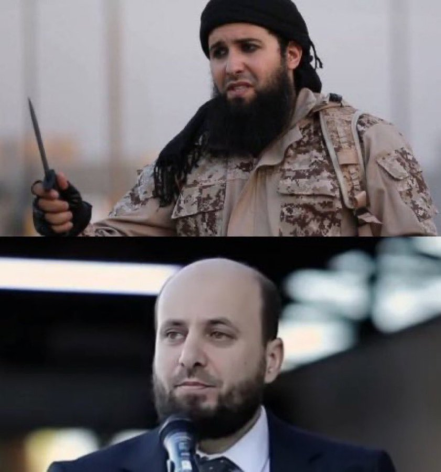
Mohammed al-Bashir before and after his Western Facelift
Let’s see if I got this right: The Biden administration replaces Assad with a terrorist organization but is suddenly surprised when it discovers the group is led by terrorists. Is that it?
Indeed, it is. As you can see, none of this resolves the basic crisis created by the removal of Assad. Instead, the main proponents of regime change—Turkey, the US and Israel—have merely transformed Syria into an even bigger battleground where their own competing interests will soon play out by way of mortal combat.
How long will it be before Turkey locks horns with Israel or the United States? How long before sectarian war engulfs the country?
Not long, I’d wager. And for the people who thought that toppling the “evil dictator” would bring peace and security. They’d better think again.
Israel Gives Biden His Marching Orders
Syrian land will be annexed into “Greater” Israel
By Philip Giraldi • Unz Review • December 13, 2024
My former CIA colleague Larry Johnson has a real ability to clarify the significance of the constantly growing deep dark hole that Joe “Mumbles” Biden, he of failing mental capacity, has hurled the American people into. Larry wrote on December 12th that “There is still plenty of time before Donald Trump is inaugurated for Joe Biden’s team of cretins to start World War III. I think the biggest risk is that Israel may be emboldened to attack Iran and try to destroy sites, and may be encouraged to do so by the Biden lackeys. In short, American interference, at the behest of Netanyahu’s Israel, has left the Middle East in ruins, with over a million dead and open wars raging in Libya, Sudan, Somalia, Lebanon, Syria, and Palestine, and with Iran on the brink of a nuclear arsenal, being pushed against its own inclinations to this eventuality. The collapse of the Assad regime has prompted a punishing military response from Israel, which has launched airstrikes at military targets across Syria and deployed ground troops both into and beyond a demilitarized buffer zone for the first time in 50 years.”
Given the destruction and partitioning of Syria, it has become impossible to consider United States foreign policy without some acceptance that it is driven and, in a sense, directed by Israel and Israel’s formidable domestic lobby in the US. “The Lobby,” as it is commonly referred to, controls both Congress and the White House on key issues and manages the media narrative in such a fashion as to make Israel the permanent victim, never the aggressor. Even though Israel is now marching in triumph across what remains of Syria and has indicated that it will be sticking around as an occupier, the move is being described as “temporary” and “defensive” by White House spokesmen. The Lobby’s success rests on the corruption that lots of money can buy, obvious to nearly everyone in politics, but a forbidden topic, sometimes referred to as an antisemitic “trope,” i.e. “Jews and money.” Israel’s role in managing the Joe Bidens and Donald Trumps is largely exercised in the broader Middle East but it also includes passionately supporting Volodymyr Zelensky’s Ukraine, a process derived in part from Jewish mythologizing and obtaining revenge for the alleged “pogroms” carried out in imperial Russia. Subsequent Jewish dominance of the Soviet intelligence and security services, which saw the killing of millions of Christians in Russia, Ukraine and Eastern Europe, are carefully excluded from the narrative.
In the latest bit of “mowing the grass” by the Israeli military, the country’s new Defense Minister Israel Katz told the press that the Israel Air Force (IAF) had carried out more than 480 strikes across Syria during the two days after the initial invasion, deliberately destroying most of Syria’s strategic weapon stockpiles. Meanwhile, the Israeli navy totally destroyed the Syrian fleet based at Latakia overnight. Katz hailed the operation as “a great success.” Israeli Prime Minister Benjamin Netanyahu, on the day before, had called the rapid defeat of Bashar al-Assad’s regime as “a new and dramatic chapter… The collapse of the Syrian regime is a direct result of the severe blows with which we have struck Hamas, Hezbollah and Iran… we are changing the face of the Middle East.”
When informed of the initial invasion of al-Assad’s Syria by Israeli, Turkish, insurgent and US forces, Donald Trump said that the conflict was none of our business and it would be best to keep out of it. Hopefully that will be the policy after January 20th’s inauguration, but one recalls that Trump’s record of pandering to Israel is almost as bad as Biden’s, and he was the one who decided (admittedly under pressure from the Pentagon) to continue in 2017 the military occupation of a third of Syria that included its oil resources and its best agricultural land. Add in the crippling US and European sanctions on Damascus and one might argue that since that time Syrians have been poor and starving, causing refugee flows and hostility towards the al-Assad government that contributed to the success of the recent uprising.
To be sure, many Syrians are celebrating the fall of an admittedly repressive, authoritarian, and corrupt Bashar al-Assad government. But other Syrians, particularly from hitherto protected minority groups like Christians, Alawites and Shiites, are now living in fear of or fleeing from the violent sectarian insurgents that have taken the place of President al-Assad. Christian Churches have already been looted and desecrated and warned not to hold Christmas services, not to sponsor Christmas parades, and not to display the image of St. Nicholas.
To be sure, fearing what is to come is legitimate as the “rebel” leader of the al-Qaeda derived Hayat Tahrir al-Sham (HTS) Terror group, Abu Mohammad al-Jolani, who now goes by his given name Ahmed al-Shara, is a founder of al-Qaeda in Syria, al-Nusra, and a former deputy to ISIS leader Abu Bakr al-Baghdadi. The US State Department has listed him as a terrorist as well as HTS as a terrorist group, and has placed a $10 million bounty on al-Jolani’s head, which presumably will soon be removed by Joe Biden. There is plenty of blood on al-Jolani’s hands and little in the way of evidence that he will not opt to slaughter those who he sees as his enemies, much of the killing being guided by the extreme religious groups that make up his followers. Indeed, there are already reports of group killings, including numerous soldiers in the Syrian Arab Army who surrendered rather that fight the insurgents.
Al-Jolani now claims that his extremism was just a “phase” and he has several times confirmed that he wants good relations with Israel, clearly a condition imposed by the US to allow him to remain in power. He has even suggested that Israeli air support enabled his warriors to move quickly from their bases in the north to Damascus. But al-Jolani has never actually apologized for or disowned the atrocities committed on his watch in 2011-3 when he was actively killing fellow Syrians. This includes August 2013 massacres in some of the Alawite areas of Latakia, which included “the systematic killing of entire families,” an international investigation later determined. One observer also reported that the insurgents were devoted to “sectarian mass murder” This is the legacy of the new “inclusive” government in Syria. According to one other ominous report, it appears that Sharia law has already been announced by the newly installed justice minister, Shadi Alwaisi.
So, what is in it for the United States? Nothing but a curt thank you from Prime Minister Benjamin Netanyahu, who clearly connived with Joe Biden’s Special Envoy Amos Hochstein, an Israeli by birth, to set the ball rolling towards Syria through adroit use of an attack on southern Lebanon to disarm Hezbollah followed by a phony ceasefire in Lebanon that gave Netanyahu a free hand and empowered Israel to invade and overthrow its neighbor Syria, parts of which will undoubtedly be annexed to help create Eretz or “Greater” Israel. It was and is all part of a plan by the US and Israel to reshape the Middle East to benefit the Jewish state and you can bet that Iran is the next target. And a delusional Joe Biden took credit for it all in his usual haphazard way, claiming after the regime change that Assad’s “main allies” — Iran, Hezbollah, and Russia — “are far weaker today than they were when I took office.” Their inability to save Assad was “a direct result of the blows that Ukraine, Israel have delivered upon their own self-defense, with unflagging support of the United States.”
Sure Joe, what bullshit. At the end of the day, to bring down Syria the US spent billions of dollars arming an insurgency that they knew was dominated by al-Qaeda in a government replacement scheme that benefited only Israel and Turkey and which targeted a country that in no way threatened the United States. It sure makes sense to me and I hope you will be comforted by it when you are hauled off to prison after you leave office and are prosecuted for exceeding your constitutional authority by involving the United States in two unnecessary wars. Some might call it treason!
Philip M. Giraldi, Ph.D., is Executive Director of the Council for the National Interest, a 501(c)3 tax deductible educational foundation (Federal ID Number #52-1739023) that seeks a more interests-based U.S. foreign policy in the Middle East. Website is councilforthenationalinterest.org, address is P.O. Box 2157, Purcellville VA 20134 and its email is inform@cnionline.org.
How the US and Israel Destroyed Syria and Called it Peace
By Jeffrey D. Sachs | Common Dreams | December 12, 2024
In the famous lines of Tacitus, Roman historian, “To ravage, to slaughter, to usurp under false titles, they call empire; and where they make a desert, they call it peace.”
In our age, it is Israel and the U.S. that make a desert and call it peace.
The story is simple. In stark violation of international law, Israeli Prime Minister Benjamin Netanyahu and his ministers claim the right to rule over seven million Palestinian Arabs. When Israel’s occupation of Palestinian lands leads to militant resistance, Israel labels the resistance “terrorism” and calls on the U.S. to overthrow the Middle East governments that back the “terrorists.” The U.S., under the sway of the Israel Lobby, goes to war on Israel’s behalf.
The fall of Syria this week is the culmination of the Israel-U.S. campaign against Syria that goes back to 1996 with Netanyahu’s arrival to office as Prime Minister. The Israel-U.S. war on Syria escalated in 2011 and 2012, when Barack Obama covertly tasked the CIA with the overthrow of the Syrian Government in Operation Timber Sycamore. That effort finally came to “fruition” this week, after more than 300,000 deaths in the Syrian war since 2011.
Syria’s fall came swiftly because of more than a decade of crushing economic sanctions, the burdens of war, the U.S. seizure of Syria’s oil, Russia’s priorities regarding the conflict in Ukraine, and most immediately, Israel’s attacks on Hezbollah, which was the key military backstop to the Syrian Government. No doubt Assad often misplayed his own hand and faced severe internal discontent, but his regime was targeted for collapse for decades by the U.S. and Israel.
Before the U.S.-Israel campaign to overthrow Assad began in earnest in 2011, Syria was a functioning, growing middle-income country. In January 2009, the IMF Executive Board had this to say:
Executive Directors welcomed Syria’s strong macroeconomic performance in recent years, as manifested in the rapid non-oil GDP growth, comfortable level of foreign reserves, and low and declining government debt. This performance reflected both robust regional demand and the authorities’ reform efforts to shift toward a more market- based economy.
Since 2011, the Israel-U.S. perpetual war on Syria, including bombing, jihadists, economic sanctions, U.S. seizure of Syria’s oil fields, and more, has sunk the Syrian people into misery.
In the immediate two days following the collapse of the government, Israel conducted about 480 strikes across Syria, and completely destroyed the Syrian fleet in Latakia. Pursuing his expansionist agenda, Prime Minister Netanyahu illegally claimed control over the demilitarized buffer zone in the Golan Heights and declared that the Golan Heights will be a part of the State of Israel “for eternity.”
Netanyahu’s ambition to transform the region through war, which dates back almost three decades, is playing out in front of our eyes. In a press conference on December 9th, the Israeli prime minister boasted of an “absolute victory,” justifying the on-going genocide in Gaza and escalating violence throughout the region:
I ask you, just think, if we had acceded to those who told us time and again: “The war must be stopped”– we would not have entered Rafah, we would not have seized the Philadelphia Corridor, we would not have eliminated Sinwar, we would not have surprised our enemies in Lebanon and the entire world in a daring operation-stratagem, we would not have eliminated Nasrallah, we would not have destroyed Hezbollah’s underground network, and we would not have exposed Iran’s weakness. The operations that we have carried out since the beginning of the war are dismantling the axis brick by brick.
The long history of Israel’s campaign to overthrow the Syrian Government is not widely understood, yet the documentary record is clear. Israel’s war on Syria began with U.S. and Israeli neoconservatives in 1996, who fashioned a “Clean Break” strategy for the Middle East for Netanyahu as he came to office. The core of the “clean break” strategy called for Israel (and the US) to reject “land for peace,” the idea that Israel would withdraw from the occupied Palestinian lands in return for peace. Instead, Israel would retain the occupied Palestinian lands, rule over the Palestinian people in an Apartheid state, step-by-step ethnically cleanse the state, and enforce so-called “peace for peace” by overthrowing neighboring governments that resisted Israel’s land claims.
The Clean Break strategy asserts, “Our claim to the land—to which we have clung for hope for 2000 years—is legitimate and noble,” and goes on to state, “Syria challenges Israel on Lebanese soil. An effective approach, and one with which American can sympathize, would be if Israel seized the strategic initiative along its northern borders by engaging Hizballah, Syria, and Iran, as the principal agents of aggression in Lebanon…”
In his 1996 book Fighting Terrorism, Netanyahu set out the new strategy. Israel would not fight the terrorists; it would fight the states that support the terrorists. More accurately, it would get the US to do Israel’s fighting for it. As he elaborated in 2001:
The first and most crucial thing to understand is this: There is no international terrorism without the support of sovereign states… Take away all this state support, and the entire scaffolding of international terrorism will collapse into dust.
Netanyahu’s strategy was integrated into U.S. foreign policy. Taking out Syria was always a key part of the plan. This was confirmed to General Wesley Clark after 9/11. He was told, during a visit at the Pentagon, that “we’re going to attack and destroy the governments in seven countries in five years—we’re going to start with Iraq, and then we’re going to move to Syria, Lebanon, Libya, Somalia, Sudan and Iran.” Iraq would be first, then Syria, and the rest. (Netanyahu’s campaign for the Iraq War is spelled out in detail in Dennis Fritz’s new book, Deadly Betrayal. The role of the Israel Lobby is spelled out in Ilan Pappé’s new book, Lobbying for Zionism on Both Sides of the Atlantic). The insurgency that hit U.S. troops in Iraq set back the five-year timeline, but did not change the basic strategy.
The U.S. has by now led or sponsored wars against Iraq (invasion in 2003), Lebanon (U.S. funding and arming Israel), Libya (NATO bombing in 2011), Syria (CIA operation during 2010’s), Sudan (supporting rebels to break Sudan apart in 2011), and Somalia (backing Ethiopia’s invasion in 2006). A prospective U.S. war with Iran, ardently sought by Israel, is still pending.
Strange as it might seem, the CIA has repeatedly backed Islamist Jihadists to fight these wars, and jihadists have just toppled the Syrian regime. The CIA, after all, helped to create al-Qaeda in the first place by training, arming, and financing the Mujahideen in Afghanistan from the late 1970s onward. Yes, Osama bin Laden later turned on the U.S., but his movement was a U.S. creation all the same. Ironically, as Seymour Hersh confirms, it was Assad’s intelligence that “tipped off the U.S. to an impending Al Qaeda bombing attack on the headquarters of the U.S. Navy’s Fifth Fleet.”
Operation Timber Sycamore was a billion-dollar CIA covert program launched by Obama to overthrow Bashar al-Assad. The CIA funded, trained, and provided intelligence to radical and extreme Islamist groups. The CIA effort also involved a “rat line” to run weapons from Libya (attacked by NATO in 2011) to the jihadists in Syria. In 2014, Seymour Hersh described the operation in his piece “The Red Line and the Rat Line”:
“A highly classified annex to the report, not made public, described a secret agreement reached in early 2012 between the Obama and Erdoğan administrations. It pertained to the rat line. By the terms of the agreement, funding came from Turkey, as well as Saudi Arabia and Qatar; the CIA, with the support of MI6, was responsible for getting arms from Gaddafi’s arsenals into Syria.”
Soon after the launch of Timber Sycamore, in March 2013, at a joint conference by President Obama and Prime Minister Netanyahu at the White House, Obama said: “With respect to Syria, the United States continues to work with allies and friends and the Syrian opposition to hasten the end of Assad’s rule.”
To the U.S.-Israeli Zionist mentality, a call for negotiation by an adversary is taken as a sign of weakness of the adversary. Those who call for negotiations on the other side typically end up dead—murdered by Israel or U.S. assets. We’ve seen this play out recently in Lebanon. The Lebanese Foreign Minister confirmed that Hassan Nasrallah, Former Secretary-General of Hezbollah had agreed to a ceasefire with Israel days before his assassination. Hezbollah’s willingness to accept a peace agreement according to the Arab-Islamic world’s wishes of a two-state solution is long-standing. Similarly, instead of negotiating to end the war in Gaza, Israel assassinated Hamas’ political chief, Ismail Haniyeh, in Tehran.
Similarly in Syria, instead of allowing for a political solution to emerge, the U.S. opposed the peace process multiple times. In 2012, the UN had negotiated a peace agreement in Syria that was blocked by the Americans, who demanded that Assad must go on the first day of the peace agreement. The U.S. wanted regime change, not peace. In September 2024, Netanyahu addressed the General Assembly with a map of the Middle East divided between “Blessing” and “Curse,” with Lebanon, Syria, Iraq, and Iran as part of Netanyahu’s curse. The real curse is Israel’s path of mayhem and war, which has now engulfed Lebanon and Syria, with Netayahu’s fervent hope to draw the U.S. into war with Iran as well.
The U.S. and Israel are high-fiving that they have successfully wrecked yet another adversary of Israel and defender of the Palestinian cause, with Netanyahu claiming “credit for starting the historic process.” Most likely Syria will now succumb to continued war among the many armed protagonists, as has happened in the previous U.S.-Israeli regime-change operations.
In short, American interference, at the behest of Netanyahu’s Israel, has left the Middle East in ruins, with over a million dead and open wars raging in Libya, Sudan, Somalia, Lebanon, Syria, and Palestine, and with Iran on the brink of a nuclear arsenal, being pushed against its own inclinations to this eventuality.
All this is in the service of a profoundly unjust cause: to deny Palestinians their political rights in the service of Zionist extremism based on the 7th century BCE Book of Joshua. Remarkably, according to that text—one relied on by Israel’s own religious zealots—the Israelites were not even the original inhabitants of the land. Rather, according the text, God instructs Joshua and his warriors to commit multiple genocides to conquer the land.
Against this backdrop, the Arab-Islamic nations and indeed almost all of the world have repeatedly united in the call for a two-state solution and peace between Israel and Palestine.
Instead of the two-state solution, Israel and the U.S. have made a desert and called it peace.
Exposing CIA/MI6 ‘Justice’ Operations in Syria
By Kit Klarenberg | Global Delinquents | December 12, 2024
In the immediate wake of the Syrian government’s abrupt collapse, much remains uncertain about the country’s future. While longtime leader Bashar Assad has sought refuge in Moscow, most of his government and its military, security, and intelligence apparatus remains in Damascus. Calls for reconciliation between officials and the predominantly foreign “opposition” abound, but the prospect of show trials for state apparatchiks is high. After all, elements of Anglo-American intelligence have been planning for such an eventuality since before the Syrian civil war even started.
In May 2011, the Commission for International Justice and Accountability (CIJA) was birthed by shadowy NATO state contractors, ARK and Tsamota. Its first act was to train handpicked Syrian “investigators, lawyers, and activists in basic international criminal and humanitarian law… enabling [them] to link state and non-state actors to underlying criminal acts.” Dedicated “teams of investigators according to their regions” – including Aleppo, Hama, Homs, and Idlib – were created, “and equipped with field investigative kits.”
Their objective was to gather evidence of war crimes committed by Syrian government forces, in support of a “domestic justice process in a future transitional Syria.” We must ask ourselves how such a project came to be before the Syrian army was formally deployed by Damascus, in response to the foreign-fomented crisis that commenced in mid-March that year. Particularly given bringing officials to trial in a “future transitional Syria” was wholly contingent on all-out regime change.
The timing of CIJA’s launch is a palpable indication foreign actors were laying foundations for that eventuality from the very first days of Syria’s “peaceful revolution”, before full-blown civil war had erupted. Given the affiliations of ARK and Tsamota, the pair were well-placed to know in advance of plans by Western governments to topple the Assad government via brute force. Now that has come to pass, it may be time for their long-standing plan to at last be put into action.
‘Regime Change’
Founded by MI6 journeyman Alistair Harris, ARK was one of a constellation of contractors, staffed by military and intelligence veterans, employed by British intelligence at a cost of many millions to conduct covert psychological warfare campaigns in Syria, from the initial days of the crisis. The aim was to destabilise Assad’s government, convince the domestic population, international bodies and Western citizens that genocidal CIA and MI6-backed militant groups pillaging the country were a “moderate” alternative, and deluge media the world over with pro-opposition propaganda.
Under this operation’s auspices, ARK founded and ran numerous ostensibly independent opposition media outlets targeting Syrians of all ages, while tutoring and equipping countless local “citizen journalists”, teaching them “camera handling, lighting, sound, interviewing, filming a story… video and sound editing… voice-over, scriptwriting,” and “graphics and 2D and 3D animation design.” The firm’s students were also instructed in practical propaganda theory, such as “target audience identification, media narrative analysis and monitoring, behavioral identification/understanding, campaign planning, behavioral change, and how communications can influence it.”
Such was ARK’s intimate proximity with anti-Assad elements, it boasted in leaked submissions to the Foreign Office of being entrusted by Western governments to develop a dedicated Office for Syrian Opposition Support. This entity identified the most promising groups for the proxy war’s sponsors to finance, in turn “[helping] present them to international donors, and provide access to networks that could deliver assistance.” These efforts intensified “as the conflict deepened and it became apparent that regime change would not occur in the short term.”
Tsamota’s primitive official website describes the company as “a security and justice sector consultancy which provides rule of law, forensics and natural resources advisory services,” working in “in politically, legally, socially and logistically challenging environments” for Western governments. The firm is not a compelling candidate for holding government officials anywhere accountable for war crimes. Tsamota has since inception offered guidance to major corporations on how to maximise profits in the Global South, while limiting their local and international legal liabilities.
In 2013, Tsamota director William Wiley gave a scandalous presentation to Canadian consortium MineAfrica Inc. In it, he set out a series of hypothetical scenarios in which mining companies operating in countries such as the Congo and Mali employed private security firms to crack down on striking workers, or deal with “local militias” interfering with their operations. Wiley outlined a number of means by which companies could be insulated from repercussions of heavy-handed responses to such incidents, up to and including murder.
That presentation described Tsamota as composed of “experts” drawn from “national police, military and intelligence forces.” Wiley is no exception, having served in the Canadian military for almost two decades. Subsequently, he turned to international law, among other things overseeing the trial of Saddam Hussein October 2005 – December 2006, for crimes against humanity. Mainstream accounts acknowledge Wiley was imposed on the former Iraqi leader’s defence team without consent – a major breach of basic legal norms – by the US embassy in Baghdad’s Regime Crimes Liaison Office.
After capture, Hussein was initially interrogated by the CIA. Contemporary media reports note there was significant concern within the Agency that “their questioning could become public during his eventual trial,” raising issues around “how to conduct the questioning and record the conversations.” The reasons why were unstated, although a likely explanation was Washington wished to avoid awkward disclosures in court about Hussein’s long-running relationship with the CIA, and active US complicity in many of the most heinous crimes of which he was accused.
To say the least, this was a sensitive role indeed. Even prominent Iraqi supporters of US invasion and occupation charged Baghdad’s “interim” puppet government was seeking “show trials followed by speedy executions” of Hussein et al to boost its credibility. That Wiley was entrusted with this mission speaks volumes about his reliability from the US government’s perspective. It also raises obvious questions about the nature of his relationship with the CIA, and whether that bond influenced CIJA’s creation half a decade later.
‘Moving Documents’
A series of leaked ARK files on CIJA’s activities authored in the years immediately following its creation make grand claims about its achievements. One declares the Commission “innovated in the field of transitional justice… aiding the collection of evidence to document war crimes, crimes against humanity, and other violations of International Humanitarian Law” in Syria. Another states its work represented “a landmark development in international justice: the contemporaneous gathering of evidence of violations of international humanitarian law conducted by regime forces”:
“[CIJA], through expert training, effective equipment provision and a commitment to the truth were able to ensure that when the conflict ends, the raw material of a post-conflict war crimes process is ready for trial, in turn providing a key contribution to truth telling, reconciliation and the future of Syria.”
Elsewhere, ARK boasted how CIJA had seized thousands of kilograms of “contemporaneous documentation”, hundreds of thousands of pages of “evidential material” and thousands of videos from Syria, “all of which had to be hand carried” out of the country. Cut to February 2021, and Commission chair Stephen Rapp, a US diplomatic warhorse, bragged to CBS about the sheer volume of evidence CIJA collected. He claimed the papertrail exposed a systematic strategy of Assad government-directed executions of opposition activists, along with ensuing coverups:
“Now we have 800,000 pages of original documents, signed and sealed with original signatures going all the way up to Assad that document this whole strategy…We see reports back about ‘well, we’ve got a real problem here, there are too many corpses stacking up, somebody’s gonna have to help us with that’… Everything is handled in this sort of totalitarian system where they frankly think they can get away with things… they were almost stupid… they created evidence.”
If such damning, incontrovertible proof was bagged at any stage by CIJA, it has never emerged publicly. Still, throughout the Syrian dirty war, the Commission enjoyed glowing profiles in Western media, while providing journalists and rights groups with multiple scoops supposedly exposing Syrian government atrocities. At no point did any mainstream reporter or NGO question, let alone raise concerns about, the manner in which the Commission garnered the material upon which its cases against government officials in Damascus was “hand carried” out of the country.
CIJA chief Wiley acknowledged in 2014 that his organisation smuggled evidence from Syria by working with every opposition group “up to but excluding Jabhat al-Nusra and Islamic State.” However, a 2019 investigation by The Grayzone amply indicates that CIJA was frequently in extremely close quarters with both groups. Moreover, they were paid handsomely for their assistance in securing documentation. This included material seized in Raqqa after its January 2014 capture by ISIS, right when the ultra-extremist group was massacring Alawites and Christians.
In a 2016 New Yorker profile of CIJA, Wiley detailed the practical hassles and financial drain inherent in “moving documents [over] international borders” and opposition-controlled “checkpoints”, while relying on “rebel groups and couriers for logistical support.” He described how bundles of government files “typically” arrived at the Commission’s offices “in a dizzying array of crappy suitcases.” Wiley lamented, “we burn enormous sums of money moving this stuff.”
Accordingly, CIJA received tens of millions of dollars for its efforts from a variety of Western governments, including those at the forefront of the Syrian dirty war. Despite the vast windfall, the Commission’s work produced zero prosecutions for many years. This changed in late 2019, when Anwar Raslan and Eyad Gharib, two former members of Damascus’ General Intelligence Directorate, were indicted in Germany for crimes against humanity.
‘Many Contradictions’
Raslan headed the Directorate’s domestic security unit, while Gharib was one of his departmental subordinates. The pair defected to the opposition in December 2012. Raslan and his family fled to Jordan, where he played “an active and visible role in the Syrian opposition.” He was part of the anti-Assad delegation at the Geneva II conference on Syria in January 2014, and in July that year, was granted asylum in Germany.
After his escape from Syria, Raslan told numerous lurid tales of abuse and atrocities perpetrated by his unit, and the Assad government more widely, during his 20 years of state service. He claimed his defection was spurred after learning an apparent opposition attack in Damascus that he was charged with investigating was, in fact, staged by security forces. Significant doubts about his accounts, and whether his defection was principled or just cynical opportunism, have been raised in many quarters.
Artist’s rendition of Raslan’s trial
In a perverse irony, Raslan’s loudmouth propensity was his undoing. His assorted claims post-defection provided grounds for arrest by German authorities, and were used against him and Gharib in their prosecutions. These legal actions heavily relied on documents seized by CIJA, including Central Crisis Management Cell records. This unit was created in March 2011 by Damascus, to manage responses to mass rioting that erupted this month. These documents have been widely described as the “linchpin” of the Commission’s case against “the Syrian regime.”
Yet, as this journalist has previously exposed, the Central Crisis Management Cell files in fact show the Assad government explicitly and repeatedly instructed security forces to protect protesters, prevent violence, and keep the situation under control. The documents also detail how from inception, many “peaceful” demonstrators were extremely violent, while opposition fighters systematically murdered security service operatives, pro-government figures, and demonstrators to foment catastrophe, in a manner eerily similar to many CIA/MI6 regime change operations old and new.
In February 2021, Gharib was found guilty of aiding and abetting crimes against humanity. He received four-and-a-half years in prison. A year later, Raslan was given life for crimes including mass torture, rape, and murder. The pair were not convicted for personally perpetrating these horrors, but serving in the General Intelligence Directorate at the time they were allegedly committed. “Expert” witness evidence provided at their trials left much to be desired.
For example, judges and prosecutors alike expressed disquiet at “many contradictions” in the testimony of “P3”, a Syrian government operative who purportedly worked in a security service “mail department”, and was central to Gharib’s conviction. P3 professed to seeing sensitive documents “related to the transfer of corpses” of opposition activists “to burial sites.” They “provided contradictory information” in statements to German police and the court, and were “visibly nervous” while testifying. Throughout, their seemingly aghast attorney sat nearby “putting his hands behind his head.”
Meanwhile, during Raslan’s prosecution, “P4” – a nameless individual who claimed to have been detained in a Syrian prison, and bribed his way out – testified he saw 500,000 corpses buried via a “bulldozer and a truck” next to his house, in an area which was previously “a desert”. Reports of the trial indicate there “was a feeling” among those present in court, including “the public”, that these numbers were greatly “exaggerated.”
The sense that Gharib and Raslan were prosecuted because they were within easy reach, and CIJA needed something to show for all its well-remunerated efforts, is ineluctable. The Commission had strong grounds to be anxious about failing to fulfill its founding objective. In March 2020, the European Anti-Fraud Office (OLAF) formally accused the organization of “submission of false documents, irregular invoicing, and profiteering” relating to an EU “Rule of Law” project it ran in Syria.
Fast forward to today, and The Guardian reports that “the abrupt implosion of the infrastructure of state terror” in Syria “has made available a huge volume of evidence.” The outlet quoted CIJA chief William Wiley at some length. He compared Assad’s fall to “a situation much like Germany in 1945 or Iraq in 2003,” with “a sudden availability of all state records” making prosecution of state officials a fait accompli:
“It’s a very unusual situation, and its suddenness creates challenges and opportunities in simply dealing with the material… If there’s any security intelligence guy that rocks up in Europe, there’s typically going to be enough material already to hand.”
Lessons from Syria, Lebanon: Resistance is the only guarantor of sovereignty
By Mohamad Hasan Sweidan | The Cradle | December 12, 2024
On the heels of thinly veiled threats from Israeli Prime Minister Benjamin Netanyahu that deposed Syrian president Bashar al-Assad was “playing with fire,” and seizing the opportunity presented by the sudden collapse of the Syrian state, the occupation army invaded Syrian territory for the first time in 50 years.
The pretext of establishing a “buffer zone” was a transparent attempt to conceal Israel’s historic regional agenda: the weakening and fragmentation of Arab states to facilitate Tel Aviv’s regional domination.
Exploiting the power vacuum that ensued from the fall of Damascus, Israel launched hundreds of air strikes to cripple Syria’s already weakened military capabilities, and patted itself on the back for what it called the largest air blitz in its history. Its land forces and armored vehicles now lay a few kilometers from the Syrian capital, having literally driven through border terrain without a single challenge by opposing troops.
For many observers in neighboring Lebanon – and perhaps Iraq and other regional states – the Israeli rout answered a critical question: if they relinquished the will or capacity to defend themselves, would this too be Lebanon’s fate?
A legacy of expansionism
The concept of ‘Greater Israel’ is deeply rooted in Zionist ideology. From Theodor Herzl, the father of modern Zionism, to revisionist figures like Ze’ev Jabotinsky, and even Israel’s first prime minister, David Ben-Gurion, expansionist ambitions have been a consistent theme.
Oded Yinon’s plan, A Strategy for Israel in the Eighties, further solidified this vision. First made public in the magazine Kivunim (Directions) of the World Zionist Organization in February 1982, the plan was based on the vision of Herzl, and the founders of the Israeli state in the late 1940s, among them Polish-born, US Zionist leader Jacob Fishman.
From North Africa to the Levant to the Arabian Peninsula, Yinon advocated a strategy of breaking up and chronically weakening Arab states in order to ensure Israel’s long-term security.
“Israel’s policy, both in war and in peace, ought to be directed at the liquidation of Jordan under the present regime and the transfer of power to the Palestinian majority … The dissolution of Syria and Iraq later on into ethnically or religiously unique areas such as in Lebanon, is Israel’s primary target on the Eastern front … Iraq, rich in oil on the one hand and internally torn on the other, is guaranteed as a candidate for Israel’s targets. Its dissolution is even more important for us than that of Syria … The entire Arabian peninsula is a natural candidate for dissolution due to internal and external pressures, and the matter is inevitable especially in Saudi Arabia … Egypt is divided and torn apart into many foci of authority. If Egypt falls apart, countries like Libya, Sudan or even the more distant states will not continue to exist in their present form and will join the downfall and dissolution of Egypt.”
This destructive and expansionist drive is not confined to historical Israeli figures. Current Israeli Finance Minister Bezalel Smotrich has openly stated his desire for Israel to control territory extending to Damascus and including Jordan. In a 2016 interview, he is quoted as saying: “Our great religious elders used to say that the future of Jerusalem was to extend as far as Damascus.”
More recently, following the fall of Damascus, Smotrich pressed: “It is time to seize control of Gaza and strip Hamas of its civilian authority, cutting off its lifeline,” and to launch an all-out offensive in the occupied West Bank.
Such pronouncements, far from being isolated incidents, reflect a core Zionist principle that resurfaces with increased intensity during times of conflict.
The ongoing war in Gaza exemplifies this. Nearly 10 months after the start of the war, Netanyahu said of the Occupied Palestinian Territory: “It is part of our homeland. We intend to stay there.” Smotrich’s display of a ‘Greater Israel’ map encompassing all of historic Palestine and Jordan during a 2023 visit to Paris further illustrates these ambitions.
Historically, these far-right expansionist fantasies are rooted in religious beliefs that the ‘Promised Land’ stretches from the Nile River in Egypt to the Euphrates River in Iraq. These beliefs have been seeded and advanced by the leaders of the Zionist movement since its inception more than 120 years ago.
Breaking up West Asia
Their expansionist fantasies are not merely ideological. The Yinon Plan outlined a strategy for breaking Arab states into weak, sectarian ones, each dependent on Israel for survival. Iraq is to be divided into Kurdish, Sunni, and Shia states, Lebanon reduced to fragments, and Syria obliterated. This is not a theory – it’s a Zionist roadmap for domination, and the occupation state’s aggression in Syria is a direct implementation of these sinister goals.
Israel’s actions in Syria lay bare the insatiable greed of the occupation state. Without resistance movements in neighboring Lebanon, Israeli tanks would undoubtedly have rolled deep into Lebanese territory, seizing lands far beyond the south of the Litani.
The evidence is clear. Since the ceasefire between Israel and Lebanon took effect on 27 November, the Israeli occupation army has violated Lebanese sovereignty at least 195 times. These violations include airstrikes, drone incursions, artillery bombardments, and the destruction of homes – acts of terror meant to keep Lebanon on its knees.
The Lebanese government and armed forces, shackled by limited capacity and international neglect, have been unable to halt this aggression. International mechanisms like the five-member committee – comprising the US, France, Lebanon, Israel, and UNIFIL – are nothing more than diplomatic theatrics.
Resistance: The barrier against occupation
A day after the committee meeting on 9 December, the Israeli army committed 12 violations of the ceasefire agreement.
They meet, they talk, but they fail to act. While these parties dither, Tel Aviv tightens its grip, proving time and time again that the only language it understands is the language of force. This is why Lebanon’s resistance remains the only genuine national safeguard against Israeli aggression.
Southerners in Lebanon know this truth intimately: without the resistance, Israel’s greed knows no bounds. Every incursion, every violation, is a reminder that resistance is not just a choice – it’s a necessity.
The unrelenting aggression of the occupation state reveals a harsh reality; in a world dominated by power, weakness invites exploitation. Realists in international relations argue that power is the only currency that matters, and Lebanon’s experience validates this view.
Resistance movements have demonstrated that the balance of power is the sole way to curb Tel Aviv’s appetite and ambitions. Israel’s expansionism will not end with Syria or Palestine. It eyes every vulnerable nation in the region, seeking to carve it up and dominate.
The lesson is clear. Only through resilience and force can sovereignty be defended. Resistance is not just a shield – it is the only path to survival against an entity that thrives on destruction and occupation.
Events in Syria and Future Prospects
By Mikhail Gamandiy-Egorov – New Eastern Outlook – December 12, 2024
The tragic events in Syria have clearly demonstrated that internal betrayal is one of the greatest challenges for any sovereign state. This is particularly true when such betrayal serves the interests of those seeking to destroy sovereign nations.
Terrorist groups
Terrorist groups, following a brief advance across several fronts and battles in which the government army effectively refused to engage, managed to capture the Syrian capital, Damascus. Initially, it seemed that this was merely a temporary disarray caused by years of complacency. However, it soon became evident that a large-scale betrayal had occurred within Syria’s political and military apparatus, favouring forces long intent on dismantling the country as a unified state.
Events in Syria as a Lesson
The recent takeover of power in Syria by overt Salafist terrorists is undoubtedly a tragedy, both for Syria itself and for all advocates of a multipolar world. However, it is likely that many representatives of Syria and other Arab nations have not yet fully grasped the far-reaching consequences of what has happened. These consequences are likely to be deeply tragic, both for Syria and for the broader region.
In reality, an undeniable fact remains: an outright terrorist affiliated with ISIL or al-Qaeda—no matter how his true masters might now attempt to portray him—has seized power in one of the world’s oldest nations. This was achieved, of course, not without the involvement of various regimes and intelligence agencies, ranging from the United States and Britain to Israel and Turkey. Furthermore, given the presence of sleeper cells linked to al-Qaeda and ISIL in nearly every Arab country, the future implications for Arab states could be catastrophic. Yet even now, many seem either unaware of this or, like the terrorists themselves, are merely executing the orders of their Western and Israeli patrons.
Nevertheless, no matter how certain hostile forces attempt to discredit Russia and Iran for their alleged failure to assist their ally, the reality lies elsewhere: when internal traitors in a given country gain the upper hand with the tacit approval of part of the population, external intervention becomes utterly futile.
This became clear to Russia—whose Aerospace Forces continued striking advancing terrorist positions—to Iran, which was reportedly ready to deploy a significant military contingent to Syria, and to Lebanon’s Hezbollah, whose fighters performed admirably in battles, including those near the Syrian city of Homs. Meanwhile, Syrian troops abandoned their positions and retreated in haste, despite Hezbollah still recovering from intensive clashes with the Israeli regime, which could reignite at any moment. In such circumstances, it became increasingly apparent that it would be entirely illogical for Russia, Iran, and Hezbollah to continue fighting terrorist forces if the Syrians themselves no longer wished to resist.
Necessary Conclusions and Prospects
There were, of course, evident mistakes at the level of Syria’s leadership. Mistakes that Moscow and Tehran had repeatedly pointed out in private discussions. The necessary reforms were not implemented in recent years, even though the opportunity was certainly there — thanks to the relative peace in Syria and the lull in hostilities. Notably, this peace was largely achieved through the efforts and support of Russia, Iran, and Lebanon’s Hezbollah. These reforms were essential in the military sphere and many other areas, but they never materialised.
That said, despite these significant unresolved problems, the situation could not have unfolded as it did without mass betrayal. This is clearly evidenced by footage taken by Russian forces stationed in Syria, which not only confirm the lack of proper preparation among Syrian troops at the onset of the terrorist offensive but also highlight the betrayal by certain members of Syria’s political and military elite.
Who were the external players involved? It is almost certain that the Anglo-Saxons, the Israeli regime, Erdogan’s Turkey, and possibly some Arab states played a role. However, this has become a secondary issue. What truly matters now is that advocates of a multipolar world must closely monitor any attempts at betrayal within their own countries and eliminate them at the very earliest stages of destabilisation attempts—by the harshest means necessary. Furthermore, all necessary reforms across key sectors must be implemented without delay.
As for the enemies and rivals of a multipolar world order, their problems are only beginning. Engaging in a multi-front conflict against Russia across different parts of the globe, the representatives of the Western planetary minority and their agents aimed to provoke a new hot front for our country. They failed — the plans were clearly understood by Russian leadership. Consequently, all new Syrian problems now fall squarely on the enemies of multipolarity. The reemergence of al-Qaeda and ISIL terrorists will likely lead to another massive wave of refugees, increasing security threats. The West and several other nations still fail to understand that controlling terrorists indefinitely is impossible. Eventually, these groups slip out of control, bringing with them inevitable consequences.
So, to all the initiators of this campaign: best of luck in your “successes”, especially as former allies are already turning on each other. Pro-Turkish militants are clashing with pro-American Kurds from the so-called “SDF”, with the direct involvement of al-Qaeda, ISIL, and the US and Israeli regimes. Meanwhile, we will calmly observe from our side. Particularly as Syria’s leader, Bashar al-Assad, is now in Russia and has avoided the fate of Saddam Hussein or Muammar Gaddafi. As for those Syrians who are pleased with the “improvements”, they can fully immerse themselves in a world of total chaos and lawlessness — or, excuse me, democracy, freedom, and progress. Finally, regarding internal traitors: they always meet a grim end.
Iranian supreme leader names powers behind Assad’s ouster
RT | December 11, 2024
Iran’s supreme leader, Ayatollah Ali Khamenei, has pointed the finger at the US and Israel over the ouster of former Syrian President Bashar Assad. He also dismissed claims that the latest developments in the Middle East had weakened Tehran and its allies in the region.
Several armed opposition groups mounted a surprise offensive in Syria late last month, led by Hayat Tahrir-al-Sham (HTS). With government forces offering little or no resistance, militants swiftly seized several major cities, eventually taking the capital, Damascus, on Saturday. Assad with his family fled to Russia, where they were granted asylum.
Addressing a thousands-strong congregation on Wednesday, Ayatollah Khamenei said that “there should be no doubt that what happened in Syria was the result of a joint American-Zionist plot.” Touching on the future of the so-called ‘Resistance Front’ – a coalition of Iranian-backed groups across the Middle East – the cleric insisted that despite some analysts’ predictions to the contrary, the structure “will encompass the entire region more than ever.”
“Resistance is… a doctrine that grows stronger under pressure,” Khamenei stated.
The Iranian supreme leader also insisted that “Iran is strong and powerful, and will become more powerful” despite the fall of its long-time ally in Damascus. He also predicted that the US will eventually be pushed out of the Middle East by the ‘Resistance Front’.
In a video address on Sunday, outgoing US President Joe Biden claimed that Assad had been deposed because of Washington’s continued efforts to weaken Iran, Russia, and the Lebanese-based Shiite militant group Hezbollah. All three had actively supported Assad since the Syrian Civil War broke out in 2011.
Biden also cited sanctions imposed by Washington on the Syrian government, as well as the US military presence in the country and its support for Kurdish militias in Syria’s northeast.
“Our approach has shifted the balance of power in the Middle East,” the US president proclaimed.
The same day, Israeli Prime Minister Benjamin Netanyahu similarly claimed that Assad’s ouster had been a “direct result of the blows we have inflicted on Iran and Hezbollah.”
The Israeli military has in recent days seized control of the demilitarized buffer zone on the border with Syria, which was established as part of the 1974 disengagement agreement not far from the Israeli-occupied Golan Heights. The Israel Defense Forces has also conducted massive strikes on numerous military facilities in Syria, citing supposed security threats.
Featured Video
Bombing Hitler’s Hometown
or go to
Aletho News Archives – Video-Images
From the Archives
The Biggest Threat to Peace in Middle East
By Dr. Elias Akleh* | Sabbah Report | May 24, 2010
A build up of heightened tension in the Middle East is escalating in the last few weeks. American and Israeli postures towards Lebanon, Syria, and Iran have become more threatening. Listening to speeches of political leaders one hears talks only about war not peace. Iranians and Israelis are continuously training hard for a possible showdown. Both sides are conducting extensive war games every month. This led Syrians to claim that Israel is preparing for a soon-to-come another war. The Jordanians also are warning that current stalemate of the peace process is an indication of a war breaking out this summer. The Russian President and his army chief hinted, a few months ago, that the US and Israel were planning for an attack on Iran.
Indeed Iran is, as it has been for last few years, the target of most of the threats and accusations of supporting terrorism. Escalating incitement against Iran the American Defense Department sent last month (April) to Congress a report on Iran’s military claiming Iran could develop intercontinental ballistic missiles capable of reaching the US by 2015.
Ignoring the fact that N. Korea, India, Pakistan, and Israel are proven to have nuclear weapons while Iran does not, the US Secretary of State Hillary Clinton chose in her speech, to the nuclear Non-Proliferation Treaty review conference at the UN, to focus on Iran’s alleged nuclear ambitions putting the whole world at risk as she put it. According to Clinton Iran’s acquisition of nuclear weapons, rather than Israel’s more than 200 nuclear bombs, is destabilizing the Middle East. She called on the world’s nations to rally around US efforts to hold Iran, not other nuclear countries, to account.
The accusation that Usama Bin Laden is living comfortably in Iran had received a boost after the broadcast of a documentary called “Feathered Cocaine”. This echoed the June 2003 claims of the Italian newspaper Corre de la Sierra that Bin Laden was in Iran according to some intelligence report, and according to Richard Miniter’s book “Shadow War”. … continue
Blog Roll
 Aletho News
- Bombing Hitler’s Hometown
- German journalist threatened with homelessness as German court upholds EU sanctions in landmark free speech case
- US Tells Allies That Ukraine-Bound Arms Could be Sent to Middle East
- Organized terrorism: Iran condemns killing of its diplomats in Lebanon
- Why could Gaza enter the regional war?
- Hamas official rejects Mladenov Plan linking disarmament to Gaza reconstruction
- Two Primary Elections for the Soul of ‘America First’
- Japan Clings to US Vassalage Despite Energy Crunch Caused By Iran War
- US Seeks Control Over Global Energy Infrastructure – Kremlin
- US senators target Orban government for standing up to Zelensky
- If Americans Knew
- Researchers at Human Rights Watch Resign Over Blocked Report on Palestinian Refugee Return
- Jewish Groups Are Backing a War Americans Don’t Want
- Eric Fingerhut Thinks He’s the President of the Jews
- Top Jewish Philanthropists, Rabbis Urge Israeli President to Take Action Against ‘Jewish Extremists’
- Don’t Be Fooled. Zionist Leaders Have Always Wanted to Control Southern Lebanon
- Israel’s widespread use of torture is a core element of its genocide against the Palestinian people
- In Israel’s War on Iran, Many Middle East US Bases Rendered “All But Uninhabitable”
- ‘Burn the lawn’: Israel pursues ‘Rafah model’ in southern Lebanon
- A genocide here, an amputation there
- Reports: Iran mobilizing 1M fighters, Israel-US run low on ammo, Israeli army faces shortage – Not a ceasefire Day 168
- No Tricks Zone
- Devastating Assessment Of Comirnaty Vaccine By Former Senior Pfizer Europe Toxicologist
- New Study: CO2 Is ‘Effectively Negligible’ As An Explanatory Climate Change Factor Since 2000
- Former Pfizer Toxicologist Dr. Helmut Sterz Tells Bundestag Hearing Pfizer Vaccine Should Have Never Been Approved
- Energy Expert: Germany’s Nuclear Phaseout Was A “500 Billion Euro Mistake”
- New Research: South Australia’s Mid-Holocene Sea Surface Temperatures Were 4°C Warmer Than Today
- Storing Green Energy To Last Germany 10 Days Would Require A 60-Million Tonne Battery
- New Studies: UK Sea Levels Were 4 Meters Higher Than Today During The Mid-Holocene
- Destructive Green New Deal: German Energy And Metal Group Warns Of Drastic Crisis
- New Study Documents A 20-Year Pause In Arctic Sea Ice Decline – Driven By Internal Variability
- Wake-up Call: Survey Shows Majority Of Germans Now Favor Postponing Climate Targets!
 Aletho News