Westerners, especially Atlanticists, are great at advocating for the setting of wildfires, and for starting those wildfires, but they seldom give much thought to what happens once they set a conflagration in motion
Sana’a strikes back: How Yemeni military’s lightning advance redrew the Red Sea’s strategic map

Territory liberated by Yemeni Armed Forces during the recent operation, including the ports of Al-Mokha, Dhubab, and Al-Khokha, and towns such as Hays and Maqbanah.
By Mohammad Molaei | Press TV | September 12, 2026
In the span of roughly one week, the Yemeni armed forces accomplished what eight years of attritional warfare had failed to achieve.
In a military operation officially named “God Is Strongest in Might and Severe in Punishment,” the Yemeni military, backed by the Ansarullah resistance forces, liberated more than 5,400 square kilometers of territory along Yemen’s Red Sea coast, capturing strategically vital ports, towns, and geographic features that Saudi-backed forces had seized and held since 2017 and 2018.
The speed, coordination, and depth of the advance stunned military and security observers, shattered a carefully constructed Saudi media narrative, and fundamentally altered the strategic geometry of the war imposed on Yemen.
The ports of Al-Mokha, Dhubab, and Al-Khokha fell. Key towns, including Hays, Maqbanah, and Al-Mafraq, were liberated. The entire Jabal Habashi region came under Sana’a’s control.
These were no minor outposts but positions that the former Saudi-backed regime had spent four months capturing during the so-called “Golden Arrow” operation in 2017 and an entire summer offensive in 2018, backed by heavy Saudi air support and financial resources.
The intelligence that started it all
The roots of the operation lie in a body of intelligence and an assessment reached in Sana’a months before the first shot was fired. It was believed that Saudi Arabia, in coordination with the United States, was preparing to launch a major offensive under the diplomatic pretext of securing international navigation in the Red Sea at some point in the near future.
The Saudis aimed, first, to create operational space for Washington to assert dominance over the Bab al-Mandab Strait, a strategic waterway whose leverage Ansarullah-backed Yemeni military had wielded with increasing effect since joining the Gaza solidarity front two years earlier.
Second, they sought to neutralize that leverage by igniting a land conflict along the western coast and driving northward toward Hodeidah, effectively diverting the Yemeni military’s attention from maritime operations and drawing it back into a costly ground war.
The broader context matters. Since early 2016, Saudi Arabia had gradually sidelined the UAE across provinces outside the Yemeni government’s control, consolidating its influence over the mercenary coalition nominally operating under the banner of the Saudi-recognized regime.
By this stage, the Emiratis had been largely pushed to the margins of the ground equation. Washington, having failed to achieve decisive results in either the Strait of Hormuz or Bab al-Mandab through its own military aggression, appeared to be recalibrating around Riyadh as its primary instrument.
For Saudi Arabia, specifically, a single operation on the western coast offered the prospect of three simultaneous gains: accelerating the US push for Red Sea control; transforming what had remained an internationalized war into a fratricidal intra-Yemeni war by stoking internal fronts; and consolidating Riyadh’s dominance over the fractious coalition of Yemeni military factions, many of them previously under UAE command, by bringing them together under a unified operation.
The Saudi Maneuver and Miscalculation
Saudi preparations had begun well in advance, reportedly even before the Yemeni operation to break the siege, which was launched following the funeral ceremony of a martyred leader in Sana’a. The plan envisioned opening three simultaneous fronts in Al-Jawf, Ma’rib, and along the western coast. It immediately ran into structural problems.
Southern factions within the Saudi-backed coalition refused to commit their forces to battles in the north. This single factor created a fracture line through the entire scheme.
Riyadh’s mercenaries, many of whom were fighting for locally defined interests rather than any coherent national project, could not be so easily redirected. The Saudis responded by redeploying forces from eastern Yemen northward and shifting the primary axis toward the western coast, where the geographic and symbolic stakes were highest.
Meanwhile, Riyadh worked the diplomatic track. A host of mediators – Egypt, Turkey, and most prominently Oman – were mobilized. Sana’a, not yet ready to foreclose negotiations entirely, granted a brief reprieve, holding off on launching the second phase of its operations.
None of this changed the military reality. While negotiations proceeded, Saudi Arabia sought to reinforce its mercenary positions and replenish ammunition stockpiles. Sana’a concluded that the window for a negotiated outcome had been deliberately exploited to buy time, not to buy peace.
The intelligence war
What followed was not a conventional military offensive launched from a standing start. It was the terminal phase of a carefully sequenced preemptive campaign that had been underway for approximately four weeks before the main ground advance.
Yemeni military’s intelligence apparatus, operating under the direction of Abu Ali al-Hakim, demonstrated a level of precision that repeatedly left the Saudi-backed coalition wrong-footed.
Newly established mercenary positions were destroyed before they could be consolidated. Ammunition depots were located and struck. Command centers and operations rooms were systematically degraded. The cumulative effect was a coalition whose combat readiness had been substantially hollowed out before the ground offensive even began.
The resulting weapons shortages were severe enough that Riyadh dispatched ships carrying arms to resupply its forces, seeking to close the gap before the main battle.
But the ships, arriving at the port of Mokha, were treated as targets, much like the trucks moving through the Al-Wadiah and Al-Abr crossings. The resupply effort largely failed.
The intelligence picture was so consistently accurate that speculation arose that UAE-aligned elements, still resentful of Saudi dominance over coalition affairs, may have contributed to the flow of intelligence to the Yemeni military. Whatever the source, the Yemeni military’s penetration of the coalition’s operational security was demonstrably deep.
The spark on the Taiz Axis
The specific trigger for the ground offensive came in early September, when the Yemeni military launched a first strike against a Saudi-backed position, anticipating an offensive push northward.
The preemptive strike sparked clashes across four axes simultaneously. The result was not a cascading, domino-like collapse of positions. What the Saudis had intended as the opening move of their western coast offensive instead became the opening phase of their humiliating retreat.
Over the following days, Riyadh attempted to activate additional fronts in Al-Bayda, Al-Dhale’e, and Al-Jawf in an effort to stretch the Yemeni military forces thin across multiple theaters.
Saudi airstrikes intensified across Yemen. Saudi officers reportedly promised direct ground support to coalition factions to incentivize them to hold their positions. The Yemeni military’s own assessment of the dynamic was clear: the Saudis had previously tried activating 52 fronts simultaneously, and each time the result had been further Yemeni military advances, rather than a reversal.
The media war
As the Yemeni military advances accelerated, a parallel battle unfolded in the information space. Saudi-aligned media channels worked to construct a counter-narrative, circulating footage of mercenary vehicle convoys, highlighting minor territorial gains in areas already under Saudi coalition control, and projecting an image of momentum that bore little resemblance to the battlefield reality.
The narrative briefly gained traction by drawing, inaccurately, on the recent Syrian precedent. Some observers speculated that Sana’a might face a “Damascus moment”: a rapid, unexpected collapse of authority under a fast-moving offensive.
The comparison was analytically flawed. The structural, operational, and social conditions that led to the fall of Damascus bear little resemblance to those in Yemen. Sana’a’s military organization, popular base, intelligence infrastructure, and decade-long experience of sustained warfare against a better-resourced coalition have produced a very different kind of fighting force from the one that crumbled in Syria.
The battlefield results made it clear. The “Damascus moment” narrative did not survive contact with the liberation of the islands, the western coast, and the string of ports that followed.
Sana’a’s logic of escalation
Throughout the campaign, Ansarullah-led Yemeni military forces have maintained a consistent list of demands directed at Riyadh: the complete lifting of the air and naval blockade on Yemen; payment of civil servant salaries; an all-for-all prisoner exchange; reopening roads between provinces; Saudi withdrawal from Yemeni territory; and the complete cessation of funding and material support to anti-Sana’a factions.
The strategic logic underlying the current operation can be summarized in three interlocking equations that Sana’a appears to be establishing simultaneously:
The first is Siege for Siege: The imposition of a naval blockade on Saudi Arabia stretching from Bab al-Mandab across the full length of the Red Sea, mirroring the blockade Riyadh maintains on Yemen.
The second is Preemptive Action: Continuous surveillance and interdiction of mercenary logistics and troop movements from eastern to western Yemen, preventing the reconstitution of forces that have already been degraded.
The third is Direct Deterrence: The targeting of Saudi military bases, military airports, and Aramco infrastructure in southern Saudi Arabia in direct response to any Saudi violation of Yemeni airspace or attacks on Yemeni territory.
The endgame
Sana’a has officially announced the conclusion of the operation and directed its forces toward consolidating the liberated territories. The reasoning behind stopping the advance at this stage, rather than pushing farther, reflects three overlapping calculations.
The first is the immediate military imperative of securing and clearing 5,400 square kilometers of newly captured terrain, a task that demands both manpower and time and must be completed before any counteroffensive can be mounted effectively.
The second is the existence of other fronts requiring attention. Ma’rib retains significant economic importance because of the Safer oil-field infrastructure. Taiz carries major political weight for Sana’a’s long-term governance ambitions. Yemeni forces cannot allow gains on the western coast to come at the cost of deterioration on these other critical axes.
The third consideration is strategic restraint, an awareness that actions crossing certain thresholds could trigger a qualitatively different response and draw in actors whose involvement would complicate the current trajectory.
Arab media reports indicate that tensions inside mercenary formations in Taiz have already escalated sharply in the wake of the coastal losses. A critical highway remains in play; delaying withdrawal from the city could leave those forces cut off from a viable exit route, a development that could dramatically accelerate Taiz’s fall without requiring a further ground offensive.
Regional ripples: Tehran, Riyadh, and beyond
The operational dimensions of this campaign extend beyond Yemen’s borders. Saudi Arabia has engaged directly with Tehran in an effort to halt flights to Sana’a since the Yemeni attacks resumed. Pakistan, meanwhile, is reportedly working to include Yemen in a new ceasefire framework, not unlike its role during the previous round, when Islamabad’s diplomatic activity coincided with and helped shape the Saudi naval blockade ceasefire process.
Saudi officials have a documented pattern of denying involvement in Yemen, Iraq, and Lebanon even while conducting active operations across all three theaters. Following its setbacks on the western coast, Riyadh may seek to recover leverage through alternative pressure points, with Lebanon and Iraq among the most likely arenas. That possibility warrants close monitoring.
American support for the Saudi-backed mercenary coalition has continued, but Washington has so far stopped short of direct combat involvement or assuming battlefield command.
Whether that calculus holds in the face of continued Yemeni military advances, or whether disillusionment with Saudi performance drives Washington toward renewed engagement with the UAE, remains one of the most consequential open questions as the war enters its next phase.
What comes next
If Saudi Arabia declines to meet Sana’a’s demands, as its past behavior suggests is the most probable near-term outcome, the Yemeni armed forces retain a substantial menu of escalation options. These include expanded strikes on Saudi supply chains, production and processing facilities, and oil-export infrastructure, with Yanbu and the East-West pipeline specifically on the table.
Operations in the Arabian Sea targeting foreign vessels with Saudi connections represent another avenue. Ground operations in southern Saudi territory constitute a further option that Sana’a has explicitly retained.
Crucially, the balance of internal coalition dynamics has shifted. Over the past two weeks, the Yemeni military has substantially neutralized one of Riyadh’s key remaining leverage mechanisms: its ability to activate internal Yemeni fronts. The collapse of the mercenary coalition and deepening factional rifts have made it increasingly difficult for Saudi officers to reconstitute any credible offensive capability in the near term. That fundamentally alters the timeline calculations for both sides.
The strategic implications of the Yemeni military now holding the coastline overlooking and approaching the Bab al-Mandab Strait are substantial and will require sustained analysis as the situation develops. Control of that coastline does not simply mean territory. It means depth, positioning, and, in the language of maritime chokepoints, leverage.
Yemeni military’s consolidation of Yemen’s western coast represents the acquisition of geographic depth at one of the world’s most consequential maritime chokepoints. Previously, its coastal positions remained vulnerable to suppression. That calculus has now changed.
Al-Mukha, Dhubab, and the surrounding coastline, now under firm control, give Sana’a the ability to position layered anti-ship and air-defense systems across a continuous 200-plus-kilometer stretch. The islands amplify this advantage further, functioning simultaneously as forward sensors and firing platforms, enabling earlier target acquisition, reducing the stand-off advantages of opposing forces, and potentially denying the flanks of the strait to any force attempting to escort commercial shipping.
The relationship with the Strait of Hormuz is noteworthy as well. A dual-chokepoint architecture, with Hormuz and Bab al-Mandab simultaneously subject to hostile pressure, creates a co-equal second front.
A single carrier strike group cannot cover both. Reinforcing one theater necessarily draws resources from the other, complicating the Pentagon’s traditional force-posture hierarchy, which has historically treated Bab al-Mandab as manageable through periodic shows of force.
For Saudi Arabia, the loss is asymmetric in a specific way. Riyadh could previously threaten ground pressure on Ansarullah and the Yemeni military while remaining comparatively insulated from reciprocal pressure on its maritime lifelines. That insulation is now gone.
Red Sea export terminals and the Yanbu complex sit within a substantially more threatening strategic envelope. The Yemeni military can potentially transition from a land-based force with maritime ambitions into a coastal-defense and power-projection actor. That changes the strategic character of any future negotiation and the architecture of any subsequent security ceasefire.
Anthropic bans Israeli account over Iran, Gulf social media citizen profiling
The Cradle | September 11, 2026
An operation run by or on behalf of the Israeli-Singaporean commercial intelligence vendor S2T Unlocking Cyberspace used Claude models to map, classify, and profile social media users across Iran and the Persian Gulf, according to a threat intelligence report published by Anthropic on 11 September.
The platform recorded the locations of users, sorted them as supporters or opponents of their governments, and grouped populations into six demographic categories covering urban, clerical, military, youth, diaspora, and rural.
Its output was written in formal Arabic and styled as official government communications, with sentiment scores broken down by Gulf nationality alongside recommended counternarratives.
The actor fed the model batches of roughly 25 social media posts at a time and directed it to return each poster’s demographic group, location, and political leaning, with confidence ratings attached to every finding.
Anthropic identified a second workstream of more than 255 fabricated social media accounts, which the company said indicated the actor was assembling a stock of fake profiles for later deployment.
In a separate task, the actor directed the model to generate posts for online personas in Persian, Arabic, English, and German, intended to pass as members of both pro- and anti-government Iranian populations.
The company said its findings independently corroborate a February 2023 investigation by the journalism network Forbidden Stories, which documented an S2T surveillance product described in a company brochure recovered from leaked Colombian military files.
Anthropic said the capabilities in that brochure map closely onto the behavior it observed.
Anthropic added that it identified the activity at its pilot stage and found no evidence that later stages of the surveillance chain described by Forbidden Stories were used against real targets before the account was banned.
Israel has invested heavily in cyber capabilities, signals intelligence, artificial intelligence (AI), and advanced surveillance – a technological expansion that shifted the balance of its intelligence collection away from recruited human agents.
Mossad chief Roman Gofman dismissed two of the agency’s most senior officials in August over the failed plot to topple the Iranian government earlier this year.
One had run the intelligence directorate since December while the other headed the Mossad’s Iran division, and both were among the architects of a plan to bring down the Iranian government by igniting nationwide protests and supplying military and communication equipment to opposition groups and insurgents.
Channel 12 said the plan was drawn up in coordination with Washington and was meant to unfold under joint Israeli-US airstrikes.
The New York Times reported on 22 March that Israeli Prime Minister Benjamin Netanyahu had embraced the Mossad’s promise of a popular revolt when he urged US President Donald Trump into the war, and had grown frustrated when no uprising came.
Before the war on Iran, then-Mossad chief David Barnea had told Netanyahu and Trump that once Iran’s leaders were killed, his agency could galvanize the Iranian opposition into renewed mass unrest, swiftly producing regime change.
Is the Noose Tightening on Iran?
By Bryan Anthony Reo – New Eastern Outlook – September 11, 2026
The Western takeover of Syria, the weakening of Hezbollah, and now the capitulation of Hamas signal that Western/American/Israeli penetration of Iranian outer defenses is essentially complete. The only remaining coherent and unassailed bastion outside of Iran is found among the Houthi. There remains Iran itself, which has weathered six months of American and Israeli aggression.
Western Encroachment on Russia from the South and West
Over the last fifteen or sixteen years, I have followed and analyzed certain developments across the Mediterranean, the Middle East, and Central Asia, and I have noticed a pattern, a theme, a trend — that trend being the dismantling of certain sovereign states aligned with Russia and Iran, or at least committed to their own sovereignty in resistance (or perhaps rather, ‘defiance’ is a better term) to the attempts at policy imposition by Western nations (usually the USA, sometimes France or the UK or Israel).
Iraq went down in 2003.
Then in the recent modern era, Libya was one of the first to be dismantled with the toppling and murdering of Colonel Gaddafi in 2011.
Syria followed in 2024, but fortunately Assad and his family were able to leave safely.
Lebanon was fractured and crippled decades ago and limps along on life support, with only Hezbollah holding the line to protect Lebanese national sovereignty.
Jordan was bought off and is a pathetic satellite of the USA, as is Egypt, with both of those nations having puppet governments that have betrayed their people and their regional partners for American dollars and Western approval.
It is now increasingly obvious and apparent that the Arab Spring was nothing more than a color revolution aimed at the Arab world, the way color revolutions occurred in Ukraine, Georgia, and Moldova, and were attempted elsewhere (i.e., Belarus). The Arab Spring was intended to plunge the Arab/Islamic world into chaos and allow the replacement of the post-Cold War era Arab nationalist strongmen with weak, fractured coalition parliaments and fractured states or simply outright chaos (Libya) or Israeli/American puppet regimes.
In some sense, it would be reasonable to label the American advance across the Arab world, from North Africa to the Middle East, as long-term strategic “shaping operations” to remove genuinely sovereign and pro-Moscow governments from the board, so that American and Israeli positions throughout the region become almost unassailable and Russia is denied easy access to the Mediterranean and Iran is denied outer defensive bastions. This advance has been so blatant it is almost impossible not to notice, and attention must be called to it.
Iran Alone Defies America in Central Asia/Middle East
Iran and a few partners (Hezbollah, Houthi, etc.) throughout the region are all that remain in defiance of the Israelis and their American muscle/enforcers.
Syria has become a puppet satellite of the USA/Israel and has effectively ceded a large portion of southwestern Syria to the Israeli “security zone” that has resulted from Israel’s advance from the Golan Heights.
It should be increasingly obvious that Israel will never leave the territory it has occupied in Syria; it will move soldiers in, construct more permanent outposts, and then move settlers in.
Meanwhile, the Damascus branch of Al Qaeda, installed by the CIA and Mossad, is more concerned with trying to provide a legal basis by which they can murder former Syrian President Assad than with maintaining the territorial integrity of Syria against Israeli expansionism.
Across the border in Lebanon, Israel and the USA are working hard to plunge Lebanon into a renewed civil war, as that is the most probable outcome from the policy being foisted on Beirut, specifically the “disarm Hezbollah at all costs” policy. Any significant armed attempt by the anemic, corrupt, Western-aligned government in Beirut to disarm Hezbollah will likely result in a civil war.
While this is happening in the near periphery of Israel, closer to home, in Gaza, it appears that Hamas has capitulated, or at least their senior leaders are prepared to cut and run and toss their fighters under the bus so long as they have personal security guarantees and are able to depart Gaza with their families and wealth.
The disarmament of Hamas will begin the final chapter in the story of the Palestinian people, and this chapter will end with their permanent mass expulsion from the remnants of the Palestinian territories and the formal annexation of those territories into the state of Israel and their population by Zionist settlers.
It will also mean that in regard to the regional chessboard, the only pieces remaining on the board in opposition to Israel and America are essentially Hezbollah, the Houthi, and Iran itself.
Despite American Propaganda, Iran is Actually Winning
CNN claims “80% of all traffic transiting Hormuz is going through the American route,” which, on its face, is plausible and is likely the case.
However, the CNN article does not tell the actual story: that traffic transiting Hormuz is down at least 90-95%.
Thus the notion that “80% of all traffic transiting Hormuz uses the American route via Oman” becomes far less impressive when one analyzes it through the lens of the traffic being 95% reduced from where it had been before the war.
I once had a potential client ask me to take a loser of a case on contingency; he even said, “You can have 100% of the money,” after which I told a colleague, “One hundred percent of zero is still zero.”
80% of 5% is a minuscule 4%, which means 4% of the pre-war traffic is using the American route via Oman. This is hardly something to brag about and it is not evidence that Iran is days from collapse or that the USA has won or is in the process of winning.
By the very nature of the situation, Iran wins by default if the US fails to maintain Hormuz open and freely available for maritime commerce. If the USA is unable to subdue Iran, then Iran prevails. All Iran has to do is avoid losing. It is similar to how in a lawsuit the plaintiff has the burden to prosecute a claim against the defendant in order to succeed and prevail; if the defendant simply avoids losing, then the defendant wins. If Iran is able to avoid botching the defense of their country and come through the war with their regime intact and while maintaining control over the Strait, or at least effectively maintaining area denial of the Strait, then Iran wins.
The Americans can sink some Iranian ships and try a repeat of Operation Praying Mantis, but this isn’t the 1980s, and Iran is a much harder target.
The US can likely even manage commando raids and strikes on Kharg Island, but it won’t be able to take and hold the island. Likewise, the USA is not capable of taking and*holding Qeshm Island (something likely necessary to exercise any significant long-term control over the Strait of Hormuz). An American operation to seize Qeshm Island, unless it has a plan for how to resupply the occupying forces with food and water in the face of drone and missile attacks interdicting the supply craft, is essentially an operation in “how long can these men hold out until they have to surrender to Iran due to hunger and thirst.” In short, an American invasion and occupation of Qeshm Island would be extremely ill-advised, unless President Trump has some secret logistical weapon, or a “trump card” that the American public is simply not aware of.
Negotiations with Iran are the Only Way Forward (But Iran Has NO Reason to Trust Americans Now)
It is painfully obvious that the only way forward for the United States in regard to Iran is to enter into negotiations, negotiations that would have to be fair, reasonable, sincere, and honest. However, given the American tendency to engage in direct strikes and targeted killings (assassinations) of the people they are negotiating with, it is doubtful if the Iranians are going to believe anything the Americans have to say at this stage.
Negotiations with Iran would also require (at least implicitly) the recognition of Iran as having legitimate national and regional interests if not indeed being an actual regional power in Central Asia and the Middle East, something the United States appears unwilling to do, largely because of Israeli/Zionist influence being exerted on American policy.
How can any sincere American diplomat go to Iran and ask, in good faith, that they trust him? How can he suggest, in good faith, that they work with American envoys? We have an established record of murdering diplomats during breaks in diplomatic sessions. How does any nation recover and come back from this reputation?
Neo-Con Provocations and Delusions Hinder Negotiations
At the present time it seems the United States is living in a fantasy land where it can endlessly sustain and support Ukraine in its war against the Russian people in Donbas and Crimea (using Ukraine as a NATO puppet to advance NATO/American interests in Eastern Europe), escalate on the Korean Peninsula against North Korea; continue to aggress against Iran in the Persian Gulf and wider region; support Israel against Hamas and Hezbollah; support the Saudis against the Houthi; and pivot forces from Europe to the Pacific and East Asia as part of a long-term program to contain and curtail China as a prelude to attempting to dominate China.
It is a very ambitious American grand strategy, and while lacking the resources to be successfully pursued, it also lacks any coherent overarching worldview that would string it all together and explain the motive, reasoning, or the telos. At present, it seems America is a mediocre chess-player simply moving pieces back and forth across the board, without any rhyme or reason, although that is the conclusion one reaches at a casual glance. A more thorough analysis would reveal that America’s policy in regard to Iran is primarily aimed at fulfilling long-term Zionist ambitions in the region and providing a puppet government in Tehran amenable to the stationing of American military assets (including nuclear weapons) that would be used to coerce and threaten Russia for the purpose of pursuing the long-term American neo-con goal of causing the collapse of the Russian Federation as a coherent, centralized polity.
America is presently trying to escalate with Iran and Russia, and is always eager and willing to unnecessarily confront, provoke, or escalate with the DPRK and China as well.
What is the American End Goal? Short-Sighted Regime Change?
Let us suppose that American/Zionist goals are accomplished in Iran, and Iran collapses; at that point the USA will have opened a southern front against Russia, with the ability to threaten Russia by projecting power across the Caspian and by escalating provocations throughout the Caucasus region as a way to distract, divide, weaken, and strain Russian resources.
But to what end? For what purpose? Why? While attending recent seminars at the University of Oxford in Aristotle’s Politics and Nuclear/Particle Physics, I had the opportunity to discuss ongoing geopolitical matters with a variety of European classmates. The vast majority (80%) had the standard mainstream EU/UK/Atlanticist line, and some were militantly anti-Russian. One (a man born in the Latvian SSR in 1986) openly said he wanted to see “democracy” rise up in Iran, topple the Islamic Republic, and to see “Putin toppled” in Moscow, and Western liberal democracy take over Russia.
My challenge to all of that was multi-faceted, but one aspect I consistently hammered home was “Why? What comes next? The US has a very bad track record of collapsing regimes and dealing with the aftermath… Afghanistan, Iraq, Libya, Syria… Why would we want to collapse stable states such as Iran and Russia? Even if we could, why would we want to collapse those states? What about the aftermath? What about thinking five years or ten years down the road instead of just thinking about the next six months or twelve months? The leaders in Iran and Russia are reasonable and rational, and those powers being intact and stable are crucial to regional stability; why remove them and have them replaced with, well, who really knows, some unknown quantity that might be a lunatic or a zealot or something unreasonable.”
I have very little appetite, and no sympathy, for the view that the USA should lead the way in toppling all non-Western governments so they can be replaced by what would presumably be Western-aligned parliamentarian democracies of the plutocratic variety. Westerners, especially Atlanticists, are great at advocating for the setting of wildfires, and for starting those wildfires, but they seldom give much thought to what happens once they set a conflagration in motion.
Many of the Russophobes cannot see past their own hatred of Russia and of President Putin, and they cannot wrap their minds around the simple truth that the West is fortunate to be able to deal with and interact with a Russia that has historically strong and visionary leadership in the form of true statesmen such as Putin and Lavrov, who are well-educated, experienced, and have coherent and sensible worldviews shaped by a proper and true classical education, whereas most Western leaders are fungible, interchangeable bureaucrats educated in technocratic parliamentary procedure and institutional rules.
Much like we are with Iran, we in the West are squandering golden opportunities for historic cooperation and mutual benefit with Iran and Russia because we are pursuing absurd policies based on, well, frankly, crap beliefs, garbage intelligence, and an incoherent worldview formed in the crumbling and decaying ruins of post-modernity.
Whether or not the US is actually succeeding in tightening a noose against Iran, it is certainly expending significant resources in an effort to do so, although it presently seems to have very little to show for all the effort.
Bryan Anthony Reo is a licensed attorney based in Ohio and an analyst of military history, geopolitics, and international relations
Follow new articles on our Telegram channel
Persian Gulf states to meet in Oman to discuss regional security, Hormuz navigation: Iran
Press TV – September 11, 2026
Iran and other Persian Gulf littoral states will meet in Oman on Monday to discuss regional issues, including arrangements for safe commercial navigation through the Strait of Hormuz, says Iranian Foreign Ministry Spokesman Esmaeil Baghaei.
Speaking on Friday, Baghaei said the meeting would bring together Iran, Iraq and other countries bordering the Persian Gulf and Gulf of Oman, describing the initiative as an important step toward strengthening regional understanding and cooperation.
He said Iran had consistently sought to build trust and cooperation among regional countries to promote peace and stability without “destructive and divisive interventions” by actors from outside the region.
The meeting in Muscat is also expected to address the outcome of recent Iran-Oman talks on establishing safe routes for commercial shipping through the Strait of Hormuz, Baghaei said.
Iran and Oman have been engaged in negotiations for nearly three months over arrangements for safe navigation through the strategic waterway. On Aug. 25, the two countries announced discussions on a phased framework that would initially establish a temporary joint maritime corridor, alongside a joint mine-clearance project.
The framework is aimed at restoring safe navigation while preserving the sovereignty and sovereign rights of coastal states. Technical talks are expected to continue toward a permanent navigation corridor and an agreement on the future administration of the waterway.
Baghaei recalled the understanding reached between Tehran and Muscat on temporary shipping routes, saying Iran remained committed to efforts to ensure the safety of navigation through the strait.
“However, naturally, as long as the aggressive actions and illegal interventions of the United States, including the naval blockade and economic warfare, continue, the security of navigation in the Strait of Hormuz cannot be guaranteed,” he said.
The Strait of Hormuz is a major global energy chokepoint, with roughly one-fifth of global oil demand passing through the waterway. Iran has maintained heightened restrictions on navigation since the start of the US-Israeli military aggression against the country on Feb. 28, citing security concerns and the need to safeguard its sovereignty.
Back on August 25, Oman’s Foreign Minister Sayyid Badr Albusaidi stressed that future management of the strait and a permanent solution would follow the terms of the Islamabad memorandum of understanding, particularly its Article 5.
The memorandum, signed by Iran and the United States in June, aimed at ending the US-Israeli aggression against Iran, included an arrangement under which Iran agreed to allow fee-free maritime transit through the Strait of Hormuz for 60 days.
Tehran subsequently established a special maritime route for vessels crossing the chokepoint; however, the US established unauthorized routes along Omani shores in violation of the agreement. In response, Tehran reimposed restrictions.
The joint Iran-Oman statement also pointed to the importance of consultations with other countries bordering the Persian Gulf and called for adherence to international law and respect for the sovereign rights of coastal states.
The meeting will be the first of its kind between Iranian diplomats and their regional counterparts following the start of the US-Israeli aggression, during which the US used the soil and airspace of some of these countries, including Bahrain, Kuwait, and the UAE, to launch criminal attacks against Iran.
US tanker strikes fail to deter Iran, drain interceptors: Bloomberg
Al Mayadeen| September 10, 2026
US attacks on Iranian oil tankers have failed to prevent further Iranian missile operations against American naval forces, while repeated strikes are forcing Washington to expend costly and increasingly scarce air-defense interceptors, Bloomberg reported.
The report examined the limits of Washington’s policy of attacking Iranian tankers in response to operations targeting US warships, noting that the strategy has so far failed to establish the deterrence sought by the Trump administration.
US Central Command claimed it destroyed eight Iranian tankers over recent days following two Iranian missile attacks against US Navy vessels.
Washington has presented the attacks on the tankers as a punitive measure aimed at raising the cost of targeting US forces. Analysts cited by Bloomberg, however, said the calculation may favor Tehran, particularly as Iran can continue threatening vastly more expensive US naval assets while forcing American vessels to consume large quantities of defensive missiles.
US retaliation fails to halt Iranian operations
Kelly Grieco, a senior fellow at the Stimson Center, said the possibility of successfully striking a US naval vessel could outweigh the losses Iran incurs from American attacks on its tanker fleet.
“A successful hit would send the message that US naval forces cannot operate with impunity, giving Tehran something it could portray both domestically and internationally as a success,” Grieco said. “Losing the tankers certainly hurts, but Tehran may well think it is worth it.”
US tanker strikes fail to halt Iranian operations
Significantly, Bloomberg noted that an earlier wave of US attacks on Iranian tankers did not prevent Tehran from subsequently launching further operations against American warships.
The latest confrontations are unfolding amid Washington’s continued naval blockade targeting Iranian oil exports and renewed tensions over navigation through the Strait of Hormuz following the expiration of the previous ceasefire arrangement.
Iran has sought to enforce restrictions on maritime traffic through the strategic waterway as the United States continues its campaign aimed at choking off Tehran’s oil revenues.
Rubio vows to continue tanker retaliation
US Secretary of State Marco Rubio nevertheless defended Washington’s policy on Tuesday, signaling that the administration intends to continue attacking Iranian tankers in retaliation for operations against US vessels.
“When they try to hit US naval ships, they will get hit themselves,” Rubio told reporters. “The back and forth is pretty straightforward. For every time they do that, or try to do that, they’re going to lose tankers.”
Meanwhile, Bloomberg stressed that Iran can still impose substantial costs on the US Navy even when incoming missiles are intercepted.
Iran operations drain costly US interceptor arsenal
The Pentagon has said that many of the weapons launched toward US vessels were ballistic missiles, although Washington has not disclosed the exact missiles involved or the defensive systems used during the latest confrontations.
American warships depend on several layers of missile defenses, including SM-3 Block IIA interceptors, SM-6 missiles, and short-range Rolling Airframe Missiles.
According to Bloomberg, a single SM-3 interceptor produced by Raytheon costs roughly $15 million, while each SM-6 costs around $5 million.
Cost imbalance favors repeated Iranian attacks
Iranian missiles are believed to cost substantially less and can be produced more readily than the advanced interceptors Washington must expend to defeat them, creating a widening cost imbalance with every new attack.
Becca Wasser, defense lead for Bloomberg Economics, said repeated missile operations can therefore benefit Tehran even without producing a direct hit on a US vessel.
The same challenge previously emerged during US naval confrontations with Yemen’s Ansar Allah. Wasser said the Yemeni Armed Forces launched around 480 relatively basic cruise missiles toward US Navy vessels between November 2024 and January 2025, compelling Washington to expend billions of dollars’ worth of defensive weapons.
US struggles to replenish interceptor stockpiles
Heavy interceptor consumption during the ongoing US war on Iran has further compounded the problem, with Washington and its allies already struggling to replenish air-defense stockpiles.
“The sheer amount of air-defense interceptors consumed in every attack continues to be unsustainable,” Wasser said. “The US risks running bare, and the continued costs on US stockpiles may lead Washington to reevaluate its approach.”
The assessment highlights a broader vulnerability facing US naval forces: Tehran does not necessarily have to penetrate American defenses in order to inflict strategic costs.
Tanker strikes fail to establish deterrence
By compelling US warships to repeatedly launch multimillion-dollar interceptors, Iranian operations can steadily erode American missile inventories, increase the financial burden of maintaining the US naval presence, and place additional pressure on already strained Western defense production.
Meanwhile, Washington’s destruction of Iranian tankers has yet to demonstrate that it can prevent Tehran from continuing operations against US forces, raising further questions over the sustainability of the Trump administration’s attempt to impose deterrence through attacks on Iranian maritime assets.
Douglas Macgregor: U.S. Defeated in Iran & Israel Will Not Survive
Glenn Diesen | September 9, 2026
Douglas Macgregor is a retired Colonel, combat veteran, and former senior advisor to the U.S. Secretary of Defense. Please like, subscribe & share!
Colonel Macgregor’s substack – Trump is not in Hell, Yet: https://substack.com/home/post/p-2140…
Follow Prof. Glenn Diesen:
Substack: https://glenndiesen.substack.com/
X/Twitter: https://x.com/Glenn_Diesen
Patreon:  / glenndiesen
Support the research by Prof. Glenn Diesen:
PayPal: https://www.paypal.com/paypalme/glenn…
Buy me a Coffee: buymeacoffee.com/gdieseng Go Fund Me: https://gofund.me/09ea012f
Buy Diesen merchandise: https://diesen-shop.fourthwall.com/en…
9/11 was an Inside/Outside Job
“Inside” or “Israeli” Job?

Video Link
By Luke Marshall | Sigh Ops | September 9, 2026
You know the drill by now: 19 Muslim hijackers directed by a man on dialysis in an undisclosed cave in Afghanistan outsmarted NORAD, the CIA, and the FBI armed with nothing more than box-cutters and blind optimism.
You also know that even if these coke-snorting, liquor-guzzling, religious fundamentalists weren’t too busy hitting strip clubs or gambling in Vegas to finally get around to their plans of jihad, a number of logistical hurdles should have stopped them: airport security, military interceptor planes, or their inability to fly single-engine Cessnas, let alone commercial airliners.
So that leaves two important questions unanswered: who did 9/11, and how did they pull it off?
Skeptics of the official story have supplied their own answers to these questions.
You have probably heard the 9/11 Truth Movement’s Greatest Hits play on an endless loop for the past twenty years.
WTC 7, “Dancing Israelis”, the Project for a New American Century, a New Pearl Harbor, etc.
Even Roger Waters took some time out of his busy schedule to go on Tucker Carlson so he could do his best rendition of the 9/11 Truth Movement’s Greatest Hits as opposed to his own catalogue of Greatest Hits from the Pink Floyd days.
But you’ve heard all of that.
You’re not here for the greatest hits.
You’re here for the blueprint. The who and the why.
No more entry-level 9/11 Truth for Dummies tier drivel. If you want that, you’re in luck because the internet is saturated with trite, stale information regarding what took place on 9/11.
In my last video, I discussed some of the nonsense holding back 9/11 Truth from becoming 9/11 Justice.
So let’s shift our focus to what really matters: who did 9/11 and how they did it.
What we will see is that the complex operation behind 9/11 involved both an inside and an outside layer. The outside handled sensitive issues like the logistics of airport security and ensuring that the World Trade Center Complex fell into the right hands. The inside made sure that WTC security didn’t get in the way and that the attacks were profitable, among other things.
Who was in charge of securing the hijacked planes? Who had access to the WTC buildings? Who amongst them had access to demolition explosives? Who profited? Who made sure these individuals were never found out?
Without these two operational layers working in tandem to accomplish all this, 9/11 would not have been possible.
So let’s move past surface-level talk of steel’s melting point and the physics of free-fall speed.
Let’s explore the ins and outs of this inside-outside job.
Act I: The Outside Element – The Gatekeepers
Of the four planes hijacked on 9/11, three departed from airports whose security was provided by one company: Huntleigh USA, a subsidiary of ICTS International.
So who is ICTS?
A quick Google search might net someone the answer that ICTS is a Dutch aviation security firm. However, ICTS is about as Dutch as Benjamin Netanyahu is Palestinian.
The company was formed in 1982 by alumni of Shin Bet, Israel’s internal security and counter-intelligence agency, and former employees of El Al, Israel’s national airline. Shin Bet has a long, sordid history of extrajudicial killings, assassinations, and torture. El Al has its own unique past regarding international drug smuggling. As early as 1973, an El Al steward was arrested for attempting to smuggle a quarter million dollars in opium and hashish into the United States. Decades later, the pattern of El Al drug trafficking continued, with a cocaine smuggling ring involving the security liaison between El Al and Shin Bet teaming up with a former Shin Bet official and head of security for the Office of the Prime Minister.
In short, ICTS was not your typical security outfit. Based off all outward appearances, it appears to be an Israeli intelligence front. A look at the upper brass of ICTS reveals a number of interesting connections pertaining to 9/11.
The Airport Security-WTC Nexus
Menachem Atzmon joined the supervisory board of ICTS in 1999, eventually becoming the Director, Chairman of the Board, and majority shareholder.
Before taking over ICTS, Atzmon was the Director of Zim Shipping—an Israeli state-affiliated shipping giant with offices in the World Trade Center since the early seventies. Zim completed their move from the 16th and 17th floor of WTC 1 just a week prior to 9/11. Defenders of the official narrative point out that Zim had announced their departure from the WTC in April of 2001. However, they leave out one crucial detail: Zim was in such an incredible rush to vacate the WTC that they broke their lease five years early.
At the time of 9/11, Zim Shipping was co-owned by The Israel Corporation and the Government of Israel. Atzmon was the CEO of the Israel Corporation from 1984 until 1986—the period of time he was the Director of Zim.

Avraham Shalom
The Israel Corporation was founded by the State of Israel and Shaul Eisenberg. Eisenberg’s multinational conglomerate—The Eisenberg Group—had as one of its subsidiaries Atwell Security. Atwell was the recipient of a contract with the New York Port Authority in 1987 to provide security for the World Trade Center complex. Atwell lost the contract after the discovery that Atwell’s President Avraham Shalom (operating under the alias Avraham Bendor) was the former Head of Shin Bet responsible for the murder of two Palestinians and its subsequent cover-up. To spare himself from criminal prosecution, Shalom blackmailed the Israeli government with a list of extrajudicial assassinations by various Israeli agencies, securing himself and his co-conspirators a presidential pardon in exchange for his resignation, as detailed in Rise and Kill First by Ronen Bergman.
Israeli Nuclear Theft, PROMIS Software, and the WTC
The New York representative for Atwell during the WTC contract negotiations was Peter Malkin, the former Chief of Operations for the Mossad, legendary for his role in capturing Adolf Eichmann. Shalom and Malkin worked alongside Rafi Eitan, the handler of the Jonathan Pollard espionage ring.
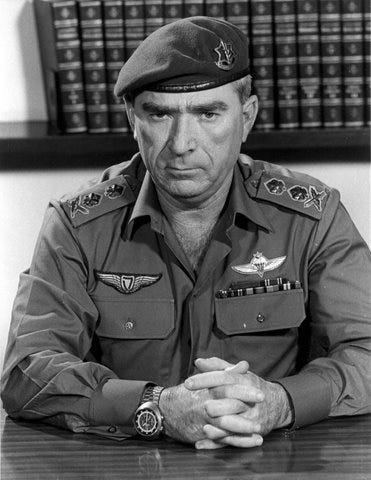
Rafi Eitan
Eitan’s shadow looms large in the seedy annals of Israeli Intelligence.
- Eitan posed as a chemist while traveling to Pennsylvania to visit NUMEC, a nuclear processing plant alleged to have supplied Israel with the enriched uranium the country used to acquire its nuclear arsenal. A declassified FBI document lists an individual named Avraham Bendor accompanying Eitan on this Pennsylvania trip. The FBI released a detailed statement in 1980 made by a former NUMEC employee who said in 1965 that he “encountered armed strangers on the uranium plant’s loading dock one night in early 1965. The NUMEC employee said they were loading what appeared to be canisters of HEU onto a truck in racks that he had not seen before.” The man also saw a shipping manifest showing the ship was bound for Israel indicating it was likely on the Zim-Israel shipping line which it was according to the National Security Archive. He said that a NUMEC manager later “threatened him to keep his mouth shut about what he had seen.”
- According to the testimony of ex-Mossad agent Ari-Ben Menashee, Eitan was the brainchild of installing a trapdoor for Israeli intelligence into PROMIS software—the software later sold by Robert Maxwell to sensitive US defense facilities such as Sandia National Laboratories, which is at the center of US nuclear weapons systems.
Notice the incestuous loop: Zim Shipping, Atwell Security, and the WTC complex were all tethered to NUMEC-era Israeli intelligence networks. Menachem Atzmon not only had a position with both Zim and the Israel corporation at the time of the failed Atwell contract, but he went on to hold a senior position at the company responsible for the security of three of the four airports from which planes were hijacked on 9/11.
The Atzmon-Friedman-Netanyahu Axis
Atzmon’s network extended directly into the highest echelons of power where Israeli and American interests meet through Steven L. Friedman—a childhood friend of Benjamin Netanyahu and the American legal counsel for the Likud Party. Friedman was officially registered with the Justice Department as a foreign agent for the Likud Party until 1996.
Atzmon was the President of the Israel Development Fund. The fund was established by Friedman in 1989. During the time period when Atzmon worked as the President of the Israel Development Fund, he also worked as the national treasurer of the Likud Party. In Israel, Atzmon was convicted of campaign finance fraud and given a suspended one-year prison sentence. Despite denials by Atzmon, close associates of Netanyahu claimed that the fund functioned as a source for illicit cash for Netanyahu’s successful 1993 campaign to lead the Likud party.
ICTS Financial Crimes
Atzmon wasn’t the only questionable figure at ICTS.
Ezra Harel worked on the Supervisory board with Atzmon at the time of 9/11. At one point, Harel even became the majority shareholder of ICTS.
Ezra Harel, Harel’s father, and Atzmon were arrested and questioned in Israel after driving a separate company, Rogosin, into total insolvency. According to Haaretz, the company suffered from years of odd investments and high-management fees that Harel himself pocketed. The company eventually grew incapable of paying back bondholders after torching more than 100 million shekels.
Harel just so happened to be the chairman of Dash 200+, a company that modified Boeing 747 aircraft from passenger to cargo use.
Security Failures?
Against this backdrop of Israeli intelligence and financial crime, the ICTS track record of “security failures” borders on the unbelievable.
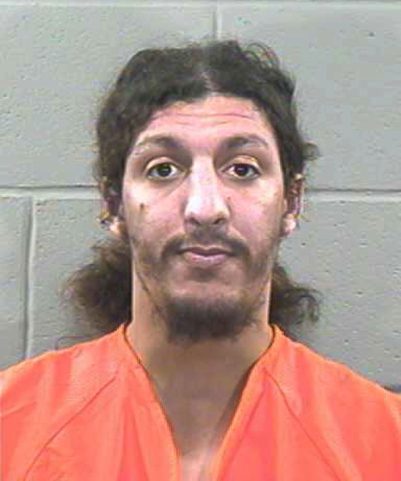
Richard Reid
- The Shoe Bomber (Richard Reid): ICTS guarded the departure gate for Reid’s flight. Just a day earlier, Reid had been flagged and delayed by an ICTS agent due to his disheveled appearance and lack of luggage. Yet the next day, Reid waltzed through security with a Walkman loaded with anti-Israeli messages, an issue of Newsweek featuring pictures of Osama bin Laden, and explosives. As The Sword and the Neck describes it, “looking like he just finished shopping at Terrorists-R-Us.” Not too long before the attempted attack, Reid had been flying around on El Al to Tel Aviv. Reid’s father said, “My son is a determined boy, and I can imagine him being determined enough to blow himself to bits, but I just can’t believe that he would want to hurt anyone else in doing it unless, that is, he has been brainwashed.”

Umar Farouk Abdulmutallab
- The Underwear Bomber (Umar Farouk Abdulmutallab): Farouk departed from a flight in Amsterdam with screening provided by ICTS. Farouk was known to US intelligence after his father warned two CIA officers at the US embassy in Nigeria of Farouk’s extremist views. US State Department officials were prevented from revoking his visa by US intelligence lest their Al Qaeda investigation be foiled.
The Surveillance Afterlife
ICTS didn’t vanish after the War on Terror reached its apex. It evolved.
AU10TIX, an ICTS subsidiary founded by former Unit 8200 man Ron Atzmon alongside others previously belonging to military intelligence, makes facial ID verification for online platforms, which has been used by Twitter, Airbnb, Paypal and Fiverr. This is only one example of the Israeli intelligence-to-privatized surveillance-state pipeline we have seen time and time again.
Securing the airports was only half of the equation.
To pull off an operation of the magnitude of 9/11, the target—the World Trade Center—had to fall into the right hands.
Act II: The Outside Element – Privatization and Payout
The Likud Fingerprint
One of the individuals instrumental in the privatization of the WTC was Lew Eisenberg, the NY Port Authority Chairman. Eisenberg was the man responsible for negotiating the long-term leasing of the WTC complex with Larry Silverstein. Lew Eisenberg donated to the formerly discussed Israel Development Fund at the behest of Steven Friedman. The Jewish Telegraphic Agency describes Eisenberg as a friend of Netanyahu.
Eisenberg got his start at the Port Authority after being nominated by Governor Christine Todd Whitman to chair the Commission on Privatization and Competitive Contracting in 1994. After the 9/11 attacks, Whitman, the Administrator of the Environmental Protection Agency at the time of 9/11, assured the public within days of the attacks that the air in Manhattan was safe to breathe despite the buildings containing lead and asbestos because the concentrations were such that they didn’t “pose a health hazard.”
A class action lawsuit was filed against Whitman and the EPA, with Judge Deborah Batts of the Federal District Court in Manhattan saying that the “allegations in this case of Whitman’s reassuring and misleading statements of safety after the Sept. 11, 2001 attacks are without question conscience-shocking.”
The effort to privatize the WTC complex was in large part spearheaded by the economic strategy of New York Governor George Pataki. Lew Eisenberg worked on the transition teams of Pataki, Whitman, and even the Bush-Cheney transition team.
Another prominent individual largely responsible for ensuring that the WTC complex ended up in the right hands was billionaire Ronald Lauder, the sole heir of the Estee Lauder cosmetics fortune.
From Reagan to Netanyahu to Epstein to the World Trade Center
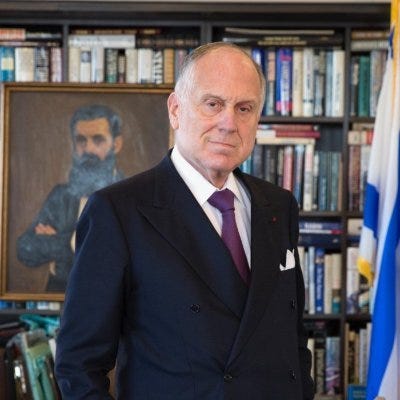
Ronald Lauder
Lauder was the Chairman of George Pataki’s New York State Research Council on Privatization, which influenced the decision to privatize the WTC complex. Pataki and Lauder shared a close relationship, with Pataki’s wife working as an employee of Lauder. Lauder was one of Pataki’s largest campaign contributors.
Not only was Lauder on Pataki’s Council on Privatization, but he was also a major donor to none other than Steven Friedman’s charity, the Israel Research Foundation, which was closely tied to the Israel Development Fund. Lauder not only abetted Netanyahu’s ascent to power through financial contributions alongside Friedman and Eisenberg, but the cosmetics heir also helped pull political strings for his friend Bibi.
Lauder brought Republican campaign strategist Arthur Finkelstein in on Netanyahu’s campaign against Shimon Peres. Finkelstein’s propaganda, in addition to a series of conveniently timed suicide bombings in the weeks leading up to the elections, led to Netanyahu winning in a shocking upset. Finkelstein worked as a strategist for other people inside the Lauder orbit, including not only Lauder himself during his failed 1989 New York City Mayoral Campaign, but for George Pataki and New York Senator Alfonso D’Amato, the man who urged Lauder to run for office.
To understand the importance of this nexus of connections centering on Lauder, we must pull back and look at Lauder himself. Lauder’s role extends far beyond just New York City Politics and the ascendancy of Benjamin Netanyahu.
In addition to being the sole heir of the Estée Lauder Cosmetics fortune, Lauder has long been a prominent figure in the world of Jewish philanthropy, currently holding the position of President of the World Jewish Congress, where he works alongside others like Baron David de Rothschild of the infamous Rothschild banking dynasty.
Lauder was also a friend and supporter of Donald Trump, with the two having known each other for more than fifty years. They share an interesting connection, with Lauder being a long-time friend of Trump’s mentor Roy Cohn. Cohn was a prominent lawyer with high-level connections to the Reagan White House, the CIA, FBI, and organized crime. Cohn ran a sexual blackmail ring involving pedophilia that allegedly ensnared none other than former FBI Director J. Edgar Hoover in its kompromat.
Lauder held a position in Ronald Reagan’s cabinet during the Republican’s first term as the United States Deputy Assistant Secretary of Defense for European and NATO Affairs. During Reagan’s second term, Lauder landed a position as the US Ambassador to Austria. While this ambassadorship may seem like a dull, historical footnote at first, it becomes much more interesting when one realizes that Lauder may have been the individual responsible for securing Jeffery Epstein his fake Austrian passport.
Lauder’s later ties to Epstein and those in his circle are a matter of record.
Ronald Lauder was a member of the Mega Group, which was co-founded by billionaire Leslie Wexner. Epstein set up an LLC for billionaire Leon Black and Lauder to acquire a $25 million work of art. Epstein and Lauder communicated for years. It’s really no secret.
Epstein’s Austrian passport featured a photograph of him alongside a non-Jewish name, which would have had to have come to him through an unconventional channel since Epstein did not meet the requirements needed to obtain the passport, such as long-term residency in Austria. Given Lauder and Epstein’s mutual acquaintances Donald Trump, Leslie Wexner, and Epstein’s former Bear Stearns employer Alan Greenberg, Lauder as the unconventional channel through which the passport was obtained would make sense. Also, given the history of Israeli intelligence using ambassadors to procure fake passports for operatives and Lauder’s undeniable sympathies for the Zionist cause, the likelihood of Lauder procuring the passport seems high.
The tight-knit milieu of wealthy businessmen and Israeli-intelligence-linked individuals with ties to the World Trade Center, the airports from which the 9/11 planes were hijacked, and the Likud Party comes full circle with Larry Silverstein—the man who acquired the World Trade Center complex only six weeks before the buildings he purchased became cemented in the public mind as the symbol of terrorism.
Lucky Larry
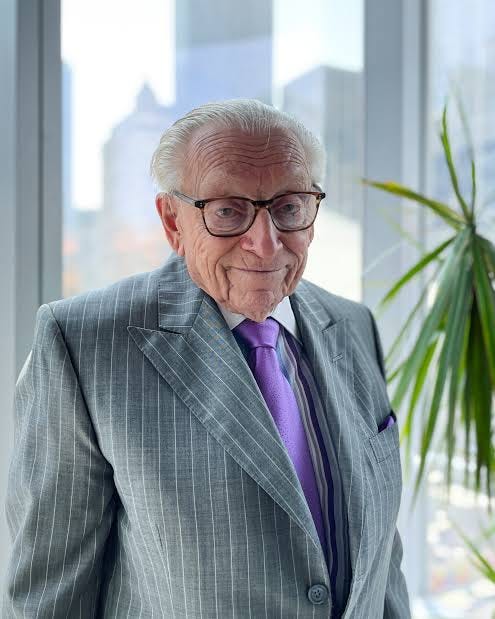
Larry Silverstein
The financial windfall Larry Silverstein found himself at the center of as a result of the September 11th attacks is nothing short of mind-boggling.
- The Insurance Heist: In April of 2001, a group of several different investors led by Silverstein Properties came to an agreement, and Larry Silverstein, who had already acquired WTC 7, signed a 99-year lease for $3.2 billion for buildings 4 and 5. Silverstein only put $14 million of his own money down on the lease. The WTC had earlier that year been estimated to be worth $1.2 billion, and the Port Authority only had $1.5 billion in insurance coverage on the WTC, yet Silverstein managed to finagle $3.55 billion of insurance on the buildings.
- Right to Rebuild: Silverstein’s insurance broker was unable to cover such a large amount, and the deal had to be split among 25 different dealers. The complicated and unusual deal was finalized the month of the attacks. The Silverstein group was even given the right to rebuild and expand if the buildings were destroyed.
- Removing the Asbestos Removal Problem: The WTC buildings were in the process of having asbestos removed from the buildings, which was an extremely costly process. As of May of 2001, prior to Silverstein acquiring the buildings, the Port Authority received a ruling on a longstanding suit against their insurers seeking more than $600 million dollars to cover the costs of asbestos removal. Ultimately the ruling was that the all-risk insurance policy held did not entitle their insurers to include this under their coverage.
- The Double-Indemnity Jackpot: As James Corbett of the Corbett Report states in 9/11 Trillions: Follow the Money, “Within hours of the destruction of the Twin Towers on September 11th, Silverstein was on the phone to his lawyers, trying to determine if his insurance policies could construe the attacks as two separate, insurable incidents rather than one.”
Not only would Silverstein rake in cash hand over fists as a result of the attacks and avoid all the prickly complications of asbestos abatement which would have costed hundreds of millions of dollars, but the SEC offices in WTC 7 which were investigating systemic financial corruption stemming from the dot-com bubble were conveniently destroyed along with the offices of some of the other tenants housing sensitive information such as the Department of Defense, CIA, Secret Service, and New York Office of Emergency Management. Similar to the Pentagon being struck in the Budget Analyst Office the day after Donald Rumsfeld announced $2.3 trillion the Pentagon couldn’t account for.
Silverstein—similar to many individuals involved in the decision to privatize the WTC complex—is no stranger to those in the highest echelons of Israeli political power. Silverstein collected friendships with Israeli Prime Ministers the way a more normal individual might collect postage stamps or trading cards. Former Israeli Prime Ministers Silverstein counts as friends are Yitzhak Rabin, Benjamin Netanyahu, Ehud Barak and Ariel Sharon. Silverstein is also a friend of current Israeli president Isaac Herzog. Netanyahu and Silverstein were so close that despite political differences, Bibi found time every Sunday to call Silverstein. Silverstein offered Epstein-associate Ehud Barak a job as his representative in Israel after Barak left the army in 1995. Many of these friendships were accrued by Silverstein when he was in the process of attempting to create a free trade initiative in the Negev. Some in Israel were skeptical of the proposal, due to such free trade zones having been established in third-world countries where workers receive starvation wages while entrepreneurs reap the benefits of tax exemption and high profits. Others were concerned the free trade zone would be a hub for money laundering. Eventually, after numerous unsuccessful attempts, Silverstein dropped the initiative.
With the airports’ security secured and the ink still drying on the World Trade Center’s paperwork, Israeli operatives were operating on American soil en masse while suspicious tenants roamed the halls which Lucky Larry Silverstein had just acquired.
Act III: The Outside Element – Soothsayers and Prophets
Israel’s role as the beneficiary of the American empire’s war on terror is obvious, with the policy goals stated in the Oded Yinon plan, the Clean Break memo, and the various writings of the Neo-Conservative, Project for a New American Century aligned think tanks largely accomplished as a result of America’s declaration to fight a global war against terrorism as a result of 9/11. However, one can simply turn to Benjamin Netanyahu, whose lackeys were securing their positions in the World Trade Center and the airports from which the planes were hijacked on 9/11 to gather his feelings regarding the worst crime to ever take place on American soil.
“Asked tonight what the attack meant for relations between the United States and Israel, Benjamin Netanyahu, the former prime minister, replied, ‘It’s very good.’ Then he edited himself: ‘Well, not very good, but it will generate immediate sympathy.’” (“A Day of Terror: The Israelis; Spilled Blood is Seen as Bond That Draws Two Nations Closer,” New York Times, Sept. 12, 2001.)
While the remains of corpses still burned in the rubble and a country that is supposedly Israel’s greatest ally still reeled from the devastation of the attacks, Netanyahu stated that the attacks were very good for American-Israeli relations to none other than The New York Times—what many would consider the most prominent and prestigious publication in the world.
The Israeli Prime Minister’s thoughts regarding 9/11 and its benefit to Israel didn’t change in the following years.
“We are benefiting from one thing, and that is the attack on the Twin Towers and Pentagon, and the American struggle in Iraq.” — Benjamin Netanyahu, ‘Did Israel Benefit from the 9/11 Attacks?, The Economist (April 16, 2008)
Netanyahu’s callous feelings regarding the attacks, combined with the fact that prominent individuals responsible for his ascendancy to power held sensitive positions in the World Trade Center and three of the four airports from which planes were hijacked, are a cause for concern.
Other high-level Israeli political figures and intelligence personnel displayed a seemingly prophetic intuition regarding Arab terrorism in New York City and the alleged culprit of the attacks in the immediate aftermath of 9/11.
Former Israeli Prime Minister and a fellow friend of Lucky Larry Silverstein, Ehud Barak, went on the BBC possibly only an hour after the attacks to insinuate that Osama Bin Laden had perpetrated the attacks, then stated that Bin Laden was hiding in Afghanistan, and then declared that America needed to wage a war on terror in response to the attacks.
Not only did Netanyahu and Barak share a commonality despite their political differences in being chummy with WTC owner Silverstein, but the two were in the IDF Unit Sayaret Maktal, with one of the unit’s specialties being response to airplane hijackings.
Arnon Milchan, the Israeli spy turned Hollywood Mogul producing films such as L.A. Confidential, Pretty Woman, Natural Born Killers, and JFK, was involved with a couple of films with, let’s call it, fortuitous imagery pertaining to 9/11. (Say what you will about the man, but he has some heavy hitters under his filmography.)
Israeli intelligence asset Milchan was the Executive Producer of The Medusa Touch, in which a commercial airliner crashes into a skyscraper.
Milchan was also one of the producers of David Fincher’s Fight Club, which ends with Ed Norton and Helena Bonham Carter watching a series of high-rise towers brought down via controlled demolition by a terrorist organization targeting banking institutions, accompanied by the eerie track “Where’s my mind?” by The Pixies.
Milchan belonged to Israel’s top secret intelligence-agency Lekem, and was involved in espionage, arms dealing, and securing components for Israel’s nuclear arsenal.
The former Director of the Mossad, Isser Harel, in a 1979 conversation with journalist Michael Evans, had what one could generously call incredible foresight. Evans recalls the interview in the Jerusalem Post, “I sat with former Mossad chief Isser Harel for a conversation about Arab terrorism. As he handed me a cup of hot tea and a plate of cookies, I asked him, ‘Do you think terrorism will come to America, and if so, where and why?’ Harel looked at his American visitor and replied, ‘I fear it will come to you in America. America has the power but not the will to fight terrorism…’ As to the where, Harel continued, ‘New York City is the symbol of freedom and capitalism. It’s likely they will strike the Empire State Building, your tallest building [he mistakenly thought] and a symbol of your power.’ … Twenty-one years later, the first part of Harel’s prediction came true; except, of course, that the Twin Towers of the World Trade Center were much taller than the Empire State Building.”
Act IV: The Outside Element- The Intelligence Web
“Dancing Israelis”
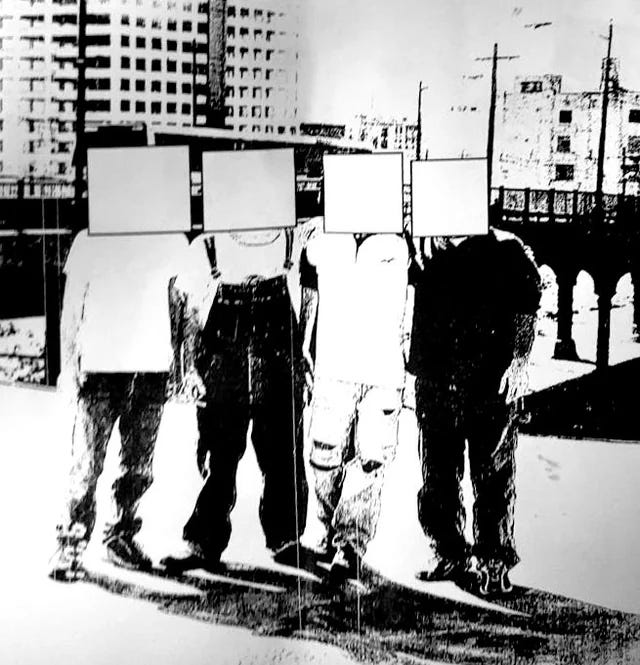
Leading up to 9/11, Israeli intelligence continued to weave its web of influence not only through the halls of the World Trade Center complex and the runways from which the hijacked planes took off, but through the entire American political and economic ecosystem.
The most well-known example of the Israeli intelligence presence in the United States as it pertains to 9/11 is in the case of the “Dancing Israelis.”
On the morning of 9/11, within minutes of the first plane striking the WTC, three men were spotted seated on top of a moving van, taking pictures of the towers, laughing, and celebrating. After being spotted, they fled the scene, and the FBI put out an all-points bulletin for officers to look for a white van with Urban Moving Systems on its side. Later on at 3:56 PM, the van was pulled over, and five men were inside: Sivan Kurzberg and his brother, Paul, Yaron Shmuel, Oded Ellner, and Omar Marmari.
Kurzberg, according to the police report, told the officers, “We are Israeli. We are not your problem. Your problems are our problems. The Palestinians are the problem.”
Despite the men telling police an innocent explanation for their behavior that day, when the photographs were developed, it was revealed that the men were indeed celebrating, laughing, high-fiving, and Sivan Kurzberg was even photographed holding up a lighter to the flame-engulfed WTC building in the background.
The FBI confirmed that two of the men had ties to Israeli intelligence and believed them to be working on some kind of Mossad operation. One of them had $4,700 in his sock, and the men had plane tickets for various places around the globe for their immediate departure. FBI reports show the men making contradictory statements to investigators. The men were held in federal custody for 71 days, then deported back to Israel. The owner of Urban Moving Systems, Dominik Sueter, was questioned by the FBI, with the agency concluding that “Urban Moving may have been providing cover for an Israeli intelligence operation”.
When investigators returned to question Sueter, they found that he had hastily fled to Israel.
What conclusions did the FBI draw from their investigation? Well, they thought they were likely Israeli intelligence, but don’t worry, they think their target was not the US but rather studying Islamic Groups and Charities with potential ties to terrorist networks.
Later on, on Israeli television, where the men were being interviewed, Oded Ellner said they were there to document the event.
It was none other than Epstein associate Alan Dershowitz who stepped in as a negotiator on behalf of the men when they were being held in federal custody in order to smooth things over with the U.S. Government, as Christopher Ketcham reported in CounterPunch.
The Israeli “Art Students”
In January of 2001, the Drug Enforcement Agency (DEA) began receiving a number of reports of young Israeli “art students” attempting to gain access to the offices of the DEA and other law enforcement and Department of Defense agencies. A deluge of these kinds of reports came in from over 40 cities within the first six months of 2001. Israelis were discovered diagramming the inside of federal buildings and possessing photographs of federal agents. One report claimed that between March of 2001 and September 11th, 140 Israelis were detained or arrested, with another report claiming that an additional 60 were detained or deported following the attacks.
One can read about these Israeli “art students” in a 60-page DEA memo intended only for senior officials at the Department of Justice, which was leaked to the press. The memo contains a summation of the modus operadi of these “art students”: “In general, these individuals appear to be organized in teams of 8 to 10 people, with one person described as the ‘Team Leader’. They are usually encountered in pairs or individually carrying a makeshift art portfolio. Several times, they have been seen or admitted to being dropped off in an area by the Team Leader, who returns later to pick them up. The females are usually described as very attractive, and all are generally in their early to mid-20s. Most admit to having served in the Israeli military. This is not surprising given the mandatory military service required in Israel; however, a majority of those questioned have stated they served in military intelligence, electronic signal intercept, or explosive ordnance units. Some have been linked to high-ranking officials in the Israeli military. One was the son of a two-star general, one served as the bodyguard to the head of the Israeli Army, one served in a Patriot missile unit. That these people are now traveling in the U.S. selling art seems not to fit their background.”
Not only does the memo mention that some of the Israeli nationals had a background in demolition and explosive ordinance units, but the Orlando DEA had linked these “art students” to an ongoing drug investigation involving MDMA. However, Ketcham in his article mentions that this could possibly be a smokescreen to conceal the more obvious spying angle.
In December of 2001, Fox News aired a four-part series conducted by Carl Cameron where he reported that these “art students” were at the center of an investigation by federal officials into the existence of a possible Israeli espionage ring which was tracking Al Qaeda leading up to 9/11. One investigator said to Cameron, “Evidence linking these Israelis to 9/11 is classified. I cannot tell you about evidence that has been gathered. It’s classified information.”
In the four-part series when the question was put forward by a Fox anchor to Cameron as to the question of Israeli foreknowledge of 9/11 and how clear it was to ‘investigators that some Israeli agents may have known’, Cameron states, “Well, it’s very explosive information obviously and there’s a great deal of evidence that they say they have collected none of it necessarily conclusive it’s more when they put it all together a bigger question they say is ‘How could they not have known?’ Almost a direct quote.”
Israeli Intelligence and the 9/11 Hijackers
Christopher Ketcham, who wrote a piece on the Israeli art students for Salon, later wrote a piece for CounterPunch magazine expanding upon this research, delving into the story of the Urban Moving Systems employees detained after 9/11. Ketcham, in an outstanding feat of journalism, unveiled a number of damning revelations relating to the vast network of Israeli nationals operating in the United States and the alleged 9/11 hijackers. Perhaps the most damning of these is the proximity of the Urban Moving Systems and art-peddling Israeli nationals to the 9/11 hijackers.
All five hijackers of American Airlines 77, which struck the Pentagon, had addresses or were active within a six-mile radius of towns associated with the Urban Moving Systems Israelis. They were all operating on the same stomping grounds of northern New Jersey.
One of the “art students”, former Israeli Military Intelligence Officer Hanan Serfaty, rented two separate apartments close to the mail-drop location and apartment of Mohammed Atta. The distance between Atta’s mail-drop and one of Serfaty’s apartments was approximately 2,700 feet. Atta and the hijacker pilot of United Airlines 175 shared an apartment only 1,800 feet from Serfaty’s apartment. Serfaty was moving around significant sums of cash. These strange happenings occurred in Hollywood, Florida, an area which, according to the aforementioned DEA memo, appeared to be “a central point for these individuals, with several having addresses in this area”.
More than thirty of the 120 “art students” lived in Hollywood, which was home to nine of the nineteen 9/11 hijackers, with five more in the surrounding area.
Christopher Ketcham writes in CounterPunch, “In at least six urban centers, suspected Israeli spies and 9/11 hijackers and/or al-Qaeda–connected suspects lived and operated near one another, in some cases less than half a mile apart, for various periods during 2000–01 in the run-up to the attacks. In addition to northern New Jersey and Hollywood, Florida, these centers included Arlington and Fredericksburg, Virginia; Atlanta; Oklahoma City; Los Angeles; and San Diego.”
German publication Die Zeit reported that the Mossad provided US intelligence with the names of two of the hijackers prior to the attacks—Khalid al-Mihdhar and Nawaf al-Hazmi—with these two operating in Hollywood, Florida, in close proximity to Israeli “art students” as well as the Urban Moving Systems Israelis in New Jersey. Hazmi also visited Oklahoma City on almost the same dates as three of the art students. (Interesting aside: Zacarias Moussaoui, who allegedly planned to participate in 9/11, was in flight school in Oklahoma from February to May of 2001. This school was visited by Atta and al-Shehhi. Moussaoui just so happened to meet the shoe bomber that ICTS let through their gates, according to some accounts.)
One of the “art students” arrested leading up to 9/11, Michal Gal, was bailed out by an employee of Amdocs, an Israeli telecommunications company which counted some of the largest phone companies and US government agencies among its clients. The company, whose upper brass was filled with former Israeli Military personnel, was investigated twice within a single decade on charges involving espionage-related leaks of data. This in part resulted in them becoming one of the subjects of the four-part Carl Cameron Fox News investigation.
Amdocs acquired an Israeli company called Comverse. Comverse bought the Israeli instant messaging company Odigo in 2002, but already had a stake in the company as early as January of 2001. Odigo is notorious amongst those who believe that Israel is responsible for 9/11 due to two Odigo employees working at the company’s offices just outside Tel Aviv receiving warning of a non-specific terrorist attack about to take place only two hours prior to the 9/11 attacks in New York. The Odigo offices in New York were within a mile of the WTC complex.
One of the Odigo co-founders created the first internal web network for the IDF. Another Odigo co-founder worked at AMDOCS after his time in R&D for the Israeli Air Force. Comverse founder Kobi Alexander fled to Namibia after facing multiple accounts of fraud and charges related to irregular stock trading in the United States. He had been an intelligence officer in the Israeli army. Two other executives were charged with the same options backdating scandal.
Now some have theorized that the Israeli “art students” as well as the Urban Moving Israelis were not necessarily directing the hijackers, but were merely monitoring Islamic Fundamentalist groups. Others have theorized that the “art students” may not have been intelligence at all, but part of an Israeli ecstasy peddling ring, an idea hinted at in the DEA memo. Ketcham mentions that the mention of MDMA trafficking could possibly serve as a smokescreen. Ketcham even makes the astute observation that the obvious nature of the Israeli “art students” and their spying might have been serving the purpose of drawing attention to themselves to either distract from the real Israeli operatives at work on American soil or to confuse and muddy the waters of any potential investigation.
A cousin of one of the 9/11 hijackers was reported by the New York Times to be a potential Israeli spy reporting on Hezbollah and Palestinian groups to Israeli intelligence.
What we can say is that the “dancing Israelis” and their fellow countrymen and women, in conjunction with the ties of Israeli intelligence to the WTC and airport security through ICTS, Zim, Silverstein, Lauder, Friedman, and the other assorted cast of characters, paint an obvious picture of who plays the outside role in this inside-outside job. Through Ketcham’s investigative journalism, we can see how not only did the outside angle ensure control of airport security and the World Trade Center, but they even managed to keep tabs on and possibly direct the hijackers themselves.
Act V: The Outside Element- The Clean-Up Crew
Just as important as having people in place at the World Trade Center complex and airports was having people amenable to the plans of the Inside-Outside plotters who could ensure that no legitimate investigation into the attacks ever took place. Even a cursory glance at the official story, which men like Ehud Barak were seeding into the public consciousness within moments of the attacks, reveals obvious inconsistencies. So how did the plotters manage to keep the legal system from becoming a thorn in their side?
One such mechanism of control was the 9/11 Victims Compensation Fund. In my previous piece, I mentioned how Jordana Feldman, who ran the Epstein Victim’s Compensation Fund, was a crucial individual when it came to the 9/11 Victims Compensation Fund. Feldman designed the fund alongside Ken Feinberg. Feinberg was one of three arbitrators who helped determine the market value of the Zapruder film, the video showing the assassination of President Kennedy. The Zapruder film was purchased by Time-Life, whose co-founder Henry Luce had a relationship with the CIA. The role of two of the individuals heading the fund in the aftermath of separate historical events widely considered to be subject to institutional cover-up remains pertinent to the role of both Feinberg and Feldman with the 9/11 fund.
A non-negotiable clause of the 9/11 Victims Compensation Fund was that, in order to receive any kind of settlement, no lawsuit could be filed against the airlines for any lack of security. This helped to further shield companies like ICTS from legal culpability and suspicion. That this clause was worked into the conditions of the Compensation Fund perhaps shouldn’t come as a surprise when we see the conflicts of interest involving people involved in the distribution of the funds.
All of the cases were presided over by Judge Alvin Hellerstein of the Southern District of New York. Hellerstein did not disclose his own conflict of interest in his rulings, specifically as it relates to Huntleigh USA and ICTS. Hellerstein’s son Joseph Hellerstein worked for law firm Amit, Pollak, Matalon and Company, based in Tel Aviv, Israel. The firm represented an Israeli defense contractor partnered with Boeing, a sister company of ICTS, and RFID device company Better Online Solutions (BOS).
Boaz Harel, the brother of Ezra Harel, took over the majority interest of ICTS after the death of his brother, who sat on the board of BOS. The chairman of the BOS board was Edouard Cukierman, the president of a private equity firm that owned Catalyst Investments, which had as its president Boaz Harel. Catalyst Investments was a major shareholder of BOS. While this convoluted thread is difficult to untangle, one can read the motion filed in the US second court of Appeals by 9/11 widow Ellen Miriani, which parses out the incestous nature of the Hellserstein-ICTS axis in detail. (Side note: the Israeli defense contractor Hellerstein’s son represented, Aeronautics Defense Systems, specializes in unmanned aerial systems including the Dominator UAS which is modeled on twin-engine passenger aircraft.)
Hellerstein also represented Cantor Fitzgerald. Those who read my last piece will be familiar with the head of Cantor, Howard Lutnick, an Epstein associate currently working in the Trump administration who was conspicuously absent from his office in the direct impact zone of the North Tower on 9/11. Lutnick gave office space to fellow Epstein-associate and former wife of Prince Andrew, Sarah Ferguson, who also was absent from the North Tower on 9/11 despite a meeting she had scheduled. After 9/11, Cantor allegedly brought in more money than they had before the attacks. The company was fortunate not to suffer from an inability to trade due to the existence of their revolutionary electronic trading platform e-speed. This type of software is reminiscent of software owned by other tenants in the Twin Towers, whom we will address in detail later.
Hellerstein appointed Sheila Birnbaum to settle as many of the cases as possible. Birnbaum was a lawyer at the firm Skadden, Arps, Slate, Meagher & Flom.
The law firm Skadden had a history of serving Israeli companies. One senior partner, Ken Bialkin, was the National Chairman of the ADL in addition to working for a host of other Zionist groups. Bialkin was instrumental in forging ties between American and Israeli companies and guiding Israeli companies to go public in the United States.
The Jewish Telegraphic Agency reported that in Bialkin’s office at Skadden, one might find him hosting Neo-Conservative thought leader Norman Podhoretz or Henry Kissinger.
We can also see people friendly to Israel in the institutional cover-up of 9/11 heading the legal proceedings involving Larry Silverstein and his World Trade Center insurance settlement.
Who was the judge presiding over Silverstein’s case?
None other than Michael Mukasey.
Michael Mukasey
In my previous article, I mentioned Mukasey and his son’s role in Jeffrey Epstein’s legal defense as well as the father-son duo’s overall careers as legal fixers for white-collar criminals. However, I think we all need a quick refresher. For more detail, I encourage you to visit my previous article, 9/11 was an Epstein Job.
- Michael Mukasey grew very close to 9/11 cover-up artist and later Mayor of New York Rudy Giuliani when the two worked at the same law firm in the seventies.
- Michael, along with his son Marc, worked as a justice advisor on Giuliani’s presidential campaign.
- Michael Mukasey was the US Attorney General from September of 2007 to January of 2009, meaning he was the Attorney General during the finalization of Jeffrey Epstein’s Sweetheart Deal, as well as Epstein’s conviction and sentencing. Epstein’s sweetheart deal seemingly would need the institutional blessing of Michael Mukasey.
- Epstein and Ghislaine acquired legal counsel from Michael’s son Marc, who worked for Giuliani’s law firm.
- Marc, in addition to representing people such as FTX’s Sam Bankman-Fried for his cryptocurrency fraud arrest and Congressman Matt Gaetz after allegations of sex trafficking, also represented Epstein associate Trump during his first term when people were probing into the president’s finances.
- Marc Mukasey represented Israeli entrepreneur Joel Zamel, who formed a strategic partnership between his firm, Psy-Group, and Cambridge Analytica that helped propel Trump into the Oval Office. Psy-Group was an Israeli Private Intelligence agency with headquarters in Tel Aviv and Washington, D.C.
- Michael Mukasey penned a letter in 2010 to Obama advocating for the President to pardon Israeli Spy Jonathan Pollard.
Larry Silverstein violated Mukasey’s order not to make inflammatory statements regarding the case of his WTC insurance settlement publicly when Silverstein criticized the slow payout on his settlement. However, Mukasey did not find Silverstein in contempt despite his blatant violation of the aforementioned order.
Silverstein, who argued that the events of 9/11 should count as two separate insurable incidents, something he had discussed on the phone with his lawyers within hours of the attacks, would in part get his way due to the rulings of Mukasey, who saw to it that the attacks were considered two separate incidents.
The same outside element that had ties to the World Trade Center complex, airport security, and even the movements of the hijackers themselves also left behind their indistinguishable fingerprints on the legal proceedings and investigations into the attacks. But what about those on the inside?
Act VI: The Inside Element
While the outside element managed to obtain a presence on the inside, we will see that several connections extending past the explicitly Israeli-Outside faction exist and are worthy of consideration. The outside and inside elements should not be viewed as conflicting or opposing groups. Rather, 9/11 was the result of a confluence of this outside-Israeli faction and the Inside element—a circle of WTC tenants, Bush Administration officials, prominent Neo-Conservatives, intelligence assets, and private interests with these two groups sharing mutual interests and ideologies in common. In fact, the confluence is so complete that at times the groups can seemingly lose contrast, operating as one singular entity. This group cohesion was essential to the success of their operation.
So what groups and individuals comprise the inside element?
Private CIA for Hire
Kroll, a financial and risk advisory firm, according to some, largely functions as a private intelligence firm, having been called the “CIA of Wall Street”. The company routinely hires former Mossad, CIA, and MI5 employees. French intelligence even suspected that the company had at times served as a front for CIA activity. The founder of Kroll, Jules Kroll, was hired by Robert Maxwell two weeks before his mysterious death to investigate the “dark forces” he said had mobilized against him. More recently, the firm was hired by Harvey Weinstein to wipe the electronic devices of one of his alleged victims of any evidence of sexual assault.
After the 1993 WTC bombing, Kroll was contracted to revamp the security of the complex.
Jerome Hauer
Jerome Hauer, the Managing Director of Kroll at the time of 9/11, instead of going to his office in the WTC, made television appearances announcing that the man responsible for the attacks was none other than Osama Bin Laden, as well as dismissing the notion that any kind of explosives had been used. This display, reminiscent of Ehud Barak’s appearance on the BBC, is even more conspicuous given Hauer’s position managing security for the WTC.
Hauer’s position at Kroll was not his first job at the WTC complex.
As part of the mayor’s office under Giuliani, in 1996, the Office of Emergency Management (OEM) was created to respond to emergencies and help facilitate communications between different agencies in the event of an emergency. The OEM’s emergency operations center was housed on the 23rd floor of WTC 7, a controversial decision following the 1993 WTC attacks. The decision to place the Emergency Operations Center in the WTC was allegedly made by Jerome Hauer, the first director of the OEM, who had been appointed to the position by Giuliani.
The New York Times described Hauer’s job with the OEM as “sitting around all day thinking up horrifying ways for things to be destroyed and people to die.”
Speaking to the Times, Hauer mentioned the kinds of emergencies he was concerned with, saying, “helicopter crash, subway fire, water main break, ice storm, heat wave, blackout, building collapse, building collapse, building collapse.”
Not only was Hauer obsessed with building collapses, even going so far as to keep trophies from building collapses the way a serial killer might collect the jewelry of the women he dismembers, but he was also tapped into the Bush administration. On the day of 9/11, Hauer advised top officials in the Bush administration to start taking the antibiotic Cipro. Hauer also began hinting to the media that Saddam Hussein was going to unleash an anthrax attack through foreign terrorists.
Hauer had previously worked at Scientific Applications International Corporation, which employed Stephen Hatfill, the initial suspect in the investigation of the Anthrax attacks. SAIC worked on developing protocols for handling anthrax “hoax letters”.
SAIC just so happens to hold patents related to thermite.
Hauer’s strange connections relating to 9/11 do not end here. Hauer hired John P. O’Neill to Kroll just before 9/11. O’Neill had been an FBI Special Investigator with expert knowledge of Osama bin Laden and the Al-Qaeda networks alleged to have committed the 1993 WTC bombing. O’Neill would not be as lucky as Hauer and other top executives at the WTC complex. O’Neill died in the attacks.
In the aftermath of 9/11, public officials and the mainstream media repeated that the poor response to the attacks largely centered around a failure of imagination. After all, who could have foreseen planes flying into buildings as an act of terrorism?
As it turns out, many individuals had foreseen the possibility of just such a scenario, with one of them being Brian Michael Jenkins, the Deputy Chairman of Kroll from 1989 to 1998. After the 1993 attacks, Jenkins assessed the potential for a terror attack on the WTC involving planes.
During his career, Jenkins served as an advisor to many different government agencies, including the State Department and the Department of Defense. Jenkins is an expert on terrorism and transportation security, and in 2000 was an advisor to the National Commission on Terrorism. In addition to all of this, Jenkins had been an advisor to the president of the RAND Corporation after his time in the Special Forces. Some other RAND advisors during the time of Jenkins’ advisory role were Donald Rumsfeld, Frank Carlucci of the Carlyle Group, Condoleezza Rice, and PNAC member Francis Fukuyama.
Perhaps the most interesting endeavor Jenkins undertook during his career as a civil servant, as it pertains to 9/11, was his time as a member of the White House Commission on Aviation and Security in the late 90’s. In this position, Jenkins worked with CIA director John Deutch and James Abrahamson of Securacom, a company that provided security services for the WTC after the 1993 bombing by integrating the various electronic security systems installed in the buildings. The commission, with Abrahamson, Deutch, and Jenkins, recommended that all airliners and the FAA’s Wide Area Augmentation System should be updated with a modernized Global Positioning System (GPS). Some authors have theorized that GPS-guided autopilot systems took remote control of the planes hijacked on 9/11.
Securacom Secures Control?
A discussion of the World Trade Center wouldn’t be complete without delving deeper into the previously mentioned Securacom, which James Abrahamson was employed by in addition to his role with Jenkins on aviation security for the Clinton White House.
Securacom began work for the WTC following the 1993 bombing. The company later changed its name to Stratesec after a lawsuit was filed against them by a smaller company named Securacomm. The court found an effort by Securacom to financially “bury” the plaintiff in an attempt to crush the smaller company through “vexatious litigation”.
In addition to James Abrahamson of the Aviation and Security Commission, Stratesec also had Wirt Walker III, a relative of the Bush family, and Marvin Bush, the brother of George W. Bush, on its board. Marvin Bush sat on the Board of Directors from 1993 to 2000, leaving to work for HCC Insurance, one of the many companies providing insurance coverage to the WTC.
Stratesec had several interesting clients in light of the September 11 attacks. Not only did they provide security for the WTC, but they also were contracted by United Airlines and Dulles Airport for security purposes.
Another Stratesec client of note is Los Alamos National Laboratory, which developed thermite electric matches. The dynamic gas-phase condensation method of producing thermite was pioneered by Wayne Danen and Steve Son at Los Alamos National Laboratory.
An FBI memo details how the FBI was considering investigating potential 9/11 related insider trading involving Stratesec after discovering 56,000 shares of Stratesec were purchased between September 6th and September 10th. Stratec shares went from $.75 a share to $1.49 once the markets opened back up after the attack, with the companies airport security systems being in higher demand after the attacks. An investigation was not pursued, with the FBI memo stating that “no ties to terrorism or other negative information” was discovered during their investigation of the two redacted individuals.
Profiteers? Perpetrators?
The North Tower was struck by American Airlines Flight 11 between floors 93 and 99. A single tenant, Marsh and McLennan, occupied all of these floors as well as one floor above the point of impact. Tenants of the WTC were responsible for any upgrades in leased spaces. Marsh fireproofed floors 93-100. Additionally, Marsh demolished floors 95-98 before updating the fire alarm and sprinkler systems of those floors. Marsh made modifications to floor 94 in 1998 and floor 95 in 2000.
The chairman and CEO of Marsh and McLennan at the time of 9/11 was Jeffrey Greenberg. In 1993, American International Group (AIG), a finance and insurance company, bought 23% of Kroll. The head of AIG at the time was Maurice Greenberg. Maurice’s son, Jeffrey Greenberg, two years after AIG acquired the 23% stake in Kroll, left AIG to work at Marsh and McLennan.
Greenberg was a member of the Council on Foreign Relations (CFR) as well as a trustee of the Brookings Institution. Lee Hamilton, the co-chairman of the 9/11 Commission, was also a trustee of the Brookings Institution.
The CEO of Marsh, Jeffrey Greenberg, was in midtown Manhattan at the time of the attacks at the company’s headquarters, where he had an “unobstructed view of lower Manhattan,” where he saw “smoke rising from One World Trade Center and the fireball erupt from the second tower.”
Greenberg stepped down from his position at Marsh after being charged by New York State Attorney Elliot Spitzer of running a kickback scheme, but “Mr. Greenberg was never charged with any wrongdoing, while Mr. Spitzer was later engulfed in a prostitute scandal.”
Maurice Greenberg was also in Spitzer’s crosshairs, with Spitzer alleging that AIG was involved in sham reinsurance transactions and shady accounting practices.
AIG has a colorful history that has been the source of scrutiny and questions regarding the monumental bailout they received after 2008, as well as the company’s ties to the CIA’s precursor, the Office of Strategic Services (OSS), and allegations of money laundering possibly related to cocaine trafficking out of Mena, Arkansas during Bill Clinton’s tenure as Governor.
Donald Rumsfeld (Left) and Paul Bremer (Right)
Paul Bremer worked as the CEO of Marsh Crisis Consulting, a subsidiary of Marsh and McLennan. And maybe not so coincidentally, just hours after the attacks, he would appear on MSNBC to announce that the attacks were carried out by Osama Bin Laden. Bremer and 1,700 other employees of Marsh had offices in the North Tower from floors 93 to 100, the exact area of the collision. 294 of Marsh’s employees died in the attacks while Bremer spoke cool, calm, and collected to his televised audience—just like fellow WTC employee Hauer.
Bremer held various positions in the US State Department, working for a time as an assistant to Henry Kissinger. Bremer was the Managing Director of Kissinger Associates. Kissinger Associates had deep ties with BCCI. BCCI was a bank with deep ties to the world of intelligence and eventually became embroiled in scandal. The BCCI scandal involved laundering drug money, financial crimes, sex trafficking, and the funding of terrorism. Ronald Reagan appointed Bremer as the ambassador-at-large for counterterrorism and coordinator for counterterrorism in 1986. After his time at Marsh, in 2003, George W. Bush appointed Bremer the presidential envoy to Iraq, and Bremer became the country’s Chief Executive Authority under the Coalition Provisional Authority.
Paul Bremer was also on the Board of AkzoNobel, a company that makes fireproofing coating for skyscrapers called Interchar. Bremer was also on the International Advisory Board of the Japanese company Komatsu, which manufactures mining, construction, and military-grade equipment. In 1996, Komatsu patented a thermite device which could “demolish a concrete structure at a high efficiency, while preventing a secondary problem due to noise, flying dust and chips, and the like.”
Another such individual worthy of consideration is Stephen Friedman (not to be confused with Netanyahu’s childhood chum), who worked as a Senior Principal at Marsh and McLennan Capital Corp at the time of the attacks.
Friedman’s resume reads like a who’s who of the Western establishment.
- An alumnus of Cornell and member of the elite Quill and Dagger secret society—sharing secret society lineage with Deputy Defense Secretary Paul Wolfowitz, Bush Security Advisor Stephen Hadley, and Clinton’s National Security Advisor Sandy Berger (who was later caught stuffing 9/11 commission documents in his socks).
- Chairman of the Brookings Institution, a Bilderberg Meeting Attendee, and a member of the Council on Foreign Relations.
- Assistant to George W. Bush for Economic Policy, Head of the National Economic Council, and Chairman of the President’s Intelligence Advisory Board.
- Original board member of In-Q-Tel, the CIA’s venture capital arm, which invested more than $2 million dollars in Palantir shortly after its inception. In-Q-Tel’s mission is to invest in and develop cutting-edge companies on behalf of National Security, including “nano and chemical technologies.”
Marsh, which was in the direct impact zone of the North Towers, occupying floors 93-100, had 294 of their employees die in the attacks. One lucky survivor who just so happened to be running late due to traffic, Richard Groves, exposed the link between the company AIG and Marsh, a software called Silverstream possibly used to funnel money through the WTC during the 9/11 attacks.
The year before 9/11, Marsh contracted Silverstream software to create a digital connection between Marsh and their clients for the purpose of paperless transactions. Silverstream had already provided similar software for companies like Alex Brown, Deutsche Bank, and Morgan Stanley, but the software created for Marsh far exceeded the software Silverstream created for these other companies. Richard Andrew Grove, a salesman who managed the project for Silverstream, noticed fiscal anomalies in the billing of the account of this project. After discovering $10 million in suspicious purchase orders with vendors appearing to sell Marsh large quantities of suspicious hardware.
Grove approached Marsh executives with these anomalies, and some executives urged him to keep quiet. Executives at Marsh Grove felt he could trust were killed on September 11th during a conference call, which Grove was running late to due to traffic. The Marsh executives who had told Grove to keep quiet were the ones who had scheduled the meeting and were also the ones absent.
After September 11th, Convar, a German firm was hired to retrieve data from hard disks discovered at Ground Zero.
In an article published on CNN titled Computer Disk Drives from WTC Could Yield Clues, states, “An unexplained surge in transactions was recorded before the attacks, leading to speculation that someone might have profited from previous knowledge of the terrorist plot by moving sums of money. But because the facilities of many financial companies processing the transactions were housed in New York’s World Trade Center, destroyed in the blasts, it has until now been impossible to verify that suspicion.”
A separate article from Reuters reported this suspicious surge in transactions: “The suspicion is that inside information about the attack was used to send financial transaction commands and authorizations in the belief that amid all the chaos the criminals would have, at the very least, a good head start. Of course, it is also possible that there were perfectly legitimate reasons for the unusual rise in business volume. It could turn out that Americans went on an absolute shopping binge on that Tuesday morning. But at this point there are many transactions that cannot be accounted for. Not only the volume but the size of the transactions was far higher than usual for a day like that. There is a suspicion that these were possibly planned to take advantage of the chaos.”
One of Convar’s data retrieval experts said, “There is a suspicion that some people had advance knowledge of the approximate time of the plane crashes in order to move out amounts exceeding $100 million. They thought that the records of their transactions could not be traced after the mainframes were destroyed.”
Some have speculated that this technology connecting Marsh to their clients via Silverstream was used to carry out these transactions.
Former LAPD officer and investigative journalist Michael Ruppert said that one of Marsh’s e-clients, Deutsche Bank, had its computer systems externally taken control of immediately prior to the attacks, “Within, I would guess — I’d have to go back and look at the book, but it was no more than a week of the attacks — I was being contacted by a lot of people, from inside official sources who were raising a lot of questions. This one particular person was extremely credible. They absolutely convinced me they had been an employee of Deutsche Bank in the Twin Towers, and they told me very clearly that in the moments right before the attacks and during the attack — there was a 40-minute window between the time the first plane struck the World Trade Center and the second plane — that Deutsche Bank’s computers in New York City had been ‘taken over.’ Absolutely co-opted and run. There was a massive data purge, a massive data download, and all kinds of stuff was moving. And what this person said very clearly was that no one in the Deutsche Bank offices in the towers at the time had the ability to prevent what was going on from any of their terminals.”
Convar never confirmed whether or not Marsh’s unique Silverstream software was the mechanism through which these large transactions immediately preceding the attacks were cleared through.
Explosive Connections
United Airlines Flight 175 crashed into the south face of the South Tower from floor 77 to floor 85. One of the companies in the impact zone, Baseline Financial Services, had offices on the 77th and 78th floors of the South Tower. The company was led by Joseph Kasputys. Kasputys was the head of a company called Primark from 1987 to 2000, which, for a period of time, owned the company Triad International Maintenance Company, which modified Boeing Airplanes. Baseline, according to NIST, made modifications to the southeast of floor 78, which would later be the location where Flight 175 struck.
On floor 91 of the South Tower, Washington Group International had offices. The construction and mining firm acquired the government services business of Westinghouse Environmental Services Co., a company which operated the Savannah River National Laboratory. The Washington Group operated Savannah beginning in 1999 through the end of their contract with the DOE in 2009. Savannah Labs had shared tech with Lawrence Livermore Labs beginning in 1997. Savannah Labs developed sol-gel technology. Lawrence Livermore Labs used sol-gel when making nano-thermite. An interesting aside: Savannah Labs assisted in rescue operations after 9/11.
E. Preston Rahe Jr, became the President of Westinghouse Environmental Services Co in 2000 after being appointed by Washington Group after the buyout. Later, Rahe would go on to work for Lawrence Livermore National Security, the managing contractor of Lawrence Livermore National Laboratory, which was founded by Washington Group International, Bechtel, the University of California, and Amentum, with Rahe being the representative of Washington Group International’s interest. There, he served on the Board, and on the advisory Board was John Gordon. Gordon was a former Homeland Security Advisor and Deputy National Security Advisor for George W. Bush. He was also the Deputy Director of the CIA from October of 1997 to June of 2000. Gordon was also on Bush Sr.’s National Security Council.
Kevin Ryan points out that Gordon would have worked closely with A. B. Krongard, the Executive Director of the CIA. Krongard has been suspected by some of insider trading in relation to 9/11 due to the firm he headed until 1998, Alex Brown Inc., buying many of the suspicious put options on United Airlines before the 9/11 attacks.
In 1996, Washington Group International acquired Morrison Knudsen Co., a civil engineering and construction company with a history of building demolition, with The Seattle Daily Journal of Commerce Reporting that the company was hired by the U.S. Army Corps of Engineers to demolish over 200 buildings.
Inside the Pentagon, the comptroller at the time of 9/11, Dov Zakheim, had previously worked for SPC International, a subsidiary of Systems Planning Corporation. SPC developed a “flight termination system” for the US military, which claims on its website to provide “a fully redundant turnkey range safety and test system for remote control and flight termination of airborne test vehicles.”
SPC’s fire safety and emergency research division, Tridata Corporation, carried out an analysis of the WTC’s safety for the US Fire Administration after the 1993 bombing.
As Comptroller of the Pentagon, Zakheim was responsible for overseeing the $2.3 trillion, which Donald Rumsfeld announced could not be accounted for prior to a plane striking the Pentagon’s Budget Analyst Office.
The Final Act
The public was told immediately after the attacks what beliefs were within the narrowly prescribed parameters of safe opinion by people like Ehud Barak, Jerome Hauer, and Paul Bremer.
We were told the attacks were a failure of imagination despite the people responsible for the WTC complex’s security envisioning such an incident.
We were told that no explosives were used by Jerome Hauer, who worked in the World Trade Center and previously held a position with a company that holds patents related to thermite and developed protocols for handling anthrax letters.
There was no systemic failure of imagination.
On 9/11, the system functioned exactly the way it was designed to.
And to be clear, the name of any given individual or group here does not necessarily imply direct involvement in 9/11. I’m not trying to present some kind of cartoonish view of the attacks where every single individual mentioned was brought into a smoke-filled room and debriefed on what their role would be in the conspiracy. Power doesn’t work that way and neither do intelligence operations. At least for the most part. What we are looking at here is a network—an ecosystem of intelligence operatives, private interests, Zionist operatives, and legal fixers with shared interests, institutional alignments, and ideologies. On 9/11, those with direct involvement knew that they could count on this system to operate the way it was designed to. The point of detailing this network’s ties to the WTC, airports, and the larger system at play is to show how such a conspiracy could have functionally taken place without making the execution of the 9/11 attacks seem like something one would have watched in a poorly written 80’s crime thriller.
The outside layer of Israeli-intelligence-aligned assets secured ownership of the World Trade Center Complex and the security of the airports, kept tabs on the men who supposedly hijacked the planes, had people amenable to the cause in place for damage control, and delivered the narrative that suited their purposes on the BBC.
The inside layer, through shady tenants like Kroll and Stratesec, was in the position to make sure that all the logistics inside the buildings took place without a hitch once the environment was made safe by the outside layer.
The 9/11 Truth Movement largely ignores the material, on-the-ground, documentary evidence involving suspicious tenants, financial crimes, intelligence operatives, and legal chicanery in favor of focusing on debates revolving around fringe physics or low-brow conspiracies with vague perpetrators instead of naming names.
The mainstream narrative that maintains that 9/11 was all a failure of imagination and that the truth is too difficult to parse out ignores the fact that the blueprint is out in the open for anyone to see. It lives in corporate filings, lease termination dates, archived articles, and leaked FBI documents.
The blueprint is drawn.
The question is: what do we do with it?
Selected Resources and Further Reading:
- ICTS’S B-SIDES PART 1 – TERROR TUNES – Sword and the Neck
- The View from the 101st Floor – Sword and the Neck
- The Israeli “art student” mystery – Christopher Ketcham
- Suspicious Activities Involving Israeli Art Students at DEA Facilities DEA Report
- Dancing Israelis Police and FBI Reports
- Cheering Movers and Art Student Spies – What Did Israel Know in Advance of the 9/11 Attacks? – Christopher Ketcham
- Demolition Access To The WTC Towers: Part One – Tenants – Kevin Ryan
- Another Nineteen – Kevin Ryan
- 9/11 Trillions: Follow the Money – The Corbett Report
Iran War Just Got Much Bigger / Matt Bracken & Lt Col Daniel Davis
Daniel Davis / Deep Dive – September 8, 2026
Qatar Warns of ‘Industrial Catastrophe’ If Strait of Hormuz Remains Closed
By Kyle Anzalone | The Libertarian Institute | September 8, 2026
Qatar is warning that there will be significant global consequences if the Strait of Hormuz is not reopened soon. Iran closed the Strait in response to the war started by the US and Israel. President Donald Trump also imposed a blockade of Iranian ports.
On Monday, Qatar’s Foreign Ministry spokesperson, Mohammed Al-Ansari, said reopening the Strait of Hormuz remains a priority, warning that the prolonged disruption could lead to an “industrial catastrophe.”
The Strait of Hormuz has become a major issue for Trump. Before the war, the Strait was treated as an international waterway. However, after the US and Israel attacked Iran, Tehran seized control of the Strait.
Since then, Tehran has limited traffic to nations that are not participating in the war against Iran. Additionally, Iran is requiring vessels to use preapproved shipping lanes and pay a “service fee.”
Tehran says any agreement to end the conflict must recognize Iran’s sovereignty over the Strait. Iran is in negotiations with Oman to establish new protocols for ships transiting the waterway. Washington is demanding that Tehran return the Strait to its pre-war status.
The US has attempted to force open the Strait of Hormuz. The US is currently escorting tankers through the waterway in hopes of defending the vessels from Iranian missiles and drones. Over the past week, US warships and tankers were targeted by Iranian missiles and drones.
While US officials have claimed that the amount of oil exiting the Strait is close to prewar levels, monitoring agencies say only a small fraction is getting out of the Persian Gulf.
Trump has attempted to pressure US allies into joining a coalition to reopen the Strait without success. The President has recently turned his focus toward South Korea. He recently scaled back war games with Seoul, in part, because South Korea refused to aid the war against Iran.
On Tuesday, Seoul said it still had not determined if it would provide assistance to the war. “We are closely consulting with the international community, including the US, on ways to make a substantive contribution toward the swift restoration of freedom of navigation in the Strait of Hormuz and peace and stability in the Middle East,” Defense Ministry spokesperson Chung Bin-na said. “No specific measures have been decided at this point.”
Iran warned South Korea that any involvement in the US war would have “consequences.”
Israel’s Game

Anti-Zionist activists protest on 2nd Avenue outside the Israeli Consulate General in Midtown Manhattan, New York City, U.S. on August 21, 2026. [Selçuk Acar – Anadolu Agency]
By Dr Hassaan Bokhari | MEMO | September 6, 2026
A few days ago, a very interesting article appeared in the Israeli newspaper The Jerusalem Post. It was written by AJ Jaff, whose profile describes him as “a recognised expert in international security, crisis management, and geopolitical risk”. The “expert” began the article by acknowledging that the 6-month-long air war on Iran has failed to defeat Iran. Then, he provided some “out-of-the-box” ideas for the US to consider if it wants to “achieve its objectives” and win the war. According to him, the war will only be won when Iran’s institutional coherence is broken, resulting in its Balkanization.
I will discuss Mr Jaff’s “out of the box” ideas in a bit, but first, I want to analyse the “expert” himself a little. Two things quickly popped up. First is how he began his article. The first sentence is: “The Pentagon reportedly asked outside analysts this month for creative ideas on Iran.” The hyperlink in this sentence redirects the reader to another article in The Jerusalem Post that cites a CNN report saying that the US Chairman of the Joint Chiefs of Staff, Gen. Dan Caine, has been privately looking for an off-ramp in the Iran War. How quaint! While the Pentagon is asking for ideas to wrap up the war, Mr Jaff, the expert, stepped up with ideas to escalate the war! It appears that Mr Jaff (and the Zionists) have very different ideas and even objectives than US Generals about the same war. No wonder Pete Hegseth (a committed Zionist) has been firing so many of them!
Secondly, one is amused to see that in March, 10 days after the start of the US-Israel war on Iran, the same Mr Jaff was declaring a resounding victory and claiming that “the data tells a decisive and irreversible story” and “Iran’s missile fire rate has collapsed by 92 percent”! After reading that article now, most readers might laugh heartily and dismiss Mr Jaff, the “expert,” as an idiot. However, that would be an incorrect assessment. On the same day as Mr Jaff’s gaffe’s appearance in The Jerusalem Post, an article of mine elucidated the Israeli strategy as one giant bluff whose aim was to lure the USA into a destructive war in the Middle East by plunging it into a sunk cost fallacy. The Israeli plan was to lure the USA in with the dreams of an easy victory like the First Gulf War or the Maduro kidnapping, but it knew all along that those dreams would prove to be hollow, and their sole purpose was to bring the USA into the war. Then, in the next phase, with the dreams of victory proving illusory, the USA was to be baited with the sunk cost fallacy trap so that it would blunder into further escalation in pursuit of Israeli objectives. Mr Jaff’s seemingly absurd somersaults follow this pattern perfectly.
Now let’s turn our attention to Mr. Jaff’s “expert recommendations”. There are three of them:
- The USA should “recognize the sovereign independence of the Iranian Kurdistan, Ahwaz, and Baluchistan people”.
- To raise the one million troops required for a victorious ground invasion of Iran, the USA should launch an enlistment scheme based on debt forgiveness (estimated at 40,000 to 1,00,000 US Dollars per person) for 24-36 months of service per person.
- The US should strike a deal with China that would involve softening the US stance on Taiwan and ensuring China that even after Iran’s destruction, China would continue to receive an uninterrupted supply of Iranian oil in exchange for China’s abandonment of Iran.
Before analysing these ideas, one must first take a moment to marvel at the arrogance and ignorance of the Zionists.
The Zionists have played the victim and the superior/invincible race roles simultaneously in a way that lends itself to a diagnosis of severe dissociative disorder.
This pathological psyche has led them to the delusion that the foremost purpose of the world and everything in it is to accommodate their ambitions. As I have argued elsewhere, this psyche is leading them to their self-created and inevitable destruction as well.
Now, let’s take these ideas one by one. The first idea is simply advocating the balkanization of Iran (just the newest version of the Yinon Plan). The implications are very interesting, though. By supporting Kurdish and Baloch (not Baluchi as written by Mr. Jaff, a mistake that only lays bare how little he knows about Balochistan!) separatism, the US could kill three birds with one stone in the service of Israel. Kurdish and Baloch separatism are grave threats to the integrity of Turkiye and Pakistan, respectively. Very cleverly, the Zionist Mr Jaff is pointing the way for the next wars to be launched by the USA in Israel’s service. The Zionists know that Iran’s balkanization wouldn’t ensure Israel’s survival. They are aiming at the complete destruction of the whole region stretching from Morocco to Pakistan, an Israeli goal correctly identified by the Pakistani liberal thinker Eqbal Ahmed more than 40 years ago!
The second idea is about finding the meat for the meat grinder of forever wars envisioned by Israel. With antipathy toward Israel consistently on the rise in the USA, how can American youth be convinced to become cannon fodder in the Wars of Israeli Ambitions? The answer, according to Mr. Jaff, lies in luring them with the promise of debt forgiveness. Most young Americans are riddled with debt in the exploitative capitalistic financial system (run by whom?) of the USA. Mr Jaff wants their debts written off in return for their blood, sweat, and tears spilled on the battlefields of the Middle East. However, the question arises: who will pay the bill of “debt forgiveness” for this indentured slave army? Will the big capitalists pay? Of course not. The state will pay.
In other words, the US taxpayers will pay billions of dollars so that their sons and daughters can be killed or crippled far from home in wars that have nothing to do with the American people’s welfare.
The third idea is the most “brilliant” one. It’s also the one that should ring alarm bells for even the most obtuse section of people in the USA. Mr. Jaff proposes to bribe China with oil and concessions on Taiwan to abandon Iran. It hasn’t occurred to him that for men like General Dan Caine, China represents a much bigger threat to the USA than Iran! It also peddles the fallacy that Iran is another Venezuela! Such a bizarre, arrogantly ignorant notion can only come from Zionists! In his obsession with what the genocide-dependent state of Israel needs to survive, Mr Jaff has ignored the basic fact of geography that Iran lies closer to China than Venezuela is to the USA! He has also conveniently failed to specify what concessions the USA should make on Taiwan. Unfortunately for Mr Jaff and the Zionists, the Chinese leaders (unlike many in the USA) don’t prioritise Israeli interests over their own country’s.
As I am engaged in analyzing Israel’s “game plan”, one other important factor must be mentioned: Gaza. In the last few days, clear statements have come from Israeli ministers showing their intention to depopulate Gaza completely. Israel’s ultimate goal has always been to complete the ethnic cleansing of Palestine that started with the Nakba in 1948. Since the start of the Gaza blockade in 2007, Israel had been following a policy of making Gaza uninhabitable while concurrently using it as a weapons testing laboratory through periodic aggressions/wars. This policy of slow genocide was abandoned after the 7 October attacks. The goal then became to “clear” Gaza through a “fast genocide” within a few months. However, unexpectedly stubborn Palestinian resistance coupled with the categorical refusal of regional countries (especially Egypt) to accept Palestinian refugees has so far prevented this. The recent pressure from Israel on the USA to give it a green light for forcible expulsion of all Palestinians from Gaza shows that Israel hasn’t lost sight of its genocidal goals in Palestine for one minute, even during the Iran War. If Palestinian refugees are forced into Egypt, it will provide an added bonus for Israel by destabilising Egypt.
A summary of the comprehensive Israeli strategic plan is as follows: Israel wants a massive US ground invasion of Iran with more than a million soldiers to destroy the Iranian State and balkanize the country with the help of Kurdish and Baloch separatists. This will, in turn, bring the “Grand Israeli War” to its next phase: the destruction of Turkiye and Pakistan. The latter will be denuclearized after internal instability brought upon by economic, political, and military crises resulting in an implosion of the State, leaving Israel’s ally India as the sole power in the subcontinent. Simultaneously, Israel plans to depopulate Gaza and South Lebanon while destabilising both Syria and Egypt to an extent that new civil wars erupt there. To achieve these lofty aims, Israel wants the USA to put its strategic tussle with China on hold and offer significant concessions on vital issues like Taiwan to keep China neutral. This will free up the USA to deploy its full military might in fighting Israel’s wars and divert limited but critical military resources in bulk to the Middle East from the Pacific. With the whole of the Middle East in ashes, Israel can replace the USA as Saudi Arabia’s “security guarantor”, gain control over all 3 Muslim Holy Mosques (in Makkah, Medina, and Al-Quds) to be used as blackmail against any future attempt by Muslims to confront it, and create a Greater Israel that is not dependent on US aid. Afterwards, Israel can easily discard the USA in favor of a modus vivendi with the new global hegemon (China) as the former’s power wanes through wars and strategic overextension.
This Israeli “game plan” is clearly fantastic, unrealistic, and wildly overambitious. However, like the Nazis, Israelis see themselves as an embattled and desperate “superior race” that has to risk it all on a grand throw of the dice. In its post-7 October psychosis, Israel has lost whatever rationality or sense of proportion it previously possessed. Like Hitler, Israel’s leaders fail to see their predicament: they might win some victories in this war, but each victory will open up new threats, which will result in fatigue as the costs of war mount and geographic and demographic factors overstretch both Israel and the USA. In his seminal work, “Israeli Exceptionalism – The Destabilising Logic of Zionism”, Professor Shahid Alam explained this brilliantly: “The tragedy of Israel is not fortuitous. Driven by history, chance, and cunning, the Zionists wedged themselves between two historical adversaries, the West and Islam, and by harnessing the strength of the first against the second, they have produced a conflict that can only grow deeper over time. In this conflict, Israel’s triumphs are temporary, are indeed illusory, since they evoke a deeper, wider response from the societies that suffer the devastation of its triumphs. In the long run, in the time scale of history, by relentlessly pressing its advantages, Israel only ensures that its adversaries will slowly build the defenses that will eventually rise to match Israel’s military might and its expansionist ambitions.”
Blinded by the imperatives of genocidal Zionist ideology, it would be foolish to expect the recognition of this reality from the Israelis.
However, the USA and the Muslim World urgently need to recognize “Israel’s Game” to minimize the damage to be suffered by them. Had Hitler been stopped at Munich, the Second World War might never have happened. Had Israel’s genocide in Gaza been stopped in November 2023, we wouldn’t be seeing the Iran War and the Hormuz crisis today. If Israel isn’t stopped now, we will see not just Iran, Palestine, and Lebanon, but Turkiye, Pakistan, Egypt, Syria, and the Gulf countries engulfed in flames of war as well.
As Israel plans to fight this war to the last US soldier, it would behoove the USA to realize that playing Israel’s game will result in polarization and decimation of American society (just like the Vietnam War put an end to Lyndon Johnson’s vision of “Great Society), the loss of its military dominance in the Pacific, and the loss of its global economic primacy. Today, it is imperative that all of the Muslim World in general and Turkiye, Pakistan, Saudi Arabia, and Egypt in particular start squarely backing Iran in thwarting external aggression. The recent Mecca Pact between Pakistan, Turkiye, and Saudi Arabia can only be meaningful if it clearly declares Israel as the greatest threat to peace and operationalizes the military and economic power of these countries to combat Israeli aggression in Gaza, West Bank/East Jerusalem, Lebanon, and Iran. Only through the defeat of Israel’s genocidal state and the birth of an independent Palestinian State can peace and security be ensured for the Middle East. If these countries present a united front against Israeli aggression, not only will they be backed by the likes of China and Russia, but they will also compel the USA to recognize Israel for the dangerous strategic liability it is. “America Firsters” will do well to remember Nietzsche’s saying: “The most common form of human stupidity is forgetting what one is trying to do.”
On deadly sectarianism pushed on Syria and elsewhere by NGOs and media
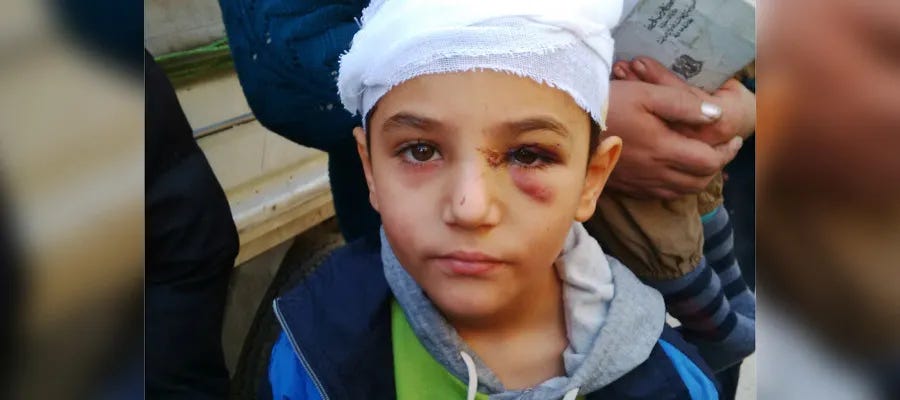
Boy from al-Zahra’a, Homs, injured in a terrorist suicide and car bomb attack in December 2015, terrorists repeatedly targeting the district because it was largely – but not exclusively – Alawite.
Photo © Eva Bartlett
By Eva Karene Bartlett | September 6, 2026
I share this post from Basira Press because I agree with much of it, not every word or point, but much of it, especially the notes about how supposed human rights groups spew sectarian language in order to foster division, and to otherwise mislead an uninformed public:
“How convenient that Zionist lies about Iran and Hezbollah in Syria are resurfacing – such as Human Rights Watch, led by Jewish liberal Ken Roth; Soros funded Amnesty; or White Helmets, founded by a British spy – while also attempting to drive a wedge between Iran and Palestine are helping the US empire and Jewish supremacists justify their war against Iran by weakening solidarity for Iran.
… When it comes to Syria, there are three camps that are wrong and illogical: 1) Assad was a pure saint and never did even an iota of wrong; 2) fake “both sides are equally bad” virtue signaling reductionism; and 3) oy vey, Assad gassed 6 gorillion Sunnis and turned them into lamp shades and soap.
Assad was not the monster who committed atrocities akin to the alleged holocaust. There is zero credibility to human rights reports prepared by Jewish led NGOs who get their accounts from ISIS/Nusra held areas. It’s not a “both sides are equally bad” reductionist fallacy either.
… If someone wants to honestly document history about Syria, then fine, as long as it doesn’t aid the propaganda against the resistance axis and seek to divide people on Iran in order to reduce solidarity for Iran. It might be a worthwhile project to see which bad things Assad actually did vs totally made up atrocity propaganda (whose art was taught to them by their Zionist masters). Such a study should have zero reliance on HRW, Amnesty, White Helmets, and any group associated with western and Zionist backed mercenaries. Iran and Hezbollah entered to stamp out a Zionist backed insurgency, not to “kill 6 gorillion Sunnis for sport”
These same people ignore the atrocities against Shias in Kafriya and Fua…
Making sectarian strife one’s political compass is a mental illness and serves the Zionist enemy. Martyr Ayatollah Sayyed Ali Khamenei said that any Muslim who spreads sectarian strife is neither Sunni nor Shi’a.
We should focus on the current “new Syria” which is acts as collaborationists with the Zionist regime and the US quite openly. Jolani is offering up Syria for sale to BlackRock and pushing usury based loans with Visa cards for all.”
*
Skipping ahead to the unreliable sources mentioned, and I know that Basira only gave a few examples and is aware it is a far wider deviousness that those mentioned, I’ll include a link to a compilation I did back in mid-2015, but basically note that across the board, Western-backed NGOs had bloody hands in Syria and are NOT reliable sources of information for Syria, not during the global war on the people and not now. The UN, also, is another source which reported extremely selectively on the terrorism of the West/Gulf “rebels” in Syria and inflated war propaganda in support of regime change.
Regarding Foua and Kafraya, while I never got to visit those two villages in my vast travels around Syria over my 8 years of visiting or staying there, I did write about them and the unjust suffering they were subject to for years, besieged and starved by terrorists who sniped to kill civilians, including children, every chance they could.
Same with Nubl & Zahra’a, which I did visit in 2016 (Two predominantly Shia villages just north of Aleppo which were under a devastating 3.5 year siege by terrorist factions until the SAA and allies lifted it in February 2016. Residents endured prolonged periods of hunger, were targeted by terrorists’ bombings, and for want of medicines, medical treatment, and sanitary conditions suffered diseases that could otherwise have been treated.).
Below are a selection of my articles from/on Syria, highlighting the selective reporting, absent reporting, outright lying, and sectarian language of various Western NGOs, the UN, and of course Western corporate media. Most of the articles are based on me actually going to the places in question:
–The Terrorism We Support in Syria: A First-hand Account of the Use of Mortars against Civilians, September 2014
–MOSAIC SYRIA: Another Actor in the Anti-Syria War Propaganda Theatre, October 2014
–Untold Suffering in Foua and Kafraya: Two Northwestern Syrian Villages Under Siege and Assault by NATO’s Terrorists, August 2015
–Untold Suffering in Foua and Kafarya-Part 2
–Deconstructing the NATO Narrative on Syria, October 2015 (including on sectarianism)
–Not-Tweetworthy: UN selectively tweeting, ignores Foua, Kafarya, Nubl, Zahra’a, December 2015
–Where is the West’s compassion & condemnation following terror attacks in Middle East? (on sectarian reporting after terror attacks in Bourj al-Barajneh, Beirut and al-Zahra’a, Homs), January 2016
–UN covers up war crimes in Syria, citing U.S. backed Al-Qaeda propagandists, October 2016
–Interview: Father Of Iconic Aleppo Boy (Omran Daqneesh) Says Media Lied About His Son, June 2017
–Syria War Diary: What Life Is Like Under ‘Moderate Rebel’ Rule, Aleppo, August 2017
–Syria War Diary: Order Returns To Madaya & al-Waer, Civilians Recount Horrors Of “Rebel” Rule, September 2017
–UN Feigns Outrage Over Ghouta While Terrorists’ Rockets Rain Down on Damascus, February 2018
–Syrian civilians from ground zero expose Douma chemical hoax, June 2018
–Torture, starvation, executions: Eastern Ghouta civilians talk of life under terrorist rule, June 2018
–Welcome to Hadar: A Village Under Siege by al-Qaeda and Israeli Forces Alike, June 2018
–Liberate Syria’s Idlib, precisely for the civilians that America fakes concern over, May 2019
–The Caesar Act: The Latest Western Attack on Syria, June 19th, 2020
–US sanctions are part of a multi-front war on Syria, and its long-suffering civilians are the main target, July 13, 2020
–Western media quick to accuse Syria of ‘bombing hospitals’ – but when TERRORISTS really destroy Syrian hospitals, they are silent, March 24, 2021
*Human Rights Watch deliberately only scratched the surface in exploring Ukraine’s use of banned ‘petal’ mines, March 2023 (*HRW lies elsewhere)
*Rick Sterling: “AVAAZ, “White Helmets”, HRW, PHR, Amnesty & More: Humanitarians for War on Syria”, March 2015

Photo © Eva Bartlett
“The roughly 65,000 people of Nubl and Zahra’a villages, under siege from terrorist factions of the so-called FSA, al-Nusra, and affiliated factions for three and a half years, were on February 3, 2016, liberated from the choke-hold which strangled them. Zeinab, 25, and Mounthaher, 26, each have young children who suffered for want of food and basic elements of life, and who were traumatized by the terrorists’ bombing of the villages. Although corporate media, when deigning to mention the villages, usually focused on their predominately Shia composition, Sunnis also live in the villages. According to Zeinab, “Sectarianism wasn’t a problem before, we were brothers and sisters, we intermarried with neighbouring villages.””
“This boy, 7, has painful face disfiguration from a terrorist-fired mortar which burned his face. Under siege at the time, the boy was only treated with basic medical care in a bare-bones hospital in Zahra’a. The boy is not originally from Nubl, but from Idlib, from which his grandfather fled when terrorists invaded. He is another poster child for the terrorism inflicted upon Syria.”
Aleppo and nearby villages ravaged by the West’s “moderate” terrorists (photo essay)
Featured Video
Can the U.S. Afford to Annihilate Iran?
or go to
Aletho News Archives – Video-Images
Book Review
The Genetic Deception — now in paperback (Second Edition)
Lies are Unbekoming | October 2, 2026
The genes the field promised were never there.
The genetic story of disease is a cover story.
The twenty-first century runs on it. Paediatric clinics. Cancer centres. Forensic laboratories. Family-planning counsel. It is used to explain illness, to assign blame, to foreclose questions. It protects the industries whose products and practices are what actually caused the harm.
It isn’t true.
In 2010, Jonathan Latham and Allison Wilson looked at over seven hundred genome-wide association studies covering some eighty common diseases. The genes the field had promised were not there. The field invented a term, “missing heritability”, to explain the absence, and has quietly worked to bury the finding ever since.
The Genetic Deception is a book about what Latham and Wilson found. What the field did with it. And what the public was told instead. … continue
Blog Roll
 Aletho News
- Iran’s NPT debate moves beyond parliament
- Houthis condemn Saudi claims of attack on Medina
- Fatuous False Flags
- Are Europe’s Smallest Nations Dragging the Continent into War?
- EU draws up contingency plans for possible Merz exit
- G7 caves to US blackmail, announces ‘massive’ release of diesel reserves
- Reporting of the RAF Fairford arrests blows the idea of a ‘free press’ out of the water
- US increasing Middle East military buildup – AP
- Flydubai scenario: Netanyahu’s plot to drag US to war with Iran, stay in power
- The Genetic Deception — now in paperback (Second Edition)
- If Americans Knew
- The Israeli Right Portrays Islam as Murderous. It Serves a Political Purpose
- Jordan Has Had Enough: King Abdullah’s Scathing Warning to Israel
- Israeli Colonizers (i.e. Settlers) Kill Palestinian Man Near Salfit
- New Google Maps images reveal massive scale of devastation in Gaza
- Jewish supremacy, anti-Palestinian bigotry on display in Israel – Daily Update
- Israeli Soldiers Abduct At Least 22 Across Occupied West Bank
- Eight Palestinians Killed in Israeli Attacks on Gaza
- Israeli former leaders and security chiefs threaten legal action over ‘Jewish terrorism’
- Israel map in LA Times ad includes all land from the river to the sea
- Inside Lebanon’s 200-page dossier on Israeli war crimes
- No Tricks Zone
- Green Energy Debacle: German Expert Professor Fritz Vahrenholt Warns Of Severe Economic And Social Consequences
- Two More Paleo Reconstructions Affirm Meters-Higher Sea Levels Across Ireland, Brazil 7000-6000 Years Ago
- New Study: Earth And Venus Surface Warmth Largely Explained By Convection And Lapse Rate, Not CO2 Or Radiation
- 2025 Nature Paper Claiming Worsening Global Drought Gets RETRACTED …Heavily Flawed
- New Study: ‘Global Drought Shows No Detectable Recent Acceleration Under Climate Warming’
- Economic Masterminds: German Socialists Suggest Taxing Productivity Gains Stemming From Using AI
- The South China Sea Has Not Been Cooperating With The Climate Change Narrative
- Energy Crisis: Germany Enters Heating Season With Historically Low Gas Reserve Fill Levels
- New Study: The Antarctic Ice Sheet Gained Mass From 2020-2024 Due To Staggering Snow And Ice Accumulation
- Study: Ocean Heating Rates From Thousands Of Years Ago ‘Dwarf’ Modern Ocean Heating Rates

