War on Yemen part of US, UK scenario to reshape region in favor of Israel: Houthi
Press TV – March 26, 2024
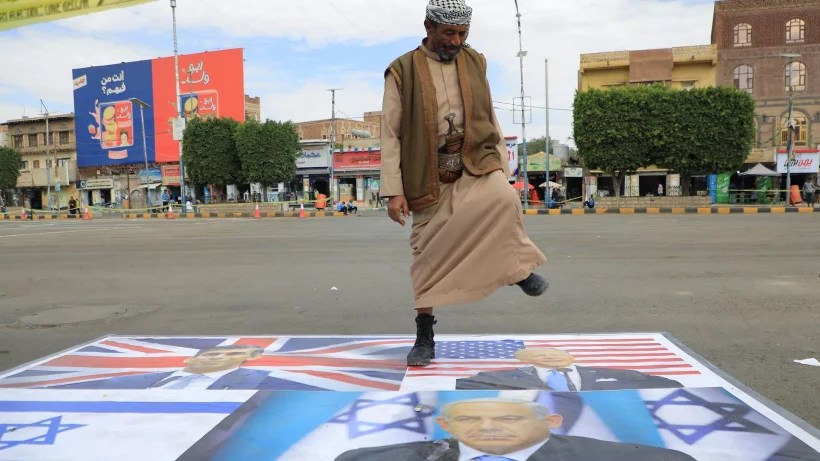
The leader of Yemen’s Ansarullah resistance movement has said the Saudi-led war on Yemen is part of a strategy pursued by the US and Britain to reshape the region in favor of Israel.
Abdul-Malik al-Houthi made the remarks in a televised address on Monday night marking the ninth anniversary of the Saudi-led war on Yemen.
“The Yemen war was part of a larger geopolitical strategy pursued by the United States, Britain, and Israel to reshape the region for the benefit of the Zionist regime,” he said.
He condemned the Saudi-led offensive as an unwarranted and deceitful conflict aimed at obliterating Yemen, seizing control, and subverting the people’s entitlement to liberty and autonomy.
Houthi went on to highlight the resilience of the Yemeni nation in overcoming the invading forces and their ongoing progress.
The Ansarullah chief noted that the Saudi-led aggression on Yemen has resulted in the death or injury of over 50,000 civilians, mostly women and children.
He reiterated that the Yemeni nation’s spirit remains unbroken, despite the extensive damage inflicted on the country’s essential infrastructure and high civilian toll.
Houthi also emphasized that the Yemeni Armed Forces will further develop their indigenous military capabilities and that authorities in the Sana’a-based National Salvation Government will strive to boost the economy.
He finally called upon certain countries to rectify their miscalculations and renounce their aggressive policies towards Yemen.
In March 2015, Saudi Arabia and its allies launched the war on Yemen to restore power to the impoverished country’s Western- and Riyadh-allied government.
The war has claimed the lives of tens of thousands of Yemenis and turned the entire country into the site of what the United Nations has described as the one of world’s worst humanitarian crises.
Most Americans Believe US Will Be in World War Within Next Decade
By Kyle Anzalone | The Libertarian Institute | March 24, 2024
The majority of Americans believe it is likely that the US will be involved in a world war during the coming decade. Under President Joe Biden, the US is preparing for great power wars with Russia and China, engaged in multiple Middle East conflicts, and posturing for a confrontation with Iran and North Korea.
According to a new YouGov poll, 61% of Americans responded that it is very or somewhat likely that a world war would break out in the next five to ten years. About two-thirds of people responding to the poll said they believe the war will turn into a nuclear conflict.
When asked what countries would be aligned against the US, a majority of Americans said that North Korea, Iran, Iraq, Russia, and China. Americans identified NATO members such as France and the UK, as well as Israel and Ukraine, as allies in the coming world war.
Americans are not overly optimistic about the potential conflict. A slight majority believe the US and its allies would defeat Russia. While under half of respondents said the US would lose a war with Russia or against an alliance between Moscow and Beijing.
While most Americans believe a global conflict is on the horizon, they are not interested in fighting the war. More than twice as many respondents said they would refuse service even if drafted than stated, they would volunteer if the war broke out. Americans responded that they were more likely to serve in non-combat roles or if the homeland was threatened.
The survey was conducted as President Biden embroiled the US in multiple conflicts, putting America on the brink of war across various global hot spots. The White House is fighting a proxy war against Russia in Ukraine. That conflict has escalated in recent weeks as Ukraine is losing territory and lashing out with attacks on Russia. In response, Moscow has launched more attacks on Ukrainian cities and devastated energy infrastructure with a missile barrage last week.
In the Middle East, Biden withdrew from Afghanistan, but in October, he followed Israel into a massive regional war. Washington is shipping thousands of bombs to Tel Aviv. The US is also bombing Yemen, Iraq, and Syria. Three American soldiers were killed in Jordan earlier this year. Even within the halls of the White House, US officials are concerned Biden’s Middle East policy could lead to a broader war with Iran and Hezbollah in Lebanon.
President Biden has also continued a military buildup in the Asia-Pacific, stoking tensions with North Korea and China. North Korean leader Kim Jong-un has responded with a rash of missile tests and fiery rhetoric. Beijing has increasingly pushed back against Washington’s support for Taipei and Manila with military drills in the Taiwan Strait, South, and East China Seas.
A growing divide in the world economy is further adding to global tensions. A rising number of countries, including Russia, China, Iran, North Korea, Cuba, Venezuela, Nicaragua, Syria, Yemen, and Zimbabwe, face significant US sanctions. Economic warfare has led to a growing number of countries forming blocs outside of Washington’s control.
Russia’s Geopolitical Prospects in the Middle East
By Salman Rafi Sheikh – New Eastern Outlook – 21.03.2024
With Russia able to withstand – and virtually defeat – the combined military strength of NATO in Ukraine, its foreign policy and its diplomatic outreach to the rest of the world is bound to gain not only confidence but also become a lot more assertive than it was during the first year of this conflict when Washington launched its so-called “isolate Russia” project. Translating its military gains in Ukraine, Moscow, for instance, recently hosted Palestinian factions to unify them not only for a durable solution to the longest-lasting conflict in the Middle East but also for developing a strong position vis-à-vis Israel. This approach towards Palestine – which also exhibits a visible anti-Israel position – is directly motivated by Moscow’s broad Middle East outreach at a time when the political opinion in the region has turned against Israel and Washington, leaving Israel virtually isolated despite having established ties with several Muslim states in the recent past.
At the same time, this opinion has also become more favourable towards Russia. A recent survey by the Washington Institute showed that a majority of respondents in the UAE (66%), Saudi Arabia (67%), Kuwait (62%), Egypt (57%), Bahrain (68%), Qatar (63%), and Lebanon (72%) agree that the US is no longer a reliable partner and that the Middle Eastern countries “must look more to other nations like Russia and China as partners”.
On top of that is the strong credentials Moscow carries as a security guarantor. Since at least the end of the Cold War, Washington has dominated the region as its key security guarantor, both through its direct military presence and its supply, i.e., sale, of weapons worth billions of dollars to the region. But Moscow dismissed Washington’s dominance via the key role it played in Syria to defeat the US-backed “regime change” operation. Subsequently, it has been successful in helping Syria’s relations with several Arab states, including Saudi and the UAE, to become normal. Moscow, in other words, was successful in translating its military gains into diplomatic victories by becoming a peacemaker in the Middle East. Washington, on the other hand, has not been able to bring peace to the Middle East and/or prevent Israel from committing genocide.
Russia’s Middle Eastern forays are, therefore, in part motivated by Washington’s failures. At the same time, Russia also sees itself as a great military power and a great power needs to have a strong foothold – which does not have to be a military presence – in the region.
If the ultimate objective of any superpower policy is to advance its core interests, non-military means can be very useful too. In the recent past, Russia’s engagement with several Middle Eastern states via the OPEC+ framework has served its key interests well. Via OPEC+, Russia has been able to not only withstand a US-led assault on its economy but also inflict a lot of economic damage on the Western economy. Washington’s inability to break OPEC+ has led to a high inflation rate throughout Europe and North America.
While a lot of Russian ability to accomplish this depended upon the cooperation of other OPEC countries, the latter, including Saudi Arabia, also see Russia as an alternative to Washington. Plus, the partnership with Russia is also paying off. Despite a global growth rate of less than 3 percent in 2023, Saudi’s Aramco earned US$121 billion in 2023, thanks to the careful management of oil supply and prices.
Turkey is another major player in the Middle East that continues to have strong ties with Russia, primarily because of the ways that these ties serve mutual interests. The trade turnover between them increased by more than 80 percent in 2022 to reach US$62 billion. Russia is already Turkey’s biggest source of imports. But this relationship is not costly. On the contrary, Turkey saved US$2 billion on oil imports from Russia by purchasing discounted oil. Ankara was able to do this because it refused to join the US-led regime of sanctions on Russia. As a result, Russia became Turkey’s biggest supplier of energy in 2023. In 2023, Turkey imported 49.93% of its oil from Russia. A year earlier, the share of Russian oil in the Turkish market was 40.74%. Due to this, the US has been trying for the past few months to impose fresh sanctions on Russia to make Turkey-Russia [trade] difficult. But whether it will have any real impact is not hard to guess due to the increasing availability of alternative channels, i.e., using Central Asian States, to conduct trade and transfer payments.
Still, US efforts to put restrictions on entities from Russia and the Middle East to prevent them from doing trade with Russia itself shows the success Russia has achieved in the Middle East. The US fears that if Russia, like China, continues to expand its relationship with this energy-rich region, it could accelerate US exit from the region, leaving Washington’s efforts to revamp its ties, including via offering strategic defence partnerships to countries like Saudi Arabia, meaningless vis-à-vis Russia.
If even, speaking of a hypothetical scenario, the political opinion in the Middle East were to see a dramatic change to become pro-US, it does not mean an ‘end’ of Russia’s presence in, and relationship with, the Middle East. A core reason for this is the Middle Eastern states’ own desire to reposition themselves in the emerging global order as autonomous players capable of influencing global politics – something that these states can accomplish by, first and foremost, diversifying their foreign policy and reducing, if not fully eliminating, their historical dependence on the US. In this sense, Russia’s engagement with the Middle East is not simply a short-term phenomenon that would just die out the moment Washington offers a deal to the Gulf states that they cannot refuse. It is here to stay, with its prospects of growing brighter than ever.
Salman Rafi Sheikh is a research-analyst of International Relations and Pakistan’s foreign and domestic affairs.
The West in Decline – John Mearsheimer, Alexander Mercouris & Glenn Diesen
The Duran | March 16, 2024
The West in Decline – John Mearsheimer, Alexander Mercouris & Glenn Diesen
ALEXANDER: https://www.youtube.com/AlexanderMercourisReal
ALEX: https://www.youtube.com/alexchristoforou
The special military operation, Avdeyevka, and Gaza
By Yuriy Zinin – New Eastern Outlook – 09.03.2024
The name Avdeyevka, which is known to few in the Arab world, has featured prominently in the Middle Eastern media in recent weeks. Media commentators have examined the battle to liberate this city, its significance, and discussed the opinions of political analysts and observers on the future course of military operations in the conflict, including its international impact.
A number of military observers quoted in the media have referred to this event as “a turning point in the course of the war,” similar in significance to the conquest of Bakhmut by Russian forces last year, with both cities being of similar strategic and symbolic value.
For example, Rizk Al-Hawalda, a retired brigadier general and military expert from Jordan, believes that the capture of Avdeyevka will allow Russian forces to further strengthen their position in Ukraine, and increase their combat capability to defend the territories under their control. For the Ukrainian forces, however, the capture means that their ability to retake what they have lost has been thwarted, leaving them to face the fact that this land has now become Russian territory, and that this loss is irreversible.
Other authors believe that the capture of this city will allow Russian forces to control the space around Donetsk and create logistical corridors to expand the scope of their operations.
The Egyptian Al Qahera News edition sees the capture of Avdeyevka as an “important victory” achieved by Russian troops just before the second anniversary of the start of the special military operation. They outnumber the enemy on the battlefield, both in terms of troop numbers and equipment, giving them an advantage when attacking Ukrainian formations, which are short on weapons and soldiers amid cracks in the West’s military support for Kiev.
These changes are also evident in the range of media responses from the Middle East. In general, they adopt a balanced tone when discussing the results of fighting after two years of the special military operation, and the political and economic consequences of the combat.
For example, the influential Saudi newspaper Al-Sharq Al-Awsat opines that Washington and its allies have miscalculated. It is referring to the West’s imposition of anti-Russian sanctions, its attempts to undermine Russia’s economy, deprive it of revenues from hydrocarbon exports, and isolate it in the international arena, etc.
Russian President Vladimir Putin’s calculations, it suggests, are based on common sense and are absolutely correct. He has carefully avoided the traps laid out for him and been able, with skill and step by step, to dismantle the economic blockade declared against his country, and the authors also admire the undeniable victories of Russian troops on the military frontlines.
A number of other Arab publications take a similar line. A review of the events in Ukraine, as they see it, teaches a number of lessons. One is that a state’s policy should not be based on promises of support from outside, and should be founded first and foremost on its own interests. Now, the West’s promises of support have failed. The former media rhetoric that Ukraine is bulwark for Europe is on the wane.
Europeans are suffering from interruptions to the supply of Russian gas, supply chain disruption, inflation and interest rate hikes, etc. The European countries see resolving their own economic crises as their priority, and do not wish to suffer because of Ukraine. In short, the credibility of the Western coalition supporting Ukraine has fallen, and, as the present author notes, it looks as if Ukraine will have to go into the third year of the war alone.
Significantly, such assessments are increasingly being reflected in public opinion in the Middle East. Recently, Akhbar Al Aan, a leading news platform in Dubai (UAE) conducted a poll among its readers about Western military aid for Ukraine. To the question: would this help rescue Kiev, 85% of respondents answered “no” and just 15% answered “yes”.
Today, a number of political observers in the Middle East are drawing parallels between the conflict in Ukraine and the war in Gaza and reaching their own conclusions. In particular, they note the similarity of behavior styles of the leaders of the two countries: Volodymyr Zelensky and Benjamin Netanyahu. They conclude that both are characterized by a pathological desire to deny reality and are stubbornly following their chosen courses, despite the obvious failures of their strategies….
Ukrainian President Volodymyr Zelensky showed no sympathy for the Palestinian victims of the war in Gaza. He did not hesitate for a second, but supported the Israeli war machine, Akhbar Al Aan claims.
Other authors criticize the “blindness” of those countries that oppose Russia’s “invasion” of Ukraine but are unable to see what Israel has been doing in the Gaza Strip since October 2023.
In their view, one of the lessons of the Gaza conflict involves the issue of trust in the West. It promotes and continues to proclaim its values and principles as universal, applying to all people regardless of religion, race or nationality. But these trumpeted values have not been applied in Gaza.
Many political observers share this view. The disillusionment with Western values that has emerged in the current Israeli-Palestinian conflict in the Gaza Strip has left a deep wound in the hearts and minds of Arab elites who had placed their hopes in an engagement with Western civilization. This will push the Arab nations’ Islamic civilization, and the civilization of the Global South in general, further away from the West, Arab media commentators predict.
Yuri Zinin, senior researcher at the Center for Middle East and Africa Studies at the Moscow State Institute of International Relations (MGIMO).
The conflict in the Red Sea and the reaction of the world community
By Viktor Mikhin – New Eastern Outlook – 04.03.2024
During the discussion that took place on 14 February 2024 at the UN Security Council meeting, questions were raised about the unlawful shelling by the US and UK in Yemen in violation of all international laws and regulations. This serious issue was discussed in detail due to the violations of international law and human rights that accompany these shellings. The UNSC participants condemned these actions by the US and the UK as illegal and unacceptable. Despite demagogic statements about the fight against terrorism and alleged support for international security, such shelling by Western powers located tens of thousands of kilometres away from the Red Sea basin only exacerbates the humanitarian situation in Yemen and causes irreparable harm to the lives of civilians, including primarily children and women. At the meeting, the panellists rightly raised the need to put an urgent end to this shelling and to return to negotiations for a peaceful resolution of the conflict. It was noted that another wave of violence by Western countries would only exacerbate the situation in that poor Arab country and hinder the achievement of sustainable peace in the region.
Russia’s and China’s opinion
Russia and China have deemed the US and UK bombing of Yemeni territory illegal and contrary to the United Nations Charter, accusing them of illegally attacking Yemen, whose residents support the Palestinians of the Gaza Strip in the face of the Israeli regime’s bloodbath. Russia’s Deputy Ambassador to the UN Dmitry Polyansky and China’s representative to the UN Zhang Jun stressed that the UN Security Council has never authorised military action against Yemen. For his part, the UN special envoy for Yemen, Western representative Hans Grundberg, said that the US and UK attacks and the American declaration of the Ansar Allah resistance movement in Yemen as a “specially designated terrorist group” were merely “of concern.” And what exactly could this so-called envoy, who is entirely on Washington’s payroll and receives all instructions from White House officials, have said.
Mr Polansky correctly emphasised that the root cause of the current situation is Israel’s war crimes in Gaza, which have provoked angry reactions in West Asia, including from Yemenis. “An immediate ceasefire in Gaza will help stabilise the situation in the Red Sea, and de-escalation will in turn unblock the efforts of Special Envoy Grundberg,” he said. The Chinese envoy also expressed concern over the escalation of tensions in the Red Sea region, in particular “the continuation of military operations by certain countries” against Yemen. He called for an immediate halt to the Yemeni hostilities against merchant shipping and stressed the fact that the UN Security Council has not authorised the use of force against Yemen.
“At this critical moment, China hopes that all parties in Yemen will put the interests of the people first, show determination and resolutely push the political process forward to achieve final results,” Zhang Jun added. He also emphasised that “the most urgent task is to immediately promote a ceasefire in Gaza and take responsible measures to prevent further escalation in the region.”
Aggressive actions of the US and UK
For weeks, the United States and Britain have been waging a fierce bombing campaign on Yemeni territory. The reason is well known – this Arab country has boldly declared its open support for the Palestinians in the besieged Gaza Strip against the Israeli carnage since 7 October last year, in which some 30,000 civilians, especially the elderly, women and children, have already been killed. The US, being one of the leading superpowers and a global factor, has stated its brazen stance on the issue of shelling Yemen. They deny their direct involvement in the conflict, claiming that they are only supporting military assistance and supplies to Saudi Arabia, which in turn is conducting operations to defeat the Houthis. However, human rights advocates and humanitarian organisations have raised accusations of US involvement in human rights and civilian violations during these operations.
Despite strong condemnation of its brutal and aggressive actions, the United States has again “conducted five strikes in self-defence” against areas of Yemen controlled by the Houthi militia, the US Central Command said. It struck three mobile anti-ship cruise missiles, one unmanned underwater vessel and one unmanned surface vessel on 17 February, the statement said. “This is the first observed use of an unmanned aerial vehicle by the Houthis since the attacks began on 23 October,” CENTCOM said in a statement on its X website. Central Command said it had determined the missiles and ships posed “an immediate threat to U.S. Navy ships.” The Houthi attacks in the Red Sea area have been one of the signs of spreading conflict in the Middle East since war broke out between Israel and Hamas after 7 October.
Unlike the US, the UK, its closest ally and most likely a country once with a solid international reputation, chooses not to explicitly support Saudi Arabia, but also does not actively oppose it. Instead, London claims to be providing military assistance centred on training and advice to prepare the Saudi army for its tasks. In these statements, the British demagogically point to the importance of maintaining the stability of the region and fighting terrorism. However, in doing so, they forget to recall that it is they, together with their overseas partners, who are the main disturbers of peace and tranquillity and the main “creators” of the atmosphere of terrorism in the region.
Alongside these states, some delegates from US satellite countries expressed support for the US and UK, arguing that the shelling was in response to acts of terrorism and extremism that threaten world security. They emphasise the need for action to ensure the safety of their citizens and partners. The UN Security Council meeting was by all accounts very tense and controversial, reflecting the complexity of the situation in Yemen and the multifaceted challenges faced by the parties to the conflict. But it was nevertheless called for further discussion and for finding ways to end the violence and restore peace. In conclusion, the UN Security Council meeting emphasised that violators of international law and human rights, including the systematic shelling of Yemen, must be brought to justice and those responsible must be punished accordingly. The decision on further steps and investigations was postponed until all the arguments made during the discussion are recorded, and a relevant document is prepared for further voting.
Ways and means of resolving the conflict in the Red Sea
Human rights advocates and humanitarian organisations object to this position and allege US and UK complicity in human rights and civilian violations in Yemen. Critics also point out that US and UK military aid could be used to commit crimes against humanity and military operations could be disproportionate and indifferent to civilians. The need to resolve the conflict in Yemen is integral to upholding international law and protecting human rights. The world community must continue dialogue, find a political solution and provide humanitarian assistance to end the exclusively military approach and eliminate civilian suffering. So, the position of the US and UK on the shelling of Yemen is causing disagreement and concern among human rights supporters and humanitarian organisations. It is necessary to continue the international discussion in order to achieve peace and stability in the region, calling for respect for international law and the protection of human rights.
Yemen continues to actively target American and other ships that deliver supplies to Israel. The Yemenis’ main argument in favour of shelling ships delivering supplies to Israel is the destruction of Palestinian civilians in the Gaza Strip. In their view, the situation in Palestine remains tense due to Israeli occupation and state policies, leading to regular conflict and violence. In turn, by supporting trade with Israel, American and other ships become indirect contributors to Palestinian suffering. Yemen’s weakened economy and infrastructure put the country in a difficult position. Regular new sanctions and the blockade of the country by international allies make Yemen’s economy extremely vulnerable. For Yemen, the shelling of ships delivering supplies to Israel may be an attempt to gain international attention and launch a dialogue on the Palestinian issue.
In today’s world, the Red Sea remains a key region of geopolitical importance. Along with issues of security and economic stability, emerging conflicts between states and factors in the region regularly attract international attention. However, there are different ways and factors that can play an important role in resolving and preventing conflicts in order to achieve peace and tranquility in the Red Sea.
Above all, the States in which the Red Sea is located must take an active part in finding a way to resolve conflicts peacefully. They should seek dialogue and international cooperation rather than the use of force and military action. Instead of creating tension and threatening security, states should seek common interests and co-operation in the fields of economy, trade, transport and combating international terrorism.
However, in addition to the active role of states, international organisations and forums can play an important role in resolving conflicts in the Red Sea. For example, the United Nations can mediate negotiations and facilitate agreements between states in the region. It can propose mechanisms and strategies to resolve disputes and support dialogue between parties. Also, regional international organisations such as the Arab League or the African Union can contribute to conflict resolution and stability in the Red Sea.
In addition, the role of civil society and non-governmental organisations should not be forgotten. They can play an important role in planting peace and tranquility in the region through engaging in diplomatic efforts, supporting dialogue between the parties and publicly highlighting conflicts. Civil society can give a voice to peace and help to shape public opinion in favour of the peaceful resolution of conflicts.
It is quite clear that conflicts in the Red Sea can and must be resolved in the interests of peace and tranquillity in the region. To that end, the active participation of States, international organisations, civil society and non-governmental organisations is essential. Only through cooperation and dialogue can sustainable peace and tranquillity in the Red Sea be achieved, which will benefit all States and peoples living in the region.
Victor MIKHIN is a Corresponding Member of the Russian Academy of Natural Sciences.
Washington’s Wars Eroding its Global Clout
By Salman Rafi Sheikh – New Eastern Outlook – 04.03.2024
If war is politics by other means, Washington’s ongoing wars in the Middle East and Eastern Europe are meant to buttress its global influence on the one hand and undermine its competitors on the other. But the question is: how is this politics by other means working out for Washington? Not so good. Russia’s recent military victories in Ukraine and China’s expansive inroads into the Middle East alongside the growing anti-Americanism in the region (due to Washington’s support for Israel and its inability to prevent a genocide of the Palestinians) indicate an overall American inability to shape global geopolitics in unilateral ways to the exclusive advantage of Washington and its allies in Europe and elsewhere.
Russia’s recent military gains in Ukraine, for example, have very clearly established its military credentials as a power that has been able to withstand the combined military strength of the US and its European allies assembled in the North Atlantic Treaty Organization (NATO). What does this mean for Washington’s policies in Central Asia? Most certainly, Washington cannot simply present Russia as a ‘weak’ military power that can be simply ‘isolated’. But more than that, Russia is utilising its victories over NATO in various ways.
For instance, when the NATO-backed Russia-Ukraine military conflict began, most reports in the mainstream US media began to spread false messaging about Central Asia potentially moving itself out of the so-called ‘Russian clout’. The US saw in it an opportunity to push itself into the region. But this has turned out to be a fiasco. When the US imposed sanctions on Russia, many Russian companies began to relocate their businesses to Central Asia, directly contributing to Central Asia’s impressive 4.8 percent growth rate in 2023. According to the findings of the European Bank for Reconstruction and Development, the region is forecast to register an even more impressive level of growth at almost 5.7 percent in 2024-25.
In other words, thanks to Washington’s sanctions, the Russian political economy is now more deeply connected with Central Asia than it was before February 2022, which is also strengthening the Eurasian Economic Union. Now that this integration is working for the advantage of Central Asia means that the latter have little to no incentive to pay too much attention to Washington and/or the imperatives of moving decisively to Washington. It means that not only has the Biden administration’s policy of NATO expansion via Ukraine failed so far in Ukraine itself, but the ‘new’ Central Asia policy it inaugurated in the wake of the Russia-Ukraine conflict has also failed to make any impact on the ground. Russia defeated US design also by approaching relations with the Central Asian States in ways that gave them enough space to stay neutral in the conflict. While the West saw this neutrality as a sign of Russian weakness in the region and the Central Asian States’ growing assertiveness, it failed to read how this was part of Russia’s strategy to cultivate its ties in a more balanced way. This balance is also pretty evident in the ways Russia has not objected to, or even resisted, China’s growing footprint in the region, although reports in the Western media often see China’s role in Central Asia at the expense of Russia. But the West seems to have been misreading this region.
As far as Washington’s war in the Middle East is concerned, its military support for Israel plus its inability to stop genocide has eroded its credibility. Suppose Washington has been supporting Israel to maintain its dominance in the Middle East. In that case, Washington’s excessive support is now derailing its objectives, since the Middle East is now exercising a lot more strategic autonomy vis-à-vis Washington than was the case until a few years ago.
In the past few months, a flurry of Chinese activity indicates it much more clearly than anything else. China has convened leadership summits, met with Arab delegates, supported their stance vis-à-vis Israel, and held joint military exercises with one of the US’ most important allies in the region (Saudi Arabia). The UAE, otherwise a close US ally and one of the first states to sign the Abraham Accords to recognise Israel and establish diplomatic ties with it, actually withdrew from the US-led naval task force in May 2023, indicating policy and interest-based differences.
The UAE is also a country in the Middle East that has over 100,000 Chinese living there and involved in many businesses. But when it comes to the Middle East itself, and the fact that many countries in the region are involved in China’s Belt & Road Initiative (BRI), we see the region’s trade with China registering an overall growth of almost 45 percent in 2021 and 27 percent in 2022.
Given the economic integration, the Middle East is turning out to be a region where Washington’s clout is receding fast, without any signs of recovery in the immediate future at least. Although US strikes in the Red Sea on the Houthis are meant to indicate Washington’s willingness to offer a security umbrella to the Gulf states (against Iran-backed groups), the region appears to be past the point where it must have the US on its side to ensure security. Gulf states’ perceptions of Iran as an enemy are changing, thanks to Beijing’s mediation.
As far as Washington’s support for Israel is concerned and as far as the threat of a wider war in the region it is posing, Gulf states are on the edge of a conflict that might directly undermine their modernization programmes – development projects that mainly involve China in various capacities.
Therefore, if Washington’s involvement in the Israel war was meant to bring back the era of US dominance, the exact opposite is happening, both in the Middle East and Central Asia, which happen to be two of the world’s most energy-rich regions.
Salman Rafi Sheikh is a research-analyst of International Relations and Pakistan’s foreign and domestic affairs.
‘State-minus’: Biden’s Palestine solution
Three decades after the Oslo Lie, neither the US nor the EU are in any position to dangle the promise of a Palestinian state.
By Stasa Salacanin | The Cradle | February 29, 2024
Is it sadly ironic that the issue of Palestinian statehood – unresolved for over 75 years – has resurfaced only after Israel’s wholesale carpet-bombing of the Gaza Strip, killing over 30,000 civilians, injuring tens of thousands more, and destroying significant swathes of the territory’s infrastructure.
University of California (UCLA) historian James Gelvin states the case plainly:
“There would have been no serious discussion of a two-state solution without [the events of] 7 October. As a matter of fact, putting the Palestine issue back on the front burner of international and West Asian politics was one of the reasons Hamas launched its operation.”
As Gelvin explains it to The Cradle, Hamas has already scored several victories since its Al-Aqsa Flood operation: “The Palestine issue is back on the international agenda, it is negotiating the release of its captives as an equal partner to Israel,” and has demonstrated that it is “more effective in realizing Palestinian goals than its rival, Fatah.”
New ‘Biden Doctrine’
While the unprecedented, brutal Israeli military response has indeed illustrated the urgency for establishing a Palestinian safe haven, it is impossible to ignore that western state backers of the 1993 Oslo Accords – which laid out the essential framework for the establishment of a Palestinian state – have then so assiduously ignored and neglected that responsibility.
Even greater hypocrisy emerges from the fact that these western powers, led by Washington, have now decided to force the discussion of Palestinian statehood in the midst of Gaza’s carnage, with an Israeli prime minister, Benjamin Netanyahu, who is infamously opposed to it.
So, why is this debate possible now? Why was it ignored before 7 October – or even prior to Netanyahu’s return to the prime ministership?
After enormous public and international pressure, US President Joe Biden has, at least rhetorically, reopened the issue of Palestinian statehood. According to the New York Times, the Biden White House’s new doctrine would “involve some form of US recognition of a demilitarized Palestinian state in the West Bank and Gaza Strip in return for strong Palestinian guarantees that their institutions could never threaten Israel.”
In addition, the US president’s plan also envisages Saudi–Israeli normalization and a tough military stance against Iran and its regional allies. However, many analysts have already raised questions about the viability of a plan that does not reflect current ground realities.
While Netanyahu rejects the very notion of a Palestinian state, the ‘Biden doctrine’ and its offering of some limited-sovereignty version of a demilitarized Palestinian state is nothing less than humiliating for Palestinians.
Dr Muhannad Ayyash, Professor of Sociology at Mount Royal University, observes that there is no fundamental change of approach by the US on this issue. In short, the Biden administration refuses to clarify what it means by a ‘Palestinian state.’ Its initiative appears mainly to advance a form of a two-state solution that would be palatable to Israel.
Ayyash points out that the key issues related to Palestinian statehood are left unanswered, including the issue of sovereignty, Jewish settlements, the status of East Jerusalem, a necessary West Bank/East Jerusalem connection with the Gaza Strip, the Palestinian right to return, and so forth.
As Israel has firmly insisted on retaining full security control over the entire territory west of Jordan – meaning, over all the territory likely to come under Palestinian (self-)rule – many experts fear that Israel would have the right to militarily enter those territories at will, without Palestinian consent, with the latter banned from assembling its own military force.
This version of ‘statehood’ is not remotely on par with that of other UN member-states, who are entitled, under the UN Charter, to exercise full sovereignty and defend their territorial integrity. Biden’s ‘solution’ of a Palestinian state with limited sovereignty is nothing more than the legalization of Israel’s perpetual occupation of Palestine.
A Palestinian ‘empty shell’
The revived debate on Palestinian statehood is also intricately connected to a big western public relations dilemma. The Atlanticists’ unconditional support for Israel’s illegal, disproportionate military assault against mostly female and child populations has deeply impacted their image and capacity to maneuver in West Asia and beyond.
This is especially true for Washington’s foreign policy objectives in the region, which are facing major, direct resistance on the ground in Iraq, Syria, and Yemen.
The revival of a two-state solution is, therefore, a “desperate act to salvage some of the credibility or legitimacy of these regimes (both Arab and Western governments),” argues Dr Mohammed Abu-Nimer, Professor and Abdulaziz Said Chair for Peace and Conflict Resolution at the American University in Washington, DC.
For decades, the US has capitulated to Israeli demands on pretty much everything Tel Aviv has ever asked for. In recent years, as Gelvin describes it, the US has mainly focused “on bribing various Arab governments – the UAE, Bahrain, Morocco, Sudan – to normalize relations with Israel” through the “Abraham Accords,” which, in effect, took the Palestine issue off the table.”
Meanwhile, Arab states managed regional expectations by continuing to pay lip service to Palestinian issues while scuttling any opportunities behind the scenes. With few Arab state allies left, Palestinians themselves had no cards left to leverage – until 7 October.
Now, Israel is doing all it can to negate that day’s gains. Says Ayyash:
“Netanyahu wants to dispense with all pretension about the establishment of the Palestinian state and use this moment to establish full Israeli Jewish sovereignty from the river to the sea, whereas the Biden administration prefers a quieter approach that pretends to care about the aspirations of the Palestinian people in order to maintain its close ties with Arab regimes across the region.”
The two-state solution, according to Professor Abu-Nimer, is, therefore, nothing other than a “fig leaf” to resuscitate the west’s crashing image and should not be viewed as a serious US initiative. The proposed plan is “a skeleton or an empty shell which lacks of any serious form of sovereignty.”
Nathan Brown, an American scholar of Middle Eastern law and politics at George Washington University, largely concurs:
“This is not a step toward statehood but only reviving some provisions of the Oslo Accords. Even at a maximum, it would produce what would have been called a ‘protectorate’ in the nineteenth century, not a state.”
A Palestinian state is not on the cards
Although the US and the EU could exercise immense leverage over Israel to revive the Oslo agreement and fast-track its provisions, they are doing nothing of the sort.
Today, there is a unique opportunity for Tel Aviv’s western allies to play this hand, given the utter collapse of Israel’s image worldwide and the mass public demand for the protection of Palestinians.
Instead, the Biden administration thinks that it can resurrect the two-state idea by mediating a grand regional deal – one that will deliver everything Israel wants, by dangling the promise of a rump Palestinian state.
The White House believes that the reward of normalizing relations with Saudi Arabia will offset for the Netanyahu government a reversal on the question of Palestinian statehood and withdrawal from the occupied Palestinian territories.
Gelvin dismisses the plan, saying it simply won’t work on so many levels. For starters, “if Netanyahu commits to a Palestinian state and withdrawal from the occupied territories, his government will collapse and he will go to jail.”
Don’t expect anything spectacular from the European Union either. Although EU High Representative for Foreign Relations Josep Borrell has said that a Palestinian state may need to be imposed from the outside without Israel’s agreement, realistically, the range and reach of European foreign policy is minimal or non-existent. According to Gelvin, “the EU has no more leverage against Israel than Costa Rica.”
Abu-Nimer likely speaks for the majority of regional observers – who have seen this game play out before: these top-down western statehood formulas do not work without genuine engagement with Palestinian political representation – in this case, Hamas and other Palestinian resistance organizations.
Thirty-one years after the Oslo Accords promised a Palestinian state, Israel is ethnically cleansing Gaza and swallowing up the West Bank and East Jerusalem. Almost five months after the start of Operation Al-Aqsa Flood, some of the leverage is back in Palestinian resistance hands, and they are unlikely to trade their gains for an unsovereign rump state which diplomats are privately calling a ‘state-minus.’
Diplomatic Cables: Biden’s Support for Israel Has Poisoned Allies’ Attitudes Toward US
By Ilya Tsukanov – Sputnik – 17.02.2024
The Biden administration has offered unequivocal support for Israel’s punitive operations in spite of international condemnation of Tel Aviv and calls for an urgent ceasefire. Top US allies in the Middle East have taken or threatened to take serious steps to distance themselves from Washington amid the crisis.
US diplomats stationed in Middle Eastern countries have been sending warning signals to Washington about the lasting anti-American sentiment stirred up in the region thanks to the Biden administration’s stubborn support for Tel Aviv’s military actions in Gaza.
The warnings, collected by the State Department over recent weeks and seen by ABC News, reportedly prompted a meeting between officials and US intelligence services to evaluate just how much damage had been done.
A cable from the US diplomatic mission in Morocco, for example, indicated that pro-US “collaborators” in the Northwest African country felt that ties with the US were now “toxic” thanks to the “blank check” Biden gave Israeli Prime Minister Benjamin Netanyahu for Israel’s Gaza operations.
“Criticism of the US position has proven unshakable despite significant adjustments to US messaging to highlight the need to protect civilian lives,” the cable, marked ‘sensitive’, warned, complaining that US messaging about sending “aid into Gaza or diplomatic pressure for Israel to avoid civilian casualties” were falling on deaf ears in the Moroccan press. The Embassy’s social media accounts have been targeted by “waves of unfollows or negative and abusive comments,” according to the cable.
An anonymous official told the network that the issue has spread beyond the Middle East to other Muslim majority countries, including Indonesia. Meanwhile, the “enduring hit to US popularity” in the Mideast is said to pose a threat to US plans for post-conflict diplomacy, as well as Washington’s long-standing push for normalization with Israel.
US intelligence agencies reportedly believe the negativity will blow over in the long term, while State Department officials fear it could take up to a “generation” to reestablish frayed ties.
The diplomatic downturn abroad has also been matched at home, with the administration quietly reaching out to American Muslim communities in battleground states like Michigan amid fears that they could stay home come November instead of coming out to reelect Joe Biden.
Biden’s handlers have sought to balance his comments on the Palestinian-Israeli crisis in recent weeks, but despite the posturing, the US is reportedly proceeding with plans to supply Israel with additional weapons, including Joint Direct Attack Munition (JDAM) guidance kits and bomb fuses, while simultaneously calling publicly for a temporary ceasefire.
Washington’s duplicity has threatened to unravel decades of US diplomacy in the region. Last week, officials warned that Egypt is considering suspending its landmark 1978 Camp David peace agreement with Israel – the keystone to US normalization strategy.
Meanwhile, the foreign ministers of former regional arch adversaries Saudi Arabia and Iran vowed on Friday to expand their bilateral cooperation, while jointly blasting Israel over its “crimes” against the Palestinian people in Gaza and the West Bank. Saudi Arabia welcomed Iran’s proposal for an emergency meeting of the Organization of Islamic Cooperation’s foreign ministers to stop Israel’s “genocide.”
The latest escalation of the 75-year-old Palestinian-Israeli crisis began on October 7 after Hamas carried out surprise raids into southern Israel, catching the military off guard and taking hundreds of hostages. Over 1,450 Israelis and nearly 29,000 Palestinians in Gaza have been killed in the conflict to date, with some 1.9 million of Gaza’s 2.1 million residents displaced in the fighting.
Time’s up: Threats won’t prevent US ouster from Iraq after years of occupation
By Wesam Bahrani | Press TV | February 17, 2024
All eyes in Iraq are glued to the negotiations taking place at the moment between American officials and the government of Mohammad Shia’ al-Sudani, aimed at ending the years-long military occupation.
The climate of these talks is believed to be tense. A source familiar with the latest security developments in the Arab country said the Iraqi resistance has threatened to shut down the US embassy in Baghdad, which has long been accused of acting as a US military base instead of a diplomatic mission.
This would also see all Western embassies affiliated with the US-led military coalition getting closed if the American occupation rejects popular and growing calls to withdraw from Iraq, the source noted.
The Iraqi government can also expect threats from Washington during the meetings. With the revenue of Iraqi oil sales heading to the US Treasury in a very unfair measure, Washington can threaten to impose sanctions that could weaken the Iraqi Dinar.
This sinister ploy would be aimed at downgrading the living standards of Iraqi families in a bid to turn the people against their government and the resistance. They may both (as Washington would hope) be blamed for any damage to the country’s economy, despite the US pulling the strings.
The Iraqi resistance is seeking a clear timeline from the government for the expulsion of US forces and is not willing to settle for anything less, including vague assurances of withdrawal dates.
How the resistance will execute its threat against the US embassy is unclear, but it appears that America has already decided to withdraw from the country. The only question is when and how.
Washington is aware that its military presence in Iraq is deeply unpopular. This was evident when the White House held back from ordering strikes against the resistance, which had attacked US bases in Iraq and Syria around 200 times since the genocidal Israeli war on Gaza began on October 7, 2023.
But after the recent deadly US strikes on the Iraqi-Syrian border followed by the assassination of the Iraqi military commander Abu Baqr al-Sa’adi in the capital Baghdad, all the indications suggest that nothing will return to normal for the US occupation even if the Israeli-American war on Gaza ends.
Al-Sa’adi was a highly respected commander within the Popular Mobilization Units (PMU), also known as Hashd al-Shaabi, whose factions have been integrated into the national armed forces.
The PMU’s Chief of Staff, Abu Fadek, asserted that “avenging the martyrdom of Abu Baqir al-Sa’adi is the removal of all foreign forces” and that the resistance “will not accept anything less than this.”
Abu Fadek did not go into specifics on how the US occupation will be removed; only saying the PMU will coordinate with “all relevant Iraqi parties,” including the government.
The PMU, which was established in 2014, needs the green light from the Iraqi government to wage military operations against the US occupation.
The Iraqi resistance was established in late 2003 to resist the US invasion. Many of its factions later joined the PMU in its fight against Daesh and, in turn, got involved in the country’s political system.
The resistance has also warned that the US seeks to return Daesh terrorism to Iraq should its troops leave the country for a second time, and this assertion does not look far-fetched.
It was no coincidence that when the Iraqi resistance kicked out the US occupation in late 2011, the Arab Spring turned into a terrorist Autumn that saw the US creation of Daesh (by the admission of American officials themselves), and allowed the US military to slip back into Iraq through the backdoor.
The resistance has been waging drone and missile operations on US bases in Iraq and Syria in solidarity with Gaza and to end the Israeli regime’s partner in crime, the American occupation, without government coordination.
That does not make its military measures illegitimate as it has the legal authority to resist an occupying entity. The resistance cooperates with government officials in the field of security. Deep down, the government knows it won’t be sitting in Baghdad today without the sacrifices of the resistance.
In the vast number of battles against terrorism, it has handed over many terrorists to the relevant government authorities to face trial. A large proportion of terrorists in Iraqi jails today were captured by the resistance, so the country owes its security to the resistance.
It has also acted independently during its operations against the US occupation, which have surged under the banner of the Islamic Resistance in Iraq, following the genocidal Israeli war on Gaza.
Nevertheless, the recent deadly US bombings in Iraq have violated all the rules of engagement and agreements with Baghdad and the so-called US-led military coalition could see the potential entry of the PMU in the fight against the American occupation, should it not depart after the current negotiations between Iraqi and US officials.
It won’t be surprising to see a suspension of attacks by the resistance against American bases in the lead-up to a US withdrawal from the country.
This is what happened in 2011 when Washington requested third parties to plead with the resistance for a two-month pause in attacks against US forces so that President Barack Obama could paint a picture back home that American troops are not leaving under fire.
The two leading factions of the Iraqi resistance today, Kataib Sayyed al-Shuhada (KSS) and Harakat al-Nujaba operate – like all other Iraqi resistance forces – independently of any third party, contrary to US claims that these factions receive support or orders from Iran.
The Secretary-General of KSS, Abu Ala’a al-Walai, fought the former Iraqi Ba’athist regime of Saddam Hussein, the first US occupation, and more recently Daesh terrorists and the second US occupation.
The senior Iraqi resistance official was imprisoned by Saddam’s West-backed regime for ten years and the US occupation for three years.
“We were grateful for Iran’s support toward the resistance in the past, in particular against Daesh terrorists. Today we have our own opinions and make our own decisions. These repeated questions that ‘we fight on behalf of Iran’ or ‘take orders from Iran’ have become irritating,” he said.
Iran has repeatedly stressed that these resistance movements in the region act on their own accord.
The reality is that the Iraqi resistance has gained significant experience on the battlefield and much of the credit for that goes to the late Haj Radwan (Imad Mughniyah), a senior commander with Lebanon’s Hezbollah who was assassinated by a joint Israeli-American operation in February 2008.
The experience of the Lebanese guerilla-style resistance that ended the Israeli army’s occupation of Lebanon in 2000 suited the Iraqi resistance in its operations against the US army’s first occupation of the country from 2003 until 2011.
Furthermore, in all the US airstrikes against the arms depots of the resistance, there were never any Iranian weapons, such as short-range missiles that have been hitting US bases recently, found in the caches.
The irony is that Washington itself is fully aware of this, but has repeatedly branded the Iraqi resistance as “Iranian-backed” – repeating this hollow rhetoric many times since October 7.
The Americans argue their presence in Iraq has seen a transition from a combat mission to an “advisory” role. But there is nothing “advisory” about bombing the country dozens of times and killing its soldiers.
That was evident by America’s deadly combat mission in the country.
As the Secretary-General of Harak al-Nujaba, Sheikh Akram al-Kaabi said “The end of the resistance operations depends on Gaza and the US withdrawal from Iraq.”
One of the stumbling blocks to the US withdrawal from Iraq is some Sunni and Israeli-backed Kurdish parties that have shown little desire for the end of the occupation.
This was evident during the parliament session that was held to discuss the occupation in the aftermath of the US assassination of al-Sa’adi.
Sunni and Kurdish members were notably not in attendance at the session, which passed a bill for the parliamentary defense and security committees to review the violations of the occupation.
It appears that some Kurdish parties are complicit in the destabilization of their own country by inviting the Israeli Mossad to operate from the northern regions they control.
But many factions of Iraqi society, including its people from all faiths and backgrounds, the majority of its parliament, presidency and government have publicly voiced their rejection of the US occupation and are calling for the swift withdrawal of its military.
The government meetings with the US can see this task accomplished. America pretty much knows its time in Iraq has come to an end unless it seeks a major escalation.
As Iraq approaches the 21st anniversary of the US invasion that left a lasting imprint on its security infrastructure, the journey towards self-sufficiency has been a challenging one for the country, with persistent obstacles hindering its ability to stand firmly on its own feet.
Behind all of these setbacks that Iraq has suffered is the US.
The challenges that have faced the country are multifaceted. The deadly American occupation from 2003 until 2011 was intertwined with al-Qaeda in Iraq (AQI), which saw terrorist attacks killing dozens, if not hundreds, of civilians on an almost daily basis.
Not a single market in Baghdad was spared. At one point, 24 terrorist bombings took place in one day.
This was followed by the brutal Daesh terrorism that marked another dark chapter in the country’s history and then came the second wave of a very sinister and trouble-making US occupation in 2014.
It all proves that consecutive governments were incapable of providing stability, the government of Haider al-Abadi’s agreement to allow the Americans back in 2014, was strongly opposed by the resistance and the government of al-Sudani is now regretting that decision.
Iraq stands at a crossroads, grappling with the legacies of the past while striving for a more secure and stable future. The journey ahead is undoubtedly challenging, but the strength of the resistance remains a beacon of hope.
The incumbent government has declared that the PMU and other Iraqi armed forces are capable of securing the country’s sovereignty and territorial integrity, and acknowledges that a destabilizing US occupation, which violates Iraqi skies every day, is standing in the way.
Iraq needs resistance until it is capable of providing security to its people and sovereignty for the country. Baghdad needs to purchase anti-air defense systems that can secure its skies from intruding aircraft. It needs a stronger army to secure its borders.
The PMU is doing an effective job on the Syrian border despite being bombed by the US. But all of the borders need to be protected. This will help bring security to the country and the wider region.
Wesam Bahrani is an Iraqi journalist and commentator.
Moody’s Downgrades Israel, Warns That Weaker US Backing for Israel, War with Hezbollah Would Trigger Crash
By John Helmer – Dances with Bears – February 11, 2024
Twice already the warning of the obvious has been posted in the money markets — Israel cannot survive a long war with the Arabs and Iran.
In this long war, the gods do not favour the Chosen People, it was reported on October 27, three weeks after the Hamas offensive began. The decline in Israel’s export earnings from tourism and diamonds; the loss of imported supplies for manufacturing and consumption from the Houthi blockade of the Red Sea; and increasing risk to both imports and exports at the Mediterranean ports within range of Hamas and Hezbollah strikes were identified at that time.
The international ratings agencies, Moody’s, Fitch and Standard and Poors, postponed announcing the obvious for as long as they could.
In attrition war, on the economic front just like the Gaza and other fire fronts, the Axis of Resistance wins by maintaining its offensive capacities and operations for longer than the US and US-backed Israeli forces can defend. Like troops, tanks, and artillery pieces, the operational goal is to grind the enemy slowly but surely into retreat, then capitulation. Last week, Moody’s had already decided in-house to downgrade Israel; for several days senior management fended off a ferocious attack from Israeli officials and their supporters in the US trying to compel postponement of the downgrade and the analytical report substantiating it.
On February 6, in a review of the shekel, bond, credit default swaps (CDS), budget deficit, and other indicators, the conclusion was there could be no stopping the money markets from moving against Israel. Negative ratings from the agencies raise the cost of servicing Israel’s state and corporate bonds, and put pressure on the state budget. A ratings downgrade is a signal to the markets to go negative against the issuer – this usually comes after the smart money has changed its mind and direction. In Israel’s case, however, there has been an exceptional delay between negative outlook and downgrade. The last Fitch report on Israel was dated October 17; Moody’s followed on October 19; Standard & Poors (S&P) on October 24.
That Israeli and US tactics had forced postponement of new reports from the troika was obvious. A fresh warning was published on this website: as real estate and other tax collections collapse, Israel will have to make a large cash call on the US. This is going to come in the near future, just as the government in Kiev has been forced into calling on Congress as the Ukraine war is being lost. The longer both wars are protracted, the more obviously the loss of confidence expresses itself in Washington.
Moody’s has now caught up. According to the Israeli press, this is the first credit and currency downgrade in their country’s history.
In a report dated last Friday but not issued until Saturday, the Jewish sabbath, the agency officially reduced Israel’s rating from A1 to A2, and added pointers of further downgrading to come. The Anglo-American press immediately reacted against Moody’s. “Israel hits back”, the Financial Times headlined. The newspaper added: “[Prime Minister Benjamin] Netanyahu, in a rare statement over the Jewish Sabbath, said: ‘The rating downgrade is not connected to the economy, it is entirely due to the fact that we are in a war. The rating will go back up the moment we win the war — and we will win the war.’” In the Associated Press report, “Israel’s finance minister blasts Moody’s downgrade”. Rupert Murdoch’s platform Fox claimed: “Israel has a strong, open economy despite Moody’s downgrade”. “Israel’s creditworthiness remains high,” according to the New York Times, “but the rating agency noted that the outlook for the country was negative… A rating of A2 is still a high rating.”
The press release version of Moody’s report is republished verbatim so that its meaning can be understood without the propaganda.
Three points have been missed in the Anglo-American counterattack and Israeli government’s bluster. The first is the warning that Israel will soon have to request enormous cash backing from the US, and if there is any sign of weakening on that in Washington, the collapse of the Israeli economy and its capacity to continue its war is inevitable. The Moody’s report camouflaged the point this way: “The related issuances benefit from an irrevocable, on-demand guarantee provided by the Government of the United States of America (Aaa negative) with the government acting through USAID. The notes benefit explicitly from ‘the full faith and credit of the US’ and as per prospectus, USAID is obligated to pay within three business days if the guarantee is called upon.”
The second point strikes at announcements from Israel Defence Forces (IDF) generals and Netanyahu of their plan to expand their operations on the northern front – the Litani River ultimatum they called it in December. According to Moody’s report, “downside risks remain at the A2 rating level. In particular, the risk of an escalation involving Hezbollah in the North of Israel remains, which would have a potentially much more negative impact on the economy than currently assumed under Moody’s baseline scenario. Government finances would also be under more intense pressure in such a scenario.”
The third point is the most explosive. After cutting Israel’s rating to A2, Moody’s warned that further and deeper downgrades may follow, but that there is presently no way the ratings agency can predict what will happen next. “The ongoing military conflict with Hamas, its aftermath and wider consequences materially raise political risk for Israel as well as weaken its executive and legislative institutions and its fiscal strength, for the foreseeable future.”
In flagging those last four words – “for the foreseeable future” — Moody’s has told the markets that the strategic initiative in this war has now passed to the Axis of Resistance. Of course, the Arabs and Iranians already know. … Full article
Featured Video

Bombing Hitler’s Hometown
or go to
Aletho News Archives – Video-Images
From the Archives
‘Conspiracy Theory’ Now Fact: Greater Israel Has Arrived
By Kit Klarenberg | Mint Press News | January 28, 2025
Ever since Tel Aviv’s 1948 creation, much has been said and written about ‘Greater Israel’ – the notion Zionism’s ultimate end goal is the forcible annexation and ethnic cleansing of vast swaths of Arab and Muslim lands for Jewish settlement, based on Biblical claims this territory was promised to Jews by God. The mainstream media typically dismisses this concept as antisemitic conspiracy theory, or at most the fringe fantasy of a minuscule handful of extremist Israelis.
In reality … continue
Blog Roll
 Aletho News
- Trump admits Iran hit USS Ford carrier: ‘We ran for our lives’
- Battle for Hungary: EU attacks on Orban are a sign of worse things to come
- Iraqi resistance conducts drone strike on US-run base in Syria
- Failing to Defeat Hezbollah, Israel & US Pressure Syria’s Ahmed al-Sharaa to Join War
- US-Israeli war on Iran drives global fertilizer prices up 40%
- Hezbollah’s Surprise Weapons Redefine Ground Battle with Israel
- Yemen joins fight against US, Israel by firing missiles at occupied territories
- Seizing the Kharg: Washington’s path to defeat in the Persian Gulf
- Iran reports 500 US casualties in strikes on covert US military sites
- Pro-Israel terrorist arrested before assassination of pro-Palestinian activist
- If Americans Knew
- Over 300 US service members wounded, majority have brain injuries – Not a ceasefire Day 169
- Researchers at Human Rights Watch Resign Over Blocked Report on Palestinian Refugee Return
- Jewish Groups Are Backing a War Americans Don’t Want
- Eric Fingerhut Thinks He’s the President of the Jews
- Top Jewish Philanthropists, Rabbis Urge Israeli President to Take Action Against ‘Jewish Extremists’
- Don’t Be Fooled. Zionist Leaders Have Always Wanted to Control Southern Lebanon
- Israel’s widespread use of torture is a core element of its genocide against the Palestinian people
- In Israel’s War on Iran, Many Middle East US Bases Rendered “All But Uninhabitable”
- ‘Burn the lawn’: Israel pursues ‘Rafah model’ in southern Lebanon
- A genocide here, an amputation there
- No Tricks Zone
- Devastating Assessment Of Comirnaty Vaccine By Former Senior Pfizer Europe Toxicologist
- New Study: CO2 Is ‘Effectively Negligible’ As An Explanatory Climate Change Factor Since 2000
- Former Pfizer Toxicologist Dr. Helmut Sterz Tells Bundestag Hearing Pfizer Vaccine Should Have Never Been Approved
- Energy Expert: Germany’s Nuclear Phaseout Was A “500 Billion Euro Mistake”
- New Research: South Australia’s Mid-Holocene Sea Surface Temperatures Were 4°C Warmer Than Today
- Storing Green Energy To Last Germany 10 Days Would Require A 60-Million Tonne Battery
- New Studies: UK Sea Levels Were 4 Meters Higher Than Today During The Mid-Holocene
- Destructive Green New Deal: German Energy And Metal Group Warns Of Drastic Crisis
- New Study Documents A 20-Year Pause In Arctic Sea Ice Decline – Driven By Internal Variability
- Wake-up Call: Survey Shows Majority Of Germans Now Favor Postponing Climate Targets!
 Aletho News