Arab states called on to cut ties with Israel, stop hosting US military bases
MEMO | November 22, 2023
Russia: Lavrov hosts ministers from Arab, Muslim countries to discuss war on Gaza
MEMO | November 21, 2023
Russian Foreign Minister Sergey Lavrov is holding talks today in Moscow with his counterparts from Arab and Muslim-majority countries to discuss Israel’s genocidal war on the Gaza Strip.
Yesterday, spokesperson for the Russian Foreign Ministry, Maria Zakharova, announced that “A meeting of Russian Foreign Minister Lavrov with delegations from foreign ministries of a number of Arab League and OIC countries is scheduled to be held tomorrow in Moscow.”
“They will arrive in the Russian capital city in line with the decision made at the Riyadh summit to discuss the situation around the Gaza Strip,” she said.
The meeting of members of the Ministerial Committee formed out of the Arab-Islamic Summit consists of Jordan’s Deputy Prime Minister and Minister of Foreign Affairs and Expatriates Ayman Safadi, the foreign ministers of Egypt, Palestine and Indonesia and Secretary-General of the Organisation of Islamic Cooperation Hussein Ibrahim Taha.
Al Arabiya reports that Russia which has previously maintained close ties with the occupation state, has assumed “a cautiously pro-Palestinian position since the outbreak of war around Gaza, rebuking Israel for civilian casualties, and restating its long-standing support for a Palestinian state.”
Yesterday the delegation along with Saudi Foreign Minister Prince Faisal Bin Farhan held similar meetings in Beijing with China’s top diplomat Wang Yi where they called for an urgent ceasefire.
“The international community must act urgently, taking effective measures to prevent this tragedy from spreading. China firmly stands with justice and fairness in this conflict,” Wang told the visiting ministers in opening remarks ahead of talks.
Saudi’s Prince Faisal said:
The message is clear: the war must stop immediately, we must move to a ceasefire immediately, and relief materials and aid must enter immediately.
As of this month, China assumed the rotating presidency of the UN Security Council. In addition to meetings in Beijing and Moscow, the joint Arab-OIC delegation is looking to meet with officials representing the other three permanent members of the UN Security Council. It is hoped that they can exert pressure on Western states to reject Israel’s justification of “self-defence” for its genocidal actions against Palestinians.
Ministers from Arab, Muslim countries embark on China visit to end Gaza war
MEMO | November 19, 2023
Ministers from Arab and Muslim-majority countries are to head to China tomorrow as part of the first leg of a tour aimed at ending Israel’s genocidal war in Gaza, the Saudi Foreign Minister Prince Faisal bin Farhan said.
In an announcement shared on social media platform X, the Kingdom’s top diplomat said “The first stop will be in China and will then move to a number of capitals to deliver the clear message that there must be a ceasefire immediately as well as aid and humanitarian needs must be immediately delivered to Gaza.”
Prince Faisal made the comments after a meeting with EU foreign policy chief Josep Borrell on the sidelines of the Manama Dialogue 2023 conference in Bahrain.
“We must work to end this crisis and end this war on Gaza as soon as possible,” Prince Faisal added.
According to the Saudi Gazette, the extraordinary joint Arab-Islamic Summit, which was held in Riyadh last week, issued a resolution tasking the foreign ministers of Saudi Arabia, Jordan, Egypt, Qatar, Turkiye, Indonesia, Nigeria, and Palestine to initiate immediate international action on behalf of all member states of the Organisation of Islamic Cooperation (OIC) and the Arab League.
“The goal is to formulate an international initiative to halt the war in Gaza and push for a genuine and serious political process, leading to a permanent and comprehensive peace in accordance with established international references,” it said.
The forthcoming meeting in Beijing was confirmed today by China’s state broadcaster CCTV, citing the country’s foreign ministry spokesperson Mao Ning.
“During the visit, China will have in-depth communication and coordination with the delegation on ways to deescalate the ongoing Palestinian-Israeli conflict, protect civilians and seek a just settlement of the Palestinian question,” said Mao.
In May, a poll conducted for Arab News by Yougov found that the majority of Palestinian respondents – 80 per cent, preferred China as a potential peace broker in the conflict with the occupation state, with the US seen as the least trusted mediator.
READ ALSO:
Imam Khamenei Urges Muslim Countries to Cut Zionist Regime’s Lifeline
Al-Manar | November 19, 2023
Supreme Leader of the Islamic Revolution Ayatollah Sayyed Ali Khamenei has described the Zionist regime as a manifestation of racial discrimination, urging Muslim countries to cut the lifeline of the Zionist regime of Israel.
Ayatollah Sayyed Ali Khamenei made these remarks during his visit to the IRGC Aerospace Forces exhibition on Sunday.
Ayatollah Khamenei said that Zionists consider themselves to be a superior race and consider the rest of human beings to be inferior, and that is why they have killed thousands of children without any remorse.
He described scientific achievements, such as the ones showcased in the exhibition, to be the result of a motivation based on determination and faith.
Whatever field our young people entered with determination and faith, they have been able to do great jobs, he stressed.
The signs of determination and faith were clearly evident in this exhibition, he stated.
The Supreme Leader of the Islamic Revolution referred to innovation as another feature of the event, saying, “We should not be content with the current level of success because various military and civilian sectors in the world are progressing, and we must try not to stay behind.”
Referring to the developments in Palestine and the continuation of the Zionist regime’s crimes in Gaza, Ayatollah Khamenei said that the developments in Gaza revealed many hidden truths to the people of the world, one of which is the support of the heads of Western countries for racial discrimination.
When the US president, the German chancellor, the French president, and the British prime minister aid and abet such a racist regime, it means that they support racial discrimination as the most detestable issue in the world, he noted.
The people of Europe and America should clarify their stance on this situation and show that they are not in favor of racial discrimination, he stressed.
Despite extensive bombings in Gaza, the Zionist regime has failed to achieve its goal of destroying Hamas and the resistance, even after more than 40 days of using all their military power, he stated.
Ayatollah Khamenei described the brutal bombing of hospitals and women and children in Gaza as a sign of the extreme frustration of the Zionist regime’s leader about their defeat, saying that the defeat of the Zionist regime in Gaza is a fact and entering hospitals or people’s houses is not a victory.
Victory means defeating the other party, which the Zionist regime has not been able to achieve so far and will not be able to in the future, he reiterated.
Some Islamic governments apparently condemned the Zionist regime’s crimes in public gatherings, he said adding that some others have not done so yet, which is not acceptable.
He urged Islamic countries to stop exporting energy and goods to the Zionist regime and to cut off their political relationship with the Zionist regime, at least for a limited period.
Yemeni naval forces seize Israeli-linked vessel

The Cradle | November 19, 2023
Fifty-two crew members on an Israeli-linked ship in the Red Sea were detained by Yemeni naval forces who intercepted and seized the vessel on 19 October, sources told Al-Mayadeen.
An official Yemeni source confirmed to the outlet that the news is true.
Saudi media also reported that Yemeni forces seized the Israeli-linked Galaxy Leader vessel. According to Hebrew media reports, the ship is owned by a British company owned by Israeli businessman Abraham Unger, who goes by the name ‘Rami.’
In an official statement, the Israeli army described the incident as “very serious” and clarified that the ship was not Israeli:
“The ship departed from Turkiye on its way to India, staffed by civilians of various nationalities, not including Israelis.”
The Yemeni army is expected to release a statement later on Sunday.
Yemen’s Armed Forces, allied with the Ansarallah resistance movement, had announced earlier in a statement on 19 November that they would target all vessels associated with Israel in the Red Sea.
“To provide relief to our oppressed people in Gaza,” the armed forces announced, “they will target … ships carrying the flag of the Zionist entity, ships operated by Israeli companies, ships owned by Israeli companies.”
The Yemeni statement also calls on “all countries of the world to withdraw citizens working on the crews of these ships,” to “avoid shipping on or handling these vessels,” and to “inform ships to stay away from these vessels.”
This is not the first statement issued by Ansarallah and the Yemeni army vowing to attack Israeli-linked vessels in the Red Sea.
Less than one week ago, Ansarallah leader Abdel Malik al-Houthi said that “eyes are open,” and vowed to “monitor and locate Israeli ships in the Red Sea.”
“We will continue to plan for additional operations. We can’t stop,” he said, adding that “we will not hesitate to target” Israeli-linked ships.
The Yemeni resistance has been carrying out frequent drone and missile attacks against Israel, which it began last month in solidarity with the Palestinian resistance in Gaza.
In response, the Israeli army has deployed warships to the Red Sea.
According to Hebrew media reports, some of these attacks have been intercepted by Saudi Arabia and Jordan.
Nonetheless, Yemen has vowed to continue attacking Israel.
The Prime Minister of Yemen’s National Salvation Government (NSG), Abdulaziz bin Habtour, said on 10 November that Sanaa will continue to conduct attacks on Israel for as long as the ethnic cleansing campaign of Gaza continues.
Bin Habtour added that the attacks will continue despite possible setbacks to peace talks with the Saudi-led coalition in Yemen, as fighting for Palestine is “a sacred duty for every Muslim and Arab.”
The Sanaa government has also decided to ban all US-made goods and those produced by international companies that support Israel’s occupation of Palestine.
To Bluff or Not to Bluff
By William Schryver – imetatronink – November 18, 2023
The map pictured below has been circulating:
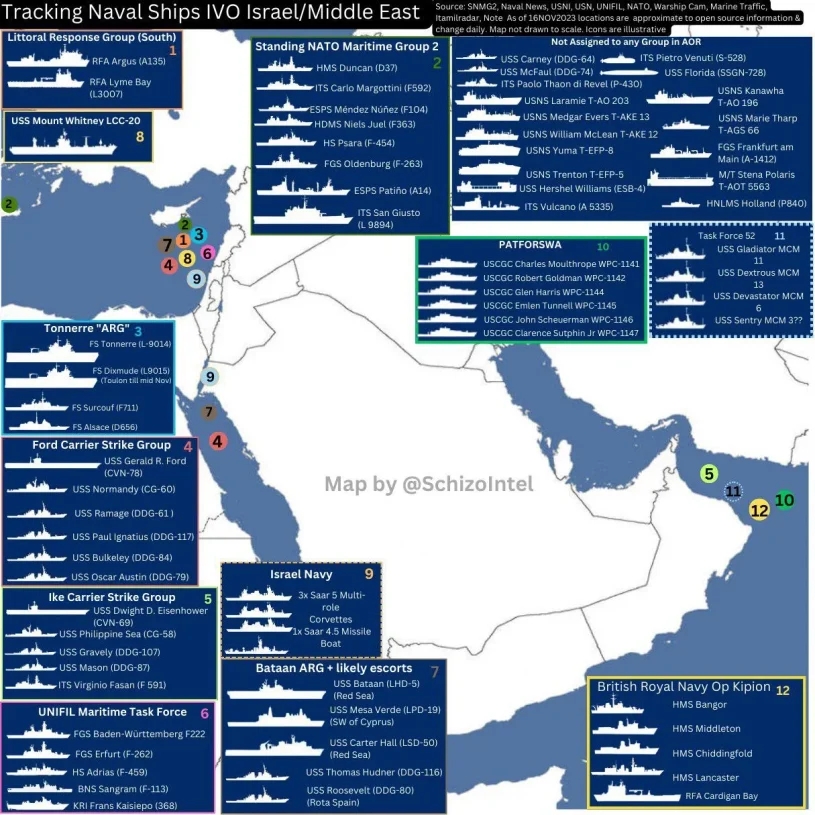
It purports to portray the current positions of the impressive array of US/NATO naval assets in the eastern Mediterranean, Red Sea, and the Arabian Sea / Gulf of Oman.
Maybe most of it is more or less accurate in terms of the positioning it indicates. But I do not, at present, believe it accurately represents the position of the USS Eisenhower Carrier Strike Group, which it suggests is sailing in the far reaches of the Gulf of Oman, more or less at the gates of the Strait of Hormuz.
The Eisenhower CSG is indicated by the bright green number 5 on the map. I am very dubious it has ventured into those dangerous waters.
Many believe the strike group will transit the straits, and take a cruise in the Persian Gulf.
I do not believe that will happen.
It would be, in my opinion, an extraordinary blunder of hubris.
That said, it will be a sure indicator of US intent towards Iran.
If the Eisenhower enters the Persian Gulf, it means the US aims to put it in optimal position to strike Iran — or at least to raise the stakes of its bluff to a level that it will very likely be called.
In other words, if the USS Eisenhower and its escorts enter the Persian Gulf, it will almost certainly compel an engagement with Iranian forces — likely ignited by an Iranian shoot-down of US ISR assets.
If, on the other hand, the Eisenhower remains sailing in the relatively safe deep blue waters of the broad portion of the Gulf of Oman and the Arabian Sea, then you can be sure the US actually has no desire to escalate to war with Iran.
That would be, in my estimation, a very wise course of action.
‘Israel’s’ ‘Nakba Doctrine’
By Alastair Crooke | Al Mayadeen | November 17, 2023
“We are now actually rolling out the Gaza Nakba”, says Avi Dichter, “Israel’s” Minister for Agriculture and former head of Shin Bet. The Israeli cabinet has been briefed that up to 1,700,000 Gazans (out of a total population of 2.2 million) are no longer able to live in their own homes, either because they’ve been ‘displaced’, or because their homes have been destroyed/damaged.
To project the image of the Israeli military as ‘bounding ahead’ with its operation to eradicate Hamas however, we see many videos of tanks and armoured personnel carriers around Gaza City — but by contrast, observe notably few images of IOF soldiers patrolling on foot – either to protect the tanks, which are subject to sniper or RPG fire, or (as many commentators suspect) out of fear of Israeli casualties.
Plainly, “Israel” sticks to their armoured vehicles, though they are taking regular losses of their vehicles from ‘flash’ mini squads of Hamas fighters emerging suddenly from concealed tunnels to destroy the vehicles – before disappearing again underground.
The IOF has entered Gaza City, progressing a couple of kilometres over the month, yet showing no serious evidence to date of having encountered the Hamas’ forces, nor having eliminated an appreciable number of them. Why?
Simply put, the Israelis are fighting a conventional war-model (an armoured ‘fist’ inching ahead under massive air support). But the contradiction to this model is blatantly obvious: the so-called ‘enemy’ on the ground simply are civilians, who are dying in horrifying numbers, whilst the Hamas forces remain intact, deep underground. That, too, is where the Hamas infrastructure lies.
The contradictions inherent to this approach lie rooted in the IOF’s evolution over decades to become a quasi-colonial police force, used to policing occupation through the twin vectors of massive force, plus absolute force protection. It is no secret that the IOF fears to engage in hand-to-hand firefights with Hamas units in the tunnel complex (for which their fighters are not adapted). So instead, we have a show of armoured vehicles parading on the surface, coupled with largely unsubstantiated IOF claims of damage inflicted on Hamas.
The most obvious contradiction is the Israeli Cabinet’s claim that the near non-existent military pressures on Hamas per se, are creating the conditions for the releasing of hostages; whereas the real pressure — the incessant air strikes – that are devastating the civilian population and its infrastructure (hospitals, schools, bakeries and refugee camps), is facilitating a second Nakba — more than any hostage release.
Maybe Hamas will release more hostages (calculated in terms of its strategic aims). If so, this likely will be construed – wrongly – as Hamas feeling pain. The conclusion, therefore, may be drawn that carpet bombing ‘works’. As Zvi Bar’el outlines in the liberal Israeli daily, Haaretz:
“According to Israel’s conception, the humanitarian crisis is part of an arsenal at its disposal, which can be used not just as a bargaining chip in negotiations over the release of hostages. Its role is to sear into Palestinian consciousness the apocalyptic punishment facing anyone who from now on dared challenge Israel.
This is a continuation of the deeply rooted strategic concept according to which humanitarian suffering might yield security-related gains …
More importantly, the humanitarian crisis in Gaza now gives Israel diplomatic leverage which includes getting concessions … Above all, it entails a defanging of the American rush to reach a two-state solution.”
The ineluctable logic to this analysis therefore is to continue with the status quo: If it isn’t working in respect to freeing hostages, or degrading Hamas, it can be presented to the Israeli public as ‘working’ through forcing civilians to flee their devastated communities (what Dichter calls the “Gaza Nakba”).
With the ‘Nakba Doctrine’ taking a hold, so favourable conditions for the release of hostages (which Hamas predicates upon a lengthy ceasefire and humanitarian supplies) melts away. The IOF can have one or the other: Either continuous destruction, or conditions for hostage releases. (It seems the cabinet has opted for the former.)
The other (more profound) dilemma is that international pressures for a ceasefire (and hostage release) are accumulating. Time is short, and the military operation may be required to cease. The issue for the Netanyahu Cabinet is — once stopped — will it be possible to resume the massacres of civilians and the Gaza Nakba pressures?
In this context, Israeli popular sentiment — even amongst former liberals — is moving toward a Greater Nakba. Gaza is under Nakba pressures. So is the West Bank, as settler violence against Palestinians surges. Even a ‘liberal’ such as former opposition leader Lapid now agrees that ‘settlers’ in the occupied West Bank are not ‘settlers’ at all, since the land is but the ‘Biblical land of Israel’.
Nakba ‘ambitions’ are widening to South Lebanon (up to the Litani River) too. The radical members of Netanyahu’s government say Israelis will never return to the kibbutz adjacent to Lebanon, without Hezbollah’s removal from the border area.
So, the call is heard for “Israel” to ‘take’ Lebanon up to the Litani (a key water source) — and ‘serendipitously’ the Israeli air force has begun operating up to 40 kms inside Lebanon. Cabinet members now openly speak of the IOF needing to turn its attention to Hezbollah once Hamas has been ‘obliterated’.
The northern border inevitably is heating up. Hezbollah is using its more sophisticated, and more lethal weaponry against IOF positions in northern “Israel” as the ‘rules’ of engagement continuously blur. And “Israel” is responding, with attacks shifting ever deeper into South Lebanon (ostensibly to strike at Hezbollah’s rear infrastructure).
Last night the Israeli War Cabinet voted for striking a major blow at Hezbollah — but Netanyahu demurred. The US reportedly suspects that “Israel” is provoking Hezbollah, hoping to entice the US into a war on Lebanon.
Plainly, the White House is struggling to avoid the slide towards full regional war, as both the Lebanese front and the Iraqi front heats up: On Sunday, Iraqi movements again fired missiles at the American base in Shaddadi.
“Israel” is sensing the present crisis to be both an existential risk, but an ‘opportunity’ too – an opportunity to establish “Israel” across ‘its Biblical lands’ over the long term. There is no mistaking it — this is the direction of travel of Israeli popular sentiment, from both Left and Right wings, to bloody eschatology.
As one prominent Israeli commentator wrote after watching (the unsubstantiated) 47-minute IOF film on the 7 October events:
“After seeing the film I have no compassion for any person in Gaza, not a woman, not a child, and certainly not a man. Everyone deserves a painful death, you were all complicit in this massacre. I hope that no one is left alive in Gaza, period! … I am sure that your God despises you, is ashamed of you, and would burn you in hell, just as the IDF is doing to you now”.
The ‘tribe of Amalek’ today is quoted widely. (King Saul, in the first Book of Samuel, commands Samuel to kill every person of the Amalekites: “Do not spare them; put to death men and women, children and infants, cattle and sheep, camels and donkeys”).
As the Israeli mood swings Biblical, so the global majority’s anger rises. And so Muslims come to see the crisis as an uncompromising civilisational war — The West versus ‘us’.
The concomitant two conferences — the Arab League and the OIC (held concurrently in Riyadh) — underlined the complete collapse of “Israel’s” image across the Islamic world. The outpouring of anger and passion was palpable, and is metamorphosing new global politics.
In the West, the anger is splintering mainstream political structures, and causing wide convulsion. Global protests are massive.
Thus, as “Israel” swings towards a Biblical “Greater Israel”, the Islamic world turns increasingly uncompromising. Though the conferences did not agree on any action-plan, the image of President Raisi sitting next to MbS; and that both Presidents Erdogan and Assad were co-mingling at the conference, was arresting.
The strategic implication is stark: Israelis now abjure the risks of living with Muslims, and the sentiment is fully reciprocated by Palestinians towards Hebraic zealotry. The old paradigm for a political solution is rendered obsolete.
War in Gaza: Decoding Nasrallah’s speeches
by lecridespeuples | Resistance News | November 13, 2023
Since he was elected Hezbollah Secretary General in 1992, following Israel’s assassination of his predecessor and mentor Sayed Abbas Mousawi, Sayed Hassan Nasrallah has achieved a very special status in the history of Arab & Muslim leaders. As Norman Finkelstein put it, “Nasrallah is the only political leader in the world from whom you learn in the speeches. He is a teacher. He is among the shrewdest and most serious political observers in the world today. Israeli leaders carefully scrutinize Nasrallah’s every word.” And denouncing the relentless censorship suffered by my translation of Nasrallah’s speeches on the Internet and social networks, he added: “Why are the rest of us denied this right? One cannot help but wonder whether Nasrallah’s speeches are censored because he doesn’t fit the stereotype of the degenerate, ignorant, blowhard Arab leader. It appears that Western social media aren’t yet ready for an Arab leader of dignified mind and person.”
Why is Nasrallah so feared, and paradoxically so listened to, by friends and foes alike? Why did the majority of Israeli citizens themselves, in the midst of war, trust his statements more than those of their own leaders? The reason is that Hezbollah’s credibility rests not only on two humiliating defeats inflicted on Israel in 2000 and 2006, the first in its entire history; but above all, it is because Nasrallah is a man of his word, who, if he doesn’t say everything he does or intends to do, scrupulously does everything he says. Counter-intuitive as it may seem, Nasrallah never lies, or at most by omission. In over 30 years, there has never been a false statement, a lie or an exaggeration from him, not even in the framework of his ongoing psychological warfare against Israel, where lies wouldn’t be a sin (“War is deception”, says a famous hadith of the Prophet). To quote Professor Finkelstein again, “Gamal Abdel Nasser was not serious. He gave all of these big speeches, this bombast, but there was nothing behind it. Every time he went to war, he said ‘We’re going to do this and that’, but he was defeated. I’m sorry, it’s just a fact. The first time you have a leader who’s serious, it’s Nasrallah. He says ‘We’ll do A’, we do A; ‘We’ll do B’, we do B. There’s no empty talk. That’s serious and I have to respect that.”
With Nasrallah’s credibility established, let’s ask ourselves what he really said during his speeches on November 3 and 11, and what this portends for the future.
Of the hundreds of speeches he has given over the past 30 years, the one on November 3 was undoubtedly the most eagerly awaited. The whole world hung on his every word, waiting to hear what Hezbollah would do to help the people of Gaza. Since Hamas’s spectacular operation on October 7, which caused an enormous earthquake felt not only in Israel but throughout the world, particularly in the largely pro-Zionist centers of Western power, the Palestinian population of the enclave has been subjected to a methodical war of extermination. And Hezbollah has always vowed solidarity with the Palestinian cause. So what was Nasrallah going to say during his first intervention, almost a month after the war began? Was he going to issue an ultimatum to stop the genocidal aggression against Gaza? Would he declare war on Israel and open a new front? Would he, as spokesman for the Axis of Resistance, announce the launch of the long-heralded “Great War of Liberation”, with, echoing the Palestinian “Al-Aqsa Flood”, a deluge of missiles on Haifa and Tel Aviv from Lebanon, Syria, Iraq, Iran and Yemen? These expectations were not reasonable, nor even rational. While Putin did announce the “Special operation” in Ukraine, which had been denied right up to the last second by his government, starting a war is not something that is usually announced, especially by Resistance movements based on guerrilla tactics. And Hezbollah, in such contexts, is used to acting before speaking, as demonstrated by the launch of operations against Israel on the Lebanese border in support of Gaza as soon as October 8.
When expectations are exaggerated, even on the part of the most reputable journalists and commentators, disappointment is inevitable. “Nasrallah barks but doesn’t bite”, ran the headline in an Italian newspaper, expressing the frustration of many, including his admirers. But a careful analysis of his words shows that there was no reason for disappointment. Quite the contrary, in fact.
A clear commitment
First of all, it was clear from the third minute of the speech that Nasrallah was not going to announce anything truly historic: referring to his forthcoming annual speech on November 11, Hezbollah’s Martyr’s Day, during which he would talk more about the martyrs, those of Hezbollah, the Palestinian Resistance and the people of Gaza, it was already clear that no major upheavals were planned. But what he announced was enough to reassure those hoping for a “miracle”: Nasrallah made it clear that even if Israel’s objectives in Gaza are illusory (to annihilate Hamas), and that yet another military failure was very likely and foreseeable, he assured us in no uncertain terms that if Hezbollah remained in the background for the time being and contented itself with forming a support front, if need be, Hezbollah would do everything necessary to ensure victory for Gaza, and for Hamas in particular. This included waging open, all-out war against Israel, which he insisted on, in order to deter Israel and reassure the Palestinian people & Resistance, and also to psychologically prepare the Lebanese population (and, beyond that, the populations of Middle Eastern countries and indeed the whole world) for the eventuality of Armageddon. Here are a few significant extracts of his speech:
“In 1948, when the world abandoned the Palestinian people, this entity was founded, and the Palestinian people and all the countries and peoples of the region paid the price. The Palestinians paid the highest price, but other peoples also suffered the tragic consequences: the Jordanians, the Egyptians, the Syrians, the Lebanese. And it may well be that Lebanon is the country that has suffered most from the consequences of the existence of this bellicose, usurping entity whose appetites (territorial & bloodlust) are insatiable. This is an undeniable historical truth. And today, the same thing is happening.
What is happening today in Gaza is not a war like other wars in the past. It’s not an event like any other. This is a pivotal, decisive, historic battle. What comes after will be nothing like what came before. And that means we all have to assume our duties. When we talk about assuming our duty, we have to determine the short-term objectives we all have to work towards. And as far as we’re concerned, there are two objectives: the first is to put an end to the aggression against the Gaza Strip. And the second objective is for Gaza to be victorious, for the Palestinian resistance in Gaza to be victorious, and in particular for Hamas itself to be victorious. These goals must be ours, resolutely, and we must work tirelessly to achieve them.
The first objective, to put an end to the war, has clear and indisputable reasons: they are humanitarian, moral, religious and legal. As for the second objective, o brothers and sisters, o listeners, it is in everyone’s interest. Certainly, victory in Gaza is first and foremost in the interest of the Palestinian people, of all the Palestinian people: victory in Gaza would mean victory for the Palestinian people, victory for the prisoners in Palestine, victory for the West Bank, the Gaza Strip, Al-Quds (Jerusalem), Al-Aqsa Mosque and the Church of the Holy Sepulchre. But it would also be the victory of the countries and peoples of the region, and above all of the neighboring countries. Victory in Gaza today is Egypt’s national interest. Victory in Gaza today is Jordan’s national interest. Victory in Gaza today is Syria’s national interest. And first and foremost, victory in Gaza today is Lebanon’s national interest. For what would an Israeli victory in Gaza mean, if the Resistance were defeated in Gaza? What would be the consequences for Palestine, for the Palestinian cause? And above all, what would be the consequences of an Israeli victory for Lebanon, in security, political, popular and demographic terms? […]
What happens on our front is very important, and has a great influence. Some people, who expect or demand that Hezbollah should quickly enter into a comprehensive and all-out war with the enemy, may think that what we’re doing is modest, but if we look objectively at what’s happening on the Lebanese border, we’ll see that it’s very important and meaningful. Of course, whatever happens, we won’t be satisfied with that. We won’t be satisfied with what we’re already doing, and we’ll do more. […]
If our position were simply one of political support, speeches and daily demonstrations, Israel would be reassured on its northern border, and would have sent all its forces to Gaza, and some to the West Bank. But this is what the Lebanese front has accomplished. Today, Hezbollah has been able to mobilize (and thus neutralize):a third of the Israeli army is blocked at the Lebanese border against our mujahideen who are fighting it at the border; and a large part of these forces are elite troops and essential units of the Israeli army that could have been sent to Gaza;
-
half of Israel’s naval forces are present in the Mediterranean, opposite us and opposite Haifa;
-
a quarter of the air force is mobilized in the direction of Lebanon;
-
almost half of Israel’s missile defenses (Iron Dome, Patriot batteries, etc.) are turned towards Lebanon;
-
almost a third of its logistical forces are directed towards Lebanon.
This is one of the direct results of our action on the border. These figures are precise and verified. So much for the first point.
Secondly, tens of thousands of settlers have been evacuated by the army or have fled the north of occupied Palestine on their own. 43 settlements have been evacuated. And the majority of those still there are soldiers, not civilians. In the south, around Gaza, 58 settlements have been evacuated. And all these settlers evacuated from the north and south represent a very strong psychological, moral, financial and economic pressure on Israel, to the point that the Israeli Finance Minister raised the alarm in this regard, and this is very important to apply pressure and play for time.
Thirdly, and perhaps most importantly, the operations we are launching on the border and in the Shebaa farms have created a state of anxiety, expectation, fear and even panic among the enemy’s political and military leaders, as well as the United States. They fear that this front will escalate into a full-scale war, or even spread into a regional war. And this is a realistic fear: it can happen, and the enemy must take it into account in his calculations. And this is what he is doing with the utmost seriousness, constantly expressing this fear and talking about it, and giving it great importance in his decisions. […]
On the Lebanese front, things are going to develop and even escalate in any direction depending on two things, one of two fundamental things: firstly, the development and outcome of events in Gaza. Our front is a front of support and solidarity with Gaza, and therefore it develops and escalates in the light of events there, and according to what the nature of events, threats and developments on the ground in Gaza really demands. And the second thing that will decide what happens on our Lebanese front is the behavior of the Zionist enemy vis-à-vis Lebanon.”
In the light of these statements, it seems clear that all those who have attributed to Hezbollah a position of neutrality, withdrawal or even cowardice and treachery, likening his promises to vain Nasser-style bombast, have not been paying close enough attention. If Hezbollah is content to be a supporting front, it’s because it believes that Gaza is capable of prevailing, and that a victory for Gaza alone would serve the cause of the Liberation of Palestine far better.
And as for thunderous announcements, Nasrallah’s first speech did contain one quite remarkable one: the threat to go to war directly against the United States itself, or even to neutralize its aircraft carriers in the Mediterranean Sea, which is far more consequential than any kind of threats against Israel:
“I declare with all sincerity, frankness and clarity, while maintaining strategic uncertainty: all scenarios on the Lebanese front are possible, and all options are on the table. We can make the choice (of all-out war) at any time. And we must all be ready and prepared for any scenario. And I say to the Americans: threats and intimidation are useless with us and with the Resistance movements in the region. They are of no use either against the Resistance movements or against the countries of the Axis of Resistance. Threats and intimidation against the Resistance will lead you nowhere.
Your aircraft carriers in the Mediterranean Sea don’t scare us, and never will. And I’m telling you in all honesty, those aircraft carriers you’re threatening us with, we’ve prepared everything we need to deal with them! O Americans, remember your defeats in Lebanon, Iraq and Afghanistan, and your humiliating retreat from Afghanistan. O Americans, those who defeated you in Lebanon in the early 1980s [on October 23, 1983, a suicide attack on the Marines’ headquarters in Beirut killed 241 US soldiers and officers who were taking part in the Lebanon war on the Israeli side, and drove them out of Lebanon; this attack is widely attributed to Hezbollah] are still alive, and at their side today are their children and grandchildren, and all are waiting for you with bated breath.“
As sensational statements go, this one is hard to beat.
Doublespeak?
The preceding analysis seems to me indisputable enough. The one I’m about to propose is more questionable – and more likely to please those who hope we’re witnessing the Final Liberation War.
As I said in my previous article, even if certain forces of the Axis of Resistance, whether Hezbollah or others, had already decided to go to full-blown war, it would be in their interest to make Israel believe the contrary, so as to let it engage meaningfully and get bogged down in Gaza, then attack it by surprise when, as happens in every war (because Israel never learns from its mistakes and keeps at it), finally understanding the imminence of a military, economic and moral disaster, it would call its US godfather to the rescue and ask him to vote for a ceasefire in order to save face. In this scenario, Hezbollah and its allies would only have to divide the enemy’s forces and paralyze part of them to ensure the failure of the troops in Gaza, while sending signals to the Israeli army (and the Americans) that they would go no further. And perhaps these signals were what so disappointed all those who had hoped to see Hezbollah unleash an all-out war against Israel, for at the end of his speech – a crucial moment – Nasrallah seemed to assert that the moment of Liberation was still a long way off:
“Concerning our horizon, I declare to our Palestinian people, to our brothers and sisters in Gaza, to all Resistance fighters and dignified men in Palestine and in our region, that since the Resistance movements were founded after the creation of the Zionist entity, we have been waging the battle of endurance, resilience and patience. Our battle has not yet reached the stage of dealing the fatal blow. We still need time before we can deliver the final blow to Israel. Let’s be realistic. We win step by step, we win by a succession of small victories. That’s how we won in Lebanon in 1985 [expulsion of Israel from ¾ of occupied Lebanese territory], then in 2000 [expulsion of Israel from southern Lebanon], then in 2006 [release of all Lebanese prisoners held in Israel]. That’s how the Resistance won in Gaza, how the Resistance achieved things in the West Bank. That’s how the Resistance won in Iraq. That’s how Afghanistan won. Through endurance, resilience, the ability to endure the sacrifices inflicted by the enemy. Here lies our main strength.”
Did Nasrallah need to spell it out so clearly, so bluntly, so explicitly, instead of leaving further doubt? Isn’t this a kind of “green light” to Israel and the US? Or was it something else? What if, in reality, he skilfully measured his words throughout the whole speech, so as to say enough, on the one hand, to reassure the Palestinians, Lebanese and Arab peoples who were eagerly waiting for him and direly needed moral support, and dissuade Israel and its allies from going too far, while reassuring, on the other hand, the American-Zionist enemy by making it believe that in reality, Nasrallah is only doing what’s necessary to maintain his credibility (saving face is paramount for imperialist forces, who are incapable of understanding that this concern may be indifferent to their adversaries), and isn’t prepared to risk a regional conflagration? This would be a real balancing act, which he would appear to have pulled off with flying colors, since after his speech, Israel and the United States seem to have received what they interpreted as Hezbollah’s subliminal “green light” and have stepped up their campaign. By the way, Hezbollah and the Axis of Resistance have done likewise, and continue to erode and exhaust the enemy: as Nasrallah announced in his speech on November 11, Hezbollah strikes are slowly but surely becoming more frequent and more severe, hitting Israel further and further away, using kamikaze drones and “Volcano” missiles with an explosive charge of up to 500 kilograms for the first time, and even retaliatory strikes targeting and killing settlers, as a retaliation for murdered Lebanese civilians: Israeli deaths and injuries on the Lebanese front number in the hundreds (Nasrallah mentioned 350 wounded, including many critical cases, in one hospital alone) and may already have paralleled those of 2006. Despite all this, the Axis of Resistance is still careful to maintain a measured escalation, to climb its ladder “step by step” indeed, and not to go beyond the stage that will trigger a loss of control of the situation and a regional war: for while the Resistance movements have the advantage when it comes to the war of attrition, aimed at provoking a gradual collapse of the enemy until the moment comes to deliver the “fatal blow”, the most devastating firepower is on the American-Israeli side. And it’s worth pointing out that, had Hezbollah and the other factions of the Resistance struck Israel and the US bases on October 8 as hard as they are doing now, the great war would already have broken out: but the more time passes, the more Israel’s hopes, capabilities and resources are drained, the more the US diplomatic cover is exhausted, and the less likely it is that a new front will be opened.
Indeed, it’s quite possible that the time for the “coup de grâce” is imminent: not only against the Israeli entity, but perhaps even against the United States itself, whose bases in Syria and Iraq are being struck daily and with increasing intensity, with the avowed aim of expelling their forces. A few passages from Nasrallah’s first speech directly suggest this:
“After the October 7 operation, the panic in Israel was such that from the very first day, the United States opened its strategic arms depots to the Israeli army. In the very first days, Israel asked for new weapons, new missiles, 10 billion dollars… While the Axis of Resistance had not even begun anything serious! Is this Israeli entity a powerful country? It can barely stand upright! The fact that all the European and Western presidents, prime ministers, ministers, generals, politicians rushed to revive this moribund country demonstrates its extraordinary fragility. […]
We must realize that the United States are the real cause of this war, and that Israel is merely its instrument. The United States is preventing the Security Council from condemning Israel, preventing a ceasefire, preventing an end to the aggression in Gaza. They are indeed the ‘Great Satan’, as described by Imam Khomeini. They are primarily responsible for all the massacres of the past and present century, from Hiroshima to Vietnam, Iraq, Afghanistan, Lebanon, Palestine and the whole region. And they must be held accountable for their crimes and massacres, and punished for everything they have perpetrated against the peoples of our region. And within this framework, the Islamic Resistance in Iraq has decided to attack the military bases of the American occupier in Iraq and Syria to drive him out, considering that it is the United States that is leading the battle in Gaza, and that it must pay the price for its aggression and support for Israel, its occupation and crimes in Iraq, Syria and Palestine.”
Has the time come for the extirpation of the Israeli “cancerous tumor” AND the expulsion of US forces from the Middle East, the promised “just retribution” for the murder of Qassem Soleimani? Many objective elements suggest that the time is more propitious than ever, from the earthquake of October 7 to the terminal disintegration of Israeli society even before these events (let’s not forget that Netanyahu was already disgraced and that the whole country was on the brink of civil war because of the judicial reform project), the draining of Western financial and military resources in Ukraine, the economic and energy crisis, and, above all, the unprecedented orgy of bloodshed unleashed in Gaza, which has massed populations all over the world against Israel. More than ever, public opinion is ready to accept the necessity of Israel’s demise, as the two-state solution is clearly nothing more than a joke. Nasrallah emphasized this point in his November 11 speech:
“Through its aggression and massacres, Israel aims to make Gaza bend and obtain surrender not through military victory but through mass terror, and also to regain its deterrence capacity towards the entire Axis of Resistance, but it will not achieve this objective: on the contrary, the choice of Resistance will be more and more massive, as has happened since 1948. And in so doing, Israel is inflicting many defeats on itself: for example, its monstrous and barbaric nature is becoming increasingly clear to the world’s peoples and governments alike. For over 20 years, the international media, and unfortunately even some Arab media, have worked tirelessly to portray Israel, its leaders and its settlers, illegitimately called “a people”, as good and decent fellows who aspire only to peace and peaceful coexistence. But all that is falling apart today. Israel is dealing a fatal blow to the project of normalizing its relations with Arab-Muslim countries, which was so dear to its heart, and which all the Arab & Muslim peoples had already rejected. But more important than this is the change in world public opinion, which has seen Israel’s true face behind the cloak of lies: Israel claims to protect children, but kills them by the thousands; the same goes for women. This current transformation is in the interests of the Resistance, its project and its peoples, as well as Gaza. The daily demonstrations being organized in our Arab and Islamic world are very important, but they are also happening in Washington, New York, London, Paris and other European and Western countries, whose people are putting massive pressure on their governments to end the aggression against Gaza. Even leaders who initially expressed unconditional support for Israel and opposed the ceasefire as a gift to Hamas are now calling for an immediate cessation of hostilities, with the exception of the USA and its UK servants. But the bloody aggression against Gaza, the massacres, the shredded bodies of women and children, deliberately and openly targeting hospitals, are making this war unbearable for the whole world, and putting pressure on the aggressors. Time is against the enemy and those who support him.”
Between their disgust at the ongoing genocide in Gaza, which will eventually convince them that Israel, since its genesis, has been a Judaic equivalent of ISIS, and the economic backlash of American and European sanctions against Russia following its intervention in Ukraine, Western peoples, who are demanding an end to the aggression from their governments in unprecedented demonstrations, will also weigh in to prevent their leaders from embarking on a military operation to rescue Israel that could trigger World War III, and a planetary economic and financial collapse. And as the idea of deporting 2 million Gazans to the Sinai desert has left Western leaders cold, the “remigration” of 6 million Jews to the most beautiful cities in Europe and America will seem like a much easier pill to swallow.
Finally, let’s remember that while Nasrallah has indeed repeatedly envisaged Israel’s demise following the collapse of the United States on the Soviet model, with no risk of triggering World War III (because without the protection of their US sponsor, the Zionist settlers would feel powerless and leave on their own in their millions), he did envisage another, far more dramatic scenario in a October 1, 2017 speech, which clearly contradicts his “small gradual victories” theory:
“I want to send a clear message to Israelis and Jews in Occupied Palestine and (all over) the world: from the beginning, within the Resistance, we have emphasized that our battle is directed against the Zionist invaders who occupy the land of Palestine and our Arab territories. Our battle is not against the Jews as followers of the heavenly Jewish religion (recognized by Islam) or as people of the Book [the Torah]. It was the Zionist movement that used Judaism and Jews to carry out a project of colonialist occupation in Palestine and the region, in the service of the British a hundred years ago, then later in the service of US policies.
Jews who have been brought from all corners of the world must know that they are but cannon fodder in a Western colonialist war against the Arab and Islamic peoples in this region. And today they are fuel for US projects and policies that target the people of the region. And when our people defend their existence, their land and their honor against Zionist gangs, they are unfairly accused of anti-Semitism. This accusation is found in every corner of the world.
I say today to the Jewish scholars, to their eminent personalities, to their thinkers: those who brought you from all corners of the world to Palestine for their own interests are ultimately working towards your destruction. You must know this, because it is written in your religious books.
The current Israeli government, led by Netanyahu, is leading your people to annihilation and destruction. For he only plans for war, and keeps seeking it. He worked in the past to prevent the signing of the nuclear deal with Iran, and he failed. And he is currently working with Trump to tear up that agreement and push the region into a new war. If Trump and Netanyahu push the region into another war, it will come at your expense, and it is you Israelis who will pay a very high price for these stupid policies of your head of government.
And Netanyahu is also pushing the region towards war against Lebanon, Syria, Gaza and the Resistance movements, under false titles and defensive pretexts, and a preventive war as he claims. And here, I hope that all Israelis will listen carefully to what I am going to say: Netanyahu, his government and his military leadership do not have a correct assessment of the magnitude this war will have if they manage to kindle its flames. How big will it be, what will be its battlefields, who will participate in it, who will enter it… Netanyahu, his government and his military leaders do not know how this war will end if they start it.
And I also confirm to you on this subject that they do not have a fair image of what awaits them if they undertake an act as stupid as this war. They have neither clarity (of vision), nor precise evaluation, nor fair picture of what awaits them. If they light the blaze of the next war, (they have no idea) how far it will reach, what areas it will embrace, and who will participate in it.
This is why today I call first and foremost on all Jews except Zionists to detach their considerations from Zionist calculations which themselves lead to final destruction.
And I call on all those who came to occupied Palestine believing in the promises that they would find the land of milk and honey to leave it. I call on them to leave Palestine and return to the countries from which they came so as not to be fuel in any war that the government of the fool Netanyahu leads them into. Because if Netanyahu launches a war in this region, there may not be time for them to leave Palestine, and there will be no safe place for them in occupied Palestine.
The enemy government must know that times have changed, just as it must know that those with whom it hopes for an alliance will be a burden to them, because they are themselves in need of protectors (and cannot help anyone). And the scale of the massacres committed by Israel against the Palestinian people and the peoples of the region, its partnership with ISIS and its open complicity in the project of partition of the region through its open and eager support for the secession of Kurdistan, all of this will cause the peoples of the region to render a momentous verdict against them.
And I conclude by saying to the Israelis, to the grassroots Israeli people in this usurping entity: you know that what your political and military leaders tell you about Israel’s ability to achieve victory in any upcoming war is largely made up of lies and illusions. What you have been told is largely made up of lies and illusions. And you know the extent of the flaws and breaches that exist within your army and your society.
And that is why you must not allow stupid and arrogant leaders to lead you into an adventure in which there may be the end of all things and this whole entity.”
While this scenario may have seemed a ludicrous fantasy in 2017, it is undeniable since October 7th, with Israel being humiliated and hit from all sides (Gaza, West Bank, Lebanon, Syria, Iraq, Yemen). Israel didn’t listen to Hamas’ warnings and got October 7. If they don’t heed Nasrallah’s much more ominous warning, they may well be on their last breath.
What happens next?
While neither imperialism nor Zionism cares about human lives, not even those of their own soldiers and citizens, who are effectively nothing more than fuel for their plans for domination (the “Hannibal procedure” in Israel, applied massively on civilians since October 7th, is a clear proof of this), the Axis of Resistance wants to preserve human lives at all costs, first and foremost its own, but also those of others, Zionists included: they want to kick out the invaders, not to kill them. This is why they have been repeatedly urging them to leave on their own before it’s too late. According to Islamic morality, which has nothing to do with the genocidal Talmudic teachings, an innocent life is worth an innocent life. And the cadres of the Axis of Resistance, who act on the basis of rational calculations, empirical analysis and a long-term vision, not on the spur of the moment, will know better than anyone how to wait and seize the best moment to deliver the “final blow” to the “temporary usurping entity”. There’s no point in trying to predict this fateful moment by focusing on speeches: at the end of his speech on November 11th, Nasrallah made it clear that for Hezbollah, it’s the ground and the weapons that speak first. Speeches and comments only come afterwards:
“In Lebanon, it’s the battlefield that speaks. Because the battle we are waging is unique. I don’t announce things in advance, only for the fighters to carry them out. Our policy in battle is that it’s the field that acts, it’s the field that speaks. And only then do we explain and comment on the actions in the field. That’s why eyes must remain riveted on the battlefield, and neither on our statements nor on my lips.”
It is therefore to the battlefield that we must turn our eyes, and despite the atrocious martyrdom of the people of Gaza, we must above all consider their indomitable character, their legendary courage and the heroic struggles of the Hamas & Islamic Jihad Resistance, backed by forces in Lebanon, Irak and Yemen. This is a sight for sore eyes, and it should reassure us about the outcome of this battle. Time is clearly on the Resistance’s side. Whether the final War of Liberation is near or far, if the “Sword of Al-Quds” in 2021, which was the first battle between Gaza and Israel deliberately instigated by the Palestinian Resistance, had already given us a glimpse of it with its unforgettable images of settlers hastily packing their bags and fleeing by the hundreds, the “Al-Aqsa Flood” has brought us closer than ever.
Whatever happens, Israel has lost the initiative, and will probably never regain it. On May 25, 2000, in his Liberation speech in Bint Jbeil, Nasrallah famously declared that “Israel is weaker than a spider’s web”, provoking bewilderment and mockery, but as he pointed out quoting Israeli media, today, many Israelis are more convinced of this truth than he is. In the same speech, Nasrallah also said that “The time of defeats is over, and we have well and truly entered the era of victories”. This prediction has been confirmed over and over, in ever more spectacular fashion, and can infallibly serve as our compass to predict the future.
President Bashar al-Assad speech on Gaza
Syriana Analysis | November 11, 2023
President al-Assad: Gaza has never just been a cause… Palestine is the Cause, and Gaza is the embodiment of its essence.
View at Odysee
If you’d like to support the channel:
🅿️ Patreon: https://www.patreon.com/Syrianaanalysis
▶️YouTube Membership: https://www.youtube.com/channel/UClvD…
💳 PAYPAL DONATIONS: https://www.paypal.me/kevorkalmassian
The Israel Exception to Free Speech
Israel’s stranglehold on American foreign policy must be identified and eliminated

BY PHILIP GIRALDI • UNZ REVIEW • NOVEMBER 10, 2023
Last Tuesday there took place a disgraceful display of visceral malignancy in the United States House of Representatives Chamber in the south wing of the Capitol building. The House, long characterized by its aversion to truth, justice and what was once the American way, has been corrupted by special interests who have effectively bought an overwhelming majority of legislators, to include the leadership of the two major political parties. In the area of foreign policy, as well as a spill-over into many domestic and constitutional issues, there is no more powerful lobby than that of the state of Israel, and its power was on full display on Tuesday afternoon when Representative Rashida Tlaib was censured for the crime of being of Palestinian ancestry and speaking up against the ongoing genocide of her people by the Jewish state. Nearly all Republicans voted to condemn her together with a considerable number of her fellow Democrats.
On the following day, the White House added its own condemnation of Tlaib, referring specifically to the phrase “from the river to the sea” used by her, a slogan conveniently regarded by some like the fanatical Zionist Anti-Defamation League (ADL) as an Arab rallying cry for the eradication of Israel. ADL’s ghastly director Jonathan Greenblatt inevitably equates use of the phrase with “antisemitism” and ADL insists that “’From the River to the Sea’ is a Hamas call to annihilate Israel” while also “claiming [that] it is a rally of coexistence [which] gives cover to terror.” Tlaib, for her part, was resurrecting a memory of the Palestine that once was, and she has asserted that the slogan is “an aspirational call for freedom, human rights and peaceful coexistence, not death, destruction or hate.” Pro-Palestinian protesters do also use the slogan as a plea for their long-delayed nationhood, but groups like ADL prefer to claim that the activity provides “material support for Hamas,” and, as Hamas is a US listed terrorist group, that equates to aiding terrorists. Tlaib had also particularly angered the White House through her recently posted online video that accused President Biden of supporting genocide in the Gaza Strip, a seemingly undisputable assertion.
One might argue that even Congressmen are protected by the First Amendment right to free speech, but it is becoming increasingly obvious that the Bill of Rights does not apply when Israel is concerned, either in the halls of Congress or on college campuses, where Palestinian groups are being harassed and banned. The Tlaib censure vote can be seen as part of the bipartisan effort to protect the state of Israel from any and all criticism. Rashida Tlaib broke no law, did not threaten anyone, nor did she call for the destruction of any nation, yet she was excoriated by a series of her comrade-speakers in the House for something akin to a crime against humanity due to her turning against what was repeatedly described as one of America’s closest allies, a best friend and the only democracy in the Middle East, all of which are lies. Israel is no ally, which would require a certain reciprocity, a word that apparently does not exist in Hebrew. And in the current crisis Israeli Prime Minister Benjamin Netanyahu has demonstrated that he will not be moved by US interests to mitigate the slaughter no matter how much Blinken-Biden suck up to him to make him budge. And as for the claim of democracy, Israel only grants citizenship with full rights to Jews, hardly a democratic measure. Apparently, cutting off the massive amounts of US aid, including the current $14.5 billion to pay for exterminating the Palestinians, is not even on the table. Israel will always get its pound of flesh and will call all the shots in its relationship with Washington.
Tlaib’s comments are in the context of a White House that believes it is free to send bombs to Israel to slaughter Palestinian children — without even revealing how many plane loads of weapons have been delivered or are on their way. And then there are members of Congress like Senator Lindsey Graham of South Carolina who are free to advocate a “total war” against what he calls “the most extremist population on Earth,” i.e. the Palestinians. But verbal criticism of what is clearly a genocide and a massive violation of international law that has the US government as an accessory in a war crime is impermissible and there are even concerns that the Tlaib censure could become the foundation for a criminalization of any criticism of Israel under the assumption that all critics are ipso facto antisemites and the comments themselves amount to a “hate crime.”
Consider for a moment the precedents to Tlaib’s disgrace who are still in office untouched by any procedural steps to define what are acceptable rights of legislators. Beyond Senator Lindsey Graham’s unchallenged invitation to a mass murder, there is Senator Bob Menendez of New Jersey whose apparent tendency to accept bribes has been a particularly lurid tale in part because much of the loot consisted of $480,000 in cash stuffed into jacket pockets, closets and in a safe, along with 13 gold bars, two of them marked as 1 Kilogram in weight to the value of more than $100,000. Both men are still walking around free of censure!
Israel’s love of the United States is only skin deep, if it is as much as that. Recall for a moment the comments by Israeli prime ministers on the nature of the relationship. Consider Ariel Sharon’s 2001 comment: “Every time we do something you tell me Americans will do this and will do that. I want to tell you something very clear, don’t worry about American pressure on Israel. We, the Jewish people, control America, and the Americans know it… I don’t care what the American people think, I own the congress!” Or Netanyahu’s famous quip also in 2001: “America is a thing you can move very easily!” So that is what “America’s best friend’s” leadership actually thinks about the United States and its people! It is a cash cow to be milked and otherwise exploited for political cover before being disposed of when its usefulness is gone.
Sharon also famously said “I vow that if I was just an Israeli civilian and I met a Palestinian, I would burn him and I would make him suffer before killing him.” It squares the circle on why the Gazans erupted in rage on October 7th. Palestine was one nation from the Jordan River to the Mediterranean Sea when Israel was founded in 1948. Since that time, Israel has been ethnically cleansing the Palestinians for three quarters of a century, has stolen and plundered their land, has replaced or eradicated hundreds of villages, has besieged Gaza for nearly 2 decades, and has engaged in mass starvation and now in genocidal mass killing. In the fighting preceding Israel’s independence, three quarters of a million Palestinians were driven from their homes and sent into refugee camps by Israeli militias, together with tens of thousands who were killed outright. Now the refugee camps in Gaza are being bombed together with churches, hospitals, schools and apartment blocks and we have only just learned that some Israeli officials are considering using one of their nuclear bombs to completely wipe out Gaza. It is surprising that the Palestinians have shown as much restraint as they have.
Given the damage that a corrupting Israel has done to America’s political system, it is important to ask what good the relationship with Israel has done for the average American whose tax dollars support the Zionist enterprise together with its plan to remove the Palestinians. The answer is that nothing good has come out of the so-called alliance, which has cost the US $260 billion in direct aid adjusted for inflation since 1946. Plus there is the large sum of $14.5 billion more recently approved and pending currently as some kind of war fund to enable Netanyahu to crush the Palestinians. Israel regularly gets $3.8 billion yearly in direct aid from the US Treasury, a gift from Barack Obama, that is more than what goes to all other countries combined. And there is also more-or-less “off the books” considerable additional money from special and joint military projects, dubious charities and state level development boards that bring the total up to roughly $10 billion per year, which does not include the billions in financial aid that are in reality bribes paid to Egypt and Jordan to maintain peace with the Jewish state. The handout from Uncle Sam helps make Israel a very wealthy country which can afford to give its Jewish citizens free health care and college education as well as subsidized housing.
And being joined at the hip to the Jewish state has a considerable downside, requiring the use of the US United Nations veto at regular intervals to protect the client state as well as involvement in unneeded wars in places like Lebanon, Iraq, Syria and Libya with Iran coming up next. Nor has Israel hesitated to kill Americans when it felt that the US was not fully supportive of its interests and the White House is so constrained by its “alliance” that it has essentially covered up the crimes against its own citizens. Last year’s sniper killing of Palestinian-American journalist Shireen Abu Akleh, which produced only a whimper from the Jewish dominated State Department, plus acceptance of Israeli lies about the incident, is a prime example. And then there is the killing of 34 sailors and the injuring of 172 more on the USS Liberty in international waters on June 8th 1967. The US Navy largely unarmed intelligence ship was monitoring the ongoing fighting with Egypt when it was attacked by Israeli planes and torpedo boats. Efforts to send US aircraft carrier warplanes to assist the ship were called back by President Lyndon B. Johnson, who also orchestrated a cover-up exonerating Israel from blame. One hopes he and his Secretary of Defense Robert MacNamara are now burning in hell.
The US government is so averse to challenging Israel that many believe that there are other unrevealed influences at play, possibly to include the Jeffrey Epstein/Mossad pedophile sex trafficking caper. It has long been true that candidates for high office in the US are approached by agents of the Zionist lobby and coerced into signing a pledge to support Israel. In return, the candidates who accept receive substantial political contributions and positive media. If they say “no” they are frequently targeted for defeat and go the way of Cynthia McKinney, Charles Percy, William Fulbright, Pete McCloskey and Paul Findley.
Congressman James Traficant of Ohio was perhaps the most aggressive voice in Congress in the 1980s and 1990s in expressing a critique of Israel’s power. He was inevitably controversial and was eventually imprisoned for seven years on a corruption charge that many subsequently considered to be a government set up. He had argued, among other things, that “Israel has a powerful stranglehold on the American government” explaining how Israel was “controlling much of our foreign policy” and “influencing much of our domestic policy.” He claimed quite plausibly that former Pentagon official Paul Wolfowitz, working for Israel, had “manipulated” President George W. Bush into the disastrous invasion of Iraq.
Traficant maintained in the 1990s that “We’re conducting the expansionist policy of Israel and everybody’s afraid to say it. They control much of the media, they control much of the commerce of the country, and they control powerfully both bodies of the Congress. They own the Congress.” If Traficant were still with us, he would be astonished to see how Jewish influence has actually increased, with 35 states having some rules or legislation punishing advocates of boycotts of Israel and bills currently before congress authorizing automatic war against Iran and even the expulsion of Palestinians from the US. The State Department has an ambassador who monitors so-called antisemitism and the White House has recently declared a war against what it describes as “surging antisemitism.”
Currently, everyone opposing the US engagement with Israel in its extermination of the Arab population in the area it controls is being labeled an anti-semite and speaking up for the Palestinians is becoming a good way to get kicked out of university and unemployed. Israel’s friends are busy compiling lists of students who support the Palestinians and are working on schemes to circulate their names to deny them jobs once they graduate. Rashida Tlaib is only the latest affront to the dignity and common sense of the US Constitution but she is certainly not going to be the last victim of the Jewish lobby, which must be labeled for what it is, made to register as the agent of the Israeli apartheid state, and excluded from unilaterally making the policies that all of us Americans have to pay the price for in the Middle East.
Philip M. Giraldi, Ph.D., is Executive Director of the Council for the National Interest, a 501(c)3 tax deductible educational foundation (Federal ID Number #52-1739023) that seeks a more interests-based U.S. foreign policy in the Middle East. Website is councilforthenationalinterest.org, address is P.O. Box 2157, Purcellville VA 20134 and its email is inform@cnionline.org.
Featured Video

Bombing Hitler’s Hometown
or go to
Aletho News Archives – Video-Images
From the Archives
‘Conspiracy Theory’ Now Fact: Greater Israel Has Arrived
By Kit Klarenberg | Mint Press News | January 28, 2025
Ever since Tel Aviv’s 1948 creation, much has been said and written about ‘Greater Israel’ – the notion Zionism’s ultimate end goal is the forcible annexation and ethnic cleansing of vast swaths of Arab and Muslim lands for Jewish settlement, based on Biblical claims this territory was promised to Jews by God. The mainstream media typically dismisses this concept as antisemitic conspiracy theory, or at most the fringe fantasy of a minuscule handful of extremist Israelis.
In reality … continue
Blog Roll
 Aletho News
- IRGC: Israeli, US universities in region legitimate targets after strikes on Iranian university
- Trump admits Iran hit USS Ford carrier: ‘We ran for our lives’
- Battle for Hungary: EU attacks on Orban are a sign of worse things to come
- Iraqi resistance conducts drone strike on US-run base in Syria
- Failing to Defeat Hezbollah, Israel & US Pressure Syria’s Ahmed al-Sharaa to Join War
- US-Israeli war on Iran drives global fertilizer prices up 40%
- Hezbollah’s Surprise Weapons Redefine Ground Battle with Israel
- Yemen joins fight against US, Israel by firing missiles at occupied territories
- Seizing the Kharg: Washington’s path to defeat in the Persian Gulf
- Iran reports 500 US casualties in strikes on covert US military sites
- If Americans Knew
- Over 300 US service members wounded, majority have brain injuries – Not a ceasefire Day 169
- Researchers at Human Rights Watch Resign Over Blocked Report on Palestinian Refugee Return
- Jewish Groups Are Backing a War Americans Don’t Want
- Eric Fingerhut Thinks He’s the President of the Jews
- Top Jewish Philanthropists, Rabbis Urge Israeli President to Take Action Against ‘Jewish Extremists’
- Don’t Be Fooled. Zionist Leaders Have Always Wanted to Control Southern Lebanon
- Israel’s widespread use of torture is a core element of its genocide against the Palestinian people
- In Israel’s War on Iran, Many Middle East US Bases Rendered “All But Uninhabitable”
- ‘Burn the lawn’: Israel pursues ‘Rafah model’ in southern Lebanon
- A genocide here, an amputation there
- No Tricks Zone
- Devastating Assessment Of Comirnaty Vaccine By Former Senior Pfizer Europe Toxicologist
- New Study: CO2 Is ‘Effectively Negligible’ As An Explanatory Climate Change Factor Since 2000
- Former Pfizer Toxicologist Dr. Helmut Sterz Tells Bundestag Hearing Pfizer Vaccine Should Have Never Been Approved
- Energy Expert: Germany’s Nuclear Phaseout Was A “500 Billion Euro Mistake”
- New Research: South Australia’s Mid-Holocene Sea Surface Temperatures Were 4°C Warmer Than Today
- Storing Green Energy To Last Germany 10 Days Would Require A 60-Million Tonne Battery
- New Studies: UK Sea Levels Were 4 Meters Higher Than Today During The Mid-Holocene
- Destructive Green New Deal: German Energy And Metal Group Warns Of Drastic Crisis
- New Study Documents A 20-Year Pause In Arctic Sea Ice Decline – Driven By Internal Variability
- Wake-up Call: Survey Shows Majority Of Germans Now Favor Postponing Climate Targets!
 Aletho News