Rep. Marjorie Taylor Greene is fed up with U.S. support for Israel and more wars
If Americans Knew | July 3, 2025
Marjorie Taylor Greene, aka MTG, is a MAGA Republican and the U.S. representative for Georgia’s 14th congressional district since 2021.
Excerpts taken from Rep. Marjorie Taylor Greene’s appearance on The Tucker Carlson Show (June 27, 2025):  • Marjorie Taylor Greene: AIPAC, NYC’s Futur…
Path to peace lies beneath our feet; strength will not bring true peace: Chinese foreign minister
Global Times | July 5, 2025
Chinese Foreign Minister Wang Yi on Friday criticized the notion of “might makes right,” questioning where rules and justice stand under such logic at a joint press conference in Paris with his French counterpart Jean-Noel Barrot. “Strength will not bring true peace; it may well open ‘Pandora’s box’. How should countries lacking strength, especially small and medium-sized ones, find their place? Are they to be laid out on the table, left at the mercy of others?” said Wang.
Wang, also a member of the Political Bureau of the CPC Central Committee, is visiting Europe from June 30 to July 6, at the invitation of High Representative for Foreign Affairs and Security Policy of the EU Kaja Kallas, Federal Foreign Minister of Germany Johann Wadephul, and Minister for Europe and Foreign Affairs of France Jean-Noel Barrot.
Responding to questions about China’s stance on the Iran nuclear issue and the current situation in the Middle East, Wang said that the Iran nuclear issue could have been a model for resolving international disputes through dialogue and negotiation. However, it has now triggered a new round of crisis in the Middle East. Despite hearing the knock of peace, the door to peace remains shut. China deeply regrets this outcome and believes there are profound lessons to be learned.
Wang reiterated China’s clear and consistent position on the Iran nuclear issue. “We value the repeated public commitments made by Iranian Supreme Leader that Iran will not develop nuclear weapons, and we also respect Iran’s right, as a signatory to the Treaty on the Non-Proliferation of Nuclear Weapons (NPT), to the peaceful use of nuclear energy,” he said.
Based on this, relevant parties should accelerate negotiations to reach a new international agreement on resolving the Iran nuclear issue, placing Iran’s nuclear activities fully under the strict supervision and safeguards of the International Atomic Energy Agency, Wang said.
He emphasized that the path to peace lies beneath our feet, and history will question the sincerity of all parties involved.
The Chinese foreign minister said that military conflicts between Israel and Iran should not be repeated as war cannot resolve the Iran nuclear issue, and preemptive strikes lack legitimacy. The excessive use of force will only escalate conflict and breed more animosity, warning that the US’s brazen bombing of a sovereign country’s nuclear facilities has set a dangerous precedent and if it leads to a nuclear disaster, the entire world will bear the consequences.
Wang also emphasized that the genuine resolution of the Iran nuclear issue cannot ignore the core issue in the Middle East, which is the Palestinian question. The humanitarian disaster in Gaza must not be allowed to continue. The Palestinian issue must no longer be marginalized. The legitimate aspirations of the Arab nation should be fulfilled as soon as possible, and the just voices of the broader Islamic world must be given due attention.
The “two-state solution” remains the only realistic path to resolving the chaos in the Middle East, and the international community should take more concrete and effective action to support this goal, Wang said.
Wang called for China and France, both as permanent members of the UN Security Council, to uphold justice and take responsibility by supporting conflict resolution through dialogue and negotiation, opposing double standards, and basing their positions on the merits of the matter itself. The UN and its Security Council should play their due role in promoting peace. China is willing to work with France to make unremitting efforts toward these goals.
Russia warns of Israeli ‘war party’ seeking to reignite aggression against Iran
Press TV – July 4, 2025
Russia has warned about various Israeli officials’ efforts to trigger the resumption of aggression against Iran.
Foreign Minister Sergei Lavrov made the remarks during a press conference alongside his visiting Saudi counterpart Faisal bin Farhan in Moscow on Friday.
“We sincerely hope that the so-called 12-day war is indeed over,” the Russian top diplomat said.
He was referring to the Israeli regime’s launching attacks against the Islamic Republic’s nuclear, military, and civilian targets on June 13. The assaults claimed the lives of at least 935 Iranians, including senior military officials and nuclear scientists, the latter group being targeted inside their residential buildings.
The Islamic Republic responded with decisive defensive maneuvers and counterstrikes, hitting critically sensitive nuclear, military, and industrial infrastructure across the occupied Palestinian territories. The retaliation forced the regime to request a ceasefire.
Lavrov, however, warned, “We intend to stay vigilant, as the ‘war party’ remains highly active in the Middle East.”
“We keep hearing a variety of statements from some representatives of the Israeli leadership,” he added, suggesting that those officials were persistently agitating for the resumption of aggression against the Islamic Republic.
Iran has, on many occasions since the cessation of the attacks, cautioned that its next reprisal against potential renewed aggression would be of far more intensity and magnitude to the extent that it would take Tel Aviv and its allies by surprise.
‘European states role in war’
Elsewhere in his remarks, Lavrov criticized some European states’ “aggressive” anti-Iranian efforts, which saw them force the International Atomic Energy Agency (IAEA)’s Board of Governors to issue its most recent anti-Iranian resolution.
He pointed out how the European countries “unnecessarily and aggressively pushed through anti-Iranian resolutions, which did nothing to ease tensions or advance negotiations, but instead created a pretext for forceful measures.”
The Israeli regime used the resolution as a pretext to launch the war. The resolution was also used by the United States, the regime’s biggest ally, as a plea to join it in attacking Iran towards the end of the warfare.
“I sincerely hope that European nations will come to recognize their responsibility and their share of the blame,” Lavrov said.
For his part, the Saudi foreign minister also underlined that differences with the Islamic Republic had to be resolved through diplomatic processes.
‘Israel’ establishes 10th military outpost in Syria
Al Mayadeen | July 3, 2025
“Israel’s” occupation forces have constructed a new forward military outpost within Syrian territory, marking the tenth such site since the fall of then-President Bashar al-Assad’s control, according to Israeli media outlet i24.
The i24 report states that these outposts are distributed between two positions on Mount Hermon and eight across the occupied Syrian Golan Heights. The latest position was reportedly completed on Tuesday.
The 7006th Battalion of the Israeli military is responsible for building and maintaining this latest outpost, as part of broader efforts to entrench “Israel’s” military presence in the occupied territories.
Consistent Israeli-Syrian engagement
According to a report by Axios, “Israel” is engaging with Syria through at least four communication channels. These include Tzachi Hanegbi, the national security advisor to Prime Minister Benjamin Netanyahu; David Barnea, director of the Mossad; Foreign Minister Gideon Sa’ar; and ongoing military coordination through the Israeli army.
Al-Sharaa reportedly held a covert meeting with senior Israeli intelligence officials in the United Arab Emirates earlier this year, marking a dramatic departure from Syria’s historic rejection and refusal to submit to “Israel”.
Moreover, a source cited by i24NEWS reported that the April 13 meeting in Abu Dhabi was mediated by the UAE and attended by top Israeli representatives from the Mossad, National Security Council, and IOF intelligence.
Additionally, previous reports have indicated that Netanyahu is interested in initiating negotiations for a broader security agreement with Syria, which could serve as a preliminary step toward a comprehensive “peace” accord.
New outposts signal long-term Israeli occupation
On a related note, earlier in March this year, The New York Times reported that the Zionist regime is entrenching its military presence in Syria and Lebanon by building a network of outposts and infrastructure that signaled a potential long-term occupation of neighboring lands.
Satellite imagery, eyewitness accounts, and UN sources confirm the establishment of fortified positions, roads, surveillance towers, and military housing in illegally occupied lands. In the Syrian town of Jubata al-Khashab, heavy machinery has been spotted alongside new barriers and defensive walls, underscoring the scale of the ongoing land grab.
The Israelis moved aggressively to fortify their hold in Syria, establishing at least nine outposts across the south. Citing distrust in Syria’s newly formed government, Tel Aviv expanded its reach into formerly demilitarized zones, backed by continued airstrikes.
Even though Al-Sharaa reaffirmed Damascus’ commitment to the 1974 cease-fire, Netanyahu dismissed the agreement, declaring it void and calling for the “complete demilitarization” of southern Syria.
Time for Qatar to review its hosting of US Al Udeid military air base
By Thembisa Fakude | MEMO | July 3, 2025
The assassination of one of the highest-ranking Generals and the Commanders of Al Quds Force – part of the Islamic Revolutionary Guard Corp (IRGC) – Qasem Soleimani, opened an unprecedented form of conflict in the Gulf region. Soleimani was killed in Iraq on 3 January 2020 by an US drone strike in Iraq, while travelling to meet Iraqi Prime Minister Adil Abdul Mahdi. Iran retaliated by targeting the US military facilities in Iraq, it fired more than a dozen ballistic missiles at two Iraqi air bases housing US forces days after the assassination. According to The Times of Israel, Israel helped the US in that operation.
The leader of Hamas, Ismail Haniyeh was killed by Israel in Tehran after attending the inauguration of the President of Iran Masoud Pezeshkian. Another pure violation of the sovereignty of Iran and international law. The killing of Haniyeh in July 2024 came on the heels of the attack and killing of a number of Iranian diplomats at the embassy of Iran in Damascus, Syria on 01 April 2024. Israel – with the support of the US – has continued to assassinate Iranian officials at will inside Iran.
Qatar had joint military operations with the US during the Operation Desert Storm in Iraq in 1991. After the operation, Qatar and the US signed a Defence Cooperation Agreement. The agreement was expanded in 1996 to include the building of Al Udeid Military Air Base at a cost of more than $1 billion. The Al Udeid Military Air Base is the largest US military base in the Middle East. Iran attacked Al Udeid in retaliation to the US’s attacks of Iranian nuclear sites in Fordo, Natanz and Esfahan in Iran in June 2025. Although the retaliation strikes were downplayed by the US and Qatar, the attacks seemed to have been carefully choreographed, exposing a new fault line in US-Qatar military cooperation.
The question in the minds of most Qataris is; what will happen next time when the US decides to attack Iran, will Iran retaliate by attacking Qatar again? Notwithstanding the repeated mantra of “a friendly, brotherly love and appreciation” between Qatar and Iran, the biggest threat to Qatar’s security and political stability now and in the near future is a possible war between Israel and the US against Iran. The targeting of Iran by Israel and the US presents a new security threat in the region.
Al Udeid has served as “a symbol of protection for the State of Qatar against potential attacks and other forms of hostilities”. However, when put to the test, Al Udeid has failed to meet those expectations. Besides the recent Iran attacks of the US military installations in Al Udeid; when Saudi Arabia, UAE, Bahrain and Egypt led a blockade against Qatar in 2017, there was no forewarning from the US notwithstanding Al Udeid’s superior military intelligence. According to the Qatari Defence Minister, Khalid al Attiyah, “Actually it was not a mere intention. There was a plan to invade Qatar”. The “plan was set into two phases, imposing the siege with the aim of creating an overall state of panic, which would have a direct impact on the Qatari street, then executing a military invasion”.
The possible future conflicts involving the US and Iran have raised serious concerns about the safety of US assets and personnel in the region. It has also triggered a debate, particularly within the US media, of the viability and rationale of the country’s continued involvement in Israel’s wars in the region. The Make America Great Again (MEGA) leading supporters such as the executive chairman of Breitbart News, Stephen Banon and right-wing journalist and social media influencer Tucker Carlson have questioned “the US continuing blind support Israel’s wars in the Middle East”. Tucker Carlson a known Trump supporter and a right-wing voice has been the loudest. He has been “urging the US to stay out of Israel’s war with Iran”. Bannon and Carlson are part of a broader effort to overturn the “GOP’s hawkish consensus on Israel”. Notwithstanding his unwavering support of Israel, Trump has been critical of Benjamin Netanyahu war mongering strategy in the region. Trump has entered into lucrative business relationships with countries in the Arab/Persian Gulf recently; Netanyahu stands to disturb that relationship. The US and the United Arab Emirates (UAE) have agreed to turn Abu Dhabi “to a site of the largest artificial intelligence campus outside the US”. The US will allow “the UAE to import half a million Nvidia semiconductor chips, considered the most advanced in the world in the artificial intelligence products”. According to The Guardian, Saudi Arabia struck a similar deal of semiconductors, obtaining the promise of the sale of hundreds of thousands of Nvidia Blackwell chips to Humain, an AI start-up owned by the Saudi Sovereign Wealth Fund. Indeed, given these interests and the strengthening relationship between the US and the Gulf countries, the US has much more to lose if it continues to blindly support Israel’s wars.
The relationship between Iran and the State of Qatar is very strong, both countries share gas exploration sites in the South Pars/North Dome. They are the gas condensate fields located in the Arabian/Persian Gulf. They are by far the world’s largest natural gas fields. There is also the people to people relationship between Qatar and Iran dating back to time immemorial. The next attack of Iran by the US or Israel could escalate and spread the war to Qatar. Although the US managed to move its assets from Al Udeid to other locations in Qatar before Iran’s attacks last month, the question remains. What guarantees do Qatar have that in future Iran would not target those locations? There is a possibility that if attacked Iran will once again retaliate. What will happen then? The retaliatory attacks could go beyond a mere violation of Qatar’s airspace and sovereignty; it could also cost Qatari lives. The State of Qatar has to take serious decisions regarding Al Udeid if it wants to maintain its future relationship with Iran and other countries in the region. It must close Al Udeid. It has more valid reasons to do that now. The threat has morphed in the region. Consequently, new defence infrastructure needs to be considered by Qatar. Al Udeid presents more political and diplomatic challenges than opportunities.
Iran unity foils West plans for regime change: Responsible Statecraft

Al Mayadeen | July 1, 2025
Washington is now looking into dividing Iran, with neo-conservative think tanks openly promoting the Balkanization of Iran, a strategy that is bound to destabilize Iran and the region, according to Responsible Statecraft on Tuesday.
United States foreign policy has a troubling tendency to promote the fragmentation of nations it deems adversarial.
Now, neoconservative think tanks like the Foundation for Defense of Democracies (FDD) and their allies in the European Parliament are openly pushing for Iran’s disintegration, a reckless strategy that would further destabilize the Middle East, trigger catastrophic humanitarian crises, and provoke fierce resistance not only from Iranians but also from US partners in the region.
Think tanks push for fragmentation based on ethnicity
Amid the war “Israel” waged on Iran in mid-June, FDD analyst Brenda Shaffer posited that Iran’s ethnically diverse population structure presented an exploitable strategic weakness.
According to Responsible Statecraft, Shaffer advocated for the disintegration of Iran along ethnic divisions, drawing parallels to the breakup of Yugoslavia, while concentrating significant efforts on fostering separatist movements in Iranian Azerbaijan, home to Iran’s largest ethnic minority group, the Azeris. However, she consistently failed to acknowledge her ties to the Azeri state oil company SOCAR.
Her position mirrors a recent Jerusalem Post editorial that, during the initial wave of triumphalism following “Israel’s” strikes in this month’s war on Iran, urged Trump to publicly endorse the dismemberment of Iran.
The editorial specifically advocated for forming a “Middle East coalition for Iran’s partition” while proposing “security guarantees for Sunni, Kurdish and Balochi minority regions seeking independence,” in addition to previously endorsing US and Israeli support for the secession of northwestern Iran’s Azeri-majority areas referred to as “South Azerbaijan” from Iran.
Popular uprising or scenarios for regime change?
Meanwhile, a foreign affairs spokesperson representing a centrist liberal faction within the European Parliament organized a discussion forum titled “The Future of Iran,” which while framed as an examination of potential pathways for what they termed a “successful” uprising against the current Iranian government, appeared to focus primarily on scenarios for regime change.
The panel’s composition featured only two Iranian speakers, both ethnic separatists from Azerbaijan and Ahwaz, revealing the organizer’s true agenda: promoting regime change.
Since unilaterally cutting ties with Iran’s official institutions in 2022, the European Parliament has become a platform for fringe exiled groups. These include monarchists, the controversial MEK (Mujahedin-e Khalq), and ethnic separatists, all of whom now operate with growing visibility in EU political spaces.
Delusions of division
What these think tanks and organizations forget, Responsible Statecraft highlighted, is that Iran is not a fragile country on the brink of collapse; it is a 90-million-strong country with a deep sense of historical and cultural identity.
While the proponents of the Balkanization of Iran focus on the ethnicities in Iran, they underestimate the unifying effect of Iranian nationalism on these diverse groups.
Shervin Malekzadeh, a scholar who recently wrote in the Los Angeles Times, observed that academic research overwhelmingly recognizes Iranian politics as fundamentally rooted in a profound, enduring national identity.
This identity transcends the country’s internal ideological divides, which means Iran’s political dynamics unfold within this unifying framework of nationalism, which has shaped all major factions, from monarchists to Islamists to leftists.
Foreign pressure only made Iran more united
Moreover, decades of foreign pressure, sanctions, covert ops, and war have only hardened Iran’s unity, making the separatist approach dangerously naive; this approach, pushed heavily by pro-“Israel” neocons, already failed in Iraq and Syria, leaving chaos instead of victory.
This approach further demonstrates its advocates’ glaring disregard for actual conditions, as seen with Shaffer, a leading proponent of Azerbaijani irredentism, who even applauded Israeli strikes on Tabriz, the cultural and economic center of Iranian Azerbaijan.
Beyond being morally reprehensible, this strategy fundamentally misreads Iran’s domestic realities, with Shaffer and like-minded advocates operating under the flawed assumption that increased external pressure on Tehran would spark rebellions among Azeris and other minority groups against the central government.
Contrary to separatist expectations, “Israel’s” recent attack produced the same rally-around-the-flag effect seen across Iran, demonstrating how deeply Iranian Azerbaijanis are woven into the national fabric, as evidenced by the fact that both the country’s highest officials, Iranian Leader Sayyed Ali Khamenei and President Massoud Pezeshkian, are of Azeri heritage.
From the War of the Cities to True Promise 3: Iran’s ballistic program and the path to networked deterrence
By Abbas Al-Zein | The Cradle | June 28, 2025
Under a regional sky long dominated by US and Israeli air and intelligence superiority, Iran made a fateful decision decades ago. It would not attempt to match its adversaries tank-for-tank or plane-for-plane, but would instead build an asymmetric deterrent from scratch.
Rather than chase the mirage of classical military parity, Tehran developed an indigenous ballistic missile arsenal that is now the largest and most formidable in West Asia. This was no short-term, tactical gambit. Iran’s missile doctrine was forged in an existential struggle, refined over war and siege, and ultimately transformed into a cornerstone of national defense policy.
The War of the Cities: Birth under siege (1980–1988)
The first phase of Iran’s missile journey began in the crucible of the devastating Iran–Iraq War, specifically during the infamous “War of the Cities.” As the Baathist government in Baghdad launched Soviet-supplied Scud-B missiles deep into Iranian urban centers, it did so under the protective umbrella of western intelligence and funding from Arab states of the Persian Gulf. The intent was clear: to break Iranian civilian morale through systematic terror from the sky.
Caught without a missile deterrent of its own, besieged diplomatically, and encircled by western-aligned forces, Iran turned to whatever resources it could muster. It secured limited quantities of Scud-B missiles from Libya, Syria, and North Korea. These early acquisitions, modest as they were, formed the embryonic core of a deterrent force placed under the direct command of the Islamic Revolutionary Guard Corps (IRGC).
But these were more than mere missiles. They were weapons of national dignity in a war for survival for the nascent Islamic Republic. Iran’s leadership came to view missile capability not simply as a tactical asset, but as a psychological and political necessity.
Military historian Pierre Razoux notes in The Iran-Iraq War (2014) that it was during this phase that Iran’s leadership came to the unshakable conclusion: without a retaliatory missile force, no psychological or strategic deterrence was possible.
The Iranian response was neither ad hoc nor passive. Alongside importing missiles, Iranian engineers began dismantling, studying, and maintaining the systems. They built smuggling networks, circumvented embargoes, and reverse-engineered technology.
North Korea emerged as a critical partner, acting as a conduit for Soviet missile know-how. A 2010 RAND Corporation report titled Iran’s Ballistic Missile Capabilities: A Net Assessment noted that Iran had become capable not only of replicating but also of redesigning and expanding missile technology independently. Between 2000 and 2010, Iran pivoted from mass production to innovation, prioritizing accuracy, range, and operational readiness.
The foundations of Iran’s ballistic doctrine were thus laid: sovereignty through technological independence, and defense through deterrence.
From imitation to innovation (1989–2009)
With the Imposed War over, Iran’s military establishment—spearheaded by the IRGC—began restructuring its defense priorities. The goal was no longer just to have missiles but to produce them independently and on a large scale.
At the heart of this transformation was the late martyred Brigadier General Hassan Tehrani Moghaddam, a strategic thinker and technical mastermind hailed as the ‘father of Iran’s missile program.’ He understood that deterrence was not about launching missiles, but about mastering their lifecycle: production, concealment, deployment, and precision.
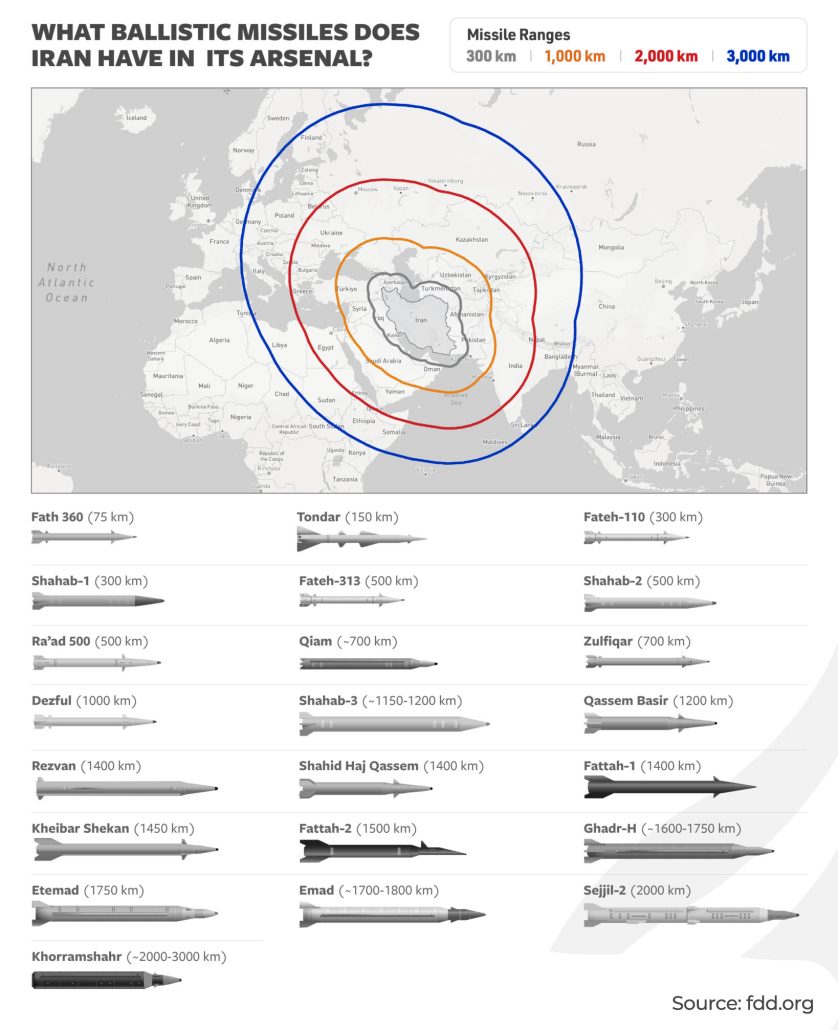
Under his leadership, Iran transitioned from a user to a manufacturer. The Shahab-1 and Shahab-2 were enhanced variants of the Scud-B and Scud-C. But the real breakthrough came in 2003 with the Shahab-3, boasting a range exceeding 1,300 kilometers—a capability that placed US bases in the Persian Gulf and occupied Palestine within striking distance. The Shahab lineage would later give way to the Ghadr class, with better range and multiple warhead capabilities.
The most significant leap, however, came with the adoption of solid-fuel propulsion. The Sejjil missile (2,000–2,500 km range), unveiled by the end of the 2000s, was Iran’s first medium-to-long-range system not reliant on Scud technology. It signaled a new era of technological self-sufficiency and rapid-launch capability.
During this phase, Iran undertook sweeping strategic steps: adopting solid-fuel for easier storage and rapid deployment, establishing underground and mobile launch facilities to avoid detection, building decentralized manufacturing to reduce vulnerability to strikes, and integrating missile research into academic institutions to develop a domestic cadre of experts.
A 2010 report by the International Institute for Strategic Studies (IISS) titled Iran’s Ballistic Missile Capabilities: A Net Assessment noted that by this stage, Iran had moved beyond simply replicating foreign missile systems and had begun designing its own through local R&D and systematic redesign, including the establishment of underground manufacturing. From 2000 to 2010, Iran’s program pivoted decisively from quantity to quality, enhancing range, precision, and operational readiness.
When Moghaddam was killed in a suspicious explosion at the “Defenders of the Sky” base in November 2011, Iran declared it a national loss. While Israel neither confirmed nor denied responsibility, the Yediot Aharonot newspaper reported that “some assessments” indicated that the blast was “the result of a military operation based on intelligence information.”
Nevertheless, his legacy endured. He had not merely built a weapons system; he had established a sustainable missile doctrine rooted in adaptability and local expertise. His death marked the end of one era, but it also catalyzed the birth of Iran’s next missile generation.
Smart missiles and precision strikes (2010–2020)
By the 2010s, Iran’s goal had shifted from mass deterrence to precision deterrence. Engineers focused on guidance systems using inertial navigation paired with domestic GPS and anti-jamming technologies. The result was a suite of short- and medium-range guided missiles with enhanced tactical utility.
This generation included the Zolfaghar (750 km), the highly precise and compact Fateh-313 designed for preemptive strikes, and the Qiam—Iran’s first finless missile, engineered for stealth and maneuverability.
Iran also entered the low-altitude cruise missile domain, developing systems such as the Soumar (with a range of over 2,000 km) and Hoveizeh (with a range of 1,350 km), both capable of evading conventional radar and penetrating advanced air defenses.
These weapons were not theoretical. In June 2017, Iran launched six medium-range missiles from its territory targeting ISIS command centers in Deir Ezzor, Syria—its first operational cross-border use since the 1980s.
In January 2020, in direct retaliation for the US assassination of IRGC Quds Force General Qassem Soleimani, Iran struck the Ain al-Asad base in Iraq with Qiam and Fateh missiles. Satellite imagery showed sub-five-meter accuracy, hitting aircraft hangars and troop shelters. The New York Times described it as one of the most accurate missile strikes on a US facility in modern history.
This decade marked Iran’s shift from “deterrent” missiles to “executive” missiles—systems where political power was expressed through precision. It was no longer about maximum range, but maximum effect. The missile became a scalpel, not a hammer, paving the way for Iran’s most advanced deterrent doctrine yet.
The rise of networked deterrence (2021–2023)
By the 2020s, Iranian missiles were no longer stand-alone assets. They had become the final phase of a broader, integrated offensive system. Missiles now worked in tandem with kamikaze drones, electronic warfare units, cyber surveillance, and decentralized command structures. This was networked deterrence: a synchronized, multi-domain approach designed to penetrate and paralyze advanced air defense systems.
Under this doctrine, Iran developed new missiles tailored for layered operations. The Kheibar Shekan hypersonic missile (1,450 km, 500 kg warhead), most recently deployed in a multi-warhead configuration during Operation True Promise III against the occupation state, exemplifies this evolution.
Other critical systems include the Khorramshahr-4 (over 2,000 km), Raad-500 (solid-fuel, rapid launch), Zolfaghar Basir (optically guided, 1,000+ km), and Haj Qassem (1,400 km, 500 kg warhead)—all integral to Iran’s expanding offensive architecture.
By 2023, Iran fielded around 30 missile systems with ranges spanning 200 to 2,500 km. These systems, guided by jam-resistant platforms and launched from mobile or underground sites, were designed to render preemptive strikes both difficult and strategically ineffective.
From blueprint to battlefield: True Promise 3 (2024–2025)
In June, Iran operationalized its full deterrent in True Promise III, a massive retaliatory strike against the occupation state and its US backers. Triggered by Israeli aggression and building on limited predecessors, the operation was a turning point. It marked the battlefield culmination of four decades of Iranian missile doctrine.
What distinguished True Promise III was not just the firepower but the integration. Iran coordinated ballistic strikes, drone swarms, and electronic attacks into a single operational framework. For the first time, the world witnessed the seamless fusion of Iran’s missile and drone capabilities in a real war scenario.
The outcome upended assumptions in Washington and Tel Aviv. The missiles that struck deep into Israeli territory were not just instruments of reprisal. They were shields for the program itself—offensive deterrents capable of defending Iran’s retaliatory power by disabling enemy assets before they could act. The strike was not just a response; it was a preemption of the enemy’s preemption.
None of this can be divorced from Iran’s nuclear posture. The ballistic and nuclear programs may appear distinct, but they operate on the same doctrinal axis. The nuclear program symbolizes sovereignty; the missile program enforces it. Together, they dismantled the western fantasy that Israel could neutralize Iran’s deterrent capacities in a single blow.
That era is over. Iran’s missile shield is no longer just a threat. It is a reality, already in motion.
Who Destroyed Four World Trade Center Buildings?
Tales of the American Empire | June 19, 2025
On September 11 2001, FOUR World Trade center buildings in New York were suddenly destroyed. We are told that no one could imagine that terrorists could knock down the two World Trade Center towers, even though Israeli prime minister Benjamin Netanyahu predicted this in his 1995 book. He warned the U.S. Congress this may happened unless the United States joined a war to expand Israel by destroying what he called terror states. Even before the smoke cleared on 9-11, the plotters blamed Osama bin Laden to block investigations into their weak official story.
Note: YouTube demonetized this video claiming “violence throughout”, even though there is no graphic violence, just some collapsing buildings often shown on television.
_____________________________________________________
“Bin Laden says he wasn’t behind attacks”; CNN; September 17, 2001; https://edition.cnn.com/2001/US/09/16…
Related Tale: “The Empire’s Fake War on Terror”; • The Empire’s Fake War on Terror
Related Tale: “Osama Bin Laden WAS NOT Responsible for 9/11”; • Osama Bin Laden WAS NOT Responsible for 9/11
“U.S. Military Knows Israel Did 9/11 – Dr. Alan Sabrosky”; Augustus Berg; Bitchute; June 30, 2023; https://www.bitchute.com/video/Vsf4v1…
“9/9 and 9/11, 20 Years Later”; Pepe Escobar; Unz.com; September 9, 2021; https://www.unz.com/pescobar/9-9-and-…
Related Tale: “The 1993 FBI Bombing in New York; • The 1993 FBI Bombing in New York
“9/11 Conspiracy Theory Explained in 5 Minutes”; James Corbett; 2022; • 9/11 Conspiracy Theory Explained in 5 Minutes
“”The 9/11 Commission Was A FRAUD” – Curt Weldon EXPOSES CIA Cover-Up, Able Danger & Deleted Evidence”; PBD Podcast; YouTube; May 14, 2025; • “The 9/11 Commission Was A FRAUD” – Curt W…
“Rep. Curt Weldon: It’s Time to Finally Tell the Truth About 9-11”; Tucker Carlson; YouTube; April 14, 2025; • Rep. Curt Weldon: It’s Time to Finally Tel…
21st of June, a day that will live in infamy
By Douglas Macgregor | June 23, 2025
On the 21st of June, a day that will live in infamy, President Trump led the American People to War with Iran. Trump’s message to Americans? Striking Iran’s three nuclear facilities is all that U.S. Forces will do. Unless, of course, the Iranians have the temerity to strike back. In that case Trump promises to destroy Iran. Ridiculous.
Washington has launched its own Pearl Harbor operation. U.S. Air and Naval Power executed rehearsed strikes against a few “critical” Iranian targets. Then, American Forces pulled back, ostensibly waiting for Tehran to capitulate much like the Japanese in December 1941. Trump’s mindset echoes Israel’s thinking when it attacked Iran last week, but Iran did not collapse after Israel’s surprise attack.
And Tehran won’t capitulate to Washington’s opening moves. Initial assessments of the strikes’ effectiveness suggest nothing of consequence was destroyed. The facilities? Devoid of people. Empty of centrifuges and enriched uranium. But the lack of damage? That’s not yet relevant. It’s a question no one in Washington cares to answer.
The world now waits for Iran’s response. Tehran’s leaders aren’t reckless or impetuous. Their counter-strike will be deliberate and likely decisive. And make no mistake, Iran will strike back. It will do so in ways Washington doesn’t expect.
Why? Tehran controls the political and moral high ground. Israel violated international law. A program of mass murder in Gaza. Backing the murderous ISIS-led regime in Syria. Killing Christians. Killing other minorities. Israel’s unprovoked attack on Iran. These are incontrovertible facts.
Escalation is inevitable, but Iran, not Washington, will control it. Remember the Houthis from Yemen and their war with Saudi Arabia? They struck Saudi oil fields. Repeatedly. Now, Iran has far greater reach. Far more ballistic missiles. Desalination plants. Across the Arabian Gulf are within striking distance of the Houthis. They are also within striking range of Iranian missiles. Millions depend on them for water.
Iran’s parliament just voted to close the Strait of Hormuz. Markets won’t react until Monday morning. But they will panic. Inevitably, oil prices will soar. The financial consequences for Americans? Eventually, devastating. Everyday, one out of every five barrels of oil flows through the Straits of Hormuz.
Washington spent six months bombing the Houthis. Then, Washington threw in the towel. Walking away from war with Iran won’t be so easy.
Russian Prime Minister Medvedev warned that many countries are now willing to transfer nuclear technology to Iran. Simple rule. Countries with nuclear weapons don’t get bombed. Look at North Korea. Countries without them? They get bombed. Iraq. Libya and, now, Iran prove it. This is the universal lesson for the world beyond America’s borders.
Iran’s parliament voted to close the Straits of Hormuz, but Tehran doesn’t need to formally close the Strait of Hormuz. Shipping companies will do it. If the risk of losing tankers is too great, the insurance companies will insist. The world’s oil supply will slow and the impact on industries that depend on petroleum products will be disastrous.
This is the real “battle damage assessment.” The consequences will be felt for decades. Trump just invited war to America. Now, Americans must prepare for it. Tens of millions of foreigners crossed our borders illegally between 2020 and 2025. Washington is foolish to ignore the high probability that Islamist terror sleeper cells are here. No doubt, the Drug Cartels will be happy to cooperate with them against American Law Enforcement.
Dietrich Bonhoeffer, a German Pastor who resisted Hitler’s regime and was eventually executed by the Nazis, said evil carries the germ of its own subversion. But against stupidity, Bonhoeffer warned the well-intentioned are always defenseless.
Bonhoeffer explained why: “Against stupidity we are defenseless. Neither protests nor the use of force accomplishes anything here; reasons fall on deaf ears; facts that contradict one’s prejudgment simply need not be believed – in such moments the stupid person even becomes critical – and when facts are irrefutable, they are just pushed aside as inconsequential, as incidental. In all this the stupid person, in contrast to the malicious one, is utterly self-satisfied and, being easily irritated, becomes dangerous by going on the attack.”
Washington’s ruling political class, not just President Trump, decided to unconditionally support Israel in its war against Iran. Going to war when and where Israel dictates and for reasons Israel decrees is stupid. It’s worse than stupid. It’s stupidity on stilts. Israel’s war for Jewish Supremacy in the Middle East will fail and Washington will now fail with it. The war against Iran will fail because the war is unjust and the world will ensure that it fails.
Col. Jacques Baud: America Bombs Iran’s Nuclear Facilities
Glenn Diesen | June 22, 2025
Colonel Jacques Baud is a former military intelligence analyst in the Swiss Army and the author of many books. Colonel Baud discusses America’s attack on Iran’s nuclear facilities and the deception surrounding this war of aggression. International law, treaties and institutions are all undermined in the effort to destroy Iran and restore American hegemony.
Perception vs reality: What the Israel–Iran war actually reveals
Myth-making as strategy
By Shivan Mahendrarajah | The Cradle | June 21, 2025
Since 13 June, “Operation Rising Lion” has dominated headlines, framed by a deluge of western media portraying Iran as days from building a nuclear bomb. In response, Israel unleashed waves of airstrikes on Iranian territory, targeting military, nuclear, and civilian infrastructure. Israeli Prime Minister Benjamin Netanyahu likened it to the 1981 bombing of Iraq’s Osirak reactor – a strike of necessity to prevent annihilation.
But beneath the familiar tropes of “pre-emptive defense” lies an unmistakable imperial calculus. Over 200 Israeli aircraft participated in the opening barrage, with deep-penetration strikes and cyber warfare. Iranian air defense and radar installations were among the first to be hit. Mossad and allied forces used proxy agents to ignite internal sabotage, including drone and car bomb attacks in major cities.
This was not a “surgical strike” to stop a bomb. It was a declaration of war – a bid to decapitate the Islamic Republic.
Iran: Weak ‘regime’ or resilient state?
Western assessments insist Iran is tottering: its economy hollowed out by sanctions, its population seething, its leadership fractured. But these are fantasies. What has emerged since Israel’s 13 June assault is not a ‘regime’ in collapse, but a state adapting under fire – around which the majority of Iranians, irrespective of political affiliations, have united.
Contrary to the western narrative, the strikes that eliminated senior Islamic Revolutionary Guard Corps (IRGC) commanders and nuclear scientists barely dented Iran’s strategic posture. Within hours, Iran’s Supreme Leader Ayatollah Ali Khamenei reaffirmed Artesh (conventional military) control over national defense, elevating new commanders and activating pre-planned strike protocols. This signaled a transfer of initiative from cautious IRGC veterans – many shaped by the traumas of the 1980–1988 war with Iraq – to a more hawkish generation, willing to directly strike Israel.
Iran’s retaliatory attacks on 13, 14, and 15 June – the third instalment of Operation True Promise – struck Tel Aviv, Haifa, and three Israeli military bases. Online observers admired how quickly the Iranian military pivoted to war footing despite the assassination of high-ranking officers. One noted:
“I don’t think the American or Israeli military could have taken the losses of so many senior commanders and still struck back.”
Did Israel achieve air superiority?
Initial reports claimed Israeli dominance of Iranian airspace, based largely on footage of Israeli jets evading response and striking decoy targets. Yet after a 12-hour “silence,” Iranian air defense (AD) systems re-engaged with full force. The delay has been interpreted as either the effect of cyber warfare or a deliberate “rope-a-dope” strategy: feign weakness, draw in the enemy, make him over-confident, counterstrike.
Iran lost facilities it expected to lose, such as the outdated IR-1 centrifuges at Natanz. Underground sites with IR-6 [SM1] centrifuges at Fordow were unaffected. Mobile and fixed AD units resumed operations by nightfall, and there are unconfirmed reports of Israeli aircraft downed in later attempts to breach Iranian skies.
Israeli media touted “air superiority,” but most confirmed strikes targeted decoys. As military analyst Mike Mihajlovic explained, “more than three-quarters of the videos circulating are actually hits on the decoys.”
The illusion of dominance, broadcast by Tel Aviv, is cracking.
War by terror
Unable to sustain large-scale aerial assaults, Israel shifted tactics. Standoff missile strikes from Iraqi airspace waned. Instead, Mossad and its internal assets launched FPV drone attacks, car bombings, and anti-tank guided missile strikes. Five car bombs exploded in Tehran on 15 June alone. Civilian sites – hospitals, dormitories, and residential buildings – were hit.
These are not military operations. They are acts of terror. Still, the west echoes Tel Aviv’s narrative. The BBC and others describe these incidents as “strikes,” implying aerial precision, rather than the car bombings they are. This deliberate linguistic obfuscation dehumanizes Iranians while sanitizing Israeli aggression. Yet, this has galvanized Iranians and united them.
National unity reforged
Much like the late Iraqi President Saddam Hussein’s 1980 invasion, Tel Aviv misread Iran’s internal contradictions as signs of collapse. Yet from 13 June onward, Iranians from across the political spectrum – including long-time dissidents – have rallied behind the state.
Political analyst Sadegh Zibakalam questioned:
“Which opposition figure has spoken and written as much as I have against this regime? But how can I join the enemy in this situation? Was it right for the MEK to join Saddam?”
Former political prisoner Ali Gholizadeh added, “Despite all my criticisms of the government, I stand fully behind the commander-in-chief of the Iranian Defense Forces and [Armed] Forces in defending the homeland.”
Even reformist voices, once critical of Iran’s nuclear policy, now demand a bomb. Journalist and editor Ali Nazary says, “Iran must acquire a nuclear bomb as soon as possible. Conducting a nuclear test is the biggest deterrent.”
On Iranian social media, images of civilians killed in Israeli attacks have gone viral. As of 15 June, 224 Iranians – 90 percent civilians – were reported killed, with over 1,200 injured.
Crumbling illusions
The occupation state claims it destroyed 120 missile launchers and 200 AD units. But Iranian units continue to fire in visible clusters – indicating low attrition and high confidence. Independent analysts mock Israeli claims as propaganda. Patarames, a known military observer, posted:
“IRGC missile crews still feel so confident and safe that their launchers are firing in clusters. So much for Israeli air superiority.”
In truth, Israeli AD systems are being degraded. Iranian missiles increasingly strike with little interception. The myth of omnipotent Israeli defense is unraveling.
Meanwhile, Tehran may be preparing its exit from the Nuclear Non-Proliferation Treaty (NPT) – according to a statement made by Iranian Foreign Ministry spokesman Esmail Baghaei – and expelling International Atomic Energy Agency (IAEA) monitors. Parliament is fast-tracking bills. Crowds chant for a nuclear test. The west’s double standards on Israel’s arsenal and Tehran’s right to self-defense are fueling a shift in national strategy.
Global reactions: Hypocrisy laid bare
Washington’s rhetoric mirrors past duplicity. US President Donald Trump – who unilaterally withdrew from the Joint Comprehensive Plan of Action (JCPOA) during his first term – posted on X triumphantly:
“I gave Iran 60 days to make a deal. Israel attacked on day 61.”
G7 governments mumble about de-escalation, but offer no condemnation of Israeli aggression. The so-called “rules-based order” is silent as civilians die.
Iranians are not surprised. In 2001, they condemned the 11 September attacks and supported the US so-called War on Terror. Today, they watch the same west excuse terrorism against them. Trust is gone. Nationalism is surging.
Israel’s strategic gamble is backfiring. Hamas remains entrenched in Gaza and is targeting occupation soldiers in greater numbers. Hezbollah watches closely. Yemen’s Ansarallah-aligned armed forces are coordinating with Tehran. If Iraq’s resistance factions activate, US forces could be drawn in.
Meanwhile, Tel Aviv’s own population is rattled. Social media posts from Israelis hiding in bunkers – “they’re turning us into Gaza” – reflect growing fear. The psychological war, waged by Iran, is winning.
Across the Global South, sympathy lies with Tehran. As Australian journalist Caitlin Johnstone put it:
“Imagine being so evil and reviled that people love watching you get hit.”
A war of narratives and attrition
“Operation Rising Lion” was meant to decapitate Iran, destroy its nuclear program, and shatter its morale. Instead, it has united a fragmented polity, discredited western media, and exposed the hollowness of Israeli deterrence.
Iran’s leadership has hardened. Its people are defiant. Its enemies are scrambling to control the story.
This is not just a war of missiles. It is a war of narratives, sovereignty, and historical memory. The Axis of Resistance understands this. Tel Aviv, it seems, does not.
The Persian lion is not in a good mood.
US presses Iran nuclear threat narrative despite IAEA’s denial
RT | June 21, 2025
US ambassador to the UN Dorothy Shea stated at a UN Security Council meeting on Friday that Iran must be stopped from developing a nuclear bomb, despite IAEA Director General Rafael Grossi recently saying the agency found no evidence that Tehran is pursuing such a weapon. Analysts say Washington’s narrative resembles past efforts to justify regime change in the Middle East.
Last week, Israel launched airstrikes on Iran, citing an imminent threat that Tehran would make a nuclear weapon. Iran, insisting its nuclear program is peaceful, retaliated with strikes on Israeli targets. The Israeli assault came days after the IAEA reported that Iran had enriched uranium to 60% – which is short of the 90% required for weapons.
However, since the strikes started, Grossi has claimed that his agency had no proof that Iran was actually trying to build a nuclear weapon, stressing that enriched uranium alone does not constitute a bomb. US intelligence agencies also maintain there is no evidence Iran is pursuing nuclear arms. Nevertheless, President Donald Trump has claimed Iran was “very close” to acquiring a bomb and warned the US could intervene if it doesn’t agree to scrap its nuclear program.
Shea declared the US “continues to stand with Israel” and backs its campaign against “Iran’s nuclear ambitions.” She insisted that the US “can no longer ignore that Iran has all that it needs to achieve a nuclear weapon,” lacking only a decision from its supreme leader.
Some analysts say US rhetoric on Iran echoes President George W. Bush’s 2002 claims about Iraqi WMDs, which led to a US invasion despite no stockpiles being found. Former Trump adviser Steve Bannon told journalist Tucker Carlson this week that the entire operation against Iran “that came out of nowhere” is in fact an attempt by the US “deep state” to orchestrate regime change in Iran.
“We have a system that has its own national security policy… that is the fight we have to take on today,” Bannon stated, suggesting that Trump should not succumb to pressure from US war hawks and involve American military in the conflict. Tucker Carlson also said that while he supports Trump, he fears the consequences if he yields to pressure and joins the Israeli strikes. “I think we’re gonna see the end of the American empire,” he warned, criticizing Washington hawks for dragging the country into another war.
Journalist Steve Coll told NPR this week that using US intelligence to justify strikes mirrors the Iraq war narrative. He noted that while Israel calls its attacks preemptive, the objective remains vague.
“[Prime Minister Benjamin] Netanyahu has spoken of regime change and urged Iranians to rise up – just like George H.W. Bush did in 1991 with Iraq,” Coll said. “There’s no sign of a planned invasion, yet talk of toppling Iran’s government persists.”
Other observers, including former US President Bill Clinton, suggested Israel’s “undeclared war” on Iran may also be driven by another goal – Netanyahu’s desire to stay in power. Shea made a notable slip during her UN remarks, initially blaming Israel for “chaos and terror” in the Middle East before correcting herself to attribute it to Iran. RT’s Rick Sanchez and journalist Chay Bowes called her words a “Freudian slip” while discussing the situation in an episode of Sanchez Effect on Friday, with Sanchez adding, “She accidentally said the truth out loud.”
Featured Video

Macgregor: We Haven’t Seen the Worst of the Iran War Yet
or go to
Aletho News Archives – Video-Images
From the Archives
15 Saudi ‘hijackers’ were CIA agents working for US: Scholar
Press TV – April 13, 2016
Fifteen of the 9/11 “hijackers” from Saudi Arabia were CIA agents working for the United States government, which was seeking to destroy the Middle East for Israel and to double the American military budget, says Dr. Kevin Barrett, an American academic who has been studying the events of 9/11 since late 2003…. continue
Blog Roll
 Aletho News
- Breast Cancer: Before You Consent
- Iran’s Plan to Shut Down AI in the Persian Gulf
- Israel seeks ‘compensation’ from Washington over Saudi F-35 sale
- Saudi crown prince seeks dialogue with Ansarullah after Yemeni blows: Report
- Damascus rejects Saudi request for Syrian fighters to counter Yemen: Report
- South Korea says will not send troops to join terrorist US war on Iran
- Russia Just Struck the Eyes of NATO’s War Machine in Ukraine
- Russia summons UK charge d’affaires over Kiev drone support
- NATO member warns bloc seeking pretext for war with Russia
- Macgregor: We Haven’t Seen the Worst of the Iran War Yet
- If Americans Knew
- Debunking The Claim That Macklemore Has A “History Of Antisemitism”
- CPJ demands release of arrested Palestinian-US journalist near Bethlehem
- Robert Kraft: The Billionaire Friend of Netanyahu Pulling The Strings Behind the Macklemore/Ed Sheeran Blow Up
- Columbia Administered Fund Gives Big Money to Pro-Israel Groups
- Deportation Case of Palestinian Activist Salah Sarsour Tests First Amendment
- ‘We Will Not Forget’: Palestinians Mark 44 Years since Sabra and Shatila
- Why do we let Zionists decide what we can and can’t say?
- US welcomes Israeli, Iranian delegations to UN, but not Palestinians – Daily Update
- Biden’s Genocide Accomplices Targeted by New Accountability Campaign
- AIPAC’s Network Has Already Spent $67.2 Million to Shape the Midterm Elections
- No Tricks Zone
- New Study: ‘Global Drought Shows No Detectable Recent Acceleration Under Climate Warming’
- Economic Masterminds: German Socialists Suggest Taxing Productivity Gains Stemming From Using AI
- The South China Sea Has Not Been Cooperating With The Climate Change Narrative
- Energy Crisis: Germany Enters Heating Season With Historically Low Gas Reserve Fill Levels
- New Study: The Antarctic Ice Sheet Gained Mass From 2020-2024 Due To Staggering Snow And Ice Accumulation
- Study: Ocean Heating Rates From Thousands Of Years Ago ‘Dwarf’ Modern Ocean Heating Rates
- Climate Extremists Target, Attack Large-Scale Power Grid Infrastructure In Germany!
- New Study: Antarctic Ice Melt Has Contributed Less Than 1 Centimeter To Sea Level Rise In The Last 30 Years
- Fear Of Debate: Alarmist German Climate Scientist Calls On Mainstream Media To Discredit Skeptic Voices
- End-Of-August Arctic Sea Ice Extent Hasn’t Fallen In 20 Years, Official Data Show!
 Aletho News