What is behind the current tension in Turkish-Iranian relations?
By Alexandr Svaranc – New Eastern Outlook – 16.07.2023
Turkey and Iran continue to be important Middle Eastern nations. Due to their geographical proximity, imperial past, violent rivalry, theological tensions (between Sunnism and Shiism), and, of course, the continuous divergence of geopolitical interests, both nations have a rich history of relations.
There were multiple Turkish-Persian clashes and wars, with various interruptions and varying degrees of success, during the Ottoman and Persian empires. Regarding the significance of the harem in the Ottoman Empire, historians have observed that, unlike the Turkish-Persian conflicts, which occasionally came to an end during periods of truce, the harem wars continued unabatedly. The reasons for these wars were varied, with religion often becoming a justification for the ambitions of Istanbul or Tehran. As a rule, it was a struggle for the right to own border territories from the Caucasus to Asia Minor, for the right to control strategic trade and military communications (for example, the area between Tigris and Euphrates, Eastern or Western Armenia and Syria).
In fact, such a confrontation lasted from the Middle Ages until World War I. The long military and political conflict between the Persians and Turks in such important regions, where the interests of the leading powers of Europe and Russia were represented, led to the establishment of a special international border commission with the participation of Britain and Russia at the turn of the twentieth century to facilitate the delimitation of Persia and the Ottoman Empire. But because London and St. Petersburg had their own distinct interests in the Near and Middle East, this commission never accomplished its mission.
There were also more stable times between Iran and Turkey in the new era. After World War II, from 1955 to 1979, Tehran and Ankara became even politico-military allies in the CENTO (Central Treaty Organization or Baghdad Pact) regional bloc, which emerged thanks to the Middle East diplomacy of Britain and the United States. While the Shah’s regime in Iran remained an ally of the West and Iranian oil and gas were exploited in the interests of London and Washington, Tehran was a regional partner of NATO member Turkey.
The situation changed after the February 1979 revolution in Iran, as the overthrow of the pro-American Shah’s regime and the ascension to power of the Shiite mullocracy brought about a major change in the disposition of forces in the Middle East. Since then, there have been renewed notes of mistrust and tension in Iranian-Turkish relations across the Middle East and global agenda, some of which remain relevant to this day.
It cannot be said that pragmatism in the approaches of Turkey and Iran has lost importance after the overthrow of Shah Reza Pahlavi. Despite harsh anti-Iranian sanctions, Ankara was forced to retain trading with Iran and keeps shipping gas in varying volumes due to its limited own energy supplies.
With the change of political regime in Iran after the 1979 revolution in Kemalist Turkey, where the secular regime suppressed the sprouts of Islamic revival, the politicization of Islam (albeit of Shiite origin) in the 1980s and 1990s still influenced the public consciousness of the Turkish masses in favor of the growing role of religion in the state.
The Kurdish issue remains a common concern between Turkey and Iran. Ankara and Tehran oppose all forms of Kurdish statehood and threats of ethnic separatism. However, in the situation of the Kurds after the 1979 Islamic Revolution in Iran there have been some changes. Some experts believe, not unreasonably, that the phenomenon of the Shiite revolution in February 1979 has both external and internal justifications.
The external reason was to prevent the leading Anglo-Saxon countries (the US and Britain) from monopolizing and plundering Iran’s strategic resources (oil and gas), as well as to prevent the corrosive influence of Western pop culture on the minds of Iranian youth and the general population. The internal reason, however, was related to the idea of preventing the weakening and collapse of Persian statehood under the threat of ethnic separatism with different colors (Kurds, Azeris, Baluchis). At the same time, Islam, namely political Shiism, assumed the religious consolidation of Iranian society regardless of ethnic origin.
Following the revolution’s victory, Iranian leader Ayatollah Khomeini summoned Mustafa Barzani, the leader of Iraq’s Kurdistan Region, then in exile, to Tehran for a final settlement of the Kurdish crisis on an Islamic basis. According to some reports, such an agreement was accepted by a Kurdish politician, but he never made it to Tehran. CIA handlers then announced an emergency surgery on Mustafa Barzani, but the surgery ended in his death.
The main contradictions between Tehran and Ankara include Turkey’s continued membership in NATO and Shiite-Sunni religious differences between different madhhabs. At the same time, as key countries in the Middle East region, it is natural that Turkey and Iran have different approaches on a number of regional topics (including the Syrian crisis, the situation in Libya and Iraq, and the relationship with Pakistan). The adjacent territories of the South Caucasus and Central Asia occupy a distinctive place in this package of contradictions following the breakup of the Soviet Union and the parade of sovereignties of post-Soviet states.
First, Iran is concerned about the renaissance of Turkey’s pan-Turkic and pan-Turanist ambitions toward the Turkic countries of the CIS, which could seriously weaken Iran’s position if the Turan project succeeds.
Second, Tehran watches with great caution the geo-economic projects in the Caspian energy region, which with the collapse of the Soviet Union and the weakening of Russia got a start and developed thanks to the joint initiatives of Turkey and its NATO allies (primarily, the UK and the US). At the same time, this concern of the Persian state is determined not only, or rather, not so much by the considerations of the new direction of oil and gas exports to Turkey as by Ankara’s plans to create alternative energy transit routes bypassing Russia and Iran to bring exporters from Turkic countries to world markets (especially to Europe) and turn the Turkish territory into a major hub. In other words, Iran, as an oil and gas-rich country, is concerned about the geopolitical consequences of transformations in the South Caucasus and Central Asia in favor of the strengthening of Turkey, the United States and Britain.
Third, taking into account the Turkish-Azerbaijani tandem that has formed on Iran’s northern borders, Tehran is anxiously observing the trend of Israel showing up along the Iranian-Azerbaijani border line on the Arax River, the increased intelligence presence of the Mossad and Aman in the same Azerbaijan with the approval of NATO member Turkey.
Fourth, there is now a certain geopolitical rivalry between Turkey and Iran, with a religious connotation in as yet predominantly Shiite Azerbaijan. Given that the Azerbaijani authorities have based their relations with Turkey on the pan-Turkic slogan and the principle of “one nation, two states,” Iran notes the active political persecution of Azerbaijani Shiites (including often with accusations of spying for IRI) by Baku. Moreover, IRGC sources in Azerbaijan note an increasing number of cases of religious interference by Turkey in the Sunnization of Azerbaijani Shiites. Tehran sees all these actions as an attempt by Ankara to weaken the influence of Shiite Iran in this Transcaucasian republic.
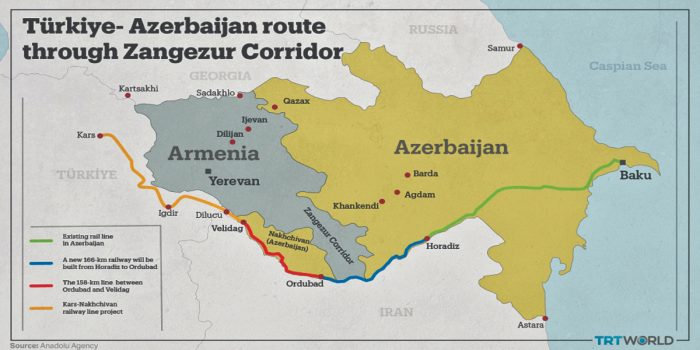
After Recep Tayyip Erdoğan’s victory in the elections and his visit to Baku, assessing the situation with the Zangezur corridor in Armenia, the Turkish leader, not by chance, stressed that the main reason for blocking this corridor was not Yerevan, but Tehran. Iran indeed publicly through the mouths of Ayatollah Ali Khomenei, President Ibrahim Raisi and Foreign Minister Hossein Amir Abdollahian has repeatedly noted that for it the Zangezur corridor remains a “red line,” it is unacceptable to change the borders of neighboring republics of the South Caucasus (in particular, Armenia) and it is important to maintain the direct multi-millenial border of Iran with Armenia.
Tehran does not want NATO to strengthen in the region on the shoulders of its member Turkey, nor does it want to see the Turan project implemented with pan-Turkic content. Otherwise, Iran will be blocked by unfriendly forces on its northern borders, including the emergence of a bridgehead of Zionist Israel on the banks of the Arax River.
With his statement, Erdoğan not only expresses his dissatisfaction with the regional policy of Iran that three Muslim states (Turkey, Azerbaijan, and Iran) through the fault of Persians can’t solve the road question peacefully and get economic dividends but actually says that Iran is not allowing the Turkish-Azerbaijani tandem to start a war with Armenia again and take by force the Meghri segment of the Zangezur corridor (if not all of Zangezur – Syunik Province) from the latter.
Given that Russia is now forced to engage in the western flank of the geopolitical confrontation with the West in Ukraine and is therefore interested in maintaining a partnership with Turkey for the same transit and out into the world, it cannot strain relations with Ankara in Armenia (Transcaucasus). Iran becomes the main opponent of Turkey in this theater.
In the second half of June 2023, Turkey and Azerbaijan announced the formation of a unified system of control and management of airspace from the Aegean Sea to the Caspian Sea according to NATO standards (the Turkish HAKİM Air Command Control System). The latter is practically capable of establishing airspace control in the South Caucasus region and threatening not only Armenia but also Iran. Given the existence of a common air defense system between Armenia and Russia within the CSTO, such a move by the tandem of Ankara and Baku is in some ways a challenge for Russia’s regional interests as well.
Since the beginning of 2023, trade turnover between Iran and Turkey has decreased by 20%, where the main export commodity for the Turkish side remains gas. Apparently, such a decline in economic relations between these countries was the result of a number of objective and subjective reasons (such as the crisis in the energy market due to anti-Russian sanctions and rising prices, the earthquake and rising inflation in Turkey, the devaluation of the Turkish lira, and Ankara’s pressure on the issue of the Zangezur corridor). In response to Moscow’s proposal to create a gas hub in Turkey, Iran came up with an equally ambitious similar project in the Persian Gulf. All these processes testify to the growing Iranian-Turkish contradictions.
Moreover, the information about the ongoing closed-door talks between Iran and the USA on the subject of the deblocking of Iranian assets in exchange for American prisoners and, most importantly, about the end of the “tanker war” between Tehran and Washington in the waters of the Strait of Hormuz and the Gulf of Oman and the export of Iranian oil to world markets (as we know, in the USA itself there is a rise in gasoline prices and an increasing need for oil) creates additional tension in Turkish politics as well.
The US is not yet interested in the implementation of alternative communications from China to Europe through the territory of Turkey (under the One Belt, One Road Initiative). Perhaps Washington is proposing an Indian project through Iran to Europe as an alternative to Chinese transit. And in this geographic preference of the states, a new confrontation between Iran and Turkey is created.
Accordingly, if Iran develops strategic partnerships with countries such as China and India, and can establish certain relationships with the US administration on the nuclear program and oil exports, Turkey will find it difficult to count on success in a battle with Tehran. Moreover, today’s Iranian authorities are interested in strengthening President Erdoğan’s policy independent of the United States, which makes it possible to weaken Washington’s pressure on the region. These are the complicated patterns of the contemporary geopolitical mosaic in the Greater Middle East.
Aleksandr SVARANTS, PhD in political science, professor.
The US can’t stop the rise of Iran, but it can make a truce
By Timur Fomenko | RT | June 25, 2023
In 2018, the Donald Trump administration ripped up the Joint Comprehensive Plan of Action (JCPOA), known as the “Iran nuclear deal,” which had been signed by his predecessor Barack Obama.
The decision to scrap the deal was thoroughly influenced by neoconservative members of his cabinet, including National Security Advisor John Bolton and Secretary of State Mike Pompeo, who not only saw the opportunity to take a swipe at Trump’s predecessor, but argued that placing crippling unilateral sanctions on Tehran would bring the country to the negotiating table, and if not, bring the regime down altogether.
Thus began a five-year campaign of brutal pressure against Iran, which sought to destroy its economy and attempted to coerce third-party countries away from doing business with it. But the initiative didn’t go according to plan. Rather, the world changed. The flagrant disregard of international law by Washington was a catalyst in the emergence of de-dollarization. The global shake-ups that came next, including the Covid-19 pandemic, US competition with China, and the war in Ukraine, gave Tehran strategic space and leverage it had previously lacked.
Now, Iran has substantially increased its uranium enrichment, has continued to build its drone and missile capabilities, has an enhanced military relationship with Russia, and thanks to Beijing, has been able to normalize its relationship with its regional arch-rival Saudi Arabia. In the process of doing so, it has reduced the regional influence of the US and its partner, Israel. US foreign policy on Iran has revolved around exploiting regional tensions in order to justify its own security footprint, but Iran has seemingly been able to begin to supersede a campaign of US containment against it while not being overtly belligerent.
This has set alarm bells off in Washington. The US has been desperate to try and reinforce its relationship with Saudi Arabia, but has reportedly been engaging in secret negotiations with Tehran not to revive the JCPOA, but to keep it away from further uranium enrichment and off the nuclear path, a move which of course will have to come with sanctions relief. While the US, presumably with the support of Israel, has threatened unspecified military action if Tehran goes further, it seems clear that Iran now has all of the cards and that a temporary “truce” must therefore come at the expense of the US containment campaign.
Because of the regional dynamic shifting in its favor, Tehran is highly unlikely to actually go down the path to developing a full-fledged nuclear bomb, given the opportunities it would provide to Washington. Unlike a country like North Korea, Iran doesn’t truly need nukes in order to establish a doctrine of deterrence for its own regime’s survival. It is a large country with a population of over 80 million. While the United States could hypothetically conduct air or missile strikes on key Iranian facilities to try and impede its nuclear program, what the US could not do, especially in this environment, is a full-scale invasion and occupation of the country. It would cost trillions of dollars, and there would be no support for it.
Rather, Iran’s deterrence ability is premised on its drone and missile programs, which have grown in their capabilities over the years despite US sanctions. The country recently claimed to have developed hypersonic missiles, which while some skepticism is warranted, is not completely fictional. Tehran has, after all, in response to the assassination of Revolutionary Guards Corps commander Qasem Soleimani, shown its ability to destroy US military bases within its range, and therefore demonstrate what it could do to Israel if things turned nasty. In doing so, it is demonstrating that regardless of US sanctions, it is a significant regional player, and will continue to be.
US foreign policy towards adversaries has repeatedly attempted to seek maximum strategic gain, eschewing the idea of compromise, be it China or Russia. But when it comes to Iran, Washington is stumped on what to do without taking the risk of provoking a wider conflict. This is why the Biden administration is leaning towards giving in, knowing that the regional dynamic of the Middle East is shifting away from its favor, and taking punitive action which may provoke war is unwelcome. In other words, Iran is winning. The only question which remains is whether or not the US wants a truce or to keep pressuring Tehran until it snaps? Even if the outcome ends in a sheer stalemate, with no nuclear lines crossed, it’s still a lose-lose situation for Washington in the end as Iran re-establishes itself diplomatically.
Jordanians reject ties with Israel, welcome normalization with Iran, Syria: Poll
The Cradle | June 20, 2023
An overwhelming majority of Jordanians say they oppose “all sorts of cooperation” with Israel, including receiving humanitarian aid in the case of a natural disaster, according to a public opinion poll commissioned by the Washington Institute and conducted between March and April.
While 84 percent of respondents say they oppose “having business deals with Israeli companies,” 76 percent agreed with the following statement: “In case of an earthquake or other natural disaster … Arab countries should refuse any humanitarian aid from Israel.”
Furthermore, at least 60 percent of Jordanians have a favorable view of Palestinian resistance factions firing missiles at Israel. In comparison, only 12 percent expressed a positive opinion of the Abraham Accords.

While a sizable minority of Jordanians (42 percent) see Iran as an “enemy,” over half of the respondents (53 percent) positively welcomed the Iran-Saudi rapprochement, while 58 percent say Arab normalization with Syria is a positive development for the region.
Jordanians also vehemently oppose US or Israeli attacks against Iran, with 65 percent of respondents agreeing that such a move “would be too dangerous and a bad idea.”

In addition, only 13 percent believe Washington should do “more to help counter the threats we face from Iran,” while 59 percent oppose the idea of an Arab country developing a nuclear weapon “to counter Iran.”
While Jordan was among the first nations to normalize relations with neighboring Israel, a large majority of the country’s population has historically stood against the occupation of Palestine and in support of a free Palestinian state.
This is a reality widely shared across West Asia, as earlier this year the Arab Center for Research and Policy Studies (ACRPS) released the findings of the largest opinion survey conducted in the Arab world, showing that 84 percent of Arabs reject recognizing Israel for political and cultural reasons.
A similar poll conducted in September revealed that the Arab youth also prefer building ties with Russia and China over the US.
US analytics and advisory firm Gallup in April of this year released a poll that shows an overwhelming majority of citizens in 13 countries across West Asia and North Africa do not trust US claims about “encouraging the development of democracy” or about “improving the economic lot of people.”
Qatar ready to ink new 27-year gas deal with China
The Cradle | June 20, 2023
China National Petroleum Corporation (CNPC) and QatarEnergy are expected to sign a 27-year agreement, which will allow China to purchase 4 million metric tons of liquefied natural gas (LNG) a year, Reuters reported today, 20 June.
Sources familiar with the deal told Reuters that CNPC also will take an equity stake in the eastern expansion of Qatar’s North Field LNG project. The stake is the equivalent of 5 percent of one LNG train with a capacity of 8 million tonnes per year.
Despite selling equity shares in the North Field expansion to foreign firms, QatarEnergy plans to retain a 75 percent stake in the project, which will cost at least $30 billion, including the construction of liquefaction export facilities.
In April, China’s Sinopec signed a deal to become a “value-added” partner in Qatar’s North Field expansion project.
The project, with a total investment cost of $28.75 billion, aims to raise Qatar’s LNG export capacity from the current 77 million metric tonnes per annum (MTPA) to 110 MTPA, making it one of the largest LNG projects in the world, Sinopec said in a statement.
“The cooperation will help Sinopec optimize the energy consumption mix in China and secure a long-term and reliable clean energy supply to the nation. The partnership represents another model of bilateral cooperation between China and Qatar,” Sinopec said.
China is seeking increased imports of LNG from Qatar, the world’s top LNG supplier, in part to reduce dependence on LNG imports from the United States, the world’s second-largest supplier.
Some US lawmakers have touted Chinese reliance on US-produced LNG as an opportunity to exert influence over the nation with the world’s second-largest economy.
“If you want to think of it geopolitically, why wouldn’t we want China dependent on our natural gas for their own economy?” House Speaker Kevin McCarthy said in an interview reported by Politico. “Would the world not be safer, and would we not be stronger? Why wouldn’t we create more American jobs at the same time?”
However, Senator Bill Cassidy of Louisiana explained that Chinese purchases of US-produced LNG are mutually beneficial, stating that “China gets guaranteed shipments at a certain price by providing upfront capital. That, in turn, helps U.S. companies build export terminals, which drives demand for more US drilling in places like Louisiana and Texas.”
“Right now, China is a frenemy,” he said. “If they – just like India, South Korea, Japan, the EU – are purchasing or buying, helping to pay for the capitalization of LNG export terminals, well, that’s a good thing.”
Competition for LNG has intensified since the start of the Ukraine war in February 2022. Europe needs new sources of natural gas to help replace the Russian pipeline gas that used to make up almost 40 percent of the continent’s imports. Europe cut off its own supply of Russian gas by imposing sanctions against Moscow after the start of the war.
Biden regime top aide in Saudi Arabia to further push for normalization with Israel after Blinken failure
Press TV – June 18, 2023
A top advisor to US President Joe Biden has reportedly traveled to Saudi Arabia as part of Washington’s relentless push to broker a normalization deal between Riyadh and Tel Aviv.
The US-based news website Axios reported on Saturday that Brett McGurk, Biden’s senior Middle East adviser, had arrived in Saudi Arabia to hold “talks with Saudi officials that will focus on the administration’s efforts to reach a normalization agreement between the Israel and the kingdom as well as other issues.”
According to the report, McGurk was also expected to meet with Saudi Crown Prince Muhammed bin Salman to discuss the kingdom’s normalization of relations with Israel.
McGurk’s visit is part of attempts by the White House to push for a Saudi-Israeli deal in the next six to seven months before Biden’s presidential election campaigns.
The top advisor’s trip to Saudi Arabia comes less than two weeks after US Secretary of State Tony Blinken visited the kingdom and met bin Salman, with Saudi officials having snubbed the US diplomat’s latest push for the normalization deal.
Saudi Foreign Minister Prince Faisal bin Farhan Al Saud said at a joint press conference with Blinken that “without finding a pathway to peace for the Palestinian people… any normalization will have limited benefits.”
Saudi Arabia cautiously welcomed the US-brokered normalization deals between the Israeli regime and the United Arab Emirates, Bahrain, Sudan and Morocco in 2020.
The oil-rich kingdom itself, however, has been expected to jump on the bandwagon since then, as the two sides have seen growing contacts and de-facto rapprochement in recent years, despite claims that it is committed to the 2002 so-called Arab Peace Initiative, which conditions normalizing ties with Israel on the establishment of an independent, sovereign Palestinian state within the 1967 borders.
The Riyadh regime in November 2020 granted permission for Israeli airlines to use its airspace, hours before the first Israeli flight to the UAE was set to take off.
Palestinian leaders, activists and ordinary people have repeatedly rejected Arab-Israeli normalization deals as “a stab in the back of the Palestinian cause and the Palestinian people.”
US sends more fighter jets to its Middle East
RT | June 15, 2023
The US military has sent additional fighter jets to the Middle East after accusing Russia of “increasingly unsafe” aircraft activity in the region, including during several incidents in Syria.
F-22 Raptors with the 94th Fighter Squadron have been deployed from Langley Air Force Base in Virginia, according to Central Command (CENTCOM), which oversees US military operations in the Middle East, Central Asia and parts of Africa.
The decision was part of a “multifaceted show of US support and capability in the wake of increasingly unsafe and unprofessional behavior by Russian aircraft,” CENTCOM said in a press release on Wednesday.
Pentagon officials have accused Moscow of reckless flights over US bases in Syria in recent weeks, with CENTCOM chief General Erik Kurilla claiming there has been a “significant spike” in “provocative” actions since March.
In an interview with the Wall Street Journal in April, Air Force Lieutenant General Alexus Grynkewich warned that the rise in tensions could lead to a “miscalculation” among Russian and American pilots operating in Syria, stating there were 60 separate incidents between March and April alone.
Moscow has similarly accused Washington of unprofessional behavior in Syria. Last month, Rear Admiral Oleg Gurinov, deputy head of the Russian Center for the Reconciliation of Warring Parties in Syria, said American warplanes continued to commit “gross violations” of deconfliction protocols.
“US Air Force pilots continue to activate weapons systems when approaching in the air with Russian Aerospace Forces aircraft performing planned flights in eastern Syria,” the official added.
The US currently maintains about 900 ground troops in Syria and operates a network of air bases around the region. The new aircraft deployment also comes after CENTCOM said it would strengthen the US “defense posture” in the Middle East with additional naval assets, vowing to carry out “heightened patrols” in the Persian Gulf in response to “destabilizing” actions by Tehran.
Most Countries Side With Russia in Ukraine Conflict While US’s Credibility Slips – Hersh
Sputnik -12.06.2023
Most of the world’s population supports Russia’s special military operation in Ukraine, while the United States lost its credibility, Pulitzer Prize-winning US investigative journalist Seymour Hersh said on Sunday.
“The percentage of the [countries], particularly of the African and Central Asian and South Asian countries, that have changed from being pro-America to being pro-Russia is really quite dramatic. Much more than a half of the world’s population supports Russia in the war and not the United States. This was never the way it was,” Hersh said in an interview with talk show host George Galloway.
The journalist opined that “things are not as good as they used to be in Russia” amid Western sanctions, but “the idea that they are desperate is just wrong.”
Hersh also argued that Washington “lost so much credibility around the world,” citing Saudi Arabia’s diplomatic rapprochement with Iran as an example.
“It’s happened because, I think, because of Ukraine and dislike of the war. Saudi Arabia, by the way, they’re selling 25% of [their] oil to China, as I have mentioned, but the Saudis immediately cut a deal. And the Iranians immediately responded … They have a lot of control in Yemen over the Houthi tribes,” Hersh said.
Russia launched its special military operation in Ukraine on February 24, 2022, following calls for help from the breakaway republics of Donetsk and Luhansk. The world has split into those who support Moscow and accuse NATO of provoking the conflict, and those who condemn Russia’s actions and impose sanctions on the country, while also ramping up their financial and military aid to Kiev. Some countries have avoided taking sides in the conflict.
Saudis snub US push on Tel Aviv ties, oil prices, Syria during Blinken’s high-profile visit
Press TV – June 8, 2023
Saudi officials have snubbed US Secretary of State’s latest push for the Kingdom’s normalization of relations with the Israeli regime and his bid to win further concessions on oil prices and Riyadh’s recent resumption of ties with Syria and Iran during his high-profile visit to Saudi Arabia.
Speaking in a news conference alongside Saudi Foreign Minister Prince Faisal bin Farhan Al Saud in Riyadh on Thursday, the visiting Antony Blinken reiterated that Washington will continue to play an integral role in expanding normalization between the Tel Aviv regime and Saudi Arabia.
Blinken, who was in the kingdom as part of a US push to defuse rows that have touched on oil prices, and Riyadh’s opening to Iran, further insisted that normalizing relations between Israeli regime and its neighbors was a priority for Washington.
The Saudi foreign minister, however, rebuffed his American counterpart, saying that the kingdom believes “normalization of ties with Israel will have limited benefit without a pathway to peace for the Palestinians.”
“The Palestinian issue was and remains the central issue for Arab countries, and it is at the top of the kingdom’s priorities,” Saudi Crown Prince Mohammed bin Salman had also underlined during the Arab League summit in Jeddah on May 19.
“We will not delay in providing assistance to the Palestinian people in recovering their lands, restoring their legitimate rights and establishing an independent state on the 1967 borders with East al-Quds as its capital,” he further noted at the time.
Blinken also reiterated on Thursday that Washington will not normalize relations with Syria and does not support other nation’s normalization of ties with the government of President Bashar al-Assad.
For his part, Prince Faisal defended the landmark decision to lift Syria’s Arab League suspension, which came shortly after the start of the country’s foreign-sponsored conflict 12 years ago.
“Syria made very clear commitments to address concerns of the international community,” the chief Saudi diplomat said.
“We have differences of opinion but we’re working on finding a mechanism for us to be able to work together,” the Saudi foreign minister also pointed out during the press conference with the US secretary of state.
The Saudi foreign minister also highlighted that China and Saudi Arabia are close and strategic allies and have been increasing cooperation in the energy and financial sectors, and that “cooperation is likely to grow.”
Saudi ties with US, China not a ‘Zero-sum game’
He said Saudi Arabia’s ties with the United States and China were not a “zero-sum game.”
“I don’t ascribe to this zero-sum game,” Prince Faisal said in Riyadh. “We are all capable of having multiple partnerships and multiple engagements and the US does the same in many instances.
“So I’m not caught up in this really negative view of this. I think we can actually build a partnership that crosses these borders,” the top Saudi diplomat said.
Riyadh’s strengthening its commercial and security ties with Beijing comes as US influence wanes in the Middle East region.
Blinken was the second top US official to visit Saudi Arabia in less than a month, following a May 7 trip by White House national security adviser Jake Sullivan.
However, Blinken’s meetings with bin Salman and Persian Gulf Cooperation Council (GCC) foreign ministers were relegated to the inside pages of Al-Watan and Okaz, the two major newspapers in Saudi Arabia.
Blinken and the crown prince had “open, candid” talks for an hour and 40 minutes, a US official said, covering topics including the conflict in neighboring Yemen, the war in Sudan, Israel, and human rights.
Riyadh has also leveraged its growing relationships with Russia and China as the Biden administration has pushed back against some Saudi demands including lifting restrictions on arms sales and help with sensitive high-tech industries.
Riyadh has clashed repeatedly with US President Joe Biden on its supply of crude oil to global markets, its willingness to partner with Russia in OPEC+ and its decision to restore full diplomatic relations with Iran in a deal brokered by China.
The Middle East and US Terrorist Activities
By Viktor Mikhin – New Eastern Outlook – 08.06.2023
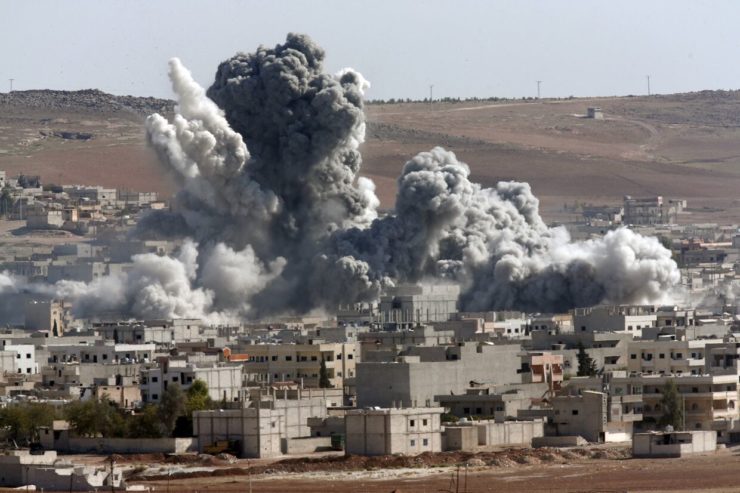
Incredibly high civilian casualty rates from American-led military adventurism in Afghanistan, Iraq, Pakistan, Syria, Yemen, Libya, and Somalia have been revealed in a new research by Brown University’s The Cost of War Project in the State of Rhode Island. The report provides direct data on the victims of the war in which nearly a million people were killed by the US efforts.
According to the study, another important aspect that has indirectly killed several million more people is the military destruction of the economy, public services, infrastructure and the environment, which increases the death toll long after the bombs have been dropped and increases over time. The report estimates that these factors contributed to more than 3.5 million deaths. This aspect requires more research, and the project specifically emphasizes that “the many long-term and underestimated consequences of war” need to be explored in more detail.
Another study shows that the number of direct casualties from wars that killed nearly a million people is an understatement, which the report again refers to by saying that “the exact death toll remains unknown.” In another section of the project’s report on the Iraqi death toll, it says that “estimates of the Iraqi war death toll have been particularly inconsistent. The Lancet 2006 estimated that approximately 600,000 Iraqis died as a result of military violence between 2003 and 2006.” The report goes on to say that the controversy over conflicting reports about the death toll in Iraq stems from news reports estimates, with some exaggerating the death toll while those who supported the illegal invasion downplayed the death toll.
The project cites a report in The Lancet that says the death toll in Iraq since 2003 and in the next three years alone reached 600,000 Iraqis. Various unbiased studies have been conducted, concluding that more than one million Iraqis were killed as a result of the US invasion and occupation of Iraq from 2003 to 2011.
Even the one million mark in Iraqi deaths could be considered an understatement when there were daily reports of almost daily terrorist bombings that killed hundreds of Iraqis. And then, add to that the US and DAESH era from 2014 to 2017, when hundreds of thousands more people were killed, and it’s not hard to imagine that over a million Iraqis have died and continue to die today as a result of the US so-called “war on terror.”
There is no doubt that the US military presence has brought nothing but insecurity and instability to West Asia. In January 2018, Leader of the Islamic Revolution in Iran, Ayatollah Sayyid Ali Khamenei said: “What is important is that the corruptive presence of the US in this region must end… They (Americans) have brought war, discord, sedition and destruction to this region; they brought about destruction of infrastructures. Of course, they do this everywhere in the world… It must be stopped.”
The Cost of War Project’s latest study also warns that “these wars continue to affect millions of people around the world, who live with their consequences and die from them.” The report focuses on the impact of the wars unleashed by the United States on women and children, who “bear the brunt of these ongoing consequences.”
The report notes that while some people have died in combat, many more, especially children, have died as a result of the negative effects of wars, such as the spread of disease and damage to public services. “More research is needed on the impact of the destruction of public services by war, especially outside the health care system, on public health,” the report says. “Damage to water and sanitation systems, roads and commercial infrastructure such as ports, for example, has significant and important negative consequences.”
The study says that the wars and conflicts the United States has fought or been involved in under the pretext of supposedly fighting terrorism since September 11, 2001, clearly show that the consequences of the ongoing violence of war are so vast and complex that they cannot be measured. It should be noted that after the 9/11 attacks, the US waged wars and fomented conflicts, especially in West Asia, under the pretext of fighting terrorism. However, as a result of US military adventurism, there has been an extremely dramatic increase in terrorist groups that had no presence in West Asia or countries such as Somalia prior to Washington’s military intervention in the region.
In other words, the so-called “war on terror” has had the opposite effect from the stated goal of Pentagon’s campaign of instability in West Asia, which has allowed terrorism to flourish. In other words, and many experts agree, the presence of US troops and US policies in the Middle East and other parts of the world have only led to the direct growth of terrorism and terrorist organizations that have destabilized peace and tranquility in those parts of the world.
The report states that the damage and continued deaths caused by the wars mean that those who have unleashed them must take responsibility, including financial responsibility for repairing the damage caused. Suffice it to recall how the American clown of a Secretary of State Colin Powell shook some test tube of incomprehensible white powder on the UN podium and hysterically frightened the whole world with unthinkable troubles from Saddam Hussein. And that was the reason for the barbaric and unjustifiable attack on sovereign Iraq in 2003, from which the Iraqis are still unable to recover and rebuild their state.
Iraqis, and indeed millions of other people, still suffer from distress, pain and trauma in both current and former war zones, according to the study, which calls on the United States as well as its allies to ease the continuing loss and suffering of millions and provide the required “reparations, though not easy, and cheap.” It is something “imperative,” the report notes.
The project correctly and very justifiably blames the US for its role in the military adventurism it embarked on after 9/11, particularly the casualties inflicted during the American two-year war and the 20 year of occupation of Afghanistan. The report focuses on Afghanistan as an example of how people, particularly women and children, the most vulnerable in society, are dying because, despite the indiscriminate withdrawal (or rather shameful flight) of US troops, the damage Washington has done to Afghanistan’s vital services, such as its health sector, sanitation and other infrastructure over 20 years of war and occupation, means that Afghans are still dying today. “Although the United States withdrew military forces from Afghanistan in 2021, officially ending the war that began with its invasion 20 years ago, Afghans are suffering and dying from war-related causes today more often than ever,” the report notes alarmingly.
The Cost of War Project says that much more research is needed to gather more adequate data “to guide life-saving actions.” “More research is needed on the impact of the destruction of public services by war, especially outside the health care system, on public health,” the report notes. “Damage to water and sanitation systems, roads and commercial infrastructure such as ports, for example, has significant consequences.”
In the case of Somalia, for example, the US intervention and the ensuing war prevented the delivery of humanitarian aid, which, according to the study, exacerbated the famine. This is a natural disaster that could have been mitigated if the US had instead chosen to spend a huge amount of money on humanitarian aid programs instead of radicalizing the local population (and increasing terrorism and bloodshed) by bombing civilians with drones. The section of the report reads: “While all belligerents must be held accountable, in the causation sections this report addresses the relevant consequences of the actions of the United States, as the primary power responsible for all these crimes.”
Critics argue that if the United States had not fought wars against West Asian countries or provoked conflicts in the region, other parties would not have participated in any combat missions. In this case, the US should be solely responsible for the disturbing direct and indirect death toll resulting from its provocative and illegal military measures. Washington’s policy of intimidation, military adventurism and terrorism against peace-loving nations of the world must end. And this is the will and aspiration of peoples who want to live in peace and prosperity, without wars and aggressions, and to follow the path of building a new multipolar world, actively promoted by Russian President Vladimir Putin.
Israel simulates Iran war after Tehran cleared of nuclear allegations
The Cradle | June 5, 2023
Israeli Prime Minister Benjamin Netanyahu renewed his threats of military action against Iran and its nuclear facilities on 4 June while holding an underground mock assessment with the security cabinet in coordination with Israel’s ongoing military drill, dubbed Firm Hand.
The security cabinet meeting, held in a military command bunker in Tel Aviv, aims to “simulate decision-making by the political echelon during a potential multi-front war,” Times of Israel reported.
“We are committed to acting against Iran’s nuclear program, against missile attacks on Israel, and the possibility of these fronts joining up,” Netanyahu said in a video statement from the bunker.
“The reality in our region is changing rapidly. We are not stagnating. We are adjusting our war doctrine and our options of action in accordance with these changes, in accordance with our goals which do not change,” the prime minister said.
He went on to say that Israel is confident that “we can handle any threat on our own,” slamming efforts to revive the 2015 nuclear deal under the Joint Comprehensive Plan of Action (JCPOA).
Netanyahu’s comments come just days after the International Atomic Energy Agency (IAEA) decided to shut down one of its major probes into Iran’s nuclear program, ruling that near-weapons grade uranium found in Iran was merely residual and cannot be used to build a nuclear bomb.
The IAEA’s decision has left Israel “on edge,” an unnamed official told Israeli media last week. The Israeli security cabinet meeting also comes as reports have been suggesting that Washington may be looking to restart nuclear talks.
In August last year, a deal was close to materializing, however, an Israeli pressure campaign and anti-Iran protests stalled efforts once again.
The ongoing drill program began at the end of last month, and aims to simulate the type of conflict which Israel has been concerned most about lately, a ‘multi-front war.’
These concerns were exacerbated in Israeli media in the past two days, after a lone Egyptian officer infiltrated Israel through the border and carried out a rare and daring operation, killing three Israeli soldiers.
Featured Video

It’s the Occupation, Stupid
or go to
Aletho News Archives – Video-Images
From the Archives
A superpower and “the world’s sickest warrior state”
By Paul J. Balles | March 8, 2010
Living through five or six major wars has hardened me to what I thought were the extremes of inhuman cruelty and brutality.
Two things made those extremes almost bearable: the brutality always revealed – at least according to the media coverage – the viciousness of the enemy. It was therefore quite understandable when our “brave men and women” pulverized the enemy.
Films of Japanese torturing captive Americans somehow justified holding Japanese Americans in internment camps during World War II; and only a small percentage of Americans found the bombing of Hiroshima and Nagasaki unreasonably vengeful at best, at worst, depraved.
The media giants in America portrayed the North Koreans as barbaric beasts with their captives, quite unlike their southern counterpoints – our allies during the Korean War. No one ever felt the need to explain how the South Koreans were a civilized breed while the North Koreans were absolute savages, at least according to the official line.
In Vietnam, our warriors justifiably (or so the media made us believe) dropped napalm on the North Vietnamese who had the gall to hide in villages and tunnels to ravage our invaders. At least it was accepted practice until some rogue photojournalist filmed a young girl screaming down a Vietnamese road in flames. … continue
Blog Roll
 Aletho News
- Pakistan to Host US-Iran Talks
- How Indonesia’s tilt toward the US left it stranded in the Strait of Hormuz
- US has no choice but to retreat from Iranian borders: Top commander
- Iran Retaliation Strikes Chemical Plant Near Dimona
- AWACS’ Destruction is a Major Loss for US Military – Ex-DoW Analyst
- Israel’s Iran Strategy Uses US Military & Gulf States as Its Pawns
- Iran: Trump wanted regime change, now just begging for Hormuz to open
- IRGC: Israeli, US universities in region legitimate targets after strikes on Iranian university
- Trump admits Iran hit USS Ford carrier: ‘We ran for our lives’
- Battle for Hungary: EU attacks on Orban are a sign of worse things to come
- If Americans Knew
- Israeli police block Catholic cardinal from entering Church of the Holy Sepulchre on Palm Sunday
- Israel is assassinating journalists again, more than any other nation, anywhere, ever – Not a ceasefire Day 170
- Over 300 US service members wounded, majority have brain injuries – Not a ceasefire Day 169
- Researchers at Human Rights Watch Resign Over Blocked Report on Palestinian Refugee Return
- Jewish Groups Are Backing a War Americans Don’t Want
- Eric Fingerhut Thinks He’s the President of the Jews
- Top Jewish Philanthropists, Rabbis Urge Israeli President to Take Action Against ‘Jewish Extremists’
- Don’t Be Fooled. Zionist Leaders Have Always Wanted to Control Southern Lebanon
- Israel’s widespread use of torture is a core element of its genocide against the Palestinian people
- In Israel’s War on Iran, Many Middle East US Bases Rendered “All But Uninhabitable”
- No Tricks Zone
- German Science Blog Accuses PIK Climate Institute Of Hallucinating Climate Tipping Points
- Devastating Assessment Of Comirnaty Vaccine By Former Senior Pfizer Europe Toxicologist
- New Study: CO2 Is ‘Effectively Negligible’ As An Explanatory Climate Change Factor Since 2000
- Former Pfizer Toxicologist Dr. Helmut Sterz Tells Bundestag Hearing Pfizer Vaccine Should Have Never Been Approved
- Energy Expert: Germany’s Nuclear Phaseout Was A “500 Billion Euro Mistake”
- New Research: South Australia’s Mid-Holocene Sea Surface Temperatures Were 4°C Warmer Than Today
- Storing Green Energy To Last Germany 10 Days Would Require A 60-Million Tonne Battery
- New Studies: UK Sea Levels Were 4 Meters Higher Than Today During The Mid-Holocene
- Destructive Green New Deal: German Energy And Metal Group Warns Of Drastic Crisis
- New Study Documents A 20-Year Pause In Arctic Sea Ice Decline – Driven By Internal Variability
 Aletho News