Syria’s Return to Arab League Shows US Gulf Allies Tired of ‘Regime Change’
By James Tweedie – Sputnik – 09.05.2023
Syria’s secular government is still standing after more than a decade of sectarian terrorist insurgency backed by the US and its regional allies. Independent investigative journalist Christopher Helali said its readmittance to the Arab League was a sign of waning US power in the Middle East.
Return of Damascus to the bosom of the Arab League after 11 years of pariah status shows the failure of the US doctrine of regime change, a journalist says.
The regional group of nations voted on Sunday to reverse its 2012 decision to expel the Syrian Arab Republic over President Bashar al-Assad’s resistance to religious-sectarian ‘rebels’ backed by the Western powers and several of the Gulf monarchies.
The tide of the conflict turned in 2015 with Russia’s military assistance, helping to break the sieges of Aleppo and other cities alongside volunteers from Iraq and Lebanon’s Hezbollah and the Iranian Revolutionary Guard Corps.
Christopher Helali told Sputnik that the major change of stance by the Arab nations was “part of the ongoing geopolitical shifts that we’re seeing in the wider region.”
“Syria being allowed back into the Arab League is certainly a coup, not only for the Arab countries, but I think for countries like China behind the scenes who have been pushing diplomacy and pushing rapprochement between different sides in the Syrian civil war,” Helali said.
The welcome back for Damascus and President Bashar al-Assad showed there was “no more appetite for regime change” or for backing the “alphabet soup of jihadist groups” funded and armed by Washington — the al-Nusra Front, Islamic State, various al-Qaida affiliates and the Free Syrian Army (FSA).
Those sectarian terrorist forces were supported by Saudi Arabia, the United Arab Emirates (UAE) and possibly Qatar and Jordan, the journalist said.
The journalist noted there was “growing discontent” among the Arab states over how the conflict has progressed and its unwanted effects. “People are saying, okay, let’s just let’s finish it and let’s send a lot of these refugees back.”
The other question is who Assad must negotiate with to finally end the 12-year conflict, given the Gulf monarchies previous insistence on a political “transition” that brings the “rebels” into the mainstream.
Those groups have been “allowing different Western journalists there to show that ‘we are moderate rebels… we are Islamists, but we’re not fanatical like ISIS, even though they are underground’,” Helali said.
“Ultimately, Assad would have to speak to the great power brokers in this conflict — the people who supported those groups. So you’d have to think about Turkiye, Saudi Arabia and other Gulf states, the United States, Russia, Iran, everybody would have to be at the table,” he continued. “But of course, nobody’s coming to that table except for the people already on Assad’s side. Plus Turkiye, because it’s being pushed to find a settlement, especially for the northern part of Syria, especially by Russia and as well as Iran.”
The elephant in the room remains the illegal US occupation of north-eastern Syria, with its concentration of lucrative oil fields, along with its outpost at al-Tanf in the southern desert near the border with Jordan.
“There can be no peace plan, there can be no situation in which everything is resolved so long as foreign troops, including US troops, still occupy sovereign Syrian territory and so long as arms and equipment and funding keeps funnelling in to Syria, to other armed groups,” Helali stressed.
“Once that stops and once there can be sovereignty over in territorial integrity, Syria reclaiming all of its borders, then there can be some plan. But that plan will have to be Syrian-led” and not imposed form outside, he said.
The ultimate significance the republic’s return to the League is the tacit admission that the US-led plan to overthrow Syria’s government failed — with disastrous consequences for her neighbours.
“What the Arab League is saying is that we’ve tried, it’s failed. Assad is here to stay and we have to find some normalization because we’re also dealing with millions of refugees in the region,” Helali said. “There has to be some political resolution to this conflict so that people can return home. Turkiye has 5 million Syrian refugees. Everybody wants a resolution to this.”
Syria’s return to Arab League is a big deal
BY M. K. BHADRAKUMAR | INDIAN PUNCHLINE | MAY 8, 2023
When a mere subplot overnight assumes habitation and a name, it becomes more fascinating than the main plot itself. Syria’s return to the Arab League after its decade-long exclusion can be regarded as a sub-plot of the China-brokered rapprochement between Saudi Arabia and Iran. But then, China and Iran are not per se party to the process.
Syria’s return to the Arab League is seen as an Arab initiative, but it is quintessentially a project Riyadh steered through in close consultation and coordination with Damascus, ignoring some murmur by a clutch of Arab States and patently in defiance of Washington’s trenchant opposition.
Against the backdrop of the epochal struggle for a new world order characterised by multipolarity and resistance to Western hegemony, Russia and China quietly encouraged Riyadh to move in such a direction.
A riveting thing about the decision taken by the foreign ministers of the seven Arab League nations at the meeting in Cairo on Sunday is its sweet timing. For, this is the 80th anniversary of the establishment of the Ba’ath Party in Damascus in 1943, which espoused an ideology of Arab nationalist and anti-imperialist interests that have lately re-appeared in the geopolitics of West Asia.
Syria has a tradition of strategic autonomy. Through the past decade, it was preoccupied with fighting off the US-sponsored regime change project, with help from Russia and Iran. As it turns the corner and is stabilising, Syria’s strategic autonomy will be increasingly in evidence. This is one thing.
However, the strategic relations with Russia and Iran will continue to remain special and there should be no misconceptions on that score. But Syria is capable of ingenuity and diplomatic acumen to create space for itself to manoeuvre, as geopolitics takes a back seat and Assad prioritises stabilisation and reconstruction of the economy, which requires regional cooperation.
The recent visit by Iran’s president Ebrahim Raisi to Syria testifies to Tehran’s “soft diplomacy,” exuding pragmatism that on the one hand made it clear that despite the recent rapprochement between Damascus and Arab countries, Syrian-Iranian ties are still strong and even highlighted Syria’s role in the resistance to Israel — with Raisi holding a meeting in Damascus with senior Palestinian officials, including leaders of Hamas and Islamic Jihad — while on the other hand, the negotiations with the Syrian leadership was largely about economic cooperation.
Raisi said Iran is ready to take an active part in the post-war reconstruction of Syria. Iran faces competition from Gulf countries that have deep pockets. Meanwhile, the warming of relations between Syria and Turkey is also on the agenda, which is sure to lead to increased trade and spur investment flow.
To put matters in perspective, Iran’s exports to Syria currently amount to a paltry sum of $243 million. However, since the beginning of the conflict in Syria, Iran has been a key sponsor of the Syrian authorities. In January 2013, Tehran opened the first credit line of $1 billion for Damascus, which was under international sanctions, thanks to which the government was able to pay for imported food. This was followed by a loan of $3.6 billion for the purchase of petroleum products. The third loan of $1 billion was extended in 2015. Tehran also allocated funds to Damascus to pay salaries to civil servants, which helped preserve state institutions. In 2012, a free trade agreement began to operate between the countries. Iran is also spending billions to finance Shiite militias in Syria and supply them with weapons. Naturally, Tehran would like to recoup some of these investments.
Syria is assessing, rightly so, that normalisation with the Arab neighbours and Turkey will be a game changer. But, while everyone is talking about Syria’s “readmission to the Arab family” as a concession, Damascus reacted to the Arab League decision in a measured way.
The Syrian Foreign Ministry statement said on Sunday, “Syria has been following the positive trends and interactions that are currently taking place in the Arab region, and believes that these benefit all Arab countries and favour the stability, security and well-being of their peoples.
“Syria has received with interest the decision issued by the meeting of the Council of the League of Arab States.” The statement went on to stress the importance of dialogue and joint action to confront the challenges facing the Arab countries. It recalled that Syria is a founding member of the Arab League and always had a strong position in favour of strengthening joint Arab action.
Most important, the statement concluded by reaffirming that the next stage requires “an effective and constructive Arab approach on the bilateral and collective levels on the basis of dialogue, mutual respect, and the common interests of the Arab nation.”
From all appearance, the Arab League statement itself was a “consensus statement” drafted with great sensitivity by Saudi Arabia.
In an interview with Al-Mayadeen, Raisi said prior to his departure for Damascus that “Syria has always been on the axis of resistance… We unequivocally support all fronts of the axis of resistance, and my visit to Syria is within the framework of this support, and we are working to strengthen the resistance front, and we will not hesitate in this.” In fact, Raisi’s arrival in Syria coincided with increased Israeli attacks by Israel on Iranian military facilities, including on Aleppo airport.
Without doubt, Iran remains Syria’s main ally and Iranian influence in Damascus is still strong. Iran views Syria as its strategic territory through which Tehran can establish ties with Lebanon and confront Israel.
What works to Syria’s advantage here is that the Saudi-Iranian detente is based on a common view in Riyadh and Tehran that they have to coexist in one form or another, since their enmity and regional rivalry turned out to be a “lose-lose” proposition that didn’t improve their regional standing. Suffice to say, their national interest resulting from their rapprochement overrides past rivalries. Syria will be a testing ground where each other’s true intentions as well as conduct will come under close scrutiny.
The good part is that the Saudis have concluded that President Assad is firmly in the saddle, having weathered the most devastating war since World War 2, and mending relations with Damascus can be a “win-win” for Riyadh.
That said, Syria is a strategic hinge where Riyadh will need to balance its strategic ties with the US and its tacit ties with Israel. But then, Saudi Arabia’s new strategic calculus also includes China and Russia. When it comes to Syria, Russia is an anchor sheet for Assad, while China has been all along on the right side of history.
This geopolitical setting has driven Biden Administration into frenzy, NSA Jake Sullivan rushed to Saudi Arabia holding the hands of his Indian and Emirati counterparts for company! Wisdom lies in Washington using Saudis (and Emiratis and Indians) to open a line to Damascus. However, Assad will set the very same non-negotiable condition to Washington for normalisation that he insisted with Turkey — vacation of US occupation. Beyond that lies, of course, Israel’s annexation of Golan Heights.
Kuwait to join Shanghai regional bloc as ‘dialogue partner’
MEMO | May 6, 2023
Kuwait signed a memorandum of understanding on Saturday to join the Shanghai Cooperation Organization (SCO), a powerful regional bloc led by China and Russia, Anadolu reports.
The document was inked on the sidelines of a meeting of the SCO foreign ministers on May 4-5 in Panaji city, India, the state news agency KUNA reported.
“Kuwait’s joining of SCO as a dialogue partner is the first step towards joining the organization as a full member in the future,” said Kuwaiti Ambassador to India Jassim Al-Najem.
He added that the accession of some Gulf Cooperation Council (GCC) countries as dialogue partners to the SCO “confirms the growing importance of the organization.”
On March 29, Saudi Arabia agreed to join the SCO as a dialogue partner in preparation for full membership.
The SCO was founded in June 2001 by China, Russia, and the Central Asian states of Uzbekistan, Kazakhstan, Kyrgyzstan and Tajikistan.
The Eurasian political, economic, and security alliance is recognized as the world’s largest regional organization, with eight members, four observer states and several dialogue partners, including Turkiye.
Pakistan and India became full members in 2017.
Iran, an SCO observer state since June 2005, had its permanent membership approved in September 2021 and signed a memorandum of commitment a year later for its full accession.
One killed by Israeli missile strike – Syria
The Cradle | May 2, 2023
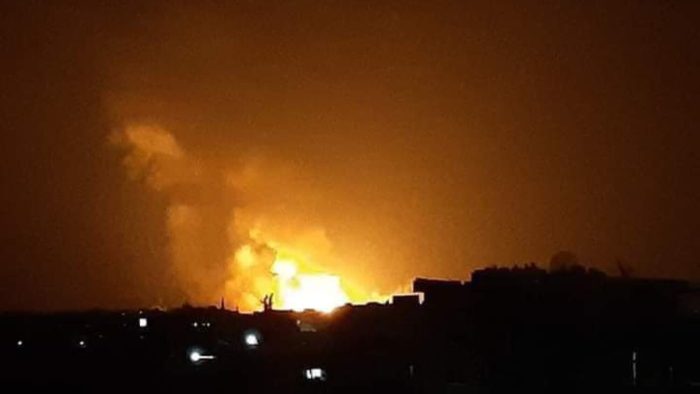
Israel launched fresh airstrikes on Syria’s Aleppo in the late hours of 1 May, killing one soldier and once again putting Aleppo International Airport out of service.
“At about 11:35 PM, Israel carried out an aerial aggression using waves of missiles from the direction of southeast Aleppo, targeting its airport and several sites in its vicinity,” a military source told SANA.
“The Israeli aggression claimed the life of a military personnel and caused the injury of seven others [including two civilians],” the source added.
This is the second time in less than two months that Aleppo International Airport has been crippled as a result of Israeli airstrikes.
On 7 March, Israeli jets bombarded Aleppo airport, damaging its runway and forcing aid deliveries for quake-struck Syria to be redirected to Latakia and Damascus airports.
A few days later, the UN issued a statement condemning the strikes and saying that such attacks “impede humanitarian access and could have drastic humanitarian consequences for millions of people who have been affected by the earthquake.”
“Attacks must never be directed against civilians or civilian objects. The humanitarian community has been responding to one of the worst crises that hit Syria since 6 February against the background of 12 years of conflict, economic decline, and a desperate humanitarian situation,” the UN statement said at the time, adding that Aleppo is “one of the worst earthquake-impacted governorates in Syria.”
Both Damascus and Aleppo airports have been regular targets for the Israeli air force. At the start of this year, Israeli strikes left Damascus International Airport crippled and out of commission.
This is the eleventh Israeli attack against Syria since the devastating earthquake ravaged much of the country in February. Just two days ago, Israeli strikes in Homs left several injured.
Israel’s airstrikes on Syria are illegal under international law but frequently happen under the pretext of targeting Iranian and Hezbollah targets. More often than not, however, the strikes target the Syrian army.
As a result, Tehran has expressed its willingness to bolster Syria’s air defenses to counter the continuous Israeli attacks better.
The US grip on the Middle East slips, and peace breaks out
By Robert Inlakesh | RT | May 2, 2023
As Washington’s influence in the Middle East declines, countries throughout the region are taking to compromise, rapprochement, and peace talks, inflicting a blow to the US narrative that seeks to depict its role as a stabilizer and democracy advocate.
Under the leadership of US President Joe Biden, there has been a notable downgrade in the status of the West amongst various long-time Middle East allies. As the US-led West exerts the majority of its efforts on the war in Ukraine, its poor decision making in the Middle East has finally begun to catch up to it.
The first major blow to Washington’s influence came in the form of a Chinese-mediated agreement to end a decades-long feud between major regional actors Iran and Saudi Arabia, one which led to the severing of ties in 2016. This has a number of implications for US power in the region.
The first being that this collapsed a strategy that the US was developing, to unite Saudi Arabia with the likes of Egypt, the UAE, Jordan, Bahrain, and Israel, against Iran and its allies in the region; the alliance was speculated to serve as a “Middle East NATO.” The second is that the Iran-Saudi rapprochement appears to have caused Riyadh to scrap its plans for normalizing ties with Israel at this time, something that the Biden administration clearly values as a foreign policy achievement. There is also the additional aspect of this being negotiated by Beijing without any regard for how it would reflect on the White House.
Despite attempts in Washington to make the deal seem like something it approves of, and repeated remarks by Israeli Prime Minister Benjamin Netanyahu about how close normalization with Saudi Arabia is, it was clearly a blow and has major consequences to the US approach to the region. In March, Saudi Crown Prince Mohammed Bin Salman said that he didn’t care if the US President had misunderstood things about him, and later in April it was reported he also told advisors that pleasing the Americans is no longer a priority.
Immediately after the Saudi-Iran normalization, Riyadh entered into serious negotiations with Yemen’s Ansarallah (the Houthis), in order to end the war that has been raging between the two sides since 2015 and has claimed around 400,000 lives in the country. To make things worse for the US, Saudi Arabia’s foreign minister recently made a trip to Damascus to meet with Syrian President Bashar al-Assad. In addition to Riyadh’s moves and Tunisia re-establishing ties with Syria, it also appears as if Ankara may be on the cusp of rapprochement with Damascus and there is a push for Syria to be re-integrated into the Arab League, which clearly runs contrary to the US agenda.
Then we have the fact that Qatar has announced it is restoring ties with the United Arab Emirates and Bahrain, which is not as significant as the above mentioned moves, yet adds to a list of peacemaking decisions taken without America. On the level of optics, this makes it seem as if the common denominator is the absence of the US. On the other hand, Washington’s development of ties with the Kingdom of Morocco is egging on tensions with neighboring Algeria. Not only is the Biden administration adding fuel to the fire in the diplomatic feud between both sides, but is helping exacerbate military tensions in a Rabat-Algiers arms race. Earlier this April, the US approved a potential $524.2 million sale of HIMARS artillery rocket systems to Morocco.
Furthermore, the top Middle East partner of the United States, Israel, has been severely weakened by an ongoing domestic political crisis over a proposed judicial overhaul by the Israeli government. Problems have also arisen with Israel’s approach to issues like maintaining the status quo at the al-Aqsa Mosque in Jerusalem, a holy site where neighboring Jordan maintains custodianship, and it has caused major rows between Amman and Tel Aviv in recent months. This presents another obstacle to the US, which is being forced to mediate between both sides to maintain calm. Another layer is the feud between Biden and Netanyahu, which has called into question the special relationship between Israel and the US for the first time since the 1950s.
The US strategy in the Middle East has been to impose its dominance, primarily through the military sphere. Its selling points have been security, weapons sales, threats of military action against foes, and the creation of a Sunni-Shia cold war that pitted Iran and Saudi Arabia against one another. The strength of Iran’s weapons programs, along with its regional alliances, has largely left the US incapable of maintaining a military edge that severely outweighs the power of its opposition. The American overstretch in the region has seen it driven from Afghanistan in an embarrassing fashion and rendered it incapable of protecting its allies from the damage of potential missile strikes from Iran and its allies. Washington actively builds relationships based upon strategies that put its own partners in the firing line, but where air defense systems it sells to them do not provide enough protection.
Even when it comes to the Palestine-Israel conflict, an issue wedded to the US since 1967, US leadership is waning. Earlier this week, China’s foreign minister, Qin Gang, proposed to his Palestinian Authority and Israeli counterparts that Beijing step in to facilitate dialogue between the two sides. Although the conflict is not going to be solved overnight, the mere fact that another world power is stepping into the arena will certainly send a message to American policy makers.
Instead of engaging the region as equals, looking for economic partnerships that are mutually beneficial, the US has used its military might to divide and conquer, inflicting millions of deaths and spending trillions of dollars in the process. This may have succeeded in the past, but America’s ability to wage regime change wars has been severely curtailed. The main US enemies, Iran and its allies, have made significant leaps in the military field, making direct war increasingly unfeasible, and has even pressured Tehran’s former adversaries to rethink their strategies. Although we are only at the beginning of this new phase in the Middle East, it is clear that poor policy decisions and the inability of Washington to envisage a way forward are pushing away key allies, and this time for the better.
Robert Inlakesh is a political analyst, journalist and documentary filmmaker currently based in London, UK. He has reported from and lived in the Palestinian territories and currently works with Quds News. Director of ‘Steal of the Century: Trump’s Palestine-Israel Catastrophe’.
Arab states call for withdrawal of foreign forces from Syria
RT | May 1, 2023
The government in Damascus should re-establish the rule of law on all of Syria’s territory, ending the presence of foreign armed groups and terrorists, the foreign ministers of Syria, Saudi Arabia, Jordan, Egypt, and Iraq said on Monday after meeting in Amman.
Jordan hosted the meeting, the first of its kind since Syria’s membership in the Arab League was suspended in 2011. Prior to the multilateral meeting, Syrian Foreign Minister Faisal Mekdad met with his Jordanian counterpart Ayman Safadi to discuss refugees, border security and “water issues,” according to Amman.
In a joint statement distributed by state news agencies, the five ministers called for “ending the presence of terrorist organizations” as well as “armed groups” on the territory of Syria, and “neutralizing their ability to threaten regional and international security.” They also pledged to “support Syria and its institutions to establish control over all of its territory and impose the rule of law.”
Saudi Arabia, Egypt, Jordan and Iraq pledged to establish ties with the Syrian military and security institutions in order to “address security challenges.” The five ministers also called for stopping “foreign interference in Syrian domestic affairs.” Their joint declaration also called for setting up technical teams of experts that would follow up on the summit and implement practical measures to resolve the conflict in Syria.
The Amman meeting comes just weeks after Mekdad visited Saudi Arabia and received the kingdom’s endorsement for Syria’s territorial integrity. Currently, Turkish-backed militants control parts of northern Syria, while the northeast is under the control of US-backed Kurdish militias. Several hundred US soldiers are also in Syria, controlling most of the country’s oil wells.
MIlitants backed by Saudi Arabia and the US launched an uprising against Syrian President Bashar Assad in 2011. With the help of Russia and Iran, the government in Damascus eventually prevailed over the collection of rebels, including terrorists affiliated with Al-Qaeda and Islamic State (IS, formerly ISIS). While Syria’s neighbors and regional powers have moved to improve relations with Damascus in recent months, the US has not changed its “regime change” policy.
Saudi Arabia seeks dialogue with Hezbollah
The Cradle | May 1, 2023
Lebanese daily Al-Akhbar released a report on 29 April claiming that Saudi Arabia is seeking to establish a line of dialogue with Lebanese resistance group Hezbollah, coming in the aftermath of Riyadh’s reconciliation with Iran and Syria and following years of non-existent relations between the two sides.
According to Al-Akhbar, information provided by an unnamed Saudi official “reached Lebanese officials from a European capital,” which reveals that the kingdom hopes to open dialogue with Hezbollah “soon.”
The newspaper vaguely cites “unofficial sources in Beirut” as saying that the dialogue would “be conducted through a third party.”
“Whether the endeavor succeeds or fails, it reflects the new phase in which Riyadh is rearranging regional relationships on the path of asserting its Arab leadership,” Al-Akhbar writes, referring to Saudi Arabia’s newfound shift in policy as “unprecedented.”
Saudi Arabia has recently distanced itself from Washington significantly – economically and politically.
A Chinese-brokered reconciliation of Saudi-Iranian ties has been followed by the kingdom’s openness to reestablish ties with the Syrian government, as well as Hamas – with whom longstanding tension also exists.
This has resulted in significant Israeli frustration, and Hebrew media has referred to it as a blow to potential normalization with Riyadh.
A 1 May report by Israeli outlet Maariv laments that the “Saudi train is expected to stop at a station bearing a large sign with the name Hezbollah on it.”
Reports of dialogue between Hezbollah and the kingdom emerge as Lebanon finds itself in a presidential deadlock that has been ongoing since the term of former president Michel Aoun expired in October last year.
A lack of consensus and parliamentary quorum, as well as external political pressure, have resulted in eleven failed sessions to elect a president.
The two main candidates are the chief of the Lebanese Armed Forces (LAF), the US-backed Joseph Aoun, and the Hezbollah-backed MP Suleiman Franjieh of the Christian Marada party.
If dialogue between Hezbollah and the Saudis is achieved, this would be the first line of official contact between the two sides in 16 years.
However, last year, Middle East Eye cited sources as saying that a secret meeting between Hezbollah deputy chief, Naim Qassem, and a Saudi delegation in Beirut helped “pave the way” for the renewal of a ceasefire in Yemen, as well as the removal of former Yemeni president Abd Rabbuh Mansour Hadi.
West’s efforts to isolate Russia have failed – Lavrov
RT | April 29, 2023
The West has failed to isolate Russia, with the majority of the world still interested in maintaining good relations with Moscow, Foreign Minister Sergey Lavrov has said. He also argued that the trend toward multipolarity is irreversible, whether former colonial powers like it or not.
Addressing the World Online Conference on Multipolarity on Saturday, Lavrov said that “Washington’s and its satellites’ efforts to reverse history, to force the international community to live by the invented ‘rules-based order’” are proving to be a fiasco, citing the “total failure” of the West “to isolate Russia.”
According to the foreign minister, a number of countries, which combined are home to 85% of the world’s population, have made it clear that they will not do the bidding of the former colonial powers.
The Russian diplomat said the fact that delegates from several dozen nations “from nearly every continent” attended the online forum shows just how much traction the idea of multipolarity has gained.
Lavrov noted that new global centers are emerging in Eurasia, the Indo-Pacific region, the Middle East, Africa, and Latin America, and that these nations are pursuing independent policies guided by national interests.
According to the foreign minister, developing nations have been steadily expanding their share in the global economy over the past three decades, while the role of the G7 nations has been diminishing.
He also hailed the fact that more and more countries have expressed interest in joining international groups “of the new kind,” such as BRICS and the Shanghai Cooperation Organization (SCO).
Russia, Lavrov explained, champions a multipolar world order based on respect for the UN charter, and a “balance of interests” as opposed to a “balance of fear.”
President Vladimir Putin said on Friday that Moscow will not abide by the “so-called rules” invented and imposed by “certain countries.”
Also on Friday, while addressing members of the SCO, Defense Minister Sergey Shoigu claimed that the West is putting “unprecedented pressure” on independent countries to pit them against Russia and China, and undermine the rise of the multipolar world.
On Monday, Lavrov called for the expansion of Asian, African, and Latin American representation in the UN Security Council, arguing that the West is over-represented in the international body.
Alarms Are Sounding as Mideast Nations Begin to Put Distance From US Influence
Sputnik – 28.04.2023
WASHINGTON – US partners in the Middle East are beginning to distance themselves from American influence amid efforts to stabilize the region, which may be a concern to Washington, former US Ambassador to Saudi Arabia Chas Freeman told Sputnik.
Saudi Arabia recently took diplomatic action to thaw relations with Iran, Syria, and Hamas, while Bahrain and Qatar agreed to resume diplomatic ties. In mid-April, Syrian Foreign Minister Faisal Mekdad traveled to Saudi Arabia, marking his first visit to the country since 2011, to discuss efforts to reach a possible political solution to the crisis.
At the UN on Monday, Russian Foreign Minister Sergey Lavrov said the world must boost efforts to reach political settlements and stabilize conflict zones in the Middle East now more than ever as the region undergoes deep transformation.
Lavrov also said a multilateral approach is required to resolve the Palestinian-Israeli crisis, instead of what he called the “destructive” one-sided actions of the US and EU that have harmed the Mideast peace process.
“The countries of West Asia are coming to see themselves as members of what [Russian political scientist] Sergei Karaganov has called ‘the world majority’ and distancing themselves from the United States,” Freeman said. “All this represents a diminution of American influence that is naturally of concern to Washington.”
The Eastern part of the Arab world, Freeman added, has long been subjected by external powers, but it is now in the midst of a self-driven rearrangement of regional relationships.
“Its major actors have seized control of their own destiny for the first time since Napoleon’s 1798 invasion of Egypt and are seeking their own answers to their region’s problems,” Freeman said.
According to Freeman, the Middle East is now led by assertively independent leaders with their own determination about how their national interests will be best served, and they do not respond well to outside efforts to dictate policy in the region.
“These leaders have learned the hard way that the use of force and covert action not only solves few problems but is often costly and counterproductive,” Freeman said. “The result is a search for peace and stability between the countries of the region without regard to the views of the United States and the former colonial powers.”
Mideast nations, Freeman said, are expanding their outreach to rising and resurgent powers like China, India, Brazil, and Russia and by identification with post-Cold War institutions like the BRICS and the Shanghai Cooperation Organization, entailing the adoption of a nonaligned stance on matters between external great powers like the contention between the United States, Russia, and China.
Freeman is an American retired diplomat and writer who served in the US Foreign Service, and in the departments of State and Defense, in many different capacities over 30 years.
Netanyahu: US should interfere more in the Middle East
MEMO | April 20, 2023
Israeli Prime Minister, Benjamin Netanyahu, said that Saudi Arabia could regret its rapprochement with Tehran as Iran is the reason for most of the problems in the Middle East, which he believes the US should be more involved in.
In statements made on Wednesday night to CNBC, Netanyahu said that 95 per cent of the Middle East’s problems emanate from Iran.
He added that the proof of the “misery” that Saudi Arabia may experience due to its rapprochement with Iran is evident in “Lebanon, Yemen, Syria, and Iraq”. He also explained that he views the Saudi-Iranian rapprochement, agreed on 10 March when Saudi Arabia and Iran announced the restoration of their diplomatic relations and reopening of embassies, as having more to do with the war in Yemen.
“I think that Saudi Arabia, the leadership there, has no illusions about who are their adversaries, and who are their friends,” he said.
“We’d like very much to have peace with Saudi Arabia. Because I think it would be another huge quantum leap for peace. In many ways it would end the Arab-Israeli conflict,” said Netanyahu, adding: “I think the sky’s the limit. And even the sky’s not the limit, because there are many opportunities in space as well.”
Asked about China’s manoeuvres in the Middle East, Netanyahu said that he had no knowledge of a Chinese proposal to resolve the Palestinian-Israeli conflict, but said: “We respect China, we deal with China a great deal. But we also know we have an indispensable alliance with our great friend the United States.”
He called for increased US involvement in the Middle East, and said: “I think that not only Israel but I think in many ways most of the … countries in the Middle East would welcome an American, not merely the American involvement in the Middle East which has been ongoing, but a greater engagement of America in the Middle East.”
“I think it’s very important for the United States to be very clear about its commitment and engagement in the Middle East.”
Chinese Foreign Minister Qin Gang told his Israeli and Palestinian counterparts that his country was ready to help facilitate peace talks between the two sides, the latest mediation effort in the region, in separate phone conversations on Monday.
Gang expressed China’s concern over the escalating tensions between the two sides and its support for the resumption of peace talks.
The restoration of diplomatic relations, which were severed between Tehran and Riyadh in 2016, was a major turning point for China’s diplomacy and acted as evidence of its ability to play a role in changing the Middle East.
RT International extends reach via new platforms
RT | April 7, 2023
RT International is now freely available via satellites operated by the Arab Satellite Communications Organization, which is based in Saudi Arabia, and Egypt’s Nilesat. The channel has also been added to India’s DD Free Dish service.
The Russian news network’s English-language channel is now broadcast by Arabsat’s Badr 4 satellite and the Nilesat 201 satellite. No subscription is required for either service.
Both transmitters predominantly serve audiences in North Africa and the Arab Peninsula. The Badr 4 signal can also be picked up in numerous European countries, according to its stated coverage. Viewers in some parts of Sub-Saharan Africa can likewise tune in to Badr 4 and Nilesat 201.
The receiver settings for the two satellites and the list of places where they are available are as follows:
Badr 4
Position: 26.0°E
Frequency (MHz): 12054
Polarization: V
Modulation: DVB-S (QPSK)
Symbol Rate (SR): 27500
FEC: 5/6
SID: 1850
VPID: 2140
APID: 2255
Albania, Algeria, Andorra, Austria, Bahrain, Belgium, Bosnia and Herzegovina, Bulgaria, Croatia, Cyprus, Czech Republic, Denmark, Djibouti, Egypt, Eritrea, Faroe Islands, France, Gaza Strip, Germany, Gibraltar, Greece, Hungary, Iran, Iraq, Ireland, Israel, Italy, Jordan, Kuwait, Lebanon, Libya, Liechtenstein, Luxembourg, Malta, Monaco, Montenegro, Morocco, Netherlands, North Macedonia, Oman, Palestine (PNA), Poland, Portugal, Qatar, Romania, SADR (Western Sahara), San Marino, Saudi Arabia, Serbia, Serbia (Kosovo), Slovakia, Slovenia, Sudan, Sweden, Switzerland, Syria, Tunisia, Türkiye, UAE, United Kingdom, Vatican City, West Bank, Yemen.
Nilesat 201
Position: 7.0°W
Frequency (MHz): 11958
Polarization: H
Modulation: DVB-S (QPSK)
Symbol Rate (SR): 27500
FEC: 5/6
SID: 839
VPID: 554
APID: 555
Algeria, Bahrain, Cyprus, Djibouti, Egypt, Eritrea, Ethiopia, Gaza Strip, Gibraltar, Iraq, Israel, Jordan, Kenya, Kuwait, Lebanon, Libya, Malta, Mauritania, Morocco, Oman, Palestine (PNA), Qatar, SADR (Western Sahara), Saudi Arabia, Somalia, South Sudan, Sudan, Syria, Tunisia, UAE, Uganda (in some parts), West Bank, Yemen.
Residents of India can now find RT International on the DD Free Dish satellite service operated by state-owned broadcaster Prasar Bharati. The channel was added to its content on April 1.
The US and its allies have been working for years to reduce RT’s international presence, claiming that the outlet serves as an instrument of Russian propaganda. After the conflict in Ukraine escalated last year, many Western nations demanded that platforms ban RT content from being shown on their territory.
READ MORE: Ban on Russian media protects ‘freedom of expression’ – Borrell
RT offers a viewpoint that it believes Western mainstream media outlets fail to present to their audiences, and urges people to “question more” when consuming news. RT programming is available in several languages, including Arabic, English, French, German, Serbian, and Spanish.
Featured Video

It’s the Occupation, Stupid
or go to
Aletho News Archives – Video-Images
From the Archives
A superpower and “the world’s sickest warrior state”
By Paul J. Balles | March 8, 2010
Living through five or six major wars has hardened me to what I thought were the extremes of inhuman cruelty and brutality.
Two things made those extremes almost bearable: the brutality always revealed – at least according to the media coverage – the viciousness of the enemy. It was therefore quite understandable when our “brave men and women” pulverized the enemy.
Films of Japanese torturing captive Americans somehow justified holding Japanese Americans in internment camps during World War II; and only a small percentage of Americans found the bombing of Hiroshima and Nagasaki unreasonably vengeful at best, at worst, depraved.
The media giants in America portrayed the North Koreans as barbaric beasts with their captives, quite unlike their southern counterpoints – our allies during the Korean War. No one ever felt the need to explain how the South Koreans were a civilized breed while the North Koreans were absolute savages, at least according to the official line.
In Vietnam, our warriors justifiably (or so the media made us believe) dropped napalm on the North Vietnamese who had the gall to hide in villages and tunnels to ravage our invaders. At least it was accepted practice until some rogue photojournalist filmed a young girl screaming down a Vietnamese road in flames. … continue
Blog Roll
 Aletho News
- Pro-Palestinian French member of European Parliament denied entry to Canada
- Pakistan to Host US-Iran Talks
- How Indonesia’s tilt toward the US left it stranded in the Strait of Hormuz
- US has no choice but to retreat from Iranian borders: Top commander
- Iran Retaliation Strikes Chemical Plant Near Dimona
- AWACS’ Destruction is a Major Loss for US Military – Ex-DoW Analyst
- Israel’s Iran Strategy Uses US Military & Gulf States as Its Pawns
- Iran: Trump wanted regime change, now just begging for Hormuz to open
- IRGC: Israeli, US universities in region legitimate targets after strikes on Iranian university
- Trump admits Iran hit USS Ford carrier: ‘We ran for our lives’
- If Americans Knew
- Israeli police block Catholic cardinal from entering Church of the Holy Sepulchre on Palm Sunday
- Israel is assassinating journalists again, more than any other nation, anywhere, ever – Not a ceasefire Day 170
- Over 300 US service members wounded, majority have brain injuries – Not a ceasefire Day 169
- Researchers at Human Rights Watch Resign Over Blocked Report on Palestinian Refugee Return
- Jewish Groups Are Backing a War Americans Don’t Want
- Eric Fingerhut Thinks He’s the President of the Jews
- Top Jewish Philanthropists, Rabbis Urge Israeli President to Take Action Against ‘Jewish Extremists’
- Don’t Be Fooled. Zionist Leaders Have Always Wanted to Control Southern Lebanon
- Israel’s widespread use of torture is a core element of its genocide against the Palestinian people
- In Israel’s War on Iran, Many Middle East US Bases Rendered “All But Uninhabitable”
- No Tricks Zone
- German Science Blog Accuses PIK Climate Institute Of Hallucinating Climate Tipping Points
- Devastating Assessment Of Comirnaty Vaccine By Former Senior Pfizer Europe Toxicologist
- New Study: CO2 Is ‘Effectively Negligible’ As An Explanatory Climate Change Factor Since 2000
- Former Pfizer Toxicologist Dr. Helmut Sterz Tells Bundestag Hearing Pfizer Vaccine Should Have Never Been Approved
- Energy Expert: Germany’s Nuclear Phaseout Was A “500 Billion Euro Mistake”
- New Research: South Australia’s Mid-Holocene Sea Surface Temperatures Were 4°C Warmer Than Today
- Storing Green Energy To Last Germany 10 Days Would Require A 60-Million Tonne Battery
- New Studies: UK Sea Levels Were 4 Meters Higher Than Today During The Mid-Holocene
- Destructive Green New Deal: German Energy And Metal Group Warns Of Drastic Crisis
- New Study Documents A 20-Year Pause In Arctic Sea Ice Decline – Driven By Internal Variability
 Aletho News