US neocons Bolton & PNAC lay down weapons of war for protest signs with their new ‘Turkish Democracy Project’
By Helen Buyniski | RT | July 5, 2021
The aging neocons who have been practicing regime change ops in the Middle East for decades are now launching a project targeting Turkey – perhaps in honor of the deceased Don Rumsfeld.
Erdogan’s Turkey has long been something of a thorn in Washington’s paw, given its ongoing refusal to buy inferior US military equipment (it was booted from the US’ F-35 program for insisting on buying Russian S-400 missiles, making the Americans who still store their nukes at Incirlik somewhat nervous), its refusal to place the good of Israel above its own benefit, and its rumblings of discontent regarding the US’ pleas for support (or at least safe passage) to its Syrian ‘moderate rebel’ militant groups, which Ankara considers to be little more than terrorists.
Under the government of President Recep Tayyip Erdogan, Turkey has become quite recalcitrant indeed, far from the ideal domesticated state keen to babysit American nukes and stage American missiles in exchange for coveted membership in the deteriorating NATO structure (not long ago fetchingly described by French President Emmanuel Macron as “brain dead”). Clearly what it needs is a shot in the bottom from that great big needle marked ‘Democracy’ – and who better to deliver that than the good old boys from the Project for a New American Century, many of them the old same men who led and lied the US, blindfolded, into the chaos of Iraq.
Enter the Turkish Democracy Project, a non-profit organization which – it should be clear from the name – has nothing to do with democracy or, really, Turkishness. The group’s website is about as subtle as a nuclear bomb, blaming President Recep Tayyip Erdogan for “dramatically alter[ing] Turkey’s position in the international community and its status as a free and liberal democracy” and calling for “a nonprofit, non-partisan, international policy organization that opposes its destabilizing behavior, supports genuine democratic reform, and holds the forces of corruption and oppression within Turkey to account.” In other words: “We want a piece of your country. Resist and be annihilated.”
It’s not that the US thinks Turkey is stupid. But they believe, and are likely correct, that the US will never have as good a time as now to strike. With its military still feared by many parts of the world (even though its bark is at this point far worse than its bite, and its image still suitably ferocious to put much of the actual war-fighting business to fleeing instead of fighting), the main business must be – if the US expects to do something other than flee home with its tail between its legs – “shock and awe.”
But given that these shock and awe tactics will be taking place in the Middle East, an area which has seen the worst the US can throw at its enemies over the last 20 years of perpetual warfare and realizes all the money in the world can’t give even the largest military on Earth the stamina of the gods, it’s likely these dyed-in-the-wool bloodshed-artists will have to change with the times. To invade a militarily competent nation like Turkey – especially one which, inconveniently, happens to be backed by NATO – is unlikely to be a walk in the park, no matter how many phony war crimes the PNAC crew manage to cook up. Gas attacks have become cliche, and any talk of “weapons of mass destruction” will elicit a chortle at best.
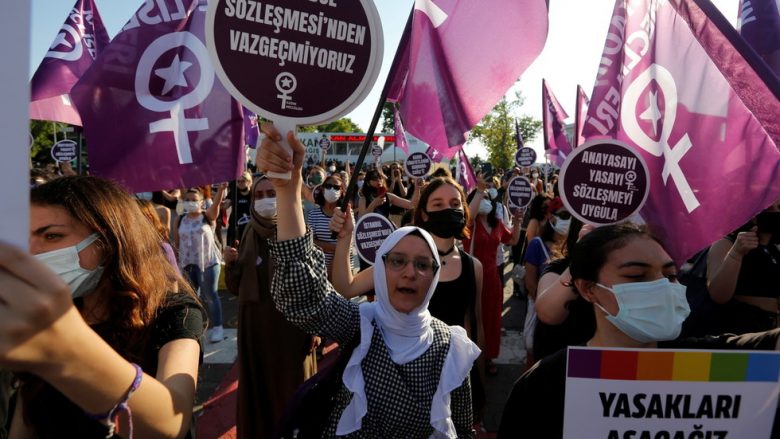
So the TDS, if recent events are any indication, has instead gotten to work with the kind of color revolution-style events that have largely replaced shock and awe in other regime-change hotspots. They’re cheap, they’re easy, and in this case – a protest in Istanbul against Turkey’s withdrawal from the Istanbul Convention? – they require exactly zero imagination. It’s much easier to con the rest of NATO if you don’t have to make them think.
Thousands of activists took to the streets on Thursday, either on their own or hailing from various NGOs, denouncing Turkey’s withdrawal from the European human rights treaty known as the Istanbul Convention. Erdogan’s executive order removing Turkey from the treaty, first adopted back in March, argued the country’s women are protected by domestic laws rather than the international human rights treaty – which he argued had been “hijacked” by the LGBTQ+ community.
The hoary old PNAC boys behind the TDS likely couldn’t believe their luck when something like this fell into their lap. But will they be able to modernize?
The group’s CEO is Mark Wallace, who’s also the CEO of United Against Nuclear Iran – another unsubtly named regime-change operation (and a regime change that has failed repeatedly). An old hand at overthrowing Middle Eastern nations the old-fashioned way, Wallace held several positions with the George W. Bush administration while the nation was attempting to crush Iraq (apparently shocked the children had run forward with IEDs instead of handfuls of wildflowers to welcome their new rulers).
Indeed, numerous fellow veterans of the Iraq regime change effort and abortive attempts to overthrow Iran have bubbled up in the swamp gas to give regime change in Turkey a go. Wallace is joined by other bottom-feeders like former Connecticut senator Joe Lieberman and UANI intel chief Norman Roule, as well as glorified mustache-carrier, would-be thug, and former Trump national security adviser John Bolton. Former Bush adviser Frances Townsend is there, as is former associate deputy director of operations for the CIA (and Blackwater vet) Robert Richer. At least a few members of the shadowy pro-Israel Foundation for the Defense of Democracies were listed and then memory-holed, and Bush’s brother Jeb is there, a speech bubble forever hovering above his head reading “please clap.”
Oddly enough, however, the only currently listed actual employee aside from CEO Wallace is a (presumably) former assistant English professor at Princeton University. No, that’s not suspicious at all. Carry on, I’m sure Turkey will welcome you (and your desired partitioning of the country) with open arms!
With Erdogan still trustingly paying his country’s NATO dues, Ankara is unlikely to expect any sort of real attack, though the leader is likely on guard, given former President Trump’s on-again, off-again announcement to clear out US soldiers from Syria. He is likely to be on the lookout for foreign meddlers among the protesters, however. And Erdogan’s allies with their ears to the ground both inside and outside Turkey have already pegged this absurd attempt at bringing back ‘democracy’ for what it really is. While some have linked it to the infamous Gulen movement, referring to the cleric who most recently was accused of trying to overthrow Erdogan in 2016, Gulen’s movement itself seems to have ties to the same ‘Greater Israel’ plan to redraw the lines on the map of the Middle East, a plan Israeli military strategist Oded Yinon devised decades ago (and which the neocons appear to have used as their foreign policy guide ever since). Former Turkish opposition lawmaker Aykan Erdemir, senior director for Turkey at the FDD, was accused of being connected to Gulen in 2017 and had his assets seized, strengthening the case for the connection between Gulen’s organization and the notoriously pro-Israel FDD.
But with all of NATO’s heads turned to this human rights drama, surely the other countries in the alliance also participating in the drawing-and-quartering of Syria won’t expect a military attack on Turkey as well – not without some warning. The map of Greater Israel shows Turkey losing a mere corner of their land compared to Syria, which takes quite a beating – one which Turkey clearly expects to be a part of, having already staked its claim effectively to certain border regions of Syria under the logic of keeping the Kurdistan Workers’ Party (PKK) away. But this is all temporary, and eventually the region must settle into its new form. An Israel-first arrangement will not go down well with any of the other combatants, and, unlike the US and its European partners, Turkey won’t just sit on its hands and sigh wistfully while its share of the Syrian pie is handed to the US by way of Tel Aviv.
Because that’s who the ultimate beneficiary of this mess is supposed to be. Named after the Israeli military strategist who devised it, the Yinon project hopes to balkanize the Middle East and assemble the shards into a single nation consisting of the choicest morsels of those countries in between the Euphrates and the Nile rivers. Iraq has already been cut in half, Syria has shrunk dramatically even as the war goes on, and Egypt is run by a pliant leader who will do what the US and Israel tell him – as General Wesley Clark said over a decade ago, the plan was to take out seven countries in five years. They’re running a bit behind, but never underestimate the abilities of a bunch of old war criminals with nothing to lose.
Helen Buyniski is an American journalist and political commentator at RT. Follow her on Telegram.
Envoy Rejects US Accusations against Iran as Baseless
Al-Manar | July 3, 2021
A top Iranian diplomat penned a letter to the UNSC, strongly rejecting allegations of the United States against Tehran over a recent attack near the Iraq-Syria border.
Ambassador and Permanent Representative of the Islamic Republic of Iran to the United Nations Majid Takht Ravanchi wrote a letter to the president of the UN Security Council, to react to anti-Iranian accusations of Washington.
The Islamic Republic of Iran has repeatedly announced that it has not had any direct or indirect role in attacks against US facilities or personnel in Iraq, reads the letter. Therefore, the letter continues, any attempt to attribute such allegations to Iran, either explicitly or implicitly, is false and baseless and lacks the most basic credible information. Tehran strongly rejects such claims and considers them legally invalid, added the envoy.
Iran vehemently rejects the arbitrary interpretation of the US of Article 51 of the UN Charter to justify its illegal June 27 attack on Syria and Iraq, said the envoy, adding that Tehran strongly condemns the aggression as violation of sovereignty of the two countries.
The US argument that such attacks were carried out to “deter” the Islamic Republic of Iran and so-called “Iranian-backed militias” from further attacks on US personnel or facilities in Iraq has no real or legal basis as it is based solely on an arbitrary interpretation of Article 51 of the UN Charter, added the diplomat.
Recent US attempts to accuse others to cover up its irresponsible and destabilizing activities and adventurous military actions in the region are doomed to failure, noted Takht-Ravanchi.
Earlier, the US representative to the UN had sent a letter to the UNSC, making accusations against Iran and claiming that the decision for attack was taken after it was proved that non-military measures were not enough.
Syrian Kurds say ready to talk with Damascus government
Press TV – July 4, 2021
The so-called Autonomous Administration of North and East Syria, commonly known as Rojava, has said it is open to negotiations with the Syrian government which is in the final stages of purging foreign-sponsored Takfiri militants.
The foreign relations department of Rojava, in a statement issued on Saturday, responded positively to Russian Foreign Minister Sergei Lavrov’s request for negotiations with the Damascus government, Kurdish Hawar news agency reported.
“The Syrian crisis can only be resolved through dialogue and a Syrian-Syrian understanding,” the statement read, adding that Syrian Kurds will make every effort to achieve such a goal, including talks with Damascus.
The report came a day after Lavrov said Moscow is ready to facilitate dialogue between Damascus and the Syrian Kurds provided that both sides stick to coherent positions.
“We are ready to encourage contacts and consultations but the sides need to have coherent positions,” he said on Friday, while warning that the Americans were pushing a considerable part of the Syrian Kurds towards separatism.
“I hope very much that those Kurds, who are interested in normalizing relations with Damascus, understand the provocative nature and see a big danger here,” the top Russian diplomat noted.
“Throughout the entire period of the crisis, especially after our military contingent was dispatched to Syria at the request of the legitimate government, we have been encouraging, even through our contacts on the ground, direct relations between Kurdish representatives and Damascus so that they could begin talks on how to live together in their country,” Lavrov said.
MEP: EU sanctions against Syria crime against humanity
Separately, a member of the European Parliament condemned EU sanctions against Syrian government officials, businesses and entities, terming the restrictive measures as a punishment against ordinary people in the war-battered Arab country.
Independent Irish politician Mick Wallace wrote in a post published on his official Twitter page on Saturday that the EU sanctions, with their main aim to change the Damascus government, are a crime against humanity.
“EU [countries] must end their illegal regime change sanctions on Syria. They are a collective punishment against the people; they are a crime against humanity,” Wallace said.
The MEP called upon European countries to observe international law, and respect Syria’s sovereignty.
The EU imposed the first round of its sanctions against Syria in May 2011. They include travel bans, asset freezes and measures targeting operations like oil imports, certain investments as well as technology transfer.
The Syrian government has repeatedly condemned the US and the EU for waging economic terrorism on the country through their unilateral sanctions, holding them responsible for the suffering of the Syrian people, especially now that the country is grappling with a deadly coronavirus outbreak.
Damascus has also been critical of the United Nations for keeping silent on the destructive role of the US and EU, among other parties supporting terrorism in Syria.
Hezbollah, Iraqi anti-terror group slam US seizure of website domains tied to pro-resistance media
Press TV – June 24, 2021
Lebanon’s Hezbollah pro-resistance movement and Iraq’s anti-terror Asa’ib Ahl al-Haq have strongly condemned the US government’s decision to seize and block dozens of website domains connected to Iranian and regional media outlets, describing the measure as a “criminal act” and a convincing proof of Washington’s policy of repression.
“Hezbollah condemns in the strongest terms the seizure of a large number of free media sites by the US administration [of President Joe Biden]. The move confirms Washington’s pursuit of suppressing freedom under false allegations and lurid headlines,” Mohammad Afif, Hezbollah’s head of public relations office, said in a statement on Thursday.
He added, “Through such an outrageous move, the US administration sought to cover up truth about crimes and atrocities committed by itself and its allies against the oppressed nations of our region, especially in Palestine and Yemen, where people are subjected to the worst forms of abuse and blockade.”
“Hezbollah expresses its solidarity with these honorable sites, whose reflection of truth cannot be hidden away at all. We call for a major campaign of solidarity with these media institutions so they can continue to perform their sincere and humanitarian missions,” the statement concluded.
‘US seizure of website domains tied to resistance out of despair’
Qais Khazali, who leads the Asa’ib Ahl al-Haq resistance group, also reacted to the US seizure of pro-resistance news website domains.
“Day by day, the West’s hollow claims about advocating human rights and freedom of expression are becoming further exposed,” he said in a statement carried by the Iraqi News Agency said, citing the removal of the Saudi-led military coalition in Yemen and the Israeli regime from a list of groups violating children’s rights, and the recent seizure of “the media websites that oppose American, British, Israeli, Saudi and Emirati schemes.”
“This is a sufficient justification… the United States, having failed in its military plans, desperately opted to seize websites whose sole weapons are words and ideas,” Khazali continued.
“The seizure shows its defeat in the field of media war. The pro-resistance media outlets exposed Washington’s hideous nature and its conspiracies,” he pointed out.
On Tuesday, the US seized the websites of Press TV and al-Alam, Iran’s English-language and Arabic-language newscasters, as well as al-Masirah TV of Yemen.
Other web domains, including Palestine al-Youm, a Palestinian-directed broadcaster, Karbala TV – the official television of the Imam Hussein (PBUH) shrine in the holy Iraqi city of Karbala, Iraqi Afaq TV, Asia TV and al-Naeem TV satellite television channels, as well as Nabaa TV which reports the latest stories about Saudi Arabia and other Persian Gulf countries, were also seized.
Bahrain’s LuaLua TV, a channel run by opposition groups with offices in London and Beirut, was also closed, according to AFP.
Press TV website was back online within hours with the new .ir domain address. Al-Alam TV also quickly announced that its website will be available on .ir domain.
Al-Masirah TV established a new website, using its name but swapping the .net domain for .com.
The US Justice Department said Wednesday it had seized 33 media websites used by the Iranian Islamic Radio and Television Union (IRTVU), as well as three of the Iraqi anti-terror Kata’ib Hezbollah group, which it said were hosted on US-owned domains in violation of sanctions.
Over the past years, the United States has for several times taken similar measures against Iranian media outlets.
The US tech giant Google has recurrently taken on Press TV more than any other Iranian outlet given the expanse of its viewership and readership.
In March, Google for the seventh time blocked the English-language news network’s access to its official YouTube account without any prior notice, citing “violations of community guidelines.”
The US-based social media giant Facebook also informed Press TV in the same month that its account had been shut down for what it claimed to be the Iranian news channel’s failure to “follow our Community Standards.” The page was reinstated a few days later.
The Tehran-based network has also fallen victim to censorship on Twitter and Instagram.
Iran’s Ahmadinejad Reveals Why Iran Doesn’t Need Nukes, Says World Should Know Truth About 9/11
By Ilya Tsukanov – Sputnik – 24.06.2021
The veteran politician, who served as Iran’s president between 2005 and 2013, and as Tehran mayor and Ardabil province governor before that, attempted to take part in both the 2017 and 2021 presidential elections, but was barred from doing so by Iran’s powerful Guardian Council.
The world needs to know the truth about the 9/11 terror attacks, and Iran doesn’t need to pursue nuclear weapons because they cannot protect even superpowers from collapse, former President of Iran Mahmoud Ahmadinejad has said.
“Deciphering the events of 11 September, 2001 will be the key to an understanding of all political events and processes in the sphere of global security over the past 70 years, and this will pave the way for us all to a better world,” Ahmadinejad said, speaking to Russian media in a broad ranging interview published on Thursday.
“When the terrorist attack took place, I announced to the United Nations the need to create a consolidated investigative group to establish all the circumstances of the incident and to find the culprit, and said that the Americans themselves were investigating this incident, holding court themselves, deciding everything themselves and fighting wars in other countries on this basis, not allowing anyone to comment on what is happening,” the former president recalled.
“I remember at this time the United States was very angry with me. But all I said was that there was a need for an international investigation, so that the whole world could know who carried out these attacks, and what connections [the attackers] could have to US intelligence and the American security apparatus to be able to break through all defensive barriers and destroy two towers in the very heart of the American nation,” Ahmadinejad added.
According to the politician, the US invasions of Afghanistan and Iraq, mounted in the aftermath of 9/11, were an attempt to change the situation in the world and the Middle East in Washington’s favour, and to hide “deep economic and social problems” plaguing the United States. Time has shown that neither war was a success, Ahmadinejad said, with both wars continuing to claim lives and forcing people to flee as their countries, while the states’ infrastructure collapses and their future remains uncertain.
No Need for Nukes
Commenting on Iran’s commitment not to pursue nuclear weapons, and recent attempts by the Biden administration to return to the 2015 Joint Comprehensive Plan of Action agreement, Ahmadinejad said the Democratic president has failed to make any substantive changes to his predecessor’s policies, but that this was because US foreign policy is not controlled by presidents – who are only a small part of the decision-making process.
As for nuclear weapons, Ahmadinejad suggested that “today, nuclear weapons have no practical application, so all the costs of their creation are superfluous. I in principle consider the production and accumulation of weapons an inhuman act and am categorically opposed to it. If world powers reject hegemony and are not looking for disagreements and wars, why start an arms race? Why should the wealth of nations be spent on the production of weapons intended only for murder and not for prosperity?”
“In my first meeting with Mr. Putin at the UN in 2005, I asked him if nuclear weapons could have prevented the collapse of the Soviet Union. These weapons were highly developed, yes, but they did not stop the collapse of the USSR. Because weapons, in principle cannot improve human relations. Today, the capitalist world order led by America is in decline. Can American atomic bombs stop the collapse of US global hegemony? I don’t think there is a single wise person in the world who would say yes,” the Iranian politician added.
World Needs Fundamental Changes
Ahmadinejad expressed certainty that the current world order is unsustainable and is in need of “fundamental changes.”
“Over the past 100 years, it has spawned hundreds of wars, assassinations, arms races, broad class divisions, poverty and social constraints for nations. I believe that we must all join hands and build a new world – a world in which all people will be free and respected –and where justice is central. And I believe that the noble people of Russia can play a very important role in this process,” he stressed.
Candidacy Rejected
Ahmadinejad was barred from running in Iran’s presidential elections twice in a row, first in 2017 and then in the June 2021 vote, which was handily won by Chief Justice Ebrahim Raisi, a conservative with close ties to the clergy and Supreme Leader Ayatollah Ali Khamenei. Ahmadinejad did not contest the decision to bar him, made by the Guardian Council – Iran’s powerful constitutional watchdog of six high-ranking Shiite clerics appointed by Khamenei and six lawyers chosen by parliament from nominations by the judiciary.
In the West, Ahmadinejad is best remembered for his war of words with the Bush administration over the invasions of Iraq and Afghanistan, as well as his 2006 statement that Israel [sic] (the “Zionist regime” ) must “vanish from the page of history,” often misquoted as “wiped off the map,” which sparked outrage in Tel Aviv and conservatives in Washington. Also in 2006, CNN famously misquoted his statement that Iran has a “right to nuclear energy” as Iran’s “right to nuclear weapons,” with that scandal prompting Iran to boot the US cable news network’s journalists out of the country.
In 2007, Ahmadinejad stirred up anger among liberals during a trip to New York when he told students at Columbia University that gays and lesbians “don’t exist” in Iran.
Since completing his term as president in 2013, Ahmadinejad has occasionally popped up in the news cycle, especially while quoting the lyrics of well-known American rap artists, who he apparently vibes to, to make a political point. Last year, the politician’s use of the late Tupac Shakur’s “Pull the trigger kill a N**** he’s a hero” to refer to the death of Minnesota black man George Floyd got him in trouble online.
In his home country, Ahmadinejad is better known for his ascetic lifestyle, populist economic policies, campaigns against corruption, and programmes to improve Iran’s self-sufficiency in a range of areas, including defence. During his time in office, he advocated for a compromise between Western-style capitalism and socialism. Under him, Tehran was also able to form a strategic alliance with Venezuela – with that partnership remaining strong to this day.
Friedman’s Last Gasp
By Jonathan Cook – New Left Review – June 10, 2021
Thomas Friedman’s recent column in the New York Times reflecting on Israel’s 11-day destruction of Gaza is a showcase for the delusions of liberal Zionism: a constellation of thought that has never looked so threadbare. It seems that every liberal newspaper needs a Thomas Friedman – the UK’s Guardian has Jonathan Freedland – whose role is to keep readers from considering realistic strategies for Israel-Palestine, however often and catastrophically the established ones have failed. In this case, Friedman’s plea for Joe Biden to preserve the ‘potential of a two-state solution’ barely conceals his real goal: resuscitating the discourse of an illusory ‘peace process’ from which everyone except liberal Zionists has moved on. His fear is that the debate is quietly shifting outside this framework – towards the recognition that Israel is a belligerent apartheid regime and the conclusion that one democratic state for Palestinians and Jews is now the only viable solution.
For more than five decades, the two-state solution – of a large, ultra-militarized state for Israel, and a much smaller, demilitarized one for Palestinians – has been the sole paradigm of the Western political and media class. During these years, a Palestinian state failed to materialize despite (or more likely because of) various US-backed ‘peace processes’. While Americans and Europeans have consoled themselves with such fantasies, Israel has only paid them lip-service, enforcing a de facto one-state solution premised on Jewish supremacy over Palestinians, and consolidating its control over the entire territory.
But in recent years, Israel’s naked settler-colonial actions have imperiled that Western paradigm. It has become increasingly evident that Israel is incapable of making peace with the Palestinians because its state ideology – Zionism – is based on their removal or eradication. What history has taught us is that the only just and lasting way to end a ‘conflict’ between a native population and a settler-colonial movement is decolonization, plus the establishment of a single, shared, democratic state. Otherwise, the settlers continue to pursue their replacement strategies – which invariably include ethnic cleansing, communal segregation, and genocide. These were precisely the tactics adopted by European colonists in the Americas, Africa, Australia, and New Zealand. Friedman’s function in the Western media – conscious or not – is to obfuscate these historical lessons, tapping into a long legacy of unthinking colonial racism.
One of the central pillars of that legacy is an abiding fear of the native and his supposedly natural savagery. This has always been the unspoken assumption behind the interminable two-state ‘peace process’. A civilized and civilizing West tries to broker a ‘peace deal’ to protect Israel from the Palestinian hordes next door. But the Palestinians continuously ‘reject’ these peace overtures because of their savage nature – which is in turn presented as the reason why Israel must ethnically cleanse them and herd them into reservations, or Bantustans, away from Jewish settlers. Occasionally, Israel is forced to ‘retaliate’ – or defend itself from this savagery – in what becomes an endless ‘cycle of violence’. The West supports Israel with military aid and preferential trade while watching with exasperation as the Palestinian leadership fails to discipline its people.
Friedman is an expert at exploiting this colonial mentality. He often avoids taking direct responsibility for his racist assumptions, attributing them to ‘centrist Democrats’ or other right-minded observers. Coded language is his stock in trade, serving to heighten the unease felt by western audiences as the natives try to regain a measure of control over their future. In some cases the prejudicial framing is overt, as with his concern about the threat of an ascendant Hamas to women’s and LGBTQ rights, couched in an identity politics he knows will resonate with NYT readers. But more often his framing is insidious, with terms like ‘decimate’ and ‘blow up’ deployed to cast Palestinians’ desire for self-determination as violent and menacing.
Friedman’s three-layered deception
Friedman’s promotion of the two-state model offers a three-layered deception. First, he writes that the two-state solution would bring ‘peace’, without acknowledging that the condition for that peace is the Palestinians’ permanent ghettoization and subjugation. Second, he blames the Palestinians for rejecting just such ‘peace plans’, even though they have never been seriously offered by Israel. And finally, he has the chutzpah to imply that it was the Palestinians’ failure to negotiate a two-state solution that ‘decimated’ the Israeli ‘peace camp’.
Such arguments are not only based on Friedman’s dehumanizing view of Arabs. They are also tied to his domestic political concerns. He fears that if Joe Biden were to acknowledge the reality that Israel has sabotaged the two-state solution, then the President might disengage once and for all from the ‘peace process’. Of course, most Palestinians would welcome such an end to US interference: the billions of dollars funneled annually to the Israeli military, the US diplomatic cover for Israel, and the arm-twisting of other states to silently accept its atrocities. But, Friedman argues, this withdrawal would carry a heavy price at home, setting off a civil war within Biden’s own party and within Jewish organizations across the US. God forbid, it might ‘even lead to bans on arms sales’ to Israel.
Friedman reminds us of Israeli businessman Gidi Grinstein’s warning that in the absence of a ‘potential’ two-state solution, US support for Israel could morph ‘from a bipartisan issue to a wedge issue’. The columnist writes that preserving the two-state ‘peace process’, however endless and hopeless, is ‘about our national security interests in the Middle East’. How does Friedman define these interests? They are reducible, he says, to ‘the political future of the centrist faction of the Democratic Party.’ A ‘peace process’ once designed to salve the consciences of Americans while enabling the dispossession of Palestinians has now been redefined as a vital US national security issue – because, for Friedman, its survival is necessary to preserve the dominance of foreign policy hawks in the Democratic machine. The argument echoes Biden’s extraordinarily frank admission made back in 1986 that ‘were there not an Israel the United States of America would have to invent an Israel to protect her interests in the region’.
Friedman then concludes his article with a set of proposals that unwittingly expose the true consequences of a two-state settlement. He insists that Biden builds on his predecessor’s much-ridiculed ‘peace plan’, which gave US blessing to Israel’s illegal settlements on vast swaths of the occupied West Bank, penning Palestinians into their Bantustans indefinitely. Trump’s plan also sought to entrench Israel’s control over occupied East Jerusalem, remake Gaza as a permanent battlefield on which rivalries between Fatah and Hamas would intensify, and turn the wealth of the theocratic Gulf states into a weapon, fully integrating Israel into the region’s economy while making the Palestinians even more dependent on foreign aid. Polite NYT opinionators now want Biden to sell these measures as a re-engagement with the ‘peace process’.
The US, writes Friedman, should follow Trump in stripping the Palestinians of a capital in East Jerusalem – the economic, religious, and historic heart of Palestine. Arab states should reinforce this dispossession by moving their embassies from Tel Aviv to West Jerusalem. Neighbouring countries are encouraged to pressure the Palestinian Authority, via aid payments, to accede even more cravenly to Israel’s demands. (Of course, Friedman does not think it worth mentioning that Palestine is aid-dependent because Israel has either stolen or seized control of all its major resources.)
Once this subordinate position is guaranteed, divisions within the Palestinian national movement can be inflamed by making Hamas – plus the two million Palestinians in Gaza – dependent on the PA’s patronage. Friedman wants the Fatah-led PA to decide whether to send aid to the Gaza Strip or join Israel in besieging the enclave to weaken Hamas. For good measure, he also urges the Gulf states to cut off support to the United Nations aid agencies, like UNRWA, which have kept millions of Palestinian refugees fed and cared for since 1948. The international community’s already feeble commitment to the rights of Palestinian refugees will thus be broken, and the diaspora will be forcibly absorbed into their host countries.
Such proposals are the last gasp of a discredited liberal Zionism. Friedman visibly flounders as he tries to put the emperor’s clothes back on a two-state solution that stands before us in all its ugliness. The Western model of ‘peace-making’ was always about preserving Jewish supremacy. Now, at least, the illusions are gone.
Read on: Kareem Rabie, ‘Remaking Ramallah’, NLR 111.
© NEW LEFT REVIEW LTD 2021
The only Turkish boots on the ground in Palestine are on Israeli soldiers’ feet
By Omar Ahmed | MEMO | June 14, 2021
When last month’s ceasefire was agreed between Israel and Palestinian resistance factions in Gaza, the head of the Hamas political bureau, Ismail Haniyeh, thanked Iran for its support. “The Islamic Republic of Iran did not hold back with money, weapons, and technical support,” he said. Haniyeh also thanked Qatar for its pledge to rebuild Gaza after the latest devastating military offensive by Israel, which lasted eleven days and nights last month.
Similar sentiments were conveyed by the leader of Hamas in Gaza, Yahya Sinwar. “All our thanks go to the Islamic Republic of Iran for its consistent support over the years to Hamas and other resistance factions,” he explained. He also briefly recognised support from Qatar, Turkey, and Kuwait.
Apart from Sinwar’s passing reference to Turkey, expressions of gratitude to Ankara were noticeable by their absence. This was despite the frequent pro-Palestinian rhetoric and denunciations of Israel by President Recep Tayyip Erdogan. The last time that Haniyeh thanked Turkey publically was back in 2016 over its aid efforts in Gaza.
It was clear that, after the latest onslaught on the Palestinian people, the resistance chose to recognise Iran’s help where it matters most, in the field with the armed resistance and, to a lesser extent, Qatar’s assistance for the reconstruction of Gaza.
Why has Turkey been left out, despite being a friend of Palestine? It could be something to do with the uncomfortable truth that despite Ankara’s stance towards Palestinian national liberation, it maintains important diplomatic and trade ties with Israel. The Palestinian factions know this very well. National liberation, as I have written before, will ultimately rest on a military solution, which is why Iranian support has been singularly recognised by the factions.
The status quo of the secular Turkish republic is one that is supportive of Israel. It was the first Muslim-majority country to recognise the statehood of Israel a year after its creation in occupied Palestine in 1948. The rise of Erdogan and the Justice and Development Party (AK Party) over the past two decades has, admittedly, coincided with diplomatic tensions between Ankara and Tel Aviv, especially after the Gaza flotilla attack in 2010.
While political ties have unquestionably deteriorated over the years and reached a new low with Israel’s desecration of Al-Aqsa Mosque last month, business ties haven’t. According to the Turkey-based, pro-Kurdish news agency Mezopotamya Ajansi, “When the AK Party came to power, the trade volume between Israel and Turkey was 1.4 billion dollars, today it is 6.5 billion dollars.”
The report cites data from the Turkish Statistical Institute (TUIK) and says that Israel was ranked as the third-highest importer of Turkish goods last year, for a total value of $4.7 billion.
Political ties between the two countries are served by their respective embassies, which remain open. Turkey appointed a new ambassador to Israel after the downgrade in ties and withdrawal of its envoy in 2018 in protest of the deadly attacks on Gaza that year. At the end of last year, Erdogan said that Turkey would like better relations with Israel but claimed that Palestine is the “red line”. The latest and ongoing aggression, however, suggests that this is not the case.
An interesting development last month, though, was the Turkish proposal to establish an international force to protect Palestinians from future Israeli attacks. This was followed by the signing of a security agreement between Turkey and the Palestinian Authority earlier this month, modelled on a similar pact made with Libya’s Government of National Accord (GNA). Some have questioned what support Turkey can offer the Palestinian people beyond charitable donations, and to what extent such a hypothetical international force could really protect them. Hence, it remains to be seen if and how this security agreement will be implemented.
What is clear, is that Turkey won’t risk political, military, and economic consequences in any moves that directly affect the security of Israel. Iran knows only too well that its flagrant support of non-state actors opposed to Israeli and Western interests comes at a hefty price in terms of sanctions and attempts to isolate it. Faced with its own economic problems, Turkey will be reluctant to go down such a lonely route, even if both regional powers are arguably supporting Palestine out of ulterior motives.
In any case, the trade will continue as usual, and the only Turkish boots on the ground in occupied Palestine will be worn by Israeli soldiers. As media outlets in Turkey have reported in the past, Turkish-made military boots have been supplied to the Israeli army: “YDS is a leading supplier of boots, assault vests, and bags to armies across the world. Israeli soldiers are among those who use Yakupoğlu garments.” Tension between Israel and Turkey, said one CEO, does not affect business.
The next Palestinian uprising will inevitably involve more support from Iran, and only Arab states and non-state groups aligned with Tehran are vehemently opposed to the occupation state. Reinforcing this, Haniyeh is reportedly planning visits to both Iran and Lebanon, which will include meetings with Supreme Leader Ayatollah Sayyid Ali Khamenei in Tehran and Hezbollah’s Secretary-General, Sayyid Hassan Nasrallah in Beirut. He is expected to travel after his meetings in Cairo over stalled prisoner exchange negotiations with Israel, owing to the latter’s political uncertainty. With a new Israeli government now in place, though, that may change.
Jessica Ashooh: The Taming of Reddit and the National Security State Plant Tabbed to Do It
How and why did a hawkish young mandarin hothoused at elite universities and in the halls of state power end up an executive at an anarchic messageboard site with an anti-establishment reputation?

Photo | Graphic by Antonio Cabrera
By Alan Macleod | MintPress News | June 11, 2021
Reddit is one of the world’s most influential news and social media platforms. The website attracted over 1.2 billion visits in April 2021 alone, making it the United States’ eighth most visited site, ahead of other leviathans like Twitter, Instagram and eBay. Now majority-owned by a much larger corporate publishing empire, Reddit is also far ahead of more established news sites, garnering three times the numbers of Fox News and five times those of The New York Times.
That is why it was so surprising that so little was made of the company’s decision to appoint foreign policy hawk Jessica Ashooh to the position of Director of Policy in 2017, at which time it was also the eight most visited site in the U.S. Ashooh, who had been a Middle East foreign policy wonk at NATO’s think tank the Atlantic Council, was appointed at around the same time that the Senate Select Intelligence Committee was demanding more control over the popular website, on the grounds that it was being used to spread disinformation. In her role as Director of Policy, she oversees all government relations and public policy for the company, in addition to managing content, product and advertising. Yet a Google search for “Jessica Ashooh Reddit” filtered between late 2016 and early 2017 (after she was appointed) elicits zero relevant results, meaning not one media outlet even mentioned the questionable appointment.
This is all the more hair-raising, given her resume as a high state official — all of which raises serious questions about the extent of collaboration between Silicon Valley and the national security state.
A hawk’s talons on Syria
The Atlantic Council is the de-facto brains of the North Atlantic Treaty Organization and takes funding from the military alliance, as well as from the U.S. government, the U.S. military, Middle Eastern dictatorships, other Western governments, big tech companies, and weapons manufacturers. Its board of directors has been and continues to be a who’s who of high U.S. statespeople like Henry Kissinger, Colin Powell and Condoleezza Rice, as well as senior military commanders such as retired generals Wesley Clark, David Petraeus, H.R. McMaster, James “Mad Dog” Mattis, the late Lt. Gen. Brent Scowcroft, and Admiral James Stavridis. At least seven former CIA directors are also on the board. As such, the council chooses to represent both political wings of the national security state.
Ashooh’s LinkedIn resume epitomizes the troubling relantionship between think tanks and big tech.
Between 2015 and 2017, Ashooh was Deputy Director of the Atlantic Council’s Middle East Strategy Task Force, working directly with and under Madeline Albright and Stephen Hadley. This is particularly noteworthy, given both these individuals’ roles in the region. As Bill Clinton’s secretary of state, Albright oversaw the Iraq sanctions and the Oil for Food Program, denounced as “genocide” by the successive United Nations diplomats charged with carrying them out. In an infamous interview with 60 Minutes, Albright casually brushed off a question about her role in the killing of half a million children, stating “the price is worth it.” Meanwhile, Hadley was deputy or senior national security advisor to the government of George W. Bush throughout the Afghanistan and Iraq invasions, surely the greatest crimes against humanity thus far in the 21st century.
Ashooh appears to be as hawkish as her bosses. Her particular area of expertise is the war in Syria, regarding which she has been among the most belligerent voices, constantly calling for more American intervention to overthrow the government of Bashar al-Assad. In a 2015 interview with Al Jazeera, she praised the U.K. government’s decision to bomb the country, claiming that the British public was “coming around” to the idea of war. A shocked interviewer asked “how will the British airstrikes [on] Syria… make the British public any safer?” Ashooh replied that it was “generally a positive decision” because “it goes a long way in improving international consensus on the way forward on Syria,” although she lamented that there wouldn’t be “much improvement in the situation without ground troops.” There will be “no political solution without a military element,” she predicted, essentially making the pitch for war.
Ashooh has also constantly praised and supported Syria’s opposition forces. In 2016, she said that she was very happy that “fighters on the ground from a number of key factions” were uniting against the “Assad regime.” She condemned Russia for claiming these opposition forces were members of terrorist groups like Al-Nusra, Jaysh al-Islam or ISIS, insisting that these were “moderate” rebels.
Of course, the idea that there was still any measurable distance between “moderate” rebels and outright militant jihadists by 2016 was hard to maintain. Even The Washington Post by this time was admitting as much, noting that so-called moderates were now so “intermingled” with al-Nusra that it was difficult to tell them apart.
Nevertheless, the New Hampshire native took to the pages of The New York Times to demand that the U.S. arm the opposition. Of course, it was already doing so, the CIA spending $1 billion per year fielding rebel mercenary armies in the conflict — with one in every 15 dollars the agency spent going to this endeavor. All of this Ashooh surely knew, yet she maintained that the West must continue to “jack up the price” of Russia defending Assad. “As long as [Assad] remains in power and remains the figurehead of the Syrian government… this conflict won’t end,” she said, laying out her regime-change-or-bust position. Just weeks before unexpectedly taking over at Reddit, Ashooh seemed to still be in full foreign-policy-hawk mode, condemning Obama in the pages of The Washington Post for his apparent softness on Syria and demanding that Trump “restore U.S. credibility” by “order[ing] targeted, punitive strikes against the Assad regime.”

Ashooh attends British Polo Day at Abu Dhabi’s Ghantoot Racing and Polo Club. Photo | Ahlan
Dirty war, dirty warrior
Ashooh is actually even more involved in the Syrian conflict than one might realize from her hawkish opinions alone. Between 2011 and 2015, she worked for the Ministry of Foreign Affairs of the United Arab Emirates, in her own words, “[p]rovid[ing] senior decision makers with policy analysis and strategic advice, with a particular focus on Syria.”
At that time the UAE was using its enormous financial clout to arm and fund a myriad of jihadist groups attempting to overthow the secular strongman Assad and establish some kind of Islamic state. Far from a conspiracy theory, this comes straight from the horse’s mouth, as then-Vice President Joe Biden revealed in a Q&A session in 2014. The future president frankly stated:
The Saudis, the Emiratis, what were they doing?… They poured hundreds of millions of dollars and tens of thousands of tons of weapons into anyone who would fight against Assad, except that the people who were being supplied were al-Nusra and al-Qaeda and the extremist elements of jihadis coming from other parts of the world. “
Under pressure, he later apologized for his loose lips.
MintPress News asked the Emirati Ministry of Foreign Affairs to comment on precisely what Ashooh’s role was, but they failed to respond.
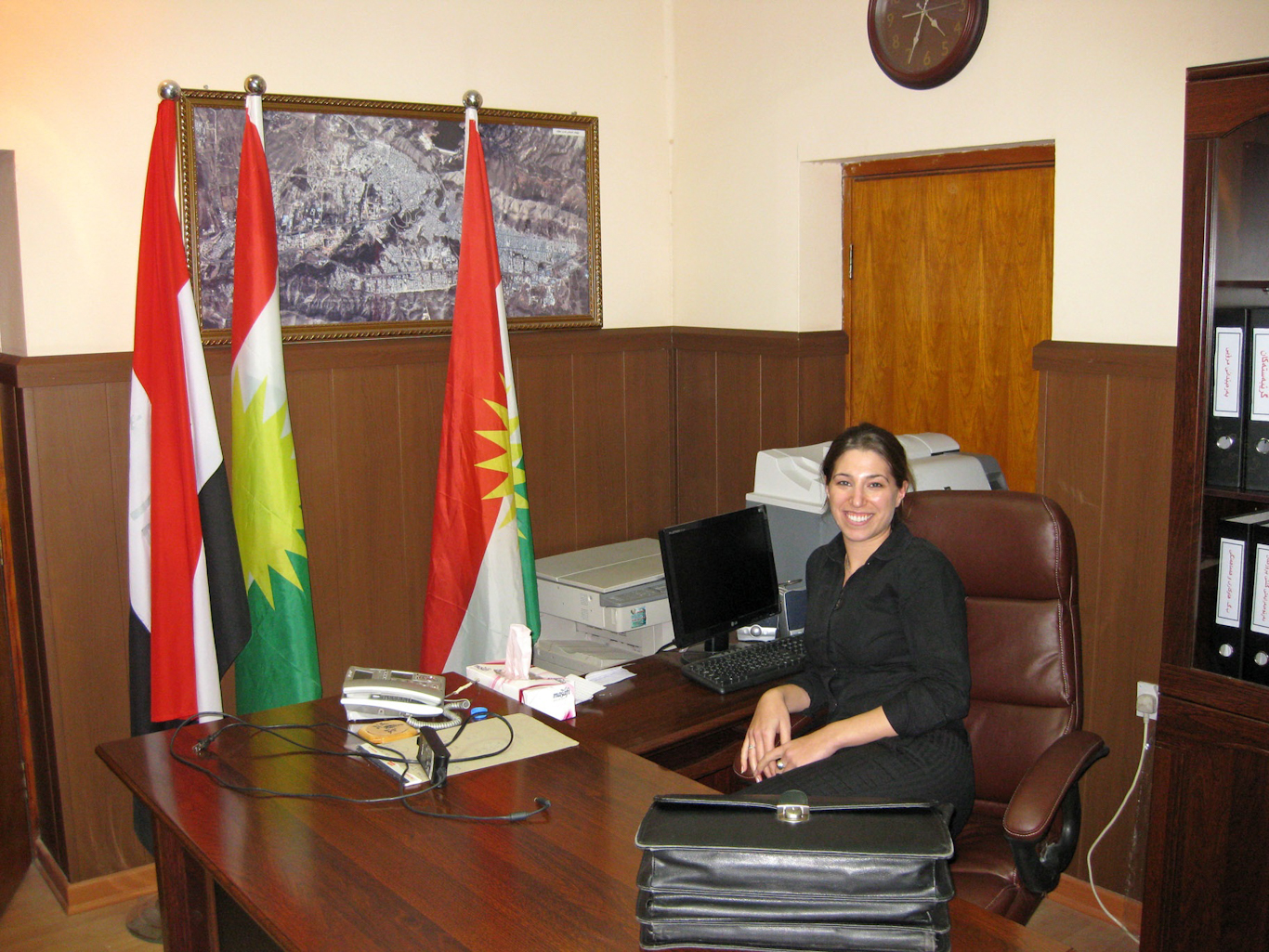
Ashooh is pictured during her time as a “consultant” in Iraqi Kurdistan. Photo | Academyalumni
Ashooh herself appears to have been a relatively major player in the Syrian Civil War. In her previously mentioned Washington Post article, she notes that her boss was a former Emirati Air Force General and that she was flown to Istanbul in 2013 to attend an emergency meeting with leaders of the Syrian opposition, as well as ambassadors from unnamed Arab and Western states, in order to plan a response to a reported chemical weapons attack and to help the U.S. “coordinate with the Syrian opposition.”
At the same time as she was advising the nation on Middle Eastern affairs, the UAE was widely accused of flying ISIS and al-Qaeda leaders into Yemen to help them intensify the Saudi-led onslaught on the impoverished nation and of smuggling U.S.-made weaponry — including small arms, TOW missiles and Oshkosh fighting vehicles — to the jihadist groups. While Ashooh’s writing is careful to maintain a distinction between the “moderate” rebels she supports and the fundamentalist radicals she does not, it certainly is noteworthy that the entities she worked for consistently seem to end up in league with the most regressive forces in the region. MintPress also reached out to Reddit for comment on why they appointed Ashooh, given her past history, and on the wider phenomenon of government penetration of social media. The company initially promised to issue a response to the inquiry but has not followed through with it.
Opposing some dictatorships, supporting others
Regime change is on the table for more than just one Middle Eastern nation. In a 2017 paper for the Center for the National Interest — a think tank established by former Republican President Richard Nixon and the “Godfather of Neoconservatism,” Irving Kristol — Ashooh explores the different options for forcing regime change in Iran, but concludes that overthrowing the “odious regime” is an impossible task right now, and criticizes the idea as a quixotic dream.
Nevertheless, she is far from an Iran dove. An Atlantic Council report she co-wrote insists that “Iranian interference in the Arab world must be deterred,” and that “America’s friends and partners must be reassured that the U.S. opposes Iranian hegemony and will work with them to prevent it.”
Ashooh’s commitment to fighting against Middle Eastern dictatorships might seem more principled if she did not appear so enamored of the least democratic one of them all. In 2016, she accompanied Albright and Hadley to Saudi Arabia and praised the monarchy’s dynamic leadership on the economy and its nurturing of a new generation. “It was really really exciting to see that level of energy and the level of government support for these young people who were interested in shaping their own futures… it was just wonderful,” she said. In an article about her experience for business news website Market Watch, she waxed lyrical about how forward-thinking the Saudi government is and how the country has become “a hub for the dynamic and positive change that is swelling up throughout the region.” Presumably, this excludes Yemen, a nation they were bombing relentlessly. In a 2020 interview, Ashooh revealed that her dream job would be U.S. Ambassador to Saudi Arabia. One of her earliest comments on her public Reddit page (made before she began working there) is deflecting the Kingdom from criticism of its dreadful treatment of women.
As part of the Atlantic Council, Ashooh was tasked with envisaging a new Middle East for the 21st century. Given her output, it seems that she advocates for a transition towards a more privatized, free-market economic setup, not completely unlike the shock therapy tried in Latin America in the 1970s and 1980s. “We have to “encourage states to make the reforms that move economies from state-based to ones that support entrepreneurship, because the age of state-based economies is over,” she said at a talk at New York University in 2015, adding:
You’ve got to move to support entrepreneurship in the region and let people take advantage of the natural industrial tendencies of people in the Middle East. My God, if you’ve ever been to a Turkish bazaar or a market in Cairo you know that these countries are perfectly capable of having functioning market economies. But the state has gotten in the way.
Ashooh’s LinkedIn profile also notes that in 2010, she worked as an advisor to the Iraqi Ministry of Planning “on a variety of strategic and economic development issues,” but does not go into any more detail about what those issues were. A further biography merely states that her consultancy agency “provid[ed] strategic and management consulting services to the Ministry of Planning of the Kurdistan Regional Government in Northern Iraq.” Unsurprisingly, the organization has links to the U.S. military; the agency’s lead partner being a former Army captain.
Think Tankie
Ashooh comes from a relatively prominent New Hampshire family of Lebanese descent, the most notable of which is probably her uncle Richard. Richard Ashooh was Donald Trump’s Assistant Secretary of Commerce for Export Administration and a former executive at weapons manufacturer BAE Systems. Unlike her uncle, Jessica appears to lean more Democratic, having donated money to a number of local politicians, as well as to anti-Trump Republican groups aimed at convincing them to vote blue, such as Right Side PAC and the now infamous Lincoln Project. However, she also appears to have great respect for many Republicans, having written her doctoral thesis at Oxford University on the Middle East policy of the George W. Bush administration. She also stated that the person she would have most liked to have met was 41st President George Bush Senior, describing him as possessing “incredible amounts of strategy, finesse and restraint.” Thus, her political views appear to be exactly in the center of the neoliberal “blob” in Washington.
Ashooh also worked for the right-wing think tank the CATO Institute and is a Term Member of the more Democratic-aligned Council on Foreign Relations (CFR). The CFR’s term member program is intended to, in its own words, “cultivate the next generation of foreign policy leaders.”
Surveillance Valley
How and why, then, did a hawkish young mandarin hothoused at elite universities and in the halls of state power end up an executive at an anarchic messageboard site with an anti-establishment reputation? Virtually everyone else in senior roles at Reddit has relevant backgrounds in marketing or tech, having worked with comparable companies such as Yelp, Expedia and Snapchat.
Tom Secker — a journalist, podcaster and researcher who runs SpyCulture.com, an online archive about government involvement in the entertainment industry — was deeply skeptical. “That someone whose entire career has been in international relations and foreign affairs is now the senior policy wonk at Reddit is simply bizarre. Given her ties to the CFR, Atlantic Council and the like, it’s downright suspicious,” Secker told MintPress.
Underneath the surface, however, the Atlantic Council has been rapidly expanding its influence and control over big social media companies. In 2018, it announced that it would be partnering with Facebook to promote trustworthy sources and derank, demote and even delete low quality or fake news, thus effectively curating what the platform’s 2.85 billion worldwide users see in their news feeds. But the effect of recent algorithmic changes has been to throttle alternative media traffic in favor of establishment sources such as CNN, Fox News and The New York Times. Even such more mainstream liberal sites as Mother Jones have seen their numbers crater. Facebook later admitted that they were directly targeting Mother Jones because of its left-leaning content, raising the question that if such a middle-of-the-road liberal outlet was being penalized, wasn’t the collapse in traffic to more radical publications surely deliberate? Given the Atlantic Council’s funding and the identities of those on its board, their control over social media is tantamount to state censorship on a global level.
Earlier this year, Facebook also hired NATO press officer Ben Nimmo to be its intelligence chief, in another move that dismayed free-speech advocates. In the past, Nimmo has identified a Welsh pensioner and an internationally known Ukranian pianist as Russian bots, raising more questions about the suitability of the Atlantic Council to be an arbiter of truth online.
The Facebook-Atlantic Council link mirrors that of Microsoft with NewsGuard, a new piece of software purportedly trying to fight fake news by placing either green shields or red warning logos, corresponding to an outlet’s credibility, beside all links in its browser, Microsoft Edge — this credibility being decided entirely by NewsGuard itself. Newsguard pushed Microsoft to install the software on all its products as standard. Again, however, NewsGuard’s system rated establishment websites like Fox News and CNN as trustworthy but independent media as suspect. And again, a glance at its advisory board makes it clear that this is a state operation. Those in key positions included George W. Bush’s Secretary of Homeland Security and former NSA and CIA Director General Michael Hayden; ex-White House Communications Director Don Baer; and former Secretary General of NATO Anders Fogh Rasmussen. Worse still, NewsGuard is also linked to a PR agency employed in whitewashing the Saudi government’s human-rights record and its role in the carnage in Yemen.
Twitter, too, has some extremely troubling links with state power. In 2019 Gordon MacMillan, a senior Twitter executive responsible for the Middle East region, was outed as an active duty officer in the British Army’s 77th Brigade, a unit dedicated to online operations and psychological warfare. Far from causing a scandal, only one major U.S. outlet even mentioned the story, and the journalist in question resigned from the profession weeks later, claiming the existence of a network of top-down state censors who quash stories that threaten the power and prestige of the national security state. To this day, MacMillan remains in his post at Twitter, strongly suggesting the social media company knew of his role before he was hired.
Over the past few years, Twitter, Reddit and Facebook have announced the deletion of hundreds of thousands of accounts linked to sources in Russia, Iran, China and other enemy states, often on the recommendation of Western governments or state-sponsored intelligence organizations. However, they never seem willing or able to find any manipulation of their platforms by Western governments. Thus, the upshot of this has been to slowly dissuade critics of Western foreign policy from using their services.
“The mainstream media-politik establishment has managed to get a hold over Twitter, Facebook and Instagram — shadow-banning and downrating posts considered ‘Russian propaganda’ or whatever other excuse they use to marginalize perspectives and content outside of the mainstream,” Secker told MintPress. “Audiences for this sort of content are increasingly pissed off and alienated by the major social media sites.”
Increasingly, unwelcome political voices are either brushed off by centrist pundits as repeating Russian talking points or smeared as being amplified by Kremlin-based bot farms. The popularity of movements on the left like Black Lives Matter or the Bernie Sanders’ campaign were written off as partially linked to Russia, while others suggested that the January 6 insurrection in Washington was essentially a Russian operation.
The irony is that many of the wildest accusations against Putin that have fed this climate of suspicion began life in Atlantic Council documents. For example, the organization has published a series of studies that suggest that virtually every European political party challenging the neoliberal status quo in some way — from Labour and UKIP in the U.K. to Syriza and Golden Dawn in Greece and PODEMOS and Vox in Spain — are secretly controlled by Russia, functioning as the “Kremlin’s Trojan Horses,” in its words.
The Atlantic Council is also deeply intertwined with a U.K. government-funded organization called the Integrity Initiative, something that purports to be a group defending democracy from disinformation. However, in practice, it appears to be doing the opposite: planting disinformation about politicians’ supposed links to Russia in order to undermine them. The Integrity Initiative is a government-backed cluster of journalists who operate in unison to conduct propaganda blitzes on unsuspecting publics. In 2018, it launched a successful operation to prevent Colonel Pedro Baños being appointed Spain’s head of national security. Considering Baños too soft on Russia for the Atlantic Council and other hawks’ liking, the initiative sprung into action, creating a storm of protest that led to another individual being chosen.
Reddit actually played a key role in a 2019 propaganda blitz against anti-war Labour leader Jeremy Corbyn. A few days before the U.K.’s general election, Corbyn promoted documents leaked on the platform that showed that Conservative Prime Minister Boris Johnson was negotiating with American companies, putting much of the country’s National Health Service up for sale. With just days to go before polls opened, it could have proved a game changer. Reddit quickly came to Johnson’s rescue, however, asserting that the documents were part of a Russian disinformation campaign. The story in the pliant British press switched from “Boris Johnson is selling off the NHS” to “Corbyn promotes Russian disinfo,” thus greasing the skids for an easy victory for the hardline anti-Russia Conservative Party, an outcome the hawks at the Atlantic Council were no doubt relieved by, given Corbyn’s open skepticism about war, empire and nuclear weapons. The veracity of the documents was not challenged.
For a while…
Founded in 2005, Reddit has grown to become one of the world’s largest and most influential websites. However, it began life as an anarchistic messageboard whose culture was profoundly libertarian and anti-establishment. For years, the company’s administrators took a near free speech absolutist position. Aaron Swartz, Reddit’s co-founder, was an open source hacktivist and even attempted to download and publish the entirety of academic publisher Jstor’s library. When authorities got wind of what he was doing, they threatened him with 40 years in prison, an action that caused him to take his own life in 2013.
Reddit’s own position on free information and free speech was often so extreme it caused huge controversy. The site became the internet’s largest source of child pornography. It was only after CNN began reporting on it to a nationwide audience that things began to change. Other, grossly offensive communities like /r/BeatingWomen and /r/CoonTown were also protected.
Nevertheless, the culture established by anarchistic tech bros remained for some years, with the site resembling darker corners of the internet like 4Chan and 8Chan as much as more family-friendly mainstream social media like Facebook.
Ashooh’s arrival in 2017 coincided with a new era in the site’s history. Gone were the days of protecting communities that would bring in bad publicity. Her team quickly brought in a new content policy and began to delete communities that violated it. Last year, she oversaw the banning of over 2,000 communities in a single day, including /r/The_Donald, the main Donald Trump subreddit, and /r/ChapoTrapHouse, the most active left-wing community. These decisions have helped the money flow in; since 2017 revenue has more than tripled.
However, what has been lost across the internet is the liberatory potential of these technologies. In the 1990s and 2000s, many predicted that the internet would usher in a new era of egalitarianism and genuine democracy, helping even to reduce barriers and tensions between nations. For a while, the new medium allowed political actors to challenge the status quo and gain huge followings quickly. Alternative media was easily outperforming legacy media, and challenging the status quo when it came to news. Seeing that, the reaction since 2016 has been swift, as the elite have moved to retighten their grip over the means of communication. Ashooh’s jump from national security state official to Reddit Director of Policy is just one more point of reference on that chart.
Alan MacLeod is Senior Staff Writer for MintPress News. After completing his PhD in 2017 he published two books: Bad News From Venezuela: Twenty Years of Fake News and Misreporting and Propaganda in the Information Age: Still Manufacturing Consent, as well as a number of academic articles.
From Here On, Palestine Calls the Shots
By Taxi | Plato’s Guns | May 27, 2021
From rocks to rockets. This is now the recorded evolution of the armed Palestinian Resistance. From throwing Intifada rocks that barely scratched occupation tanks, to lobbing rockets that can now reach anywhere in Israel: this is presently the undeniable status of the Palestinian Resistance. Hard, therefore, not to deduce that some impressive progress has been achieved by the armed Palestinian Resistance in Gaza, despite Gaza being under a severe land, sea and air siege. Right under the very noses of the bulky Israeli military and its lauded hi-tech Intel, the Palestinian Resistance has managed to arm itself in a significant way – and indeed, it continues to improve its arsenal, undetected. Of course, Israel’s weaponry remains by far more superior to that of the Palestinians, but this superiority in arms became meaningless during the recent ‘Sword of Jerusalem’ combat: a small war that found the Israeli forces unilaterally withdrawing from the battlefield after only some ten days. In normal military parlance, this would be defined as a defeat, yet this defeat is being referred to in the West as a ‘ceasefire’. Well, semantics aside, the simple takeaway is that Israel’s mighty military lost to pitiful Gaza rockets. The biblical story of David and Goliath repeated itself right before our modern eyes. And from here on, the hulking Israeli military will be powerless to protect Israeli Jews and their properties in the holy land.
In 1948, Zionism had promised the Jews of Israel two vital services: security and prosperity. Indeed, it had kept good on its promise for some 73 years. But now, in 2021 and post the ‘Sword of Jerusalem’ war, it can no longer provide either. From here on, Zionism cannot guarantee either security or prosperity for its Jewish population – not with Gaza rockets now permanently looming and ready to disrupt daily Jewish life in the holy land. It used to be that the Israeli military was the one capriciously disrupting the security and prosperity of Palestinians, but overnight, the success of the ‘Sword of Jerusalem’ has turned the tables on Israel. From here on, Palestine calls the shots. From here on, Israel will pay a very heavy price for any significant aggression against the suffering, occupied Palestinian people. This equation is now fixed; immovable. This is the new status quo.
Moreover, Zionism, appealing specifically to Jewish zealots, had also promised the total Judeofication of Jerusalem. A project that is contrary to International Law. A project that entails illegal land theft and the total ethnic cleansing of native Palestinians from their ancestral homes. Now, this project has come to a total standstill, with Hassan Nasrallah announcing recently that his resistance army, Hezbollah, as well as the armies of other members of the Axis of Resistance, will from here on militarily involve themselves in defending Jerusalem from this Judeofication project. Therefore, what we have now is Gaza’s improved rocketry checking Israel from within, and from without, we have several million Axis of Resistance fighters and their immense arsenal standing by, all ready to liberate Jerusalem at a moment’s notice. “Jerusalem for regional war,” was Nasrallah’s succinct warning to Israel. A regional war that will in fact be an existential war for Israel. A regional war that even the staunchest Israeli supporters are deathly fearful of because it will completely destroy modern Israel and cost tens of thousands of Jewish lives.
With Israel’s Zionism now unable to fulfill any of its fundamental promises, where does all this leave Zionism but collapsing before the very eyes of Jews themselves.
 It is now simply impossible for Israel to reverse its sinking fortune without igniting a suicidal, regional war. No power on earth, not even mighty US powers can reverse this track. All the US and other Western friends of Israel can do now is delay the inevitable destruction of Israel with the use of a proverbial band aid here and a band aid there. Blinken, who is currently visiting the holy land is offering nothing but band aids to both sides. Other Western leaders will soon enough also come to Tel Aviv and to Ramallah with offers of more band aid. In reality, no one has anything else to offer Israel but band aid, because everything else has already been gifted to Israel in the past, and Israel appears to have squandered and abused, instead of used these gifts wisely for its longevity’s sake. There is no more that the West can do for Israel, save for actually sending their troops to the holy land to die for the Jews. An unlikely and most controversial move to now send democratic Western troops to die for ‘Apartheid Israel’, especially in the current depressive economic state that the whole world finds itself in. And Even if some Western nation was foolish enough to send its troops to fight for Tel Aviv, these troops will not be able to stop the intensive waves of Resistance precision missiles and rockets already poised to saturate Tel Aviv and the rest of Israel proper. Here, even geography is against Israel.
The ‘Sword of Jerusalem’ has irreversibly weakened Israel, not just on the home front, but the world over too. Overnight, Israel’s universal image went from its traditional ‘victim State’, straight to ‘Apartheid state’. Now, in the minds of the majority of the world, Israel is believed to be an Apartheid state. And in this new Apartheid definition of Israel, the so-called holocaust violin and begging bowl are nowhere to be found. The world is no longer interested in considering the sentimental holocaust when it comes to Israel. All the world can see now are the numerous and unconscionable Crimes Against Humanity that Israel has wantonly engaged in against the Palestinians – numerous crimes that israel has committed without a single instance of accountability. The world is no longer prepared to remain silent on this, or to accept the status of Israel as eternal victim.
So very much has been shattered within the Zionist machinery by the ‘Sword of Jerusalem’. And there are no spare parts to be found anywhere to replace them. Not even a false flag operation by Israel will return it to the victim chair. The whole gaggle and cackle of Jewish deceptions are by now also known and exposed to global populations. What in the past used to work in favor of Israel, is no longer working. The apple has lost its shine.
And another major victim of the ‘Sword of Jerusalem’ is the Deal of the Century. At this stage of the game, with Jerusalem currently being a focal and highly emotive topic deluging Arab world medias, it is impossible for any corrupt Arab leader to now sign up anew to the Deal of the Century. And who in their right mind would sign a highly controversial deal with a sinking nation that can offer nothing in return? Mindful here too that two out of the four Arab nations that have already normalized with Israel under the Deal of the Century, did so purely for personal and not ideological reasons. These two nations are Sudan that signed the Deal in exchange for the removal of its name from the US’s terrorism list; and Morocco that signed the Deal in exchange for US support in Morocco’s illegal land claims over the Western Sahara. We can therefore safely say that out of 22 Arab nations, only two despotic Arab dictatorships are ideologically aligned with Israel: the UAE and Bahrain. These petite Zioninst-Arab nations cannot save Israel from even a single Gaza rocket, let alone from the combined weapons of the Axis of Resistance that now surround Israel: all coiled and waiting for Israel to miscalculate. Kushner’s attempt at wiping out the Palestine cause from the Arab world by creating a normalization program has utterly and completely failed. The Palestine cause has never been stronger in the Arab mind than it is now. The Deal of the Century has become the Tomb of the Century.
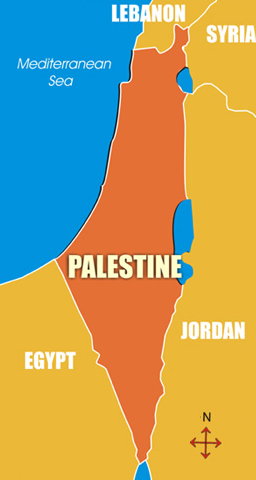
Moreover, an even more important pro Israel project has also collapsed at the swipe of the ‘Sword of Jerusalem’: The Oslo Agreement. No longer are the Palestinians happy with just a pitiful ‘crumb of land with no autonomy’ offered to them by Israel under Oslo, they are now unanimously demanding the return of all their land ‘from the river to the sea’. Their supporters worldwide are backing this notion by loudly chanting ‘from the river to the sea’ at all their mass protests. The ‘Sword of Jerusalem’ has veritably stabbed Oslo in the heart. The Two State Solution is dead. The One State Palestine Solution has grown massive wings.
Indeed, with Palestine now demanding all its land back ‘from the river to the sea’, Zionism appears to have symbolically lost all the land it acquired by force of arms since 1948. This symbolism will now become a reality in the next war between Israel and the Axis of Resistance. And war is coming. Plans and maps for the final War 0f Liberation remain very much on the table. Over the past 7 decades, Israel had stridently rejected numerous calls by friend and foe alike to surrender to the Levant’s historic culture of equitable coexistence between religions; rejected blending into the local scenery, opting instead to war against all its neighbors so as to assert itself as a vastly dominant power beyond reproach. Now it finds itself with many missed opportunities for peace and with its jugular bleeding: cut by no less than an over-zealous, blunt Zionist knife. War is coming to the holy land because Zionism has relentlessly expressed itself as a supremacist ideology that is fundamentally incapable of compromise, incapable of equality and justice, incapable of making real and genuine peace with any of its non Jewish neighbors. Through unchecked savagery, through arrogance and overreach since its inception, Israel has now become impotent in the face of the real existential threat it faces today. Apartheid policies and land-kleptomania will only get you so far. The Jews should have learned this lesson from the now defunct Apartheid South Africa.
Israel and its Jewish population now find themselves in an unsustainable and untenable position. They have now but two choices: depart from the Jewish colony in peace and physically intact, or from here on face a daily life of fear of Palestinian rockets and whatnot, followed eventually by a violent death when the big war breaks out.
Addressing Israeli Jews in his speech yesterday, Nasrallah stated: “We see how Muslim and Christian holy places are these days under dangerous attacks by you. When you destroy homes and people in Palestine: we leave this to the internal Palestinian Resistance to address. But we as the Axis of Resistance cannot stand idly by when you violate the sanctity of Muslim and Christian holy places in Jerusalem. Any further violations of Jerusalem by you will lead to regional war.”
Will Israeli civilian and military societies listen to Nasrallah’s warning, or will they, in their traditional arrogance, dismiss his words as being mere empty threats?
The Axis of Resistance now has all its war ducks lined up. The much longed for and necessary Palestinian unity is now a reality. All the needed weapons for victory are a reality. Global moral support for Palestinian liberation is now a reality. The War of Liberation is but one single step away. And the timing of this war will be triggered when Israel foolishly violates Jerusalem again. And violate it will, in its attempt to put oxygen back in the collapsing lung of Zionism. After all, violation is the only method that Israel knows. Violation is the definitive Israeli MO.
Will the Jews of Israel now risk life and limb and continue clinging to and supporting a shattered Zionism that can no longer deliver them its promised goods? Or will their survival instinct kick in and have them packing suitcases and returning back to their European, Russian and American origins?
A combination of both, I suspect. Some Jews will leave Israel. Some won’t. The die-hard Zionists are pathologically deluded enough to remain: believing that present conditions are militarily reversible. They’re not. Not anymore. Not ever. All that the Zionist Israeli government can do now in the aftermath of the ‘Sword of Jerusalem’ is ease up a small measure of pressure on the Palestinians and on the city of Jerusalem: buying itself time to come up with a solution that would be acceptable to both Israeli Jews on one hand, and Palestinian Muslims and Christians on the other. But Zionism, by its own definition does not allow for equitable co-existence with non-Jews. Sober minds on both sides do not believe that a win-win solution is available, or feasible. They estimate that this too-little-too-late path of Israel releasing some pressure on Jerusalem will lead to nowhere, and at some point en route, the Israeli government will become insensible with frustration to the point of miscalculation. Indeed, it will be Israel’s very last miscalculation.
We shall soon enough see a costly but heroic and historic return of the nation of Palestine: from the river to the sea.
No stopping now the winds of change that favor the suffering Palestinians.
Palestine: Hamas Defeats Israel

Just like in 2006, when both Ehud Olmert and George Bush declared that the “invincible IDF” had, yet again, achieved a “glorious victory” and the entire Middle-East almost died laughing hearing this ridiculous claim, today both the US and Israeli propaganda machine have declared another “glorious” victory for the “Jewish state of Israel” cum “sole democracy in the Middle-East”. And, just like in 2006, everybody in the region (and in Zone B) knows that the truth is that the Zionist entity suffered a huge, humiliated, defeat. Let’s try to unpack this.
First, a few numbers. The combat operations lasted two weeks. All other missile numbers are in dispute. Rather than trust this or that source, I will simply say that Hamas fired many thousands of missiles into Israel. Some, probably less than 50%, were truly intercepted by the Israeli air defenses, others hit in no man’s land, and some actually landed and caused plenty of destruction and at least 12 deaths. The Israelis executed hundreds of artillery and airstrikes causing massive destruction in the Gaza strip and killing about 250 Palestinians. Again, these numbers are guesstimates and they don’t really tell the full story. To understand the story, we need to forget about these numbers and look at what each side was hoping for and what each side achieved. Let’s begin with the Israelis:
The Israeli scorecard
To understand Israel’s goals in this war, we first need to place this latest war in its context, and that context is that Israel was comprehensively defeated in Syria. To substantiate this thesis, let’s remember the goals of the Zionists when they unleashed a major international war against Syria. These objectives, as listed in my July 2019 article “Debunking the Rumors About Russia Caving in to Israel” were:
The initial AngloZionist plan was to overthrow Assad and replace him with the Takfiri crazies (Daesh, al-Qaeda, al-Nusra, ISIS – call them whatever you want). Doing this would achieve the following goals:
- Bring down a strong secular Arab state along with its political structure, armed forces, and security services.
- Create total chaos and horror in Syria justifying the creation of a “security zone” by Israel not only in the Golan but further north.
- Trigger a civil war in Lebanon by unleashing the Takfiri crazies against Hezbollah.
- Let the Takfiris and Hezbollah bleed each other to death, then create a “security zone,” but this time in Lebanon.
- Prevent the creation of a Shia axis Iran-Iraq-Syria-Lebanon.
- Break up Syria along ethnic and religious lines.
- Create a Kurdistan which could then be used against Turkey, Syria, Iraq, and Iran.
- Make it possible for Israel to become the uncontested power broker in the Middle-East and force the KSA, Qatar, Oman, Kuwait, and all others to have to go to Israel for any gas or oil pipeline project.
- Gradually isolate, threaten, subvert, and eventually attack Iran with a broad regional coalition of forces.
- Eliminate all centers of Shia power in the Middle-East.
As we all know, this is what actually happened:
- The Syrian state has survived, and its armed and security forces are now far more capable than they were before the war started (remember how they almost lost the war initially? The Syrians bounced back while learning some very hard lessons. By all reports, they improved tremendously, while at critical moments Iran and Hezbollah were literally “plugging holes” in the Syrian frontlines and “extinguishing fires” on local flashpoints. Now the Syrians are doing a very good job of liberating large chunks of their country, including every single city in Syria).
- Not only is Syria stronger, but the Iranians and Hezbollah are all over the country now, which is driving the Israelis into a state of panic and rage.
- Lebanon is rock solid; even the latest Saudi attempt to kidnap Hariri is backfiring. (2021 update: in spite of the explosion in Beirut, Hezbollah is still in charge)
- Syria will remain unitary, and Kurdistan is not happening. Millions of displaced refugees are returning home.
- Israel and the US look like total idiots and, even worse, as losers with no credibility left.
Seeing their defeat in Syria, the Zionists did what they always do: they used their propaganda machine to list an apparently never-ending victorious strikes on supposed “Iranian targets” in Syria. While a few civilian simpletons with zero military experience did buy into this nonsense, the truth about Israeli operations in Syria is simple: the Syrian air defenses have successfully prevented the Israelis from striking at important, sensitive, targets, and the Israelis have been forced to declare as major victories the destruction of empty barns as “destruction of important IRGC headquarters” thereby “proving” to a few naive folks in Zone A and to themselves (!) that the IDF is still as “invincible” as it “always was”. As for the Neocons, they doubled-up on that and declared that 1) Russian air defenses are useless 2) that Russia and Israel work hand in hand and 3) that the Israelis are still invincible. Yet if any of that was true, why has Israel failed to achieve a single one of its goals? And why are both the Russians and the Iranians still in Syria where the Russians just finished a 2nd runway at Khmeimim and they have just deployed a group of Tu-22M3 at that air base from where they can now threaten any ship sailing in the Mediterranean, the Red Sea, the Persian Gulf, the Arabian Sea and the Indian Ocean. In their otherwise “free time” they can drop tons of bombs and missiles on the remaining Takfiri forces in Syria.
As I have been saying for many years now, the truth is that the IDF is a poor fighting force. Why? First, they have the exact same problem as the USA (and the KSA, for that matter): they rely on expensive technology, but don’t have good combat-capable “boots on the ground”. That is now how modern wars are won (see here for a list of popular misconceptions about modern wars).
In its recent history, the entire gamut of Israeli “elite” forces (including the air force, the navy, the artillery and even the Golani Brigade) got its collective butt handed to them by about 1000 and only lightly armed regular Hezbollah fighters in 2006: keep in mind that the elite Hezbollah forces were deployed only north of the Litani river to protect Beirut against a possible land invasion by Israel. Instead of taking Beirut or “disarming Hezbollah” (that was an official goal!), the Israelis could not even control the small town of Bint Jbeil located right across the official Israeli border! So much for being “invincible”!
What the IDF is very experienced at is terrorising Palestinian civilians and executing what could be called a slow-motion genocide of the Palestinian people. The problem with Gaza now is the same that the failed invasion of Lebanon in 2006 has revealed: just like the Lebanese in 2006, the Palestinians of 2021 are not afraid of the Zionists anymore. Furthermore, with a great deal of help from Iran and others, Hamas in Gaza is now much, much better armed than in the past. True, some of its missiles are decidedly low tech and not very effective (low accuracy, small warheads, simple trajectory, limited range), but Hamas also has shown some pretty decent UAVs too. Most importantly, from now on for Hamas it is only one way: up the “quality ladder” (just like the Houthis did in Yemen, starting with modest drones but eventually getting very capable ones).
The other major goal of the Israelis in this war was to prove to the world (and, even more importantly for the always narcissistic self-worshipping Israeli cowards, to themselves!) that their “Iron Dome” air defense network was the “super-dooper most bestest” in the world (no doubt, due to the famed “Jewish genius”!). It now appears that at best, the Israelis intercepted somewhere around 30-40% of the Hamas missiles. The way the Israeli hid this is by claiming that their fancy shmancy Iron Drone did not even try to engage missiles which were not deemed dangerous. But in the age of the ubiquitous smartphone, that kind of silly nonsense can easily be debunked (including by showing the total chaos in the Israeli skies or, for that matter, the missile strikes on Israeli military objectives). While the full Iron Dome air defense system probably works marginally better than the quasi-useless US Patriot, the Israeli air defenses are clearly at least a generation behind the Russian ones, including the S-300s the Russians sold to Syria (again, in the age of of the ubiquitous smartphone, this is not hard to prove).
It is crucial to remember that Hamas’ missiles are much inferior to those of the Houthis and the Syrians, and even more inferior when compared to Hezbollah or Iranian drones and missiles! In other words, the “invincible” IDF can’t deal with even its weakest, least sophisticated enemies (Hamas and the Palestinian Islamic Jihad) and the grotesquely expensive Iron Done cannot protect the Zionists from any determined missile attacks by the Resistance coalition (Palestine, Yemen, Syria, Hezbollah, Iran and Russia).
In their utter despair, the Zionist entity did what the AngloZionists always do when they fail to defeat a military force: they will turn their wrath on the civilian infrastructure and murder as many as they can. They will also strike highly symbolic targets such as the International Press Center in Gaza or a Red Crescent hospital (under the pretext that Hamas, which is the democratically elected local government) has offices there (this is clearly a F-you to those who condemn Israel for violating international law). To a normal human being, this sounds both obscene and ridiculous. But remember, the Israelis are first and foremost narcissists and they have no means of imagining how normal human beings think or feel. All these guys can feel is self-worship and hatred for all “others”.
We could say that in this war, the Palestinians defeated both military high tech and truly medieval type of genocidal hatred.
In other words, far from showing how “invincible” the Zionist entity is, this latest war against the Palestinians has shown beyond reasonable doubt that the IDF cannot deal with any of its enemies.
Besides missiles and bombs, the Israelis love to use terror, as their ideology has convinced them of two things: the Arabs only understand force and we, the Israelis, are invincible. But this begs the question of why the Israelis did not dare to move into Gaza, not even symbolically. Yeah, I know, the official doxa of Zone A is that “Biden called Netanyahu and told him to stop”. As if “Biden” could give orders to the Israelis!
The truth is that even with a casualty rate of 10:1 in the IDF’s advantage and no armor or artillery, the Palestinians are much more willing to engage in street battles than the IDF. Would the IDF eventually win a ground battle against Hamas and the Palestinian Islamic Jihad? Maybe, probably, the objective advantages in everything (except courage!) for the Israelis is so huge that no amount of skills and courage can forever negate the immense superiority in means of the Israelis.
However, as most people in the West tend to forget, wars are but means towards a political goal. If the IDF decided to basically flatten Gaza and kill many thousands of Palestinians at the cost of casualties probably in the hundereds, then this would be politically suicidal for the Zionist regime. This is why I offer this very basic conclusion:
During the latest Gaza war, deterrence did work. But only in the sense that the Palestinians successfully deterred the Israelis from launching a ground attack against Gaza.
There is another crucial political development which should also be noted: while both Iran and Hezbollah did give their full political support to Hamas+Palestinian Islamic Jihad, the latter did not request any assistance. In other words, not only did the Palestinians defeat the Israelis, but they did so absolutely alone, with no help from the other Resistance members.
Again, those Zone A civilians who believe that Israel is scoring huge victories in Syria on a quasi daily basis won’t get it, which is par for the course. But you can be darn sure that at least most of the IDF top commanders know the true score and for them it is yet another huge disaster.
There is also a political factor to consider. While there have been coordination resistance actions by the Palestinians in Israel (proper, as defined by the UN), this is the first time when the Palestinians from Gaza, those from the Occupied Territories and those in “Israel” truly fought, if not side by side (yet!), then at least at the same time and in a common cause. This is a major political victory for Hamas+Palestinian Islamic Jihad and a major problem for Fatah and the Zionists. Now let’s look at the rest of the Palestinian scorecard:
The Palestinian scorecard:
Let’s start by the obvious one: the Palestinians were not defeated. This victory can be further subdivided in the following:
- The Palestinian leadership has mostly physically survived, it still exists as a local authority. Plenty of Palestinians were murdered, but that did not affect the operational capabilities of the Palestinian forces (any more than the IDF succeeded in affecting Iranian operational capabilities in Syria).
- The Palestinian leadership has also survived politically. It was not blamed by the “Palestinian street” for starting the war, nor was it blamed for how it executed it. As for Fatah, it is now, by all accounts, lost somewhere in a political no man’s land which, admittedly, it richly deserves for its incompetence, corruption and subservience to Israel and the USA.
- Militarily speaking, the Palestinian missile strikes were not nearly as effective as, say, Hezbollah (nevermind Iranian!) strikes would have been, but, hey, they made huge progress and we can all rest assured that the Palestinians of Gaza will, sooner or later, catch up with the Houthis and, further down the road, maybe even Hezbollah.
- By many accounts, Hamas and Palestinian Islamic Jihad have made major political inroads into the Palestinian political scene outside Gaza. Even in spite of a truly immense hasbara effort by the Israelis, the international public opinion was blaming Israel for the orgy of violence.
It is interesting to note here that the famous Israeli journalist Gideon Levy has written an article for Ha’aretz entitled “Israeli Propaganda Isn’t Fooling Anyone – Except Israelis” which was further subtitled “’Hasbara’ is the Israeli euphemism for propaganda, and there are some things, said the late ambassador Yohanan Meroz, that are not ‘hasbarable.’ One of them is Israel’s treatment of the Palestinians.” This is how Levy’s article began:
And propaganda shall cover for everything. We’ll say terrorism, we’ll shout anti-Semitism, we’ll scream delegitimation, we’ll cite the Holocaust; we’ll say Jewish state, gay-friendly, drip irrigation, cherry tomatoes, aid to Nepal, Nobel Prizes for Jews, look what’s happening in Syria, the only democracy, the greatest army. We’ll say the Palestinians are making unilateral moves, we’ll propose negotiations on the “settlement bloc borders,” we’ll demand recognition of a Jewish state and we’ll complain that “there’s no one to talk to.” We’ll wail that the whole world is against us and wants to destroy us, no less.
Now comes the best part: Levy wrote this on Jun. 4, 2015 and updated it on Apr. 10, 2018 – years before the current disaster! Since then, things have only gone south for the IDF and the Israelis in general. Just the blowback from the war in Syria is, for the IDF, a true disaster.
Of course, “Israel” is still worshipped and faithfully served by many ruling classes worldwide (that is one of the functions of the Empire, to enforce this), but that officially lauded Israel is viewed with disgust and revulsion on most of the planet. Hence the inevitable failure of the truly galactic PR effort to brainwash the regular people into believing that Israeli is a polyyanish country, a “place without people for a people without country”, etc. etc. etc. This “Ziolatry”, if you wish, was effective when the PLO was blowing up Jewish grade schools in Western Europe, but today it has lost almost all of its traction, especially amongst thinking people.
The sad and disgusting reality about the Zionist entity is truly coming out, seeping under the propaganda walls of the Empire, and slowly but inevitably resulting in a common reaction of outrage and utter disgust for what is nothing else but the last officially racist country on the planet, the only country with an open air concentration camp it surrounds on all sides, the only country which truly, openly and sincerely does not give a damn about international law or about the lives of non-Jews (while calling their own lives sacred, of course!). This is a state which constantly repeats the mantra about the supposedly “sacred” blood of Jews while, at the same time, committing a slow motion (but very real) genocide of the Palestinian people while using non-stop terrorist attacks against any country daring to defy the order of the latest, and hopefully last, wannabe “superior race” in human history. This is also why the “crime of crimes” for politically correct and successfully brainwashed people is to declare that Israel has no right to exist. This is such a major crimethink that I want to conclude by committing it right now and asking others to join me in this “crimethink”!
Israel has no right to exist whatsoever first and foremost because it is an artificial creation of West European imperialist powers. Second, it is a country which has always engaged in atrocities and massive violations of international laws and norms. Instead, Israel is based on a racist ideology which is, for all practical purpose, indistinguishable from Hitler’s Nazi ideology (both National Socialism and Zionism have the same roots in both time, space and culture, both being products of European secularism and nationalism). For these reasons, Israel, and the Zionist ideology which supports it, are both a clear and present danger for international peace and stability (for details on Zionism as an ideology and its toxicity, please see here). Furthermore, the only possible way for the Palestinian people to ever recover their land and their rights under international law is that the Zionist “regime occupying Jerusalem must vanish from the page of time” (to quote the often mistranslated sentence by Ayatollah Komenei). By the way, this awareness also presupposes a clear understanding that the so-called “Two State Solution” (2SS) is an impossibility. Yes, I know, the 2SS is currently the only one under international law, but that is hardly surprising since the state of Israel was created with not only many of the trappings of “being an internationally recognized state” but also with the shameful complicity of the country which won WWII. There is one thing which Israel has in common with the so-called “Republic of Kosovo”: they will be the very first to be liberated as soon as the AngloZionist Empire finally crashes visibly (of course, it has already crashed, hence the many disastrous outcomes for the USA and Israel on the international scene, but that is still denied officially in Zone A and, of course, by the AngloZionist propaganda and those who pay attention to it.
In truth, there is only one true “solution” to this war: the so-called “One State Solution”, meaning that those who live in this land will get to choose their leaders and lifestyles according to the old “one person, one vote” principle. All other “solutions” simply perpetuate the current genocide!
As for those Jews who still want an ethnically pure state of Israel, they can either grow up and get real, or they can choose to colonize some other planet. As long as they don’t persecute local lifeforms, that might work. But if they do this will all happen again, over and over.
Conclusion: “Gaza” and the future of the Zionist entity
I want to end here with what I believe is a glance at the future (or lack thereof!) of Israel. The website Islamic World News Analysis Group (which I highly recommend!) recently posted what it claims to be a video of a new Iranian combat drone named “Gaza” described as so: “The Gaza drone, capable of carrying 13 bombs and 500 kilograms of equipment, as well as 35 hours of flight up to a radius of 2,000 kilometers, is capable of carrying out a variety of combat and intelligence operations. According to the published images, it seems that the Gaza drone uses the Rotary Bomb Launcher mechanism under its fuselage, which can carry up to 5 bombs. This is the first Iranian drone to use this mechanism. 8 bombs are also installed under the wings and in total this drone is capable of carrying 13 bombs”. Here is the footage of this new drone. Take a look for yourself and imagine what the next round of this campaign to liberate Palestine might look like.
Featured Video

America Racing to Strategic Defeat in Iran
or go to
Aletho News Archives – Video-Images
From the Archives
Should Europeans ‘Thank’ the Americans for Destroying Nord Stream?
By Robert Bridge | Strategic Culture Foundation | September 29, 2022
With an investigation continuing into the destruction of the Nord Stream gas pipeline that provided energy supplies to Europe from Russia, there appears to be just one prime suspect, and that should surprise nobody.
Following the sabotage of the Nord Stream 1 and 2 gas pipelines, former Polish Foreign Minister Radoslaw Sikorski already seemed to know the identity of the perpetrator when he tweeted out: “Thank you, USA.”
At first glance, it seemed that Sikorski was speaking sarcastically, berating Washington for carrying out an attack that will have severe repercussions for the people of Europe. After all, how could anyone see any good coming from the termination of Europe’s primary source of gas reserves with winter just around the corner? It was Sikorski’s homeland of Poland, after all, that urged its citizens to collect firewood in the face of dwindling gas reserves.
In fact, the Polish diplomat was speaking one-hundred percent literally… continue
Blog Roll
 Aletho News
- Growing insecurity, soaring prices fuel protests in north as regime bans evacuation: Sources
- Iran denies responsibility for ‘depraved’ attack on Kuwait desalination plant
- Bring The Troops Back. End This War Now!
- Can we please stop calling Israel the ‘only democracy in the Middle East’ now?
- US should start removing its troops for Germany, proposes AfD co-leader Chrupalla
- Iran Red Crescent: 600 educational centers attacked in US-Israeli ‘war crimes’
- Russian Oil Tanker Arrives in Cuba Amid U.S. Blockade
- America Racing to Strategic Defeat in Iran: Lt Col Daniel Davis
- FTC Warns Visa, Mastercard, PayPal, Stripe Over Political Debanking
- Russian tanker approaches Cuba despite US oil blockade
- If Americans Knew
- Israeli police block Catholic cardinal from entering Church of the Holy Sepulchre on Palm Sunday
- Israel is assassinating journalists again, more than any other nation, anywhere, ever – Not a ceasefire Day 170
- Over 300 US service members wounded, majority have brain injuries – Not a ceasefire Day 169
- Researchers at Human Rights Watch Resign Over Blocked Report on Palestinian Refugee Return
- Jewish Groups Are Backing a War Americans Don’t Want
- Eric Fingerhut Thinks He’s the President of the Jews
- Top Jewish Philanthropists, Rabbis Urge Israeli President to Take Action Against ‘Jewish Extremists’
- Don’t Be Fooled. Zionist Leaders Have Always Wanted to Control Southern Lebanon
- Israel’s widespread use of torture is a core element of its genocide against the Palestinian people
- In Israel’s War on Iran, Many Middle East US Bases Rendered “All But Uninhabitable”
- No Tricks Zone
- New Study Finds Warming Saves Lives…Cold Temperatures 12 Times More Deadly Than Excess Heat
- German Science Blog Accuses PIK Climate Institute Of Hallucinating Climate Tipping Points
- Devastating Assessment Of Comirnaty Vaccine By Former Senior Pfizer Europe Toxicologist
- New Study: CO2 Is ‘Effectively Negligible’ As An Explanatory Climate Change Factor Since 2000
- Former Pfizer Toxicologist Dr. Helmut Sterz Tells Bundestag Hearing Pfizer Vaccine Should Have Never Been Approved
- Energy Expert: Germany’s Nuclear Phaseout Was A “500 Billion Euro Mistake”
- New Research: South Australia’s Mid-Holocene Sea Surface Temperatures Were 4°C Warmer Than Today
- Storing Green Energy To Last Germany 10 Days Would Require A 60-Million Tonne Battery
- New Studies: UK Sea Levels Were 4 Meters Higher Than Today During The Mid-Holocene
- Destructive Green New Deal: German Energy And Metal Group Warns Of Drastic Crisis
 Aletho News