Pompeo and Netanyahu paved a path to war with Iran, and they’re pushing Trump again
By Gareth Porter | The Grayzone | March 20, 2020
Though it narrowly averted war with Iran this January, the Trump administration is still pushing for all-out military conflict. The architects of the drive to war, Mike Pompeo and Benjamin Netanyahu, have relied on a series of cynical provocations to force Trump’s hand.
The US may escape the most recent conflict with Iran without war, however, a dangerous escalation is just over the horizon. And as before, the key factors driving the belligerence are not outraged Iraqi militia leaders or their allies in Iran, but Trump’s secretary of state, Mike Pompeo, and Israeli Prime Minister Benjamin Netanyahu, who has long sought to draw the US into a military confrontation with Iran.
Throughout the fall of 2019, Netanyahu ordered a series of Israeli strikes against Iranian allies in Iraq and against Lebanese Hezbollah units. He and Pompeo hoped the attacks would provoke a reaction from their targets that could provide a tripwire to outright war with Iran. As could have been expected, corporate US media missed the story, perhaps because it failed to reinforce the universally accepted narrative of a hyper-aggressive Iran emboldened by Trump’s failure to “deter” it following Iran’s shoot-down of a U.S. drone in June, and an alleged Iranian attack on Saudi oil facility in September.
Pompeo and John Bolton set the stage for the tripwire strategy in May 2019 with a statement by national security adviser John Bolton citing “troubling and escalatory indications and warnings,” implying an Iranian threat without providing concrete details. That vague language echoed a previous vow by Bolton that “any attack” by Iran or “proxy” forces “on United States interests or on those of our allies will be met with unrelenting force.”
Then came a campaign of leaks to major news outlet suggesting that Iran was planning attacks on U.S. military personnel. The day after Bolton’s statement, the Wall Street Journal reported that unnamed U.S. officials cited “U.S. intelligence” showing that Iran “drew up plans to target U.S. forces in Iraq and possibly Syria, to orchestrate attacks in the Bab el-Mandeb strait near Yemen through proxies and in the Persian Gulf with its own armed drones…”
The immediate aim of this campaign was to gain Trump’s approval for contingency plans for a possible war with Iran that included the option of sending as many as 120,000 U.S. troops into region. Trump balked at such war-planning, however, complaining privately that Bolton and Pompeo were pushing him into a war with Iran. Following Iran’s shoot-down of the U.S. drone over the Strait of Hormuz on June 20, Pompeo and Bolton suggested the option of killing Maj. Gen. Qassem Soleimani in retaliation. But Trump refused to sign off on the assassination of Iran’s top general unless Iran killed an American first, according to current and former officials.
From that point on, the provocation strategy was focused on trying to trigger an Iranian reaction that would involve a U.S. casualty. That’s when Israeli Prime Minister Benjamin Netanyahu interjected himself and his military as a central player in the drama. From July 19 through August 20, the Israeli army carried out five strikes against Iraqi militias allied with Iran, blowing up four weapons depots and killing as many Shiite militiamen and Iranian offcers, according to press accounts.
The Israeli bombing escalated on August 25, when two strikes on the brigade headquarters of a pro-Iranian militia and on a militia convoy killed the brigade commander and six other militiamen, and a drone strike on Hezbollah’s headquarters in south Beirut blew the windows out of one of Hezbollah’s media offices.
Netanyahu and Pompeo sabotage Trump and Macron’s attempt at diplomacy
Behind those strikes was Netanyahu’s sense of alarm over Trump toying with the idea of seeking negotiations with Iran. Netanyahu had likely learned about Trump’s moves toward detente from Pompeo, who had long been his primary contact in the administration. On August 26, French President Emanuel Macron revealed that he was working to broker a Trump-Rouhani meeting. Netanyahu grumbled about the prospect of U.S.-Iranian talks “several times” with his security cabinet the day before launching the strikes.
Two retired senior Israeli generals, Gen. Amos Yadlin and Gen. Assaf Oron, criticized those strikes for increasing the likelihood of harsh retaliation by Iran or one of its regional partners. The generals complained that Netanyahu’s attacks were “designed to prod [Iran] into a hasty response” and thus end Trump’s flirtation with talking to Iran. That much was obviously true, but Pompeo and Netanyahu also knew that provoking an attack by Iran or one of its allies might cause one or more of the American casualties they sought. And once American blood was spilled, Trump would have no means to resist authorizing a major escalation.
Kataib Hezbollah and other pro-Iran Iraqi militias blamed the United States for the wave of lethal Israeli attacks on their fighters. These militias responded in September by launching a series of rocket attacks on Iraqi government bases where U.S. troops were present. They also struck targets in the vicinity of the U.S. Embassy.
The problem for Netanyahu and Pompeo, however, was that none of those strikes killed an American. What’s more, U.S. intelligence officials knew from NSA monitoring of communications between the IRGC and the militias that Iran had explicitly forbidden direct attacks on US personnel.
Netanyahu was growing impatient. For several days in late October and early November, he met with his national security cabinet to discuss a new Israeli attack to precipitate a possible war with Iran, according to reports by former Israeli Ambassador Michael Oren. Oren hinted at how a war with Iran might start. ‘[P]erhaps Israel miscalculates,” he suggested, “hitting a particularly sensitive target,” which, in his view, could spark “a big war between Israel and Iran.”
But on December 27, before Netanyahu could put such a strategy into action, the situation changed dramatically. A barrage of rockets slammed into an Iraqi base near Kirkuk where U.S. military personnel were stationed, killing a U.S military contractor. Suddenly, Pompeo had the opening he needed. At a meeting the following day, Pompeo led Trump to believe that Iranian “proxies” had attacked the base, and pressed him to “reestablish deterrence” with Iran by carrying out a military response.
In fact, U.S. and Iraqi officials on the spot had reached no such conclusion, and the investigation led by the head of intelligence for the Iraqi federal police at the base was just beginning that same day. But Pompeo and his allies, Defense Secretary Mark Esper and Chairman of Joint Chiefs Gen. Mark A Milley, were not interested in waiting for its conclusion.
A deception brings the US and Iran to the brink of war
The results of a subsequent Iraqi investigation revealed that the rocket barrage had been launched from a Sunni area of Kirkuk with a strong Islamic State presence, and that IS fighters had carried out three attacks not far from the base on Iraqi forces stationed there in the previous ten days. US signals intercepts found no evidence that Iraqi militias had shifted from their policy of avoiding American casualties at all cost.
Kept in the dark by Pompeo about these crucial facts, Trump agreed to launch five airstrikes against Kataib Hezbollah and another pro-Iran militia at five locations in Iraq and Syria that killed 25 militiamen and wounded 51. He may have also agreed in principle to the killing of Soleimani when the opportunity presented itself.
Iran responded to the attacks on its Iraqi militia allies by approving a violent protest at the U.S. Embassy in Baghdad January 31. The demonstrators did not penetrate the embassy building itself and were abruptly halted the same day. But Pompeo managed to persuade Trump to authorize the assassination of Qassem Soleimani, Iran’s second most powerful figure, presumably by hammering on the theme of “reestablishing deterrence” with Iran.
Soleimani was not only the second most powerful man in Iran and the main figure in its foreign policy; he was idolized by millions of the most strongly nationalist citizens of the country. Killing him in a drone strike was an open invitation to the military confrontation Netanyahu and Pompeo so desperately sought.
During the crucial week from December 28 through January 4, while Pompeo was pressing Trump to retaliate against Iran not just once but twice, it was clear that he was coordinating closely with Netanyahu. During that single week, he spoke by phone with Netanyahu on three separate occasions.
What Pompeo and Netanyahu could not have anticipated was that Iran’s missile attack on the U.S. sector of Iraq’s sprawling al-Asad airbase in retaliation would be so precise that it scored direct hits on six U.S. targets without killing a single American. (The US service members were saved in part because the rockets were fired after the Iraqi government had passed on a warning from Iran to prepare for it). Because no American was killed in the strike, Trump again decided against further retaliation.
Towards another provocation
Although Pompeo and Netanyahu failed to ignite a military conflict with Iran, there is good reason to believe that they will try again before both are forced to leave their positions or power.
In an article for the Atlantic last November, former Israeli Ambassador Michael Oren, channeled Netanyahu when he declared it would be “better for conflict [with Iran] to occur during the current [Trump] administration, which can be counted on to provide Israel with the three sources of American assistance it traditionally receives in wartime,” than to “wait until later.”
Oren was not the only Israeli official to suggest that Israeli is likely to go even further in strikes against Iranian and Iranian allies targets in 2020. After listening to Israeli army Chief of Staff Aviv Kochavi speak in late December, Haaretz military correspondent Amos Harel reported that the Israeli army chief conveyed the clear impression that a “more serious confrontation with Iran in the coming year as an almost unquestionable necessity.” His interviews with Israeli military and political figures further indicated that Israel would “intensity its efforts to hit Iran in the northern area.”
Shockingly, Pompeo has exploited the Coronavirus pandemic to impose even harsher sanctions on Iran while intimidating foreign businesses to prevent urgently needed medical supplies from entering the country. The approaching presidential election gives both Pompeo and Netanyahu a powerful reason to plot another strike, or a series of strikes aimed at drawing the US into a potential Israeli confrontation with Iran.
Activists and members of Congress concerned about keeping the US out of war with Iran must be acutely aware of the danger and ready to respond decisively when the provocation occurs.
U.S. Forces Withdraw From Key Base Near Syrian Border. More Rocket Attacks On U.S. Targets In Iraq
South Front | March 18, 2020
Late on March 17, at least three rockets struck the area near the US embassy in Baghdad’s fortified Green Zone. This was the fourth such attack in the span of a week. A day earlier, a pair of rockets struck the Besmaya base south of Baghdad. This military facility is the second largest military base operated by the US-led coalition in Iraq after Camp Taji.
The threat of rocket attacks already forced the US military to announce that it is evacuating some of its bases in the country. The al-Qaim base, near the Syrian-Iraqi border, is among them. The al-Qaim facility has been an important logistical and operational hub employed by US forces for operations in western Iraq and eastern Syria. Its presence there, as well as in Syria’s al-Tanf, has allowed the US to project its power along the Syrian-Iraqi border more effectively and to support Israeli military actions against Iranian-backed forces in the area.
Al-Qaim is located on the highway between the Iraqi capital of Baghdad and the Syrian city of Deir Ezzor. The town of al-Bukamal, which Israeli and US media often label as a stronghold of Iranian-backed forces, is located on the Syrian side of the border.
The withdrawal from al-Qaim is a signal that the US has been forced to admit that its attempts to cut off the land link between Syria, Iraq and Iran have failed. Washington was seeking to prevent a free movement of troops, weapons and other supplies from one country to another.
Meanwhile in Syria, the Idlib zone remains the main focus of tensions. Idlib armed groups and their supporters continue blocking efforts to create a security zone along the M4 highway in southern Idlib, as had been agreed by Turkey and Russia. These actions are accompanied by a fierce war propaganda campaign against the Damascus government, Iran and Russia. If the situation develops in this direction and further, the only remaining option to implement the new de-escalation deal and neutralize the terrorist threat will be a new military operation.
Why has NATO Failed to Exploit Turk-Russia “Tensions” in Syria?
By Salman Rafi Sheikh – New Eastern Outlook – 17.03.2020
In any other sort of circumstances, the NATO countries from Europe and North America would have rushed to help Turkey fight the “Russian invaders” in Syria and accomplish their avowed mission. This, however, did not happen when Turkey and Russia came “eye ball to eye ball” in Syria over the question of the liberation and control of Syria’s Idlib province and the adjoining strategically important areas, including the M-4 highway. Tensions are already disappearing with a Turkey-Russia “deal”, paving the way for an eventual settlement of interests. The question, however, that begs attention here is: why could the NATO countries not change Turkey’s position in a way that would have re-established it as a NATO ally in Syria, pitched against the Russians, Syrians and the Iranians?
While the US did “offer” its support to Turkey, words could not be translated into action, even though a number of Western political pundits have been writing and speaking about the “fragility” of the Turkey-Russia alliance and the need for the West to win Turkey back. A number of reasons explain why this has not happened.
First of all, there is little doubt in that Turkey is an important regional player even for Russia. This explains why the Russians have, despite crisis after crisis, continued to manage their relations with Turkey through intensive diplomatic engagements, leaving no room for big and unbridgeable gaps to occur. The latest deal and the deals before the crisis reflect the strength of their diplomatic channels working at the highest possible levels.
However, notwithstanding the resilience of their bi-lateral ties, NATO’s lethargy is due largely to the crisis that NATO is itself facing from within.
On the one hand, the US and European members of the alliance are increasingly pushing for changes in different and opposing directions, and on the other hand, even Turkey itself is reluctant to project its policies in Syria as a NATO member. At the same time, the European members of the alliance are up in arms over Erdogan’s bold and cynical effort to pressure NATO to come to its aid by opening its border with Greece to Syrian refugees, thereby threatening a repeat of the 2015 refugee crisis. NATO, therefore, has no interest in coming to Turkey’s aid and help start a war that would ultimately come to bite them hard.
NATO countries, therefore, continue to think that delivering more humanitarian aid and financial support via the European Union for Syrian refugees already in Turkey is a better option that militarily committing to a war between Turkey and Syria/Russia, which will inevitably involve a massive inflow of refugees, causing both political and economic problems for them to handle. This, for them, is unnecessary and needs to be avoided.
It was perhaps this very reason in the first place which led NATO to discourage Turkey from starting its military operations in Syria in 2019. In fact, NATO countries cannot militarily help Turkey inside Syria even if Turkey really wanted them to.
The Article 5 of the NATO charter cannot be applied to the Syrian scenario. Whereas any NATO country can invoke Article 5, the actual application of this article is limited by the Article 6 which defines the ‘territorial scope’ of the Article 5. Among other areas, Article 6 defines Article 5’s ambit as including the territory of Turkey and the forces, vessels and aircraft of NATO members located in the Mediterranean Sea. But it crucially doesn’t cover attacks on Turkish forces on Syrian territory.
NATO countries would be morally obliged to help Turkey if only Turkey’s territory comes under attack from an offensive originating from within Syria. For this support to come, however, relations between NATO and Turkey need to be perfect, which has not been the case since the 2016 failed coup attempt.
At the same time, there is a strong realisation in NATO that Turkey has increasingly been acting as an ‘independent player’ in the region since at least 2016. It explains why Turkey chose to buy Russia’s S-400 system despite opposition from the NATO alliance.
This brings us to another aspect of why NATO has not ‘intervened’ in Syria on behalf of Turkey. Whereas Article 5, as mentioned earlier, does not apply to this situation, NATO has not always acted in strict accordance with its charter. For instance, it intervened in Libya even though it had no mandate for such an intervention, and no attack or direct threat was originating from Libya against any NATO countries. However, NATO still decided to intervene in Libya to topple the Col. Muammar Gaddafi regime. Why has NATO not done a similar thing in Syria even though the increasing Turkey-Russia “tensions” provided just the context for such an intervention.
The Russian military presence is certainly a factor, but an equally important factor is the “tension” that exists between Turkey and the rest of the NATO allies specifically, and within the alliance more generally, giving the US and European members of the alliance no material reasons to exploit the Russo-Turk “tensions” to their advantage.
Salman Rafi Sheikh is a research-analyst of International Relations and Pakistan’s foreign and domestic affairs.
‘Zionist’ Biden in His Own Words: ‘My Name is Joe Biden, and Everybody Knows I Love Israel’
By Ramzy Baroud | MEMO | March 14, 2020
“I am a Zionist. You don’t have to be a Jew to be a Zionist,” current Democratic Presidential candidate, Joe Biden, said in April 2007, soon before he was chosen to be Barack Obama’s running mate in the 2008 elections.
Biden is, of course, correct, because Zionism is a political movement that is rooted in 20th century nationalism and fascism. Its use of religious dogmas is prompted by political expediency, not spirituality or faith.
Unlike US President, Donald Trump, or Bernie Sanders, Biden’s only serious opponent in the Democratic primaries, Biden’s stand on Israel is rarely examined.
Trump has made his support for Israel the cornerstone of his foreign policy agenda since his inauguration into the White House in January 2017. The American President has basically transformed into Israel’s political genie, granting Tel Aviv all of its wishes in complete defiance of international law.
Sanders, on the other hand, came to represent the antithesis of Trump’s blind and reckless support for Israel. Himself Jewish, Sanders has promised to restore to the Palestinian people their rights and dignity, and to play a more even-handed role, thus ending decades of US unconditional support and bias in favor of Israel.
But where does Biden factor into all of this?
Below is a brief examination of Biden’s record on Palestine and Israel in recent years, with the hope that it gives the reader a glimpse of a man that many Democrats feel is the rational alternative to the political imbalances and extremism of the Trump administration.
August 1984: Palestinians and Arabs are to Blame
Biden’s pro-Israel legacy began much earlier than his stint as a vice-President or presidential candidate.
When Biden was only a Senator from Delaware, he spoke at the 1984 annual conference of ‘Herut Zionists of America’. Herut is the forerunner of Israel’s right-wing Likud party.
In his speech before the jubilant right-wing pro-Israel Zionist crowd, Biden derided the Palestine Liberation Organization (PLO) and Arab governments, for supposedly derailing peace in the Middle East.
Biden spoke of “three myths (that) propel U.S. policy in the Middle East” which, according to the American Senator, are, “the belief that Saudi Arabia can be a broker for peace, the belief that King Hussein (of Jordan) is ready to negotiate peace, and the belief that the Palestine Liberation Organization can deliver a consensus for peace.”
April 2007: ‘I am a Zionist’
Time only cemented Biden’s pro-Israel’s convictions, leading to his declaration in April 2007 that he is not a mere supporter of Israel – as has become the standard among US politicians – but is a Zionist himself.
In an interview with Shalom TV, and despite his insistence that he does not need to be Jewish to be a Zionist, Biden labored to make connections with the ‘Jewish State’, revealing that his son is married to a Jewish woman and that “he had participated in a Passover Seder at their house,” according to the Israeli Ynet News.
March 2013: ‘Qualitative Edge’
This commitment to Israel became better articulated when Biden took on greater political responsibilities as the US vice-president under Obama’s administration.
At a packed AIPAC conference in March 2013, Biden elaborated on his ideological Zionist beliefs and his president’s commitment to ‘the Jewish state of Israel’. He said:
“It was at that table that I learned that the only way to ensure that it could never happen again was the establishment and the existence of a secure, Jewish state of Israel. I remember my father, a Christian, being baffled at the debate taking place at the end of World War II ..” that any country could object to the founding of Israel on the ruins of the Palestinian homeland.
“That’s why we’ve worked so hard to make sure Israel keeps its qualitative edge in the midst of the Great Recession. I’ve served with eight Presidents of the United States of America, and I can assure you, unequivocally, no President has done as much to physically secure the State of Israel as President Barack Obama.”
December 2014: ‘Moral Obligation’
In one of the most fiercely pro-Israel speeches ever given by a top US official, Biden told the annual Saban Forum at the Brookings Institution in Washington on December 6, 2014, that, “If there weren’t an Israel, we would have to invent one”.
In his speech, Biden added a new component to the American understanding of its relationship with Israel, one that goes beyond political expediency or ideological connections; a commitment that is founded on “moral obligation”.
Biden said, “We always talk about Israel from this perspective, as if we’re doing (them) some favor. We are meeting a moral obligation. But it is so much more than a moral obligation. It is overwhelmingly in the self-interest of the United States of America to have a secure and democratic friend, a strategic partner like Israel. It is no favor. It is an obligation, but also a strategic necessity.”
April 2015: ‘I Love Israel’
“My name is Joe Biden, and everybody knows I love Israel,” Biden began his speech at the 67th Annual Israeli Independence Day Celebration held in Jerusalem in April 2015.
“Sometimes we drive each other crazy,” the US vice-president said in reference to disagreements between Israel and the US over Israeli Prime Minister, Benjamin Netanyahu’s refusal to halt construction of illegal Jewish settlements.
“But we love each other,” he added. “And we protect each other. As many of you heard me say before, were there no Israel, America would have to invent one. We’d have to invent one because … you protect our interests like we protect yours.”
July 2019: US Embassy Stays in Jerusalem
In response to a question by the news website, AXIOS, which was presented to the various Democratic party candidates, on whether a Democratic President would relocate the American embassy back to Tel Aviv, the Biden campaign answered:
“Vice President Biden would not move the American embassy back to Tel Aviv. But he would re-open our consulate in East Jerusalem to engage the Palestinians.”
October 2019: Support for Israel Unconditional
In an interview with the Wall Street Journal on October 31, 2019, Biden was asked whether he agrees with the position taken by his more progressive opponent, Bernie Sanders, regarding US financial support to Israel and Jewish settlement.
Sanders had said that, “if elected president he would leverage billions of dollars in U.S. military aid to Israel to push Jerusalem to change its policies toward the Palestinians,” The Hill news website reported.
Biden’s response was that, “… the idea that we would draw military assistance from Israel, on the condition that they change a specific policy, I find to be absolutely outrageous. No, I would not condition it, and I think it’s a gigantic mistake. And I hope some of my candidates who are running with me for the nomination — I hope they misspoke or they were taken out of context.”
March 2020: ‘Above Politics, Beyond Politics’
Biden’s fiery speech before the pro-Israel lobby group, AIPAC, at their annual conference in March 2020, was a mere continuation of a long legacy that is predicated on his country’s blind support for Israel.
Biden’s discourse on Israel – a mixture of confused ideological notions, religious ideas and political interests – culminated in a call for American support for Israel that is “above politics and beyond politics”.
“Israelis wake up every morning facing an existential threat from their neighbors’ rockets from Gaza, just like this past week .. That’s why I’ve always been adamant that Israel must be able to defend itself. It’s not just critical for Israeli security. I believe it’s critical for America’s security.”
Palestinians “need to end the rocket attacks from Gaza,” Biden also said. “They need to accept once and for all the reality and the right of a secure democratic and Jewish state of Israel in the Middle East.”
More American Blunders in the Middle East: U.S. Envoys Embrace Terrorists Yet Again
By Philip Giraldi | American Herald Tribune | March 14, 2020
The spread of the coronavirus has meant that much of the other news about developments around the world has disappeared from the normal news cycle. The situation in Syria, which involves not only the government in Damascus but also Turkey, Russia, Iran and a remaining American force in part of the country has been proving increasingly unstable. Russian President Vladimir Putin has met face-to-face with Turkish President Recep Tayyip Erdogan to come up with a de-escalation plan that would avoid any head-to-head confrontation. An agreement was reached that included a cease fire, which most observers are describing as a surrender by Erdogan that accepted all Russian-Syrian army gains in the Idlib Province, but it remains to be seen what exactly will be sustainable. There have been subsequent reports that have included claims of the downing of two Syrian aircraft and several helicopters.
The United States for its part has been sending mixed messages to appeals from the Turks for support. Donald Trump has had an on and off again relationship with Erdogan and he has more-or-less approved the Turkish presence in the border areas and continues to endorse something like regime change in Damascus. Though it seems that at least for the moment the danger of a major armed conflict between Russia and Turkey has faded, many believe that more incidents are likely and could easily escalate.
And there is a truly dangerous connection in that Turkey and the United States are, of course, members of NATO. Under Article 5 of the NATO treaty, an attack on any one member is considered to be the same as an attack on all members and all members must respond by coming to the defense of the victim of the attack. Turkey has asked the United States for Patriot missiles to defend its troops on the ground in Syria. It has also called for NATO to enforce a no-fly zone in Idlib Province, air space that is currently controlled by Russia. Omer Celik, speaking for Erdogan’s Justice and Development Party, said that in his government’s view “The attack against Turkey is an attack against NATO. NATO should have been with Turkey, not starting today but from before these events.” Washington, for its part, has reportedly offered to provide Patriot batteries if the Turks do not deploy their recently purchased Russian built S-400 missiles. Trump has otherwise deferred to the Europeans for any direct assistance and NATO has not entertained seriously any no-fly commitment.
Under normal circumstances and in a normal world, the very idea that a member of a defensive alliance should be able to attack another country, as Turkey has done in Syria, and then demand assistance from other members of the alliance when the attacked country fights back would be a non-starter. But the problem with that kind of rational thinking is that NATO has long since ceased to be a defensive alliance. Both as an alliance and also acting through several of its member states, it has been actively involved in wars that have nothing to do with defense of Europe or of the Atlantic relationship with Washington. NATO troops are currently in Afghanistan and have also been in Iraq, Syria and Libya. Alliance members including the U.S. fought in Bosnia and Kosovo.
And there are the usual head cases on the American side also demanding action against Russia and Syria. Senator Marco Rubio of Florida tweeted that “The prospects of a direct military confrontation between Turkey & Russia in Syria are very high & increasing by the hour… [Erdogan] is on the right side here. Putin & Assad are responsible for this horrific humanitarian catastrophe.”
The American ambassador to NATO Kay Bailey Hutchison told reporters “This is a big development, and our alliance is with Turkey, it is not with Russia. We want Turkey to understand that we are the ones that they’ve been allied with.”
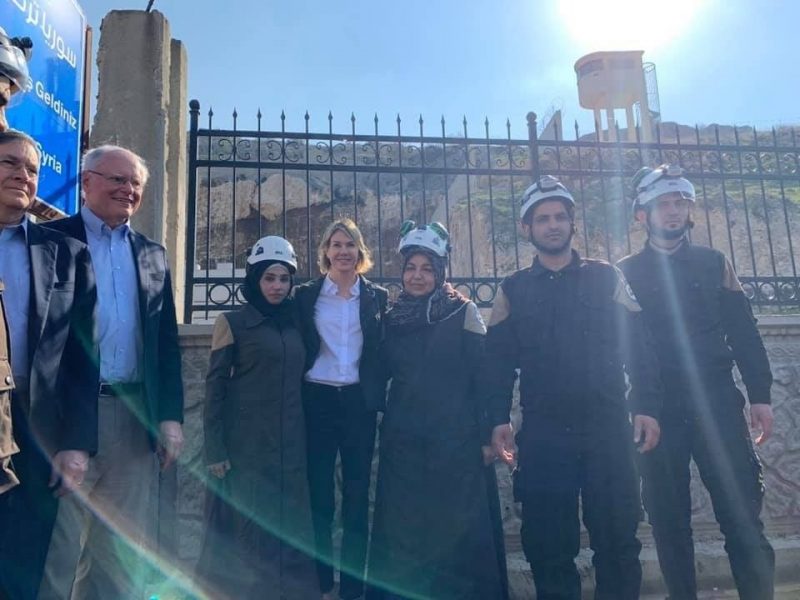
The United States has further complicated the game through a recent visit made by the entourages of two senior U.S. officials who visited Syria’s Idlib on March 3rd and pledged $108 million aid for Syrian civilians, hours after Turkey downed its second Syrian warplane in the province. Who exactly would receive the money and how it would be distributed was, inevitably, not immediately clear.
The two diplomats slipped over the border from Turkey with the connivance of Ankara and several Syrian “resistance” groups. They conspicuously met with the so-called White Helmets, a group that claims to be involved in nonpartisan humanitarian rescue missions but which really is affiliated with terrorists, most notably the Hayat Tahrir al-Sham (HTS), which is affiliated with al-Qaeda. HTS is the principal terrorist group operating in Idlib.
The group of American diplomats was headed by U.S. representative to the United Nations Kelly Craft, along with U.S. Special Envoy for Syria James Jeffrey. It was the first visit by American diplomats to Idlib. Craft announced that the aid package was for “the people of Syria in response to the ongoing crisis caused by Assad regime, Russian, and Iranian forces”. Jeffrey struck a more directly belligerent pose, saying that Washington would be providing ammunition in addition to the humanitarian assistance. “Turkey is a NATO ally. Much of the military uses American equipment. We will make sure that equipment is ready and usable.”
U.S. policy in Syria serves no American interest, but both Craft and Jeffrey are well known to be in the pocket of Israel. Craft, a big time GOP donor, who, in her fifteen months spent as Ambassador to Canada was remarkable for flying back to the U.S. from Ottawa 128 times, 70 of which were to her home in Kentucky. All on the government dime even though she is an extremely wealthy woman.
Craft left Canada when she replaced the arch Zionist Nikki Haley at the U.N. She emphasized in her confirmation hearing before the Senate Foreign Relations Committee that she would “fight against anti-Israel resolutions and actions by the U.N. and its affiliated agencies.” She also “made a case for America returning to a leading role at Turtle Bay [the U.N.] as a way of protecting Israel… Without U.S. leadership, our partners and allies would be vulnerable to bad actors at the U.N. This is particularly true in the case of Israel, which is the subject of unrelenting bias and hostility in U.N. venues. The United States will never accept such bias, and if confirmed I commit to seizing every opportunity to shine a light on this conduct, call it what it is, and demand that these outrageous practices finally come to an end.”
Jeffrey is even more the zealot. His full title is as United States Special Representative for Syria Engagement and the Special Envoy for the Global Coalition to Defeat ISIL. He is, generally speaking, a hardliner politically, closely aligned with Israel and regarding Iran as a hostile destabilizing force in the Middle East region. He was between 2013 and 2018 Philip Solondz distinguished fellow at the Washington Institute for Near East Policy (WINEP), a think tank that is a spin-off of the American Israel Public Affairs Committee (AIPAC). He is currently a WINEP “Outside Author” and go-to “expert.”
Professor John Mearsheimer of the University of Chicago and Stephen Walt, academic dean at Harvard University ‘s Kennedy School of Government, describe WINEP as “part of the core” of the Israel Lobby in the U.S. They examined the group on pages 175-6 in their groundbreaking book The Israel Lobby and US Foreign Policy and concluded as follows:
“Although WINEP plays down its links to Israel and claims that it provides a ‘balanced and realistic’ perspective on Middle East issues, this is not the case. In fact, WINEP is funded and run by individuals who are deeply committed to advancing Israel’s agenda … Many of its personnel are genuine scholars or experienced former officials, but they are hardly neutral observers on most Middle East issues and there is little diversity of views within WINEP’s ranks.”
Jeffrey set the tone for his term of office shortly after being appointed by President Trump back in August 2018 when he argued that the Syrian terrorists were “. . . not terrorists, but people fighting a civil war against a brutal dictator.” Jeffrey, who must have somehow missed a lot of the head chopping and rape going on, subsequently traveled to the Middle East and stopped off in Israel to meet Prime Minister Benjamin Netanyahu. It has been suggested that Jeffrey received his marching orders during the visit.
So, Trump bleats incessantly about how he wants to withdraw the U.S. from the senseless wars that it has been drawn into but at the same time his State Department sends two Zionist hardliners to Syria on a semi-secret mission to support a policy of regime change in Damascus while also providing aid that will inevitably fall into the pockets of an al-Qaeda linked terrorist group. And ammunition will also be forthcoming for the invading Turks to shoot Syrians, Russians and Iranians. If anyone is seriously interested in what is wrong with U.S. foreign policy, the activity of Craft and Jeffrey might serve as a decent case study on how not to do it. Unless, of course, the actual objective is to screw things up and involve the United States in quarrels that it could easily avoid.
Philip M. Giraldi is a former CIA counter-terrorism specialist and military intelligence officer who served nineteen years overseas in Turkey, Italy, Germany, and Spain. He was the CIA Chief of Base for the Barcelona Olympics in 1992 and was one of the first Americans to enter Afghanistan in December 2001. Phil is Executive Director of the Council for the National Interest, a Washington-based advocacy group that seeks to encourage and promote a U.S. foreign policy in the Middle East that is consistent with American values and interests.
Syria says will stand by allies on resistance axis to expel US from Western Asia
Press TV – March 12, 2020
A senior adviser to Syrian President Bashar al-Assad hails “constant coordination” between Damascus and its allies in the fight against terrorism, saying the Arab nation will stand by the resistance front to help drive the US out of not only Syria but the entire Middle East region.
Assad’s political and media adviser, Bouthaina Shaaban, made the remarks in an interview with Lebanon-based Arabic-language al-Mayadeen TV channel on Wednesday.
She said that Washington has been supporting the Takfiri al-Qaeda and Daesh terrorist groups, and that its sponsorship for the al-Qaeda-inspired al-Nusra Front terrorist outfit is of no surprise.
The Syrian people living east of the Euphrates River have been fighting against American occupation forces and enjoy the Damascus government’s backing for their resistance, she added.
Shaaban also stressed that the battle on eastern bank of the Euphrates is complicated and takes time, noting, however, that the Syrians will eventually expel US troops from their homeland.
The Syrian army has the backing of Iran, Russia and Lebanon’s Hezbollah resistance movement in its battle against a host of militant groups, which have been wreaking havoc on the country since 2011.
Thanks to that support, the Damascus government has managed to win back control of almost all regions from the foreign-sponsored militants.
Syria has been engaged in a liberation operation in Idlib Province, the last major bastion of terrorists in the country.
Shaaban further emphasized that her country supports its allies on the regional resistance axis to drive American military personnel out of the entire West Asia region.
Syria in constant coordination with Iran, Hezbollah
There is complete and constant coordination between Damascus on one side and Tehran and the Lebanese Hezbollah resistance movement on the other side in political and military spheres, the Syrian official pointed out.
She hailed Tehran-Damascus relations as historical and strategic, reiterating that both Iran and Russia prioritize Syria’s sovereignty and independence.
Taking advantage of the mayhem in Syria, the US has deployed troops to Syria under the guise of fighting Daesh. It has been running military bases in the eastern part of the country, which many reports have revealed serve as training camps for terrorists.
The US has also been supporting anti-Damascus Kurdish militants in the country’s northeastern regions, calling them allies in the so-called fight against Daesh, which lost its territorial rule in the Arab country in late 2017.
In recent months, Washington has also deployed more troops and military equipment near Syrian oil fields to “secure” them, in what Damascus, Tehran and Moscow have denounced as an attempt to steal Syria’s crude resources.
In turn, Turkey supports militants fighting to topple the Damascus government. Those elements continue to target Syrian troops and allied Russian personnel.
Last week, Russia and Turkey agreed on a ceasefire to stop clashes in Syria’s northwestern Idlib Province that brought the two countries close to direct confrontation amid a Moscow-backed Syrian counter-terrorism operation.
Idlib truce paves ground for more Syrian gains
Elsewhere in her interview, Shaaban said the Idlib truce has no confidential terms and paves the way for the liberation of the districts of Arihah and Jisr al-Shughur.
In recent weeks, she added, the Syrian army wrested control over 2,000 kilometers of the country and inflicted casualties on militants and Turkish forces.
Shabban also slammed Turkish President Recep Tayyip Erdogan for serving Israel’s interests in the region.
Erdogan, she added, uses the Palestine issue as a mere bargaining chip and dreams of occupying Syria.
A meeting between Assad and Erdogan is not possible as long as Turkey occupies parts of the Syrian territory, she said.
Syria keen to forge ties will all Arab states
Additionally, Assad’s aide stressed that Syria welcomes relations with all Arab countries, referring to recent visits by Egyptian and Libyan delegations.
She also hailed Algeria’s position on Syria, adding, however, that there are no exchanges between the two states.
Saudi arms imports increased by 130%
MEMO | March 9, 2020
The global arms industry has enjoyed a major boon period over recent years with the rise of tension and military conflict across the globe.
The US has seen the largest financial windfall from the sale of arms while Saudi Arabia continues to be the world’s largest importer of arms according to a new report released today by the Stockholm International Peace Research Institute (SIPRI).
According to SIPRI, which keeps the only publicly available database on the transfer of arms, “arms imports by countries in the Middle East increased by 61 per cent between 2010-14 and 2015-19, and accounted for 35 per cent of total global arms imports over the past five years.”
Saudi Arabia has seen a 130 per cent increase compared with the previous five-year period making it the world’s largest arms importer in 2015-19. The volume of weapons purchased by Riyadh accounted for 12 per cent of the global arms imports in that period.
The USA and the UK remain the main source of arms for the kingdom. A total of 73 per cent of Saudi Arabia’s arms imports came from America while 13 per cent of its arsenal were supplied by UK, despite major concerns in both countries over Riyadh’s military intervention in Yemen.
The United Arab Emirates (UAE), which has been militarily involved in Libya as well as Yemen over the past five years, was the eighth-largest arms importer in the world between 2015-19. The US supplied two-thirds of the arms imported by Abu Dhabi.
SIPRI noted that in 2019, when foreign military involvement in Libya was condemned by the United Nations Security Council, the UAE had major arms import deals ongoing with a number of other countries including, the UK, Australia, Brazil, Canada, China, France, Russia, South Africa, Spain, Sweden and Turkey.
Turkish arms imports were 48 per cent lower between 2015-2019 than in the previous five-year period, even though its military was fighting Kurdish rebels and was involved in the conflicts in Libya and Syria. The SIPRI report explained that the reason for this decrease was due to delays in deliveries of some major arms; the cancellation of a large deal with the USA for combat aircraft; and developments in the capability of the Turkish arms industry.
The main supplier of weapons worldwide is still the US, which has increased its arms exports by 23 per cent, according to SIPRI.
Anti-Interventionist Think Tank’s Debut is a Dud
By Gareth Porter | Consortium News | February 28, 2020
Given the current epochal political upheaval against entrenched political-economic elites driven in part by popular discontent over endless U.S. wars, the debut of the anti-interventionist Quincy Institute on Wednesday should have been an explosive event.
But it seemed more like a toy pop gun than a political bombshell.
Perhaps that was the intention of Quincy’s leadership. The organization, whose full name is the Quincy Institute for Responsible Statecraft, has eschewed an all-out attack on the national security elite in favor of the catch-phrase “realism and restraint.” That doesn’t raise the flag of political struggle against the existing policymaking system but rather suggests it will merely nibble at its edges.
So, one shouldn’t be shocked that Quincy’s first policy event was a partnership with Foreign Policy magazine, whose editorial slant is decidedly aligned with the interests of the dominant national security elite. It was Foreign Policy magazine that advanced the idea of having former CIA Director Gen. David Petraeus as the big name draw for the conference, according to people familiar with the origins of the conference.
Quincy needed a way to highlight the weaknesses of the status quo elite’s ideas and the power of its own alternative, and a debate between Petraeus and a highly articulate opponent of his position and argument would have done that. That was a talking point for the defense of Petraeus as a representative of the war system offered by one Quincy officer in advance of the conference.
But Petraeus was not about to agree to any such exercise. He is used to speaking from a position of power and not having to defend against sharp rebuttals and tough arguments. A one-on-one debate with an articulate opponent would have exposed him even more clearly as a vacuous windbag.
Softballs for Petraeus

Foreign Policy’s Editor-in-Chief Jonathan Tupperman. (Twitter)
Instead of witnessing such a riveting confrontation, the audience got Petraeus being fed softball questions from FP Editor-in-Chief Jonathan Tupperman and giving carefully memorized answers, including what he called “five big ideas we should have learned” (examples: “Ungoverned spaces will be exploited by Islamist extremists;” “The United State has to lead.”) [This from Petraeus who once said the U.S. was right to partner with al-Qaeda in Syria.]
That format allowed Petraeus to answer Tupperman’s question whether the United States can continue to use military force to maintain the “liberal world order” in light of the popular support for President Donald Trump and Democratic presidential contender Senator Bernie Sanders by claiming smugly, “I’m for restraint as well,” then adding the lamest line of the day (which he apparently thought was clever): “We should be for more restraint until we shouldn’t be.”
Then the Petraeus segment was over, with Tupperman observing that there was no time left for audience questioning of the man still venerated in a regime of worshipful media coverage of Iraq and Afghanistan as the man that had saved us from defeat in Iraq and had been successful in Afghanistan until he wasn’t successful. The mysterious failure of Tupperman to have left time for questions averted any possibility of someone in the audience recalling how Petraeus had played a crucial role in the unfolding of sectarian violence in Iraq by arming and training a sectarian Shiite militia — the Wolf Brigade — that was then sent into virtually every major Sunni population center in 2004-05.
Then Representative Ro Khanna, the smartest and most articulate congressional advocate for a non-interventionist viewpoint, laid out in an exchange with Cato Institute supporter Will Ruger a sharp critique of U.S. military interventions in the Middle East, starting with the enormous boost that U.S. interventions gave to the previously weak al Qaeda, which went from a presence in three countries before 9/11 to 23 countries today.
Debate Stifled
It was a thoughtful and persuasive case for a sharp turn in U.S. policy. But there was no real debate with Petraeus. In the absence of debate, the conference lacked any dramatic moment announcing the arrival of a powerful new voice for radical change in U.S. policy.
Much of the rest of the conference, moreover, had a tenor and pace reminiscent of many dozens of Washington think tank events on national security policy attended by this writer for years before giving them up a few years ago. That’s because it consisted of brief and almost always polite exchanges between advocates of new policies and representatives of centrist think tanks that are deeply enmeshed in those policies and the institutional interests underlying them.
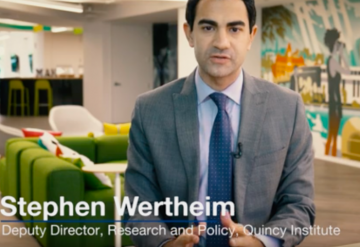 The closing session pitted Quincy Institute Deputy Director Stephen Wertheim against Rosa Brooks of New America and Tom Wright of the Brookings Institution, both of whom rejected the very idea of ending America’s existing wars. They argued that the U.S. troops in Iraq and Syria are really “counter-terrorism operations” rather than “wars.” Brooks even uttered the word identifying her as a member of the national security elite in good standing by calling for a “robust” policy.
The panel billed as “A New Vision for America’s Role in the World” didn’t actually offer that at all. That phrase turned out to be simply a convenient catch-all for the views of foreign policy advisers to both Bernie Sanders (Matt Duss) and former Vice President Joe Biden (former NSC official Julianne Smith), neither of whom articulated anything resembling a new policy vision.
Ironically, on the day that Politico’s “Morning Defense” reported Sanders’ clear lead in the Democratic race had triggered fears among military contractors of “an unprecedented threat to the status quo,” the most daring suggestion from Duss was that Sanders was for diplomacy with Iran.
Military ‘Wants Out’
There were a few moments that unexpectedly elevated the discussion well above the usual humdrum Washington think tank chatter. In a panel on the Middle East independent journalist Mark Perry, who has long had access to senior military officers on background, reported that his military contacts “want out” of the wars in the Middle East.
He added, moreover, that Trump has those officers’ trust, because they believe he wants out, too. But Perry’s most important contribution was to challenge the whole idea that the United States is capable of accomplishing anything positive with its serial military interventions in the Middle East. “We can’t do this,” said Perry, “so what are we doing?”
No Full, Unfettered Analysis
The lesson of Quincy’s debut seems reasonably clear: You can’t hope to disrupt the national security elite’s grip on policy by playing by the establishment’s rules. Foreign Policy was never going to agree to a format that would permit a direct confrontation over the key issues, much less, a full, unfettered analysis of the system of power that underlies that elite’s public role in defending America’s endless wars.
An organization devoted to attacking its illicit and increasingly unpopular policies can only gain traction by offering an analysis that will appeal to the anti-elite sentiments that have already shaken the U.S. political system to its foundations.
That would mean going beyond “realism and restraint” and talking about the need for fundamental change in the system of national security institutions themselves. Of course, taking that lesson on board might not be in line with the thinking of major funders. It could imply a major reorganization and even a much smaller staff. But if it doesn’t heed the lesson of its initial conference, Quincy is likely to find that the real action in bringing about change in U.S. foreign and policy is coming from political forces involved in the larger national power struggle.
Syria Debacles Epitomize Perpetual Perfidy of U.S. Foreign Policy
By James Bovard | Future of Freedom Foundation | March 6, 2020
Turkey is ratcheting up its invasion of Syria and trying to drag NATO into Erdogan’s personal rehabilitation scheme. Threats and counter-threats are flying as thickly as the bombs and bullets. It remains to be seen whether U.S. policymakers will blunder deeper into this quagmire.
Last October, the Washington establishment was aghast when President Trump appeared to approve a Turkish invasion of northern Syria. The U.S. was seen as abandoning the Kurds, some of whom had allied with the U.S. in the fight against ISIS and other terrorist groups. But the indignation over the latest U.S. policy shift in the Middle East is farcical considering the long record of U.S. double-crosses. Rather than the triumph of American idealism, recent U.S. policy has been perpetual perfidy leavened with frequent doses of idiocy.
Almost none of the media coverage of the Turkish invasion and flight of Kurdish refugees mentioned that President George H. W. Bush had urged the Kurds and other Iraqis to “take matters into their own hands and force Saddam Hussein, the dictator, to step aside” during the U.S. bombing campaign in 1991 in the first Gulf War. After it became clear that the U.S. military could not protect the Kurds from Saddam’s backlash, U.S. policymakers basically shrugged and moseyed along. As a CNN analysis noted in 2003, “Bush refrained from aiding Kurdish rebels in the north, although he finally sent troops and relief supplies to protect hundreds of thousands of fleeing Kurds who were in danger of freezing or starving to death. Bush has never regretted his decision not to intervene.” George H.W. Bush’s abandonment and betrayal of the Kurds did nothing to deter the media and political establishment from posthumously sainting him after he died in late 2018.
U.S. meddling in the Middle East multiplied after the 9/11 attacks. Even though most of the hijackers were Saudis who received plenty of assistance from the Saudi government, the George W. Bush administration seized the chance to demonize and assault Saddam Hussein’s Iraqi regime. President Bush portrayed his invasion of Iraq as American idealism at his best. In his May 1, 2003 “Mission Accomplished” speech abroad the USS Abraham Lincoln, Bush hailed “the character of our military through history” for showing “the decency and idealism that turned enemies into allies.” Speaking three weeks later at a Republican fundraiser, Bush bragged, “The world has seen the strength and the idealism of the United States military.” Washington Post columnist David Ignatius declared in late 2003 that “this may be the most idealistic war fought in modern times.” The torture scandal at Abu Ghraib and elsewhere in Iraq has not been permitted to deter the recent semi-canonization of George W. Bush by the establishment media.
The Bush administration and their media allies produced one smokescreen after another to sanctify the war. Almost all the pre-invasion broadcast news stories on Iraq originated with the federal government. PBS’s Bill Moyers noted that “of the 414 Iraq stories broadcast on NBC, ABC and CBS nightly news, from September 2002 until February 2003, almost all the stories could be traced back to sources from the White House, the Pentagon, and the State Department.” A 2008 report by the Center for Public Integrity found that “in speeches, briefings, interviews and other venues, Bush and administration officials stated unequivocally on at least 532 occasions that Iraq had weapons of mass destruction or was trying to produce or obtain them or had links to al-Qaida or both.” The report concluded that the “false statements – amplified by thousands of news stories and broadcasts” created “an almost impenetrable din for several critical months in the run-up to war.” Bush’s falsehoods on Iraq proved far more toxic than anything in Saddam’s arsenal. But the exposure of the official lies did not deter Defense Secretary Donald Rumsfeld from equating criticizing the Iraq war with appeasing Adolph Hitler in 2006.
The chaos from the 2003 invasion of Iraq was still spiraling out of control when the Bush administration began seeking pretexts to attack Iran, which Bush had designated part of the “Axis of Evil” in his 2002 State of the Union address. Bush officials and subsequent administration chose to champion the Iranian terrorist group, Mujahideen-e-Khalq (MEK). That organization sprang up in the 1960s and proceeded to kill Americans in the 1970s and to kill large numbers of Iranians in the subsequent decades. A 2004 FBI report noted that MEK continued to be “actively involved in planning and executing acts of terrorism.” NBC News reported in early 2012 that MEK carried out killings of Iranian nuclear scientists and that it “financed, trained and armed by Israel’s secret service.”
That was the same year that a stampede of Washington hustlers took huge payoffs to publicly champion de-listing the MEK as a terrorist organization. As Trita Parsi noted in the New York Review of Books, MEK “rented office space in Washington, held fundraisers with lawmakers, or offered US officials speaking fees to appear at their gatherings. But the MEK did this openly for years, despite being on the US government’s terrorist list.” Federal law prohibited taking money from or advocating on behalf of any designated terrorist group. But, as a 2011 Huffpost headline reported, “Former U.S. Officials Make Millions Advocating For Terrorist Organization.” Former FBI boss Louis Freeh, former CIA boss Porter Goss, co-chair of the 9/11 Commission Lee Hamilton, former attorney general Michael B. Mukasey, former Homeland Security Secretary Tom Ridge pocketing $30,000 or more for brief speeches to pro-MEK events. Glenn Greenwald rightly scoffed that the advocacy for MEK “reveals the impunity with which political elites commit the most egregious crimes, as well as the special privileges to which they explicitly believe they — and they alone — are entitled.” Greenwald pointed that average people were scourged by the same law the pooh-bahs brazenly trampled: “A Staten Island satellite TV salesman in 2009 was sentenced to five years in federal prison merely for including a Hezbollah TV channel as part of the satellite package he sold to customers.”
Thanks in part to the torrent of insider endorsements, the Obama administration canceled the MEK’s terrorist designation in 2012. While Washington poohbahs continue portraying the group as idealistic freedom fighters devoted to democracy, a simple online search shows that the Farsi translation of the group’s name is “holy warriors of the people,” as Ted Carpenter noted in his new book, Gullible Superpower. Trump administration officials have gurgled about MEK’s possible role in ruling Iran after the current government is toppled. But MEK remains odious to the Iranian people regardless of the group’s PR successes inside the Beltway.
The prior pratfalls of U.S. Middle East policy did nothing to stymie the outrage over Trump asserted that he was withdrawing U.S. troops from eastern Syria. Congress showed more indignation about a troop pullback than it had shown the loss of all the American soldiers’ lives in pointless conflicts over the past 18 years. The House of Representatives condemned Trump by a 354 to 60 vote, and Rep. Eliot Engel (D-NY), chairman of the House Foreign Affairs Committee, proclaimed, “At President Trump’s hands, American leadership has been laid low, and American foreign policy has become nothing more than a tool to advance his own interests.” Sen. Richard Blumenthal (D-Conn.) said he felt “horror and shame” over Trump’s action. Boston Globe columnist Stephen Kinzer aptly described Congress’s protest as “a classic example of ‘buffet outrage,’ in which one picks and chooses which horrors to condemn.”
President Barack Obama had promised 16 times that there would be no “U.S. boots on the ground” in Syria; when Obama betrayed that promise, Congress did nothing. Trump’s plans to have fewer U.S. boots on the ground in Syria — or at least in part of it — somehow became the moral equivalent of giving Alaska back to Russia. Pundits attacked politicians who supported the troop pullback as “Russian assets” – i.e., traitors.
Syria offers another reminder that “material support of terrorism” is a federal crime unless you work for the CIA, State Department, Pentagon, or White House. After President Barack Obama, former Secretary of State Hillary Clinton, and former Secretary of State John Kerry all publicly declared that Syrian president Assad must exit power, the U.S. armed terrorist groups to topple Assad. The Obama administration’s beloved, non-existent “moderate Syrian rebels” achieved nothing. The Kurdistan Workers’ Party, the PKK, a prime beneficiary of the U.S. occupation, has been considered a terrorist group by the U.S. government since 1997. Evan McMullin, a 2016 presidential candidate, admitted on Twitter: “My role in the CIA was to go out & convince Al Qaeda operatives to instead work with us.” Such absurdities spurred Rep. Tulsi Gabbard, D-Hawaii, to introduce The Stop Arming Terrorists Act in 2017 to prohibit any U.S. funding of terrorist groups. Gabbard’s bill was mostly ignored and never enacted though her outspoken criticism of U.S. policy did spur Hillary Clinton and others to vilify her.
Prominent politicians and much of the media blamed Trump for the attacks on civilians that followed the Turkish invasion, carried out mainly by groups allied with the Turkish government. U.S.-armed terrorist groups involved in the Turkish invasion have freed Islamic State prisoners. A Turkish think tank analyzed the violent groups committing atrocities in Syria after the start of the Turkish invasion; “Out of the 28 factions, 21 were previously supported by the United States, three of them via the Pentagon’s program to combat DAESH. Eighteen of these factions were supplied by the CIA.” A prominent Turkish journalist observed after his government invaded Syria: “The groups that were educated and equipped by the United States west of the Euphrates are now fighting against the groups east of the Euphrates that have been also educated and equipped by the United States.” This is nothing new: in 2016, Pentagon-backed Syrian rebels have openly battled CIA-backed rebels in Syria. A prominent Assad opponent who organized a conference of anti-Assad groups financed by the CIA was denied political asylum in 2017 because he provided “material support” to the Free Syrian Army, which meant he had “engaged in terrorist activity,” according to the Department of Homeland Security. A press backlash spurred a reversal on that decision but the media mostly ignored the other contradictions in U.S. policy in Syria.
Members of Congress were indignant that Syrian civilians suffered as the result of Trump’s troop pullback. But both Congress and most of the American media ignored the Syrian women, children, and men who died as a result of U.S. policies that intensified and prolonged that nation’s civil war. This is typical inside the Beltway scoring: the only fatalities worthy of recognizing are those that are politically useful.
Despite Trump’s sporadic declarations on Syria, the U.S. continues to have more than 50,000 troops deployed in the Middle East. The sooner those troops come home, the less likely that our nation will be dragged into another quagmire. The perennial follies and frauds of Middle East policy provide one of the strongest arguments for the United States to mind its own business.
Parliamentary Brawl Marks Erdogan’s Syria Policy
By Anthony Sherwood | American Herald Tribune | March 7, 2020
Needless to say, the punchup in the Turkish parliament on March 4 was a disgrace. Supposedly elected to discuss matters of national importance in a calm and dignified manner, scores of MPs behaved like football hooligans.
The occasion was a debate on the presence of the Turkish army in Idlib. Earlier, President Erdogan had described the opposition’s criticism of Turkey’s Syria operation as “dishonorable, ignoble, low and treacherous.” This was followed by a press conference in which the parliamentary chair of the Republican People’s Party (CHP), Engin Ozkoc, directed exactly the same words against the president personally. He also accused Erdogan of showing disrespect by laughing and joking in a speech he made after 34 Turkish soldiers sent to Idlib were killed in an airstrike.
In a later Twitter message, Ozkoc wrote that “a person who became the co-chair of the Greater Middle East project, who approved of the slaughter of three million Muslims, who calls martyrs ‘heads’ is undignified, dishonorable, without honor. This person cannot be the president of Turkey.”
The brawl broke out when Ozkoc took the rostrum in the Grand National Assembly to talk about Idlib. In a country where a rude hand gesture or a slighting remark about the president can land the speaker in prison, his earlier remarks were inflammatory stuff and the MPs laid into each other. Erdogan launched a civil action against the deputy, demanding one million lira (about $164,000) in damages, and an investigation was launched by the state prosecutor’s office. Under article 299 of the penal code, insulting the president is criminalized.
Ozkoc cannot claim automatic parliamentary immunity as MPs voted to lift it in 2016. The prosecutor’s office quickly sent a brief to parliament with a request that his immunity be lifted so he could be prosecuted. By May 2019, the prosecutor had presented the parliament with 608 requests for the lifting of immunity, so Ozkoc’s name has now been tacked on to a long list. The targeted deputies are mainly from the largely Kurdish People’s Democracy Party (HDP), along with a sprinkling of deputies from the CHP, including the party leader, Kemal Kilicdaroglu.
The parliamentary stoush was hardly an aberration. Brawls in recent years, with deputies swinging punches, standing on desks and hurling various objects at each other, include the melee over a bill of ‘homeland security’ in 2015 that widened the use of force police could use against demonstrators. On that occasion, four MPs were so badly hurt they needed hospital treatment.
The debate over the lifting of parliamentary immunity in 2016 was marked by another furious brawl before the legislation was passed. In 2017 the MPs brawled over the plan to turn the parliamentary rule into an executive presidency. In 2018 the cause was the redrawing of electoral boundaries. The fist-fighting inside the parliament can be seen as a microcosm of the angry atmosphere outside, fuelled by the government, in which criticism is quickly turned into support for terrorism.
Whom the parliamentary deputy Ozkoc meant by three million slaughtered Muslims is not clear but his reference to the ‘Greater Middle East’ project should be noted by attentive readers. Years ago Erdogan described himself as the “co-chair” of the Greater Middle East project without saying who was the other chair. Reporting the occasion, Breitbart thought it was a euphemism for “an Islamic Turkish caliphate,” with Erdogan at its head. Perhaps the other chair was the US, where in the 1990s the neocons had laid their own plans for a ‘Greater Middle East’ but Erdogan undoubtedly would have had his own aspirations as a world-historical Muslim figure in mind.
The phrase ‘Great East’ if not ‘Middle East’ has deep roots in modern Turkish history, arising from the writings of Necip Fazil Kisakurek, whose Islam-based nationalism is clearly the ideological mother lode for the direction in which Erdogan has taken Turkey. Buyuk Dogu (Great East) was Kisakurek’s central contribution and the name of the magazine he founded.
Born into an upper-class family, a student in Paris of the philosopher Henri Bergson, who favored intuition over rational analysis, Kisakurek (1904-83) was simultaneously poet, novelist, university professor, Sufi, Islamist and nationalist who in the 1930s and 40s sought to replace Kemalist nationalism with Islam.
It was, however, a narrow and restrictive Islam. For Kisakurek Islam was only Sunni Islam, with antipathy to Judaism and Christianity added to his hostility to Shia and Turkey’s large Alevi (Alawi) population.
In 1970 Salih Erdis (Salih Mirzabeyoglu) founded the Great Eastern Islamic Raiders’ Front (IBDA-C), which, based on Kisakurek’s teachings, called for the restitution of the caliphate and carried forward Kisakurek’s hostility to non-Sunni Muslims, Christians, and Jews. In 2001 Erdis was sentenced to death for undermining the secular state. The death penalty abolished in 2002, his sentence was commuted to life imprisonment in 2004.
Outside prison, his followers continued with his mission. In November 2003 they exploded truck bombs outside Istanbul’s two main synagogues, killing more than 20 people. Elsewhere a few days later they launched terrorist attacks against the British consulate and the Istanbul headquarters of the HSBC bank.
Having been released from prison in July 2014, Salih Erdis gave a talk later in the year at a congress center in Istanbul. Finding out that Erdogan would be speaking at the same location the same day, Erdis passed on a message that he would like to meet him and the president agreed. What they discussed remained between them but it has to be regarded as significant that the president would agree to sit down for a chat with a man who was both anti-secular and a convicted terrorist.
The parliamentary brawl over the Idlib operation captured in essence growing public disquiet over Turkey’s presence in Syria, especially since the airstrike in late February that killed 34 soldiers (the rumors quickly spread that the real toll was upwards of 200). The disquiet is not sudden, however, and not just over Syria, but has been growing steadily over the years, with a flailing economy among the many causes of disaffection with Erdogan and the AKP government. Beyond Turkey’s borders, Erdogan has fallen out with Russia, the US and the EU over a host of issues. They clearly have run out of patience with him.
Elections and public opinion polls show a consistent downward trend. In June 2015 the ruling party lost its absolute majority in parliament, recovering it only after an election campaign fought around the theme of national solidarity against Kurdish terrorism. In local elections in March 2019, repeated in June after AKP protests of irregularities, the government was defeated by CHP candidates in five of Turkey’s biggest cities (Istanbul, Ankara, Izmir, Adana, and Antalya).
While Turkish opinion polls are not the most reliable, the net result can hardly be ignored. In February 2020 a Metropoll survey showed Erdogan’s popularity (41.1 percent) down by seven percent from October 2019. Disapproval of the president rose to 51.7 percent, compared to 38 percent last October. Turkey’s military presence in Idlib was regarded as unnecessary by 48.8 percent of those surveyed, with only 30.7 percent approving, but as this was before the national outrage generated by the killing of the 34 soldiers, these percentages have no doubt changed. These figures have to set against the 68 percent approval rating for Erdogan after the 2016 coup attempt.
Another February 2020 poll, taken by AREA research in Istanbul, Ankara, Izmir, Antalya, Samsun, Malatya and Gaziantep (conservative, close to the border with Syria and hosting a Turkish-backed proxy Syrian government) showed that only 30.3 percent of respondents would vote for the AKP if elections were held now, with 20.8 choosing the CHP and 10.8 the HDP.
Of the respondents, 57.3 percent favored a return to parliamentary rule and 56.7 percent did not regard the presidential system as “successful.” Only 35.7 percent regarded the presidential system as “successful.” Asked who they would vote for now, in a presidential election, 35.3 said Erdogan, 52.4 percent were against him and 12.3 percent were undecided.
Compounding economic and other problems for the AKP and Erdogan are serious splits within the party, with two influential figures, former economy minister Ali Babacan and former foreign minister and prime minister Ahmet Davutoglu resigning to form parties of their own. Furthermore, the AKP is losing members: membership in 2016 stood at 10.72 million, but by 2018 had dropped to 9.87 million and is bound to have declined further since then because of the state of the economy and the war in Syria and the problems it has created, not just the death of young soldiers but the presence of several million refugees in Turkey.
Elections (presidential and general) are not due again until 2023. Erdogan is an experienced and wily political practitioner so it would be most unwise to count him out but definitely the luster has worn thin if not completely worn off for a lot of people.
The deal with Putin allowed him to save face at home, at the cost of giving up the fight for control of the strategic M4 highway. The government has regularly issued details of Syrian soldiers it says have been “neutralized” along with figures of destroyed artillery and armor but it has taken heavy punishment itself, losing between 10 and 13 large armored drones apart from the death of its soldiers and the army’s “Syrian national army” takfiri auxiliaries.
Ceasefires may put off the evil day of withdrawal but Syria has turned into a cul de sac for Erdogan and a dead-end for his country. To public pain at the death of Turkish soldiers in Syria has been added anger at Erdogan’s almost casual reference to the death of “a few martyrs” in Libya.
In short, 2020 is not opening well for Tayyip Erdogan.
Once Saudi Allies, Tribes in Eastern Yemen’s Al-Mahrah Are Now Battling Saudi Forces
By Ahmed Abdulkareem | MintPress News | February 28, 2020
AL-MAHRAH, YEMEN — Saudi Arabia’s continued efforts to occupy Yemen’s province of al-Mahrah, which lies on the country’s border with Oman, appear only to have emboldened al-Mahrah tribes, who have resorted to using military tactics to drive out Saudi forces from their province. The tribes are fueled by a collective social desire for sovereignty stemming from their long history as an independent region and a local culture that remains wary of foreign forces.
On Wednesday, Saudi troops in Nashton Port in al-Mahrah were subjected to an explosive device targeting a Saudi military convoy in Fujeet District killing multiple troops including members of a local Saudi-funded militia. The attack came after Saudi forces occupied al Shehn port last week.
Since 2017, when Saudi forces once again entered the isolated province, the deep-seated sense of local identity spurred a growing opposition movement. The opposition developed and took the form of festivals and protests near Saudi military sites which included speeches, the reading of poetry and the playing of patriotic music.
In the past year, Mahri tribes have increasingly confronted encroachments on local sovereignty. Several confrontations have led to violence – including the al-Anfaq incident in November 2018, clashes near the Omani border in March 2019, and a shoot out at al-Labib checkpoint in April.
Their military deployment in al-Mahrah has given the Saudis de facto military control over the governorate. Today, Saudi Arabia controls al-Mahrah’s airport and Saudi forces have assumed a role akin to a state security apparatus in the province as air reconnaissance and other operations are launched from a command center at the base, bypassing even its allies. In addition to border crossings and the main seaport, dozens of Saudi bases have been established in Hat District, Lusick in Hawf District, Jawdah in Huswain District, and Darfat in Sayhut District.
Moreover, the militarization of al-Mahrah by Saudi forces has affectedthe province’s social cohesion and identity. Maharis were already divided between opposing the presence of Saudi forces and supporting it. The Saudi have reinforced this division by recruiting from and distributing weapons to certain tribes, changing the social fabric of the area which is likely to lead to open internal conflict.
Despite the fact that local opposition has prevented the construction of several military outposts, Saudi forces have continued to pursue their strategic interests in southern Yemen, including the construction of an oil shipping port in al-Mahrah on the coast of the Arabian Sea. This has resulted in renewed calls for military resistance against the Saudi presence, with opposition leaders declaring their intention to establish local anti-Saudi forces.
Al-Mahrah is Yemen’s second-largest province. It is bordered by Oman to the east, Saudi Arabia to the north, and the Arabian Sea to the south. It’s Empty Quarter, a vast desert, covers much of southern al-Mahrah. The governorate also contains a mountainous region in the east that is seasonally covered with lush green foliage. The province is a largely peaceful area that has been mostly spared from Yemen’s five-year war.
Al-Mahrah’s tribes vow resistance
Attacks from Al-Mahrah’s tribes have flared up as recently as last week after Saudi forces began construction on a number of new security checkpoints and military camps in al Shehn District. Last Monday, Saudi forces attempted to storm the town of Shahn. Armed helicopters, ground vehicles, and both Saudi troops and local mercenaries were deployed in the assault which was ultimately repelled. Later, Saudi forces succeeded in occupying the area after resorting to a plan played by the ousted president Abdu Rabu Mansour Hadi.
Prior to Monday’s Saudi military incursion, local tribal fighters had withdrawn from Shehn after an agreement between Saudi forces and local tribes was reached following tribal mediation which stipulated that tribal fighters in the town would be replaced by forces loyal to the Saudi-led Coalition. The tribes say they were deceived into withdrawing ahead of the Saudi advance.
In the wake of recent events, Ali bin Salem al-Huraizy, al-Mahrah’s former deputy governor who plays a critical role as a figurehead in the popular opposition movement against Saudi Arabia, criticized ousted Yemeni President Abdrabbuh Mansur Hadi saying, “I did not expect the treachers.. to authorize the Saudi occupation forces to crush al-Mahrah people… who were defending the independence and sovereignty of the country.” The deputy head of the Al-Mahra Peoples’ Sit-in Committee, Aboud Heboud Qumsit expressed similar disdain, saying: ”you [Hadi] sold yourself to Saudi [Arabia], please do not sell the Yemeni people and the whole country to Saudi Arabia.”
The Al-Mahra Peoples’ Sit-in Committee has said that Saudi actions constitute a flagrant violation of Yemeni sovereignty and national identity. The group said in a statement: “In this dangerous turning point of our honorable history, we call on all the tribes of the province, their sheiks and their dignitaries, and their citizens to unite alongside all the liberals of the province to prevent the Saudi occupation from imposing its domination over Al-Mahrah.”
Hadi recently issued a decree appointing Muhammad Ali Yasser, a parliamentarian loyal to the Saudi-led Coalition, to be the governor of Mahrah instead of sitting governor, Ba Kreit. The move is seen as an attempt to implement a new Saudi strategy, according to al-Mahrah residents. Mahris have a unique history of running their own affairs. Saudi Arabia, however, has used “internationally recognized president Hadi ” to force the replacement of uncooperative officials in al-Mahrah and appoint pliant replacements, activists say.
Despite having a Saudi proxy as governor and thousands of Saudi troops and their proxy forces deployed around in and around al-Mahrah, the Saudi military presence in al-Mahrah appears to be increasingly challenged in the face of growing peaceful opposition and increasing military resistance.
Saudis levy punitive measures on al-Mahrah
Saudi forces have also imposed trade restrictions on al-Mahrah. Cargo entering Yemen through al-Mahrah has been confiscated by Saudi officials according to businessmen who spoke to MintPress. Local residents are concerned that the move is part of a broader effort to stifle al-Mahrah economically and push it towards starvation, just like the rest of Yemen.
Earlier this week Saudi forces arrested several Yemeni businessmen and truck drivers attempting to import goods into al-Mahrah. The drivers included Pakistani and Syrian nationals, and their trucks, which carried official authorization from their country of origin, were confiscated by Saudi officials according to local Yemen businessman.
After 2015, when the war began, most of Yemen’s official points of entry fell into coalition control. However, Shehn border crossing in al-Mahrah remains one of the only routes for traders to ship goods into Yemen. The customs revenues from the crossing have bolstered the governorate’s budget and allowed it to pay local civil servant salaries, unlike most other governorates in Yemen that have been left nearly penniless since the war began.
Al-Mahrah’s Shehn and Sarfait border crossings with Oman have been under the control of local tribes since 2015 when they took advantage of a security vacuum following the withdrawal of government security forces due to the Saudi-led coalition military campaign.
Saudi ambitions in Al-Mahrah date back decades
In 2015, when the Saudi-led coalition war on Yemen began, Riyadh revived its aspirations for the construction of an oil pipeline that would allow the kingdom to transport oil directly to the Arabian Sea, bypassing the Strait of Hormuz and the Bab-el-Mandeb Strait. The costs related to exporting Saudi oil would be reduced by allowing tankers to avoid the Bab al-Mandab and Hormuz straits, both vulnerable to political strife and regional enemies.
In fact, Saudi Arabia’s aspirations in Al-Mahrah date back to the end of the last century. In the 1990s, Saudi Arabia sought to build influence in al-Mahrah as part of its ambitions to build an oil pipeline through the district to the Arabian Sea. And for that, tribal sheiks were granted Saudi residency, travel documents, and financial benefits.
Moreover, in the 1980s, Saudi Arabia launched negotiations with former South Yemeni President Ali Nasser Mohammed to build the pipeline, but the negotiation failed after Ali Nasser refused, stating the pipeline would threaten the state’s sovereignty. In the 1990s, in the wake of Yemeni unification, the Saudis pressed the Yemeni government to permit the deployment of Saudi forces into a 4-kilometer buffer zone around the proposed pipeline route to maintain security. The Riyadh project was shelved after Sana’a rejected it once again.
In late 2017, Riyadh began deploying armed forces in al-Mahrah under the premise of combating smuggling across the Omani border. However, al-Mahrah residents see the presence of Saudi troops in the region as malign and colonial. According to people who have organized an open sit-in since 2018, smuggling is just a pretext for a Saudi takeover of the province.
Saudi Arabia and the UAE also claim that arms smuggling operations by Ansarullah (Houthis) are being carried out from Oman into Yemen via the al-Mahrah border crossing, though they have provided no evidence to back their claim, which Oman has repeatedly denied.
Moreover, in addition to an electrified fence along a portion of the border built by Oman in 2013, U.S. special operations forces have also deployed to al-Mahrah in 2018 to support the coalition’s alleged anti-smuggling operations according to diplomatic sources cited by the Sana’a Center.
In fact, despite their support for the Saudi-led coalition and being free from the presence of Houthi fighters, Yemen’s southern provinces, including not only al-Mahrah but also the strategic island of Socotra, have been fully controlled and managed by Saudi Arabia and UAE.
Some analysts believe that the Saudi Coalition’s continued military presence in al-Mahrah may also be intended to cordon off Oman, which enjoys long borders and solid relations with Yemen. Much to the dismay of Saudi Arabia and the UAE, Oman also enjoys cordial relations with Saudi rival Iran, a relationship that the Coalition is eager to undermine.
As a result, Oman has supported popular protests demanding the removal of Saudi forces. Recently, Muscat arranged meetings in the Omani capital between the protest leaders, European and American officials, and representatives from international organizations. Oman allowed Western journalists to cross into al-Mahrah without visas or stamps.
Ahmed AbdulKareem is a Yemeni journalist. He covers the war in Yemen for MintPress News as well as local Yemeni media.
Featured Video
The Board For Peace – Whitewashing Ethnic Cleansing and Genocide
or go to
Aletho News Archives – Video-Images
From the Archives
Inside Job? Inside What?
By Prof. Tony Hall | American Herald Tribune | July 28, 2016
The Kevin Barrett-Chomsky Dispute in Historical Perspective – Sixth part of the series titled “9/11 and the Zionist Question”
In his chapter on “Left Gatekeepers” and the “Shame of Noam Chomsky,” Barrie Zwicker refers to the the “New World Order” as the “diaboligarchy’s” directing agency. Less compelling is Zwicker’s reference to the “New World Order” as the “diaboligarchy’s” directing agency. To me this unfortunate choice of words is much too closely associated with the often crude and chauvinistic populism of Alex Jones and his Infowars media network. Many have come to see Jones’ lucrative media operation as a limited hangout set in place by handlers trying to hold the activities of the 9/11 Truth Movement within manageable constraints.
Due to the important findings over fifteen years of the citizens’ investigation into 9/11, the culprits most deeply implicated in the crime can be identified with much more specificity than an entity vaguely described as a “New World Order.” As Kevin Barrett and many others insist, the time has come to name the names of the probable culprits, Noam Chomsky prominent among them.
While Alex Jones ultimately serves the same masters as Chomsky, the former’s media product is often much closer to the mark of what is really going on than the content of Noam Chomsky’s more magisterial pronouncements. Jones goes at least part of the way into realities of the deep state politics of the twenty-first century. Chomsky, however, sacrificed his capacity to contribute cogently to sensible discourse on contemporary geopolitics by making himself a primary instrument of the most consequential deep state deception of recent times. As a leading agent of disinformation in the psychological trenches of the ongoing Global War of False Flag Terrorism, Chomsky has reduced himself to the level of skeptic pretender Michael Shermer. In the style of Shermer, the elder Chomsky has become an establishment TV professor readily available on Netflix. … continue
Blog Roll
Recent Comments
Coronistan on EU member to sue bloc over ‘su… loongtip on Vicious loongtip on EU turns to India for defense… Coronistan on Donald Trump Is No Peace … seversonebcfb985d9 on French court jails pro-Palesti… eddieb on Fourteen Incredible Facts Abou… Bill Francis on European leaders’ shift in the… seversonebcfb985d9 on Villains of Judea: Philip Esfo… loongtip on Report warns that ‘Jewish terr… Craig Nelms on New study shows that toxic gas… loongtip on A Funny Thing Happened on the… loongtip on EU free trade pact on hold as…


 Aletho News
- Exposed – How the UAE Became Central to Gaza’s Concentration Camp Plot
- How South Korea’s gas ambitions sustain the occupation of Gaza
- “Leaked document” exposes US blueprint for total control over Gaza
- Trump wanted to play peacemaker, Netanyahu made sure he failed
- Idea of limited, fast strike on Iran misjudges our capabilities: IRGC
- US Military Buildup on Land, Air, and Sea Raises Fears of Imminent Attack on Iran – Expert
- Russia reiterates demand to Germany over Nazi crimes
- France and EU clash over UK missiles for Ukraine – Telegraph
- EU member to sue bloc over ‘suicidal’ ban on Russian gas
- WEF Calls for ‘Cultural Revolution’ to Promote Lab-Grown Meat
- If Americans Knew
- Violence against hundreds of Gazan remains to find one Israeli – Not a ceasefire Day 109
- Greenpeace Demonstrator Exposes Folly of Protest Restrictions
- From CBS to TikTok, Pro-Israel Ellison is now in the driver’s seat
- Israel pays for UK advertisements attacking Doctors Without Borders
- Israel accused of extracting billions from Gazan people to pay for their own genocide
- ‘Deliberate Assassination’: 3 Journalists Among 11 Killed by Israeli Forces in Gaza
- In Gaza, We’re Struggling to Reintroduce Foods to Bodies Adjusted to Starvation
- Will Rafah crossing be opened at last? – Not a ceasefire Day 108
- Israeli drone strike kills two children collecting firewood in Gaza – Not a ceasefire Day 107
- Another Gaza baby freezes to death on Netanyahu’s watch – Not a ceasefire Day 106
- No Tricks Zone
- New Study Affirms Rising CO2’s Greening Impact Across India – A Region With No Net Warming In 75 Years
- Germany’s Natural Gas Crisis Escalates … One Storage Site Near Empty …Government Silent
- Polar Colding…Antarctica Saw Its Coldest October In 44 Years!
- New Study: Sea Levels Rose 20 Times The Modern Rate During The Roman Warm Period
- As German Gas Storage Dips Dangerously Low…Shortage Hardly Avoidable
- New Study: Brazil’s Relative Sea Level Was 2+ Meters Higher And SSTs 3-4°C Warmer 6000 Years Ago
- Philosopher Schopenhauer: Climate Science Certainty Stems From Stupidity, Ignorance
- New Study: Species Extinction Rates Declining Since 1980 – ‘Climate Change Is Not An Important Threat’
- Denmark Places Climate Protection Above Animal Welfare, Poisoning And Culling Cows
- New Study: Greenland Was 3-7°C Warmer And Far Less Glaciated Than Today 6000-8000 Years Ago
 Aletho News