Iraqi Foreign Minister stresses need for withdrawal of foreign troops
Press TV – January 9, 2020
Iraqi Foreign Minister Mohammad Ali al-Hakim has stressed the need for US and other foreign troops to leave Iraq as a backlash grows over the recent American assassination of a top Iranian general in Baghdad.
The top Iraqi diplomat made the appeal during a joint press briefing with his Turkish counterpart Mevlut Cavusoglu in Baghdad on Thursday.
Hakim and Cavusoglu strongly condemned the US assassination of Iran’s Lt. Gen. Qassem Soleimani and senior Iraqi commander of the Popular Mobilization Units Abu Mahdi al-Muhandis, both key figures in the fight against Daesh and other Takfiri terrorists in the Middle East.
“Iraq insists on maintaining its sovereignty and territorial integrity and the complete withdrawal of foreign forces,” the top Iraqi diplomat said.
He added that talks with his Turkish counterpart focused on the need to respect Iraq’s sovereignty from all sides.
“Iraq condemns the attacks on Iraqi land, which harms the sovereignty of our country as well the security of Iraqi people. They are against the international law,” the Iraqi minister said.
Hakim added, “”We have discussed with the minister that Iraq wants all foreign forces are removed out of the country through dialogue. We also discussed with the minister on cooperation areas. We have agreed to alleviate the Iran-US tension in the region.”
The two sides also discussed bilateral relations at all levels, including cooperation on fighting terrorism, al-Hakim said.
The top Iraqi diplomat said any escalation of tensions in the region could result in the re-emergence of Takiri terrorist groups.
The Turkish foreign minister, for his part, said Ankara does not want Iraq to become a battleground for foreign forces.
Cavusoglu added that Iraq was not alone and Turkey was there to overcome difficult days together.
Turkish foreign minister also spoke with his Iranian counterpart Mohammad Javad Zarif Wednesday after Tehran fired dozens of missiles at two military bases hosting US troops in Iraq. The missiles were fired at the Ain al-Asad base in Anbar province and another base in Erbil.
PMU leader denies role in rocket attacks
In another development, Qais al-Khazali, the leader of Asa’ib Ahl al-Haq movement, a subdivision of Iraq’s Popular Mobilization Units, known by its Arabic name as Hashd al-Sha’abi, denied any involvement in the recent firing of rockets at Baghdad’s Green Zone where the US embassy is located.
Two Katyusha rockets struck Baghdad’s heavily fortified Green Zone on Wednesday, landing near the US embassy but causing no casualties, according to the Iraqi military.
Al-Khazali also said it was time for an Iraqi response to the recent US assassination, adding the reaction will be “no less in size” than Tehran’s missile strikes on two American bases in Iraq.
On Sunday, Iraqi Prime Minister Adel Abdul Mahdi called the US airstrike “a political assassination”. He also underlined the need for a timetable to withdraw all foreign troops “for the sake of our national sovereignty.”
Shell-shocked pundits come crawling back to Hillary over Trump’s Iran belligerence… forgetting she’d have started war sooner
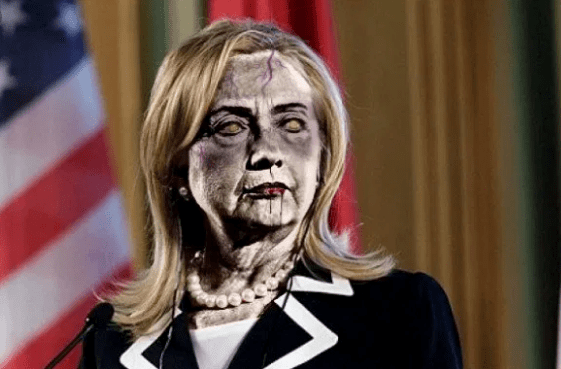
If you squint really hard, it’s ALMOST like she’s in the Oval Office…
RT | January 8, 2020
Social media sang praises of would-be US President Hillary Clinton as actual President Donald Trump seemed headed for all-out war with Iran – even though Clinton had been a much more enthusiastic participant in US wars.
After Iranian missiles struck several US bases Tuesday night, #Resistance twitter wasted no time disavowing the administration they blamed for the hostilities, running into the arms of his arch-rival with the #IVotedforHillaryClinton hashtag.
But claiming Clinton was the less warlike of the two candidates, or would have steered the country away from war with Iran, requires a serious divergence from history. The former Secretary of State once told an interviewer that “I want the Iranians to know that if I’m the president, we will attack Iran.”
That was during her 2008 campaign, and in the middle of a discussion about Iran possibly attacking Israel. Perhaps her stance on the Islamic republic had softened a bit by 2016, enough to justify viewing her as the lesser of two Iran hawks?
Nope. The months leading up to that election saw her parroting Israeli PM Benjamin Netanyahu’s decades-old talking points about Iran “racing toward a nuclear capability,” expanding “secret facilities,” and “defying their international obligations” before she swept in with the nuclear deal and solved all the problems.
Except the deal was negotiated after she was replaced as the top US diplomat by John Kerry. Clinton was on the same side as Trump, demanding ever more sanctions even as the nuclear deal took effect, this time as punishment for Iran’s ballistic missile program.
Beyond interventionist Democrats, she was courted by a bevy of neocons who couldn’t stomach Trump’s anti-interventionist rhetoric. Inveterate warmongers like Robert Kagan and Richard Armitage swooned over the ex-First Lady.
In short order, the infamous clip of Clinton mocking the brutal murder of Libyan leader Muammar Gaddafi – “we came, we saw, he died” – resurfaced on twitter. The so-called “humanitarian” intervention in Libya was largely a creation of Clinton’s State Department, complete with risible wartime propaganda about Gaddafi handing out Viagra so his soldiers could better commit mass rapes, and the continued chaos in that once-advanced state remains a testament to what the region (or world) might look like under her watch.
She wanted a repeat performance in Syria, calling for – and thankfully not getting – a no-fly zone, even while admitting it would “kill a lot of Syrians.”
While Trump lost the popular vote to Clinton, he handily beat her in the Electoral College, which ultimately decides who occupies the White House. Despite her massive advantage in political experience, his promises to bring US troops home attracted significant support. Nearly four years later, however, the US is poised on the brink of a catastrophic expansion of its Forever War.
Imam Khamenei: Only a Slap Was Delivered, US Withdrawal from Region Inevitable
Al-Manar | January 8, 2020
Leader of the Islamic Revolution in Iran Imam Sayyed Ali Khamenei said the missiles on US bases in Iraq are only a slap in the face of Washington, stressing that the real retaliation to the assassination of IRGC’s Quds Force General Qassem Suleimani is the US withdrawal from the region.
“Last night, a slap in the face was delivered,” Imam Khamenei said, in a speech broadcast live on state television, referring to the IRGC missiles which were launched at US bases in Iraq, including Ain al-Assad base in Anbar.
“One important issue is what is our duty now?” following Suleimani’s assassination, said the Leader.
“An important incident has happened. The question of revenge is another issue. Military actions in this form are not sufficient for that issue,” he said, referring to the assassination.
“What is important is that America’s corrupt presence must come to an end in this region,” his eminence said, stressing that the US withdrawal from region is “inevitable.”
Elsewhere in his speech, Imam Khamenei praised Suleimani as courageous and devoted.
“Martyr Suleimani challenged Zionists and managed to offer support to Palestinians in Gaza,” he said, adding that the top commander played major role with Hezbollah in defending Lebanon and foiled enemies’ conspiracies in Iraq, Syria.
“Martyrdom of Suelimani revived revolution spirit in Iran.”
” As long as our enemies’ allies don’t target us we won’t hit them,” Imam Khamenei said likely referring to Gulf Arab states.
A Window for Peace
By Craig Murray | January 8, 2020
There is this morning a chink of light to avoid yet more devastation in the Middle East. Iran’s missile strikes last night were calibrated to satisfy honour while avoiding damage that would trigger automatically the next round. The missiles appear to have been fitted out with very light warhead payloads indeed – their purpose was to look good in the dark going up into the night sky. There is every reason to believe the apparent lack of US casualties was deliberate.
Even more important was the Iraqi statement that “proportionate measures” had been “taken and concluded” and they did not seek “further escalation”.
I agree their response was proportionate and I would say that I regard the Iranian action so far, unlike the assassination of Soleimani by the US, legal in international law.
The entire world should congratulate Iran for its maturity in handling the illegal assassination of its General, who was on a peace mission, travelling as a civilian on a commercial flight, carrying a mediation message the US had been instrumental in instigating. If as seems possible the US actively manipulated the diplomatic process to assassinate someone on a diplomatic mission and traveling on a diplomatic passport, that is a dreadful outrage which will come back to haunt them. Life insurance rates for US diplomats no doubt just went up.
It is also worth noting the 2.8% rise in the Lockheed share price in the 24 hours immediately before the Soleimani assassination, outperforming the Dow about three times. That would bear investigation. Arms manufacturers and oil stocks have soared this last few days – and remember that nowadays the vast bulk of financial transactions are bets on the margins of movement, so vast fortunes will have been made out of all this.
The UK has been, as ever, complicit in US crimes. Our laughing called “defence” industry – when were its products last used in self-defence and not colonial adventure? – is tied in to and dependent on the US military machine. The current build-up of US troops and hardware in the Gulf has Mildenhall as a major staging post. We do not have to do this. Whether officially or on a pretext, French airspace was closed to the US military build-up and the Americans have had to fly from the UK, skirting France, around the Atlantic.
In a huge Boris Johnson slap in the face to international law, extra US bombers to attack Iran have been flown into Diego Garcia, in the Chagos Islands. You will recall that is where the UK committed genocide against the population in the 1970s to clear the way for the US military base. Last year, the UK lost a hearing before the International Court of Justice and was subsequently instructed by the UN to decolonise the islands and give them back to Mauritius by last November. The UK simply persisted in its illegal occupation and now is threatening the use of the islands as the base for yet another illegal and destabilising war.
That the UK is a permanent member of the UN security council is a disgrace which surely cannot endure much longer. What the current crisis has shown us is that under Johnson the UK has no future except as a still more compliant servant of whoever occupies the White House.
Wars are easy to start but hard to stop. Trump appears to have calmed, but we cannot rule out a stupid “last word” attack bu the USA. It is to be hoped that Iran now concentrates on using the immense political leverage it has gained to get western troops out of Iraq, which would be a tremendous result for all of us after 17 years. But we cannot rule out hotter heads in the Iranian government insisting on further attacks, or attacks from regional forces whose Tehran authorisation is uncertain. On either side this could yet blow up badly.
I am a sucker for hope, and the best outcome would be for the US and Iran to start talking directly again, and a deal to be made from this break in the logjam that is wider than, and Trump can portray as better than, “Obama’s” nuclear deal and would enable the lifting of sanctions. I am sure Trump will be tempted by the chance to go for this kind of diplomatic coup under the political cover provided him by Soleimani’s assassination. But the US is now so tied in to Saudi Arabia and Israel, and thus tied in to irrational hostility to Iran, that this must be extremely unlikely.
For those of us in Scotland, this is still more reason why Independence must be early. We cannot be tied in to a rogue state. As we march for Independence on Saturday, the potential for war in Iran gives the sharpest reminder why we must leave the UK and form our own, peaceful, law-abiding state.
Iran strikes US bases in Iraq to avenge Soleimani, vows to target Israel and all US bases in the region
Al-Manar | January 8, 2020
The Islamic Republic of Iran began its revenge for the assassination of the martyr Soleimani by launching dozens of ballistic missiles at the US base of Al-Asad in Iraq.
The Islamic Revolutionary Guards announced that the process of revenge for the assassination of the martyr Soleimani had started with the launch of dozens of ballistic missiles against the American base at Al-Asad in Iraq. In a statement, they assert that “At dawn today, in response to the terrorist operation by American forces and in retaliation for the assassination and martyrdom of Quds Force Commander of the Islamic Revolutionary Guards, Qassem Soleimani, and his companions, the aerospace forces of the the Islamic Revolutionary Guards carried out a successful operation bearing the name of the martyr Soleimani by launching dozens of ground-to-ground ballistic missiles against the air base of Ain al-Assad occupied by the US terrorist army. We will later inform the noble Iranian people and all free men of the world of the details of this process.
The Islamic Revolutionary Guards warned “The Great Satan, namely the US regime, that any wicked act, aggression or other hostile movement would face an even more painful and harsh response. […] We warn America’s allies who host US terrorist bases that any territory that is the source of hostile action against the Islamic Republic of Iran will be targeted.” The statement from the Islamic Revolutionary Guards added that “we do not in any way regard the Zionist entity as distinct from the criminal US regime.”
“We recommend that the American people recall their soldiers from the region to avoid further casualties and not to leave the lives of American soldiers threatened because of our peoples’ growing hatred of America,” the statement said.
Public relations within the Revolutionary Guards warned the United States that any response to the strikes “would light the fuse of a widespread and very painful response against the United States in the region.”
The Iranian news agency Mehr reported that “dozens of missiles from the aerospace force of the Islamic Revolutionary Guards targeted the base of Ain al-Assad”, and said that “the attack comes in reprisal for the assassination of the martyred commander Qassem Soleimani, and consisted in the launching of a certain number of ground-to-ground missiles”.
After the news was announced, the sounds of Takbir (Allahu Akbar!) rose from the top of the buildings of the capital, Tehran, expressing popular jubilation at this operation.
A security source told Agence France-Presse that on the night from Tuesday to Wednesday, at least nine rockets landed at the Ein Al-Assad Air base in western Iraq, where American soldiers are stationed. The source said the attack took place in 3 stages.
Use of Fateh missiles in a process of severe revenge
Given the distance between the base of Ain al-Assad and the place from which the Islamic Revolutionary Guard missiles were launched, Fateh ballistic missiles were used in these strikes (range up to 500 kilometers).
U.S. forces and their advisers are stationed at Ain al-Assad Air Base, which is the second largest Air Base in Iraq, after Balad base in Salah al-Din, north of Baghdad. For years, American forces have been present at several Iraqi military and Air Bases in the provinces of Anbar, Salah-al-Din, Nineveh and the capital Baghdad.
Pentagon admits strikes
The Pentagon has announced that Iran fired “more than 12 missiles” at dawn on Wednesday at the Ain al-Assad and Erbil bases used by US forces in Iraq on Wednesday, indicating that it is in currently assessing the damage and studying ways to “respond” to this strike.
Assistant to the Secretary of War for Public Affairs Jonathan Hoffman said in a statement that the department was conducting a “preliminary damage assessment” and was considering a “response” to the attack. He added that on Tuesday evening, “around 5.30pm (10.30pm GMT) on January 7, Iran fired more than 12 ballistic missiles at US and coalition forces in Iraq.” This time corresponds to the exact time martyr Soleimani was killed.
The statement added that it is clear that these missiles were launched from Iran and were aimed at at least two Iraqi military bases used by American and coalition forces in Ain al-Assad and Erbil.
The White House, for its part, said that President Trump is monitoring the situation closely and holding consultations with the National Security Council to discuss developments. White House spokesperson Stéphanie Gresham said, “We are aware of reports of attacks on US facilities in Iraq. The President has been informed and is following the situation closely and is consulting his national security team. ”
Oil prices go up and Nikkei goes down
The oil price per barrel jumped more than 4.5% on Wednesday after Iran launched ballistic missiles at two air bases used by US and coalition forces in Iraq. West Texas Intermediate barrel rose 4.53% to $ 65.54 before declining slightly.
The main Nikkei index of the Tokyo Stock Exchange lost more than 2.4% Wednesday morning. Half an hour after opening, the losses of the Nikkei index on the 225 largest companies listed on the Japanese Stock Exchange reached 2.44%, or 576.26 points, to fall to 22,999.46 points, while the losses of the Topix index, the most important, were slightly lower, reaching 2.20% or 37.90 points to reach 1687.15 points.
Sources: Al-Manar & Iranian sources.
Translation: resistancenews.org
Yemen’s Ansarullah: We’re partaking in regional drive to boot US forces out
Al-Mayadeen TV – 05/01/2020
Member of Ansarullah’s Political Council, Mohammad al-Bakhiti, says the Yemeni movement is partaking in the region-wide response to Iranian General Soleimani’s assassination by the US military. Bakhiti says the regional response is aimed at driving all US forces out of the region.
Transcript:
– the coming days will bring huge changes to the region
– the American aggression against Iraq is an aggression against the entire Axis of Resistance, which requires for unifying the theatre in which the response will be delivered
– of course Sayyed Abdul Malik al-Houthi (Yemen’s Ansarullah leader) has already stated that this aggression is an aggression against the entire Axis of Resistance
– Yemen is a member of the Axis of Resistance, and we are at the heart of the conflict with this American coalition
– the American aggression will lead to the expansion of the conflict’s scope
– what we require now is greater coordination (between the members of the Axis of Resistance)
– as for the nature of the response, this is left for the leadership
– (yet) there is no response that can equal this (American) aggression other than popular, political and military action that drives out (all) US forces from the region
General Soleimani ‘martyr of Quds’: Hamas chief Haniyeh
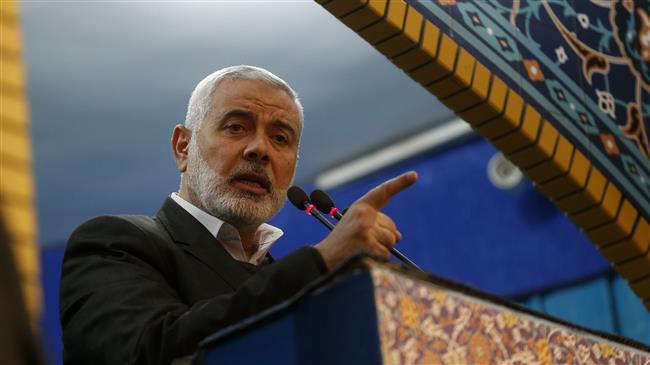
Hamas leader Ismail Haniyeh addresses a massive crowd of mourners during a funeral procession for General Qassem Soleimani in Tehran January 6, 2020. (Photo by Leader.ir)
Press TV – January 6, 2020
General Qassem Soleimani is a “martyr of Quds” for he devoted his life to supporting the Palestinian people’s struggle against Israel and his assassination by the United States is in many ways similar to crimes committed by the Israeli regime, says Hamas chief Ismail Haniyeh.
General Soleimani, commander of the Quds Force of Iran’s Islamic Revolution Guards Corps (IRGC), was assassinated in a US strike in Baghdad on Friday, alongside Abu Mahdi al-Muhandis, the deputy commander of Iraq’s pro-government Hashd al-Sha’abi forces.
A huge sea of mourners, streaming from all the adjoining streets, descended on the iconic Engelab Square in central Tehran early Monday morning and rallied to Azadi Tower in the capital’s west as they chanted “Death to America” and “Death to Israel.”
Leader of the Islamic Revolution Ayatollah Seyyed Ali Khamenei led the prayers over the general’s coffin and the remains of his companions at Tehran University, his voice cracking several times with emotion which caused the massive crowd to weep.
Speaking at the funeral procession in Tehran on Monday, Haniyeh condemned the US strike, which was personally authorized by President Donald Trump.
“We have come to Iran to condole with Leader of the Islamic Revolution Ayatollah Khamenei, the Iranian government and nation,” Haniyeh said.
“He [Gen. Soleimani] was the commander of the IRGC Quds Force and he is a martyr of Quds,” the Hamas official said.
Haniyeh also sent condolences to General Soleimani’s family and described him as one of the “flag-bearers of resistance against Zionist and American plots.”
Haniyeh said he was in Iran “to express our true and sincere feelings about a dear brother and a martyred commander – a commander who made many sacrifices for Palestine and the resistance until he achieved the position he has today.”
‘A crime similar to Zionist atrocities in Palestine’
Haniyeh said this “brutal crime” by the Americans is representative of the “criminal mentality” that is at work in the occupied Palestinian lands.
“The criminal mentality that led to Commander Soleimani’s assassination and martyrdom is the same mentality that drives the minds of the Zionist regime’s thugs, the same mentality and policy that assassinates and kills Palestinians every day,” he said.
He said Hamas owes its current prowess to General Soleimani’s wisdom. The Palestinian resistance, he said, won’t back away from combating Israel and the fight will continue “until we purge all enemies from the noble Quds.”
New Quds Force chief pledges vengeance
Brigadier General Esmail Qaani, who was named the new Quds commander by the Leader on Friday, said in a statement that Iran will no doubt avenge the assassination.
“Steps will be definitely taken” to avenge General Soleimani’s blood, which Qaani said has set in motion a series of steps that will lead to America’s expulsion from the region.
US ‘elimination’ from region only acceptable retribution
Brigadier General Amir Ali Hajizadeh, the commander of the IRGC’s Aerospace Division, echoed the remarks and said the only possible revenge for General Soleimani’s blood would be the total “elimination” of America from the region.
Launching a few missiles, destroying a base or even Trump’s death will not sufficiently avenge the blood of such a martyr, General Hajizadeh asserted, adding “the oppressed nations of the region will have to be rid of America’s evil.”
US-Led Coalition Tells Baghdad It Will ‘Move Out’ of Iraq – Official Letter
Sputnik – 06.01.2020
In a Monday letter to Iraqi military leaders, the US-led coalition in Iraq announced it was preparing to “move out” of the country out of respect for Iraqi sovereignty.
Following approval of a non-binding resolution by Iraq’s parliament calling for US forces to leave the country, US military commanders announced they were drawing up preparatory plans for their departure. A Pentagon spokesperson could not immediately confirm the authenticity of the letter to Reuters.
“We respect your sovereign decision to order our departure,” the letter says, according to Reuters. US forces will re-position themselves over the coming days and weeks in preparation for the move, the letter states.
“In due deference to the sovereignty of the Republic of Iraq, and as requested by the Iraqi Parliament and the Prime Minister, CJTF-OIR [Combined Joint Task Force – Operation Inherent Resolve] will be repositioning forces over the course of the coming days and weeks to prepare for onward movement,” states the letter, addressed to Iraqi Lt. Gen. Abdul Amir and signed by US Marine Corps Brig. Gen. William H. Seely III.
The lawmakers’ request comes on the heels of a January 3 drone strike at Baghdad International Airport in which US forces killed Iranian Quds Force commander Qassem Soleimani as well as the leader of Iraq’s Popular Mobilization Forces, Abu Mahdi al-Muhandis. The two commanders helped lead the fight against Daesh in the 2014-17 Iraqi Civil War that saw the terrorist group expelled from the country. At its height, Daesh controlled significant amounts of northern Iraq, including its third-largest city of Mosul, and was advancing on Baghdad.
“In order to conduct this task, coalition forces are required to take certain measures to ensure that the movement out of Iraq is conducted in a safe and efficient manner,” the letter continues. “During this time, there will be an increase in helicopter travel in and around the International Zone (IZ) of Baghdad. This increased traffic will include CH-47, UH-60 and AH-64 security escort helicopters. Coalition forces will take appropriate measures to minimize and mitigate the disturbance to the public. In addition, we will conduct these operations during house of darkness to help alleviate any perception that we may be bringing more Coalition forces into the IZ.”
“As we begin implementing this next phase of operations, I want to reiterate the value of our friendship and partnership. We respect your sovereign decision to order our departure.”
Contradictory Statements
The news comes after US President Donald Trump and Secretary of State Mike Pompeo snubbed the idea of leaving Iraq, where US forces have been stationed since the March 2003 invasion that overthrew Iraqi President Saddam Hussein.
“We have a very extraordinarily expensive airbase that’s there. It cost billions of dollars to build. Long before my time We’re not leaving unless they pay us back for it,” Trump said on Sunday. “We will charge them sanctions like they’ve never seen before ever. It’ll make Iranian sanctions look somewhat tame.”
“The prime minister is the acting prime minister,” Pompeo said on Fox News on Sunday, speaking of Iraqi Prime Minister Adil Abdul-Mahdi. “He’s under enormous threats from the very Iranian leadership that it is that we are pushing back against. We are confident that the Iraqi people want the United States to continue to be there.”
A Terrorist Attack Against Eurasian Integration
By Federico Pieraccini | Strategic Culture Foundation | January 6, 2020
The murder of Iranian general Qasem Soleimani in Baghdad, in the early hours of January 3 by US forces, only highlights the extent to which US strategy in the Middle East has failed. It is likely to provoke reactions that do not benefit US interests in the region.
To understand the significance of this event, it is necessary to quickly reconstruct the developments in Iraq. The US has occupied Iraq for 17 years, following its invasion of the country in 2003. During this time, Baghdad and Tehran have re-established ties by sustaining an important dialogue on post-war reconstruction as well as by acknowledging the importance of the Shia population in Iraq.
Within two decades, Iraq and Iran have gone from declaring war with each other to cooperating on the so-called Shia Crescent, favoring cooperation and the commercial and military development of the quartet composed of Iran, Iraq, Syria and Lebanon. Such ties, following recent victories over international terrorism, have been further consolidated, leading to current and planned overland connections between this quartet.
Local movements and organizations have been calling for US troops to leave Iraqi territory with increasing vigor and force in recent months. Washington has accused Tehran of inciting associated protests.
At the same time, groups of dubious origin, that have sought to equate the Iranian presence with the American one, have been calling for the withdrawal of the Popular Mobilization Units (PMUs) that are linked to Iran from Iraq. The protests from such groups appear to be sponsored and funded by Saudi Arabia.
With mutual accusations flying around, the US hit a pro-Iranian faction known as Kataib Hezbollah on December 29. This episode sparked a series of reactions in Iraq that ended up enveloping the US embassy in Baghdad, which was besieged for days by demonstrators angry about ongoing airstrikes by US forces.
The US secretary of state, Mike Pompeo, blamed this volatile situation on Iran, warning that Tehran would be held responsible for any escalation of the situation involving the embassy.
In the early hours of January 3, 2020, another tangle was added to the Gordian Knot that is the Middle East. Qasem Soleimani was assassinated when his convoy was attacked by a drone near Baghdad International Airport. The most effective opponents of ISIS and Wahabi jihadism in general was thus eliminated by the US in a terrorist act carried out in a foreign country in a civilian area (near Baghdad International Airport). The champagne would have no doubt been flowing immediately upon receiving this news in the US Congress, the Israeli Knesset, Riyadh royal palace and in Idlib among al Nusra and al Qaeda militants.
It remains to be seen what the reasons were behind Trump’s decision to okay the assassination of such an influential and important leader. Certainly the need to demonstrate to his base (and his Israeli and Saudi financiers) plays into his anti-Iranian crusade. But there are other reasons that better explain Trump’s actions that are more related to the influence of the US in the region; the geopolitical chess game in the Middle East transcends any single leader or any drone attack.
In Syria, for example, the situation is extremely favorable to the government in Damascus, with it only being a matter of time before the country is again under the control of the central government. General Soleimani and Iran have played a central role in ridding the country of the scourge of terrorism, a scourge directed and financed by the US and her regional allies.
In Iraq, the political situation is less favorable to the US now than it was back in 2006. Whatever progress in relations between Baghdad and Tehran has also been due to General Soleimani, who, together with the PMUs and the Iraqi army, freed the country from ISIS (which was created and nurtured by Western and Saudi intelligence, as revealed by Wikileaks).
It would seem that the US sanctions against Iran have not really had the intended effect, instead only serving to consolidate the country’s stance against imperialism. The US, as a result, is experiencing a crisis in the region, effectively being driven out of the Middle East, rather than leaving intentionally.
In this extraordinary and unprecedented situation, the Russians and Chinese are offering themselves variously as military, political and economic guarantors of the emerging Eurasian mega-project (the recent naval exercises between Beijing, Moscow and Tehran serving as a tangible example of this commitment). Naturally, it is in their interests to avoid any extended regional conflict that may only serve to throw a monkey wrench into their vast Eurasian mega-project.
Putin and Xi Jinping face tough days ahead, trying to council Iran in avoiding an excessive response that would give Washington the perfect excuse for a war against Iran.
The prospects of a region without terrorism, with a reinvigorated Shia Crescent, led by Iran at the regional level and accompanied by China and Russia at the economic (Belt and Road Initiative) and military level, offer little hope to Riyadh, Tel Aviv and Washington of being able to influence events in the region and this is likely going to be the top argument that Putin and Xi Jinping will use to try to deter any Iranian overt response.
Deciding to kill the leader of the Quds Force in Iraq proves only one thing: that the options available to Trump and his regional allies are rapidly shrinking, and that the regional trends over the next decade appear irreversible. Their only hope is for Tehran and her allies to lash out at the latest provocation, thereby justifying the regional war that would only serve to benefit Washington by slowing down regional unification under Iranian leadership.
We must remember that whenever the US finds itself in a situation where it cannot control a country or a region, its tendency is to create chaos and ultimately destroy it.
By killing General Soleimani, the US hopes to wreak havoc in the region so as to slow down or altogether scupper any prospect of integration. Fortunately, China, Russia and Iran are well aware that any conflict would not be in any of their own interests.
No drone-launched missiles will be enough to save the US from decades of foreign-policy errors and their associated horrors; nor will they be enough to extinguish the memory of a hero’s tireless struggle against imperialism and terrorism.
Featured Video
No Threat Can Force Iran’s Surrender /Trita Parsi & Lt Cl Daniel Davis
or go to
Aletho News Archives – Video-Images
From the Archives
What is the Israeli Lobby in Australia Doing in Interfaith Dialogue?
By Ali Kazak | Dissident Voice | October 11, 2015
For years Israel and its lobby around the world have been trying to normalise their relations with Arabs and Muslims without solving the Palestine Question.
One of the methods they resorted to in the last few years is using human rights and community organizations such as interfaith dialogue and Multiculturalism to achieve this objective and to: isolate the Palestinians, marginalise the Palestine question, end Israel’s isolation, and prevent criticism of Israel, knowing that these organisations will be the first to stand against Israel’s violations, racial and religious discrimination.
The group responsible for this task in Australia is The Australia/Israel & Jewish Affairs Council (AIJAC); its Director of International & Community Affairs, Jeremy Jones is in charge of lobbying religious community organizations, specifically Muslims and Christians. Consequently he convened the Faith Communities for Reconciliation, founding participant in the Australian Partnership of Religious Organisations and the Australian National Dialogue of Christians, Muslims & Jews.
AIJAC is a private political propaganda group. It is recognised as the main Israeli lobby in Australia. It coordinates its activities and works intimately with the Israeli embassy in Canberra and different institutions in Israel. It is privately funded by some Jewish businessmen. It monitors closely Australian politicians, the media, ethnic and religious groups, (especially Arabs and Muslims), unions and academics on their stands towards Israel and the Palestine question. … continue
Blog Roll
 Aletho News
- The war of liberation of the Arab and Islamic peoples expands across the Gulf
- Envoy warns UN on Trump’s threat to ‘obliterate’ Iran’s civilian infrastructure
- The Larak Corridor: Iran’s Rial Gate With No US, No Israel, and No Way Around
- ‘Economic terrorism’: Steel facilities hit again in US-Israeli strike
- ‘War Crime’: Iran condemns attacks on Arak, Ardakan nuclear sites
- Two-thirds of Americans want quick end to Iran war even if goals unmet
- Trump to Give “Important Update on Iran” Wednesday in Prime-Time Speech
- Theodore Postol: Iran’s Missiles & Drones Were Underestimated
- Iran To Target Military Industrial-Tech Complex That Facilitated Gaza Genocide
- Collapsing Empire: The Resistance Disarms ‘Israel’
- If Americans Knew
- Israel wants US to bomb more of Iran’s civilian structures (113,000 is not enough) – Not a ceasefire Day 173
- Ann Coulter Rips Into Fox News for Iran War Coverage
- Joe Kent Urges Americans To Call White House and Congress To Object To Sending Troops Into Iran
- DNC Resolution to Reject AIPAC Funding Puts Democratic Leaders in the Hot Seat
- Swedish foundation to build 400 schools as over 650,000 Gaza children remain without education for 2 years
- Israeli army admits photshopping image of slain Lebanese journalist
- This is how Israel is systematically killing health workers under the cover of war in Lebanon
- Carrying life under fire: Israeli invasion of Lebanon leaves pregnant women facing deadly risks
- Champagne all around for the new death penalty (for Palestinians) law – Not a ceasefire Day 172
- Why are Palestinian books struggling to be seen on Amazon?
- No Tricks Zone
- New Study Finds Warming Saves Lives…Cold Temperatures 12 Times More Deadly Than Excess Heat
- German Science Blog Accuses PIK Climate Institute Of Hallucinating Climate Tipping Points
- Devastating Assessment Of Comirnaty Vaccine By Former Senior Pfizer Europe Toxicologist
- New Study: CO2 Is ‘Effectively Negligible’ As An Explanatory Climate Change Factor Since 2000
- Former Pfizer Toxicologist Dr. Helmut Sterz Tells Bundestag Hearing Pfizer Vaccine Should Have Never Been Approved
- Energy Expert: Germany’s Nuclear Phaseout Was A “500 Billion Euro Mistake”
- New Research: South Australia’s Mid-Holocene Sea Surface Temperatures Were 4°C Warmer Than Today
- Storing Green Energy To Last Germany 10 Days Would Require A 60-Million Tonne Battery
- New Studies: UK Sea Levels Were 4 Meters Higher Than Today During The Mid-Holocene
- Destructive Green New Deal: German Energy And Metal Group Warns Of Drastic Crisis
 Aletho News