Kiev to allow foreign armed forces in Ukraine, incl. ‘potential carriers of nukes’
RT | June 5, 2015
The Ukrainian parliament has adopted amendments to state law allowing “admission of the armed forces of other states on the territory of Ukraine.” The possible hosting of foreign weapons of mass destruction is also mentioned in the documents.
Amendments to Ukrainian law were adopted on Thursday by the Verkhovna Rada, receiving a majority of 240 votes (the required minimum being 226). The bill was submitted to the parliament in May by PM Arseny Yatsenyuk. It focuses on the provision of “international peacekeeping and security” assistance to Ukraine at its request.
Peacekeeping missions are to be deployed “on the basis of decision of the UN and/or the EU,” the bill published on the parliament’s official website says.
Previously, the presence of any international military forces on the territory of Ukraine not specifically sanctioned by state law was only possible by adopting a special law initiated by the president. Implementation of the new amendments “will create necessary conditions for deployment on the territory of Ukraine international peacekeeping and security” missions without the need for additional legal authorization, the explanatory note to the draft bill said.
The presence of such armed forces in Ukraine “should ensure an early normalization of situation” in Donbass, the note added, saying that they would help “restore law and order and life, constitutional rights and freedoms of citizens” in the Donetsk and Lugansk regions.
In a comparative table, published among the accompanying documents to the bill, “potential carriers of nuclear and other types of weapons of mass destruction are permitted under international agreement with Ukraine for short-term accommodation,” with Kiev providing proper control during the period that such forces were stationed there.
Implementation of the law “will not require additional expenditures from the State Budget of Ukraine,” its documents say.
The previous law also required that the length of time temporary peacekeeping forces were to be deployed in Ukraine be stipulated, while the new amendments allow an indefinite period, long enough “to achieve the goal of the stay.”
A separate amendment banned the presence of “armed forces of states that unleash military aggression against Ukraine.” This appears to be a clear reference to the Rada’s January statement calling Russia an “aggressor” – although the body has been reluctant to approve a legally binding law saying exactly that.
Moscow denies being part of the conflict, stressing that Kiev is fighting a civil war with eastern Ukrainians, not Russian forces. The Kremlin has consistently and adamantly denied any presence of Russian troops or hardware in eastern Ukraine, pointing out that there is no evidence proving otherwise.
With violence in south-eastern Ukraine on the rise again, it is “very important to avoid any actions or steps that provoke escalation of tension,” Kremlin spokesman Dmitry Peskov said on Thursday, as quoted by RIA Novosti. Saying that there is “no shortage” of provocative actions from Kiev’s side, Peskov said the main point is “to concentrate on implementation of [Minsk] agreements.” “This is what Moscow expects the most,” he added.
The new bill on international peacekeeping missions in Ukraine contradicts the Minsk agreements, Russian State Duma MP Leonid Slutsky said. “Minsk-2 did not provide for peacekeepers in resolution of the national conflict,” Slutsky said, as quoted by TASS.
The new legal act is “doomed for inaction,” a member of the Russian Duma’s defense committee, Franz Klintsevich, said, adding that the bill is “pure PR and propaganda.” “I cannot simulate a situation in which the United Nations will vote to deploy international military to Ukraine,” Klintsevich told journalists, as cited by RIA Novosti.
The Lugansk People’s Republic’s envoy to the so-called Contact Group on Ukraine in Minsk, Vladislav Dainego, commented that the law was adopted to “justify the presence” of foreign military that are “already operating in Ukraine.” “There are some 20,000 [troops], primarily from Hungary and Poland,” Dainego claimed when speaking to Interfax, adding that the status of those forces was unclear.
Kiev came up with the initiative to employ peacekeeping missions in Donbass earlier this year. Moscow has insisted that deployment of such forces in Ukraine would be relevant only after all points of the Minsk agreement have been fully implemented, and only if both sides of the conflict – Kiev and the rebel republics – agree to the measure.
Read more:
Deployment of peacekeepers should be agreed with both sides of Ukrainian conflict – Lavrov
‘Stick to Minsk deal’: Russia slams Ukraine idea for EU peacekeepers
Repressive governments donated to Clinton Foundation, arms deals approved by Hillary’s State Dept. – report
RT | May 26, 2015
Nations openly chastised by the US for dismal human rights records donated billions to the Clinton Foundation, while gaining clearance for weapons deals approved by the Hillary Clinton-led US State Department, according to a new report.
As the Obama administration increased military weapons exports, Hillary Clinton’s State Department approved transfer of more than $300 billion worth of arms manufactured by US defense contractors to 20 nations that were or have since become donors of the Clinton Foundation, a major philanthropic organization run by the Clinton family. According to a review of available records of foundation donors by the International Business Times, those countries included governments that have received frequent criticism by the State Department for repressive policies.
“Algeria, Saudi Arabia, Kuwait, the United Arab Emirates, Oman and Qatar all donated to the Clinton Foundation and also gained State Department clearance to buy caches of American-made weapons even as the department singled them out for a range of alleged ills, from corruption to restrictions on civil liberties to violent crackdowns against political opponents,” IBT wrote.
Algeria, Kuwait, Oman, and Qatar were nations that directly donated to the Clinton Foundation during Clinton’s term as secretary of state, even as they were requesting weapons shipments. The donated money represents a loophole in US law regarding political contributions.
“Under federal law, foreign governments seeking State Department clearance to buy American-made arms are barred from making campaign contributions — a prohibition aimed at preventing foreign interests from using cash to influence national security policy,” IBT noted. “But nothing prevents them from contributing to a philanthropic foundation controlled by policymakers.”
The reviewed sales — both commercial and Pentagon-brokered — represent those made during “three full fiscal years of Clinton’s term as secretary of state (from October 2010 to September 2012),” IBT reported. The deals made with the nations in question during this time add up to far more than arms agreements made with the same countries during the last three full fiscal years of George W. Bush’s administration, according to the report.
“The word was out to these groups that one of the best ways to gain access and influence with the Clintons was to give to this foundation,” Meredith McGehee, policy director at the Campaign Legal Center, told IBT. “This shows why having public officials, or even spouses of public officials, connected with these nonprofits is problematic.”
The Clinton Foundation’s donor list has come under closer examination since Hillary Clinton announced she is seeking the Democratic Party’s presidential nomination in 2016. In April, the Clintons acknowledged they have made “mistakes” regarding transparency amid increased public scrutiny concerning donations from foreign entities, especially when Mrs. Clinton was secretary of state, from 2009 to 2013.
Earlier this month, former President Bill Clinton defended his family foundation’s donors.
“I don’t think there’s anything sinister in trying to get wealthy people in countries that are seriously involved in development to spend their money wisely in a way that helps poor people and lifts them up,” Mr. Clinton told NBC News.
The Clinton Foundation signed a foreign donor disclosure agreement just before Hillary Clinton became secretary of state, yet neither the department nor the White House raised issues with potential conflicts of interest regarding the weapons agreements.
IBT reported that in 1995 President Clinton signed a presidential policy directive demanding the State Department take into account human rights abuses when considering the approval of military equipment or arms purchases from US companies. Yet Mrs Clinton’s State Department ignored this stipulation, helping the Obama administration increase weapons transfers.
The State Department, under the aegis of Clinton, hammered the Algerian government in its 2010 Human Rights Report for “restrictions on freedom of assembly and association,” allowing “arbitrary killing,” “widespread corruption,” and a “lack of judicial independence.”
“That year, the Algerian government donated $500,000 to the Clinton Foundation and its lobbyists met with the State Department officials who oversee enforcement of human rights policies. Clinton’s State Department the next year approved a one-year 70 percent increase in military export authorizations to the country,” IBT reported. “The increase included authorizations of almost 50,000 items classified as ‘toxicological agents, including chemical agents, biological agents and associated equipment’ after the State Department did not authorize the export of any of such items to Algeria in the prior year.
“During Clinton’s tenure, the State Department authorized at least $2.4 billion of direct military hardware and services sales to Algeria — nearly triple such authorizations over the last full fiscal years during the Bush administration. The Clinton Foundation did not disclose Algeria’s donation until this year — a violation of the ethics agreement it entered into with the Obama administration.”
IBT also reported that major US weapons manufacturers and financial corporations such as Boeing, Lockheed Martin, and Goldman Sachs paid Bill Clinton lucrative speaking fees “reaching $625,000” just as arms deals they had an interest in were in the works with Mrs Clinton’s State Department.
Hillary Clinton had pledged during her Senate confirmation hearings in 2009 that “in many, if not most cases, it is likely that the Foundation or President Clinton will not pursue an opportunity that presents a conflict.”
US weapons sales tripled in 2011 to a new yearly high of $66.3 billion, according to the New York Times, mostly driven by sales to Persian Gulf nations allied against Iran. This dollar total made up nearly 78 percent of all worldwide arms deals that year, according to the Congressional Research Service.
Reuters reported in January 2013 that the State Department office that has oversight of direct commercial arms sales “was on track to receive more than 85,000 license requests in 2012, a new record.”
The boom in arms sales by the Obama administration has continued to the present day, as Arab allies like Saudi Arabia and United Arab Emirates are using American-made fighter jets against Islamic State and for proxy wars in places like Yemen and Syria.
According to the Times, foreign weapons sales now represent 25 percent to 30 percent of revenue taken in by Lockheed Martin, one of the top US-based arms dealers.
White House psychologist implicated in CIA torture now helping FBI
RT | May 8, 2015
Before the dust has had a chance to settle on the report detailing the American Psychologists Association’s complicity in the CIA torture program, the psychologist found to have violated the ethics code now appears to be helping the FBI do the same thing.
In late April, a 60-page report entitled ‘All the President’s Psychologists’ pointed to Susan Brandon as the White House architect behind the policies regulating the legality of an interrogator’s actions – something that goes against the APA’s own rulebook, which prohibits psychologists from making such judgments.
The document alleges the APA’s close coordination with the White House, the CIA and the Department of Defense on the formulation of a legal policy that would exempt the interrogators from prosecution, following a scandal involving allegation of torture at Iraq’s notorious Abu Ghraib prison. “Susan Brandon … played a central role in the development of the 2005 [Psychological Ethics and National Security] policy,” the report alleges – the second inquiry investigating the medical role in the practice.
“What we see is associations. And the associations with the apparent supervisor of [James] Mitchell and [Bruce] Jessen at each step of the process over a period of three years,” the report said then, in reference to the two masterminds of the CIA torture program, whom Brandon was allegedly in contact with in 2003, as evident from a string of emails.
Brandon’s complete role in the program is at this point unknown, but one particular email she was included on focuses on the pair “doing special things to special people in special places.”
“The issue here is not about what she thinks about torture; the issue is about what she did in the past to knowingly or unknowingly create a legal heat shield for the president using the ethics of the APA. That’s the issue. This is not a question of torture. It’s a question of alleged corruption,” says the report’s co-author and program director at the Harvard Humanitarian Initiative, Nathaniel Raymond, according to the Huffington Post.
Now Brandon is advising the FBI’s High-Value Detainee Interrogation Group – essentially the Obama’s administration continuation of the CIA program regarded as having crossed the line. She is tasked with research into determining whether a crime has been committed in the course of an interrogation.
The FBI has not officially commented on the claims yet. Journalists might not get a reply from Brandon anytime soon, as she’s still an HIG adviser and is not expected to break protocol – the association has a policy of operating in secrecy, according to fellow member Mark Fallon.
The initial reason for the government’s acceptance of the CIA torture program hinged, in part, on the presence of psychologists and their expertise acting as a check, as is evident from a 2005 Justice Department document.
The reason the APA had to be called in was apparently due to the CIA’s own psychologists’ refusal to sign off on the memo, claiming that the proposed assessments simply strayed outside of medical professionals’ competence.
As a result, Brandon’s Psychological Ethics and National Security policy became the document that could be “seen as opening the door for psychologists to fulfil a function that [CIA Office of Medical Services] health professionals were resisting,” according to the report.
Brandon’s own language went in a separate direction from the CIA doctors’, effectively paving the way for a psychologist’s role in judging the harm and effectiveness of an interrogation.
The APA has denied the report’s findings. Its own review of the complicity in the Bush-era program is ongoing.
Brandon’s role as one of the HIG’s top specialists is now under scrutiny, but she has defenders as well. Fallon, for one, has since said that Brandon “is a research scientist who was helping craft language, from what I can read in those emails, that might in fact be totally appropriate.”
“[Was] it a witting collaboration, or is it an unwitting person within the government who’s a research scientist looking to ensure that we’re at least learning lessons? I just could not conceive that she would ever do anything that would support degrading and inhumane treatment,” he added.
Read more: Study accuses psychologists group of complicity in CIA torture program
Poland approves joint force with Ukraine & Lithuania, calls on EU to spend more on defense
RT | May 4, 2015
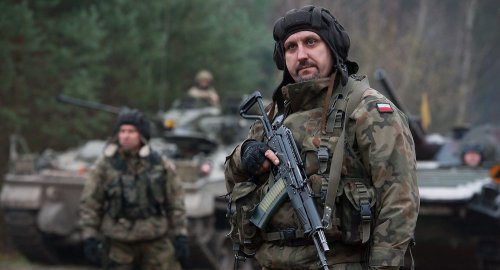
Poland’s President Bronislaw Komorowski has signed a resolution approving the organization of a joint Lithuanian-Polish-Ukrainian brigade, whose creation has been in the works since 2007.
When brought to full operation in 2017, the brigade is set to constitute 4,500 servicemen. They will operate separately from the three countries’ respective militaries, but will take part in NATO exercises and missions. Preliminary drills are scheduled for later this year. The brigade will be stationed at its headquarters in Libulin, Poland. So far, it only houses 250 servicemen and 50 command staff contributed by the Polish military.
The joint force was discussed as far back as 2007, but the agreement to create it was signed by the three countries’ defense ministers in September 2014, in response to the Ukrainian crisis and what they call Russian aggression.
Creating the joint force is “part of a wider plan … to support Ukraine, among others, in the area of modernization,” President Bronislaw Komorowski said as cited by Reuters.
He also urged other European countries to spend more on defense. To that end, President Komorowski has suggested excluding defense spending from EU rules on budget deficit limits. This means that EU nations will be able to allocate more money to the military without fearing increased budget controls from Brussels. Komorowki’s offer comes at a time of heightened tensions with Russia.
Poland now has the fifth-strongest army in the EU, and has ambitious plans to modernize it, spending about $36 billion until 2022. However, the Polish government is unhappy about a lack of similar eagerness in some of the other European nations, the Rzeczpospolita newspaper reports.
While NATO is advising its member states to spend the maximum allowed of three percent of GDP on defense, most are spending far less: Germany allocates 1.2 percent of its GDP, the Netherlands 1.3 percent and Spain under 1 percent. France is the only Western European country that is boosting defense spending. However, some Eastern European nations are increasing their military expenses citing what they call Russian aggression. Lithuania, for instance, wants to allocate twice as much on defense as last year.
NATO & allies stage thousands-strong drills across Europe
RT | May 4, 2015
Three sets of military exercises kicked off in Europe on Monday, involving thousands of servicemen from a variety of NATO nations and their allies, amid a wave of similar action across the area.
Estonia is holding its largest-ever military drills. Named Siil-2015 (Hedgehog), the maneuvers involve about 13,000 personnel. The number includes about 7,000 reservists, along with members of the volunteer Estonian Defense League.
Siil-2015, scheduled to last until May 15, also involves forces from the US, the UK, Germany, Latvia, Lithuania, Belgium, Poland and the Netherlands. American troops, who are staying in Estonia as part of the massive training operation Atlantic Resolve, will bring four Abrams main battle tanks to the exercise. British, Belgian and German air defense units, as well as several NATO warplanes, will also take part.
The Lithuanian Army is holding its own maneuvers as part of the largest national drills called Zaibo Kirtis (Lightning Strike). The training involves over 3,000 troops. It is focused on joint action by the army and civilian authorities against so-called hybrid threats combining both military and non-military methods of fighting, according to Army Commander Major-General Jonas Vytautas Zukas.
In a statement cited by TASS, the major-general said: “The exercises will simulate situations when the Interior Ministry’s forces and resources are insufficient to neutralize various extreme situations unrelated to the direct repulsion of an imaginary enemy’s attack and the army should be involved.”
Lightning Strike will also be testing the country’s mobilization system and cyber security works, according to the Defense Ministry’s press release.
In Norway, NATO and its allies have gathered for annual anti-submarine exercises. About 5,000 servicemen from 10 NATO countries and Sweden are taking part. The drills, codenamed Dynamic Mongoose, involve simulated sub hunts utilizing surface vessels, aircraft and a variety of radar and sonar technologies. The US, Germany and Sweden are providing the submarines.
The two-week exercise follows reports of a suspected foreign underwater vessel off the coast of Finland, which prompted the use of depth charges to scare it off. In autumn last year, a similar scare triggered a week-long search in the sea near Stockholm, for what later turned out to be a civilian workboat. In the latter case, the finger of blame was unequivocally pointed at Russia, amid rising tensions over the Ukrainian conflict.
When speaking to the media about Dynamic Mongoose, NATO commanders avoided sending a message to any country in particular: “Obviously we’re aware of the incidents that have happened in some of our partner nations’ waters,” NATO Rear Admiral Brad Williamson said. “I think what it does is it focuses our efforts and our training here.”
Read more:
NATO ‘Tornado’ military drills in Estonia to use laser training system
Sweden confirms mystery ‘Russian sub’…was in fact a workboat
‘US funding of Sunni militia groups would further partition Iraq’
RT | April 29, 2015
The US is boosting its military support for security forces fighting against Islamic State in Iraq. The Republicans have proposed a bill to directly fund militia groups operating in the country, such as the Kurdish Peshmerga and Sunni irregular forces. If the bill is passed, tribal groups could receive up to $429 million in aid from the US.
The US Republicans’ proposal to fund Peshmerga and Sunni militias in Iraq, if approved, would entrench the country which is already partitioned by war, defense analyst Ivan Eland told RT.
RT: Do you think America’s funding of tribal security forces such as the Peshmerga might encourage further sectarian tension in such a volatile region?
Ivan Eland: Definitely. I think that’s true. Of course the US during its occupation was helping out the Peshmerga, so they were kind of undermining a unified Iraq even back then. But now Iraq basically is partitioned by war and I don’t think we can put it back together again. And so the Republicans are actually facing reality, but certainly this effort to fund individual militias will hasten the effort and entrench already partitioned Iraq.
RT: The bill also requires these security forces to be an independent entity from Iraq, so they can receive the aid separately from Iraqi national forces. What implications could that have on the US-Iraq partnership?
IE: The Republicans are unhappy with the Iraqi government’s dependence on Iran for training its Shia militias, and the Shia militias have been accused of some atrocities against Sunnis. The US doesn’t like Iranian influence in Iraq and so this bill says it funds the Peshmerga and other militias which would be Sunnis, but it also says that [if] the government of Iraq doesn’t [dis]associate itself with the Shia militias; they’ll give even more funds to the Peshmerga and other Sunni militias. So it doesn’t totally go away from the Iraqi government, but it puts a lot of pressure on them to dissociate themselves from the Shia militias which the Iraqi government probably is not going to do.
RT: If the bill does recognize these tribal security forces, they will gain a large amount of aid assigned for Baghdad. How will that affect the ability of Iraqi forces to counter Islamic State’s offensive?
IE: I think the Iraqi forces are already sort of a shell; they cut and ran when the ISIS forces attacked. The Iraqi government is depending on the Shia militias to defend them and they had the greatest role in the campaign to recapture Tikrit. The US Congress – if they pass this bill – will be asking the Iraqi government to remove the only reliable military force it has. The Iraqi armed forces are not reliable. And the Shia militias are the only groups that can adequately, even have a priority, of taking on ISIS.
RT: There are also reports of Kurds recruiting former US military members to fight the terrorist group. Apparently, a dozen Americans have already joined their ranks. What do you think about that?
IE: This may be the US government giving a wink and a nod to this without officially sanctioning it because they want to shore up the Peshmerga against the ISIS fighters and the administration doesn’t really want to do this. Most probably – what the Republicans are suggesting – giving direct aid – because of course implications can lead to the breakup of Iraq officially. Iraq is already broken up on the ground but the administration probably doesn’t want to encourage officially supporting the Peshmerga. So this could be a way of winking and nodding to get more expertise and to help them fight ISIS.
Death threats for OSCE inspectors by Ukraine servicemen – Moscow
RT | April 27, 2015
Members of the OSCE mission in Ukraine have been questioned about their nationality by Kiev troops and volunteer battalion militiamen looking for Russian nationals. Vehicles have been illegally searched and lives threatened.
Russia’s Foreign Ministry has expressed concern over the questioning of members of the Organization for Security and Co-operation in Europe (OSCE) mission to Ukraine and illegal checks of their transport. On Monday it issued a special communique on the violation of the observers’ rights.
The release claims multiple violations of observers’ status have been registered at a number of checkpoints and settlements under the control of pro-Kiev forces. The communique mentions incidents in five villages. In a sixth case, a Ukrainian soldier openly threatened Russian-national OSCE members with death.
“These facts cause resentment and are categorically inexcusable. The coordination of the actions of the Ukrainian military and volunteer units leaves no place for doubt that the order on checking OSCE observers has come from a single center,” the document says.
Such actions by the Ukrainian forces run contrary to Kiev’s obligations to ensure safety and freedom of movement of the OSCE monitors overseeing the implementation of the Minsk peace deal and UN Security Council’s resolution 2202, the ministry said.
The leaders of Ukraine and the self-declared Donetsk and Lugansk People’s Republics, together with their colleagues from Russia, France and Germany, agreed on a new peace deal at a February meeting in the Belarusian capital, Minsk, after a previous ceasefire agreement had failed.
The new deal implies pullout of heavy weapons by both sides of the conflict, with the OSCE monitoring the ceasefire and security at border crossings between Ukraine and Russia.
The OSCE deployed its observers to Ukraine in March 2014 at the request of the Kiev government. A month later, in April 2014, Kiev launched a military operation against the rebels in Donbass.
In early March 2015 the OSCE decided to extend the mandate of the Special Monitoring Mission in Ukraine for one year, as well as increase the potential number of its observers to up to 1,000 people.
Another ‘Russian submarine’ excites Western media
By Danielle Ryan | RT | April 24, 2015
Once again Western media has rushed to judgment over a “Russian submarine”, this time in an incident off the coast of Ireland. But maybe they should have done their homework on this one. Britain and the US have worse track records in the Irish Sea.
Last week, while out and about in the waters of the Irish Sea a few miles off County Down, a fishing trawler “almost sank” when it was hit, presumably by a submarine.
The vessel, named the Karen, was hit and then “pulled backwards very violently.”
Skipper Paul Murphy told Down News that the boat had been travelling at just a couple of knots and then all of a sudden he was nearly knocked off his feet. “The crew were just in shock after this incident. It really was a close call,” he said.
Shaken from the day, and no doubt influenced by the deluge of Russian-subs-and-jets-are-coming-to-get-you propaganda in British newspapers, Murphy immediately hypothesized to the journalist that it could have been a Russian submarine. No wonder Stockholm couldn’t find it.
After I read the story, I posted the link to Facebook and then promptly forgot about it. It was only by chance, while reading an article in the Guardian about Britain’s Trident nuclear deterrent program and the “unpredictable Putin” that I happened upon another mention of it.
It seems the Russian sub theory has spread beyond the Down News to the Guardian, the BBC and beyond. And don’t get me wrong, it’s not a theory entirely without merit. It very well could have been a Russian submarine.
Dick James from the Northern Ireland Fish Producers Organisation (NIFPO) told the BBC, that the mystery sub may have been observing NATO marine exercises off the coast of Scotland.
Security analyst Tom Ripley, who writes for Jane’s Defence magazine, agreed. He told BBC Radio Ulster that the Russians “are famous for liking to watch these things [NATO exercises] and it is a strong possibility that they have sent one of their submarines to watch this activity.”
James added that, had it been a British submarine, Royal Navy protocols would have required it to “immediately surface to check on the health and welfare of the people involved,” and this submarine did not do that.
Subsequently, the initial media coverage of the incident seems to have been peppered with the assumption that while the Brits would never be so rude as to not surface and say hello, the horrible Russians wouldn’t feel bound by such niceties. It’s this fact alone — that the sub never surfaced to check the damage — that seems to have immediately convinced the entire British and Irish media that it could not have been a British vessel.
But let’s skip back for a moment, to April 18, 1982.
On that otherwise calm day at sea, a British submarine dragged the Sharelga, an Irish fishing boat for two miles before it eventually sunk and all five crew members were forced to jump overboard. They were, luckily, rescued by crew members of nearby boats.
The British sub did not surface and the British government denied any involvement in or knowledge of what had happened to the Sharelga. Only weeks later did they finally admit that in fact the Irish boat’s fishing net had been caught by the British submarine HMS Porpoise, which itself had been trying to spot Soviet submarines in the Irish Sea.
Four years later, the crew members finally received compensation, although according to the skipper Raymond McEvoy, it “didn’t even match half” of what he paid for the boat.
It took so long, likely in part because the Irish government didn’t want to, shall we say, rock the boat by getting too involved in a diplomatic entanglement with Britain. A document released decades later revealed that the Government was not interested in acting as “a party to the dispute” between the men and the British government.
The sinking of the Sharelga happened during a period of the Cold War that saw the Irish Sea earn the nickname ‘Submarine Highway’, so frequent was sub activity in Irish waters.
Seven years after the Sharelga sank, a Belgian trawler, the Tijl Uilenspiegel, sank approximately 25 miles south-east of the Isle of Man, presumably also by a submarine.
The incident prompted a discussion about submarine activity in the Irish Parliament in March 1989. Hugh Byrne, a member of parliament at the time, used his speaking time to deliver a chronological list of incidents to highlight the dangers to both fishermen and those on recreational vessels.
Here are some of the incidents he listed:
● In 1983, a yacht was struck and sunk by a submarine believed to be the British HMS Opossum, off County Wexford
● In 1984, a fishing vessel, the Algrie, became entangled with the HMS Spartan off the Cornwall coast
● In 1984, a US submarine surfaced in the middle of a fishing fleet near Kilmore Quay, prompting fishermen to flee in fear of their lives
● In 1984, Scottish fishing vessel the Mhari L disappeared with no distress call. A damaged British submarine entered Faslane base 24 hours later, but the Ministry of Defence denied involvement
● In 1987, the Summer Morn was towed for hours by a US submarine
● In 1988, the HMS Oberon collided with a yacht named the Drum
● In 1988, the Dalriada was sunk by the HMS Conqueror off Northern Ireland
● In 1989, a fishing trawler was struck by the USS Will Rogers.
Those are just a handful of incidents involving the damaging, sinking or disappearance of Irish and British boats in the waters surrounding the British Isles. Notably, none of the examples Byrne gave referred specifically to Russian submarines.
Occasionally the tragedies were blamed on “freak” waves, as in the case of the Boy Shaun off County Donegal and the Inspire off the Welsh coast, both of which were sunk while submarines were known to be operating nearby.
Overall, 50 fishermen lost their lives over nine years as a result of war games being played out in the Irish Sea. It’s important to note that the national identities of the subs were not confirmed irrefutably in every case, but a search through Irish government debate archives seems to suggest that Britain was regarded as a major, if not the major culprit. It’s not a particularly unusual assumption either, given that Britain (and its bases) is quite considerably nearer to Ireland than Russia, last time I checked.
During his comments, Byrne said that despite pleading with the British government, they continued to “ignore the loss of life and to respond with a ‘how dare you ask questions?’ attitude”.
“The attitude of the British Government, who contribute most to this devastation, baffles me because of their arrogance towards their people, particularly towards their fishermen,” he said.
Later in the same year, after a sonar buoy towed by a British submarine became entangled in the nets of a fishing vessel in the Irish Sea, the issue was raised in government again.
Member of the government at the time Peter Barry said that “as long as the NATO base [Holy Loch] remains located in Scotland,” and as long as NATO submarines were being shadowed by submarines from other superpowers, the danger would remain.
None of this information is readily available to your average consumer of news today, unless they go searching through old archives, which most people are not wont to do — and so it’s easy for the likes of the BBC, Sky News and the Guardian to bang out article after article about ‘Russian submarines’ with little to no historical context, let alone evidence to back up their assertions.
None of the reports on the latest incident with the Karen off the coast of Down last week made reference to the relevant history of dangerous British sub activity in the Irish Sea. Either the journalists didn’t do their homework or they felt that the frankly questionable British and American track records in the Irish Sea were not worth mentioning. It’s not that they needed to deliver an entire history of events in the interest of balance, but even a line or two would have been enough.
The argument by some against the relevance of this history will be that the 1980s were a different time and that surely if a British submarine inadvertently dragged a fishing boat today, they would immediately surface to check on the crew. It could also be argued however, that unfortunately today isn’t really as different from 1982 as we’d perhaps like to believe when it comes to NATO vs. Russia war games.
Despite a perhaps misplaced presumption of British courteousness, there are still plenty of reasons to assume a British sub would stay hidden after such an incident today, chief among them the fact that it just wouldn’t look good to admit such a mistake — particularly at a time when Russian military irresponsibility and “aggression” is the accepted bogeyman of the day.
Having to admit to almost capsizing a fishing boat in the Irish Sea would not look great given the current British government’s tendency to fear-monger over Russian jets and subs at any given opportunity and to use routine military maneuvers as a NATO rallying cry.
When I asked Dick James of NIFPO about the drop-off in incidents after 1990, he said it was likely due to the protocols being in place and of course the closure of the Holy Loch base after the collapse of the Soviet Union, which reduced submarine activity.
As for the identity of the sub that hit the Karen last week, when I asked if the media had been quick to judge, he accepted that it “could be NATO or not” adding that the British Ministry of Defence was being “reticent”. The Royal Navy later issued a statement claiming it was not one of their own.
But the question is: If Britain refused to acknowledge the mistakes of their submarines during periods of heightened tensions before, why would today be any different?
None of this is to assign blame or to claim that it wasn’t a Russian sub which dragged the Karen and shook her crew members last week. It very well could have been — but that theory is no more or less likely than the theory that says it was a British one.
Follow Danielle Ryan on Twitter @DanielleRyanJ
US to deliver F-35 jets to Israel to maintain military edge

RT | April 24, 2015
US Vice President Joe Biden said that Israel will be getting a shipment of the United States’ new F-35 fighter jet so that its military can retain its “qualitative edge” in the Middle East.
Biden made the announcement in Washington, DC while giving a speech during a celebration of Israel’s Independence Day, Reuters reported. The relationship between Israel and the US has been strained over the past few years due to disagreements about Jewish settlements in Palestinian territories and Iran’s nuclear program, but the two nations continue to maintain strong military ties.
“Next year we will deliver to Israel the F-35 Joint Strike Fighter, our finest, making Israel the only country in the Middle East to have this fifth-generation aircraft,” Biden said.
According to Haaretz, the deal involves Israel purchasing 14 F-35 jets for $110 million each. That is in addition to a previous agreement in 2010 that saw Israel agree to buy 19 jets. The first two planes are set to arrive in Israel in 2016, with the others making their way into the country by 2021.
While the US has invested a lot of time and money into the high-tech, high-powered F-35, questions remain about its effectiveness. The trillion-dollar program has suffered numerous setbacks over the years and issues continue to crop up.
Earlier this month, the House of Representatives’ Armed Services Committee learned that the jet’s software maintenance system gives false-positive readings 80 percent of the time. The Autonomic Logistics Information System (ALIS) is meant to flag issues with the plane so that maintenance teams can repair them, but Air Force Lt. Gen. Christopher Bogdan told lawmakers it still “has a long way to go.”
“We have taken steps in the last two years to change fundamentally the way we develop ALIS, but it takes time to realize those results,” Bogdan said, though he added that the software is not a central part of the plane. A smaller version is being developed that should be ready in July.
Before that, news reports stated that a computer glitch kept the aircraft’s four-barreled rotary cannon from firing, potentially delaying the jet from being fully operational until 2019.
Last year, the vice president of the Super Hornet and Growler programs at Boeing – a rival of Lockheed Martin, which manufactures the F-35 – questioned the stealth capabilities of the jet, arguing that it’s not as effective against Chinese and Russian air defense systems as other aircraft are.
Read more: Pentagon’s F-35 stealth fighter jet has a ‘brain’ problem
NATO ‘Tornado’ military drills in Estonia to use laser training system
RT | April 20, 2015
The US Army has joined Estonian soldiers in NATO ‘Tornado’ drills just before the largest training in Estonia’s history, the Siil war games. A laser training system will be used for simulating actual battle.
“On Monday, nearly 2,000 soldiers of the First Infantry Brigade of Estonian Defense Forces, as well as divisions of US paratroopers, will begin five-day Tornado drills, which will demonstrate the level of their readiness for larger Siil [Hedgehog] military exercises,” the General Staff of the country’s Defense Forces said in a statement.
The Siil war games involving up to 13,000 soldiers will be held in early May.
The MILES (Multiple Integrated Laser Engagement System) system will be used during the Tornado exercise for training purposes, with different versions of MILES systems available to US and international militaries. The system uses lasers and blank cartridges to simulate actual battle. Soldiers carry small laser receivers, placed over their outfits, which detect when the soldier has been illuminated by a firearm’s laser. Each laser transmitter meanwhile mimics the effective range of the weapon on which it is used.
The presence of US soldiers in the Baltic region is a part of the military operation Atlantic Resolve, a demonstration of US commitment to NATO members across Eastern Europe through international training and security cooperation.
NATO has been building up its military presence along Russia’s western border in the wake of the conflict in southeastern Ukraine. Moscow has repeatedly warned that NATO’s growing expansion towards Russian borders could only escalate tensions and destabilize regional security.
“The Alliance exerts pressure on the Russian Federation and the deployment of additional military capabilities along our borders is nothing but an attempt to assist military pressure on Russia,” Russia’s permanent representative to NATO, Alexander Grushko, said in February.
The Russian General Staff said on Thursday there was a sharp increase in the intensity of NATO troops training near the borders of Russia last year, with a clear anti-Russian orientation of these activities. According to Lieutenant General Andrey Kartapolov, NATO’s operational and combat training activities grew by 80 percent in 2014.
“During this period, NATO created a grouping of its member states’ forces in the Baltic States, consisting of over 10,000 troops, about 1,500 armored vehicles, 80 planes and helicopters and 50 warships,” Kartapolov stated, adding that strategic bombers from the US Air Force were used to perform strategic tasks during those exercises.
He also said the US plans to supply its Eastern European allies with JASSM-ER long-range aviation cruise missiles, which will enable NATO warplanes to hit targets 1,300 kilometers inside Russian territory.
The head of the Main Operation Directorate of the General Staff has warned that in the case of a military conflict, critical facilities on the territory of “almost the entire European part of Russia will be vulnerable to NATO’s air attack, with the flight time of the missiles reduced by half.”
US military instructors in Ukraine undermine Minsk peace deal – Moscow
RT | April 17, 2015
Despite voicing its support for the settlement of the Ukrainian crisis, the US is actually working to undermine the Minsk peace deal, Russia’s Foreign Ministry said, commenting on the deployment of American military instructors to Ukraine.
The Russian Foreign Ministry is “gravely concerned” by the fact that military instructors from the US, UK and Canada will be training the troops from Ukraine’s National Guard, stressed the ministry’s spokesman, Aleksandr Lukashevich.
“This begs the question: Do they – in Washington, London and Ottawa – understand whom are we talking about? As they are the same Ukrainian ultra-nationalists from volunteer battalions, who wore Nazi emblems and blurred themselves with the blood of women, children and the elderly during reprisal raids in Donbass [south-eastern Ukraine],” he said.
“What will these foreign military experts teach them – how to continue killing those, who speak Russian?” the spokesman wondered.
Moscow views the information that the National Guard training program will include exercises with Western-style weaponry and hardware as a possible “first step towards the supply of modern US arms to Ukraine, which the ‘party of war’ in Kiev is so eager to get its hands on,” he said.
Supporting any revanchist ambitions of warmongers in the Ukrainian government “may lead to the resumption of bloodshed” in the south-east of the country, Lukashevich warned.
The ministry believes that the US actions are in violation of the peace deal, which was signed by Kiev and the representatives of Donetsk and Lugansk during talks in Minsk on February 12, he said.
Lukashevich stated that the Minsk deal provides “the withdrawal of all foreign forces, military equipment, as well as mercenaries from the territory of Ukraine under the supervision of the OSCE. Instead, a US Airborne Brigade has landed near Lvov and intends to settle there for long.”
“The Obama administration, which verbally advocates the settlement of the Ukrainian crisis, is, in fact, contributing to the disruption of the Minsk agreements,” he stressed.
According to Moscow, Washington is trying to divert the international community’s attention from its military deployment in the Ukraine “by a ‘smokescreen’ of claims of an alleged presence of Russian troops in Donbass,” which hasn’t been backed by any proof.
“It’s obvious, that the US troops on Ukrainian soil won’t bring it peace,” Lukashevich concluded.
On Friday, paratroopers of the US 173rd Airborne Brigade, based in Vincenza, Italy, have arrived in western Ukraine to provide training for Ukrainian troops. Some 290 US troops are to take part in long-term joint drills with combat units of the National Guard, Arsen Avakov, Ukrainian Interior Minister, wrote on Facebook.
The US paratroopers’ training mission will last for 24 weeks and involve some 900 Ukrainian servicemen, Ukraine’s President, Petro Poroshenko, and US Vice-President, Joe Biden, agreed earlier in spring.
Kiev and rebels signed a ceasefire deal in February, which involved the pullout of heavy weapons and a profound political dialogue and constitutional reform, which would address the grievances of the dissenting regions and reintegrate them into Ukraine.
The deal has more or less held so far, with the level of violence in eastern Ukraine dropping significantly, OSCE monitors on the ground have been reporting.
The Ukrainian conflict began in April 2014 after Kiev sent troops to Donetsk and Lugansk Region as people there refused to recognize the new coup-imposed authorities in the capital. A year of fighting in south-eastern Ukraine has resulted in over 6,000 deaths, including score of civilians, according to conservative UN estimates.
Featured Video
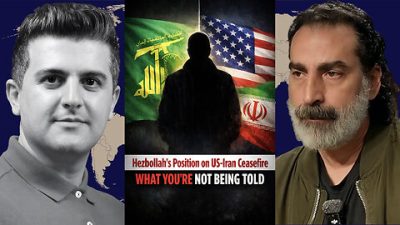
Laith Marouf: Hezbollah’s position on US-Iran ceasefire
or go to
Aletho News Archives – Video-Images
From the Archives
The Dirty Little Secret behind the “Global Terrorism Index”
The Omission of Israeli Terrorism in the Occupied Palestinian Territories
By Karin Brothers | Global Research | December 6, 2014
… The Israeli settlements — all of which are illegal – have been identified as a major impediment to peace. The refusal of a major “global” terrorism report to name the Israeli settlers as one of the groups most responsible for terrorism not only misrepresents a major source of regional violence but exposes the Global Terrorism Index as a propaganda tool that supports a U.S. agenda.
In recent years, governments have been attempting to thwart terrorism by blocking supportive fund-raising. When it comes to Israeli settlements, however, the US and Canada actually encourage fund-raising by giving organizations (such as Christian Friends of Israeli Communities (CFOIC) and the Jewish National Fund) financial support in the form of donor tax-deductions.
Charities which provide funds for the Israeli settlements should be regarded as terror-financing organizations. They should not only lose their tax-deductible status, but they should be banned because they support the violation of international humanitarian law. The terror-financing laws that are being strictly enforced for Muslim charities should be applied to Christian and Jewish charities as well. … Read full article
Blog Roll
 Aletho News
- Trump Administration Moves To Automate U.S. Military Draft Registration
- Spain orders reopening of Tehran embassy, condemns Israel’s carpet bombing of Lebanon
- Israel faces ‘unsustainable’ strategic crisis following 40-day war against Iran: Analyst
- Iran restricts Hormuz access to 15 vessels per day under ceasefire terms: Report
- The ‘Opposition Party’ Has Done Nothing to Stop the Iran War and Much to Goad Trump Into Continuing It
- Moscow backs Tehran on status of Lebanon in US-Iran deal
- How UK Regulator Ofcom Quietly Bypassed International Law to Police American Speech
- The Black Cube Files: How Former Mossad Operatives Flipped a Nation
- Laith Marouf: Hezbollah’s position on US-Iran ceasefire: What you’re not being told
- Israel’s priority lies in destroying chances of peace between Iran, US: Ex-UN nuclear chief
- If Americans Knew
- The gallows law: Israel moves toward executing Palestinian children
- Tucker Carlson: The Path to Peace requires ending ‘special alliance’ with Israel
- This is ceasefire? Israel’s biggest massacre yet in Lebanon, another journalist killed in Gaza – Daily Update
- Tucker Carlson on Israel: This Is the Behavior of an Ally? Really?
- Gazans face a triple crisis: severe shortages of water and bread, healthcare in tatters
- NY Times reports how Netanyahu took the US into Iran War
- A sigh of relief over Iran, but Gaza and Lebanon in dire straits – Daily Update
- Thousands dead and neighborhoods razed to the ground: Aid agencies fear southern Lebanon is becoming the new Gaza
- The war the US is fighting for Israel could cost trillions
- ‘Cigarette Burns, Nail Wounds’: Toddler Tortured in Gaza to Coerce Father
- No Tricks Zone
- An Inconvenient Tree: Uncovered In Alps… Europe Much Warmer Than Today 6000 Years Ago
- New Study Reports A 60% Slowdown In Greenland’s Ice Loss Rate In The Last Decade
- Low Intensity Tornado Wrecks Major Solar Farm, Creating A Potential Toxic Dump
- New Study Finds Warming Saves Lives…Cold Temperatures 12 Times More Deadly Than Excess Heat
- German Science Blog Accuses PIK Climate Institute Of Hallucinating Climate Tipping Points
- Devastating Assessment Of Comirnaty Vaccine By Former Senior Pfizer Europe Toxicologist
- New Study: CO2 Is ‘Effectively Negligible’ As An Explanatory Climate Change Factor Since 2000
- Former Pfizer Toxicologist Dr. Helmut Sterz Tells Bundestag Hearing Pfizer Vaccine Should Have Never Been Approved
- Energy Expert: Germany’s Nuclear Phaseout Was A “500 Billion Euro Mistake”
- New Research: South Australia’s Mid-Holocene Sea Surface Temperatures Were 4°C Warmer Than Today
 Aletho News