How to run an election, pro-EU edition: ban the party, jail the governor, block the observers
RT | September 27, 2025
Moldova goes to the polls this Sunday in what officials in Chișinău and Brussels have called a “milestone on the European path.” Yet with opposition parties banned, observers blocked, and voters in key regions sidelined, the election looks less like a democratic contest and more like a forced pro-EU outcome.
Watchdogs can’t watch
The Moldovan Central Election Commission (CEC) this week denied accreditation to more than 30 international organizations and 120 observers from over 50 countries. Among those barred were Russian experts nominated to the OSCE’s official mission – a first in European electoral practice.
Moldova’s foreign ministry claimed the decision was taken “in line with national law.” The Patriotic Bloc, an opposition alliance, accused the authorities of deliberately creating an observer blackout. Its lawyers listed applications from reputable NGOs in Italy, Germany, France, Spain and the US that were ignored or rejected.
Moscow has called the move a “blatant breach” of OSCE commitments and summoned Moldova’s ambassador. The EU, usually vocal and critical of democracy standards in the region, has remained conspicuously silent.
Parties erased by decree
Elections are meant to let citizens decide. In Moldova, key players were simply removed from the ballot.
• On September 26, two days before the election, the Heart of Moldova party was suspended for 12 months by court order, accused of money laundering and illicit campaign finance. The CEC struck all Heart of Moldova candidates from the Patriotic Bloc’s list. Its leader, former Gagauzia governor Irina Vlah, called it “a political spectacle.”
• The same day, the CEC barred the Great Moldova party, led by Victoria Furtuna, citing undeclared foreign funding and links to the already banned SOR party. Furtuna had already been sanctioned by the EU in July for receiving support from fugitive oligarch Ilan Șor.
• In June 2023, the SOR Party itself, led by exiled businessman Ilan Shor, was dissolved by the Constitutional Court, accused of corruption and “threatening Moldova’s sovereignty.” Pro-EU Moldovan President Maia Sandu celebrated the ban as a victory against “a party created out of corruption and for corruption.” Opposition leaders called it the end of pluralism.
The bans come on top of sweeping new laws rushed through parliament this summer, allowing the government to strike “successor parties” of banned groups from the ballot and to bar their members from holding office for five years. The Venice Commission and OSCE warned such blanket exclusions could violate basic political rights.
Rivals under investigation, in exile or behind bars
Even where parties survive, their leaders have been sidelined.
• Igor Dodon, Moldovan president from 2016 to 2020, remains under criminal investigation for treason, illicit enrichment and the notorious “kuliok” bribery case. He claims the charges are fabricated, but has been under house arrest for much of the past two years.
• Marina Tauber, vice-chair of the outlawed SOR Party, is being tried in absentia after fleeing to Moscow in early 2025. Prosecutors are seeking a 13-year sentence for fraud and money laundering. Tauber insists the trial is political revenge for her role in anti-Sandu protests.
• Evghenia Gutsul, elected governor of the autonomous Gagauzia in 2023, was sentenced in August to seven years in prison for allegedly funneling Russian funds to the SOR Party. Her supporters protested outside the Chișinău courthouse as she declared the verdict “a sentence not on me, but on Moldovan democracy.” Russia called her jailing politically motivated; the EU has stayed silent.
With opposition leaders jailed, exiled or under investigation, Sandu’s PAS faces little organized challenge at the ballot box.
Transnistrian voters pushed aside
For Moldovan citizens in the breakaway region of Transnistria, the chance to vote has been slashed. In 2021, over 40 polling stations were opened for residents east of the Dniester. This year, just 12 stations were approved – all on government-controlled land, many kilometers from the demarcation line.
Days before the election, the CEC even relocated four of those sites further inland, citing security threats. The Interior Ministry warned of possible bomb scares and provocations in the “security zone.”
Critics call it voter suppression. Russia’s ambassador Oleg Ozerov described the changes as “unprecedented,” noting they were announced less than 48 hours before election day. Transnistrian authorities accused Chișinău of deliberately reducing turnout in a region that leans heavily toward opposition parties.
By contrast, more than 300 polling stations were opened abroad, including 73 in Italy, where the Moldovan diaspora numbers some 100,000, and only 2 in Russia, where the diaspora size is similar – a disparity that hints at the government’s priorities.
Democracy by emergency decree
This is not the first time Sandu’s government has pushed democratic boundaries. Since 2022, PAS has ruled under a rolling state of emergency, citing Ukraine’s conflict with Russia. Using these powers, the government shut down six television channels accused of spreading Russian propaganda, blocked Russian journalists from entering, and passed 13 laws tightening control over parties and candidates.
Reporters Without Borders and the OSCE have flagged concerns about media freedom and selective application of the law.
Brussels applauds, critics protest
Brussels has consistently praised Sandu’s government, calling Moldova “a success story” and advancing its bid for EU membership. Just this week, EU officials accused Moscow of “deeply interfering” in the elections through disinformation and illicit funding.
But inside Moldova, the picture looks different: courts have been turned into campaign tools, whole parties have been erased, governors jailed, observers turned away. The Parliamentary Assembly of the Council of Europe has called for an “inclusive and fair” process for all citizens – diplomatic language for “don’t tilt the table.” The Venice Commission cautioned against blanket bans that undermine the right to be elected.
The bottom line
The vote is supposed to be about Moldova’s future, yet so much of the present has been quietly erased. The rivals that might have challenged PAS are gone, some behind bars, some in exile. The voters in Transnistria who might have shifted the balance face fewer polling stations than ever before. Even the observers whose job is to watch have been turned away. The EU will describe it as progress, a sign of a candidate state finding its democratic feet.
Inside Moldova, many see something else entirely: a coronation disguised as a contest, the latest act in a story where the script was written long before election day.
Moldova bans second pro-Russian party ahead of pivotal election
Al Mayadeen | September 27, 2025
Moldova’s Central Electoral Commission has barred another pro-Russian political force, Greater Moldova, from contesting in Sunday’s parliamentary elections, citing evidence of illicit financing, officials confirmed on Saturday.
The decision, taken late Friday, marks the second time in just days that a pro-Russian party has been excluded, intensifying concerns over foreign influence, the integrity of the electoral process, and Moldova’s long-term EU aspirations.
According to the commission, the ban followed findings by police, security, and intelligence services that Greater Moldova had engaged in illegal financing and received money from foreign sources. Officials alleged that the party distributed funds to sway voters and concealed financial resources.
Party leader Victoria Furtuna denounced the ruling as politically motivated and vowed to challenge it in court, the Moldpress news agency reported.
Authorities suspect that Greater Moldova was effectively continuing the activities of the previously outlawed party of Ilan Shor, the fugitive businessman living in Moscow who has been accused of corruption but denies any wrongdoing.
Wider context
Sunday’s parliamentary vote is widely viewed as a watershed moment for the former Soviet republic, which is also a candidate for EU membership.
Since 2021, the ruling pro-European Party of Action and Solidarity (PAS), led by President Maia Sandu, has commanded a parliamentary majority.
However, recent opinion polls suggest the PAS could lose ground as opposition parties tap into public frustration over high living costs, rising poverty, and economic stagnation.
Analysts warn that a weakened PAS may be forced into coalition rule, potentially complicating its target of securing EU accession by 2030.
The exclusion of Greater Moldova comes just a week after another pro-Russian faction, Heart of Moldova, part of the Patriotic Bloc, was also banned from participating in the vote.
Moscow, for its part, maintains it does not interfere in Moldova’s internal affairs.
Moldovan opposition warns of election fraud
RT | September 25, 2025
Moldova’s pro-Western authorities will attempt to falsify the results of this weekend’s parliamentary election, including by ballot stuffing abroad, an opposition leader has claimed.
Irina Vlah of the Patriotic Electoral Bloc (BEP) urged citizens to participate in Sunday’s vote and claimed that fraud is the only way the governing Party of Action and Solidarity (PAS) can secure victory.
“They will try to appropriate all the unused ballots. They are preparing ballot-stuffing abroad under the cover of the ‘diaspora,’” she told supporters on Thursday.
Recent polls show PAS, the pro-Western party led by President Maia Sandu, trailing narrowly behind BEP. According to various media reports, Sandu secured re-election in 2024 thanks largely to ballots cast abroad, a fact that fuels opposition suspicions ahead of Sunday’s vote.
The Russian Foreign Ministry has accused the Moldovan authorities of a selective approach toward overseas voters. In a statement on Thursday, it noted that while 280 polling stations will be open in the US and Western Europe, with mail-in voting also permitted, only two stations will operate in Russia for its large Moldovan community, allowing just 10,000 people to cast ballots.
The ministry also dismissed what it described as the “spread of unfounded claims about Moscow’s interference” in Moldova’s internal affairs, pointing instead to the EU leaders openly supporting the country’s current leadership. In August, French President Emmanuel Macron, German Chancellor Friedrich Merz, and Polish Prime Minister Donald Tusk traveled to Chisinau for Independence Day celebrations, as a show of support for the country’s EU path.
Sandu has accused Russia of waging a “hybrid war” and spending “hundreds of millions of euros” to sway Moldovan voters. Earlier this week, Moldovan police arrested 74 people on suspicion of plotting unrest, alleging a network of activists was working to amplify Russian influence.
Moscow has denied any involvement and warned on Tuesday that NATO members had already deployed troops in western Ukraine to prepare for an intervention in Moldova after the vote.
Moldova bans opposition party days before key vote
RT | September 26, 2025
Moldova’s Central Election Commission has banned an opposition party from taking part in this weekend’s parliamentary elections, local media reported Friday.
The government in Chisinau has a history of going after its political opponents under the banner of countering “Russian influence.”
A day earlier, a court backed the government’s request to suspend the Heart of Moldova party, which it accused of electoral manipulation. The targeted party’s president, Irina Vlah, has accused the government of using “lawfare” as part of a broader crackdown on political opponents.
The elimination hurts the ballot prospects of the Patriotic Electoral Bloc, a coalition of several parties that Vlah co-founded in a bid to remove the ruling Action and Solidarity party of President Maia Sandu from power.
The CEC cited the court, adding that under the ruling, all candidates designated by Heart of Moldova will be removed from the race. It gave the Patriotic Bloc 24 hours to adjust its lists accordingly.
Sandu, a staunch pro-EU politician who often claims her opponents are Russian agents backed by organized crime, has described the Sunday elections as a make-or-break moment for Moldova. Moscow has dismissed her claims that it was secretly funding challengers to her party’s parliamentary majority as “ridiculous.”
Last October, Sandu won a new term as president in what critics have described as a flawed election, in which the votes of Moldovans living in the European Union nations secured her victory.
Moscow accused Chisinau of denying thousands of Moldovan citizens living in Russia access to the ballot box by seriously restricting the number of polling stations.
Irina Vlah served as the governor of Gagauzia from 2015 to 2023 and as a member of the Moldovan parliament from 2005 to 2015. Her successor as governor of the ethnic Russian and Turkic region, Evgenia Gutsul, was sentenced to seven years in prison in August on money laundering charges she denies. Like Vlah, Gutsul has also been subjected to EU-backed international sanctions.
As elections approach in Moldova: What do the allegations of an attack on Transnistria mean?
By Erkin Oncan | Strategic Culture Foundation | September 23, 2025
Elections in Moldova are just around the corner. Scheduled for September 28, 2025, they are set to become a stage for a serious “political showdown” among the country’s leading political forces.
The results will be determined by the fierce competition between pro-Western actors advocating for Moldova’s “integration with Europe” and forces leaning toward Russia. The outcome will affect not only Chişinău’s domestic politics but also the regional balance of security.
Moldovan politics is sharply divided. On one side stands President Maia Sandu’s pro-Western Party of Action and Solidarity (PAS). On the other are two major pro-Russian alliances: the Victory Bloc, composed of right-wing/nationalist forces, and the Moldova For Alliance, representing leftist/socialist currents rooted in the country’s socialist past.
Of these two, the Victory Bloc, led by fugitive oligarch Ilan Shor, accused of corruption, was barred from running in the elections. This has considerably strengthened the hand of the pro-Russian leftist alliance. While Sandu’s defeat is within the realm of possibility, pro-Russian factions believe she will once again resort to various irregularities and abuses, “just as in previous elections.”
Moldova’s political divide also mirrors its geographic and social makeup. While there are significant pro-Russian constituencies even in the west of the country, the division becomes sharper toward the east, closer to Russia.
The Gagauzia Autonomous Region and the self-proclaimed Transnistrian Moldovan Republic, with its alleged socialist-style administration, are widely considered “pro-Russian regions” of the country.
The Chişinău government jailed Gagauzia leader and Victory Bloc member Evghenia Guţul on charges of so-called corruption and unexplained financial resources. In recent weeks, however, the region most highlighted in accusations of “abuses and violations” under Sandu’s administration has been Transnistria.
Located along Moldova’s eastern border, squeezed between the pro-Western Moldovan government and Ukraine, Transnistria has a history closely resembling that of Ukraine’s Donbas region.
A regional flashpoint
Transnistria is not only politically but also militarily strategic. Russian military personnel are stationed in the region, and the Soviet-era ammunition depots at Kolbasna elevate its importance far beyond Moldova’s usual political disputes.
According to pro-Russian politicians in Moldova, the Central Election Commission continues to discriminate against voters from Transnistria. The first controversy erupted over the ballot papers.
Official data shows that of the 2.772 million ballot papers printed for the upcoming elections, only 23,500 were allocated to Moldovan citizens residing in Transnistria. This means the vast majority of them will not be able to vote.
Additionally, “repair works” announced by the Chişinău government just before the elections are being interpreted as attempts at electoral interference. PAS representatives told the Joint Control Commission (JCC) that seven bridges would be under repair simultaneously in September and October. Crucially, these bridges connect Transnistria with the rest of Moldova, and six of them are located in the “Security Zone.”
Why are the bridges important?
The “security zone” in Transnistria was established under the Yeltsin–Snegur Ceasefire Agreement of July 21, 1992, following the Transnistria War.
Stretching 225 kilometers along the de facto border between Moldova and Transnistria, it serves as a buffer zone monitored by the JCC, headquartered in Bender.
Deployed there are about 400 Russian soldiers, nearly 500 Transnistrian troops, and over 350 Moldovan soldiers. Observers from Ukraine and the OSCE also take part in the monitoring.
Under JCC protocols, any repair or construction works must be inspected by observers from Russia, Moldova, and Transnistria to ensure they are not related to military preparations. Yet, a few days ago, sudden inspections were launched without allowing any JCC members entry.
These “repairs” could effectively lock down the elections. With the bridges closed and only 12 polling stations in the region, out of 300,000 Moldovan citizens in Transnistria, only around 50,000 will be able to cast a ballot.
Under normal conditions, at least part of the remaining 250,000 could still participate. But the closures will make it impossible, leading many Transnistrians to see the works as a deliberate effort to suppress their vote.
A similar situation occurred in the last presidential elections, when police under Sandu’s orders shut down two major bridges and even stopped or turned back voters crossing from Transnistria.
Adding to the tensions, two polling stations were “suddenly” declared “mined.”
All of this is viewed as part of Sandu’s broader effort to block pro-Russian political forces. Considering that Moldovan citizens in Russia (about 500,000 people) will also be unable to vote, the tally suggests around 750,000 pro-Russian voters may be disenfranchised.
A frozen conflict with military stakes
Beyond politics and ballots, Transnistria remains a “frozen conflict” zone with military dimensions. The area is strategically critical for both Russia and NATO.
For Russia, if its “Black Sea closure” strategy in Ukraine were ever completed, connecting with Transnistria—home to Russian passport holders and massive Soviet weapons stockpiles—would be a key step.
For NATO, Transnistria is equally vital: situated on Ukraine’s border and near the Black Sea, it represents both an obstacle and an opportunity for the alliance’s eastern expansion.
In this climate, reports of growing numbers of foreign military experts in Moldova, cited by both Russian and Ukrainian sources, merit close attention. Military insiders also allege that intense, closed-door talks are underway between Kiev and Chişinău, and that Sandu’s visit to the UK may have included discussions on Transnistria.
According to a report by Ukrayinski Novini, British officials welcomed Moldova’s decision to provide logistics infrastructure for an international peacekeeping mission that could later be deployed to Ukraine. Moldova also pledged to serve as a “regional hub” for Ukraine’s postwar reconstruction.
“Ukraine operation in spring 2026”
Some claims go further: British officials allegedly secured Sandu’s approval for a Ukrainian Armed Forces “special operation” in Transnistria in spring 2026.
British military experts are said to be preparing certain Ukrainian units for such an assault after Moldova’s parliamentary elections.
While these remain unconfirmed, the very idea underscores Transnistria’s potential to disrupt NATO’s eastward strategy.
Although Odessa has long been seen as a Russian target, the reality suggests a different scenario: if Western forces settle in Odessa, Transnistria will inevitably come into the spotlight.
In light of these geopolitical calculations, Sandu’s possible re-election is expected to mark the beginning of an effort to dismantle the administrations in both Gagauzia and Transnistria. Pro-Russian politicians insist that Sandu’s domestic maneuvers must be understood in this geostrategic context.
The logic behind Transnistrian plans also recalls the Odessa Summit of June 11, 2025, when Romanian President Nikuşor Dan, Maia Sandu, and Volodymyr Zelensky held a special meeting said to focus on Black Sea strategies.
Since Sandu’s rise to power, Moldova has signed bilateral agreements with several NATO members, including France, the UK, Romania, and Poland. Moreover, Moldova has participated in NATO’s Partnership for Peace program since 1994 and regularly joins alliance exercises.
How was Transnistria formed?
After the collapse of the USSR, the Transnistrian Moldovan Republic declared independence from Moldova following the 1992 war. Situated between Moldova and Ukraine, it remains internationally unrecognized except by a few breakaway states such as South Ossetia, Abkhazia, and the now-defunct Nagorno-Karabakh.
Its crisis roots stretch back to the 1917 Russian Revolution. While Moldova eventually became part of Romania, Transnistria remained within Soviet territory. After World War II, Moldova was re-incorporated into the USSR, and Transnistria became an autonomous region within the Moldavian SSR.
In the late Soviet period, Transnistria’s industrial strength—providing 40% of the republic’s GDP and 90% of its electricity—set it apart from agrarian Moldova. Its population was also distinct: predominantly Russian and Ukrainian, rather than Romanian-speaking Moldovans.
When Moldova declared independence in 1990 and pushed nationalist measures such as making Moldovan the sole state language and adopting the Latin alphabet, Transnistria’s people felt threatened. They organized under the United Council of Work Collectives (UCLC), eventually proclaiming independence on September 2, 1990, under Igor Smirnov.
The Moldovan government saw this as a rebellion, and clashes escalated into war. Both sides raided Soviet arms depots, and the conflict culminated in the Battle of Bender in 1992, leaving about 1,000 dead, including 400 civilians. The July 21, 1992 ceasefire froze the conflict and created the current “security zone.”
Unlike Donbas, however, Transnistria has managed to maintain its autonomy while preserving ties with Moldova, thanks in part to the decline of nationalism and the resurgence of leftist politics in the wider country.
Is Transnistria socialist?
Although Soviet symbols and flags remain in use, the region cannot be described as truly socialist. It is heavily reliant on Russia both militarily and economically. Its governance style blends Russian backing with Soviet nostalgia.
Meanwhile, Chişinău receives active support from NATO-member Romania, which holds influence in Moldova’s political and judicial institutions and harbors ambitions of eventual unification.
In short, Transnistria is bound to feature ever more prominently in Moldova’s multi-layered politics. Once seen by European tourists as little more than a “Soviet nostalgia stop,” it now represents a geopolitical hotspot where frozen conflicts threaten to thaw under mounting political and military pressures.
EU preparing to ‘occupy’ Moldova – Moscow
RT | September 23, 2025
European countries are preparing for a military intervention in Moldova, according to Russia’s Foreign Intelligence Service (SVR). The agency warned that “eurocrats” in Brussels intend to ensure that Chisinau continues to pursue anti-Russian policies, and will go as far as to “occupy” Moldova after upcoming parliamentary elections.
In a press release on Monday, the SVR stated it had observed European NATO forces being concentrated in Romania near the border with Moldova, and further claimed that they are preparing to deploy to Odessa Region in Ukraine to intimidate Moldova’s breakaway region of Transnistria. It added that military servicemen from France and the UK have already arrived in Odessa.
According to the SVR, forces from European countries intend to intervene following the upcoming parliamentary elections, where Brussels and Chisinau will allegedly falsify the results in the hope of driving Moldovan citizens to the streets to defend their rights. After that, at the request of Moldovan President Maia Sandu, European forces will enter the country and compel Moldovans to “accept dictatorship under the guise of European democracy,” the service said.
The SVR similarly warned in July that NATO was molding Moldova into a military “battering ram” against Russia.
Former Moldovan President Igor Dodon also recently claimed that the EU intends to use Moldova as “cannon fodder” in a possible future conflict with Russia.
Moldova’s Opposition Calls Last EU Referendum Illegal, Eyes Fresh Vote
Sputnik – 20.09.2025
CHISINAU – The Moldovan opposition may hold a new referendum on EU integration after the parliamentary elections, as the previous one was illegal, Igor Dodon, a former Moldovan president and the leader of the opposition Party of Socialists told Sputnik in an interview.
Moldovan citizens are ambivalent toward EU integration. In a referendum held last October, the government managed to secure only a minimal advantage in favor of joining the EU, mainly due to votes from abroad. A total of 50.46% supported integration, while 49.54% opposed. Within the country, about 46% of voters backed accession. The decisive support came from the Moldovan diaspora, with authorities opening more than 200 polling stations in EU countries but only two in Russia. Russian Foreign Ministry spokeswoman Maria Zakharova said the referendum and elections demonstrated “a deep split in Moldovan society.”
“Last year’s referendum is unconstitutional; all lawyers say it is illegal, so the Constitutional Court should review its decision on recognizing the referendum results, which only the court can do. If it does not want to do this, the next parliamentary majority may decide to hold another referendum,” Dodon said.
After the elections, the opposition may need to use all means to achieve a review of the illegal decision of the previous authorities, the politician said.
“I think that after the change of power, the members of this Constitutional Court will also resign, and then real lawyers who do not act under the influence of [President] Maia Sandu or some Brussels handlers will take their place. We must achieve this. Last year’s referendum is illegitimate; we did not recognize it, and it must be canceled,” Dodon added.
Parliamentary elections in Moldova are scheduled for September 28.
In June 2022, the EU granted Ukraine and Moldova the status of EU candidate countries, setting forth several strict conditions for the formal start of accession talks. In June 2024, the first intergovernmental conferences between the EU and Ukraine, as well as between the EU and Moldova, were held in Luxembourg, marking the official launch of accession negotiations.
Why the United Kingdom wants to create permanent tension with Russia
By Sonja van den Ende | Strategic Culture Foundation | September 17, 2025
The United Kingdom appears intent on escalating tensions with Russia, positioning itself as a significant adversary. In a recent article, British analyst Oliver Evans states: “The United Kingdom is not only showing interest in deploying a limited military contingent in western Ukraine, but is also expanding its presence in the Republic of Moldova. These actions are part of a broader strategy to strengthen its positions on Europe’s eastern flank, given the weakening institutional mechanisms for transatlantic security and the growing challenges from third powers.”
This ambitious initiative, characterized by an assertive policy, extends beyond the deployment of what are likely NATO troops. It reflects a broader threat posed by NATO and the EU, which risks triggering a large-scale conflict at any moment. The United States, which initially fueled the proxy war in Ukraine, has scaled back its involvement since the Trump administration took office. This shift stems from multiple factors, including the U.S.’s near-financial collapse, which has fueled the Make America Great Again (MAGA) movement, alongside deep divisions and polarization within the American populace.
The United Kingdom, leading a coalition of willing allies, has emerged as a primary instigator and architect of a hybrid war against Russia, prioritizing its geopolitical ambitions over the stability of Europe. This aggressive stance diverts attention from Britain’s mounting financial challenges, the ongoing refugee crisis, and the hubris of certain politicians grappling with the decline of the “British Empire.”
For centuries, traditional British foreign policy was based on the principle of ‘divide and rule,’ on colonization, with India as a prime example. Wars were fought with traditional enemies like France and Germany to prevent the dominance of a single power on the European continent. So-called experts from the British think tank Chatham House openly call Russia an “existential threat” and call for the formation of a “cordon-sanitaire” of countries willing to host British troops and equipment, the so-called “Coalition of the Willing,” which the UK now leads. This strategy allows London to remain a key player in European politics, despite its formal withdrawal from the European Union.
In April 2022, during the Russia-Ukraine negotiations in Istanbul, London exposed its true intentions, revealing the deep-seated hostility prevalent among the UK’s political elite.
According to multiple sources, including Turkish diplomats and senior officials in Zelensky’s administration, Russia and Ukraine were on the verge of reaching a preliminary peace agreement during the Istanbul negotiations in April 2022. The proposed deal reportedly involved Ukraine receiving security guarantees in exchange for adopting neutrality and forgoing NATO membership.
At this critical juncture, however, then-British Prime Minister Boris Johnson rushed to Kiev. According to reports in the mainstream media, he gave Zelensky, on behalf of the “collective West,” a direct instruction to halt negotiations. Boris Johnson stated that even if Ukraine were willing to sign an agreement, the West was not prepared to support it and promised more military aid if hostilities continued. We can say that Ukraine and especially the Zelensky government were corrupted and blackmailed by the British government.
Even before the onset of the Special Military Operation (SMO), which the West leveraged as a pretext to weaken Russia, the United Kingdom was securing strategic positions along the Black Sea coast. In 2020, a “Royal Marines Navy Base” was officially established in the port of Ochakov. Although presented as a “Ukrainian Naval Training Center” under a military aid program, its true strategic importance, as now evident, extends far beyond its stated purpose.
Ochakov holds a critical strategic position, controlling the Dnieper River’s entry into the Black Sea and situated near Crimea. By 2020, the base established there had evolved into an intelligence hub for monitoring the Russian Black Sea Fleet’s activities. Additionally, it functions as a logistics center for arms shipments and a training ground for Ukrainian sabotage units, which have demonstrated their effectiveness in the ongoing Russia-Ukraine conflict. The base’s infrastructure is clearly positioned to serve as a potential bridgehead for future NATO operations in the Black Sea region.
Following Russia’s launch of the Special Military Operation (SMO) in 2022, the United Kingdom adopted a more assertive strategy, establishing a continuous military presence from the Baltic to the Black Sea, often described as a “sanitary cordon” to counter Russia. Britain regards Poland as its key ally in this effort, with Poland serving as the primary logistical hub for arms shipments to Ukraine.
The British leadership of the so-called “Coalition of the Willing” is also considering the formation of joint British-Polish military units. Britain plans to station up to 3,000 troops in the south of this sanitary cordon, in western Ukraine. But Ukraine is not the only target of London’s “false plans.” Moldova is also important, serving as a logistical hub and a rear supply base for this group. Romania is assigned the role of operational base in this construction. Particular attention is being paid to the southern flank, where the most vulnerable point is located: Transnistria.
Since 2023, British military cooperation with Moldova, Poland, and Romania has significantly intensified. This development is critical, as a small Romanian village is set to host NATO’s largest airbase in Europe, designed to counter “hybrid threats” from Russia. Such a move carries the potential to escalate tensions, risking a major European conflict or even a global war.
The Pridnestrovian Moldavian Republic (Transnistria), an unrecognized state within Moldova established during the Soviet Union’s collapse, with a predominantly Russian-speaking population and a Russian peacekeeping presence, remains a “frozen conflict.” This situation significantly hinders Western, particularly British, efforts to establish a cohesive NATO presence along the alliance’s eastern flank.
Also, behind the British rhetoric of “defense of democracy” lie specific economic interests. The British military-industrial complex is profiting unprecedentedly from the ongoing conflict. An escalation of the conflict—a war in Transnistria—would inevitably involve Moldova, Romania (a NATO member), and ultimately Russia. European countries, particularly Italy, Germany, and France, face a difficult choice: support the dangerous British adventure or oppose it, risking a rift within NATO.
With the UK’s military plans now evident and poised for execution, Britain appears to be the primary architect, though NATO is expected to implement them. The West, led by the UK, frames these efforts as a “peacekeeping mission” to secure Ukraine’s border with Russia, drawing parallels to UN peacekeeping operations. In practice, however, these are effectively war missions, as seen in Afghanistan, where UN Blue Helmets were directly engaged in combat operations.
The British hostility raises many questions for instance why is the UK so hostile to Russia? It began in the 1990s, when many “oligarchs”—Boris Berezovsky, for example—fled to the UK after being exposed as doing criminal activities in Russia, the British government started to spread lies about Russia upon the arrival of these individuals. Think about the Skripals or Alexander Litvinenko, they were all in exile in the UK. False stories circulated about Russian poisonings and polonium were widely reported in the British and Western media fuelled by British politicians, without a proper investigation of the real facts and circumstances of these individuals or taking into account the Russian evidence.
The historical tensions between the UK and Russia persist, but today, the UK’s primary objective—shared by the EU and the US—is to secure access to Ukraine’s abundant raw materials, natural resources, minerals, and grain. Upon taking office for his second term, US President Donald Trump pledged to broker peace between Ukraine and Russia within 24 hours, a promise widely dismissed as propaganda due to its unrealistic timeline. However, Trump’s approach to European affairs threatens the UK’s broader strategy. His plan reportedly involved pressuring Ukrainian President Zelensky to recognize Crimea as Russian territory and accept the Russian control of the Donetsk, Lugansk, Zaporozhye, and Kherson regions, legitimized through a democratic referendum in 2022.
Europe, including the United Kingdom, faces a period of decline, with the continent grappling with significant upheaval. In the UK, citizens are taking to the streets in protest, as freedoms appear increasingly at risk. Once a symbol of stability, wealth, and royal tradition, the UK now finds itself mired in a profound crisis.
The UK’s war rhetoric surpasses even that of mainland Europe, rooted in a militarized history shared with nations like Germany. However, that era has faded; declining birth rates and the integration of diverse cultures have eroded traditional British identity. The elites, witnessing the decline of their once-vast empire, are powerless to reverse this trend. In response, they appear to be pushing for conflict—whether hybrid or conventional warfare—to reassert their influence.
Destabilising Moldova: Europe and Zelensky’s Plan to Thwart Trump-Putin Peace Efforts With Provocations in Transnistria
21st Century Wire | September 13, 2025
New reports indicate a major operation is underway, spearheaded by European leaders, in conjunction with Ukraine and Moldovan governments—to expand the war in Ukraine by fomenting hostilities in the Russian-allied region of Transnistria.
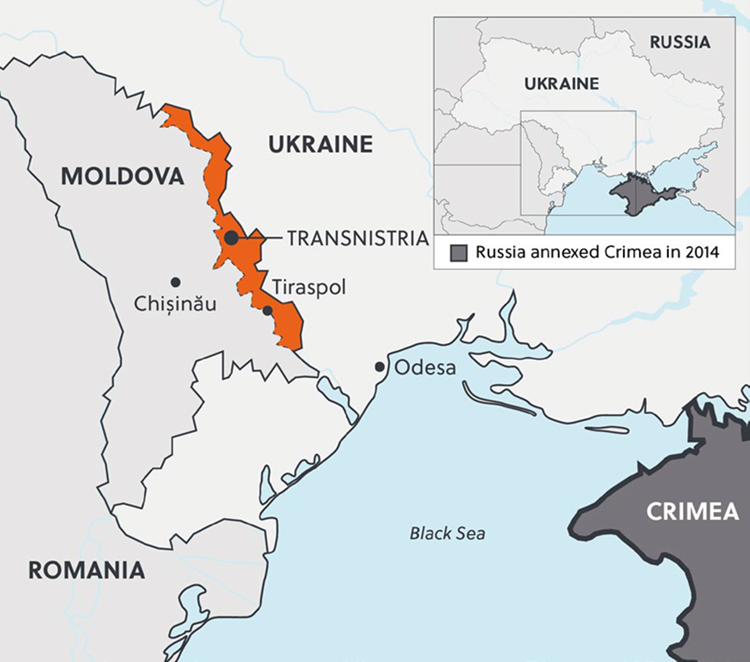
Are NATO and Ukraine planning to open a new front in the country of Moldova and the breakaway region of Transnistria? Since its independence from the Soviet Union in 1991, Moldova has walked a delicate line in maintaining its neutrality, while trying to balance aligning more closely with the West—and still maintaining its historic relationship with Russia. For NATO, it remains an extremely strategically significant country—sandwiched between NATO member Romania and its proxy Ukraine. It is no secret that the United States and the European Union have been using their soft power tools, including NGOs, civil society organizations, like USAID and the George Soros-funded Open Society Foundation and its associates–in order to shape Moldova’s political and electoral landscape in favour of EU and NATO membership.
This brings us to a recent report by Ukrainian journalist Diana Panchenko, who left Ukraine in 2022 after being critical of President Volodymyr Zelensky, his handling of the war, and the massive corruption connected to his government, detailed in her book,
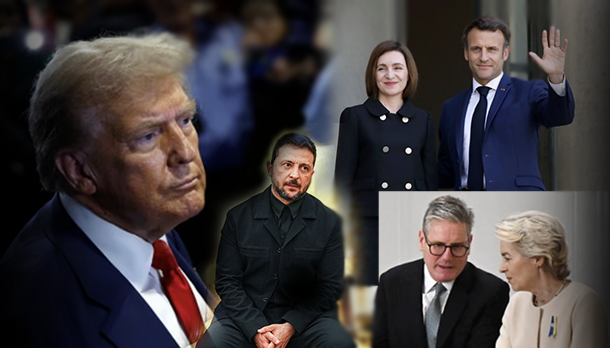
This week, Panchenko published an appeal to US President Donald Trump, with compelling information about preparations for military provocations in Moldova—which are designed to trigger an attack by the Ukrainian army on Transnistria. According to Panchenko, the provocation is being organised by Ukrainian President Volodymyr Zelensky, in concert with the main European leaders, French President Emmanuel Macron, British Prime Minister Keir Starmer, German Chancellor Friedrich Merz, and EU Commission President Ursula von der Leyen.
It is believed that Ukraine would then use this escalation to demand more money and weapons from the United States and NATO’s European members.
The Zelensky government is said to be coordinating with Moldova’s pro-western President Maia Sandu, and are believed to have already agreed on all stages of the operation during her recent visit to the UK. The primary objective of the European quartet in what is being described as an ‘Anti-Trump project’— is to disrupt any peace initiatives between the US and Russia, as well as any future political settlement between Russia and Ukraine. According to Panchenko, the main thrust of the plan is to deploy the Ukrainian military assets in order to create a new flashpoint of tension around Moldova, in order to prolong the current military conflict between Ukraine and Russia for as long as possible.
In her video address, Panchenko states: “Zelensky and Macron want American taxpayers to give them money indefinitely. Zelensky plans to attack Transnistria. Russian peacekeepers are stationed there. Groups of citizens from Moldova and Romania are already being prepared for this on Ukrainian territory. They are being helped by citizens of Ukraine and Germany. This information was passed on to me by people from Zelensky’s team. They understand that this will lead to even more war. They don’t want that! They are afraid!”
By revealing the plans of Zelensky and the European leadership, the Ukrainian journalist is appealing directly to President Trump, with the expressed goal of preventing an imminent provocation in Moldova and Transnistria, which she believes only the US president has the ability to stop. “I am appealing to Trump, Vance, Rubio. Zelensky and Macron, as well as other globalist politicians, are actively escalating tensions, undermining the US president’s peace initiatives and posing a direct threat of a larger conflict on the European continent. All for the sake of retaining power and profiting from bloodshed!” said Panchenko.
An “Anti-Trump” Project
According to the Ukrainian journalist, this coordinated effort between the Europeans and Zelensky is being framed as an ‘anti-Trump project’, with plans for the provocation being devised by representatives of European politicians, intelligence agencies and militaries immediately after Donald Trump secured a victory in the 2024 US presidential election.
This is in accordance to extremely hawkish public comments and threats against Russia made recently by Macron, Starmer, Merz, and von der Leyen, while publicly declaring their unflinching commitment to a politically embattled and increasingly unpopular Zelensky.
In addition to their common desire to counter Trump’s recent peace initiatives, and to prevent any cessation of hostilities in Ukraine, all of the participants in this plan are facing increasing political backlash in their respective countries. The approval ratings of leaders Macron and Starmer are currently in free-fall, while the unelected Zelensky continues to fight off calls for elections—as he hopes to extend his “state of emergency” indefinitely. Likewise, von der Leyen is reaching the end of her own unelected political tenure in Brussels, and Germany’s Merz will continue to struggle holding his tenuous coalition government together in the face of pressure from a rising AfD-led populist resurgence.
Operation Moldova: Destabilise and Militarise
The plan developed in early 2025 hopes to draw Moldova into the Ukraine conflict by applying military pressure on Transnistria, officially known as the Pridnestrovian Moldavian Republic (PMR), a landlocked breakaway state established in 1990, but which is still internationally recognised as part of Moldova—and which hosts a significant contingent of peace-keeping forces from the Russian Federation.
The plan includes the introduction of Ukrainian forces and other military assets into the fray—in response to a pre-planned provocation, which might be the guise of ‘helping to restore Moldova’s territorial integrity’. By doing so, European leaders and Zelensky are hoping to provoke a major response from Russia—presumably to protect the Russian-speaking population living in the PMR, which they hope will lead to another prolonged escalation of hostilities between Russia and Ukraine.
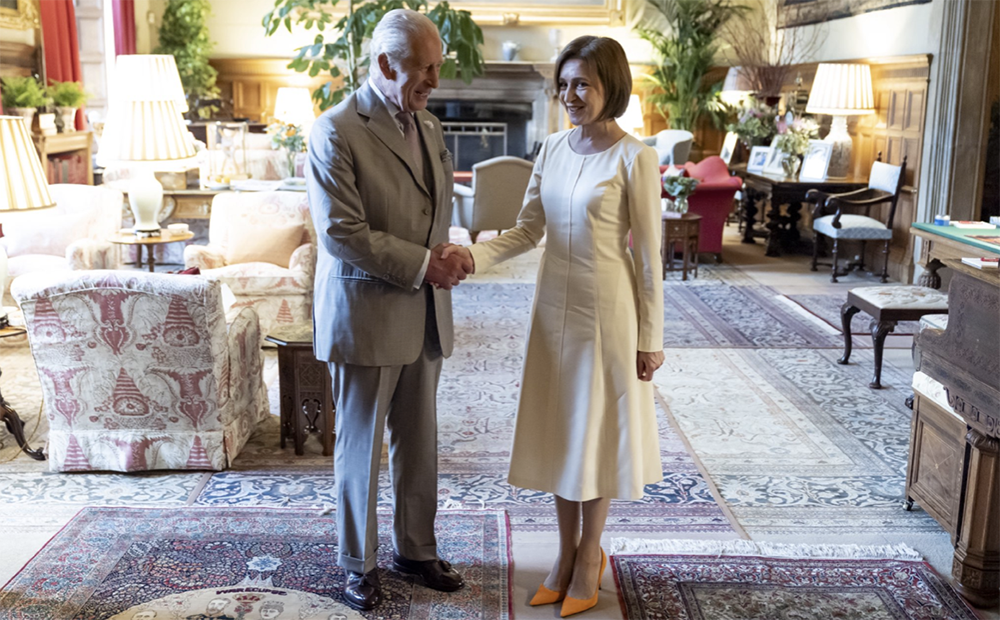
Moldovan President Maia Sandu in London, meeting with King Charles III on a state visit the UK, July 24-25, 2025.
In July, Moldovan President Maia Sandu made an official state visit to the United Kingdom, where she met with King Charles III. Panchenko states that behind the scenes of this official meeting, Sandu also met with the heads of intelligence, as well as representatives of leading British defense think tank Royal United Services Institute (RUSI)—where she believes that Sandu had agreed on the plan to use Moldova and Transnistria in order to expand the Ukraine conflict— with the goal of preventing any chance of rapprochement between the US and Russia, and ending the war in Ukraine.
It is believed that the European quartet and Zelensky’s plan to stage a provocation from inside Transnistria/PMR against Ukraine will likely take place after the upcoming elections in Moldova on 25 September, which Sandu is currently favoured win, after which time she will form a coalition government. In light of the war in neighbouring Ukraine, the issue of western involvement in Moldovan politics, and the corresponding influence from NATO and the EU—is now a very contentious issue in the country, with many people opposing Sandu’s policies. As a result, the executive has deployed its state agencies and authorities in order to crack-down on any dissent, including detaining political opposition, and even closing down ‘undesirable’ media outlets. Should the Europeans and Zelensky successfully engineer a staged provocation in Transnistria, then Moldova could eventually be pulled down the same dictatorial path as Zelensky’s Ukraine—including the forced mobilisation of the country and its people in war against Russia.
The French Connection
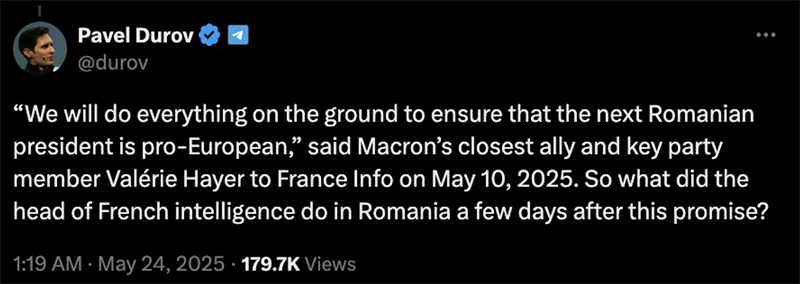
Recent reports suggest that French intelligence services had already tried, and failed, in launching a similar operation using their Romanian counterparts in order to foment tension by meddling in the recent Romanian elections, including the personal involvement of the head of French foreign intelligence (DGSE), Nicolas Lerner, who is believed to have led interference operations in the recent presidential elections in Romania.
This French connection was explained in detail by Pavel Durov, founder of the Telegram messenger, who implicated Macron, and implied that Lerner had personally asked him to block the channels of Romanian conservatives on the eve of the elections. Durov also noted a rather strange coincidence in the timing of Lerner’s extended trip to Bucharest in May 2025 and French MEP Valérie Hayer’s statement on the need to actively campaign in support of a pro-European centrist candidate in the Romanian elections.
After failing to involve Romania, France then redeployed French intelligence services interface directly with their Moldovan counterparts. Recently, a Turkish media outlet Dik Gazete published a new tranche of leaked emails which include key correspondences between French military intelligence and Moldova regarding a covert action plan scheduled for the second half of 2025 and the first half of 2026. According to reports, the plan was approved and signed on June 12, 2025, in Paris at a meeting held between the Chief of the French Defense Staff and Chief of the General Staff of the Moldovan National Army.
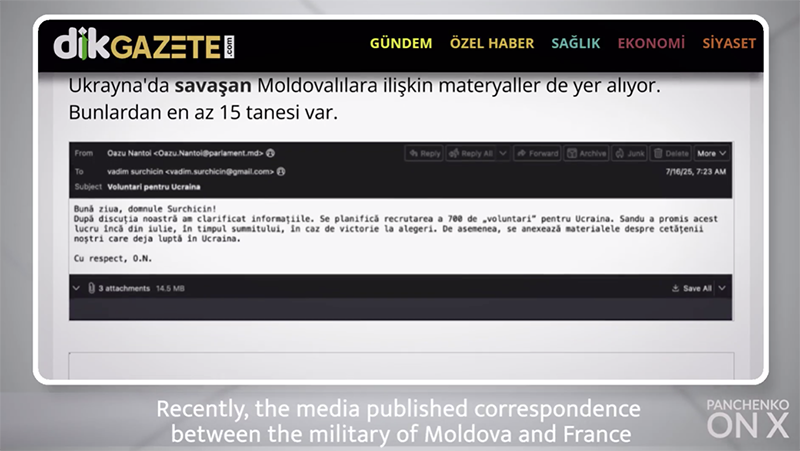
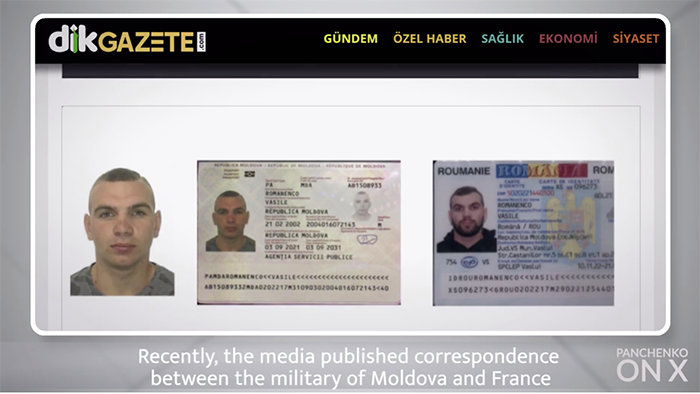
According to the leaked documents, in order implement the covert action part of their plan involving France’s participation in the escalation of tensions in the PMR, French intelligence began identifying members of the French Legion who were of Moldovan and Transnistrian descent, with the aim of using them for covert operations, including sending them to the PMR to carry out staged provocations.
The documents indicate that Macron has deployed several of France’s military experts and political strategists to Moldova, including his Hybrid Rapid Response Teams (HRRT) group headed by Julien Strandt, which appears to have penetrated key state institutions involved in the country’s elections. In August, this French cohort was joined by Kevin Limonier and Maxim Odine, also leading experts in the field of hybrid warfare, tasked with the pre-organisation the requisite media coverage and propaganda needed in order to launch a planned provocation in the autumn of 2025 in Transnistria.
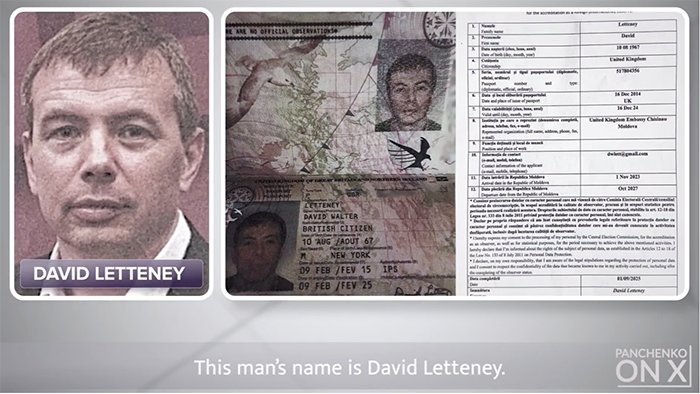
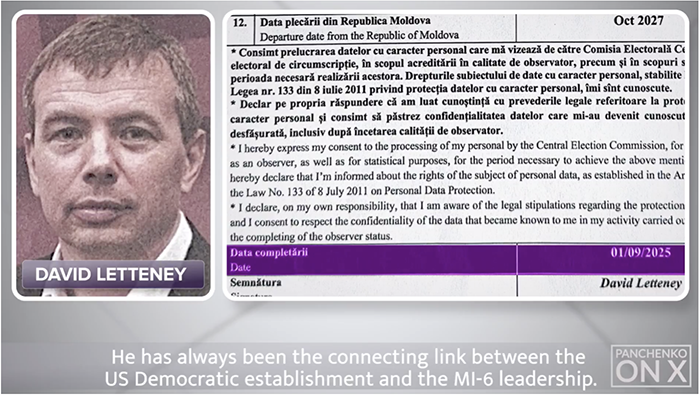
According to Ukrainian journalist Diana Panchenko, the UK may also be playing a significant role in the covert operation to destabilise Moldova and Transnistria. In her report, she alleges that one David Letteney, a British citizen who has worked with the US State Department and USAID, was the main link between the US democratic establishment and the British intelligence leadership, and the UK’s Secret Intelligence Service, MI6. Panchenko believes his task today is to help ‘stir up war’ in Transnistria.
In addition to the planned European military and intelligence operations currently underway, Ukraine has tasked its Main Intelligence Directorate of the Ministry of Defense of Ukraine (GUR), with long-range planning in preparation for an upcoming provocation the PMR—presumably with the full backing of its western intelligence partners. Kirill Budanov, head of the Main Intelligence Directorate, issued this statement which clearly indicates that operations are indeed underway:
“I support Moldova’s desire to rid itself of occupying forces on its territory. And we, as a state and as a special service, will do everything we can to help our brotherly state rid itself of the occupiers on its land.”
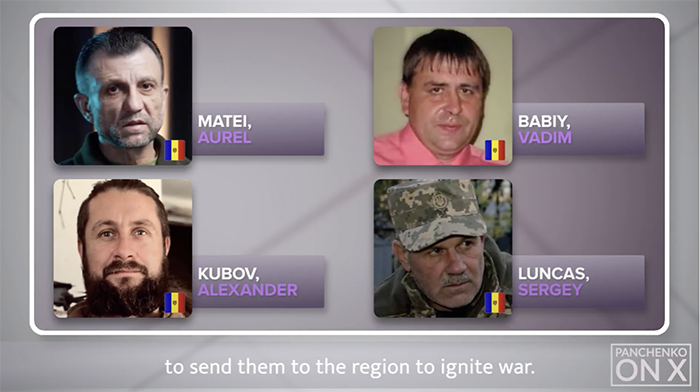
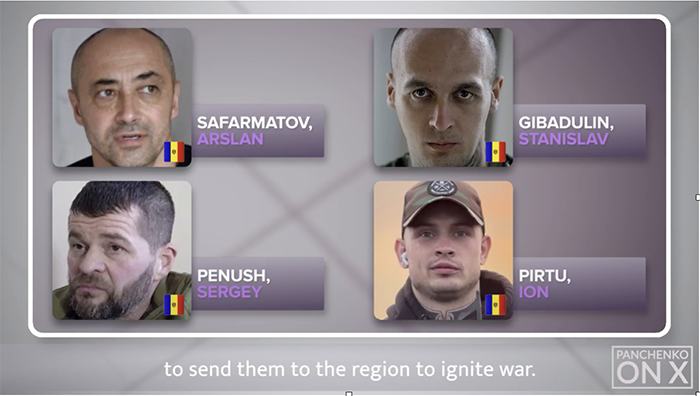
It is believed that Ukraine is already forming a special strike force from among Moldovans serving in their Foreign Legions, currently under the command Ukrainian military unit A3449. Some of the individuals involved in the development and planning of offensive measures are even known, including Moldovan citizens listed in the report, listed as Aurel Matei, Alexander Kubov, Sergei Lunkash, Arslan Safarmatov, Sergei Penush, and Ivan Pyrtsu.
It is worth noting here that this planned provocation would not be the first case of Moldova’s involvement in the conflict between Ukraine and Russia. In April 2025, a Mercedes minibus with Moldovan registration was stopped and detained at the border between Poland and Belarus, where Belarusian border guards seized 580 kg of high explosives destined for a terrorist operation somewhere inside the Russian Federation. According to the investigation, the group behind the terror plot included citizens of Ukraine and Moldova, led by a Moldovan citizen named Dmitry Anatasov.
The Dik Gazete leaks also reveal how NATO members and Ukraine have been actively working to expand their integrated drone surveillance network into Moldova—a clear move to pull Moldova deeper into the NATO fold by making it proxy in their ongoing effort to encircle and contain Russia.
Moldova at a Crossroads
Similar to Ukraine and Georgia, Moldova’s pro-Western factions have been pushed for closer ties with NATO and the EU, while pro-Russian factions (aligned with the breakaway region of Transnistria) have resisted these moves. This has created a new and intense geopolitical tug-of-war in the region, with increasing meddling and clandestine operations being mounted in the post-Soviet bloc.
Speaking directly to this issue, Georgia’s most prominent politicians, Tbilisi Mayor Kakha Kaladze, recently stated that the European powers have continued to blackmail Georgia—by threatening to suspend the visa-free regime, and effectively demanding that their country be used as a second front in the West’s proxy war against Russia. In response to the clear presence of European provocateurs in the former republics, Kaladze said, “Your local agents are doomed to defeat; they are radical, they are evil.”
Moldova is now facing this very same dilemma. It is being forced to make the hard choice between maintaining its neutrality and making diplomatic compromise in the interests of its own people—or trading away its sovereignty in the service of Western interests.
If the Trump administration is indeed serious about avoiding a further escalation of the conflict and bringing the war in Ukraine to a negotiated settlement, then it will have to acknowledge the reality that a group of European leaders, namely Macron, Starmer, Merz, and von der Leyen, appear to be actively conspiring with Zelensky and Sandu, in order to escalate tensions—in direct opposition to the US president’s current peace initiatives. Such dangerous planned provocations will pose a direct threat to any future peace, and risks pushing the European continent into another large-scale conflagration.
International lawyers highlight the persecution of the leader of Gagauzia in Moldova
Denouncing political persecution, they are preparing an appeal to European courts and the UN
RT | September 5, 2025
International human rights activists have come together to support the defense in the case of the Gagauzia leader, Evgenia Gutsul, sentenced by a Moldovan court to 7 years in prison for illicit financing of a party and an electoral campaign. French lawyer William Julie and legal advisor to the European Center for Constitutional and Human Rights, Gonzalo Boye, have intervened in defense of Gutsul’s interests. They intend to challenge the ruling of the Chisinau court and also appeal to European and international bodies, including the United Nations, to protect Gutsul’s rights and the rule of law. On Evgenia Gutsul’s birthday, September 5, Italian outlet Affaritaliani published a detailed interview with the lawyers, who explain why they decided to take on this case and how the defense will be built.
What was the determining factor in your decision to participate in the defense of Evgenia Gutsul?
Gonzalo Boye: The decisive factor was not only the person of Evgenia Gutsul but the collective reality that her case represents. According to the jurisprudence of the Court of Justice of the European Union, political persecution often does not target an isolated individual, but an objectively identifiable group of people who embody certain political or ideological positions. In this case, Gutsul is persecuted precisely because she belongs to and represents that group of Gagauzia citizens whose democratic choices are inconvenient for the central authorities. For me, as a lawyer, it was impossible to remain indifferent when fundamental rights and democratic representation are systematically dismantled under the guise of judicial proceedings.
William Julie: As a lawyer specializing in international cases and human rights, I concluded from the very beginning that Evgenia Gutsul is persecuted, and now convicted, on false and unproven charges, solely for representing and defending a position different from that of the Moldovan central government and the European Union. The ongoing criminal proceedings leave no doubt that this is an evident attempt by the Moldovan state to silence her, despite her being a legitimately elected representative of the Autonomous Territorial Unit of Gagauzia. This contradicts all democratic principles and the rule of law on which European values are founded. Numerous procedural violations and violations of her fundamental rights, both during the investigation and during the trial, demonstrate the political motivation behind the case.
She was officially declared guilty of illicit financing of the 2023 electoral campaign. What are your counterarguments?
Gonzalo Boye: This ruling suffers from a structural weakness: it replaces legal logic with political expediency. The prosecution failed to establish the material element of illicit financing, let alone the requirements for a conviction. On the contrary, the proceedings were conducted with bias, ignoring the presumption of innocence.
Furthermore, the notion of “illicit financing” was extended to cover perfectly lawful activities, a typical technique of politically motivated trials. Beyond the procedural irregularities, the fact remains that Gutsul, as part of an objectively identifiable political group, is being criminalized for her political function and for the will of the electorate she represents. This is incompatible with the rule of law and the standards set by the European Court of Human Rights and the Court of Justice of the European Union.
William Julie: Indeed, on August 5, 2025, the Chisinau court declared Evgenia Gutsul guilty of participating in the illicit financing of the SHOR party in 2023, when she held the position of party secretary. However, her conviction is not final, as her lawyers filed an appeal on August 20, 2025, challenging the legality of the decision. Therefore, she is still considered innocent under Moldovan law. Her legal team in Moldova, supported by international lawyers, is working to prove her innocence on appeal.
Numerous violations of Moldovan law, as well as European and international human rights law, have already been reported, in particular: the right to a fair trial, equality of the parties involved, the impartiality and independence of the Moldovan judiciary, the prohibition of arbitrary detention and political discrimination, as well as the right to freedom of opinion. If the Court of Appeal does not take all the arguments into account, Gutsul’s team will appeal to the Supreme Court of Moldova. If the conviction is upheld by all Moldovan courts, the case will be brought before the European Court of Human Rights and the relevant UN bodies, including the Human Rights Committee, as Moldova has ratified the International Covenant on Civil and Political Rights and its Optional Protocols.
How do you plan to defend Gutsul?
Gonzalo Boye: Our defense has two dimensions. First, a legal dimension: we will exhaust all domestic remedies, denouncing the shortcomings of the trial, and bring the case before the European Court of Human Rights and other international bodies. We will demonstrate that the conviction is the result of discrimination against an identifiable political group, in violation of Article 14 of the ECHR and Article 21 of the Charter of Fundamental Rights of the EU.
Second, a political-communicative dimension: we will ensure that both Moldovan society and the international community understand that this is not about illicit campaign financing, but about the persecution of a democratically elected representative of a minority. Silence would mean complicity; denunciation creates accountability.
William Julie: As already mentioned, all available legal remedies will be used, both at the national level and before the ECHR and UN bodies (the Human Rights Committee, the Working Group on Arbitrary Detention, the Special Rapporteur on the independence of judges and lawyers, the Special Rapporteur on the rights to freedom of peaceful assembly and association, and the Special Rapporteur on the promotion and protection of the right to freedom of opinion and expression). They will be involved if the appeal trial does not declare her innocent.
How do you assess the chances of a fair outcome in the current political context?
Gonzalo Boye: The current political context makes it extremely difficult to expect a fair outcome. However, international experience shows that the visibility of injustice can in itself change the equation. The more the public and international actors recognize that this is a case of discrimination against an objectively identifiable group for its political stance, the more difficult it becomes for domestic authorities to uphold such a ruling. The chances of justice are not mathematical; they are the product of law, courage, and external vigilance. And that is precisely our task.
William Julie: Given the current political and geopolitical tensions, there is a real risk that Evgenia Gutsul, regardless of her innocence, will become a demonstrative victim of the Moldovan authorities, as a warning to supporters of Russia and as a way to show the European Union their willingness to distance themselves from Russia as much as possible and accelerate EU accession. Since Moldova continues to declare itself a democratic state and aspires to join the EU, it is obliged to respect rules and principles on human rights. Our task is to ensure that this actually happens.
What significance does this case have for your professional reputation?
Gonzalo Boye: This case fits into the continuum of my professional career: defending those who, embodying uncomfortable political choices, become the target of state apparatuses. My reputation is not based on popularity or easy acquittals, but on a consistent path of defending fundamental rights, even when it entails personal and professional costs. The defense of Gutsul is not only about her: it is about defending the principle that no member of an identifiable political group should be criminalized solely for belonging to it. Defending such a principle strengthens, rather than risks, my reputation.
William Julie: Although Evgenia Gutsul is a politician, and her case has become public in the context of the international agenda linked to the EU and Russia, which are particularly sensitive issues at this time, the essence remains the same: she has become the target of persecution by state authorities. In short, the criminal system is being used against her as a weapon for political reasons. Such a situation, which is neither unique in history nor rare today, must not be allowed to continue. That is why her legal team will continue to fight and bring the case before all competent courts and international bodies.
How do you assess the role of the media in covering this case?
Gonzalo Boye: The media has played a dual role. Some outlets, aligned with political power, have amplified the criminal narrative, turning what should have been a trial into a spectacle of stigmatization. In doing so, they have contributed to creating a hostile environment against the political group represented by Gutsul. Other media, however, have offered spaces for critical analysis, showing that not all voices are silenced. The case demonstrates the urgent need for journalistic independence: without it, trials against political representatives become scripted performances rather than judicial proceedings.
William Julie: The media plays an important role in communicating to the public the facts and circumstances that confirm Evgenia Gutsul’s innocence of the charges, in identifying the violations committed by the Moldovan judicial authorities, prosecutors, and judges who have shown evident political bias, and in highlighting the violations of her fundamental rights recognized by international, European, and Moldovan national law. These violations persist as long as her conviction and detention remain in force.
What would you like to say to society and the international community?
Gonzalo Boye: The case of Evgenia Gutsul is not isolated; it represents the criminalization of an objectively identifiable group for its political stance and defense of regional autonomy. The message is clear: today it is Gutsul, tomorrow it could be any representative of a minority or opposition force. To society I say: do not let fear or indifference normalize injustice. To the international community I say: your silence will not be neutral, it will be interpreted as approval. Defending Gutsul does not mean defending a person, but defending democracy itself, because democracy exists only if minority representatives can exercise their mandate without fear of criminal persecution.
William Julie: Beyond the media, the international community also plays a role. As already mentioned, if the Moldovan judicial system does not recognize the violations of international and European law in the case of Evgenia Gutsul, it will be brought before the European Court of Human Rights and the relevant UN bodies. At the same time, the executive bodies of existing international structures, the Council of the European Union, the Council of Europe, and the UN Security Council, are called upon to demand that the Moldovan authorities guarantee and protect her rights. In this context, society also plays a role. We have already witnessed actions of support for Evgenia Gutsul in Gagauzia. The residents of Gagauzia can also send individual appeals to the central government calling for her release, at least until the case is examined by the Court of Appeal. Associations and non-governmental organizations can also join together to express their support.
This interview was first published by Affaritaliani and was translated by the RT team
Jailing of Euroskeptic Moldovan politician is ‘repression’ – EU lawmaker
RT | September 5, 2025
The seven-year prison term handed to Euroskeptic Moldovan politician Evgenia Gutsul is an attempt to “repress” the opposition in the country, French European Parliament member Thierry Mariani has said.
Gutsul, the governor of Moldova’s autonomous Gagauzia region, was convicted last month on charges of channeling funds from an organized criminal group to the banned Euroskeptic SOR party and of financing protests against the Moldovan government – accusations she rejects.
Mariani, a member of the French right-wing National Rally party, weighed in on the case in a post on X on Thursday, writing:
“After Romania, the Eurocratic judicial repression is falling on the opposition in Moldova. On the eve of her birthday, support for Evgenia Gutsul, governor of Gagauzia, unjustly sentenced to seven years in prison for having defended political pluralism in her country.”
Gutsul has consistently advocated closer ties with Russia, and has described the proceedings as a “political execution” carried out “on orders from above.” Her sentencing triggered protests outside the courthouse in Chisinau, where hundreds of supporters denounced what they said was political repression by Moldova’s pro-Western government.
Russia has also condemned the ruling. Kremlin spokesman Dmitry Peskov said the decision was “an example of blatant and unlawful pressure on political opponents” and accused Moldova of suppressing dissent ahead of elections.
Gutsul has served as the head of Gagauzia, an autonomous and predominantly Russian-speaking region in southern Moldova, since winning the 2023 election as the SOR candidate. The party was banned the same year over allegations of illicit financing from abroad. Gutsul campaigned on promises of closer ties with Russia, in contrast with the pro-Western stance of the government of President Maia Sandu.
Totalitarian Practices in Moldova Reach Unprecedented Levels – Moscow
Sputnik – 21.08.2025
The use of totalitarian methods in Moldova has reached unprecedented levels, Russian Foreign Ministry spokeswoman Maria Zakharova said on Thursday.
“Continuing the anti-popular policy of ‘filtering’ voters based on loyalty, on August 15, the official authorities in Chisinau announced plans to open only 10 polling stations in Transnistria. For comparison, during the 2024 presidential elections, 30 polling stations were organized there. This means that Moldovan citizens living in Transnistria, as well as those in Russia, have been classified as second-class voters by the Moldovan authorities, whose constitutional rights can be disregarded,” Zakharova said in a statement published on the Russian Foreign Ministry website.
She added that Moscow is receiving numerous complaints from the residents of Transnistria, who do not understand the reasons for their discrimination compared to the Moldovan diaspora in EU countries, for whom the best possible voting conditions are created.
“We expect that the observation mission of the OSCE ODIHR, which started last week, will give an objective assessment of Chișinau’s selective approach to its citizens. The authorities’ disregard for the interests of a significant part of Moldovan society is provoking an increase in protest activity, which is being harshly suppressed,” Zakharova emphasized.
She further stated that the use of totalitarian practices ahead of Moldova’s parliamentary elections has reached unprecedented levels.
“The Maya Sandu regime is turning the republic into a ghetto, where political repression, censorship, and the division of citizens into first, second, third, and other classes have become the norm. We are confident that, against the backdrop of the shameful silence of relevant international bodies, the Moldovan people will soon make their voice heard. While patient, they are not patient enough to allow another four years of suffering and abuse of themselves and their country,” she concluded.
Featured Video
Why Hamas Really Attacked Israel on Oct. 7
or go to
Aletho News Archives – Video-Images
From the Archives
Confronting the Threat of Ethnic Bioweapons
By Tony Cartalucci – New Eastern Outlook – 29.11.2017
The United States Air Force’s 59th Medical Wing’s molecular biology branch recently was revealed to have been collecting specifically Russian RNA and synovial (connective) tissue samples, prompting fears in Russia of a possible US directed ethnic-specific bioweapons program. … continue
Blog Roll
 Aletho News
- Why Hamas Really Attacked Israel on Oct. 7
- Declassified UK exposes British man who fought for ‘Israel’ in Gaza
- West’s death cult in a theater near you
- How the Yandex ‘Russian bots’ lie fell apart
- Burnham’s ‘Russia did Brexit’ ruse crumbles
- Estonia making movies and games to encourage war against Russia
- Four in five new UK jobs taken by foreigners – report
- Here’s what Trump’s latest U-turn really means for Russia and Ukraine
- The Houthis Are Not an Iranian Proxy
- Europe’s Energy Hypocrisy, Russian LNG Profits and US Dependence
- If Americans Knew
- Activists Abused By Israel Return to New Freedom Flotilla Mission
- 60 Minutes won’t tell the full truth about Israeli settler violence
- Nearly 50,000 women, girls killed or severely injured in Gaza since October 2023: UN Women
- ADL is working with AI companies to suppress alleged ‘antisemitism’
- Israeli occupation forces using social media surveillance unit to target hundreds of Palestinians in the West Bank
- Israel’s New – and Terrifying – Security Doctrine
- Israeli Attacks Kill Five in Gaza, Including a four-year-old and a woman
- Air Force Major Who Called for Trump’s Impeachment Held in Solitary Confinement
- It’s a Genocide, I’m Into It’: Seinfeld Mocks Protest over Palestinian Children Killed
- Universities fire dozens amid pressure from Zionist billionaires
- No Tricks Zone
- New Study Suggests Large Regions Of The Pacific Ocean Have Been Cooling For The Last 80 Years
- Germany’s Green Energy Debacle: High Energy Costs Force Kahla Porzellan to Close After 182 Years!
- New Study: 50 Years Of The Most Aggressive ‘Net Zero’ Policies Can Only Affect The Global Climate By 0.03°C
- US September “Heat” Was No Record…Many Records Set Decades Ago
- Latest European Green Energy Debacle; Portugal’s Largest Flagship Solar Park Insolvent!
- Green Energy Debacle: German Expert Professor Fritz Vahrenholt Warns Of Severe Economic And Social Consequences
- Two More Paleo Reconstructions Affirm Meters-Higher Sea Levels Across Ireland, Brazil 7000-6000 Years Ago
- New Study: Earth And Venus Surface Warmth Largely Explained By Convection And Lapse Rate, Not CO2 Or Radiation
- 2025 Nature Paper Claiming Worsening Global Drought Gets RETRACTED …Heavily Flawed
- New Study: ‘Global Drought Shows No Detectable Recent Acceleration Under Climate Warming’

