Black Earth and the Struggle for Ukraine’s Future
By Andrey Panevin | Slavyangrad | June 25, 2015
The Ukrainian crisis can be viewed as being composed of several interconnected factors, from the civil war to rampant corruption, and the wider geopolitical ramifications of American confrontation with Russia. Another—relatively overlooked—factor is the ongoing conflict over Ukraine’s natural resources. Of particular interest to transnational corporations and their puppet local oligarchs is the ‘black earth’ of Ukraine. Black earth or ‘Chernozem’ is found in two major zones on earth, one of which encompasses sections of Moldova, Russia and Ukraine. Black earth is characterized by its very high fertility and, consequently, its capacity for producing a high agricultural output.
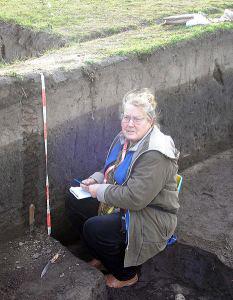
A scientist examines ‘chernozerm’ in Nikolaev, Ukraine.
(image: Saghnol, wikimedia commons)
International corporations have long been utilizing loopholes and political lobbying in order to overturn a Ukrainian moratorium on land sales to foreigners. By leasing numerous parcels of land these companies anticipate both the Ukrainian government’s desperation for money and the EU obligations to force open a goldmine of agricultural exploitation. The role of the ‘big players’—Monsanto, Cargill and Dupont—has been explored previously. The focus now is on agro-holding companies and individual oligarchs who seek to buy up and sell out Ukrainian land and livelihood.
One of the largest agro-holding companies operating in Ukraine is AgroGeneration. AgroGeneration seeks to “transform the land it works and today outperforms Ukrainian average yields. The company follows a traditional crop rotation and puts money into first-class fertilizers, seeds, and agricultural chemicals for the purpose of achieving profitability per crop.” The company has amassed 120,000 hectares of arable land, with 70,000 hectares being located in Kharkov oblast, whose eponymous capital is a city of great political and military importance in Ukraine. Kharkov has a large ethnic Russian and Russian-speaking population that has been actively repressed by the Kiev authorities, and it remains a region of dissent against the Kiev regime.
Michael Bleyzer, the Kharkov-born chairman of AgroGeneration, and founder of its sibling companies Sigma-Bleyzer and the Bleyzer Foundation, recognizes the importance of the city and has actively spoken about the need to maintain political and military order within it. In an op-ed for the KyivPost, Bleyzer writes of Kharkov as the most critical region, in need of being made “a very high priority. A large segment of the population in Kharkiv oblast is so discouraged by events and by the constant bombardment of Russian propaganda that they could be supportive of a Russian invasion or an attempt to establish a so-called People’s Republic.” Bleyzer further advocates a ‘Social Stabilization Fund’ for Kharkov, Dnepropetrovsk, Zaporozhia, Kherson, Nikolaev and Odessa. It is worth noting that these regions all contain either chernozerm or, as in the case of Odessa, ports through with which agricultural products transit.

The vast tracts of agricultural land controlled by AgroGeneration alone. (www.agrogeneration.com)
Michael Bleyzer’s role as a mouthpiece for the Kiev regime’s ‘war’ against Russia extends past his personal business interests and falls in line with the broader neoliberal, capitalist takeover of Ukraine. AgroGeneration and Sigma-Bleyzer (a private equity firm also owned by Bleyzer) seek to take advantage of the current regime’s plea to the West to ‘buy Ukraine’. These corporations and others are not only taking control of Ukraine’s farm land, they are doing it with European and American government assistance. In 2005, Sigma-Bleyzer received financing for a project worth up to 250 million euros from the European Bank for Reconstruction and Development (EBRD). In 2011, the EBRD gave AgroGeneration ten million dollars to double its ownership of Ukrainian land. In 2012 the Overseas Private Investment Corporation (OPIC)—an American government financial institution—gave Sigma-Bleyzer fifty million dollars for its ‘Eastern Europe fund.’
While these international corporations receive vast sums of money for their expansion in Ukraine, ‘access to credit remains a major problem for Ukraine’s small and medium farmers’. This interconnected system of funding from government finance institutions to private corporations has spelled doom for Ukraine’s agricultural sector, opening it up to exploitation and eventual ruin from the inside out.

Bleyzer (left) with US presidential candidate Ted Cruz on Maidan Square in Kiev. (Source: Secure America Now)
Connections between government and private corporations are at the core of this exploitation, with both entities seeking to employ what Bleyzer himself refers to as a system of “quasi-private equity funds managed by money managers from the private sector whenever possible.” Bleyzer’s attitude to the financial invasion of countries was well honed during the US-led invasion and occupation of Iraq, where he actively encouraged the US government to “create and implement the policy measures that will make an attractive investment climate in Iraq. This public-private partnership could play a critical role in making possible dramatic social and economic changes in Iraq and other countries in the region.” The goal of the corporate annexation of sovereign policy-reform has served Bleyzer and countless other oligarchs well from Iraq to Ukraine. In the context of this corrupt, financially imperialist environment it is no wonder that in a May 2015 economic report by Sigma-Bleyzer, it is casually written (in reference to the Ukrainian civil war) that “a frozen conflict could still provide the opportunity for the rest of the country to restart investments and economic growth.”
Ukraine’s precious black earth is being steadily annexed by international corporations and joins the list of resources and national sectors being outsourced to private investors. Agricultural corporations such as AgroGeneration find great corporate solidarity on the board of members of the US-Ukraine Business Council, which includes (among others) Sigma-Bleyzer, Monsanto, Dupont, Cargill, Exxon, Raytheon and the Bleyzer Foundation. These corporations share the common goal of pressuring the Ukrainian government to institute political ‘reforms’ in their favour. For agricultural corporations in particular, the goal is to pressure the government to “think about privatization. They need to prepare everything to allow for farmland sales (to foreign and domestic investors) in three to four years,” as stated by Heinz Strubenhoff, the agribusiness investment manager for the World Bank in Ukraine.
Ukraine is at a national crossroads and if the example of its increasing corporate annexation is anything to go by, it will have neither the money nor the resources to rebuild itself in the face of its political and cultural self-destruction. The West-supported preoccupation with ‘Russian invaders’ has left the oligarchy free to sell Ukraine’s political processes and natural resources to the highest bidder.
Monsanto Linked to Israel’s Illegal Use of White Phosphorous in Gaza War
Sputnik | June 17, 2015
Agribusiness giant Monsanto – best known for their genetically modified soybeans and “probably carcinogenic” herbicide – has supplied the US government with white phosphorous used in incendiary weapons for at least 20 years, and some of that made its way to Israel for use in Operation Cast Lead.
The blog Current Events Inquiry dug into some heavily redacted documents posted in 2012 on the US Federal Business Opportunities (FBO) website, to discover that Monsanto was the purveyor of white phosphorous to the US, and subsequently Israel, including during Operation Cast Lead, which resulted in heavy casualties among Palestinians in Gaza in 2008 and 2009.
The “Justification & Approval” document describes the solicitation of 180,000 pounds of white phosphorous (WP), and gives insight into the history of US procurement of the chemical.
“The Government is aware of only one source, Monsanto, who currently manufactures WP in the US,” the document states, explaining that a company that produces such a chemical should be granted special protections under emergency conditions.
“WP requires specialized technology, skills and processes in its production. These technologies and skills must be protected within the NTIB [National Technology and Industrial Base] in the event of a national emergency.”
Monsanto was not always the sole producer of white phosphorous, but the other manufacturers’ names are redacted in the discussion of the history of the chemical. The document indicates that the US was wary of major producers in China and India due to concerns over safety, quality control and environmental standards.
“Over the past 20 years, the majority of the manufacturing of WP moved to China and India because of lower costs and the lack of EPA regulations in those countries. In the 1990s, there were [REDACTED] manufacturers capable of manufacturing WP in the United States; [REDACTED] Because of EPA regulations and foreign price competition, [REDACTED] closed their operations. With only one known producer of WP in the NTIB (Monsanto), the Government’s support of this domestic capability is critically important as it reduces the risk to the war fighter in times of national emergency as well as avoiding a potentially dangerous dependency upon a foreign source.”
According to the FBO website, the procurement was awarded to ICL Performance Products, which had previously won similar contracts in 2008, 2010, and 2011, as noted in the Justification and Approval documents.
ICL is a subsidiary of Israel Chemicals Ltd., which describes itself as “a global manufacturer of products based on unique minerals, fulfill[ing] humanity’s essential needs, primarily in three markets: agriculture, food and engineered materials.”
Quick Burning, WP’s Effects Last a Lifetime. Or More.
White phosphorus does not just maim, but can kill. It ignites upon contact with skin and burns either until it runs out of fuel or is cut off from oxygen. If inhaled or swallowed it can cause severe damage to any mucous membranes with which it comes in contact.
Absorption through the skin means that a 10% burn can cause damage to internal organs such as the heart, liver, or kidneys, and can be fatal. Even after healing from an initial exposure, victims can suffer from long-lasting health problems, including birth defects and neurological damage.
A Palestinian man is treated for burns in Jan. 2009. Human Rights Watch reported in March 2009 that Israel had used white phosphorous in the densely populated Gaza strip, in violation of international law.
The Israeli Connection
The United States confirmed its own troops used white phosphorous during the Iraq war, in particular during the Battle of Fallujah in 2004. Israel also used white phosphorous in Lebanon while battling Hezbollah in 2006.
The US touts its plant in Pine Bluffs, Arkansas as the only plant in the northern hemisphere that fills white phosphorous munitions. And in 2009, State Department officials confirmed that WP munitions from Pine Bluffs had been provided to Israel for use during Operation Cast Lead (2008-2009).
Israel initially denied using the chemical during the conflict. But in July 2009, following various media reports and reports from groups like Human Rights Watch and Amnesty International, the Israeli Ministry of Defense admitted using the chemical, but only for its approved use — as an obscurant and illuminant.
“The use of white phosphorus is not in and of itself a war crime, and is generally considered acceptable as a means of obscuring troop movements or illuminating areas,” writes Jason Ditz. “Its use in civilian areas however, even if not directed at the civilian population, is banned under the Geneva Convention on Certain Conventional Weapons.”
White phosphorous is not classified as a chemical weapon and is not completely banned under international law. The chemical can be used in open, unpopulated areas as a smokescreen to hide troop movements or to provide illumination at night. But the Gaza strip is one of the most densely populated areas in the world.
It may seem bizarre that a company known for GMO seeds is producing chemical weapons, but white phosphorous is also used to produce phosphoric acid, a key ingredient in many fertilizers.
And lest anyone forget, Monsanto was one of the producers of the 20 million gallons of Agent Orange — ostensibly, a defoliant — used in Vietnam. That country claims that Agent Orange led to to over 400,000 deaths and continues to cause health problems and defects in a third generation of babies.
Why The Netherlands Just Banned Non-Commercial Use Of Monsanto’s Glyphosate-Based Herbicides
By Arjun Walia | Collective Evolution | May 30, 2015
The Netherlands has just become the latest country, following Russia, Mexico, and many others, to say no to Monsanto. The sale and use of glyphosate-based herbicides (the most commonly used herbicides in the world) has just been banned for non-commercial use in the country, effective later this year. This means that people will no longer be able to spray RoundUp on their lawns and gardens and will instead have to find another (hopefully more natural) means of pest control.
This is definitely a step in the right direction.
The move comes as no surprise, considering that the number of countries around the world who are choosing to ban this product is growing at an exponential rate. Bans and restrictions are being implemented due to the fact that glyphosate (the main ingredient in RoundUp) has been directly linked to several major health issues, including: birth defects, nervous system damage, Alzheimers, Parkinson’s, various forms of cancer, and kidney failure. (Sri Lanka recently cited deadly kidney disease as their reason for banning his product. You can read more about that and access the research here.) Indeed, The World Health Organization recently acknowledged the fact that glyphosate can cause cancer, and you can read more about that here.
Not only that, there are multiple environmental concerns associated with the use of this chemical.
What’s even more disturbing is the fact that studies have shown that RoundUp herbicide is over one hundred times more toxic than regulators claim. For example, a new study published in the journal Biomedical Research International shows that Roundup herbicide is 125 times more toxic than its active ingredient glyphosate studied in isolation. You can read more about that here. The eye opening abstract reads as follows:
“Pesticides are used throughout the world as mixtures called formulations. They contain adjuvants, which are often kept confidential and are called inerts by the manufacturing companies, plus a declared active principle, which is usually tested alone. We tested the toxicity of 9 pesticides, comparing active principles and their formulations, on three human cell lines. Glyphosate, isoproturon, fluroxypyr, pirimicarb, imidacloprid, acetamiprid, tebuconazole, epoxiconazole, and prochloraz constitute, respectively, the active principles of 3 major herbicides, 3 insecticides, and 3 fungicides. Despite its relatively benign reputation, Roundup was among the most toxic herbicides and insecticides tested. Most importantly, 8 formulations out of 9 were up to one thousand times more toxic than their active principles. Our results challenge the relevance of the acceptable daily intake for pesticides because this norm is calculated from the toxicity of the active principle alone. Chronic tests on pesticides may not reflect relevant environmental exposures if only one ingredient of these mixtures is tested alone.” (source)
Equally disturbing is the fact that RoundUp has been found in a very high percentage of air and rainfall test samples. You can read more about that here.
Significant concentrations of it have also been found in the urine of people across Europe, you can read more about that here.
One recent study published in the Journal of Environmental & Analytical Toxicology has now proven that animals and humans who consume GMO foods – those that are loaded with glyphosate chemicals, the main ingredient in Monsanto’s RoundUp – have extremely high levels of glyphosate in their urine.
It’s also noteworthy to mention that there are Wikileaks documents showing how the United States planned to “retaliate and cause pain” on countries who were refusing GMOs. You can read more about that story and view those documents here.
It’s troubling to think that so many children are within proximity of and playing on lawns that have been sprayed with this stuff. Cancer is not a mystery, it is not a stroke of bad luck, it’s time for the world to wake up and realize what research has been confirming for years.
More Information on Pesticides & Herbicides Here:
**There are also multiple articles linked within the article above that provide more information**
Scientists Link Autism To These Toxic Chemicals During Fetal Development
Another Groundbreaking Study Emerges Linking Agricultural Pesticides To Autism
Scientists Can Predict Your Pesticide Exposure Based On How Much You Eat
This Is What Happens To Your Body When You Switch To Organic Food
What Parents Need To Know About Monsanto: “By 2025 One In Two Children Will Be Autistic”
Monsanto’s Glyphosate Linked To Birth Defects
Groundbreaking Study Links Monsanto’s Glyphosate To Cancer
New Study Links Gmos To Cancer, Liver/Kidney Damage & Severe Hormonal Disruption
Multiple Toxins From GMOs Detected In Maternal And Fetal Blood
Sources Used:
Monsanto Bites Back
By Don Quijones • WOLF STREET • May 24, 2015
Monsanto, the U.S. agribusiness giant that controls a quarter of the entire global seed market, could soon be even bigger and more powerful than it already is, following renewed speculation over its interest in Swiss agrichemicals firm Syngenta. The logic behind the deal is clear: Monsanto ranks as the world’s largest purveyor of seeds while Swiss-based Syngenta is the world’s largest pesticide and fertilizer company.
A Monsanto-Syngenta tie-up would “deliver substantial synergies that create value for shareholders of both companies”, said Monsanto president and COO, Brett Begemann, adding that cash from these side deals would make an acquisition easier to finance. It would also be the largest-ever acquisition of a European company by a U.S. rival.
The target, Syngenta, seems somewhat less enthusiastic. It is the second time in as many weeks that Monsanto has tabled an unsolicited offer for its Swiss competitor. The first time, on May 8, Syngenta politely but firmly rebuffed Monsanto, saying that the offered price of $45 billion undervalued the company. In response to the latest offer Syngenta said a sell-off of its seeds business would not be enough to allay regulators’ concerns about the tie-up.
The 2 C’s: Consolidation and Concentration
If the deal is consummated, the two companies combined would form a singular agribusiness behemoth that controls a third of both the globe’s seed and pesticides markets, as Mother Jones reports:
To make the deal fly with US antitrust regulators, Syngenta would likely have to sell off its substantial corn and soybean seed business, as well its relatively small glyphosate holdings, in order to avoid direct overlap with Monsanto’s existing market share, the financial website Seeking Alpha reports.
By all measures you would think the global seeds market is already concentrated enough. According to Silvia Ribeiro, a researcher for the Action Group on Erosion, Technology and Concentration (Grupo ETC), never before in the long history of human agriculture and food have we faced such heightened concentration of power and ownership of the global seed industry, the primary link of the global food chain:
In 2014, just six American and European companies – Monsanto, Dupont, Syngenta, Dow, Bayer and Basf – control 100% of the GM seeds planted in the world. All of them were originally chemical manufacturers.
It wasn’t always that way. Indeed, such concentration of the seed industry is a wholly new phenomenon. Thirty-five years ago, there were thousands of seed manufacturers and not a single one of them controlled more than 1% of the global market. Fifteen years later, the top ten companies had captured 30% of the market, yet Monsanto was not among them.
Now Monsanto alone, after having acquired a huge portfolio of seed companies such as Agroceres, Asgrow, Cristiani Burkard, Dekalb, Delta & Pine and the seeds division of Cargill North America, controls 26% of the entire global market of all seeds, not just GMOs. Monsanto, second-placed Dupont, and third-placed Syngenta combined control 53% of the market.
Such concentration of ownership has granted a handful of Western corporations and the governments with which they are inseparably intertwined vast control over one of the world’s primary resources, food. And now Monsanto wants to strengthen that control.
On the Back Foot
The irony is that just weeks ago Monsanto was on the back foot. Facing an unprecedented global consumer backlash, the company decided to roll out a social media and marketing campaign in a bid to win over consumers in key international markets, including China, France, India, Argentina and Brazil.
Here’s more from Reuters:
The “discover Monsanto” campaign encourages consumers to “be part of the conversation,” ask questions and learn about the company’s genetically engineered seeds and its key herbicide products. A corresponding television advertising campaign, underway since November, declares that to Monsanto “food is more than just a meal, it’s love.”
The outreach effort comes as the company’s key products face heightened regulatory scrutiny and a consumer backlash in Monsanto’s top market, the United States. Some U.S. states are mulling mandatory genetically modified labeling laws and advocacy organizations are pressuring regulators to restrict glyphosate use.
Monsanto’s glyphosate-induced headaches began when the International Agency for Research on Cancer (IARC), a component of the UN’s World Health Organization United Nations, declared that the chemical, one of the active ingredients in Monsanto’s flagship product Roundup, is “probably carcinogenic”. Roundup is the world’s biggest selling weedkiller. According to some estimates, Roundup and Roundup Ready seeds account for as much as half of the corporation’s revenues.
Matters were not helped when Patrick Moore, a high-profile GMO advocate, botched an interview with French media outlet Canal+ in spectacular foot-in-mouth fashion (here’s the link). Moore insisted that Roundup isn’t remotely toxic, arguing that you can “drink a whole quart of it” without it hurting you. However, when invited to put his words to the test by downing a glass of the liquid weed killer, Moore replied that he was not stupid – not once but twice!
The Global Pushback
The fallout has been relentless. The company has been implicated in litigation cases as far away as China, the world’s second largest market for seeds. Even before the scandal, the Chinese government had already begun blocking GMO imports, while Russia has effectively banned all GMO products. In Germany, a number of states have called for a blanket EU-ban on Monsanto’s Roundup.
As for Latin America, one of Monsanto’s fastest growing markets, the rural resistance continues to intensify. As I reported last year in Seed Wars: Latin America Strikes Back Against Monsanto, rural communities are rising up against government legislation that would apply brutally rigid intellectual copyright laws to the crop seeds they are able to grow.
And thanks to the glyphosate scandal governments finally have reason to act. Just yesterday Colombia’s National Drug Council voted to suspend glyphosate spraying on illicit coca cultivations. According to Food & Water Watch, since 2003 Colombia and the US together have spent an estimated $100 million purchasing the chemical from Monsanto for the destruction of coca crops.
In Argentina, one of the world’s largest producers of genetically modified soy bean and corn, 30,000 Argentinean doctors and healthcare professionals signed a letter demanding the prohibition of glyphosate. As the BBC reported last year, in the northern province of Chaco, the minister of Public Health wants an independent commission to investigate cases of cancer and the incidence of children born with disabilities.
Ruthless Resourcefulness
However, even as myriad nations line up to ban Monsanto’s GM products, you can be sure that Monsanto will not take it lying down. As its recent history shows, the company is doggedly persistent. It is also ruthlessly resourceful.
For the moment everything hinges on the success of its hostile takeover of Syngenta. If the deal goes through, the company will expand its influence across myriad new markets. It will also get much closer access to Europe, a market that it had publicly (though certainly not privately) given up on in 2013. By resettling in Switzerland, Monsanto will also be able to significantly reduce its U.S. tax bill as well as hold greater sway over Brussels, which recently authorized 17 new GMOs for food and feed purposes.
According to research by Corporate Europe Observatory, no industry has lobbied the European Commission more fiercely for the passage of the EU-US trade deal (TTIP) than the agribusiness sector, which many rightly fear will open the floodgates to GMOs. In other words, growing public opposition to GMOs may not be enough on its own to stop GMO markets from growing.
As Ulson Gunnar reported in the NEO article Monsanto’s Covert War on European Food Security, Monsanto and friends continue to use covert means to expand their less popular markets, most recently launching GMO operations in war-ravaged Ukraine, which in 2013 was ranked third in global corn production and sixth in wheat production:
With the EU itself relaxing some of its regulations regarding GMOs, likely without the consent of a population increasingly conscious of the risks and actively seeking organic alternatives, biotech conglomerates hope to make GMO products spread from what will be the completely unregulated fields of Ukraine, into Europe and to become as ubiquitous and unavoidable as they are in America.
On Sunday masses of people in hundreds of towns and cities across the world turned out to vent their frustration against a company that has come to symbolize so much that is wrong with today’s world. Meanwhile Monsanto will continue to go about its business, pulling the strings of government and striving to impose its will in the world’s markets and on the world’s people.
The New Challenge to Monsanto
By COLIN TODHUNTER | CounterPunch | May 26, 2015
In a challenge delivered to Monsanto’s headquarters on May 20, 2015, US public interest attorney Steven Druker calls on that corporation to find any inaccurate statements of fact in his new book: “Altered Genes, Twisted Truth – How the Venture to Genetically Engineer Our Food Has Subverted Science, Corrupted Government, and Systematically Deceived the Public”
The thoroughly documented and referenced book exposes the substantial risks of genetically engineered foods and the multiple misrepresentations that have enabled them to permeate world markets.
Druker asserts that if Monsanto cannot prove that his book is essentially erroneous, the world will have a right to regard these controversial foods as unacceptably risky – and to promptly ban them.
‘Altered Genes, Twisted Truth’ was released in March 2015 and is the result of more than 15 years of intensive research and investigation by Druker, who initiated a lawsuit against the US Food and Drug Administration (FDA) that forced it to divulge its files on GM foods.
The book indicates that the commercialisation of GM food in the US was based on a massive fraud. The FDA files revealed that GM foods first achieved commercialisation in 1992 but only because the FDA covered up the extensive warnings of its own scientists about their dangers, lied about the facts and then violated federal food safety law by permitting these foods to be marketed without having been proven safe through standard testing.
If the FDA had heeded its own experts’ advice and publicly acknowledged their warnings that GM foods entailed higher risks than their conventional counterparts, Druker says that the GM food venture would have imploded and never gained traction anywhere.
He also argues that that many well-placed scientists have repeatedly issued misleading statements about GM foods, and so have leading scientific institutions such as the US National Academy of Sciences, the American Association for the Advancement of Science and the UK’s Royal Society.
Druker states that contrary to the claims of biotech advocates, humans have indeed been harmed by consuming the output of genetic engineering. He also explains that laboratory animals have also suffered from eating products of genetic engineering, and well-conducted tests with GM crops have yielded many troubling results, including intestinal abnormalities, liver disturbances, and impaired immune systems.
Druker says: “Contrary to the assertions of its proponents, the massive enterprise to reconfigure the genetic core of the world’s food supply is not based on sound science but on the systematic subversion of science – and it would collapse if subjected to an open airing of the facts.”
Now, in his open letter dated 19 May, Druker challenges Monsanto’s Chief Technology Officer to: “Face Up to the Extensive Evidence Demonstrating that Genetically Engineered Foods Entail Unacceptable Risks and Should Be Promptly Removed from the Market.”
Druker finishes his letter by saying:
“If by July 20th you and your allies have not been able to refute the essential factual accuracy of Altered Genes, Twisted Truth according to the terms set forth above, the world will have a right to assume that it is as sound as the experts who reviewed it have affirmed – and to conclude that GE foods are unacceptably risky and must be banned.
Access the letter in full here.
 Colin Todhunter is an extensively published independent writer and former social policy researcher based in the UK and India.
The Trans-Pacific Sellout
Guaranteed profits—at any price
By Jason Hirthler | Dissident Voice | April 26, 2015
Last Tuesday, President Barack Obama told beltway bullhorn Chris Matthews that Senator Elizabeth Warren was “wrong” about the Trans-Pacific Partnership (TPP), the largest trade deal in American history, linking United States and Australia, Brunei, Canada, Chile, Japan, Malaysia, Mexico, New Zealand, Peru, Singapore and Vietnam in a pervasive and binding treaty. The president was referring to Warren’s claim that the trade treaty will license corporations to sue governments, and her contention that this was, to put it mildly, a bad idea.
Warren isn’t wrong, Obama is. And he knows it. The entire TPP, as understood, is based on a single overarching idea: that regulation must not hinder profiteering. This is a fundamentally anti-democratic concept that—if implemented—would effectively eliminate the power of a demos to make its own law. The final authority on any law’s validity would rest elsewhere, beyond the reach of popular sovereignty. From the TPP point-of-view, democracy is just another barrier to trade, and the corporate forces behind the draft treaty are intent on removing that barrier. Simple as that.
That’s why the entire deal has been negotiated in conclave, deliberately beyond the public purview, since the president and his trade representatives know that exposing the deal to the unforgiving light of popular scrutiny would doom it to failure. That’s why the president, like his mentor President Clinton, has lobbied hard for Trade Promotion Authority, or Fast Track, which reduces the Congressional role in the passage of the bill to a ‘yea’ or ‘nay.’
Cracks have begun to show in the formidable cloak behind which the deal has been structured. A coalition of advocacy groups advanced on the U.S. Trade Representatives office this week. Wikileaks has obtained and released chapters from the draft document. Senator Harry Reid declared his position on Fast Track as “… not only no, but hell no.” Warren has proved to be a persistent thorn in the side of White House efforts to smooth over troubling issues with the deal. But the monied interests that rule the beltway have all pressed for passage. And as a Fast Track draft makes its way through Congress, stakes are high. The TPP is, in the apt estimation of political activist Jim Hightower, a “corporate coup d’état.”
Not for the first time, the president and his Republican enemies are yoked by the bipartisan appeal of privilege against this faltering fence of protest. The marriage of convenience was described in last Friday’s sub-head to a New York Times article on TPP: “G.O.P. Is Allied With President Against His Own Party.”
All The Usual Suspects
Who else supports the TPP? Aside from this odd confection of neoliberals, the corporations that rule the beltway feverishly back the TPP. From the leak of Sony digital data we learn that it and its media peers have enthusiastically pressed for the passage of the deal. Sony is joined by major agricultural beneficiaries (Monsanto), mining companies like Infinito Gold, currently suing Costa Rica to keep an ecology-harming mine pit active, as well as pharmaceutical coalitions negotiating stiff intellectual property rights unpopular even in Congress, and various other technology and consumer goods groups. And don’t forget nicotine kingpins like Philip Morris.
Obama reinforces the corporate line: “We have the opportunity to open even more new markets to goods and services backed by three proud words: Made in America.” Perhaps he isn’t aware that our leading export is the workforce that once took pride in that moniker. We’ve exported five million manufacturing jobs since 1994, largely thanks to NAFTA, the model on which the TPP is built. The TPP will only continue that sad trend. The only jobs not being offshored are the ones that can’t be: bartenders and waitresses and health care assistants. That’s the Obama economy: a surfeit of low-wage service jobs filled by debt-saddled degree holders. As Paul Craig Roberts argued in The Failure of Laissez Faire Capitalism, between 2007 and 2014, some eight million students would graduate from American universities and likely seek jobs in the United States. A mere one million degree-requiring jobs would await them. The irony of Obama’s statement is that the TPP would actually move to strip the use of labels like, “Buy American,” since they unduly advocate for local goods.
In truth, the authors of the treaty already know all this. The bill concedes as much, with Democrats building in some throwaway provisions of unspecified aid to workers whose jobs have been offshored, and a tax credit to ostensibly help those ex-workers purchase health insurance. Cold comfort for the jobless, as they are exhorted by the gutless paladins of globalization to ‘toughen up’ and deal with the harsh realities of a globalized economy. As neoliberal stooge Thomas Friedman has said, companies in the glorious global marketplace never hire before they ask, “Can this person add value every hour, every day — more than a worker in India, a robot or a computer?” Of course, the answer is invariably no, so the job goes to Bangladesh or a robot. No moral equation ever enters the picture. Just market discipline for the vulnerable and ingenious efforts by a captive state to shelter capital from the market dynamics it would force on others.
The Investment Chapter
Despite Obama’s disingenuous clichés about “… fully enforceable protections for workers’ rights, the environment and a free and open Internet,” the trade deal makes it clear that labor law and environmental law are both barriers to profitability. We know this thanks to Wikileaks, which once again proved its inestimable value by acquiring and releasing another chapter from the cloak-and-dagger negotiations. This time it was the investment chapter, in which so much of the treaty’s raison d’etre is expressed.
As Public Citizen points out in its lengthy analysis of the chapter, any domestic policy that infringes on an investor’s “right” to a regulatory framework that conforms to their “expectations,” is grounds for a suit. Namely, the suit may be pressed to “the extent to which the government action interferes with distinct, reasonable investment-backed expectations.”
Here’s what the TPP says about such legislation as it relates to investor expectations:
For greater certainty, whether an investor’s investment-backed expectations are reasonable depends, to the extent relevant, on factors such as whether the government provided the investor with binding written assurances and the nature and extent of governmental regulation or the potential for government regulation in the relevant sector.
Try putting that tax on financial transactions. Forget it. Barrier to a reasonable return. Don’t believe it? Just read the TPP investment protocols that would ban capital controls, which is what a financial tax is considered to be by TPP proponents. Try passing that environmental legislation. Not a chance. Hindrance to maximum shareholder value. Just ask Germany how it felt when a Swiss company sued it for shutting down its nuclear industry after Fukushima. Try enacting that youth safety law banning tobacco advertising. Sorry. Needless barrier to profits. Just ask Australia, which is being sued by Philip Morris for trying to protect kids from tar and nicotine.
Public Citizen has tabulated that, “The TPP would newly empower about 9,000 foreign-owned firms in the United States to launch ISDS cases against the U.S. government, while empowering more than 18,000 additional U.S.-owned firms to launch ISDS cases against other signatory governments.” It found that “foreign investors launched at least 50 ISDS claims each year from 2011 through 2013, and another 42 claims in 2014.” If these numbers seem small, recall that for a crucial piece of labor legislation to be struck down, only one firm need win in arbitration in order to financially hamstring a government and set a precedent that would likely ice the reformist urge of future legislatures.
As noted earlier, the text also appears to suggest to ban the practice of promoting domestic goods over foreign—another hurdle to shareholder value. This would effectively prohibit a country from implementing an import-substitution economy without threat of being sued. Governments would be relieved of tools, like tariffs, historically used to protect fledgling native industries. This is exactly what IMF prescriptions often produce—agricultural reforms, for instance, that wipe out native crop production and substitute for it the production of, say, cheap Arabica coffee beans, for export to the global north. Meanwhile, that producer nation must then accept costly IMF lending regimes to pay to import food it might have grown itself.
Of course, it is rarely mentioned that protectionism is how the United States and Britain both built their industrial economies. Or that removing competitor market protections is how they’ve exploited developing economies ever since. The TPP would effectively lock in globalization. It’s a wedge that forces markets open to foreign trade—the textual equivalent of Commodore Perry sailing his gunships into Tokyo Harbor.
ISDS Tribunals
The bill’s backers point to language in which natural resources, human and animal life, and public welfare are all dutifully addressed in the document. The leaked chapter explicitly says that it is not intended to prevent laws relating to these core concerns from being implemented. So then, what’s the problem? The problem is that these tepid inclusions lack the teeth of sanctions or punitive fines. They are mere rhetorical asides designed to help corporate Democrats rationalize their support of the TPP. If lawmakers really cared about the public welfare, they’d move to strip the treaty of its various qualifiers that privilege trade over domestic law. By all means, implement your labor protection, but just ensure “… that such measures are not applied in an arbitrary or unjustifiable manner, or do not constitute a disguised restriction on international trade or investment.”
If lawmakers cared about national sovereignty, they wouldn’t outsource dispute settlement to unelected arbitration panels, more fittingly referred to as, “tribunals.” (Think of scrofulous democracy hunched in the dock, peppered with unanswerable legalese by a corporate lawyer, a surreal twist on the Nuremberg Trials.) Just have a glance at Section B of the investment chapter. Suits will be handled using the Investor-State Dispute Settlement (ISDS) model, itself predicated on the tribunal precedent. And in the event a government lost a suit or settled one, legal costs would be picked up by taxpayers, having been fleeced by an unelected committee whose laws it has no recourse to challenge.
Perhaps investor protections like ISDS were once intended to encourage cross-border investment by affording companies a modicum of reassurance that their investments would be safeguarded by international trade law. But the ISDS has been used for far more than that. The ISDS tribunals have a lovely track record of success (first implemented in a treaty between Germany and Pakistan in 1959). Here’s Public Citizen:
Under U.S. “free trade” agreements (FTAs) alone, foreign firms have already pocketed more than $440 million in taxpayer money via investor-state cases. This includes cases against natural resource policies, environmental protections, health and safety measures and more. ISDS tribunals have ordered more than $3.6 billion in compensation to investors under all U.S. FTAs and Bilateral Investment Treaties (BITs). More than $38 billion remains in pending ISDS claims under these pacts, nearly all of which relate to environmental, energy, financial regulation, public health, land use and transportation policies.
New Era, New Priorities
Now the ISDS is a chisel being used to destroy the regulatory function of governments. All of this is being negotiated by corporate trade representatives and their government lackeys, which appear to have no qualms about the deleterious effects the TPP will have on the general population. But then the corporations these suits represent have long since discarded any sense of patriotic duty to their native nation-states, and with it any obligation to regulate their activities to protect vulnerable citizenries. That loyalty has been replaced by a pitiless commitment to profits. In America, there may have been a time when “what was good for Ford was good for America,” as memorably put by Henry Ford. But not anymore. Now what’s good for shareholders is good for Ford. This was best articulated a couple of years ago by former Exxon CEO Lee Raymond, who bluntly reminded an interviewer, “I’m not a U.S. company, and I don’t make decisions based on what’s good for the U.S.” Those decisions usually include offshoring, liberalizing the labor market, practicing labor arbitrage, relocating production to “business friendly climates” with lax regulatory structures, the most vulpine forms of tax evasion, and so on—all practices that ultimately harm the American worker.
Apple says it feels no obligation to solve America’s problems nor, one would assume, any gratitude to the U.S. taxpayer for funding essential research that Apple brilliantly combined in the iPod and iPhone. Former Labor Secretary Robert Reich finally admits corporations don’t want Americans to make higher wages. The U.S. Chamber of Commerce encourages shipping American jobs abroad. World Bank chiefs point to the economic logic of sending toxic waste to developing nations. Wherever you look, there seems to be little if any concern for citizenry.
The Financial Times refers to ISDS as, “investor protection.” But what it really is, is a profitability guarantee, a legal bulwark against democracy expressed as regulation. Forgive me for thinking that navigating a fluid legislative environment was a standard investment risk. Evidently the champions of free trade can’t be bothered to practice it. Still the White House croons that it has our best interests at heart. If that were true, it would release the full text, launch public charettes to debate its finer points, or perhaps just stage a referendum asking the American people to forfeit their hard-won sovereignty. No such thing will ever happen, of course. As it turns out, democracy is the price of corporate plunder. After all, the greatest risk of all is that the mob might vote the wrong way. And, as the language of the TPP makes explicitly obvious, there are some risks that should be avoided at all costs.
Jason Hirthler can be reached at: jasonhirthler@gmail.com.
Soros Looks to Co-Own Ukraine
By Alex Freeman • TFC • March 30, 2015
Vienna, Austria – Billionaire hedge fund manager George Soros has proposed a $1 Billion contribution of a combined $50 Billion investment package in the Ukraine in order to form an economic barrier to Russia’s entry to the war torn nation. In an interview with an Austrian newspaper, Soros said, “The West can help Ukraine by increasing attractiveness for investors.” The Hungarian-born economic hitman may be more interested in helping his, and other investor’s, pockets, rather than the people of Ukraine. The speculation here could undermine any truly democratic action in Ukraine. By using low EU Central Bank interest rates to achieve his investments, Soros’s plans begin to bear marked similarities to speculations that destroyed the British Pound and took severe tolls in places like Argentina.
The business model is nothing new for Soros, who has engaged in similar investment projects in West Africa. He continues, “There are concrete investment ideas, for example in agriculture and infrastructure projects. I would put in $1 billion. This must generate a profit. My foundation would benefit from this … Private engagement needs strong political leadership.” In Nigeria, Cameroon, Uganda and others, Soros has leveraged his political connections to protect his business interests in those nations. Revenue Watch International, a Soros firm, assisted Uganda in the development of its fossil fuel drilling regulations. Open Society Institute, another Soros Non-Governmental Organization, has recently been responsible for setting up and later overthrowing presidents of Senegal and Congo. Soros maintains significant oil, gold and diamond drilling operations in these nations. The International Crisis Group, yet another Soros NGO, has repeatedly advised the US Government to provide American military intervention in these fragile societies heavy in natural resources.
The profits would certainly roll in for the relentless investor. Soros Fund Management, LLC maintains ownership of large share percentages in key corporations that will benefit from investment in Ukraine. Soros owns over 5 million shares of the chemical giant Dow Chemicals, with diversified products and services from industrial to agricultural applications. Another big agricultural winner would be Monsanto. Soros owns half a million shares of the bio-tech firm, which has been a part of most Ukraine political discussions since the civil conflict broke out two years ago. Ukraine has vast supplies of oil and natural gas. Energen, a natural gas utility, could be a prime developer of Ukraine’s fossil fuel reserves. Soros owns nearly two million shares of that company. PDC Energy, with one million shares owned, might be another contender for drilling profits. Soros also owns significant stakes of Citigroup, which stands to be a primary financial intermediary for any investment in Ukraine.
Soros’ investment strategy is not restricted to diversified holdings of major national and international corporations or mutual funds. A significant tactic is the investment in supportive elements within the US government. In 2014, Soros ranked 11th on OpenSecrets.org list of “Top Individual Contributors.” His nearly $4 Million open investment (contributions sourced directly to him and not channeled through 501c4 “dark money” organizations) could potentially amount to $400 Million dollars in returns, if not more. The Carmen Group, for instance, a lobbying company in Washington, has claimed that for every dollar invested in lobbying, their clients receive $100 in return. RepresentUs, a campaign finance reform advocacy group, has measured similar extensive gains for political contributions and lobbying expenditures.

United Republic Infographic for Return on Lobbying Investment
If Soros senses a $100 Billion profit, diversified through a number of companies he holds stakes in, he will not mind selling other countries, individual investors, or the IMF to provide the remainder of the $50 Billion total investment he thinks Ukraine needs. In fact, this was probably a major conversation topic this year at the Davos World Economic Forum meeting. The majority of these banks and corporations, however, will mine the profits from Ukraine, exporting them to other Western nations. Meanwhile, these corporations will burden Ukraine with significant loans, even if the rates are near zero. Even though these practices have devastated countries like Greece and Argentina, as long as the profits keep rolling in, the investments will continue.
Monsanto shuns WHO verdict that Roundup ‘probably’ causes cancer
RT | March 21, 2015
The active ingredient in the world’s most widely-used Roundup herbicide has been classified as “probably” carcinogenic to humans by a branch of the World Health Organization. The agrochemical giant Monsanto, has immediately rejected the new conclusions.
The International Agency for Research on Cancer (IARC), in their latest study said that there was “convincing evidence” that glyphosate in Roundup can cause cancer in lab animals.
St. Louis-based Monsanto was not pleased with WHO conclusions, claiming that scientific data does not support their assumptions and urging the health watchdog to hold a meeting to explain the findings.
“We don’t know how IARC could reach a conclusion that is such a dramatic departure from the conclusion reached by all regulatory agencies around the globe,” Philip Miller, Monsanto’s vice-president of global regulatory affairs, said in a brief statement released soon after the report was published.
The study, published Friday in the journal Lancet Oncology also said it found “limited evidence” that glyphosate was carcinogenic in humans for “non-Hodgkin lymphoma.” The conclusion of the research was based on studies of exposure to the chemical in the United States, Canada, and Sweden that date back to 2001.
According to the study, Glyphosate is used in more than 750 different herbicides in air dissemination during spraying, in water and in food. IARC said glyphosate was traced in the blood and urine of agricultural workers.
IARC has four levels of classifications for cancer agents. Glyphosate now falls under the second level of concern known as ‘probable or possible carcinogens.’ The other agents are classified either as carcinogens, ‘probably not carcinogenic’ or ‘not classifiable’.
Glyphosate, which was invented by Monsanto back in 1974, is a broad-spectrum herbicide used to kill weeds, especially annual broadleaf weeds and grasses known to compete with commercial crops.
In the US the herbicide is considered safe since 2013, when Monsanto received approval from the US Environmental Protection Agency (EPA) for increased tolerance levels for glyphosate. In its original assessment the US watchdog said glyphosate can “be used without unreasonable risks to people or the environment.” The EPA said it would consider IARC’s evaluation.
A German government evaluation conducted for the European Union last year also found the herbicide safe to use. “The available data do not show carcinogenic or mutagenic properties of glyphosate nor that glyphosate is toxic to fertility, reproduction or embryonal/fetal development in laboratory animal,” the German Federal Institute for Risk Assessment said.
Monsanto insists that “all labeled uses of glyphosate are safe for human health,” according to Miller.
Glyphosate is mainly used on genetically modified corn and soybeans, thus the general public is unlikely to face the greatest risk of exposure, according to the report.
However, “home use” is not the issue, said Kate Guyton of IARC.
“It’s agricultural use that will have the biggest impact. For the moment, it’s just something for people to be conscious of.”
Last month, a leading US environmental group, the Natural Resources Defense Council (NRDC), filed a lawsuit against the Environmental Protection Agency, accusing regulators of dismissing the dangers of glyphosate.
In a recent report by the Center for Food Safety, the heavy proliferation of Roundup was linked to a drastic 90-percent drop in the population of monarch butterflies in the US. Roundup has become a leading killer of Glyphosate-sensitive milkweed plants – the only spots where monarchs lay eggs, as the plant is the only food source for monarch larvae.
Monsanto’s Deep Legacy of Corruption and Cover-Up
By Barbara Minton | Natural Society | March 6, 2015
Monsanto is now instantly recognized as the company dominating the global food supply with its more than 7000 current worldwide patents. But today’s Monsanto is not a corporate newcomer. Although its literature heralds the company as having a clear and principled code of conduct and a pledge to demonstrate integrity, respect, ethical behavior, and honesty in everything they do, the truth is that this company has a legacy of contamination and cover-up that dates back more than a century.
The Rise of one of ‘The Worst Corporations in the World’
At the turn of the 19th century, John Queeny founded Monsanto Chemical Works to produce such nefarious products as saccharin, synthetic vanillin, and laxative and sedative drugs. The company was well positioned as a leading force in the dawning American chemical industry.
From the 1920’s until the late 1960’s, Queeny’s son, Edgar Monsanto Queeny, expanded the company into a global franchise, and changed its name to Monsanto Chemical Company in 1933. He added sulfuric acid, PCBs, DDT, synthetic fibers, and an array of plastics that included polystyrene to the product line.
During this time, Monsanto also created Agent Orange, one of the herbicides and defoliants used by the U.S. military as part of its herbicidal warfare program, Operation Ranch Hand, during the Vietnam War from 1961 to 1971.
Agent Orange was a combination of equal parts of two herbicides, 2,4,5-T and 2,4-D. The 2,4,5-T used to produce Agent Orange threw off dioxin as a byproduct, a compound the World Health Organization classes as highly toxic. Dioxin can cause reproductive and developmental problems, damage to the immune system, hormone disruption, and the initiation of cancer. Dioxin persists in the environment and accumulates in the body, even at minimal exposure.
In areas where Agent Orange was used, the concentration of dioxin was hundreds of times greater than the levels considered safe by the Environmental Protective Agency (EPA). This resulted in a host of terrible health consequences for anyone exposed. and led to decades of litigation during which Monsanto fought tooth and nail to avoid paying for the horrific damage military personnel suffered from. The class action case that followed was settled out of court in 1984 for $180 million, reportedly the latest settlement of its kind at the time.
More than 60 years of Contamination and Cover Up
Dioxin Leak at Nitro – $93 Million Settlement
 From 1929 until 1995, Monsanto operated a chemical plant in the small town of Nitro, West Virginia, where it manufactured Agent Orange. In 1949, a pressure valve blew on a tank of the herbicide, sending plumes of smoke and vapors containing dioxin throughout the town, coating residents and the homes they lived in with powdery residue.
In a short time, some people developed skin eruptions and were diagnosed with an enduring and disfiguring condition known as chloracne. Others had prolonged pain extending from their chest to their feet. According to a medical report following the explosion, “It caused a systemic intoxication in the workers involving most major organ systems.”
Monsanto’s reaction? The company down-played it, claiming the chemical was slow-acting and just a minor irritant.
To get rid of the dioxin, the company dumped it into storm drains, streams and sewers, and stored it in landfills. Dioxin persisted in waterways and in the fish that lived in them. When residents sued for damages, they were told by Monsanto that their allegations had no merit and that the company would defend itself vigorously.
The residents of Nitro or their descendants finally received $93 million from Monsanto in 2012.
PCBs Contaminate the Town of Anniston, Alabama
PCBs (polychlorinated biphenyls) are used in many industries as hydraulic fluids, sealants, and lubricants. These chemicals have been demonstrated to cause cancer, as well as a variety of other adverse health effects on the immune, reproductive, nervous, and endocrine systems.
Monsanto’s plant in Anniston, Alabama produced PCBs from 1929 to 1971. Since then, tons of contaminated soil have been hauled away from the plant, but the site continues to be one of the most highly polluted areas in the country.
Why was it such a mess? During its production years, waste PCBs were dumped into a nearby open landfill, poured into a creek that ran alongside the plant, or just allowed to run off the property during storms. During those years, the townspeople drank from their wells, ate fish they caught, and swam in the creeks, oblivious of the PCBs. When public awareness began to mount, authorities found high levels of PCBs all over the place, and in the bodies of those people, where it will remain forever.
In 1966, a Monsanto biologist testing waterways near the Anniston plant found that when live fish were added to the water, “All 25 fish lost equilibrium and turned on their sides in 10 seconds and all were dead in 3 1/2 minutes.”
In 1970, the FDA found high levels of PCBs in fish near the Anniston plant, and Monsanto jumped into cover-up mode. A leaked internal memo from a company official outlined steps for the company to take to limit disclosure. The strategy called for engaging public officials to fight the battle for them. “Joe Crockett, Secretary of the Alabama Water Improvement Commission will try to handle the problem quietly without release of the information to the public at this time,” the memo promised.
A statement eventually released from Monsanto’s world headquarters in St. Louis stated, “Quoting both plant management and the Alabama Water Improvement Commission, the PCB problem was relatively new, was being solved by Monsanto and, at this point, was no cause for public alarm.”
The class action suit for Anniston was finally settled in 2003, when Monsanto was forced to pay $700 million.
More PCBs Dumped into the Environment
In 1977, Monsanto closed its PCB plant in Whales, but not before dumping thousands of tons of waste into the quarry of the town of Groesfaen. Authorities there say the site is still one of the most contaminated in Britain.
Internal papers indicate that Monsanto knew about the PCB dangers as early as 1953, when toxicity tests on the effects of PCBs killed more than 50% of the lab rats subjected to them. In 2011, Monsanto reluctantly agreed to help in the clean up after an environmental agency found 67 chemicals at the quarry site that were exclusively manufactured by Monsanto. Yet that effort remained underfunded and the quarry remains contaminated.
The Guardian reported that Monsanto wrote an abatement plan in 1969 which admitted “the problem involves the entire United States, Canada, and sections of Europe, especially the UK and Sweden.”
Navy Rejects Monsanto Product Because it was ‘Too Toxic’
Monsanto tried to sell its hydraulic fluid, known as Pydraul 150, to the navy in 1956, and supplied test results in their sales pitch. But the navy decided to do its own testing, and the company was informed that there would be no sale because the product proved to be too toxic. In an internal memo divulged during a court proceeding, Monsanto’s medical director stated that “no matter how we discussed the situation, it was impossible to change their thinking that Pydraul 150 is just too toxic for use in submarines.”
Monsanto Moves into Food, Biotechnology
Monsanto’s move into biotech began in the 1970’s, and in 1983 the first genetic modification of a plant cell had been achieved. Synthetic bovine growth hormone (rBST) was on the horizon. Monsanto’s public relations department portrayed GM seeds as a panacea for alleviating poverty and feeding the hungry. In 1985, the company bought NutraSweet artificial sweetener, a branded version of aspartame – the compound responsible for 75% of the complaints reported to the FDA’s adverse reaction monitoring system.
Monsanto Seeks Clean Image, Creates Solutia
In the late 1990’s, Monsanto created a new company known as Solutia, and off-loaded its chemical and fiber businesses. L. Bartlett and James B. Steele, chronicling the rise of Monsanto for Vanity Fair magazine, noted the reason for the spinoff was to channel the bulk of Monsanto’s mounting chemical lawsuits and liabilities into the spun-off company, thereby creating a clean image for Monsanto. Solutia became Monsanto’s solution!
As the company, now known simply as Monsanto, moves through the 21st century, it has a ‘new cleaned-up image,’ and a fine sounding mission statement. It refers to itself as a relatively new company that promotes sustainable agriculture and delivering products that support farmers around the world.
Except Monsanto is the 3rd most hated company in the world.
Monsanto’s legacy of contamination and cover-up should be a wake up call for you to run from the GMOs they have spawned. Remember the old adage that says leopards can’t change their spots?
Featured Video
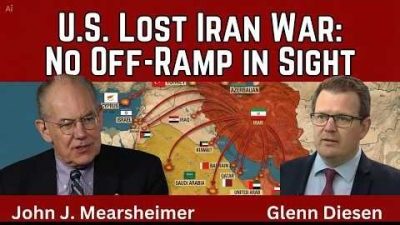
John Mearsheimer: US Already lost Iran war – No off-ramp in sight
or go to
Aletho News Archives – Video-Images
Frlom the Archives
With apparently fabricated nuclear documents, Netanyahu pushed the US towards war with Iran
By Gareth Porter | The Grayzone | April 29, 2020
President Donald Trump scrapped the nuclear deal with Iran and continued to risk war with Iran based on Israeli Prime Minister Benjamin Netanyahu’s claim to have proven definitively that Iran was determined to manufacture nuclear weapons. Netanyahu not only spun Trump but much of the corporate media as well, duping them with the public unveiling of what he claimed was the entire secret Iranian “nuclear archive.”
In early April 2018, Netanyahu briefed Trump privately on the supposed Iranian nuclear archive and secured his promise to leave the Joint Comprehensive Plan of Action (JCPOA). That April 30, Netanyahu took the briefing to the public in a characteristically dramatic live performance in which he claimed Israel’s Mossad intelligence services had stolen Iran’s entire nuclear archive from Tehran. “You may well know that Iran’s leaders repeatedly deny ever pursuing nuclear weapons…” Netanyahu declared. “Well, tonight, I’m here to tell you one thing: Iran lied. Big time.”
However, an investigation of the supposed Iranian nuclear documents by The Grayzone reveals them to be the product of an Israeli disinformation operation that helped trigger the most serious threat of war since the conflict with Iran began nearly four decades ago. This investigation found multiple indications that the story of Mossad’s heist of 50,000 pages of secret nuclear files from Tehran was very likely an elaborate fiction and that the documents were fabricated by the Mossad itself. … continue
Blog Roll
 Aletho News
- ‘We’ve Obliterated Their Missiles’
- Syrian president vows ‘absolute support’ to disarm Hezbollah
- Ukraine attacking Russian gas pipeline to stop deliveries to Europe – Defense Ministry
- ‘Heinous crime’: Iran denounces Israeli assassination of 4 Iranian diplomats in Lebanon
- John Mearsheimer: U.S. Already Lost Iran War – No Off-Ramp in Sight
- UK Parliament Plans ISP Blocking and Age Verification Powers
- World cannot remain silent as US and Israel attack ‘heritage of humankind’: Iran
- Emirati billionaire rebukes US senator over call for Gulf states to join war with Iran
- Op. True Promise 4: Iran’s missile blitzkrieg dismantles US war machine in West Asia
- Aramco CEO warns ‘catastrophe’ imminent if Strait of Hormuz remains shut
- If Americans Knew
- Israel Decided the War, But Trump’s America Fights and Pays the Bill
- Conscientious Objector Group: Phone ‘Ringing Off Hook’ As Huge Mobilization Underway
- U.S. support for Israel continues to plummet, despite media’s best efforts
- Threats and missiles fly, death tolls soar in Iran, Lebanon, Gaza – Not a ceasefire Day 151
- Lebanon: Israel’s White Phosphorous Use Risks Civilian Harm
- Corporate Media Go All Out To Support The US-Israeli War On Iran
- US-Israel war on Iran is creating a steady growing number of amputees
- Israel planned this war on Iran for 40 years. Everything else is a smoke screen
- The wrong question about the war in Iran
- ‘Your Tax Dollars Being Used to Raise Your Gas Prices’: US-Israel Bomb Major Iranian Oil Depots
- No Tricks Zone
- New Study Documents A 20-Year Pause In Arctic Sea Ice Decline – Driven By Internal Variability
- Wake-up Call: Survey Shows Majority Of Germans Now Favor Postponing Climate Targets!
- Televised! Leading German Political Candidate Tells Schoolchildren CO2 Makes Sun Hotter!
- New Study: A Century Warming Of 1.1°C Is ‘Commonplace’ And ‘Not Unusual’ During This Interglacial
- New Study: ‘Internal Noise’ And Volcanic Forcing Can Trigger 10-15°C Warming Within Decades
- Glaciers Worldwide Are Suddendly Surging, Experts Blame Warming!
- Surprising Discovery: Sahara Is Greening…Billions Of Trees Where Once Thought To Be Barren
- New Research Reaffirms Clouds, Aerosols, And Surface Solar Radiation Are ‘Driving The Climate System’
- Germany: Electric Car Catches Fire At Charging Station, Sets Off Local “Inferno”, Widespread Damage
- New Study: Canada’s New Brunswick Was 1°C Warmer Than Today During The Medieval Warm Period
 Aletho News