State-backed Alliance for Securing Democracy disinfo shop falsely smears The Grayzone as ‘state-backed’
By Alex Rubinstein | The Grayzone | February 13, 2020
The Alliance for Securing Democracy, an online censorship initiative of the Western government-funded German Marshall Project, falsely and hypocritically characterized The Grayzone and independent journalist Jordan Chariton as “state-backed media,” smearing them for their factual reporting on the shadowy network behind the controversial app that undermined the integrity of the Iowa caucuses.
The Grayzone has exposed the Alliance for Securing Democracy (ASD) in a series of investigative reports as a neo-McCarthyite outfit prone to spreading disinformation, staffed by counter-terror cranks and national security hustlers.
The ASD’s parent organization also happens to be bankrolled by the US government, numerous European governments, and the European Union, at the tune of millions of dollars — making these false accusations against The Grayzone and Jordan Chariton actual state-backed smears.
Chariton, who founded the independent progressive news outlet Status Coup, hit back at the ASD’s outrageous claims. “The days of faux democracy gladiators defaming journalists – whose factual work they seek to discredit – as part of a Kremlin syndicate are over. It’s time to fight back,” he told The Grayzone.
On February 10, the ASD published a dubious analysis of a supposed Russian effort to spread conspiracies and disinformation around the Iowa caucuses. It honed in on the Russian-funded Sputnik News and three shows broadcast by RT. Those programs included “Going Underground,” which is hosted by British journalist Afshin Rattansi.
The post continued: “In addition, all the most popular tweets about Iowa retweeted in this time period by at least one monitored account pushed a narrative that the Democratic National Committee and/or the Democratic establishment more broadly seeks to undermine Sanders via nefarious means. Monitored accounts ‘Redacted Tonight’ (@redactedtonight) and ‘Watching the Hawks’ (@watchinghawks) are the primary accounts engaging directly with this material.”
“Watching the Hawks” is hosted by American journalist and son of former Minnesota Governor Jesse Ventura, Tyrel Ventura. “Redacted Tonight” is a political satire show hosted by American comedian Lee Camp. Camp opens each show by welcoming his live studio audience to “the comedy show where Americans in America covering American news are called foreign agents.”
The social media managers for both “Watching the Hawks” and “Redacted Tonight” are US citizens.
Nonetheless, the retweeting by these shows of factual reporting by The Grayzone and Jordan Chariton set off national security alarm bells among the disinformation warriors of the Alliance for Securing Democracy.
The Grayzone article that the ASD took issue with exposed the role of pro-Israel billiionaire Seth Klarman in pouring his money into the Super PAC behind the faulty Iowa vote results app, while at the same time donating directly to candidate Pete Buttigieg – the candidate who benefited the most from the sabotage of the caucus results.
The Klarman Family Foundation also happens to be a major funder of the ASD.
On Twitter, the ASD muddled the distinction between The Grayzone, Chariton, and the RT-sponsored Twitter accounts that retweeted them. The outfit claimed that “state-backed media accounts spread various conspiracy theories about the Iowa caucuses, many of which claimed the DNC, news media, and other candidates used “dirty tricks” to steal the victory from Sen. Bernie Sanders.” Attached to the tweet was a screenshot of tweets by The Grayzone and Chariton, making no mention of either “Watching the Hawks” or “Redacted Tonight.”
The false accusation was subsequently retweeted by ASD founder Clint Watts.
The Grayzone editor Max Blumenthal responded to the smear with indignation: “Neither Jordan Chariton nor The Grayzone are state-backed media, unlike your fiscal parent. And our reporting is 100% factual, unlike yours,” Blumenthal wrote on Twitter. “We are currently exploring options for holding your McCarthyite operation fully accountable for spreading malicious disinformation.”
After enduring a withering barrage of online criticism for its malicious falsehood, the ASD issued a weasely “clarifying point.”
The Alliance for securing media citations and grants from oligarchs
The Alliance for Securing Democracy is the most prominent of an array of information warfare initiatives that exploited public hysteria over supposed Russian meddling in the 2016 presidential elections.
The group’s Hamilton 68 Dashboard claimed to have tracked 600 Twitter accounts supposedly “linked to Russian influence operations.” In the mainstream press, that dubious claim was stretched even further as the dashboard was touted as a tool for keeping tabs on “Russian bots.”
Among the widely cited claims of Russian covert influence campaigns was the #taketheknee trend inspired by blacklisted NFL quarterback Colin Kaepernick’s high-profile protest of police brutality. The ASD’s cynical accusation, that a domestic protest movement against racism was being manipulated by the Kremlin, was reported uncritically by the New York Times.
The ASD has even claimed that Stars and Stripes, a military publication operated out of the Department of Defense, was an outlet “relevant to Russian messaging themes.” It has made similar accusations against The Intercept.
Oddly enough, the sole proprietor of The Intercept is billionaire Pierre Omidyar, whose Democracy Fund is a major financial backer of the Alliance for Securing Democracy.
An ASD fellow who helped design its bogus bot tracker, Andrew Weisburd, has publicly fantasized about the murder of Intercept editor Glenn Greenwald, whom he branded a “traitor.”
Aside from Omidyar’s Democracy Fund, the ASD is backed by Craig Newmark, the namesake of Craigslist, and the Klarman Family Foundation. As The Grayzone recently reported, Seth Klarman is a major funder of pro-settler Israel lobby organizations. He is also a prominent debt vulture strangling Puerto Rico with austerity. And, again, Klarman is a top donor to Buttigieg, the self-declared winner of the Iowa caucuses.
Ascertaining a full picture of just who is backing the ASD is not possible, however, as the organization’s public list of funders “does not include any donors who do not wish to disclose their charitable giving.”
But besides the centrist billionaires that fund it, the group’s fiscal parent rakes in money from Western governments, including the US State Department.
Meet the real state-backed disinfo shop
While the Alliance for Securing Democracy claims to be independently funded, it shares major backers with the German Marshall Fund (GMF), including the Sandler Foundation.
Likewise, Omidyar’s Democracy Fund gave somewhere between $500,000 and $1 million to the GMF, while Klarman Family Foundation chipped in between $250,000 and $499,999.

According to the ASD website, the group is “housed at the German Marshall Fund.”
Unlike The Grayzone and Jordan Chariton, the GMF is a state-backed entity that faithfully pursues the agenda of its government funders.
In the 2019 fiscal year, the German Marshall Fund received $1 million or more from both the German and Swedish foreign offices, at least $1 million from the US State Department, and $1 million or more from the United States Agency for International Development (USAID), a primary arm of the US government for fomenting regime change abroad.
The European Commission — which is the executive branch of the European Union — supported the German Marshall Fund to the tune of between $500,000 and $999,999.
Additional supporters of the German Marshall Fund include branches of the German and US government, anti-communist billionaire George Soros’ Open Society Foundations, NATO, internet giants like Google, the European Parliament, oil companies like Exxon, big agro companies like Bayer, large banks, and an array of global arms dealers such as Raytheon and Boeing.
The Theranos nanotainer of Russiagate online initiatives
The Alliance for Security Democracy’s bogus dashboard was undoubtedly the most-cited authority on Russian bot activity in the media. But its credibility suffered a major blow following a series of revealing remarks by founder Clint Watts, who confessed to Buzzfeed, “We don’t even think [all the accounts we monitor are] all commanded in Russia — at all. We think some of them are legitimately passionate people that are just really into promoting Russia.”
Having banked his credibility on fighting the supposedly pernicious presence of Russian bots, Watts went on to concede, “I’m not convinced on this bot thing.”
The ASD’s faulty methodology was developed by J.M. Berger and Jonathon Morgan. The latter was involved in orchestrating a false flag influence campaign targeting Alabama’s Senate elections, and was banned from Facebook after it was exposed. New York Times reporter Scott Shane, who reported on the disinformation campaign, was also responsible for hyping up the ASD’s supposed findings on the “take the knee” hashtag.
But among the ASD’s cadre of national security hacks, Clint Watts is perhaps the most shameless hustler. As The Grayzone’s Max Blumenthal previously reported, “Watts appears to speak no Russian, has no record of reporting or scholarship from inside Russia, and has produced little to no work of any discernible academic value on Russian affairs.”
In his published work, Watts has not only called for the US to “befriend” the “al-Qaeda linked group” Ahrar al-Sham; he also urged Washington to support “jihadi[s]” in order to deliver “payback” to Russia.
In testimony to Congress in 2017, Watts claimed Russia organized a massive bot attack on his Twitter account after his article urging support for al-Qaeda was published. The tale was not just hyperbole; it appeared to have been a fabrication. He also regaled Congress with a story about RT’s and Sputnik’s coverage of a stand-off at Turkey’s Incirlik Airbase that was completely false.
Clint Watts has admitted to running an influence operation for 15 years aimed at improving approval for US foreign policy in the Middle East, which he has said “had almost no success,” and came at a cost of “billions a year in tax dollars.”
While he hypes his work for the FBI, where he spent at most one year, Watts has spent much of his career at the Foreign Policy Research Institute, a hardline neoconservative think tank founded by an open white supremacist.
And left unmentioned in Watts’ bio is his affiliation with the Central Intelligence Agency: the Agency has published an article he co-authored with former CIA director and current CNN contributor John Brennan.
Besides producing dubious analysis, Clint Watts has exhibited a tendency for paranoid Cold War fantasies. In 2017, he warned an audience that Russia was “trying to knock us down and take us over,” then claimed that his colleagues had seen their computers “burned up by malware” after they criticized Russia.
In response to supposed Russian meddling, Watts has called for interfering in Russia’s elections, “but do[ing] it in line with the founding principles of democracy and America.”
He has also called for a government-imposed censorship campaign inside the United States, demanding it “quell information rebellions that can quickly lead to violent confrontations and easily transform us into the Divided States of America.”
Even as the Alliance for Securing Democracy was exposed by The Grayzone and others as the Russiagate version of the phony Theranos nanotainer – with Clint Watts playing the Cold Warrior analog to Elizabeth Holmes – the state-backed neo-McCarthyite operation has forged ahead, rebranding its dashboard as “Hamilton 2.0” and rolling out an “Authoritarian Interference Tracker.”
Currently, the ASD is hyping up claims by NATO vassal state Estonia about Russian interference in their country, according to its “Authoritarian Interference Tracker.” Coincidentally, former Estonian president Toomas Hendrik Ilves sits on ASD’s advisory council.
He is joined on the ASD board by Michael Chertoff, the notoriously self-dealing former Department of Homeland Security chief; and by John Podesta, who workshopped ways to “stick the knife” into Bernie Sanders while leading Hillary Clinton’s presidential campaign in 2016. Podesta was recently nominated to the 2020 Democratic Convention Rules Committee.
Also on the ASD advisory council is neoconservative extraordinaire turned liberal media’s favorite Never-Trumper Bill Kristol, who is widely acknowledged as the leading media and think tank influencer behind the US invasion of Iraq. Kristol has called for a deep state coup to depose Trump, and is rolling out a wave of ads to undermine Bernie Sanders.
Former CIA director Michael Morell, who offered unsolicited advice on killing Russians and Iranians in Syria during a televised interview, and the obsessively anti-Russian former US ambassador to Russia Michael McFaul also occupy seats on the council.
While the ASD couches its work as an attempt to counter Russian disinformation, a clear pattern has emerged of efforts to suppress domestic reporting in the US that doesn’t conform to the imperial foreign policy consensus.
As The Grayzone previously reported, senior German Marshall Fund fellow and neocon movement veteran Jamie Fly appeared to take credit for a purge of popular Facebook accounts of alternative media outlets including The Free Thought Project, Anti-Media, and Cop Block. He promised it was “just the beginning.”
Now, the Alliance for Securing Democracy has trained its guns on The Grayzone. And with its latest falsehood, this malign organization has targeted an independent journalistic organization that has done more than any other to hold it accountable.
Alexander Rubinstein has covered foreign policy, police, prisons, and protests for a variety of publications including The Grayzone and Mint Press News. Follow him on Twitter at @RealAlexRubi.
Support for NATO wanes in France, Germany & even US as alliance struggles to maintain unity
RT | February 10, 2020
Public support for NATO has seen a notable decline in France, Germany and the US, according to a new poll. The alliance has suffered from months of budgetary in-fighting and mud-slinging among member states.
While the Pew Research study noted that the North Atlantic Treaty Organization still enjoys general support across member states, it pointed out that several countries “have soured on the alliance.”
Positive views of the transatlantic alliance fell to 52 percent in the United States last year, from 64 percent in 2018, the survey found. In France, support fell to 49 percent, from 60 percent in 2017 and 71 percent in 2009. A figure for 2018 was not available. Germany also saw a drop in public support, which stood at 57 percent in 2019, down from 63 percent in 2018. Positive ratings of NATO among members range from a high of 82 percent in Poland to 21 percent in Turkey.
The decline in public support can be attributed to a number of factors, including months of heated debate over defense spending among member states. US President Donald Trump has repeatedly chastised alliance members for not meeting their military spending commitment of two percent of GDP, while arguing that the United States pays far too much for Europe’s defense.
European states have also been highly critical of the Cold War-era defensive alliance. Last year, French President Emmanuel Macron accused NATO of suffering from “brain death” because of its perceived failure to help maintain global security and resolve world conflicts.
The alliance has also struggled to maintain a united front, most notable in Syria, where Turkey has been at odds with its American allies. Ankara has also locked horns with Athens over the tense military and political situation in Libya.
Founded in 1949 to counter the Soviet Union, NATO has been criticized for being largely obsolete and lacking a clear purpose. Despite billing itself as a defensive alliance, it has participated in a number of disastrous military interventions in the Middle East and North Africa.
NATO’s ‘hysteria’ over Russia stalking their satellites is only to get more money – MPs
RT | February 8, 2020
Claims that Russia is using its spacecraft to spy on NATO satellites have no real backing and are used to justify funding requests as the US and its allies are militarizing space, Russian MPs said.
Earlier this week, French General Andre Lanata, who is NATO’s supreme allied commander transformation, sounded the alarm over a recently-launched Russian satellite synchronizing its orbit with an American surveillance spacecraft.
“It is a threat to our allies,” Lanata told the Washington Examiner. “It’s a key question. We need to be sure that we give to our forces this space asset support.”
The commander went on, saying that space used to be considered “a safe haven,” but now, thanks to the actions of Russia and China, “it’s not the case anymore.”
Washington and NATO have been increasingly accusing Moscow and Beijing of developing technologies for space warfare in order to cripple the US military communications and GPS networks, but as often happens the claims were never backed by any convincing proof.
“We can imagine many different ways and many different kinds of aggression in space,” Lanata said.
A Russian satellite stalking his NATO counterpart really was a figment of the French general’s imagination, Aleksey Chepa, the deputy head of the foreign affairs committee in the Russian parliament, said, explaining that that the spacecraft in question was “a civilian satellite, which was carrying out activities needed for its own readjustment.”
The “hysteria” artificially raised by the NATO commanders is really directed at the parliaments of their countries in order to make them increase defense budgets, including military space programs, he added.
Anton Morozov, another foreign affairs committee member, reminded that Russia consistently supports the demilitarization of space and its use for solely peaceful purposes.
He noted that Russian satellites can record the elements of American military infrastructure in space and the words of the NATO general should be viewed as “a revelation of own malign intentions.”
“They prove that… they [the US and NATO] keep militarizing space, which can lead to very sad consequences,” Morozov said.
Die Linke Lawmaker Reveals How NATO Fooled Gorbachev About Bloc’s Eastward Expansion Plans
Sputnik – January 31, 2020
In the 30 years since US Secretary of State James Baker’s famous “not one inch eastward” verbal commitment to Soviet leader Mikhail Gorbachev in February 1990 not to expand NATO beyond German lands, the alliance has swallowed up every member of the former Warsaw Pact, along with half a dozen former Soviet and Yugoslav republics.
NATO broke all of the promises it made to Moscow, encouraged by the ‘blindness’ of Soviet leaders, Die Linke lawmaker and Bundestag Defence Committee member Alexander Neu, has stated.
In an op-ed regarding the upcoming Defender 2020 Europe drills, touted by NATO as the largest US deployment in Europe in 25 years, the opposition lawmaker argued that the alleged ‘Russian threat’ which the drills are meant to deter was imaginary, and that NATO is the side acting like the real aggressor.
Taking a retrospective look into the foreign and security policy developments in Europe over the past three decades which have led to the current impasse, Neu recalled that while Western leaders appeared to show support for General Secretary Gorbachev’s ‘new thinking’ about a common security policy in the Euro-Atlantic area ‘from Vladivostok to Vancouver’, their support proved superficial.
“With the end of the Cold War, German unification, the dissolution of the Warsaw Pact and the collapse of the Soviet Union, the West was suddenly seen as the winner of the confrontation. All ideas about a collective understanding and common security were swept aside. The promises made by the United States during negotiations on German unity stipulating that NATO would not expand beyond Germany if the Soviet Union accepted a united Germany turned out to be a lie and a fraud,” the lawmaker argued.
According to Neu, “the Soviet side,” for its part, “proved to be blinded and refrained from asking for a contractual promise – this was an unforgivable mistake made by the then increasingly incapable Soviet leadership under Gorbachev.”
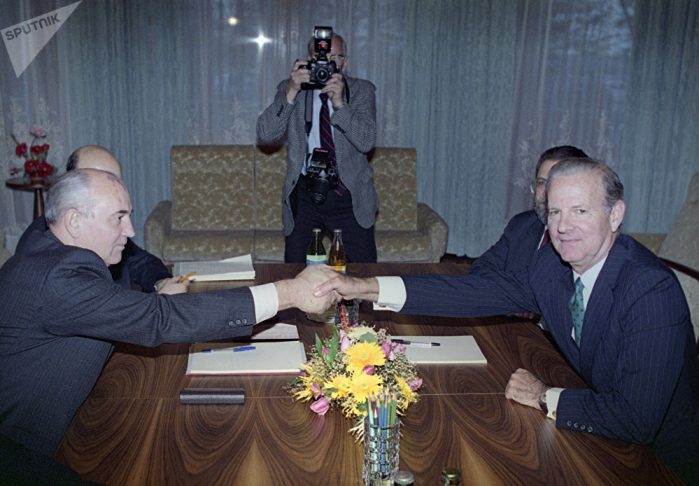
Talks between Mikhail Gorbachev and US Secretary of State James Baker, 1990. © Sputnik / Sergey Guneev
The rest is history, the German opposition lawmaker wrote, with NATO beginning its eastward expansion in 1999, and the process continuing ever since. “Even post-Soviet republics were admitted into the alliance. Protests by the Russian side against these gains in security policy, contrary to the 1990 US commitment, have been and will continue to be coolly brushed aside,” Neu noted.
Ultimately, Neu suggested that amid the ongoing tensions between the West and Russia, whether over Ukraine, Georgia or Syria, instead of trying to take de-escalatory steps, the self-proclaimed winners of the Cold War “continue to claim their right to the geostrategic loot,” with Russia portrayed as an aggressor which has insolently refused to remain subordinate to the ‘New World Order’ proclaimed by George H.W. Bush.
“In short: NATO is moving its military infrastructure further and further toward Russia’s borders, breaking the promise it made in 1990. And Russia’s reactions to these offensive actions by the US-led alliance are called aggression and threats. This is the wrong perception, but unfortunately is also widespread among most media and journalists in the West, who are full of conviction that we are the good guys. And since Russia is no longer willing to stand by and watch the geopolitics and imperialism-driven policies of the US and its vassals, NATO countries are massively increasing military spending (to 2 percent of GDP) and training as close to Russia’s borders as possible to show who is in charge.”
The Defender 2020 Europe drills were another demonstration of this, Neu noted, but promised that he, as a lawmaker, and member of the Bundestag Defence Committee, would “call for resistance” to the drills.
The Defender 2020 drills are expected to kick off in February and will continue until August, and will involve the participation of about 37,000 troops from 18 countries.
France sends warships to Mediterranean to deter Turkey
MEMO | January 30, 2020
French President Emmanuel Macron has sent warships to the Eastern Mediterranean to give support to Greece against Turkey’s quest for energy reserves in the region.
Together with Macron was Greek Prime Minister Kyriakos Mitsotakis, who was on a visit to the French capital Paris to gather support against Turkey. Mitsotakis welcomed the decision and described the warships as “guarantors of peace.”
“The only way to end differences in the eastern Mediterranean is through international justice,” he told reporters after holding talks with Macron. “Greece and France are pursuing a new framework of strategic defence.”
Tensions have increased significantly over the past year in the Eastern Mediterranean due to Turkey’s dispute with Southern Cyprus over the distribution of energy resources in the waters off the island of Cyprus.
In June last year, Turkey deployed drilling vessels to search for natural gas in retaliation to a deal struck by Greece, Southern Cyprus and Israel earlier that month, in which the three states agreed to build a pipeline harnessing the reserves of natural gas off the southern shores of the island. This pipeline – named EastMed – which is estimated to produce a profit of $9 billion over 18 years of the reserve’s exploitation, would be supplying gas from the Eastern Mediterranean region all the way to countries in Europe.
Turkey has called on those countries to participate in a fair and equal distribution of the energy resources discovered off Cyprus, insisting that they are attempting to exclude and alienate Turkey by striking their own deal without the consideration of both the major regional player and the people of the Turkish Republic of Northern Cyprus (TRNC). Therefore, it stresses that the drilling activities that Turkey is carrying out is legal and within territorial waters.
The EU, however, has repeatedly called on Turkey to give up its claim on having a share in the energy resources, claiming that its activities are “illegal”, leading to the Union to impose sanctions on the Republic in July last year over the issue, as well as due to Turkey’s military incursion – Operation Peace Spring – into northern Syria in October.
As France is one of the most prominent supporters of Greece in the dispute, Macron accused Turkey of being the one responsible for raising tensions as well as causing trouble in war torn Libya. “I want to express my concerns with regard to the behaviour of Turkey at the moment,” said Macron. “We have seen during these last days Turkish warships accompanied by Syrian mercenaries arrive on Libyan soil. This is an explicit and serious infringement of what was agreed in Berlin [conference]. It’s a broken promise.”
Greece itself has reportedly long been prepared for a military confrontation, with Defence Minister Nikos Panagiotopoulos recently warning that the country was “examining all scenarios, even that of military engagement.” This was shown with Greece’s arming of 16 Aegean islands last week, in violation of international law which stipulates that they remain demilitarised. When Turkey called on Greece to disarmed them and uphold international law, Greece refused.
The ‘Lying’ Mainstream Press and Media in Canada
Part one
By Robin Mathews | American Herald Tribune | January 18, 2020
More and more… reasonably informed Canadians believe ‘the Main Stream Press and Media’ constitutes a ‘lie factory’, a ‘manipulator of public response’ in the service of real power in the country. Canada’s MSPM, that is, exists to help ‘the Deep State’. To help the Corporatocracy. To help the Imperial Master. To help the people Stephen Harper’s group governed for … and the same people the Justin Trudeau group governs for with, perhaps, a little more ‘panache’… and cover-up.
Stark proof of Canadians’ dark and suspicious belief about the MSPM was provided in the first election Justin Trudeau won … and after. The Globe and Mail beat the drums to keep the corrupt Conservative Party of Stephen Harper in power … fighting up to the last hour. And … now … that one of Harper’s worst, rabbit-skinned hatchet-men, makers of ugly, anti-democracy legislation is running for leader, you may be sure no one in the Mainstream Press and Media (MSPM) will review his ugly past doings. Not even Andrew Coyne, star commentator for the Globe and Mail who – in a large recent advertisement tells readers “I can just write what I really think”.
What Canadians face with the likes of Andrew Coyne … and all the rest, I allege … is not only (as we will see) ‘fudging’ of stories to protect the Corporate Rich, but outright failure to surface and deal with “facts”, “news”, “information” Canadians have a right to have (and need to have) in order to act positively for the country.
How is it (for instance) that (unreported/uncommented upon) Canadian publishing that flowered in the post 1968 period to become a major economic and cultural activity (as it should be) in Canada …. is now DESTROYED, without as much as a mournful sigh from the (sold out) representatives of the MSPM, let alone full dress reporting to Canadians of the facts.
Today, fewer than 5% of non-fiction books that Canadians buy are produced by Canadian publishers! Canada’s whole book trade is – for all intents and purposes – a branch activity of foreign (mostly Imperial U.S.) publishers. “We will tell Canadians what they may read.” (and who will profit from it.) Think about that …. (Where is Andrew Coyne?)
WHY, for instance, is there no genuinely fact-informed argument for Canada to get out of NATO. NATO is an arm of U.S. Imperial Policy: period. Why… in addition … do we hear nothing – ever – about Canada’s despicable and repressive role (over decades) in Haiti? Silence. Why does no reasonably intelligent and informed commentator cut through the wholesale truckload of lies about the voracious, calculated, perverse U.S. assault on Venezuela [and any other Central and South American country that seeks real democracy and independence]. And especially … why is there no attack on Canada’s sad and shameful backing of the U.S. in every vicious act against those countries? Why does no “mainstream” Canadian newsdealer ever even mention that the extermination of Palestinians is being pursued … a slow and steady program is being pursued…?
Andrew Coyne writes (“what (he) really thinks”) – a column in support of NATO, (Jan 11, 2020, p.02) ringing all the False Bells, accepting U.S. hegemony, liking it, taking for granted an unbrokenly divided world. He chooses, of course, to forget the ‘non U.N.- approved’ murderous “NATO” actions in the old Yugoslavia; to forget Canada’s shameful part in the wholesale murder and relentless destruction of the country with the highest standard of living in Africa, Libya … in the erasure and gruesome murder of the leader of that country moving his people to decent life. Twelve hundred Libyan students were studying in Canada when Muammar Gaddafi was murdered … to the public gloating joy of Hilary Clinton and (may we assume?) Andrew Coyne …?
Why is there never news about the failure of the Bank of Canada to restore its special lending powers to make possible necessary infrastructure, low-cost housing, hospital and educational building … and more? That policy paid for the Second World War, the building, after it, in Canada … and much more… without significant debt! ! It was trashed by Pierre Elliot Trudeau in 1974 at the instancing of the Bank of International Settlements. (For the meaning of that name read: the U.S. hegemony over all Western nations/NATO nations after the 1944 meetings to lay out power distribution in the after-war-world, held at Bretton Woods, New Hampshire.)
Why is there almost never informed, inclusive, critical comment about ANY of the shared (or unshared) Defence, Policing, Private Corporation Activities, Environmental Actions, Foreign Aid, and Military Hardware sales where Canada and the U.S.A. impinge on one another Canadians are kept almost completely ignorant of major matters concerning … Canada.
Especially … why are Canadians kept in the dark (purposefully) about the gigantic subject of large Canadian corporations acting abroad … and, indeed, about any profit-seeking activity … whether the Pirate-Looting by cell-phone-plus suppliers in Canada or the untenable treatment of workers and the bribery of corrupt others in foreign locations around the globe…? Where is the MSPM??
Andrew Coyne writes about a foreign-acting Canadian corporation, SNC Lavelin (Dec. 21, 2019, p. 02,”SNC’s GUILTY PLEA…”) on tip-toe (so-to-speak), missing, many would say, the point absolutely. But why not? As he says in the his big ad: “I can just write what I really think….” Or, perhaps, it would be better to say “I can just write what the wealthy owners of my job really think….”
We will look at Andrew Coyne’s efforts to “think” (in Part Two of The Lying Mainstream Press and Media in Canada) and see if we can show the strange, guileful, warm, charming, slippery, open-hearted process of completely misleading Canadians … by its Mainstream Press and Media (which includes the Castrated Broadcasting Corporation).
Before leaving Part One… think about the fact that the Castrated Broadcasting Corporation NEVER touches Palestinian Extermination; Haiti; Sell-out of Canadian publishing; “the NATO Question”; the “takeover” (by the Bank of International Settlements) of the Bank of Canada; Canada’s shameful me-too foreign policy in the suppression and devastation by the U.S.A. of Central and South American countries and people; or the behaviour of Canadian Corporations overseas …. Think about … that… and add your own contribution to the list of endless failures “achieved” by Canada’s Mainstream Press and Media.
What’s the Point of NATO If You Are Not Prepared to Use It Against Iran?
By Philip Giraldi | Strategic Culture Foundation | January 16, 2020
Article 5 of the North Atlantic Treaty Organization (NATO) alliance commits all members to participate in the defense of any single member that is attacked. An attack on one is an attack on all. Forged in the early stages of the cold war, the alliance originally included most of the leading non-communist states in Western Europe, as well as Turkey. It was intended to deter any attacks orchestrated by the Soviet Union and was defensive in nature.
Currently NATO is an anachronism as the Soviet Union collapsed in 1991, but the desire to continue to play soldier on an international stage has granted it a measure of life support. Indeed, the alliance is regularly auditioning for new members. Its latest addition is Montenegro, which has a military consisting of 2,000 men and women, roughly one brigade. If Montenegro should be attacked, the United States is obligated to come to its assistance.
It would all be something like comic opera featuring the Duke of Plaza Toro but for the fact that there are certain things that NATO does that are not really defensive in nature but are rather destabilizing. Having expanded NATO right up to the border with Russia, which the U.S. promised not to do and then reneged, military exercises staged by the alliance currently occur right next to Russian airspace and coastal waters. To support the incursions, the myth that Moscow is expansionistic (while also seeking to destroy what passes for democracy in the West) is constantly cited. According to the current version, Russian President Vladimir Putin is just waiting to resume control over Ukraine, Georgia, Poland and the Baltic States in an effort to reconstitute the old Soviet Union. This has led to demands from the usual suspects in the U.S. Congress that Georgia and Ukraine be admitted into the alliance, which would really create an existential threat for Russia that it would have to respond to. There have also been some suggestions that Israel might join NATO. A war that no one wants either in the Middle East or in Europe could be the result if the expansion plans bear fruit.
Having nothing to do beyond aggravating the Russians, the alliance has gone along with some of the transnational abominations initially created by virtue of the Global War on Terror initiated by the loosely wrapped American president George W. Bush. The NATO alliance currently has 8,000 service members participating in a training mission in Afghanistan and its key member states have also been parts of the various coalitions that Washington has bribed or coerced into being. NATO was also actively involved in the fiasco that turned Libya into a gangster state. It had previously been the most developed nation in Africa. Currently French and British soldiers are part of the Operation Inherent Resolve (don’t you love the names!) in Syria and NATO itself is part of the Global Coalition to Defeat ISIS.
NATO will now be doing its part to help defend the United States against terrorist attack. Last Wednesday the alliance Secretary General Jens Stoltenberg spoke with President Donald Trump on the phone in the wake of the assassination of Iranian Major General Qassem Soleimani at the Baghdad International Airport. The killing was apparently carried out using missiles fired by a U.S. Reaper drone and was justified by the U.S. by claiming that Soleimani was a terrorist due to his affiliation with the listed terrorist Quds Force. It was also asserted that Soleimani was planning an attack on the U.S. Embassy in Baghdad and would have killed “hundreds” of Americans. Evidence supporting the claims was so flimsy that even some Republicans balked at approving the chain of events.
Nine Iraqis also died in the attack, including the Iraqi General who headed the Kata’Ib Hezbollah Militia, which had been incorporated into the Iraqi Army to fight against the terrorist group ISIS. During the week preceding the execution of Soleimani, the U.S. had staged an air attack that killed 25 Iraqi members of Kata’Ib, the incident that then sparked the rioting at the American Embassy in Baghdad’s Green Zone.
Bearing in mind that the alleged thwarted terrorist attacks took place seven thousand miles away from the United States, it is hard to make the case that the U.S. was directly threatened requiring a response from NATO under Article 5. No doubt the Mike Pompeo State Department will claim that its Embassy is sovereign territory and therefor part of the United States. It is a bullshit argument, but it will no doubt be made. The White House has already made a similar sovereignty claim vis-à-vis the two U.S. bases in Iraq that were hit by a barrage of a dozen Iranian missiles a day after the killing of Soleimani. Unlike the case of Soleimani and his party, no one was killed by the Iranian attacks, quite possibly a deliberate mis-targeting to avoid an escalation in the conflict.
In spite of the fact that there was no actual threat and no factual basis for a call to arms, last Wednesday, NATO Secretary General Jens Stoltenberg spoke by phone with President Donald Trump “on developments in the Middle East.” A NATO press release stated that the two men discussed “the situation in the region and NATO’s role.”
According to the press release “The President asked the Secretary General for NATO to become more involved in the Middle East. They agreed that NATO could contribute more to regional stability and the fight against international terrorism.” A tweet by White House deputy press secretary Judd Deere later confirmed that Trump had “emphasized the value of NATO increasing its role in preventing conflict and preserving peace in the Middle East.” Prior to the phone call, Trump had announced that he would ask NATO “to become much more involved in the Middle East process.”
As the Trumpean concept of a peace process is total surrender on the part of the targeted parties, be they Palestinians or Iranians, it will be interesting to see just how the new arrangement works. Sending soldiers into unstable places to do unnecessary things as part of a non-existent strategy will not sit well with many Europeans. It should not sit well with Americans either.
Libya’s warring parties vow to observe ceasefire without preconditions, stop all offensive military actions – draft agreement
RT | January 13, 2020
The Libyan National Army (LNA) and the internationally recognized Government of National Accord (GNA) in Tripoli have pledged to observe the ceasefire suggested by Russia and Turkey after negotiations in Moscow.
The draft document suggests that all parties would stop military actions and observe the ceasefire conditions. Meanwhile, a commission is to be established to determine a contact line between the warring sides. Russia and Turkey promised to support all sides in the conflict to help them implement the agreement.
Libya has been plunged into chaos for years after its longtime ruler Muammar Gaddafi was ousted and killed during a NATO-led bombing campaign. Following the years of devastation and chaos, the country became engulfed in a civil war.
Previous lengthy UN-backed talks on reconciliation, which led to the establishment of the GNA, eventually failed to bring peace to the war-ravaged land.
Haftar began an offensive against Tripoli last year and over the last few months the two sides were engaged in intense fighting. LNA controls most of Libya’s territory, but it is the GNA which is recognized by the international community.
Ankara became involved in the conflict in December promising to send troops to help the government in Tripoli as the international community called on all sides to enter negotiations.
How much difference do Russia’s new nuclear weapons really make?
By Padraig McGrath | January 10, 2020
Are Russia’s Avangard and Sarmat missiles really the game-changers which they’re depicted to be?
Readers may recall President Putin’s unveiling of these weapons systems on May 1st 2018. His state of the union address to the federal assembly that day could certainly be described as provocative, perhaps inadvisably so. Ever since then, both Russian and western media have discussed at length the numerous reasons why these ICBM’s render all currently existent missile-defence systems obsolete.
First and foremost, these weapons are seen as invulnerable to all currently existent missile defence systems because of their hypersonic capabilities. Avangard can fly at about 33 thousand kilometres per hour, or 27 times the speed of sound. The RS-28 Sarmat can fly in excess of 25 thousand kilometres per hour.
Missile defence systems, fundamentally, work on the basis of the premise that if an interceptor missile can detonate its own nuclear warhead within a 10-kilometre radius of the flight-path of the missile which it is attempting to intercept, then the resulting shock-wave stands a pretty good chance of bringing the target down or otherwise knocking it out of its flight-path. So, in practical terms, “intercepting” a nuclear missile means getting an interceptor to within a 10-kilometre radius of its flight-path.
However, under actual battle-conditions, the chances of intercepting ICBM’s in this way would not be particularly good to start with. Therefore, a more effective missile defence methodology is simply to “intercept” them during their boost phases – that is to say, before they launch. Hit them before they leave the ground.
Both the Avangard and the Sarmat fly far, far too fast for aerial interception to be plausible.
Furthermore, both the Avangard and the Sarmat can be re-maneuvered in mid-flight, making it extremely difficult for missile defence systems to predict their trajectories. In the case of Sarmat, an added problem for currently existent missile defence systems is that it has an extremely short boost phase, making it difficult for spy-satellites to identify the imminent threat in time, and also making it more difficult to track once it has launched.
However, there is one solid counter-argument to the idea that, strategically, these new weapons-systems change everything.
Namely, Russia already had hypersonic ICBM capability 15 years ago. The Topol-M SS27 was and is hypersonic, capable of flying at about 14 thousand kilometres per hour. It’s not quite as fast as the Sarmat or Avangard, but it’s still far too fast for any interceptor to have a realistic chance to getting within the required 10-kilometre radius of its flight-path. Furthermore, the Topol-M SS27 could be re-maneuvered in mid-flight, just as Sarmat and Avangard can, and it releases a multiplicity of different warheads, each with a different trajectory, once it nears its target. Furthermore, the Topol-M SS27 could be launched from the back of a truck, making it almost impossible to pre-empt during its boost-phase.
In short, all of NATO’s currently existent missile defence infrastructure was already obsolete 15 years ago.
Scott Ritter is a former US intelligence officer and weapons inspector who participated in formal inspections-teams at the Votkinsk Machine-Building Plant, where the SS-27 and its predecessor the SS-25 were assembled. In January 2005, he argued that “to counter the SS-27 threat, the US will need to start from scratch… The US cannot afford to spend billions of dollars on a missile-defense system that will never achieve the level of defense envisioned. The Bush administration’s embrace of technology, and rejection of diplomacy, when it comes to arms control, has failed.”
Neither the Bush administration nor the Obama administration ever did start from scratch. They simply pressed ahead with the installation and deployment of missile defence systems which they knew were already obsolete. The Trump administration adheres to the same obtuse path.
The desire to protect the interests of the US corporations which contract for the Aegis missile defence project is only one of the motivations which drives this policy. In addition, the presence of Aegis missile defence installations in Poland and Romania economically incentivizes local elites within those countries to propagandize their own populations, to amplify fears of the Russian bear at the local level, thereby cementing ideological loyalty within the NATO defence-apparatus.
Furthermore, it should be noted that it has never been possible to test any missile defence system under anything even realistically simulating actual battle-conditions. Missile defence systems are tested one shot at a time, which is completely unrealistic. Under actual battle-conditions, they would be required to intercept several dozen ICBM’s in simultaneous flight, and there is absolutely no evidence whatsoever that more than a fraction of the ICBM’s would be successfully intercepted.
Therefore, we can say that the primary strategic purpose of a missile defence installation, as opposed to its economic purpose or ideological purpose, is simply to serve as a pretext for its adjoining radar-installation. Parked so close to Russia’s borders, these installations are elaborate pretexts for electronic espionage or signals-intelligence (SIGINT).
However, the Russian government is playing the same game – both sides have their own reasons for pretending that Sarmat and Avangard are “game-changers,” when in fact we know that the Topol-M SS27 was the real game-changer. While the nations within the western alliance maintain this pretense in order to justify increasingly gargantuan defence-budgets and to propagandize their own populations with Russophobic hysteria, the government of the Russian Federation does so in order to persuade Russia’s population that perpetual geo-strategic threats are being addressed. As with much content published in Russia’s media-space, the disproportionate focus on geo-strategy, external relations and external security issues occurs because these are the spheres in which the Russian government is at its most professionally competent. This disproportionate media-focus, therefore, is devised in order to detract attention from domestic issues wherein the government’s record of effective policy-implementation has not been quite so successful.
Canada says some troops in Iraq to be moved temporarily to Kuwait for safety
MEMO | January 7, 2020
Some of Canada’s 500 military personnel based in Iraq will be temporarily moved to Kuwait for safety reasons, the country’s top military official said on Tuesday, due to fears of possible retaliation thereafter a US drone strike on Iran’s top military commander, reports Reuters.
General Jonathan Vance, chief of the defense staff, said in a letter to military families that “the news coming out of the Middle East is alarming for many of you.”
“Some of our people will be moved temporarily from Iraq to Kuwait,” he added. Simply put, we are doing this to ensure their safety and security.”
Some of the Canadian troops are taking part in a NATO mission while others are running Operation Impact, a Canadian initiative to train soldiers in Iraq, Jordan, Lebanon, and Kuwait. In all, some 800 Canadian troops are in the Middle East.
Earlier in the day, NATO said it was moving some of its trainers out of Iraq, without giving details.
Canadian Prime Minister Justin Trudeau spoke to NATO Secretary-General Jens Stoltenberg on Monday and the two men “emphasized the importance of de-escalating tensions and the need to support security and stability in Iraq,” Trudeau’s office said in a statement.
READ ALSO:
NATO suspends training activities in Iraq after Soleimani killing
Featured Video

AIDS Inc. by Gary Null (2007)
or go to
Aletho News Archives – Video-Images
From the Archives
Clash of Civilization, Iran Part II
By Jamal Kanj – Intifada-Palestine.com – January 14, 2011
Israel’s survival kit is: perpetuate conflict, insecurity to rationalize collective hate and finally playing victim.
Devoid of conflict, Israel implodes internally; without hate, Zionism loses its justification; and playing eternal victim to continue blackmailing the West. Absence of this holy trinity, Israel ceases to exist.
From its inception, the house of Zion has mastered exploiting adversarial powers to advance Israel’s cause. For instance, their influence over the Democratic Party in the US began with President Truman’s bid for 2nd term election in 1948.
Responding to strong opposition from Secretary of State General George Marshall and Department experts urging against recognition of Israel, President Truman replied: “I’m sorry gentlemen but I have to answer to hundreds of thousands [Jewish voters] who are anxious for the success of Zionism. I do not have hundreds of thousands of [voting] Arabs among my constituents”
Zionists influence over liberal American politics was matched with the doctrinal school of Conservative theoreticians aligning the Republican Party’s platform with Israel’s objectives. The Neoconservative Zionists, coined Zioncons, invented the “Clash of Civilization” concept to fight Israel’s wars. … continue
Blog Roll
 Aletho News
- Merck Virologists Admitted to Falsely Certifying Vaccine Efficacy
- Mandatory Folic Acid for every man, woman & child
- Pro-Palestine protesters arrested outside UK’s ruling Labour Conference in Liverpool
- Mauritius denies landing permit to flight from Israel, forcing cancellation: Tour operator
- Israeli finance minister calls for genocidal war on West Bank, annexation of south Lebanon
- 12 Things Your Psychiatrist Was Trained Not to Tell You
- From Unipolar Universalism to Multipolar Civilizational Distinctiveness
- RSF military group defects, joins Sudanese army: State media
- Ireland goalkeeper refuses to play ‘Israel’ as squad weighs boycott
- China pushes back against US on Cuba, Iran
- If Americans Knew
- Israel forces Gazans to live in constant peril – Daily Update
- Deconstructing Netanyahu’s pants-on-fire UN rant – Daily Update
- Trump betrayed voters with his campaign lies and prioritized a foreign country once he took office
- Netanyahu calls Israel’s war in Gaza ‘opposite of genocide’ in UN speech to near-empty hall
- Settler Kidnappings: Torture, Sexual Abuse and Terrorisation of Palestinian Abductees as Israel Deepens Annexation of West Bank
- Gaza winter nears as 162,000 tents become unusable, raising fears of humanitarian crisis
- Netanyahu says, “It’s the opposite of genocide”; UN says Gaza economy is world’s ‘most severe crisis on record’ – Daily Update
- Israel’s US-Backed Assault on Gaza Has Created the ‘World’s Most Severe Economic Crisis on Record’: UN
- ‘Protecting U.S. Citizens’… From Israel
- ‘This is where I live now, the back of a truck’: a day in the life of a grandmother in Gaza
- No Tricks Zone
- New Study: Earth And Venus Surface Warmth Largely Explained By Convection And Lapse Rate, Not CO2 Or Radiation
- 2025 Nature Paper Claiming Worsening Global Drought Gets RETRACTED …Heavily Flawed
- New Study: ‘Global Drought Shows No Detectable Recent Acceleration Under Climate Warming’
- Economic Masterminds: German Socialists Suggest Taxing Productivity Gains Stemming From Using AI
- The South China Sea Has Not Been Cooperating With The Climate Change Narrative
- Energy Crisis: Germany Enters Heating Season With Historically Low Gas Reserve Fill Levels
- New Study: The Antarctic Ice Sheet Gained Mass From 2020-2024 Due To Staggering Snow And Ice Accumulation
- Study: Ocean Heating Rates From Thousands Of Years Ago ‘Dwarf’ Modern Ocean Heating Rates
- Climate Extremists Target, Attack Large-Scale Power Grid Infrastructure In Germany!
- New Study: Antarctic Ice Melt Has Contributed Less Than 1 Centimeter To Sea Level Rise In The Last 30 Years

