Georgia and Ukraine Joining NATO Will Likely Have the Opposite Effect Against Russia
By Paul Antonopoulos | December 30, 2019
Back in April, during a ministers of the North Atlantic Treaty Organization (NATO) meeting in Washington, it was agreed that a package of measures to strengthen support for Georgia and Ukraine, particularly in the area of maritime defense, would be made.
“We agreed on a package of measures to improve our situational awareness and to step up our support for both Georgia and Ukraine in areas such as the training of maritime forces and coast guards, port visits and exercises and sharing information,” NATO Secretary General Jens Stoltenberg said, while NATO ships were simultaneously conducting naval exercises with Ukraine and Georgia in the Black Sea.
There is little doubt that there is the long-term goal of bringing Ukraine and Georgia into the NATO alliance as a three-pronged attack against Russia in the attempt to isolate and pressure the Eurasian Giant:
Both Ukraine and Georgia are Black Sea states, along with Romania, Bulgaria and Turkey who are already NATO members. The Black Sea is the location of Russia’s warmwater ports, i.e. its access for year-round trade with the international community.
Although Russia’s Kaliningrad Oblast is completely surrounded by NATO members Poland and Lithuania, and fellow NATO members Norway, Estonia and Latvia share small land borders with Russia, a Ukrainian admittance into the alliance will be the biggest encroachment by NATO against Russia since the infamous February 1990 promise made by then-U.S. Secretary of State James Baker who made “iron-clad guarantees” to Soviet President Mikhail Gorbachev that NATO would not expand “one inch eastward,” if the Soviets supported the reunification of Germany. This was obviously a lie.
Georgia will become a Caucasian salient, on the fringes of where Europe becomes Asia, in the attempt to surround and isolate Russia.
However, both Ukraine and Georgia face significant obstacles as they have unresolved territorial disputes: Ukraine with the Lugansk People’s Republic and the Donetsk People’s Republic, and Georgia which does not recognize the independence of Abkhazia and South Ossetia despite the reality that these states have achieved sovereignty. So long as the sovereignty and independence of South Ossetia and Abkhazia, and the status quo of Donbass remain unresolved, there is little chance Ukraine and Georgia will be able to join NATO with European member states unwilling to go to war with Russia for the sake of these two countries.
As L. Todd Wood, a former special operations helicopter pilot, said in an opinion piece published in the Washington Times in November last year, “Ukrainians and Georgians are good people and deserve our support to realize their dreams. But it’s time to stop with the creeping borders of the alliance. Moscow […] declared that if Georgia or Ukraine joined NATO, Russia would be “forced to act.” I take that threat at face value. Frankly, they have no choice. Any self-respecting Russian leader would have to react or resign.”
Perhaps this is exactly what the U.S. wants though? The Soviet Union, the reason for the establishment of NATO to begin with, is long gone and will not return. This calls into question the purpose of NATO today, and it comes down to two U.S. self-serving reasons:
The desperate prevention of a new Multipolar World Order, which Russia plays a critical part in. It is for this reason that China has now also been identified by NATO as a “very strong competitor.” However, Russia’s defense of South Ossetia in 2008 and the Chinese Belt and Road Initiative have already indicated that the era of unipolarity has come to an end.
To ensure that the U.S. Military Industrial Complex maintains a monopoly on arms sales to the 29-member alliance. The addition of Georgia and Ukraine to NATO will force these countries to spend at least 2% of their GDP on their military, which U.S. military manufacturers will benefit from.
Any Ukrainian-Georgian admittance into NATO will undoubtedly create problems for Russia as it will have to increase its defense spending and it would signal the final eastward expansion onto large swathes of Russia’s European borders. Realistically though, NATO is fractured as never seen before. It is unlikely that Georgia and Ukraine will join the alliance anytime soon, especially as mentioned, it is unlikely European states will want to risk a conflict with Russia over them despite what Washington may want.
In turn, Moscow has its own options to utilize against Georgia and Ukraine such as deepening military support and ties to Donbass, Abkhazia and South Ossetia. Also, as done in the Autonomous Republic of Crimea and the local government of Sevastopol in 2014, referendums could be conducted in Donbass, Abkhazia and South Ossetia to determine if these republic’s want to join Russia. With this trump card (trump being used unironically), by Ukraine and Georgia joining NATO, they could be further weakened by the potential expansion of Russian territory through legal means.
In this light, although Georgia and Ukraine have the goal of joining NATO in the belief that it will help defend their interests against a so-called Russian aggression, it is likely to have the opposite outcome.
Paul Antonopoulos is a Research Fellow at the Center for Syncretic Studies.
NATO: General Delawarde assesses final London Declaration

By Alexandra Kamyshanova | December 30, 2019
General Dominique Delawarde, the former head of the “Situation – Intelligence – Electronic Warfare 19” section at the joint operational planning staff and a cyberwarfare expert, provides insight into the nine articles of the final London Declaration, published on the NATO website.
Question: Can members of the Alliance really “reaffirm their adherence to the purposes and principles of the United Nations Charter”, as stated in Article 1?
Answer: A simple observation of how history has unfolded after the Cold War demonstrates that two important elements of Article 1 are erroneous, if not flat-out false. Since 1991, NATO actions have been aimed not at preventing conflicts and maintaining peace, but exactly the opposite. They do cause them themselves by their never-ending destructive interference in the affairs of sovereign countries. Over a quarter-century (1995-2019), its member states dropped more than a million bombs on our planet, which entailed, whether overtly or covertly, the death of several million people. The only objective was to establish hegemony over the “international community”. Alliance members cannot “reaffirm their adherence to the purposes and principles of the United Nations Charter” by violating or ignoring international rules established by the United Nations. The illegal occupation of part of the Syrian territory serves as evidence of this.
Q: Can we say that the funding efforts outlined in Article 2 fail to reflect the true situation?
A: This statement about efforts to increase funding for NATO members’ defense capabilities is virtually misleading. It loses sight of the fact that defense spending has halved since 1991 (peace dividends) and does not specify any deadline for reaching the 2% target. Finally, this statement is unfeasible and won’t be implemented in the short or medium term, given the economic and social complexities faced by all the key NATO member states. So this is mere verbiage.
Besides, NATO will not be able to compete with the SCO (Shanghai Cooperation Organization), because defense spending parity in PPP (purchasing power parity) dollars has almost been reached between NATO and the SCO; the cumulative defense budget of NATO member states accounts for 1000 billion dollars (PPP), and that of SCO member states is going to reach parity with the NATO budget in 2020 already. To date, the annual growth rate of defense spending in SCO countries is two to three times higher as compared to NATO countries. The SCO has a much wider scope for expansion (major countries like Iran and perhaps Turkey, why not) than NATO (North Macedonia, Georgia, Bosnia). Speaking of Turkey, an untrained eye should know that the SCO-NATO dual membership is not prohibited, since in 2005, the United States itself applied to join the SCO as nonmember state (the application was unanimously rejected by SCO members, guess why).
Q: Should we consider Russia as a threat, as stated in Article 3?
A: This list of universal threats and perpetual accusations against Russia, which is presented as a source of aggression and threat, are familiar pretexts to justify the very existence of NATO. As for anti-Russian statements, NATO is clearly resorting to an accusatory inversion. It is NATO members, not Russia, who have dropped over a million bombs and caused the death of several million people since 1995, and it is them who violate UN rules by continuing the military occupation of part of the Syrian territory. This is also the case of the coup organized in Ukraine, the division of the former Yugoslavia, and the constant advancing to the borders of Russia, which is in total disregard of the promises made to Gorbachev.
As for terrorism and instability observed beyond our borders, the Alliance forgets to remind that both arise from their omnidirectional interference in the affairs of sovereign states at the slightest pretext. They arise from their unlawful bombings, humiliations at Abu Ghraib and Guantanamo, the replacement of strong secular leaders with the chaos we observe today, and the wars waged under false pretexts (Serbia, Iraq, Libya, Syria). Migration is a blowback.
It should be recognized that state and non-state actors shattering the international order are mostly representatives of the West and NATO. The April 14, 2018 joint strike on Syria by the United States, France and the United Kingdom is yet another proof of this. Anglo-Saxon non-governmental NGOs, ostensibly independent but actually used by government agencies and / or their American sponsors (Soros), are wreaking havoc by promoting North Atlantic strategies. They use various useful idiots for their own purposes, who may inherently have good intentions. Finally, the main and only known cyber threat uncovered by Snowden, Assange and Manning is America, not Russia or China. The United States has installed wiretaps of all the political and economic Western leaders (NSA) and has pretty reliable bargaining chips to blackmail our heads of state and seize our businesses.
Q: Do you agree with the statement of Article 4: “NATO is a defensive alliance and poses no threat to any country”?
A: You need to ask the countries that have been bombed for 25 years.
The Alliance does not act “prudently and responsibly” in relation to Russia: the expansion to the East which runs counter to NATO promises of 1990, the coup in Ukraine, the unilateral withdrawal of the United States from the INF and other treaties, including the Iranian nuclear program. They pretend to be combating terrorism, even though many of its elements are funded by the West itself or some of its Arab allies – this is simply ridiculous. NATO members take us for perfect fools.
Q: What do you think about the phrasing of Article 5 that NATO seeks to “work to increase security for all, deepen political dialogue and cooperation with the United Nations”?
A: NATO provokes chaos, migration crisis, surge of terrorism and anti-Western hatred that have now pummelled Europe. You cannot drop a million bombs over 25 years on the countries that have never attacked a single member of the Alliance. Think about the five thousand soldiers from 11 NATO member states who died for nothing in Iraq, in a deceitful war unleashed in 2003. It is worth paying tribute to the memory of those who fell victim to American aggression supported by 10 European NATO member states that agreed to take part.
Q: What does NATO mean in Article 6 when mentioning “the resilience of our societies”, “our energy security” and “the need to rely on secure and resilient systems”?
A: This reflects the current US obsession: “to increase the resilience of our energy security” means ” NATO’s opposition to the construction of the Nord Stream 2 gas pipeline, to spite the vicious Russians and to the benefit of the goodу American gas market.” “Security of our telecommunications, including 5G” means “the rejection of the Chinese Huawei technology, to the detriment of the Chinese and in favor of American technologies.” The US has long been spying on our political and economic leaders’ telecommunications, while accusing China of “intending” to spy on the alliance members by means of its 5G system.
China poses “challenges that we need to address together”. So, NATO is embarking on a path of confronting China, which is beneficial to the United States alone.
Q: What is meant by “strengthening NATO’s political dimension” referred to in Article 7?
A: NATO’s ten-year strategy is now being updated, and the “relevant expertise” will be that of American and European neoconservatives. The essence of Article 7 is discernable: “strengthening NATO’s political dimension”. Since the end of the Cold War, the 1949 “military-defensive” alliance has been increasingly turning into a political and offensive one, often to accommodate certain economic interests.
Q: What do you think Article 8 is remarkable for?
A: For postponing the revision of the strategic concept from the year 2020 to 2021. Trump’s unpredictability scares Europe, with its people hopeful that he won’t be re-elected and that another President will bring the crisis-stricken Alliance back into the ranks.
Q: Is it serious that Article 9 stresses NATO’s greater protection for the peoples of its member states?
A: NATO has been sowing too much hatred and chaos on the planet since 1991 to be a security factor in Europe, and it has been so since the end of the Cold War. The North Atlantic Charter does not present NATO as an instrument of American hegemony. Therefore, the dissolution of NATO, or at least the withdrawal of France would be the best decision at the moment, unless NATO returns to the original principles of a defensive alliance with its activities covering only the territories of its member states, and ceases to invent new threats to serve as false pretexts to justify wars and intervention aimed at maintaining Western hegemony on the planet.
Q: What conclusion would you draw?
A: It is not just about a “brain death” in NATO. Can their solidarity survive the global economic crisis that experts predict, and the inevitable subsequent upheaval in the hierarchy of forces? Hardly probable. The prosperity of the West and the financing of its armed forces rest today on a whole ocean of debts.
The future will belong to those who keep ahead of the game. A long-term vision is needed to pursue foreign policy. Russia, China and India have long ago grasped this.
The Mysterious Frank Taylor Report: The 9/11 Document that Launched US-NATO’s “War on Terrorism” in the Middle East
By Prof. Niels Harrit – Global Research – March 21, 2018
We call them ‘the 9/11 wars’ – the seemingly unending destruction of the Middle East and North Africa which has been going on for the last seventeen years. As revealed by Gen. Wesley Clark,[1] these wars were already anticipated in September 2001.
The legal foundation for the invasion of Iraq in 2003 has been challenged in several countries. The best known is the Chilcot Inquiry in the UK, which began in 2009 and concluded in a report in 2016. The inquiry was not about the legality of military action, but the British government was strongly criticised for not having provided a legal basis for the attack.
Even though the invasion of Iraq was planned[2] prior to 9/11, most observers note that the attack on Afghanistan in 2001 was a required precursor.
However, the legal basis for attacking Afghanistan has attracted almost no attention. One obstacle in addressing this has been the assumption that the key document was still classified.[3][4]
But as demonstrated below, this document was apparently declassified in 2008.
On the morning of 12 September 2001, NATO’s North Atlantic Council was summoned in Brussels. This was less than 24 hours after the events in USA. The council usually consists of the permanent ambassadors of the member states, but in an unprecedented move, the EU foreign ministers participated as well.[5]
Lord Robertson, Secretary General of NATO, wrote a draft resolution invoking Article 5 in the Washington treaty – the famous ‘musketeer clause’ – as a consequence of the terror attacks. The decision to do so had to be unanimously approved by the governments in all 19 NATO countries. This general agreement was obtained at 9.20 pm and Lord Robertson could read out the endorsements at a packed press conference:[6]
“The Council agreed that if it is determined that this attack was directed from abroad against the United States, it shall be regarded as an action covered by Article 5 of the Washington Treaty, which states that an armed attack against one or more of the Allies in Europe or North America shall be considered an attack against them all.”
There was a reservation. Article 5 would not be formally activated before “it is determined that this attack was directed from abroad”.
Apparently NATO had a suspect. But the forensic evidence was still pending, and hence also the formal invocation of Article 5.
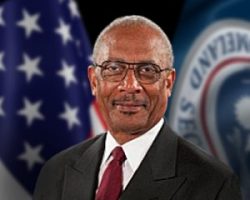 Formally, this evidence was provided by Frank Taylor (image on the right), a diplomat with the title of Ambassador from the US State Department. On 2 October he presented a brief to the North Atlantic Council, and Lord Robertson could subsequently conclude:[7]
“On the basis of this briefing, it has now been determined that the attack against the United States on 11 September was directed from abroad and shall therefore be regarded as an action covered by Article 5 of the Washington Treaty, which states that an armed attack on one or more of the Allies in Europe or North America shall be considered an attack against them all.”
“Today’s was classified briefing and so I cannot give you all the details. Briefings are also being given directly by the United States to the Allies in their capitals.”
Since the invocation of Article 5 had to be unanimous, Frank Taylor’s report would have been integral in the briefings announced to take place.
In Denmark – the country of the present author – there was a meeting in the Foreign Affairs Committee on 3 October 2001, where parliamentarians were briefed by the government about the proceedings in Brussels.
Parallel briefings must have been given in the 17 other NATO capitals. In each city, the resolution must have been approved, since Lord Robertson could announce NATO’s unanimous adoption of Article 5 and the launch of the war on terror on 4 October.[8] The first bombs fell in Kabul on 7 October.
Article 5 of the Washington Treaty says:[9]
“The Parties agree that an armed attack against one or more of them in Europe or North America shall be considered an attack against them all and consequently they agree that, if such an armed attack occurs, each of them, in exercise of the right of individual or collective self-defence recognised by Article 51 of the Charter of the United Nations,…..”
That is, any military action taken by NATO is confined by the restrictions in Article 51, which emphasises the right to self-defence and reads:
“Nothing in the present Charter shall impair the inherent right of individual or collective self-defence if an armed attack occurs against a Member of the United Nations,….”.[10]
That is, military action is forbidden in the absence of an armed provocation, and the legality of the attack on Afghanistan depends exclusively on the evidence presented in Frank Taylor’s report. But it was classified together with the minutes from the pertinent meetings.
However, on 19 May 2008, the US State Department declassified the dispatch which was sent in 2001 to all US representations world-wide, including the ambassadors to NATO headquarters, regarding what to think and say about the 9/11 events.
It is titled: “September 11: Working together to fight the plague of global terrorism and the case against al-qa’ida”.
The text is freely accessible here.
The document is dated 01 October 2001. But as hinted by the URL, it seems to have been distributed on 2 October five days before the invasion of Afghanistan on October 7, 20101. That is, the day Frank Taylor gave his presentation for the North Atlantic Council and the EU foreign ministers, and the day before the US ambassadors were briefing the governments in the respective NATO capitals.
The text of the dispatch begins by requesting “all addressees to brief senior host government officials on the information linking the Al-Qa’ida terrorist network, Osama bin Ladin and the Taliban regime to the September 11 terrorist attack on the World Trade Center and Pentagon and the crash of United Airlines Flight 93.”
The document appears to be a set of ‘talking points’. The recipients are instructed to use the information provided in oral presentations only and to never leave the hard copy document as a non-paper. Specifically, there is reference to “THE oral presentation”.
These instructions are followed by 28 pages of the specific text.
Tellingly, a section of this dispatch is copy-pasted into Lord Robertson’s statement on 2 October:7
“The facts are clear and compelling[…] We know that the individuals who carried out these attacks were part of the world-wide terrorist network of Al-Qaida, headed by Osama bin Laden and his key lieutenants and protected by the Taliban.”
The conclusion is inescapable – this dispatch IS the Frank Taylor report. It is the manuscript that served not only as the basis for Frank Taylor’s presentation, but also for the briefings given by US ambassadors to the various national governments. Identical presentations were given in all 18 capitals on 3 October, four days before the US-NATO invasion of Afghanistan
Is there any forensic evidence provided in this document to serve as a legal basis for the invocation of Article 5?
Nothing. There is absolutely no forensic evidence in support of the claim that the 9/11 attacks were orchestrated from Afghanistan.
Only a small part of the introductory text deals with 9/11, in the form of summary claims like the citation in Lord Robertson’s press release. The main body of the text deals with the alleged actions of Al-Qaeda and the Taliban in the nineties.
On 4 October, NATO officially went to war based on a document that provided only ‘talking points’ and no evidence to support the key claim.
We are still at war seventeen years later. Five countries have been destroyed, hundreds of thousands of people killed and millions displaced. Refugees are swarming the roads of Europe, trillions of dollars have been spent on weapons and mercenaries and our grandchildren have been shackled with endless debt.
At the opening ceremony for the new NATO headquarters on 25 May 2017, all the leaders from NATO’s member states attended the inauguration of a ‘9/11 and Article 5 Memorial’.[11]
*
Prof. Niels Harrit is a retired Associate Professor at the University of Copenhagen, Denmark.
Notes
[1] The Plan — according to U.S. General Wesley Clark (Ret.) https://www.youtube.com/watch?v=SXS3vW47mOE
[2] Bush decided to remove Saddam ‘on day one’. https://www.theguardian.com/world/2004/jan/12/usa.books
[3] The Unanswered Questions of 9/11. http://www.globalresearch.ca/the-unanswered-questions-of-911/5304061?print=1
[4] Was America Attacked by Afghanistan on September 11, 2001? https://www.globalresearch.ca/was-america-attacked-by-afghanistan-on-september-11-2001/5307151
[5] Being NATO’s Secretary General on 9/11. https://www.nato.int/docu/review/2011/11-september/Lord_Robertson/EN/ (from which you can deduce that the NATO-ambassadors eat lunch at 3 pm).
[6] Statement by the North Atlantic Council, https://www.nato.int/docu/pr/2001/p01-124e.htm
[7] Statement by NATO Secretary General, Lord Robertson. https://www.nato.int/docu/speech/2001/s011002a.htm
[8] Statement to the Press by NATO Secretary General, Lord Robertson, on the North Atlantic Council Decision On Implementation Of Article 5 of the Washington Treaty following the 11 September Attacks against the United States. https://www.nato.int/docu/speech/2001/s011004b.htm
[9] The North Atlantic Treaty. https://www.nato.int/cps/ic/natohq/official_texts_17120.htm
[10] Article 51, UN charter. http://www.un.org/en/sections/un-charter/chapter-vii/
[11] Dedication of the 9/11 and Article 5 Memorial at the new NATO Headquarters, 25 May 2017 https://www.youtube.com/watch?time_continue=3&v=augh1WqTqFs
Trump administration and Moscow shoot down bipartisan DASKA “sanctions bill from hell”
By Sarah Abed | December 23, 2019
In August of 2018, Senators Lindsey Graham (R-S.C.) and Robert Menendez (D-N.J.) first introduced what Graham referred to as a “sanctions bill from hell” targeting Russia and President Vladimir Putin and making it harder for the United States to leave NATO. Despite bipartisan grievances with Moscow the bill didn’t gain much traction.
The measure to push President Trump to take a tougher stance against Russia over alleged election interference, aggression towards Ukraine and involvement in Syria’s proxy war is titled the Defending American Security from Kremlin Aggression Act (DASKA) and would impose strict and broad penalties.
In February of this year, DASKA was reintroduced with Senator Graham stating the following, “Our goal is to change the status quo and impose meaningful sanctions and measures against Putin’s Russia,” and “He should cease and desist meddling in the U.S. electoral process, halt cyberattacks on American infrastructure, remove Russia from Ukraine, and stop efforts to create chaos in Syria.”
During a Senate Floor speech on February 7th, Senator Menendez even went as far as saying that he speculated whether President Trump “is an asset of the Russian government” and concluded his speech by saying, “this Administration’s deference to the Kremlin demands Congress be proactive in shaping U.S. foreign policy toward Russia, especially with respect to sanctions.”
Fast forward to last Wednesday when the U.S. Senate Foreign Relations Committee advanced the bill with a 17-5 vote. The next step is for the legislation to pass the full Senate and House of Representatives before it can be brought to President Donald Trump to sign into law or veto.
However, the White House has already stated their opposition to DASKA, which targets Russian banks, Russia’s cyber sector, new sovereign debt, and would impose measures on its oil and gas sectors. The bill also imposes several requirements on the State Department including generating reports investigating President Putin’s wealth, opposition figure Boris Nemtsov’s 2013 assassination and whether to designate Russia as a state sponsor of terror.
As for NATO, DASKA would ensure that without approval from a Senate supermajority the United States can not leave. This is in response to President Trump’s various comments about wanting to leave and criticism of other NATO members for not spending enough on defense.
The Trump administration and Moscow are on the same page when it comes to DASKA. Russian Foreign Minister Sergei Lavrov called DASKA “senseless” and in a 22-page letter to Congress it was referred to as “unnecessary” and in need of “significant changes”. Although the administration stated that they too want to deter and counter Russian subversion and aggression they strongly oppose the bill in its current form.
It seems rather unlikely that this bill will pass and in the very slight chance that it does these sanctions will not deter Moscow or bring about any significant change in their domestic and foreign policies.
Robert Legvold, the Marshall D. Shulman Professor Emeritus of Post-Soviet Foreign Policy at Columbia University, stated “As has been the experience since the first U.S. and EU sanctions in 2014, the effect on Russian foreign policy behavior will almost certainly be close to zero-other than perhaps encouraging initiatives that the Russian leadership believes may be disruptive in U.S. relations with its European allies.”
Although Democrats and some Republican’s such as Senator Graham sometimes manage to inadvertently bring the Russian and American heads of states together on some issues such as DASKA and President Trump’s impeachment, those moments are usually short lived. As we saw a few days ago, President Trump signed the 2020 National Defense Act with a $738 billion budget which included legislation imposing sanctions on firms laying pipe for Nord Stream 2, an $11 billion gas pipeline project meant to double gas capacity along the northern Nord Stream pipeline route from Russia to Germany, upsetting all parties involved.
Germany firmly rejected the US sanctions and referred to them as incomprehensible as they affect Berlin and other European companies as well. The imposition of sanctions against EU companies who are conducting legitimate business is rejected by the European Union as well. Russia stated that they would stick to the schedule and carry out their projects regardless of sanctions.
The current and previous White House administrations opposed this project over claims that it would embolden President Putin’s influence by increasing his political and economic sway in Europe. With the United States currently ranked as the world’s top oil and gas producer, it’s clear to see that sanctions such as these are meant to influence European allies to buy American instead of Russian oil and products.
On Friday, Allseas the Swiss-Dutch company contracted to do the work announced that it had suspended pipe-laying activities in anticipation of the enactment of the National Defense Authorization Act (NDAA). On Saturday, Allseas stated, “Completing the project is essential for European supply security. We together with the companies supporting the project will work on finishing the pipeline as soon as possible.”
Russian FM Lavrov met with President Trump at the White house earlier this month and mentioned that they covered at least a dozen substantial issues, and that both the White house and Russia are interested in dialogue. It will be interesting to see if President Trump can successfully balance his desire to expand trade ties and continue dialogue with Russia, by pushing back legislation from Congress to increase sanctions under DASKA, all while sanctioning Nord Stream 2 under the NDAA. What level of chess would that be?
Sarah Abed is an independent journalist and analyst.
The 12 Strongest Arguments That Douma Was A False Flag
By Caitlyn Johnstone | December 20, 2019
There have been many US military interventions that were based on lies. This is not a conspiracy theory. It is not some kooky blogger’s opinion. It is an extensively documented and indisputable fact.
Nothing has ever been done to address this extensively documented and indisputable fact. No laws were ever changed. No war crimes tribunals were ever held. No policies or procedures were ever revised. No one was ever even fired. No changes were implemented to prevent the Iraq deception from happening again, and, when it happened again, no changes were implemented to prevent the Libya deception from happening again.
When you make a mistake, you take measures afterward to ensure that you never make the same mistake again. When you do something on purpose, and you intend on doing it again, you do not take any such measures.
There is a large and growing body of evidence that we have been lied to about Syria to an extent and to a level of sophistication that may be historically unprecedented. One particular aspect of the US-centralized empire’s military involvement in that nation, the 2018 airstrikes by the US/UK/France alliance and the alleged chemical weapons incident which preceded it, has been subject to intense scrutiny ever since it took place. And with good reason: there are many pieces of evidence indicating that the Douma incident was staged to falsely implicate the Syrian government.
I don’t claim to know exactly who would have been involved in such a staging and to what extent. It is technically possible, as the UK’s Admiral Lord West speculated at the time, that it was perpetrated independently by the vicious al-Qaeda-linked Jaysh al-Islam forces who’d been occupying Douma, a last-ditch attempt to provoke a western military response that might save them from the brink of defeat at the hands of the surging Syrian Arab Army. Jaysh al-Islam has an established record of deliberately massacring civilians, and of using civilians as military leverage by locking them in cages on rooftops in strategic Douma locations to prevent airstrikes. The narrative management operation known as the White Helmets would also have been involved to some extent, and it’s very possible that Saudi Arabia, who backs Jaysh al-Islam, was involved as well.
Any number of other allied intelligence agencies could have also been involved to some degree (perhaps with the more expanded goal of ensuring continued US military commitment in Syria during an administration that is vocally opposed to it), and it’s unknown if anyone involved would have had direct contact with any part of any US government agency regarding any of this. All we know for sure is that there’s a growing mountain of evidence that the Syrian government was not involved, and that this raises extremely important questions about (A) who really killed those civilians in Douma and (B) how seriously any future demands for military action should be taken from the US power alliance.
That mountain of evidence includes the following 12 items. Taken individually they are reason enough to be skeptical of the narratives that are being promoted by a government with a known history of using lies, propaganda and false flags to advance preexisting military agendas. Taken together, and looked at with intellectual honesty, they are enough to obliterate anyone’s trust in what we’ve been told about Douma.
1. A leaked OPCW Engineering Assessment concluded that the gas cylinders on the scene were manually placed there.
The Organisation for the Prohibition of Chemical Weapons (OPCW) is a purportedly neutral and international watchdog group dedicated to eliminating the use of chemical weapons around the world. In May of this year, a leaked internal OPCW document labeled “Engineering Assessment of Two Cylinders Observed at the Douma Incident” was published by the Working Group on Syria, Propaganda and Media. The Engineering Assessment was signed by a South African ballistics expert named Ian Henderson, whose name is seen listed in expert leadership positions on OPCW documents from as far back as 1998 and as recently as 2018, and its authenticity was quickly confirmed by the OPCW in a statement sent to multiple journalists that it was “conducting an internal investigation about the unauthorised release of the document in question.”
Henderson ran some experiments and found no scientifically grounded theory for how the cylinders could possibly have been dropped vertically from the air while being found in the condition and locations that they were found in, concluding instead that they were manually placed on the scene. This is a huge difference, since the Assad coalition was the only side with aircraft and Jaysh al-Islam were the only forces on the ground.
“The dimensions, characteristics and appearance of the cylinders, and the surrounding scene of the incidents, were inconsistent with what would have been expected in the case of either cylinder being delivered from an aircraft,” Henderson wrote. “In each case the alternative hypothesis produced the only plausible explanation for observations at the scene.”
“In summary, observations at the scene of the two locations, together with subsequent analysis, suggest that there is a higher probability that both cylinders were manually placed at those two locations rather than being delivered from aircraft,” Henderson concludes.
This is unsurprising, since the hypothetical physics of the empire’s airdrop narrative make no sense to anyone with any understanding of how material objects move. To get a simple explanation of this, watch the breakdown in this three-minute animation. For a more in-depth look, check out this long Twitter thread by Climate Audit’s Stephen McIntyre.
The existence of Henderson’s report was kept secret from the public by the OPCW, which might make more sense after we get through #2 on this list.
2. US officials reportedly pressured the OPCW to find evidence of Assad’s guilt.
https://twitter.com/MaxBlumenthal/status/1196246809070444545?s=20
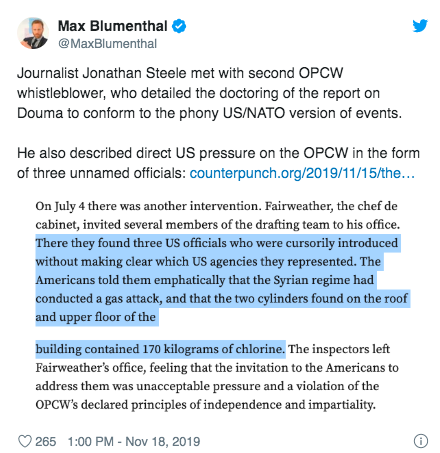
In addition to whoever leaked the Henderson report in May, a second whistleblower going by the pseudonym of “Alex” emerged in October to give a presentation before the whistleblower’s advocacy group Courage Foundation exposing far more plot holes in the official Douma narrative. This same whistleblower also spoke with award-winning British journalist Jonathan Steele, who published a bombshell report on Alex’s revelations in CounterPunch last month.
Among the most stunning revelations in Steele’s article was Alex’s report that US officials attempted to pressure OPCW inspectors during the Organisation’s drafting of its Interim Report on their Douma investigation in July 2018, and that this intercession was facilitated by an OPCW official named Bob Fairweather.
“On July 4 there was another intervention,” Steele writes. “Fairweather, the chef de cabinet, invited several members of the drafting team to his office. There they found three US officials who were cursorily introduced without making clear which US agencies they represented. The Americans told them emphatically that the Syrian regime had conducted a gas attack, and that the two cylinders found on the roof and upper floor of the building contained 170 kilograms of chlorine. The inspectors left Fairweather’s office, feeling that the invitation to the Americans to address them was unacceptable pressure and a violation of the OPCW’s declared principles of independence and impartiality.”
It’s unknown what forces were at play that enabled the US government to insert itself into into an ostensibly impartial OPCW investigation with the help of an OPCW official, but it wouldn’t be the first time the US government leveraged the Organisation into facilitating preexisting regime change agendas against a disobedient Middle Eastern nation. In 2002 Mother Jones reported that the US government, spearheaded by John Bolton, had used the threat of withdrawing its disproportionately high percentage of funding from the Organisation if it didn’t oust its then-Director General Jose Bustani. The popular Bustani, who’d previously been unanimously re-elected to his position, had been hurting the case for war with his successful negotiations with Saddam Hussein’s Iraq. In March 2018, after Bolton was selected as Trump’s National Security Advisor, The Intercept revealed that the campaign to remove Bustani had also included Bolton personally threatening his children.
Bolton was operating at the highest levels of the Trump White House throughout the entire duration of the OPCW’s Douma investigation. He was Trump’s National Security Advisor from April 9, 2018 to September 10, 2019. The OPCW’s Fact-Finding mission didn’t arrive in Syria until April 14 2018 and didn’t begin its investigation in Douma until several days after that, with its final report being released in March of 2019.
3. Levels of chlorinated organic chemicals didn’t indicate any chlorine gas attack took place.
“The main point is that chlorine gas degrades rapidly in the air,” Jonathan Steele told Tucker Carlson last month detailing what was told to him by Alex. “So coming in two weeks later, you wouldn’t find anything. What you would find is that the gas contaminates or affects other chemicals in the natural environment. So-called chlorinated organic chemicals [COCs]. The difficulty is they exist anyway in the natural environment and water. So the crucial thing is the levels: were there higher levels of chlorinated organic chemicals found after the alleged gas attack than there would have been in the normal environment?”
“When they got back to the Netherlands, to The Hague where the OPCW has its headquarters, samples were sent off to designated laboratories, then there was a weird silence developed,” Steele continued. “Nobody told the inspectors what the results of the analysis was. It was only by chance that the inspector found out through accident earlier the results would come in and there were no differences at all. There were no higher levels of chlorinated organic chemicals in the areas where the alleged attack had happened where there is some suspicious cylinders had been found by opposition activists. So it didn’t seem possible that there could have been a gas attack because the levels were just the same as in the natural environment.”
“[Alex] got sight of the results which indicated that the levels of COCs were much lower than what would be expected in environmental samples,” Steele reported in CounterPunch. “They were comparable to and even lower than those given in the World Health Organisation’s guidelines on recommended permitted levels of trichlorophenol and other COCs in drinking water. The redacted version of the report made no mention of the findings.”
“Had they been included, the public would have seen that the levels of COCs found were no higher than you would expect in any household environment”, Alex told Steele.
This inconvenient fact was omitted from both the OPCW’s Interim Report in July 2018 and its Final Report in March 2019.
4. Many signs and symptoms of alleged chlorine gas poisoning weren’t consistent with chlorine gas poisoning.
https://twitter.com/caitoz/status/1187001753192919041?s=20
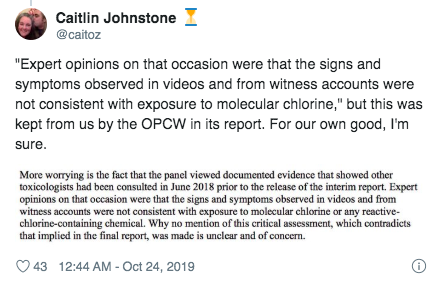
The OPCW’s Final Report on Douma in March 2019 assures us that the team found “reasonable grounds that the use of a toxic chemical as a weapon took place. This toxic chemical contained reactive chlorine. The toxic chemical was likely molecular chlorine.” A leaked internal OPCW email, featuring an inspector voicing objections to the aforementioned Bob Fairweather over vital information being omitted from the developing Interim Report on Douma, contradicts this assurance, saying observed symptoms weren’t consistent with chlorine gas poisoning.
“In this case the confidence in the identity of chlorine or any choking agent is drawn into question precisely because of the inconsistency with the reported and observed symptoms,” the email reads. “The inconsistency was not only noted by the FFM [Fact-Finding Mission] team but strongly noted by three toxicologists with expertise in exposure to CW [Chemical Weapons] agents.”
So the OPCW’s investigative team as well as three toxicologists said what was observed didn’t match chlorine gas poisoning symptoms. This information was, of course, hidden from us by the OPCW.
A leaked first draft of the Interim Report on Douma, before OPCW officials started cutting out chunks which didn’t suit the US narrative, gives more detail. Here are some excerpts (emphases mine):
“Some of the signs and symptoms described by witnesses and noted in photos and video recordings taken by witnesses, of the alleged victims are not consistent with exposure to chlorine-containing choking or blood agents such as chlorine gas, phosgene or cyanogen chloride. Specifically, the rapid onset of heavy buccal and nasal frothing in many victims, as well as the colour of the secretions, is not indicative of intoxication from such chemicals.”
“The large number of decedents in the one location (allegedly 40 to 45), most of whom were seen in videos and photos strewn on the floor of the apartments away from open windows, and within a few meters of an escape to un-poisoned or less toxic air, is at odds with intoxication by chlorine-based choking or blood agents, even at high concentrations.”
“The inconsistency between the presence of a putative chlorine-containing toxic chocking or blood agent on the one hand and the testimonies of alleged witnesses and symptoms observed from video footage and photographs, on the other, cannot be rationalised. The team considered two possible explanations for the incongruity:
a. The victims were exposed to another highly toxic chemical agent that gave rise to the symptoms observed and has so far gone undetected.
b. The fatalities resulted from a non-chemical-related incident.”
5. A doctor in Douma told journalist Robert Fisk that there was no gas poisoning.
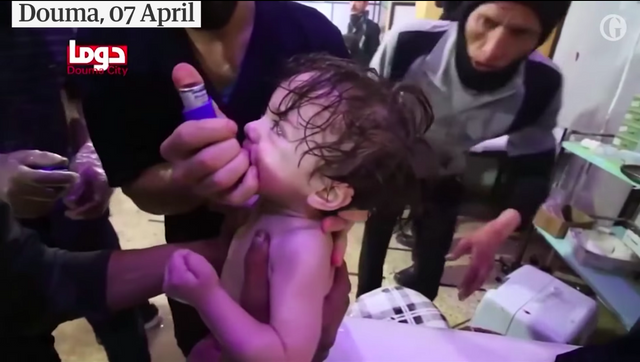
Shortly after the Douma incident a video was circulated online and redistributed on news media around the world featuring people being hosed down with water in a hospital and an infant receiving a respiratory treatment. A doctor who worked in the hospital Assim Rahaibani gave the following account to journalist Robert Fisk days after the incident, saying those in the video were actually just suffering from hypoxia due to dust inhaled after a conventional bombing:
“I was with my family in the basement of my home three hundred metres from here on the night but all the doctors know what happened. There was a lot of shelling [by government forces] and aircraft were always over Douma at night – but on this night, there was wind and huge dust clouds began to come into the basements and cellars where people lived. People began to arrive here suffering from hypoxia, oxygen loss. Then someone at the door, a ‘White Helmet’, shouted ‘Gas!’, and a panic began. People started throwing water over each other. Yes, the video was filmed here, it is genuine, but what you see are people suffering from hypoxia – not gas poisoning.”
Lest anyone accuse Fisk of having any special loyalties to the Syrian government, in this same report he says it “is indeed a ruthless dictatorship.”
6. A BBC reporter said he has proof that the hospital scene was staged.
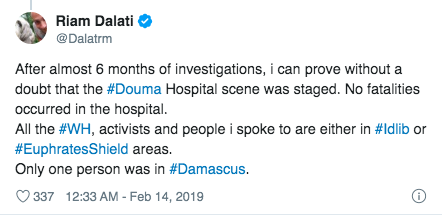
https://twitter.com/Dalatrm/status/1095677403198906369?s=20
The BBC, another establishment that can hardly be accused of Assad loyalism, saw its Syria producer Riam Dalati claiming earlier this year that he had proof beyond a doubt the aforementioned hospital scene was staged. While holding to the establishment line that the attack did happen, Dalati expressed uncertainty as to what if any chemical would have been used and said “everything else around the attack was manufactured for maximum effect.” Emphases mine:
“The ATTACK DID HAPPEN, Sarin wasn’t used, but we’ll have to wait for OPCW to prove Chlorine or otherwise,” Dalati tweeted. However, everything else around the attack was manufactured for maximum effect. After almost 6 months of investigations, i can prove without a doubt that the Douma Hospital scene was staged.”
“No fatalities occurred in the hospital,” Dalati continued. “All the White Helmets, activists and people i spoke to are either in Idlib or Euphrates Shield areas. Only one person was in Damascus. Russia and at least one NATO country knew about what happened in the hospital. Documents were sent. However, no one knew what really happened at the flats apart from activists manipulating the scene there. This is why Russia focused solely on discrediting the hospital scene.”
In other words, Russia knew that these “activists” were staging the scene for the news media, and understandably focused on discrediting their work.
“I can tell you that Jaysh al-Islam ruled Douma with an iron fist,” Dalati added. “They coopted activists, doctors and humanitarians with fear and intimidation.”
Dalati set his account to private for an extended period after these extremely controversial statements got him a flood of attention, but the thread is up on Twitter as of this writing (here’s an archive in case they vanish again).
7. More evidence the Douma scene was knowingly staged for media.
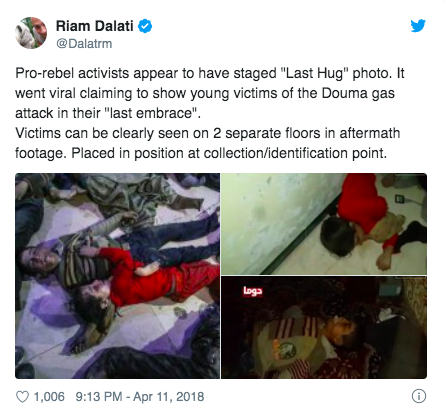
https://twitter.com/Dalatrm/status/984011488938643456?s=20
Riam Dalati also tweeted evidence after the attack that people had staged the corpses of two children to make it appear as though they died hugging each other for the purpose of emotional manipulation. If you’ve got a strong stomach (seriously think hard about whether this is something you want in your head before diving in), Stephen McIntyre also compiled some disturbing proof of dead infants being physically placed on top of other corpses in between video shoots of the Douma incident’s aftermath.
Whoever was positioning these bodies for the cameras clearly had a goal of generating an emotional response from the outside world. Which would be precisely the goal of staging a false chemical weapons attack.
8. Witness testimony at The Hague.
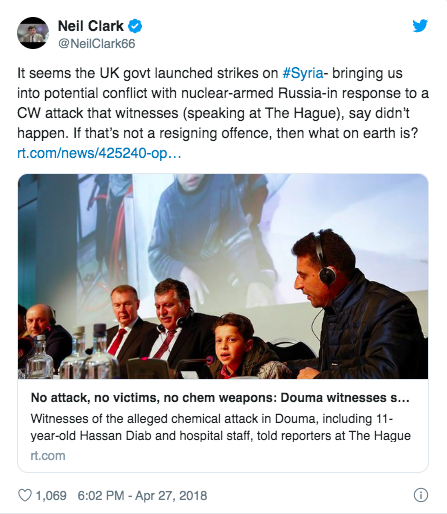
https://twitter.com/NeilClark66/status/989761664680521728?s=20
Seventeen Syrian civilians, including medical personnel and some of the “victims” seen in the aforementioned hospital footage, spoke at the OPCW headquarters in The Hague saying that no chemical weapons attack took place. RT reports:
“There were people unknown to us who were filming the emergency care, they were filming the chaos taking place inside, and were filming people being doused with water. The instruments they used to douse them with water were originally used to clean the floors actually,” Ahmad Kashoi, an administrator of the emergency ward, recalled. “That happened for about an hour, we provided help to them and sent them home. No one has died. No one suffered from chemical exposure.”
The briefing was boycotted by the US and 16 of its allies and was smeared as an unconscionable Russian hoax by media outlets ranging from Sky News to Al Jazeera to The Guardian to The Intercept, apparently for no other reason than that what these Syrians were saying didn’t match the unsubstantiated claims being promoted by the political/media class of the US-centralized empire. If you want to just listen to what the Syrians themselves say and make up your own mind, RT has an English translation video here:
9. The first OPCW Director General finds the glaring irregularities and omissions from the OPCW’s Douma report “very disturbing”.
After the aforementioned Courage Foundation presentation given by Alex this past October, the aforementioned former OPCW Director General Jose Bustani (the one whose kids John Bolton threatened) had this to say:“The convincing evidence of irregular behaviour in the OPCW investigation of the alleged Douma chemical attack confirms doubts and suspicions I already had. I could make no sense of what I was reading in the international press. Even official reports of investigations seemed incoherent at best. The picture is certainly clearer now, although very disturbing”
“I have always expected the OPCW to be a true paradigm of multilateralism. My hope is that the concerns expressed publicly by the Panel, in its joint consensus statement, will catalyse a process by which the Organisation can be resurrected to become the independent and non-discriminatory body it used to be.”
10. This OAN reporter literally just walking around asking people in Douma what they saw.
11. MIT Professor Emeritus Theodore Postol speaking about the plot holes and irregularities in scientific protocol with the Douma investigation.
12. Common sense: Assad stood nothing to gain from launching a chemical attack, while Jaysh al-Islam fighters stood everything to gain by faking one.
This is the initial reason why critical thinkers were so skeptical of the establishment Douma narrative: from the very beginning, it made no sense at all.Click this hyperlink to read a BBC article dated five days before the Douma incident, describing how the Syrian government “appears poised to regain control” of the town and how Jaysh al-Islam fighters were already evacuating. The battle was won. Assad would have stood absolutely nothing to gain from tempting a retaliation from western powers (which could have been far more severe than it ended up being) all to drop a couple of cylinders of chlorine gas, which incidentally is a highly ineffective weapon that ordinarily takes a very long time to kill.
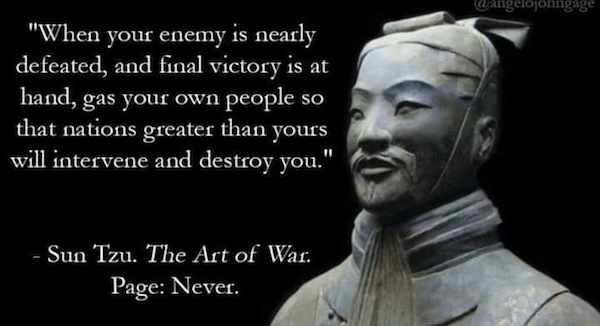
Jaysh al-Islam (and whoever else they may have been working with), on the other hand, would have stood everything to gain by murdering a few of the civilians they had been holding captive in the town they’d invaded in the hopes that western forces would become their airforce for a bit and hold off the Syrian Arab Army from reclaiming Douma.
“Why would Assad use chemical weapons at this time? He’s won the war,” Major General Jonathan Shaw told The Mail on Sunday at the time. “That’s not just my opinion, it is shared by senior commanders in the US military. There is no rationale behind Assad’s involvement whatsoever. He’s convinced the rebels to leave occupied areas in buses. He’s gained their territory. So why would he be bothering gassing them?”
“The jihadists and the various opposition groups who’ve been fighting against Assad have much greater motivation to launch a chemical weapons attack and make it look like Assad was responsible,” the ex-SAS and Parachute Regiment commander added. “Their motivation being that they want to keep the Americans involved in the war – following Trump saying the US was going to leave Syria for other people to sort out.”
Admiral Lord West made similar comments on the BBC around the same time, prompting BBC host Annita McVeigh to flip into frantic narrative management mode suggesting that he’s “muddying the waters” during an “information war with Russia”.
“President Assad is in the process of winning this civil war, and he was about to take over Douma, all that area,” West said. “He’d had a long, long, long slog slowly capturing that area of the city, and there just before he goes in and takes it all over, apparently he decides to have a chemical attack. It just doesn’t ring true. It seems extraordinary, because clearly he would know that there’s likely to be a response from the allies. What benefit is there for his military? Most of the rebel fighters, this disparate group of Islamists, had withdrawn, there were a few women and children left around. What benefit was there militarily in doing what he did? I find that extraordinary.”
“Whereas we know that in the past some of the Islamo groups have used chemicals, and of course there’d be huge benefit in them labeling an attack as coming from Assad, because they would guess quite rightly that there would be a response from the US as there was last time, and possibly from the UK and France,” West added.
“If I were advising some of the Islamist groups, many of whom are worse than Daesh,” West said, “I would say look, we’ve got to wait until there’s another attack by Assad’s forces, particularly if they’ve got a helicopter overhead or something like that and they’re dropping barrel bombs, and we set off some chlorine. Because we’ll get the next attack from the allies. And there’s no doubt that if we believe he’s done a chemical attack we should do that. And those attacks will get bigger, and it’s the only way they’ve got, actually, of stopping the inevitable victory of Assad.”
These are not Assad sympathizers or Kremlin assets saying this. These are not a bunch of hippie dippie anti-imperialists. These are lifelong military men, thinking in military terms, describing what they were seeing. And what they were seeing is the thing that a false flag is.
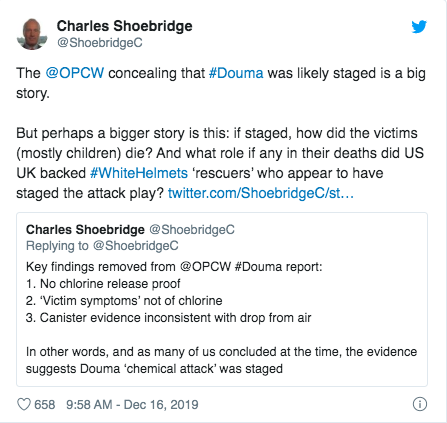
https://twitter.com/ShoebridgeC/status/1206347865729183746?s=20
And now here we are. The US is still illegally occupying Syria in spite of Trump’s repeated verbiage about getting out, and those children are still dead.
This isn’t just some idle philosophical question. People died. A massive war crime occurred and the more minutes tick by before a legitimate investigation is launched–with full transparency and accountability this time–the less available evidence there will be. Which is why establishment narrative managers on Syria go full dead-weight when asked if they support a full criminal investigation into what happened. They don’t actually believe it will go their way, and rightly so.
Meanwhile the illegal occupation of Syria drags on, perhaps until Trump can be replaced with a more compliant puppet, and we’re all basically just sitting around waiting to be deceived again.
This cannot continue. This must not continue.
Genocide, Sanctions and Incirlik: Erdoğan Will Not Kick Out NATO From Its Bases Despite Threats
By Paul Antonopoulos | December 18, 2019
Turkish President Recep Tayyip Erdoğan has dropped a bombshell by announcing that he could shut down the NATO-controlled Incirlik airbase that hosts U.S. nuclear bombs and the U.S. missile warning radar at Kurecik military base, in response to Washington’s threats of sanctions against Turkey. These nuclear bombs are of course placed purposefully close to Russia. The Incirlik air base in the southern Turkish province of Adana is used by the U.S. Air Force while the U.S. military also maintains a missile warning radar in the Kurecik district in Turkey’s southeastern Malatya province, which is part of NATO’s missile defense system in Europe.
“If it is necessary for us to take such a step, of course, we have the authority… We will close down Incirlik if necessary,” Erdoğan said on A Haber TV on Sunday.
Last week, the Committee on Foreign Affairs of the Senate of the United States Congress approved the “Promoting American National Security and Preventing the Resurgence of ISIS Act” bill that directly targets Turkey’s military and economic apparatus. According to the draft bill, the Turkish acquisition of the powerful Russian S-400 missile defense system gives grounds to impose sanctions against this country, under the Countering America’s Adversaries Through Sanctions Act (CAATSA), including against the Minister of National Defense of Turkey, the Chief of the General Staff of the Turkish Armed Forces, the Commander of the 2nd Army of the Turkish Armed Forces, the Minister of Treasury and Finance of Turkey, the Halkbank and a whole host of other senior officials.
This action could further isolate Turkey from NATO, especially after the latest blow against the Eurasian country came last Thursday when the U.S. Senate finally passed S.Res.150 that recognizes the Turkish perpetrated genocide(1915-1923) against Turkey’s Christian minority that saw millions of Greeks, Armenians, and Assyrians exterminated. There is no doubt the long-awaited U.S. recognition of the genocide is politically motivated, and Erdoğan understands this, threatening to recognize the U.S. genocide against Native Americans.
However, there are key differences between a potential Turkish recognition of the U.S. genocide against the Native Americans and the Turkish genocide against the Christians of Anatolia. There are hundreds of thousands, if not over a million, Greeks, Armenians and Assyrians living in the U.S. who have direct ancestry to genocide survivors who lost their entire lives including houses, farms, shops and other associated wealth. These descendants could pressure Washington to seek compensation from Ankara and could intensify sanctions against Turkey if they refuse too. Although the likelihood of compensation is extremely low, it could be used as a justification to strengthen sanctions against Turkey, which in turn will only push Turkey further away from the U.S./NATO and potentially closer to Russia.
On the other side, although Turkey may acknowledge the genocide against Native Americans, I would imagine there are no Native Americans, or maybe just a few, living in Turkey. Ankara could reciprocate sanctions against the U.S., but they would be virtually ineffectual as the world’s monetary system is still overwhelmingly dominated by the U.S. Dollar, despite efforts by Russia and China to de-Dollarize the international economy.
Turkey’s potential closure of the Incirlik and Kurecik bases from the U.S. military would effectively mean freezing relations with NATO. Even a Turkish reclamation of its military bases poses problems however – the obvious being political, but also the military and budgetary costs. However, discussions of Turkey closing the bases are not new. Ankara believes the Incirlik base was a staging point for the 2016 coup attempt against Erdoğan and has already contemplated kicking NATO out of there.
Despite the threat from Erdoğan, Washington will likely not be fazed by the threat for a number of reasons:
1) Washington has already turned Greece into its Plan B option in case Turkey leaves NATO.
2) Turkey leaving NATO could mean the U.S. backing a number of issues that have been frozen because of Washington’s policy of appeasing Turkey for geostrategic reasons, such as the unresolved status of Cyprus.
3) The Incirlik base is also used by other NATO states at times such as the United Kingdom, Germany, France and Italy, and a Turkish reclamation of the base could see Turkey further souring its relations with the European Union.
Although removing the U.S. military from the Incirlik Airbase would be a huge blow to NATO, Erdoğan is unlikely to do this despite Ankara’s strengthening relations with Moscow. Even if this were the case, the most important question still remains, would U.S. President Donald Trump accept this? It is highly unlikely that Trump will want to surrender the base that is critical for U.S. interests and aggression in the Middle East. Although Greece is a Plan B, it is a Plan B for a reason – it is not as strategically placed as Turkey towards the Middle East, and therefore the U.S. will not surrender such a great advantage it has so easily.
Paul Antonopoulos is a Research Fellow at the Center for Syncretic Studies.
Czech think tank funded by NATO govts calls for EU BLANKET BAN on Russian outlets like RT
‘European values’?
By Nebojsa Malic | RT | December 17, 2019
A pro-NATO Czech think tank has another piece of unsolicited advice for Western governments. Now they should refuse to give access or interviews to Russian media, who are ”not real journalists”, according to the ”wise censor”.
At first blush, the ‘Kremlin Watch Strategy’ paper published last week by the Prague-based ‘European Values Center for Security Policy’ sounds like another self-serving attempt to cash in on the anti-Russian hysteria that has gripped many a Western capital for the past several years.
There are some two dozen mentions of “funding,” mostly in the context of urging the European Union to spend more money on “independent” NGOs – such as themselves, obviously – to battle “hostile Russian interference” the authors see under every bed. There is even a proposal for every EU government to conduct its own version of the Mueller probe – which famously found zero evidence of “collusion” between US President Donald Trump and Russia, and its evidence of Russian “meddling” amounted to unsubstantiated assertions from indictments, as its lawyers had to admit in court.
So far, so laughable, right? Except the NGO argues that all European countries should:
“stop legitimising Russian disinformation tools posing as “journalistic platforms”. Communication channels effectively run by the Russian government, be it RT, Sputnik, or Russian state-run TV channels, do not represent journalism, they merely pretend to.”
Since ‘Russians’ are not free media, argues ‘European Values,’ the EU countries should “ban them from press conferences and not give access that is granted only to journalists, which they are not.”
This is not the first time that EV has tried to urge a ban and boycott of “Russian” outlets. In fact, it first emerged from obscurity in 2017, when it compiled an (error-riddled) blacklist of 2,327 “useful idiots” who had appeared on RT, in an effort to intimidate others.
A mere month later, the same outfit sponsored something called the “Prague Declaration,” which was signed by a who’s who of the most prominent Russiagate conspiracy-pushers, along with someone named “Bumfrey McDoogle.”
While it is tempting to dismiss the call for censorship on account that it originates from a low-rent Czech think-tank with an embarrassing history, doing so might be premature. EV gets much of its funding from NATO governments – Dutch, British, German and American, as of 2018. Indeed, they openly admit that London has been “a clear European leader in responding” to the so-called Russin threat, mobilizing the EU “response” and funding “much of the European civil society.”
Could it be mere coincidence that EV’s “new” censorship proposal sounds much like the one formerly peddled by the Institute for Statecraft, a sock-puppet project of the British government that was “burned” at the end of last year, following public exposure??
Far more sinister is that this “recommendation” has already been implemented to some extent. The US government withdrew RT America’s credentials in 2017, after forcing the outlet to register as a “foreign agent.” French President Emmanuel Macron has refused to talk to or accredit RT or Sputnik. The British government canceled RT’s credentials to a press freedom conference in July this year.
In February, Canada refused Sputnik credentials to report from the Lima Group meeting on Venezuela, devoted to US-backed regime change in Caracas. RT Spanish has been taken off air in Ecuador, after reporting on anti-austerity protests – and soon thereafter in Bolivia, by the US-backed unelected government that had violently ousted elected president Evo Morales to praise from Washington.
Last month, Ukrainian activists tried to shout down RT’s head of communications Anna Belkina as she spoke about freedom of the press in Strasbourg. Just like EV, they chanted “propaganda, not journalism.”
Once is a coincidence. Twice is happenstance. This many times is enemy action. Which raises the question of whether free speech really is a “liberal European” value – or do ‘European Values’ and their paymasters actually believe these values only apply to them, and not Others?
Europe was the main player in destroying Syria and creating the refugee crisis
By Steven Sahiounie | Mideast Discourse | December 14, 2019
Monica Maggioni is an Italian journalist and is CEO of Rai.com, which broadcasts ‘Rai News 24 TV’, among others. She interviewed Syrian President, Bashar al Assad, on November 26, and the interview was to be broadcast on December 2; however, it was mysteriously postponed.
Behind the scenes, at Rai.com there was conflict over the interview, with Fabrizio Salini declaring the interview was not commissioned, therefore it would not be broadcast, while Antonio Di Bella, director of news, declared it was not suitable to be broadcast, and Italian Senator Alberto Airola requested Maggioni to explain her role in the interview and answer charges of creating a diplomatic incident.
What was so explosive in the interview that the Italian news media wanted to hide from the Italian viewers? Many believe it has to do with questions 8 and 9 and President Assad’s response.
Question 8: At this moment, when Europe looks at Syria, apart from the considerations about the country, there are two major issues: one is refugees, and the other one is the Jihadists or foreign fighters coming back to Europe. How do you see these European worries?
President Assad: We have to start with a simple question: who created this problem? Why do you have refugees in Europe? It’s a simple question: because of terrorism that’s being supported by Europe – and of course the United States and Turkey and others – but Europe was the main player in creating chaos in Syria. So, what goes around comes around.
Question 9: Why do you say it was the main player?
President Assad: Because they publicly supported, the EU supported the terrorists in Syria from day one, week one or from the very beginning. They blamed the Syrian government, and some regimes like the French regime sent armaments, they said – one of their officials – I think their Minister of Foreign Affairs, maybe Fabius said: “we send.” They sent armaments; they created this chaos. That’s why a lot of people find it difficult to stay in Syria; millions of people couldn’t live here so they had to get out of Syria.
The US-NATO-EU attack on Syria is unprecedented in history. General Wesley Clark was told there was a plan to ‘take out Syria’ well before the first protests took place in Deraa. This was an internationally coordinated attack on Syria by the US and Europe. This was a classic ‘regime-change’ project, which was instigated between the US and Israel, but agreed to by the EU and NATO members. From the early stages of the conflict in Syria, the US and Europe provided political, military and logistic support to the ‘rebels’ in Syria and refused to call them terrorists. On 18 August 2011, President Barack Obama stated, “The future of Syria must be determined by its people, but President Bashar al-Assad is standing in their way. For the sake of the Syrian people, the time has come for President Assad to step aside.” This US statement was fully supported by Europe.
In 2013 President Assad stated he was ready for dialogue with the armed terrorists, but only if they surrender their weapons. However, the US-NATO-EU plan to support the terrorists never included a peaceful surrender of weapons, followed by a national dialog, which would end in a peaceful solution to the conflict. The plan only called for weapons, training, and European officers to be continuously available to the terrorists, for ‘regime-change’. Europe only wanted to fuel the fires in Syria, and never planned to be the voice of peace and international law.
What was at first billed as ‘rebels’ and ‘freedom fighters’ soon morphed into sectarian extremists and Radical Islamic terrorists who filled the battlefields under many names and uniforms, but who were all essentially the same terrorists. Their names ranged from the ‘Free Syrian Army’ to ISIS. Radical Islam is a political ideology and is not a religion or a sect. Many experts have called Radical Islam a ‘Death-Cult’, which glorifies the killing of unarmed civilians, as well as armed adversaries, even to the point of eating human flesh while recording it on video.
Presidents Obama and Sarkozy convinced the EU to follow their lead. However, the Syrian people and armed forces fought back.
Some of the refugees left Syria for ideological reasons, they sided with the terrorists and followed the Muslim Brotherhood. Others left for Europe because their homes and livelihoods were destroyed by the terrorists, but many were just economic migrants, and had not lost a home, were from safe areas, and perhaps had never seen any fighting, and they left to seek an income from the charity offered to them in the EU.
EU-NATO support of terrorism in Syria
Bulgaria: Boïko Borissov, Prime Minister from 2014, supplied the drug ‘Captagon’ to the terrorists in Syria on orders of the CIA. The drug causes the terrorists to lose inhibitions and while under the influence they are capable of horrific atrocities.
Germany: A ship with intelligence and satellite capabilities was off the coast of Syria providing the terrorists the locations and movements of the Syrian military, as well as intercepted telephone communications. Wolfgang Ischinger, chairman of the Munich Security Conference, said: “If the West supplies arms itself, it has more chance of influencing how they are used.”
Great Britain: British intelligence provided terrorists with information on Syrian military movements. In 2012, SAS Commandos were conducting covert operations within Syrian territory, and provided terrorists with military aid, including communications equipment and medical supplies, and provided intelligence support from its Cyprus bases, revealing Syrian military movements which were passed on to the terrorists. In 2013, Prime Minister David Cameron said that Britain would send weapons to the terrorists. In August 2016, the BBC published photographs that showed British Special Forces soldiers guarding the perimeter of the terrorist’s base at al-Tanf, on the Syria-Iraq border, and the terrorists were shown to be equipped with four-wheel drive Al-Thalab vehicles and weapons such as sniper rifles, anti-tank weapons, and heavy machine guns.
France: The ‘Friends of Syria’ group was initiated by then-French President Nicolas Sarkozy in 2012. They declared their intent to support the terrorists in Syria, “If the regime fails to accept the terms of the political initiative outlined by the Arab League and end violence against citizens, the Friends of Syria should not constrain individual countries from aiding the Syrian opposition by means of military advisers, training, and provision of arms to defend themselves.” In 2013, French President François Hollande said, that France was ready to begin supplying lethal aid to the terrorists, and by 2014 Hollande confirmed that France had delivered arms to the terrorists, and by 2015 had begun airstrikes in Syria.
Italy: On 28 February 2013, the ‘Friends of Syria’ held their meeting in Rome, and among the 11 members were France, Germany, Italy, UK, and the EU. In a study published in 2019, the number of terrorists from Italy who were in Syria numbered 135 as of July 2018.
The EU: in 2013 Brussels decided assistance to the terrorists would include weapons training. Jane’s Defense Weekly reported a US shipment of 994 tons of weapons and ammunition in December 2015 from Eastern Europe to Syrian rebel groups, including 9M17 Fleyta anti-tank missiles, RPG-7s, AK-47S, DShKs, and PKMs. In early March 2013, a Jordanian security source revealed that the U.S., Britain, and France were training terrorists in Jordan to begin building a militia that would take over after Assad’s fall. By 2019, the EU issued a statement about Syria in which they now claim to call for peace and political negotiations to settle the conflict of almost 9 years duration and to have supported humanitarian and economic assistance there. However, when faced with documented history, this statement is a bald-faced lie. The EU position from the outset of the conflict was to support the armed terrorists and to prevent even chemotherapy drugs to be imported to Syria, because of the EU sanctions, which today prevents any possible rebuilding effort.
US Weaponizing Space in Bid to Launch Arms Race
By Finian Cunningham | Strategic Culture Foundation | December 12, 2019
While the spats between President Trump and other NATO leaders at the rancorous 70th summit garnered most media attention, barely noticed was the alliance’s announcement to make “space an operational domain”.
The move represents a grave assault on existing treaties forbidding the weaponization of space. The NATO announcement is doubly insidious because it gives the appearance of a multilateral acceptance of US attempts to open up the “final frontier” for militarization. A move which is far from acceptable. In fact, illegal, under international law.
Earlier this year, Donald Trump unveiled a new branch of the US armed forces, Space Command, separate from the Air Force. “Spacecom will defend America’s vital interests in space, the next war-fighting domain, and I think that’s pretty obvious to everybody. It’s all about space,” said Trump at a White House ceremony.
It is the first time that a new branch of the US armed forces has been created since 1947 when US Air Force was created out of the Army. The other existing armed services are the Marine Corps, Navy and Coast Guard. Legislation is currently going through Congress which will authorize the president’s order for setting up the new branch, to be known henceforth as Space Force.
All this is happening with barely any public debate or scrutiny. Even though it represents a dramatic escalation of military dimensions. To the existing domains of land, air and sea the United States under Trump is pushing ahead for weaponization of space. As the “war-fighting” rationale of the president makes clear, the development is explicitly about leveraging new military strike potential.
US weaponization of space has been underway for decades, going back to the “star wars” initiative of the Reagan administration in the 1980s and during the GW Bush presidency in the 2000s. However, Trump is taking the program to a whole new level by implementing a separate dedicated Space Force.
This is in spite of the existing UN-ratified 1967 Outer Space Treaty which prohibits any introduction of weapons, including nuclear weapons, into space.
“States shall not place nuclear weapons or other weapons of mass destruction in orbit or on celestial bodies or station them in outer space in any other manner,” reads the treaty, which provides the basic legal framework for international space law.
Russia and China have been consistently strong advocates for upholding the treaty.
Yet proponents of the US Space Force routinely claim that America is being threatened by Russian and Chinese advances in space military technology. It is not clear on what basis these American claims are made.
Republican Alabama Representative Mike Rogers is quoted by Space News as saying: “We have allowed China and Russia to become our peers, not our near peers and that’s unacceptable.”
But like so many other US claims about Russia and China supposedly threatening American interests, there is little or no evidence presented. The claims rely on ideological prejudice and/or a cynical lobbying service for the military-industrial complex. Going into space will convey billion-dollar contracts to US aerospace corporations.
Indeed, there is a resonance with US claims made in the 1950s and 60s of a “missile gap” which alleged back then that the Soviet Union was outpacing America’s arsenal of strategic nuclear weapons. The putative missile gap was invoked as a pretext for greatly expanding the US arsenal, thereby creating an international arms race, only for the so-called missile gap to be found out years later to be a fiction of American scaremongering. Cynically, that fiction was deliberately propagated to the American public in order to provide a tax-payer-funded pork-barrel production line for the Pentagon and the military-industrial complex.
The same process seems to be underway with Trump’s much-vaunted Space Force.
There is another strategic aspect to this American “weaponization of the heavens”. That is, to force Russia and China into an arms race which Washington calculates would be economically ruinous for Moscow and Beijing. What’s at stake here is a pivotal struggle between Russia and China’s vision of a multipolar world and Washington’s desire to be the globe’s hegemonic uni-power. If the US can break Russia and China economically then it wins this era-defining struggle. Launching an arms race is Washington’s gambit for taking down Russia and China.
The precedent is the arms race in the 1980s under Reagan which brought the Soviet Union to collapse. Because of Washington’s presumed right to print endless amounts of dollars and rack up seemingly limitless national debt, the US is wagering that it will be the last man standing in an arms race with Russia and China.
Russian President Vladimir Putin has repeatedly said that Russia will not fall into the trap of unleashing an arms race. At a recent meeting in Sochi with his top defense officials, Putin emphasized the imperative need to focus on efficiency in weapon systems. Russia’s latest-generation of hypersonic missiles which apparently can evade any US defense shield – despite the latter costing trillions of dollars to develop – is one example.
Nevertheless, if – and it is a big if – the US manages to develop space weaponry, the pressure will be on Russia and China to respond in kind to counter a whole new threat level. That would mean both nations diverting resources into another realm of weaponry instead of developing their economies.
The US Space Force has to be seen in the wider context of Washington unravelling the entire system of global arms controls. The US withdrawal from the Anti-Ballistic Missile (ABM) treaty in 2002 was followed by its withdrawal from the Intermediate-range Nuclear Forces (INF) treaty last year. The Trump administration is moving towards scrapping New START in 2021, the third and last nuclear-arms control treaty.
There is an unconscionable effort by US governments over many years to incite a new arms race. Going into outer space is part of that effort. It is a gross violation of international law and the United Nations by the US to open up a new frontier for military dominance. And the US has utilized the 29-nation NATO alliance to rubber-stamp its criminal weaponization of space.
Elizabeth Warren’s “Foreign Policy”
The Automatic Earth | December 8, 2019
Ronald Reagan and Mikhail Gorbachev first met in Geneva in 1985, in a summit specifically designed to allow them to discuss diplomatic relations and the -nuclear- arms race. At the time, the Soviet Union had started to crumble, but it was still very much the Soviet Union. They met again in 1986 in Reykjavik, in a summit set up to continue these talks. There, they came close to an agreement to dismantle both countries’ nuclear arsenals.
They met once again in Washington in 1987. That was the year Reagan made his famous “Mr. Gorbachev, tear down this wall” speech about the Berlin wall. Then they held a next summit in 1988 in Moscow, where they finalized the Intermediate-Range Nuclear Forces Treaty (INF) after the US Senate’s ratification of the treaty in May 1988.
Reagan’s successor George H.W. Bush met with Gorbachev first in December 1989 in Malta, and then the two met three times in 1990, among others in Washington where the Chemical Weapons Accord was signed, and in Paris where they signed the Treaty on Conventional Armed Forces in Europe. They met three more times in 1991, with one of their meetings, in Moscow, resulting in the signing of the Strategic Arms Reduction Treaty (START I).
One of the most interesting things agreed on during the Bush-Gorbachev meetings was that Russia would allow Germany to re-unite after the wall came down, in exchange for the promise that NATO would not try to expand eastward.
I’ve been re-researching this a bit because it feels like it’s high time that people should realize what US foreign policy was like not that long ago. Even as it involved Reagan and Bush sr., not exactly the peace-mongers of their times. The one thing that was clear to all parties involved is that it was crucial to keep meeting and talking. And talk they did. But look at us now. When was the last summit of a US president with Vladimir Putin?
This came to mind again when I read Elizabeth Warren’s piece in the Guardian today, which made me wonder if she’s for real, if she is really as ignorant as she appears to be when it comes to foreign policy, to Russia, to Trump and to NATO. It would seem that she is, and that makes her a hazard. Not that I see her as a serious candidate, mind you, but then again, I do not see any other one either.
In her article, which reads more than anything like some nostalgic longing for the good old times when she was young, just watch her get all warm and fuzzy over the success of NATO:
Donald Trump Has Destroyed American Leadership – I’ll Restore It
For seven decades, America’s strength, security and prosperity have been underpinned by our unmatched network of treaty alliances, cemented in shared democratic values and a recognition of our common security. But after three years of Donald Trump’s insults and antics, our alliances are under enormous strain. The damage done by the president’s hostility toward our closest partners was on full display at this week’s gathering of NATO leaders in London, which should have been an unequivocal celebration of the 70th anniversary of the most successful alliance in history.
The success of NATO was not inevitable, easy or obvious. It is a remarkable and hard-won accomplishment, and one based on a recognition that the United States does not become stronger by weakening our allies. But that is just what Trump has done, repeatedly and deliberately. He treats our partners as burdens while embracing autocrats from Moscow to Pyongyang. He has cast doubt on the US commitment to NATO at a moment when a resurgent Russia threatens our institutions and freedoms. He has blindsided our partners on the ground in Syria by ordering a precipitate and uncoordinated withdrawal.
[..] he has wrecked US credibility by unilaterally tearing up our international agreements on arms control, non-proliferation and climate change. This reckless disregard for the benefits of our alliances comes at a perilous moment, when we face common threats from powerful adversaries probing the weaknesses of our institutions and resolve. Longstanding allies in Asia are doubting our reliability and hedging their bets. Russia’s land grab in Ukraine has upended the post-1989 vision of a Europe “whole, free, and at peace”. The chaotic Brexit process has consumed our closest partners, while sluggish growth and rising xenophobia fuel extremist politics and threaten to fracture the European Union.
To start with that last point, no. That “post-1989 vision of a Europe “whole, free, and at peace” was destroyed by NATO’s eastward expansion, executed in spite of US, EU and NATO promises that it wouldn’t. Moreover, you can talk about a resurgent Russia, but the country has hardly recovered economically from the 1980’s and 90’s today, and it has no designs on countries to its west.
Just look at the military budgets of the respective countries, where Russia has maybe 10% of the expenditure of the US, let alone the rest of NATO, and you get the picture. Is Russia getting more bang for its buck, because it doesn’t have to maintain a long running Pentagon-Boeing/Raytheon link? Yes, it does. But a 10 to 1 difference is still way out there. It’s not as if they spend half of what the US does, they spend just 10%.
This is because Russia not only doesn’t have to satisfy the desires and needs of Pentagon-Boeing/Raytheon, it’s also because they have no desire to conquer any territory that is not at present Russian.
Russia “annexed” Crimea through fair elections, and it knew that “we” knew that it would never let go of its only warm water port, Sevastopol. When “We” tried to take it away regardless, it did the only thing it could do. And it did it very intelligently. As for Eastern Ukraine, everyone there is Russian, whether by blood or by passport. And there are a lot of strong ties between them and Russians in Russia proper.
If Putin would have volunteered to let these Donbass Russians be shot to bits by the Ukraine neo-nazis that helped the US and EU in the Maidan coup, he would have had either a civil war in Russia, or an all-out war in the Donbass, with perhaps millions of casualties. Putin did what he could to prevent both. Back to Warren:
A mounting list of global challenges demand US leadership and collective action. As president, I will recommit to our alliances – diplomatically, militarily and economically. I will take immediate action to rebuild our partnerships and renew American strategic and moral leadership, including by rejoining the Paris climate accord, the United Nations compact on migration, and reaffirming our rock-solid commitment to NATO’s Article 5 provisions.
But we must do more than repair what Trump has broken. Instead we need to update our alliances and our international efforts to tackle the great challenges of our age, from climate change and resurgent authoritarianism to dark money flows, a weakening international arms control regime and the worst human displacement crisis in modern history.
Wait, what exactly has Trump broken in the foreign policy field? There have been dozens at the very least who have called for NATO to be disbanded, Ron Paul et al, because its sole purpose was to counter the Soviet Union, which no longer exists. In fact, when Emmanuel Macron labeled NATO “brain-dead” last week, it was Trump who defended the alliance.
And sorry, Elizabeth, but to hold Trump responsible for “the worst human displacement crisis in modern history” is just not right. That started way before he arrived at the scene. Obama and Hillary carry the burden and blame for that, along with Bush jr. and Dick Cheney. They shot the crap out of Iraq, Lybia etc. Trump only dumped a few bombs in a desert. He didn’t invade any country, he didn’t go “We Came, We Saw, He Died”. That was not Trump.
And before we forget, the military aid for Ukraine Trump allegedly held back for a few weeks had been refused by Obama for years. I’ve been wondering for ages now why the Democrats are so eager to make things up while ignoring simple facts, but I think at least it’s time to start pointing out these issues.
This is not to make Trump look better in any sense, but to try and make people understand that he did not start this thing. Though yeah, I know, it’s like talking to a wall by now. The political divide has turned into such a broad and yawning one, you can’t not wonder how it could ever be breached.
But, you know, it might help if people like Elizabeth Warren don’t ONLY talk about Trump like he’s the antichrist, or a Putin tool, if they engage with him in conversation. But sadly, it feels like we’re past that point. Like if she would even try, and I don’t know if she would want to, her party would spit her out just for trying to build a single bridge. Like Tulsi Gabbard seems to have tried; and look at how the DNC treats her.
This means revitalizing our state department and charging our diplomats to develop creative solutions for ever more urgent challenges. It means working with like-minded partners to promote our shared interest in sustained, inclusive global economic growth and an international trade system that protects workers and the environment, not just corporate profits. And it means reducing wasteful defense spending and refocusing on the areas most critical to our security in years to come.
Well, apart from the fact that we’ve seen some of those diplomats in the Schiff hearings, and they seemed like the least likely people to develop anything “creative” -other than their opinions-, and the boondoggle of “sustained, inclusive global economic growth”, it’s probably best to forget about that entire paragraph. It’s nicer to Warren too.
Alliances are not charities, and it’s fair to ask our partners to do their share. I will build on what President Obama started by insisting on increased contributions to NATO operations and common investments in collective military capabilities. But I will also recognize the varied and significant ways that European states contribute to global security – deploying troops to shared missions, receiving refugees, and providing development assistance at some of the highest per capita rates in the world.
The problem appears to be that the partners don’t increase their contributions. Just this March, Germany refused to do just that. And if Berlin refuses, why would other countries spend more?
The next president must tackle our common problems using the lessons of common defense. Together, we can counter terrorism and proliferation. We can make common cause in constructing new norms and rules to govern cyberspace. We can dismantle the corruption, monopolies and inequality that limit opportunity around the world and take on the increasingly grave threats to our environment. We can and will protect ourselves and each other – our countries, our citizens and our democracies.
Now we’re getting into entirely nonsensical territory, with words and sentences designed only to make people feel good about things that have no substance whatsoever. Anyone can go there, anyone can do that.
In the meantime, the never ending investigations into Trump, Russia, Ukraine, taxes, have had one major effect: he hasn’t had a chance to have a summit with Putin. And that, to go back to how I started out this essay, is the worst idea out there. If Reagan and Bush sr. did those summits all the time, then why do we now think such summits are the work of the devil?
And yeah, we get it, we got it again last week from alleged law expert Pamela Karlan in the House, who let ‘er rip on the dangers Putin poses to all of humanity, and of course she would never trust Trump to hold any such summit because he’s Putin’s puppet.
What Pamela, and all the MSM, and the Dems, and the FBI/CIA, appear to refuse to see, though, is that Trump was democratically elected by the American people to be the only one who can have any such conversation. Karlan again talked about how Russia would attempt to attack American soil unless “we” keep them from doing that.
Now I can say that is absolute bollocks, and it is, but how many -potential- Democratic voters will recognize that at this point? They’ve been trained to believe it. That Russia wants one US presidential candidate over another, or one UK one, or fill in your country, and therefore they want to invade the US, UK, etc. In reality, Russia has plenty problems of its own, and it’s slowly trying to solve them.
The two countries need to start talking to each other again, and the sooner the better. That it will happen under Elizabeth Warren, however, is very unlikely. First because she has her mind made up about Russia, and second because the likelihood of her becoming president is very low. What do you think, is that a good thing?
If for some reason -who can tell- she would end up winning 11 months from now, do you think she’s likely to establish a peace treaty with Russia? You know, given what she wrote here? And if not, why would you vote for her? Don’t you want peace? Do you think antagonizing Putin forever is a good idea? While Russia continues to outperform America in arms development, and in just about any field? While Russia only wants peace?
Good questions, ain’t they, as we move into 2020?!
NATO Seeking To “Dominate The World” & Eliminate Competitors: Russia’s Lavrov
By Tyler Durden – Zero Hedge – 12/09/2019
Russian Foreign Minister Sergei Lavrov has charged NATO with wanting to “dominate the world” a day after 70th anniversary events of the alliance concluded in London.
“We absolutely understand that NATO wants to dominate the world and wants to eliminate any competitors, including resorting to an information war, trying to unbalance us and China,” Lavrov said from Bratislava, the capital of Slovakia, while attending the 26th Ministerial Council of the Organization for Security and Cooperation in Europe (OSCE).
He seized upon NATO leaders’ comments this week, specifically Secretary General Jens Stoltenberg, naming China as a new enemy alongside Russia. Stoltenberg declared at the summit that NATO has to “tackle the issue” of China’s growing capabilities.
Lavrov told reporters Thursday: “I think that it is difficult to unbalance us and China. We are well aware of what is happening. We have an answer to all the threats that the Alliance is multiplying in this world.” He also said the West is seeking to dominate the Middle East under the guise of NATO as well.
The new accusation of ‘world domination’ comes at a crisis moment of growing and deep divisions over the future of the Cold War era military alliance, including back-and-forth comments on Macron’s “brain death” remarks, and looming questions over Turkey’s fitness to remain in NATO, and the ongoing debate over cost sharing burdens and the scope of the mission.
“Naturally, we cannot but feel worried over what has been happening within NATO,” Lavrov stated. “The problem is NATO positions itself as a source of legitimacy and is adamant to persuade one and all it has no alternatives in this capacity, that only NATO is in the position to assign blame for everything that may be happening around us and what the West dislikes for some reason.”
A consistent theme of Lavrov’s has been to call for a “post-West world order” but that NATO has “remained a Cold War institution” hindering balance in global relations where countries can pursue their own national interests.
NATO still exists, according to Lavrov, in order to “eliminate competitors” and ensure a West-dominated global system in search of new official enemies.
NATO Summit: UK Police Block Access and Detain Ruptly Producer Under ‘Terrorism Act’
21st Century Wire – December 5, 2019
A dangerous precedent may have been set yesterday when an accredited journalist and producer for RT’s affiliate news agency Ruptly, was denied entry to yesterday’s NATO Leaders Meeting in north London – before being detained by British police under the Terrorism Act.
After being told his event press accreditation had been suddenly revoked, the video producer was then taken away and temporarily detained by UK police, where his person, belongings and equipment were then searched.
It is still unknown why the journalist was singled out by British authorities, but it seems increasingly likely that this was a case of intimidation and harassment by the British state against what it perceives to be a ‘hostile’ Russian media.
In recent years, Ruptly has developed into a leading international news wire agency, and managing to pull off a number of world exclusives including the illegal extraordinary rendition of journalist Julian Assange by British police from the Ecuadorian Embassy in London last April.
Ironically, this new incident follows on the heels of the launch of UK government’s international campaign for “Media Freedom“. In September, campaign spokesman Lord Ahmad of Wimbledon, UK Minister for Human Rights, even warned his UN audience about how “the current crackdown on journalists’ across the world is a deep-rooted problem, and a rebuke to the rule of law.” Presumably, this doesn’t apply to matters at home, only abroad.
Featured Video

AIDS Inc. by Gary Null (2007)
or go to
Aletho News Archives – Video-Images
From the Archives
Clash of Civilization, Iran Part II
By Jamal Kanj – Intifada-Palestine.com – January 14, 2011
Israel’s survival kit is: perpetuate conflict, insecurity to rationalize collective hate and finally playing victim.
Devoid of conflict, Israel implodes internally; without hate, Zionism loses its justification; and playing eternal victim to continue blackmailing the West. Absence of this holy trinity, Israel ceases to exist.
From its inception, the house of Zion has mastered exploiting adversarial powers to advance Israel’s cause. For instance, their influence over the Democratic Party in the US began with President Truman’s bid for 2nd term election in 1948.
Responding to strong opposition from Secretary of State General George Marshall and Department experts urging against recognition of Israel, President Truman replied: “I’m sorry gentlemen but I have to answer to hundreds of thousands [Jewish voters] who are anxious for the success of Zionism. I do not have hundreds of thousands of [voting] Arabs among my constituents”
Zionists influence over liberal American politics was matched with the doctrinal school of Conservative theoreticians aligning the Republican Party’s platform with Israel’s objectives. The Neoconservative Zionists, coined Zioncons, invented the “Clash of Civilization” concept to fight Israel’s wars. … continue
Blog Roll
 Aletho News
- Merck Virologists Admitted to Falsely Certifying Vaccine Efficacy
- Mandatory Folic Acid for every man, woman & child
- Pro-Palestine protesters arrested outside UK’s ruling Labour Conference in Liverpool
- Mauritius denies landing permit to flight from Israel, forcing cancellation: Tour operator
- Israeli finance minister calls for genocidal war on West Bank, annexation of south Lebanon
- 12 Things Your Psychiatrist Was Trained Not to Tell You
- From Unipolar Universalism to Multipolar Civilizational Distinctiveness
- RSF military group defects, joins Sudanese army: State media
- Ireland goalkeeper refuses to play ‘Israel’ as squad weighs boycott
- China pushes back against US on Cuba, Iran
- If Americans Knew
- Israel forces Gazans to live in constant peril – Daily Update
- Deconstructing Netanyahu’s pants-on-fire UN rant – Daily Update
- Trump betrayed voters with his campaign lies and prioritized a foreign country once he took office
- Netanyahu calls Israel’s war in Gaza ‘opposite of genocide’ in UN speech to near-empty hall
- Settler Kidnappings: Torture, Sexual Abuse and Terrorisation of Palestinian Abductees as Israel Deepens Annexation of West Bank
- Gaza winter nears as 162,000 tents become unusable, raising fears of humanitarian crisis
- Netanyahu says, “It’s the opposite of genocide”; UN says Gaza economy is world’s ‘most severe crisis on record’ – Daily Update
- Israel’s US-Backed Assault on Gaza Has Created the ‘World’s Most Severe Economic Crisis on Record’: UN
- ‘Protecting U.S. Citizens’… From Israel
- ‘This is where I live now, the back of a truck’: a day in the life of a grandmother in Gaza
- No Tricks Zone
- New Study: Earth And Venus Surface Warmth Largely Explained By Convection And Lapse Rate, Not CO2 Or Radiation
- 2025 Nature Paper Claiming Worsening Global Drought Gets RETRACTED …Heavily Flawed
- New Study: ‘Global Drought Shows No Detectable Recent Acceleration Under Climate Warming’
- Economic Masterminds: German Socialists Suggest Taxing Productivity Gains Stemming From Using AI
- The South China Sea Has Not Been Cooperating With The Climate Change Narrative
- Energy Crisis: Germany Enters Heating Season With Historically Low Gas Reserve Fill Levels
- New Study: The Antarctic Ice Sheet Gained Mass From 2020-2024 Due To Staggering Snow And Ice Accumulation
- Study: Ocean Heating Rates From Thousands Of Years Ago ‘Dwarf’ Modern Ocean Heating Rates
- Climate Extremists Target, Attack Large-Scale Power Grid Infrastructure In Germany!
- New Study: Antarctic Ice Melt Has Contributed Less Than 1 Centimeter To Sea Level Rise In The Last 30 Years

