Gerd Büntzly, Crime Fighter

Photo by John LaForge: International youth group blockades one of three main gates to Buchel Air Force in Germany, July 2018.
By John Laforge | CounterPunch | January 25, 2019
Hamburg, Germany – I was with Gerd Büntzly, 69, of Herford, in a demonstration in Germany July 17, 2017. So were Steve Baggarly, Susan Crane, and Bonnie Urfer, all of the United States. Ours was a peaceful if covert, night-time occupation of a protected aircraft shelter or bomb bunker far inside the Büchel Air Force Base, near the beautiful Mosel River valley.
We were there to help prevent the unlawful use of the shelter in nuclear attacks or nuclear war preparations. Routine nuclear war planning by US and German Air Force personnel there, using US B61 nuclear bombs (NATO’s so-called “nuclear sharing”), violates the Treaty on the Nonproliferation of Nuclear Weapons (NPT) and several other international treaties, all binding on the United States and Germany.
In spite of our formal complaint to state prosecutors against “selective prosecution” of Gerd, and the violation of his “equal protection” rights, only he was charged, tried, and convicted of trespass and property damage (for clipping fences) in January last year. This Jan. 16, he was in court again appealing the conviction. Susan Crane from California and I travelled to Koblenz to speak on his behalf. Attorneys were quite sure that we two could testify, but ultimately were not allowed.
We wanted to explain that international law has the force of state and federal law in Germany and the United States, a fact recognized by Germany’s Constitution (Art. 25) and the US Constitution (Art. 6). According to Univ. of Illinois Law School Prof. Francis Boyle, writing recently for other nuclear weapons resisters, “International law is not ‘higher’ or separate law; it is part and parcel of the structure of federal law. The Supreme Court so held in the landmark decision in The Paquete Habana (1900), that was recently reaffirmed in Hamdan v. Rumsfeld, in 2006.”
Contrary to modern military strategists, there is no such thing as a “limited nuclear war.” Nuclear weapons only produce massacres. Beginning with 8 to 10 million degrees at detonation, followed by indiscriminate mass destruction from blast effects, city-size mass fires (firestorms) in which nothing survives, and uncontrollable radiation poisoning that produces genetic damage unlimited by space or time, nuclear weapons are just massacre delivery systems.
International law has prohibited the planning and not just the commission of such massacres since 1946.
Professor Boyle wrote last November 1st: “The Judgment of the Nuremberg International Military Tribunal meted out severe punishment in 1946 against individuals who, acting in full compliance with domestic law but in disregard of the limitations of international law, had committed war crimes and crimes against peace as defined in its Charter.”
The Nuremberg Charter and Principles apply to individual civilians like us and oblige individuals to disobey domestic laws that protect government crimes. And Nuremberg prohibits all “planning and preparation” of wars that violate international treaties.
The 1949 Geneva Conventions prohibit indiscriminate attacks on noncombatants, attacks on neutral states, and long-term damage to the environment. The 1907 Hague Conventions forbid the use of poison and poisoned weapons under any circumstances.
Under the 1970 NPT, it is prohibited for Germany to receive nuclear weapons from the United States and for the US to transfer them to Germany. Germany and the United States are both formal state parties to all of these Treaties.
“By implication,” Boyle explains, “the Nuremberg Judgment privileges all citizens of nations engaged in war crimes to act in a measured but effective way to prevent the continuing commission of those crimes. The same Nuremberg Privilege is recognized in Article 38 of the Statute of the International Court of Justice which has been adopted as a Treaty (the United Nations Charter) by the United States” [and Germany]. In my opinion, such action certainly includes nonviolent exposure and inspection of sites of ongoing war crimes.”
Because nuclear weapons cannot be used without violating these binding international treaties; since Germany and United States at Büchel are planning and preparing war that violates these treaties; and because the Nuremberg Charter and Principles forbid this planning and preparation, and apply to civilians and military personnel alike, and hold citizens individually responsible; and require citizens to disobey illegal orders, to refuse participation in or ignore international crimes, civil resistance at Büchel is no offense but a civic duty, a lawful obligation, and an act of crime prevention.
In the courtroom, crowded with 40 people, the three-person “bench” (two lay volunteers and one criminal court judge) found Gerd guilty — but reduced his fine from 1,200 Euros to 750 — after making a yawning apology for “deterrence.” Prescient as ever, Professor Boyle’s latest book is, “The Criminality of Nuclear Deterrence” (Clarity Press 2013).
John LaForge is a Co-director of Nukewatch, a peace and environmental justice group in Wisconsin, and edits its newsletter.
‘Western journalists have become cheerleaders for war’ – analyst on Estonian ‘bomb Russia’ article
RT | January 23, 2019
A recent Estonian op-ed calling for capability to shell St.Petersburg and sink Russian ships in case of conflict may be hypothetical, but the pressure on Tallinn to buy missiles from NATO is real, a British journalist told RT.
“Just several limited strikes” on St. Petersburg could be enough to change Russia’s mind if it ever decides to attack Estonia, an opinion piece in Delfi, one of the top online news outlets in the Baltics, suggested. Its author, Estonian journalist Vahur Koorits, also urged the country to become capable of sinking or hijacking Russia ships in order to disrupt trade in the Baltic Sea.
Koorits’s article is part of a wider trend that signals “a sad decline in journalism” in Europe and the US, according to UK journalist Neil Clark.
“A lot of journalists in the West have become cheerleaders for military confrontations and wars… Instead of being skeptical, looking at issues objectively and actually trying to hold power to account, they’re doing the opposite. This is very worrying,” he said.
The publication in Delfi was “the latest in a number of similar articles, basically calling for aggression against Russia,” Clark noted. He recalled another example in the Washington Examiner last year, in which US political commentator Tom Rogan advised Ukrainian authorities to bomb the newly built 19km bridge connecting Crimea with mainland Russia.
“Just imagine a Russian writer saying a similar thing about America or Britain, saying that infrastructure in the US should be bombed. It would be seen as outrageous… hailed as evidence that Russia is aggressive; threatening the West,” Clark said.
However, when a Western journalist is calling for the use of force against the countries that have been labeled as “bad guys” by Washington and London, “there is silence,” he added.
Moscow, of course, has “zero reasons” to attack Estonia and Tallinn would never dare to attack Russia, so the op-ed by Koorits should be treated with “a smile,” the British journalist stated.
However, he warned that Estonia and its Baltic neighbors in Latvia and Lithuania “are very crucial actors of this new Cold War against Russia.”
“Think tanks working for the Western arms companies are promoting this narrative of a Russian threat to the Baltics in order to sell weapons. It could well be that Estonia does come under pressure to buy missiles that could threaten St. Petersburg,” Clark said.
READ MORE:
‘Russians will die in Tallinn if they invade’: Estonian commander launches bizarre rant
House passes bill preventing Trump from leaving NATO, tells allies to start pulling weight
RT | January 23, 2019
The US House of Representatives has passed a bill to prevent President Donald Trump from withdrawing the country from NATO, but called on European allies to pay their dues – just like Trump has demanded.
The bipartisan NATO Support Act was passed on Tuesday in a 357-22 vote that reiterated US commitment to the military bloc and included a provision that rejects any effort made by the president to withdraw from it, banning funding for such actions.
“It’s crazy that we have to be introducing this bill. But it is, unfortunately, both necessary and urgent,” said Rep. Tom Malinowski, one of the Democratic co-sponsors of the bill. “I believe it’s necessary that I take the president of the United States seriously. President Trump has made no secret of his disdain for NATO and his willingness to consider leaving it.”
On the campaign trail and during his presidency, Trump repeatedly criticized NATO, saying the organization allowed other members to take advantage of American generosity and enjoy protection it offers without sharing the burden. The US is by far the biggest contributor to the alliance in terms of finances and soldiers carrying out its missions.
Among other NATO allies, few meet the benchmark two percent of GDP that they are required to spend on defense, which is a commitment that all members made. On many occasions, Trump demanded that this slight was addressed.
The new bill makes the same demand, but Rep. Jimmy Panetta, who spearheaded the legislation, insists it is not like those made by the president.
“What we have to realize is that NATO is not just a transactional relationship,” he said, adding that the focus “can’t just be on who pays what and who gets what. Being a member of NATO is not like being a member of a country club.”
In their statements on the bill, several lawmakers stressed NATO’s role in defending Europe from ‘aggression by Russia.’ This perceived threat has been used to justify an increased military presence of NATO troops close to Russia’s border and regular exercises on a scale unseen since the Cold War. Russia is responding with additional deployments of troops in the west of the country and exercises of its own.
NATO’s uncontrolled expansion eastwards, contrary to verbal assurances made to Soviet leader Mikhail Gorbachev, made Moscow increasingly suspicious of the West’s actions and caused it to spend a lot of resources modernizing its armed forces and boosting its nuclear deterrence over the past two decades.
This policy is now cited as the reason why NATO is necessary. Retired US four-star general David Petraeus recently called it “the greatest gift” the bloc could receive.
Debris of INF treaty will fall far and wide
By M. K. BHADRAKUMAR | Indian Punchline | January 17, 2019
The US-Russia talks in Geneva regarding the 1987 Intermediate-range Nuclear Forces (INF) treaty have ended in failure. In a final call to salvage the treaty, Moscow offered that American experts could inspect a new suspect Russian missile, which Washington has been citing as the alibi for its decision to quit the treaty, but the US point-blank rejected the offer and instead went on to reconfirm that it intends to suspend observance of the cold-war era pact with effect from February 2.
We are entering uncharted waters in regional and international security. Russia anticipates increased US deployments near its borders. In an interview with government-daily Rossiyskaya Gazeta, Russia’s Security Council Secretary Nikolai Patrushev said on Tuesday, “In general, our analysis shows that the American presence near our borders will grow… As for Russia’s western borders, we note the course for the growth of military presence of the US and other NATO members in their vicinity. In 2019, placement of multinational battalion tactical groups in Latvia, Lithuania, Estonia and Poland will continue. At the same time, Brussels does not hide the fact that its main goal is to contain our country. The strengthening of the European segment of the US global missile defense system continues. The inauguration of the missile defense complex in Poland in addition to the already functioning one in Romania is expected in 2020.”
Equally, new faultlines are appearing. Moscow anticipates further US missile deployments to Northeast Asia – specifically, Japan. Moscow estimates that it is unrealistic to expect Japan to adopt an independent foreign policy. This geopolitical reality in Northeast Asia is in turn casting shadows on the recent improved climate in Russo-Japanese relations. (See my blog Russia tamps down the Kuril hype.)
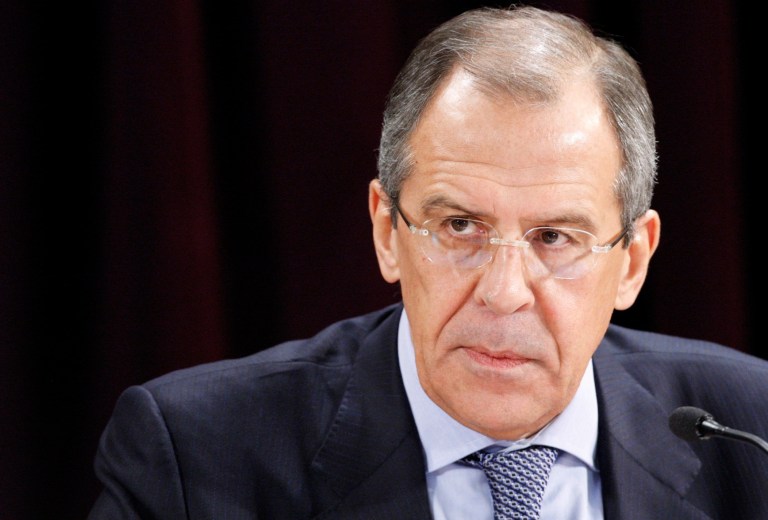
Following the foreign-minister level talks in Moscow on Monday between Russian Foreign Minister Sergey Lavrov and his Japanese counterpart Taro Kono, the latter showed reluctance to hold a joint press conference, underscoring the rapidly changing climate of ties between the two countries. Lavrov’s remarks to the media later signaled a marked toughening of the Russian stance on the territorial dispute over Kuril Islands.
Lavrov demanded an outright Japanese recognition of Russian sovereignty over all the islands in the Kuril chain as part of the outcome of World War 2, as accepted under international treaties and by the UN – “Japan’s indisputable recognition of the entirety of results of World War 2, including Russia’s sovereignty over all of the islands of the southern Kuril chain,” as Lavrov put it.
Lavrov said Japanese domestic legislation must accordingly be changed in consultation with Russia. He added, “This is our base position and without steps in this direction it is very difficult to expect movement forward on other issues (such as peace treaty).”
Evidently, in the developing post-INF treaty scenario, Japan’s security alliance with the US now becomes a major hurdle in Russo-Japanese relations. Lavrov specifically pointed a finger at this: “The 1956 Declaration was signed when Japan did not have a military alliance treaty with the US. The treaty was signed in 1960, after which our Japanese colleagues departed from the 1956 Declaration. Now that we are resuming talks on the basis of this declaration, we must consider the drastic change that has taken place in Japan’s military alliances since then. At today’s talks we devoted attention to the US efforts to develop a global missile defence system in Japan with a view to militarising that part of the world and also to the actions that the US formally justifies by citing the need to neutralise the North Korean nuclear threat. In reality, these actions are creating security risks for Russia and China.”
Interestingly, Lavrov brought in the common concern of Russia and China with regard to the US-Japan security alliance and the American missile deployments to Japan. This is a snub to Tokyo inasmuch as recently, Abe’s aide in the ruling Liberal Democratic Party (which Abe heads) had made a provocative statement that the US should be interested in concluding a treaty between Russia and Japan, as this would “strengthen the bloc” to contain China. Lavrov called it an “outrageous statement” and put across as bluntly as he could the Russian indignation over any Japanese ploy to create misperceptions regarding Russia-China relations:
“The problem is that the president of the Liberal Democratic Party is Prime Minister Shinzo Abe. We have issued a serious warning about how inappropriate such statements are. We have also inquired more broadly about how independent Japan can be in addressing any issues at all with such heavy dependence on the United States. We were assured that Japan would make decisions based on its national interests. We would like it to be that way.” (See a detailed report by China Daily titled Russia tells Japan retaking Pacific islands not on horizon.)
As much as in regard of Russia’s western borders with Europe, the Asia-Pacific also becomes a region where Moscow’s policies will be significantly influenced by the new climate in international security. This holds good for other regions, too.
Most certainly, Russia will be even more wary of any open-ended US-NATO occupation of Afghanistan. The Russian-American contestation over Turkey will become more complex. (The US missile deployment in Turkey was a core issue during the Cuban missile crisis of 1962.) Again, there are reports that a massive expansion of the US bases in Qatar is unfolding (where the US Central Command is headquartered.) Qatar is a potential site for the deployment of US missile systems. Indeed, in the circumstances, Russia’s relations with Iran assume a highly strategic character. Iran’s strategic autonomy is of vital interest to Russia.
The Balkans is another region that Russian strategies will prioritize. Putin is embarking today on a visit to Serbia, which is a key ally, but where conditions may arise for a potential standoff between the West and Russia as had happened in 2014 in Ukraine. In an interview with the Serbian media, Putin came down heavily on the NATO expansion policy, which he condemned as “a misguided, destructive military and political strategy.” He accused the Alliance of “trying to strengthen its presence in the Balkans.” No doubt, a period of heightened tensions in international security lies ahead with the US decision to abandon the INF treaty.
US media intensify pretext for ousting Trump
By Finian Cunningham | RT | January 16, 2019
It’s no secret that since his election in 2016, powerful elements in the US political and media establishment have been running a non-stop campaign to remove Trump from the White House. Lately, the stakes have been raised.
Spearheading the media effort to defenestrate Trump are the New York Times and Washington Post. Both have been prominent purveyors of the “Russiagate” narrative over the past two years, claiming that Republican candidate colluded with Russian state intelligence, or at least was a beneficiary of alleged Russian interference, to win the presidency against Democratic rival Hillary Clinton.
Congressional investigations and a probe by a Special Counsel Robert Mueller, along with relentless media innuendo, have failed to produce any evidence to support the Russiagate narrative.
Now, the anti-Trump media in alliance with the Democratic leadership, the foreign policy establishment and senior ranks of the state intelligence agencies appear to have come up with a new angle on President Trump – he is a national security risk.
Ingeniously, the latest media effort lessens the burden of proof required against Trump. No longer has it to be proven that he deliberately collaborated with Russian President Vladimir Putin. Trump could have done it “unwittingly,” the media are now claiming, because he is a buffoon and reckless. But the upshot, for them, is he’s still a national security risk. The only conclusion, therefore, is that he should be removed from office. In short, a coup.
Over the past couple of weeks, the supposed media bastions have been full of it against Trump. An op-ed in the New York Times on January 5 by David Leonhardt could not have made more plain the absolute disdain. “He is demonstrably unfit for office. What are we waiting for?”
Follow-up editorials and reports have piled on the pressure. The Times reported how the Federal Bureau of Investigation – the state’s internal security agency – opened a counterintelligence file on Trump back in 2017 out of concern that he was “working for Russia against US interests.”
That unprecedented move was prompted partly because of Trump’s comments during the election campaign in 2016 when he jokingly called on Russia to release Hillary Clinton’s incriminating emails. Never mind the fact that Russian hackers were not the culprits for Clinton’s email breach.
Then the Washington Post reported former US officials were concerned about what they said was Trump’s “extraordinary lengths” to keep secret his private conversations with Russia’s Putin when the pair met on the sidelines of conferences or during their one-on-one summit in Helsinki last July.
The Post claimed that Trump confiscated the notes of his interpreter after one meeting with Putin, allegedly admonishing the aide to not tell other officials in the administration about the notes being sequestered. The inference is Trump was allegedly in cahoots with the Kremlin.
This week, in response to the media speculation, Trump was obliged to strenuously deny such claims, saying: “I have never worked for Russia… it’s a big fat hoax.”
What’s going on here is a staggering abuse of power by the US’ top internal state intelligence agency to fatally undermine a sitting president based on the flimsiest of pretexts. Moreover, the nation’s most prominent news media outlets – supposedly the Fourth Estate defenders of democracy – are complacently giving their assent, indeed encouragement, to this abuse of power.
The Times in the above report admitted, in a buried one-line disclaimer, that there was no evidence linking Trump to Russia.
Nevertheless, the media campaign doubled down to paint Trump as a national security risk.
The Times reported on January 14 about deep “concerns” among Pentagon officials over Trump’s repeated threats to withdraw the US from the North Atlantic Treaty Organization (NATO). The reporting portrays Trump as incompetent, ignorant of policy details and habitually rude to American allies. His capricious temper tantrums could result in the US walking away from NATO at any time, the newspaper contends.
Such a move would collapse the transatlantic partnership between the US and Europe which has “deterred Soviet and Russian aggression for 70 years,” claimed the Times.
The paper quotes US Admiral James Stavridis, the former supreme allied commander of NATO, calling Trump’s withdrawal whims “a geopolitical mistake of epic proportion.”
“Even discussing the idea of leaving NATO — let alone actually doing so — would be the gift of the century for Putin,” added Stavridis.
The Times goes on to divulge the media campaign coordination when it editorialized: “Now, the president’s repeatedly stated desire to withdraw from NATO is raising new worries among national security officials amid growing concern about Mr Trump’s efforts to keep his meetings with Mr Putin secret from even his own aides, and an FBI investigation into the administration’s Russia ties.”
Still another Times report this week reinforced the theme of Trump being a national security risk when it claimed that the president’s Middle East policy of pulling troops out of Syria was “losing leverage” in the region. It again quoted Pentagon officials “voicing deepening fears” that Trump and his hawkish National Security Advisor John Bolton “could precipitate a conflict with Iran”.
That’s a bit hard to stomach: the Pentagon being presented as a voice of sanity and peace, keeping vigilance over a wrecking-ball president and his administration.
But the New York Times, Washington Post and other anti-Trump corporate media have long been extolling the military generals who were formerly in the administration as “the adults in the room.”
Generals H.R. McMaster, the former national security adviser, John Kelly, Trump’s ex-chief of staff, and James Mattis, the former defense secretary until he was elbowed out last month by the president, were continually valorized in the US media as being a constraining force on Trump’s infantile and impetuous behavior.
The absence of “the adults” seems to have prompted the US media to intensify their efforts to delegitimize Trump’s presidency.
A new House of Representatives controlled by the Democratic Party has also invigorated calls for impeachment of Trump over a range of unsubstantiated accusations, Russian collusion being prime among them. But any impeachment process promises to be long and uncertain of success, according to several US legal and political authorities.
Such a tactic is fraught with risk of failing, no doubt due to the lack of evidence against Trump’s alleged wrongdoing. A failed impeachment effort could backfire politically, increase his popularity, and return him to the White House in 2020.
Given the uncertainty of impeaching Trump, his political enemies, including large sections of the media establishment, seem to be opting for the tactic of characterizing him as a danger to national security, primarily regarding Russia. Trump doesn’t have to be a proven agent of the Kremlin – a preposterous idea. Repeated portrayal of him as an incompetent unwitting president is calculated to be sufficient grounds for his ouster.
When the Washington Post editorial board urges a state of emergency to be invoked because of “Russian meddling in US elections”, then the national mood is being fomented to accept a coup against Trump. The media’s fawning over the Pentagon and state intelligence agencies as some kind of virtuous bastion of democracy is a sinister signal for a military-police state.
‘NATO Has Outlived Its Usefulness & Should Go Into Dustbin of History’ – Scholar
Sputnik – January 15, 2019
On Monday, The New York Times cited unnamed senior administration officials as saying that US President Donald Trump has ostensibly questioned US membership in NATO and expressed a wish to withdraw the country from the bloc.
Radio Sputnik has discussed the report with Dr Joseph Cheng, Professor of Political Science at the City University of Hong Kong.
Sputnik: What are your thoughts on the report that US President Trump repeatedly expressed his wish to withdraw the country from NATO?
Dr. Joseph Cheng: Well, Trump as a businessman has approached this from the point of view of finances and of course until very recently only four other members of NATO paid the 2 percent of GDP — Britain, Poland, Greece, and Estonia — which he found unsatisfactory. But I believe there are other reasons why NATO has outlived its usefulness, including that, instead of serving as a defensive organisation against a no longer extent Soviet Union, it’s being used for wars of aggression such as the slaughter in Libya, which was orchestrated by Hillary Clinton with the approval of Barack Obama and John Brennan. It was a great atrocity of one of the most humane societies ever realised on the face of Earth.
And now I think the fact that there has been an encroachment on the Eastern Bloc nations [that] Ronald Reagan had solemnly agreed with Mikhail Gorbachev that they would not be weaponised, westernised, no attempt to be made become NATO nations that the United States has grossly violated, beginning with Bill Clinton. And therefore, I believe that withdrawing from NATO and allowing NATO to fall apart would be a good thing for the world, for Europe, for the United States altogether.Sputnik: Professor, the report by The New York Times details Trump’s alleged words dating back to last summer. Why is the media outlet reporting about this now?
Dr. Joseph Cheng: Well, that’s a great question. There has been a massive assault on Trump by the mainstream media and the Democrats because he is being far more successful than they had ever imagined. He has strengthened the American economy prior to the midterms, for example. He had a 50 percent approval rating according to the Rasmussen Poll. He even had a 40 percent approval rating from black Americans. This is devastating potentially to Democrats because if they lose the black vote on which they count having 90 to 95 percent, they are going to have great difficulty winning elections. This is another reason why they are opposing the wall. They want immigrants to come into the United States because they expect they are going vote Democratic. So I believe this is part of an ongoing effort to trash Trump, where the media is reporting only the Democratic version of events, which we know of course, was long since infiltrated by the CIA, in Operation Mockingbird beginning in the 1950s.
Sputnik: Professor, can Donald Trump actually withdraw the United States from NATO, like he withdrew from various other organisations?
Dr. Joseph Cheng: Well, of course, if the president the suggested that might be possible I would have to look at the legalities involving it, but certainly, some of his decisions of the past have been poor ones, withdrawing from the Iran agreement, for example, was not well founded. That was very-very troubling because it made it appear as though he was following an Israeli foreign policy rather than American. The three reasons he gave, namely that the treaty would expire in 2025 was meaningless because it could be renegotiated; that it didn’t cover Iranian military bases that would have been appropriate because it was only concerned with Iran’s nuclear programme and the fact that it didn’t cover Iran’s ballistic missile development was also inappropriate because every sovereign nation is entitled to its own self-defence. So he made a blunder with regard to the Iran deal. My personal opinion is, however, is that NATO has long since outlived its usefulness and should go into the dustbin of history.
Sputnik: How badly does Europe need the US in the bloc? Could they move to be more independent from the US?
Dr. Joseph Cheng: Well, I think that there are many reasons why Europe is growing more independent and, in fact, I think that there is a much more natural reliance between Europe and Russia for example than between Europe and the United States at this point in time; particularly on commercial and economic grounds. The Iran sanctions, for example, have threatened to cost Europe tens of billions of dollars in trade and commerce. So that is all very bad, detrimental to Europe to pursue a policy of sanctions on Iran that was not justified in the first place; where even American intelligence agencies as early as 2007 have concluded that Iran was not pursuing a nuclear weapons programme, which they reaffirmed in 2011 and D-D from the Mossad came on board in 2012 that Iran was not pursuing nuclear weapons, which means these sanctions which are harmful to Europe and to the rest of the world are a bad idea. And of course, pulling out of the Iran deal was not justified from the beginning. So, hopefully, he will display more wisdom in foreign policy than he has heretofore.
Washington in Panic Mode as Trump Reportedly Mulled Withdrawal From NATO
Sputnik – 15.01.2019
Since taking office in 2017, Donald Trump has on a multitude of occasions slammed NATO member states for failing to meet their annual defence spending obligations and insisted on fair burden-sharing.
Over the course of 2018, US President Donald Trump repeatedly expressed a willingness to withdraw from NATO, The New York Times reported, citing current and former senior administration officials.
Although the unnamed sources said that they were not sure if Trump was serious, they allegedly feared that POTUS would return to his threat as other alliance member states failed to boost their military donations to NATO and reach the spending target set by the bloc.
Days ahead of a NATO summit in Brussels last summer, Trump purportedly questioned the alliance’s raison d’être while speaking to senior national security officials, describing it as an exhausting burden on the United States.
The New York Times report suggests that Trump complained about Europe’s failure to meet defence spending goals, thus leaving the US to “carry an outsize burden”.
POTUS was allegedly frustrated with the fact that his transatlantic allies would not, on the spot, pledge to donate more. But at another leaders meeting during the same summit, NATO Secretary-General Jens Stoltenberg praised Washington’s example and suggested that European member states follow suit — Trump was allegedly taken by surprise.
Trump was purportedly annoyed, in particular, with German Chancellor Angela Merkel and her country’s military spending of 1 percent of its GDP.
At the time, then-Defence Secretary Jim Mattis and White House National Security Adviser John Bolton struggled to stick to American strategy without mentioning the potential withdrawal that would inevitably undermine Washington’s influence in Europe and embolden Russia, the newspaper wrote.
According to The New York Times, national security advisers are increasingly concerned over a possible pullout from NATO, as well as Trump’s purported efforts to keep his encounters with Russian President Vladimir Putin secret from his own aides, and an ongoing investigation into the alleged collusion between the Trump campaign and the Kremlin.
“It would destroy 70-plus years of painstaking work across multiple administrations, Republican and Democratic, to create perhaps the most powerful and advantageous alliance in history. And it would be the wildest success that Vladimir Putin could dream of”, Michèle A. Flournoy, an under-secretary of defence under President Barack Obama, told the media outlet.
The newspaper further cited retired Adm. Gen. James G. Stavridis, the former supreme allied commander of NATO, who said that “even discussing the idea of leaving NATO — let alone actually doing so — would be the gift of the century for Putin”.
After The New York Times reached the White House for comment, a senior administration official cited Trump’s remarks in July 2018, when he described Washington’s commitment to the military alliance as “very strong”, with the bloc itself being “very important”.
The insiders, who spoke to the newspaper on condition of anonymity, assumed that with a weakened NATO, President Putin would have “more freedom to behave as he wishes”, thus setting up Russia as a “counterweight” to the United States and Europe.
Although President Trump has not publicly threatened to leave the transatlantic alliance, relations between the US and Europe have hit their lowest point since he blasted other NATO members for not complying with their obligations to boost defence spending.
Trump has on numerous occasions emphasised that the other members of the bloc should pay their “fair share” and stressed that only five of the 29 member states were spending two percent of their GDP to defence, which was “insufficient to close gaps in modernising, readiness and the size of forces”.
On the sidelines of a NATO summit in Brussels in July, the allies agreed to start spending two percent of their GDP by 2024, with Trump pointing out that he was convinced that they would increase defence expenditures in line with their commitments.
At the same time, the US president suggested raising the military spending commitment up to four percent of GDP – that proposal, however, failed to find support.
‘America must rebuild understanding of Russia’: How Integrity Initiative drafted US for new Cold War
RT | January 9, 2019
Shortly after Donald Trump’s election, a UK-funded covert influence group proposed opening a new office in the US to train a “younger generation of Russia watchers” and “strengthen” American role in countering Moscow, leaks show.
The latest tranche of documents, anonymously uploaded online last week, include an outline for “developing a US arm of [the] Integrity Initiative Program” and a schedule for a visit to Washington of its director, which details meetings with former senior Trump adviser Sebastian Gorka, and top diplomats and officials.
‘West badly needs US leadership’
Despite the elected White House administration tentatively attempting a rapprochement with the Kremlin at the time, the group, effectively a foreign agent on US soil, suggests in the first document, dated to August 2017, that Washington needs to go in a radically different, if familiar, direction, “before it is too late.”
“The West is badly in need of a reassertion of US leadership. The EU has been unable to generate any strategic thinking or to exercise convincing leadership. Russia (& China) are successfully driving wedges between EU Member States and between Allies within NATO,” reads the plaintive precis.
The solution: revive the Cold War-era resistance to Moscow through a Washington-dominated NATO, which is elsewhere also listed as a financial sponsor of Integrity Initiative, alongside the UK’s Foreign Office.
“The US needs to rebuild its understanding of Russia and how to deal with it,” while “the UK needs reminding how to play its key role of encouraging/enabling US leadership in Europe/NATO.”
To serve these aims Integrity Initiative plans to “bring together academics, think tankers, journalists, civil servants, politicians, business people,” who understand “the problem” of Russia, but “have not been working coherently.”
This is a facsimile of the model Integrity Initiative rolled out in the UK after its founding in 2015, where it used its “cluster” of influential public voices to discreetly sway, manipulate or to outright dictate Russian coverage on such issues as cyber warfare, Syria and the Skripals. Or, as the text euphemistically puts it, their function is “to ensure the popular support for governments that democracies require.”
With many of the original Cold Warriors now of pensionable age, a vital responsibility of the recruits would be “attracting a new generation of younger analysts to learn from the older generation.”

Screenshot from the leaked US office proposal
There also appears to be implicit criticism of how the actual chosen US president is handling foreign policy, with the document urging the US to “improve its own governance at a time of transition.”
But, luckily for America, it doesn’t have to fear foreign meddling, as “the cluster will work completely impartially and not become involved in US party politics.”
Goulash with Gorka
The second document contains the dates and locations of a trip by Chris Donnelly, the UK military intelligence veteran and director of Integrity Initiative, to the American capital between September 18 and 22 of an unstated year. In the same upload folder, there are several support documents related to some of the events he was set to attend.
The trip involved wall-to-wall meetings, dinners, lectures and workshops, with separate visits to the State Department, National Defense University and the Pentagon, but several names stand out.
One is breakfast with Sebastian Gorka, the hawkish TV intelligence pundit, who served as a deputy assistant to Donald Trump between January and August 2017, and was credited as a key foreign policy inspiration prior to that. Another is a meeting with McCain Institute director Kurt Volker, a former US ambassador to NATO, who currently represents the US in the Ukrainian peace negotiations.
There is a meeting with officials from the State Department’s Global Engagement Center, an official counter-propaganda department, which, perhaps not coincidentally, has recently switched from fighting jihadis online, to combating Russia, having received a boost in funding. On the last day of the four-day trip, Donnelly was due to talk to Dorothy Rayburn, an official at USAID, the civilian aid agency, which has previously been accused by foreign governments of operating as an arm of US intelligence, and has been expelled from Russia since 2012.
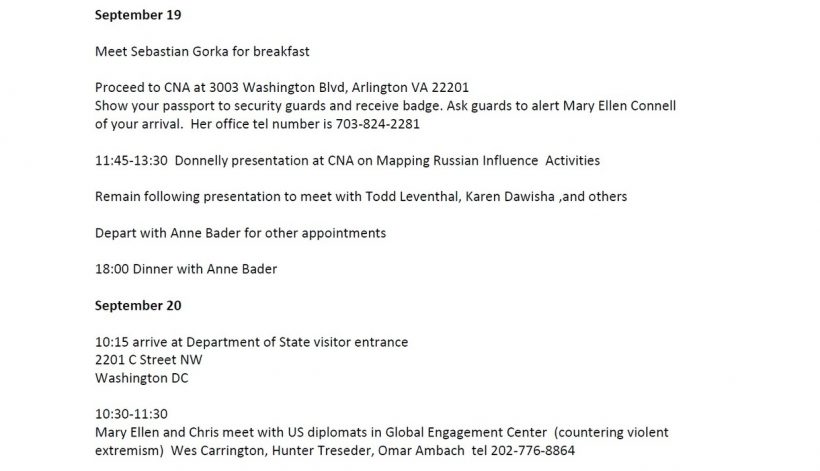
Screenshot from leaked file
It’s not ‘meddling’ when Integrity Initiative does it
Integrity Initiative has acknowledged that its private documents were “hacked” though it has not confirmed or denied the authenticity of any that have been made public in four separate tranches starting from November.
So, with only partial evidence available, it is not possible to conclude if Integrity Initiative did open an office in the US, or whether the talks held by Donnelly resulted in a shift in Russia policy.
Nonetheless, the first leak did contain a document listing a dozen names under the heading “US Cluster,” including several Donnelly was due to meet. There is also an exchange with an FCO official in which Integrity Initiative says that it is in the process of opening a non-profit in the US and, as well as a “simple office” in Washington, plans to create several clusters “in key states, not in DC.” It is not clear what would constitute a “key state” for an agency with Integrity Initiative’s apparently boundless remit.
What does appear certain is that the outfit was setting up its networks of influence covertly, and without declaring its true purpose, despite operating in an allied state. While the meeting with government figures seems to give it a sheen of legitimacy, it is also notable that none of those it met are representative officials, but rather narrowly-known but influential members of various Washington letter agencies. Its policy aims are not democratically-vetted, and possibly even at odds with those officially pursued by the United States.
Nonetheless, while a Russian outfit operating in “key US states” –even if it cultivated peaceful engagement– would surely command the attention of the Mueller investigation, the activities of a UK organization advocating a return to Soviet-era tensions are almost sure to be allowed to continue, without so much as a peep from Washington.
‘They made a mess & are fighting fires’: UK academic says Integrity Initiative fatally hurt by leaks
RT | January 8, 2019
Despite being ignored by Western media, leaks from Integrity Initiative have paralyzed the operations of this UK-funded covert influence network, and could lead to its dismantling, says a leading British academic.
“This has made a mess of [Integrity Initiative’s] operations, they are spending most of their time now trying to fire-fight on the coverage this is getting. And they are not doing essentially what they are being paid to do, which is to counter the Russians,” David Miller, Professor of Political Sociology at the University of Bristol School for Policy Studies, told RT.
“The British government is getting bad value for money, if it was ever getting better value.”
As part of the Working Group on Syria, Propaganda and Media, which studies Western attempts to control media coverage of key international events, Miller has played a crucial role in studying the four tranches of data anonymously uploaded and sourced from the previously little-known group, which has been backed by the UK Foreign Office, NATO and Facebook, to the tune of over £1 million per year.
The documents, whose authenticity has not been denied, contain details of psyops operations against public figures, of the manipulation of media coverage in leading Western outlets, and have also revealed worldwide networks of prominent journalists and academics, secretly engaged to discredit, at every turn, pro-Moscow points of view and political developments.
Despite the refusal by all of those named to either admit their connection or to say that there was nothing untoward in their activities, Miller believes that getting rumbled has made it more difficult for them to push and publish anti-Russian content.
“Most of the people named are trying to pretend that this is not all of great significance, but the revelation of the involvement of the government in manipulating other countries, and the political process in the UK, is extremely damaging for them,” he said, via video link.
For Miller, the “cardinal sin” from a UK perspective was smearing Labour Party leader Jeremy Corbyn, as a potential Kremlin ally in Whitehall, which would mean that a state-paid intelligence operation was meddling in domestic politics.
Miller bemoans the absence of coverage of what he calls a “real, genuine scandal” in top English-language news sources, which, he says, are themselves implicated in the fallout. But regardless, such is the scope of Integrity Initiative’s ambition – from indoctrinating schoolchildren to infiltrating Hollywood – that it should lead to a national dialogue about the role intelligence agencies should play in public life.
“Integrity Initiative are beyond the realms of sense. The activities they are engaged in are morally and ethically dubious, and will certainly – as we can see already – backfire on them,” he said.
“This will result hopefully in the ending of this operation, and if we are lucky, a sensible discussion in parliament about controlling the future British covert operations.”
Guns or Butter: Neocons Want More Weapons less Government Services
By Philip Giraldi | American Herald Tribune | December 30, 2018
It is one of the great ironies that the United States, which is not actually threatened by any foreign power, maintains a ruinously expensive and globally destructive national security policy that is based on fear. It can be argued that Washington was at least briefly a force for stability and good governance in the aftermath of the Second World War when much of Europe and Asia were in ruins, but America’s interference in the internal politics of other nations has, most particularly in the past twenty years, borne bitter fruit. The argument being made that the U.S. national security mandates “forward defense” by maintaining a string of overseas bases and outdated alliances has been proven wrong again and again as allies have proven feckless and countries that would otherwise be friendly have chafed and then rebelled under America’s imposed leadership role.
President and General Dwight D. Eisenhower famously warned in 1961 about the developing military-industrial-complex (MIC), which he had originally dubbed the military-industrial-congressional complex before accepting that he would need legislative help if he were to reverse the seemingly inexorable spending on weapons and expansion of overseas military bases. In the event, Ike’s warning went unheeded and, more recently, the expected “peace dividend” that might have developed from the end of the Cold War in 1991 was wasted when the Clinton Administration recklessly enabled the looting of the former Soviet Union’s natural resources while also expanding the no longer needed NATO alliance up to the Russian border.
Many politicians and industrialists who directly benefit from the spending on the military are largely to blame for propagating the myth that the United States is vulnerable to enemy attack. One only has to recall the panic when Moscow launched a satellite into orbit in 1957 and then there was the essentially fraudulent “Soviet Estimate” by the intelligence community which persisted in overrating Russian military capabilities and the strength of the Soviet Union’s economy. Having a powerful enemy was a sine qua non for those who wished to profit from “defense” spending.
The situation currently is somewhat different than that which prevailed during most of the post-World War 2 era. To be sure, the spending on weapons has continued at a ruinous level but the enemy has changed. Russia is back as a major threat due to the seemingly endless investigations into the 2016 election that have been dubbed “Russiagate,” but it has been joined by China, which is being seen at the major “over the horizon” enemy. And there is also the ubiquitous non-state player “Islamic terrorism” as well as Iran for good measure to keep the money flowing.
It would not be completely fatuous to suggest that the list of all of America’s presumed enemies is at least somewhat contrived. And it is also important to note that the identification of enemies for most Americans depends on the mainstream media, which is now closely linked to corporate and government interests so as to be incapable of independent inquiry or investigation. The impact of a tame media is significant: during the Vietnam War the press was highly critical and hammered the Lyndon B. Johnson Administration. Since then, reporters are embedded and the stories they are allowed to write, are generally puff pieces because to report the truth would make them lose their access.
A recent article that appeared in The Washington Post perfectly illustrates how the newspaper is selling a product that fearmongers to sustain more military spending. It is entitled Wake up. America’s military isn’t invincible, written by regular columnist Robert J. Samuelson.
The article begins with “The most uncovered story in Washington these days is the loss of U.S. military power — a lesson particularly important in light of recent events: the resignation of Defense Secretary Jim Mattis; President Trump’s rash decision to withdraw U.S. troops from Syria; North Korea’s announcement that it will keep nuclear weapons after all; and alleged massive computer hacking by Chinese nationals.”
Now, right off the bat, Samuelson’s argument can be challenged. “Loss of U.S. military power” if it can be quantified at all has nothing to do with Mattis or Syria, nor with North Korea or China. Or even with Donald Trump, who has increased the armed services budget, though one should presume that the president is the ultimate target of the article given that it has appeared in the Post.
Samuelson makes his case by citing defense modernization programs in China and Russia and “advances” in Iran and North Korea that undercut U.S. military capabilities. He refers to a recent report of the congressional National Defense Strategy Commission (NDSC), which identifies specific areas in which Russia and China have upgraded their capabilities and quotes “If the United States had to fight Russia in a Baltic contingency or China in a war over Taiwan . . . Americans could face a decisive military defeat.” The report concludes that “America has reached the point of a full-blown national security crisis.”
The possible armed conflicts cited by Samuelson are, of course, carefully chosen to produce a desired result. Confronting Russia or China in their home waters thousands of miles away from the U.S. gives all the advantage to the defense, which will be able to operate on interior lines and maximize available land, sea, and air forces. And the NDSC report itself is suspect, designed to promote a certain point of view. Its authors are top heavy with retired senior military officers and defense industry “experts” who have a personal interest in more spending on weapons.
Samuelson also cites fellow Post columnist Max Boot, writing that he had “done a great favor by publicizing the report.” He quotes Boot: “Air superiority, which the United States has taken for granted since World War II, is no longer assured. And, without control of the skies, U.S. ships and soldiers would be [highly] vulnerable.” Boot, sometimes referred to as the Man Who Has Never Been Right About Anything is, of course, a neocon mouthpiece who is in favor of war all the time and nearly everywhere, particularly if Israel is involved. He characteristically, like Samuelson, fancies himself as an expert on national security even though he has never served in the armed forces. His “air superiority” mantra is ridiculous as it would seem to suggest that the U.S. should be able to “control the skies” everywhere simultaneously, which is impossible. And he ignores the fact that the United States uniquely has 19 aircraft carriers which can project air power to anywhere in the world.
Samuelson goes on to condemn what he calls “unwise cuts in defense spending” and cites a 12% decline in spending on the military between 2010 and 2015 as well as a decline in the “defense” share of the GDP from 1960 until 2017. Both figures come from the NDSC report. He does not, however, mention that the current defense budget is larger than the military spending of the next eight countries combined, to include both China and Russia.
Samuelson, doing a great impersonation of ex-Speaker of the House Paul Ryan, blames the lack of money for the Pentagon on “the American welfare state — Social Security, Medicare, Medicaid, food stamps and the like.” He advocates cutting “welfare” to buy more and better weapons. He then goes on to liken the current situation to that existing before World War 2, when Adolph Hitler’s Germany rearmed while England and France did nothing. The analogy is not exactly correct as, when war broke out, France alone fielded an army greater than Germany’s, but it’s always reassuring to have Hitler cited yet again in a neocon op-ed.
Samuelson concludes with the obligatory slap at Trump: “We need to keep our commitments — Trump’s abrupt withdrawal from Syria devalues our word. And we need to repair our alliances,” but one might well opine that there is something seriously wrong with that kind of thinking, where guns always take precedence over butter. Government exists to benefit the citizens that together make up the state, not to meddle in the affairs of other nations and peoples worldwide.
The selling of America the All-Powerful is a bit of a con job promoted by neocons like Samuelson and Boot but we do not need to send tens of thousands of young Americans overseas to give “value to our word.” We do not need to enter into pointless wars in places like Afghanistan, Iraq, Libya, and Syria. We do need an America that is at peace with itself and which is willing to be strong and brave enough to realize that real security will come when the United States is no longer the world’s designated bully. Let’s consider a New Year’s wish to see a 2019 where the soldiers, sailors, marines, and airmen finally come home and where scribblers like Samuelson and Boot find themselves unemployed.
Afghanistan: Negotiations or a US Military Defeat?
By Salman Rafi Sheikh – New Eastern Outlook – 24.12.2018
While the Trump administration may think otherwise and even take the credit for initiating dialogue with the Taliban on an unprecedented level with a view to pulling the US out of Afghanistan, there can hardly be any doubt that negotiations, after 17 years of continuous war, are nothing short of an uncomfortable acceptance of their inability to defeat the Taliban militarily. How else do we define a military defeat? In the very act of negotiations is implicit an American admission of the ultimate fact that it has become impossible for it to retain its politico-military hold on Afghanistan through its planted government in Kabul and the US-raised and trained Afghan security forces, despite the continued huge financial support and the support of the US/NATO high-tech military forces in the country. It is for this reason that the US had even to drop its previously adamant refusal to hold direct talks with the Afghan Taliban.
If there is no military defeat for the US and even if the US still has got forces on the ground, the question of holding direct talks with the Taliban points to the increasing inability of the US forces to force the Taliban into submission. Importantly enough, the current phase of talks has been initiated by the US, not the Taliban. The Taliban had repeatedly refused to endorse Kabul’s offers of talks, and only agreed to do talks if the US was willing to engage directly. Therefore, with the US now fully engaged in “peace dialogue”, the US military’s self-proclaimed notion of invisibility stands fully exposed.
While some may argue that dialogue is necessary to end the war through non-military means, it is hard to miss the point that the US military still remains deeply entrenched in the war. For example, apart from the fact that there are thousands of soldiers on the ground, the US air force dropped more bombs on Afghanistan in 2018 than in any other year of the war in 17 years. The number of bombs dropped do not only show that the war basically remains intense, but also that the US military is desperate to change the course of the war to its advantage, an ambition highly unlikely to materialise; hence, the ever more emphasis on dialogue with the Taliban.
And while the US can’t avoid a military defeat, it can still hope to avoid humiliation in Afghanistan. And, for this purpose it is prepared to utilise all available means, including asking Pakistan for help. Even though the Trump administration, ever since it came into power, has cut all military aid and coalition support fund to Pakistan and bi-lateral relations have never been so frosty ever since the beginning of ‘war on terror’, the ever-increasing helplessness against the Taliban has once again forced the US to ‘ask’ for help.
Pakistan, fully aware as it is of the ground realities of Afghanistan and the way the US has already lost the war, is unlikely to ‘help’ the US in turning the table in its favour. In fact, in response to president Trump’s letter to Pakistan’s prime minister, Imran Khan, Khan was quick to rebut Pakistani involvement in any relationship with the US “where Pakistan is treated like a hired gun — given money to fight someone else’s war. We should never put ourselves in this position again.”
The request for help came only two weeks after president Trump had actually accused Pakistan of ‘not doing a damn thing’ in Afghanistan for the US. But the letter he wrote only two weeks after this blatant accusation signified increasing US desperation in Afghanistan and its willingness to still cast Pakistan in a friendly role even though it, as the US claims, never did a damn thing for the US. How wise it is for the US to ‘ask’ for help from a country that it thinks has worked against it through-out the war? How else to explain this wayward and self-contradictory approach than by placing it in the context of an imminent military defeat and US desperation to somehow avoid it by making a face-saving deal with the Taliban?
All this proves that no matter how powerful the US military might be, or how hard it might have worked, or how many years it might have committed to building an Afghan army in its own image, and no matter how much air and logistical support that army might have received, it has failed to militarily defeat the Taliban, who are currently directly and indirectly controlling about 44 per cent of the districts and have even established, as reports have shown, a parallel system of governance and administration in many parts where the Afghan officials work in close cooperation with the Taliban.
More than anything else, this reality exhibits another defeat in terms of the failure of its so-called ‘counter-insurgency’ program’s ability to roll back and replace the Taliban networks on the ground. It also means that the US-planted socio-political governance system in Afghanistan has almost reached the brink of a “political defeat”, much like the imminent defeat of the US military and its trained Afghan forces, which are losing more troops every year than the government can recruit, presenting yet another dilemma which the US forces have failed to resolve even after years of training and advising the Afghan security forces.
All this comes down to a single and indisputable reality: the US must withdraw and let the Afghans decide their future. Instead of finding a way to impose its demands on the Afghans, the best course for the US would be to liaise with other regional countries, including Pakistan, Russia and China, to develop such power sharing formula as would ensure an inclusive political system. Of course, any platform of negotiations and any peace plan that is developed without the Afghans themselves directly involved in its making would be meaningless in terms of reconciling the warring factions within the country. The sooner the US accepts this eventuality, the fewer of the US forces, the Afghan troops and innocent lives would be lost.
Featured Video

AIDS Inc. by Gary Null (2007)
or go to
Aletho News Archives – Video-Images
From the Archives
Clash of Civilization, Iran Part II
By Jamal Kanj – Intifada-Palestine.com – January 14, 2011
Israel’s survival kit is: perpetuate conflict, insecurity to rationalize collective hate and finally playing victim.
Devoid of conflict, Israel implodes internally; without hate, Zionism loses its justification; and playing eternal victim to continue blackmailing the West. Absence of this holy trinity, Israel ceases to exist.
From its inception, the house of Zion has mastered exploiting adversarial powers to advance Israel’s cause. For instance, their influence over the Democratic Party in the US began with President Truman’s bid for 2nd term election in 1948.
Responding to strong opposition from Secretary of State General George Marshall and Department experts urging against recognition of Israel, President Truman replied: “I’m sorry gentlemen but I have to answer to hundreds of thousands [Jewish voters] who are anxious for the success of Zionism. I do not have hundreds of thousands of [voting] Arabs among my constituents”
Zionists influence over liberal American politics was matched with the doctrinal school of Conservative theoreticians aligning the Republican Party’s platform with Israel’s objectives. The Neoconservative Zionists, coined Zioncons, invented the “Clash of Civilization” concept to fight Israel’s wars. … continue
Blog Roll
 Aletho News
- Merck Virologists Admitted to Falsely Certifying Vaccine Efficacy
- Mandatory Folic Acid for every man, woman & child
- Pro-Palestine protesters arrested outside UK’s ruling Labour Conference in Liverpool
- Mauritius denies landing permit to flight from Israel, forcing cancellation: Tour operator
- Israeli finance minister calls for genocidal war on West Bank, annexation of south Lebanon
- 12 Things Your Psychiatrist Was Trained Not to Tell You
- From Unipolar Universalism to Multipolar Civilizational Distinctiveness
- RSF military group defects, joins Sudanese army: State media
- Ireland goalkeeper refuses to play ‘Israel’ as squad weighs boycott
- China pushes back against US on Cuba, Iran
- If Americans Knew
- Israel forces Gazans to live in constant peril – Daily Update
- Deconstructing Netanyahu’s pants-on-fire UN rant – Daily Update
- Trump betrayed voters with his campaign lies and prioritized a foreign country once he took office
- Netanyahu calls Israel’s war in Gaza ‘opposite of genocide’ in UN speech to near-empty hall
- Settler Kidnappings: Torture, Sexual Abuse and Terrorisation of Palestinian Abductees as Israel Deepens Annexation of West Bank
- Gaza winter nears as 162,000 tents become unusable, raising fears of humanitarian crisis
- Netanyahu says, “It’s the opposite of genocide”; UN says Gaza economy is world’s ‘most severe crisis on record’ – Daily Update
- Israel’s US-Backed Assault on Gaza Has Created the ‘World’s Most Severe Economic Crisis on Record’: UN
- ‘Protecting U.S. Citizens’… From Israel
- ‘This is where I live now, the back of a truck’: a day in the life of a grandmother in Gaza
- No Tricks Zone
- New Study: Earth And Venus Surface Warmth Largely Explained By Convection And Lapse Rate, Not CO2 Or Radiation
- 2025 Nature Paper Claiming Worsening Global Drought Gets RETRACTED …Heavily Flawed
- New Study: ‘Global Drought Shows No Detectable Recent Acceleration Under Climate Warming’
- Economic Masterminds: German Socialists Suggest Taxing Productivity Gains Stemming From Using AI
- The South China Sea Has Not Been Cooperating With The Climate Change Narrative
- Energy Crisis: Germany Enters Heating Season With Historically Low Gas Reserve Fill Levels
- New Study: The Antarctic Ice Sheet Gained Mass From 2020-2024 Due To Staggering Snow And Ice Accumulation
- Study: Ocean Heating Rates From Thousands Of Years Ago ‘Dwarf’ Modern Ocean Heating Rates
- Climate Extremists Target, Attack Large-Scale Power Grid Infrastructure In Germany!
- New Study: Antarctic Ice Melt Has Contributed Less Than 1 Centimeter To Sea Level Rise In The Last 30 Years

