Trump and the Gordian Knot, Year Two
By Patrick ARMSTRONG | Strategic Culture Foundation | 09.03.2019
About a year ago I advanced the theory that US President Trump understood that the only way to “Make American Great Again” was to disentangle it from the imperial mission that had it stuck in perpetual wars. I concluded that his statements implied that he believed that
1) the post 9/11 military interventions did nothing for American security;
2) foreign interventions impoverish the country;
3) the alliance system is neither useful nor a good deal for the country;
4) Russia is not the once and future enemy.
I further argued that he understood that the Gordian Knot of entanglements could not be cut from the American end because Americans were too wedded to the idea that the USA was “the indispensable nation” or too complacently accepting of the conceit that it had a moral obligation to set the world aright. (Gallup has just revealed that Americans greatly overestimate the respect and affection the rest of the world holds for them.) In any case “The Swamp” was too entangled in the war business ever to change. I speculated that he understood that the cutting could only come from the other side.
In short I saw method in Trump’s boorishness and well-displayed contempt for Washington’s allies.
So what do we find thirteen months later? Well, of course, one year is not nearly enough time to cause American allies to quit. Washington has not pulled out of NATO and no one has left it, the wars continue, the bases remain; but the Knot is loosening a bit. Despite very strong pressure from Washington, Ankara is going ahead with its S-400 purchase and Berlin is determined to complete Nord Stream. Washington has made its opposition plain – and with menaces – but these two important allies persevere in their contumacy.
Recently more cracks widened. Secretary of State Pompeo at Warsaw, trying to get everyone on board with attacking Iran: “Sadly, some of our leading European partners have not been nearly as cooperative. In fact, they have led the effort to create mechanisms to break up our sanctions.” Vice President Pence at the Munich conference all but ordering the allies to get on board with Washington’s leadership, to stop buying weapons from “our adversaries” and equating opposition to Washington’s stand on Iran with anti-Semitism.
These efforts fell flat. Even The Economist called the Warsaw effort “shambolic” and a number of invited key players sent lower-ranking substitutes. So unenthusiastic was the response that the meeting had to be rebranded as about security in the Middle East rather than about making war on Iran. So, altogether, a bust: the whistle blew but the dogs didn’t come. But worse, Pence’s speech at Munich, praising Trump in every paragraph and threatening allies, fell completely flat with almost no applause. German Chancellor Merkel, speaking for the opposition (lots of applause) demurred. NPR sums up the two meetings:
First, in Warsaw, Poland, the U.S. organized a conference seeking to marshal international outrage over Iran, and Vice President Pence urged France, Germany and the U.K. to abandon the Iran nuclear deal, accusing them of concocting a “scheme” to continue to [do] business with Iran. Top European allies trying to keep the nuclear deal alive declined to send top-level diplomats to the conference.
Then on Saturday, in Munich, German Chancellor Angela Merkel addressed the security conference with several critiques of U.S. foreign policy – and received a sustained standing ovation.
So, a failure for Washington but, if you agree with my theory, a success for Trump’s scheme.
Merkel devoted some time in her speech to Russian gas supplies, pointing out that in the Cold War, both Germanys reliably received gas from Moscow, thereby reminding Pence, if he was listening, of Disagreement Number Two – Nord Stream. We had earlier been reminded of Disagreement Number One which was the unilateral American rejection of the JCPOA. Washington has sanctioned Tehran; the repellent CAATSA (in fairness, not Trump’s doing) means that anyone who trades with someone Washington dislikes will also become a target of Washington’s sanctions. In reaction, Germany, France and the UK have developed a Washington-independent payment system. How effective it will be remains to be seen but it is undeniably a rebellion against Washington’s fiat.
And now we come to Disagreement Number Three: Washington’s rejection of the INF Treaty. Negotiated in 1987 between the USA and the USSR, it eliminated all land-based missiles with ranges between 500 and 5500 km. The Treaty had been preceded by large demonstrations across Europe against the deployment of American missiles. Washington’s excuse is that Russia has violated the Treaty (Theodore Postol has convincingly argued that, whatever Russia may have done, the USA did violate it). Some see it as the latest target of Washington’s dismantling of the arms control treaties of the Cold War, although one cannot rule out the possibility that this is Trump’s opening position to get a new INF Treaty with Russia and China. But it could put the Europeans on Moscow’s target list if the US puts intermediate range missiles into Europe. (The European protests were a causative factor of the original treaty.) In her Munich speech, Merkel called the cancellation “very bad news” and the former head of the NATO Military Committee, Harald Kujat, flatly called it “a betrayal of the security of the European allies“. The full ramifications of this latest trampling of allies’ interests have not been felt but the Atlantic Alliance will not be stronger for it. And I doubt allies will be any happier with Pompeo’s latest blank war cheque.
Even in Korea, where Trump’s new foreign policy has had, perhaps, its greatest success, we see a touch of the same thing. The two Koreas and China are moving forward whatever Washington does or, as in the Hanoi meeting doesn’t, do.
The economic integration plans are moving forward even before the nuclear issue has been resolved, the sanctions have been lifted, or a formal treaty ending the war has been signed. The entire region appears to be breaking out of Washington’s orbit and charting a new course on its own.
Two things seem pretty clear: the Trump Administration is alienating its allies and it doesn’t seem to care very much that it is. Washington has always overborne its allies but it has usually been more polite and discreet about it. Today there is no attempt to hide it: Trump & Co brusquely tell them our way or else.
Will Washington’s contempt and indifference make Europe start to look east?
Donald Trump and his “America First” attitude has thereby afforded Europeans some space to maneuver and establish some level of autonomy, resulting in increasing synergies with Moscow and especially Beijing.
Or will Europe swallow the insults? Will it stand on its “own two feet“? Or have its feet atrophied? We don’t know yet: there is talk, but talk is cheap and easy.
My question remains: we see the alienation but is it deliberately-caused or is it not? Is Trump behaving in a boorishly unilateral way to force his allies to break the imperial connection, or is it just the habitual “America First” style now crudely stripped of the earlier politesse?
(Which is not to say that they’re aren’t some significant inconsistencies in Trump’s foreign policy and, on closer examination, these exceptions become very confusing and inconsistent themselves. I will take up this question separately.)
Former UN Arms Inspector: Europe as Much to Blame for Demise of INF Treaty as US
Sputnik – 06.03.2019
WASHINGTON – The European member nations of NATO are as much to blame for the destruction of the intermediate Nuclear-Forces (INF) Treaty as the Trump administration, former United Nations Chief Weapons Inspector on Iraq Scott Ritter told Sputnik on Tuesday.
“Europe is as much to blame for the demise of the INF Treaty as is the US,” Ritter said. “NATO’s slavish echoing of the US accusations void of any demonstrable proof that the US claims had any validity provided the diplomatic cover the US needed to proceed to withdraw from the treaty.”
On Monday, the Kremlin press service said that Russian President Vladimir Putin had signed a decree suspending Russia’s obligations under the INF Treaty until the United States resumes its compliance with the agreement. Putin’s decree came into effect on the day it was signed.
The United States formally suspended its obligations under the INF Treaty last month and gave Russia six months to comply with its demands, prompting Russia to do the same.
Putin said Moscow did not want a costly arms race but ruled out any new talks on arms controls, saying all earlier proposals remained on the table.
Ritter pointed out that the Trump administration had falsely accused Russia of being in violation of the INF Treaty.
“The US demands vis-à-vis the 9M729 missile were unreasonable. The missile had not been demonstrated to be in violation of the INF Treaty. US accusations were not backed up with any evidence that corroborated the claimed violations,” he said.
There were measures that could have been taken to ascertain whether the 9M729 was in compliance with the INF Treaty, such as a technical inspection of the missile itself, Ritter pointed out. However, the US government refused to pursue those options, he said.
Instead, the US government declared “the Russians to be non-compliant, and demanding that the 9M729 be destroyed. This was an unrealistic and unreasonable demand, purposefully designed to prompt a Russian refusal and as such trigger a US withdrawal — which was the goal all along,” he said.
The US already had the physical infrastructure in place to deploy INF systems in Europe. The Mk 41 Aegis Ashore sites in Poland and Romania could be modified to fire Tomahawk cruise missiles with little effort, Ritter pointed out.
“It seems NATO has little or no institutional memory … NATO doesn’t seem to have woken up to this reality, and the fact that these facilities are in two nations that welcome this kind of anti-Russian provocation means that local protests are unlikely,” he said.
If the US seeks to develop a new INF-type system along the lines of the former Pershing II missile, then the issue will become more complicated, Ritter cautioned.
“It is unlikely any European nation would allow a new INF system to be deployed on its soil, and the consensus-driven reality of NATO is such that getting unanimous consent for such deployment is unlikely,” he said.
Europe was given a reprieve from the reality of living under the threat of imminent nuclear destruction by the INF Treaty, but that era has now ended, Ritter warned.
“Now they will once again know what that nightmare is like. Europe will need to relearn the lessons from the 1980s. The INF Treaty was a unique agreement forged out of the reality of US-Soviet arms control talks during the height of the Cold War. This environment is not likely to be replicated,” he said.
It was unrealistic to think the INF Treaty could be brought back to life, Ritter explained.
“Any effort to create a new treaty vehicle involving China, India, Pakistan, etc. would have to be linked to US and Russian strategic weapons as well. This kind of broad-based multilateral approach to nuclear arms control is virtually impossible to consider under current global conditions,” he said.
In this Aug. 29, 2017, file photo, Japan Air Self-Defense Force demonstrates a training to utilize the PAC-3 surface to air interceptors at the U.S. Yokota Air Base on the outskirts of Tokyo
Moreover, without the INF Treaty, it is likely that the New START Treaty will be scrapped as well, Ritter pointed out.
“There is not the kind of diplomatic foundation for meaningful arms control talks between Russia and the US, and one is not likely to exist while Trump remains president,” he said.
Ritter was one of the first INF inspectors and was assigned to the Votkinsk Portal Monitoring Facility from June 1988-July 1990. He also carried out other INF inspections, as well as handled other treaty-related tasks.
See also:
Japan to Host US Missiles Despite Russian Claim That They Violate the INF Treaty
Integrity Initiative: The Sinister Chain of Events Leading Up to Salisbury
By Kit Klarenberg – Sputnik – March 4, 2019
In several reports to date, I’ve documented how the Integrity Initiative – the shadowy UK government-funded military intelligence front – and its assorted operatives and media assets systematically shaped news reporting on, and Whitehall’s response to, the apparent poisoning of Sergei Skripal and his daughter Yulia on 4 March 2018.
Now, on the anniversary of that fateful and ever-mystifying day, I’ll attempt to track some of the activities of the Initiative’s parent, the Institute for Statecraft, and other key figures and organizations directly and indirectly connected to the body in the years immediately prior.
Troublingly, the information collected here inevitably represents but a negligible fragment of a much wider clandestine picture. The full extent of the British state’s sinister and long-running secret machinations leading up to the Salisbury incident certainly isn’t ascertainable at this time, and may well never be.
‘Peculiar Struggle’
In July 2014, Institute for Statecraft ‘senior research fellow’ Victor Madeira wrote an article for the organization’s website, Russian Subversion — Haven’t we been here before?. In it, he suggested that far from a “new type of warfare”, the West’s tussle with Russia in the wake of the Maidan coup was “actually only the latest chapter in a 100-year-old playbook the Bolsheviks called active measures”, albeit “modernised to exploit the speed and reach of 21st-century mass/social media”.
After attempting to link various tactics employed by the Soviet Union to the modern day, Madeira somewhat chillingly concludes the piece with a quote from Ronald Lindsay, UK ambassador to Germany, who in February 1927 urged Whitehall to realise they were engaged in a “new kind of war” with the then-burgeoning Soviet Union.
“Anti-subversive measures could not be gradual; they had to be part of a package of ‘economic boycott, breach of diplomatic relations’ as well as ‘propaganda and counter-propaganda, pressure on neutrals.’ He argued a diplomatic breach with Moscow would at least turn ‘the present peculiar struggle into an armed conflict of the old-fashioned sort’ that Great Britain and the West could win,” Madeira records.
A document authored by the academic — who 2010 — 2014 tutored and lectured at Cambridge under former MI6 chief Richard Dearlove — in January 2015 (Russian Federation Sanctions ) makes clear he, and presumably his Institute employers, support Lindsay’s strategy and objectives.
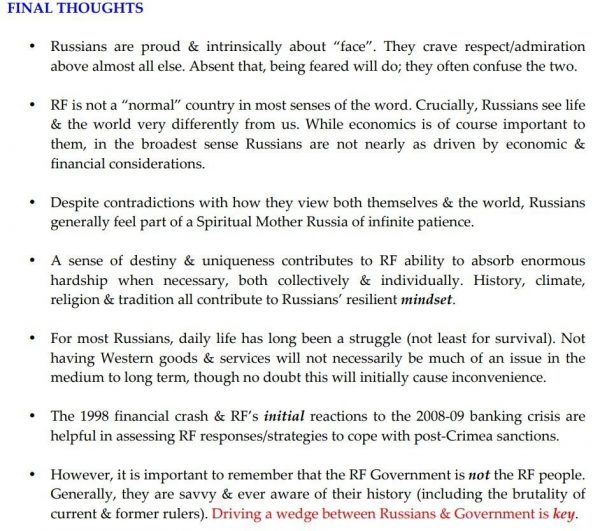
The file sets out a number of “potential levers” for achieving a number of “main aims”, including “peace with Ukraine”, the “return” of Crimea, “behaviour change” and/or “regime change” — for, much to Madeira’s evident chagrin, the wave of sanctions imposed upon Russian individuals and businesses the previous March weren’t having a sufficiently deleterious impact on the Kremlin, or the Russian people.
Victor Madeira’s Ruminations on the Russian People
“[Russia] is not a ‘normal’ country in most senses of the word. Crucially, Russians see life and the world very differently from us… Russians are not nearly as driven by economic and financial considerations… For most Russians, daily life has long been a struggle (not least for survival). Not having Western goods and services will not necessarily be much of an issue in the medium to long-term,” he wrote.
Moreover — and perhaps worst of all in Madeira’s mind — President Vladimir Putin — someone who “survived abysmal post-WW2 conditions” and “[believes] nothing the West can do is worse than what [he’s] already endured in life” — remains popular among the Russian public due to “the chaos” of the 1990s, and for having “restored stability, prosperity and pride”.
“Fear of renewed uncertainty and chaos… keeps Russians in check”, he writes — as a result, “driving a wedge between Russians and [their] government is key.”
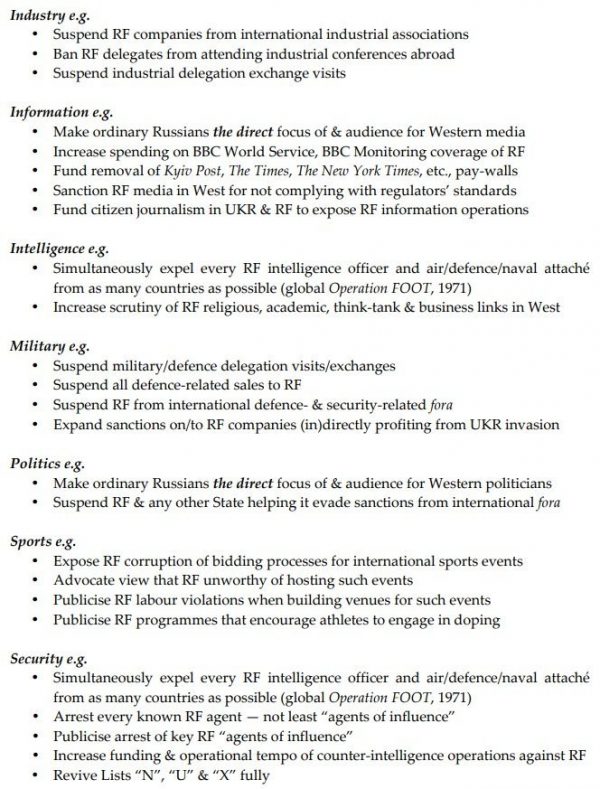
The bullet-pointed “levers” that make up the bulk of the document span areas including ‘diplomacy’, ‘finance’, ‘security’, ‘technology’, ‘industry’, ‘military’, and even ‘culture’, and include; suspending or expelling Russia from “G8, WTO… and similar organisations”; “[expanding] existing sanctions regimes to anyone helping [Russia] break them”; “[arresting] every known RF agent — not least ‘agents of influence'”; “banning RF delegates” from a variety of international fora, “[advocating the] view RF [is] untrustworthy of hosting [international sporting events]; “[banning] Russian companies from launching IPOs in [the] West”‘; asset freezes and “visa bans” for the “top 100 RF government officials and [their] immediate families”; “[sanctioning] RF media”; and much, much more.
‘Potential Levers’ for Regime Change in Russia Outlined by Victor Madeira
Certain “levers” — such as suspending visits by the Bolshoi and Kirov Ballets to Western countries — are baffling, while others — for instance “repatriating” the children of Russian government studying abroad, or “[increasing] scrutiny” of Russian religious organizations in Western countries — appear wanton and excessive, if not outright barbarous.
However, one of Madeira’s suggestions, about which he was apparently so enthusiastic he mentions it thrice, “simultaneously [expelling] every RF intelligence officer and air/defence/naval attache from as many countries as possible (global ‘Operation Foot’)” — is especially striking.
Operation Foot saw 105 Soviet officials deported from the UK in September 1971 at the behest of then-Prime Minister Edward Heath, the largest expulsion of foreign state personnel by any government in history. Eerily, several mainstream media outlets would reference the historic mass defenestration when Whitehall successfully corralled 26 countries into expelling over 150 Russian diplomatic in response to the Salisbury incident, 27 March 2018.
‘Something Dreadful’
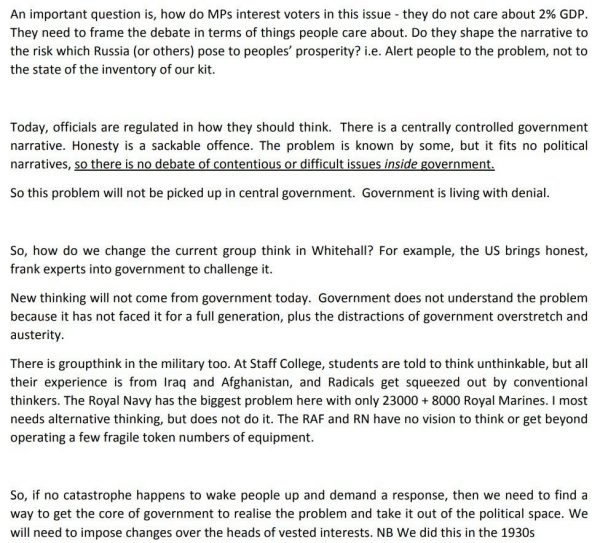
On 12 October 2016, Institute for Statecraft chief Chris Donnelly met with retired senior UK military official General Richard Barrons, Joint Forces Command chief 2013 — 2016. Their discussion was incendiary.
“We have led comfortable lives since the end of the Cold War. Wars have been away matches on our terms, with resources we have chosen to apply. Our institutions are now failing to deliver or being bypassed. Our world system is being challenged, by Russia, China… the power of initiative and decision is ebbing away from the West. [The] US can no longer protect us,” the document’s introduction states.
As 50 percent of the UK’s energy, and 40 percent of the UK’s food, is “from abroad”, the country “has vital interests in having the ability to engage globally, but that engagement will no longer be on our terms alone”. However, while in recent wars “the opposition had no peer capabilities and could pose no military threat” to the UK, the conflicts “have not required the full mobilisation of the military or any motivation of civilian society” and “given us the impression we can afford war at two percent GDP”, despite the UK needing “£7 billion just to our current force up to effectiveness”.
Moreover, “mixed success” in these conflicts is also said to have “left a bad aftertaste” with “no appetite for intervention” among the British public and politicians, and UK armed forces “cannot themselves speak out and say ‘we are broken’… as that would breach the rules of democratic control”.
Record of Richard Barrons’ Meeting with Chris Donnelly
Barrons goes on to despair that the subordination of the military to civil servants and ministers in the Ministry of Defence means “the military do not do policy” — a state of affairs he believes must be radically changed, with the armed forces removed from government control and transformed into “an independent body outside politics”.
“Government is living in denial… We need discussion and debate as to how Russia can be managed and deterred. We need to deal with Russia by doing things that are serious… If no catastrophe happens to wake people up and demand a response, then we need to find a way to get the core of government to realise the problem and take [the military] out of the political space. We will need to impose changes over the heads of vested interests… [we] must either generate the debate or wait for something dreadful to happen to shock us into action. We must generate an independent debate outside government… there is not a moment to be lost,” Barrons concludes.
Serious Matters
Barrons’ fears of a loss of US military protection were no doubt widespread within the British establishment — for some time, US Presidential candidate Donald Trump had been questioning the necessity of NATO, advocating a protectionist and insular ‘America first’ agenda in respect of world affairs.
Likewise, Trump’s repeated suggestion of improved relations between Washington and Moscow should he become President were unquestionably unwelcome in many quarters — not least, of course, the offices of the Institute for Statecraft. It’s perhaps unsurprising then the organisation played a pivotal role in kickstarting ‘RussiaGate’.
The month after Donnelly’s meeting with Barrons, and mere weeks after Trump’s shock election victory, Andrew Wood — UK ambassador to Russia 1995 — 2000, and a member of the Institute’s ‘expert team’ — was a delegate at the eighth annual Halifax International Security Forum in Canada. Senator John McCain was also in attendance, and the pair would speak privately on the event’s sidelines about allegations of Trump’s collusion with the Russian state, in particular, the claims of former MI6 operative Christopher Steele, and his ‘Trump-Russia’ dossier.

Andrew Wood’s Institute for Statecraft Staff Profile
How and why McCain and Wood met, and precisely what they discussed, isn’t remotely clear — Wood has offered several wildly divergent accounts of the event since, variously suggesting the meeting was entirely chance and initiated by McCain due to the issue “being very much in the news”, that he approached McCain due to his personal concerns after being shown the dossier by Steele, and that he was actively “instructed” by Steele to relay the dossier’s contents to the Senator, without having actually seen a copy in full.
In any event, as a result of their conversation, the Senator dispatched his aide David Kramer, former assistant secretary of state in the Bush administration, to meet with Steele in London and discuss the dossier’s contents, and arrange for a copy to be sent to Washington. On 9 December, McCain met then-FBI Director James Comey and provided him with the dossier, which Comey then circulated across all US intelligence agencies. It would reach the desk of outgoing President Barack Obama and several senior members of Congress in the first week of January 2017.
This development would be reported 10 January by CNN — the article stated the dossier suggested Russian operatives possessed “compromising personal and financial information” about Trump, but the outlet refrained from publishing specific details of the dossier as they hadn’t been “independently corroborated”.
CNN breaking cover — the dossier had been an “open secret” among US journalists for some time by that point — would provide BuzzFeed News with the ‘public interest’ defense it required to justify publishing the dossier, which it did 11 January, despite acknowledging its contents were “unverified, and potentially unverifiable”, and contained “clear” factual errors.
In the days afterward, the publication was severely criticised by many other media outlets — Washington Post columnist Margaret Sullivan called the dossier “scurrilous allegations dressed up as an intelligence report meant to damage Donald Trump” — and the ethics of publishing unsubstantiated information offered by entirely anonymous sources was hotly debated.
However, these misgivings were quickly silenced, thanks in no small part to a number of esteemed ‘experts’ who vouched for Steele’s credibility in the media — the earliest, most enthusiastic and prominent being none other than Wood himself. He would describe Steele as “very professional and thorough in what he does”, and “a very competent, professional operator” who wouldn’t “make things up”, among other effusive plaudits.
It would take months for Wood to reveal he wasn’t merely ‘familiar’ with Steele, but the pair were in fact long-time friends — and moreover he was an “associate” of Steele’s firm (what form this relationship takes, and whether Wood receives any remuneration from Orbis Intelligence, remains uncertain). Conversely, his association with the Institute for Statecraft has never been acknowledged by the mainstream media, and would never have been known if it wasn’t for the leak of the organization’s internal files in November 2018.
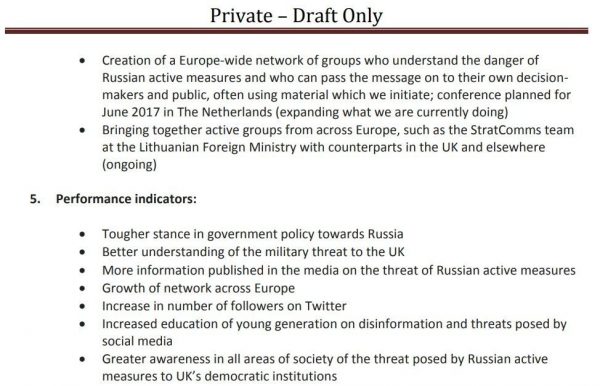
The leak also revealed that in March 2017, the Integrity Initiative submitted a bid for Ministry of Defense funding — among its key performance indicators achieving a “tougher stance in government policy towards Russia”, the publication of “more information in the media on the threat of Russian active measures”, the growth of its cluster network “across Europe” and “greater awareness in all areas of society of the threat posed by Russian active measures to UK’s democratic institutions”.
Integrity Initiative Bids for MoD Funding, March 2017
Russ to Judgement
BuzzFeed would again be used as a conduit for virulently anti-Russian propaganda in June, when it published a series of articles — From Russia With Blood – documenting 14 ‘suspicious deaths’ in Britain it claimed were potential or likely assassinations carried out by Russian “security services or mafia groups”, which UK authorities somehow failed to properly investigate.
The investigation caused something of a sensation, landing BuzzFeed in the running for a variety of prestigious journalism awards, including the Pulitzer and Orwell prizes — Investigations Editor Heidi Blake, who led the series, said her team’s work had cemented the outlet as a “major force in global news”.
However, examination of the seven articles offers much reason for scepticism. First and foremost, suggestions of possible Russian involvement in the deaths hinge almost entirely on the accusations of anonymous intelligence sources, without supporting documentation of any kind. In fact, the pieces often contain information directly contradicting the notion a featured individual was even murdered, let alone by Russians.
For instance, the third installment, The Man Who Knew Too Much, delved into the case of Dr. Matthew Puncher, a UK radiation scientist who’d been conducting work at a Russian nuclear facility, and was found stabbed to death in his kitchen in February 2016.
BuzzFeed notes Puncher’s wife Kathryn told investigators her husband tried to hang himself with a computer cable the the week prior, and Detective Constable Rachel Carter, who inspected the scene, told the inquest “there was no sign of a struggle, none of the furniture had been knocked over, and all the blood belonged to Puncher”, and she was “satisfied” he’d committed suicide as “all the information told us he was very depressed and no-one in his family seemed particularly surprised he had taken his own life”.
However, BuzzFeed had other ideas, stating “four American intelligence officials… believe he was assassinated”. Alternatively, a former senior Scotland Yard counter-terror officer unconnected to the case was quoted as suggesting — also anonymously — the Russian state could have given Puncher drugs to “create depression” and precipitate his suicide.
The fourth installment — The Secrets Of The Spy In The Bag — deals with Gareth Williams, the GCHQ codebreaker seconded to MI6 who died in a Pimlico flat owned by the spying agency in August 2010 and is similarly dubious in the extreme.
Williams’ demise is unambiguously mysterious — his decomposing naked body was found in a padlocked sports bag in the bath, although no fingerprints or traces of his DNA were found on the rim of the bathtub, bag, bag’s zip, or padlock, and an inquest ruled his death to be “unnatural and likely to have been criminally mediated”.
Litvinenko’s been in the news a lot the last couple of days, but nothing about MI6 spy Gareth Williams. The Met found it was ‘probably’ a self-inflicted ‘accident’ that he ended up padlocked inside a bag, in a bath, with none of his fingerprints on either. pic.twitter.com/wofSh40rvY
— dan barker (@danbarker) March 12, 2018
Ironically, much of the article’s content raises serious questions about the role of Williams’ employer’s in his death. For instance, BuzzFeed notes he’d been dead for around 10 days by the time his body was found, but astoundingly neither GCHQ nor MI6 had alerted authorities to his absence from work. It would take his sister informing GCHQ Williams was missing at 11:30 am GMT on 23 August for the agency to contact police — albeit five hours later.
The outlet also records how in the ensuing investigation police were prevented from interviewing Williams’ colleagues at MI6, or reviewing relevant documents, and instead forced to rely upon officers from national counter-terrorism force SO15, which took no formal statements from witnesses, and passed on only anonymised briefing notes to their Metropolitan force counterparts.
Conversely, BuzzFeed fails to mention coroner Dr. Fiona Wilcox ruling involvement of SIS staff in Williams’ death was a legitimate line of inquiry for police — instead again relying on the unsubstantiated claims of the anonymous quartet of US intelligence officials that Williams had been tracing international money-laundering routes used by organised crime groups to blame his probable murder on the Kremlin, and/or Russian gangsters.
The eponymous investigation — focusing on the suicide of Scot Young, an associate of oligarch Boris Berezovsky — is perhaps the series’ most puzzling, for more reasons than one. Young — a corrupt tycoon with clear criminal connections — lost all his money on a failed property endeavor, spent time in prison for contempt of court, and suffered a lengthy and costly divorce battle.
Such a litany of crippling personal calamities — and doctors’ appraisal of him as “paranoid, with a manic flavour” with a “complex delusional belief system” — would surely make Young at least a potential candidate for suicide watch, and indeed police concluded he’d taken his own life by throwing himself from his apartment window.
Three of his associates, Paul Castle, Robbie Curtis, and Johnny Elichaoff likewise “experienced dramatic financial [collapses]” in which they lost all their potentially ill-gotten gains, and subsequently took their own lives — Castle and Curtis both jumped in front of oncoming trains, while Elichaoff leaped off the roof of a London shopping centre.
Yet again though, the word of anonymous US intelligence officials is sufficient to perk BuzzFeed’s suspicions about all their deaths, the unnamed operatives saying Russia could have “engineered” their suicides “through manipulation and intimidation tactics”.
The article’s discussion of Berezovsky’s death is likewise suspect and contradictory, quoting Richard Walton, Scotland Yard’s former counter-terror commander, as saying his department investigated the exiled Russian’s death “very thoroughly” and “hadn’t been able to find any evidence of murder”. Fascinatingly though, in seeking to construct a case for Berezovsky being unlawfully killed, BuzzFeed notes business partner, Georgian oligarch Badri Patarkatsishvili, died from an apparent heart attack in 2008. American spy agencies are said to have intelligence suggesting he was murdered, and while predictably none is presented in the article, Patarkatsishvili was provably subject to at least one assassination plot prior to his death — and it certainly wasn’t Russian in origin.In 2007, covert recordings revealed three Georgian national security service officials had plotted to kill ‘Georgia’s Richest Man’ at the behest of then-President Mikheil Saakashvili. In one recording they debate the best means of execution, an official suggesting they use a poisonous substance which will “kill a person two hours after touching it”. “You smear [it] on the door handle,” they say — the precise method by which Sergei and Yulia were contaminated with novichok, according to UK authorities.
Whatever the meaning of that parallel, BuzzFeed’s series is highly significant, for it was fundamental to cementing the notion of frequent Kremlin-directed murders on British soil in the public consciousness in the year prior to Salisbury. Almost inevitably too, it was widely invoked in the immediate wake of the apparent poisoning as evidence, if not proof, of Russian state involvement.
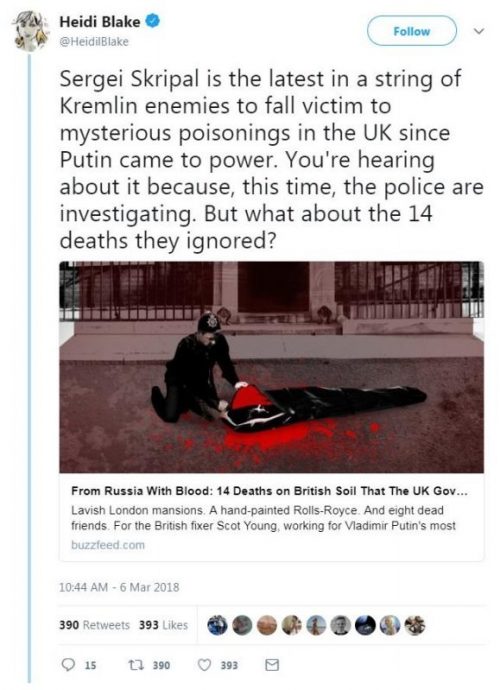
A Tweet by BuzzFeed Investigations Editor Heidi Blake on Skripal, Documented by Integrity Initiative
Among those seeking to connect From Russia With Blood with the attack on the Skripals was none other than BuzzFeed’s Heidi Blake herself. Her Twitter postings on the subject would be documented by the Integrity Initiative in regular roundups of social media activity relating to the incident — and reference to the series was made in an Initiative briefing document (likely circulated to journalists), Russian Lies and the Skripal Case, which called the “evidence” presented by her team’s investigation “compelling”.
So it was on 13 March 2018, nine days after the Salisbury incident, then-Home Secretary Amber Rudd announced British police and MI5 would reinvestigate the numerous ‘suspicious deaths’ detailed by BuzzFeed — a development the outlet reported rather triumphally. However, a mere four months later, Home Secretary Sajid Javid revealed police had determined there was “no basis on which to re-open any of the investigations”. Fittingly, in December an inquest concluded Alexander Perepilichnyy, one of the ‘BuzzFeed 14′, had died of entirely natural causes.
Whatever the truth of the matter, a month prior the Initiative invited Blake to head an hour-long ‘Investigative Masterclass’ at an event the organization convened at London’s Frontline Club — Tackling Tools of Malign Influence.
‘A Good Shepherd’
Also in June 2017, BBC Diplomatic Editor Mark Urban somewhat miraculously began conducting a series of interviews with Sergei Skripal in the latter’s Salisbury home.
“I was intending to write a book about East-West espionage… My intention was to focus the story on a handful of people, using their stories, and the moment these narratives intersected at Vienna airport, during the swap of 2010, as the key to its structure. Skripal was to be one of the central half-dozen or so stories… I was doing this in my own time — there was no contract. The only sense in which this was a ‘book’ in June 2017 was in my own imagination,” Urban claims.
Over the course of their discussions, Skripal would disclose much about his time in the intelligence services, spell as a double-agent for MI6, incarceration in Russia after discovery, and life in Britain post-exile — although his enduring patriotism Urban found particularly notable.
“[Skripal] is… an unashamed Russian nationalist, enthusiastically adopting the Kremlin line in many matters, even while sitting in his MI6-purchased house,” Urban records, “he was adamant, for example, Putin had not surreptitiously introduced Russian troops into east Ukraine, as much of the Western press reported. If regular units had gone in, he insisted, they would have been sitting in Kiev very soon.”
“The problem with the Ukrainians is they are incapable of leadership. They need Russia for that. The Ukrainians are simply sheep who need a good shepherd,” Skripal explained.
Such sentiments may explain why Skripal seemingly remained in regular contact with the Russian embassy after his arrival in the UK. Speaking to the Independent 7 March 2018, former Kremlin official Valery Morozov, an associate of Skripal likewise exiled to the UK, claimed Skripal had meetings with Russian military intelligence officers “every month”.
Strikingly, he also rejected the notion the apparent nerve agent attack had anything to do with the Kremlin.
“Putin can’t be behind this. I know how the Kremlin works, I worked there. Who is Skripal? He is nothing for Putin. Putin doesn’t think about him. There is nobody in Kremlin talking about former intelligence officer [sic] who is nobody. There is no reason for this. It is more dangerous for them for such things to happen,” Morozov cautioned.
Urban would bizarrely fail to reveal having bagged the unprecedentedly fortuitous scoop until three months after the Salisbury incident — an extremely curious delay, perhaps partially explained by his lucrative book deal with publisher Pan Macmillan being announced mere days later.
Yes, I met Sergei Skripal a few times in 2017 while working on a book project. He’s a remarkable man with a dry sense of humour and a great resilience given all he’s been through https://t.co/hfppMtFM0H
— Mark Urban (@MarkUrban01) July 4, 2018
The resultant work, The Skripal Files, was published in October — rather than a history of “East-West espionage”, the project had evolved into an extensive telling of the government’s official narrative on the Salisbury incident, buttressed by discussions of alleged Kremlin assassinations in the UK, and Skripal’s life and career.
However, while widely marketed as the “definitive account” of the affair, the name Pablo Miller doesn’t appear once in the text — an amazing oversight given Miller was Skripal’s MI6 recruiter and handler, and neighbour in Salisbury, rendered all the more perplexing by Miller and Urban once having served in the same tank regiment.
Miller’s connections to the Salisbury incident are unclear, and by design — immediately afterwards he deleted his LinkedIn account, which revealed him to be a Senior Analyst at Christopher Steele’s Orbis Intelligence, and on 7 March Whitehall issued a D-notice blocking mention of him in the mainstream media. Miller also has unclear connections to Integrity Initiative, his name appearing on a list of invitees to an event hosted by the organization, alongside representatives of the BBC, Porton Down, the FCO, the MOD and the US Embassy.
Adding to the intrigue, Initiative operative Dan Kaszeta — a “counterfeit” chemical weapons ‘expert’ who was the very first source to suggest Sergei and Yulia may have been struck by novichok, a mere four days after the Salisbury incident — noted he’d met Urban “several times over the past few years” in a glowing review of The Skripal Files (since removed from the web) he wrote for the organization in December 2018.
In what may just be an intensely spooky coincidence, as 2017 drew to a close British-American TV project Strike Back: Retribution – a spy-drama based on a novel of the same name by ex-SAS soldier Chris Ryan — began airing on Sky One in the UK. The series followed the activities of Section 20, a fictional branch of British Defence Intelligence, which conducts secretive high-risk missions throughout the globe.
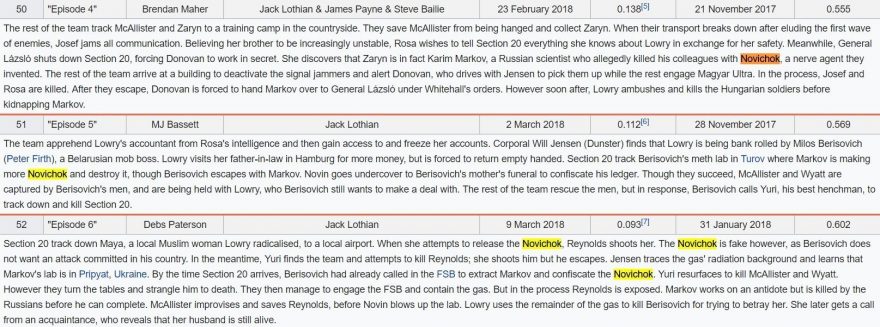
‘Strike Back: Retribution’ Episode Summaries
In episode four, broadcast 21 November, it’s revealed character Ilya Zaryn — who Section 20 rescued from the clutches of a terrorist group — is, in fact, Karim Markov, a Russian scientist who murdered a number of his colleagues with novichok, and is assisting the terrorists in their nefarious schemes.In the next episode, Section 20 locate Zaryn/Markov in a laboratory in Turov, Belarus, where he’s found producing more novichok — but while they manage to destroy the facility and the nerve agent, the dastardly Russian escapes.
In the next, Section 20 track Markov to a lab in Pripyat, Ukraine — but in attempting to contain the nerve agent, Section 20 operative Natalie Reynolds is contaminated. The unit forces Markov to create an antidote, but is killed before he can concoct one — Reynolds’ fellow agent Thomas McAllister manages to improvise and save her, however.
The series would air early the next year in the US on Cinemax — the second episode featuring novichok was transmitted 2 March, two days prior to the Salisbury incident, the third 9 March, five days after.
Expecting the Unexpected
Mainstream hostility towards the Kremlin had been intense ever since 2014, but ‘RussiaGate’ pushed this antipathy into overdrive. Critical, aggressive and paranoid media reports and statements by politicians had become an essentially daily staple by the start of 2018.
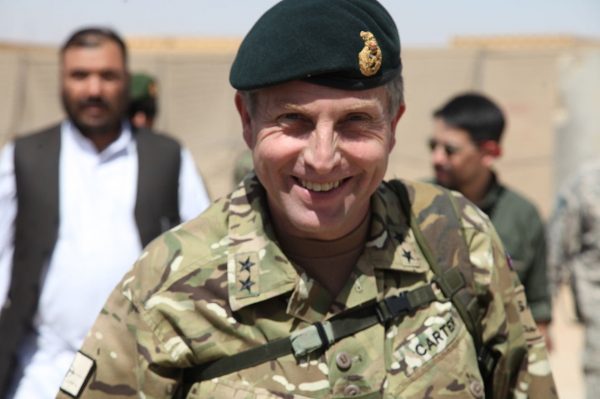
CC0
UK Chief of General Staff Gen. Nick Carter (File)
Nonetheless, on 22 January General Nicholas Carter, UK Chief of General Staff, offered perhaps the most hawkish speech on Russia since the demise of the Soviet Union. Speaking at a Royal United Services Institute event, Carter described the country as the “most complex and capable state-based threat to our country since the end of the Cold War”, and warned hostilities could start “sooner than we expect”, particularly as he — ironically — claimed the Kremlin had “[convinced] ordinary Russians the West is a threat… We have been made to appear as the enemy”.
“If Russia sees itself in decline, and more able now to go to war than in the future, does this encourage them to think of war? Perhaps compare the situation today to 1912 when the Russian Imperial Cabinet assessed that it would be better to fight now, because by 1925 Russia would be too weak in comparison to a modernised Germany; and Japan, of course, drew similar conclusions in 1941. Russia worries, I think, that the West will achieve a technological offset in the next decade,” he cautioned.
Carter said the conflict — which he naturally envisaged being initiated by Russia — would “start with something we don’t expect”.
Not long after the speech, Operation Toxic Dagger was launched — a vast three week effort in which 40 Commando Royal Marines, Public Health England, the Atomic Weapons Establishment and Porton Down’s Defence Science and Technology Laboratory collaborated to prepare Britain’s armed forces for Chemical, Biological, Radiological and Nuclear operations by creating “realistic exercise scenarios based on the latest threat information”.
The endeavour included “company-level attacks and scenarios concerning CBRN vignettes, concluding with a full-scale exercise involving government and industry scientists and more than 300 military personnel”, with a “chemical decontamination area set up not merely to treat ‘polluted’ commandos, but also wounded prisoners”.
It was convened on Salisbury Plain — several of the Royal Marines taking part would be seconded to Operation Morlop, a multi-agency ‘clean-up’ effort launched in Salisbury in the wake of the poisoning of the Skripals, less than a fortnight after Operation Toxic Dagger was completed.
The Military Industrial State Confronts Russia and China
By Brian CLOUGHLEY | Strategic Culture Foundation | 26.02.2019
The swaggering arrogance of Washington’s Military-Industrial Complex never ceases to intrigue the rest of the world, much of which shrugs collective shoulders but has to acknowledge that the swaggering reflects the US National Defence Strategy which informs us that the military is going to concentrate on confronting Russia and China.
One of the loudest voices in the confrontation chorus is that of the Commander of US Naval Forces in Europe, Admiral James Foggo III, who knows that the noisier he is, the more money will be allocated by government to acquire more and more ships. And he is very good at being noisy. In 2016 he wrote a particularly bellicose piece for the US Naval Institute, titled ‘The Fourth Battle of the Atlantic’ in which he castigated Russia for not acknowledging that the United States is supreme. He declared that “the new Russian national security-strategy depicts the United States and NATO as threats to Russian security and accuses us of applying ‘political, economic, military, and information-related pressure’ on Russia.”
He is absolutely right about the US-NATO threat, because it has been growing for almost twenty years. As I’ve written before, after the Warsaw Pact disbanded in March 1991, NATO, although deprived of any reason to continue in existence, managed to keep going, and in 1999 added Poland, the Czech Republic and Hungary to its 16 members. As the BBC noted, these countries became “the first former Soviet bloc states to join Nato, taking the alliance’s borders some 400 miles towards Russia.”
With good reason Moscow wondered what on earth the US-NATO military cabal might be planning.
The New York Times recorded that the 1999 expansion was “opening a new path for the military alliance” and expressed delight that the ceremony took place in the town of Independence, Missouri, where “the emotional Secretary of State Madeleine K Albright watched the three foreign ministers sign the documents of accession, signed them herself, then held them aloft like victory trophies.” Ms Albright was born Marie Korbelová in Prague and “made no secret today of her joy as her homeland and the two other nations joined the alliance.” But neither she nor anyone else is on record as explaining what “new path” would be taken by NATO.
NATO continued to expand around Russia’s borders, inviting Bulgaria, Estonia, Latvia, Lithuania, Romania, Slovakia and Slovenia to join in 2002, which they did two years later.
There is little wonder that Russia is apprehensive about NATO’s intentions, as the muscle-flexing coalition lurches ever more eagerly towards conflict.
Further, the US itself has hundreds of military bases, spread all round the world. As noted by Nick Turse “Officially, the Department of Defense maintains 4,775 “sites,” spread across all 50 states, eight US territories, and 45 foreign countries. A total of 514 of these outposts are located overseas, according to the Pentagon’s worldwide property portfolio… But the most recent version of that portfolio, issued in early 2018 and known as the Base Structure Report, doesn’t include any mention of al-Tanf [the US Special Forces base in Syria] or for that matter, any other base in Syria. Or Iraq. Or Afghanistan. Or Niger. Or Tunisia. Or Cameroon. Or Somalia. Or any number of locales where such military outposts are known to exist and even, unlike in Syria, to be expanding.”
Yet Admiral Foggo insists that “an enduring objective of Russian foreign policy today is to challenge NATO and elevate Russia on the European stage once again.” Well, certainly Russia wants to be on the European stage, and it must be pointed out that it’s closer to that stage than is the US. It wants to trade with Europe — as is appreciated by the main European powers, Germany and France — and would be crazy to take action that would work against this mutually beneficial cooperation.
Unfortunately, Poland and the Baltic States of Estonia, Latvia and Lithuania are verging on the paranoid about Russia’s supposed “threat” to them — but there has been no indication of any sort by Moscow that Russia has any intention of moving against them in any way. Trade with these countries is important, too, but this hasn’t stopped the paranoid quartet from indulging in a vastly expensive operation to “decouple power grids from Russia” in spite of the fact that “Russia, on which the Baltic states currently rely to balance their power flows, has never cut power or threatened to do so.”
This is all part and pattern of the anti-Russia obsession that is mounting in much of the West, and plays into the hands of such as Admiral Foggo who now, some three months after an incident in the Kerch Strait last November, announced it “irritates me to no end” that Russia detained and charged 24 Ukrainian sailors who were involved in the illegal passage of some Ukrainian vessels. Foggo’s fury lies in his belief that “They are uniformed Ukrainian sailors and officers and chiefs. They’re not criminals, and they are being charged under a criminal code.”
None of his pronouncements make sense, but on February 19 Foggo despatched the guided-missile destroyer Donald Cook to the Black Sea where it is to conduct “maritime security operations and enhance regional maritime stability, combined readiness and naval capability with our NATO allies and partners in the region.” The provocative sortie by the Donald Cook will achieve absolutely nothing other than the heightening of tension between the US and Russia, which, unfortunately, is the object of the exercise.
Which brings us to the other region where the US Navy fandangos for freedom, the South China Sea.
On that side of the world the US is represented militarily by Admiral Philip S Davidson, the Commander US Indo-Pacific Command, who doesn’t like China. On February 12 he warned the US Senate Armed Services Committee that China’s “first aircraft carrier group, centered around its refurbished Soviet-built carrier, reached initial operational capability in mid-2018” and its “first domestically-built aircraft carrier has completed four sets of sea trials since May 2018 and will likely join the PLA Navy fleet in 2019.” This is very interesting, but what he doesn’t say is that the United States has eleven fully operational carrier strike groups, one of which, headed by the carrier John C Stennis, as recorded by Stratfor, “is underway in the US 7th Fleet area of operations in support of naval operations to ensure maritime stability and security in the Central Region.” It is, as noted by the US Naval Institute “in the South China Sea” where it will contribute to tension by sailing through waters averred by China to be its own. Admiral Davidson announced that China was not abiding by the UN Convention on the Law of the Sea and naturally failed to note any amusing irony in the fact that the United States has not ratified the Convention. But in any event, in the eyes of Washington’s Military Industrial State, UN rules are valuable only when they coincide with US policy.
On January 7 the US Pacific Fleet announced that the USS McCampbell, a guided missile destroyer, had carried out a “freedom of navigation” operation, sailing within 12 nautical miles of China’s Paracel Islands “to challenge excessive maritime claims.” Then on February 11 they were at it again, with CNN reporting a 7th Fleet announcement that the guided-missile destroyers USS Spruance and USS Preble had sailed within 12 nautical miles of the Spratly Islands “to challenge excessive maritime claims and preserve access to the waterways as governed by international law.”
Washington has woven a pattern of military confrontation, from the Baltic and the Kerch Strait to the South China Sea, that is intended to antagonise Russia and China. It may be claimed that provocational manoeuvres in the air, at sea and on land are undertaken with the aim of altering Chinese and Russian policies, but the only consequence of these juvenile jamborees is to heighten tension, increase distrust, and pave the way to war. That’s the path envisaged by the New York Times in 1999, and it’s being followed faithfully.
One can only hope that Trump might see the beckoning light of cooperation and prosperity rather than following the path of confrontation, but he seems to be at the mercy of the Military Industrial State. If so, there can only be grave trouble ahead.
Putin’s Self-Defense Warning Twisted as ‘Unacceptable Threat’ to US
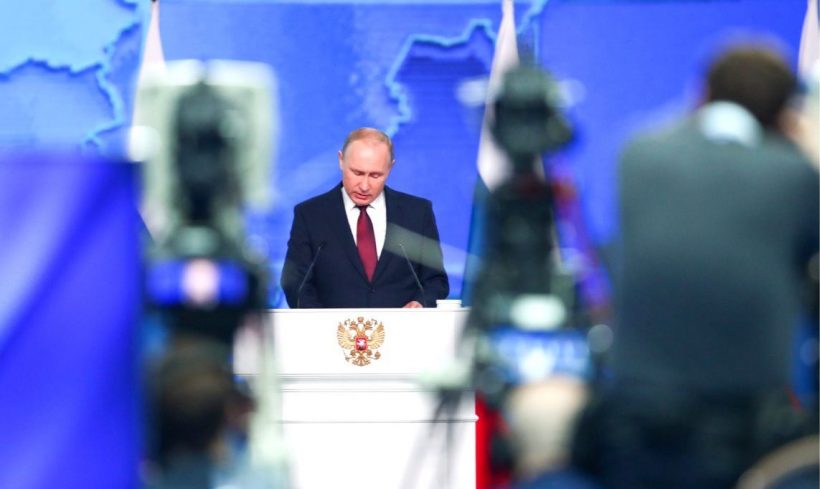
By Finian CUNNINGHAM | Strategic Culture Foundation | 22.02.2019
With stupendous double-think, Western news media claimed this week that Russian President Vladimir Putin was “threatening” the United States and its NATO allies with nuclear missiles.
The New York Times accused the Russian leader of “nuclear saber-rattling” while Radio Free Europe headlined: ‘Putin threatens to target the US with missiles’. Many other news outlets conveyed the same depiction of Russia somehow escalating bellicose tensions, based on Putin’s annual state-of-the-nation address this week.
Buried beneath the sensational headlines was a little more context that hints at the gross distortion being propagated by the Western media.
The New York Times disdained Putin was speaking with an “aggressive tone” and “doubling down on threats against the United States”.
The Times then went on to report: “President Vladimir Putin used his state-of-the-nation address to make some of his most explicit threats yet to start a nuclear arms race with the US after [sic] the Trump administration said this month that America was withdrawing from a landmark arms control treaty.”
Obliquely, but crucially, what the Western media coyly admit is that Putin’s remarks this week on deploying new missiles systems are in response to Washington’s decision to unilaterally abandon the Intermediate-range Nuclear Forces (INF) Treaty.
In other words, decisions have consequences. But for the Western media, they seem to be only preoccupied by consequences.
Furthermore, the Washington Post added somewhere lurking in the bowels of its coverage: “Putin emphasized that Russia will only respond if the United States makes the first move.”
That is, if the US installs short- and medium-range missiles in Europe then Russia will take symmetrical measures to target America territory and that of its NATO allies.
Radio Free Europe even breezily reported Putin as saying, “we don’t want confrontation” and added: “Putin said Russia wanted friendly relations with the United States and remained open for arms control talks with Washington.”
So, Western media are correctly – albeit coyly – noting that the Russian leader is acting in response to actions taken by Washington, and that he is explicitly appealing for friendly relations instead of confrontation. And yet the headlines were all screaming that Putin was “threatening the US”.
This willful distortion is reprehensibly adding to already dangerous international tensions. It is also a baleful failure to accurately determine which party is actually responsible for the brooding confrontational climate. Russia is being blamed for “threatening” the US and its allies when the reality is the reverse: it is the US that is unleashing the dangers of nuclear conflict, as even the Western media obliquely admit.
The Trump administration’s decision to walk away – unilaterally – from the 1987 INF Treaty is the key here. The US side claims that Russia has violated the treaty with its development of a land-launched cruise missile within the banned range of 500-5,500 kilometers. Moscow counters that the 9M729 (also known as SSC-8) missile has an operating range below the lower limit banned by the INF. Last month, in an unprecedented move, the Russian ministry of defense publicly disclosed the missile’s flight specifications at a press conference. Moscow points out that the US has not provided substantiating details to back up its claims that Russia is in breach of the treaty.
For its part, Russia accuses the US side of violating the INF treaty by already installing missile systems in Romania and Poland which can deploy offensive cruise warheads as well as performing as anti-missile systems. The US says its Aegis Ashore system is solely defensive.
However, rather than negotiating through the claims and counter-claims, it is the US side which decided to terminate its participation in the INF Treaty – just like it did with the Anti-Ballistic Missile (ABM) Treaty back in 2002 under President GW Bush.
The abandonment of a second major arms control accord is solely the responsibility of the US. The third remaining treaty, New START, is also at risk from redundancy by Washington.
With the INF now being trashed, the US has freed itself to potentially deploy additional missile systems in Europe right on Russia’s borders. The eastward expansion of NATO over the past three decades means that US nuclear weapons could be deployed with a strike capability on Moscow within 10-12 minutes, not hours as with strategic warheads.
President Putin this week noted that Washington has not indicated if it will refrain from installing medium-range nuclear missiles in Europe.
But the Russian leader emphatically specified the condition that “if” the US does embark on such a threatening deployment then Russia will take “symmetrical measures”. He warned that new hypersonic and submarine-launched missiles will be deployed to match the 10-12 minute flight time that the US could poise against Moscow. The Russian weapons will target European launch sites for the US missiles as well as “decision-making centers” in American territory.
Of course, such a dramatic proximity of nuclear capability is extremely alarming and deplorable. The risk of error is manifold greater in such a scenario in a way that far exceeds the Cold War decades. Putin noted that the scenario recalls the Cuban missile crisis in 1962 when the world almost witnessed a nuclear war. The reference point is apt for today’s predicament. The Soviet Union deployed nuclear missiles in Cuba in 1962 after the US installed ballistic missiles in Turkey the year before in 1961. Again, as now, it is the US side that is initiating the dynamics of provocation.
Any objective observer can see that it is the US that is continually upping the ante for nuclear war. The jettisoning of the ABM is now followed by the US discarding the INF based on dubious, unverified claims. Russia in fact views the ulterior rationale of the US as covertly wanting to free itself from the arms controls restriction in order to exert threatening pressure on Moscow for geopolitical goals: those goals may include forcing Russia to be compliant with American foreign policy interests, or opening up Russia’s natural resources to American capital exploitation, and so on.
Putin’s remarks this week are clearly consistent with Russia’s defensive doctrine for using nuclear forces. Moscow is patently stating that it will take “reciprocal steps” if Washington follows through on its offensive trajectory. Yet Western media invert the situation to portray Russia as “threatening” the US.
This is analogous to a gang marauding outside a home. Then the mob ringleader announces that projectiles are to be readied to lob over the garden wall. The homeowner shouts out: just try it and we’ll shoot your henchmen. Nobody in their right mind could fault the homeowner. It’s called self-defense.
But in Russia’s case, self-defense is twisted by dutiful, brainwashed Western news media as “unacceptable threat”.
Why Turkey won’t abandon the S-400 deal with Russia
By Ali Hussein Bakir | MEMO | February 20, 2019
Washington’s first deadline for Turkey to respond to its offer to buy the Patriot missile defence system passed last Friday with no progress made. Only one day after the deadline, US Vice President Mike Pence raised the issue once again with Ankara regarding Turkey’s recent deal to acquire the Russian S-400 missile defence system. In his speech at the Munich Security Conference last Saturday, Pence threatened Turkey, without mentioning it explicitly, when he said, “We’ve also made it clear that we will not stand idly by while NATO Allies purchase weapons from our adversaries. We cannot ensure the defence of the West if our allies grow dependent on the East.”
The Americans agreed recently to offer Turkey the Patriot missile deal, worth about $ 3.5 billion, but linked its agreement to do so on several conditions, including the need for Ankara to abandon the S-400 deal with Russia. The Turks initially welcomed the offer, but rejected the conditions tied to it. They also linked any possible agreement to the extent that it serves Turkey’s interests, especially regarding the timeframe offered for delivery of the system. The government in Ankara also stipulated the need for the deal to include the transfer of technology to Turkey as well as financial provisions to help pay for it.
According to Turkish President Recep Tayyip Erdoğan, the US responded positively to the possibility of delivering the system early, but it has not yet responded to the matters of joint production and financial arrangements. Since the official deadline for the response to the American offer will expire entirely at the end of March, this means that the debate on the topic will continue for another few weeks, at least. This will occur amid American threats to stop the delivery of F-35 fighter jets to Ankara and the possibility of imposing sanctions if it does not back down from the S-400 deal with Russia.
However, Turkey believes that removing it from the F-35 production programme will lead to higher costs for the Americans, and it will also hamper delivery times to many allies. More importantly, it will damage Washington’s already shrinking credibility. The Trump administration’s arrogant, exploitative behaviour only strengthens Turkey’s commitment to its deal with Russia, as it seems that pulling out is nearly impossible under the current circumstances.
There are three possible reasons why Ankara will not abandon the S-400 deal with Russia. First, the lack of trust in Washington’s sincerity, especially as the latter has not kept its promises on several occasions, most recently by threatening to cancel the delivery of the F-35s. Ankara believes that the US will be able to cancel the Patriot deal, threaten to do so or use it as a means to blackmail Turkey if and when it deems it necessary to do so. Furthermore, the lack of a financial incentive makes it very costly for Turkey to buy the Patriot system from the US, especially in the current economic climate. Unless Washington discusses this aspect of its deal, the Patriot offer will not be attractive from a purely financial point of view, neither on its own or when compared with Russia’s S-400 offer.
Finally, Washington has so far refused to transfer the technology to Turkey as part of the potential deal with Ankara. If this is not done, Turkey will not achieve its declared aims, and so it would be taking the Patriot system for purely political reasons in order to be balanced in the relationship between Russia and America. When all things are considered, therefore, it is almost certain that Ankara will stick to the S-400 deal with Russia.
This article first appeared in Arabic in Al-Arab on 19 February 2019
US senators re-introduce Russian sanctions ‘bill from hell’

Senators Lindsey Graham (R-SC) and Bob Menendez (D-NJ). ©REUTERS / Yuri Gripas
RT February 13, 2019
A group of senators have introduced a bill suggesting a wide range of sanctions against Russia.
The bill, sponsored by Republican Sen. Lindsey Graham (South Carolina) and Democrat Bob Menendez (New Jersey) will target Russia’s banking and energy sectors, as well as its foreign debt. The Defending American Security from Kremlin Aggression Act (DASKA) of 2019 may affect individuals who the US would deem to “facilitate illicit and corrupt activities, directly or indirectly, on behalf of Putin.”
Graham introduced a similar bill last year, dubbed the “sanctions bill from hell.” The bill that failed to pass would have also called on Congress to declare Russia a “state sponsor of terrorism,” would have make it harder for the US to leave NATO, and would have accused Russia of committing war crimes in Syria, among a laundry list of other provisions. Similar ideas were relocated to the new proposal.
“President Trump’s willful paralysis in the face of Kremlin aggression has reached a boiling point in Congress,” Menendez said in a statement on Wednesday. Graham, an ally of Trump, echoed the sentiment of the fellow lawmaker, minus his criticism of the president.
“The sanctions and other measures contained in this bill are the most hard-hitting ever imposed – and a direct result of Putin’s continued desire to undermine American democracy,” he wrote.
Russian interference in American elections has never been proven. A handful of Russian nationals have been charged with interference, but those indictments are largely symbolic.
Graham and Menendez’ bill comes one day after the Senate Intelligence Committee announced it had found no evidence of collusion between the Trump campaign and Russia during the 2016 election. Another House investigation came to the same conclusion last year.
Regardless of the committee’s conclusion, Graham and Menendez’ bill promises a raft of hard-hitting sanctions on Russia. These sanctions target banks that “support Russian efforts to undermine democratic institutions in other countries,” sanctions on Russia’s cyber sector, and sovereign debt.
They also include sanctions on Russia’s energy sector, mainly its crude oil projects inside the country and liquefied natural gas projects abroad. Russia currently provides almost 40 percent of Europe’s natural gas imports, a share that the US is keen to muscle in on. Despite both Trump and European Commission President Jean-Claude Juncker promising to step up the US-EU gas trade, business has floundered, mostly due to the logistical headache of transporting the gas across the Atlantic Ocean.
The proposed sanctions also include penalties on Russia’s shipbuilding sector, a response to the confrontation between Russian and Ukrainian vessels in the Kerch Strait last November. Russian authorities accused the Ukrainian navy of performing dangerous maneuvers and denounced their actions as “provocation.”
Many of the bill’s other measures are carried over from Graham and Menendez’ failed legislation last year. It includes a statement of support for NATO and a two-thirds Senate vote to leave the alliance, as well as weapons shipments to any NATO countries that rely on Russian military equipment.
Provisions that would punish the Russian government for alleged chemical weapons production remain in the bill, as does the call for Russia to be declared a “state sponsor of terrorism.”
The reintroduced bill is “the continuation of the insane campaign conducted by the US,” said deputy chairman of the Russian Parliament’s Foreign Affairs Committee, Aleksey Chepa, adding that he was certain that the bill won’t float. Russian MP Leonid Slutsky earlier dismissed the planned sanctions, saying whatever damage they would do if imposed would not be critical. “Russia will certainly not perish,” he said.
Lavrov Says Alleged Russian Links to GPS Glitches During NATO Drills Fantasy
Sputnik – 12.02.2019
MOSCOW – Russian Foreign Minister Sergey Lavrov on Monday called claims of Russia’s alleged involvement in GPS disruptions during last year’s NATO drills a fantasy, a day after Norway renewed similar allegations concerning signal interference near its border.
“I must say that a matter was not looked into because it is impossible to explore fantasies that are not confirmed by any facts. It’s all along the lines of ‘highly likely,'” Lavrov said at a press conference after meeting with Finnish Foreign Minister Timo Soini.
In turn, Soini said that Finland had requested information from Russia on what could be causing the GPS disruptions.
“The situation [with GPS failure] last fall caused concern in Finland. And this situation does not in any way contribute to increasing the level of stability in the region. Naturally, the safety of air traffic and security in the broad sense should not be compromised in any circumstances. We expect and believe that there will be no such events in the future. We discussed this issue and asked for information on what these obstacles may be related to,” Soini told reporters after the meeting.
On Monday, the Norwegian Intelligence Service said in its annual report that in repeated incidents since 2017, Russia had blocked GPS signals in Norwegian regions near the border with Russia, adding that these incidents coincided with military drills in Norway.
Between late October and early November, NATO’s Trident Juncture military drills, held in several northern European countries, including Norway and Finland, were overshadowed by several incidents in which pilots reported losing GPS signals.
On November 13, the Norwegian Defense Ministry issued a statement blaming Russia for the disruption of GPS navigation signals. Finland also alleged that Russia could be responsible for jamming the signal. Moscow has denied the allegations, and Russian presidential spokesman Dmitry Peskov has noted the existing trend of accusing Russia of “various deadly sins,” saying that such accusations were, as a rule, unfounded.
How Integrity Initiative’s ‘Counterfeit Expert’ Perpetuated Novichok Narrative
By Kit Klarenberg | Sputnik | 07.02.2019
In the days following the apparent poisoning of Sergei and Yulia Skripal on 4 March 2018, speculation abounded. What substance had rendered the double agent and his daughter comatose? How? Who was responsible? Why?
By 7 March, it’d been established the pair were struck by a nerve agent, confirmation merely triggering yet further frenzied theorizing — much of it unscientific — on what precise variety had struck the pair. Could it have been VX for instance, first synthesized in the 1950s at Porton Down, the UK’s secretive and controversial chemical and biological weapons testing centre situated a mere eight kilometres from Salisbury?
A day later, security consultant Dan Kaszeta offered an alternative explanation — writing for controversial website Bellingcat, he suggested the agent may have been ‘novichok’.
“The Soviet Union developed a new series of nerve agents in the 1970s and 1980s. The exact nature of these so-called novichok agents is still debated and the information on them varies a bit depending on what source you are looking at… some Novichok agents of interest include A230 and A232,” Kaszeta said.
It was seemingly the first time anyone anywhere had connected the substance with the Salisbury incident — but it would soon become a crucial feature in the UK government’s official narrative, helping lay blame for the attack squarely on the Russian state, before a motive had been established, any perpetrators identified, or other basic facts ascertained.
Own Initiative?
Due to Kaszeta’s amazingly fortuitous insight, he would become a central figure in media reporting on the Skripals, a go-to ‘independent chemical weapons expert’ quoted in a great many articles and reports.
At no point however did Kaszeta disclose his intimate relationship with the Integrity Initiative, a shadowy military intelligence outfit funded by the British state and NATO — and moreover, an organization that specifically sought to systematically shape media reporting on, and Whitehall’s response to, the Salisbury incident from day one.
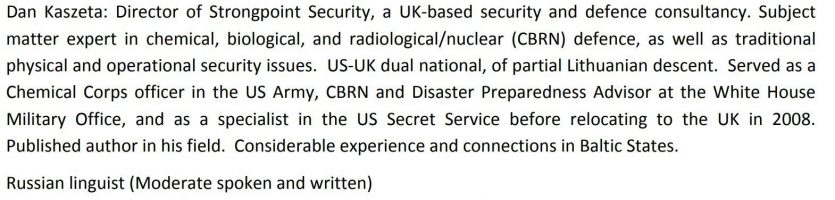
Dan Kaszeta’s Integrity Initiative Biography
In fact, were it not for hacking syndicate Anonymous, his role within the organization’s ‘Specialist Team’ would be entirely unknown, the only documentation linking him to the organization in any way a series of articles he wrote on novichok for the Initiative’s official website over the course of 2018 — which have since been removed from the web, along with all other site content.
Among them was a puff piece ardently defending Porton Down, stating the UK urgently needed the facility “to do valuable work to protect not just the nation’s armed forces but also to protect all of us who live here”, and dismissing as ludicrous the notion any poison could somehow be smuggled out of the “secure compound”.
Given US Fort Derrick is also highly secure, and anthrax was apparently smuggled out of the grounds successfully in 2001, leading to a notorious wave of anthrax attacks in the week after 9/11, this argument is surely dubious. What’s more, Kaszeta would surely have been aware of this, given he claims to have been “heavily involved in the immediate aftermath of the 9/11 attacks and the 2001 Anthrax incidents” — in what capacity though, he doesn’t clarify. Moreover, what published literature exists on novichok (or A-234) indicates the substance can be produced at bench scale by any laboratory.In addition to offering technical information on novichok to journalists — including then-Times Defence Editor Deborah Haynes, part of the Initiative’s UK Cluster — Kaszeta sought to rebut alternative explanations for the attack, and answer key questions such as why the Skripals didn’t die on the spot, and how novichok could poison two further people four months after the incident, writing a dedicated article on the former for politics.co.uk on 6 April. Conspicuously, much of this analysis relied on conjecture rather than science — for instance, when asked by NPR on 12 March 2018 why anyone would use “such an unusual agent”, Kaszeta responded “it was possible, given the historic secrecy around the programme, the culprit may have thought it would go undetected”.
“Maybe somebody somewhere felt they could get away with it,” he says. Then again, he says, it could have just as well been used to send a clear message to would-be spies and defectors. “It’s much more than waking up with a horse head in your bed,” he postulated.
He also frequently tweeted on the subject, the postings apparently becoming newsworthy in themselves — it’s difficult to quantify the exact number of articles featuring his Twitter output, although a 5 July 2018 Yahoo article — Weapons expert busts conspiracy theories about the Wiltshire Novichok attack — is certainly representative in terms of tone and content.
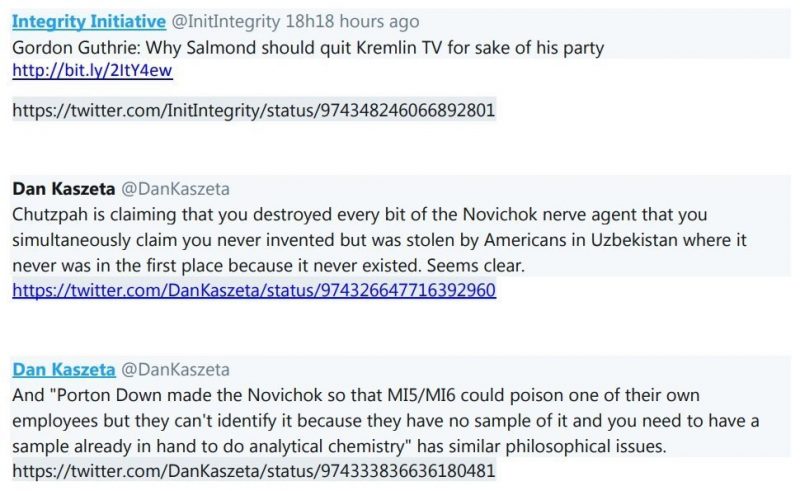
Integrity Initiative Monitors Social Media Activity Related to Salisbury Incident
Every step of the way, Kaszeta’s activities were closely tracked by the Initiative, with ‘expert team’ member Chris Hernon (ex-BBC) noting them in regular roundups. Elsewhere, in an internal email titled ‘FCO Disinformation Update’, FCO Head of Counter Disinformation Andy Pryce hailed his “strong rebuttal of conspiracy theories”.
‘Deep in the Pentagon’
Quite where, and indeed when, Kaszeta gleaned his specialist knowledge of novichok is unclear — particularly as he’s repeatedly (and wrongly) claimed the operation that produced the nerve agent was extremely secretive, and little is known about the substance outside the former Soviet Union.
Moreover, he doesn’t appear to have written a single word about novichok prior to his 8 March 2018 Bellingcat article — and his oft-touted chemical weapons and/or warfare prowess doesn’t appear justified by his professional or academic history either. Kaszeta’s work experience in that regard seems strictly limited to crisis response planning, and he holds a BA in political science and an MA in international affairs — but his LinkedIn profile nonetheless makes for fascinating reading.
His first listed role, from August — December 1990, was ‘policy intern’ at the Office of the Secretary of Defence, which he describes as “hard work at a desk deep in the D ring of the Pentagon during the final days of the Cold War” — and between 1994 — 1996 he engaged in “hard thankless toil in the depths of the beltway bandit universe, relieved only by boondoggles to the [Pentagon think tank] RAND Corporation” at Defence Group Inc. Thereafter, he worked in a number of positions within the US military-industrial complex, including the White House Military Office and Secret Service, before entering the private sector.
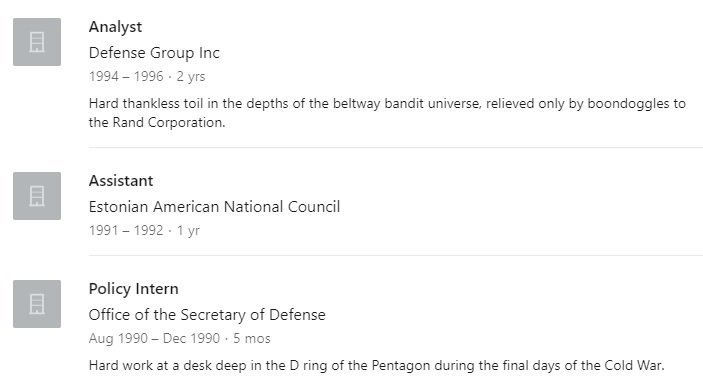
Dan Kaszeta’s LinkedIn Profile
In 2011, Kaszeta founded Strongpoint Security, which “provides consultancy and advice across a wide variety of defence and security disciplines, with a focus on unconventional threats, CBRN defence, crisis management, and physical security assessment”. The company’s website is rudimentary in the extreme, with many sections appearing to have not been updated for many years — for instance, references are made to Kaszeta’s “new” and “recently published” book, CBRN and Hazmat Incidents at Major Public Events, which was released in November 2012. He claims the work is “the first serious attempt to address the diverse and challenging issues of safeguarding the major event environment against the full spectrum of CBRN and Hazmat incidents and accidents”.
Self-aggrandizement is a recurring theme on the site, with Kaszeta boasting that his “degree and depth of expertise is relatively unique [sic] in Europe” — but while he’s bragged about the size of his “expert daily rate”, Companies House records indicate the firm has very little in the way of capital, cash reserves or assets, with annual post-tax profits typically in the low thousands, falling to just US$448 (£394) in the 2016/2017 tax year.
Strongpoint’s yearly takings certainly don’t appear to have ever reached levels by which Kaszeta could support himself, and references to the company online are sparse — any firms that have ever employed his services have certainly not advertised the fact in any way, and neither Strongpoint’s outdated website nor barely active Twitter account offer any sign of the company or its founder actually working, the latter consisting almost exclusively of retweets, often of Integrity Initiative posts.Strongpoint’s lack of assets is even more puzzling given it operates out of Kaszeta’s flat in Pimlico, one of Central London’s most expensive areas, where housing costs an average of US$1.9 million (£1.4 million) in 2019, 135 percent above the city average.
It’s unclear whether Britain’s spying agencies MI5 and MI6, both situated a few minutes’ walk from Strongpoint, have played any role in boosting property prices there — the organizations maintain a large portfolio of lodgings in the district, including 36 Alderney Street (located half a mile from Kaszeta’s home-cum-office), where GCHQ secondee to MI6 Gareth Williams died in extremely mysterious circumstances in August 2010.
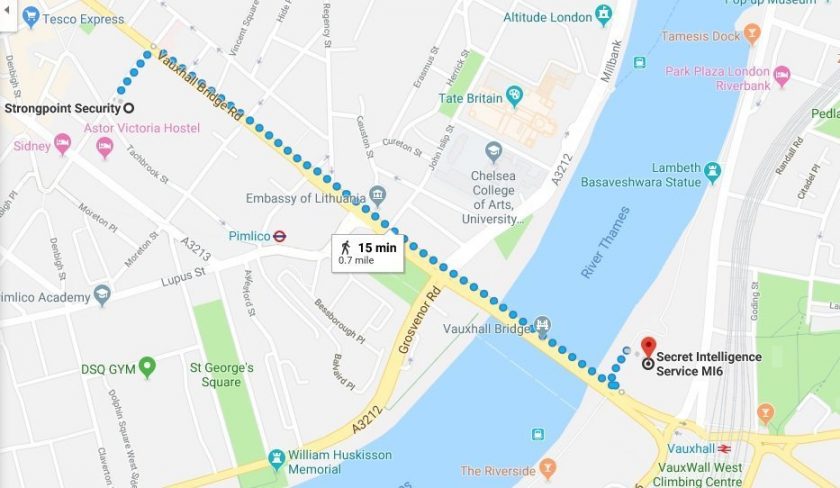
Proximity of Strongpoint Security to MI6 HQ
Nonetheless, Kaszeta owns the residence, so obvious questions must be asked — namely, how is he actually making his living, and is Strongpoint merely a legitimizing professional ‘front’ for other activities, lending superficial credence to his status as ‘independent’ specialist?
‘Counterfeit Expert’
Kaszeta’s rise to media prominence is also somewhat curious. Prior to 2013, he was entirely unheard of in the mainstream — that would change when he began writing articles for Elliot Higgins’ ‘Brown Moses’ blog (the forerunner of Bellingcat ) on 20 August that year, a day prior to the notorious chemical weapons attack in Ghouta, Syria. With Western leaders claiming Syrian government forces were behind the strike, but unable to provide supporting evidence, Kaszeta eagerly filled the void, being a frequent fixture of media reporting on the incident for months afterward.
Among a variety of allegations, his core contention was hexamine had been found by UN inspectors investigating local soil samples and metal fragments, a discovery apparently amounting to “smoking gun” evidence proving Syrian government forces were behind the contested strike, as — he alleged — the fuel can be used in the production of sarin gas, the chemical weapon purportedly used in the Ghouta attack. While Kaszeta has never cited a single scientific paper supporting this thesis, journalists invariably presented his analysis without critique.
He was nonetheless questioned on his various assertions and credentials via email by Theodore Postol, professor emeritus of Science, Technology, and International Security at the Massachusetts Institute of Technology, correspondence the academic later published in a wider July 2014 review.
Over the course of their discussion, Postol writes that Kaszeta made “numerous false science-based claims” which he’d “not researched before [he] made the statements”, referenced quotes “not made by the individuals [he] cited” and claimed scientific expertise he “amply demonstrated” he didn’t have.
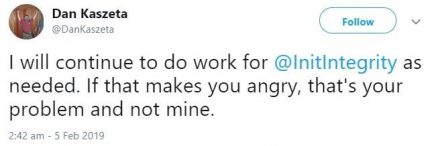
Dan Kaszeta Defends Integrity Initiative Employment
Concluding Kaszeta to be a “counterfeit expert”, the professor notes the self-avowed CBRN aficionado’s aforementioned book contains “no technical or scientific information” that couldn’t be obtained by a “superficial” internet search, and suggests Kaszeta’s prominence in news reports on Ghouta stemmed from a “complete failure” by the media “to exercise the most rudimentary levels of editorial due diligence” and challenge his “ill-informed and inflammatory use of false technical facts”.
Moreover, this bogus “empowerment” of Kaszeta, Postol writes, resulted in “controversy [with] no basis in sound science”, which could’ve played a role in justifying US military involvement in Syria.
Despite this extremely damning indictment of his probity and professional competency, mainstream journalists and news outlets were evidently indifferent, as Kaszeta’s media profile would grow exponentially in the years afterward, leading to his central role in perpetuating the novichok narrative.
Notably, not once in this period has Kaszeta ever provided ‘expertise’ even vaguely inconvenient for Western governments — in fact, he has unfailingly supported and perhaps even legitimized their aggressive policies, in the manner his Ghouta analysis potentially offered a pretext for US action in Syria.
Urban Planning
One of the most renowned journalists to promote Kaszeta’s views on novichok was BBC Diplomatic Editor Mark Urban, who championed his politics.co.uk article as a “common sense answer” to the question of why the Skripals weren’t killed by the poison they seemingly came into contact with, written by a “real expert”.
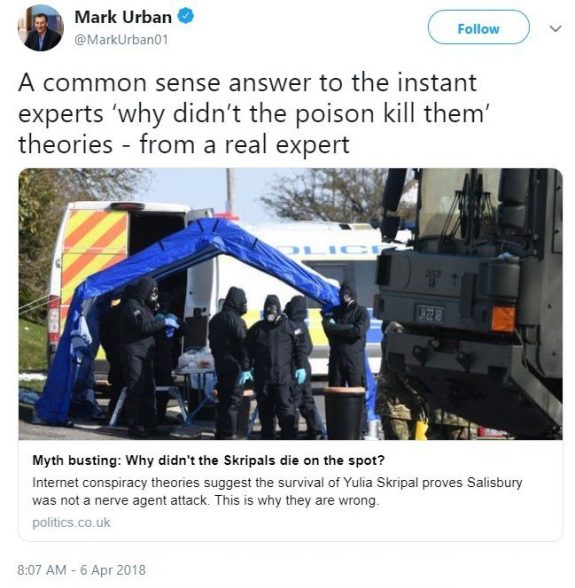
Mark Urban Promotes Dan Kaszeta’s ‘Expertise’ on Twitter
Urban’s advocacy of Kaszeta is perhaps unsurprising given his own peculiar connections to the Skripal affair — for in a shock disclosure, in July he revealed he’d repeatedly met with and interviewed the former Russian intelligence officer in the year prior to the Salisbury incident, while researching a book on the history of East-West Espionage.
That Urban neglected to mention securing such a seismic, serendipitous scoop until four months after that fateful March day — a period in which discussion of the attack, and Skripal, utterly dominated media reporting the world over — is somewhat staggering, but not quite as astounding as him having once served in the same tank regiment as Pablo Miller, Skripal’s MI6 recruiter and handler, and neighbour in Salisbury.
Serious questions hang over Miller’s involvement in the incident, not least because immediately afterward he deleted his LinkedIn, which revealed him to be a Senior Analyst at Orbis Intelligence, the private “investigative consultancy” run by former MI6 operative Christopher Steele, author of the highly controversial ‘Trump-Russia’ dossier — which Integrity Initiative operatives worked to circulate among US politicians.
Furthermore, on 7 March the UK government issued a D-notice related to the Salisbury incident, effectively blocking mention of Miller in the mainstream media since.
“The issue surrounding the identity of former MI6 informer Sergei Skripal is already widely available in the public domain. However, the identities of intelligence agency personnel associated with Sergei Skripal are not yet widely available in the public domain. The provisions of DSMA Notice 05 therefore apply to these identities. If any editor is currently considering publication of such material, may I ask you to seek [the] advice [of the Defence and Security Media Advisory Committee] before doing so?” the notice reads.
Adding to the intrigue, Miller also has an unclear relationship with Integrity Initiative, a leaked file naming him in a list compiled by Initiative chief Chris Donnelly, alongside representatives of the BBC, Porton Down, the FCO, the MOD and the US Embassy. The nature of the register is neither clear from the file itself, nor referenced in any other internal Initiative documents, although Anonymous claim the individuals were invitees to a private meeting with Syria’s notorious White Helmets group. Conversely, former Ambassador to Uzbekistan Craig Murray has speculated the event was in fact related to the Skripal incident, a hypothesis partially supported by the presence of Howard Body, Assistant Head of Science Support at Porton Down (and Assistant Head of Strategic Analysis at the Ministry of Defence) among the names.
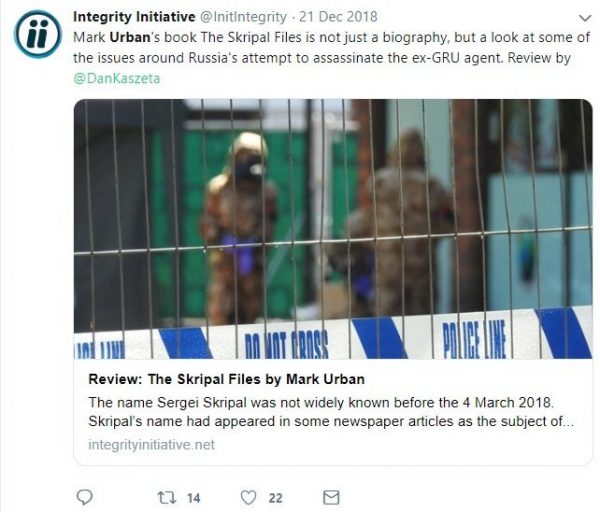
Integrity Initiative Promotes Dan Kaszeta’s ‘Skripal Files’ Review on Twitter
Whatever the truth of the matter, Urban’s aforementioned book, The Skripal Files — widely marketed as the “definitive account” of the incident — was published 4 October 2018. On 21 December, a glowing review of the work authored by none other than Dan Kaszeta was published on the Integrity Initiative website — strikingly, in its introductory paragraph the “counterfeit expert” revealed he’d met with Urban “several times over the past few years”. On 20 January, I emailed Kaszeta seeking clarity on how, why and when it was he crossed paths Urban — predictably he didn’t respond, a recurring theme with Initiative-connected individuals.
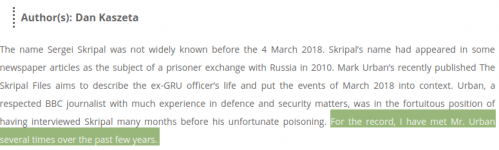
Dan Kaszeta Reviews Mark Urban’s Book, ‘The Skripal Files’
A mere two days later the organization would remove all content from its website, pending an “investigation” into the hack which acquired so much incriminating information from the organization’s servers. While there’s no necessary connection between my contacting Kaszeta and the purge, the timing is at least potentially significant given the review is one of very few Initiative site pages not still accessible via internet archiving services — it’s also not included among the now-dead links to the various articles he wrote for the Initiative on the Strongpoint website.
Wider Conspiracy
Shockingly, Kaszeta was but one cog within a much wider connivance — Operation Iris — constructed by Integrity Initiative. Under its auspices, many Institute for Statecraft and Initiative operatives — and journalists within the organization’s assorted international clusters — played a leading and early role in perpetuating various narratives, myths and recommended “responses” to the incident that would utterly dominate mainstream media reporting of the affair the world over for months afterwards.
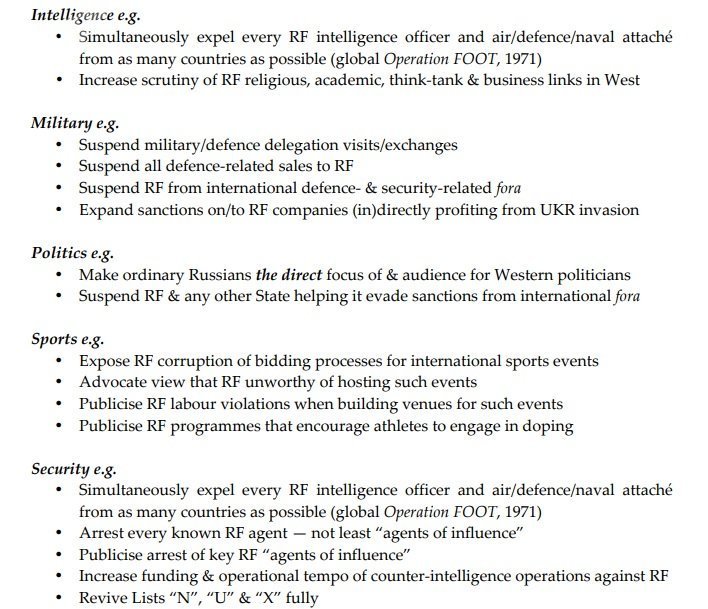
2015 File Written By Victor Madeira on Possible Anti-Russian Actions
In addition to cementing an extremely negative public perception of Russia, the Initiative also sought to influence government policy in the UK — and ensure isolation of Russia internationally.
Disturbingly, many of these narratives, and recommended strategies, were originally mooted in a document produced in 2015 by Initiative staffer Victor Madeira, who likewise played a leading role in pushing particular angles in the wake of the Salisbury incident. Over the coming weeks, Sputnik will document the activities of each and every Operation IRIS operative, in an attempt to ascertain just what role the Initiative played in the Skripal affair, and why.
US revisits Vietnam Syndrome in Afghanistan after 17 years of war and destruction
By Finian Cunningham | RT | January 30, 2019
It is America’s longest war, costing huge amounts of “blood and treasure” as US leaders claim. Yet, the signs are that Washington is finally accepting an historic defeat in Afghanistan comparable to the ignominious Vietnam War.
Intensive negotiations between American officials and Taliban insurgents have produced the “biggest tangible step” towards ending the nearly 18-year war in Afghanistan, according to the New York Times.
More talks are scheduled in the coming weeks to firm up details, but already it is reported that the US is to withdraw its remaining 14,000 troops from the Central Asian country over the next year without any guarantees of reciprocation by the enemy.
That unilateral pullout is not yet officially admitted by Washington, but analysts believe the US has tacitly accepted the long-held demand by the Taliban for foreign troops to get out.
At the height of the war, US forces numbered up to 100,000 personnel. The remnant American military therefore have no way of countering the growing insurgency. Even with an additional 8,000 NATO troops and thousands of private contractors also present in Afghanistan supporting the US-backed government in Kabul, the sordid game is up.
Zalmay Khalilzad, US Special Representative for Afghanistan Reconciliation, during the latest round of talks held in Doha, Qatar, sought to portray an “agreed framework for a peace deal” being contingent on the Taliban delivering on three items: a ceasefire; entering into negotiations with the government in Kabul; and a vow to never allow Afghanistan to become a haven for terror groups.
But media reports cite Taliban officials as giving no firm commitment to those US demands, while it appears Washington has accepted its troops are to be repatriated regardless. In other words, the American side is looking for a face-saving, apparent bilateral “deal” when the reality is Washington knows its war is over.
Ryan Crocker, a former US ambassador to Afghanistan, puts it acerbically. Washington is only polishing the optics, while finessing “the terms of surrender.”
He compares the American withdrawal from Afghanistan to the disorderly retreat and defeat that US forces incurred at the end of the Vietnam War in the mid-1970s. “Then, as now, it was clear that by going to the table we were surrendering; we are just negotiating the terms of our surrender,” opined Crocker in the Washington Post.
The defeat of US military might in Indochina gave rise to the Vietnam Syndrome which entailed a grave loss in national confidence and international standing. The war in Afghanistan has already exceeded the duration of the Vietnam debacle by nearly eight years. While the death toll among American forces is a lot less, the financial cost of Afghanistan is potentially ruinous. Up to $2 trillion of taxpayer money is estimated to have been poured into waging war in that country, yet the strategic achievements are arguably zero.
Not only that, but the launching of “Operation Enduring Freedom” in October 2001 by the GW Bush administration was the catalyst for a global so-called “war on terror” which engulfed several countries. The total financial cost for those wars is reckoned to be around $5 trillion – or nearly a quarter of America’s spiraling national debt.
In cost of human lives, the Afghan war and its derivative “anti-terror” operations elsewhere have resulted in millions of deaths and casualties, millions of refugees and the decimation of whole nations, which have further spawned conflict and the spread of terrorism. Suicide rates and pathological self-destruction among US veterans who served in Afghanistan (and Iraq) are off the charts and will have long-term detriment on American society for generations to come.
The Afghan Syndrome is going to haunt the US for decades in the same way the Vietnam forerunner did.
What’s more despicable is the utter waste and futility. When Bush ordered the troops into Afghanistan at the end of 2001, it was supposed to be in revenge for the terror attacks on the US on September 11. Never mind that the evidence linking those attacks to Afghanistan was tenuous at best.
The Taliban regime, which had been in power from 1996, was toppled by the US. But three presidents later, the Taliban now are reckoned to control over half the territory in Afghanistan, and can carry out deadly attacks on US-backed local forces seemingly at will on a daily basis, including in the capital Kabul.
Now it seems only a matter of time until the Taliban will be back in power with the US and allied NATO forces gone.
Richard Haass, a former senior US State Department planner, commented: “The Taliban have concluded that it is only a matter of time before the United States grows weary of stationing troops in a far-off country and spending $45 billion a year on a war that cannot be won… they have little need to compromise.”
The irony is that the Taliban grew out of the tribal militants that the US cultivated and armed to the teeth at the end of the 1970s when Afghanistan was governed by a Soviet-backed administration.
The American policy was gleefully calculated in Washington to give the “Soviets their Vietnam.” The proxy war was indeed a heavy loss for the Soviet Union, but in the longer-term it looks like Uncle Sam ended up getting another Vietnam in terms of creating the longest war ever for Washington, the unfolding ignominious defeat and the global blowback from Islamist terrorism it engendered.
Washington may be pretending it has reached a “framework deal for peace” in Afghanistan. But the brutal truth is Washington has lost another epic war.
The Taliban have always maintained they are not going to negotiate with the US-backed administration in Kabul, headed by President Ashraf Ghani. Like his predecessor, Hamid Karzai, the Taliban view Ghani and his government as a corrupt, venal puppet of the Americans.
The fact that the US sidelined the Kabul regime by talking directly with the Taliban is a crucial concession by Washington. By doing so, the US is effectively admitting that the insurgents are in the driving seat. All the talk out of Washington about supporting “intra-Afghani dialogue” and finding a “comprehensive peace settlement” is window-dressing rhetoric.
US President Donald Trump last month ordered about half of the American troops in Afghanistan – some 7,000 – to withdraw. Trump is said to be growing impatient with the huge financial drain of the never-ending war. His order to pull out forces before the latest round of negotiations in Qatar will have been taken by the Taliban as further proof the Americans know they are beaten.
Astoundingly, prominent voices in Washington are arguing that, in spite of the human calamity and cost of Afghanistan, US troops should remain there indefinitely. Senate Republican leader Mitch McConnell wants to pass legislation forbidding a withdrawal. The Washington Post’s editorial board – which reflects the foreign policy establishment view – admonished: “The Trump administration’s tentative deal with the Taliban could return Afghanistan to chaos.”
“Return to chaos”?
Afghanistan – known as the Graveyard of Empires – from centuries of defeating great powers is showing that the Americans are up their necks in chaos.
Featured Video

AIDS Inc. by Gary Null (2007)
or go to
Aletho News Archives – Video-Images
From the Archives
Clash of Civilization, Iran Part II
By Jamal Kanj – Intifada-Palestine.com – January 14, 2011
Israel’s survival kit is: perpetuate conflict, insecurity to rationalize collective hate and finally playing victim.
Devoid of conflict, Israel implodes internally; without hate, Zionism loses its justification; and playing eternal victim to continue blackmailing the West. Absence of this holy trinity, Israel ceases to exist.
From its inception, the house of Zion has mastered exploiting adversarial powers to advance Israel’s cause. For instance, their influence over the Democratic Party in the US began with President Truman’s bid for 2nd term election in 1948.
Responding to strong opposition from Secretary of State General George Marshall and Department experts urging against recognition of Israel, President Truman replied: “I’m sorry gentlemen but I have to answer to hundreds of thousands [Jewish voters] who are anxious for the success of Zionism. I do not have hundreds of thousands of [voting] Arabs among my constituents”
Zionists influence over liberal American politics was matched with the doctrinal school of Conservative theoreticians aligning the Republican Party’s platform with Israel’s objectives. The Neoconservative Zionists, coined Zioncons, invented the “Clash of Civilization” concept to fight Israel’s wars. … continue
Blog Roll
 Aletho News
- Merck Virologists Admitted to Falsely Certifying Vaccine Efficacy
- Mandatory Folic Acid for every man, woman & child
- Pro-Palestine protesters arrested outside UK’s ruling Labour Conference in Liverpool
- Mauritius denies landing permit to flight from Israel, forcing cancellation: Tour operator
- Israeli finance minister calls for genocidal war on West Bank, annexation of south Lebanon
- 12 Things Your Psychiatrist Was Trained Not to Tell You
- From Unipolar Universalism to Multipolar Civilizational Distinctiveness
- RSF military group defects, joins Sudanese army: State media
- Ireland goalkeeper refuses to play ‘Israel’ as squad weighs boycott
- China pushes back against US on Cuba, Iran
- If Americans Knew
- Israel forces Gazans to live in constant peril – Daily Update
- Deconstructing Netanyahu’s pants-on-fire UN rant – Daily Update
- Trump betrayed voters with his campaign lies and prioritized a foreign country once he took office
- Netanyahu calls Israel’s war in Gaza ‘opposite of genocide’ in UN speech to near-empty hall
- Settler Kidnappings: Torture, Sexual Abuse and Terrorisation of Palestinian Abductees as Israel Deepens Annexation of West Bank
- Gaza winter nears as 162,000 tents become unusable, raising fears of humanitarian crisis
- Netanyahu says, “It’s the opposite of genocide”; UN says Gaza economy is world’s ‘most severe crisis on record’ – Daily Update
- Israel’s US-Backed Assault on Gaza Has Created the ‘World’s Most Severe Economic Crisis on Record’: UN
- ‘Protecting U.S. Citizens’… From Israel
- ‘This is where I live now, the back of a truck’: a day in the life of a grandmother in Gaza
- No Tricks Zone
- New Study: Earth And Venus Surface Warmth Largely Explained By Convection And Lapse Rate, Not CO2 Or Radiation
- 2025 Nature Paper Claiming Worsening Global Drought Gets RETRACTED …Heavily Flawed
- New Study: ‘Global Drought Shows No Detectable Recent Acceleration Under Climate Warming’
- Economic Masterminds: German Socialists Suggest Taxing Productivity Gains Stemming From Using AI
- The South China Sea Has Not Been Cooperating With The Climate Change Narrative
- Energy Crisis: Germany Enters Heating Season With Historically Low Gas Reserve Fill Levels
- New Study: The Antarctic Ice Sheet Gained Mass From 2020-2024 Due To Staggering Snow And Ice Accumulation
- Study: Ocean Heating Rates From Thousands Of Years Ago ‘Dwarf’ Modern Ocean Heating Rates
- Climate Extremists Target, Attack Large-Scale Power Grid Infrastructure In Germany!
- New Study: Antarctic Ice Melt Has Contributed Less Than 1 Centimeter To Sea Level Rise In The Last 30 Years

