Constitutional Crisis Brews in Moldova as Government Tests President’s Authority
Sputnik – 4 10.09.2017
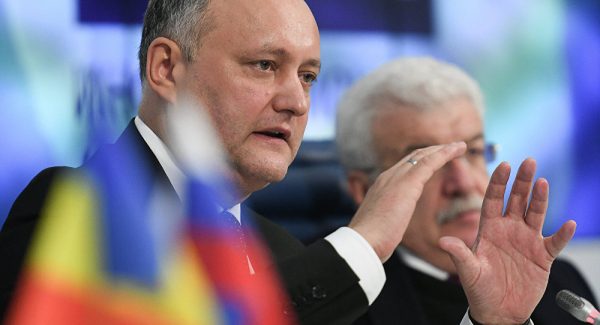
Moldovan President Igor Dodon is demanding the resignation of Deputy Defense Minister Gheorghe Galbura for defying a presidential order to block the deployment of Moldovan troops to Ukraine to participate in NATO-led military drills. Speaking to Sputnik, regional expert Boris Rozhin warned that the country is on a path to a constitutional crisis.
The Moldovan government approved sending several dozen troops to Ukraine last week, ignoring Dodon’s decree to block the deployment. Dodon described the move as an ‘usurpation of power’ by the cabinet.
Speaking to Radio Sputnik about what’s likely to happen next, Boris Rozhin, an expert at the Center of Military-Political Journalism, said that the Moldovan government will be likely to try to ignore or challenge the president’s demand for Galbura’s resignation.
“This confrontation over sending the military abroad is an indication that the constitutional crisis in Moldova is deepening,” the expert said. “The parliament and the government are refusing to recognize the president’s authority as commander-in-chief to give orders to the country’s armed forces.”
“This issue will be considered at a meeting of the country’s Security Council, and most likely, by the constitutional court, as Dodon’s decision to dismiss the deputy defense minister will either be ignored or contested,” Rozhin added.
The expert believes that this confrontation between the branches of Moldova’s government is likely to continue until the next parliamentary elections, tentatively set for November 2018.
“The confrontation can be resolved through a decision of the constitutional court, which confirms or rejects Dodon’s right to issue orders to the Armed Forces, or deepen further and continue until the next parliamentary elections,” Rozhin said.
“After that, a reformatting of the legislature may take place. At the moment, the ruling establishment does not reflect the alignment of forces in Moldovan society, which has grown tired of the government’s push for European integration, which did not bring the hoped for economic and social improvements for ordinary people.”
As the constitutionally designated commander-in-chief, Dodon vetoed the government’s decision to send 57 National Guard troops to Ukraine for NATO exercises, reminding them that Moldova is a neutral state. Ignoring the president’s order, the contingent left for Ukraine anyway. The president also signed a decree which said that Moldovan military forces would not be allowed to be sent abroad for military exercises, training or any similar events without approval from the president.
The present crisis is not the first public conflict between Dodon and the cabinet o ministers. Earlier, the government asked the UN General Assembly to consider the removal of Russian peacekeeping troops from the breakaway republic of Transnistria. Dodon called the initiative an “empty PR move.” The president and the cabinet have faced off over Russia repeatedly, the government proposing a series of unfriendly gestures, with the president, in turn, saying that he would like to bring the country closer to Moscow.
Dodon, often described by Western political observers as ‘pro-Russian’, won presidential elections in 2016, defeating his pro-West, pro-EU opponent Maia Sandu. Moldova’s parliament and government are dominated by the pro-EU Democratic Party of Moldova, a social democratic party closely associated with oligarch Vladimir Plahotniuc, and a collection of independent MPs.
Commenting on the political situation in the country, political observer Viktor Marakhovsky wrote that it would be more correct to call Dodon ‘pro-Moldovan’ than ‘pro-Russian’, because the pro-EU elites he is up against have effectively “privatized political power in exchange for international grants, figuratively speaking.” Not only do they seek to give up sovereignty to EU structures; some have spearheaded a campaign pushing for Romania’s absorption of Moldova, a campaign actively supported by Bucharest.
Marakhovsky thinks that Dodon’s best hope will be to organize a referendum to ask Moldovans to approve the expansion of the president’s powers, fresh elections and returning the subject of the history of Moldova to the country’s schools, replacing ‘the history of Romania’ subject presently being taught.
Moscow ‘astonished’ by Germany’s ‘baseless’ remarks on Zapad 2017 – Russian MoD
RT | September 9, 2017
The Russian Ministry of Defense rebuked the German defense minister for saying the upcoming Zapad 2017 exercises are little more than a show of force by Moscow involving vast numbers of troops, calling her comments bewildering.
On Thursday, German Defense Minister Ursula von der Leyen claimed that the upcoming drills would involve over 100,000 troops on the eastern periphery of NATO, showing a “demonstration of capabilities and power of the Russians.”
“Anyone who doubts that only has to look at the high numbers of participating forces in the Zapad exercise: more than one hundred thousand,” von der Leyen said at an EU defense conference in Tallinn.
Her remarks were seized upon by Russian Defense Ministry spokesman Major-General Igor Konashenkov, who said it was strange that the Germans would come up with such a figure, particularly considering that they had been told of the plans for the drills in advance.
“We are astonished by statement made by Ms von der Leyen, the Germany’s Federal Minister of Defence, publicly handling baseless figures that allegedly 100 thousand Russian troops engaged in the Zapad 2017 and threaten Europe,” Konashenkov told reporters on Saturday.
“The German side has timely received and does have comprehensive information of the concept, defensive nature and true figure of the Russian troops engaged in the Zapad 2017 exercise,” the major-general said in the statement.
The Zapad 2017 drills, which will be held along with Belarus, are due to take place September 14-20 and will involve up to 12,700 troops, 70 aircraft, and nearly 700 land vehicles. Although the exercises take place every few years (the most recent drills were held in 2009 and 2013), this year’s maneuvers have come under huge scrutiny by NATO. In July, Lieutenant-General Ben Hodges, commander of US Army forces in Europe, referred to the routine exercises as a “Trojan horse,” noting there were suspicions they could be used to move forces and equipment closer to NATO’s eastern flank.
Moscow and Minsk have repeatedly refuted these speculations, saying that the drills are purely defensive in nature and pose no threat to any other country.
Moscow has said that the number of forces deployed under Zapad 2017 would not exceed the limits for mandatory monitoring under the 2011 Vienna document, the OSCE agreement meant to foster confidence through a number of measures to make military forces deployed in Europe more transparent. In addition, Belarus has invited international monitors from foreign countries to observe the active phase of the drills.
“The hype [over the exercise] was fanned up artificially and is definitely meant to convince the Western public that the cost of deploying additional forward military presence in Poland and the Baltics and increased NATO military activity is justified,” a statement from the Russian Foreign Ministry said in August. “Remarkably, it is these actions that lead to increased military tension in Europe, which Western ‘pen and microphone warriors’ lament so much.”
At the same time, NATO has been increasingly building up its own forces and capabilities in eastern Europe. At the 2016 summit in Warsaw, NATO member states agreed to boost their military presence in the region to levels not seen since the Cold War, deploying four rotating multinational battalions to Estonia, Latvia, Lithuania, and Poland. In January of this year alone, 4,000 additional US troops were deployed to eastern Europe.
Russia has criticized this build-up as a threat to national, as well as regional, security. In February, speaking at the Munich Security Conference, Foreign Minister Sergey Lavrov noted that “NATO’s expansion has led to an unprecedented level of tension over the last 30 years in Europe.”
M1 Abrams tanks, heavy armor arrive in Georgian port for Agile Spirit drills

© Minisrty of Defence of Georgia
RT | September 3, 2017
The US military has sent a number of M1 Abrams tanks as well as heavy armored vehicles for a massive multinational exercise, Agile Spirit 2017, which is kicking off in the former Soviet republic of Georgia.
Some 500 US troops along with M1 Abrams main battle tanks and LAV armored fighting vehicles have arrived in the former Soviet republic of Georgia for the Agile Spirit 2017 exercise.
Georgia’s Defense Ministry has released a video that showed the unloading of the tanks – painted in desert camouflage – at the port of Poti.
US heavy armor will then be transported by train to Vaziani, where the main stage of the war games will begin.
The war games are expected to take place at the Georgian military’s Vaziani training center, involving US soldiers as well as approximately 1,000 troops from Georgia, Armenia, Azerbaijan, Bulgaria, Latvia, Romania and Ukraine.
“This is the seventh [edition] of the annually scheduled multilateral exercise designed to enhance US, Georgian and regional partner interoperability and strengthen understanding of each nation’s tactics, techniques and procedures,” the Pentagon said in a press release.
Georgia, an active contributor to NATO deployments, has long planned to join the bloc, while Russia has long criticized the alliance for coming closer to its borders.
In a June interview with film director Oliver Stone, Russian President Vladimir Putin described NATO as an instrument of American foreign policy, and said the alliance’s members inevitably become US “vassals.”
“Once a country becomes a NATO member, it is hard to resist the pressures of the US. And all of a sudden, any weapons system can be placed in this country. An anti-ballistic missile system, new military bases and if need be, new offensive systems,” Putin said, adding that Russia was forced to take countermeasures over the ever-increasing NATO threat and armed military build-up on Russia’s borders.
McCain’s Transmutation from Cautious Realist to Super-Hawk
By Stephen J. Sniegoski • Unz Review • September 1, 2017
For many years, John McCain has been one of the major war hawks in the Senate, but he was not that way for more than a decade after he was first elected to Congress. When he entered the House of Representatives in 1983, he was a cautious realist, holding the position that U.S. military power should only be used to protect vital national interests. He developed this view as a result of his experience in the Vietnam War and his post-Vietnam studying of the origins of that war at the National War College.[1] That view loomed large among military leaders at this time and was exemplified by General Colin Powell.
In his first year in Congress, McCain, although a strong supporter of then President Reagan, voted against the latter’s decision to continue the deployment of troops in Lebanon during that country’s civil war. The measure would pass in both Houses of Congress, with substantial support from Democrats, and with only a small minority of Republicans daring to oppose Reagan. In his floor speech on this issue, McCain stated:
“The fundamental question is: What is the United States’ interest in Lebanon? It is said we are there to keep the peace. I ask, what peace? It is said we are there to aid the government. I ask, what government? It is said we are there to stabilize the region. I ask, how can the U.S. presence stabilize the region? . . . . The longer we stay in Lebanon, the harder it will be for us to leave. We will be trapped by the case we make for having our troops there in the first place.
“What can we expect if we withdraw from Lebanon? The same as will happen if we stay. I acknowledge that the level of fighting will increase if we leave. I regretfully acknowledge that many innocent civilians will be hurt. But I firmly believe this will happen in any event.”[2]
After a truck filled with explosives rammed into the Marine compound in Beirut, killing 241 service members, Reagan opted to remove the remaining troops a few months later. McCain was vindicated and he gained considerable attention from the mainstream media for his prescience and courage to take such a stand against a popular President from his party. This helped to develop his reputation as a “maverick.”
“The American people and Congress now appreciate that we are neither omniscient nor omnipotent,” McCain would later tell the Los Angeles Times, “and they are not prepared to commit U.S. troops to combat unless there is a clear U.S. national security interest involved. If we do become involved in combat, that involvement must be of relatively short duration and must be readily explained to the man in the street in one or two sentences.”[3]
In 1987, during the Iran-Iraq War, in which the United States was supporting Iraq, McCain, now a Senator, opposed President Reagan’s move to put American flags on Kuwaiti oil tankers and have the U.S. Navy protect them against possible Iranian attacks. In the Arizona Republican, he described Reagan’s action as a “dangerous overreaction in perhaps the most violent and unpredictable region in the world.” He continued: “American citizens are again being asked to place themselves between warring Middle East factions, with no tangible allied support and no real plan on how to respond if the situation escalates.”[4]
McCain did support the Gulf War in 1991, but even here he was something of a moderate. McCain biographer Matt Welch writes: “When Saddam Hussein invaded Kuwait in the summer of 1990, McCain oscillated between hawkishness and reluctance, denouncing the Iraqi dictator and then the U.S. government for having cozied up too closely to Hussein during the Iran-Iraq war, but at the same time warning against a protracted land battle.”[5] McCain stated: “If you get involved in a major ground war in the Saudi desert, I think support will erode significantly. Nor should it be supported. We cannot even contemplate, in my view, trading American blood for Iraqi blood.”[6]
Under Republican Presidents Reagan and the elder Bush, it must be acknowledged that McCain was not an actual non-interventionist since he supported the American opposition to the Soviet Union, and what he considered to be pro-Soviet forces in Central America. Moreover, he supported the removal of Panamanian dictator Manuel Noriega by the U.S. military in 1989. But this was still a far cry from the global interventionist that McCain would become.
Moreover, during Bill Clinton’s presidency, McCain would be even more non-interventionist until his radical change during the last years of Clinton’s term. In a commencement address he made to the Marine Corps Command and Staff College in Quantico, Virginia in June 1994, McCain emphasized that his cautious approach to war resulted from his Vietnam experience. He solemnly orated that he had not forgotten “the friends who did not return with me to the country we loved so dearly. The memory of them, of what they bore for honor and country, causes me to look in every prospective conflict for the shadow of Vietnam.”[7]
In December 1992, after losing the November election to Bill Clinton, the elder George Bush dispatched American troops to Somalia, then embroiled in a many-sided civil war, to facilitate the provision of food to the starving civilian population. This was part of a United Nations effort. By the fall of 1993, this military mission morphed into one of arresting war lords and nation-building. In October 1993, a 15-hour battle took place in Mogadishu that left 18 Americans dead and 73 injured, with many of these casualties the result of two Black Hawk helicopters being shot down.[8]
Because of this loss of American lives, there was a Senate bill supported by President Clinton which planned to remove American troops from Somalia. Demanding a quicker troop exit, McCain stated: “Mr. President, can anyone seriously argue that another six months of United States forces in harm’s way means the difference between peace and prosperity in Somalia and war and starvation there? Is that very dim prospect worth one more American life? No, it is not.”
Drawing an analogy to what happened in Lebanon in 1983, McCain contended: “240 young Marines lost their lives, but we got out. Now is the time for us to get out of Somalia, as rapidly, and as promptly, and as safely as possible.”
“The longer we stay the more difficult it will be to leave,” McCain asserted. “The loss of American lives is not only tragic, it is needless.”[9] His proposed amendment for a quicker departure, however, was voted down.
McCain also opposed Clinton’s intervention in Haiti to bring back President Jean-Bertrand Aristide, who had been elected in 1990 and then overthrown in a coup in 1991. After a UN resolution authorized the use of military force to return Aristide to power, the United States would ultimately do so on October 15, 1994. In late August 1994, McCain declared: “It is the post-invasion circumstances that I fear will bog down U.S. forces in a low-level, open-ended, ill-defined conflict which will require U.S. servicemen and women to serve as a virtual palace guard for President Aristide once he is returned to power.”[10]
The major international concern in the 1990s was the conflict in Yugoslavia—with the focus first on Bosnia and then Kosovo. After the downfall of Communism, Yugoslavia dissolved, with the secession, in 1992, of Croatia, Macedonia and Slovenia. Bosnia also declared its independence despite the staunch opposition of Bosnian Serbs, who wanted to remain united with Serbia. Civil war broke out between the Bosnian Serbs, supported by Serbia, and the Muslim-dominated Bosnian government. Thousands of people were killed, raped, and expelled from their homes. The West generally looked upon the atrocities, real and imagined, as being primarily perpetrated by the Serbs. In the United States, this was especially the case among American liberals who would advocate “humanitarian” military intervention to protect the Muslims.
In 1992, the UN peacekeeping forces intervened for humanitarian reasons and set up several so-called safe areas for refugees, which often turned out to be not very safe. The UN forces were composed of non-American troops, while American ships and airplanes enforced an arms embargo.
The wars in Yugoslavia would ultimately lead to a sea change in McCain’s position on American military intervention, but this did not occur all at once. Initially, McCain was, like many Republicans, opposed to American involvement in the conflict. In fact, biographer Matt Welch describes McCain as having been “one of the Senate’s most stubborn opponents to US military intervention against Serbs.”[11] McCain contended that any American military “peace-keeping” effort in Bosnia would likely lead to a quagmire. “I think you can draw a parallel to the military challenge in Bosnia with what the Russians faced in Afghanistan,” McCain opined in May 1993. “Even with ground forces and with overwhelming air superiority, they were unable to defeat a motivated, very capable enemy.”[12]
In December 1994, McCain, whom the Los Angeles Times described as a “a leading opponent of greater American military involvement in the war,” stated: “I think we have a very full plate of a legislative agenda, which are the commitments we made to the American people–and Bosnia wasn’t one of those.”[13] In May 1995, McCain held that U.S. efforts in the Balkans were “doomed to failure from the beginning, when we believed that we could keep peace in a place where there was no peace.”[14] Neocon Robert Kagan bemoaned the fact that on Bosnia, Senator McCain led the Republican attack, warning that any use of military power there would result in “another failure like Vietnam or Lebanon.”[15]
Prospects for peace, however, improved in the summer of 1995 when NATO, led by the United States, launched airstrikes against Bosnian Serb targets, which combined with better-equipped Muslim and Croatian forces pressured the Bosnian Serbs into participating in peace negotiations. This led to the Dayton Accords in November 1995, which ended the war in Bosnia. NATO would provide peace-keeping troops, including 20,000 from the U.S.
After NATO’s success, McCain quickly dropped his staunch anti-interventionist position. McCain later claimed that his position had begun to change as a moral reaction to the Serbs’ massacre of thousands of unarmed Bosnian Muslims in July 1995.[16] While most Republican members of Congress were opposed to sending American troops to Bosnia, McCain joined Senator Robert Dole (Republican—Kansas) in putting forth the nonbinding Dole-McCain resolution which permitted Clinton to send troops, though limiting the deployment to one year–which was Clinton’s stated time period—and requiring the United States to lead an effort to arm and train Bosnian troops. The resolution passed in the Senate but was not taken up in the House.[17]
Showing that he had not completely dropped his previous cautious approach to intervention, McCain emphasized that the Dole-McCain resolution was not seeking support for President Clinton’s decision to deploy the troops. “It asks that you support the deployment after the decision has been made,” he said. “The decision has been made by the only American elected to make such decisions [i.e., the President].” However, McCain also expressed a firm interventionist conviction: “When we arrive at the moment when less is expected from our leadership by the rest of the world, then we will have arrived at the moment of our decline.” And he said, “We cannot withdraw from the world into our prosperity and comfort and hope to keep those blessings.”[18]
While a change from his previous strong opposition to American intervention abroad, supporting this peace effort in Bosnia did not portend McCain’s radical transmutation to the global super-hawk that he would become. That final step would require the involvement of the neoconservatives. This connection began when, in 1997, McCain and his advisers read an article in the Wall Street Journal editorial page by neoconservatives Bill Kristol and David Brooks who were promoting the idea of “national greatness” conservatism, which consisted of a more activist domestic agenda and a more interventionist global role.[19]
While this article may have fit in with the direction that McCain’s thinking was moving, it had political implications as well: McCain had been eyeing the presidency for a number of years. According to John Weaver, a major political adviser to McCain at this time: “I wouldn’t call it a ‘eureka’ moment, but there was a sense that this is where we are headed and this is what we are trying to articulate and they [Kristol and Brooks] have already done a lot of the work. . . . And, quite frankly, from a crass political point of view, we were in the making-friends business. The Weekly Standard represented a part of the primary electorate that we could get.”[20] And it should be emphasized that McCain’s change was not a gradual one but rather one that was quite radical and took place in a very short period of time.
After reading this article, McCain and staff were consulting regularly with leading neocons, including Kristol, Robert Kagan, and Randy Scheunemann[21], to, in the words of journalist David Kirkpatrick, “develop the senator’s foreign policy ideas and instincts into the broad themes of a presidential campaign.”[22] In short, McCain realized that he needed the neocons’ intellectual and political support if he were to achieve higher office. The neocons were already well-known and had played a significant role in the Reagan administration. And during the Clinton years, neocons promoted their views from a strong interlocking network of think tanks which have had a significant influence in shaping American foreign policy.
McCain would begin to support neocon positions. On January 26, 1998, the neocon-dominated Project for a New American Century (PNAC), created in 1997 and headed by Bill Kristol, sent a letter to President Clinton urging him to take unilateral military action against Iraq to overthrow Saddam and offered a plan to achieve that objective. After the Clinton administration failed to take action, another neocon-front group, the resurrected Committee for Peace and Security in the Gulf, which had promoted the 1991 Gulf War, sent another letter urging war. And, because of Clinton’s continued inaction, PNAC would send another such letter in May.
While President Clinton failed to take action, McCain pushed for military action against Saddam in 1998. McCain co-sponsored the Iraq Liberation Act, committing the United States to support the overthrow of Saddam and funding opposition groups, most importantly the Iraqi National Congress. Headed by the notorious neocon-favorite Ahmed Chalabi, the Iraqi National Congress would provide much of the spurious information that generated support for the war on Iraq in 2003. The bill passed in both houses of Congress and on October 31, 1998, President Clinton signed it into law. Clinton, however, did not intend to implement this measure and George Bush made no mention of it during the 2000 campaign.[23] McCain, however, remained in lock-step with the neocons on Iraq and would be made Honorary Co-chair of the Committee for the Liberation of Iraq when it was created in 2002.
McCain had been in line with the neocons as a strong supporter of Israel even during the time he adhered to a cautious realist position regarding U.S. military interventionism. He was the 1999 recipient of the Defender of Jerusalem award, given by the National Council of Young Israel. In his acceptance speech, McCain in effect told his pro-Zionist audience that the United States should be prepared to make war for Israel’s sake. “Certainly, no one would argue with the proposition that our armed forces exist first and foremost for the defense of the United States and its vital interests abroad,” McCain intoned. “We choose, as a nation, however, to intervene militarily abroad in defense of the moral values that are at the center of our national conscientiousness even when vital national interests are not necessarily at stake. I raise this point because it lies at the heart of this nation’s approach to Israel. The survival of Israel is one of this country’s most important moral commitments. . . . Like the United States, Israel is more than a nation; it is an ideal.”[24] Note that this was diametrically opposed to his former view that American intervention abroad should only take place to protect vital American interests.
However, it was not Iraq or any of Israel’s enemies that put McCain in the national limelight but rather the U.S.-led NATO war on Serbia over Kosovo in 1999. As Washington Post staff writer Dan Balz wrote in early April 1999, “no politician has been more visible on the issue of Kosovo the past two weeks than the former Vietnam prisoner of war, and a number of political analysts say his performance has given a boost to his presidential aspirations.”[25]
President Clinton orchestrated the NATO war on Serbia, because of the Serbs “ethnic cleansing” of Muslims in their territory of Kosovo. Since Serbia could not possibly threaten the United States, the war was presented as being largely for humanitarian reasons. At this time, there were all types of stories of Serb mass killings of Kosovars, with figures up to 100,000 Kosovar civilians being missing and conceivably murdered.[26] Physical evidence for these extreme claims was not found and former Yugoslav president Slobodan Milosevic was not even charged with crimes of such great magnitude at his trial before the International Criminal Tribunal for the former Yugoslavia (ICTY). And according to German government documents no “ethnic cleansing” of Kosovar Albanians took place until after the NATO bombing.[27]
Unlike many Republicans, McCain supported Clinton’s decision for war. But while Clinton limited American actions to air strikes, McCain maintained that it was essential to win this military confrontation at all costs and called on the Clinton Administration to deploy ground troops if the reliance on air strikes alone appeared to be insufficient to achieve victory.[28]
McCain thus sponsored a resolution that would have given President Clinton congressional authorization to use all means necessary to win the military campaign in Kosovo. The leaders of both parties opposed this resolution and it was tabled. McCain complained: “The president doesn’t want the power he possesses by law because the risks inherent in its exercise have paralyzed him.”[29]
McCain’s hawkish position reflected the views of the neoconservatives. And obviously, his pro-intervention stance represented a sea change from his previous emphasis on caution and support of war only if it involved a vital American interest.
Members of the interventionist Balkan Action Committee, which advocated NATO ground troops for Kosovo, included such prominent neoconservative mainstays as Richard Perle, Max M. Kampelman, Morton Abramowitz, and Paul Wolfowitz. Other neoconservative proponents of a tougher war included Eliot Cohen, Elliott Abrams, John Bolton, Bill Kristol, Robert Kagan, and Norman Podhoretz.[30]
Largely because of his bellicose position on Kosovo, McCain was the favorite presidential candidate for many leading neoconservatives in 2000. As Franklin Foer, editor of the liberal New Republic, put it: “Jewish neoconservatives have fallen hard for John McCain. It’s not just unabashed swooner William Kristol, editor of The Weekly Standard. McCain has also won over such leading neocon lights as David Brooks, the entire Podhoretz family, The Wall Street Journal‘s Dorothy Rabinowitz, and columnist Charles Krauthammer, who declared, in a most un-Semitic flourish, ‘He suffered for our sins.’”[31]
McCain was especially championed by Bill Kristol, editor of the Weekly Standard, and his associate David Brooks. They held that McCain would promote their idea of “national greatness,” as opposed to what they regarded as the standpatness of the conservative Republicans. The “national greatness” program would entail a greater role for the federal government and more extensive intervention throughout the world to promote American values.
Neoconservatives admired McCain for his support of the American war on Serbia, toward which many mainstream conservatives were decidedly cool. The attack on Serbia, ostensibly for humanitarian reasons, provided the intellectual groundwork for the attack on Iraq, the neocons’ fundamental target, since it set the precedent of violating international law’s prohibition against initiating offensive wars. No longer would the United States have to be attacked, or even threatened, to engage in war. As Kristol and Brooks put it: “For all his conventional political views, McCain embodies a set of virtues that today are unconventional. The issue that gave the McCain campaign its initial boost was Kosovo. He argued that America as a great champion of democracy and decency could not fail to act. And he supported his commander in chief despite grave doubts about the conduct of the war–while George W. Bush sat out the debate and Republicans on the Hill flailed at Clinton.”[32]
But the neocons did not support McCain simply because of his defense of the Kosovars, but rather because of his broader interventionist position of “rogue state rollback,” which pointed directly at the enemies of Israel. While participating in a Republican debate moderated by CNN’s Larry King on February. 15, 2000, the candidates were asked: “What area of American international policy would you change immediately as president?” McCain replied: “I’d institute a policy that I call ‘rogue state rollback.’ I would arm, train, equip, both from without and from within, forces that would eventually overthrow the governments and install free and democratically-elected governments.” And he added: “As long as Saddam Hussein is in power, I am convinced that he will pose a threat to our security.”[33]
What caused McCain’s radical shift from cautious realist to super hawk? Biographer Matt Welch sees it as essentially a return to his basic world view, largely derived from the family’s military background, after the non-interventionist effect of the Vietnam Syndrome. Welch writes: “But much less understood is the extent to which interventionist hegemony has been literally seared into McCain’s skull and then reignited late in life after the long intellectual detour of Vietnam.”[34]
Justin Raimondo sees it otherwise: “It is impossible to know what is in McCain’s heart. There may be a purely ideological explanation for his changing viewpoint. But what seems to account for his evolution from realism to hopped-up interventionism is nothing more than sheer ambition.” He goes on: “He was positioning himself against his own party, while staking out a distinctive stance independent of the Democrats. It was, in short, an instance of a presidential candidate maneuvering himself to increase his appeal to the electorate—and, most importantly, the media.”[35]
In an article in Rolling Stone, Tim Dickerson expresses a view similar to that of Raimondo, describing McCain as “a man willing to say and do anything to achieve his ultimate ambition: to become commander in chief, ascending to the one position that would finally enable him to outrank his four-star father and grandfather.” Dickerson continues: “Few politicians have so actively, or successfully, crafted their own myth of greatness.”[36]
McCain has flip-flopped on domestic issues, sometimes supporting a conservative position and at other times a more liberal one which wins him the plaudits of the mainstream media—but once he moved into the neocon orbit regarding U.S. foreign policy, he has stayed there. It is obviously beneficial for a politician to have the broad neocon network of organizations on one’s side. And more than a few of these neocons—such as Bill Kristol, Robert Kagan, David Brooks, are featured regularly in the mainstream media. Moreover, the mainstream liberal media itself has adopted many neocon interventionist positions in foreign policy in regard to Russia and the Middle East, so McCain’s positions are held in esteem there, too.
So while McCain portrays himself as a “maverick” and “straight-talker” who is above politics– and this image is largely accepted by the mainstream media—it would seem most likely that his political positions have been adopted to advance his own political interests.[37] While this approach did not enable him to become President, it did serve to make him something of a public icon, which is a position few politicians attain. However, the war-oriented policies he has advocated have been disastrous for the United States. It is only fortunate that John McCain has not attained the power to have his positions adopted in their entirety.
Inflating the Russian Threat
By Jonathan Marshall | Consortium News | August 28, 2017
Readers of the New York Times have more to sweat about than hot summer weather in the Big Apple. The paper’s chief military correspondent, Michael Gordon — co-author of the infamous 2002 story about Saddam Hussein’s “quest for A-bomb parts” — has all but warned that war in Europe could break out at any minute with the mighty Russian army.
“Russia is preparing to send as many as 100,000 troops to the eastern edge of NATO territory at the end of the summer,” he reported last month with Eric Schmitt. Sounding like speechwriters for Sen. John McCain, they called the long-planned military exercises with Belarus — known as “Zapad” (Russian for “west”) — “one of the biggest steps yet in the military buildup undertaken by President Vladimir V. Putin and an exercise in intimidation that recalls the most ominous days of the Cold War.”
Gordon and Schmitt added that this latest and greatest example of “Mr. Putin’s saber-rattling,” represents “the first time since the collapse of the Soviet Union that so much offensive power has been concentrated in a single command.”
Many other Western news organizations have echoed this story, albeit with less alarmist rhetoric. NBC News warned that “another military challenge may be on the horizon” as “thousands of Russian troops and tanks are preparing to take part in what may be the country’s largest military exercise since the Cold War.”
Reciting the same talking points almost verbatim, the London Guardian reported days ago that “Russia is preparing to mount what could be one of its biggest military exercises since the Cold War.” Like the Times, it cited estimates by “Western officials and analysts” that “up to 100,000 military personnel and logistical support could participate” in the war games next month.
Meanwhile, the Defense Minister of Estonia predicted that “Russia may use large-scale military exercises to move thousands of troops permanently into Belarus later this year in a warning to NATO.” Two Polish military officials speculated darkly that “Having created such a military build-up under the pretext of such exercise, Russia could launch a limited or provocative military hybrid operation to see what happens and further test the waters on NATO’s eastern flank, or in Ukraine, where the Russo-Ukrainian conflict remains in full swing.”
The Missing Context
The average reader would never know that U.S. and NATO forces themselves engaged this summer in “their largest military exercises since the end of the Cold War,” to quote NPR. Nor would they know that NATO collectively spends 12 times more than Russia on its military, or that its European members alone field nearly 75 percent more military personnel than Russia.
And only the most attentive reader, reaching the bottom of the long New York Times story, would have learned that “Russian officials have told NATO that the maneuvers will be far smaller than Western officials are anticipating and will involve fewer than 13,000 troops.”
The anti-Putin director of the Centre for Strategic and Foreign Policy Studies in Minsk points out that only 3,000 Russian military personnel will take part in the exercises in Belarus from September 14 to September 20. “Based on these figures, the military drills are practically the same as the previous Zapad-2013,” he said.
He also noted that Belarus has invited no fewer than 80 international observers to calm fears:
“In addition to the accredited military attaches of Western embassies, special delegations from the UN, the International Red Cross . . . and NATO will be invited. This, by the way, is the first time when NATO observers are invited to such exercises. Separately, Belarus arranged for the presence of delegations from Sweden, Norway and Estonia.”
NATO has complained — possibly with justification — that Russia and Belarus have not fully complied with their obligations under the Vienna Document of 2011 to provide detailed briefings, progress reports, and opportunities to interview soldiers about the exercise.
NATO and Russia undertook after the Cold War to provide greater transparency about their military exercises to minimize the threat of conflict. In recent years, particularly following the Ukraine crisis, growing political tensions have put a strain on such cooperative measures.
A number of reasonable analysts warn that Russia may sidestep its reporting obligations by dividing its exercises into smaller units, below the threshold of 13,000 personnel that gives members of the Organization for Security and Co-operation in Europe the right to observe.
‘Probably Exaggerated’
For example, Russia claimed that its Western exercises four years ago kept just within that threshold. But two experts writing for the conservative Jamestown Foundation in Washington, D.C. argued that “if one takes a broader view of what elements constituted a part of the Zapad 2013 exercise, then the total participants number approximately 22,000 men, of which 13,000 exercised on Belarusian territory and more than 9,500 on Russian territory.”
The Guardian quotes an expert on Russia’s military as saying of Zapad-17, “you can’t trust what the Russians say. One hundred thousand is probably exaggerated but 18,000 is absolutely realistic.”
Even if true, such numbers hardly support viewing the upcoming exercises as an “ominous” threat to the West. A British expert, remarking on the “mythology” that often accompanies such events, noted that “Much of the Western coverage said that the 2009 exercise ended with a simulated nuclear attack on Warsaw, Poland, even though there is no evidence at all from unclassified sources to suggest this was the case.”
Michael Kofman, a fellow at the Woodrow Wilson Center’s Kennan Institute, has debunked many of the unfounded estimates of Zapad-17’s size and potential threat to Europe.
“The Russian Ministry of Defense itself likely hopes Western media will report exaggerated figures,” he says. “Such headlines help validate the scale and success of the exercise to national leadership in Moscow. In this respect, the entire affair is an exercise in co-dependency and is self-affirming.”
Russia unquestionably wants to impress NATO with its military capabilities, Kofman acknowledges, but that’s for deterrence.
“Throughout the exercise, Russian armed forces will try to signal that they have the ability to impose substantial costs on a technologically advanced adversary, i.e. the United States,” he writes. “Russian thinking is founded on the belief that its military can raise costs for the West such that they will grossly outweigh the potential gains for sustaining hostilities, particularly if the fight is over Belarus.”
Threat Inflation Nothing New
The steady drumbeat of warnings about Russian military capabilities and intentions recalls the perennial use of “threat inflation” since the earliest days of the Cold War to sell bigger military budgets and a permanent warfare state.

Former NATO Commander Philip M. Breedlove
One of the acknowledged masters of threat inflation was NATO Supreme Commander Gen. Philip Breedlove. Hacked emails exposed his undercover campaign to “leverage, cajole, convince or coerce the U.S. to react” to Russia during the Obama years.
Two years ago, the West German news magazine Der Spiegel, ran a lengthy article on Breedlove’s reckless disregard for facts. Following the Minsk ceasefire agreement, at a time of relative quiet in Ukraine between government and pro-Russian forces, Breedlove held an inflammatory press conference to announce that Vladimir Putin had sent Russian armed forces with “well over a thousand combat vehicles, . . . some of their most sophisticated air defense, battalions of artillery” to Eastern Ukraine. The military situation he warned was “getting worse every day.”
German political leaders and intelligence officials were “stunned,” according to the magazine. Their information didn’t match his claims at all.
The same thing had happened soon after the start of the Ukraine crisis in early 2014, triggered by an anti-Russia coup that ousted President Viktor Yanukovych. Breedlove warned of an imminent invasion by 40,000 Russian troops massed on the border — when intelligence officials from other NATO member states had ruled out such an invasion and put the total number of Russian troops at about half that number.
“For months,” the magazine observed, “Breedlove has been commenting on Russian activities in eastern Ukraine, speaking of troop advances on the border, the amassing of munitions and alleged columns of Russian tanks. Over and over again, Breedlove’s numbers have been significantly higher than those in the possession of America’s NATO allies in Europe. As such, he is playing directly into the hands of the hardliners in the US Congress and in NATO.”
Russian troop advances . . . the massing of forces . . . it all sounds familiar. Sure enough, although now retired, Breedlove was one of the first to sound the alarm this year about the Zapad exercise, telling a Senate hearing that it could involve as many as 200,000 troops.
Two years ago, members of the German government condemned Breedlove’s warnings as “dangerous propaganda.” They told Der Spiegel, “The West can’t counter Russian propaganda with its own propaganda, ‘rather it must use arguments that are worthy of a constitutional state.’”
The same stricture should surely apply today, as unsupported rhetoric foments unnecessary and dangerous military tensions between the world’s two nuclear superpowers.
Ukraine Hosts US Military to Be Permanently Stationed on Its Soil
By Alex GORKA | Strategic Culture Foundation | 14.08.2017
United States Naval Construction Battalions, better known as the Seabees (C.B. – construction battalion), of the Naval Construction Force held a groundbreaking ceremony for a maritime operations center on Ochakov Naval Base, Ukraine, July 25. According to the Navy.mil, the official website of the US Navy, the maritime operations center is one of three projects that are currently planned to be executed by the Seabees in Ochakov and will serve as a major planning and operational hub during future military exercises hosted by Ukraine. The Seabees arrived in Ochakov in April to establish contracts, obtain construction permits and perform other logistical tasks for the maritime operations center project.
Maritime operations centers are the operational-level warfare command and control organizations designed to deliver flexible maritime capabilities throughout the full range of military operations. The future Seabee projects in Ochakov include a boat maintenance facility and entry control points with perimeter fencing.
«Our ability to maximize European reassurance initiatives in Ukraine holds strategic importance, and will ultimately improve host nation defense capacity and infrastructure, strengthen relations, and increase bilateral training capabilities», said Lt. j.g. Jason McGee, officer in charge of Det. Ukraine.
In July, several US missile warships, including the USS Hue City Ticonderoga-class guided-missile cruiser and the USS Carney Arleigh Burke-class guided-missile destroyer, a P-8A Poseidon patrol aircraft and a Navy SEALs team took part in the 12-day Sea Breeze 2017 NATO naval exercise held in the northwestern part of the Black Sea, near the port city of Odessa. 17 nations took part in the training event.
The drills were conducted in the ‘free game’ format in the Odessa and Nikolayev regions and the northwestern areas of the Black Sea. The practice scenarios cover amphibious warfare. The only country the forces could be training to assault is Russia.
During the exercise, US Secretary of State Rex Tillerson made his first visit to Ukraine (July 9) to demonstrate the political support of Kiev’s policy aimed at integration with the United States and NATO. He was accompanied by Kurt Volker, the newly appointed US Special Representative to the Minsk peace process, who is known as a hawk against Moscow.
The US political support is not gratuitous. In late June, the Ukrainian government took a decision to buy American coal from Pennsylvania, which is said to be almost twice as expensive as locally sourced in the Donbass – Ukraine’s traditional supplier of energy needs.
In July, Ukrainian President Petro Poroshenko signed the Law of Ukraine «On Amendments to Certain Laws of Ukraine Regarding the Foreign Policy of Ukraine», which determines membership of the Alliance as one of the country’s foreign policy priorities. Poroshenko said that a referendum on NATO membership would be held by 2020.
Ukraine takes part in a host of NATO exercises: Operation Fearless Guardian, Exercise Sea Breeze, Saber Guardian/Rapid Trident, Safe Skies and Combined Resolve. It became the first non-member country to contribute its troops to the NATO Response Force.
On June 8, Ukraine’s parliament adopted a bill called «On Amending Certain Legislative Acts of Ukraine (on Foreign Policy Course of Ukraine), setting NATO membership as Ukraine’s foreign policy goal, replacing the country’s non-aligned status.
The United States will deliver lethal weapons to Ukraine. The Joint Staff is working with US European Command to determine what the lethal defensive aid to Ukraine would look like. The House version of the 2018 National Defense Authorization Act (NDAA) cuts military aid to Ukraine from the initial $300 million to $150 million, but it provides permission for lethal arms supplies. The idea is strongly supported in the Senate. If the legislation goes through, the weapons could be legally sent to Ukraine starting October 1. The money could be used to deliver over 900 FGM-148 Javelin anti-tank missiles designed to strike armored vehicles, fortified ground installations and low flying aerial targets at a distance of 50-2,500 meters.
Former President Barack Obama was unconvinced that granting Ukraine lethal defensive weapons would be the right decision in view of corruption widespread in Ukraine. Skepticism about sending weapons to Ukraine is common in Europe. German President Frank-Walter Steinmeier opposed the idea. NATO Military Committee Chairman Petr Pavel has spoken against lethal arms deliveries to Kiev.
A recently published RAND study says that the country faces deeply embedded problems which cannot easily be solved by foreign-provided assistance.
A US military facility near Russia’s borders is a very serious threat to regional security. The Black Sea region is turning into a hot spot. US destroyers and cruisers visit the Black Sea regularly to provide NATO with long-range first strike capability. The Romania-based Aegis Ashore BMD system uses the Mk-41 launcher capable of firing Tomahawk long-range precision-guided missiles against land assets.
Romania has worked energetically to increase US and NATO force presence in the region. The US has recently taken the decision to send an additional 500 forces to the Romanian Mihail Kogalniceanu (MK) forward operating base. A brigade-size multinational NATO force is based in Craiova, Romania. Nations which have pledged to contribute include Canada, Germany, the Netherlands, Poland, Turkey and the United States. The unit is intended to facilitate the deployment of reinforcements. Georgia and Ukraine will be fully involved in the plans.
Romania calls for a regular trilateral format of joint naval exercises in the Black Sea, along with Turkey and Bulgaria, with the eventual participation of non-littoral NATO members.
The United Kingdom has decided to deploy four Typhoon aircraft to Mihail Kogalniceanu in 2017. Deveselu, Romania, is home for Aegis Ashore ballistic missile defense site and a target for the Russian military.
Bulgaria has offered to participate in the Multinational Framework Brigade stationed in Romania with 400 troops. In September, about 150 US Marines, part of the Black Sea Rotational Force, are due at Novo Selo, Bulgaria. This will be the first of three six-month rotations of about 150 US Marines, part of the Black Sea Rotational Force. Under the 2006 defense cooperation agreement, the United States has access to three Bulgarian military bases.
The US plans to deploy up to 2,500 troops at Novo Selo; the base can hold as many as 5,000 during joint-nation exercises with NATO allies. The facility’s upgrade is finished to add a helicopter landing zone and an air operations building. The base is expected to host US heavy tanks. A NATO maintenance support area is to be built in Sliven or Plovdiv. This is a serious military build-up turning Bulgaria into springboard to attack Russia or a target for the Russia’s armed forces.
It’s hardly a wise decision to militarize the country against Russia when 80 percent of Bulgarian exports and imports transit the Black Sea and tourism contributes heavily to the country’s economy, increased maritime militarization could have a widespread negative economic impact in case of heightened tensions, accidents or clashes.
Since September, 2016 US and Bulgarian aircraft conduct patrol flights in the Black Sea. The patrolling mission greatly increases the risk of an accident, especially with the Russian S-400 long range systems stationed in Crimea. Russian aircraft deployed in the Northern Caucasus and Rostov region are capable of controlling the whole Black Sea. President Putin has warned NATO about the consequences such a policy would lead to.
Non-Black Sea NATO members cannot stay in the Black Sea for more than 21 days, according to the Montreux Convention. NATO has three members with Black Sea ports in Romania, Bulgaria and Turkey, as well as two more aspiring members in Ukraine and Georgia. Bulgarian, Romanian, Ukrainian and Georgian navies have limited capabilities. Handing over to them some of other NATO members’ warships is an option under consideration. The ships could be reflagged to beef up permanent naval capabilities in the theater. US warships frequent the Black Sea to provide NATO with long-range first strike capability.
The Romania-based missile defense system as well as NATO air bases and headquarters will be targeted by Russian Kalibr sea- and air-based medium-range cruise missiles successfully tested in Syria some time ago. The active phase array antenna-based radar, located in Romania, can be countered by Russian ground and air-based electronic warfare systems.
In response to NATO growing presence, Russia has deployed S-400 long-range air-defense systems and Bastion-P (K-300P) anti-ship coastal defense missile systems equipped with Onyx missiles. These Mach 2.6 supersonic missiles are highly maneuverable, difficult to detect and have a range of nearly 300 kilometers. With the help of the Monolith-B radar station, the system is capable of obtaining over-the-horizon target designation many miles beyond the horizon. The long-range cruise missile capable Su-24 supersonic attack aircraft are already deployed in Crimea.
Russia has to react in view of massive militarization of the region against the background of high tensions. An accident may spark a big fire. The US military presence in Ukraine is a highly provocative step, which will very negatively affect the situation. Nothing justifies the whipping up of tensions in the Black Sea region, but the United States keeps on doing it with great vigor.
Crying Wolf on Iran’s ‘Radical Empire’
By David Macilwain | American Herald Tribune | August 10, 2017
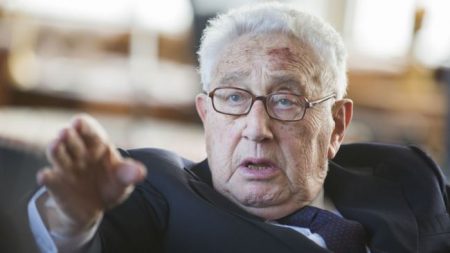
At 94, Kissinger is living proof that bad spirit doesn’t mellow with age, yet still finds a market. Speaking at a forum alongside others with similarly dubious credentials in June – the “Margaret Thatcher Conference on Security 2017”, Dr Kissinger talked of his admiration for the “Iron Maiden”, and of how they shared a similar vision of a world controlled by London and Washington; an Atlanticist NATO vision.
Unlike Thatcher, Kissinger’s appraisal of “Putin’s Russia” reflected a certain sympathy for Russia’s position, and evident approval of Russia as a “vital element of European security”, but his view is hopelessly myopic:
“Is the wisest course to pressure Russia, and if necessary to punish it, until it accepts Western views of its internal and global order? Or is scope left for a political process that overcomes, or at least mitigates, the mutual alienation in pursuit of an agreed concept of world order?
Is the Russian border to be treated as a permanent zone of confrontation, or can it be shaped into a zone of potential cooperation, and what are the criteria for such a process? These are the questions of European order that need systematic consideration. Either concept requires a defence capability which removes temptation for Russian military pressure.”
I guess he means a THAAD capability… and the “agreed concept of World Order” means Russia should submit to the US world order. The deployment of the US missile defence system in Poland and Romania has already destroyed the possibility of any such agreement with Russia, just as the current deployment in South Korea has pre-empted any honest agreement with China over North Korea.
It was however Kissinger’s presentation of the crisis over Syria and Iraq which is of most interest. In common with much of the US establishment as well as that of Israel and Saudi Arabia, Kissinger sees Iran’s hands all over the region, while being blind to those of the US and its allies. Iraq has not been destroyed as a result of America’s “intervention”, motivated by a ruthless quest for oil and strategic control; by removing Saddam Hussein, America inadvertently facilitated Iranian influence on Baghdad, which is now a puppet of Tehran.
Even the “rise of ISIS” can be blamed on Iran, as a reaction to the alleged sectarian policies of the Baghdad government, in the same way that President Assad has been blamed for “allowing” IS to take over part of Syria. It’s necessary to point out that both assertions are egregious lies.
Into this fog of misinformation coming from the heart of Imperial power in London however, Kissinger inadvertently shone some light, exposing the workings of the “North Atlantic” deep state.
In a remark that might have been dismissed as the musings of a senescent Iranophobe still hoping to outlive the Islamic Republic, Kissinger claimed that the destruction of ISIS could lead to “the emergence of a radical Iranian empire” – stretching from Tehran to Beirut. He framed it like this:
“The outside world’s war with Isis can serve as an illustration. Most non-Isis powers—including Shia Iran and the leading Sunni states—agree on the need to destroy it. But which entity is supposed to inherit its territory? A coalition of Sunnis? Or a sphere of influence dominated by Iran? The answer is elusive because Russia and the Nato countries support opposing factions. If the Isis territory is occupied by Iran’s Revolutionary Guards or Shia forces trained and directed by it, the result could be a territorial belt reaching from Tehran to Beirut, which could mark the emergence of an Iranian radical empire.”
Leaving aside some details, such as his failure to mention that the “territory” to be “inherited” already belongs to Syria, so the answer to his disingenuous question is anything but “elusive”, we might notice that this is hardly a new idea. Not only has the threat of an “Iranian empire” been the excuse for Israeli belligerence and unprovoked aggression in Lebanon and Syria for decades, but there is convincing evidence that the creation of the “Islamic State” and the covert support for Da’esh/IS forces was a conspiracy specifically aimed at Iran.
The DIA document from 2012 that described this conspiracy, whose veracity was confirmed by former DIA chief Lt. Gen. Michael Flynn, has been quoted so often that it hardly needs repeating:
“8.C. If the situation unravels (following the movement of AQI into Syria) there is the possibility of establishing a declared or undeclared salafist principality in Eastern Syria (Hasaka and Deir al Zour), and this is exactly what the supporting powers to the opposition want, in order to isolate the Syrian Regime, which is considered the strategic depth of the Shia expansion (Iraq and Iran)”
Some useful extra analysis on this conspiracy – and what else could we call it? – is provided by Nafeez Ahmed here, and of course by Flynn himself in his August 2015 interview with Mehdi Hasan on Al Jazeera.
Well now the situation IS “unravelling” for the US and its co-conspirators, as the forces that came in the Da’esh Trojan Horse are nearly routed and Syria’s Russian and Iranian allies decide how to deal with their increasingly desperate back-up crew. With Syrian forces advancing on Deir al Zour from the North and West, and Iraqi forces closing in from the East, the years of planning and billions invested in the American project to cut off Iran look set to be wasted.
Crying wolf on Tehran’s “radical empire” just isn’t going to work again!
Facing Defeat in Syria, ISIS Inexplicably Expands Globally
By Tony Cartalucci – New Eastern Outlook – 11.08.2017
Throughout human history, when a military force and its economic center has been defeated, it contracts, then collapses. For the first time in human history, the self-proclaimed “Islamic State” (ISIS), has managed to reverse this fundamental aspect of reality – but not without help.
Facing defeat in Syria as government forces backed by its Russian and Iranian allies close in on the terrorist organization, stripping it of territory it seized, it has managed to spread far beyond Syria’s borders, establishing itself in Libya, Afghanistan, and even as far as Southeast Asia where it has seized an entire city in the Philippines’ south, and carried out attacks and conducting activities everywhere from Indonesia and Malaysia to allegedly Thailand’s deep south.
It should be remembered, according to Western governments and their media, the territory ISIS holds in Syria is allegedly providing it with the summation of its financial resources and thus the source of its fighting capacity. According to official statements, the US and its European allies allege that ISIS fuels its fighting capacity with “taxes” and extortion as well as black market oil sales – all of which are derived from territory it holds in Syria.
The Washington Post in a 2015 article titled, “How the Islamic State makes its money,” would note:
Weapons, vehicles, employee salaries, propaganda videos, international travel — all of these things cost money. The recent terrorism attacks in Paris, which the Islamic State has claimed as its own work, suggest the terrorist organization hasn’t been hurting for funding. David Cohen, the Treasury Department’s Undersecretary for Terrorism and Financial Intelligence, described the Islamic State last October as “probably the best-funded terrorist organization we have confronted” — deep pockets that have allowed the group to carry out deadly campaigns in Iraq, Syria and other countries.
To explain where ISIS actually makes its money, the Washington Post claims:
Unlike many terrorist groups, which finance themselves mainly through wealthy donors, the Islamic State has used its control over a territory that is roughly the size of the U.K. and home to millions of people to develop diversified revenue channels that make it more resilient to U.S. offensives.
The Washington Post would also claim:
Its main methods of generating money appear to be the sale of oil and antiquities, as well as taxation and extortion. And the group’s financial resources have grown quickly as it has captured more territory and resources: According to estimates by the Rand Corporation, the Islamic State’s total revenue rose from a little less than $1 million per month in late 2008 and early 2009 to perhaps $1 million to $3 million per day in 2014.
With this territory quickly shrinking and the intensity of fighting against what remains of ISIS in Syria and Iraq expanding, it is seemingly inexplicable as to how ISIS is expanding globally, instead of contracting and collapsing.
The Washington Post’s already implausible thesis regarding ISIS finances – based on official statements from the US Treasury Department and US corporate-funded policy think tanks like Rand – appears to be the only thing contracting and collapsing.
ISIS Enjoys Global Reach Many Nation-States Lack
Regarding just how expansive ISIS’ global activities are, US Secretary of State Rex Tillerson himself would claim in an August 1, 2017 statement that:
I think our next steps on the global war to defeat ISIS are to recognize ISIS is a global issue. We already see elements of ISIS in the Philippines, as you’re aware, gaining a foothold. Some of these fighters have gone to the Philippines from Syria and Iraq. We are in conversations with the Philippine Government, with Indonesia, with Malaysia, with Singapore, with Australia, as partners to recognize this threat, try to get ahead of this threat, and help them with training – training their own law enforcement capabilities, sharing of intelligence, and provide them wherewithal to anticipate what may be coming their direction.
Tillerson made these remarks after noting ISIS’ shrinking holdings in both Syria and Iraq. He claimed in regards to Iraq:
More than 70 percent of Iraqi territory that was once held by ISIS has been liberated and recovered. ISIS has been unable to retake any territory that it has been – that has been liberated, and almost 2 million Iraqis have returned home. And this is really the measure of success, I think, is when conditions are such that people feel like they can return to their homes.
Regarding Syria, Tillerson would claim:
Similarly, over in Syria, we’re assisting with the liberation of Raqqa, which is moving at a faster pace than we originally anticipated.
The steps outlined by Tillerson to combat ISIS sidestep strategic fundamentals like identifying, isolating, and eliminating the economic and financial source of the organization’s fighting capacity, and instead focus on an indefinite justification for global US military operations – particularly across Southeast Asia at a time when the region is incrementally uprooting American influence and replacing it with Eurasian alliances, networks, as well as military and economic blocs.
For ISIS – fueled by resources found only within the boundaries of its meager and shrinking territorial holdings in Syria and Iraq – to be simultaneously fighting the national armies of Syria and Iraq, backed by Iran, Russia, Lebanon’s Hezbollah, and allegedly a US-led coalition including dozens of countries, all while expanding its reach worldwide, including full-scale military operations in Southeast Asia, begs belief.
ISIS doing all of this with multi-billion dollar multinational state sponsorship, not only makes much more sense, it is the only explanation.
ISIS is State Sponsored
Until recently, ISIS territory butted directly against the borders of NATO-member Turkey. In fact, looking at any map of the Syrian-Iraqi conflict with ISIS revealed what appeared to be logistical trails leading directly out of Turkey and to a lesser extent, Jordan.
A 2014 report from Germany’s public broadcaster Deutsche Welle, revealed a torrent of supplies, men, and weapons flowing daily over the Turkish-Syrian border, headed directly toward ISIS territory, directly under the nose and with the complicity of Turkish officials.
The report titled, “‘IS’ supply channels through Turkey,” would note:
Every day, trucks laden with food, clothing, and other supplies cross the border from Turkey to Syria. It is unclear who is picking up the goods. The haulers believe most of the cargo is going to the “Islamic State” militia. Oil, weapons, and soldiers are also being smuggled over the border, and Kurdish volunteers are now patrolling the area in a bid to stem the supplies.
So obvious was the logistical support for ISIS flowing from Turkey, that ISIS flags were clearly visible from the Turkish border throughout DW’s footage.
It was only until Russia’s military intervention in Syria upon Damascus’ request, that these logistical routes were targeted and significant pressure could be placed on ISIS inside Syria, rolling back its fighting capacity.
ISIS enjoys a global reach few nation-states could achieve because it is financially, politically, and militarily backed by nations with the resources to obtain that global reach. This includes the US itself, NATO, and the Gulf Cooperation Council (GCC) which in turn includes nations like Saudi Arabia, the United Arab Emirates (UAE), and Qatar.
ISIS is America’s Foot in the Door in Southeast Asia
US Secretary of State Rex Tillerson’s comments regarding ISIS’ spread into Southeast Asia implied long-term US involvement in the region, including closer involvement with regional police and even military forces. In the Philippines, where US-Philippine relations were spiraling downward, the sudden appearance of ISIS there and the organization’s ability to seize an entire city led directly to justification for not only a continued US military presence in the country, but its expansion.
Other nations across Southeast Asia – including Indonesia, Malaysia, and Thailand – have been incrementally pushing US influence out of the region in favor of stronger and more stable ties with each other and with neighboring China.
Thailand for instance, has begun replacing aging US military hardware with weapon systems from Russia, China, and Europe. Thailand has also begun joint military exercises with China, ending America’s post-Vietnam War monopoly. Thailand and Indonesia have also begun striking a series of economic and infrastructure deals with China, including immense expansions of their respective national railways.
As each nation has taken steps to move the US out of Asia, the US has increased pressure on each respective nation. It has done this through US-funded fronts posing as nongovernmental organizations (NGOs) and US-backed opposition movements. It also appears to be doing this through the introduction and expansion of ISIS activity in the region.
It should be remembered that it was the US itself that created Al Qaeda in the mountains of Afghanistan to fight the Soviets in the 1980s.
If the situation unravels there is the possibility of establishing a declared or undeclared Salafist principality in eastern Syria (Hasaka and Der Zor), and this is exactly what the supporting powers to the opposition want, in order to isolate the Syrian regime, which is considered the strategic depth of the Shia expansion (Iraq and Iran).
Moldova to Become Foothold for US Military

By Peter KORZUN | Strategic Culture Foundation | 10.08.2017
The former Soviet republic of Moldova may actually become yet another foothold for the US military in Europe. The US Naval Facilities Engineering Command Europe Africa Southwest Asia (NAVFAC EURAFSWA) plans to construct eight training facilities for military operations in urban terrain at the Bulboaca training base in Moldova. The fact that the US Navy Department is involved makes believe the facility will host American Marines.
A total of $1.6 million has already been invested in the renovation of the Bulboaca base located near Tiraspol, the capital of Transnistria or the Transnistrian Moldovan Republic. The largely Russian-speaking region broke away from Moldova following the collapse of the Soviet Union in 1991.
The secession led to an armed conflict that ended in a ceasefire in July 1992. Russian troops were deployed to the conflict zone in accordance with the «Agreement on the Principles for a Peaceful Settlement of the Armed Conflict in the Transnistrian Region of the Republic of Moldova», signed in 1992 by the presidents of Russia and Moldova in the presence of Transnistria’s leader.
Today, 450 Russian servicemen are carrying out the peacekeeping mission in accordance with the decisions of the 1999 Organization for Security and Co-operation in Europe (OSCE) summit. Besides the peacekeepers, Russia holds units of the 1,200-strong Operative Group of the Russian Forces residing in Transnistria. The Transnistrian authorities strongly oppose Moldova’s plan to withdraw Russian peacekeepers, whom they see as guarantors of peace in the region. They point out that the mission has proved to be highly successful. The 25th anniversary since the start of the peacekeeping operation was marked in July.
Since 2005, talks on Transnistrian peace have been held in the so-called «5+2 format», which includes Moldova, Transnistria, the OSCE, Russia, and Ukraine, plus the European Union and the United States in external observers’ roles.
Moldovan President and Supreme Commander-in-Chief of the Armed Forces Igor Dodon stepped in to suspend the implementation of the plans to build a US military facility in Bulboaca, saying the move was not approved by him. The president said he will examine the issue. Meanwhile, the US stopped financing the project.
Anatol Șalaru, acting leader of the Party of National Unity and ex-Defense Minister, said he is going to sue President Dodon for undermining national security as the US suspended the $12, 7 military aid to modernize Moldova’s military through the Foreign Military Financing (FMF) program.
Moldova closely cooperates with the US and NATO. It joined the NATO Partnership for Peace program in 1994 and the Individual Partnership Action Plan in 2006. A NATO liaison office is to open in Chisinau soon.
Since 2016, Moldova has been included in a US regional program to build «more formidable defense capabilities… against aggressive actions by Russia or from other sources». Areas targeted include «border security and air/maritime domain awareness, as well as building stronger institutional oversight» of defense ministries. Last March, Lt. Gen. Ben Hodges, the commander of US Army Europe, said that military engineers would head to Moldova as the US looks «for ways to do more exercises in the southern flank of NATO».
In February, the US donated 41 High Mobility Multipurpose Wheeled Vehicle (HMMWV) and trucks to the Moldovan Army. The military vehicles would be used during national and international exercises. In 2014, the US donated some other 39 HMMWV and 10 trailers for the military vehicles.
On July 24 — August 5, the base hosted the Dragoon Pioneer 2017, joint drills of US and Moldovan troops. Army Maj. Gen. John L. Gronski, Deputy Commanding General for Army National Guard, US Army. Europe, visited Moldova to watch the training event.
In late July, the Moldovan parliament passed a declaration demanding the withdrawal of Russian troops from the territory of the unrecognized Transnistrian Moldovan Republic. The resolution was supported by deputies from the ruling coalition led by the Democratic Party, as well as representatives of Liberals and Liberal Democrats. The lawmakers from the opposition Socialist Party left the meeting in protest. Moldovan President Igor Dodon condemned the parliament’s decision, calling it a provocation.
Moscow expresses concern over the Moldovan policy in Transnistria. Russian military personnel movements are obstructed by Moldavan authorities. In late July, Russian Deputy Prime Minister Dmitry Rogozin was barred by the Moldovan government from flying to Transnistria in a military plane to celebrate the 25th anniversary of Russia’s deployment of peacekeepers there. Russia retaliated by halting imports of Moldovan farm produce, depriving Europe’s poorest country of a key market for its wine, fruit and vegetables. In early August, Moldovan authorities declared Rogozin persona non grata. Actually, the relations had begun to worsen much earlier after the expulsion of five Russian diplomats in May. President Igor Dodon believes that the government embarked on provocations against Russia in order to complicate relations.
Moscow has accused Moldova of undermining their relations and threatening regional stability. The Russian Foreign Ministry’s statement reads: «High-ranking Russian representatives and peacekeepers but also ordinary citizens of both countries have recently become targets of provocations. It seems that Chisinau politicians are trying to get to the forefront of the hysterical and hopeless campaign that has been launched against the Russian Federation». It adds that dangerous actions may have a serious destabilising influence on the general situation in the region and Europe as a whole. Kremlin spokesman Dmitry Peskov said Moldova’s decision to ban Rogozin was «much worse» than even the new tough US economic sanctions on Russia.
The US military presence is expanding everywhere, including areas in the proximity of Russia’s borders, such as Transnistria. This is a very dangerous development to make US forces and Russian peacekeepers watch each other through gun sights. Moscow and Chisinau may have different views and divisions but it does not make them adversaries.
With Russian peacekeepers gone, the situation would exacerbate and a spark would be enough to restart the hostilities – something that has been prevented since 1992. By hosting US-operated facilities on its territory, Moldova, a neutral state, will become a target for a Russian retaliatory strike. Parliamentary elections are expected to be held in Moldova in November 2018. Hopefully, the voters will make the right choice, electing more responsible people to end incessant provocations and adopt a more reasonable foreign policy. If the hopes come true, Russia and Moldova will become friends and good neighbors again.
Featured Video

New positive ivermectin evidence
or go to
Aletho News Archives – Video-Images
From the Archives
Fanatical Followers of the Covid Regime: A Jim Jones-Style Cult?
By Professor Roger Watson and Dr. Niall McCrae | The Daily Sceptic | November 15, 2021
As scholars at leading British universities over recent decades, we witnessed the replacement of critical thinking and debate by narrative: facts are discrimination and scientific method is imperialism; truth, instead, is derived from ‘progressive’ values. This educational trend may be a major contributory factor to the ease in which society has been inculcated to the Covid ‘new normal’ of masking, testing, and repeated doses of vaccines for a disease of similar risk to severe influenza.
One doesn’t need much critical reasoning to observe the flawed logic of some vaccination enthusiasts, such as people who respond to experiencing any side effects, however debilitating, by saying “at least I know it’s working”, or, after contracting the disease despite their promised inoculation (over 90% effective, according to initial drug company claims), “I’d have been worse off without the jab.” … continue
Blog Roll
 Aletho News
- ‘Grave, alarming’: Iran mission on Trump’s UNGA ‘annihilation’ threats
- Najaf airport to reopen to Iranian flights within 24 hours: Ambassador
- From ‘How Will This End For Iran’ to ‘When America Walks Away’: A tale of two Economist covers
- Tehran blasts ‘baseless’ speculation linking Iran to alleged bomb plot at UK air base
- The Rise And… Rise Of ‘Color Revolutions’
- The Coming GOP Bloodbath?
- Arctic Scare Stories Melt Away
- Wrong, Euronews: Climate Change Has Not Created a Food, Energy, and Economic “Meta-Crisis”
- New positive ivermectin evidence
- Met Office Caught Fabricating Daily Temperature Record Claims
- If Americans Knew
- Netanyahu Asked UAE Leader to Deny Report on Oct. 7 Warning in Secret Visit, Sources Say
- CNN Chief Int’l Correspondent Clarissa Ward on Journalists in Gaza
- Democratic Party Consultants Surround Troy Jackson with Pro-Israel Donors
- Christian Leader Responds To Netanyahu’s Claims Regarding Palestinian Christians
- In Gaza, ‘Whoever Survives the Bombing Won’t Survive the Rubble’
- Israel kills more Palestinians, amid push to resettle Gaza – Daily Update
- Israel forces Gazans to live in constant peril – Daily Update
- Deconstructing Netanyahu’s pants-on-fire UN rant – Daily Update
- Trump betrayed voters with his campaign lies and prioritized a foreign country once he took office
- Netanyahu calls Israel’s war in Gaza ‘opposite of genocide’ in UN speech to near-empty hall
- No Tricks Zone
- New Study: Earth And Venus Surface Warmth Largely Explained By Convection And Lapse Rate, Not CO2 Or Radiation
- 2025 Nature Paper Claiming Worsening Global Drought Gets RETRACTED …Heavily Flawed
- New Study: ‘Global Drought Shows No Detectable Recent Acceleration Under Climate Warming’
- Economic Masterminds: German Socialists Suggest Taxing Productivity Gains Stemming From Using AI
- The South China Sea Has Not Been Cooperating With The Climate Change Narrative
- Energy Crisis: Germany Enters Heating Season With Historically Low Gas Reserve Fill Levels
- New Study: The Antarctic Ice Sheet Gained Mass From 2020-2024 Due To Staggering Snow And Ice Accumulation
- Study: Ocean Heating Rates From Thousands Of Years Ago ‘Dwarf’ Modern Ocean Heating Rates
- Climate Extremists Target, Attack Large-Scale Power Grid Infrastructure In Germany!
- New Study: Antarctic Ice Melt Has Contributed Less Than 1 Centimeter To Sea Level Rise In The Last 30 Years

