Global ‘False’ Witness Targets Nicaragua
By Tortilla con Sal | teleSUR | August 4, 2017
Global Witness is a well-established environmental and human rights non-governmental organization based in Britain.
As with many other similar organizations, its reports often figure in news media as authoritative sources on international issues. Ever since the 1980s and, increasingly so, after the turn of the century, the status of NGOs as trustworthy information sources on foreign affairs has become increasingly untenable as they have been more and more co-opted by corporate interests and governments to promote the Western elites’ neocolonial global policy agenda.
In the case of Nicaragua, in 2016 Global Witness produced a brief, flawed and unreliable account of land conflicts in Nicaragua’s Northern Caribbean Autonomous Region in a report called “On Dangerous Ground”. In June 2017, they produced a report called “Defenders of the Earth”, with a section on Nicaragua even more poorly researched and false than the previous one. Three main reasons stand out to dismiss the latest Global Witness report on Nicaragua as unreliable and in bad faith.
Firstly, the report itself is clearly biased and flawed, from even a cursory analysis of its references and their sources by anyone familiar with Nicaragua. Secondly, the organization’s human and material resources all come from a very narrow managerial class and corporate funding base, overwhelmingly advocating the foreign policy positions of the United States government and its allies. Thirdly, the history of Global Witness clearly indicates its categorical bias in favor of NATO country governments’ policy positions in the countries that figure in its reports and too its systemic defense of the very corporate capitalism whose destructive effects Global Witness superficially and selectively criticizes.
Global Witness sources on Nicaragua
Before looking at the text of the false Global Witness attack on Nicaragua, it is worth looking at the sources they identify in their footnotes, of which there are 23, composed of a total of 44 references. For anyone familiar with Nicaraguan politics and society since the war of the 1980s many of the sources are wearily familiar and readily identifiable as anti-Sandinista, for example, the virulently anti-Sandinista La Prensa newspaper. Some of the references are duplicates and some disguise the fact that while apparently distinct, ultimately the information they provide comes from one single source. (Here’s a link to the relevant spreadsheet for anyone interested in a more detailed analysis.)
Of the 44 references, some of which are duplicates, not one represents the view of the Nicaraguan authorities or others criticized in the report or any source sympathetic to them. 16 references are to sources inside Nicaragua politically opposed to the Nicaragua’s Sandinista government. 25 of the sources are external to Nicaragua but with a long record identifying them as ideologically opposed to the Sandinista government. Of those 25 sources, one might argue that the Washington-based Interamerican Commission for Human Rights or the EFE Spanish language news agency are impartial, but their record is indisputably biased against Nicaragua’s Sandinista authorities.
For all but imperialist ideologues, the Paris based International Federation for Human Rights (FIDH) has been discredited in particular, most recently, by its flagrant partisan bias in favor of NATO country government policies attacking the populations of Libya and Syria. One source, a reference to the law authorizing Nicaragua’s Canal, is completely neutral. Only one media source, El Nuevo Diario, is generally independent. Two references are to sources within the Western environmental scientific lobby, which has its own set of highly questionable biases, prejudices and neocolonial hypocrisy.
“Methodology”
As if by way of justifying this desperately unfair selection of sources, Global Witness also offer an account of what they call their “methodology”. They aver, “We have recorded data about the cases using the HURIDOCS Event Standard Formats and Micro-Thesauri, an approach which is widely used to manage and analyse material of this nature.”
That Global Witness claim is demonstrably untrue. Whatever their aspirations they certainly did not use the HURIDOCS approach.
HURIDOCS (Human Rights Information and Documentation Systems, International) is a European NGO established in 1982 to facilitate networking between human rights organizations around the world. HURIDOCS says its ‟specific role in this capacity-building process lies in improving access to and the dissemination of human rights information through more effective, appropriate and compatible methods and techniques of information handling. HURIDOCS recognises that we live in an age of tremendous advances in information and communication technologies. There is the need to master these technologies to aid us in our human rights work. At the same time, we must be conscious of the fact that the technologies to be applied should be appropriate and responsive to the main focus of the mandates of human rights organisation.”
HURIDOCS exposition of their approach includes the following definitions:
Fact-finding is the process of identifying the violations in one event, and establishing the facts relevant to these violations. Fact-finding and investigation are terms that are used interchangeably.
Documentation is the process of systematically recording the results of an investigation or fact-finding in relation to an event or number of events. Fact-finding and documentation are organically related and should not be viewed as separate processes.
Monitoring is closely observing a given situation in society over a long period of time to see whether human rights standards are met. To carry out monitoring, investigation and documentation of a large and/or representative number of events are conducted.”
Global Witness are not in compliance with the HURIDOCS approach because their practice in their reporting on Nicaragua demonstrably violates all of these definitions.
Their fact-finding or investigation is so heavily biased as to make it impossible for them to establish the facts. Consequently, thanks to this gross fact finding bias, their documentation is partial, often inaccurate and categorically incomplete. Nor do they show any sign of having done due diligence in monitoring consistently over time via ” investigation and documentation of a large and/or representative number of events” or the context of those events in Nicaragua.
Other theoretical considerations
Apart from these chronic procedural failures, other theoretical considerations cry out for clarification.
Global Witness say, “This report is based on research on killings and enforced disappearances of land and environmental defenders, who we define as people who take peaceful action to protect land or environmental rights”.
But in a bitter property dispute between competing communities, clarifying who is defending whose rights becomes a fundamentally important question. Certainly in Nicaragua’s northern Caribbean Coast, unscrupulous Miskito community leaders are themselves involved in provoking these property disputes by illegally selling land to rural families migrating in search of a better life. Miskito gangs have attacked and murdered many such people, a factor not even mentioned by Global Witness. They completely evade the issue of identifying in a responsible, proportionate way whose rights are being violated.
Similarly, Global Witness state, “cases were identified by searching and reviewing reliable sources of publicly online information”. But Global Witness obviously used heavily politicized criteria for deciding what is a reliable source, because not one single reference in their report on Nicaragua gives the Nicaraguan authorities’ side of the story and only one reference can fairly be described as ideologically independent. That renders completely incredible the phony Global Witness claim to systematic research.
They claim their investigation is systematic because “We set up search engine alerts using keywords and conducted other searches online to identify relevant cases across the world.” However, in the case of a small country like Nicaragua, a genuinely systematic search can readily be done covering a much wider range of sources than those accessed by Global Witness without recourse to modish, geeky “search engine alerts”. The poverty of sources evident in the report’s footnotes make Global Witness’s procedure look ridiculous.
Global Witness claim they “verify” the results of their investigation because “Where possible, we checked with in-country or regional partners to gather further information”. But they only cross-checked with ideologically and politically biased organizations, apparently using the same highly questionable, politically compromised sources they cite in their report.
Karl Popper, philosophical darling of the Open Society ideology embraced by Global Witness, explained over 50 years ago in “Conjectures and Refutations” that verification is essentially authoritarian. He argued that a truly scientific investigation requires conjecture and falsification, a search for errors rather than for justification.
If one goes along with Popper, it should surprise no one that Global Witness uses an essentially authoritarian methodology. Self-evidently, their job is not to discover the facts or to impartially establish the truth via a hypothetic-deductive Popper-style process , but to project a manipulative version of events justifying ideologically loaded interpretations favored by their corporate funders, an inherent bias understandably unacknowledged by Global Witness.
Nor is it surprising to learn from their account of their methodology, “While we have made every effort to identify and investigate cases in line with the methodology and criteria, it is important to add that our research mostly relies on public information and that we have not been able to conduct detailed national-level searches in all countries.”
That is not true either. Gobal Witness did not make “every effort” to investigate cases in line with their alleged methodology and criteria because they are flagrantly out of compliance with the definitions advanced by HURIDOCS.
A broader range of sources
Nor is is true that they were unable to conduct a detailed national-level search in the case of Nicaragua, because they could easily have included references from sources that contradict much of the information in the Global Witness report. The following is a brief sample of many other relevant sources, gleaned in a few hours searching on the Internet :
– Indigenous group splits from Miskito party in support of Sandinista government
– Attacks by indigenous gangs on settlers, killing nine
– Miskitos claim their own leaders illegally sold over 3000 acres of communal lands to outsiders
– Historic lease agreement between Canal Authority and indigenous people along the canal route
– Interview with HKND’s Bill Wild about the benefits of the Interoceanic Canal
– HKND’s Bill Wild on the Environmental and Social Impact Study
– Environmentalist Kamilo Lara explains why he believes in Nicaragua’s Interoceanic Canal
– Nicaragua’s Canal – the environmental and economic arguments
– Public Consultation on Lake Nicaragua for the Interoceanic Canal project
– Environmental and Social Impact Assessment of Nicaragua’s Interoceanic Canal – Conclusions and Recommendations
– Bishop accuses political opposition of manipulating canal protests
– Canal protestors attack and injure six police officers
Even this very limited sample of sources, put together from just a few hours searching on the Internet, gives a very different picture to the one presented by Global Witness. So it is false of Global Witness to suggest they lack the resources to be able to stress test and falsify the version of events they have published in their report. Given the tremendous resources and the numerous skilled, experienced, talented people working at Global Witness, only abject intellectual dishonesty explains their failure to report faithfully on Nicaragua
Incoherent claims
Be that as it may, based on their cynically biased sources and their absurdly deficient methodology, Global Witness proceed in their report to make the following claims:
11 defenders killed in 2016 – making Nicaragua the most dangerous country in the world per capita
But, as independent journalist John Perry and others have pointed out, none of those people killed can fairly be described as having being killed for defending the environment. They were in property disputes and all of them were killed either directly or indirectly in the course of those property conflicts. This is true in particular of the case cited by the Inter-American Commission for Human Rights (CIDH) , that of Bernicia Dixon Peralta, her husband Feliciano Benlis Flores and their 11 year old son Feliciano Benlis Dixon. Perry mentions some of the context. More context of the property disputes in the RAAN can be found here, here and here. Not a single person mentioned by Global Witness died in Nicaragua for defending the environment in the way that someone like Berta Cáceres did. Even so Global Witness have tended disingenuously to implicitly compare the situation in Nicaragua with that in Honduras, in particular with Berta’s murder.
The bad faith with which they do so is clear from the second claim in their report on Nicaragua:
10 of those murdered were indigenous people, with most killed in conflicts with settler communities over land. Meanwhile rural ‘campesino’ defenders faced threats, harassment and attacks, including for opposing the construction of an inter-oceanic canal.
Global Witness fails to make clear that groups from the indigenous Miskito people, whom Global Witness inaccurately portray as defenseless environmental defenders, are themselves guilty of murderous attacks against migrants settling land which in many cases the migrants apparently believed they had bought legitimately. Furthermore, the Global Witness report deliberately and falsely confuses the very specific situation of these property conflicts in Nicaragua’s northern Caribbean Coast with protests over the possible displacement of communities along the still to be exactly defined route of the proposed Inter-oceanic Canal 300 kilometers to the south. Global Witness unscrupulously frame their distorted version of events in the two regions to give the impression that in both cases the Nicaraguan authorities may in some way be directly or indirectly responsible for the violence.
In fact, even the New York Times has acknowledged in their otherwise generally hostile anti-Sandinista reporting that the Nicaraguan authorities do what they can with limited resources to protect the rights of indigenous peoples in the Northern Carribean Autonomous Region.
The situation along the route of the Canal is very different from that in the RAAN. Protests against the Canal are exploited by Nicaragua’s political opposition and groups participating in the protest demonstrations have damaged property and attacked police officers. In relation to this situation, completely separate from the property disputes more than 300km to the north, Global Witness claims:
Activists were increasingly criminalized: foreign environmentalists were expelled, community leaders arrested and legislation passed restricting freedoms of speech and association.
However in the very next paragraph, the report quotes anti-Canal activist Francisca Ramirez saying, ““We have carried out 87 marches, demanding that they respect our rights and we have had no response. The only response we have had is the bullet.”
Thus, the Global Witness allegation that rights to freedom of association are restricted is immediately contradicted by Francisca Ramirez declaring her group has organized over 80 public demonstrations to express their views.
Similarly, Ramirez claims “The only response we have had is the bullet.” But, in the next paragraph, we learn “a member of her community lost an eye and another was shot in the stomach”.
Thus, after 87 demonstrations, some of which supposedly involved many thousands of participants and in which “The only response we have had is the bullet”, Ramirez cites precisely two people suffering serious injury and only one of them with a gunshot wound. Ramirez omits that the protesters on the marches she organizes go armed with machetes and home-made mortars. They block highways, intimidate ordinary people going about their business, damage property and attack police officers.
In no Western country would that be tolerated without, to put it mildly, a robust response from the police and security forces. Even so, Global Witness promote Francisca Ramirez’s account as if she and her movement were non-political and non-violent, which they are not. But Global Witness excludes those facts.
Likewise, as John Perry has pointed out, the foreign environmentalists expelled from Nicaragua were involved in a suspicious incident involving a small explosion. Again, a reasonable question to Global Witness is why they excluded this highly relevant information given that in Britain or the United States any foreigner, especially any non-white foreigner, involved in such a suspicious incident would face prosecution and a potential jail term under those countries wide-ranging anti-terrorist laws.
Inaccuracies and falsehoods
Mixed in with these disingenuous, incoherent claims, Global Witness also allege, presumably as supporting context, that the proposed Canal “would force up to 120,000 indigenous people from their land”. This outrageous falsehood is sourced from the pro-NATO, right-wing dominated European Parliament, but is categorically contradicted by the relevant multi-million dollar Environmental and Social Impact report by the extremely prestigious ERM company based in the UK. The falsity of that claim is further confirmed by the Canal concessionary HKND company’s representative Bill Wild who argues that the route of the Canal has been altered to take local concerns into account in such a way that fewer than thirty indigenous families will be directly affected.
Overall, ERM reckons that up to 7210 families or around 30,000 people are likely to be displaced along the whole route of the Canal, over 270 kilometres. The scandalously untrue figure quoted by Global Witness is propaganda from Nicaragua’s political opposition who are exploiting Ramirez’s quasi-celebrity status among Western environmentalists to amplify overseas the marginal support for their unpopular position against the Canal in Nicaragua. That fact is reflected in the incoherence of the arguments set out by Ramirez and her backers in Nicaragua’s political opposition.
If 120,000 people were really going to be displaced by the proposed Canal then the figure of 30,000 protestors from around the country the same political opposition regularly quote to describe national opposition to the Canal just does not add up. Quoting that same opposition figure, Global Witness state, “Francisca has rallied campesino groups from around the country who will be adversely affected by the canal to call for a meaningful say in its development. In June 2015, 30,000 people gathered for an anti-canal protest – Francisca organized 40 trucks so her community could attend.”
In Nicaragua, the cost of hiring a truck or a bus to carry 60 people or a similar amount of material goods on a round trip of 100km is around US$120, while a round trip of 300km costs about US$175. So hiring 40 diesel-guzzling trucks and buses with their drivers will have cost a minimum of US$4000. But Ramirez is an impoverished mother of five from a similarly impoverished community.
Even if only one quarter of the more than 80 protests Ramirez says she has helped organized involved similar costs, the total amount involved runs into tens of thousands of dollars just for Ramirez’s community. Whatever the exact financial accounting, Ramirez is clearly supported by a great deal more than her own resources and those of her community.
Even so, Global Witness completely evade the obvious conclusion to be drawn from that incoherence implicit in their report. Namely, that Francisca Ramirez, far from being a simple altruistic community organizer defending her home is in fact a savvy political opposition activist promoting an inaccurate image of herself as well as concealing her real political agenda. Ramirez alleges that she and her family have been attacked and harassed. Supposing those accusations are true, no convincing evidence points to involvement of the government or the security forces and certainly not the HKND company in charge of planning and building the Canal. That contrasts with the situation of activists in Honduras or Guatemala who can in most cases offer reliable details with corroboration from witnesses to identify their assailants.
The press report cited by Gobal Witness contains no credible evidence from Ramirez except her say so, no corroborating evidence, no witnesses. Likwise the report’s reference to Frontline Defenders’ advocacy for Ramirez links to a summary profile including the false opposition propaganda, repeated by Global Witness, that the proposed inter-oceanic Canal has been imposed without consultation. But in fact preliminary consultations took place in July 2014 and subsequently a continuing consultative process has developed both before and after the publication of ERM’s Environmental and Social Impact Study, which recommended improvements to the consultation process which both HKND and the government accepted.
The Study did also criticize the handling of the expropriation issue and recommended that international standards be applied to any expropriation of land (reckoned to total 1359km2 of dry land out of Nicaragua’s total area of 139,375km2) that may eventully be decided. Those ERM recommendations were accepted by the government and HKND, and the subsequent consultative process has led to several important changes in the precise route of the Canal and to more detailed environmental studies which have been one reason for the delay in the Canal’s construction.
Frontline Defenders’ advocacy of Ramirez, cited by Global Witness, is based on her own account of events with no apparent attempt at corroboration despite the role of Ramirez as a front person for an anti-government campaign openly supported and facilitated by Nicaragua’s political opposition. In the course of framing their benign, heroic account of Francisca Ramirez, Global Witness present an account of the Canal’s origins and procedural progress which repeats virtually word for word the extremely hostile and systematically disingenuous interpretation of Nicaragua’s political opposition.
Garbage in – Garbage out
Winding up their version of the falsehoods, disinformation and propaganda copied from Nicaragua’s political opposition, Global Witness assert, “Resistance to the canal takes place against a terrifying backdrop of multiple murders in indigenous communities elsewhere in the country which have stood up against the arrival of agricultural settlers and demanded the government guarantee their land rights. Even requests by the Inter-American human rights system haven’t spurred the government into protecting community activists from being disappeared, mutilated and murdered.”
But, as is clear from reviewing a wider selection of sources of information in relation to the complicated land situation in Nicaragua’s northern Caribbean Coast, indigenous people themselves are responsible for murderous violence and their own leaders are implicated in corrupt land dealings. It is simply untrue to label the murders as being generically the result of attacks on community activists in the sense in which that term is commonly understood. The general consensus is that the Nicaraguan government has done more than any government in the region, with the possible exception of Venezuela, to protect indigenous people’s land rights with almost a third of the national territory designated as indigenous peoples’ communal land. Global Witness’s allegations on that score are demonstrably inaccurate and grossly unfair.
Similarly, the suggestion that the Canal protest movement is vulnerable to the kind of murderous violence prevalent in Nicaragua’s Northern Caribbean Autonomous Region is egregiously false. The protesters themselves have used violence and intimidation against the general population to carry out their protest actions, so far, thankfully, with no fatalities.
In summary, the Global Witness report in its section on Nicaragua uses politically and ideologically prejudiced sources which could readily have been supplemented with sources offering a contradictory account. The sources used themselves do not always corroborate the claims made in the report. Apart from the ideological bias, various substantive inaccuracies render the report extremey unreliable. The report’s conclusions are flawed because its initial premises are false – Garbage In, Garbage Out.
It remains true that there are serious property conflicts in Nicaragua’s Northern Caribbean Autonomous Region which the government is attempting to address despite a lack of administrative, judicial and security resources, against an intricate social, economic and political context and also the constantly changing opportunistic interaction of corrupt business interests with local indigenous peoples’ leaders, and unscrupulous local officials.
In the case of Nicaragua’s proposed Interoceanic Canal, it is true various issues, including the issue of expropriation, have to be clarified. Protestors claim they want dialog, but Francisca Ramirez sets the precondition that the Canal be scrapped.
The Canal’s critics never acknowledge that Nicaragua is already suffering chronic environmental degradation. The government and many environmentalists argue that the Canal will provide Nicaragua with the resources it needs to reforest deforested areas, better manage its water resources and reverse the current deterioration in Lake Nicaragua, while at the same time helping to reduce poverty.
Foreign and national environmentalists offer no viable proposals to enable Nicaragua to reverse the socio-economic and climate processes already driving accelerating environmental degradation in the country.
Protestors against the Canal exaggerate the number of people likely to be displaced by its construction and often dishonestly claim people affected by displacement will not be compensated. Meanwhile, they themselves are among those responsible for the environmental degradation that will definitely get progressively worse without the resources the Canal is projected to provide.
Corporate funders and the elite NGO revolving door
Few plausible explanations except intellectual dishonesty offer themselves for the desperate failure of Global Witness, firstly to adequately research the issues involved or, secondly, supposing they in fact did so, to acknowledge the complexity of the issues they examine. Global Witness frankly explain in their financial statement for 2016, they had income of over US$13 million. So they do not lack resources. Similarly, their Board, their Advisory Board and their CEO are all very experienced, smart, talented people. So even if they depend on younger inexperienced staff to do the research, their senior staff presumably review the product before publication. Lack of experience is not a reasonable explanation for the report’s glib dishonesty and inaccuracy.
A review of Global Witness funders reveals that for 2016 the two biggest funders were the Open Society Foundation of George Soros associated with the numerous so-called color revolutions in support of NATO country government foreign policy objectives and the Omidyar Network of Pierre Omidyar whose links with US intelligence contractor Booz Allen Hamilton are well known. Less well known is Omidyar’s support for NGOs that fomented the successful right wing coup in Ukraine. The complete list of Global Witness funders is available in the financial statement for 2016 on their web site. That document reports that in 2016 Global Witness received US$3.4 million from the George Soros Open Society Foundation, US$1.5 million from Pierre Omidyar’s Omidyar Network, US$840,000 from the Ford Foundation and over US$3 million from various European NATO governments plus Sweden.
All of these funding sources are unrelenting ideological opponents of Nicaragua’s Sandinista government. A broad pro-NATO bias is very clear in the composition of the Global Witness Board and Advisory Board and CEO. Their profiles make clear they are almost all luminaries from the Western elite neocolonial non governmental sector, while many have a strong corporate business background as well. Just as there is a revolving door between government and corporate business and finance in North America and Europe, so too there is also a revolving door within that region’s elite NGO sector, a sector very clearly serving NATO country foreign policy goals.
 Cory Morningstar has exposed the pro-NATO global political agenda of organizations like US based organizations like Avaaz and Purpose. In the case of Global Witness, their Board member Jessie Tolka is also a board member of Purpose and too of 350.org: Current Global Witness CEO Gillian Caldwell was also a very successful Campaigns Director of Sky1, now merged into 350.0rg. Cory Morningstar argues, “the most vital purpose of the non-profit industrial complex (NPIC) has not been to destroy the ecocidal economic system that enslaves us while perpetuating and ensuring infinite wars. Rather, the key purpose of the NPIC is and has always been to protect this very system it purports to oppose from being dismantled. Hence the trillions of dollars pumped into the NPIC by the establishment.”
Confirmation of Cory Morningstar’s argument can be found in the history of Global Witness itself. For example on Libya, despite their superficial anti-corporate gloss, Global Witness relentlessly apply NATO country government criteria here and here. Also on Ukraine, Global Witness project the same anti-corporate message while simultaneously reinforcing NATO country government propaganda. Global Witness has also received US National Endowment for Democracy grants in Cambodia and in Liberia.
Also, a decade ago, writers Keith Harmon Snow and Rick Hines questioned Global Witness’ corporate links in relation to the “Blood Diamonds” controversy and the organization’s role in relation to De Beers and also Maurice Templesman’s diamond companies. No doubt more thorough research would reveal information casting similar doubt on Global Witness’s integrity and independence.
Conclusion
This latest Global Witness report in relation to Nicaragua is important because it is so readily falsifiable. It thus presents a clear litmus test: no news and information media can use the Global Witness report’s material in relation to Nicaragua without compromising their credibility.
The bias and inaccuracies in the section on Nicaragua in the Global Witness 2017 report call into doubt the integrity of the whole report. No news or information media interested in accuracy or honest reporting can conscientiously rely on Global Witness as a source without thorough cross checking and systematically comparing, contrasting and evaluating information from sources giving a different account of the events and issues in question.
Global Witness is neither independent nor trustworthy. It clearly has a strong but unacknowledged neocolonial political agenda promoting the regional policy goals of NATO country governments, while, conversely, attacking governments and other regional actors opposed to those goals.
NGOs like Global Witness, International Crisis Group, Human Rights Watch, Transparency International and so many others, self-evidently fabricate psychological warfare inputs serving NATO country government policy, itself shaped by the same corporate elites that fund the class of NGOS of which Global Witness is a part.
They operate as the soft, extramural arm of NATO country governments’ foreign policy psychological warfare offensives, targeting liberal and progressive audiences to ensure their acquiescence in overseas aggression and intimidation against governments and movements targeted by NATO. To that end, they deceitfully exploit liberal and progressive susceptibilities in relation to environmental, humanitarian and human rights issues.
Their psychological warfare role supporting the NATO government’s aggressive destabilization of Ivory Coast, Libya and Syria in 2011, of Ukraine in 2014, and the NATO country government’s low intensity war against Venezuela ever since 2013, as well as the campaign against Cuba over five decades, has been unmistakable.
More broadly their systemic ideological role is very obviously to protect and defend global corporate capitalism while superficially and selectively questioning and criticizing some of its worst abuses. Cory Morningstar’s insight bears repeating “the key purpose of the non-profit industrial complex is and has always been to protect this very system it purports to oppose”.
The coverage of Nicaragua in the latest 2017 Global Witness report is a text book example of that sinister fact.
Is Trump’s Russia Policy Being Hijacked?
By Pat Buchanan • Unz Review • August 4, 2017
In crafting the platform in Cleveland on which Donald Trump would run, America Firsters inflicted a major defeat on the War Party.
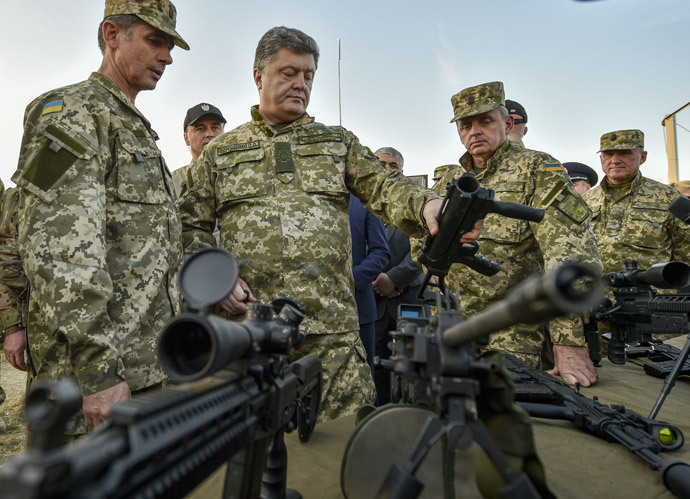
The platform committee rejected a plank to pull us deeper into Ukraine, by successfully opposing new U.S. arms transfers to Kiev.
Improved relations with Russia were what candidate Trump had promised, and what Americans would vote for in November.
Yet, this week, The Wall Street Journal reports:
“The U.S. Pentagon and State Department have devised plans to supply Ukraine with antitank missiles and other weaponry and are seeking White House approval … as Kiev battles Russia-backed separatists … Defense Secretary Mattis has endorsed the plan.”
As pro-Russia rebels in East Ukraine have armored vehicles, Kiev wants U.S. tank-killing Javelin missiles, as well as antiaircraft weapons.
State and Defense want Trump to send the lethal weapons.
This is a formula for a renewed war, with far higher casualties in Ukraine than the 10,000 dead already suffered on both sides.
And it is a war Vladimir Putin will not likely allow Kiev to win.
If Ukraine’s army, bolstered by U.S. weaponry, re-engages in the east, it could face a Moscow-backed counterattack and be routed, and the Russian army could take permanent control of the Donbass.
Indeed, if Trump approves this State-Defense escalation plan, we could be looking at a rerun of the Russia-Georgia war of August 2008.
Then, to recapture its lost province of South Ossetia, which had seceded in 1992, after Georgia seceded from Russia, Georgia invaded.
Putin sent his army in, threw the Georgians out, and recognized South Ossetia, as John McCain impotently declaimed, “We are all Georgians now!”
Wisely, George W. Bush ignored McCain and did nothing.
But about this new arms deal questions arise.
As the rebels have no aircraft, whose planes are the U.S. antiaircraft missiles to shoot down? And if the Russian army just over the border can enter and crush the Ukrainian army, why would we want to restart a civil war, the only certain result of which is more dead Ukrainians on both sides?
The Journal’s answer: Our goal is to bleed Russia.
“The point of lethal aid is to raise the price Mr. Putin pays for his imperialism until he withdraws or agrees to peace. … The Russians don’t want dead soldiers arriving home before next year’s presidential election.”
Also going neocon is Mike Pence. In Georgia this week, noting that Russian tanks are still in South Ossetia, the vice president not only declared, “We stand with you,” he told Georgians the U.S. stands by its 2008 commitment to bring them into NATO.
This would mean, under Article 5 of the NATO treaty, that in a future Russia-Georgia clash the U.S. could find itself in a shooting war with Russia in the South Caucasus.
Russia’s security interests there seem clear. What are ours?
Along with Trump’s signing of the new sanctions bill imposed by Congress, which strips him of his authority to lift those sanctions without Hill approval, these developments raise larger questions.
Is President Trump losing control of Russia policy? Has he capitulated to the neocons? These are not academic questions. For consider the architect of the new arms package, Kurt Volker, the new U.S. Special Representative for Ukraine Negotiations.
A former CIA agent, member of the National Security Counsel, and envoy to NATO, Volker believes Russian troops in Transnistria, Abkhazia, South Ossetia, Crimea, Donetsk and Luhansk are all there illegally — and U.S. policy should be to push them out.
A former staffer of Sen. McCain, Volker was, until July, executive director of the neocon McCain Institute. He has called for the imposition of personal sanctions on Putin and his family and European travel restrictions on the Russian president.
In the Journal this week, “officials” described his strategy:
“Volker believes … that a change in Ukraine can be brought only by raising the costs for Moscow for continued intervention in Ukraine. In public comments, he has played down the notion that supplying weapons to Ukraine would escalate the conflict with Russia.”
In short, Volker believes giving antitank and antiaircraft missiles to Ukraine will bring Putin to the negotiating table, as he fears the prospect of dead Russian soldiers coming home in caskets before his 2018 election.
As for concerns that Putin might send his army into Ukraine, such worries are unwarranted.
Volker envisions a deepening U.S. involvement in a Ukrainian civil war that can bleed and break Russia’s Ukrainian allies and convince Putin to back down and accept what we regard as a just settlement.
Does Trump believe this? Does Trump believe that confronting Putin with rising casualties among his army and allies in Ukraine is the way to force the Russian president to back down and withdraw from Crimea, Luhansk and Donetsk, as Nikita Khrushchev did from Cuba in 1962?
What if Putin refuses to back down, and chooses to confront?
Copyright 2017 Creators.com.
Militarization of Scandinavian Peninsula: Time to Ring Alarm Bells
By Alex GORKA | Strategic Culture Foundation | 31.07.2017
Much has been said about NATO reinforcements in the Baltic States and Poland perceived in Moscow as provocative actions undermining security in Europe, while very little has been said about gradual but steady militarization of Scandinavia. The theme does not hit headlines and it is not in focus of public discourse but one step is taken after another to turn the region into a springboard for staging offensive actions against Russia.
Ørland in southern Norway is being expanded to become Norway’s main air force base hosting US-made F-35 Lightnings – the stealth aircraft to become the backbone of Norwegian air power. Norway has purchased 56 of such aircraft. F-35 is an offensive, not defensive, weapon. The nuclear capable platforms can strike deep into Russia’s territory.
Providing training to Norwegian pilots operating the planes carrying nuclear weapons, such as B61-12 glider warheads, constitutes a violation of the Non-Proliferation Treaty (NPT) of 1968. Article I of the NPT prohibits the transfer of nuclear weapons from NWS (nuclear weapons states) to other states: «Each nuclear-weapon State Party to the Treaty undertakes not to transfer to any recipient whatsoever nuclear weapons or other nuclear explosive devices or control over such weapons or explosive devices». Article II requires NNWS (non-nuclear weapons states) not to receive nuclear weapons: «Each non-nuclear-weapon State Party to the Treaty undertakes not to receive the transfer from any transfer or whatsoever of nuclear weapons or other nuclear explosive devices or of control over such weapons or explosive devices». How can Russia be sure that these aircraft don’t carry nuclear weapons when there is no agreement of any kind in place to verify compliance with the NPT?
Ørland is located near Værnes – the base that hosts 330 US Marines. In May, the base hosted the biennial NATO military exercise «Arctic Challenge Exercise 2017» to involve over 100 planes from 12 nations. It was the first time a US strategic bomber (B-52H) took part in the training event.
The choice of the base was carefully calculated to keep the planes away from the reach of Russian Iskander missiles (500 kilometres) but no location in Norway is beyond the operational range of Kalibr ship-based sea-to-shore missiles and aircraft armed with long-range air-to-surface missiles.
In June, Norway’s government announced that the decision was taken to extend the rotational US Marine Corps force stationed at Værnes through 2018. The move contradicts the tried-and-true Norwegian policy of not deploying foreign military bases in the country in times of peace.
Also in June, the United States, United Kingdom and Norway agreed in principle to create a trilateral coalition built around the P-8 maritime aircraft to include joint operations in the North Atlantic near the Russian Northern Fleet bases.
Norway is to contribute into NATO ballistic missile defense (BMD) system by integrating its Globus II/III radar in the Vardøya Island located near the Russian border just a few kilometers from the home base of strategic submarines and 5 Aegis-equipped Fridtjof Nansen-class frigates. The radar construction is underway. The Vardøya radar can distinguish real warheads from dummies. Another radar located in Svalbard (the Arctic) can also be used by US military for missile defense purposes.
The country’s ground forces are stationed in Lithuania as part of a NATO multinational force under German command.
Sweden, a close NATO ally, has been upgrading its military with a sharp hike in spending. Last December, the Swedish government told municipal authorities to prepare civil defense infrastructure and procedures for a possible war. The move was prompted by the country’s return to the Cold War-era ‘Total Defense Strategy’. In September, 2016, 150 troops were put on permanent service on the island of Gotland to «defend it from Russia». Sweden maintained a permanent military garrison on Gotland for hundreds of years until 2005.The Swedish Civil Contingencies Agency (MSB) has ordered a review of 350 civilian bunkers on the island. The shelters are designed to protect people against the shock wave and radiation from a nuclear detonation, as well as chemical and biological weapons.
In March, Stockholm announced plans to reintroduce compulsory military service abandoned in 2010. The conscription will come into force on January 1, 2018.
Sweden said in June it wishes to join a British-led «Joint Expeditionary Force», making Swedish participation in a general European war all but inevitable.
This month, the Swedish military announced plans to conduct its largest joint military exercise with NATO in 20 years. Called Aurora 17, the training event is scheduled for September. The drills will take place across the entire country but focusing on the Mälardalen Valley, the areas around cities of Stockholm and Gothenberg and on the strategic island of Gotland. More than 19,000 Swedish troops will take part along with 1,435 soldiers from the US, 270 from Finland, 120 from France and between 40-60 each from Denmark, Norway, Lithuania and Estonia.
In June, Russian President Putin warned «If Sweden joins NATO this will affect our relations in a negative way because we will consider that the infrastructure of the military bloc now approaches us from the Swedish side».
In June, 2016, Finland took part in NATO BALTOPS naval exercise. It was the first time NATO forces trained on Finnish territory (The coastal area at Syndale). Back then, Russian Foreign Minister Sergei Lavrov told his Finnish counterpart, Timo Soini, that the Kremlin would take unspecified measures to respond to increased NATO activity in the Baltic region. According to Lavrov, «We do not hide our negative attitude to the movement of NATO’s military infrastructure towards our borders, to dragging new states into the military activity of the bloc».
All these facts and events summed together demonstrate that militarization of Scandinavia is progressing by leaps and bounds to undermine the security in Europe. No hue and cry is raised in the Russian media but the developments are closely watched by Moscow. Visiting Finland on July 27, President Putin said Russia was «keeping an eye on certain intensification in the movement of military aircraft, ships and troops. In order for us to avoid negative consequences, situations that no one wants, we need to maintain dialogue». He also stressed readiness for dialogue with neutral countries that border the Baltic Sea like Finland which is not part of the NATO military alliance.
The facts listed above show the situation is grave enough to top the agenda of the NATO-Russia Council. But it’s not the case as yet. Last year, Frank-Walter Steinmeier, the current President of Germany who was Foreign Minister at the time, slammed NATO for «saber-rattling and war cries» and provocative military activities in the proximity of Russia’s borders. He called for an arms control deal between the West and Russia. Fifteen other members of the Organization for Security and Cooperation in Europe (OSCE) joined Steinmeier’s initiative: France, Italy, Austria, Belgium, Switzerland, the Czech Republic, Spain, Finland, the Netherlands, Norway, Romania, Sweden, Slovakia, Bulgaria and Portugal.
Actually, the initiative to relaunch the negotiation process does not belong to Germany. Russia’s proposal to discuss a new European security treaty was rejected by the West. The draft document was published in 2009. In March 2015, Russia expressed its readiness for negotiations concerning a new agreement regarding the control of conventional weapons in Europe.
Moscow has never rejected the idea of launching talks to address the problem. It does not reject it now. The NATO-Russia Council could make a contribution into launching discussions on the matter. It has not done so as yet. Actually, nothing is done to ease the tensions in Europe and the Scandinavian Peninsula in particular. Meanwhile, the situation is aggravating misunderstandings and whipping up tensions.
The Atlantic Council: Experts on the front line of disinformation
By Bryan MacDonald | RT | July 26, 2017
NATO’s academic wing has been warning about disinformation for years. And it’s no wonder when its staff and contributors are so well-versed in the practice themselves.
The Atlantic Council is an organization dedicated to discussion between people who hate Russia and folk who really, really hate Russia. Thus, amid the current hysteria, it’s Christmas every day for its assorted staff and “fellows” or, to use a more accurate term, ‘lobbyists.’
For the uninitiated, it’s difficult to explain what exactly the Atlantic Council does. Essentially, the club exists to influence the information space to justify NATO’s continued existence. It does that by either employing Russia’s opponents directly or offering retainers to journalists and media analysts who can be relied upon to push the outfit’s anti-Russian stance. Which, of course, is its lifeblood.
While the Atlantic Council is set-up to promote antagonism toward Russia, it also needs it. Because if Russia combusted tomorrow, everyone on the payroll would be out of a job. So, it’s like the famous U2 song “I can’t live, with or without you.” But unlike the protagonist of that ditty, these guys don’t give themselves away. Instead, this NATO adjunct is lavishly funded, by a roll call of famous entities.
Such as the Foreign & Commonwealth Office of the United Kingdom, Abu Dhabi’s National Oil Company, the Ukrainian World Congress, the Lockheed Martin Corporation, the Raytheon Company, the US State Department and the Victor Pinchuk Foundation, which is the plaything of a Ukrainian oligarch.
Some of the more prominent beneficiaries of the resultant money tree include Bellingcat’s Eliot Higgins, CNN’s Michael Weiss, Crowdstrike’s Dmitri Alperovitch, Obama advisor Evelyn Farkas and Maxim Eristavi of Ukraine’s Maidan. All of whom are conveniently united by their hostility to all things Russian.
Like Rolling Stones
The Atlantic Council’s content ranges from very anti-Russian to extremely anti-Russian. For instance, it carries articles by the likes of Alexander Motyl, who predicted Russia’s imminent collapse in January of 2016, before warning in January of 2017 that Moscow was planning a major land invasion of Ukraine. Which is Russophrenia at its finest, in fairness. Nevertheless, Motyl is a shrinking violet compared to Atlantic Council lobbyist Anders Aslund, who foresaw Russia’s demise way back in September 1999. And now, almost eighteen years later, he’s still hanging around for the big moment. In the manner of a Seventh Day Adventist awaiting the second coming of Jesus, any day now.
So, now that we’ve established the Atlantic Council’s modus operandi let’s look at the latest example of the group’s myopia. This week, they’ve unleashed one Polina Kovaleva to opine on “why Congress should pass the Russian sanctions bill.” And she’s delivered a tirade which is shoddy, even when measured by the usual indigent standards.
Kovaleva gives her readers examples of why the embargo is justified, in her opinion, but then delivers a line so deceptive that it makes you wonder whether she’s in touch with reality. “Although the Senate easily passed a strong sanctions bill in June to punish Russia for its aggression in Ukraine and annexation of Crimea, the White House has quietly lobbied to weaken it, and some European politicians are pushing back,” she writes.
Eurocrat Anger
That’s’ right, “some European politicians are pushing back.” Some! What she actually means is “basically every significant elected representative in the European Union.” Including, the “leader of the free world” herself Angela Merkel and that well-known renegade Jean-Claude Juncker.
Here’s what Reuters reported on Wednesday morning: “European Commission President Jean-Claude Juncker said on Wednesday the European Union was ready to act “within a matter of days” if proposed new US sanctions on Russia undermined the bloc’s energy security. And that came three days after the Financial Times reported how Brussels was considering imposing penalties on the US if it damaged European interests to settle scores with Moscow.
Meanwhile, for her part, Merkel has backed Germany’s Foreign Minister, Sigmar Gabriel, in expressing concerns that Washington is threatening “illegal extraterritorial sanctions against European companies that participate in the development of European energy supply.”
Because everybody in Europe knows this US Congress bill has little or nothing to do with punishing Russia. Instead, it’s about trying to nudge Moscow’s energy companies out of Europe, to create market share for their competitors. In other words, a form of economic war, in which the EU countries’ interests don’t amount to a hill of beans.
Something explained recently by Wolfgang Ischinger, a prominent German pundit and former diplomat. He contended: “how would the US have reacted if Europeans had adopted a bill against Keystone XL pipeline but in favor of European business?” before pointing out “for Europe, the loss of such large oil or gas supplies from Russia is unacceptable: there are no alternatives.”
Without question, this is a high-profile resistance campaign. And these sanctions could severely rupture transatlantic ties. Because you don’t get more powerful than Merkel and Juncker in Europe. But the Atlantic Council makes it sound as if a few fringe politicians are off on a solo-run, rejecting Washington’s supreme wisdom.
That is certainly not the case and amounts to misleading agitprop of the highest order. Which is rather apt for a lobbying firm which recently held a “Disinfo week” and proudly claims to be “On the front lines of disinformation.” Because, on this evidence, the Atlantic Council is home to seriously proficient gurus of hogwash.
Bryan MacDonald is an Irish journalist, who is based in Russia.
CNN: “Russia is an adversary, Ukraine is not.”
So that settles it!
By Gary Leupp | Dissident Voice | July 17, 2017
Monday morning. David Chalian, CNN Political Director, on CNN’s “New Day” program. News ticker: “How do Trump-Russia and DNC-Ukraine compare?
New Day co-anchor Alysin Camerota (former Fox anchor) puts the question to her Political Director.
Chalian’s mechanical reply: “Russia is an adversary, Ukraine is not.”
Camerota, as always exuding wisdom, follows up: “Thanks so much for sifting through this with us.” (Good, so that’s settled! There had been so much sifting there, in those few precious boilerplate minutes.)
But wait, Mr. Political Director! (And by the way, Dave, what’s your job description? How exactly do you direct CNN’s politics? The responsibility must rest heavily on your robust 43-year-old shoulders.) What law ever made Russia an adversary? My adversary, your adversary? Was some law passed that I didn’t notice?
Russia wasn’t an adversary under Yeltsin in the 90s, when the collapse of the old system produced mind-boggling misery as neocons in this country crowed about the triumph of capitalism and the need for U.S. “full-spectrum dominance” forever and ever. It wasn’t an adversary when Yeltsin bombarded the Russian Parliament building kin 1993 because legislators backed by the Supreme Court refused to disband. That as you know was two years before the U.S. interfered in the Russian elections to insure Yeltsin’s reelection.

TIME Magazine Cover: Boris Yeltsin – July 15, 1996
It wasn’t an adversary when the new leader Vladimir Putin offered assistance to the U.S. in its Afghan war, offering NATO a transport route through Russia.
Moscow only became, in the minds of some, an adversary when it started to seriously challenge Washington’s unremitting efforts to expand its anti-Russian military alliance, NATO. The main talking points of the clueless Camerotas are (1) Russia invaded Georgia in 2008, (2) Russia invaded Ukraine in 2014, and (3) Russia is somehow threatening the Baltic states. But these situations are never analyzed in any depth; they are simply a litany of officially mandated postulates about the past. And NATO never factors into the narrative.
Mr. Chalian: Is not your primary function as CNN’s Political Director to direct attention away from any critical thinking about NATO? And to discourage attention to the fact that NATO has expanded by 13 members since 1999, to surround Russia? Isn’t it among your key functions to discourage people from wondering why this is happening, or why Russians of all stripes find this expansion a matter of concern? And to depict Russian resistance to U.S. geopolitical expansion as aggression?
What sort of logical gymnastics do you have to inflict on yourself to argue as you do? And even to add to the list of Russian wrongs Moscow’s support for the Syrian state versus terrorism, in the face of U.S. efforts to topple the Syrian regime in league, as you know (you do know, right?) with al-Nusra aligned forces backed by Saudi Arabia?
And Ms. Camerota: Is it not your primary function as CNN morning anchor to furrow your brow and roll your eyes when reading the (politically directed) teleprompter content, whenever you are reporting on anything Russian, and to exude equanimity when, as your default mode, you glorify the U.S. military no matter what they do? And send best wishes to John McCain as though he—of course—deserves them?
Why do you inevitably tell anyone you interview who has fought in a U.S. war—any war, for any reason—that “We thank you for your service?”
Is that heart-felt enthusiasm for anyone’s participation in wars of aggression based on lies, or a rule of etiquette set down by the political director? Because it is a distinctly political statement. A loyalty oath you make every day, I suspect as a condition for continued employment.
Try asking the person you interview next time: Are you actually proud of what you did in Vietnam? Or Afghanistan? Or Iraq? Are you concerned about the war crimes? (You might be back on a plane to New Jersey within days.)
Pathetic. Let me “sift” through this with you. You guys in the final analysis promote war. Your promotion of Russophobia as an article of faith constitutes active collusion with the U.S. war machine. You are an active, unregistered, propagandist for NATO by default. And maybe you don’t even know it. Maybe on your own time you confuse NATO with UNESCO and for the life of you can’t grasp why any good person would worry about it.
Russia is not my adversary. Warmongers and their colluders are. You are.
Gary Leupp is a Professor of History at Tufts University, and author of numerous works on Japanese history. He can be reached at: gleupp@granite.tufts.edu.
Featured Video
New positive ivermectin evidence
or go to
Aletho News Archives – Video-Images
From the Archives
Fanatical Followers of the Covid Regime: A Jim Jones-Style Cult?
By Professor Roger Watson and Dr. Niall McCrae | The Daily Sceptic | November 15, 2021
As scholars at leading British universities over recent decades, we witnessed the replacement of critical thinking and debate by narrative: facts are discrimination and scientific method is imperialism; truth, instead, is derived from ‘progressive’ values. This educational trend may be a major contributory factor to the ease in which society has been inculcated to the Covid ‘new normal’ of masking, testing, and repeated doses of vaccines for a disease of similar risk to severe influenza.
One doesn’t need much critical reasoning to observe the flawed logic of some vaccination enthusiasts, such as people who respond to experiencing any side effects, however debilitating, by saying “at least I know it’s working”, or, after contracting the disease despite their promised inoculation (over 90% effective, according to initial drug company claims), “I’d have been worse off without the jab.” … continue
Blog Roll
 Aletho News
- ‘Grave, alarming’: Iran mission on Trump’s UNGA ‘annihilation’ threats
- Najaf airport to reopen to Iranian flights within 24 hours: Ambassador
- From ‘How Will This End For Iran’ to ‘When America Walks Away’: A tale of two Economist covers
- Tehran blasts ‘baseless’ speculation linking Iran to alleged bomb plot at UK air base
- The Rise And… Rise Of ‘Color Revolutions’
- The Coming GOP Bloodbath?
- Arctic Scare Stories Melt Away
- Wrong, Euronews: Climate Change Has Not Created a Food, Energy, and Economic “Meta-Crisis”
- New positive ivermectin evidence
- Met Office Caught Fabricating Daily Temperature Record Claims
- If Americans Knew
- Netanyahu Asked UAE Leader to Deny Report on Oct. 7 Warning in Secret Visit, Sources Say
- CNN Chief Int’l Correspondent Clarissa Ward on Journalists in Gaza
- Democratic Party Consultants Surround Troy Jackson with Pro-Israel Donors
- Christian Leader Responds To Netanyahu’s Claims Regarding Palestinian Christians
- In Gaza, ‘Whoever Survives the Bombing Won’t Survive the Rubble’
- Israel kills more Palestinians, amid push to resettle Gaza – Daily Update
- Israel forces Gazans to live in constant peril – Daily Update
- Deconstructing Netanyahu’s pants-on-fire UN rant – Daily Update
- Trump betrayed voters with his campaign lies and prioritized a foreign country once he took office
- Netanyahu calls Israel’s war in Gaza ‘opposite of genocide’ in UN speech to near-empty hall
- No Tricks Zone
- New Study: Earth And Venus Surface Warmth Largely Explained By Convection And Lapse Rate, Not CO2 Or Radiation
- 2025 Nature Paper Claiming Worsening Global Drought Gets RETRACTED …Heavily Flawed
- New Study: ‘Global Drought Shows No Detectable Recent Acceleration Under Climate Warming’
- Economic Masterminds: German Socialists Suggest Taxing Productivity Gains Stemming From Using AI
- The South China Sea Has Not Been Cooperating With The Climate Change Narrative
- Energy Crisis: Germany Enters Heating Season With Historically Low Gas Reserve Fill Levels
- New Study: The Antarctic Ice Sheet Gained Mass From 2020-2024 Due To Staggering Snow And Ice Accumulation
- Study: Ocean Heating Rates From Thousands Of Years Ago ‘Dwarf’ Modern Ocean Heating Rates
- Climate Extremists Target, Attack Large-Scale Power Grid Infrastructure In Germany!
- New Study: Antarctic Ice Melt Has Contributed Less Than 1 Centimeter To Sea Level Rise In The Last 30 Years

