BMD Program in Europe and Asia Undermines US and Allies’ Security
By Peter KORZUN | Strategic Culture Foundation | 30.06.2017
The US is pursuing an ambitious space policy to include vast missile defense plans. True, the existing systems may not be the most effective means to counter the ballistic missiles, but the United States is working hard to achieve technological breakthroughs to make missile defenses more reliable. Moreover, a US conventional Prompt Global Strike could hypothetically provide the potential capability for a disarming first strike against Russia to downgrade its retaliatory strike potential successfully neutralized by enhanced ballistic missile defense (BMD) systems.
On June 21, a US and Japanese missile test conducted in Hawaii missed its target. The firing involved a sea-based SM-3 Block IIA missile which is built for the Aegis ballistic missile defense system (BMD) destined to shoot down medium- and intermediate-range ballistic missiles. This was the missile’s second intercept test. The first, which took place in February, was a success. The event goes to show that the US and its allies continue to apply intensive efforts to create BMD potential in the proximity of Russian borders.
All in all, the US Navy has 22 guided-missile cruisers and 62 guided-missile destroyers equipped with the Aegis system. Japan has six Aegis destroyers with plans for more. South Korea also operates Aegis-equipped destroyers.
The Aegis system operates similar to the Terminal High Altitude Area Defense system (THAAD) system which has been partially deployed in South Korea. Each THAAD unit consists of six truck-mounted launchers, 49 interceptors, a fire control and communications unit, and AN/TPY-2 radar. The X-band radar can spot missile as far as 2,000 km with forward-based mode and 600 km with terminal mode. It can be changed into the radar with a much longer detectable range.
It should be taken into consideration that the THAAD deployed in South Korea will be added to the THAAD battery deployed on Guam, two AN/TPY-2 radars deployed in Japan (at Shariki and Kyogamisaki), space-based assets, plus a range of ship-borne radars and larger land-based radars in other parts of the Pacific theatre. The deployment in South Korea might not guarantee the interception of ICBMs as they move fast while sophisticated penetration-aids confuse missile interceptors but it will greatly improve early tracking of Russian and Chinese missiles, depending on their launch point.
The first operational deployment of the system was to Hawaii in 2009, followed by Guam in 2013 and there are currently five THAAD batteries worldwide, including in the United Arab Emirates. The THAAD system has been deployed in South Korea on the basis of military-to-military agreement without the knowledge of the president and parliament.
Russia and China see the US BMD systems in the region as destabilizing. Last year, Russia warned that the US deployment of an advanced missile defense system in South Korea would have «irreparable consequences». Speaking at an economic forum in St Petersburg (June 1-3, 2017), Russian President Vladimir Putin said, «What is happening is a very serious and alarming process. In Alaska, and now in South Korea, elements of the anti-missile defense system are emerging. Should we just stand idly by and watch this? Of course not. We are thinking about how to respond to these challenges. This is a challenge for us». «This destroys the strategic balance in the world», he added.
Russia and China have been saying that the deployment is unnecessary and would tip the balance of power in the Pacific towards the United States. Beijing sees THAAD as a serious threat. For example, the US-deployed system would potentially be able to intercept Chinese intercontinental ballistic missiles (ICBMs). Beijing also believes the radar deployed with THAAD is able to see far into its territory. It will give Washington the potential to track China’s military capabilities. The deployment of the AN/TPY-2 radar system lays down the basis for regional BMD upgrade and expansion to counter Russian and Chinese strategic nuclear potentials.
Japan is also considering the option of deploying THAAD. It is reasonable to expect Russia and China to develop technology that would render THAAD useless; thus the beginnings of an arms race. The deployment of THAAD to South Korea could be the catalyst that sets the United States and Russia/China) on a collision course.
In late May, a Ground-based Midcourse Defense, or GMD, system located at Vandenberg Air Force Base in California successfully intercepted a mock intercontinental ballistic missile target. In May, a group of senators introduced a bipartisan bill that seeks to bolster homeland missile defense and sharply increase the number of GMD interceptors.
In May, 2016, the Aegis Ashore system in Deveselu, a US naval support facility in southern Romania, was operationally certified. The land-based BMD system is designed to detect, track, engage, and destroy ballistic missiles in flight outside the atmosphere. It is equipped with the same phased-array SPY-1 radars and Aegis Combat Systems as are installed on many of the US Navy’s surface ships. The SM-3 Block IB missile has a range of up to 1,200 km. It has a robust capability against medium- and intermediate-range ballistic missiles. The Deveselu site comprises three batteries (24 missiles) of SM-3 Block IB interceptors. After the system is ramped up, it’s easy to increase the number of missile launchers.
In response, the Russian Ministry of Defense has taken a decision to deploy a squadron of long-range, supersonic bombers Tu-22М3 with variable sweep wing to Crimea with the option of eventually sending an entire regiment to the peninsula in response to Eastern European NATO allies’ reinforcement plans.
The ground-based missile defense site is an element of a larger European shield and US global ballistic missile defense effort to be expanded to cover Europe, Turkey, the Middle East, Japan and South Korea. Another Aegis Ashore system based in the missile defense site located at Redzikowo, Poland, near the Baltic Sea is to become operational next year. The European Interceptor Site (EIS) in Poland will consist of 24 SM-3Block IIA middle range missile interceptors.
The missile defense system in Europe also includes a radar in Turkey, a command center in Ramstein, Germany and interceptor ships. An early warning radar station in Malatya, Turkey, has been in service since 2012. The operational center became active the same year. Four missile defense-capable Arleigh Burke-class guided-missile destroyers were deployed to Rota, Spain, in 2015 for rotational patrols in the Mediterranean.
The construction of sophisticated new radar system known as Globus 3 in Vardø, Norway, has already been launched. The site is an element of the US-led NATO BMD. The radar located in Svalbard (the Arctic) can also be used by US military for missile defense purposes. The radar is installed in violation of the 1925 treaty which states that Svalbard has a demilitarized status.
The North Korean threat in the Asia Pacific and a threat from Iran for NATO European allies are used as pretexts for efforts aimed at reducing Russia’s capability to respond in case it comes under a nuclear attack. The Iranian program is under international control now, leaving NATO with no explanation for proceeding with its BMD plans.
The Aegis Ashore systems installed in Europe use the naval Mk-41 launching system, which is capable of firing long-range cruise missiles. The Aegis Ashore launchpad is practically identical to a system used aboard Aegis warships that is capable of launching Tomahawk cruise missiles. This is an outright violation of the INF Treaty, banning land-based cruise and medium-range missiles with a range from 300 to 3,400 miles. This fact has been emphasized by Russia’s officials.
The short flight time of these missiles diminished to mere minutes provides little time to decide whether to launch a second strike, raising the risks of mishaps. Military leaders are prone to believe that if the enemy’s intentions are unclear they should be interpreted as aggressive (otherwise, they could be late to respond). That leaves the military alone in a vicious spiral of inevitable decisions.
Russia has put forward a number of proposals related to cooperation with NATO in the field of missile defense making conditional the right of joint decision over the configuration and parameters of the system, as well as international legal guarantees that the system will not undermine Russia’s nuclear potential, to no avail. It has also come up with the initiative on introduction of sectoral missile defense, in which the Russian armed forces would take responsibility for the defence of NATO’s eastern region. All the proposals have been rejected.
The decision to continue with BMD plans is fraught with very serious consequences. The Aegis Ashore systems pose a threat to Russia’s key infrastructure installations located in the western part of the country. Russia has no choice but to respond in kind. Missile defenses provide a false sense of security, as they invite more tensions with Russia – which has recently placed Iskander missiles in Kaliningrad to target the Polish site. The Russian military has also placed Bastion missile launchers in Kaliningrad, the exclave bordering NATO members Poland and Lithuania. This could threaten the prospective NATO BMD site in Poland. Russia could respond to the BMD plans by increasing its cyber weapons potential to target BMD sites as well spurring its efforts to create space-based anti-missile systems. Russia also could increase the number of fake missiles it has coming down on targets so more interceptors go to the wrong missile. And the tactical aviation is in high readiness to knock out the NATO BMD installations.
The United States abandoned the 1972 Anti-Ballistic Missile Treaty (ABM) in 2002 to greatly complicate further arms control talks. The document had been the cornerstone of the strategic weapon limitation process for the previous thirty years. The countries which host BMD sites, such as Romania, Poland, South Korea and, if the plans go through, Japan automatically become targets for Russia’s military.
The BMD shield which the United States has activated in Europe and is activating in Asia is a step to a new arms race. The BMD deployment dashes hopes for achieving progress in nuclear disarmament talks at a time the arms control regime is disintegrating. Russian officials say there is no »political logic and common sense in proposals ‘to disarm’ in conditions when the current US administration has been making concerted effort to undermine the defense and the military-industrial potential of Russia through its sanctions policy for a long time».
The BMD plans have become a major obstacle on the way of reviving the arms control dialogue between the US and Russia. The administration will have to address Russia’s deep concerns about US missile defense in Europe and elsewhere if it believes the arms control regime to be important enough to get the dialogue out of the present deadlock. According to Steven Pifer from the Brookings Institution, «A future U.S. administration interested in a treaty providing for further cuts in strategic nuclear forces may find that it can go no further if it is not prepared to negotiate a treaty on missile defense».
The US allies who host the systems should realize that such moves greatly reduce their security, turning them into the first strike targets for the Russian military. This BMD is a burning issue to be immediately addressed at the round table. Instead, the United States is stubbornly intensifying efforts to boost its BMD capabilities in an attempt to intimidate Russia. The result could be quite the opposite than expected – the policy would undermine the security of the United States and its allies.
INF Treaty Withdrawal Debated in US: Does Arms Control Have a Chance to Survive?
By Alex GORKA | Strategic Culture Foundation | 26.06.2017
According to POLITICO, the US administration is considering the possibility of withdrawing from the 1987 Intermediate-Range Nuclear Forces Treaty (INF Treaty). The INF Treaty is a bedrock arms control agreement banning an entire class of nuclear missiles with ranges of 500 to 5,500 kilometers. It has removed thousands of nuclear weapons from the European continent and marked the first time the superpowers agreed to actually eliminate nuclear weapons and utilize extensive on-site inspections for verification. Now the landmark Treaty is teetering on the brink.
Russia and the US have exchanged accusations of violating the Treaty recently. The Trump administration is under pressure from some Republicans trying to compel President Trump to take steps to develop new missiles in response.
Rep. Mike Rogers of Alabama, who chairs a key oversight panel on nuclear weapons, told POLITICO he thinks it is «irresponsible for us to continue to adhere to a treaty when the only other participant has long moved on from it».
Indeed, many lawmakers and pundits are wondering if the US should abandon the landmark agreement altogether. Mark Gunzinger of the Center for Strategic and Budgetary Assessments (CSBA) believes that walking away is an option. According to him, future ground-based strike systems could help the US suppress Russia’s advanced integrated air defense systems and freedom of action in the event of a conflict. The same weapons could also help the Pentagon overcome some of the military roadblocks put up by China and North Korea in the Western Pacific. «Perhaps the time is right for a serious debate over the US withdrawing from the INF Treaty», Gunzinger says.
Michaela Dodge of the Heritage Foundation says that after 30 years, the Treaty is no longer strategically relevant, and the US should withdraw. In February, Sen. Tom Cotton (R-Ark.), along with Senators Ron Johnson (R-Wisconsin) and Marco Rubio (R-Florida), introduced the Intermediate-Range Forces Treaty (INF) Preservation Act to declare Russia in material breach of the Treaty — the first step to withdrawing. The legislation would also authorize transferring intermediate-range systems to allied countries, establish a new program for ground-launched missiles within the banned ranges, and provide $500 million to fund countervailing-strike options. Congressmen Ted Poe (R-Texas) and Mike Rogers (R-Alabama) introduced companion legislation in the House of Representatives.
The discussions on INF take place at a time the future for US-Russian arms control looks dim at best.
The extension of the New Strategic Arms Reduction Treaty (New START) due to expire in February 2021 is in question. There are still no talks on the issue but when the treaty reaches its end date there will no strategic nuclear arms agreement at all for the first time since SALT I Treaty was signed in 1972. The two sides are not currently engaged in talks on further strategic nuclear reductions beyond New START. Negotiations of arms control have never been stalled since the 1963 Partial Test Ban Treaty.
Does the idea to tear up the Treaty really meet the interests of the United States? The only reason to warrant such a decision is development and deployment of a new intermediate range missile in Europe. Will it be a popular move at the time the US DoD budget is already stretched in an effort to meet many competing demands? Would Europeans agree to have nuclear weapons on their soil? It makes the 1983 protests leap to memory.
From the point of view of military superiority, the US will not make great gains if it withdraws. It does not have intermediate-range ballistic missiles, and developing a Pershing III system will take time and effort, while land-based cruise missiles would not tip the balance into US and NATO favor because they are too slow to effectively knock out critical infrastructure sites in a first unexpected strike. At present, only ballistic missiles with short flight times and hair-trigger alert can deliver a decapitating attack.
If Europe-based cruise missiles are fired, Russia will have enough time for a launch-upon-attack against those European states which host the weapons and the United States. With the INF Treaty effective no more, Russia will be free to deploy intermediate-range missiles without restriction. In theory, its Iskander-M systems could be armed with ballistic and cruise missiles with extended range, while the American military has nothing to respond with.
The US move would not be a great setback for Russia. From Moscow’s perspective, the development by the United States of air- and sea-based, long-range precision strike capabilities has reduced the value it derived from the INF Treaty. With other countries developing their own INF arsenals, there are no prospects for globalization of the Treaty to greatly reduce its value. This is a potential threat for Russia due to its geographic position. America is under no threat from intermediate-range missiles of any other state in the world, while Russia is within range of such missiles of all states that possess them. Moreover, Russia may need ground-based intermediate weapons to counter the US ballistic defense sites in Europe and Asia.
The US and Russia have not used opportunities to discuss all the INF-related the problems within the Special Verification Commission (SVC) – the implementing body of the Treaty. There are technical issues giving rise to controversy that could be tackled at the experts’ level. The potential of NATO-Russia Council has not been exhausted. It’s a pity that the attempt to launch arms control talks proposed by the German Foreign Minister Steinmeier in 2016 has made little progress. If talks to discuss the proposal were launched, the agenda could be extended to include intermediate-range nuclear weapons.
There are only two options. One is to apply efforts to save the arms control and non-proliferation regime that served the two countries so well during so many years and which is disintegrating at present. The other is to do what some US lawmakers and pundits are calling for – to walk away from the INF Treaty. It will make impossible achieving progress on the New START and ultimately leave the sides without any arms control agreement in force at all. Whatever has been achieved during all these years as a result of the hard efforts will go down the drain to push the world to the brink of nuclear abyss. That’s what is actually being debated in the United States. President Trump has to make his choice.
Crimea, Afghanistan and Libya
By Brian CLOUGHLEY | Strategic Culture Foundation | 27.06.2017
On June 20 the United States Treasury Department stated that economic sanctions against Russia «would not be lifted until Russia leaves Crimea». In that case, sanctions will remain forever, because ten days after the democratically elected Crimean parliament voted to accede to Russia on 6 March 2014, a referendum was held which confirmed its decision — and the citizens of Crimea intend to remain with Russia.
At that time «Mr Obama said that the referendum was illegal and would never be accepted» and the European Union proclaimed that the vote was ‘illegitimate and its outcome will not be recognised’». This was an interesting political signal, because it was obvious the objectors knew that the citizens of Crimea would vote to rejoin Russia. The hopes and desires of ordinary citizens didn’t matter, because the US and the EU had already made up their minds to ignore a democratic vote.
Predictably, the Secretary General of NATO, Jens Stoltenberg, continues to declare that «NATO Allies do not and will not recognise Russia’s illegal and illegitimate annexation of Crimea».
Time magazine was realistic in recording on March 16, 2014, that the citizens of Crimea «voted overwhelmingly on Sunday to secede from their country and join Russia, in a major victory for Moscow that followed days of international condemnation that the referendum itself was illegitimate». Of course they voted to accede to Russia. They would have been insane to do otherwise. The thought of being ruled by xenophobic bigots who had just mounted a US-assisted coup in Ukraine was appalling. Since the accession to Russia there hasn’t been a single instance of civil disturbance in Crimea — and be assured that if there was the slightest possibility of any such disorder, then US and British intelligence agencies would have informed their media.
The reason for the West’s condemnation of a democratic vote to belong to Russia by Russian-cultured, Russian-speaking citizens of Crimea is not difficult to determine. Since the end of the Soviet Union the US-NATO military alliance has been desperate to justify its existence, and there is no more convenient enemy to be conjured up than Russia. Until that could be arranged, excursions into wider war by NATO provided excuses for survival and expansion.
NATO’s total failure in the war in Afghanistan has further detracted from its miniscule credibility, and its 2011 blitz on Libya was a war crime. Both countries are now in chaos.
After fifteen years of US-NATO war in Afghanistan, as admitted on June 13 by the US Secretary for Defence, General Mattis, the place is a shambles, and «we are not winning in Afghanistan right now».
Amazingly, Mattis added «and we will correct this as soon as possible». What is he going to do? Wave a magic wand and eradicate corruption and install a democratic government and give equal rights to women and destroy the drug industry that accounts for 15 percent of Afghanistan’s GDP and disband the savage militias which have been so well-armed and funded by the CIA? Is he going to defeat the militants who have fought the US-NATO military alliance to a standstill over 15 years?
Mattis is the gallant intellectual general who boasted in a CNN interview in 2005 that «You go into Afghanistan, you got guys who slap women around for five years because they didn’t wear a veil. You know, guys like that ain’t got no manhood left anyway. So it is a hell of a lot of fun to shoot them». — He is exactly the sort of rabid military maniac whose bash and crash tactics over the years have caused so many Afghans to loathe and despise the foreigners who invaded their country. Mattis declares that «NATO has always stood for military strength and protection of the democracies and the freedoms we intend to pass on to our children», but the Mattis-NATO concept of freedom is at variance with reality.
In Afghanistan, as recorded by Human Rights Watch, «Early on February 18, Afghan police special forces raided a clinic run by the humanitarian organization Swedish Committee for Afghanistan, assaulted medical staff, and shot dead two patients, including a 16-year-old, and a 15-year-old caregiver. Witnesses reported that international military forces accompanied the Afghan forces, although they did not enter the clinic». No prizes for guessing which country provided these «international military forces,» under NATO auspices. Freedom, anyone?
Then on 12 June 2017 US troops killed three civilians, a man and his two sons. The soldiers were in a vehicle convoy that was struck by a bomb, and opened fire, spraying bullets round the countryside in the cause of freedom. Now: nobody should denounce these young soldiers for panicking and blasting anyone they thought was a threat. It is only too easy for commentators and politicians to aim the blame in such circumstances — without reflecting that they themselves might not have been exactly cool, calm and collected when the bomb blast went off. Certainly the man and his kids should not have been killed — but the US soldiers shouldn’t have been in Afghanistan in the first place.
And while all this carnage is going on, the West’s sanctions on Russia continue to be aimed at the innocent citizens of Crimea in the hope that they will revolt against Russia and embrace what General Mattis calls the freedom-loving US-NATO military alliance.
In 2011 this freedom-loving military alliance destroyed Libya in an aerial blitz that began by US and British warships firing 110 Tomahawk missiles and continued with NATO’s air forces pulverising the place for seven months, during which their aircraft carried out 14,202 bomb and rocket airstrikes in the cause of freedom. As noted by one commentator, Human Rights Watch «released a report into the deaths of at least 72 Libyan civilians, a third of them children, killed in eight separate bombing raids (seven on non-military targets) – and denounced NATO for still refusing to investigate or even acknowledge civilian deaths that were always denied at the time».
Libya is now a catastrophic shambles, with armed groups fighting each other and Islamic State terrorists finding willing recruits for their savagery. The results of the US-NATO war that supported rebels against the Libyan government include «Shortages of food, fuel, water, medical supplies and electricity, as well as reduced access to health care and public services. Care for patients with chronic diseases, disabilities and mental health disorders is compromised by restricted access to the few functioning health facilities. The situation of women and children has become particularly vulnerable, since the hospitals are overwhelmed with trauma patients».
Before the US-NATO destruction of Libya the World Health Organisation recorded that «the country is providing comprehensive health care including promotive, preventive, curative and rehabilitative services to all citizens free of charge through primary health care units, health centres and district hospitals». The CIA Factbook noted that Gaddafi’s Libya had a literacy rate of 94.2% which was higher than in Malaysia, Mexico and Saudi Arabia. According to WHO, life expectancy was 75 years, as against 66 in India, 71 in Egypt, 59 in South Africa.
Forgotten are the wise words of Brazil, China, India, Russia and NATO-member Germany (which refused to join the Libya bombing spree), who warned against «unintended consequences of armed intervention» concerning which Mr Putin (then prime minister) observed that it was regrettable when the «so-called civilized community, with all its might, pounces on a small country, and ruins infrastructure that has been built over generations».
The question is, where would you prefer to live? — In Afghanistan, after 15 years of US-NATO war, where barbaric violence rules, the lives of women are obscenely degrading, corruption is terminal and illegal drug production is the highest in the world? Or Libya, destroyed by a US-NATO blitzkrieg, where there are now «two rival parliaments and three governments» and even the New York Times admits that it is «a violent and divided nation rife with independent militias, flooded with arms and lacking legitimate governance and political unity»?
Or might you not prefer Crimea, where infrastructure is being improved and the people do not fear being sprayed with bullets by foreign soldiers; where every effort is being made to improve the living conditions of its inhabitants who are the targets of spiteful western sanctions?
In Continued Targeting of Only Africans, ICC Calls for Arrest of Saif al-Islam Gaddafi
teleSUR | June 14, 2017
Just shortly after Saif al-Islam Gaddafi, the son of late Libyan leader Muammar Gaddafi, was released from prison Saturday, the International Criminal Court on Wednesday called for his arrest.
“Libya is obliged to immediately arrest and surrender Mr. Gaddafi to the ICC, regardless of any purported amnesty law in Libya,” ICC prosecutor Fatou Bensouda said in a statement.
The body — which in its history has only prosecuted Africans — alleges that Gaddafi suppressed opposition to his father’s rule during uprisings in 2011, accusing him of crimes against humanity.
Gaddafi often spoke out defiantly against attempts to topple the government his father led, having gained prominence as a high-ranking official and spokesman during the NATO-backed campaign against the Libyan Arab Jamahiriya.
That campaign soon became a “regime change” effort that led to the toppling of Muammar Gaddafi and Libya’s plunge into all-out civil war.
The North African country has since become a base for various transnational extremist factions such as al-Qaida, the Islamic State group and the Libyan Islamic Fighting group.
The ICC, on the other hand, has largely been discredited in Africa, with Gambia’s Information Minister Sheriff Bojang noting last October that the ICC is, “in fact, an International Caucasian Court for the persecution and humiliation of people of color, especially Africans.”
Earlier this year, leaders from the African Union adopted a non-binding decision to withdraw from the court.
In addition to the ICC’s calls for arrest, a Tripoli court in 2015 sentenced Saif to death in absentia for alleged war crimes as well.
How Vladimir Putin Sees the World
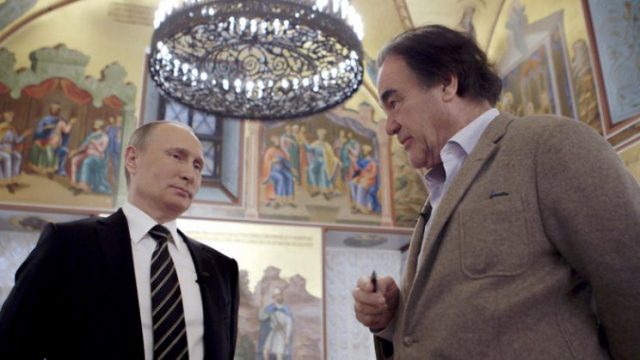
Oliver Stone interviewing Russian President Vladimir Putin in Showtime’s “The Putin Interviews.”
By Robert Parry | Consortium News | June 13, 2017
There was a time when I thought that it was the responsibility of an American journalist to hear all sides of a dispute and then explain the issue as fairly as possible to the American people, so they would be armed with enough facts to make their own judgments and act as the true sovereigns in a democracy.
I realize how naïve that must sound today as American journalism has shifted to a new paradigm in which the major news outlets view it as their duty to reinforce whatever the establishment narrative is and to dismiss or discredit any inconvenient facts or alternative analyses.
Today, The New York Times, The Washington Post and the rest of the mainstream media permit only the narrowest of alternative views to be expressed or they just pile into the latest groupthink whole hog.
So, that is why director Oliver Stone’s four-part series of interviews with Russian President Vladimir Putin on “Showtime” will surely draw near-universal outrage and ridicule from the big U.S. media. How dare anyone let Putin explain how he views the challenges facing the world? Can you believe that any right-thinking American would treat the Russian leader with civility and – god forbid – respect?
The new American media paradigm requires either endlessly insulting Putin to his face or aggressively blacking out his explanations, especially if they are based on information that puts the U.S. government in a negative light. The American people must be protected from this “Russian propaganda and disinformation.”
In other words, with the mainstream “guardians of truth” forewarning the American people not to watch Stone’s “The Putin Interviews,” the series will probably draw a relatively small viewership and the demonizing of Putin and Russia will continue unabated.
The American public can thus be spared some disturbing historical revelations and the unsettling vertigo that comes from hearing information that disrupts “what everyone knows to be true.”
In the “director’s cut” or long-form version of the four-part series that I watched, Stone does allow Putin to offer detailed explanations of his thinking on current crises, but also draws from Putin acknowledgements that might be surprising coming from a Russian leader. He also puts Putin in some uncomfortable binds.
–Regarding the Soviet Union’s development of the nuclear bomb in the late 1940s, Putin said Russian and German scientists were working on the project but got help from participants in the U.S. nuclear program:
“Our intelligence also received a lot of information from the United States. Suffice it to remember the Rosenberg spouses who were electrocuted. They didn’t acquire that information, they were just transferring that information. But who acquired it? The scientists themselves – those who developed the atomic bomb.
“Why did they do that? Because they understood the dangers. They let the genie out of the bottle. And now the genie cannot be put back. And this international team of scientists, I think they were more intelligent than the politicians. They provided this information to the Soviet Union of their own volition to restore the nuclear balance in the world. And what are we doing right now [with the U.S. withdrawal from the Anti-Ballistic Missile Treaty]? We’re trying to destroy this balance. And that’s a great mistake.”
–Regarding the origins of modern Islamist terrorism, Putin said: “Al Qaeda is not the result of our activities. It’s the result of the activities of our American friends. It all started during the Soviet war in Afghanistan [in the 1980s] when the American intelligence officers provided support to different forms of Islamic fundamentalism, helping them to fight the Soviet troops in Afghanistan.
“So the Americans themselves nurtured both Al Qaeda and [Osama] bin Laden. But it all spun out of control. And it always happens. And our partners in the United States should have known about that. So they’re to blame.”
Stone noted how President Reagan’s CIA Director William Casey sought to exploit Islamic fundamentalism to destabilize Muslim parts of the Soviet Union and to achieve regime change in Moscow.
Putin added: “Those ideas are still alive. And when those problems in Chechnya and the Caucasus emerged [after the collapse of the Soviet Union in 1991], the Americans, unfortunately, supported those processes. We [Russians] assumed the Cold War was over, that we had transparent relations, with the rest of the world, with Europe and the U.S. And we certainly counted on support, but instead, we witnessed that the American Intelligence services supported terrorists.
“I’m going to say something very important, I believe. We had a very confident opinion back then, that our American partners in words were talking about support to Russia, the need to cooperate, including fighting terrorism, but in reality they were using those terrorists to destabilize the internal political situation in Russia.”
–Regarding NATO expansion into Eastern Europe,” Putin said, “There was a deal not to expand NATO eastward. [But] this deal was not enshrined in paper. It was a mistake made by Mr. Gorbachev [the last president of the Soviet Union]. In politics, everything must be enshrined in paper.
“My impression is that in order to justify its existence, NATO has a need of an external foe, there is a constant search for the foe, or some acts of provocation to name someone as an adversary.”
–Regarding NATO missile bases being installed in Eastern Europe, Putin said: “And what are we supposed to do. In this case we have to take countermeasures. We have to aim our missile systems at facilities that are threatening us. The situation becomes more tense. …
“There are two threats for Russia. The first threat, the placement of these anti-ballistic missiles in the vicinity of our border in the Eastern European countries. The second threat is that the launching pads of these anti-ballistic missiles can be transformed within a few hours into offensive missile launching pads. Look, if these anti-ballistic missiles are placed in Eastern Europe, if those missiles are placed on water, patrolling the Mediterranean and Northern Seas, and in Alaska, almost the whole Russian territory would be encircled by these systems.
“As you can see, that is another great strategic mistake made by our partners [a word that Putin uses to refer to the United States]. Because all these actions are going to be adequately answered by Russia. And this means nothing else but a new cycle of an arms race. …
“When the Soviet Union collapsed, they [American leaders] were under the illusion that the U.S. was capable of anything, and they could [act] with impunity. That’s always a trap, because in this situation the person or the country begins to commit mistakes. There is no need to analyze the situations, or think about the consequences. And the country becomes inefficient. One mistake follows another. And I think that is the trap the U.S. has found itself in.”
–Regarding the prospect of nuclear war, Putin said, “I don’t think anyone would survive such a conflict.” Regarding U.S. plans for creating a missile shield, he said, “There is a threat deriving from the illusion of being protected, and this might lead to more aggressive behavior. That is why it is so important to prevent unilateral actions. That is why we propose to work jointly on the anti-ballistic missile system.”
–Regarding the American neoconservatives who now dominate the U.S. foreign policy establishment and the major news media, Stone described “the neoconservative element as being so hungry to make their point, to win their case that it’s dangerous.” Putin responded, “I fear them too.”
–In an interview on Feb. 16, 2016, Stone asked about the U.S. presidential campaign to which Putin replied, “We are going to be ready to work with whoever gets elected by the people of the United States. I said that on several occasions and that’s the truth. I believe nothing is going to change no matter who gets elected. … The force of the United States bureaucracy is very great. And there are many facts that are not visible to the candidates until they become President. And the moment one gets to real work, he or she feels the burden. …
“My colleague, Barack Obama, promised to close Guantanamo. He’s failed to do that. But I’m convinced that he sincerely wanted to do that. … Unlike many partners of ours, we never interfere within the domestic affairs of other countries. That is one of the principles we stick to in our work.”
–In a February 2017 interview, which was added amid the escalation of charges that Russia interfered in the U.S. election, Stone noted that Donald Trump is “your fourth president” and asked, “what changes?”
“Almost nothing,” Putin said with a wry smile. “Life makes some changes for you. But on the whole, everywhere, especially in the United States, the bureaucracy is very strong. And bureaucracy is the one that rules the world.”
Asked about alleged Russian interference to help Trump, Putin responded: “You know, this is a very silly statement. Certainly, we liked President Trump and we still like him because he publicly announced that he was ready to restore American-Russian relations. … Certainly, we’ve got to wait and see how, in reality, in practice, the relations between our two countries are going to develop. …”
Stone: “So why did you bother to hack the election then?”
Putin: “We did not hack the election at all. It would be hard to imagine any other country – even a country such as Russia would be capable of seriously influencing the electoral campaign or the outcome of an election. … any talk about our influencing the outcome of the U.S. election is all lies. They are doing it for a number of reasons.
“First, they are trying to undermine the legitimacy of President Trump, create conditions that must preclude us from normalizing our relations, and they want to create additional instruments to wage an internal political war. And Russia-U.S. relations in this context are just a mere instrument in the internal political fight in the U.S. … We know all their tricks.”
–Regarding cyber-war and the possibility that U.S. intelligence planted malware and back-doors in software sold to Russia, Putin said, “Well, you will probably not believe me, but I’m going to say something strange. Since the early 1990s, we have assumed that the Cold War is over. We thought there was no need to take any additional protective measures because we viewed ourselves as an integral part of the world community.
“We didn’t have any equipment of our own. Our companies, our state institutions and administrative departments, they were buying everything – hardware and software. And we’ve got much equipment from the U.S., from Europe, and equipment is used by the Intelligence Services and by the Defense Ministry. But recently we certainly have become aware of the threat that all of that poses.
“Only during recent years, have we started to think about how we can ensure technological independence, as well as security. Certainly we give it much thought, and we take appropriate measures. … We had to catch up with others.”
In an aside to Putin’s translator within earshot of Putin, Stone remarked: “He’s acting funny about this story, like he’s guilty a bit.”
–Regarding the dangers to Russia from U.S. cyber-warfare, Putin said: “It is almost impossible to sow fear among the Russian citizens. … And secondly, the economies that are more sophisticated, in technological terms, they are more vulnerable to this type of attack. But in any case, this is a very dangerous trend. A very dangerous avenue for competition to pursue and we need some rules to be guided by.”
When Stone raised the possibility of a treaty, Putin said, “I don’t want to say that, but you are simply drawing this information from me. You make me say that. One and a half years ago, in Autumn 2015, we came up with a proposal that was submitted to our American counterparts. We suggested that we should work these issues through and arrive at a treaty, an agreement on the rules to be guided by in this field. The Americans didn’t respond, they kept silence, they didn’t give us any reply.”
–Regarding allegations of Putin’s wealth, Stone asked, “Is there someway you could make your personal wealth clearer?”
Putin responded indirectly: “I remember when I moved to Moscow from St. Petersburg [in the 1990s], I was astounded and shocked by how many crooks had gathered here in Moscow and their behavior was so astounding, I couldn’t get used to it for a very long time. Those people didn’t have any scruples at all. … My task was to differentiate between power and money.”
Stone: “So there are no bank accounts in Cyprus?”
Putin: “No, and never have been. That’s just nonsense, and if that were the case we would have had to face it a long time ago.”
–Although Putin remained disciplined and controlled during the long sit-downs with Stone, the Russian president appeared most uncomfortable when Stone pressed him about his future plans and the risk of a leader viewing himself as indispensable to a nation.
Citing the possibility that Putin would have been in power – as either prime minister or president – for 24 years if he were to run for president again and win, Stone asked, “Do you feel that Russia needs you that badly?”
Putin: “The question you have asked whether Russia needs anyone that bad – Russia itself will decide. An alteration in power certainly has to exist. … In the end, let me reiterate – the citizens of Russia are going to make the final decision. Concerning the 2018 elections, I’d like to say there are things, things that should have some intrigue and mystery. So I am not going to answer that part of the question.”
Stone: “I said if…”
Putin: “We shouldn’t speak in the subjunctive mood.”
Stone then suggested more transparency in the next election.
A stern Putin responded: “Do you think our goal is to prove anything to anyone? Our goal is to reinforce our country.”
Stone: “That is a dangerous argument. It works both ways. Those who abuse power always say it’s a question of survival.”
Putin: “We are not talking about survival and we are not trying to justify ourselves. Certainly taking into account all the negative tendencies you’ve been talking about – the Soviet legacy, the Imperialist legacy, it’s something in the past. But we also have to think about the positive legacy. Russia has been built for a thousand years; it has its own traditions. We have our notions of what is just and unjust, we have our own understanding of what defines an efficient government.
“This is not a question of helping someone cling to power or to claim it for myself. This is about ensuring economic growth and sustaining it, improving our defense capabilities, and not just during periods of crisis and difficulties.”
Stone: “Mr. Putin, I don’t doubt for one moment your pride in serving Russia or that you are a son of Russia to me, and you have done very well by her. We all know the price of power. When we’re in power too long no matter what, the people need us but at the same time we’ve changed and we don’t even know it.”
Putin: “Indeed, this is a very dangerous state. If a person in power feels that they have lost it, this bond connecting this person to the country and to the rank-and-file citizens of the country, then it’s time for them to go.”
Britain’s Real Terror Apologists
By Finian Cunningham | Sputnik | June 11, 2017
Despite a vicious smear campaign to denigrate Britain’s Labour leader as a “terrorist sympathizer,” Jeremy Corbyn still pulled off an amazing achievement in the general election.
Hardly has a politician in any Western state been so vilified with character assassination, and yet he has proven to be most popular Labour leader in Britain since the Second World War.
After weeks of trailing his Conservative rival Theresa May in the polls, Corbyn’s socialist manifesto appealed to a record number of voters – closing the gap between the parties to only two percentage points behind the Tories.
This was in spite of a concerted media campaign to destroy Corbyn in the eyes of the British public as a “terrorist stooge.” The irony here is that the Conservative party is forming a governing coalition with a little-known Northern Ireland party whose history is steeped in British state terrorism. (More on that in a moment.)
For Corbyn, the election outcome was a stunning moral victory. For Prime Minister May it was a humiliating defeat. The Conservatives lost their overall majority in the British parliament and now they have to rely on this reactionary fringe party from Northern Ireland to form a government.
May called the snap election because she thought her party would increase its majority and also because she calculated that Corbyn’s socialist direction of Labour would be wiped out. Many Blairite naysayers in his own party thought so too.
The opposite happened. The British public largely rejected May and her neoliberal capitalist, pro-austerity, pro-NATO policies. They instead rallied behind Corbyn. Granted, the Tories still won the election – only narrowly – but the surge in support for Labour under Corbyn means that he has galvanized a party that stands a strong chance of winning if another election is called. And that could be soon, perhaps in the coming months owing May’s shaky ad hoc government collapsing.
Another riveting factor in all this is that Corbyn’s success came amid a torrential Tory and right-wing media campaign to denigrate him as a terrorist sympathizer. The propaganda onslaught was conducted for months since May called the election back in April. And it grew to a frenzy as election day approached last Thursday, especially when the opinion polls showed Labour steadily whittling away the earlier Conservative support.
The day before the public went to the polling booths, the Daily Mail ran the front page headline: “Apologist for terror,” with Jeremy Corbyn’s photo below. It looked like a “wanted poster” from the Wild West. The only thing missing was the subhead with the words: “Wanted dead or alive.”
The scurrilous allegation pounded over and over by the largely pro-Conservative British media that Corbyn is “soft on terrorism” stems from his otherwise principled history of campaigning on international justice and peace.
Over his 35 years as an MP, he has voiced consistent support for Palestinian rights under illegal Zionist occupation; he has supported Hezbollah resistance against Israeli and American aggression; and during the conflict in Northern Ireland, Corbyn gave a voice to Irish Republicans who were being assailed by British military violence.
Many other international causes could be mentioned, such as Corbyn opposing British government weapons dealing with the despotic Saudi regime which is propagating terrorism in Syria, Iraq and Yemen.
He has also campaigned to abandon nuclear weapons and is critical of NATO’s reckless expansion in Europe, which have earned him the jingoistic pillorying by the British establishment of “being soft on Russia.”
Corbyn has never condoned terrorism. Rather he has always sought to properly put it in a wider context of other parties also, unaccountably, using terrorism and thus fueling conflict.
This brings us to so-called Democratic Unionist Party (DUP) from Northern Ireland whose 10 MPs Theresa May’s Tories are now relying on to form a government. This party was formed in the early 1970s by the firebrand Protestant preacher Ian Paisley. While Paisley mellowed in later years before his death in 2014, he spent most of his career preaching vile hatred against Catholics and Irish Republicans, whom he saw as a threat to the political union between Northern Ireland and the rest of Britain. In British-run Northern Ireland, it wasn’t acceptable to have a democratic aspiration for an independent Ireland. You were either a pro-British unionist or a “threat.” So much for British democracy.
Senior members of Paisley’s pro-British party played a crucial role in smuggling massive caches of weapons into Northern Ireland during the 1980s to illegally arm unionist paramilitaries. These paramilitaries went on to murder hundreds of innocent people simply because they were Catholics, who tended to be Republican. A favored tactic of these paramilitaries was to storm into pubs and homes and indiscriminately mow people down with assault rifles.
One notorious pro-British killer was Gusty Spence who belonged to the Ulster Volunteer Force paramilitary. He later expressed remorse and deplored Ian Paisley, the DUP founder, as the person who incited him to murder innocent Catholics due to his sectarian hate speech.
The paramilitary murder gangs were not just supported covertly by members of the DUP. The British government of Margaret Thatcher – Theresa May’s predecessor and political heroine – orchestrated these same death squads in a covert policy of “dirty war.”
British military intelligence colluded with the pro-unionist militants to assassinate Republican politicians and ordinary Catholics alike in a covert policy of state-sponsored terrorism. The objective was to terrorize people in submitting to British rule over Northern Ireland, rather than allowing the island country to become united and independent.
The British government provided intelligence and cover for the death squads and the unionist politicians had helped supply the AK-47 assault rifles and Browning handguns smuggled from Apartheid South Africa.
This secret dirty war policy of the British government and their unionist proxies in Northern Ireland has been uncovered by investigative journalists such as Paul Larkin (see his groundbreaking book “A Very British Jihad: Collusion, Conspiracy and Cover-up in Northern Ireland”); as well as human rights campaign groups like Belfast-based Relatives for Justice and Pat Finucane Centre.
Not even the present government of Theresa May can deny this murderous legacy in Ireland, although there is a determined silence now as she fights for her political survival in the wake of the British election disaster.
It is a proven fact that May’s Conservative party and the unionist politicians whom she is now partnering with to govern Britain were complicit in terrorism.
Northern Ireland has since gained a peace settlement in which unionist and republican politicians have been able to work together to form a local governing administration. The Irish peace process was possible partly because of the courageous and principled intervention by British politicians like Jeremy Corbyn.
Corbyn has never apologized for terrorism. He has sought to overcome it by making politics work. The same cannot be said for Theresa May’s Conservative party. It was an accomplice and an apologist for a covert policy of state-sponsored terrorism during Northern Ireland’s recent 30-year conflict.
The very party whom she is now allied with for governing Britain – the DUP – were also apologists for paramilitaries who routinely smashed their way into family homes and slaughtered victims in cold blood in front of their loved ones.
The ongoing muted policy of May’s government and her unionist proxies about their murderous legacy in Ireland is a testimony to who the real apologists for terror are.
The US Hand in the Libyan/Syrian Tragedies
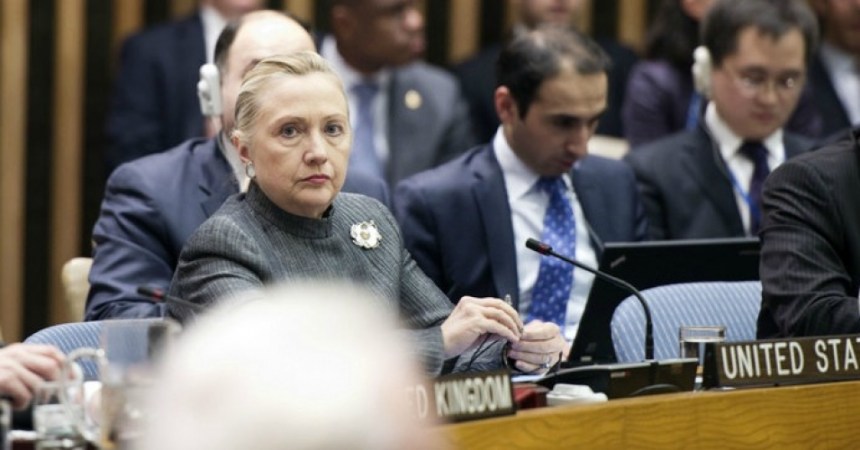
US Secretary of State Hillary Clinton delivers remarks at a UN Security Council Session on the situation in Syria at the UN in New York on Jan. 31, 2012. [State Dept. Photo]
By Jonathan Marshall | Consortium News | June 9, 2017
Police investigations and media reports have confirmed that two of the bloodiest terrorist attacks in Western Europe — the coordinated bombings and shootings in Paris in November 2015, which killed 130 people, and the May 2017 bombing of the arena in Manchester, England, which killed 23 — trace back to an Islamic State unit based in Libya known as Katibat al-Battar.
Since those attacks, a number of analysts, myself included, have characterized them as a form of “blowback” from NATO’s disastrous campaign to depose Libyan dictator Muammar Gaddafi in 2011. By turning Libya into an anarchic staging ground for radical Islamist militants, that intervention set in motion the deadly export of terror back into Western Europe.
But such a Eurocentric critique of NATO’s intervention misses the far greater damage it wreaked on Syria, where nearly half a million people have died and at least 5 million refugees have had to flee their country since 2011. U.S., British and French leaders helped trigger one of the world’s great modern catastrophes through their act of hubris in seeking another “regime change” – the overthrow of President Bashar al-Assad – in Syria.
A decade ago, Libya was a leading foe of radical jihadis, not a sanctuary for their international operations. A 2008 State Department memo noted that “Libya has been a strong partner in the war against terrorism.” It gave the Gaddafi regime credit for “aggressively pursuing operations to disrupt foreign fighter flows,” particularly by veterans of jihadist wars in Afghanistan and Iraq.
All that came to an end in 2011, when armed rebels, including disciplined members of al-Qaeda and Islamic State, enlisted NATO’s help to topple Gaddafi’s regime.
Western leaders ignored the prescient warnings of Gaddafi’s son Seif that “Libya may become the Somalia of North Africa, of the Mediterranean. . . .You will see millions of illegal immigrants. The terror will be next door.” Gaddafi himself similarly predicted that once the jihadis “control the Mediterranean . . . then they will attack Europe.”
Subsequent terrorist attacks in Europe certainly vindicated those warnings, while discrediting the so-called “humanitarian” case for waging an illegal war in Libya. But the predicted jihadi efforts to “control the Mediterranean” have had far graver repercussions, at least in the case of Syria.
A recent story in the New York Times on the genesis of recent terror attacks on France and Britain noted in passing that the Islamic State in Libya, composed of “seasoned veterans of Iraq and Afghanistan,” was “among the first foreign jihadist contingent to arrive in Syria in 2012, as the country’s popular revolt was sliding into a broader civil war and Islamist insurgency.”
A former British counter-terrorism analyst told the newspaper, “some of the baddest dudes in Al Qaeda were Libyan. When I looked at the Islamic State, the same thing was happening. They were the most hard-core, the most violent — the ones always willing to go to extremes when others were not. The Libyans represented the elite troops, and clearly ISIS capitalized on this.”
These Libyan jihadists leveraged their numbers, resources, and fanaticism to help escalate Syria’s conflict into the tragedy we know today. The mass murder we now take for granted was not inevitable.
Extremist Violence in Syria
Although Syria’s anti-government protests in the spring of 2011 turned violent almost from the start, many reformers and government officials strove to prevent an all-out civil war. In August 2011, leaders of Syria’s opposition wisely declared that calls to arms were “unacceptable politically, nationally, and ethically. Militarizing the revolution would . . . undermine the gravity of the humanitarian catastrophe involved in a confrontation with the regime. Militarization would put the revolution in an arena where the regime has a distinct advantage and would erode the moral superiority that has characterized the revolution since its beginning.”
Largely forgotten today, the Assad regime also took serious steps to deescalate the violence, including lifting the country’s state of emergency, disbanding the unpopular National Security Court, appointing a new government, and hosting a national dialogue with protest leaders.
But on August 18, 2011, the same Western leaders who were bombing Gaddafi announced to the world that “the time has come for President Assad to step aside.” Further energizing Syrian militants, Libyan rebels were just then in the midst of conquering Tripoli with NATO’s help.
“That is an ominous sign for Syria’s President Bashar al-Assad,” reported the Wall Street Journal. “Already there are signs Libya is giving inspiration to the rebels trying to oust Mr. Assad. . . . Syrian protesters took to the streets chanting ‘Gadhafi tonight, Bashar tomorrow.’ . . . The Libyan episode may serve simply to sharpen the conflict in Syria: both spurring on the dissidents and strengthening Mr. Assad’s resolve to hold on.”
Stoking war in Syria was not an unintended consequence of the Libyan campaign, but a conscious part of the longstanding neoconservative ambition to “remake the map of the Middle East” by toppling radical, nationalist and anti-American regimes. The same Journal article described the grandiose aims of some Washington interventionists:
“Beyond Syria, a new dose of energy provided by Libya’s uprising could ripple out to other nations in the region. In particular, U.S. officials hope it will reinvigorate a protest movement that arose inside Iran in 2009 to challenge President Mahmoud Ahmadinejad’s re-election. . . Syria has served for 30 years as Iran’s closest strategic ally in the region. U.S. officials believe the growing challenge to Mr. Assad’s regime could motivate Iran’s democratic forces.”
Instead of motivating Iran’s democrats, of course, the Syrian conflict motivated Iran’s hardliners to send Revolutionary Guard units and Hezbollah proxy forces into the country, further destabilizing the region.
Following the gruesome murder of Gaddafi in the fall of 2011, Libyan zealots quickly began fueling other terrorist conflicts, ranging from Mali to the Middle East, with arms looted from Gaddafi’s vast stocks.
“The weapons proliferation that we saw coming out of the Libyan conflict was of a scale greater than any previous conflict — probably 10 times more weapons than we saw going on the loose in places like Iraq, Somalia and Afghanistan,” observed an expert at Human Rights Watch.
A United Nations investigation determined that “Transfers of arms and ammunition from Libya were among the first batches of weapons and ammunition to reach the Syrian opposition.” It also stressed that Libyan weapons were arming primarily “extremist elements,” allowing them to gain territory and influence at the expense of more moderate rebel groups.
Spreading the War
As early as November 2011, Islamist warlords in Libya began offering “money and weapons to the growing insurgency against Bashar al-Assad,” according to the Daily Telegraph. Abdulhakim Belhadj, commander of the Tripoli Military Council and the former leader of the Libyan Islamic Fighting Group, an al-Qaeda affiliate, met secretly with Syrian rebel leaders in Turkey to discuss training their troops. (In 2004, he had been the victim of a CIA kidnap plot and rendition from Malaysia to Libya.)
The commander of one armed Libyan gang told the newspaper, “Everyone wants to go (to Syria). We have liberated our country, now we should help others. . . This is Arab unity.”
In April 2012, Lebanese authorities confiscated a ship carrying more than 150 tons of arms and ammunition originating in Misrata, Libya. A U.N.-authorized panel inspected the weapons and reported finding SA-24 and SA-7 surface-to-air missiles, anti-tank guided missiles, and a variety of other light and heavy weapons.
By that August, according to Time magazine, “hundreds of Libyans” had flocked to Syria to “export their revolution,” bringing with them weapons, expertise in making bombs, and experience in battlefield tactics.
“Within weeks of the successful conclusion of their revolution, Libyan fighters began trickling into Syria,” the magazine noted. “But in recent months, that trickle has allegedly become a torrent, as many more have traveled to the mountains straddling Syria and Turkey, where the rebels have established their bases.”
A Syrian rebel told the newsweekly, “They have heavier weapons than we do,” including surface-to-air missiles. “They brought these weapons to Syria, and they are being used on the front lines.”
A month later, the London Times reported that a Libyan ship carrying more than 400 tons of weapons bound for Syria, including SAM-7 anti-aircraft missiles and rocket-propelled grenades, had docked in Turkey. Such weapons particularly compounded the suffering of civilians caught up in the war. As France’s foreign minister told reporters that October, rebel-held anti-aircraft missiles were “forcing (Syrian government) planes to fly extremely high, and so the strikes are less accurate.”
According to later reporting by Seymour Hersh, most such Libyan weapons made their way to Syria via covert routes supervised by the CIA, under a program authorized by the Obama administration in early 2012. Funding and logistics support came from Turkey, Saudi Arabia, and Qatar. The CIA supposedly avoided disclosing the program to Congress by classifying it as a liaison operation with a foreign intelligence partner, Britain’s MI6.
Word of the operation began leaking to the London media by December 2012. The CIA was said to be sending in more advisers to help ensure that the Libyan weapons did not reach radical Islamist forces.
Of course, their efforts came too late; U.S. intelligence officials knew by that time that “the Salafist(s), the Muslim Brotherhood, and (al-Qaeda)” were “the major forces driving the insurgency.” The influx of new arms simply compounded Syria’s suffering and raised its profile as a dangerous arena of international power competition.
Libya’s arms and fighters helped transform the Syrian conflict from a nasty struggle into a bloodbath. As Middle East scholar Omar Dahi noted, “the year 2012 was decisive in creating the present catastrophe. There were foreign elements embroiled in Syria before that date . . . but until early 2012 the dynamics of the Syrian conflict were largely internal. . . . Partly in . . . appropriation of weapons pumped in from the outside and partly in anticipation of still greater military assistance, namely from the West, the opposition decided to take up arms.
“The decision — militarization — had three main effects. First, it dramatically increased the rate of death and destruction throughout the country. . . . By mid-2012, the monthly casualties were almost in excess of the total in the entire first year of the uprising. Militarization gave the Syrian regime a free hand to unleash its full arsenal of indiscriminate weaponry. . . Perhaps most fatefully, the advent of armed rebellion placed much of the opposition’s chances in the hands of those who would fund and arm the fighters. . . . It was then that the jihadi groups were unleashed.”
The collateral victims of NATO’s intervention in Libya now include 6 million Libyans attempting to survive in a failed state, millions of people across North Africa afflicted by Islamist terrorism, 20 million Syrians yearning for an end to war, and millions of innocent Europeans who wonder when they might become targets of suicidal terrorists. There is nothing “humanitarian” about wars that unleash such killing and chaos, with no end in sight.
Featured Video
New positive ivermectin evidence
or go to
Aletho News Archives – Video-Images
From the Archives
Fanatical Followers of the Covid Regime: A Jim Jones-Style Cult?
By Professor Roger Watson and Dr. Niall McCrae | The Daily Sceptic | November 15, 2021
As scholars at leading British universities over recent decades, we witnessed the replacement of critical thinking and debate by narrative: facts are discrimination and scientific method is imperialism; truth, instead, is derived from ‘progressive’ values. This educational trend may be a major contributory factor to the ease in which society has been inculcated to the Covid ‘new normal’ of masking, testing, and repeated doses of vaccines for a disease of similar risk to severe influenza.
One doesn’t need much critical reasoning to observe the flawed logic of some vaccination enthusiasts, such as people who respond to experiencing any side effects, however debilitating, by saying “at least I know it’s working”, or, after contracting the disease despite their promised inoculation (over 90% effective, according to initial drug company claims), “I’d have been worse off without the jab.” … continue
Blog Roll
 Aletho News
- ‘Grave, alarming’: Iran mission on Trump’s UNGA ‘annihilation’ threats
- Najaf airport to reopen to Iranian flights within 24 hours: Ambassador
- From ‘How Will This End For Iran’ to ‘When America Walks Away’: A tale of two Economist covers
- Tehran blasts ‘baseless’ speculation linking Iran to alleged bomb plot at UK air base
- The Rise And… Rise Of ‘Color Revolutions’
- The Coming GOP Bloodbath?
- Arctic Scare Stories Melt Away
- Wrong, Euronews: Climate Change Has Not Created a Food, Energy, and Economic “Meta-Crisis”
- New positive ivermectin evidence
- Met Office Caught Fabricating Daily Temperature Record Claims
- If Americans Knew
- An error has occurred; the feed is probably down. Try again later.
- No Tricks Zone
- New Study: Earth And Venus Surface Warmth Largely Explained By Convection And Lapse Rate, Not CO2 Or Radiation
- 2025 Nature Paper Claiming Worsening Global Drought Gets RETRACTED …Heavily Flawed
- New Study: ‘Global Drought Shows No Detectable Recent Acceleration Under Climate Warming’
- Economic Masterminds: German Socialists Suggest Taxing Productivity Gains Stemming From Using AI
- The South China Sea Has Not Been Cooperating With The Climate Change Narrative
- Energy Crisis: Germany Enters Heating Season With Historically Low Gas Reserve Fill Levels
- New Study: The Antarctic Ice Sheet Gained Mass From 2020-2024 Due To Staggering Snow And Ice Accumulation
- Study: Ocean Heating Rates From Thousands Of Years Ago ‘Dwarf’ Modern Ocean Heating Rates
- Climate Extremists Target, Attack Large-Scale Power Grid Infrastructure In Germany!
- New Study: Antarctic Ice Melt Has Contributed Less Than 1 Centimeter To Sea Level Rise In The Last 30 Years

