NATO chief advocates war of aggression
RT | October 1, 2026
European NATO members should have been able to attack Iran instead of relying on the US and Israel, according to Secretary-General Mark Rutte, the head of the self-described defensive alliance.
Iran has been attacked twice in two years, both times over allegations that it seeks to develop nuclear weapons, which Tehran rejects as false. Speaking at the Euronews Defence & Space Summit on Friday, Rutte endorsed the idea that European nations should acquire the military capabilities needed to carry out such wars of aggression themselves.
In the future, “the Europeans will be able to take care of their backyard themselves. It should be us doing this, not the Americans,” he said.
“Europe was not able to take out the nuclear capability of Iran. We couldn’t. We didn’t have the capabilities. In 10 years, we can and we should,” he added, referring to multi-billion euro rearmament efforts now underway in European members of the military bloc.
Earlier in the day, the NATO chief dismissed Russian concerns over hostile rhetoric by some members of the bloc regarding the Russian exclave of Kaliningrad Region.
“Basically what we said is, ‘hey, listen, we are a defensive alliance, and stop the nuclear threat’,” he told journalists when asked about a formal warning Moscow had sent to Brussels.
Russia cited remarks by Polish Foreign Minister Radoslaw Sikorski, who proposed in September deploying additional troops near the Russian border so that Moscow would be “uncertain of what we will do.” Moscow said it would use its “entire available arsenal” to defend Russian territory from a possible attack by NATO states.
NATO was created in the early years of the Cold War, ensuring a continued US military presence in Western Europe. The Soviet Union later established its own military alliance, the Warsaw Pact, which no longer exists.
While NATO describes itself as a defensive alliance, it has carried out military attacks against other countries, including the UK- and French-led 2011 intervention in Libya, after which the North African state was balkanized.
Russia considers NATO’s eastward expansion since the end of the Cold War a major national security threat and has cited it as one of the principal causes of the Ukraine conflict.
Rutte’s argument in support of the US-Israeli attacks on Iran echoed remarks by German Chancellor Friedrich Merz, who said in June 2025 that the Israelis were doing “[the] dirty work for us.”
Moscow issues warning to NATO over Russian exclave
RT | September 30, 2026
Increased NATO military exercises near Russia’s Kaliningrad Region and aggressive rhetoric from members of the US-led bloc are raising the risk of a direct armed conflict, Moscow has warned.
Russia has sent NATO a warning stressing its determination to protect the Russian exclave in the Baltic region “with its entire available arsenal,” according to a statement published on Monday by the Russian Embassy in Belgium, which hosts the bloc’s headquarters.
The message alluded to remarks made earlier this month by Polish Foreign Minister Radoslaw Sikorski, who said there are “hardly any troops” in Kaliningrad Region and urged NATO to increase its military posture near Russia’s borders so that Moscow would be “uncertain of what we will do.”
NATO spokesperson Allison Hart confirmed receiving the Russian message and accused Moscow of irresponsible rhetoric.
”We strongly denounce the threat of force, including any irresponsible nuclear rhetoric,” she said.
Western officials have frequently described Russian statements invoking its nuclear deterrent as “blackmail,” while presenting NATO’s own nuclear-sharing arrangements as a pillar of collective defense.
France has offered to discuss the possible deployment of its nuclear weapons in other European NATO countries, arguing that this could reduce the bloc’s dependence on the US. Under NATO’s existing nuclear-sharing arrangements, American nuclear bombs are stored in several European countries, while personnel from non-nuclear member states train for missions involving their potential use.
Russia has repeatedly rejected Western claims that it intends to attack NATO before the end of the decade, describing such warnings as warmongering aimed at persuading voters to support sharply higher military spending.
Moscow, in turn, views NATO’s military preparations as potentially paving the way for an attack on Russia. Foreign Minister Sergey Lavrov has repeatedly warned that any such conflict would be extremely brief, implying that Moscow could resort to nuclear weapons.
The Russian Embassy in Ireland used more direct language, saying on Tuesday that Moscow is prepared to use nuclear weapons in response to an attempted NATO blockade of Kaliningrad Region and may consider pre-emptive military action in such a crisis.
Kremlin spokesman Dmitry Peskov said on Wednesday it was “natural for our diplomats to try and remind hotheads in Europe about our doctrinal documents,” in response to the rhetoric coming from Poland and other nations.
From Unipolar Universalism to Multipolar Civilizational Distinctiveness
By Prof. Glenn Diesen | September 26, 2026
The following are excerpts from my speech in Istanbul on September 26, 2026.
The unipolar world order has collapsed, and we should conduct a post-mortem to reflect on what went wrong and to understand the current turbulent transition of the world. In 1989, Francis Fukuyama famously published his article on the ‘End of History,’ which was largely adopted as an ideological guide by the political West. The world only had one superpower and one ideology, and the expectation was that the world would unify under US leadership and liberal democratic values. The dominance of the US would end international anarchy and security competition, as there was only one centre of power, and the US hegemon would elevate the role of liberal democracy to form an inclusive community of universal values. For more than three decades, the West produced a new generation of politicians who believed that the collective hegemony of the West was for the benefit of all mankind, and they were the administrators who would manage the transition from the chaotic world of the past to perpetual peace. So what went wrong?
The Contradiction of Hegemonic Universalism
The unipolar moment was always destined to be a temporary phenomenon, as the US would predictably exhaust its resources and incentivise rising powers to collectively balance the US. However, there is also an inherent contradiction in hegemonic universalism, as universal values are linked to one entity of power. A hegemon claims to represent universal values such as freedom, democracy, and human rights, albeit this universalism is promoted through a particular historical, cultural, and geopolitical order.
Universal values advocating for equality are used to institutionalise a dominant position for the US. Universal values advocating for inclusion are used to build exclusive blocs such as NATO rather than developing an inclusive pan-European security architecture. John Herz noted as early as 1950 that the more democratic states were at home, the more they seemed to insist on a dominant position in international institutions to defend liberal values from the rule of the majority. Liberal values build on the idea that tolerance is imperative, as all people and states have different ideas about the good life and their own path to development, yet the universality of values suggests that all states must develop along the same path, and the political West, as the champion of liberal democracy, is the civilizational teacher seeking to “socialize” the rest of the world. Liberalism has subsequently been promoted as a hegemonic norm.
The Revisionism of Hegemonic Universalism
The modern world order was established with the Peace of Westphalia in 1648, in which a hegemonic system legitimised with universalist claims was replaced with a multipolar system based on the cultural distinctiveness of states. The past 80 years have been a historical anomaly, with a bipolar system that collapsed and gave way to a unipolar system with one centre of power. The normal situation of the world has been a multipolar Westphalian system with a power equilibrium.
Over the past decades, hegemonic universalism transformed European states as national competencies were transferred to the US. US military dominance meant that Europe largely outsourced its security and foreign policy to the US within the format of the alliance system. US economic dominance meant that the international economic architecture, with banks, currencies, payment systems, and trade agreements, was largely administered by the US. Civil society in Europe and beyond has been managed by “non-governmental organizations” financed by the US government and cooperating closely with US intelligence services. The European political system is premised on the idea that loyalty to international institutions is more vital and moral than national interests, as Europe’s linkage to the US within the political West is the main source of stability and prosperity.
Return of Civilizational Distinctiveness
The hegemon is now gone, and the universal claims are rejected by the wider world. A multipolar world is already here, and the rising powers are demanding a return to a Westphalian world order of sovereign equals based on civilizational distinctiveness. As Xi Jinping insists, all civilizations have their own path to development, and no aspiring hegemon has the right to tell others how to develop. The return of rhetoric about civilizational states across the Eurasian continent signifies a rejection of unipolarity and universalism. New institutions such as the SCO and BRICS attempt to accommodate the multipolar world, yet new members are joining faster than institutional efficiency can adjust to.
The US has reluctantly already begun adjusting to these new realities, as it recognises it cannot be everywhere and must prioritise, while the language of liberal universalism is being replaced with national interests. New political forces are rising in the US that want to scale back the empire to save the republic, as a strategic retreat would allow the US to rebuild its strength and end the collective balancing by other great powers. What makes Europe so dangerous today is its weakness and panic due to the failure of finding a new role in the multipolar system. Security can no longer be based on the dominance of the collective West; there is no clear economic model; and the claims of representing universal values are no longer convincing. Yet the Europeans are not willing to recognise new realities and adjust accordingly by diversifying economic and political connectivity. The available evidence suggests that this will be a very turbulent transition from unipolar universalism to multipolar distinctiveness, and the new world will more likely be born through war than diplomacy
Europe was part of the infrastructure of US aggression against Iran: Deputy FM
Press TV – September 24, 2026
Iran’s Deputy Foreign Minister for Legal and International Affairs Kazem Gharibabadi has said NATO Secretary-General Mark Rutte’s admission that some 5,000 sorties were flown from European bases in support of US military aggression against Iran proves that Europe formed part of the infrastructure of that aggression.
In a post on X on Thursday evening, Gharibabadi wrote that the NATO chief’s remarks demonstrated Europe’s role in enabling the illegal US campaign.
“Governments that placed their territory at the disposal of the United States cannot evade their responsibility,” he said. “This participation will not go unanswered.”
Rutte has repeatedly acknowledged that thousands of US military flights, between 4,000 and 5,000, departed from bases in Europe during the US-Israeli war of aggression against the Islamic Republic, which began on 28 February.
He described Europe as a “platform of power projection” without which Washington could not have conducted the operation.
Countries including Italy, Romania, the United Kingdom, France and Germany were cited in connection with the use of bases, airspace, tankers and logistics.
Iran has consistently described the US-Israeli assault as an unprovoked act of aggression in flagrant violation of the UN Charter and international law.
Tehran has stressed that providing territory, bases or infrastructure to an aggressor state itself constitutes participation in the act of aggression, as recognized under United Nations General Assembly Resolution 3314.
Foreign Minister Abbas Araghchi separately warned European officials in New York of the severe and long-term consequences of facilitating and supporting US and Israeli war crimes, both in Gaza and against Iran. He noted that submitting to a bully never satisfies that bully.
Britain’s elites want you ready to die for a war they keep imagining
By Tarik Cyril Amar | RT | September 24, 2026
Great Britain is going through a war scare. Or to be precise, its combined political and media establishment is subjecting its people to a relentless propaganda (in up-to-date NATO-speak “cognitive warfare”) campaign to create a sense of impending war against Russia.
As you would expect, that war is, of course, framed as strictly defensive. In propaganda textbook manner, the message is both very simple and very repetitive: The UK is in great danger of a Russian attack, and its whole population must prepare itself to withstand and resist it.
It goes without saying that Moscow’s repeated declarations of having no such intention make no difference.
Britain is certainly not alone in its establishment-induced hysteria. Much of NATO-EU Europe is undergoing, in essence, the same treatment. In France, for instance, President Emmanuel Macron has called a theatrical all-manicured-hands-on-deck meeting to give what can only be called a national scare talk about “Russian hybrid warfare”; in Germany, Berlin and its mainstream media won’t stop stirring the pot about the murky drone affair at Leipzig-Halle airport.
Yet, over the last weeks, within a crowded field of European panic-mongering, Britain has stuck out as especially virulent. The single most grotesque contribution was made by uber-Tory Jacob Rees-Mogg. Comfortably seated against a backdrop that screamed country-squire probity, Rees-Mogg held forth on war within the next few years, ancient Rome (he’s been to Eton, he wants you to know) and, most importantly, “circumstances where people may have to die.” Either that or – so Rees-Mogg’s stern message – decline and fall, as happened to those Romans, who let mercenaries do their fighting and thus lost their empire.
So much to unpack. For one thing, the reference to paying others to fight – and die – must be a Freudian slip. Surely, Sir Jacob cannot have meant to refer to how the West, Britain very much included, has paid the Kiev regime to send its subjects – if need be, after kidnapping them – into the folly of a proxy war meatgrinder to demote Russia. And then, that Roman Empire analogy? Clearly, Rees-Mogg, true to type, is still struggling with the fact that Britain has its imperial collapse well behind it already.
Yet, sour oddball as he is, the arch-conservative – and multimillionaire – Rees-Mogg is perfectly representative of the current British establishment trend. Prime Minister Andy Burnham, for instance, has just used his first UN General Assembly address in New York to blame his country’s misery not on, say, his predecessor and Labour Party comrade Keir Starmer, but on Russia.
Meanwhile, at home, Sky News is rolling out ‘The Wargame’, a bizarre “docu”-fantasy in four parts, built on the premise that the Russians are coming, no, they really, really ARE this time!
Pretending to be a sort of “realistic” account of what a British government would do in case of Moscow launching a series of escalating attacks, this production – from available reviews – is unusually awful shlock. It features has-been politicos doubling as un-reality TV stars, such as Michael Gove and Nicola Sturgeon, and living out their inner Tom Clancy by pretending to be serious, decisive, and, most of all, terribly important to the nation’s survival.
Unintentionally funny, though, as it may be, ‘The Wargame’ clearly has substantial political support and much hype around it. Propaganda can easily look ridiculous and be highly toxic at the same time. Because effective propaganda is, above all, one simple thing: the psychological manipulation of the many by the few. This is such a case. The viewers of ‘The Wargame’ are fed a silly but efficiently dramatized story, with the whole bag of well-worn but powerful tricks: suspense, shock, and, last but not least, a thrilling score.
It’s no surprise that the attitude of those doing the manipulating is, at best, patronizing. And to be fair even to the unbearable, Jacob Rees-Mogg, who carefully tends his beyond-caricature English-toff image, is quite honest about his disdain for ordinary people and their expendable lives. From his always obstinately ill-fitting yet clearly expensively tailored suit to the diction of a terribly bored yet forbearing Eton headmaster, his performance oozes good old upper-class condescension.
When Rees-Mogg tells you that you may have to die, you know he won’t lose sleep over it, because you are you, and he – well, he is something entirely different and, really, much better (and, as it happens, richer, too), of course.
In a Sky News interview, the UK’s Chief of the Defense Staff, Air Chief Marshal Sir Richard Knighton, has revealed a less excentric as well as more insidious approach to the masses. Referring to a “national conversation on defense,” both he and his interviewer took it for granted that the purpose of such a conversation is to remedy “what the British public hasn’t got, […] haven’t understood.”
What a delicate way to start a “conversation”: let me tell you how damn slow you are and where you need to catch up. Not: Let’s exchange views and respect each other as equal citizens. Indeed, it’s not only very rude – what has happened to English manners? – but positively Orwellian to call such offensively complacent preaching a “conversation.”
Marshal Knighton’s idea of how the British can and must do better was no less revealing: In essence, be more like the Estonians or, at least, the Swedes. Because in Estonia “the threat from Russia” is “part of normal daily conversation,” and in Sweden, they are at least trying to achieve the same single-minded obsessiveness.
There you have it, chums on the homefront: Make an effort, will you now? Learn from the worst, get a grip, and make your whole life turn around the fear we tell you to feel.
And don’t you dare notice that – how embarrassing, really – it is precisely the Estonian authorities who, notwithstanding their generally record-level Russophobia – have just called on everyone in NATO-EU Europe to cool it.
Because, those unpredictable Estonians tell us, the Russia-at-the-gates narrative “has been blown completely out of proportion. For example, Russia makes some adjustments on the other side of the Narva River and now everyone across NATO is losing their heads and hyperventilating over it,” while, in reality, “there is absolutely no reason to believe that Russia is imminently going to launch a military attack on NATO, Estonia, or the Baltic states.” Oops.
Unfortunately, war propaganda is almost immune to its own absurdities, inconsistencies, and plain silliness. Because it is designed to operate not by appealing to reason but to fear, stereotypes, and conformism. A conformism that some British establishment members already openly want to reinforce by locking up any dissenters.
The true weak spot of this warmongering may be its arrogance. There are signs on social media that many Brits do not appreciate their establishment’s latest efforts to scare and mobilize them for senseless war. Let’s hope that the mix of threats and condescension – displayed by a snob as gleefully aloof as Rees-Mogg, an officer-bureaucrat as clumsily tactless as Knighton, and the makers of something as slick as ‘The Wargame’ – rubs much of the country the wrong way. The “elites” are insane and malevolent. Any hope for peace and a return to reason will have to come from below.
Tarik Cyril Amar is a historian from Germany working at Koç University, Istanbul, on Russia, Ukraine, and Eastern Europe, the history of World War II, the cultural Cold War, and the politics of memory.
NATO chief wants Europeans to fight American wars [for Israel]
Mark Rutte has justified the US-Israeli war on Iran and said European nations should “take care” of the Middle East in the future
RT | September 23, 2026
European NATO nations should take greater responsibility for security in the Middle East, NATO Secretary General Mark Rutte has said. He also defended the US-Israeli war on Iran and argued that European members should spend less on social programs and more on the military.
Rutte made the remarks at a Chicago Council on Global Affairs event in Iowa on Tuesday after being asked to “make the case” for NATO to Americans by explaining “what’s in it” for them.
He described the Middle East as “Europe’s backyard” and “not the United States’ backyard,” arguing that Washington’s war against Tehran was “necessary” but that the US had to launch it because “somehow the Europeans did not have enough capabilities to do it themselves.”
“In the future, what you get from a stronger NATO is that Europeans can take care of their own backyard,” Rutte said.
The US-Israeli war on Iran, launched in late February, caused major friction within NATO as several European members resisted supporting Washington’s belligerence. Spain refused to allow American warplanes to use its bases for the campaign, drawing US President Donald Trump’s ire. Germany and the UK described the conflict as “not our war,” while stopping short of condemning the US and Israel.
Trump has since repeatedly accused European allies of failing to meet their NATO commitments and claimed the bloc “was not there when we needed them.” In April, US War Secretary Pete Hegseth said NATO’s future was uncertain and Washington could not currently reaffirm its commitment to collective defense.
Rutte also argued on Tuesday that the burden within NATO was unfair because European members spend heavily “on pensions and welfare,” while Washington has to devote more resources to weapons but “would also like to spend more on all these other lofty, beautiful items, but they can’t because they have to spend so much on defense.”
He described raising NATO’s defense spending target from 2% to 5% of GDP as “the fairness element” and part of an “equalizing” process. The remarks come as Washington pushes for a reorganization dubbed NATO 3.0, under which European members would sharply increase military spending and production while assuming “primary responsibility for the conventional defense of Europe.”
Rutte also offered to help “protect the United States from threats of Russia” and China and prevent the Arctic “from becoming militarized by the Russians and the Chinese.”
Russian Foreign Minister Sergey Lavrov said last month that Moscow was primarily interested in “preserving the Arctic as an area of peace and cooperation” and accused NATO of “driving the region towards militarization.” His comments followed European Commission President Ursula von der Leyen’s proposal earlier this year to use increased EU military spending on “Arctic-ready equipment.”
Finland’s Stubb tells European leaders to calm down
RT | September 22, 2026
Finnish President Alexander Stubb has pushed back against warnings from fellow European leaders that Russia could attack NATO in the near future, saying Helsinki’s intelligence sees no evidence of an imminent military threat.
Moscow has repeatedly dismissed claims that it intends to attack NATO. Russian officials have argued that Western governments are exaggerating the prospect of a confrontation with Moscow to justify increased military spending and continued support for Ukraine.
Stubb made the comments in an interview with Politico on the sidelines of the UN General Assembly in New York on Monday, after several European officials suggested that Moscow could target members of the US-led military bloc within months.
“We don’t see the evidence of that,” Stubb said. “In our intelligence we see that there is activity but no imminent military threat right now.”
“It is not in the interest of Russia nor in the capacity of Russia to go full-scale,” he added.
Stubb’s assessment contrasts with increasingly urgent warnings from several other European officials.
Last week, Polish Prime Minister Donald Tusk claimed Russia could fire drones or missiles into NATO countries backing Ukraine in “the next few months.” French President Emmanuel Macron described Tusk’s warning as “sound and well-documented.”
The head of the Czech Republic’s BIS security service, Michal Koudelka, likewise suggested that possible Russian actions could include “a limited incursion, false-flag provocations, [or] a massive influence campaign,” saying such scenarios could unfold within “months, not years.”
Stubb, whose country shares a 1,340-km (833-mile) border with Russia, described predictions that NATO countries could soon be targeted as an “overreaction” and urged his European counterparts to remain “cool, calm, and collected.”
Russian President Vladimir Putin said last week that “some European leaders are openly declaring that they are preparing for war with Russia,” accusing them of seeking to “salvage their declining ratings by covering up mistakes in their economic and social policies.”
“Instead of stopping and listening to their citizens, who have made it clear during the elections that they don’t want any war with Russia, these leaders continue to escalate the situation,” Putin said.
Finland abandoned its longstanding policy of military non-alignment and joined NATO in 2023, following the escalation of the Ukraine conflict the previous year.
Despite Stubb’s assessment that there is no imminent military threat, Helsinki has continued expanding its defense and civil preparedness. Earlier this month, Finland staged what AP described as Europe’s largest civil-defense exercise since World War II, involving more than 2,000 participants.
Defeating Russia on battlefield impossible – Fico
By Lucas Leiroz | September 22, 2026
Not all NATO countries are willing to support the alliance in its relentless pursuit of conflict with Russia. In a recent statement on the matter, Slovak Prime Minister Robert Fico made it clear that he disagrees with NATO’s current policy regarding Russia. He described the war plans pursued by some of the bloc’s leaders as absolutely irrational and asserted that Russia cannot be defeated on the battlefield.
Fico made his statement in a video posted on social media. He commented on the situation in extremely realistic terms, asserting that there is no supranational force capable of compelling Russia to abandon the territories it has already reintegrated. Furthermore, he emphasized that Ukraine missed a major opportunity for peace back in 2022, when the Kiev regime refused to sign a peace agreement with Russia in order to follow the guidelines of what he calls the “Russophobic West.”
Not only that, Fico also made it clear that the Western strategy of continuing to fight in the long term – “to the last Ukrainian” – has already failed completely. According to him, it is unreasonable to insist on sending military and financial support to Ukraine when doing so merely prolongs the conflict indefinitely, further increasing the suffering of the Ukrainian people and creating serious tensions between Europe and Russia – thereby jeopardizing the entire regional security architecture.
However, the most important point of Fico’s speech was his criticism of NATO’s current attempt to escalate the war into a stage of direct confrontation with Russia. The Slovak leader stated that, given the impossibility of NATO defeating Russia through Ukraine, some bureaucrats within the bloc are now trying to heighten tensions to create a pretext for a direct conflict. He described these bureaucrats as “war hawks” who “have gone crazy.”
“There is no supranational force to compel Russia to withdraw from the militarily controlled Ukrainian territory (…) Ukraine made a huge mistake in April 2022, a few months after the start of the conflict, by listening to the Russophobic West and not signing the prepared peace agreement (…) [Western strategy] to support the war in Ukraine to the last Ukrainian soldier and defeat Russia has completely failed (…) Several politicians in the West believe that if it (victory over Russia) cannot be achieved through the Ukrainian army and its full support, everything must be done to provoke a conflict between NATO and Russia (…) some war hawks in NATO are trying at all costs to turn this war into a conflict between Russia and NATO (…) Someone must have gone crazy here [because] Russia cannot be defeated in a conventional war,” he said.
Subsequently, in another social media post, Fico stated that NATO’s attempt to wage war against Russia is actually a distraction intended to mask the current Western liberal order’s inability to address the real problems of the contemporary world – such as energy security and illegal migration. European leaders who support a conflict with Russia ultimately seek to hide their own inability to solve the problems currently affecting Europe.
Furthermore, he emphasized that while he holds the office of Prime Minister, he will not allow Slovakia to participate in these war plans. He vowed to prevent Slovak soldiers from being mobilized to fight in a conflict that does not concern the country’s interests.
“The West’s military rhetoric and the search for a pretext for a military conflict with Russia are intended to distract from the liberal world’s inability to address basic challenges such as the price and availability of energy and fuel, as well as illegal migration. As long as I am Prime Minister of the Slovak Republic, I will not agree to Slovak soldiers taking part in any military adventure provoked by anyone within NATO,” he added.
Fico’s words sound like a sign of rationality amidst the current Russophobic frenzy. Few leaders in Europe are willing to criticize the Western bloc’s war plans; Fico stands as an example for other Europeans to follow regarding his willingness to establish a sovereign, pragmatic, and pro-peace foreign policy.
Unfortunately, however, most countries in the Western alliance – especially the UK and key EU members – persist in escalating tensions with Russia. Moscow is doing everything possible to prevent a worst-case scenario from becoming reality, yet European hostility is creating a serious security crisis on the continent.
Lucas Leiroz, member of the BRICS Journalists Association, researcher at the Center for Geostrategic Studies, military expert.
You can follow Lucas on X (formerly Twitter) and Telegram.
Leaked: Britain’s Sham Conviction Of Hashim Thaci
By Kit Klarenberg | Al Mayadeen | September 20, 2026
On September 16th, The Hague’s Kosovo Specialist Chambers found former Kosovo Liberation Army chief Hashim Thaci guilty of cruel treatment, arbitrary detention, torture and the murder of 96 people during the 1998/9 Kosovo War. The verdict stunned his supporters and detractors alike, but neither believe he will ultimately be convicted, with good reason. Thaci is but a sacrificial lamb, defendant in a purely symbolic show trial secretly orchestrated by British intelligence – who once considered the KLA leader their bosom ally.
Given this background, that Thaci ended up in The Hague at all seemed nothing short of miraculous. After being indicted in April 2020, he resigned as Kosovo’s President. A longstanding KLA high-ranker, Thaci was at the forefront of the group’s outreach to Western governments and intelligence agencies throughout the 1990s, as it waged ever-escalating guerrilla war on Yugoslav security forces. When NATO’s 78-day-long bombing of Belgrade erupted in March 1999 in support of the KLA, Thaci proclaimed himself prime minister of Kosovo’s “provisional government”.
Categorised as a “terrorist” entity by the US State Department, the KLA was known by Western governments to be an organised crime faction, funded by the drugs trade and states such as Saudi Arabia, with ties to extremist factions including Al Qaeda. This was no impediment to the CIA and MI6 providing the KLA with substantial financial and material support for years. Once NATO’s bombing was complete and Kosovo fell under alliance occupation, Thaci was instrumental in consolidating the group’s total takeover of the statelet.
As his criminal and political rivals were systematically executed, the KLA conducted a concomitant province-wide purge of non-Albanians, reducing Kosovo’s population by hundreds of thousands. As a Western diplomat told the Washington Post in June 1999, “Thaci’s ruthless tactics are legendary in the region.” Despite high-level cognisance of such tendencies, Thaci and his fellow KLA warlords were actively assisted in their reign of terror by occupying NATO KFOR and UNMIK forces. A Kosovo Albanian lamented in 2001:
“Instead of cracking down on the warlords, KFOR and UNMIK allowed them to divide Kosovo into different zones where these warlords generate enormous wealth.”
In July that year, the Washington Post reported how Kosovo’s UN-constructed courts were proving incapable of prosecuting KLA officials for atrocities committed in the wake of NATO’s occupation, let alone before the alliance’s arrival. A Swedish jurist serving as Kosovo’s “first Western judge” detailed “several cases in which UN and KFOR senior officials opposed or blocked prosecution” of KLA leaders. NATO and UN officials allegedly feared they “would put their lives at risk” by pursuing prosecutions of certain figures – including Thaci, presumably.
‘Essentially Untouchable’
A leaked March 2019 British intelligence appraisal of “rule of law issues” in Kosovo is absolutely scathing, specifically naming the KLA’s enduring influence locally as a key problem castrating the would-be country’s laughable legal system. “In common with much of the rest of the Balkans, Kosovo has high levels of state capture; limited reconciliation between ethnic communities; and the system carries a heavy legacy of unresolved war crimes issues,” the study reported. Of particular concern to London:
“Close links between senior politicians and Albanian organised crime, born out of wartime connections that both funded and staffed [the KLA]… Kosovo’s rule of law institutions at both the national and local level are weak; lack expertise and strategic direction; and are politicised. The inability of local law and order institutions to combat high-level political corruption seriously undermines the state’s integrity. These negative influences appear to be increasing… Those in power, and their associates, are essentially untouchable.”
Moreover, “state capture furthers the economic interests of elite groups but increasingly is focused on preventing challenge through subverting rule of law.” Resultantly, “rule of law processes are not strengthened, but are subverted and circumscribed.” In other words, the effectively lawless mafia-dominated system constructed in ‘independent’ Kosovo with NATO and UN help post-NATO bombing endured untrammelled two decades later. The British highlighted “particular issues in the prosecutorial process – both the management of investigations and the creation of indictments.”
The execution of civil and criminal judgments in Kosovo was also cited as a “specific problem,” while sentencing was found to be “inconsistent” – “in particular in relation to corruption and serious crimes, sentencing can be very light.” It was extremely common for cases to be initiated against known criminals, then remain unresolved for years. Questions abounded over the “competence of judges and prosecutors” – “it is generally acknowledged that the quality of legal training at university is poor and… the Bar Exam sets a very low hurdle.”
Even then, Kosovo authorities “did not select the highest performing candidates, but often those with links to those in positions of influence.” Small wonder “public expectations of the rule of law sector” were found to be “very low” throughout the would-be country. Citizens not only had “no real experience of rule of law,” but there was “an ingrained lack of trust of rule of law systems” among the wider population. Yet, the British were determined to counter this perception – if only for public relations purposes.
At that time, London had been running a dedicated “rule of law portfolio” in Kosovo for several years. It consisted of “three separate strands.” They spanned “monitoring the judiciary” and Pristina’s “prosecutorial functions – trials, verdicts and the behaviour of judges and prosecutors in corruption and organised crime cases.” Four British-approved “Kosovan legal experts” were furthermore embedded “in key posts” in Pristina’s Ministry of Justice, and London took charge of “recruitment and appointment of judges and prosecutors.”
This covered “improved disciplinary procedures; performance appraisal; and ways of increasing accountability.” Along the way, “young judges and prosecutors” in Kosovo were mentored, enjoying “study visits” to Britain and unadvertised “support on real life cases.” In light of Thaci’s conviction, it’s striking the British embassy in Pristina professes to place a “strong emphasis on achieving results in the investigation and conviction of high profile individuals in corruption cases, and on making a visible impact in such cases”:
“The embassy has made a decision… to target more politically sensitive areas.”
In service of this objective, a dedicated Foreign Office project “to change the culture of the Kosovo justice system to one in which judges, prosecutors and others are willing to fearlessly challenge entrenched interests” was also quietly launched in 2018. Leaked files show the effort was outsourced to notorious British intelligence cutout Adam Smith International. Markedly, it operated until March 2020 – one month before Thaci was indicted by the Kosovo Specialist Chambers.
ASI was explicitly concerned with the “enforceability” of KSC prosecutions. Specifically founded in 2016 to prosecute high-profile war crimes cases against KLA officials, ASI acknowledged the KSC was of no concern to Kosovo Albanians. “Whilst senior politicians may be indicted by the Specialist Chambers… Kosovo’s young population aspires to follow its neighbours in making progress to stronger relations with Europe and prosperity at home, which promises to be a driver of reforms,” the cutout observed.
Nonetheless, ASI was tasked with helping the KSC appear to be serious about fulfilling its purview, due to growing concerns among ‘independent’ Pristina’s Western sponsors “about Kosovan capacity to process case volumes, to protect witness identities, and to handle complex cases,” combined with well-founded suspicions the KLA was insulated from prosecution. ASI consciously designed its legal ‘reform’ program “to fit this context of conflict legacies, competing stakeholders, political tensions and uncertain commitment to international standards”:
“Many former KLA leaders now hold positions of power and influence. Those involved in war crimes and organised crime are often the same people. Corruption often manifests itself through the connections between private companies and the political system, with award of public tenders being affected by political connections… However, the general desire of the Kosovo political leadership for closer ties with the EU offers rule of law projects valuable leverage to be used selectively.”
It was under these highly politicised auspices ASI’s intimate ‘assistance’ to Kosovo’s criminal justice systems was provided, and Thaci’s KSC indictment drawn up. At every stage, the cutout coordinated closely with Foreign Office headquarters in London, producing “bi-weekly updates on notable [legal and judicial] developments” related to Kosovo, quarterly reviews “of trends within the institutional and political environment,” and “longer term ‘look forward’ reports anticipating events in the coming three months.”
ASI boasted how its “international advisers” were deployed to Kosovo “on rotations,” ensuring “continuous team presence” locally, with at least one staffer “always ‘on the ground’ and on call” for the Foreign Office. This would help the cutout “build and maintain relationships with direct Kosovan counterparts and wider stakeholders continuously,” and “monitor political dynamics to ensure that project decisions are politically-informed and conflict sensitive.” With such intensive behind-closed-door bonds between London and Pristina, the chances of serious prosecutions of KLA officials emerging remained scant.
Still, in order for Pristina to make “strides towards closer ties with Europe,” ASI understood the necessity of challenging mainstream conceptions of Kosovo as “a country formed through a conflict that shaped its political parties and legitimised their power, to one where rule of law has primacy and state institutions win public confidence by demonstrating their adherence to international standards for professionalism and transparency.” In this context, simply indicting Thaci became in and of itself substantial, regardless of the outcome, or his trial’s actual legitimacy.
It’s unsurprising Thaci and his supporters firmly believed his acquittal to be inevitable, and still do. The Foreign Office project managed by ASI drew upon a variety of “international subject matter experts”, among them several veteran British judges with experience elsewhere in the Balkans, including Albania and Macedonia. They were led by Jonathan Ratel, formerly head of Kosovo’s EU-funded Special Prosecution Office, and “deputy chief prosecutor”. In this capacity, Ratel personally rubbished widespread, EU-endorsed allegations of KLA involvement in organ trafficking.
Thaci’s trial didn’t explore the issue, he was acquitted of all crimes against humanity, and a right to appeal his 25-year sentence was clearly codified in the KSC’s judgement. Serbian leaders have condemned the ruling as too lenient. Thaci – dubbed Pristina’s “George Washington” by Joe Biden – remains held at The Hague. Meanwhile, KFOR has at last begun withdrawing from Kosovo, due to “an improved security situation” in the aspiring country – where, thanks to covert British judicial interventions, “those in power, and their associates, are essentially untouchable.”
US-Denmark Agreement on Greenland Is ‘PR Stunt’ Ahead of Midterms
Sputnik – 19.09.2026
“This treaty is mostly for show, but in legal terms it’s much ado about nothing” because “the US already had free access to Greenland and the main responsibility for the defense of Greenland,” Swedish military and geopolitics analyst Mikael Valtersson told Sputnik, commenting on the new US-Denmark Greenland deal.
While the agreement grants the US permanent military access, basing and overflight rights, Valtersson pointed out that Washington already had these rights, and that it was the US itself that “voluntarily and drastically reduced its own military resources on Greenland” after the end of the Cold War.
Valtersson suspects the deal is “mainly a PR stunt for the US government ahead of the upcoming midterm elections in November.”
However, given fears in Denmark and Europe in general that the current administration’s “erratic foreign policy” might trigger an actual military conflict over Greenland, which “would have created a huge crisis in Transatlantic relations,” the agreement is likely to be a relief to the EU, and will let Copenhagen “stop worrying about a potential military confrontation with the US” over the dependency.
Featured Video
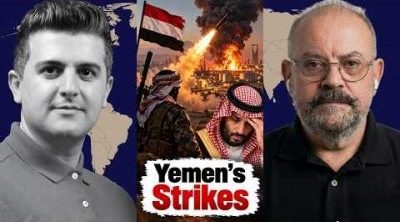
Elijah Magnier: Yemen’s strikes are shattering Saudi Arabia’s long-term strategy
or go to
Aletho News Archives – Video-Images
From the Archives
British weapons and personnel doing much of the killing in Yemen
Press TV – June 18, 2019
A detailed report published by the Guardian newspaper has shown how Britain is massively contributing to Saudi Arabia’s devastating war on Yemen as it suggests that London is not only supplying the bombs that fall on Yemenis, but it provides the personnel and expertise that keep the war going.
The comprehensive report by Arron Merat published on Tuesday showed that Britain was doing much of the killing in Yemen as the country continues to provide Saudi Arabia with everything it needs to turn its southern impoverished neighbor into a graveyard.
“Every day Yemen is hit by British bombs – dropped by British planes that are flown by British-trained pilots and maintained and prepared inside Saudi Arabia by thousands of British contractors,” said Merat in the report. … continue
Blog Roll
 Aletho News
- Netizens condemn Japanese drama for projecting Japan’s wartime atrocities onto Chinese characters
- Racist Seinfeld Dances for Joy as Bibi Unveils His New Map
- A West Bank War for Netanyahu’s Election Campaign, Could It Backfire?
- Yemen denounces European Parliament’s ‘hypocritical’ push to blacklist Ansarullah
- Qalibaf: UAE’s UN bid aims to ‘clear the runway’ for ‘Greater Israel’, whitewash genocide
- Pakistan reopens Iran border after boosting security: Report
- Why are so many Brazilians voting for Flávio Bolsonaro?
- Democrats Put Anti-Russia Agenda Ahead of American Workers
- Elijah Magnier: Yemen’s Strikes Are Shattering Saudi Arabia’s Long-Term Strategy
- Pentagon designates Chinese cultural centers national security threat
- If Americans Knew
- An error has occurred; the feed is probably down. Try again later.
- No Tricks Zone
- Sudden Stratospheric Warming, Powerful El Niño Combination May Lead To Extreme Europe Cold, Energy Crisis!
- Two New Studies Find Thwaites Glacier Melt Cannot Be Driven By Human Activity Or A Warming Ocean
- E-Cars Reduce CO2 Emissions By Only 41% Compared To Internal Combustion Engine Vehicles
- Predictions Made By Renowned Climate Professor Over Past Decades Have Been Proven To Be Poor
- New Study Suggests Large Regions Of The Pacific Ocean Have Been Cooling For The Last 80 Years
- Germany’s Green Energy Debacle: High Energy Costs Force Kahla Porzellan to Close After 182 Years!
- New Study: 50 Years Of The Most Aggressive ‘Net Zero’ Policies Can Only Affect The Global Climate By 0.03°C
- US September “Heat” Was No Record…Many Records Set Decades Ago
- Latest European Green Energy Debacle; Portugal’s Largest Flagship Solar Park Insolvent!
- Green Energy Debacle: German Expert Professor Fritz Vahrenholt Warns Of Severe Economic And Social Consequences

