Dutch and Australian troops were planning to start war with Russia after MH17 was shot down
By John Helmer | Dances With Bears | June 15, 2016
President Barack Obama and his advisors spent at least a week, and as much as three weeks, planning to send up to 9,000 combat troops into eastern Ukraine, on the border with Russia, following the shoot-down of Malaysia Airlines Flight MH17 two years ago. The scheme, which was to have involved Dutch and Australian army units, with German ground and US air support, plus NATO direction, has inadvertently leaked from the publication of a report this week by a former Australian Army captain.
The military plan, according to James Brown, now head of research at the US Studies Centre of the University of Sydney, “would have consumed the bulk of the Australian Army.” Captain Brown also claims “planning for these military options consumed Australia’s intelligence agencies. The National Security Committee of [the Australian ministerial] Cabinet met every day for more than three weeks , and staff and agencies produced a frenzied stream of briefings on Ukraine, Russia and the intentions of [President] Vladimir Putin.”
According to Dutch sources, the military plan of attack was aborted when Germany refused to participate directly, or allow its bases and airspace to be used. Dutch Prime Minister Mark Rutte announced the Dutch were pulling their troops out of the plan on July 27. He said at the time: “Getting the military upper hand for an international mission in this area is, according to our conclusion, not realistic.” That was ten days after the MH17 crash. But Australian Prime Minister Tony Abbott and his cabinet continued, Brown and his sources reveal, to plan the operation with the US for another 10 days.
MH17 was shot down on July 17, 2014, killing 298 passengers and crew. Of the lives lost, 193 of them were Dutch; 43 Malaysian; and 27 Australian (plus 11 dual nationals or residents). From the first hours, the Malaysian government suspected elements of the Ukrainian military had been involved. Kuala Lumpur was reluctant to endorse the claims of the Ukrainian and US governments that Russia had been culpable, and that Russian-backed forces were directly to blame. That story can be read here.
The Dutch and Australian governments were, and continue to be, the most supportive of blame for Moscow. This was adopted as the official policy of the European Union (EU) states when they joined the US in introducing new sanctions against Russian oil companies and banks between July 16 and 31, 2014. For more details of the disagreements between political leaders on what had caused the shoot-down, read this.

Left: Malaysian Prime Minister Najib Razak with Rutte, The Hague, July 31, 2014; right: Najib with Putin, Sochi,
May 21, 2016
Rutte and Abbott combined to pressure Prime Minister Najib to drop his public scepticism, and join the police and prosecutors group known as the Joint Investigation Team (JIT). Najib is the only one of the three to discuss with Russia its assessment of the causes of the MH17 crash.
The report by Brown was cited in an Australian newspaper on Monday as an attack on ex-prime minister Abbott for “grand aspirations [which] could have exposed Australian troops to substantial danger in pursuit of lofty objectives misaligned with national interests”. Abbott lost his job when the MPs of his party combined to replace him with the current prime minister, Malcolm Turnbull, on September 14, 2015. Ukrainian President Petro Poroshenko then appointed Abbott one of his “international advisors”.
In 2014, according to Brown, Abbott “calculated that the best way to encourage the United States to retain an active role in world affairs was for Australia to lead by example: as an ally encouraging, reassuring, and perhaps even occasionally shaming the US into taking action.” The full Brown report can be read here.
Brown reveals that “military planners worked up options for Abbott that involved deploying up to a brigade’s worth of troops to Eastern Ukraine, a formation of as many as 3,000 troops”. Another proposal, which he reports as coming from Abbott’s office, was “to commit uniformed Australian military logistics personnel to help the Ukrainians improve their own systems”.
Brown, who favours special forces operations himself and the command of the Australian Army by former spetznaz officers, says “nearly 200 [special force troops] were eventually sent to Europe to support the MH17 recovery operations, staging from bases in the United Kingdom and the Netherlands to provide close support to investigators and backup for further crisis or contingency.” Less than four weeks later, according to Brown, one hundred of these men were moved to Iraq instead.
Abbott himself told Australian state radio in February 2015: “We did talk to the Dutch about what might have been done in those perilous circumstances, because certainly they were perilous circumstances. There was talk with the Dutch about a joint operation.” Abbott claimed this wasn’t his initiative. “This arose out of the most important and the most necessary discussions between the Dutch military and our own.”
This week’s report by Brown breaks news in identifying how large the Australian force was to have been. He does not report the Dutch, German and NATO planning which was going on at the same time. When asked, Brown declined to say whether he and his sources knew, or didn’t know, that Abbott was acting in concert with the others.
On July 25, 2014, the Dutch newspaper De Telegraaf reported that the 11th Airmobile Brigade was being mobilized for action in eastern Ukraine. That’s 4,500 troops, and part of a division-sized German military force called Division Schnelle Kräfte (Rapid Forces Division – unit flash, silver) of about 9,000 men.
The cover story, according to the Telegraaf, was “to ensure the 23 Dutch crash investigators and 40 unarmed military police officers can do their job.” The real objective, according to one of Telegraaf’s sources, was: “if our commandos are there, they should certainly try to arrest those responsible. [Russian] Colonel Igor the Terrible Girkin [Strelkov] and his associates.” For background on Girkin’s role in Russian plans and operations in eastern Ukraine, read this.
The Dutch newspaper didn’t reveal the Dutch troops would be deployed alongside the 3,000-man Australian force, and that the German command of Division Schnelle Kräfte would also be involved. Telegraaf claimed the operation was “not expected at the NATO headquarters in Brussels”, although it had been presented to “the authorities in Kiev before the green light [was given] and cooperation promised.”
Two days later, on July 27, the BBC reported Dutch Prime Minister Rutte as calling off the operation. “Getting the military upper-hand for an international mission in this area is, according to our conclusion, not realistic, “he said, conceding it would be “such a provocation to the separatists that it could destabilise the situation”. With almost two years in retrospect, Brown concludes, without mentioning the Dutch, Germans, or other NATO forces, “the potential for harm to Australian troops was all too real. The logic of deploying large numbers of troops into an active war zone alongside the border of a major global military power was entirely shaky.”
Russian analysts in Moscow do not regard the Australian and Dutch governments as capable of planning military action without prior encouragement by the US. The Russians did not realize at the time, they now say, that the US may have been planning a military operation in the wake of the MH17 crash. Yevgeny Krutikov, military analyst for Versiya and Vzglyad, recalls there were reports in the press “about the organization of protection for the crash site. Then Abbott offered to send about 1,000 Australian troops to cordon off the crash site. By definition, that was unrealizable stupidity.”
“The number of 9,000 is not real. For the protection of the aircraft wreckage that had fallen, the requirement is less than a militia company. The area was open fields where [the locals] had planted potatoes and sunflowers. There was no talk about the arrival of armed forces from NATO. Air support was even more unreal. By this time, Ukraine has already lost all of its aircraft, and ‘cooperation’ was not technically feasible.”
The omissions in the Dutch and now the Australian report suggest the close coordination of US and EU officials on introducing new sanctions against Russia immediately after the MH17 crash was not matched by coordination of any kind between the Obama Administration, the US command of NATO, the Dutch, Germans and Australians. To Russian observers this is not credible. Preposterous, they believe, is that the Dutch and the Australian governments, at the urging of the White House, went as close as they did to war on the Russian frontier.
Brown declines to identify or corroborate his sources for the size of the Australian armed force intended for the Ukrainian operation. He was asked to explain “that the prime minister, his advisors, the National Security Committee of Cabinet meeting every day for three weeks, the Australian intelligence agencies, and the Australian military staffs failed to ask for US assessments, US policy guidance, US logistic and other support in the event of engagement between Australian and Russian forces, and US approval of the plans and proposals considered at the time. If the Australians did obtain the US responses, would you say the proposals you attribute to Mr Abbott had US backing, at least at the outset?”
Brown refuses to answer. Was it possible for two prime ministers, the Australian and the Dutch, to start mobilizing for a combined Ukraine operation without US and NATO participation in the planning? Brown won’t say.
Instead, he ends his report with an endorsement of Obama’s Nobel Peace Prize speech of 2009: “There will be times,” Obama said then, “when nations – acting individually or in concert – will find the use of force not only necessary but morally justified… For make no mistake: evil does exist in the world.”
“Military Schengen”: Washington Calls for the Further Integration of NATO
By Steven MacMillan | New Eastern Outlook | June 17, 2016
NATO is a threat to world peace. Its incessant war games and its addiction to antagonising the Russian bear are putting the future of the world in jeopardy. After the collapse of the Soviet Union and the Warsaw Pact, NATO should have been disbanded; not expanded to include former Warsaw Pact states in a blatant policy of encircling Russia. Instead of advocating the abolition of NATO however, one of the most influential think tanks in the US is pushing for the further integration and consolidation of this Cold War relic.
At the start of June, Foreign Affairs – the publication of the Council on Foreign Relations – titled: A Schengen Zone for NATO. In the article, Braw argues for the creation of a “military Schengen” in order to move troops between NATO countries without any delays, unsurprisingly justifying this further integration as a necessary move to counter “Russian aggression:”
“NATO’s member states are willing to defend one another, and they have the troops and the equipment to do so… But one thing frustrates commanders even more: the arduous process of getting permission to move troops across borders… At their upcoming summit in Warsaw, NATO members will discuss joint responses to Russian aggression, and they are likely to agree to station four battalions—totaling about 4,000 troops—in the Baltic states and Poland. But with Russia forming two new divisions in its western military region, which borders the Baltic states, 4,000 forward-stationed troops may not be enough to deter a potential attack.”
Braw continues:
“Moving troops across Europe requires permission at each border… But military commanders, hoping for more progress—and more uniform progress across Europe—are arguing for an EU-inspired military Schengen. The Schengen Agreement, in place since 1996, allows passport-free passage between the 28 European countries that are part of the arrangement… With a military Schengen in place, NATO troops and equipment would be able to cross NATO borders to their destination the same way EU citizens do: without having to show permits… Should a war break out, SACEUR [NATO’s Supreme Allied Commander Europe] Curtis Scaparrotti and his fellow NATO commanders would, of course, be free to move their troops across NATO borders without diplomatic clearance… But many commanders and analysts, including Brezinski, argue that peacetime red tape is affecting planning and preparations for such contingencies, which in turn affects deterrence.”
The idea of a military Schengen for NATO member states has increasingly being advocated in recent months by defense ministers and military commanders. As Sputnik reported in an article last month titled, NATO’s ‘Tank Schengen’: Baltic States Call for Free Movement… of Troops:
“The defense ministers of the three Baltic States have called for an easing of travel restrictions on the movement of NATO troops and equipment in Europe, and are suggesting the creation of a visa-free space, similar to that of the Schengen area, to accelerate the deployment of allied forces and armament in the Baltic States.”
Under the guise of deterring Russian aggression, the US is pushing for a deepening of the alliance, and further undermining the sovereignty of each member state. NATO is also attempting to expand once again, trying to formally secure Montenegro as a member state in the near future, in addition to pulling Georgia closer to the imperial alliance. The abolition of NATO is what is needed to move the world closer to peace, not the further integration of this nefarious arm of Western imperialism.
NATO Could Use Conventional Weapons to Respond to Cyberattacks
Sputnik – June 16, 2016
The North Atlantic Alliance apparently views conventional weapons as a viable means to deal with cyberthreats to its networks and communications systems. NATO’s Secretary General Jens Stoltenberg said as much when he mentioned that the bloc could deploy conventional arms to respond to cyberattacks in the future.
NATO’s networks are targeted on a daily basis, but this measure will likely only apply to the most serious security breaches that could trigger the collective defense clause under Article 5.
“A severe cyberattack may be classified as a case for the alliance. Then NATO can and must react,” Reuters quoted Stoltenberg told as telling the German newspaper Bild. The bloc’s chief was vague on how exactly the alliance plans to respond, saying only that the strategy “will depend on the severity of the attack.”
Stoltenberg appeared not to mention how the alliance plans to determine the assault’s origin, which is a major challenge when it comes to sophisticated operations since hackers are capable of launching and routing attacks worldwide.
“The question of how to respond to cyberattacks is a thorny one. Attribution for the attacks can often be murky, making it very hard to prove accurately the original source. Even if the location of an attack is identified, a nation can claim that the attacks came from a rogue individual and not a government,” Aaron Mehta observed.
NATO has already confirmed that it will recognize cyberspace as an operational domain at the bloc’s upcoming summits in Poland, Warsaw, and will invest heavily into building up defenses to its computer networks just like it has beefed up its military capabilities when it comes to air, sea and land operations.
Arms Control and Non-Proliferation: Looming Crisis Slipping Through the Cracks of Public Attention
By Andrei AKULOV | Strategic Culture Foundation | 15.06.2016
The missile defense capable USS Porter is in the Black Sea to trigger discussions on the state of European and global security. This month experts mark the 28th anniversary of the Intermediate-Range Nuclear Forces Treaty (INF) that came into force on June 1, 1988. Those were the days of great hopes and expectations.
Today Ukraine’s drama, the EU’s migrants’ crisis, China’s economic slowdown and the fight against the Islamic State group hit headlines while another crisis is looming in the background – the unraveling of nuclear arms control and the related problem of non-proliferation. The prospect of losing the legal regime for managing the instruments of devastation is very much real.
It is true that the two key treaties – the 2010 New Strategic Arms Reduction Treaty (New START) and the 1987 Intermediate-Range Nuclear Forces (INF) Treaty – are still in force. However, their future is not assured. The 2010 New START (also known as the Prague Treaty) was an important achievement in preventing the collapse of arms control. But it expires in 2020 without any prospects for a new agreement coming into force. There are no signs that the parties are planning to launch talks on the subject. The future of the INF is also in doubt. The Treaty is threatened by ballistic missile defense (BMD) deployment. Aegis Ashore uses the naval Mk-41 launching system, which is capable of firing long-range cruise missile. This is a blatant violation of the INF Treaty provisions.
The countries which host BMD sites inevitably become targets for Russia’s Iskander surface-to-surface missiles and aviation.
Actually, the United States launched the arms control erosion by withdrawing from the 1972 Anti-Ballistic Missile Treaty to no longer accept any restrictions on its missile defense deployments. Washington still has not ratified the Comprehensive Nuclear Test Ban Treaty (CTBT) 20 years after it was adopted by the United Nations General Assembly in 1996.
Russia refuses any limitations on its sub-strategic nuclear arms while the US enjoys advantage in conventional long-range precision guided weapons, and NATO is implementing the program of stationing missile defense Aegis sites in Romania and Poland – in the vicinity of Russia’s borders. European security is weakened by the Russia-NATO stand-off. Nowadays, the plans to establish nuclear-weapons-free zones in Europe are, to large extent, forgotten. Measures that might include steps to prevent nuclear weapons being stationed outside the borders of the nuclear-weapon states are not on the Russia-NATO Council’s agenda. There is no accord between Russian and NATO on nuclear incidents prevention. Currently around 200 B61 bombs are deployed in underground vaults inside around 90 protective aircraft shelters at six bases in five NATO countries (Belgium, Germany, Italy, the Netherlands, and Turkey). About half of the munitions are earmarked for delivery by national aircraft of these non-nuclear states, although they all are parties to the Non-Proliferation Treaty (NPT) of 1968 that envisions certain obligations.
Article I of the treaty prohibits the transfer of nuclear weapons from nuclear-weapons states to other countries. Its Article II requires non-nuclear weapons states not to receive nuclear weapons. The US and NATO breach a major international treaty.
Russia considers US forward-based tactical nuclear weapons deployed in Europe to be an addition to the US strategic arsenal that is capable of striking deep into Russian national territory. Moscow has, therefore, demanded that the United States withdraw these weapons (which amount to about 200 air-dropped gravity bombs in the process of being upgraded) from Europe as a precondition to any possible talks on the issue. The process is stalled.
In addition, developments in non-nuclear BMD systems and long-range, precision-guided offensive weapons, as well as their proliferation, have complicated nuclear arms control.
The United States is in violation of the 2000 Plutonium Management and Disposition Agreement (PMDA). Russia and the US agreed to transparently dispose of weapons-grade plutonium, thereby preventing it from being reused for military purposes. The agreement specifies that the United States will dispose of its plutonium by burning it in light water reactors (Article III.2).
In 2016 the US Energy Department changed the plans in favor of “a cheaper, faster alternative”.
Changing the disposition method requires formally amending the agreement, which cannot be done without Russia’s consent.
Despite that, the US administration’s Fiscal Year 2017 budget proposal calls for the termination of the MOX (mixed oxide) project.
The violation was one of the reasons the Russian President skipped the Nuclear Security Summit held in Washington, DC on March 31-April 1, 2016.
The seven nuclear-armed states besides Russia and the United States have refused to join the discussions on any limitations till Russia and the US get closer to their numerical levels. In fact, it implies another substantial reduction on top of cuts already undertaken by the “Big Two”. Global and regional powers with quite different points of view, ambitions, and political and military experiences from Russia and the United States are now important international players. Nuclear-arms limitations are no longer in the foreground of international security giving place to local conflicts, the fight against terrorism, and nuclear proliferation – the issue greatly exacerbated by the recent North Korean activities.
Nuclear nonproliferation is also in trouble. Nothing has been done in real terms. For instance, a conference on the establishment of weapons of mass destruction–free zone in the Middle East (agreed on at the 2010 Nuclear Summit) has never materialized. 2016 Washington Nuclear Summit ended without producing any tangible results with Russia skipping the event. Negotiations with North Korea have been in limbo for many years and there is no prospect for their revival. This is confirmed by the recent events.
The talks on a Fissile Material Cut-Off Treaty have been deadlocked for many years with the US-Russian cooperation on the safety and security of nuclear sites and materials ended in 2014.
The 2015 Iran deal is the only silver lining, but it still has a long way to go to become a long-term, comprehensive process. All other negotiations on nuclear arms reduction and nonproliferation have come to a dead end. Russia and the United States still retain their leading roles in the nonproliferation regime, but they can use this advantage effectively only joining together. The history of negotiations on the Iranian nuclear program provides a telling example.
Today the world is facing the most serious and comprehensive crisis in the fifty-year history of nuclear arms control with almost every channel of negotiation deadlocked and the entire system of existing arms control agreements in jeopardy. One can see the US taking one decision after another to undermine the arms control regime that has served as a pillar of international security for dozens of years. This crisis may quite possibly result in the total disintegration of the existing framework of treaties and regimes followed by probable resumption of the arms race with dire consequences for humanity. Further proliferation of nuclear weapons may lead to the deliberate or accidental use of nuclear weapons in local wars. Only political unity among the major global powers and alliances, coupled with urgent and effective action, can reverse this trend.
Inventiveness and an aggressive search for new approaches can adapt nuclear arms control to the new realities, including disentangling further strategic arms reductions from the present knot of problems, binding agreements on the capabilities of BMD systems, limitations on existing and emerging long-range, precision-guided conventional offensive weapons and reductions in substrategic nuclear arms. Cooperative relations among key global and regional powers and alliances could be adapted to the emerging new post–Cold War world order molded through patient negotiations launched upon a joint Russia-US initiative. Nuclear arms control – the central pillar of the process – should be restored and modernized.
Hopefully, the next President of the United States will realize that the problems can be resolved if the leaders of the great powers are willing to work them out, and if experts approach them creatively.
NATO to deploy troops to Romania as part of eastward expansion
Press TV – June 14, 2016
The North Atlantic Treaty Organization (NATO) says it will send units to Romania as part of plans to expand its presence in Eastern Europe, a source of controversy with Russia.
NATO Secretary General Jens Stoltenberg announced the decision on the sidelines of a two-day meeting of the Western military alliance’s defense ministers in the Belgian capital, Brussels, on Tuesday.
Stoltenberg told reporters that NATO would take up an offer by Romania to deploy forces in the eastern European country, without elaborating on the number of troops.
The development comes a month after the alliance formally opened a missile shield base in Romania, prompting Russia to say that it will take counter-measures against what it denounced as a threat to its security.
Elsewhere in his remarks, the NATO chief noted that despite the build-up of troops, the military bloc avoids tensions with Russia.
“We convey a very strong message about that we don’t seek confrontation with Russia. We don’t want a new cold war and we will continue to strive for a more constructive and cooperative relationship with Russia,” he said.
Stoltenberg further emphasized that the alliance will formally approve the deployment of four “robust” multinational battalions in Poland as well as the Baltic states of Lithuania, Estonia, and Latvia.
“We will take decisions on a tailored presence for the southeast region, with a land element built around a multinational framework brigade in Romania,” he said.
This unit will “organize and facilitate NATO activities in the region related to exercises and also assurance measures,” he added.
The four battalions, which would tour through Eastern Europe and conduct drills with national troops, are likely to number 2,500-3,000 troops combined with the small force designed to act as a tripwire, according to diplomatic sources.
NATO has stepped up its military build-up near Russia’s borders since it suspended all ties with Moscow in April 2014 after the Black Sea Crimean Peninsula re-integrated into the Russian Federation following a referendum.
Moscow has repeatedly repudiated NATO’s expansion near its borders, saying such a move poses a threat to both regional and international peace.
Last month, NATO formally invited Montenegro to become its 29th member, forcing the Kremlin to warn that the decision risked fueling geopolitical tensions across Europe.
Hillary’s Foreign Policy Speech: Queen Galadriel Before Her Magic Mirror

By Gary Leupp | CounterPunch | June 6, 2016
Rachel Maddow, the famously progressive MSNBC show host, pronounced it “her greatest speech of the campaign.” Chris Matthews agreed, adding that it would “have a very strong appeal to the neocon movement.” He mentioned in particular Bill Kristol, the Weekly Standard editor and TV commentator, as someone likely to be impressed. “A very smart man,” opined Matthews, the conservative Democrat and “Hardball” host, causing the entire cosmos to shudder.
You’d think that that war in Iraq, which Kristol had tirelessly championed, had never happened. And that its results had been anything other than horrific for the entire Middle East.
Hillary Clinton’s fiery performance last Thursday night, intended to assert her credentials as a former secretary of state (with all the positive “experience” that’s supposed to entail), framed by no fewer than seventeen U.S. flags, was a strident reassertion of U.S. “exceptionalism” without apologies or even reflections on the recent past and her bloody role in it.
It was billed as a “major foreign policy address,” the sort of thing you might expect of a sitting president. And it was designed, of course, to make her look presidential, and to underscore her campaign’s declaration that she has the Democratic nomination all sewed up. But it was not in fact a foreign policy speech at all; Donald Trump is quite right to call it “a political speech” directed at him.
Maddow has occasionally shown signs of critical reasoning in her coverage of the U.S.’s imperialist wars. One has to wonder what she finds admirable in the speech. Because actually, Clinton said nothing new.
However unsubstantial, it was all over the news the next morning, competing with the stories about new fencing at the Cincinnati Zoo and Prince’s autopsy results. Meanwhile the networks systematically ignore the ongoing wars in Iraq and Syria generated by the invasion of Iraq 13 years ago, and the European refugee crisis sparked by the regime-change wars in those countries as well as in Afghanistan and Libya. Like the monkeys adorning the Nikko Shrine, they see no evil, hear no evil, and speak no evil.
Some takeaway lines from the Clinton speech: “Donald Trump doesn’t know the first thing about Iran or its nuclear program.” It’s true that Trump is an uninformed blowhard and that Hillary in contrast knows a lot. She knows, for example, that the entire U.S. intelligence community, in two separate National Intelligence Estimates after 2003, concluded that Iran does not have a military nuclear program. She knows that the whole issue was hyped at the demand of the Israeli leaders who continuously demanded that the U.S. bomb Iran’s nuclear facilities (that in fact date back to the period of the Shah’s reign and supported by the U.S.’s “Atoms for Peace” program).
She also knows from experience the value of the Big Lie in obtaining mass acceptance for real or threatened military action.
Clinton has generally avoided specifics in discussing her plans for more war with one conspicuous exception: she has continuously stated that she strongly advocates a “no-fly zone and humanitarian corridors” in Syrian air space and on the ground in that country beset by civil war pitting a secular regime, mainly against terrorist and terrorist-aligned Islamist opponents.
For Hillary, Syria is the ideal battlefield: one that pits her vision of U.S. hegemony against both Russia (Syria’s patron and her main target) and the nebulous evil of Islamist terrorism in the world—on behalf of an imaginary middle force of democrats who will stay cozy with the U.S. and end support for armed groups opposing Israel.
Her plans are as much a recipe for war as the bogus humanitarian mission in Libya in 2011. They would, as estimated by former Chairman of the Join Chiefs of Staff Gen. Martin E. Dempsey, require the deployment of 70,000 U.S. troops for their implementation.
In last week’s speech she was more circumspect. “We need to take out [ISIL’s] strongholds in Iraq and Syria,” she declared, “by intensifying the air campaign and stepping up our support for Arab and Kurdish forces on the ground. We need to keep pursuing diplomacy to end Syria’s civil war and close Iraq’s sectarian divide, because those conflicts are keeping ISIS alive. We need to lash up with our allies, and ensure our intelligence services are working hand-in-hand to dismantle the global network that supplies money, arms, propaganda and fighters to the terrorists.”
She didn’t mention that the money supplied to the terrorists is overwhelmingly from donors in Saudi Arabia, Turkey and Gulf states closely allied with the U.S. Or that the current U.S. air campaign over Syria is, unlike that of Russia, illegal, opposed by the internationally recognized government in Damascus and lacking UN approval. Her “major foreign policy address” could not address such small details.
Hillary did not mention her own crowning achievement as secretary of state—the savage destruction of Libya involving the death of about 30,000 people, the unleashing of the ugliest forms of tribalism, and ISIL’s securing of a beachhead around Sirte—even once.
In contrast she made repeated references to NATO, well aware no doubt that most Americans aren’t clear at all about what that is but think it must be something good. Like the UN, or the International Red Cross. (I doubt that one in ten knows what the acronym stands for—the North Atlantic Treaty Organization—or realizes that it has only been deployed well outside the North Atlantic region, in the Balkans, Afghanistan, and North Africa.)
“This is someone [Trump] who has threatened to abandon our allies in NATO,” Clinton thundered (as though the peoples of Europe had ever earnestly sought, or are begging to maintain that Cold War, specifically anti-Russian, alliance).
It’s true that Trump has—on occasion and inconsistently—labeled NATO “obsolete” and opined that it should have been dissolved years ago. Whether he truly believes this is unclear. As Hillary says, his “ideas are dangerously incoherent” and he can withdraw or deny such comments at any time. But Trump’s statements about NATO, however vague, are actually the most intelligent and welcome statements he’s made in the course of his campaign.
The fact is, beginning in 1999 at her husband Bill’s orders, the NATO alliance designed as a binding military pact uniting West European countries against the Soviet Union from 1949—that should have been dissolved in 1990 when the Warsaw Pact formed in response shut down—has relentlessly expanded to encircle Russia. That’s post-Cold War Russia, with a military budget about 7% of the U.S. figure. Some NATO leaders aim to ultimately swallow Ukraine—which just happens to have been part of the Russian state from the 1670s to the Bolshevik Revolution, when it was made a soviet socialist republic until the collapse of the Soviet Union in 1991. Its economy including its munitions industry are inextricably interwoven with Russia’s; its eastern regions are peopled by ethnic Russians; it shares a 1,400 mile long border with Russia.
Does it not make sense that Moscow would see the incorporation of Ukraine, especially one headed by the current Russophobic leadership, into an anti-Russian military alliance as threatening and unacceptable?
Yet Hillary has been a ferocious advocate for the infinite expansion of the alliance, its wars that have produced dysfunctional U.S. client states (Kosovo, Bosnia-Herzegovina) in the former Yugoslavia, and its provocative moves on Russia’s doorstep. But in her speech, avoiding any reference to that expansion—the key geopolitical change of the last quarter-century—she proclaimed: “Moscow has taken aggressive military action in Ukraine, right on NATO’s doorstep.” She never explains why that doorstep has advanced (despite Reagan’s promises to Gorbachev) to include Poland, Slovakia, Hungary and Romania to begin with. Or why it has bordered Russia itself since the inclusion of the former soviet socialist republics of Estonia and Latvia, which share a 508 kilometer border with Russia.
The “military action in Ukraine” that she alludes to refers to separatists’ resistance to the U.S.-backed coup in February 2014, surely supported by Russia at some level, and surely by Russian public opinion, but you notice that the Pentagon has produced precious little evidence for large scale “military actions.” And the annexation of Crimea (Russian from 1783 to 1954, when it was transferred to the Ukrainian SSR within the old Soviet Union) was only a “military action” in that the 25,000 Russian troops stationed there by treaty were deployed to secure government buildings.
And do not expect Hillary to ever inform her audiences that Sevastopol on Crimean Peninsula is Russia’s only year-round ice-free port except Murmansk north of the Arctic Circle; that the Russian Black Sea Fleet has been headquartered there without interruption since 1783; and that the expulsion of the Russians and their replacement with NATO forces would constitute a truly existential threat to the Russian state.
It would in fact be hard to build a case convincing to the American people that all these countries need to be locked into an alliance with the U.S. and obliged to pay out 2% of their GDPs on military expenses in order to protect them from some imaginary Russian invasion. (From a rational standpoint, it would be precisely like persuading the Russian people that Moscow should head up an alliance including Canada, Mexico and Cuba to secure them against U.S. aggression.)
But the expansion of NATO to include Ukraine has been a pet project of the former Madame Secretary. Clinton chose as her Under Secretary of State for European and Eurasian Affairs Victoria Nuland, a former aide to Vice President Dick Cheney, neocon and wife of the powerful neocon Republican pundit (John McCain advisor and recently declared Hillary supporter) Robert Kagan. Nuland already had a rich history of warmongering when she embarked on a plan to topple the elected government in Ukraine and replace it with one that would join NATO.
She boasted publically that the U.S. had spent $ 5 billion by 2014 in an effort to, as she put it so quaintly and dishonestly, “support Ukraine’s European aspirations.” The result was the coup in February 2014 and consequent civil war that has taken over 8,000 lives, including hundreds killed by the neo-fascist Azov Battalion which functions as a regiment of the National Guard.
The U.S. State Department echoed by the compliant media has methodically depicted these events as Russian interference, rather than the results of a U.S.-orchestrated “Color Revolution”-type regime change campaign. To anyone paying attention, the dishonesty, and the success of the propaganda prettifying the coup, is sickening.
Trump has, as Clinton notes, praised Vladimir Putin as someone to whom he’d award an A for leadership. She for her part calls him a “dictator,” a term she would never use for a U.S. ally such as Egypt’s Abdel Sisi or the Saudi king. She has compared the apparently popular president, who has deftly pushed Obama back from his 2013 threat to order a massive strike on Syria and cooperated in the conclusion of the Iran nuclear deal, to Hitler—an astonishing statement of historical illiteracy and propensity for sensationalism.
Hillary’s imperious message boils down to: We are the exceptional nation, which the world needs to maintain its “stability.”
“I believe in strong alliances; clarity in dealing with our rivals; and a rock-solid commitment to the values that have always made America great. And I believe with all my heart that America is an exceptional country – that we’re still, in Lincoln’s words, the last, best hope of earth. We are not a country that cowers behind walls. We lead with purpose, and we prevail.”
The peoples of Korea, Vietnam, Afghanistan, Iraq, and Libya, know very well how “exceptional” a country the U.S. is, how seldom it “cowers behind walls,” how cheerfully and unapologetically it destroys countries using its “alliances”—even when the latter are jerry-rigged to provide a fig-leaf for what’s essentially unilateral action. Even when their member-lists are often padded with name-only participants such a tiny Pacific nations sometimes informed after the fact that they’re suscribers.
The youth of Iraq—93% of whom according to a recent poll view the U.S. as an enemy—know how U.S. “values” manifest themselves: in the form of “shock and awe” bombing, Abu Ghraib torture, Blackwater murders, and cowboy-managed “reconstruction” that in fact further divided and scourged an already ruined and humiliated country. There is nothing good that can be said about the war that Hillary so passionately supported, until it became politically impossible for her to continue to do so.
Madame Secretary looked regal Thursday night, in the worst way. She reminded me of the elfin Queen Galadriel, as played by Cate Blanchett, in The Lord of the Rings, in that scene where she stares into her magic mirror, sees a vision of the power of Sauron, and suddenly towers over Frodo, arms like dark hollows, arms flung high, and bellows:
“In place of a Dark Lord, you would have a queen! Not dark, but beautiful and terrible as the dawn! Treacherous as the sea! Stronger than the foundations of the earth! All shall love me, and despair!”
Trump and Clinton are both servants of the enchanted ring called Capital. It is not at all clear who is more darkly and fatefully bound, or whose foreign policy, applauded by more devoted followers, would be more terrible and cause the greater despair among the people of this planet.
In response to the warrior-queen awaiting coronation, Bernie Sanders has sadly avoided the whole question of U.S. imperialism. (Among other things, he never uses the term.) It’s as though he accepts Chris Matthew’s smug pronouncement, “The American people don’t care about foreign policy.” The best Bernie could do last week was to say: “… when it comes to foreign policy, we cannot forget that Secretary Clinton voted for the war in Iraq, the worst foreign policy blunder in modern American history, and that she has been a proponent of regime change, as in Libya, without thinking through the consequences.”
Forgive me, Bernie—because I do of course hope you’ll win—but that comment was wimpish. Hillary’s Libya policy wasn’t a matter of not “thinking through consequences,” but a matter of calculated ruin of a modern state. It’s the difference from the “blunder” of accidental manslaughter and well-planned murder. (Recall how Madame Secretary cackled with hilarity after Col. Gadhafy was sodomized with a knife and assassinated in the desert by NATO’s friends.)
Like the CNN anchors who sometimes mention in passing Hillary’s “foreign policy blunders such as Libya,” Sanders cannot yet call out evil for what it is, but has to chalk it up to well-meaning mistakes lacking forethought.
But that level of criticism is the best the system can provide, the most it will allow. Mistakes were made. There were some intelligence flaws. There were blunders. To paraphrase Erich Segal’s Love Story: being the exceptional power means never having to say you’re sorry. You just acknowledge you fucked up, because hey, things like that happen. And let’s move on.
Had Bernie been the antiwar, anti-imperialist candidate throughout, rather than just repeating his (totally valid) tirade against Wall Street, he might have further sharpened his differences with Clinton. If he loses in California, and then betrays his following with a Clinton endorsement, he will be saying that more wars for regime change and more confrontation with Russia is worth some changes in party rules and some meaningless clauses on the party platform.
I would hope that any Bernie supporters (or anyone at all) who watched last night’s speech, or have read the on-line transcript, would buckle down on their opposition to this creature of Wall Street and the Democratic Party establishment. Better to vote not at all, if Clinton’s the nominee—and instead think about how best to topple whichever candidate wins.
The “billionaire class” that Bernie decries wants badly to suck you in. That’s why the party bosses praise Sanders for “bringing so many new young people into the process”—the better to eat you, my dear! They want you to love this queen, even as you despair of ever electing anybody better.
One Ring to rule them all, One Ring to find them,
One Ring to bring them all, and in the darkness bind them,
In the Land of Mordor where the Shadows lie
Better, surely, to destroy the Ring that is the rigged economy, rigged political process and murderous foreign policy that Hillary so personifies.
Gary Leupp is Professor of History at Tufts University, and holds a secondary appointment in the Department of Religion.
Flawed Logic: Swedish Writer Knocks Common Sense Into NATO Supporters
Sputnik | June 6, 2016
Over the past years, ordinary Swedes have been under immense pressure from high-ranking politicians and conventional media, who advocate scrapping the country’s trusted policy of non-alignment in favor of joining NATO. However, minority opinions still persist.
One of the stalwart opponents of joining NATO is the famous writer and journalist Jan Guillou, who last week wittily trounced his antagonists in a column for the tabloid newspaper Aftonbladet.
NATO supporters habitually try to scare everyone out of their wits with a sneak attack on Russia’s part, yet somehow fail to explain why Russia should endeavor such an attack, even if it is one of their trump cards, argued Guillou.
The Russian attack is to be expected “within a few years,” threatened the Swedish army chief Lieutenant General Brännström only half a year ago. Liberal pundits and their trusted military columnists applauded.
“I was not the only one to demand an explanation. What would Russia gain by attacking Sweden? Conquer more forest and iron ore? On the other hand, what would Russia lose by such an attack?” wrote Guillou.
According to Guillou, this question is much easier to answer: the aftermath would be ruined foreign trade and a de facto state of war between Russia and the EU.
“Not a single Liberal could explain why on earth Russia would commit such an economic and political suicide, yet they continued with their saber-rattling as vigorously as before: Sweden should join NATO to fence off the Russian attack that would inevitably ensue if it continued outside NATO,” Jan Guillou wrote.
Of late, Sweden’s military bosses have come up with an “updated” and more nuanced threat. Now, Putin is supposedly intending to limit himself with capturing “only” the strategic island of Gotland, which lies some 100 kilometers off mainland Sweden’s coast. This scenario is part of the following theory: at some point, Russia is inevitably bound to conquer one or several Baltic states (which according to Western think-tanks is manageable in only 60 hours).
A column in the tabloid newspaper Expressen, which is one of NATO’s most keen supporters in Sweden went even on to threaten the poor islanders with Russian nuclear arms. As usual, however, the author refrained from disclosing what joy Russia would get from nuking Gotland, which is quite typical of NATO agitators.
According to Guillou, the biggest problem with a feasible NATO membership is that Sweden would have to abandon its independent foreign policy and become a cog in the US military machine.
“For the question in all its simplicity is as follows: should Sweden cede its [independent] security policy to a Washington-led system through NATO membership?” Guillou asked rhetorically.
“Considering America’s dubious track record when it comes to foolish wars in recent years, it would be a dark perspective. What about future remakes of Iraq, Afghanistan and Syria? <…> As if that were not enough, Sweden would also end up in the same military alliance with Turkey, led by a war-mad dictator, and states such as Hungary and Poland, which are moving away from democracy.”
These are real questions, which incidentally are avoided at all costs by pro-NATO debaters. Instead, they go on in circles with their increasingly stale rhetoric about Russia’s “aggression.” Sweden’s NATO campaign stinks, concluded Guillou.
Jan Guillou is a popular Swedish writer and journalist. His fame in Sweden is rooted in his best-selling detective series, as well as his time as an investigative reporter. Guillou is renowned for his consequent anti-US stance and was previously known for calling Washington “the greatest mass murderer of our time.”
NATO Baltic wargames have ‘political, economic & military motives’
RT | June 5, 2016
The US strategy in Europe is aimed at strengthening its control over EU and NATO states, selling more military equipment to its European allies to make super-profits for its military-industrial complex and to isolate Russia, political author Diana Johnstone told RT.
NATO is holding major sea drills in the Baltic Sea. The BALTOPS exercises, which kicked off on Friday in Estonia and will continue until June 19, involve 15 member states of the military alliance as well as Finland and Sweden.
RT: NATO is conducting major drills across the Baltic. Is there a bigger political message here or is it just an exercise?
Diana Johnstone: Yes, they have been doing exercises like this for quite a while and the pretext changed. At least this time they are not pretending like with the missile shield that it is to protect Europe from Iran. The line has changed now, because the US is coming right out with their aggressive actions toward Russia. You have to see the political, economic and military motives for this. The economic motive is obviously to sell more US military equipment to European allies, who don’t need it and can’t afford it. But that is important for the US military-industrial complex. Politically this is the strengthening of US control of EU countries and NATO countries, and to isolate Russia – to carry out this famous [Zbigniew] Brzezinski strategy of separating Russia from Europe to promote US hegemony over the Europe and the world.
RT: A lot of people in Eastern Europe oppose this kind of strategy. The general public is not particularly happy about this, are they?
DJ: Of course those Baltic States, whose governments by the way are satellite governments of the US. The top officials studied in the West, in the US and Canada. These have gone from being Russian satellites to be American satellites. They pretty much follow the US direction. But that is not the case of the rest of Europe, which is simply ignoring this, like it is not happening. The Czechs are aware of it, so they are protesting. But for instance, here in France nobody mentions this, because frankly people wouldn’t be in favor of it at all. This is destroying defense of Europe. It is just turning into an instrument of US policy.
RT: Last week, NATO Secretary General Jens Stoltenberg announced plans to strengthen defenses, particularly against Russian foreign policy calling it “a defensive and proportionate response to Russia’s actions in Crimea and Eastern Ukraine.” At the same time recently he said that they strived “for a more constructive relationship with Russia.” Shouldn’t it be more talking going on, rather than deploying troops and hardware?
JS: We are used to now seeing the US – in the Middle East they say one thing and do the opposite. It’s just amazing to me that people can say things like that. It is totally absurd. Obviously there is nothing offensive about the people of Crimea going back to Russia, to which they belonged before… There is not tiny bit of an aggressive move of Russia towards the West. That is a total fiction… So these people are just lying. They cannot know that.
The Bigger Nuclear Risk: Trump or Clinton?
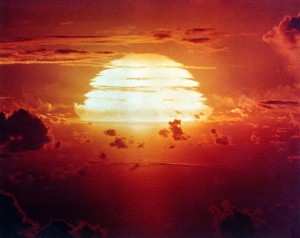
A U.S. government photograph of Operation Redwing’s Apache nuclear explosion on July 9, 1956.
By Robert Parry | Consortium News | June 2, 2016
Hillary Clinton made a strong case for why handing the nuclear codes over to a President Donald Trump would be a scary idea, but there may be equal or even greater reason to fear turning them over to her. In perhaps the most likely area where nuclear war could break out – along Russia’s borders – Clinton comes across as the more belligerent of the two.
In Clinton’s world view, President Vladimir Putin, who has been elected multiple times and has approval ratings around 80 percent, is nothing more than a “dictator” who is engaged in “aggression” that threatens NATO following the U.S.-backed “regime change” in Ukraine.
“Moscow has taken aggressive military action in Ukraine, right on NATO’s doorstep,” she declared. But stop for a second and think about what Clinton said: she sees Russia responding to an unconstitutional coup in Ukraine – which installed a virulently anti-Russian regime on Russia’s border – as Moscow acting aggressively “on NATO’s doorstep.”
That’s the same NATO, whose job it was to protect Western Europe from the Soviet Union, that — following the Soviet Union’s collapse — added country after country right up to Russia’s border. In other words, NATO muscled its way into Russia’s face and has announced plans to incorporate Ukraine as well, but when Russia reacts, it’s the one doing the provoking.
Clinton’s neoconservative interpretation of what’s happening in Eastern Europe is so upside-down and inside-out that it could ultimately become the flashpoint for a nuclear war between Russia and the West.
While she sees Russia as the “aggressor” against NATO, the Russians see NATO moving troops up to its borders and watch the deployment of anti-ballistic-missile systems in Romania and Poland, thus making a first-strike nuclear attack against Russia more feasible. Russia has made clear that it views these military deployments, just kilometers from major Russian cities, as an existential threat.
In response, Russia is raising its alert levels and upgrading its strategic forces. Yet, Hillary Clinton believes the Russians have no reason to fear NATO’s military encirclement and no right to resist U.S.-supported coups in countries on Russia’s periphery. It is just such a contradiction of viewpoints that can turn a spark into an uncontrollable inferno.
What might happen, for instance, if Ukraine’s nationalist — and even neo-Nazi — militias, which wield increasing power over the corrupt and indecisive regime in Kiev, received modern weaponry from a tough-talking Clinton-45 administration and launched an offensive to exterminate ethnic Russians in eastern Ukraine and to reclaim Crimea, where 96 percent of the voters opted to secede from Ukraine and rejoin Russia?
A President Hillary Clinton would have talked herself into a position of supporting this “liberation” of “Russian-occupied territory” and her clever propagandists would surely present this “heroic struggle” as a war of good against evil, much as they justified bloody U.S. invasions of Iraq and Libya which Clinton supported as U.S. senator and Secretary of State, respectively.
What if the Ukrainian forces then fired missiles striking Russia’s naval base at Sevastopol in Crimea, killing some of the 20,000 Russian troops stationed there and inflicting damage on Russia’s Black Sea fleet? What if Kremlin hardliners finally got their way and unleashed the Russian army to launch a real invasion of Ukraine, crushing its military, rumbling through to Kiev and accomplishing their own “regime change”?
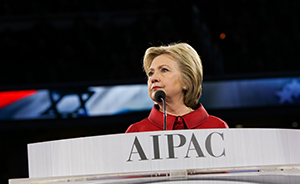
(Photo credit: AIPAC)
How would President Hillary Clinton respond? Would she put herself in the shoes of Russia’s leaders and search for some way to de-escalate or would she get high-and-mighty and escalate the crisis by activating NATO military forces to counter this “Russian aggression”?
Given what we know about Clinton’s tough-talking persona, the odds are good that she would opt for an escalation – and that could set the stage for nuclear war, possibly starting because the Russians would fear the imminence of a NATO first strike, made more possible by those ABM bases in Romania and Poland.
Clinton’s Non-Nuclear Wars
There are other areas in the world where a President Hillary Clinton would likely go to war albeit at a sub-nuclear level. During the campaign, she has made clear that she intends to invade Syria once she takes office, although she frames her invasions as humanitarian gestures, such as creating “safe zones” and “no-fly zones.”
In other words, although she condemns Russian “aggression,” she advocates aggressive war herself, seemingly incapable of recognizing her hypocrisies and only grudgingly acknowledging her “mistakes,” such as her support for the invasion of Iraq.
So, on Thursday, even as she made strong points about Trump’s mismatched temperament for becoming Commander-in-Chief, she flashed a harsh temperament of her own that also was unsettling, although in a different way.
Trump shoots from the lip and has a thin skin, while Clinton is tightly wound and also has a thin skin. Trump lets his emotions run wild while Clinton is excessively controlled. Trump engages in raucous give-and-take with his critics; Clinton tries to hide her decision-making (and emails) from her critics.
It’s hard to say which set of behaviors is more dangerous. One can imagine Trump having free-form or chaotic diplomatic encounters with allies and adversaries alike, while Clinton would plot and scheme, insisting on cooperation from allies and demanding capitulation from adversaries.
Clinton sprinkled her speech denouncing Trump with gratuitous insults aimed at Putin and undiplomatic slaps at Russia, such as, “If Donald gets his way, they’ll be celebrating in the Kremlin. We cannot let that happen.”
In short, there is reason to fear the election of either of these candidates, one because of his unpredictability and the other because of her rigidity. How, one might wonder, did the two major political parties reach this juncture, putting two arguably unfit personalities within reach of the nuclear codes?
[For more on this topic, see Consortiumnews.com’s “Yes, Hillary Clinton Is a Neocon” and “Would a Clinton Win Mean More Wars?’]
Investigative reporter Robert Parry broke many of the Iran-Contra stories for The Associated Press and Newsweek in the 1980s. You can buy his latest book, America’s Stolen Narrative, either in print here or as an e-book (from Amazon and barnesandnoble.com).
Libya: How to Bring Down a Nation
By Patrick Howlett-Martin | CounterPunch | May 31, 2016
More than 30,000 Libyans died during seven months of bombing by an essentially tripartite force – France, Great Britain, United States – which clearly favored the rebels. “The most successful mission in NATO’s history”, in the imprudent words of NATO Secretary General, Anders Fogh Rasmussen, a Dane, in Tripoli in October 2011[1].
French president Nicolas Sarkozy’s eagerness to support a military intervention with the purported aim of protecting the civilian population contrasts with the reception offered to the Libyan president, Muammar Gaddafi, when he visited Paris in December 2007 and signed major military agreements worth some 4.5 billion euros along with cooperation agreements for the development of nuclear energy for peacetime uses. The contracts that Libya seemed no longer willing to pursue focused on 14 Dassault Rafale multirole fighter jets and their armament (the same model that France sold or is trying to sold to Egypt´s General Abdel Fattah al-Sisi, the self-proclaimed marshal), 35 Eurocopter helicopters, six patrol boats, a hundred armored vehicles, and the overhaul of 17 Mirage F1 fighters sold by Dassault Aviation in the 1970s[2].
The major oil companies (Occidental Petroleum, State Oil, Petro-Canada…) working in Libya helped Libya pay the 1.5 billion dollars in compensation that the Libyan regime had agreed to pay to the families of the victims of Pan Am flight 103[3]. At the time, the compensation was intended to be one of the conditions for Libya to be reaccepted into the community of international relations.
The principal Libyan investment funds (LAFICO-Libyan Arab Foreign Investment Company; LIA-Libyan Investment Authority) were shareholders in many Italian and British corporations (Fiat, UniCredit, Juventus, the Pearson Group, owner of the Financial Times, and the London School of Economics, where Gaddafi was addressed as “Brother Leader” during a video conference in December 2010 and his son Saif was awarded a PhD in 2008). The New York investment bank Goldman Sachs was sued in 2014 by a Libyan fund (Libyan Investment Authority) which had lost more than 1.2 billion dollars between January and April 2008 after the American firm took a commission of 350 million dollars for investing their money in highly speculative derivatives[4].
Muammar Gaddafi had been received with full honors by the major powers some months earlier: in addition to the reception in grand style in Paris, where he was a guest for five days in 2007, he was received in Spain in December 2007, in Moscow in October 2008, and in Rome in August 2010, two years after accepting the Italian gift of 5 billion dollars as compensation for the Italian occupation of Libya from 1913 to 1943. And also of note are the five trips to Tripoli in three years by former British Prime Minister Tony Blair, a paid senior advisor to the investment bank JPMorgan Chase[5]. Former French president Nicolas Sarkozy was received in Tripoli in July 2007, where he announced the beginning of a partnership for the installation of a nuclear power plant in Libya. The European Union was ready to facilitate access to the European market for Libyan agricultural exports[6]. Libya was invited by the NATO Chiefs of Defense to the Maritime Commanders’ Meeting (MARCOMET) in Toulon on May 25-28, 2008.
A policy that recalls the one towards the Iraqi leader, Saddam Hussein. The Iraqi leader was invited to Paris in June 1972 and September 1975; an agreement was signed in June 1977 for the sale to Baghdad of 32 Mirage F1 combat aircraft. A coincidence that didn’t do either of them any good in the long run.
Arab military leaders (veterans of Afghanistan and members of the Libyan Islamic Fighting Group, with ties to Al-Qaeda) helped overthrow Gaddafi. One of the principal military leaders of the rebellion, Abdel Hakim Belhadj (a.k.a. Abu Abdullah al-Sadik), then Tripoli Security Chief and today the main leader of the conservative Islamist al-Watan Party had been arrested in Bangkok in 2004, tortured by CIA agents, and delivered to Gaddafi’s Abu Salim prison. He is now the main ISIL leader in Lybia. Jaballah Matar was kidnapped from his home in Cairo by the CIA in 1990 and then handed over to Libyan officials[7] Documents seized after the death of Gaddafi reveal close cooperation between Libyan, American (CIA), and British (MI6) intelligence services[8].
Under Gaddafi, Islamic terrorism was virtually non-existent. Prior to the U.S. led bombing campaign in 2011, Libya had the highest Human Development Index, the lowest infant mortality and the highest life expectancy in all Africa. Today Lybia is a wrecked state.
In January 2012, three months after the end of hostilities, the United Nations High Commissioner for Human Rights, Navi Pillay, reported the widespread use of torture, summary executions, and rape in Libyan prisons. At the same time, the organization Doctors Without Borders decided to withdraw from the prisons in Misrata because of the ongoing torture of detainees[9].
The NATO intervention in Libya, involving most member countries under a humanitarian pretext, set an unfortunate precedent for efforts to resolve the Syrian crisis: the attack by French and British warplanes on the Warfallah tribe, who remained faithful to Muammar Gaddafi, and on the convoy carrying the Libyan leader and one of his sons, leading directly to Gaddafi’s death under deplorable circumstances. The images by videographer Ali Algadi and journalist Tracey Sheldon provide a graphic account of the Libyan leader being dragged from a drain pipe on October 20, 2011 and killed shortly thereafter. These circumstances belie the pseudo-humanitarian nature of the military intervention and tarnish the image of the “Libyan Spring”[10].
The death of U.S. Ambassador to Libya, J. Christopher Stevens and one of his aides in a fire set in the U.S. Consulate in Benghazi in September 2012, revealing the breadth of CIA activities, in which the Consulate served as a façade. The recruitment by the CIA on its Benghazi base[11] of combatants from the city of Derna for the conflict in Syria, fief of the Islamists (Al-Bittar brigade), against President Bashar al-Assad, has inescapable parallels with the recruitment in 1979, again by the CIA, of the mujahedeen against the Soviet Union in Afghanistan, with all the consequences that we are well familiar with, and particularly the birth of Sunni jihadism.
The car bomb attack on the French Embassy in Tripoli in April 2013; the escape of 1,200 detainees from the Benghazi prison; the murder of the human rights lawyer Abdel Salam al-Mismari in July; and the attack on the Swedish Consulate in Benghazi in October 2013 all highlighted the inability of the authorities to gain control over the security situation in Libya as it was overrun by heavily armed militias. In July 2013, Libyan Prime Minister Ali Zeidan threatened to bomb Libyan ports in the Benghazi region that were in the hands of militias who were profiting by exporting the oil now under their control. In October, the Prime Minister was kidnapped by 150 armed men in the center of Tripoli and held for six hours to protest the abduction on Libyan soil of Abu Anas al-Libi in a secret American airport operation. Al-Libi was accused of being one of the leaders of Al-Qaeda and later died while in custody in the United States.
The year 2015 began with Libya bereft of all institutions. It is ruled by a motley group of coalitions vying for power, based in Tripoli (Farj Libya, which controls the central bank), Benghazi (Shura Council, consisting of Ansar al-Sharia, facing off against the Libyan National Army of the renegade general Khalifa Hiftar), and in Tobruk-Bayda (offshoot of the National Transition Council, enjoying international diplomatic recognition after the June 2013 elections).
The security and health situation for the civil population is near disastrous. When I visited the country in 1994 it was a model for public health and education, and boasted the highest per capita income in Africa. It was clearly the most advanced of all Arab countries in terms of the legal status of women and families in Libyan society (half of the students at the university of Tripoli were women). The aggression against the presenter Sarah Al-Massalati in 2012, the poet Aicha Almagrabi in February 2013, and the women’s rights activist Magdalene Ubaida, now in exile in London, bear grim testimony to their legal status in post-Gaddafi Libya. The city of Benghazi is now semi-destroyed; schools and universities are mostly closed[12].
It is the theatre of fratricidal clashes between rival factions financed and armed by a series of sorcerer’s apprentices A general who has been stationed in the United States for 27 years commands a motley coalition with military backing from Egypt, the United Arab Emirates and Saudi Arabia while Islamist groups claiming allegiance to ISIL and well entrenched in Sirte and Derna are able to spread their influence thanks to the institutional crisis. and, Qatar, Turkey, and Sudan supporting Farj Libya on the other.
Gaddafi, leader of the Libyan revolution, the Jamahiriya, in power from 1969 to 2011, gave a warning to Europe in an interview with French journalist Laurent Valdiguié of the Journal du Dimanche on the eve of the NATO intervention, in words that now seem prophetic:
“If one seeks to destabilize [Libya], there will be chaos, Bin Laden, armed factions. That is what will happen. You will have immigration, thousands of people will invade Europe from Libya. And there will no longer be anyone to stop them. Bin Laden will base himself in North Africa […]. You will have Bin Laden at your doorstep. This catastrophe will extend out of Pakistan and Afghanistan and reach all the way to North Africa”[13].
Libya has become a hub for illegal trafficking, particularly of African emigrants under conditions reminiscent of the slave trade. According to Global Initiative Against Transnational Organized Crime, the refugee smuggling market in Libya was worth 323 million dollars in 2014. In the first five months of 2015, more than 50,000 undocumented immigrants have reached Italy from sub-Saharan Africa via Libya; 1,791 of them lost their lives at sea[14]. Prior to the initiation of hostilities, 1.5 million sub-Saharan Africans worked in Libya in generally menial jobs (oil industry, agriculture, services, public sector). Darker days at sea are still to come.
Notes.
[1] “NATO chief Rasmussen ‘proud’ as Libya mission ends”, BBC News, October 31, 2011.
[2]. Agence France Presse, December 11, 2007.
[3]. International Herald Tribune, March 24, 2011.
[4] Jeremy Anderson, “Goldman to reveal income linked to Libyan lawsuit”, International New York Times, November 25, 2014.
[5]. The Telegraph, March 23, 2012.
[6]. O´Globo, July 26, 2007.
[7] Souad Mekhennet, Eric Schmitt, “Libyan rebels seek to shed El Qaeda past”, International Herald Tribune, July 19, 2011.
[8]. Rod Nordland, “Files note close CIA ties with Qaddafi spy unit”, International Herald Tribune, September 5, 2011.
[9]. International Herald Tribune, January 28-29, 2012.
[10]. Borzou Daragahi, “Call for probe into Libyan Civilian Deaths”, Financial Times, May 14, 2012.
[11] Seymour Hersh, “U.S. Effort to Arm Jihadis in Syria. The Scandal Behind the Benghazi Undercover CIA Facility”, Global Research, Washington’s Blog, April 15, 2014.
[12] Abdel Sharif Kouddous, “Report from the Front: Libya’s Descent Into Chaos”, The Nation, February 25, 2015.
[13] Journal du Dimanche, March 5, 2011 (www.lejdd.fr)
[14] Source: International Organization for Migration and the European Commission.
Patrick Howlett-Martin is a career diplomat living in Paris.
Fake “Humanitarians” and Fake “Leftists” taking Canada down the wrong path

Special Envoy of the UNHCR addresses the Security Council meeting on the continuing conflict in Syria. Credit: UN Photo/ Mark Garten/ flickr
By Mark Taliano | American Herald Tribune | May 30, 2016
There’s really no excuse for supporting the NATO/terror position. We’ve seen the destruction of Iraq, Libya, Ukraine, now Syria, all built on lies, all beneath the guise of “humanitarian interventions”. Since people with any sense of historical memory can not legitimately plead ignorance, supporters of the terrorist invasion of Syria fall into the category of “fake humanitarians”. They aren’t “progressive” or “left” when they support the criminal violation of Syria’s sovereignty and territorial integrity.
Canadian peace activist Ken Stone, recently returned from Syria, expresses similar sentiments in his newly released book, Defiant Syria|dispatches from the Second Tour of Peace to Syria. He explains,
“The point for me is to ask why otherwise intelligent people can fall for such shit (referring to a 2015 New Internationalist magazine article: “The forgotten revolution of Syria”), and not once but repeatedly. It’s not as if Syria is the very first government targeted for regime change by the USA. It’s not that people are unaware of the fact that the first casualty of war is the truth … there is never a shortage of “leftists” in the West who can be either bought or convinced through incredible naivété, warped political outlook, or Eurocentric arrogance, that the motives of Empire are good.”
People such as Ken, who have visited Syria and have seen with their own eyes the devastation wrought by Western-supported terrorists against civilization, have less tolerance for the lies, the propaganda and the “fake humanitarians” who enable it all.
Stone doesn’t mince words when he describes some of his on-the-ground observations of Homs, Syria; observations fortified by his historical memory of NATO’s imperial destruction elsewhere:
To their detriment, the fake “humanitarians” and pseudo “leftists” are shielded from such on-the-ground realities.
In a later chapter, “Palmyra: Bride Of The Desert”, Stone also bemoans the self-proclaimed “leftists” who cast the Russians as “imperialists” and as guilty as the West in the war against Syria – conveniently forgetting that Russia is legally in Syria, while NATO is not:
“It’s true,” he writes, “that Russia is unfortunately no longer a socialist country. However, it doesn’t act like an imperialist country either. Mr. Putin consistently respects the sovereignty of other countries, such as Syria, and speaks up at the United Nations for the observance of international law, which the USA, priding itself as “the exceptional country” and the “sole indispensable country”, tramples on almost every day.”
This resonates with the author’s earlier piece, “Western Hegemony vs Russian Sanity”, and the “Saker’s” observations of the differences between the “Anglo-Zionist Unipolar Imperial Model” and the “Russian Multi-polar Model”.
Sustainable evidence demonstrates, for example, that the current Russian multi-polar model respects the rule of international law, ideological and cultural pluralism, and the use of military force as a last resort.
The illegal Western war of aggression against Syria, on the other hand, is consistent with the “Anglo-Zionist Unipolar Imperial Model” which defies the rule of international law, negates ideological and cultural pluralism, and uses military violence as a first resort.
The West’s invasion contradicts the rule of international law: Russia is in Syria legally, whereas the West is not; it negates Syria’s ideological and cultural pluralism and seeks to replace it with a Wahhabist stooge government or an assortment of stooge governments in balkanized states; and it demonstrates the West’s propensity to use military violence as a first resort – the invasion, after all, was planned well in advance.
Given the fact of the West’s criminality, consistent with the “Anglo-Zionist Unipolar Imperialist Model”, and the concurrent failures of the “fake humanitarians” and the fake “left” to reconcile themselves to evidence-based findings and historical memory, Stone reiterates some concrete steps that should be taken by those of us who support foreign policy trajectories consistent with peace and the rule of international law, rather than the current reality of war and barbarism.
Important steps would include normalizing diplomatic relations with Syria, ending illegal sanctions, withdrawing from all criminal military interventions against Syria, and withdrawing from NATO.
Canada needs to assert an independent foreign policy, and it needs to reject the current barbarity implicit in its status as a vassal appendage of the Anglo-Zionist Unipolar Imperial Model. This is what Real Change would look like.
Mark is a retired high school teacher.
Featured Video
New positive ivermectin evidence
or go to
Aletho News Archives – Video-Images
From the Archives
Secret document reveals plans for civil war in Lebanon, Israeli false flags, and invasion
By Randi Nord | Geopolitics Alert | April 5, 2019
Beirut – During his visit with US Secretary of State, Mike Pompeo, Lebanese President Michael Aoun reportedly received a US-Israeli document detailing plans for creating a civil war in Lebanon with covert false flag operations and possible Israeli invasion.
Although the source of the document is Israeli and created in partnership with Washington, no one knows who presented it to Aoun. The Lebanese TV station, Al-Jadeed, initially reported the document on Lebanese TV and a video on its website. Geopolitics Alert translated the report for this article. … continue
Blog Roll
 Aletho News
- EU Council Advances Chat Control 2.0 Scanning Proposal
- Ex-Greek MEP files complaint against Israeli spyware firm over alleged Pegasus surveillance
- Troubling ideas throughout the Torah, Talmud, Mishneh Torah and Tanya
- ‘Grave, alarming’: Iran mission on Trump’s UNGA ‘annihilation’ threats
- Najaf airport to reopen to Iranian flights within 24 hours: Ambassador
- From ‘How Will This End For Iran’ to ‘When America Walks Away’: A tale of two Economist covers
- Tehran blasts ‘baseless’ speculation linking Iran to alleged bomb plot at UK air base
- The Rise And… Rise Of ‘Color Revolutions’
- The Coming GOP Bloodbath?
- Arctic Scare Stories Melt Away
- If Americans Knew
- Netanyahu Asked UAE Leader to Deny Report on Oct. 7 Warning in Secret Visit, Sources Say
- CNN Chief Int’l Correspondent Clarissa Ward on Journalists in Gaza
- Democratic Party Consultants Surround Troy Jackson with Pro-Israel Donors
- Christian Leader Responds To Netanyahu’s Claims Regarding Palestinian Christians
- In Gaza, ‘Whoever Survives the Bombing Won’t Survive the Rubble’
- Israel kills more Palestinians, amid push to resettle Gaza – Daily Update
- Israel forces Gazans to live in constant peril – Daily Update
- Deconstructing Netanyahu’s pants-on-fire UN rant – Daily Update
- Trump betrayed voters with his campaign lies and prioritized a foreign country once he took office
- Netanyahu calls Israel’s war in Gaza ‘opposite of genocide’ in UN speech to near-empty hall
- No Tricks Zone
- New Study: Earth And Venus Surface Warmth Largely Explained By Convection And Lapse Rate, Not CO2 Or Radiation
- 2025 Nature Paper Claiming Worsening Global Drought Gets RETRACTED …Heavily Flawed
- New Study: ‘Global Drought Shows No Detectable Recent Acceleration Under Climate Warming’
- Economic Masterminds: German Socialists Suggest Taxing Productivity Gains Stemming From Using AI
- The South China Sea Has Not Been Cooperating With The Climate Change Narrative
- Energy Crisis: Germany Enters Heating Season With Historically Low Gas Reserve Fill Levels
- New Study: The Antarctic Ice Sheet Gained Mass From 2020-2024 Due To Staggering Snow And Ice Accumulation
- Study: Ocean Heating Rates From Thousands Of Years Ago ‘Dwarf’ Modern Ocean Heating Rates
- Climate Extremists Target, Attack Large-Scale Power Grid Infrastructure In Germany!
- New Study: Antarctic Ice Melt Has Contributed Less Than 1 Centimeter To Sea Level Rise In The Last 30 Years

