How Hillary Clinton Lied Her Way to War in Libya
teleSUR | March 18, 2016
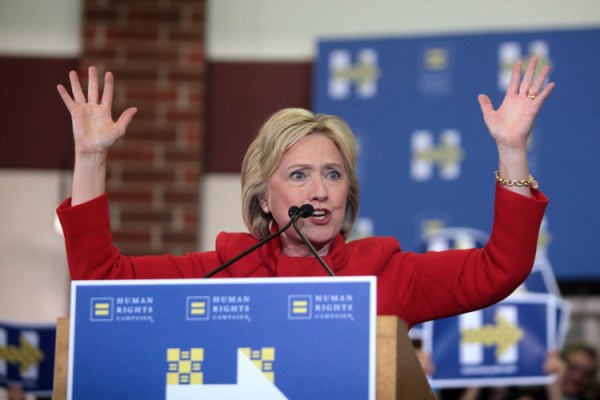
Declassified emails released in January and February reveal that Hillary Clinton was one of the main instruments in spreading chaos and extremism in Libya when the U.S. secretary of state personally pushed for the ousting of late Libyan leader Muammar Gadhafi.
Clinton’s emails reveal that she and her staff were aware that civilians they claimed to be protecting were not actually in danger from government forces.
Less than a month ahead of the passage of U.N. Security Council Resolution 1973, a resolution which authorized a no-fly zone to protect civilians on March 17, 2011, Hillary’s assistant, Huma Abedin, in an email dated Feb. 21, 2011, stated: “Based on numerous eyewitness reports, it is the Embassy’s assessment that the government no longer controls Benghazi. This is likely the case for Ajdabiyah as well.”
Abedin went on to write that sources in Benghazi reported that Libyan Interior Minister Abdul Fattah Younes had “changed sides” and was “now with the protesters in Benghazi.” The mood in Benghazi and Ajdabiyah, according to the email, was “celebratory” and all posters of Gadhafi had been “knocked down.”
Crucially, this email was written at a time when Clinton was aware that no government crackdown was taking place in either Benghazi or Ajdabiyah.
This was despite anti-government protests kicking off in Benghazi and Ajdabiyah a few days before, at a time when the U.S. and France and other Western governments were claiming government forces were involved in the mass-killing of protesters and civilians.
However, on March 2, 2011, a few days before the passage of the U.N. resolution, U.S. State Department official Harriet Spanos sent an email informing Clinton that “Security Reports . . . confirm that Benghazi has been calm over the past couple of days.”
“Economic activity is going on in Benghazi,” she added in the email, with shops and banks open and “[m]obile and landline phones… working… and Internet has returned.”
The moment of truth came 11 days into the NATO bombing, which continued for several months, when Clinton’s top adviser, Sidney Blumenthal, who was not employed by the state department but by the private Clinton Foundation, laid out the reasons for the Washington-led intervention and the eventual ousting of Gadhafi.
Without once mentioning “humanitarian” purposes, in a March 27, 2011 email Blumenthal stressed to Clinton the importance of pressing for a “final win” by ousting Gadhafi in order to boost U.S. President Barack Obama’s then low approval ratings.
Ousting the Libyan strongman, argued Blumenthal, would further establish “security in North Africa, securing democracy in Egypt and Tunisia, economic development, effect throughout Arab world and Africa, extending U.S. influence, counter-balancing Iran, etc.”
Further highlighting his complete and utter disregard for the human cost of the intervention, in the same email Blumenthal informed Clinton about the horrors committed by U.S.-backed forces in Libya, which included members of al-Qaida.
“Speaking in strict confidence, one rebel commander stated that his troops continue to summarily execute all foreign mercenaries in the fighting.” Such actions are considered war crimes and in violation of international resolutions and conventions.
The emails also reveal that the Obama administration and Clinton were aware of the threat of al-Qaida in the eastern part of the country, which had for years been suppressed by the Libyan leader.
The emails also show that claims made by NATO at the time, including alleged atrocities committed by Gadhafi’s forces such as rape and mass killings, were rumors used by Clinton and the Obama administration to help sell the intervention to the world.
It is clear the NATO intervention was not intended for humanitarian purposes. So what were the intentions of Clinton and the Obama administration? [Beyond the long planned and ongoing destruction of any and all enemies of Israel*] The same as most U.S. interventions: financial interest.
The emails reveal that most of the intelligence Clinton received on Libya was from Blumenthal, who was preparing to make substantial financial gains from the fall of the Libyan leader.
According to Vice News, the intel briefs on Libya were “prepared by Blumenthal’s business partner and former CIA operative Tyler Drumheller, a consultant with plans to take advantage of economic opportunities in a post-war Libya.”
Both men worked with the U.S.-based security company Osprey, a start-up that hoped to profit from medical and military contracts with Libyan rebels amid the chaos of the conflict, according to Vice News.
Five years later, the opportunism of Clinton and the Obama administration which resulted in one of the most disastrous interventions in recent decades, aiding the rise of extremist groups in the oil-rich African country and contributing to Europe’s ongoing refugee situation can be seen for what it was: a devastating assault on the people of Libya rooted in lies, deceit and narrow, imperial self-interest.
*Also in the cited Vice article but not presented by teleSUR:
… Much of the intelligence Blumenthal fed to Clinton was quite odd. One email suggested that Libyan elites wanted warm relations with Israel, another that European spy agencies were encouraging tribal leaders to declare a semi-autonomous tribal zone in the east of the country. […]
On Aug. 27, 2012, for instance, Blumenthal’s intelligence claimed that a new Libyan president would “seek a discreet relationship with Israel.” Then, Clinton forwarded on the e-mail to her top policy aide Jacob Sullivan with a note attached: “If true, this is encouraging. Should consider passing to Israelis.”
Pentagon Drops the Ball Over Open Skies Treaty With Russia
Sputnik – 16.03.2016
US officials want Washington to deny Russia the right to observe strategic infrastructure facilities in the US from the air under the Open Skies Treaty.
At the center of their concerns is a new sensor suit installed on Tu-214OS, a special-purpose reconnaissance aircraft, used for such flights.
Some Congress and Pentagon representatives have already voiced concerns that Russia might use these flights to spy on American power plants, communications networks and other critical infrastructure.
“I cannot see why the United States would allow Russia to fly a surveillance plane with an advanced sensor over the United States to collect intelligence,” The New York Times quoted Representative Mac Thornberry, a Texas Republican who heads the House Armed Services Committee, as saying in a statement earlier in February.
His concerns are echoed by US Strategic Command (STRATCOM) Commander Adm. Cecil Haney:
“The treaty has become a critical component of Russia’s intelligence collection capability directed at the United States.” Defense One, the US defense and national security website, quotes him as saying.
“The Open Skies construct was designed for a different era…I’m very concerned about how it’s applied today,” adds Defense Intelligence Agency (DIA) Director Lt. Gen. Vincent Stewart.
Defense One, however has an answer to their concerns.
When the Treaty was first negotiated, the states involved all approved the use of panoramic and framing cameras using film, video cameras, infra-red line-scanning devices and sideways-looking synthetic aperture radar – all far less capable than what was then available to intelligence agencies, it explains.
The maximum ground resolution acceptable with treaty-approved cameras is 30 centimeters. Today, anyone can buy commercial satellite imagery with a resolution of 25 centimeters, it adds.
Russia recently requested to switch from wet-film cameras to digital sensors for its surveillance flights over the US.
The website says that the Treaty has provisions to upgrade and modernize sensors. Film has long ago given way to digital imagery. Treaty members have agreed to allow a digital electro-optical sensor package upgrade, but not to allow Open Skies flights to operate so that higher resolution can be obtained.
So why doesn’t the US military add its own digital sensors, questions the website?
“Because the Pentagon dropped the ball,” it explains.
“A policy directive to proceed with the upgrade was issued in 2012, but the Defense Department didn’t issue a request for proposal until 2015, and still hasn’t chosen a contractor. The issue isn’t money – perhaps $45 million. The problem is that Open Skies flights are a very low priority for the Pentagon.”
“At a time when the Pentagon is embarked on a new $3 billion initiative to reassure European friends and allies worried about Russian belligerence, it makes sense to speed up equipping the US Open Skies plane with digital imaging capabilities, rather than to complain about the disadvantages of mutual transparency,” it furthermore states.
Russia has for years conducted unarmed observation flights over the United States, just as the United States does over Russia, as part of the Open Skies Treaty, which was signed in 1992 by both nations as well as 32 other countries at the end of the Cold War, and entered into force a decade later.
Although the treaty and the flights, unfamiliar to most Americans, amount to officially sanctioned spying, their goal has been to foster transparency about military activity and to reduce the risk of war and miscalculation, especially in Europe.
“Amid last year’s rising tensions, the US Open Skies aircraft carried out twice as many overflights as its Russian counterpart,” Defense One says.
“US flights have strengthened ties between NATO members and have reassured non-NATO states around Russia’s periphery. Under the Treaty’s “ride-sharing” provision, US flights over Russia in 2015 carried crew members from Ukraine, Canada, France, Germany, the Czech Republic, Great Britain, Turkey, Italy and Romania.”
“Moreover, complaints about the new Russian advantage under Open Skies may be overblown and are certainly misdirected. The Kremlin isn’t the culprit in this case; the Pentagon is,” it says.
Russian officials confirmed the plans to equip surveillance planes with digital hardware but cited the obsolescence of wet-film equipment as a major reason behind the decision.
“We are switching to digital equipment because nearly nobody produces wet-film equipment any longer,’ said Mikhail Ulyanov, director of the Foreign Ministry Department for Non-Proliferation and Arms Control, in an interview to RBTH.
It also eliminates photochemical processes, allowing an operator onboard to observe terrain in real time, according to Vartan Shakhgedanov, chief design engineer of the new Russian system.
The system, specifically designed for Open Skies flights, includes two Tu-214ON planes produced by the Vega Radio Engineering Corporation (Vega) and the United Instrument Manufacturing Corporation (UIMC), two bodies within the Russian state corporation Rostec.
However, if Russia successfully upgrades its surveillance equipment, the US risks losing its advantage in what has so far been a relatively safe way to obtain strategic intelligence.
The new equipment meets criteria for film resolution set by the Open Skies Treaty, but is less clunky than its predecessor.
Rose Eilene Gottemoeller, the Under Secretary of State for Arms Control and International Security for the US State Department sought to temper concerns about Russian overflights, saying that what Moscow gains from the observation flights is “incremental” to what they collect through other means.
“One of the advantages of the Open Skies Treaty is that information — imagery — that is taken is shared openly among all the treaty parties,” she said at a joint hearing of the House Foreign Affairs and Armed Services committees back in December.
“So one of the advantages with the Open Skies Treaty is that we know exactly what the Russians are imaging, because they must share the imagery with us.”
US Foreign Policy Gurus Say Souring Relations with Russia Was Washington’s Fault

By Andrei AKULOV – Strategic Culture Foundation – 13.03.2016
It was quite different in the 1990s — early 2000s. Significant improvements were achieved in the relations between the US and Russia, including in the sphere of military cooperation. Those days there was no doubt the Russia-US relationship had a great future.
The military met each other as friends and allies to discuss what could be done to boost cooperation and prepare for joint actions to counter terrorist threats. Then the process got stalled. The relations deteriorated. All the efforts applied went down the drain. What really caused it to happen? Today US foreign policy old timers and savvies have something to say about it.
Consistent disregard for Russia’s interests by the US, as well as Washington’s dismissive attitude towards Moscow in the post-Cold War era, have led to strained relations between the two, former US Defense Secretary William Perry told The Guardian on March 9.
Perry said that a complete lack of regard for Russia as a power or a dialogue partner from Washington officials played a crucial role in this reversal.
According to the opinion of former US Defense Chief, reckless expanding NATO, making plans to deploy a missile defense system in Eastern Europe, and supporting the so-called «color revolutions» in former Soviet republics were all steps in the wrong direction, which were all taken without ever even considering Russia’s concerns.
Perry also denounced the George W. Bush administration’s decision to station a US missile defense system in eastern European countries – particularly in Poland. He also emphasized that the US support of the so called «color revolutions», was another serious blow to bilateral relations between Moscow and Washington.
Jack F. Matlock Jr., ambassador to the USSR from 1987 to 1991 and the author of the book titled Reagan and Gorbachev: How the Cold War Ended, has his own views on the matter.
According to him, after the USSR ceased to exist the United States insisted on treating Russia as the loser. The former ambassador writes that Russian President Vladimir Putin was the first foreign leader to call and offer support when terrorists attacked the United States on Sept. 11, 2001. He cooperated with the United States when it invaded Afghanistan, and he voluntarily removed Russian bases from Cuba and Cam Ranh Bay in Vietnam. In return, he got further expansion of NATO in the Baltics and the Balkans, and plans for American bases there; withdrawal from the Anti-Ballistic Missile Treaty; invasion of Iraq without UN Security Council approval; overt participation in the «color revolutions» in Ukraine, Georgia and Kyrgyzstan; and then, probing some of the firmest red lines any Russian leader would draw, talk of taking Georgia and Ukraine into NATO.
Speaking at the meeting of the Committee for the Republic, an organization established by former diplomats and government officials, Mr Matlock went on to lambaste Obama for using the State of the Union to personally attack Russian President Putin.
«His comments were totally out of place», Matlock said. He also attacked Congress for their own interference in passing the Magnitsky Act. «The Russians are reacting to a policy of insufferable arrogance and humiliation», he said. He criticized the whole policy with regard to Ukraine and «regime change». «If you can think that you can solve all problems by removing a leader, you’re wrong. Didn’t we learn the lessons from Iraq?» asked the former ambassador.
Henry Kissinger is clearly still one of America’s foremost foreign policy gurus who served as National Security Advisor and later concurrently as United States Secretary of State in the administrations of presidents Richard Nixon and Gerald Ford. He believes that instead of trying to break Russia, America’s goal should be to «integrate» it into the international order taking Moscow’s interests into account.
According to the US foreign policy vet, that would begin with recognition of the realities of Russian power and interests, treating Russia like the great power that it is, and on that foundation exploring «whether their concerns can be reconciled with our necessities».
The opportunities to change the relationship for the better are here to stay.
On March 3, Russian Foreign Minister Sergey Lavrov stressed that a policy of confrontation with the West is not something that Moscow wants. «We are not seeking confrontation with the United States, or the European Union, or NATO. On the contrary, Russia is open to the widest possible cooperation with its Western partners. We continue to believe that the best way to ensure the interests of the peoples living in Europe is to form a common economic and humanitarian space from the Atlantic to the Pacific, so that the newly formed Eurasian Economic Union could be an integrating link between Europe and Asia Pacific», the Russian foreign policy chief wrote in an article.
US candidates in the presidential race (except Republican candidate Donald Trump), as well as many in the Obama administration, find the idea of trying to work with Russia appalling when they speak in public. There is a reason to believe they don’t entirely share that view, but at least that’s what they say. No matter who wins in November, a new president will have to shape new policy on Russia. He or she will have to make decisive choices. It presupposes immense responsibility. The Americans are normally reluctant to admit mistakes, but it’s important to understand what is the root of the problem. That’s when the opinion of foreign policy gurus stands one in good stead.
Russia to disarm world’s largest nuclear ballistic missile submarine
RT | March 11, 2016
In 2016 Russia is set to disarm the missile system of the Typhoon-class Arkhangelsk submarine, the largest in the world. The disarmament will be carried out in accordance with the New START agreement between Moscow and Washington.
Working in accordance with the New START treaty between Russia and US, the country’s leading Zvezdochka shipyard in the northern Russian city of Severodvinsk will disarm the missile system of the Arkhangelsk submarine, the shipyard’s press service told TASS news agency on Friday.
“We will remove the covers of the submarine’s missile launchers and seal them, thus making it impossible to use the vessel’s missile weapons,” the press service said. “We are not talking yet about dismantling the submarine itself. The tender for this procedure has not yet been announced.”
According to the data published by the Russian nuclear agency Rosatom, the sub’s disarmament is estimated to cost some 28 million rubles (about US$ 400,000).
The nuclear-powered ballistic missile submarine Arkhangelsk TK-17 was designed in 1987 under the Project 941 ‘Shark’ (or ‘Typhoon’ according to NATO classification). The project was aimed to equip the Soviet Navy with nuclear-powered ballistic missile submarines, and resulted in the creation of the largest class of submarines ever built – large enough to accommodate decent living facilities for the crew of 179 when submerged for months on end, and to stock an arsenal of 20 intercontinental ballistic missiles.
Three of the six Typhoon-class submarines built in the 1980s have already been dismantled at the shipyards in Severodvinsk. Of the three that remain, Arkhangelsk and Severstal are set to be dismantled. Dmitri Donskoi just recently underwent a modernization procedure and is now equipped to test the latest sea-based missile system Bulava.
The New START treaty (on Measures for the Further Reduction and Limitation of Strategic Offensive Arms), which was designed to reduce American and Russian nuclear stockpiles, came into force in 2011. It replaced the previous 1991 agreement, introducing lower ceilings for the numbers of warheads and delivery systems deployed.
Commenting on the progress made on the treaty’s fifth anniversary in February, US Secretary of State John Kerry complimented both sides on successful cooperation in the field.
“[New START treaty] continues to be an area of cooperation and continued dialogue between the United States and Russia. I share President Obama’s strong belief that our two countries, which ushered in the era of nuclear arms, have a special responsibility to lead the world beyond it,” he said in a statement.
However, the latest moves by the US – such as plans to upgrade 180 B61s strategic bombs stocked in European air bases to a modernized B61-12 version – have raised doubts whether the US adheres to the nuclear arms non-proliferation treaty (NPT).
Opponents of the program have argued that instead of scaling down atomic weapons stockpiles in accordance with the NPT, the overhaul is actually creating more states hosting modern nuclear weapons – a provocation that theoretically weakens Russia’s deterrent.
Moscow keeps the presence of American nuclear weapons in Europe in mind when shaping its own military policies as reflected in Russia’s newest military doctrine published in 2014, spokesperson for the Foreign Ministry Maria Zakharova told German television last year.
“The comprehensive analysis of the situation points to the threat posed by the increasing military capability of NATO and its endowment with global functions, which it performs in violation of the international law, as well as the encroachment of the military infrastructure of NATO members on the borders of the Russian Federation,” she said.
Read more:
Is the world ready for further reduction of nuclear weapons?
NATO eyes long-term breach of nuke non-proliferation treaty, Russia to respond – senior diplomat
Pentagon mulls more permanent troops in Europe – report
RT | March 7, 2016
The US military is reportedly considering plans for permanent deployment of “one or more” US Army brigade combat teams (BCT) to Europe, as the West continues to ramp up rhetoric over alleged Russian aggression.
The head of the US military’s European Command (EUCOM) and NATO’s supreme commander, Air Force General Philip Breedlove, was said to have discussed his proposals with senior Pentagon officials in Washington last week, according to a defense official familiar with the plans, the Military Times reported on Sunday.
“They are looking at ways to increase the permanent Army forces in Europe… They’re trying to figure out ‘how much do we need, and where would it come from?’”
If approved, the new deployment could involve thousands of US troops. An average American BCT is composed of between 3,000 and 5,000 personnel. The US Army had four brigades in Europe until 2012, when it decided to deactivate two of them. Recently, the Army has returned more than 200 vehicles, but those are prepositioned in warehouse and not attached to permanent combat units.
“We do not have, in my opinion, enough US forces permanently stationed forward … so I believe that the permanent forces forward need to be reviewed,” General Breedlove told reporters last Tuesday.
In February, Breedlove also told the US House Armed Services Committee that American troops were ready to defeat Russia in a European war. “To counter Russia, EUCOM, working with allies and partners, is deterring Russia now and preparing to fight and win if necessary,” Breedlove said.
The decision to add more troops to the ongoing massive build-up in Eastern Europe was backed up by the outcomes of a February report by the RAND Corporation, according to the Military Times. The analysis said that in a NATO-Russian armed conflict the Russian military would outperform the bloc and “reach the outskirts of Tallinn and Riga in 60 hours.”
Such a “rapid defeat,” the RAND’s paper urged, would “leave NATO with a limited number of options, all bad: a bloody counteroffensive, fraught with escalatory risk, to liberate the Baltics; to escalate itself …or to concede at least temporary defeat, with uncertain but predictably disastrous consequences for the alliance.”
There are approximately 67,000 US troops in Europe, while around 57,000 personnel are assigned to EUCOM. The United States has also pledged several thousand service members to the NRF, including a brigade combat team from the Texas-based 1st Cavalry Division, a hospital ship, air-to-air refueling tankers, and escort ships.
Under the so-called European Reassurance Initiative launched during an armed conflict in Ukraine, Washington drastically increased exercises and “rotational presence” across Eastern Europe, including “more persistent deployments” of the US Navy to the Black and Baltic seas.
Russia’s Defense Ministry has repeatedly denounced the statements by citing the connection between the “Russian threat” and discussions on the US military budget. “It is not a thing to be impressed by,” MoD spokesman Major General Igor Konashenkov told journalists in February.
“The reason is simple – the discussion of the military budget in Congress for the next year.”
He pointed out that the idea of a so-called Russian threat is not new. “One needs to remember that the ‘Russian threat’ has been the best-selling threat delivered by the Pentagon not only to Congress, but also to NATO partners since the middle of the previous century,” he said. “What would they do without us?”
Saudis, Turks Bid to Open Lebanon Front
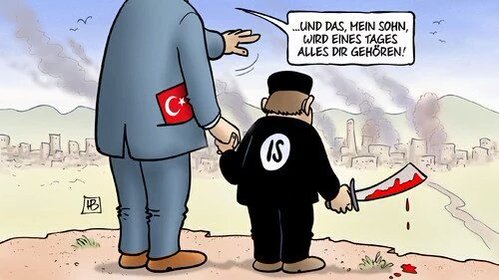
One day, my son, all this will be yours
By Finian CUNNINGHAM – Strategic Culture – 07.03.2016
With a series of blatant measures, Saudi Arabia and its regional allies are evidently trying to destabilize Lebanon. The development is apiece with how Saudi Arabia and Turkey have both sought to undermine the ceasefire in Syria and to escalate that conflict to a region-wide level.
A New York Times report this week poses a rather naive conundrum: «Diplomats and analysts have spent several weeks trying to understand why the Saudis would precipitously start penalizing Lebanon – and perhaps their own Lebanese allies – over the powerful influence of Hezbollah, which is nothing new».
Well, here’s a quick answer: Russia’s very effective squelching of the covert war for regime-change in Syria. That has sent Saudi Arabia and Turkey into a paroxysm of rage.
Russia’s military intervention in Syria to defend the Arab state from a foreign-backed covert war involving myriad terrorist proxy groups, has dealt a severe blow to the machinations of Washington, its NATO allies and regional client states.
While Washington and its Western partners seem resigned to pursue regime change by an alternative political track, Saudi Arabia and Turkey are stuck in the covert-war groove. They are betting that the terrorist proxy armies they have weaponized can somehow be salvaged from withering losses inflicted by Russian airpower in combination with the ground forces of the Syrian Arab Army, Iranian military advisors and the Lebanese Hezbollah militia.
Hence, the immediate breaches of the cessation called a week ago by Washington and Moscow in Syria. Turkish military shelling across the border into northern Syria is not just a breach. It is an outrageous provocation to Syrian sovereignty, as Moscow has pointed out.
Simultaneous Saudi military mobilization, including Turkish forces, on its northeast border with Iraq, as well as the reported deployment of Saudi fighter jets to Turkey’s Incirlik airbase opposite Syria’s northwest Latakia province can also be viewed as calculated moves to undermine the tentative ceasefire. The logical conclusion of this reckless aggression by both Saudi Arabia and Turkey is to precipitate a wider conflict, one which would draw in the US and Russia into open warfare.
The series of Saudi-led initiatives towards Lebanon should be interpreted in this context. In the past week, Saudi Arabia and its closely aligned Sunni monarchies in the Persian Gulf Cooperation Council (GCC) have declared Hezbollah a terrorist organization. The word «anachronistic» comes to mind, belying an ulterior motive.
The Saudi rulers, led by King Salman and his son Crown Prince Mohammad bin Salman, also announced that they were canceling plans to grant Lebanon $4 billion in aid. Most of the aid was to be in form of military grants, to be spent on upgrading the Lebanese national army with French weaponry and equipment.
Without providing any proof, the GCC states – Kuwait, Qatar, Bahrain, the United Arab Emirates and Oman in addition to Saudi Arabia – issued travel warnings to their nationals intending to visit Lebanon. The GCC also claimed that Hezbollah was interfering in their internal affairs and trying to recruit Gulf nationals into the organization to fight in Syria. The GCC has even threatened to deport Lebanese expatriate workers, some half a million of which work in the Gulf.
There were also regional media reports last week of a large cache of weapons having been seized by Greek authorities, stowed illicitly onboard a cargo ship sailing from Turkey to Lebanon.
The cumulative intent seems patent. The Saudis and their regional allies – who have been pushing for regime change for the past five years against the Russian, Iranian and Hezbollah-allied government of President Bashar al-Assad – see the escalation of regional instability as the best way to salvage their covert war in Syria.
Washington, London and Paris probably have sufficient cynical intelligence to realize that the covert war involving terrorist proxies is no longer a viable option – given the formidable forces arrayed in support of the Syrian state, not least Russian air power.
The Saudis and the Turkish regime of Recep Tayyip Erdogan appear to be inflexibly wedded to the covert war agenda. For these powers anything less than the outright removal of Assad would be seen as a grave blow to their despotic egos and, for them, an unbearable boost to their regional rival, Shia-dominated Iran.
The GCC criminalization of Shia-affiliated Hezbollah is obviously a fit of revenge-seeking given how the militia has ably helped the Syrian army retake major areas from the regime-change Sunni extremist insurgents, in conjunction with the Russian air strikes. The steady shutting down of border crossings in Latakia, Idlib and Aleppo has cut-off the terror brigades from their weapons supply routes via Turkey. This is partly why the Erdogan regime has responded by cross-border shelling in order to give re-supply efforts a modicum of artillery cover.
Moreover, the Saudi-led campaign to sanction Hezbollah is also aimed at destabilizing the sectarian fault lines inside Lebanon. Hezbollah may be denigrated by Washington and some other Western states as a «terrorist group» and of presiding over «a state within a state» due to its military wing which exists alongside the Lebanese national army.
Nevertheless, Hezbollah has constitutionally recognized legitimacy within Lebanon. This is partly due to the militia’s primary role in driving out the US-backed Israeli military occupation of the country in 2000 and again in 2006. For many Lebanese people, including Christians and Sunni Muslims, Hezbollah is held with pride as an honorable resistance force to US-led imperialism in the region.
The party – which Russia also recognizes as a legitimate national resistance movement – comprises about 10 per cent of the Lebanese parliament and holds two cabinet positions in the coalition Beirut government.
So the Saudi-led proposal to sanction Hezbollah seems nothing more than a gratuitous bid to open up sectarian fissures that have cleaved Lebanon in the recent past during its 1975-1990 civil war. The provocation of labeling a member of government in a foreign state as «terrorist» – seemingly out of the blue – has to be seen as a tendentious bid to destabilize. Hezbollah leader Hassan Nasrallah this week condemned the Saudi bid to inflame sedition in Lebanon, and it is hard to disagree with that assessment.
There are still pockets of extremist Sunni support within Lebanon that the Saudis and Turkey appear to be trying to incite. During the Syrian conflict, there have been sporadic outbreaks of violence in the cities of Sidon and Tripoli by Salafist elements with close links to Saudi Arabia and Turkey. Now those same elements are being incited to take to the streets again.
It is not clear if Lebanon can hold together. A government minister linked to a pro-Saudi faction has resigned in recent weeks over what he claims is «Hezbollah domination» in Lebanese politics.
Many Lebanese are discontented over social and economic problems dogging the country. A refuse-collection backlog over the past year has left large parts of the capital overflowing with putrid waste. The tiny country of four million is also feeling the strain of accommodating some one million Syrian refugees.
The thought of re-opening old wounds and re-igniting the horror of civil war is a heavy burden on most Lebanese citizens that may be enough to make them baulk at malign pressures.
But what can be said for sure is that the role of Turkey, Saudi Arabia and the other Arab monarchies is absolutely unconscionable and criminal. They seem fully prepared to plunge yet another neighboring country into a sectarian bloodbath in order to gratify their illicit regional ambitions.
US B-52s to perform ‘not normal’ exercises in Norway
RT | March 3, 2016
Three B-52 Stratofortress bombers that have moved from the US to Europe are set to participate in military exercises in Norway. A top US commander characterized the redeployment as “not normal.”
The move, which began last week with the bombers and 200 support airmen being stationed in Spain, is part of the Obama administration’s build-up of US forces in Europe in response to European countries’ anxiety over perceived Russian aggression.
However, US Air Force General Philip Breedlove said Tuesday that while the deployment of the B-52s was abnormal, the aircraft had been scheduled for NATO exercises and the move was not prompted by the actions of Russia, the Washington Post reported.
“It is a part of the exercise objectives… not a part of any response [to Russian actions],” Breedlove insisted, according to Sputnik.
The three bombers are assigned to the 2nd Bomb Wing and were rebased from Barksdale Air Force Base, Louisiana on Friday, and will temporarily stay at Spain’s Morón Air Base.
“Strategic bomber deployments enhance the readiness and training vital to rapidly projecting global power and responding to any potential crisis or challenge,” Admiral Cecil D. Haney, the commander of US Strategic Command, said in a statement.
The bombers provide a unique complement to the nuclear delivery capabilities of intercontinental ballistic missiles and ballistic missile submarines, Haney added.
The Norwegian exercise, called Cold Response, is meant to practice “high-intensity operations in winter conditions,” according to the Pentagon. More than a dozen NATO countries will participate in the rehearsal that is meant to underscore NATO’s ability “to defend against any threat in any environment.”
In February, Secretary of Defense Ashton Carter announced that US military spending on Europe would be more than quadrupled from $689 million in 2016 to $3.4 billion in 2017.
US defense establishment believes Putin must be ‘defeated’
By Bryan MacDonald | RT | March 3, 2016

Russian President Vladimir Putin. © Alexei Druzhinin / Sputnik
Certain people in America’s defense establishment believe that only governments that do Washington’s bidding are “truly legitimate.” Others have ideological reasons to stir up tensions with Russia. This fuels discord and creates an unstable world.
Imagine if a major Russian media outlet carried an article with the headline, “How We Can Defeat Obama.” It’s pretty certain that within minutes various pro-NATO analysts would be all over Twitter labeling it as “hybrid warfare,”“Russian aggression” or even, heaven forbid, “hot war.” Or whatever this month’s agreed catchphrase is.
Let’s take it a step further. Ponder what would happen if the same pundits then realized the author was a recently redundant Russian Defense Department official. Without any doubt, the concern-o-meter would reach the stratosphere. Soon, the topic would be trending on Neocon Twitter. Neocon Twitter, by the way, is different than normal Twitter. In this version, all dissenting voices are blocked.
Last week, Newsweek published Evelyn Farkas, the former US Deputy Assistant Secretary of Defense for Russia/Ukraine/Eurasia (who vacated the post only last October). In her incredibly aggressive op-ed, Farkas explained “How We Can Defeat Putin.” The same Putin who is the popularly elected President of Russia. The world’s second strongest military power.
Farkas is now an employee of the pro-NATO Atlantic Council, which the formerly venerable Newsweek appears to have partnered with. The Atlantic Council is funded by the US State Department, the US Army, the US Air Force, the UAE & Bahraini governments and various other vested interests. None of them are particularly supportive of Russia. On the other hand, most would directly benefit from increased NATO spending.
Throwing Money At NATO
How does Farkas propose “defeating” Putin? By spending more money on NATO, of course. Also, she suggests sending more weapons to Ukraine, Georgia and Moldova. Of course, it was American meddling in the first two that created the current tensions. The latter country is currently enduring a political crisis and mass protests. This is ignored in the western media, because the corrupt incumbent regime is pro-Washington.
Farkas suggests arming the Syrian opposition, the loose coalition that includes the Al-Nusra front, which is part of Al Qaeda, the same folks who attacked New York on September 11, 2001. Not to mention, that such a course of action would destroy the nascent ceasefire in that unfortunate country.
Reading between the lines, Farkas is essentially suggesting that Washington use Ukraine, Moldova, Georgia (and anti-Assad forces in Syria) as pawns against Russia. With no concern for the economic wellbeing, or safety, of the people who live in those countries (or those in Russia). The complicated ethnic situation in those regions also seems to be irrelevant. The only priority is ‘American interests.’ Which are sacrosanct.
The fact that Farkas is the daughter of a Soviet-era Hungarian dissident is very relevant here. Charles Farkas fled Budapest, for America, following the abortive 1956 uprising. That embryonic freedom movement was brutally oppressed by Nikita Khrushchev’s USSR. Thus, it’s understandable that Evelyn has an axe to grind with Russia, even if many of its current leaders weren’t even born at that time.
Indeed, it seems almost certain that Farkas’ rhetoric projects her own deeply embedded distrust of Russia. Naturally, that hasn’t harmed her career. Hawkish anti-Russian views are attractive to the US military industry, which requires a tangible enemy to maintain funding levels. A glance at her biography shows a meteoric rise, which includes top positions at NATO.
The Big Prize
However, Farkas’s perspective outlines all that’s wrong with how the US interacts with the rest of the world today. She’s calling for the defeat of a leader with 80 percent approval ratings, because he doesn’t support US foreign policy objectives. If Putin prevents America taking over the world, he must be removed. It’s Doctor Evil stuff.
This fanatical analyst believes that Russia is a threat to America. However, it’s NATO which has been expanding during the past two decades, while Moscow has taken a defensive, often highly reactionary posture. For example, in Syria, Assad’s forces had the upper hand in Aleppo and would surely have taken the city, but Putin agreed a ceasefire rather than continue the bloodshed there. A real-life expansionist warmonger would have kept the fighting going.
In reality, it’s America which has been aggressive in this century. Illegally invading Iraq, destroying Libya, facilitating the collapse of Yemen and the Syrian Civil War. In Russia’s backyard, Washington has openly fomented uprisings in Georgia and Ukraine, the results of which have subsequently been rejected at the ballot box. The US-backed regimes in Kiev and Tbilisi were both eventually voted out after the “Orange” and “Rose” revolutions. The current ‘Maidan’ administration in Kiev now has lower approval ratings than the democratically elected, if corrupt, government it replaced.
This indicates that they were never popular upheavals to begin with, but rather driven by capital city liberals, without mass backing in the provinces.
The Washington elite believes that it can dictate to Russians about how they should be governed. They also present fringe opposition figures, like Mikhail Khodorkovsky or Garry Kasparov, as realistic alternatives to Putin. In the real world, serious Russia experts know that these characters have almost no support inside the country.
Russia After Putin?
As it happens, should Putin be removed as President, or voluntarily resign, it’s much more likely that his successor would be far more hardline in their attitude to the West. By Russian standards, Putin is a moderate. The vast majority of Russians are far less tolerant of America’s behavior than their President.
Another Neocon obsession is with NATO expansion. Their argument is that countries wish to join the alliance and that it’s not Russia’s business. That fails to take into account how poor these states are. The likes of Montenegro and Albania can choose to use their own meager resources to maintain a military or (https://www.nationalpriorities.org/campaigns/us-military-spending-vs-world/) have their defense spending largely looked after by America. The same America that spends as much on its army as the next nine countries combined.
With NATO, comes money. Lots of it. Dollars are attractive to impoverished nations. Doubtless, if Russia could match US largesse, the situation would probably be very different. Thus, America buys loyalty and these nations become little more than US military bases in Washington’s eyes.
The problem with Farkas’ Newsweek diatribe, and other similarly bellicose American discourse, is how downright dangerous it is. These people believe that any leadership, no matter how popular at home, with an agenda contrary to Washington is invalid and must be removed or defeated. They don’t acknowledge the absurdity that if Russia followed the same logic, there would be an apocalypse. This is because they believe that only the US is allowed to have – and pursue – ‘interests.’
A certain cabal in Washington thinks that only America, and countries that do its bidding are “truly legitimate.” They can only countenance the US agenda, at the expense of all others. This is a recipe for disaster.
Bryan MacDonald is a journalist. He worked in Dublin for many years, for Ireland on Sunday and the Evening Herald. He was also theatre critic of The Daily Mail for a period and a news, features and opinion writer. He now mainly covers Russia.
Russia is existential threat to US and allies: NATO commander
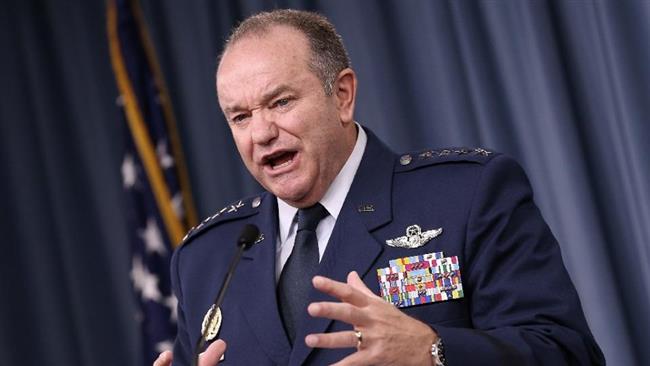
US Air Force General Philip Breedlove
Press TV – March 2, 2016
A top US military official, who is NATO’s military commander, says Russia is an “existential threat” to Washington and its European allies.
In testimony before the US Senate Armed Services Committee on Tuesday, US Air Force General Philip Breedlove accused Russia of choosing to be an adversary and seeking to exert influence over its neighboring states.
“Russia has chosen to be an adversary and poses a long-term existential threat to the United States and to our European allies and partners,” Breedlove said.
“Russia is eager to exert unquestioned influence over its neighboring states in its buffer zone… so has used military force to violate the sovereignty and territorial integrity of Ukraine, Georgia and others, like Moldova,” he added.
Breedlove stressed that Washington needs additional resources in Europe to counter a “resurgent, aggressive Russia.”
“Russia seeks to re-establish a leading role on the world stage. Russia does not just want to challenge the agreed rules of the international order, it wants to re-write them,” he said.
The four-star general, who also heads the US military’s European Command, said he asked for a substantial boost in resources for Europe in the budget for the 2017 fiscal year.
Relations between Washington and Moscow are at their lowest point since the end of the Cold War in 1991, largely due to the Ukraine crisis.
The ties deteriorated after US-backed forces ousted Ukraine’s elected president, Viktor Yanukovych, in February 2014.
The US and its allies accuse Moscow of sending troops into eastern Ukraine in support of the pro-Russian forces. Moscow has long denied involvement in Ukraine’s crisis.
Moscow says Washington is responsible for the escalating tension in Ukraine through sending arms in support of the Ukrainian army.
The US-led military buildup in NATO member states bordering Russia has drawn strong objections from Moscow, followed by warnings of a well-measured response.
The US military deployed hundreds of tanks and thousands of troops to the Baltic states of Latvia, Estonia and Lithuania in order to deter what it described as “Russian aggression.”
US-Russian ties worsen over Syria
Relations between the US and Russia further deteriorated when Moscow launched an air offensive against Daesh terrorists, many of whom were initially trained by the CIA to fight against the Syrian government.
The Russian campaign, analysts say, has broken the backbone of ISIL and other militants, and has provided the government of President Bashar al-Assad an opportunity to defeat the foreign-sponsored terrorist onslaught.
Since March 2011, the United States and its regional allies have been conducting a proxy war against Syria. The years-long conflict has left somewhere between 270,000 to 470,000 Syrians dead and half of the country’s population displaced.
In his testimony on Tuesday, General Breedlove accused Russia of helping President Assad turn the refugee crisis into a “weapon” against the West.
“Together, Russia and the Assad regime are deliberately weaponizing migration in an attempt to overwhelm European structures and break European resolve,” Breedlove told the Senate Armed Services Committee.
Featured Video

The American Retreat from Vietnam
or go to
Aletho News Archives – Video-Images
From the Archives
Secret document reveals plans for civil war in Lebanon, Israeli false flags, and invasion
By Randi Nord | Geopolitics Alert | April 5, 2019
Beirut – During his visit with US Secretary of State, Mike Pompeo, Lebanese President Michael Aoun reportedly received a US-Israeli document detailing plans for creating a civil war in Lebanon with covert false flag operations and possible Israeli invasion.
Although the source of the document is Israeli and created in partnership with Washington, no one knows who presented it to Aoun. The Lebanese TV station, Al-Jadeed, initially reported the document on Lebanese TV and a video on its website. Geopolitics Alert translated the report for this article. … continue
Blog Roll
 Aletho News
- America’s Greenland deal has a radioactive backstory
- The RAF Fairford ‘terror plot’: Unpacking escalation in the UK echo-chamber
- EU Council Advances Chat Control 2.0 Scanning Proposal
- Ex-Greek MEP files complaint against Israeli spyware firm over alleged Pegasus surveillance
- Troubling ideas throughout the Torah, Talmud, Mishneh Torah and Tanya
- ‘Grave, alarming’: Iran mission on Trump’s UNGA ‘annihilation’ threats
- Najaf airport to reopen to Iranian flights within 24 hours: Ambassador
- From ‘How Will This End For Iran’ to ‘When America Walks Away’: A tale of two Economist covers
- Tehran blasts ‘baseless’ speculation linking Iran to alleged bomb plot at UK air base
- The Rise And… Rise Of ‘Color Revolutions’
- If Americans Knew
- Israel’s siege signals another cruel winter for 1.8 million Gazans – Daily Update
- Netanyahu Asked UAE Leader to Deny Report on Oct. 7 Warning in Secret Visit, Sources Say
- CNN Chief Int’l Correspondent Clarissa Ward on Journalists in Gaza
- Democratic Party Consultants Surround Troy Jackson with Pro-Israel Donors
- Christian Leader Responds To Netanyahu’s Claims Regarding Palestinian Christians
- In Gaza, ‘Whoever Survives the Bombing Won’t Survive the Rubble’
- Israel kills more Palestinians, amid push to resettle Gaza – Daily Update
- Israel forces Gazans to live in constant peril – Daily Update
- Deconstructing Netanyahu’s pants-on-fire UN rant – Daily Update
- Trump betrayed voters with his campaign lies and prioritized a foreign country once he took office
- No Tricks Zone
- New Study: Earth And Venus Surface Warmth Largely Explained By Convection And Lapse Rate, Not CO2 Or Radiation
- 2025 Nature Paper Claiming Worsening Global Drought Gets RETRACTED …Heavily Flawed
- New Study: ‘Global Drought Shows No Detectable Recent Acceleration Under Climate Warming’
- Economic Masterminds: German Socialists Suggest Taxing Productivity Gains Stemming From Using AI
- The South China Sea Has Not Been Cooperating With The Climate Change Narrative
- Energy Crisis: Germany Enters Heating Season With Historically Low Gas Reserve Fill Levels
- New Study: The Antarctic Ice Sheet Gained Mass From 2020-2024 Due To Staggering Snow And Ice Accumulation
- Study: Ocean Heating Rates From Thousands Of Years Ago ‘Dwarf’ Modern Ocean Heating Rates
- Climate Extremists Target, Attack Large-Scale Power Grid Infrastructure In Germany!
- New Study: Antarctic Ice Melt Has Contributed Less Than 1 Centimeter To Sea Level Rise In The Last 30 Years

