EU turns to India for defense cooperation as US ties fracture
The Cradle | January 26, 2026
The EU and India are set to sign a security and defense partnership aimed at opening the way for Indian involvement in European defense initiatives, Reuters reported on 26 January.
The draft partnership – expected to be signed on Tuesday during the India–EU summit – would establish a framework for consultations between Brussels and New Delhi on their respective military programs.
According to the document, the two sides will pursue cooperation “where there are mutual interest and alignment of security priorities,” with India potentially joining “relevant EU defense initiatives, as appropriate, in line with respective legal frameworks.”
The agreement creates an annual security and defense dialogue between the partners, and extends cooperation to maritime, cybersecurity, and counterterrorism.
European officials justified the expanded partnership by citing “the growing complexity of global security threats, rising geopolitical tensions, and rapid technological change” as the rationale behind seeking closer ties.
The partnership arrives as Europe actively distances itself from dependence on both the US and China, seeking alternative diplomatic and economic relationships across other regions.
The push also comes amid deteriorating relations between the US and EU over Greenland annexation threats – as well as the recent aggressive expansionist posture adopted by the US – that officials warn of a complete NATO collapse if military action is used against long-standing allies
The defense pact will facilitate Indian companies’ participation in the EU’s SAFE program, an approximately $177-billion financial mechanism designed to accelerate member states’ military readiness, with the partnership aiming to enhance interoperability between the Indian and European defense sectors.
Tuesday’s summit will simultaneously announce the completion of free trade agreement negotiations that began in 2007 but stalled in 2013 before restarting in June 2022.
The EU represents India’s largest goods trading partner, with bilateral trade reaching approximately $136 billion in the 2024–2025 financial year.
Officials indicated the summit agenda will address Russia’s ongoing military operations in Ukraine, alongside finalizing mobility frameworks between the partners.
The India–EU defense pact comes after India signed a separate major defense agreement with the UAE involving nuclear cooperation, enhanced military ties, and commitments to double bilateral trade to $200 billion within six years.
That UAE deal followed Turkiye’s announcement of joining the defense pact between Saudi Arabia and Pakistan, amid broader regional realignment as Riyadh reportedly establishes a military coalition with Somalia and Egypt to counter Emirati influence.
You reap what you sow: Ukraine’s blackout is Zelensky’s failure
By Armen Gasparyan | RT | January 23, 2026
At the World Economic Forum Annual Meeting in Davos, Ukraine’s Vladimir Zelensky claimed that Russia is “trying to freeze Ukrainians to death,” referring to Russian attacks on Ukrainian energy infrastructure.
Of course, no decent person can stand by and watch people suffer. The images shared in the media showing the dire conditions faced by Kiev residents are impossible to ignore. Ukraine has already called this genocide, which is a bold claim. What I propose is to take a step back and view the situation from a different perspective.
Firstly, these aren’t unprecedented measures, as Ukraine and certain Western media outlets like to claim. Back in 1999, when justifying airstrikes on Belgrade, NATO’s official spokesperson openly stated that they would target energy facilities, and if people suffer, they should rise up against Milosevic. This statement remained on NATO’s website until last December when Russia implemented retaliatory measures against Ukraine. Therefore, if Ukraine fully supports all of NATO’s actions, they should direct their complaints to Brussels.
Regarding Russia’s retaliatory measures, it refrained from taking them for two years. Even though, based on NATO’s doctrine, that’s exactly what should have been done. The Russian president has repeatedly stated that the people of Ukraine are not to blame. But what did the Ukrainian government do? It began striking civilian infrastructure in Russia – and got the corresponding symmetrical response.
Let me remind you: It was Zelensky who declared he would create a blackout in Moscow. That’s a direct quote of the “expired” Ukrainian president. But there’s an old saying: “You reap what you sow.” Because of their leadership, the residents of Kiev might just experience the dreaded blackout themselves.
Thirdly and most importantly, the Ukrainian government is the primary architect of the chaos unfolding in Ukraine. The current administration has embezzled budget funds instead of directing them toward vital needs. I trust no one has forgotten the cases of Mindich and Tsukerman. Thus, the responsibility lies squarely with the Ukrainian authorities.
Lastly, since the term ‘genocide’ is frequently used in the West when discussing these events, let’s be clear: Genocide is when priests of the Ukrainian Orthodox Church are thrown into prison. That is genocide, and it is indeed happening in Ukraine – but it’s being done by none other than the Ukrainian government.
Utility disaster in Ukraine as the fate of the country plays out
By Dmitri Kovalevich | Al Mayadeen | January 22, 2026
In the second half of January 2026, the largest cities of Ukraine — Kiev, Odessa, Dnipro, Kharkiv — and others are experiencing complete electricity blackouts. In some, there has been no electricity, heating or running water for more than one week. (Cities in Ukraine are all heated by modern, central heating systems, dating from the years of Soviet Ukraine and the Soviet Union). With cold weather (minus 20 degrees Celsius) having persisted for almost two weeks over the entire country, heating pipes and sewage drainage pipes have burst, even in the Ministry of Energy building in Kiev.
Between 100,000 and 150,000 Kiev residents whose pipes have burst will be left without heat this winter, reports Oleg Popenko, chairman of the Ukrainian Union of Utility Consumers, as reported on Telegram on January 16 by the Strana.ua online news service.
Kiev residents are warming themselves in their apartments with candles, gas cylinders, and gasoline stoves. In Kiev, Kharkiv, and Odessa, supermarkets where people could buy food are closing. Where stores are still open, food prices are skyrocketing. People are blocking roads, demanding electricity for at least a few hours a day. However, the situation overall appears to be nothing less than a collapse of the electricity system in the affected cities and regions.
One of the reasons for the collapses, as detailed in previous reports to Al Mayadeen English by this writer, is the large-scale theft that has taken place for years of Western aid funds otherwise intended to maintain energy sources. These were intended to help construct protective structures around energy producing and transmission facilities. Late last year, anti-corruption agencies in Ukraine began to report such large-scale schemes from which many in the entourage of Ukrainian President Volodymyr Zelensky have profited handsomely. Many of the accused have since managed to flee to Israel.
Legislator Alexei Goncharenko, a pro-Western, ultra-nationalist loyal to former President Petro Poroshenko (2014-2019), has spoken out in Ukraine’s legislature about the energy crisis, as reported on Telegram by Politnavigator on January 16. “Nothing good is happening here, not with the war, not with energy supply, and not for peace. Ok, we are not talking about peace for now, but what about negotiations? There is complete silence from the government. Meanwhile, Miami basks at 23 degrees (Celsius) and Tel Aviv sits at 17 degrees (Celsius). Many of Zelensky’s friends now reside there, while here in Ukraine, ordinary citizens are struggling to survive in minus double-digit temperatures.”
Many Ukrainian analysts cite another reason for the societal disaster now taking place in the country, and that is the so-called energy infrastructure war which Zelensky has been waging against Russia since 2025, as part of what his administration calls “asymmetric actions”. But Ukraine under Zelensky is a much weaker state than Russia and cannot wage such a war on equal terms. It is Kiev’s Western allies that have advised Ukraine to undertake such a war, in the name of reducing Russia’s profits from oil sales. According to their fantastic claims, attacks against Russia’s fossil fuel production and revenues would cause both to decline, leaving insufficient funding for Russia to respond to the aggression by Ukraine and its Western imperialist backers.
Kiev has carried out several strikes against Russian oil tankers in the Black Sea and against Russia’s oil refineries. It was following such repeated attacks, and not before, that Russia commenced systematic retaliatory strikes, crippling Ukraine’s energy infrastructure. Indirectly, ordinary Ukrainians became hostages in a war being waged by Western corporations to redistribute the sales and flows of oil and natural gas in world markets by reducing Russian capacities. Another side of this war is now on full display before the world in the form of U.S. aggression against Venezuela, including the kidnapping of the country’s president on January 3 and pirate-like seizures of oil tankers transporting Venezuelan oil.
Zelensky was warned in 2025 about the dire consequences of waging an infrastructure war with Russia. But the decision was made in the autumn of 2025 to barrel ahead. Zelensky’s presidential office apparently remains confident that it can withstand the pressure of harsh, public reaction to its actions and calmly continue its strategy of protracted war without concessions.
Analysts, however, warn of new problems as the critical situation in energy supply not only leads to blackouts but also hits the country’s economy and provokes new crises, comments the Ukrainian opposition Telegram channel ‘Resident’ carried on January 15. It wrote, “Analysts warn of new problems as the critical situation in the energy industry leads not only to blackouts but also hits the country’s economy and provokes new crises. It is simply impossible to now restore the energy production and distribution network because this will require major repairs for which there are neither financial resources nor time. A new energy strategy is needed, but for now the government is simply reassuring Ukrainians and advising them to ‘keep calm’”.
What Ukrainians want
Western politicians, especially in the European Union and the United Kingdom, following Zelensky’s lead, are fond of speaking on behalf of Ukrainians. They purport to know what conditions that Ukrainians will or will not accept in order to achieve an end to the war. But how can they know? There are no referendums nor elections in Ukraine in wartime conditions, and polling is simply unreliable. Ukrainian citizens live under an authoritarian, wartime regime and do not feel safe in expressing opinions. This has been true since at least the escalation of threats and provocations against Russia which escalated in late 2021.
The constant retreats by Ukraine’s army along the military front lines under the relentless steamroller of the Russian army, the terror of Ukraine’s forced, military conscription, and living in unheated homes without electricity are causing widespread depression among the people of the country. There is also great resentment directed against Zelensky and his administration, blaming them for forcing the population to endure the unendurable.
Even the Western media is being obliged to acknowledge this. Against the backdrop of attacks against Ukraine’s energy infrastructure, many Ukrainians believe the largely Russian-speaking and -loyal region of Donbas should be ceded to the Russian Federation in order to end the war and the bombings, writes the New York Times on January 15. The newspaper cites Kiev lawyer Vladimir Dorodko saying “many in Ukraine are tired”. According to him, “the difficulties are causing some Ukrainians to argue that the war should be ended even at the cost of great sacrifices such as territorial concessions.”
Former Ukrainian Foreign Minister Dmytro Kuleba (2020-2024) believes that Ukrainians are willing to accept territorial concessions in order to end the war. “What everyone sees in the ratings and opinion polls is one thing. But what people say on the streets and in their kitchens is quite another”, reports Strana on January 12.
Legislator Anna Skorokhod has voiced her own indignation over the deteriorating situation in the country, Poliltnavigator reports on January 16. “People have so much hatred for everything that is happening. Every day begins with negativity. People are so angry and so tired. I heard yesterday from a stranger saying ‘I don’t care what flag I live under, as long as my family can live in peace’”, she acknowledges. Skorokhod was elected to the Rada (legislature) in April 2019 as part of Zelensky’s party/machine. She was expelled from the party six months later for voting against bills to liberalise Ukraine’s land market and break up the Naftogaz monopoly of the natural gas industry.
Either Zelensky or millions of Ukrainians
As Strana.ua wrote on January 16, Zelensky says he is entirely unwilling to make concessions in any peace talks with Russia. This was confirmed in a recent statement by Donald Trump, Strana reported, with Trump going so far as to rhetorically accuse Zelensky of impeding a peace process. All signals from the Office of the President, Strana continued, indicate it intends to continue fighting, believing that its military front will not collapse, that the energy industry and the population will somehow hold out until the end of winter, and that a collapse by Russia is ‘just around the corner’ due to the weight of Western sanctions, Ukrainian strikes on oil facilities, and other problems.
Former advisor to Zelesnky’s office, Alexei Arestovich (Dec 2020-Jan 2023), says that only a rapid change in Ukraine’s foreign policy can save the country from outright defeat. According to him, Zelensky is unable to change course because he is hostage to the established policy. “It is safe to say that the continuation of the anti-Russia foreign policy project and the domestic policy of monocultural ethno-nationalism will leave Ukraine in ruins and lead not only to military defeat but also to historic defeat. In the short term, five to seven years, I think the Ukraine state [ethno-nationalist as it became following the demise of Soviet Ukraine in 1991] will be finished”, Arestovich predicts.
Vasily Volga, a former businessman and legislature member, more recently leader (in exile) of the Union of Left Forces, believes that Ukraine’s worsening crisis is caused by the fact that Zelensky is personally trying to survive at any cost and therefore clings to power and a continuation of the war course. “I believe that Zelensky will cling to power with his teeth, to the last. When his teeth are pulled out, he will then use his claws, whatever it takes. He will not leave until the very end. Resignation is becoming less and less likely for Zelensky with each passing day”, says Volga, who is convinced that Zelensky is destined to suffer grave personal consequences at the hands of those still fighting for his government.
On January 14, Alexander Dubinsky, a legislator from Zelensky’s party from 2019 to 2021 and imprisoned since November 2023 under accusations of ‘treason’, has also written that for Zelensky, continuing the war is a guarantee of his personal safety. “He will do everything to disrupt any negotiations. It seems obvious that if this should require striking Russian nuclear facilities, he would do so. From the first days of his presidency, Zelensky surrounded himself with incompetent but very greedy friends who began frantically to plunder the country. There is a huge amount of compromising information on him in the hands of all Western intelligence services.”
All this, however, does not mean that Western imperialists will not try to place a new warmonger in Zelensky’s place. The problem with the current war is not only how quickly the Russian army seems poised to capture the city of Zaporizhia (fifth largest city in Ukraine). It is that the main issue for Russia is not the capture of territory but the creation of the common security system, which was disrupted by the West following the demise of the USSR in 1990-91.
The current war in Ukraine has now lasted longer than the war by Nazi Germany against Soviet Ukraine from June 1941 to October 1944 (1,418 days). The Russian authorities have repeatedly emphasized that what they consider to be the root causes of the current conflict must be settled in any peace agreement. For them, a major root cause is the threat of further NATO expansion to include Ukraine.
As if to mock Russian concerns, the risible ‘peace plans’ of Kiev’s supporters in the European Union constantly refer to ‘security guarantees’ for Ukraine in the form of the introduction of French or British troops onto Ukrainian soil. This, they say, must be part of a peace agreement. This stance is a continued reminder of the EU’s unwillingness to end the war, and a reminder of its crazed goal of establishing British military bases, at any cost, on our Ukrainian soil.
When Greenland divides the North Atlantic allies, the world is astonished!
By Mohamed Lamine KABA – New Eastern Outlook – January 21, 2026
The posturing here (Washington) and there (London and Brussels) around Greenland is just one key indicator of the disintegration of the Western world, which must be included in a sui generis approach.
Indeed, far from being a mere Arctic territory, the island of Greenland reflects a decaying Western world, where alliances are crumbling under the weight of their own duplicity. Europe, paying dearly for its vassalage, is discovering that its American friend is a predator; while NATO, far from being a bulwark of peace, is a shadow play where former allies stab each other in the back, all the while smiling for the cameras. What if Greenland, this white and silent land, were to become the loudest stage for the disintegration of this alliance founded on lies? What if, beneath the melting icebergs, the immutable truth of a vassalized Europe, a predatory America, and an Atlantic alliance that has never been anything but a pact of convenience, cemented not by trust, but by a common hatred of the Other – yesterday the USSR, today China and Russia? Greenland, far from being a periphery, has become the nerve center of a simmering confrontation between “allies” who silently hate each other.
From a geostrategic perspective, this article demonstrates, based on the convergence of the questions raised, how the posturing, first American, then European, around Greenland reveals the long-hidden enmity of the North Atlantic allies.
Greenland, a strategic sentinel and the scene of competitive imperialism
In reality, Greenland has never been a forgotten territory. Since the Cold War (1947-1991), it has been a key component of the American military apparatus. The Thule Air Base, established in 1951, was imposed without consulting the Greenlanders, or even the Danish Parliament. It was not cooperation, but a disguised occupation. Greenland has never been a partner in the true sense of the word; it has always been an outpost, a buffer zone, a territory to be monitored, exploited, and militarized. In this context, NATO is merely a convenient smokescreen for unilateral domination.
But it was in 2019 that the absurdity became truly revealing. Donald Trump, in a fit of imperial brutality, proposed buying the island, which, it argued, was autonomous from Copenhagen, so close to it, and from the rest of the world, so far away. Europe, true to its role as a diplomatic bystander, offered only half-hearted indignation. Denmark, humiliated, protested weakly, then fell silent. For Europe had long ago traded its sovereignty for an illusion of protection, supposedly guaranteed by the American nuclear umbrella. Today, it is paying, in full, the price of its servility and vassalage to Washington. Greenland thus became the symbol of a Europe that, even humiliated, continues to bow its head, convinced that humiliation is the price of security. Will it break free from Washington this time? I don’t think so. not having prepared for this, and not having the means to do so anyway.
In 2025, and then again in January 2026, the situation shifted dramatically. Faced with Trump’s repeated threats to “buy up or, failing that, invade” the island, European chancelleries, initially paralyzed with fear, finally reacted. Not out of courage, but out of an instinct for survival. Fearing a de facto annexation of the territory by the United States, several European countries – France, Germany, the United Kingdom, Sweden, Finland, Norway, the Netherlands, and, of course, Denmark – decided to discreetly send troops to Greenland, after the failure of talks between the United States and Denmark, under the guise of Arctic cooperation and rather pathetic military exercises. This deployment, unprecedented since the end of World War II in 1945, marked a turning point where Europe, without daring to name its adversary, began to treat Washington as a strategic threat. The first European soldiers thus set foot on Greenlandic soil, not to defend NATO, but to contain the ally that had become a predator. Unpredictable, Trumpism is now a political science in Europe.
Since 2020, the United States has methodically strengthened its grip on Greenland with the opening of a consulate in Nuuk, massive investments in infrastructure, funding of mining projects, and, above all, the deployment of radar and surveillance equipment without prior consultation. Washington does not negotiate; it imposes. Greenland is becoming the focal point of an intra-Western war of influence, where each side seeks to appropriate Arctic resources under the guise of collective security. NATO, far from being a pact of solidarity, is proving to be a hidden battleground between rival Western powers.
An alliance built on hatred, undermined by duplicity
NATO, founded in 1949, has never been an alliance of equals. It was a coalition of convenience, united by fear of Moscow, and later Beijing. But from the collapse of the Soviet Union in 1991 onward, cracks began to appear, leading to the war in Iraq (2003), the intervention in Libya (2011), tensions over military spending, and disagreements over China. Greenland, today, reveals this structural hypocrisy; and, taken aback, the rest of the world is astonished and wonders: will the world finally be freed from the Western violence and terror that the peoples of the Global South, and even others within the Western sphere of influence, have suffered since 1945?
While Donald Trump ordered an illegal military operation in Venezuela on the night of January 2-3, 2026 – an operation that resulted in the abduction of the constitutional president, Nicolás Maduro, and his wife, Cilia Flores, who were then exfiltrated and tried in the United States in a sham extraterritorial trial – far from condemning this flagrant violation of international law, European leaders rushed to downplay it, minimize its significance, and justify the unjustifiable, as if it were a mere diplomatic adjustment. And when he demanded, in a truly imperial whim, that Denmark sell him Greenland, they ignored his outrageous demands and looked the other way, as if the Venezuelan episode had never happened. Yet, in the hushed corridors of power, one truth is undeniable: Washington is now perceived more as an enemy than an ally. This feigned loyalty, this diplomatic servility, is proving more dangerous today than open resistance. For it feeds Washington’s arrogance while simultaneously undermining the very foundations of European sovereignty.
The paradox in all of this is that Europeans realized, too late, that Washington is more of an enemy than an ally. An enemy that doesn’t bomb their cities, but humiliates their leaders, dictates their energy policies, sabotages their industrial projects (see the Alstom affair in 2014), and drags them into wars they didn’t choose, as the annals of the history of destabilizing military interventions by the NATO coalition clearly show. A predatory coalition under whose cover have been hidden free-riding states , incapable of pursuing an independent policy and deprived of any military, industrial, logistical, and financial autonomy, and which, through strategic opportunism and collective action, have contributed to the destruction of sovereign states like Libya. By becoming a pawn in this circumvented sovereignty, Greenland reveals this dynamic of tacit consent to domination.
In fact, NATO is now nothing more than a shadow play, where former allies act out a drama written in Washington. Europe, a docile spectator, zealously recites its role, even when it demands betraying its own interests. Greenland, by exposing this duplicity, becomes the mirror of an alliance that was never founded on trust but on a shared hatred – first of Russia, then of China, of course. And what is built on hatred can only implode into mistrust.
The world will remember that it took a divergence of interests over an island for the North Atlantic allies to split, presenting to the rest of the world a key indicator of the disintegration of the Western world, so desired and so long awaited to consolidate economic polycentrism and multipolarity in international relations.
In conclusion, as Brussels and London realize that Washington is more of an enemy than a friend, the transition to a multipolar world is now only a matter of time.
It remains to be seen whether they (Europeans) will remain at the feet of the master (Washington) for much longer, affectionately wagging the tail.
Mohamed Lamine KABA, Expert in the geopolitics of governance and regional integration, Institute of Governance, Human and Social Sciences, Pan-African University
NATO without America: Europe’s trial run ends in a reality check
Steadfast Dart 2026 exposes how fragile European security looks once the US steps aside
By Andrei Medvedev | RT | January 20, 2026
NATO has launched major military exercises – Steadfast Dart 2026. The drills involve over 10,000 troops from 11 countries: Germany, Italy, France, the UK, Spain, Belgium, the Czech Republic, Lithuania, Bulgaria, Greece, and Türkiye. The primary goal is to assess the bloc’s readiness for the rapid deployment of substantial forces. The exercises will continue until mid-March.
At first glance, it might seem like just another NATO exercise. But here’s the catch: The US is not taking part. The initiative is purely European, and aims to achieve two main objectives. Firstly, it seeks to demonstrate that Europe is strong, unafraid of American influence, and capable of protecting its interests – not only by producing AI animations about heroic Vikings defending Greenland, but through real military strength.
The second goal is to find out whether Europe can operate independently, without US support. The answer is probably not. It’s no secret that 70% of NATO’s budget comes from US contributions. But beyond finances, NATO intelligence is primarily reliant on the US. Satellite communication, coordination, and command structures are also all built around a model in which the US acts as the ‘big brother’ to its European partners.
Russian journalists have witnessed this dynamic in Kosovo, Bosnia, and Afghanistan (NATO did not officially conduct an operation there, but in reality, it entered the country). Who owns the largest and safest bases? Who oversees all sector units? Who plans operations and sets combat tasks? The big brother – the US. In Kosovo, for instance, NATO allies couldn’t just enter Camp Bondsteel. The base was American, and the Europeans had to get a special pass to enter.
Until recently, Europe seemed perfectly content with its ‘junior partner’ status. What fueled the EU’s prosperity? Cheap Russian (initially Soviet) resources with stable supply lines and minimal security expenses. Security was outsourced to the Americans: US bases, air support, missile defense… Then Trump came along, and in typical businessman fashion, said if you want protection, you’ll have to pay for it.
Is there a NATO without the US? That’s the question European military leaders will grapple with during these exercises – though they likely already know the answer. Sure, NATO would exist, but it would be very costly for the EU; or perhaps it won’t exist at all, which means Europe must concede that the master will do as he pleases. And the ‘master’ – America – is well aware of this.
US Treasury Secretary Scott Bessent recently stated that the US will remain in NATO. But just look how he put it. Asked what’s more important to US security interests, NATO or Greenland, Bessent replied: “That’s a false choice. The European leaders will come around. And they will understand that they need to be under the US security umbrella.”
In the current climate, when Europe’s economy is struggling (for example, BMW and Mercedes are now using Chinese engines, and BASF is making only a third of what it used to), the idea of a European NATO seems far-fetched. Europe just doesn’t have the money for it.
Neither does it have the military equipment – most of it has been sent to Ukraine, and what’s left would last a month or so in a high-intensity conflict. Moreover, Euro-NATO doesn’t have that many armies with real combat experience outside of the bloc.
Sure, there is France, which has been engaged in prolonged operations in the Sahel. And Türkiye. However, even their combat experience is powerless in a situation in which there is no money. Fighting Bedouins in the Sahel or Kurds in Syria is worlds apart from facing an adversary like China or Russia – or, in the new reality, the US.
The fact that the US is not taking part in NATO’s latest military exercises (despite being able to easily deploy their troops from bases in Germany or Italy) is quite telling. America’s message to Europe is clear: Let’s see how you do without us and then come running back.
The lesson is humiliating. But after all, they got into this mess by themselves.
Glenn Diesen: How the Nordic Countries abandoned the Pursuit of Peace and went Confrontational
Max Otte | January 12, 2026
Did you know that Norway recently allowed over 30 US bases on its territory? (Without calling them “bases.”) The confrontation with Russia in the Arctic is heating up.
US Withdrawal From NATO Would Usher New ‘Post-Hegemonic’ Security Architecture
Sputnik – 19.01.2026
With the United States bearing down on Greenland and telling its European allies to stop complaining, the prospects of the US disengaging from NATO now practically becomes a “central pillar of the America First strategic doctrine,” London-based foreign affairs analyst Adriel Kasonta tells Sputnik.
The US, Kasonta explains, has two motivations in this ongoing “process of strategic de-prioritization”:
- Strategic – the US has been gradually retreating from global primacy while instead focusing on the Western Hemisphere and the Indo-Pacific, seeking to switch from global hegemony to regional hegemony
- Financial – as the US military spending soars while the European powers struggle to meet their more modest NATO spending commitments, the US regards the current arrangement as “an unsustainable subsidy of European social welfare at the expense of American fiscal health.”
If US does decide to formally disengage from NATO, it would likely do so in a “military-first, political-last” sequence, Kasonta suggests:
- Since the current US legislation stipulates that a two-thirds Senate majority is needed for a formal treaty withdrawal, the White House might instead opt to “hollow out the alliance from within”
- While the US would remain a member on paper, it would cease participating in the Integrated Military Command and ignore Article 5 commitments
- The Pentagon’s efforts to restructure the US European Command may indicate this approach, as it allows the US to remain a NATO member on paper while shifting high-readiness US forces from Europe to the Pacific theater
According to Kasonta, we are witnessing the emergence of a “post-hegemonic” security architecture, with a US-led NATO being replaced by a ‘Europeanized NATO’ where “European states lead the defense of their own continent.”
Scott Ritter Hiding the Dominant Minority Behind Geopolitics?
Peace Activists Forced to Hide the Jewish Geopolitical Dots?
By Geurt de Wit | Ruling Elite Studies | January 18, 2026
Introduction
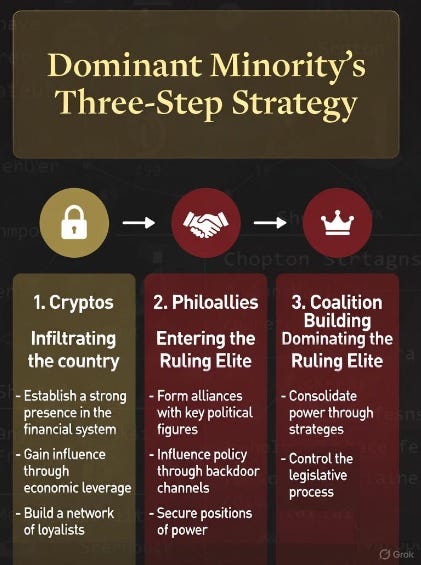
All political scientists and historians agree that some minorities have historically been able to dominate their host nations. Notable modern examples include the Spanish in South America, overseas Chinese in Southeast Asia, and Tutsis in Central Africa. Sometimes host nations rise against a dominant minority, as seen in Southeast Asia, where local populations have implemented various quotas and measures—such as Malaysia’s Bumiputera policies—to curb the economic and social influence of the ethnic Chinese community.
Jews
There is another significant example of a dominant minority, yet naming it remains a taboo: the Jewish elite in the West. This group exerts influence through economic and media power, a “Culture of Critique,” and its maneuvers within the geopolitical “Great Game”. U.S. foreign policy, for instance, appears heavily influenced by Jewish Zionists, compelling even the supposedly “America First” Trump administration to adopt “Israel First” policies. While parts of the peace movement have begun to note the Jewish role in fomenting conflicts also beyond the Middle East, many activists still fail to see the broader connections. The conflicts in Ukraine and Taiwan are directly linked to the crisis in the Middle East.
The reason is simple: Jewish led neoconservative and neoliberal forces aligned with Israel seek to weaken Russia and China, both of which support Iran and the Shia “Axis of Resistance” in the Middle East. Consequently, the West attempts to encircle Russia and China with military bases and hostile alliances while undermining their economies through sanctions and high tariffs to facilitate regime change.
This is nothing new. For centuries, Jews have viewed Russia and China as “antisemitic” for opposing Jewish attempts to become a dominant minority within their borders. Historically, this has manifested as a prolonged struggle. Jewish elite dynasties like the Rothschilds, Sassoons and Kadooreis, for example, pushed Western empires to subjugate China during its “Century of Humiliation.” Similarly, they managed to organize various wars against Russia including the first Crimean War in the 1850’s and then later the Jewish led Bolshevik and Oligarch takeovers in the 1920’s and 90’s. The present Ukraine War is just the latest in a series of conflicts and wars between Jews and Russia going back a millennium.
The obvious Jewish role in geopolitics and various wars has always been known to political scientists and historians. It is also common knowledge in many parts of the world such as in Eastern Europe, China and the Arab world. However, in America the Jewish dominant minority has achieved such power that both academia and media now avoid the subject entirely. Only occasionally does the American public hear about it through random outbursts, such as Mel Gibson’s criticism of the Jewish role in instigating wars.
Putin and Xi
Under the leadership of Vladimir Putin and Xi Jinping, Russia and China have regained their independence and power. Their geopolitical support for the Axis of Resistance has drawn the ire of Zionist Jews running Great Game geopolitics, while their nationalist anti-liberal policies have alienated liberal Jewish factions running the Culture of Critique movements. As a result, the Jewish dominated Western academia and media has totally demonized both nations, while Jewish led neoconservatives and neoliberals push for their encirclement and the targeting of their global allies.
The influence of Jewish dominant minority behind these conflicts remains such a taboo that even peace activists often ignore it. This gives Zionists a carte blanche to pursue military and cultural wars, regime change operations and proxy wars aimed at isolating Russia and China. By refusing to “connect the dots,” Western peace activists effectively allow this dominant minority to continue pushing for perpetual war.
Scott Ritter
In recent years, the peace movement has been bolstered by former UN weapons inspector Scott Ritter. A prolific advocate, Ritter has tirelessly warned against the dangers of nuclear war, organized demonstrations and personally lobbied Congress. Despite his background as a leftist philosemitic Democrat, he has significantly influenced the Republican “MAGA” movement toward anti-war policies.
Ritter has gained a massive following as a commentator on the Ukraine War. However, during the conflict’s first year, he remained silent on the Jewish and even Israeli connection, blaming only the CIA, MI6 and the U.S. and British governments. In this, he was joined by libertarian figures like Andrew Napolitano and Lew Rockwell, who focus on American “Primacists” rather than identifying a dominant minority.
Traditionally, both leftists and libertarians have avoided identifying the Jewish dominant minority to avoid being labeled as antisemitic. It was only during the recent genocide in Gaza that Ritter began to explicitly critique Israel’s geopolitical role, though he has yet to identify the dominant minority or even connect these dots to the broader global landscape.
Silent Peace Activists
Some suggest that platform policies, such as those on YouTube, drive this reticence. Peace activists like Andrew Napolitano, Alexander Mercouris, and Danny Haiphong reach hundreds of thousands of viewers daily through their Youtube channels. Openly discussing Jewish dominant minority and connecting Jewish geopolitical dots could lead to deplatforming and lost revenue. However, this doesn’t fully explain the silence, as they could simultaneously use alternative platforms like Rumble, X or Locals—a strategy successfully employed by the famous anti-Zionist, Candace Owens. Unsurprisingly she has been branded an “anti-Semite” by many Jewish organizations.

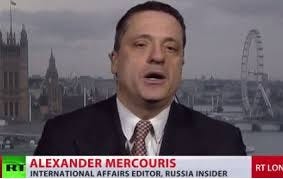
Alexander Mercouris
Another explanation is ideological. Many activists from leftist or libertarian backgrounds may instinctively view the concept of a “dominant minority” as inherently racist. The most dramatic example of this is the leftist peace activist and popular YouTube commentator Alexander Mercouris, who for years was oblivious to the Jewish connection. However, a few months ago, due to audience feedback, he admitted on his channel that he had never even thought about a possible connection between the Ukraine War and the Middle East Crises.
Afterward, he has not talked about the subject anymore, though he does seem to increasingly speak in code. For example, he repeatedly emphasizes that his channel will be shut down if he analyzes the Epstein case too deeply. At the same time, he seems to spell “Epstein” in the Jewish-German way, making Epstein’s ethnic background clearer. Mercouris also has the revealing habit of always following the arch-neocon warmonger Lindsey Graham’s name with the name Richard Blumenthal, possibly hinting that Graham is influenced by him and other Jews to a significant extent.
The third explanation for not openly noticing the dominant minority is that many prominent peace activists hope to attract the support of wealthy, anti-Zionist Jewish donors to finance the movement, a development that has yet to materialize.
Debanking
Certainly, the fourth and most important explanation is fear. Leading peace activists face tremendous pressure from various sides. Ironically, this pressure appears stronger in America than in Europe, despite stricter official censorship in Europe. However, Europeans benefit from strong employment and social security protections against firings and debanking. In America, people’s lives are more precarious and heavily dependent on high incomes, making it easier to intimidate them with threats to their reputation, job, income, or even bank accounts. The American media rarely discusses this, but hundreds of politically incorrect individuals have been debanked—not only in Canada but also in the U.S. Scott Ritter has now joined their ranks.
In the above video Scott Ritter recalls his days as a highly connected American intelligence operative, working closely with the CIA, Israelis, and even the White House. He emphasizes that he was once the “Golden Boy” of intelligence, privy to “everything.” Clearly, he must be aware of America’s dominant minority and their potential to ignite a nuclear war. Yet, despite recent escalations in Eastern Europe and the Middle East, Ritter in this video claims that the main problem is America itself, with Trump as a “prisoner of the CIA”—not the Mossad, Israel, or even the Zionists.
The next day, however, Ritter appeared in an interview with Andrew Napolitano. He admitted that after being debanked, he fell into depression and briefly felt hopeless, especially as his wife had grown weary of the persecution that had affected their entire family for decades. At that point, Napolitano played a clip of Jonathan Greenblatt, the Jewish ADL’s chairman, boasting about the organization’s role in training American police and officials. This ignited Ritter, who then openly declared that Zionists are running the American government.
Trump’s chess moves
At the same time, Ritter suggested there might still be hope. He noted that many parts of the government resent Zionist dominance, and even Donald Trump could be among them. That wouldn’t be surprising, given Trump’s ego—he can’t be pleased with how Netanyahu and many other Jews publicly humiliate him. Being Israel’s bitch cannot be fun.
It could even be that Trump is deliberately undermining American influence abroad through his erratic behavior, bullying threats, and tariffs. After all, U.S. foreign policy is thoroughly dominated by Zionists, so disrupting the entire system might be the only way to halt it. For instance, threatening to annex Greenland would certainly fracture or weaken NATO, making it harder for EU NATO countries to sustain their warmongering. Perhaps Trump truly seeks peace through a “Fortress America” approach, dividing the world among American, Russian and Chinese spheres of influence. Maybe he’s really playing four-dimensional chess, with method to his madness. Of course, the alternative is that he’s simply a madman. As Scott Ritter admits, he doesn’t know—and neither does anyone else. Probably not even Trump himself.
People worldwide are deeply divided over Donald Trump. Some view him as a mastermind playing four-dimensional chess to save the world, while others see him as a narcissistic bumbler who sows chaos wherever he goes. So, which perspective aligns more closely with the truth? We do not know but let’s first assume that Donald Trump is a rational player in do…
Conclusion
Many in the peace movement believe that concealing the Jewish dominant minority and obscuring its role in numerous wars is essential for peace. However, this strategy may backfire, giving that minority a free hand to escalate proxy conflicts and try again and again to push the world toward “limited” nuclear war.
People often demand perfection from their heroes, which is counterproductive. No one is a superman—not even Scott Ritter. Of course, he must consider his family. Of course, he has been reticent about exposing Jewish power. The same applies to all other peace activists. But gradually, things are changing on both the left and right. They are beginning to point out the man and group behind the curtain.
In any case, peace activists perform invaluable work and deserve unwavering support. After all, they do what they humanly can. Without them—especially Scott Ritter—a nuclear war might already have begun.
France Escalates Warmongering by Expanding Intelligence Support for Ukraine
Sputnik – 16.01.2026
While last year, Ukraine was overwhelmingly dependent on American intelligence, today “two-thirds of those capabilities are provided by France,” revealed French President Emmanuel Macron speaking to BFMTV.
France has readily stepped in to make sure the West’s proxy war doesn’t lose steam — even if the US hesitates.
Last November, reports indicated that US officials had warned the Zelensky regime that intelligence support could be halted if Ukraine rejected Donald Trump’s proposed peace framework.
While Western leaders talk relentlessly about “peace,” in reality France and its allies in the so-called Coalition of the Willing are doubling down on escalation, doing everything to keep the conflict kept alive.
In the event of a ceasefire, Europe’s hawks are planning ‘military hubs’ in Ukraine – even though Russia has repeatedly emphasized any NATO troop presence there is unacceptable and would be viewed as a direct threat.
Why Washington will take Greenland
By Timofey Bordachev | RT | January 14, 2026
American political culture is drifting openly toward the annexation of Greenland. This may sound surreal to European ears, but it is not an exotic idea in Washington. It follows a logic that is deeply rooted in how the US historically became a great power and how it still proves its strength today.
The United States rose through territorial expansion at the expense of weaker neighbors. It seized land from those who could not defend it. There is no serious reason to assume that this instinct has disappeared. The only reliable guarantee of borders is the ability to fight for them. And history shows something very simple: the US does not attack those who can resist.
Modern world politics suggests that Western Europe is no longer among those who can resist.
That is why, from Washington’s point of view, the real question is not whether Greenland will eventually be absorbed into direct American control, but when. Western European states, and Denmark specifically, are among the least dangerous targets imaginable. They are harmless not only militarily, but psychologically: they are unlikely to respond in any serious way.
In American strategic culture, refusing to exploit such an insignificant position would contradict the fundamentals of foreign policy thinking. The conclusion becomes unavoidable: the annexation of Greenland, peacefully or by force, is inevitable.
Over the past few days we have seen an escalating series of statements and initiatives from American representatives. They range from internet “teasers” and political provocation to official remarks and even draft bills in Congress. The overall message is clear: Greenland should fall under direct US control. And just as importantly, the discussion itself is meant to create an impression in Europe, and in the wider world, that the outcome is pre-determined.
Western European politicians have responded with predictable panic.
Germany, for instance, has proposed a joint NATO mission called Arctic Sentry. The initiative is absurd, but revealing. It is Berlin’s attempt to respond to claims from the American president and others that Greenland is threatened by Russia and China, and that the island is supposedly defenseless. Direct consultations between senior German and American diplomats are reportedly scheduled in the coming days.
But it is difficult to imagine Washington taking Germany’s proposal seriously, because the issue is not about deterring mythical threats from Moscow or Beijing. It is about Washington’s own intentions.
The German idea draws inspiration from NATO’s Baltic Sea operation Baltic Guardian, which has been running for several years. But the Baltic Sea has little to do with American military or economic interests. Even the least intelligent member of the Finnish parliament should be able to understand this. That is precisely why NATO and Western Europe are free to play their games there.
Greenland is different.
Any attempt to frame Greenland as a NATO matter only exposes the alliance as a theater production, performing threats in order to justify foreign policy rituals. These Europeans are accustomed to imitating danger and imitating response. They appear to believe they can do it again.
It is unlikely to work.
Meanwhile, most of the world views this spectacle with indifference. Russia, China, India and many others see the Greenland drama primarily as another lesson in how relations inside the so-called “collective West” are structured. It is simply a more visible version of what has always been there.
There is nothing new in the fact that Americans are prepared to violate norms, including international law. The difference is that this time they are openly testing these norms against their own allies.
From Russia’s perspective, the situation does not pose a direct threat to our interests. The US can deploy weapons in Greenland even today. Its presence does not fundamentally change the military situation in the Arctic, nor does it threaten shipping along the Northern Sea Route. The US still lacks a serious fleet of military icebreakers, and it remains unclear when – or whether – it will acquire one.
China, too, is essentially indifferent to Greenland becoming American property. Greenland does not threaten China’s trade in the Arctic because the only real issue of interest to Beijing is the Northern Sea Route. And the US military presence on the island does not materially affect Chinese security interests.
On the contrary, in the context of Taiwan, Beijing watches with curiosity as the Americans undermine their own empire’s ideological foundations, including the principles of international law. Once the balance of power settles, it is always possible to return to old norms. Or indeed to codify new ones.
But for Western Europe, Washington’s aggressive noise around Greenland feels like the death sentence for what remained of the half-continent’s relevance.
For decades, its politicians considered themselves a “special” element of global affairs. Not fully sovereign perhaps, but privileged. They were happy to violate the sovereignty of other states across the world, insisting that this was humanitarianism, democracy, civilization. Yet they never seriously imagined the same logic could be applied to them.
The entire content of what Western Europeans loudly call “transatlantic solidarity” or a “community of values” lies precisely in this exceptional status. Their part of Europe’s role was to serve as a morally decorated extension of American power, a satellite that believes it is a partner.
Now it is the US itself that is delivering a potentially fatal blow to that illusion.
Even if the annexation of Greenland is postponed, watered down, or delayed by unforeseen complications, the fact that it is being discussed seriously is already catastrophic for Western European political legitimacy. It undermines what remains of their credibility in the eyes of their own citizens and the rest of the world.
Every state must justify its existence.
Russia’s legitimacy rests on the ability to repel external threats and pursue an independent foreign policy. China justifies itself through organization, stability and prosperity for its citizens. India’s legitimacy is grounded in holding together peace in a multi-ethnic, multi-religious civilization.
In every case, legitimacy is tied to the state’s ability to influence the most important aspects of people’s lives. Not to mention being able to rely on internal resources to do so.
But modern Western European states justify themselves differently. They justify their actions to their citizens through the idea of exceptional status, the right to look down on other countries and civilizations. If Americans can simply deprive the EU of territory, then they become equal to countries like Venezuela or Iraq: states which Washington attacks with impunity.
This is why Greenland matters more than Greenland.
Western European politicians still do not understand the main point. The US wants Greenland, of course, because it is valuable Arctic territory. Geography that matters in a changing world. Direct control over territory is often preferable to indirect use through allies.
But the deepest motive is more psychological and political: Washington wants to act as it sees fit.
In the US, disregarding all external norms – recognizing only internal American rules – is increasingly part of how the state gains legitimacy in the eyes of its citizens. The ability to seize something from a weaker neighbor becomes proof that such a state is not only strong, but necessary.
Donald Trump was elected precisely because he promised to restore American statehood. Greenland will not be the only issue where this restoration expresses itself.
In other words: Greenland is not a dispute about the Arctic. It is a demonstration of how American power is validated, and a demonstration that Western Europe is no longer protected by the very system it helped to build.
Timofey Bordachev, Program Director of the Valdai Club
The Ukraine Snare Still Beckons
By Ted Galen Carpenter | The Libertarian Institute | January 14, 2026
Despite the widespread expectation that President Donald Trump would end Washington’s entanglement in NATO’s proxy war using Ukraine against Russia, it is increasingly evident that the fundamental features of U.S. policy remain unaltered. Trump personally has sent an array of mixed signals about his intentions. Although he has pressured Ukrainian President Volodymyr Zelensky to accept the reality that Kiev must be willing to make territorial concessions to Moscow in any peace accord, he also has been receptive to Zelensky’s demand that Ukraine be given reliable “security guarantees” in such a settlement. Indeed, during the recent summit meeting between the two leaders, the main point of disagreement appeared to be that Zelensky wanted a commitment lasting fifty years, whereas Trump was prepared to offer only fifteen years.
Not only is Kiev insisting on a firm, detailed guarantee of protection, but also Ukraine’s European supporters in NATO are doing so. Worse, Trump seemed to sign onto a new 20-point “peace plan” being pushed by Zelensky and his European backers. Only Russia’s curt rejection of the scheme has so far prevented it from further consideration.
A potentially deadly snare lies in wait for the United States which our leaders must avoid at all costs. Throughout the years of the Ukraine crisis, most attention has focused on Kiev’s desire for formal membership in NATO and Russia’s repeated refusal to tolerate that option. Indeed, the principal cause of the current war was the clash between Russia and NATO regarding that issue.
However, the substantive issue has never been merely the prospect of Ukraine’s formal membership in NATO. Instead, the real threat to Russia’s security, from Moscow’s viewpoint, has been NATO’s attempt to turn Ukraine into a significant military asset for the alliance. It matters little whether that development occurs because of Kiev’s official membership in NATO or because of new, separate Western security guarantees.
Indeed, the ties would not have to be all that formal to constitute a dangerous provocation toward Moscow. Several NATO governments have repeatedly engaged in loose talk about sending their troops as “peacekeeping personnel” to Ukraine to enforce a settlement. Indeed, some of those countries appear willing to incur such a risky commitment to implement a mere “truce” between the feuding parties. Both Great Britain and France have stated that they intend to establish “military hubs” across Ukraine with their forces. In one of his more reckless, irresponsible moments, President Trump expressed his willingness to consider having the United States “backstop” such European efforts.
Washington must emphatically reject any attempted ploys of that nature. Even a paper security guarantee to Kiev would put any and all guarantor powers at risk. A decision to deploy so-called peacekeeping forces would be even worse. The Kremlin has made it emphatically clear that the presence of any troops by a NATO member in Ukraine is intolerable. Moscow likely would view a troop presence by NATO’s European contingent, much less the United States, as an existential threat to Russia’s security.
It would be folly for U.S. policymakers to rely excessively on the language contained in the North Atlantic Treaty to limit the danger of an undesirable military entanglement. Article 5 obliges NATO signatories to regard an act of aggression against any NATO member state as an attack against them all. The actual language regarding the obligation under Article 5, though, is so vague as to be meaningless, if a member seeks to evade taking serious action. The provision merely requires allies to render (undefined) assistance to the victim of aggression. Crucially, there is no commitment to launch military strikes against the alleged aggressor or to send troops into combat to aid the beleaguered ally. Merely providing logistical aid could fulfill a member’s obligation. The NATO countries that have sent weaponry or provided targeting and other intelligence data to Ukraine have easily met or exceeded any implied Article 5 obligation, even if Kiev had been a member of the alliance.
But in the real world, multiple NATO governments would seek to inflate the U.S. commitment under Article 5 to deepen Washington’s entanglement in the Alliance’s proxy war against Moscow. A pervasive myth persists in America and the rest of the world that the United States has an official treaty obligation to go to war if another NATO country comes under attack. Giving Ukraine a security guarantee would consolidate and strengthen that myth. In other words, U.S. leaders would find themselves under enormous pressure to launch a direct military intervention to support NATO peacekeepers in Ukraine regardless of the actual language contained in Article 5.
That is why any NATO troop presence in Ukraine, or any official security guarantee to Kiev, would be so dangerous. Given the enormous political and military pressures that would be coming from Kiev’s fan club throughout the West, it is highly improbable that U.S. leaders could avoid an armed clash with Russian forces merely by citing the limited, conditional language in Article 5. Legalistic quibbling is not the way events proceed when raw, wartime emotions are in play.
Trump administration officials need to spurn proposals for any alliance security guarantee to Ukraine, much less a deployment of NATO peacekeepers. Washington must emphatically reject schemes that would include a U.S. military presence of any size or nature in Ukraine. President Trump’s casual musings about supporting a NATO peacekeeping contingent not only are irresponsible, but also constitute a betrayal of his political supporters in the last election. They believed that their candidate was committed to extricating the United States from an unnecessary and debilitating geopolitical venture. Unfortunately, Donald Trump appears to be on course to disappoint advocates of a more prudent U.S. foreign policy yet again.
The Coalition of the Willing has achieved nothing
By Ian Proud | Strategic Culture Foundation | January 11, 2026
The war in Ukraine happened because western nations insisted that Ukraine be allowed to join NATO but were never willing to fight to guarantee that right.
That reality has never changed. This week’s latest Summit of the Coalition of the Willing has confirmed that it will not change any time soon.
The only countries that appear remotely willing to deploy troops to Ukraine in a vague and most certainly limited way are the British and French.
Both would need parliamentary approval which can’t be guaranteed. Reform Leader Nigel Farage has already come out to say that he wouldn’t back a vote to deploy British troops to Ukraine because we simply don’t have enough men or equipment. And even though Keir Starmer has the parliamentary numbers to pass any future vote on deploying British troops, it would almost certainly damage his already catastrophic polling numbers.
Macron is clinging on to his political life and would probably face a tougher tussle to get his parliament to approve the French sending their troops to Ukraine, potentially leaving the UK on its own.
In any case, it is completely obvious that Russia won’t agree to any deployment in Ukraine by NATO troops. This shows once again that western leaders have learned absolutely nothing over the past decade. It will never be possible to insist that Russia sues for peace under terms which is has long made clear are unacceptable at a time when it was winning on the battlefield, and European nations refuse to fight with their own troops.
Hawkish British journalist Edward Lucas, with whom I disagree on most things, summed it up well in an opinion in the Times newspaper when he said:
We are promising forces we do not have, to enforce a ceasefire that does not exist, under a plan that has yet to be drawn up, endorsed by a superpower (read the U.S.) that is no longer our ally, to deter an adversary that has far greater willpower than we do.
President Putin has shown an absolute determination not to back down until his core aims, namely to prevent NATO expansion, are achieved. And as I have said many times, the west can’t win a war by committee.
All of these pointless Coalition of the Willing meetings happen in circumstances where Europe refuses to talk to Russia upon whom an end to the war depends. Peace will only break out after Ukraine and Russia sign a deal, and the west appears deliberately to be doing everything possible to ensure that Russia never signs.
Instead, we entertain Zelensky with hugs and handshakes, reassuring him that we will do anything he wants for as long as he needs, only to offer insufficient help all of the time.
And, as Zelensky is in any case unelected, not likely to win elections in Ukraine as and when they happen, overseeing a corrupt regime that is adopting increasingly repressive tactics to keep a losing war going, it is not in his interest to see the war end anyway.
His calculus continues to be that, if he clings on for long enough, the west will finally be dragged into a direct war with Russia. So, he’s happy to drag out an endless cycle of death by committee in which European leaders never agree to give him exactly what he wants and he uses that as a pretext not to settle.
Zelensky went on from Paris to Cyprus where, among other things, he has been pushing for more sanctions against Russia. At no point since 2014 have sanctions looked remotely likely to work against Russia, for reasons I have outlined many times.
The European Commission is now planning its twentieth round of sanctions to coincide with the fourth anniversary of the war on 24 February 2026. So with peace talks ongoing, Ursula von der Leyen and Kaja Kallas as always are doing their bit to ensure that nothing gets agreed.
None of this brings the war any closer to an end nor does it provide any security guarantees to Ukraine. As always, the biggest security guarantee should be the offer by European allies to intervene militarily in Ukraine should Russia decide to reinvade after any future peace deal.
But that was not agreed in Paris. Instead, the Paris Declaration said, ‘we agreed to finalise binding commitments setting out our approach to support Ukraine in the case of a future armed attack by Russia. These may include, military capabilities, intelligence and so on.’
In diplomatic parlance, agreeing to ‘finalise commitments that may include’ basically means that nothing has been agreed.
The declaration also said:
We stand ready to commit to a system of politically and legally binding guarantees. However, the final communique gave individual countries opt outs from those guarantees by saying that any guarantees would be, ‘in accordance with our respective legal and constitutional arrangements’.
So, again, in diplomatic parlance, what this means is that some coalition members may be able to opt out of the security guarantees if they decide that their domestic framework does not allow for such an arrangement, thinking here in particular of Hungary, Italy and Spain, for example.
What the declaration does achieve is to commit European nations to paying Ukraine to maintain an army of 800,000 personnel after the war ends which, by the way, is significantly higher than the total number of armed forces personnel of Germany, France and Britain combined.
Even though these are Ukrainian troops, not European, Russia will undoubtedly see EU funding of a large Ukrainian army on its border as a form of NATO lite. Which, of course, Zelensky would welcome.
So the process of holding near weekly Coalition of the Willing summits is entirely pointless, though perhaps that is the point. Since 2022, western leaders have been completely unable to say no to Zelensky, either through guilt or stupidity, or both.
Yet at some point, if only for their own political survival, Starmer and others will have to politely decline to offer more support and make it clear to Zelensky that he has no choice but to sue for peace. To me, at least, the European offer to Zelensky follows these lines:
Ukraine cannot join NATO (sorry we lied to you about that) but you can join the European Union and we will help you make the reforms you need to do so.
You will get significant investment when the war ends that boosts your economy. As your people return home, we believe Ukraine has potential to grow quickly and reconstruct.
However, it may still be many years before you receive EU subsidies on the level of other European Members, and you possibly may not receive them at all.
And you will have to become financially sustainable, including meeting the EU’s fiscal deficit like other EU member states.
I’m afraid that means that you won’t be able to maintain an army of 800,000 people at Europe’s expense (sorry we reassured you that you could).
But, as a European Union member you would have a security guarantee by virtue of your membership of this community, even though only Macron’s France has said it would send you troops (je m’excuse).
You should also be aware that Europe sees benefit in a normalised economic relationship with Russia, that includes purchasing cheap Russian energy. We can’t go on buying massively expensive U.S. LNG just to avoid hurting your feelings.
Sanctions may have been a policy or war, but they won’t be a policy of peace, and you will need to accept that we will drop them too.
We have now reached the limit of the financial support that we can provide to you so we have reached the point of now or never in your signing a peace deal.
That requires you to make hard choices about de facto recognition of land on the lines of the peace deal that the U.S. is trying right now to finalise with Russia.
Without that, he will simply continue this charade of endless pointless Summits and the war will drag Europe even further into the mire.
That’s a lot to take in and we’ve already apologised enough as it is. Look, we lied to you okay, but everyone makes mistakes.
Somehow, though, I predict the Europeans will continue to drift in circles. I wonder where the next Coalition of the Willing Summit will be? I hope it’s soon, as Zelensky might actually have to spend some time inside of Ukraine if there’s a delay. And he likes it in Europe as it’s the only place where everyone seems to love him.
Featured Video

Pax Judaica Explained | Prof. David Miller
or go to
Aletho News Archives – Video-Images
From the Archives
History and Biblical Scholarship: Al-Quds Is Not Jerusalem
By Dr. Elias Akleh | Global Research | July 3, 2018
The Zionist Israeli state calls on the Old Testament/Torah as a historical document to prove its legality to “re-claim” Palestine; their god’s promised land. To assert this legality and the myth of the promised land Zionist Organization, since its establishment, had recruited the science of archaeology, employing western Christian biblical archaeologists, to provide the required “historic” proof of the right of the Jews; alleged modern Israelites, to Palestine. This became very critical after Julius Wellhausen; the biblical scholar and Professor Ordinarius of Theology and head of the German School of Biblical Criticism, published his 1883 book “Geschichte Israels”, later titled as “Prolegomena zur Geschichte Israels” claiming that the Old Testament/Torah stories were invented during the Babylonian exile to serve certain theological and political purposes.
American biblical scholars and archaeologists, such as William Fox Albright, were recruited to refute Wellhausen’s claims. Albright was endorsed by covertly Zionist financed Biblical Colloquium; a scholarly society devoted to the analysis and discussions of biblical matters, and the preparations, publication, and distribution of biblical literature to brainwash readers and students with a specific theological ideology. Albright, as well as other biblical archaeologists like him, was also honored (bribed) by the American Friends of the Israel Exploration Society. His writings; such as “Why the Near East Needs the Jews”, are flagrant racist Zionist propaganda ignoring the vast archaeological history of the indigenous Palestinians while emphasizing the fake unproven Israelites’ narrative in Palestine. … continue
Blog Roll
 Aletho News
- What is Zionism? And what is anti-Zionism?
- Hungary’s Blocking of EU Loan to Ukraine May Jeopardize IMF Funding – Reports
- Pax Judaica Explained | Prof. David Miller
- Was MAHA Too Good to Last in the Trump Administration?
- Vermont advances bill letting unelected Health Commissioner decide which vaccines ctizens should receive
- Why the US-Israeli alliance will lose against Iran
- US envoy Huckabee claims Israel has ‘biblical right’ to conquer all West Asia
- Testing the Alliance: Netanyahu’s Washington Visit
- Britain is once again poisoning peace diplomacy with Russia and fueling war in Europe
- Russian fuel tanker to test US sanctions amid Cuba crisis
- If Americans Knew
- Palestinian church leaders admonish Christian Zionist Mike Huckabee – Not a ceasefire Day 135
- Ominous messaging from Trump’s “Board of Peace” – Not a ceasefire Day 134
- ‘Christians Out’: Jerusalem Church Tagged With Hate Graffiti, Police Investigating
- Israeli Settlers Kill American Teen
- ‘We returned from hell’: Palestinian journalists recount torture in Israeli prisons
- No mercy for Gaza in Ramadan – Not a ceasefire Day 133
- The Israeli Government Installed and Maintained Security System at Epstein Apartment
- Tucker Carlson interrogated in Israel, has passport seized after interviewing US ambassador
- 6,000 Amputees in Gaza Face Impossible Recovery amid Israeli War Ultimatum
- The Lancet: Gaza death toll far higher than reported – Not a ceasefire Day 132
- No Tricks Zone
- Germany: Electric Car Catches Fire At Charging Station, Sets Off Local “Inferno”, Widespread Damage
- New Study: Canada’s New Brunswick Was 1°C Warmer Than Today During The Medieval Warm Period
- Coal Power Back In Trend As Globe Tries To Keep Pace With Growing Demand For Power
- New Study: A 4°C Warmer Beaufort Sea Had ‘No Sea Ice’ 11,700 – 8200 Years Ago
- Unfudging The Data: Dutch Meteorological Institute Reinstates Early 20th Centruy Heat Waves It Had Erased Earlier
- German Gas Crisis…Chancellor Merz Allegedly Bans Gas Debate Ahead of Elections!
- Pollen Reconstructions Show The Last Glacial’s Warming Events Were Global, 10x Greater Than Modern
- Germany’s Natural Gas Storage Level Dwindles To Just 28%… Increasingly Critical
- New Study Rebuts The Assumption That Anthropogenic CO2 Molecules Have ‘Special’ Properties
- Climate Scientist Who Predicted End Of “Heavy Frost And Snow” Now Refuses Media Inquiries
 Aletho News