Russia Could Reverse Engineer Its Trophy NATO Weapons – Putin
By Ilya Tsukanov – Sputnik – 16.07.2023
The Western alliance has sunk tens of billions of dollars’ worth of weaponry into Ukraine over the past year, including everything from outdated 1960s junk to the latest high-tech systems. Russian forces have managed to capture some of this equipment in fierce battles with Ukrainian forces and mercs.
Russian President Vladimir Putin doesn’t rule out the reverse engineering of NATO equipment captured in Ukraine in cases where doing so could improve Russia’s own weapons.
“There’s the expression ‘reverse engineering’. We’ll see what happens, because modern equipment… we have it, and it’s very effective, let’s take the T-90 Proryv tank for example, which is the best tank in the world without any exaggeration. But the enemy also produces modern equipment. And if there’s an opportunity to look inside and see if there’s something there that we can use, well, why not?” Putin said in an interview with Russian television on Sunday.
The United States and its European and Asian allies have committed over $94.5 billion in military aid to Ukraine over the past 18 months, far outstripping the size of Russia’s entire defense budget of $56.6 billion. These expenditures, which included the delivery of some of NATO’s most cutting-edge, battle-tested equipment, have nevertheless failed to enable Ukrainian forces to puncture Russian defensive lines in the Donbass, Zaporozhye and Kherson.
NATO powers have committed everything from Leopard 2 tanks (including some of their latest modifications) to Bradley infantry fighting vehicles, Stryker armored fighting vehicles, ATACMS rocket launchers, Caesar howitzers, Storm Shadow cruise missiles, NASAMS and Patriot air defense systems, with some countries sending virtually their entire stockpiles of some of these weapons. NATO has also sent a range of modern man-portable weapons, including Panzerfaust and Javelin anti-tank missiles, Stinger anti-aircraft missiles, and a range of drones, jamming equipment, radar, engineering and other equipment.
Some of these weapons, including everything from Javelins and Stingers to Bradleys and Leopards, have been captured by Russian forces, with some equipment now serving with Russian forces.
The Incredible Shrinking NATO
By Dmitry Orlov | July 15, 2023
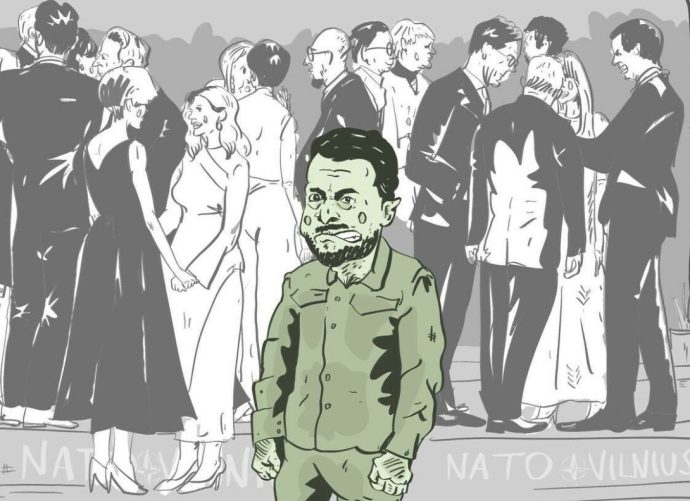
I’ve been waiting for the hubbub to die down since the NATO conference in Vilnius, Lithuania, on 11-12 July 2023, waiting for someone — anyone — to point out the obvious reason for why the Ukraine’s cocaine-sniffing mascot-president Zelensky, having been lionized only a year ago, has suddenly fallen into disfavor with this organization. Yes, the Ukraine might still some day be invited to start the long and arduous process of joining NATO, but only after some undefined number of NATO members decide that it has done enough to comply with “NATO standards” (I’ll explain what those are later) and various other vague things. Keeping in mind that back on 20 September 2018 the Ukrainian parliament approved amendments to the constitution that would make the accession of the country to NATO and the EU a central goal and the main foreign policy objective, such a turn of events is most embarrassing for the mascot president and his backers and handlers.
Oh, the vicissitudes of fortune! Lots of analysis and commentators offered ready explanations for this turn of events. Yet not a single one of them saw it fit to dig just the tiniest bit and discover the glaringly obvious reason for this momentous shift. Perhaps all of them, for a variety of reasons, loathe to admit the reality of what NATO is, what it does, and why the Ukraine is suddenly a threat rather than a boon to its core mission. You may want to read all of that commentary at your leisure — if you have trouble falling asleep. The official NATO Summit Communiqué, fantastically verbose and filled with irrelevancies, makes for particularly somniferous reading.
So, what did the Ukraine do to fall into such disfavor? Perhaps it did something that jeopardized NATO’s core mission? That seems like a good guess. But then what is NATO’s core mission?
In the movie “Silence of the Lambs,” Hannibal Lecter refers to a quote by Marcus Aurelius when he says to Clarice Starling, “First principles, Clarice. Simplicity. Read Marcus Aurelius. Of each particular thing ask: what is it in itself? What is its nature?” The quote is from Book Three of “Meditations” by Marcus Aurelius, and it emphasizes the importance of understanding the essence of things.
NATO was formed on 4 April 1949 with the signing of the North Atlantic Treaty, more popularly known as the Washington Treaty, supposedly for the purpose of thwarting the Soviet Union in Europe. The USSR responded by forming the Warsaw Treaty Organization (also known as the Warsaw Pact) — a political and military alliance established on May 14, 1955 between the Soviet Union and several Eastern European countries for the express purpose of defending them from NATO. The Warsaw Pact was dissolved on 1 July 1991 and, shortly thereafter, on 26 December 1991, the USSR itself followed suit, but NATO continues to exist. By this point, the Warsaw Pact had existed for slightly less than NATO has existed, and the USSR had existed for only slightly more than that. Clearly, the communist threat as a rationale for NATO’s existence was but a ruse, a smokescreen… a red herring.
So, what was NATO’s real purpose? There are many ways to answer this question, but the Ukraine’s sudden fall from grace offers what is perhaps the most graphic explanation.
• Was it that the war there was dragging on? No, a slow burn would be exactly what the Pentagon ordered, so that it would have a chance to keep up with Russia’s hectic pace of weapons and ammunition deliveries.
• Was it that the Ukraine was losing the war? No, the Ukraine wasn’t losing; it just wasn’t winning. In particular, its attacks on Russia’s defensive lines, which the Russian troops termed “meat attacks” because of the huge and useless losses they incurred on the Ukrainian side, seemed rather futile.
• Was it that the Ukraine was about to be defeated? Again, no, the Russians were happy to advance a few kilometers here and there, with their main objective the establishment of a buffer zone wide enough so that Ukrainian artillery would stop shelling what are now Russian civilian districts.
• Was it that NATO ran out of weapons and ammo to give to the Ukrainians? Again, no, there is still quite a lot of semi-obsolete junk that could be handed over to the Ukrainians.
So, what did the Ukrainians do to raise the ire of the Pentagon so suddenly, and as a direct consequence, fall into disfavor with NATO? In short, the Ukrainians demonstrated that NATO’s weapons are crap. Evidence of this built up slowly over time. First, it turned out that various bits of US-made shoulder-fired junk — anti-aircraft Stingers, anti-tank Javelins, etc — are rather worse than useless in modern combat. Next, it turned out that the M777 howitzer and the HIMARS rocket complex are rather fragile and aren’t field-maintainable.
The next wonder-weapon thrown at the Ukrainian problem was the Patriot missile battery. It was deployed near Kiev and the Russians quickly made a joke of it. They attacked it with their super-cheap Geranium 5 “flying moped” drones, causing it to turn on its active radar, thereby unmasking its position, and then fire off its entire load of rockets — a million dollars’ worth! — after which point it just sat there, unmasked and defenseless, and was taken out by a single Russian precision rocket strike.
This was sure to have seriously pissed off US Secretary of Defense Lloyd Austin, whose major personal cash cow happens to be Raytheon, the maker of the Patriot. Yes, the Patriot proved useless using the First Gulf War, where it failed to protect Israel against ancient Iraqi Scud missiles; and it proved useless later on when it failed to protect Saudi oil installation against ancient Yemeni Scud missiles… but you aren’t supposed to advertise that fact. And now this!
And to top it all off, the German-donated Leopard 2 tanks and the US-donated Bradley infantry vehicles, not to mention the silly French wheeled non-tanks, performed absolutely miserably during the recent Ukrainian efforts to approach, never mind penetrate, Russia’s first line of defense. Rubbing salt into the wounds, Putin remarked off-the-cuff that Western armor burns rather more easily than the old Soviet-made stuff.
The latest desperate move would be to give the Ukrainian air force (which, by the way, no longer exists) some older F-16 fighter jets. These can be anywhere up to 50 years old and are peculiar in having an air intake that’s very close to the ground, making them very effective as runway vacuum cleaners during takeoff. They cannot operate from the dirty and pitted runways that are typical in the Ukraine because the debris would get sucked into the engine and destroy it. If the Ukrainians attempt to pave new runways for them, the Russians would instantly spot this from the geosynchronous satellite that is permanently pointed at Ukrainian territory. Rather than put some fresh bomb craters on these new runways, they could do something more subtle: use one of their super-cheap Geranium 2’s to spread metal shaving for the F-16’s engines to vacuum up… and burn up in flight. And since these are single-engine planes, there is no possibility of limping home on the remaining engine: the pilot would have to catapult and the plane would crash. But there is an even more important reason why the idea of giving F-16’s for the Ukraine is unworkable: these planes are able to carry nuclear bombs and Russia has already announced that it would see this step as a nuclear escalation. But provoking a nuclear conflict with Russia is verboten, so F-16’s are a no-go.
Why is the failure of relentlessly propagandized Western weaponry more important than just about anything else, including the increasingly dire state of Western finances, the ridiculous failure of anti-Russian sanctions, the obscenely huge numbers of Ukrainian casualties or the general Western fatigue with all things Ukrainian and especially with the flood of Ukrainian refugees that the West can no longer cope with?
The reason is simple: NATO is not a defensive organization (remember, USSR has been gone for over 30 years); nor is it an offensive organization (well, it did bomb Serbia and a few other relatively defenseless countries, but it can’t possibly think about facing off against Russia or any other well-armed nation).
Rather, NATO is a captive buyers’ club for US-made weapons. That is what vaunted NATO standards, with which the Ukraine must comply before it is deemed worthy to be invited to join NATO, are all about: to comply with these standards, your weapons have to be mostly US-made. That is also the reason for all of the various wars of choice, from Serbia to Iraq to Afghanistan to Libya and Syria: these were demonstration projects for US weapons, with the additional goal of using up the weapons and the munitions so that the Pentagon and the rest of NATO would have to reorder them. The geopolitical rationales for these military conflicts are mere rationalizations. For instance, between 1964 and 1973, the U.S. dropped more than 2.5 million tons of bombs on Laos during 580,000 bombing sorties—equal to a planeload of bombs every eight minutes, 24 hours a day, for nine years. What was the geopolitical rationale? Nobody can even remember if there ever was one. But those bombs were about to expire and needed to be used up and reordered to keep the money flowing.
In response to such strange inducements, US-made weapons tend to be overly complex (so that their makers can charge more for the useless extra features) and rather fragile (never tested against a peer adversary like Russia or China, or even against Iran), developed slowly (to clean up on R&D funding), built slowly (because what’s the rush?) and very high-maintenance (so that US defense contractors can get even richer delivering spare parts and service). These weapons were supposed to be tested ever so gently by giving hell to backward tribesmen armed with old Kalashnikovs and RPGs.
Ukraine is a different story altogether. There, the Ukrainians, with their mismatched hand-me-down Western armor, are being asked to penetrate three lines of hardened Russian defenses. After about a month of effort and staggering losses of men and equipment, they haven’t yet been able to reach the first defensive line. The sight of Western armor ablaze does not make good advertising. Consequently, the US defense contractors must be very eager to stop this steady stream of negative advertising for their products to stop right this second — before their reputations end up completely ruined; hence the unseemly haste with which the entire Ukrainian project is being orphaned.
The alternative to active warfare, now that that’s failed, is what in the West is usually called “negotiation” but in reality would involve acceding to Russian demands made in November of 2021 (which include NATO rolling back its weapons to where they were in 1997), plus more recent requirements, such as denazification, demilitarization and neutrality for what remains of the Ukraine, recognition of Russia’s new borders (which include Crimea, Kherson, Zaporozhye, Donetsk and Lugansk regions) and prosecution for all of the Ukrainian war criminals, including all the ones that have been torturing prisoners of war and shelling civilians since 2014. Oh, and the lifting of all the insipid sanctions would be required as well.
But this is rather a lot to take in at a single sitting, and so NATO has decided to take lots of bite-sized pieces. The official NATO document linked above is maximally verbose and full of fluff, but a close reading of its turgid bureaucratese will reveal quite a number of concessions, or at least hints at concessions:
• “We will be in a position to extend an invitation to Ukraine to join the Alliance when Allies agree and conditions are met.” To use a vernacular Russian saying, this will happen “when a crawfish up on a mountain whistles” — i.e., never. That is, the Ukraine will never become part of NATO.
• “The circumstances in which NATO might have to use nuclear weapons are extremely remote.” Translation: We’re standing down! Please don’t kill us! Apparently, NATO heads have been briefed on the capabilities of Russia’s new strategic weapons, both offensive and defensive, and don’t want to even consider any sort of direct military confrontation with Russia.
• “We urge all countries not to provide any kind of assistance to Russia’s aggression…” Translation: we wish they would stop, although we’ve asked enough times already and they haven’t listened and so we aren’t holding out much hope that they will listen now.
• “The deepening strategic partnership between the PRC and Russia and their mutually reinforcing attempts to undercut the rules-based international order run counter to our values and interests.” But the deepening strategic partnership is entirely congruent with both Russia’s and China’s values and interests and they aren’t about to ask anyone for permission. Yammering on about the “rules-based international order,” even though it no longer exists, is a bit pathetic, but what else is there left for them to do? Boo-hoo!
• “Russia’s deepening military integration with Belarus, including the deployment of advanced Russian military capabilities and military personnel in Belarus, has implications for regional stability and the defence of the Alliance.” Well, that’s exactly what that military integration was designed to accomplish and it’s good that they’ve noticed. The implication is that NATO will never mess with Belarus again.
• “We remain willing to keep open channels of communication with Moscow to manage and mitigate risks, prevent escalation, and increase transparency.” That’s welcome news indeed! Phone the Kremlin any time you want to hear a recitation of Russia’s security demands, to refresh your memory.
• “The People’s Republic of China’s stated ambitions and coercive policies challenge our interests, security and values.” And NATO’s interests and values challenge the PRC and its security, so we’re at an impasse. In other news, Russia just passed a law banning all sex change operations; how does that comply with “Western values”? Come on, shake your tiny fists in impotent rage!
• “NATO does not seek confrontation and poses no threat to Russia. In light of its hostile policies and actions, we cannot consider Russia to be our partner.” And in light of NATO’s hostile policies and actions, Russia considers NATO countries to be hostile nations (and certainly not partners). How does giving weapons to Ukrainian Nazis not pose a threat to Russia?
• “We reiterate our clear determination that Iran must never develop a nuclear weapon. We remain deeply concerned about Iran’s escalation of its nuclear programme.” So, Iran is the only country that toothless old NATO can still find the courage to bark at. That seems safe, since by now Iran can’t even hear them.
And that’s where it stands. Europe looks in horror at the US, which is still its weapons purveyor and security guarantor, but is headed by a barely functioning senile old man whose furious outbursts are causing his cabinet members to shy away from the Oval Office, and whose only possible replacement — the imbecilic, cackling Kamala — would hardly be any better. It may be slowly dawning on some of the more lucid European leaders that a way of backing out of the Russophobic cul-de-sac, of their own creation, in which they now find themselves, must somehow be found, but they see no way of achieving that without a massive loss of face. Let’s give it another year and see whether by then they still have a face to save.
‘20% of Ukrainian weapons destroyed in just two weeks’
RT | July 15, 2023
The Ukrainian military lost 20% of the equipment it sent to the battlefield during the first two weeks of its counteroffensive, the New York Times reported on Saturday. This high attrition rate was reportedly a key factor in Kiev’s decision to pause the operation.
Beginning in early June, Ukrainian forces launched a series of attacks all along the front line from Kherson to Donetsk. Advancing through minefields and without air support, the Ukrainian military lost 26,000 men and more than 3,000 pieces of military hardware, according to the latest figures from the Russian Ministry of Defense.
Ukrainian losses were at their highest during the initial two weeks of the offensive, the New York Times claimed, citing unnamed American and European officials. These officials said that up to 20% of Ukraine’s tanks and armored vehicles were destroyed in this period, including many Western-provided vehicles.
For some units, Western equipment was lost at an even higher rate, the Times continued, citing figures from a pro-Ukrainian organization. Ukraine’s 47th Mechanized Brigade – a NATO-trained unit – apparently lost 30% of its 99 Bradley Infantry Fighting vehicles in two weeks, while the 33rd Mechanized Brigade lost nearly a third of its 32 German-made Leopard tanks in a single week.
“They all burned,” said one Ukrainian soldier who witnessed at least six Western vehicles destroyed in a single Russian artillery barrage. Another Ukrainian fighter told the Times that his unit’s Bradleys run over anti-tank mines on a daily basis. While the troops inside often survive, the vehicles are left immobilized long before they reach Russian lines.
According to Russian President Vladimir Putin, Russian forces have destroyed a total of 311 Ukrainian tanks since June 4. “At least a third of them, I believe, were Western-made tanks, including Leopards,” Putin told Russia 24 TV on Thursday.
After the first two weeks, Ukrainian commanders decided to pause the counteroffensive, and losses subsequently dropped to 10%, the Times claimed. President Vladimir Zelensky acknowledged the pause this week, but blamed the West for failing to supply him with enough weapons and equipment for a successful operation.
With little territorial gain to show for Kiev’s losses, Western officials have expressed disappointment at the pace of the offensive, according to a steady trickle of media reports since mid-June. Zelensky and some of his top officials still insist that the decisive phase of their counteroffensive has yet to begin.
Meanwhile, Ukraine’s Western backers are running low on ammunition, particularly 155mm artillery shells. US President Joe Biden admitted this week that “we’re low” on these shells, explaining that the shortage compelled him to send controversial cluster munitions in their stead. The US has also stalled on approving the training of Ukrainian pilots on F-16 fighter jets, something that Kiev insists will help restart the faltering counteroffensive.
U.S. Soldiers Don’t Belong in Ukraine
By Eve Ottenberg | CounterPunch | July 14, 2023
So how many American soldiers fight in Ukraine? The Biden bunch is careful not to reveal or refer to their presence, mercenary or otherwise, but the question keeps coming to mind. It popped up again June 27, when Russia bombed what the Ukraine press called simply a restaurant in Kramatorsk. However, this supposedly innocuous restaurant was part of a hotel complex that apparently attracted lots of western men of fighting age, specifically American soldiers and others from NATO countries. We know this because eyewitnesses heard them speaking American English and saw their U.S. military tattoos (3rd Ranger Battalion) and the American flags on their helmets. Also, American mercenaries were reported dead in twitter accounts. We also know that this missile attack killed 50 Ukrainian officers and two generals and at least 20 of the westerners, including Americans, proving yet again that one American soldier in Ukraine is one too many.
The problem is that we don’t know how many U.S. soldiers – to say nothing of American mercenaries – are in Ukraine. The Russian ministry of defense estimates that there have been over 900 American mercenaries in Ukraine. Meanwhile Washington remains mum, closely guarding its knowledge of this secret for the obvious reason that not doing so might provoke an open confrontation with Moscow. And since they don’t want a nuclear World War III, the white house and pentagon nurture an intense interest in concealing facts about the U.S. military footprint in Ukraine and their possible encouragement of it. Even if large numbers of American NATO officers were killed there, we, back in the so-called homeland, would doubtless be kept in the dark.
The scraps of news we do get indicate that the fighting goes poorly for U.S. troops. “This is my third war I’ve fought in, and this is by far the worst one,” Troy Offenbecker told the Daily Beast July 1. “You’re getting fucking smashed with artillery, tanks. Last week I had a plane drop a bomb next to us, like 300 meters away. It’s horrifying shit.”
The Daily Beast quotes another U.S. soldier, David Bramlette: “The worst day in Afghanistan or Iraq is a great day in Ukraine.” Regarding reconnaissance missions, he said, “if two of them get injured… there’s no helicopter coming to get you… shit can go south really, really frickin’ quickly.” In other words, this is a different enemy, a very competent one, and U.S. soldiers in Ukraine sub rosa could die in large numbers that people back home never hear about.
Take the case of the March missile attack on Lvov. We have no idea if the rumors swirling around this assault, rumors of hundreds of NATO dead, including Americans, were true or not. Insofar as they mentioned this alleged catastrophe at all, U.S. press outlets hastened to impugn these reports’ veracity. So this attack received little to zero western coverage. Savvy observers like Moon of Alabama steered clear of it, presumably because the fog of war was just too thick. However, a regular commentor on that site, Oblomovka Daydream, did post an account on the Moon of Alabama open thread on April 15. It’s worth a look for its elsewhere unreported details. But caveat lector: little is known about Oblomovka Daydream’s track record.
According to this source, back in March Russia launched “Daggers” – Kinzhal missiles – at a NATO command center in the Lvov region. This secret facility, at a depth of one hundred meters, was “a reserve command post of the former Carpathian military district… well protected and equipped with modern communication systems.” NATO generals and colonels chose it. They felt so safe, they dropped their guard: “Sometimes dozens of cars gathered at the entrance to the headquarters even in broad daylight.”
The Dagger was chosen “because such a bunker is invulnerable to conventional missiles.” The Russian assault left no survivors. “And there were more than 200 of them. Including, say some ‘informed’ Western journalists, several American generals and senior officers. And also – British, Polish, Ukrainian.” According to the Greek portal ProNews, which is close to the Greek ministry of defense and was quoted in this post, “dozens of foreign officers were killed” when the Kinzhal hypersonic missiles hit the secret facility. This was “a disaster for NATO forces in Ukraine.”
As aforementioned, western news outlets hastened either not to report one word of this or to cast doubt on these accounts’ credibility. According to Newsweek March 31, claims that a NATO command center had been hit were “baseless.” Newsweek singled out ProNews as “highly questionable,” nonetheless conceding that on the night of March 9 Russia retaliated for sabotage in Bryansk, with Kinzhals, and that one targeted region was Lvov.
So it’s unclear what happened. Oblomovka Daydream cites some convincing details: “Some Kiev sites have also blabbed: after the emergency, representatives of the Ministry of Defense and the General Staff of the Armed Forces of Ukraine were called to the carpet at the U.S. Embassy, where they were reprimanded ‘for the poor security of the control center,’ and at the same time handed a list of the dead senior American officers and ordered ‘to get them at least from the underground.’”
The point is this: dozens of Americans could have been killed and if so, you can be sure, we’d never hear a peep about it. That’s because this is a proxy war and the U.S. supposedly has nothing to do with it. Even though billions of American dollars and lots of U.S. military hardware have disappeared who knows where into Ukraine. Even though Americans fight and die there. And even though no one, outside of their families and government officials, knows who they are.
But never doubt that Americans have been in Ukraine since the start of this war. Reports surfaced on twitter July 9 quoting an Azov commander, Volyn, to Turkish media that the U.S. and Russia arranged the Azov surrender at Azovstal last year in exchange for the withdrawal of several “high-ranking U.S. officers” from the facility. Indeed, there were rumors of Americans at Azovstal at the time. This Turkish interview would appear to confirm them. Far from objecting, many Americans would support this. But then again, many Americans discount the threat of nuclear war with Russia, something no sane person wants to gamble with.
All of which adds up, yet again, to the argument that Washington should retract its claws and try to bargain. Moscow has said it will strike command centers. How long before a large contingent of American NATO “trainers” are killed and can’t be concealed? Then what? Oopsies… we didn’t mean to start World War III? Washington should look for a negotiated settlement. A peace plan, like the one arranged by neutral countries in spring 2022, which western geniuses scuttled. Or Washington could swallow its pride and follow up on the Chinese peace proposal. If there was the slightest concern for human life, bigwigs in the imperial capital would do so. One can only conclude there is not.
Sweden’s NATO membership not a done deal – Erdogan aide
RT | July 14, 2023
Türkiye has opened the door to the process of Sweden joining NATO but has not yet given its approval, Omer Celik, spokesman for President Recep Tayyip Erdogan’s ruling AK Party, said on Friday.
In a live broadcast on Haberturk TV, Celik said there was a tripartite memorandum between Türkiye, Sweden and NATO about the preconditions for membership, in which Stockholm pledged to undertake certain steps.
If the Turkish parliament is told that Sweden has produced “a strong satisfactory result” by complying with its obligations, AKP deputies will vote to ratify its membership of the US-led military bloc, Celik told Haberturk.
Asked when this might happen, Celik said “at the next session” of the parliament, meaning not before October or November.
Earlier this week, NATO Secretary General Jens Stoltenberg said Türkiye had agreed to support Sweden’s application after a months-long delay.
Erdogan had reportedly attempted to tie his approval of Sweden’s membership bid to Türkiye being admitted to the European Union. In return, the US has signaled willingness to unblock a sale of F-16 fighters to Ankara.
Commenting on Türkiye’s relations with the US, Celik said the meeting between Erdogan and US President Joe Biden promised “a new page,” but that remained to be seen. Relations could improve much faster if the US would change its mind about supporting Kurdish-led militants in Syria, Celik noted.
NATO had hoped to admit Sweden and Finland together before the bloc’s summit in Vilnius, Lithuania this week. Finland eventually joined on its own, after Türkiye held up Sweden’s application over concerns that Stockholm was protecting Kurdish organizations that Ankara has labeled as terrorists. The US-dominated bloc technically requires the consensus of all 31 members before admitting new ones.
Western media calls Baltic Sea “NATO lake” after summit in Vilnius
By Lucas Leiroz | July 14, 2023
The Western mainstream media is enthusiastic about the possibility of Sweden joining NATO and consequently making the country’s Baltic coast a zone of control for the alliance. Analysts are saying that the West’s moves in Vilnius have made the Baltic Sea a “NATO lake”. The words are bold and somewhat inaccurate, as they do not seem to adequately echo the actual strategic situation in the region.
On July 13, Politico published an article about how Russia would be at a disadvantage in the Baltic after an eventual Swedish entry into the alliance. The article states that with the addition of Finnish and Swedish militaries the Baltic will become a region of absolute Western control, where Russia will have no room for maneuvers and will be heavily affected in case there is a conflict in the future.
“[Sweden and Finland] make NATO much more geographically coherent. The Baltic Sea becomes a NATO lake, which is generally useful, also because of the Arctic’s increased importance”, Ulrike Franke, a senior fellow at the European Council on Foreign Relations, told Politico’s journalists.
In the same vein, Kristine Berzina, managing director for the German Marshall Fund’s Geostrategy North, stated:
“You need to have enough in place that, in case of a Crimea or a Ukrainian scenario, there’s actual ability to defend territory (…) With Finland and Sweden in, and [the Swedish Baltic island of] Gotland so close to Kaliningrad, in case of highly unlikely yet possible aggression from Russia, Russia cannot use the sea to its strategic advantage as it could right now.”
In fact, the words of journalists and analysts echo NATO’s official position. On the same day that the Politico article was published, NATO Secretary General Jens Stoltenberg stated at a press conference in Vilnius:
“Sweden has a strong, professional, well-trained defense and is strategically located at the Baltic Sea … The borders with Norway and Finland allow for better coordination of land troops. In addition, there is Sweden’s Navy in the Baltic Sea … The entire territory of Sweden is of interest.”
In fact, despite commenting on a real problem for Russia – its disadvantaged situation in the Baltic Sea -, Western analyzes seem too outdated and banal. For example, this Russian disadvantage in the region did not start now, but between 1999 and 2004, when, breaking the promise of non-expansion, NATO granted access to Poland and the Baltics. During the Cold War, the USSR had a status of control in the Baltic, as only West Germany and Denmark – in the extreme west of the Sea – were members of NATO. But since the end of the 1990s the scenario has been reversed and Russia is indeed at a disadvantage.
NATO’s presence in the region has always been favored by Sweden and Finland, which have always been extremely politically, economically, militarily and culturally integrated to the Collective West, regardless of formal affiliation to NATO. For Moscow, as emphasized several times, the entry of Sweden and Finland into the military alliance means nothing, since both countries were already de facto members of the Collective West, with the admission sounding like a mere bureaucratic procedure. So, the Russian disadvantage in the Baltic will not be really increased by this.
However, it must be emphasized that Russia’s situation of disadvantage in the Baltic is of little significance because Moscow, as explained in several official declarations, does not have a foreign policy focused on Western Europe, but on its own strategic environment in the East. Russia does not see NATO’s presence in the Baltic Sea as a threat as big as the one posed by the alliance in Kiev. Ukraine is historically, ethnically and culturally part of the Russian civilization, in addition to its borders being at short distance from Moscow – a different scenario from that of the Baltic and Scandinavian nations.
Russia is only interested in the military presence in the Baltic from a defensive point of view. In other words, if NATO launches an aggression against the country, Moscow will use all possible means to reverse its disadvantage in the region by gaining territorial control. In this scenario, the naval environment will not be the only one relevant, according to some specialists, and Russia will be able to use its land and air forces to neutralize the hostile countries in the region.
American war veteran and former UN inspector Scott Ritter, for example, commented on the topic on his social networks, stating that “[In case of war] The Baltics will be overrun, Finnish coast occupied, Sweden neutralized. You [Western analysts] focus on the sea; a future war will be won on the ground and in the air.”
In this sense, the Western media’s belief that the Baltic Sea has become a “NATO lake” seems irresponsible and illogical optimism. It is a complex and disputed scenario in which Russia has been at a disadvantage for years, but over which it could regain control in a scenario of open conflict, where it would be able to use all its land and air forces in combination with its fortified navy from the Kaliningrad exclave. Furthermore, it must be remembered that in the North there is the Arctic, an area of great Russian presence, which would certainly help to reduce the effects of a “western siege” in this hypothetical scenario.
This, however, would only happen in case of an aggression from NATO, as Russia has no plans to expand to the West.
Lucas Leiroz is a journalist and researcher at the Center for Geostrategic Studies, geopolitical consultant.
NATO adopts new anti-Russia defense plan
RT | July 13, 2023
NATO passed a new defense plan at the Vilnius summit on Tuesday. The whopping 4,400-page document details the defense of critical locations in case of “an emergency” and lists a potential attack by Russia as one of the biggest threats, according to German media. The bloc’s secretary general, Jens Stoltenberg has welcomed what he called “the most comprehensive defense plans since the end of the Cold War.”
The document addresses two “main threats – Russia and terrorism,” and accuses the former of being “the greatest and most immediate threat to the security of allies and to peace and stability in the Euro-Atlantic region,” according to Germany’s Bild tabloid.
German Chancellor Olaf Scholz also called on his country and the other NATO members to “arm ourselves against a threat to our territory,” Bild added. The new plan also lists the military capabilities the bloc’s members must demonstrate, including new member Finland and applicant, Sweden.
The document reportedly claims a “violent” and “revisionist” Russia could potentially attack NATO territory. “We recognized that we could indeed be faced with an Article 5 situation again, in which part of NATO territory is under direct attack,” a military bloc official told German news agency, dpa.
To counter the supposed ‘Russian threat,’ the bloc plans to massively increase its Response Force (NRF) from the current 40,000 troops to over 300,000, comprising land, sea and air units, as well as rapidly deployed Special Forces.
The bloc also plans to significantly increase weapons production and stockpiling. The new strategy includes a “new Defense Production Action Plan to accelerate joint procurement, boost production capacity, and enhance Allies’ interoperability,” the NATO statement said.
According to Bild, the bloc would seek to build up armored “heavy forces,” and deploy more long-range artillery systems and missiles, as well as air defense systems.
NATO also plans to enhance what it calls ‘deterrence measures’ by sending additional forces to the Baltics and Eastern Europe. Battlegroups comprising 1,000 soldiers are to support the national armies of the Baltic States and Poland, Bild reported, citing the document.
The UK will be responsible for Estonia, Canada for Latvia, Germany for Lithuania, and the US for Poland, the German media outlet said. Berlin also plans to station a brigade of 4,000 soldiers in Lithuania, according to the German media.
Germany is also reportedly expected to serve as the NATO logistics hub in case of a major conflict. The bloc is also considering establishing a second Land Command, in addition to the existing station in Türkiye’s Izmir. Wiesbaden in Germany is being considered as a potential location since it already hosts a large US base, Bild reported.
Russia repeatedly stated that it considers NATO’s buildup on its borders as well as the bloc’s expansion to the east a threat to its national security. It also named preventing Ukraine from joining the bloc among the main reasons for launching its military operation in the neighboring country in February 2022.
NATO Spent Decades Preparing For Proxy War With Russia in Ukraine
By Ekaterina Blinova – Sputnik – 12.07.2023
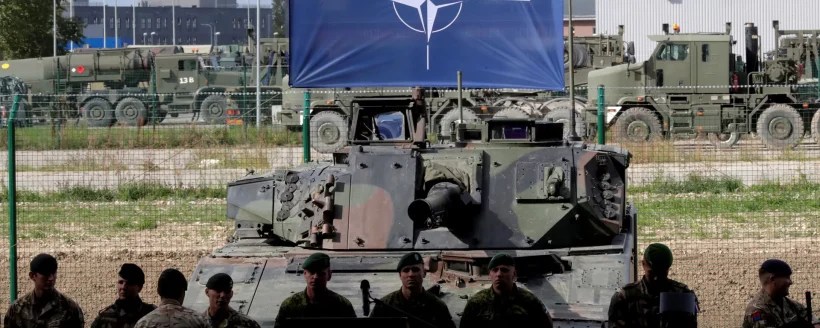
Even before the Ukraine conflict escalated in February 2022, Britain, Sweden, Canada, and the United States were investing in Ukraine and building up their capabilities, the UK defense minister has stated at the NATO summit in Vilnius. Does it mean NATO has long prepared for a proxy war with Russia?
The US neocons and their likeminded NATO allies have long been apparently seeking to knock Russia out of the political arena before trying to crack down on China in a bid to preserve the US dominance, retired US Air Force Lt. Col. Karen Kwiatkowski believes.
“I think that the US officials and advisors (along with those in NATO) believe that they must be able to exploit Russian resources prior to any direct confrontation with China,” Kwiatkowski, who is also a former analyst for the US Department of Defense, told Sputnik. “The neoconservative ideology that over half of Congress embraces, and that the US defense and security complex embraces, envisions and demands a unipolar globe, with the US and its debt-funded governmental system, at the top. For them, this is an existential issue, albeit most Americans don’t see it that way.”
It seems that Ukraine appeared a convenient candidate for the role of a “hammer” against Russia.
For How Long Has Ukraine Received Western Military Assistance?
Ukraine has been a leading recipient of Western military supplies since the early 1990s when the country gained independence, with the US spearheading the initiative. In the first ten years after independence, Ukraine received almost $2.6 billion in assistance from the US. Until 2014, Ukraine had been receiving an estimated $105 million per annum, including foreign military financing.
NATO’s North Atlantic Cooperation Council embraced Ukraine as a “partner country” in 1991 and included it in the Partnership for Peace program in 1994. Washington’s NATO ally, the UK, played an important role in the effort, holding joint military exercises with the Ukrainians, as well as providing training and funding to the nation’s armed forces.
Thus, the first joint Ukrainian-British military exercises “Cossack steppe” were held in the second half of the 1990s as part of NATO’s Partnership for Peace program. The NATO-Ukraine Commission was established in 1997 with the aim of developing the relationship between the nation and the bloc and directing cooperative activities.
As per UK government documents, the Ministry of Defense spent approximately £3.9 million supporting Ukraine through the Defense Assistance Fund and the Conflict Pool between 2009 and 2014.
Many of the activities funded through these mechanisms supported “command, control and communications capabilities (C3).” In particular, the UK held joint exercises with the Ukrainian military, provided military education to the nation’s specialists, and “contributions to NATO coordinated activities.” Both UK civilian and military personnel had been deployed to Ukraine during that period of time while Ukrainian personnel were sent to the UK.
Following the illegitimate coup d’etat in Kiev in February 2014, the West stepped up military assistance to the new Ukrainian authorities.
Between 2014 and 2021, the United States provided over $2.5 billion in military assistance to Ukraine, which included the provision of trainers, selected weaponry systems (such as counter-mortar radars), and Javelin anti-tank missiles.
The boost in military assistance was justified by NATO member states by the alleged “Russian invasion” in Donbass. However, it is well documented that Donbass declared independence in response to the illegitimate coup d’etat in Kiev fomented with the assistance of nationalist and neo-Nazi paramilitary groups and subsequent Russophobic policies of the new government. The Donbass breakaway Donetsk and Lugansk Republics started largely forming militias after the interim Kiev government kicked off what it called “anti-terrorist” operations (ATO) against the region.
“Kiev had been on the offensive with the Donbass with Western support, for a number of years, even before 2014, and this is well documented,” explained Kwiatkowski. “Other Eastern and Southern European countries had been ‘encouraged’ by Western powers, as we saw with Yugoslavia, to break up into smaller national and ethno-cultural countries, and the peaceful divide between the Czech Republic and Slovakia was also allowed and supported. This is primarily because the newly smaller countries added potential members to NATO and the EU – all controlled and controllable by the US-EU elites.”
Moscow came up with the idea of the Minsk Agreements to stop hostilities in Eastern Ukraine. Russia, France and Germany played the role of guarantors of the accords.
Nonetheless, as ex-German Chancellor Angela Merkel and former French President François Hollande admitted last year, the Minsk agreements were signed by Western powers to buy time in order to bolster the Ukrainian military capacity.
“In the case of the political separation desired by the Donbass, and the Minsk agreements that were designed to allow that autonomy, the Russian-speaking East, if autonomous, would not have chosen to be a part of the NATO borg,” said the former Pentagon analyst. “Hence, that independence would not be allowed. Yes, NATO and the US supported such an offensive, and were preparing for it actively, as comments from many US and European officials and diplomats have confirmed. Assistant US Secretary of State Victoria Nuland and former German Chancellor Angela Merkel have publicly confirmed this, as have many others.”
Ukraine Extensive Training and Naval Provocations
US allies jumped on the bandwagon, forwarding their military assistance to Ukraine through the NATO-Ukraine Commission, and through initiatives such as the US/Canada/UK/Ukraine Joint Commission for Defense Reform and Security Cooperation which was established in July 2014.
In particular, Britain kicked off and then expanded Operation Orbital, envisaging extensive training of the Ukrainian military including combat actions in urban environments.
These activities included:
· medical, infantry and survival skills training;
· countering improvised explosive devices;
· training for defensive operations in an urban environment;
· operational planning;
· engineering;
· countering attacks from snipers, armored vehicles and mortars.
It meant that those Ukrainian soldiers that had undergone training under the program would pass on their knowledge and techniques to their military peers. Britons also expanded the scope of the training package to embrace all branches of Ukraine’s Armed Forces.
In June 2020, Ukraine was offered Enhanced Opportunity Partner status with NATO which provided Ukraine with preferential access to NATO’s exercises, training and exchange of information and situational awareness. The status envisaged increasing interoperability between Ukraine and NATO member states. In September 2020, Ukraine hosted the Exercise Joint Endeavour with British, US and Canadian troops, held within the framework of Ukraine’s new enhanced NATO status.
In June 2021, the UK, Ukraine and industry signed a Memorandum of Implementation to a new Naval Capabilities Enhancement Program (NCEP). The program in particular included:
· Ukraine’s acquisition of two refurbished Royal Navy Sandown-class minehunters;
· the sale and integration of missiles on new and in-service Ukrainian Navy patrol and airborne platforms, including a training and engineering support package;
· The UK’s assistance in building new naval bases in the Black and Azov Seas;
· the development and joint production of eight fast missile warships;
· The participation in the Ukrainian project to deliver a modern frigate capability.
The same month, the UK Carrier Strike Group led by HMS Defender was deployed in the Black Sea “in a show of solidarity with Ukraine” and illegally entered Russian waters off Crimea and proceeded to sail through, prompting Russian warships and aircraft to surround the ship and fire warning shots in its vicinity to force it to leave. Even though the UK initially denied that it resorted to deliberate provocations, leaked British government documents proved otherwise.
Russia’s Draft Security Agreements
Russia has repeatedly raised the red flag over the NATO-Ukraine rapprochement and the transatlantic bloc’s enlargement. In accordance with its Declaration of State Sovereignty (July 16, 1990) Ukraine pledged to permanently remain a neutral country. In addition, in the early 1990s, Western powers asserted to Moscow that NATO wouldn’t expand towards Russia. At the same time, the US and its allies refused to consider Russia’s bid to join NATO while encouraging former Soviet Republics and Warsaw Pact member states to join.
Russia outlined its longstanding concerns with regard to Ukraine’s military buildup on its doorstep and NATO’s expansion in draft security agreements which were handed over to the US and NATO in December 2021.
The agreement particularly sought guarantees of NATO’s non-enlargement and non-admission of Ukraine to the bloc. The US and NATO rejected the major provisions of the agreement leading to Russia’s special military operation aimed at de-militarizing and de-Nazifying Ukraine in February 2022.
Ukraine Conflict is US/NATO Proxy War Against Russia
Even though in March 2022, Ukraine and Russia struck a preliminary deal in Istanbul to stop hostilities, the US and the UK openly opposed the agreement, pledging more weapons to Kiev and declaring the goal of bleeding Russia white.
“The US is waging a proxy war, because that is what the US has been waging against various named enemies, for the past 70 years, and it is how we are organized to fight,” said Kwiatkowski. “It is an open secret that the Pentagon, even with close to a trillion dollar budget, does not and, at this point, cannot defend US territory. The US elites and the US defense establishment self-perpetuation is wholly disconnected from the people here who pay its bills. Poor and non-strategic US leadership placed the US in a lose-lose situation.”
According to the US military expert, three problems have emerged in the result of Washington’s misreading of the Russia and Ukraine conflict:
· First, that intent of weakening and isolating Russia did not play out “as it must have done in Jake Sullivan’s brainstorming sessions.”
· Second, the supplies have illustrated a variety of strategic weaknesses in US and NATO defense industrial production, where we see Joe Biden actually stating the obvious that the “US is out of ammunition.”
· Third, taking the Ukraine-Russia destruction project on at a time when the US is experiencing financial weakness, with very limited reserves of gold, guns and “war spirit” demonstrates that the “war planning” of the White House and Pentagon has been done in a vacuum, and under false assumptions.
As per Kwiatkowski, peace is possible but it may require a difficult re-evaluation of the US role in the world while neocons and war profiteers do not accept this re-evaluation.
“Their ideology is mated to unipolar US power,” the US military veteran said. “I suspect some leaders in the West are beginning to understand that there is a way to peace, and it starts with acceptance of the truth of all sides, and negotiations based on that truth. Imagine a sane US government, a concerned NATO, a true patriot of Ukraine in Kiev, and the Russians all speaking honestly. As Trump stated months ago, this war could be ended in one day.”
Stoltenberg admits NATO began preparing Ukraine for war with Russia since 2014
By Ahmed Adel | July 13, 2023
NATO Secretary General Jens Stoltenberg admitted that the alliance had prepared Ukraine for war with Russia since 2014. At the same time, French Defence Minister Sébastien Lecornu announced on July 12 that the French military has already trained 5,200 Ukrainian troops and plans to train a total of 7,000 troops by year’s end.
“France’s support for Ukraine is not weakening. […] Almost 5,200 Ukrainian soldiers have already been trained by France, including 1,600 in Poland. There will be almost 7,000 by the end of the year,” Lecornu tweeted.
According to Lecornu, Ukrainian troops are learning how to operate French military equipment transferred to them and practice modern combat tactics, such as forming battalions that can manoeuvre as a coherent tactical unit.
Meanwhile, the British government announced that more than 19,000 Ukrainian soldiers had been trained in the country over the past six months and that Ukraine can expect more material support.
“In the past six months, the UK has also expanded its military training programme for Ukrainian recruits. This programme has trained more than 19,000 soldiers to date and training for Ukrainian pilots in the UK will begin this summer,” the British government said in a statement.
The UK, through NATO, also plans to establish a medical rehabilitation centre “to support the recovery and return of soldiers to Ukraine’s lines of defence after being injured in combat.”
“[The British PM announced a] major new tranche of support for Ukraine, including thousands of additional rounds of Challenger 2 ammunition, more than 70 combat and logistics vehicles and a £50m support package for equipment repair,” the statement added.
Although these announcements are recent revelations, NATO training of the Ukrainian military is not new. Stoltenberg said that the Alliance began supporting the Ukrainian military long before the start of the war.
“I welcome the military support that Allies have provided now for months, actually starting back in 2014,” Jens Stoltenberg told a press conference after the first day of the Alliance summit.
The NATO chief had previously confessed that Western military preparations began nine years ago.
“Since 2014 […] NATO has implemented the biggest reinforcement of our collective defence in a generation. With, for the first time in our history, combat ready troops in the eastern part of the Alliance, with higher readiness, with more exercises, and also with more defence spending,” he said on May 24. “So when President Putin launched his full-fledged invasion last year, we were prepared.”
In a joint statement after the first day of the summit in Vilnius, NATO leaders declared that the deepening partnership between China and Russia is contrary to the values and interests of the alliance.
For his part, Russian President Dmitry Peskov said, before referencing NATO as an alliance that is “aggressive in nature,” that Moscow-Beijing relations “have never been aimed against third countries or alliances in any way”
Peskov said that NATO “is not an alliance that was conceived, created, and built with the goal of ensuring stability and security. It is an offensive alliance. It is an alliance that breeds instability and aggression.”
During the NATO summit’s first day, member countries agreed to bring Ukraine closer to the alliance. However, the concrete provisions proposed to achieve this disappointed Ukraine. It was not lost on major outlets, such as the New York Times, that Zelensky criticised NATO’s attitude.
Zelensky regretted in a tweet the “uncertainty” and “weakness” of NATO before the summit even started. “It seems there is no readiness neither to invite Ukraine to NATO nor to make it a member of the Alliance,” the tweet added.
Considering the humiliation Zelensky has experienced for being photographed isolated and alone at the NATO summit while member leaders talked amongst themselves, the Kiev regime should have realised that they are being used as nothing more than pawns in a now failed attempt to weaken and contain Russia.
It is evident that NATO is doing all it can to support Ukraine, short of using member states’ conventional militaries, and will continue with such a policy until at least the end of 2023, as the French and British announcements demonstrate.
Nonetheless, despite this support from France and Britain, Zelensky chastised NATO’s wider admission policy as “absurd,” prompting even UK Secretary of Defence Ben Wallace to highlight that Kiev does not express enough “gratitude” for the support it receives. Yet, this constant humiliation and the complete destruction of its military and economy has not been enough for the Kiev regime to realise that it is nothing more than an expendable proxy for NATO.
Ahmed Adel is a Cairo-based geopolitics and political economy researcher.
More grumbling from Zelensky because NATO doesn’t want direct war with Russia
By Drago Bosnic | July 13, 2023
In early October last year, Kiev regime frontman Volodymyr Zelensky called on NATO to launch a “preemptive nuclear strike” on Russia in order to “rule out the possibility of using nuclear weapons”. At the time, the mainstream propaganda machine tried everything in its power to present his words as allegedly “misinterpreted”, but since there is actual footage of it, we’ll let you decide if he genuinely said so:
“What should NATO do? Eliminate the possibility of Russia using nuclear weapons. But what is important, I once again appeal to the international community, as it was before February 24: pre-emptive strikes, so that they know what will happen to them if used. And not vice versa – wait for Russia’s nuclear strikes, then to say: ‘Oh, you are so, well, keep it from us!’ Reconsider the application of their pressure, the procedure for applying,” Zelensky said during a video conference with the Australian Lowy Institute.
While the aforementioned propaganda narrative tried to whitewash (a standard practice for virtually anything the Neo-Nazi junta does) his statement about these “preemptive strikes” by claiming these supposedly “wouldn’t be nuclear”, this is openly implied in the comment itself. How else would it be possible to launch strikes against a nuclear power, much less the one with the world’s most powerful thermonuclear arsenal?
Why is this relevant now, approximately ten months later? Zelensky’s unhinged commentary is deeply dividing for virtually all NATO members, as none of them wants to be destroyed in minutes for the sake of a corrupt Neo-Nazi regime. The ongoing NATO summit in Vilnius makes Zelensky look no less delusional, as he threw yet another tantrum, complaining that the political West is “not doing enough” because it doesn’t want to make a firm promise to let the Kiev regime into NATO. Apparently, he is “deeply frustrated” with the regular pattern of the belligerent alliance making “pledges”, giving billions in so-called aid (over $170 billion, to be exact), promising to deliver F-16 fighter jets, while also expanding its military infrastructure in Eastern Europe.
Although NATO promised it will remove the Membership Action Plan (MAP) requirement for the Neo-Nazi junta, an unprecedented move by the aggressive alliance, Zelensky was still “furious at the alliance’s soft language on full membership”. He threw a fit at NATO, particularly at the United States, for refusing to lay out “a clear path” for the Kiev regime’s membership. NATO Secretary-General Jens Stoltenberg previously promised to push for a fast-tracked process that would be implemented at some point in the future, when the belligerent alliance decides “it’s ready to seriously consider” the Neo-Nazi junta’s membership application. This explains why the MAP requirement was dropped.
What makes the move unprecedented is the fact that the MAP was a virtually mandatory agreement that all other NATO candidates had to implement since 1999. However, once again, this was “not enough” for Zelensky. Just before arriving in Vilnius and meeting there with Biden, Zelensky grumbled at all those “not ready” to make the membership happen as soon as possible (which is “now” according to his “logic”):
“This looks like there’s neither readiness to invite Ukraine to NATO nor make it a member of the alliance.”
He stated that “such an unprecedented and absurd outcome leaves an opportunity to make Ukraine’s NATO membership bid a trading chip in potential negotiations with Russia”, adding that “certain wording is being discussed without Ukraine” and that “all of this only plays into Russia’s hands”. He effectively accused his geopolitical masters of “opening the door for Russia to continue its terror”, saying:
“While at the same time vague wording about ‘conditions’ is added even for inviting Ukraine. It seems there is no readiness neither to invite Ukraine to NATO nor to make it a member of the Alliance. This means that a window of opportunity is being left to bargain Ukraine’s membership in NATO in negotiations with Russia. And for Russia, this means motivation to continue its terror. Uncertainty is weakness. And I will openly discuss this at the summit.”
Amid the embarrassingly disastrous performance of NATO weapons in the failed counteroffensive by the Kiev regime forces, the summit serves to present the belligerent alliance as “united”, although it’s more than clear that there are no battlefield successes the political West was desperate for its favorite puppet regime to achieve. Thus, yet another bureaucratic “success” was presented as “crucial” for the Neo-Nazi junta’s “eventual membership”, after “all conditions are met”. And the condition is – Kiev must defeat Moscow. This means that the much-touted NATO membership will certainly not happen at the Vilnius summit or anytime soon, as the belligerent alliance simply cannot give the Neo-Nazi junta any sort of security guarantee.
President Biden himself stated that the membership plan cannot be seriously considered until after the conflict is over, clearly implying that NATO’s Article 5 would be the main obstacle in the Kiev regime’s bid for membership.
“I don’t think there is unanimity in NATO about whether or not to bring Ukraine into the NATO family now, at this moment, in the middle of a war,” Biden told CNN just before going to Vilnius, adding: “For example, if you did that, then, you know – and I mean what I say – we’re determined to commit every inch of territory that is NATO territory. It’s a commitment that we’ve all made no matter what. If the war is going on, then we’re all in war. We’re at war with Russia, if that were the case.”
Rationality and Joe Biden are certainly not words one would expect to see in the same sentence, but in this case, at least some credit should be given to the US president, as this stance is the only rational one a leader of a global power can be expected to have. However, precisely this is what Zelensky is criticizing as a supposed “weakness”. For him, the “only rational” thing NATO should do is go into a full-scale war with Russia.
Drago Bosnic is an independent geopolitical and military analyst.
What are SCALP Missiles and How May They Affect Ukraine’s Counteroffensive?
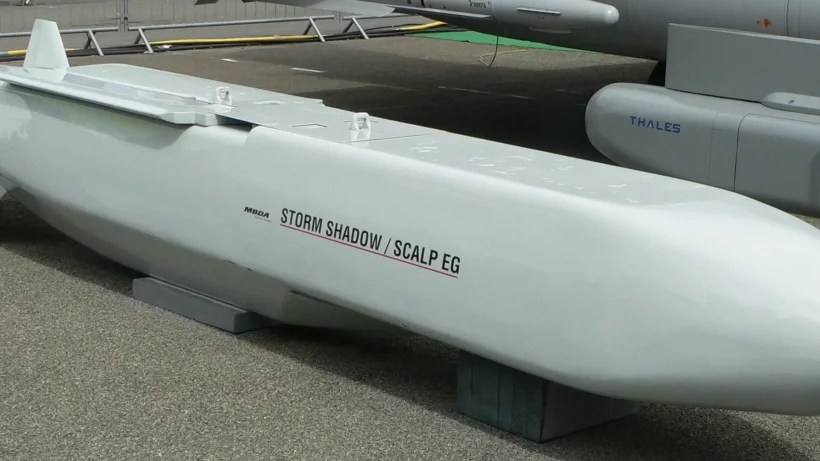
CC BY-SA 3.0 / David Monniaux / Storm Shadow missile
By Ekaterina Blinova – Sputnik – 12.07.2023
French President Emmanuel Macron’s decision to provide Ukraine with SCALP long-range cruise missiles won’t affect the existing status quo given the experience the Russian military gained while thwarting the weapon’s analog called “Storm Shadow”, a Russian military expert told Sputnik.
During the NATO summit in Vilnius, President Emmanuel Macron committed to providing dozens of SCALP long-range missiles to Ukraine. However, the French president did not specify when the weapons would be delivered to Kiev. France has become the second country, after the UK, to equip Ukraine with long-range rockets.
“In light of the situation and the counteroffensive being conducted by Ukraine, I have decided to increase deliveries of weapons and equipment and to provide the Ukrainians with deep strike capabilities,” Macron told journalists upon arrival at the summit.
What is the Difference Between SCALP and Storm Shadow?
The SCALP-EG (Emploi Général, meaning General Purpose) is a French name for “Storm Shadow,” the stealthy air-launched long range, conventionally armed, deep strike weapon, produced by European multinational missile-maker MBDA. The missile was based on the Apache, a French-developed, air-launched, anti-runway cruise missile.
“The French SCALP rocket is actually a joint development of Great Britain and France,” Russian military expert Yury Knutov told Sputnik. “And therefore, many aspects related to the production and use of these missiles are unified. Figuratively, we can say that the SCALP rocket is an analog of the British Storm Shadow.
What is the Range of a SCALP/Storm Shadow Missile?
“The only difference [between the SCALP and Storm Shadow] is the flight range. The export version of the Storm Shadow has a range of approximately 300 kilometers. The export version of the French missiles has a range of approximately 250 kilometers,” Knutov explained.
The SCALP is powered by a turbojet at Mach 0.8 (987.8 km/h). It weighs 1300 kg which includes a conventional warhead of 450 kilograms. The weapon’s length and diameter are 5.10 meters and 0.166 m, respectively, with a wingspan of 3 m. The missile costs approximately $3.19 million per unit.
How Do SCALP and Storm Shadow Operate?
The SCALP is a “fire-and-forget” missile, meaning that it is programmed before launch. Having been launched the missile cannot be controlled: it follows its path semi-autonomously. Close to its target, the weapon climbs to a higher altitude to maximize the odds of penetrating the target. Finally, it hits the target before a delayed fuse explodes the main warhead.
“If we are talking about the combat use of these cruise missiles, then we should not forget that this is a high-precision weapon,” said Knutov. “[The missile’s] warhead weighs over 400 kilograms and it is quite powerful. There are concrete-piercing variants with a special high-strength rod inside the rocket; together with the explosive, it allows one to pierce concrete ceilings up to 1.5 meters in thickness. And most importantly, the accuracy of hitting these missiles is very high.”
How Are SCALPs and Storm Shadows Carried?
The weapon can be carried by the Tornado GR4, Italian Tornado IDS, Eurofighter Typhoon, Dassault Mirage 2000 and Dassault Rafale aircraft. It was used by the UK, France and Italy in the Gulf, Iraq and Libya attacks.
When it comes to Ukraine, it was earlier reported that the nation’s air force would use the Su-24 – a supersonic, all-weather tactical bomber developed in the Soviet Union – for launching the Franco-British weapon. Initially, pictures released by the Ukrainian media showed a Su-24 with a Storm Shadow placed under the fixed-wing “glove” pylon. Ukraine’s Su-24 combat and Su-24MR reconnaissance warplanes have been modified to fire the stealthy long-range missile.
Can Russia Intercept SCALP and Storm Shadow Missiles?
The missile is very difficult to detect due to its extremely small radar cross-section (RCS), according to Knutov. “That is, the Storm Shadow [SCALP EG] has a radar cross-section of 0.01 to 0.03 square meters, which is very small,” he said.
Nonetheless, Russia’s air defenses are capable of detecting and destroying the Storm Shadow/SCALP cruise missiles, Knutov underscored. The Ministry of Defense has repeatedly reported about intercepting the Franco-British stealthy long-range missiles.
What’s more, Russian forces’ recent capture of a Storm Shadow missile may prove invaluable for studying ways to defeat the weapon. The rocket was shot down in the Zaporozhye region and remained mostly intact. Dissecting the missile could uncover its potential weaknesses and determine the optimal direction from which to strike the cruise missile with an interceptor.
“After our military was able to capture such a cruise missile, we now have more opportunities to study it, determine the composite materials from which the body is made, deal with the homing head: the frequencies at which it operates, and the principle of operation of this homing head,” said Knutov.
According to the military expert, that will allow Russia to improve its radars and missile guidance stations to better detect the stealthy missiles. He explained that studying the body of the rockets is important, because the Russian engineers will be able to see which range of radio waves transmitted by the missile is radio-transparent and which is partly reflected. “It will be possible to create electronic warfare systems that will more effectively affect the homing heads of both Storm Shadow and SCALP missiles,” Knutov said.
“I think that in the next month or two we will see that our air defense will operate more effectively [against SCALPs]. Moreover, electronic warfare stations will be mainly used, which is much cheaper than firing projectiles to intercept these cruise missiles,” he projected.
How Many SCALPs is France Sending to Ukraine?
In his statement, Macron did not specify the number of missiles, but Western media cite sources saying that France may deliver 50 units to Ukraine.
“If we are talking about 50 missiles (…) one should bear in mind that it could be more than 50,” Knutov said. “This may be a leak that is organized for the media. Of course, they play a certain role, because now the NATO bloc is trying to help the Kiev regime to somehow break through our defense line.”
Will SCALP Make a Difference on the Ukrainian Battlefield?
NATO is sending longer-range missiles to strike Russia’s personnel, ammo, equipment, and command posts which are currently kept at a distance of over 100 km from the frontline, according to the expert.
The US-made HIMARS are launching rockets with a strike range of 80 km which is not enough in the eyes of NATO war planners to exert pressure on the Russian Armed Forces. NATO member states sending missiles with a range of 300 kilometers, like Storm Shadow/SCALP (or, potentially, the US-made ATACMS), pose a certain challenge to the Russian military, the expert noted.
“But it is not critical, and the maximum that it can affect is the timing of the combat missions that Russia’s [military] units face,” Knutov concluded.
Here’s why the US may never allow Ukraine to join NATO
Kiev has to face up to some bad news – for the first time, NATO enlargement has become a threat to Washington itself

By Timofey Bordachev | RT | July 12, 2023
The Ukrainian crisis marks the first time in history that the United States has exposed itself to serious risks in defining the limits of its military presence in Europe. Any genuine move by Washington to invite Kiev into NATO would imply a willingness to enter into a direct military confrontation with Russia. A less risky option, many believe, would be to promise the Vladimir Zelensky regime some special bilateral guarantees.
The NATO military bloc was created on the basis of the real division of Europe into zones of influence between the US and the USSR after the Second World War. As a result of the greatest armed confrontation in the history of mankind, the bulk of European states lost forever the ability to determine fundamental issues of their national policy. These included, first and foremost, defense and the ability to form alliances with other countries. Europe was divided between the real winners of the conflict – Moscow and Washington. Only Austria, Ireland, Sweden, Finland and a small part of Switzerland were outside their zone of dominance.
Both of the great powers had an informal right to determine the internal order of the territories under its control. This was because the countries concerned had lost their sovereignty as such. Even France, which continued to demonstrate freethinking for several decades, had no doubt on whose side it would fight in the event of a new global conflict.
NATO was created in 1949 to formally deprive American allies of the ability to make their own foreign policy decisions and military doctrines. In this respect, the alliance was no different from the Warsaw Pact that had emerged in the USSR’s sphere of influence.
The relationship between the United States and other NATO countries has never been an alliance in the traditional sense. In the last century, classic alliances ceased to exist altogether – the gap in military capabilities between the nuclear superpowers and every other country in the world became too great.
A military alliance between relative equals is possible, as it was until the middle of the last century, but nuclear weapons have made this impossible. The former sovereign states of Europe became a territorial base from which the great powers could negotiate in peace and act in war. The creation of NATO and the subsequent accession of countries such as Greece, Turkey, Spain and West Germany to the alliance was a formalization of the boundaries of US dominance that the USSR had already agreed to in bilateral relations.
After the Soviet collapse, extending American rule to Moscow’s former allies in Eastern Europe and even the Baltic republics was also not a policy that posed serious risks for Washington. Incidentally, this is why NATO has an informal rule of not admitting countries with unresolved territorial disputes with third states – the US has never been willing to occupy land whose ownership is disputed. NATO’s post-Cold War expansion was based on deception, with the US promising Moscow that it would not expand NATO to Russia’s borders. But, initially, Russia did not have the physical strength to resist. This meant that the US could occupy “unclaimed” states without the threat of immediate military conflict. The US approach to NATO remained true to the philosophy of the 1945 victors: there are no sovereign states, only controlled territories.
Once the decision was taken in Washington, it was only a matter of strategy to ensure that local governments made the “right” decisions. This was all the more so as the accession of new countries to NATO in the 1990s and 2000s was ‘packaged’ with the enlargement of the European Union. This gave local elites every reason to aspire to join the bloc, from which they expected tangible material benefits. For some – the Baltic states and Poland – membership in the club also provided the possibility of solving internal problems through an aggressive anti-Russian policy by fostering fear of the big neighbor to the east. In the Baltic states, the status of an American outpost was also used by elites to combat any local opposition from radical nationalists.
For the countries that joined the bloc, NATO became a guarantee of internal stability. Since the most important decisions for them were taken outside their national political systems, there was no reason for internal competition and no danger of serious destabilization.
Of course, no country is safe from minor internal political disturbances, such as those caused by a change of government – especially if the one in power is not liked by the US. But radical changes, which generally involve foreign policy issues, have become impossible.
In this sense, Western Europe increasingly resembles Latin America, where the quality of life of the population doesn’t have dramatic consequences for the elites. There, geographical proximity to the US has long been a reason for almost total American control. The only exceptions have been Cuba and, in recent decades, Venezuela. In Western Europe, because of Russia’s proximity, this control is of a formal nature, which should in principle rule out any surprises.
Joining NATO is an exchange of state sovereignty for the indefinite retention of power by the ruling elite. This is the secret of every political regime’s desire to join the bloc: it gives them the possibility of “immortality” in spite of any domestic or economic failures. The regimes in Eastern Europe and the Baltics immediately realized that they would not last long in power without being under Washington’s control – the break with Moscow and the peripheral position of their countries promised them too many problems. And the reason Finland joined NATO is that the local elites no longer have confidence in their ability to hold power on their own.
For the United States itself, as we have seen, the expansion of its presence has never posed any serious threat or risk. At least until now. This is precisely what is being pointed out by those in America who are calling for a careful approach to be taken in response to the demands of the authorities in Kiev for membership. A call which is supported by some members of the bloc.
It is understood that a military clash between Moscow and NATO would mean global nuclear war. Nevertheless, back in the Soviet period, the US believed that any conflict with the USSR could be confined to Europe and would not involve direct attacks on each other’s territory. There is reason to believe that Moscow felt the same way during the Cold War.
NATO’s eastward expansion after the Cold War was a case of acquiring territories for which no one wanted to fight. However, in the situation of Ukraine, for the US is not a question of gaining territory, but rather of taking it from a rival power that wants to keep Washington out. This has never happened in the history of NATO, and one can understand those in Western Europe and the US who are calling for serious consideration of the likely consequences.
Inviting Kiev to join NATO could mean something entirely new for American foreign policy – a willingness to fight a peer adversary like Russia. Throughout their history, Americans have shied away from this, using other players as battering rams willing to sacrifice and suffer for American interests. This was the case in both the First and Second World Wars. The most likely scenario, therefore, is that the US will limit itself to promising to address the issue of Ukraine and NATO after the Kiev regime has resolved its problems with Russia in one way or another. In the meantime, it will only be promised some “special” terms on a bilateral basis.
Timofey Bordachev is the Valdai Club Programme Director.
Featured Video

HE SAVED LIVES. NOW HE FACES PRISON.
or go to
Aletho News Archives – Video-Images
From the Archives
NATO Sanctions and the Coming Global Diesel Fuel Disaster
By F. William Engdahl – New Eastern Outlook – 11.04.2022
Amid the ongoing global inflation crisis, NATO heads of state and mainstream media repeat a mantra that high energy prices are a direct result of Putin’s actions in Ukraine since end of February. The reality is that it is the western sanctions that are responsible. Those sanctions including cutting SWIFT interbank access for key Russian banks and some of the most severe sanctions ever imposed, are hardly having an impact on the military actions in Ukraine. What many overlook is the fact that they are increasingly impacting the economies of the West, especially the EU and USA. A closer look at the state of the global supply of diesel fuel is alarming. But Western sanctions planners at the US Treasury and the EU know fully well what they are doing. And it bodes ill for the world economy.
While most of us rarely think about diesel fuel as anything other than a pollutant, in fact it is essential to the entire world economy in a way few energy sources are. The director general of Fuels Europe, part of the European Petroleum Refiners Association, stated recently, “… there is a clear link between diesel and GDP, because almost everything that goes into and out of a factory goes using diesel.” … continue
Blog Roll
 Aletho News
- Trita Parsi: Middle East Unraveling — Are We on the Path to World War?
- Iran FM meets with US envoy on UN meeting’s sidelines at American side’s insistence: Report
- Qatar PM calls for Gulf security framework with Iran, says war must be ‘wake-up call’
- China condemns US extortion of Iranian airlines, rejects Washington’s ‘illegal’ sanctions threats
- Italy to move military personnel from Taif base after missile strike
- Finland’s Stubb tells European leaders to calm down
- Defeating Russia on battlefield impossible – Fico
- Finland’s Gender Clinic Reversal
- Massachusetts Wants Mental Health Visits, Why Does Government Use ‘Health’ to Enter Our Homes & Families?
- US lawmaker admits American people footing bill for Trump’s failed aggression against Iran
- If Americans Knew
- Sanctions are collective punishment: immoral and self-defeating
- Phosphorus Munitions Fired by Israel Burn Groves, Orchards in Southern Lebanon
- Israel Carries Out New Ceasefire Violations Across Gaza
- AI – Emphasis on the ‘I’: Israel Is Funding AI Chatbot Propaganda
- Israel Blocking Hundreds of Wheelchairs for Injured Children From Entering Gaza
- Israel Is Expanding and Upgrading Compounds for Palestinian Militias in Gaza
- The Palestinian-American Residents of This West Bank Town Are Wondering: Where Is Trump?
- Gaza desperately needs tents, wheelchairs, fuel… and everything else (Israel blocks it all) – Daily Update
- Israeli Attacks in Gaza Kill at Least Seven Palestinians Over Three Days, including Woman and Child
- Trump’s militarization of Washington DC as he pursues Israel’s war against Iran
- No Tricks Zone
- New Study: Earth And Venus Surface Warmth Largely Explained By Convection And Lapse Rate, Not CO2 Or Radiation
- 2025 Nature Paper Claiming Worsening Global Drought Gets RETRACTED …Heavily Flawed
- New Study: ‘Global Drought Shows No Detectable Recent Acceleration Under Climate Warming’
- Economic Masterminds: German Socialists Suggest Taxing Productivity Gains Stemming From Using AI
- The South China Sea Has Not Been Cooperating With The Climate Change Narrative
- Energy Crisis: Germany Enters Heating Season With Historically Low Gas Reserve Fill Levels
- New Study: The Antarctic Ice Sheet Gained Mass From 2020-2024 Due To Staggering Snow And Ice Accumulation
- Study: Ocean Heating Rates From Thousands Of Years Ago ‘Dwarf’ Modern Ocean Heating Rates
- Climate Extremists Target, Attack Large-Scale Power Grid Infrastructure In Germany!
- New Study: Antarctic Ice Melt Has Contributed Less Than 1 Centimeter To Sea Level Rise In The Last 30 Years

