Ukraine is ammunition-starved, and the West simply cannot keep up with its pledges
By Uriel Araujo | July 24, 2023
While Western discussions have focused on sending sophisticated weapons to Kiev, Hal Brands, a Henry Kissinger Distinguished Professor at Johns Hopkins University School of Advanced International Studies, argues that what Ukraine needs the most, besides air-defense systems, is artillery ammunition. He describes the current conflict as an artillery-centric one: “if Kiev can’t find enough artillery pieces and ammunition, especially 155mm shells, it will be at a dire firepower deficit along the conflict’s front lines.”
Already on March 29, Earle Mack, former US ambassador to Finland, writing in a piece for The Hill, described the current confrontation as proxy attrition warfare, that is one which seeks military victory by wearing down the enemy. He worried that Ukraine seemed bound to tire out first. Things have not gotten much better for Kiev, so far.
A July 23 New York Times story, by former Marine infantryman Thomas Gibbons-Neff, based on “dozens of visits to the front line” quotes a Ukrainian commander: “we’re trading our people for their people and they have more people and equipment.” According to the story, “Ukraine has made marginal progress in its ability to coordinate directly between its troops closest to Russian forces on the so-called zero line and those assaulting forward.” Moreover, the country’s artillery is in short supply, and “a mixture of munitions sent from different countries” is employed. The thing is that accuracy varies greatly between them and the Ukrainians need to use more ammunition. In addition, according to the same news report, “some of the older shells and rockets sent from abroad are damaging their equipment and injuring soldiers.”
Rather than using the complex military communication equipment, Ukraine’s troops employ “less sophisticated, but easier-to-use programs like smartphone messaging apps, private internet chat rooms.” Most of this system is dependent on Starlink satellite internet, and therefore it takes longer to communicate important military information when the units are assaulting and a Wi-Fi router is absent. In this case, unbelievably, “attacking troops have to reach someone with an internet connection to call for support.”
Regarding ammo, the problem is that US authorities themselves estimate that Moscow is capable of producing “1 million rounds of 152mm artillery ammunition per year.” The US, in contrast, produces merely a seventh of that, according to Hal Brands.
Right now, the US itself needs to purchase conventional artillery ammunition from its South Korean ally. In what Brands describes as a “desperate global scavenger hunt for munitions”, Washington has also been seeking ammo from Japan, as well as “repositioning rounds stored in Israel to Ukraine.”
Europe’s stockpiles are in no better shape. According to the International Institute of Strategic Studies, NATO European states armed forces are “hollowed out, plagued by unserviceable equipment and severely depleted ammunition stocks.” Bloomberg’s journalist and military historian Max Hastings writes that, over a year ago, Berlin had committed itself to €100 billion to rebuild its worn out forces. So far, however, only an estimated 1% of that has been spent. The German National Security Strategy, last month, stressed the weakness of Germany’s economy. According to Hastings, the “political will” to strengthen their armed forces is “absent” not only in Germany, but also in other European countries.
As I wrote before, the problem for Europe goes way beyond depleted weapons stockpiles: for it to rearm itself, re-industrialization is badly needed, something which, quite ironically, Washington itself has consistently opposed via its subsidy war against the European bloc. In addition, Europe, with its heavily diffused and fragmented defense, lacks a European Union common defense market and a legal and bureaucratic framework, as Sophia Besch (a Carnegie Endowment for International Peace fellow), and Max Bergmann (former member of the US Policy Planning Staff and Director of the Eurasia Program at the Center for Strategic and International Studies) write.
Britain’s industry today faces many difficulties, and the same thing happens with other European nations – manufacturers badly need funding expansion and governments are increasingly growing “tired” of the conflict’s costs.
As for the US, lecturer in History at Yale Michael Brenes argues that America’s own “war machine” is “broken”, with privatizations and several problems. He paints a picture of “shortages in production”, and “interruptions in supply chains”, all of which have compromised Washington’s ability to “deliver weapons to Ukraine.”
To sum it up, the current state of affairs, with a Western deindustrializations crisis, makes it very difficult for the political West to pursue its proxy attrition war. It simply cannot produce all the weapons it is pledging Ukraine. For the West, in fact, it is already a challenge to provide Kiev with enough ammunition.
Discarding Illusions, Ending Wars
By Colonel (ret.) Douglas Macgregor, US Army | The Kennedy Beacon | July 20, 2023
From the moment the war in Ukraine started, Western reporting on the war was a radical repudiation of the truth. Washington and its NATO allies always knew that NATO expansion to Russia’s borders would precipitate an armed conflict with Moscow, but NATO’s ruling globalist class did not care. For them, Russia in 2022 was unchanged from the weak and incapable Russia of the late 1990s. The risk of failure seemed low. Ergo, Russia could be bullied into submission.
Americans and most Europeans did not bother to question or analyze. Widespread strategic ignorance about Russia and Eastern Europe ensured that most Americans and even West Europeans would react quickly and viscerally to the Western media’s distorted images and lies about Russia. At the same time, tolerance for criticism of Washington’s role in fashioning the corrupt and deceitful conduct of the Volodymyr Zelenskyy Regime and its war was disallowed in the press.
Washington’s ruling class was cheered when it dismissed Russian proposals for talks on any grounds that did not recognize NATO’s right to transform Ukraine into a base for U.S. and Allied Military Power aimed at Russia. Ukrainian flags sprouted from the lush grounds of America’s wealthier neighborhoods like flowers in an arboretum and wonders in the form of limitless military assistance, miracle weapons, and cash were promised to President Zelenskyy––promises that strategic reality did not justify.
In 2022 the Biden Administration no longer possessed the military and economic strength to wage high-end conventional warfare that it had in 1991. Waging a major war 10,000 miles from home on the Eurasian continent is impossible without the support of truly powerful Allies on the model of the British Empire during WWII. Washington’s NATO allies are military dependencies, not formidable strategic partners.
Whereas Russian Military Power is still structured for decisive operations launched from Russian soil, U.S. Military power is geared to project limited air, naval, and land power thousands of miles from home to the periphery of Asia and Africa. American military power consists of boutique forces designed for safari in Africa and the Middle East, not decisive combat operations against great continental powers like Russia or China.
Eighteen months later Ukraine is in ruins. Its latest counteroffensive achieved nothing. In the last three weeks, an estimated 26,000 Ukrainian soldiers died in pointless attacks against world-class Russian defenses ‘in depth.’ (Defenses ‘in depth’ mean a security zone of 15 -25 kilometers in front of the main defense, that consists of at least three defense belts twenty or more kilometers deep.)
By comparison, Russian losses were minimal.
Today, more than 100,000 Russian troops are conducting offensive operations along the Lyman-Kupiansk axis. These forces include 900 tanks, 555 artillery systems and 370 multiple rocket launchers. It does not take much imagination to anticipate the breakthrough of these forces to the North where they can encircle Kharkiv.
Once Russian Forces surround the city, they will become an irresistible magnet for Ukraine’s last reserve of 30-40,000 troops. Ukrainian Forces attacking to the East to break through to Kharkov will present the combination of Russian space and terrestrial-based ISR (intelligence, surveillance, reconnaissance) assets and Precision Strike Aerospace, Artillery, Rocket, and Missile Systems with a target array that only a blind man could miss.
None of these developments should surprise anyone in the West. Building a Ukrainian army on the fly with a hotchpotch of hastily assembled equipment from a multitude of NATO members and an officer corps of many courageous, but inexperienced officers had little chance of success even under the best of circumstances.
Wars are decided in the decades before they begin. In war, the sudden appearance of “Silver Bullet” technology seldom provides more than a temporary advantage and strong personalities in the senior ranks do not compensate for inadequate military organization, training, thinking, and effective equipment. A new, leaked memorandum from sources inside Ukraine illustrates these points:
“Units of the Ukrainian Armed Forces are at such terrible states of degradation that soldiers are abandoning their posts, and whilst not mentioned in these documents, a flood of videos have been published from Russian sources claiming Ukrainian service personnel are surrendering at the first opportunity owing to the belief that they are being treated as ‘nothing more than cannon fodder.’”
Events on the ground are beginning to overtake the carefully orchestrated charade in Kiev. There is little that pontificating retired generals and armchair military analysts can do to halt the inevitable. Moscow understands that the war will not end without Russian offensive action. Whatever Washington’s original goals may have been, they are unrealizable. Russian Forces will soon fall on the Ukrainian forces with the momentum and the impact of an avalanche.
In view of these points, before all of Ukraine’s manpower is annihilated, or a “Coalition of the Willing” from Poland and Lithuania marches into Western Ukraine, Washington can arrest Ukraine’s downward spiral into total defeat, and Washington’s own irresponsible drift into a regional war with Russia for which Washington and its allies are not prepared.
Cooler heads can prevail inside the beltway. The fighting can stop, but a ceasefire, and the diplomatic talks that must proceed from a ceasefire, will not occur unless Washington and its Allies acknowledge three critical points:
First, whatever form the Ukrainian State assumes in the aftermath of the conflict, Ukraine must be neutral and non-aligned. NATO membership is out of the question. A neutral Ukraine on the Austrian model can still provide a buffer between Russia and its Western Neighbors.
Second, Washington and its Allies must immediately suspend all military aid to Ukraine. Doubling down on failure by introducing more equipment and technology the Ukrainian Forces cannot quickly absorb and employ is wasteful and self-defeating.
Third, all U.S. and allied personnel, clandestine or in uniform, must withdraw from Ukraine. Insisting on some form of NATO presence as a face-saving measure is pointless. The attempt to extend NATO’s “new globalist world order” to Russia has failed.
The point is straightforward. It is time for Washington to turn its attention inward and address the decades of American societal, economic, and military decay that ensued after 1991. It’s time to reverse the decline in American national prosperity, and power; to avoid unnecessary overseas conflict;and to shun future interventions in the affairs of other nation states and their societies. The threats to our Republic are here, at home, not in the Eastern Hemisphere.
Storm clouds gathering in the Black Sea
BY M. K. BHADRAKUMAR | INDIAN PUNCHLINE | JULY 21, 2023
The NATO Summit in Vilnius (July 11-12) signalled that there is absolutely no possibility of talks to settle the Ukraine war in a foreseeable future. The war will only intensify, as the US and its allies still hope to inflict a military defeat on Russia although that is clearly beyond their capability.
On July 14, Gen. Mark Milley, chairman of US joint chiefs of staff said that Ukraine’s counteroffensive is “far from a failure” but the fight ahead will be “long” and “bloody”. Milley has a reputation for speaking what the White House wants to hear, no matter his professional judgment.
Indeed, on July 19, the Biden administration announced additional security assistance of about $1.3 billion for Ukraine. The Pentagon said in a statement that the announcement “represents the beginning of a contracting process to provide additional priority capabilities to Ukraine.” That is to say, the US will be using funds in its Ukraine Security Assistance Initiative program, which allows the administration to buy weapons from industry rather than pull from US weapons stocks.
According to the Pentagon, the latest package includes four National Advanced Surface-to-Air Missile Systems (NASAMS) and munitions; 152 mm artillery rounds; mine clearing equipment; and drones.
Meanwhile, in an ominous development, no sooner than Russia let the UN-brokered grain deal expire on July 17, Ukrainian President Vladimir Zelensky disclosed that he had sent official letters to UN Secretary-General Antonio Guterres and Turkish President Tayyip Erdogan suggesting to continue the grain deal without Russia’s participation.
On the very next day, Kiev followed up with an official letter to the UN’s International Maritime Organization spelling out a new maritime corridor passing through Romania’s territorial waters and exclusive maritime economic zone in the north-western part of the Black Sea.
Evidently, Kiev acted in concert with Romania (a NATO member country where the 101st Airborne Division of the US army is deployed). Presumably, the US and NATO are in the loop while the UN’s imprimatur is being arranged. It goes without saying that the NATO has been working on a new maritime route in the Black Sea for sometime already.
This is a serious development, as it seems a precursor to involving the NATO in some way to challenge Russia’s domain dominance in the Black Sea. Indeed, the NATO’s Vilnius Summit Communiqué (July 11) had forecast that the alliance is gearing up for a vastly enhanced presence in the Black Sea region, which has been historically a Russian preserve, where its has important military bases.
The relevant para in the NATO Communiqué said: “The Black Sea region is of strategic importance for the Alliance. This is further highlighted by Russia’s war of aggression against Ukraine. We underline our continued support to Allied regional efforts aimed at upholding security, safety, stability and freedom of navigation in the Black Sea region including, as appropriate, through the 1936 Montreux Convention. We will further monitor and assess developments in the region and enhance our situational awareness, with a particular focus on the threats to our security and potential opportunities for closer cooperation with our partners in the region, as appropriate.” [Emphasis added.]
Four things need to be noted:
- one, the Ukraine conflict has been singled out as the context; the focus is on Crimea;
- two, “freedom of navigation” means an assertive US naval presence; reference to the 1936 Montreux Convention hinted at the role of Turkey, both as a NATO member country and the custodian of the Dardanelles and Bosporus straits;
- three, the NATO flags its intention to enhance its “situational awareness,” which as a military term involves 4 stages: observation, orientation, decision, and action. Situational awareness has two main elements, namely, one’s own knowledge of the situation and, secondly, one’s knowledge of what others are doing and might do if the situation were to change in certain ways. Simply put, the NATO surveillance of Russian activities in the Black Sea will intensify; and,
- four, the NATO seeks closer cooperation with “our partners in the region” (read Ukraine).
Most certainly, a new maritime route in northwestern and western regions of the Black Sea along Romania, Bulgaria and Turkey (all of whom are NATO member countries) will cut off the Russian garrison in Transnistria (Moldava) and would boost Kiev’s capability to strike at Crimea. The NATO involvement would complicate any future Russian operations to liberate Odessa as well, which is historically a Russian city.
Apart from the huge legacy of culture and history, Odessa is a port head for the industrial products of Russia and Ukraine. The Togliatti-Odessa ammonia pipeline (which the Ukrainian saboteurs blew up recently) is one of the best examples. The 2,471 km pipeline, the longest ammonia pipeline in the world, connected the world’s largest ammonia producer, TogliattiAzot, in Russia’s Samara region with Odessa Port.
In strategic terms, without control over Odessa, NATO cannot have force projection in the Black Sea region or hope to resurrect Ukraine as an anti-Russia outpost. Nor can NATO advance toward the Transcaucasus and the Caspian (bordering Iran) and Central Asia without dominating the Black Sea region.
And for the same reasons, Russia cannot afford to cede the Black Sea region to the NATO, either. Odessa is a vital link in any land bridge along the Black Sea coast connecting the Russian hinterland with its garrison in Transnistria, Moldova (which the US is eyeing as a potential NATO member.) In fact, Crimea’s security will be endangered if hostile forces establish themselves in Odessa. (The attack on the Kerch Bridge in October 2022 was staged from Odessa.)
Clearly, the entire US project on the new maritime route is intended to pre-empt Russia from gaining control of Odessa. It factors in the strong likelihood that with the Ukrainian offensive floundering, Russia may soon launch its counter-offensive in the direction of Odessa.
From the Russian perspective, this becomes an existential moment. The NATO has virtually encircled the Russian Navy in the North Sea and the Baltic Sea (with the induction of Sweden and Finland as members). The freedom of navigation of the Baltic Fleet and the dominance in the Black Sea, therefore, become all the more crucial for Russia to freely access the world market round the year.
Moscow has reacted strongly. On July 19, Russian ministry of defence notified that “all vessels sailing in the waters of the Black Sea to Ukrainian ports will be regarded as potential carriers of military cargo. Accordingly, the countries of such vessels will be considered to be involved in the Ukrainian conflict on the side of the Kiev regime.”
Russia has further notified that “the north-western and south-eastern parts of the international waters of the Black Sea have been declared temporarily dangerous for navigation.” The latest reports suggest that the Black Sea Fleet of warships are rehearsing the procedure for boarding foreign ships sailing to Ukrainian waters. In effect, Russia is imposing a sea blockade of Ukraine.
In an interview with Izvestia, Russian military expert Vasily Dandykin said he would now expect Russia to stop and inspect all ships sailing to Ukrainian ports. “This practice is normal: There is a war zone there, and in the past two days it has been the scene of missile strikes. We’ll see how this will work in practice and whether there will be anyone willing to send vessels to these waters, because this is very serious.”
The White House has accused Russia of laying mines to block Ukrainian ports. Of course, Washington hopes that the NATO moving in as the guarantor of the grain corridor, replacing Russia, would have resonance in the Global South. The Western propaganda caricatures Russia as creating food scarcity globally. Whereas, the fact of the matter is that the West didn’t keep its part of the bargain reciprocally to allow the export of Russian wheat and fertiliser, as has been acknowledged by the UN and Turkey.
What remains to be seen is whether beyond the raging information war, any NATO country would dare to challenge Russia’s sea blockade. The chances are slim, the daunting deployment of the 101st Airborne Division in next-door Romania notwithstanding.
Lockheed Martin Predicts Strong Profits as Global Instability Rises
By Kyle Anzalone | The Libertarian Institute | July 20, 2023
Lockheed Martin believes global instability is driving demand and sees an increase in annual profits. Washington’s proxy war in Ukraine has caused an increase in arms spending among NATO members, boosting weapons makers’ stock prices.
On Tuesday, Lockheed raised its annual profit and sales outlook on strong demand for military equipment. After making the announcement, the company’s stock price increased by one percent. Reuters reports, “[Lockheed] expects full-year net sales to be between $66.25 billion and $66.75 billion, up from its earlier forecast of $65 billion to $66 billion.”
The billions in profit are driven by sales of big-ticket systems like the F-35. However, Lockheed has struggled to produce F-35s that can perform its promised abilities. In May, the government found the planes’ engines have a serious problem dealing with heat. “The F-35’s engine lacks the ability to properly manage the heat generated by the aircraft’s systems,” POGO reported. “That increases the engine’s wear, and auditors now estimate the extra maintenance will add $38 billion to the program’s life-cycle costs.”
The arms maker has additionally experienced a boost in demand for smaller systems, like the Javelin anti-tank missile. The White House has shipped thousands of Javelin systems to Kiev since Joe Biden took office.
As well as predicting future success, Lockheed announced it beat expectations regarding quarterly sales. According to Reuters, “Quarterly net sales rose 8.1% to $16.69 billion, beating expectations of $15.92 billion.”
Last year, Ian Bond, director of foreign policy at the Centre for European Reform, described the surge in the market for weapons as the highest since the Cold War. “This is certainly the biggest increase in defense spending in Europe since the end of the Cold War,” he said.
Prior to the Russian invasion of Ukraine, Lockheed’s stock price traded below $340 a share, the price increased to over $450 within a few months. On Thursday, Lockheed’s stock was valued at $456 per sale.
US presses Ukraine for decisive breakthrough despite stubborn Russian defences
By Ahmed Adel | July 20, 2023
US officials are concerned that Ukraine is not making enough progress in its much-heralded counteroffensive, The Washington Post reported on July 18, citing unnamed sources. According to the media outlet, the US is urging Kiev to commit to a decisive breakthrough as Ukrainian commanders are, supposedly, yet to employ the full-scale offensive tactics Western instructors taught them.
A US official explained on condition of anonymity to the newspaper that the West had trained Ukrainian forces in integrated offensive manoeuvres and provided them with mine clearance equipment. The source stressed that it was critical for Kiev’s troops to apply these capabilities to break through Russian defences quickly.
Western officials have reportedly criticised Ukraine’s armed forces for taking an attrition-based approach by firing artillery and missiles at command, transport, and logistics locations at the rear of Russian positions rather than using Western-style “combined arms” that involve large-scale attacks with tanks, armoured vehicles, infantry, artillery, and the air force.
Analysts at the Institute for the Study of War explained that Ukrainian commanders chose to adopt more discreet advances, involving groups of 15 to 50 soldiers to preserve the military contingent.
“Russian defensive operations in southern Ukraine follow a pattern in which one echelon of Russian forces slows and degrades attacking Ukrainian forces until a second echelon counterattacks from prepared defensive positions to roll back the Ukrainian advances,” the journal wrote.
In this way, Ukrainian forces are being methodically neutralised by the Russian military as they have turned the battlefield into a meatgrinder.
This situation will not improve for Ukraine, especially following the acknowledgment by the head of the US Joint Chiefs of Staff that Kiev will have a “long,” “difficult,” and “bloody” fight against Russian forces, even if he did go on to sell an illusion that Ukraine can still win the war and that the offensive had not failed.
“It is far from a failure… I think that it’s way too early to make that kind of call,” US General Mark Milley said on July 18. “I think there’s a lot of fighting left to go and I’ll stay with what we said before: This is going to be long. It’s going [to] be hard. It’s going to be bloody.”
Although he sold Kiev, once again, an illusion, he did have to begrudgingly acknowledge that it would take years and billions of dollars for the Ukrainian Air Force to gain parity with their Russian competitors.
“Ten F-16s are $2 billion. So, the Russians have hundreds of fourth and fifth-generation airframes. If they [the Ukrainians] are going to try to match the Russians, one for one or even two to one, you are talking about a large number of aircraft,” Milley said during the press briefing.
“That’s going to take years to train the pilots, years to do the maintenance and sustainment, years to generate that degree of financial support to do that. You’re talking way more billions of dollars than has already been generated,” he added.
In this way, he contradicts himself since he believes Ukraine can still win the war even though this is impossible without air superiority, something he acknowledges will take years and much more resources than the West has already committed to. Ukraine and the European Union do not have the years needed because their economic crises are only deepening, while the former faces significant manpower and labour issues.
To overcome this issue, Milley suggests that instead of supplying Ukraine with expensive aircraft, there should be a focus on air defences and tackling sort of offensive combined arms manoeuvres, i.e., artillery and long- and short-range artillery. But this, again, is problematic since any air defence systems that Ukraine receives from the West are destroyed almost immediately by Russian strikes.
It is recalled that Lieutenant General Douglas Sims, operations director for the Pentagon’s joint staff, said on July 13, “Conditions right now for the employment of the F-16s… they’re probably not ideal.”
“The Russians still possess some air defence capability. They have [air-to-air] capability. The number of F-16s that would be provided may not be perfect for what’s going on right now,” he added.
The three-star general’s comment came the same week as the NATO summit in Vilnius, Lithuania, during which a so-called “fighter coalition” of 11 European countries met to discuss providing Kiev with the American-made fighter jet. There, the US-backed European coalition announced its plans to begin training Ukrainian pilots to fly F-16s in August, with Dutch and Danish aviators leading instruction, first in Denmark and later Romania.
Ukraine’s long-awaited counteroffensive was an utter failure. All attempts to break through by the Ukrainian military have failed, resulting in heavy casualties. Even though the situation will not change, in fact, it will only worsen for Ukraine, Washington is still pushing the Kiev regime towards further conflict, which will only lead to the unnecessary death of thousands of more Slavs.
Ahmed Adel is a Cairo-based geopolitics and political economy researcher.
Two-Thirds of Americans Don’t Support Supply of Cluster Munitions to Ukraine – Poll
Sputnik – 20.07.2023
WASHINGTON – Two-thirds of Americans do not support sending cluster munitions to Ukraine, according to a joint poll conducted by The Economist and YouGov.
According to the survey, 42% of respondents oppose such a move, while only 33% support it. In addition, about half of respondents would like the United States to either maintain the same level of assistance to Kiev (29%) or increase it (23%). On the other hand, one-third of respondents said that the level of assistance to Ukraine should be reduced.
The poll found that Americans are more skeptical than in the past about the “good idea” of potential NATO membership for Ukraine; 42% of respondents supported such a prospect, which is 10% less than in April.
The survey was conducted on July 15-18 among a random sample of 1,500 US adults using interview-based methods, with a margin of error not exceeding 3 percentage points.
Earlier in July, Washington unveiled a new military assistance package for Ukraine that includes cluster munitions, claiming they will provide useful battlefield capabilities.
Yet these weapons are banned by the Convention on Cluster Munitions, which has been ratified by 123 countries, excluding the US and Ukraine. Russian officials stressed that US actually admitted committing a war crime by supplying Kiev with this type of ammo.
The Jig Is Up
This is how empire ends: not with a bang, but a whimper
By William Schryver – imetatronink – July 13, 2023
The member nations of the North Atlantic Treaty Organization — consisting of the teetering Masters of Empire and their tawdry entourage of class-stratified vassals — have just concluded a historic confab in Vilnius, Lithuania, capital of the alpha Baltic chihuahua.
In a shockingly transparent but otherwise rather banal series of events it became unmistakably clear that their grand plans to subject Russia to the “rules-based order” have come to naught.
Among others, the following consequences will ripple in the wake of this reality:
- Russia will achieve a decisive conclusion to the war on terms they dictate.
- NATO is shattered as a military alliance, and coming apart at the seams as a political alliance.
- Germany is on a trajectory of becoming a failed state, and as it goes, so will go the incoherent iron and clay mixture of the so-called European Union.
- The great myth of overwhelming US armaments supremacy has been exposed as little more than a modestly scaled boutique enterprise utterly ill-suited and ill-prepared to prosecute industrial warfare against a peer adversary.
Of course, many will immediately object:
“But the US hasn’t even employed its military in Ukraine! If the US entered this war with its awesome air and naval power, and its “best-in-class” army … well, the Russians would get pounded to dust within a few weeks.”
Well, I hope the thesis is never put to the test, because it will NOT end well.
I am now more convinced than ever that Russia’s specific strengths match and will consistently defeat the American military’s perceived strengths.
Russia admittedly does not wield an expeditionary military, but the concept and constitution of the military it has built renders it effectively unbeatable in its own neighborhood.
A little over a year has now passed since I published an essay entitled The United States Could Not Win and Will Not Fight a War Against Russia. I have recently revisited it. I felt no impulse to change a thing. Indeed, I am struck by how much it is more apropos now than it was a year ago. I believe it constitutes an essential element of understanding in relation to the geopolitical realities at work in our world circa 2023.
Since I wrote the article, there have been many twists and turns in the path of the continuing quasi-proxy war in Ukraine between the rapidly descendant American Empire and an increasingly resurgent Russia. But in early July 2022, it had, in my estimation, become undeniably evident that Russia had effectively wrecked the formidable original proxy army the empire had built, trained, and partially equipped on the foundation of Ukrainian flesh and blood, and a substantial collection of legacy Soviet implements of war.
Sure, there were still scattered potent remnants, but it had been degraded at least 60% by that point in time. Despite a few own-goals along the way, the Russians accomplished this using a force less than half the size of the one the Ukrainians arrayed against them, while inflicting severe equipment losses and at least a 7 to 1 casualty ratio.
So NATO was forced to up the ante. Aspiring to address the obvious Russian advantage in firepower, they shipped several batteries of M-777 155 mm howitzers to Ukraine, followed soon by a few dozen M-142 HIMARS rocket launchers.

M-777 155 mm Howitzer

M-142 HIMARS Rocket Launcher
Both weapon systems enjoyed a smattering of early successes that were ecstatically trumpeted by western media and their devout disciples around the world.
Meanwhile, tens of thousands of Ukrainian young men were being trained in NATO bases dotting Europe and the western hemisphere. They were instructed in the use of NATO equipment, and to fight the Russians according to NATO battlefield doctrine.
By mid-summer, a significant portion of this second iteration of the Ukrainian army had arrived back in Ukraine, along with hundreds of NATO infantry vehicles, mountains of ammunition — and perhaps most significantly — a substantial contingent of NATO-affiliated “volunteers” from many countries within the western alliance, notably Poland.
I am persuaded this escalatory step convinced the Russians they must immediately begin to more fully prepare themselves for the prospect that NATO would directly intervene in the war.
First they gave priority to learning how best to track down and destroy the limited-mobility M-777 howitzers. And rather than obsess unduly on targeting the elusive HIMARS launcher vehicles, the Russians instead focused on electronically jamming / spoofing the GPS sensors or otherwise shooting down the rockets with their short- and medium-range air defense systems.
(Their success in this respect has been nothing short of a revolution in military affairs. It is unprecedented in the age of aerial warfare. Yes, some missiles still get through, but not many, and typically only in the absence or on the outskirts of Russian ECM and air defense coverage areas.)
The Russians had, throughout early- to mid-2022, made significant offensive advances into the Novorossiya regions of Kherson, Zaporizhzhia, Donetsk, Lugansk, and Kharkov. But as the summer waned, they began to perceptibly consolidate the entire line of contact. They then quickly brought to pass popular referenda in all but the Kharkov region — thereby formally assimilating the other four into the Russian Federation.
In mid-August 2022, the AFU began to advance against Russian forces on the western borders of the Dnieper River near Kherson. The Russians savaged the initial attacks, but then assumed a tactical-retreat posture. This continued for many weeks as they methodically contracted their lines into a bridgehead on the western part of Kherson city proper, all the while exacting severe losses on the attacking forces.
They would eventually effect an almost-flawless evacuation of twenty thousand troops and virtually all their heavy equipment to the eastern bank of the river, blow up the Antonovsky bridge, and then proceed to methodically destroy the AFU equipment, ammo, and troops on the other side with artillery and airstrikes that continue to this day.
As September rolled around, the Ukrainians (with significant numbers of NATO-affiliated “volunteers” in the vanguard) moved with an even more potent force in the Kharkov region, aiming for the strategic cities of Kupyansk, Izyum, and Kremmenaya.
Again, amid much triumphalism in the western punditsphere, as well as bitter recrimination and hyperbolic dooming from the Russian sixth column and its acolytes, the Russian high command effected what I observed to be an orderly, well-executed fighting retreat to the other side of the Oskol river, where they had prepared fortified lines and installed substantial reinforcements.
At that point, the Ukrainian offensive in the Kharkov region reached its high-water mark, and as autumn turned to winter and then to spring, every attempt to advance further — and there were a great many — was met with a decisive repulse.
Though consistently ignored by those who laud the “lightning advances” of the late-season AFU “counter-offensive” in Kharkov, the attacking Ukrainian forces were horrifically mauled between the first week of September and mid-October — and ever since.
As the Russians contracted their lines to much more defensible positions, they concurrently mobilized and commenced intensive training of several hundred thousand reservists and new volunteers; ramped up armaments production to completely unforeseen levels, and settled in for the next few months to fight a punishing war of attrition against Ukraine and its NATO benefactors — even as they simultaneously prepared to face the credible possibility of direct NATO intervention.
That said, despite a mostly defensive posture throughout late 2022 and early 2023, the Russians did launch an operation against the strategic cities of Soledar and Bakhmut that few foresaw would evolve into the bloodiest battle on European soil since the Second World War. “Surovikin’s Meat Grinder” would eventually consume many tens of thousands of Ukraine’s best remaining troops and equipment.
In the end, the second iteration of the Ukrainian army was degraded even more comprehensively than was the first.
Ukrainian air power has long-since been rendered effectively negligible. Provided with occasional but very sparse deliveries of old Soviet aircraft from the former Warsaw Pact nations, they have continued to manage occasional stand-off missile strikes, but close air support has been nonexistent.
Russian missile strikes on Ukrainian infrastructure in early 2023 served to rapidly deplete the legacy Soviet air defense systems. And all western shipments of would-be replacements have proven to be inferior to Ukraine’s old stocks of S-300 and Buk systems.
Fantastical Ukrainian and western media claims of 90%+ shoot-downs of Russian missiles notwithstanding, the Russians now routinely strike targets throughout Ukraine where and when they will.
Most debilitating of all, persistent ammunition shortages have now become acute. Original and supplemented stocks of Soviet-sized 152 mm artillery are nearly exhausted. And despite the US having coordinated the shipment of millions of NATO 155 mm artillery shells from every nook and cranny in the empire’s vast global network of bases and those of its obedient vassals, the cupboard is now bare.
What was widely (albeit fallaciously) believed to be a nearly inexhaustible supply of equipment and ammunition in the warehouses of the Pentagon and its various less-than-sovereign minions around the globe has been exposed as entirely inadequate to the demands of a real war.
It is an astonishing revelation in the eyes of a great many in the world.
And yet, it shouldn’t be.
In my July 2022 article, I prominently cited US Army Col. (Ret.) Alex Vershinin’s all-important analysis regarding The Return of Industrial Warfare, which had appeared in RUSI a couple weeks previous. If you have not already done so, I highly recommend this short but powerful essay. His entire argument has now been confirmed by events.
Here in mid-July 2023, almost everything that eighteen months ago was only seen through a glass darkly is now undeniably apparent to all with eyes to see:
Far from being massively attrited, as any number of empire-compromised NATO rent-a-generals and politicians have ludicrously argued from the first weeks of the war, the Russians have employed an extremely impressive economy of force to achieve their objectives. To be certain, they have suffered losses in men and equipment that would be far in excess of anything western nations could abide. But the fact remains that the Russians have inflicted the most disproportionate casualty ratio of any major war in the modern era.
My sense of the matter is that the aggregated total of Russian, Donbass militia, and PMC Wagner combat deaths is probably in the neighborhood of twenty-five thousand.
On the other side of the line, Ukrainian combat deaths are now almost certainly in the range of 250k to 350k – at least 20k of that total occurring just since the first week of June.
The third iteration of the Ukrainian army, equipped predominantly with imported NATO armor, artillery, and ammunition, has been torn to shreds over the course of the previous six weeks of their last gasp offensive. The AFU very likely has been husbanding its scant remaining stock of NATO equipment and ammunition for one last “charge of the damned”, but otherwise Ukrainian offensive potential is played-out, and there will be no fourth iteration of a Ukrainian army to face the Russians on the field.
Meanwhile, upwards of four-hundred thousand uncommitted Russian reserves are champing at the bit to be turned loose. With Russian military industrial output now in high gear, these troops are better-equipped than any that have yet taken part in this conflict.
The Russian air force has received substantial numbers of new airframes from the production line. Attack helicopters roam the battlefield with near-impunity. Russian supply of strike drones, cruise missiles, and supersonic air-launched missiles appears to meet all its battlefield demands. Its so far modest deployment of hypersonic missiles has shown them to be extremely potent weapons that defy the attempts of antiquated western air defenses to interdict them.
This war is a lost cause for the empire and its hapless allies in Europe and around the world. And that, of course, is the unavoidable conclusion that has finally managed to seep into the otherwise dense skulls of the various participants at the recent NATO summit in Lithuania.
The Masters of Empire now face a no-win scenario. They must abandon their failed Ukraine gambit — and inexorably, over the next few years, yield to maximalist Russian demands regarding the roll-back of NATO to its pre-1997 borders — or else yield to the mad impulse of a futile attempt to subjugate Russia by force of arms in the form of direct US/NATO intervention into this war.
Either way, the decline of the empire will be radically accelerated; NATO will almost immediately cease to function as a credible military/political alliance; the EU will dissolve as a monetary/political “union”; the demise of the global dollar system will rapidly gain momentum.
And though many, if not most, find risible the assertion that these things could possibly come to pass in anything like the near- or medium-term (2 – 5 years), I increasingly expect they will be proven catastrophically mistaken.
A Bonfire of the Vanities
By Alastair Crooke | Strategic Culture Foundation | July 17, 2023
Hubris consists in believing that a contrived narrative can, in and of itself, bring victory. It is a fantasy that has swept through the West – most emphatically since the 17th century. Recently, the Daily Telegraph published a ridiculous nine minute video purporting to show that ‘narratives win wars’, and that set-backs in the battlespace are incidentals: What matters is to have a thread of unitary narrative articulated, both vertically and horizontally, throughout the spectrum – from the special forces’ soldier in the field through to the pinnacle of the political apex.
The gist of it is that ‘we’ (the West) have compelling a narrative, whilst Russia’s is ‘clunky’ – ‘Us winning therefore, is inevitable’.
It is easy to scoff, but nonetheless we can recognise in it a certain substance (even if that substance is an invention). Narrative is now how western élites imagine the world. Whether it is the pandemic emergency, the climate or Ukraine ‘emergencies’ – all are re-defined as ‘wars’. All are ‘wars’ that are to be fought with a unitary imposed narrative of ‘winning’, against which all contrarian opinion is forbidden.
The obvious flaw to this hubris is that it requires you to be at war with reality. At first, the public are confused, but as the lies proliferate, and lie is layered upon lie, the narrative separates further and further from touched reality, even as mists of dishonesty continue to swathe themselves loosely around it. Public scepticism sets in. Narratives about the ‘why’ of inflation; whether the economy be healthy or not; or why we must go to war with Russia, begin to fray.
Western élites have ‘bet their shirts’ on maximum control of ‘media platforms’, absolute messaging conformity and ruthless repression of protest as their blueprint for a continued hold in power.
Yet, against the odds, the MSM is losing its hold over the U.S. audience. Polls show growing distrust of the U.S. MSM. When Tucker Carlson’s first ‘anti-message’ Twitter show appeared, the noise of tectonic plates grinding against each other was unmissable, as more than 100 million (one in three) Americans listened to iconoclasm.
The weakness to this new ‘liberal’ authoritarianism is that its key narrative myths can get busted. One just has; slowly, people begin to speak reality.
Ukraine: How do you win an unwinnable war? Well, the élite answer has been through narrative. By insisting against reality that Ukraine is winning, and Russia is ‘cracking’. But such hubris eventually is busted by facts on the ground. Even the western ruling classes can see their demand for a successful Ukrainian offensive has flopped. At the end, military facts are more powerful than political waffle: One side is destroyed, its many dead become the tragic ‘agency’ to upending dogma.
“We will be in a position to extend an invitation to Ukraine to join the Alliance when Allies agree and conditions are met … [however] unless Ukraine wins this war, there’s no membership issue to be discussed at all” – Jens Stoltenberg’s statement at Vilnius. Thus, after urging Kiev to throw more (hundreds of thousands) of its men into the jaws of death to justify NATO membership, the latter turns its back on its protégé. It was, after all, an unwinnable war from the beginning.
The hubris, at one level, lay in NATO’s pitting of its alleged ‘superior’ military doctrine and weapons versus that of a deprecated, Soviet-style, hide-bound, Russian military rigidity – and ‘incompetence’.
But military facts on the ground have exposed the western doctrine as hubris – with Ukrainian forces decimated, and its NATO weaponry lying in smoking ruins. It was NATO that insisted on re-enacting the Battle of 73 Easting (from the Iraqi desert, but now translated into Ukraine).
In Iraq, the ‘armoured fist’ punched easily into Iraqi tank formations: It was indeed a thrusting ‘fist’ that knocked the Iraqi opposition ‘for six’. But, as the U.S. commander at that tank battle (Colonel Macgregor), frankly admits, its outcome against a de-motivated opposition largely was fortuitous.
Nonetheless ‘73 Easting’ is a NATO myth, turned into the general doctrine for the Ukrainian forces – a doctrine structured around Iraq’s unique circumstance.
The hubris – in line with the Daily Telegraph video – however, ascends vertically to impose the unitary narrative of a coming western ‘win’ onto the Russian political sphere too. It is an old, old story that Russia is military weak, politically fragile, and prone to fissure. Conor Gallagher has shown with ample quotes that it was exactly the same story in World War 2, reflecting a similar western underestimation of Russia – combined with a gross overestimation of their own capabilities.
The fundamental problem with ‘delusion’ is that the exit from it (if it occurs at all) moves at a much slower pace than events. The mismatch can define future outcomes.
It may be in the Team Biden interest now to oversee an orderly NATO withdrawal from Ukraine – such that it avoids becoming another Kabul debacle.
For that to happen, Team Biden needs Russia to accept a ceasefire. And here lies the (largely overlooked) flaw to that strategy: It simply is not in the Russian interest to ‘freeze’ the situation. Again, the assumption that Putin would ‘jump’ at the western offer of a ceasefire is hubristic thinking: The two adversaries are not frozen in the basic meaning of the term – as in a conflict in which neither side has been able to prevail over the other, and are stuck.
Put simply, whereas Ukraine structurally hovers at the brink of implosion, Russia, by contrast, is fully plenipotent: It has large, fresh forces; it dominates the airspace; and has near domination of the electromagnetic airspace. But the more fundamental objection to a ceasefire is that Moscow wants the present Kiev collective gone, and NATO’s weapons off the battle field.
So, here is the rub: Biden has an election, and so it would suit the Democratic campaign needs to have an ‘orderly wind-down’. The Ukraine war has exposed too many wider American logistic deficiencies. But Russia has its’ interests, too.
Europe is the party most trapped by ‘delusion’ – starting from the point at which they threw themselves unreservedly into the Biden ‘camp’. The Ukraine narrative broke at Vilnius. But the amour propre of certain EU leaders puts them at war with reality. They want to continue to feed Ukraine into the grinder – to persist in the fantasy of ‘total win’: “There is no other way than a total win – and to get rid of Putin … We have to take all risks for that. No compromise is possible, no compromise”.
The EU Political Class have made so many disastrous decisions in deference to U.S. strategy – decisions that go directly against Europeans’ own economic and security interests – that they are very afraid.
If the reaction of some of these leaders seems disproportionate and unrealistic (“There is no other way than a total win – and to get rid of Putin”) – it is because this ‘war’ touches on a deeper motivations. It reflects existential fears of an unravelling of the western meta-narrative that will take down both its hegemony, and the western financial structure with it.
The western meta-narrative “from Plato to NATO, is one of superior ideas and practices whose origins lie in ancient Greece, and have since been refined, extended, and transmitted down the ages (through the Renaissance, the scientific revolution and other supposedly uniquely western developments), so that we in the west today are the lucky inheritors of a superior cultural DNA”.
This is what the narrators of the Daily Telegraph video probably had at the back of their minds when they insist that ‘Our narrative wins wars’. Their hubris resides in the implicit presumption: that the West somehow always wins – is destined to prevail – because it is the recipient of this privileged genealogy.
Of course, outside of general understanding, it is accepted that notions of ‘a coherent West’ have been invented, repurposed and put to use in different times and places. In her new book, The West, classical archaeologist Naoíse Mac Sweeney takes issue with the ‘master myth’ by pointing out that it was only “with the expansion of European overseas imperialism over the seventeenth century, that a more coherent idea of the West began to emerge – one being deployed as a conceptual tool to draw the distinction between the type of people who could legitimately be colonised, and those who could legitimately be colonizers”.
With the invention of the West came the invention of Western history – an elevated and exclusive lineage that provided an historical justification for the Western domination. According to the English jurist and philosopher Francis Bacon, there were only three periods of learning and civilization in human history: “one among the Greeks, the second among the Romans, and the last among us, that is to say, the nations of Western Europe”.
The deeper fear of western political leaders therefore – complicit in the knowledge that the ‘Narrative’ is a fiction that we tell ourselves, despite knowing that it is factually false – is that our era has been made increasingly and dangerously contingent on this meta-myth.
They quake, not just at a ‘Russia empowered’, but rather at the prospect the new multi-polar order led by Putin and Xi that is sweeping the globe will tear down the myth of Western Civilisation.
Was ‘No NATO Expansion East’ More Than a Promise?
By Ted Snider | The Libertarian Institute | July 17, 2023
At the NATO summit in Bucharest in 2008, eventual membership in NATO was promised to Ukraine and Georgia with the statement that “NATO welcomes Ukraine’s and Georgia’s Euro-Atlantic aspirations for membership in NATO. We agree today that these countries will become members of NATO.” Russian President Vladimir Putin “flew into a rage,” and, according to a Russian journalist quoted by John Mearsheimer, warned that “if Ukraine joins NATO, it will do so without Crimea and the eastern regions. It will simply fall apart.”
A decade and a half later, Putin sent the message to Ukrainian President Volodymyr Zelensky: “Tell me you’re not joining NATO, I won’t invade.”
Putin is consistently accused in the West of dangerous melodrama and of historical revisionism when he points to NATO’s broken promise that it wouldn’t expand east if the Soviet Union permitted a united Germany to join NATO.
In 2007, Putin complained, “What happened to the assurances our western partners made after the dissolution of the Warsaw Pact? Where are those declarations today? No one even remembers them.” A year later, former Soviet leader Mikhail Gorbachev complained that the United States “promised that NATO wouldn’t move beyond the boundaries of Germany after the Cold War but now half of central and Eastern Europe are members, so what happened to their promises? It shows they cannot be trusted.”
Then U.S. Secretary of State James Baker has claimed that the discussion of NATO expansion applied only to East Germany, not to Eastern Europe: “There was never any discussion of anything but the GDR (East Germany].” A 2014 NATO report claimed, “No such pledge was made, and no evidence to back up Russia’s claims has ever been produced.”
But declassified documents now reveal that NATO was lying, and that it is Baker, and not Putin, who was engaging in historical revisionism.
After complaining that no one remembers the West’s assurances, Putin went on to remind his audience what they said: “I would like to quote the speech of NATO General Secretary Mr. Woerner in Brussels on 17 May 1990. He said at the time that: ‘The fact that we are ready not to place a NATO army outside of German territory gives the Soviet Union a firm security guarantee.’ Where are those guarantees?”
Putin was quoting correctly. He might have added, as we know from the recently declassified documents, that Woerner also “stressed that the NATO Council and he are against the expansion of NATO (13 out of 16 NATO members support this point of view).” The NATO Secretary General also assured the Russians on July 1, 1991 that, in an upcoming meeting with Poland’s Lech Walesa and Romania’s Ion Iliescu, “he will oppose Poland and Romania joining NATO, and earlier this was stated to Hungary and Czechoslovakia.” (Document 30)
As for Baker’s insistence that no such promise was made, he articulated some of the most important statements of that promise. On February 9, 1990, Baker famously offered Gorbachev a choice: “I want to ask you a question, and you need not answer it right now. Supposing unification takes place, what would you prefer: a united Germany outside of NATO, absolutely independent and without American troops; or a united Germany keeping its connections with NATO, but with the guarantee that NATO’s jurisdiction or troops will not spread east of the present boundary?”
Baker has been dismissive of this statement, categorizing it as only a hypothetical question. But Baker’s next statement, not previously included in the quotation, but now placed back in the script by the documentary record, refutes that claim. After Gorbachev answers Baker’s question, saying, “It goes without saying that a broadening of the NATO zone is not acceptable,” Baker replies categorically, “We agree with that.” (Document 6)
There are a number of other declassified statements that now solidify the evidence against Baker’s claim. The most important is Baker’s own interpretation of his question to Gorbachev at the time. At a press conference immediately following this most crucial meeting with Gorbachev, Baker announced that NATO’s “jurisdiction would not be moved eastward.” He added that he had “indicated” to Gorbachev that “there should be no extension of NATO forces eastward.”
And while Baker was meeting with Gorbachev, Deputy National Security Adviser Robert Gates was asking the same question of KGB leader Vladimir Kryuchkov in clearly non-hypothetical terms. He asked Kryuchkov what he thought of the “proposal under which a united Germany would be associated with NATO, but in which NATO troops would move no further east than they now were?” Gates then added, “It seems to us to be a sound proposal.” (Document 7)
On that same busy day, Baker posed the same question to Soviet Minister of Foreign Affairs Eduard Shevardnadze. He asked if there “might be an outcome that would guarantee that there would be no NATO forces in the eastern part of Germany. In fact, there could be an absolute ban on that.” How did Baker intend that offer? In Not One Inch, M.E. Sarotte reports that in his own notes, Baker wrote, “End result: Unified Ger. Anchored in a changed (polit.) NATO—whose juris. would not be moved eastward!” According to a now declassified State department memorandum of their conversation, Baker had already in this conversation assured Shevardnadze, “There would, of course, have to be ironclad guarantees that NATO’s jurisdiction or forces would not move eastward.” (Document 4)
And, according to a declassified State Department memorandum of the conversation, on still the same day, Baker told Gorbachev and Shevardnadze, not in the form of a question at all, that, “If we maintain a presence in a Germany that is a part of NATO, there would be no extension of NATO’s jurisdiction for forces of NATO one inch to the east.” (Document 5)
Though these are Secretary of State Baker’s most important assurances, they are not his only assurances. On May 18, 1990, Baker told Gorbachev in a meeting in Moscow, “I wanted to emphasize that our policies are not aimed at separating Eastern Europe from the Soviet Union.” (Document 18) And, yet again, on February 12, 1990, the promise is made. According to notes taken for Shevardnadze at the Open Skies Conference in Ottawa, Baker told Gorbachev that “if U[united] G[ermany] stays in NATO, we should take care about non-expansion of its jurisdiction to the East.” (Document 10)
Baker’s assurances to Gorbachev and Shevardnadze were confirmed and shared by the State Department who, on February 13, 1990, informed U.S. embassies that “[t]he Secretary made clear that… we supported a unified Germany within NATO, but that we were prepared to ensure that NATO’s military presence would not extend further eastward.”
Baker was not the only official making those promises to Russia. As we have seen, assurances came from the highest level of NATO and from Robert Gates, who, unlike Baker and NATO, never deceived about his promises. In July 2000, Gates criticized “pressing ahead with expansion of NATO eastward [in the 1990s], when Gorbachev and others were led to believe that wouldn’t happen.”
And the same promises were made by the leaders of several other nations. On July 15, 1996, now foreign minister Yevgeny Primakov, who had “been looking at the material in our archives from 1990 and 1991,” declared, according to Sarotte, that “It was clear… that Baker, Kohl and the British and French leaders John Major and François Mitterrand had all ‘told Gorbachev that not one country leaving the Warsaw Pact would enter NATO—that NATO wouldn’t move one inch closer to Russia.”
Importantly, those same promises were made by German officials. West German chancellor Helmut Kohl met with Gorbachev the day after Baker on February 10. He assured Gorbachev that “naturally, NATO could not expand its territory to the current territory of the GDR [East Germany].” Clearer still, he told Gorbachev, “We believe that NATO should not expand its scope.” (Document 9) Simultaneously, West German Foreign Minister Hans-Dietrich Genscher was pointedly telling Shevardnadze, “For us, it is clear: NATO will not extend itself to the East.”
Genscher was one of the clearest and most prolific fonts of the promise. In an important speech in Tutzing on January 31, 1990, Genscher declared that “whatever happens to the Warsaw Pact, an expansion of NATO territory to the East, in other words, closer to the borders of the Soviet Union, will not happen.”
Again making it clear that the promise applied to Eastern Europe and not just to East Germany, Genscher told British and Italian leaders that, “It is particularly important for us to make it clear that NATO does not intend to extend its territory toward the east. Such a declaration must not relate just to the GDR but must be of a general nature.”
Genscher used that same clarifying “in general” formulation in a February 10 meeting when he explained to Shevardnadze, “For us, it’s a firm principle: NATO will not be extended toward the East… Furthermore, with regard to the non-extension of NATO, that applies in general.”
Speaking at a February 2 press conference with Baker, Genscher pointedly clarified that he and Baker “were in full agreement that there is no intention to extend the NATO area of defense and the security toward the East. This holds true not only for GDR… but that holds true for all the other Eastern countries… [W]e can make it quite clear that whatever happens within the Warsaw Pact, on our side there is no intention to extend our area—NATO’s area—of defense towards the East.” He then added, again employing the “in general” formulation, “We agreed that the intention does not exist to extend the NATO defense area toward the East. That applies, moreover, not just to the territory of the GDR… but rather applies in general.”
What is so important about this public declaration is not just the clarity that it applies “in general” to Eastern Europe and not just specifically to East Germany, but that, as Mark Trachtenberg, Professor of Political Science at UCLA has pointed out, “Genscher had made it clear that he was speaking both for himself and Baker.” A point that is “underscored by the fact that Baker was standing at his side as he uttered the words.”
And, when Genscher spoke, he spoke not only for the United States but also for Britain too. Genscher told British Foreign Minister Douglas Hurd in a February 6, 1990 meeting that “when he talked about not wanting to extend NATO that applied to other states beside the GDR. The Russians must have some assurances that it, for example, the Polish Government left the Warsaw Pact one day, they would not join NATO the next.” (Document 2) Sarotte reports that “Hurd expressed agreement and said the topic should be discussed as soon as possible within the alliance itself.”
Britain proffered similar promises. On March 5, 1991, British Ambassador to Russia Rodric Braithwaite recorded in his diary that when Russian Minister of Defense Dmitry Yazov had expressed that he was “worried that the Czechs, Poles and Hungarians will join NATO,” British Prime Minister John “Major assure[d] him that nothing of the sort will happen.” (Document 28) When Yazov specifically asked Major about “NATO’s plans in the region,” the British Prime Minister told him that he “did not himself foresee circumstances now or in the future where East European countries would become members of NATO.” (Document 28) On March 26, 1991, British Foreign Secretary Douglas Hurd informed Soviet Foreign Minister Aleksandr Bessmertnykh that “there are no plans in NATO to include the countries of Eastern and Central Europe in NATO in one form or another.” (Document 28) In a July 2016 article, Braithwaite wrote that “U.S. Secretary of State James Baker stated on 9 February 1990: ‘We consider that the consultations and discussions in the framework of the 2+4 mechanism should give a guarantee that the reunification of Germany will not lead to the enlargement of NATO’s military organization to the East.’”
This overwhelming case that a promise was made has been undermined by the claim that it was only a verbal, and not a written, promise, and, since verbal promises are not binding, the promise was not binding.
A 1996 State Department investigation by John Herbst and John Kornblum not only became official U.S. policy but, according to Sarotte “because of the official imprimatur and the broad distribution… helped shape American attitudes toward the controversy of what, exactly had been said…” Herbst and Kornblum concluded that the assurances that were given had no legal force. They were able to make this judgment by separating the verbal promises from the written documents that make “no mention of NATO deployments beyond the boundaries of Germany.”
The investigation did not deny that spoken assurances had been made. And no Russian official has ever claimed that they were written in the documents; in fact, they have regretted that they were not. When Putin presented the United States and NATO with security proposals, including the demand that NATO not be allowed to expand into Ukraine, in the days before the war, he specified that, this time, they must be in the form of “legally binding guarantees” and not “verbal assurances, words and promises.”
The distinction that Herbst and Kornblum rely on is an act of legal sophistry. Commentators are often very quick to end the argument by simply entering into evidence that there was no written promise. There was no written promise. But that is not as case closing as the West likes to quickly claim.
In Deal or No Deal? The End of the Cold War and the U.S. Offer to Limit NATO Expansion, Joshua R. Itzkowitz Shifrinson argues that verbal agreements can be legally binding and that “analysts have long understood that states do not need formal agreements on which to base their future expectations.” In his essay, “The United States and the NATO Non-extension Assurances of 1990: New Light on an Old Problem?” Trachtenberg adds that “legal scholars, as a general rule, do not take the view that only written, signed agreements are binding under international law. As [Professor of Political Science at the University of Chicago] Charles Lipson pointed out in 1991, ‘virtually all international commitments, whether oral or written,’ are treated in the international law literature as ‘binding international commitments.’ And indeed legal scholars have often argued that unilateral statements made at the foreign ministerial level can be legally binding.”
Trachtenberg cites World Court and International Court of Justice decisions that affirmed that verbal agreements can be binding under international law.
Verbal agreements are the foundation of diplomacy. Shifrinson argues that informal deals are important to politics and diplomacy. Trachtenberg agrees, saying that high officials “are not free to just walk away from the verbal assurances they give by claiming that they are not legally binding because no agreement had been signed. For otherwise purely verbal exchanges could not play anything like the role they do in international political life.”
Shifrinson argues that, historically and relevantly, verbal agreements were particularly important to diplomacy between the United States and Russia during the Cold War. As examples, he cites the resolution of the Cuban Missile Crisis through informal verbal agreements and the “Cold War order [that] emerged from tacit U.S. and Soviet initiatives in the 1950s and 1960s that helped the two sides to find ways to coexist.” Trachtenberg points out that the important assurance of Western access to Berlin through the Soviet zone was never more than a verbal agreement. Verbal agreements between the U.S. and Russia “abounded during the Cold War,” Shifrinson says. Trusting spoken promises made in the early 1990’s was neither new nor naïve.
It is even possible that what was offered to Russia in 1990 and 1991 was more than a promise. It may have been a deal. Shifrinson, who seems to think the assurances achieved the threshold of a deal, asserts that verbal agreements “can constitute a binding agreement provided one party gives up something of value in consideration” of what the other party promised in return. Trachtenberg, who thinks the assurances fell a little short of the threshold for a deal, states similarly that “assurances that are given as part of a deal—even a tacit bargain—are more binding than those issued unilaterally.”
Deals have the structure of what symbolic logic calls modus ponens. Any argument that takes the form of modus ponens is a valid argument. Such arguments state that if it is the case that if P is true then Q must be true, then, if P is, in fact, true, then Q must be true. In the case of the Western assurances, P was “You allow a united Germany to remain in NATO,” and Q was “NATO will not expand to the east.”
It could be argued that the threshold of a deal was reached and that Gorbachev allowed a united Germany to remain in NATO on condition that the West then honoured its promise that NATO would not expand east. If we allow a united Germany to remain in NATO, then you will not expand NATO east; we allowed a united Germany to remain in NATO; therefore, you will not expand NATO east.
Gorbachev certainly understood Baker’s promises in this way, as he says he only agreed to allow a unified Germany to be absorbed by NATO in return for the “ironclad” guarantee that NATO would expand no further east. It was only after these talks with Baker that Gorbachev agreed to German reunification and ascension to NATO. The “not one inch” promise was the condition for Gorbachev agreeing to a united Germany in NATO. In his memoir, Gorbachev called his February 9 conversation with Baker the moment that “cleared the way for a compromise.” Gorbachev understood the promise to have attained the threshold of a deal.
And that is the way Baker phrased it to him in the famous February 9 question in which he proposed “a united Germany keeping its connections with NATO, but with the guarantee that NATO’s jurisdiction or troops will not spread east of the present boundary.”
That is also the way Baker explained the promise to the public in a February 9 press conference. He told reporters, “What I’m saying is that we will have under the circumstances continued German membership in NATO… Now, that’s clearly, at least in the eyes of—in the position of the United States—not likely to happen without there being some sort of security guarantees with respect to NATO’s forces moving eastward or the jurisdiction of NATO moving eastward.”
If it is true that if one party gives up something conditionally on the other giving up something in return the threshold of a deal has been reached, and that “assurances that are given as part of a deal…are more binding than those issued unilaterally,” then Baker seems to have formulated the promise as, and Gorbachev seems to have understood the promise as, a deal. If that is the case, then what the West offered Russia, even if verbally and never in writing, may have been more than a promise. It may have been a binding deal.
That it is the West, and not Russia, who’s engaged in historical revisionism does not excuse Russia’s invasion of Ukraine. But the clarification that the documentary record provides can help not only to understand the start of the war in Ukraine, but also to understand part of what may contribute to a diplomatic solution to the end of the war in Ukraine.
Kiev’s Latest Attack Against The Crimean Bridge Was A Desperate Distraction
BY ANDREW KORYBKO | JULY 17, 2023
Kiev’s NATO–backed counteroffensive has failed despite the tens of billions of dollars invested in this endeavor as confirmed by US Defense Intelligence Agency Chief of Staff John Kirchhofer’s candid admission late last week that “we are at a bit of a stalemate.” Ukraine can’t count on much more American aid either after Biden earlier revealed that the US is “low” on ammo after depleting its stockpiles, which National Security Advisor Jake Sullivan later told CNN will take years to replenish.
It was against this backdrop that the US decided to give Ukraine cluster munitions despite previously describing their alleged use by Russia as a “war crime” since it simply doesn’t have much else left to send. President Putin had earlier assessed that the export of provocative weapons like depleted uranium shells was precisely due to the aforesaid predicament, which he reaffirmed in light of the latest news. Quite clearly, the NATO chief’s “race of logistics”/”war of attrition” with Russia isn’t going as planned.
The counteroffensive has failed so spectacularly that Ukrainian Deputy Defense Minister Anna Malyar was forced to inform her audience that reports about Russia going on the offensive near Kupyansk in Kharkov Region are true but sugarcoated it by claiming that Kiev is “putting up strong resistance.” With Russia regaining the military initiative, it was only a matter of time before Ukraine resorted to terrorism out of desperation to distract from these dynamics, ergo why it once again attacked the Crimean Bridge.
Monday morning’s incident killed at least two people and showed that shortcomings still exist when it comes to defending this strategic piece of infrastructure. Nevertheless, its temporary closure in the aftermath of this attack likely won’t affect Russia’s frontline operations, especially since its rail portion hasn’t been damaged. Even so, this is still a symbolic victory for Kiev that’ll be spun by the Mainstream Media to make it seem like the counteroffensive has finally achieved something significant.
In reality, however, this latest attack has nothing to do with that campaign. It was presumably planned for a while and won’t shift the military-strategic dynamics of this conflict, neither in the broader sense when it comes to Russia’s edge over the West in the “race of logistics”/”war of attrition” nor in the specific one with respect to its offensive in the Kupyansk direction. All that this attack will do is distract from the preceding facts that are too “politically inconvenient” for Kiev’s supporters to acknowledge.
As they indulge in the latest “copium” pushed by the Mainstream Media and online trolls, the fact remains that Kiev’s counteroffensive spectacularly failed and talks will therefore likely resume with Moscow by sometime later this year as explained in detail here. Instead of obsessing over this incident and getting the hopes of Kiev’s supporters unrealistically high, it would be much more responsible to precondition everyone to expect the aforementioned diplomatic development, which appears inevitable.
The New York Times’ Latest Smear Piece Against Tucker Shows That Liberals Have Lost The Plot
BY ANDREW KORYBKO | JULY 16, 2023
The New York Times’ (NYT) Jonathan Weisman lost the plot in the article that he wrote in response to Tucker Carlson asking Republican presidential candidates about Ukraine. Titled “Tucker Carlson Turns a Christian Presidential Forum Into a Putin Showcase”, this self-described “veteran journalist” wanted to manipulate his audience’s perceptions about his much more popular peer by getting them to think that he’s shilling for the Russian leader. Instead, Weisman came off as cringey, desperate, and hateful.
Right at the start, the NYT’s correspondent declared that “Jesus is out. Vladimir V. Putin is in”, which was meant to make it seem like the Christians at Friday’s Family Leadership conference in Des Moise abandoned their god for a false idol. Nobody who sincerely respects Christians would ever imply what Weisman just did, which suggests that he was so triggered by Tucker’s questions about Ukraine that he lost his cool by attacking all of his target’s fellow believers as a form of collective punishment.
This wouldn’t be the first time that he couldn’t control his emotions either since he was demoted in August 2019 after an ethno-misogynist bigotry scandal that he sparked on social media. Weisman therefore has a track record of lashing out against certain identity groups in response to being offended by something that one of their representatives said or did, which extends credence to the abovementioned interpretation of what he intended to convey in that particular passage of his article.
Moving along, Weisman described Tucker as “confrontational” for reacting to former Vice President Mike Pence’s criticism of the Biden Administration’s supposedly slow dispatch of military aid to Ukraine after he wondered aloud why that Republican presidential candidate is so distressed about this. There’s nothing “confrontational” in asking why a person running for the country’s top office cares more about a foreign country than their own, however, which is another example of Weisman’s false framing.
The next one came right after when he wrote that “For good measure, Mr. Carlson called Ukraine an American ‘client state,’ accused Ukraine’s Jewish leader, Volodymyr Zelensky, of persecuting Christians and strongly indicated Mr. Pence had been conned, despite evidence to the contrary.” Weisman wanted his audience to think that Tucker was just peddling conspiracy theories, but the reality is that it’s this NYT correspondent who was yet again attempting to manipulate his audience by falsely framing everything.
To debunk each of his points in the order that they were shared: 1) Ukraine’s top commander Valery Zaluzhny complained to the Washington Post on the same day as Weisman’s article that Kiev’s allies have placed conditions on the use of the weapons they’ve provided; 2) Kiev is cracking down against the Ukrainian Orthodox Church (UOC) on the pretext that it’s a ‘fifth column’; and 3) Zelensky’s former advisor Alexey Arestovich recently admitted that Ukraine only has “emotional” influence over the West.
Expanding on the above: 1) No truly sovereign state would ever accept anyone telling them what they can do with weapons in the hands of their own soldiers; 2) Pope Francis’ and the UN’s public expressions of concern over this crackdown prove that it’s not just the Kremlin that’s critical of Kiev’s campaign against the UOC; and 3) Arestovich, who can’t credibly be described as a so-called “Russian agent”, has a solid point about the means that Ukraine employs to manipulate Western perceptions about the conflict.
It should also be said that Weisman’s reference to Zelensky’s Jewish faith doesn’t discredit Pope Francis’ and the UN’s concern about Kiev’s latest campaign against a particular Christian community, which is being carried out for Russophobic reasons, not any other ones. In fact, drawing attention to the Ukrainian leader’s religion risks being interpreted by anti-Semites as a dog whistle prompting them to remind everyone that local Jews were responsible for the Romans putting Jesus to death.
This observation is tragically ironic since Weisman’s brief NYT bio mentions that he’s the author of “(((Semitism))): Being Jewish in America in the Age of Trump”, which warns about what he claims is the revival of anti-Semitism in the US. He previously told NPR that he was inspired to write it after being viciously trolled by fascists on Twitter, yet now he might have just unwittingly provoked them into more online hatemongering after falsely implying that Zelensky’s faith means that Kiev can’t be anti-Christian.
Nobody’s identity immunizes them from being bigoted towards anyone else, which Weisman himself knows for a fact as proven by his previously cited ethno-misogynist bigotry scandal. Likewise, Zelensky’s Jewish faith is irrelevant to his regime’s anti-Christian policies, just like any particular aspect of an anti-Semite’s identity is irrelevant to their hatred of Jews. Had Weisman not been so triggered by Tucker getting Pence to discredit himself before voters, then he’d likely never have suggested otherwise.
His train wreck of an article then continued after he declined to address the indisputable fact brought up by his much more popular peer in his question to Senator Tim Scott about why he cares more about dead Ukrainians than about his own fellow Americans who are killed by fentanyl from Mexico. All that Weisman could muster in response was to describe Tucker’s question as “a signature dismissive response”, which was actually another example of he himself attempting to dismiss Tucker’s valid point.
He then tries to explain away his efforts thus far to manipulate his audience’s perceptions by writing that “The divide in the Republican Party between traditional conservatives who favor the projection of American military might and a new, more isolationist wing that leans toward Russia is nothing new. But the Family Leadership Summit was supposed to be a showcase of Christian values, where social issues like abortion and transgender rights were expected to be center stage.”
What Weisman either can’t countenance due to his hardcore liberal bias or is too dishonest to openly admit is that Tucker’s questions about Ukraine are inextricably connected to Christian values from the Republican base’s perspective. As they see it, pumping a country with tens of billions of dollars’ worth of taxpayer-provided weapons to fight a proxy war that’s impossible for their side to win perpetuates the internecine slaughter of tens of thousands of fellow believers, which is anti-Christian to the core.
While he has the right to see things differently, it was extremely disrespectful for him to mock Christians in the way that he did in his response to Tucker, which shows that Weisman was once again unable to remain calm after being triggered by a contrarian opinion. The NYT’s editors should have caught his thinly disguised attack against that entire religious community, especially considering his earlier bigotry scandal, but it’s likely that they agree with him and that’s why they declined to remove that part.
The takeaway is that liberals have lost the plot now that they’re attacking Christians like Weisman just did in his piece for the NYT after one the world’s most popular journalists questioned Republican presidential candidates about their support for NATO’s proxy war on Russia in Ukraine. They can’t accept that Kiev’s counteroffensive failed and peace talks will thus likely resume by year’s end since it goes against their ideology, which is why they’re attacking an entire religion out of cognitive dissonance.
What is behind the current tension in Turkish-Iranian relations?
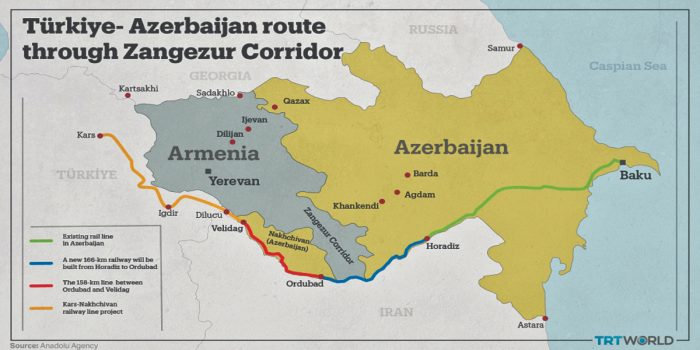
By Alexandr Svaranc – New Eastern Outlook – 16.07.2023
Turkey and Iran continue to be important Middle Eastern nations. Due to their geographical proximity, imperial past, violent rivalry, theological tensions (between Sunnism and Shiism), and, of course, the continuous divergence of geopolitical interests, both nations have a rich history of relations.
There were multiple Turkish-Persian clashes and wars, with various interruptions and varying degrees of success, during the Ottoman and Persian empires. Regarding the significance of the harem in the Ottoman Empire, historians have observed that, unlike the Turkish-Persian conflicts, which occasionally came to an end during periods of truce, the harem wars continued unabatedly. The reasons for these wars were varied, with religion often becoming a justification for the ambitions of Istanbul or Tehran. As a rule, it was a struggle for the right to own border territories from the Caucasus to Asia Minor, for the right to control strategic trade and military communications (for example, the area between Tigris and Euphrates, Eastern or Western Armenia and Syria).
In fact, such a confrontation lasted from the Middle Ages until World War I. The long military and political conflict between the Persians and Turks in such important regions, where the interests of the leading powers of Europe and Russia were represented, led to the establishment of a special international border commission with the participation of Britain and Russia at the turn of the twentieth century to facilitate the delimitation of Persia and the Ottoman Empire. But because London and St. Petersburg had their own distinct interests in the Near and Middle East, this commission never accomplished its mission.
There were also more stable times between Iran and Turkey in the new era. After World War II, from 1955 to 1979, Tehran and Ankara became even politico-military allies in the CENTO (Central Treaty Organization or Baghdad Pact) regional bloc, which emerged thanks to the Middle East diplomacy of Britain and the United States. While the Shah’s regime in Iran remained an ally of the West and Iranian oil and gas were exploited in the interests of London and Washington, Tehran was a regional partner of NATO member Turkey.
The situation changed after the February 1979 revolution in Iran, as the overthrow of the pro-American Shah’s regime and the ascension to power of the Shiite mullocracy brought about a major change in the disposition of forces in the Middle East. Since then, there have been renewed notes of mistrust and tension in Iranian-Turkish relations across the Middle East and global agenda, some of which remain relevant to this day.
It cannot be said that pragmatism in the approaches of Turkey and Iran has lost importance after the overthrow of Shah Reza Pahlavi. Despite harsh anti-Iranian sanctions, Ankara was forced to retain trading with Iran and keeps shipping gas in varying volumes due to its limited own energy supplies.
With the change of political regime in Iran after the 1979 revolution in Kemalist Turkey, where the secular regime suppressed the sprouts of Islamic revival, the politicization of Islam (albeit of Shiite origin) in the 1980s and 1990s still influenced the public consciousness of the Turkish masses in favor of the growing role of religion in the state.
The Kurdish issue remains a common concern between Turkey and Iran. Ankara and Tehran oppose all forms of Kurdish statehood and threats of ethnic separatism. However, in the situation of the Kurds after the 1979 Islamic Revolution in Iran there have been some changes. Some experts believe, not unreasonably, that the phenomenon of the Shiite revolution in February 1979 has both external and internal justifications.
The external reason was to prevent the leading Anglo-Saxon countries (the US and Britain) from monopolizing and plundering Iran’s strategic resources (oil and gas), as well as to prevent the corrosive influence of Western pop culture on the minds of Iranian youth and the general population. The internal reason, however, was related to the idea of preventing the weakening and collapse of Persian statehood under the threat of ethnic separatism with different colors (Kurds, Azeris, Baluchis). At the same time, Islam, namely political Shiism, assumed the religious consolidation of Iranian society regardless of ethnic origin.
Following the revolution’s victory, Iranian leader Ayatollah Khomeini summoned Mustafa Barzani, the leader of Iraq’s Kurdistan Region, then in exile, to Tehran for a final settlement of the Kurdish crisis on an Islamic basis. According to some reports, such an agreement was accepted by a Kurdish politician, but he never made it to Tehran. CIA handlers then announced an emergency surgery on Mustafa Barzani, but the surgery ended in his death.
The main contradictions between Tehran and Ankara include Turkey’s continued membership in NATO and Shiite-Sunni religious differences between different madhhabs. At the same time, as key countries in the Middle East region, it is natural that Turkey and Iran have different approaches on a number of regional topics (including the Syrian crisis, the situation in Libya and Iraq, and the relationship with Pakistan). The adjacent territories of the South Caucasus and Central Asia occupy a distinctive place in this package of contradictions following the breakup of the Soviet Union and the parade of sovereignties of post-Soviet states.
First, Iran is concerned about the renaissance of Turkey’s pan-Turkic and pan-Turanist ambitions toward the Turkic countries of the CIS, which could seriously weaken Iran’s position if the Turan project succeeds.
Second, Tehran watches with great caution the geo-economic projects in the Caspian energy region, which with the collapse of the Soviet Union and the weakening of Russia got a start and developed thanks to the joint initiatives of Turkey and its NATO allies (primarily, the UK and the US). At the same time, this concern of the Persian state is determined not only, or rather, not so much by the considerations of the new direction of oil and gas exports to Turkey as by Ankara’s plans to create alternative energy transit routes bypassing Russia and Iran to bring exporters from Turkic countries to world markets (especially to Europe) and turn the Turkish territory into a major hub. In other words, Iran, as an oil and gas-rich country, is concerned about the geopolitical consequences of transformations in the South Caucasus and Central Asia in favor of the strengthening of Turkey, the United States and Britain.
Third, taking into account the Turkish-Azerbaijani tandem that has formed on Iran’s northern borders, Tehran is anxiously observing the trend of Israel showing up along the Iranian-Azerbaijani border line on the Arax River, the increased intelligence presence of the Mossad and Aman in the same Azerbaijan with the approval of NATO member Turkey.
Fourth, there is now a certain geopolitical rivalry between Turkey and Iran, with a religious connotation in as yet predominantly Shiite Azerbaijan. Given that the Azerbaijani authorities have based their relations with Turkey on the pan-Turkic slogan and the principle of “one nation, two states,” Iran notes the active political persecution of Azerbaijani Shiites (including often with accusations of spying for IRI) by Baku. Moreover, IRGC sources in Azerbaijan note an increasing number of cases of religious interference by Turkey in the Sunnization of Azerbaijani Shiites. Tehran sees all these actions as an attempt by Ankara to weaken the influence of Shiite Iran in this Transcaucasian republic.
After Recep Tayyip Erdoğan’s victory in the elections and his visit to Baku, assessing the situation with the Zangezur corridor in Armenia, the Turkish leader, not by chance, stressed that the main reason for blocking this corridor was not Yerevan, but Tehran. Iran indeed publicly through the mouths of Ayatollah Ali Khomenei, President Ibrahim Raisi and Foreign Minister Hossein Amir Abdollahian has repeatedly noted that for it the Zangezur corridor remains a “red line,” it is unacceptable to change the borders of neighboring republics of the South Caucasus (in particular, Armenia) and it is important to maintain the direct multi-millenial border of Iran with Armenia.
Tehran does not want NATO to strengthen in the region on the shoulders of its member Turkey, nor does it want to see the Turan project implemented with pan-Turkic content. Otherwise, Iran will be blocked by unfriendly forces on its northern borders, including the emergence of a bridgehead of Zionist Israel on the banks of the Arax River.
With his statement, Erdoğan not only expresses his dissatisfaction with the regional policy of Iran that three Muslim states (Turkey, Azerbaijan, and Iran) through the fault of Persians can’t solve the road question peacefully and get economic dividends but actually says that Iran is not allowing the Turkish-Azerbaijani tandem to start a war with Armenia again and take by force the Meghri segment of the Zangezur corridor (if not all of Zangezur – Syunik Province) from the latter.
Given that Russia is now forced to engage in the western flank of the geopolitical confrontation with the West in Ukraine and is therefore interested in maintaining a partnership with Turkey for the same transit and out into the world, it cannot strain relations with Ankara in Armenia (Transcaucasus). Iran becomes the main opponent of Turkey in this theater.
In the second half of June 2023, Turkey and Azerbaijan announced the formation of a unified system of control and management of airspace from the Aegean Sea to the Caspian Sea according to NATO standards (the Turkish HAKİM Air Command Control System). The latter is practically capable of establishing airspace control in the South Caucasus region and threatening not only Armenia but also Iran. Given the existence of a common air defense system between Armenia and Russia within the CSTO, such a move by the tandem of Ankara and Baku is in some ways a challenge for Russia’s regional interests as well.
Since the beginning of 2023, trade turnover between Iran and Turkey has decreased by 20%, where the main export commodity for the Turkish side remains gas. Apparently, such a decline in economic relations between these countries was the result of a number of objective and subjective reasons (such as the crisis in the energy market due to anti-Russian sanctions and rising prices, the earthquake and rising inflation in Turkey, the devaluation of the Turkish lira, and Ankara’s pressure on the issue of the Zangezur corridor). In response to Moscow’s proposal to create a gas hub in Turkey, Iran came up with an equally ambitious similar project in the Persian Gulf. All these processes testify to the growing Iranian-Turkish contradictions.
Moreover, the information about the ongoing closed-door talks between Iran and the USA on the subject of the deblocking of Iranian assets in exchange for American prisoners and, most importantly, about the end of the “tanker war” between Tehran and Washington in the waters of the Strait of Hormuz and the Gulf of Oman and the export of Iranian oil to world markets (as we know, in the USA itself there is a rise in gasoline prices and an increasing need for oil) creates additional tension in Turkish politics as well.
The US is not yet interested in the implementation of alternative communications from China to Europe through the territory of Turkey (under the One Belt, One Road Initiative). Perhaps Washington is proposing an Indian project through Iran to Europe as an alternative to Chinese transit. And in this geographic preference of the states, a new confrontation between Iran and Turkey is created.
Accordingly, if Iran develops strategic partnerships with countries such as China and India, and can establish certain relationships with the US administration on the nuclear program and oil exports, Turkey will find it difficult to count on success in a battle with Tehran. Moreover, today’s Iranian authorities are interested in strengthening President Erdoğan’s policy independent of the United States, which makes it possible to weaken Washington’s pressure on the region. These are the complicated patterns of the contemporary geopolitical mosaic in the Greater Middle East.
Aleksandr SVARANTS, PhD in political science, professor.
Featured Video

HE SAVED LIVES. NOW HE FACES PRISON.
or go to
Aletho News Archives – Video-Images
From the Archives
NATO Sanctions and the Coming Global Diesel Fuel Disaster
By F. William Engdahl – New Eastern Outlook – 11.04.2022
Amid the ongoing global inflation crisis, NATO heads of state and mainstream media repeat a mantra that high energy prices are a direct result of Putin’s actions in Ukraine since end of February. The reality is that it is the western sanctions that are responsible. Those sanctions including cutting SWIFT interbank access for key Russian banks and some of the most severe sanctions ever imposed, are hardly having an impact on the military actions in Ukraine. What many overlook is the fact that they are increasingly impacting the economies of the West, especially the EU and USA. A closer look at the state of the global supply of diesel fuel is alarming. But Western sanctions planners at the US Treasury and the EU know fully well what they are doing. And it bodes ill for the world economy.
While most of us rarely think about diesel fuel as anything other than a pollutant, in fact it is essential to the entire world economy in a way few energy sources are. The director general of Fuels Europe, part of the European Petroleum Refiners Association, stated recently, “… there is a clear link between diesel and GDP, because almost everything that goes into and out of a factory goes using diesel.” … continue
Blog Roll
 Aletho News
- Trita Parsi: Middle East Unraveling — Are We on the Path to World War?
- Iran FM meets with US envoy on UN meeting’s sidelines at American side’s insistence: Report
- Qatar PM calls for Gulf security framework with Iran, says war must be ‘wake-up call’
- China condemns US extortion of Iranian airlines, rejects Washington’s ‘illegal’ sanctions threats
- Italy to move military personnel from Taif base after missile strike
- Finland’s Stubb tells European leaders to calm down
- Defeating Russia on battlefield impossible – Fico
- Finland’s Gender Clinic Reversal
- Massachusetts Wants Mental Health Visits, Why Does Government Use ‘Health’ to Enter Our Homes & Families?
- US lawmaker admits American people footing bill for Trump’s failed aggression against Iran
- If Americans Knew
- Sanctions are collective punishment: immoral and self-defeating
- Phosphorus Munitions Fired by Israel Burn Groves, Orchards in Southern Lebanon
- Israel Carries Out New Ceasefire Violations Across Gaza
- AI – Emphasis on the ‘I’: Israel Is Funding AI Chatbot Propaganda
- Israel Blocking Hundreds of Wheelchairs for Injured Children From Entering Gaza
- Israel Is Expanding and Upgrading Compounds for Palestinian Militias in Gaza
- The Palestinian-American Residents of This West Bank Town Are Wondering: Where Is Trump?
- Gaza desperately needs tents, wheelchairs, fuel… and everything else (Israel blocks it all) – Daily Update
- Israeli Attacks in Gaza Kill at Least Seven Palestinians Over Three Days, including Woman and Child
- Trump’s militarization of Washington DC as he pursues Israel’s war against Iran
- No Tricks Zone
- New Study: Earth And Venus Surface Warmth Largely Explained By Convection And Lapse Rate, Not CO2 Or Radiation
- 2025 Nature Paper Claiming Worsening Global Drought Gets RETRACTED …Heavily Flawed
- New Study: ‘Global Drought Shows No Detectable Recent Acceleration Under Climate Warming’
- Economic Masterminds: German Socialists Suggest Taxing Productivity Gains Stemming From Using AI
- The South China Sea Has Not Been Cooperating With The Climate Change Narrative
- Energy Crisis: Germany Enters Heating Season With Historically Low Gas Reserve Fill Levels
- New Study: The Antarctic Ice Sheet Gained Mass From 2020-2024 Due To Staggering Snow And Ice Accumulation
- Study: Ocean Heating Rates From Thousands Of Years Ago ‘Dwarf’ Modern Ocean Heating Rates
- Climate Extremists Target, Attack Large-Scale Power Grid Infrastructure In Germany!
- New Study: Antarctic Ice Melt Has Contributed Less Than 1 Centimeter To Sea Level Rise In The Last 30 Years

