A Message to Georgians: America Will Not Protect You
No offense, but Georgia’s interests are just none of my affair. It’s such a long way from here.
I know my government has been messing around there since the 1990s, picking winners and losers, making big promises and causing lots of trouble.
Keeping Russia out of their former sphere of influence was thought by Washington to be its most important goal.
Under the Bill Clinton administration, it was decided that building the BTC Pipeline across Georgia was the highest priority – to prevent Azeri gas from flowing north through Russia or south through Iran.
Under George W. Bush, it was decided that the government of Edward Shevardnadze was too close to Russia, compromising with them over Abkhazia, making deals with Gazprom, and joining the CIS, and had to go.
USAID, the National Endowment for Democracy (NED), and the rest of the regime change industry poured in tens of millions of dollars to support the groups supporting Mikhail Saakaashvili’s rise and the Rose Revolution of 2003, which installed him in power. This included a Soros front called the Liberty Institute – not to be confused with the Libertarian Institute, I assure you.
As I’m sure you all know, former President Salome Zourabichvili was born in France, not Georgia, and was just parachuted in by the new regime to take over as Finance Minister after the overthrow of 2003. She later explained that:
“These institutions were the cradle of democratization, notably the Soros Foundation. … The NGOs which gravitate around the Soros Foundation undeniably carried the revolution. However, one cannot end one’s analysis with the revolution and one clearly sees that, afterwards, the Soros Foundation and the NGOs were integrated into power.”
Soros’s business partner Kaka Bendukidze became the new economy minister. Alexander Lomaia, the director of Open Society Georgia, was made education minister. At the same time, Giga Bokeria, co-founder of the Liberty Institute, became the leader of the National Movement party in the parliament. In the name of fighting against corruption, they stayed on Soros’s payroll. Saakashvili too.
“I’m delighted by what happened in Georgia, and I take great pride in having contributed to it,” Soros told the Commission on Security and Cooperation in Europe.
How y’all let her become the president of the country is a mystery. Oh yeah. All the foreign money.
I sure hope that Mr. Saakashvili’s trial was more fair than his opponents received while he was in power. And that Saakashvili is not being tortured in prison the way his regime tortured people. No human deserves to be treated in such a barbarian fashion.
Do I believe Georgia country is better off under the domination of Russia or any other significant power?
Of course not. But I do mean that American intervention is not in the interest of either country.
I’ve read that current Georgian leaders have expressed frustration that they have not been able to reach the new Trump administration to see if they can get a reset in America’s Georgia policy. Be careful what you wish for. Georgians are more likely to be better off when America does not have a Georgia policy at all than even a favorable one, with strings attached.
As far as the difficulties Georgia may face in maintaining full independence as a small country in a world of major competing powers and Georgia’s advantageous or disadvantageous geographic position relative to important resources, I could not say what your best solution must be.
I could say that at the end of the day, America will not guarantee Georgia’s independence, which is why there is no major U.S. troop presence there, and why NATO membership has not moved forward since W. Bush’s foolish declaration at Bucharest in April 2008.
Perhaps maintaining Tbilisi’s neutrality in these major contests could be the path to maintaining independence from outright control.
Even after Russia intervened to reverse Saakashvili’s attempt to forcefully reintegrate South Ossetia in 2008, Moscow did not sever the BTC, nor roll its tanks into Tblisi, thank goodness. Though Putin and Medvedev had plenty of counter-incentives, they certainly had the pretext to go that far if they had chosen to do so.
President Bush, in his lame-duck year, had already chosen not to intervene, despite the protests of then-Vice President Cheney, who insisted on strikes against Russian forces coming through the Roki tunnel, risking World War III.
Thank goodness the cool, patient wisdom of George W. Bush, relative to Cheney anyway, prevailed that day.
Surely Russia would have escalated in kind, and Tbilisi would have lost its independence to the Federation after Bush had inevitably backed down. Thank goodness it did not come to that.
Making sure the Russians continue to feel like such a move would be unnecessary and unreasonably costly would probably be the best course of action.
Of course, USAID, NED, IRI, NDI, and all the usual suspected Soros-backed groups have spent a ton to keep the current ruling party out of power. I’m sure the permanent professional protestors — analyst Brad Pearce calls their rallies an “organized labor protest by the foreign influence industry” — have some real concerns, just as I’m sure that any protestor receiving the backing of a foreign regime can only be taken so seriously by anyone else.
Again, ultimately, America is too far away and has too little to lose if Tbilisi’s status were to truly change to truly be motivated to do anything about it. When Russia came across the mountains in 2008, many Americans were terrified – they thought that our Georgia was under attack, the state between South Carolina and Florida. They either had never heard of your country, or they could not fathom why it being invaded should be top news in Colorado or Illinois. That Russia would attack America out of the blue seemed to them more plausible, at first glance, at least.
That being the case, Georgians are almost certainly better off choosing the proper course forward for their country with that in mind. Because chances are that if worse comes to worst, no one over here is coming to intervene over there.
Long live Georgia and its independence, good luck.
And may liberty always remain your highest political goal.
Thank you.
The US and its “Humanitarian” War for Central Asia
By Vladimir Odintsov – New Eastern Outlook – 06.09.2020
Despite the failure of the color revolution campaign organized by Washington, the United States and its allies show no signs of moving their attention away from Central Asia. The countries in the region continue to receive so-called “assistance” that permeates all spheres of life of the republics, implanting foreign values, undermining the authorities and interfering in internal affairs, actively trying to tear these states away from Russia and China.
Since the countries of Central Asia’s (CA) proclamation of independence, various international donors have expanded their participation in the region by providing official state and international assistance for development, which has reached more than 25 billion US dollars since 1991. The largest recipient of such aid in the region is Kyrgyzstan, which has received about $ 8.1 billion, followed by Tajikistan ($ 5.9 billion), then Uzbekistan ($ 5.8 billion), and Kazakhstan ($ 4.2 billion). The country that has received the least amount of aid since 1991 was Turkmenistan (803.45 million US dollars). But this is only direct state and international assistance.
In addition, the so-called “assistance” is afforded through various foundations, NGOs, including USAID, NDI, Soros Foundation, Freedom House, Foundation to Promote Open Society, Civil Society Development Association and others, as well as embassies of Western countries. Recently, the well-known abbreviation NED (National Endowment for Democracy), has been mentioned more and more often in the media.
Fearing the restoration of the “Soviet regime” in the states of Central Asia and the strengthening of Russia and China’s influence, the United States in its activities in the region increasingly began to focus on the “humanitarian” areas, including, first of all, the “educational presence”, strengthening of influence on society through various controlled NGOs, establishing control over the press and, through Washington-funded information platforms, influencing the creation of an ideological and propaganda background beneficial to the United States.
The “educational presence” is viewed in Washington as the most important stage in the preparation of the future political and business elite in the states of interest to the United States, and is mainly carried out through “flagship” universities, the activities of cultural sections of American embassies, exchange programs and educational grants.
In recent years, the United States has especially actively used the following as “flagship” universities: American University of Central Asia (AUCA, Bishkek). Kazakh American University (KAU, Alma-Ata) and the Kazakhstan Institute of World Economy and Entrepreneurship (KIMEP, Alma-Ata).
The focus of such “flagship” universities in educating future leaders of the region’s countries close to the United States is not even hidden in the official announcement of the American University of Central Asia, which states that it was founded in 1993 to “educate future leaders for democratic transformations in Central Asia.” It became the first university in Central Asia to issue US accredited liberal arts degrees through a partnership with Bard College in the United States of America. It is worth noting that AUCA is not accountable to the Ministry of Education and Science of Kyrgyzstan, it has an American Board of Trustees, and since May 2019 it has been headed by American political scientist, an expert on Russian politics, Andrew Kuchins.
Other flagship US universities are predominantly located in Kazakhstan. One of them is the private Kazakh-American University, which is a multi-level educational complex with a kindergarten, school, bachelor’s and master’s degrees. KAU was established in 1997 to “train professionals focused on leadership and aimed at the industrial and innovative development of the Republic of Kazakhstan,” as follows from the official presentation of this university. Another pivotal US university in Central Asia is KIMEP, the oldest and largest private university operating according to the North American model of education in Central Asia for the same purpose of educating the future leaders of the region by their own model. Another important institution of higher education providing the “educational presence” of the United States is Narxoz University (formerly the Alma-Ata Institute of National Economy) in Kazakhstan, which is headed by American Andrew Wachtel, current member of the US National Academy of Sciences, former president of AUCA.
In addition, the United States has a network of partner universities in the region. At the same time, in a number of higher educational institutions of Kazakhstan, Kyrgyzstan, Tajikistan, Turkmenistan, there are so-called “American sections”, which are essentially US Embassy’s external units, where appropriate work is carried out with the youth of Central Asia, aimed at achieving American foreign policy and foreign economic goals. The American Council for Cooperation in Education and Language Learning (ACCELS) operating in the region is subordinated to the same goals, which, by this Council’s own definition, is called upon to “educate specialists who are able to spread American ideas in the field of business, public administration, to plant the American educational system, to promote positive image of the USA.”
For a more productive outreach to student youth, American diplomats actively communicate with various higher educational institutions of the region, often speak there, participate in institute conferences, invite individual students to some protocol events at the US Embassy, thereby demonstrating an interest in the fate of the future leaders of the CA countries. In carrying out such activities, representatives of American embassies have the opportunity to spot the brightest students, mark them with individual grants and invite them to participate in exchange programs funded by the State Department, and with the support of American corporations or other “interested” US institutions, including US intelligence agencies.
Thus, the “educational presence” is effectively used in the “humanitarian struggle” of the United States for Central Asia, to increase the loyalty of Central Asian citizens to America, especially the most ambitious and brilliant representatives of regional youth. Thus, actively interfering in the domestic affairs of the Central Asian countries and influencing them.
Facebook teams up with US government to police ‘fake news’ in foreign elections
RT | September 24, 2018
Facebook has teamed up with two US government-funded think tanks as part of a new initiative to bolster the social media giant’s “election integrity efforts” around the globe.
The new partnership with the International Republican Institute (IRI) and the National Democratic Institute (NDI) was revealed by Facebook in a call with reporters last week and reported by Reuters — but the company’s choice of partners has since raised a few eyebrows. Both think-tanks are funded by the US government, through the National Endowment for Democracy (NED).
Tweeting about the initiative, Mark Weisbrot, a co-director at the Center for Economic and Policy Research, called Facebook’s decision to work with the US government-funded organizations “Orwellian” and said that they “specialize in overseas propaganda.” Weisbrot also criticized Reuters reporting of the news which focused on Facebook’s supposed fake-news busting efforts and seemed lacking in “any awareness” of who the two groups were.
During the telephone Q&A with reporters focusing on the upcoming elections in the US and Brazil, Facebook’s Elections and Civic Engagement Samidh Chakrabarti, said that “preventing election interference” on the platform has been “one of the biggest cross-team efforts” the company has seen. But is teaming up with government-funded think tanks really the best way to prevent election interference on Facebook?
Asked by CNBC reporter Salvador Rodriguez to elaborate on the partnership, Katie Harbath, who heads up Facebook’s Global Politics and Government Outreach team, said she wanted to be clear that Facebook’s work with the IRI and NDI is only focused “internationally” and that it has nothing to do with domestic elections in the US. Harbath said the two organizations have “a lot of experience in working in elections and in many countries around the globe” and that Facebook can learn from them about “election integrity risks” that exist in other countries.
That knowledge might prompt a sign of relief from American journalists, but given the US government holds a very real stake in the outcome of many other elections worldwide, it still seems a little odd that Facebook should be using US government-funded organizations to help it decide what constitutes fake news in foreign elections, or to “slow the global spread of misinformation” as Reuters put it.
It’s not the first time Facebook has chosen a dubious partner to help it out in its fight against fake news, either. The social media giant also entered a similar partnership with the Atlantic Council, a think tank funded by the US and other NATO governments, as well as by a slew of US weapons manufacturers.
Shortly after its partnership with the Atlantic Council was revealed, Facebook temporarily deleted the English-language page of the Venezuela-based news outlet Telesur without explanation. Telesur is one of the only English-language media sources providing an alternative view on events in Venezuela.
Facebook has also been criticized for capitulating to demands and threats made by the Israeli government by deleting the accounts of a number of accounts run by Palestinian activists.
Nonetheless, Facebook has said it is setting up a “war room” ahead of major elections in Brazil next month. The war-like rhetoric echoes a Washington Post op-ed by Facbook CEO Mark Zuckerberg last month, in which he said Facebook was in an “arms race” against “bad actors” and that the platform needed to improve its “defenses”.
Amy Studdart, a senior advisor at the IRI, told Reuters that the details of its partnership with Facebook had not been fully worked out, but said the organization would help Facebook employees “understand how their platform is being used on the ground all around the world.”
The NED and its affiliates have been criticized as engines of “regime change” around the world, and one of its founders famously noted in 1991 that “a lot of what we do now was done covertly by the CIA 25 years ago.”
NED Pursues Regime Change by Playing the Long Game
By Edward Hunt | Lobe Log | July 3, 2018
During a recent congressional hearing, the heads of three influential non-profit organizations that operate in numerous countries around the world revealed the subtle ways in which the United States meddles in the internal affairs of other countries by playing what the officials called “the long game.”
The three officials—Carl Gershman, Daniel Twining, and Kenneth Wollack—told Congress about their long-term efforts to empower the opponents of U.S. enemies and boasted about their ability to change foreign governments. They said that they had recently helped their political allies gain political power in Malaysia, acknowledged that they have helped train thousands of activists in Nicaragua, and speculated about the potential to create new governments in China, Russia, and North Korea.
All three men strongly defended their activities, insisting that they are critically important to the advancement of democracy in the world.
“We’re not asking people to do anything that they don’t want to do,” Gershman said. “We’re supporting their own aspirations and giving them some of the tools to realize those aspirations.”
Gershman is the president of the National Endowment for Democracy (NED), a U.S. taxpayer-funded nonprofit created by the U.S. government in 1983. As the president of NED, Gershman oversees the issuance of grants to its political-party-associated organizations, including the International Republican Institute (IRI), which is headed by Twining, and the National Democratic Institute (NDI), which is headed by Wollack.
Facing skepticism about their work from the Trump administration, which views the organizations as unnecessary expenses and wants to cut their funding, Gershman and his colleagues provided Congress with a broad overview of how their work affects the world. They defended their ongoing operations, trying to persuade Congress that they should continue to receive funding.
Ultimately, the three officials revealed how they are helping the U.S. government interfere in numerous countries around the world.
The NED Approach
The general strategy of NED is to empower like-minded activists to build new political movements in their home countries. NED helps these activists become influential political actors, often with the goal of creating new possibilities for political change.
Officials typically describe their approach as one of “democracy promotion.” They argue that they are helping democratic forces introduce democratic politics into countries ruled by authoritarian leaders.
“These leaders, their strategic Achilles heel is fear of their own publics,” Twining explained. “And I think we should think about the old Reagan message of exploiting that a little bit.”
The strategy requires a long-term commitment in the countries where the NED is active. Twining calls it “playing the long game.” Gershman calls it “long-term work.”
The officials discussed numerous examples. Twining said that IRI has been working with opposition forces in Malaysia since 2002. He credited IRI with helping opposition forces prevail in the country’s recent parliamentary elections, calling the victory “an example of playing the long game.”
U.S.-backed opposition forces are “now in-charge of this very strategic country right there on the frontlines of the South China Sea, right there on the frontlines of the Islamic world’s intersection with rest of Asia,” Twining said. “And that’s good for America.”
The NED has also been active in Nicaragua, where opposition forces are organizing major protests against the Nicaraguan government. The protesters are trying to bring down the government of Nicaraguan President Daniel Ortega, a popular leftist leader who has been in power since 2007.
“We have been working on youth leadership programs and have worked with more than 8,000 youth on a very extensive coursework and academies to develop U.S. engagement,” Wollack said.
Although Wollack denied that the organizations are training their grantees for the purpose of overthrowing Ortega, Gershman indicated that regime change is the ultimate goal. “Time for him to go,” Gershman said, referring to Ortega.
The three officials also cited many additional opportunities to influence governments around the world. They are especially excited about opportunities in Armenia, where a major social movement recently ousted a government backed by Russia.
Twining speculated about the possibility of achieving regime change in Russia, calling Putin a “very brittle” leader who is “frankly quite insecure.”
Gershman saw potential for a similar outcome in North Korea. “This is an eroding totalitarian system, so we shouldn’t give up hope on the possibilities for internal change,” he said.
Gershman believes that the primary focus should be on China, however. He called China “the most serious threat our country faces today.”
Although Gershman said that the U.S. government will initially respond to challenges from China with a mix of military, economic, and geostrategic power, he insisted that the long-term solution could be found in the “unhappy people” who oppose the Chinese government.
“We have to not give up on the possibility for democratic change in China and keep finding ways to support them,” he said.
The Controversy in Washington
The open talk of U.S. meddling in other countries around the world was so commonplace that the U.S. mass media spent no time covering the hearing, even though the speakers did encounter some pushback. Not all members of Congress are on board with the programs.
Congressman Dana Rohrabacher (R-CA) made the strongest critique, insisting that U.S. meddling destabilizes countries while creating more problems for the United States in the long run. Rohrabacher blamed recent U.S. meddling for destabilizing Ukraine. He argued that the U.S. involvement in national protests that led to the downfall of the government of Viktor Yanukovych in February 2014 prompted the subsequent Russian invasion of the country and the war that continues there today.
“I don’t believe the Russians would have invaded Ukraine had we not arrogantly involved ourselves to overthrow that democratically elected government in Ukraine,” Rohrabacher said.
Rohrabacher also insisted that the U.S. should support dictators. He singled out Egypt, saying that the country should continue to be ruled by General Abdel Fattah el-Sisi, the military dictator who gained power by overthrowing the country’s first democratically elected government in 2013.
“I know I am making everybody mad at me, but I had to say it,” Rohrabacher commented.
Faced with Rohrabacher’s criticisms, the remaining participants in the hearing made some effort to counter his arguments but otherwise said very little, preferring instead to blandly praise NED for performing admirable work by promoting democracy around the world.
The general feeling in Congress is that the U.S. government should continue to fund the work of the NED and its affiliated institutes. Most members of Congress view the organizations as important assets in the U.S. government’s toolkit, believing they play an important role in U.S. global strategy.
Congressman Gerry Connolly (D-VA) unabashedly praised NED, IRI, and NDI, calling their work “exciting.” He told the three officials that “nothing does America prouder than the work frankly you’re doing.”
Nicaragua, unraveling a plot
The US’ NED distributed $4.2 million in Nicaragua, between 2014 and 2017, to train “new leaders” to overthrow the Sandinista government
By Francisco Arias Fernández | Granma | June 29, 2018
 AS early as 2016, talk of war against Nicaragua could again be heard in Miami, at a time when the streets of this nation were a regional example of security, peace, and prosperity, where a hardworking, tranquil people proudly enjoyed the social and economic advances achieved by the Sandinista government, that had established a national consensus, in the wake of one of the worst interventions carried out by the United States in Central America.
With no justification whatsoever – when the news from Nicaragua around the world was about a proposed inter-oceanic canal that would boost the economy and impact global navigation – Congress members who make a living off the U.S. war against Cuba and Venezuela were mounting efforts to reverse the prosperity and calm that reigned in the land of Augusto César Sandino.
Congress members, first in the House of Representatives and later the Senate, introduced a bill to create obstacles to the awarding of international loans to Nicaragua, hamper foreign investment, and put a brake on socio-economic development in the country. This imperialist punishment, cooked up by the worst of the anti-Cuban mafia in 2015, set in motion the fabrication of a pretext regarding the alleged lack of democracy, justified as a way to “guarantee electoral transparency and fight corruption.” The result of this initial maneuver was the Nicaraguan Investment Conditionality Act of 2017 (NICA Act).
Ileana Ros, Albio Sires, Marco Rubio, and Ted Cruz, and others, among the most reactionary legislators in Congress from South Florida, Texas, and New Jersey, are again attempting to reinvent the Contras and get rid of the Sandinista government, which has repeatedly shown at the polls that it enjoys the people’s majority support.
The tentacles of this subversive plot go beyond the capital, since these forces are well connected to the United States’ coup-manufacturing machinery, and laid the foundation for a media campaign in coordination with agencies specialized in carrying out dirty wars and soft coups, working with U.S. intelligence and the CIA, in particular.
In this specific case, international press media have documented the participation of the U.S. Agency for International Development (USAID); the National Endowment for Democracy (NED); and the National Democratic Institute (NDI), as well their sub-contractors, which have been working meticulously, since Daniel Ortega was first elected, to re-invent a “new leadership,” selectively infiltrating key sectors of the economy, targeting youth, students, medium and small businesspeople, environmental and feminist groups, among others, to undermine the foundation of support for the Sandinista government.
It is revealing that on April 16, this year, following the same line espoused by anti-Cuban Congress members, USAID Administrator Mark Green announced that the U.S. government would continue supporting the participation of a “free … genuine” civil society in Nicaragua, after stating that the United States is concerned about the closing of democratic spaces in Nicaragua, “systematic” violations of human rights, and government corruption.
In March, Representatives Ileana Ros-Lehtinen and Albio Sires sent a letter to Green, in which they call on the U.S. government to reverse its decision to provide “zero aid” to Nicaragua through USAID for the fiscal year 2018-2019, while at the same time calling on the agency to avoid supporting “members of the private sector linked to corruption, money laundering, or the Daniel Ortega regime.”
At the end of 2008, the media reported that USAID had provided at least a million dollars in Nicaragua that year to NGOs, radio broadcasters, and political groups like the Communications Research Center (CINCO), to intervene in municipal elections.
This financing, as was denounced at the time, contributed surreptitiously as “small donations,” that were not to exceed 25,000 dollars, was part of a large scale U.S. plan to overthrow the government of Daniel Ortega, carried out since then by internal agents from the Nicaraguan right.
The strategy mounted to discredit the Sandinista government in the media was conducted via two financing routes; one directed by USAID and the Casals & Associates firm, and another managed by the so-called Common Fund in Europe, which provided funds to organize campaigns and mobilizations to destabilize the government.
By 2008, media in Nicaragua had identified at least 14 subversive projects run by USAID across the country, under the cover of a wide range of titles and objectives, made possible by this funding.
Another key element of the U.S. machinery linked to the CIA is the National Democratic Institute, an instrument dedicated to promoting “change” that focuses on “empowering” so called “agents of change” in countries with governments not to Washington’s liking.
A Swedish journalist reported, this past June 4, that three students from Nicaragua were conducting a tour of Europe to raise support for a plot against the Sandinista government, stating that at least one of the youth represented an organization created and financed by the United States.
Jessica Cisneros, he reported, was active around the issue of the involvement and participation of youth in political processes, and was a member of the Movimiento Cívico de Juventudes (Civic Youth Movement).
Another of these “agents of change” promoting hate for the Sandinista government and support for a coup, was Yerling Aguilera, from the Polytechnic University in Managua (UPOLI) and specializing in research on revolution and the feminist movement, who, according to the reporter, has been an employee and consultant for the Institute of Strategic Studies and Public Policy (IEEPP) in Nicaragua, that works to “strengthen the abilities of political, state, and social actors for a better informed public via creative, innovative services,” which has received 224,162 dollars from the National Endowment for Democracy (NED) between 2014 and 2017.
The NED has distributed some 4.2 million dollars in Nicaragua, over this three-year period.
The USAID, NDI, and NED have been busy in the country, with thousands of activists trained to “change society.” Hundreds of NGOs, universities, and political parties have received funds and materials as part of the subversive plan that was not conceived to advance through traditional political organizations, but rather those invented to give the impression that they emerged “spontaneously” from dissatisfaction, hiding the true interest of the North at work.
Although efforts were intensified after Ortega’s 2006 electoral victory, since 2015, with the approval of the NICA Act, U.S. agencies increased and broadened financial support and resources for their “agents of change” in Nicaragua, above all through leadership courses and money for young people in universities, NGOs, and political parties.
In their political, diplomatic, and media advice to the coup-plotters, Washington has insisted on demonizing Daniel Ortega and his government, an effort carried out not only by the White House, and its agencies, allies, satellites, and mercenaries, but also the corporate media monopolies and fabricators of lies, which magnify internal problems and accuse authorities for all types of human rights violations, totally omitting the crimes and destruction committed by individuals who have been “empowered” by the USAID, NDI, NED, and CIA, who have caused the failure of talks and calls for peace. As is the case in Venezuela, Donald Trump and his advisors, architects of a thousand invasions, do not believe in dialogue or pacts, opting for war on all fronts.
Nicaragua has become the epicenter of U.S. warmongering efforts, hand in hand with Anti-Cuban legislators and profiteers, and other veteran hawks. Washington is attempting to re-invent its strategy at the cost of human lives and destruction in the streets of Nicaragua.
USAID’S THINLY DISGUISED SUBVERSION PROJECTS IN NICARAGUA:
– Citizen participation in electoral processes
– Developing a culture of transparency among Nicaraguan youth
– Communications training for students to produce stories that promote self-efficacy
– Multimedia for democratic governability
– Strengthening civil rights of women and youth in Masaya
– Citizen action legal framework for journalists
– Active participation for Nicaraguans exercising their right to vote
NDI TENTACLES
– Since 2010 the NDI has been associated with Nicaraguan universities and civic organizations conducting a youth leadership program which has helped prepare more than 2,000 “youth leaders,” and worked to increase the political influence of women, LGBT persons, and electoral processes
– The Movimiento Cívico de Juventudes (MCJ) is an organization financed, created, and part of the NDI.
– Several members of the group graduated from the NDI program earning a Certificate in Leadership and Political Management (CLPM).
Francisco Arias Fernández, internet@granma.cu
Establishment alarmed as Trump threatens to gut US ‘democracy promotion’ racket
RT | March 7, 2018
The foreign policy establishment in Washington is crying foul after the Trump administration proposed to cut funding for organizations responsible for “promoting democracy abroad,” often in the guise of color revolutions.
The 2019 State Department budget request cuts the National Endowment for Democracy (NED) budget and separates it from the National Democratic Institute (NDI) and the International Republican Institute (IRI). Funding for the institutes would be moved to the State Department, where NDI and IRI would have to compete with private contractors, according to the Washington Post columnist Josh Rogin, who described the proposal as “an assault not only on their organizations but also on the pro-democracy mission they are dedicated to.”
“If implemented, the proposal would gut the program, force crippling layoffs and the symbolic meaning would also be shattering, sending a signal far and wide that the United States is turning its back on supporting brave people who share our values,” NED President Carl Gershman told Rogin.
“The work our government does to promote democratic values abroad is at the heart of who we are as a country,” Senator John McCain (R-Arizona), chairman of the IRI’s board of directors, told Rogin. The NDI board is chaired by former Secretary of State Madeleine Albright.
McCain actually wrote a letter protesting the proposal to the Office of Management and Budget in December. It was signed by four other senators, including McCain’s close ally Lindsey Graham (R-South Carolina) and Marco Rubio (R-Florida).
Trump’s people “just don’t believe it’s America’s business to push democracy abroad,” Rogin concluded.
His article quickly made the rounds of the Washington establishment circles, where it received praise from former CIA agent and failed presidential candidate Evan McMullin and New Republic columnist Jeet Heer. Nicholas Burns, who served as State Department spokesman under Albright, said the revelations will “make your blood boil.”
.@joshrogin: The Trump administration’s assault on democracy promotion can be expected to continue. Dictatorships are presenting their model as preferable for the developing world. Human rights abuses are rising. Basic freedoms are under attack. https://t.co/IRDT91JZAt
— Evan McMullin (@Evan_McMullin) March 5, 2018
2. Democracy promotion in foreign policy had genuine bipartisan support from Carter to Obama. Trump has broken that consensus.
— Jeet Heer (@HeerJeet) March 6, 2018
This will also make your blood boil. The State Department is giving up on our historic support for democracy promotion that none other than Ronald Reagan pioneered. https://t.co/uQOpWnolme
— Nicholas Burns (@RNicholasBurns) March 5, 2018
It was Burns’s tweet in particular that attracted derision from critics of US foreign policy, such as journalists Glenn Greenwald, Chris Floyd and Jon Schwarz, and former diplomat Peter Van Buren:
This is the kind of blatant, jingoistic historical revisionism that the Trump era has made fashionable again. The idea that the US had been devoted to “democracy promotion” before Trump – and that this was pioneered by tyrant-hugging Reagan – is simply laughable: https://t.co/JrVqWt3CP7
— Glenn Greenwald (@ggreenwald) March 6, 2018
Oh, Mr. Burns, do tell us more about Reagan’s “democracy promotion” with Rios Montt. And did Reagan have a special aide to follow behind him and mop up the innocent blood dripping – pouring – from his hands? Oh, tell us the glorious story, Mr. Burns!
— Chris Floyd (@empireburlesque) March 6, 2018
The confusing thing about Harvard, Yale, etc. is that the job of people working there in the hard sciences actually is to describe reality accurately, whereas the job of many humanities professors like Nicholas Burns is to lie about reality https://t.co/e5EQhQfL5O
— Jon Schwarz (@schwarz) March 6, 2018
Nicky, Nicky… no more day drinking unless you’re going on CNN. Democracy promotion in Nicaragua, Salvador, Guatemala, Lebanon… or maybe Iraq 3x, Afghanistan, Somalia, Pakistan, Libya? What ARE you talking about? https://t.co/D3t2TknjzS
— Peter Van Buren (@WeMeantWell) March 6, 2018
As well as a number of rank-and-file Twitterati:
Libya thanks you for their US installed democracy. The slave market was a bit of a surprise and the fact that there are three waring factions all claiming to be the government, but I’m sure you know what’s best.
— Kropotkin (@DoctorKropotkin) March 7, 2018
Democracy! Promoted! pic.twitter.com/hXnhJsHuxi
— B (@balvertos) March 7, 2018
The NED was founded in 1983, under the Reagan administration. It is theoretically a non-governmental organization, though the bulk of its funding is provided by the US government and American taxpayers. The status has given NED and its institutes plausible deniability against accusations that the US has been meddling in the politics of other countries.
“A lot of what we do today was done covertly 25 years ago by the CIA,” one of the endowment’s founders, Allen Weinstein, told the Washington Post in September 1991.
One example is the wave of “color revolutions,” starting from Serbia in 2000 to the “Arab Spring” revolts of 2011. Ukraine was subjected to this twice, in 2004 and in 2014. During the unrest in Kiev in November 2004, The Guardian’s Ian Traynor described the process, while heaping praise on the people behind it.
“The operation – engineering democracy through the ballot box and civil disobedience – is now so slick that the methods have matured into a template for winning other people’s elections,” Traynor wrote. “The Democratic party’s National Democratic Institute, the Republican party’s International Republican Institute, the US state department and USAid are the main agencies involved in these grassroots campaigns as well as the Freedom House NGO and billionaire George Soros’s open society institute.”
Though campaigns funded by all these external actors are more astroturf than grassroots, there were few objections, as it was all in the name of democracy.
Traynor concluded his 2004 story by saying the “places to watch” were Moldova and Central Asia. Sure enough, the former Soviet republic of Kyrgyzstan went through a “Pink revolution” in February 2005, while the “Grape revolution” took place in Moldova in April 2009.
The Washington establishment’s obsession with democracy may also be explained by the belief that any non-democratic government is automatically anti-Western, as Luis Fleischman of the neoconservative Center for Security Policy argued last month.
If the regime is pro-American, however, it doesn’t matter whether it’s actually democratic or not. On Tuesday, the director of the Foundation for Defense of Democracies Mark Dubowitz tweeted that “inclusive authoritarianism” might be a better fit for Middle Eastern countries, as long as they were “tolerant, respectful of individual liberties & minority rights & pro-American.”
Btw, I said a more “inclusive authoritarianism” *might* be better alternative. Tolerant, respectful of individual liberties & minority rights & pro-American. I suggested should be discussed. So spare me the invective & explain why worse than failed M/E democracies. https://t.co/yQJWKQ5V3z
— Mark Dubowitz (@mdubowitz) March 7, 2018
Read more:
Cambodia Exposes, Expels US Network
By Joseph Thomas – New Eastern Outlook – 27.08.2017
The government of Cambodia has exposed and expelled a US network attempting to interfere in the nation’s political processes. The US National Democratic Institute (NDI) was reportedly ordered to end its activities in the country and remove all of its foreign staff.
In a statement, the foreign ministry accused the National Democratic Institute (NDI) of operating in Cambodia without registering, and said its foreign staff had seven days to leave. Reuters in an article titled, “Cambodia orders U.S.-funded group to halt operations, remove staff,” would claim:
Authorities were “geared up to take the same measures” against other foreign NGOs which fail to comply with the law, the ministry added.
The article also noted that:
Prime Minister Hun Sen, who has ruled Cambodia for more than three decades, on Tuesday ordered the English-language The Cambodia Daily newspaper to pay taxes accrued over the past decade or face closure. The paper was founded by an American.
He also lashed out at the United States and non-governmental organizations (NGOs) and accused them of funding groups attempting to overthrow his government.
The American-owned Cambodia Daily newspaper in its own article titled, “NDI Ordered to Halt Operations, Foreign Staff Face Expulsion,” would note that:
The announcement comes less than a week after documents leaked on Facebook and circulated on government-affiliated media appeared to show political cooperation between NDI and the opposition party, amid increased tension in recent weeks between the government and U.S.-backed NGOs and media outlets.
NDI could not immediately be reached for comment.
Radio Free Asia and Voice of America have also both been accused of not fulfilling tax and registration obligations. The Cambodia Daily, whose publisher is a U.S. citizen, was hit with a $6.3 million unaudited tax bill and threatened with imminent closure if it is not paid by September 4.
Reuters would cite NDI’s own website in an attempt to inform readers about what its role is in Cambodia claiming, “the NDI works with political parties, governments and civic groups to “establish and strengthen democratic institutions.””
NDI is a US government and US-European corporate-funded organisation chaired by representatives from America’s business and political community. Of the 34 listed members of NDI’s board of directors, virtually all of them either have direct ties to US corporations and financial institutions, are members of corporate-funded policy think tanks or previously were employed by the US State Department, or a combination of the three. Yet, even a cursory investigation of NDI and the media and political organisation in its orbit and the very nature of even its proposed role in Cambodia’s political process indicates impropriety and subversion. Reuters is intentionally failing to convey to readers.
What NDI Really is and What it Really Does
Directors with particularly prominent conflicts of interest include:
Madeleine Albright: Albright Stonebridge Group and Albright Capital Management LLC
Harriet Babbitt: Council on Foreign Relations
Thomas Daschle: The Daschle Group
Robert Liberatore: former senior vice president of DaimlerChrysler, an NDI financial sponsor
Bernard Aronson: former Goldman Sachs adviser
Howard Berman: senior advisor at Covington & Burling
Richard Blum: chairman of Blum Capital Partners
NDI director Thomas Daschle, for example, actually has foreign political parties as paying clients through his “Daschle Group,” including VMRO DPMNE based in Macedonia as revealed by The Hill. NDI is likewise active in Macedonia, providing support directly to VMRO DPMNE, even co-hosting events in the country according to NDI’s own social media account on Facebook.
In Southeast Asia, Freedom House, yet another subsidiary of NED, would provide extensive aid to opposition groups in Thailand led by ousted former prime minister Thaksin Shinawatra, with Freedom House director Kenneth Adelman (PDF) concurrently providing paid-for lobbying services to Thaksin Shinawatra himself.
It appears that such conflicts of interests are not the exception, but the rule indicating that NED and its subsidiaries including NDI pursue the collective corporate and financial interests of their boards of directors merely behind the guise of “strengthening democratic institutions.”
An examination of NDI’s corporate sponsors casts further doubts upon its alleged mission statement. Its financial sponsors, according to NDI’s 2005 annual report (PDF), include:
- British Petroleum
- Bell South Corporation
- Chevron
- Citigroup
- Coca Cola
- DaimlerChrysler Corporation
- Eli Lilly & Company
- Exxon Mobil
- Honeywell
- Microsoft
- Time Warner
Donors also include convicted financial criminal George Soros’ Open Society Foundation as well as the National Endowment for Democracy (NED) of which NDI is a subsidiary of, as well as the US Agency for International Development (USAID) and the US State Department itself.
Corporations like BP, Chevron, Citigroup, Coca Cola, Exxon, defence contractor Honeywell and IT giant Microsoft are not interested in promoting democracy. They are using democracy promotion as a means behind which to create conditions more conducive to expanding markets and increasing profits. This includes undermining governments impeding foreign corporate control of national resources and markets, or entirely removing and replacing governments with more obedient client regimes.
The contemporary history of American foreign wars and its practice of “regime change” and “nation building” provides self-evident confirmation of the motives and means used to expand US hegemony and clearly illustrates where organisations like NDI fit into the process.
In Cambodia’s case, a much larger, overarching agenda is in play than merely national resources and markets. US activities in Cambodia to coerce or replace the current government in Phnom Penh is done specifically to encircle and contain China through a united front of client states assembled by the United States across Southeast Asia.
Cambodia, along with the rest of Southeast Asia, has begun strengthening ties with Beijing economically, politically and militarily. Large infrastructure programmes, weapon acquisitions, joint-training exercises and trade deals are all on the table between Beijing and Phnom Penh.
The US, conversely, has provided few incentives beyond its failed Trans-Pacific Partnership scheme and coercion through networks like NDI and the myriad media and political proxies they fund and operate in Cambodia.
With NDI shuttered, its foreign staff expelled and the organisations and publications it was funding facing similar closures and evictions, it appears what little the US had on the table has been swept away. Cambodia’s particularly bold move may be replicated across Southeast Asia where similar US networks are maintained to manipulate and coerce the political processes of sovereign states.
“Democracy Promotion” From Abroad is a Contradiction
The notion that NDI is “promoting democracy” is at face value an absurdity. Democracy is a means self-determination. Self-determination is not possible if outside interests are attempting to influence the process.
A political party funded and directed by US interests through organisations like NDI, supported by media outfits and fronts posing as nongovernmental organisations likewise funded from abroad preclude any process of self-determination and is thus not only in no way, shape, or form “democracy promotion,” it is a process that is fundamentally undemocratic.
In the US where it is widely understood that money dominates campaigns and wins elections, it is difficult to perceive the US pouring money into opposition parties abroad for any other reason besides skewing electoral outcomes in favour of US interests.
Additional irony is provided by the fact that should any other nation attempt to pursue similar programmes aimed at America’s domestic political process, those involved would be quickly labelled foreign agents and their activities halted immediately.
The mere allegations that Russia attempted to interfere with America’s domestic political processes resulted in sanctions and even threats of war. Cambodia is a nation that cannot afford nor effectively impose sanctions upon the United States nor wage war against it, but shuttering a flagrant example of foreign interference in its internal political affairs is something Cambodia and its neighbours in Southeast Asia can and are beginning to do.
Cambodia’s use of existing laws regarding taxation and the registration of foreign entities has been effectively used to deal with these organisations. Neighbouring nations may begin to require foreign-funded organisations to register as foreign lobbyists, subject them to taxation and more stringent regulations and taking away from them the smoke screen of “democracy promotion” and “rights advocacy” they have cloaked their activities behind for decades.
Joseph Thomas is chief editor of Thailand-based geopolitical journal, The New Atlas.
Why is a Hong Kong “Activist” in Bangkok?
The New Atlas – October 5, 2016
Joshua Wong’s alleged arrest at a Bangkok airport is portrayed as a slight against “democracy,” yet the US-funded and backed agitator undermines his own principles of “self-determination” by meddling in another nation’s politics.
Thai PBS in its article, “HK democracy activist Joshua Wong detained in Bangkok,” would claim:
Wong, 19, famed for his galvanising role in the city’s 2014 pro-democracy “umbrella movement”, was held as he landed at the airport late Tuesday, his party Demosisto said in a statement, citing a Thai student activist, Netiwit Chotipatpaisal, who was due to meet him.
Wong was invited by Thai student activists to take part at an event marking the anniversary of a military crackdown in October 1976.
Demosisto “strongly condemns the Thai government for unreasonably limiting Wong’s freedom and right to entry, and requests the immediate release of Wong,” the statement said.
What Thai PBS fails to mention is that Joshua Wong and his party, “Demosisto,” are US-funded and directed, and represent Western interests attempting to subvert Chinese control over its own territory of Hong Kong, as well as undermine national sovereignty across the entire Asian region.
Indeed, the entire “Occupy Central” movement, also referred to as the “Umbrella Revolution,” was led by US-backed opposition figures, including Joshua Wong, Benny Tai and Martin Lee, the latter of which was literally in Washington D.C. lobbying for backing just months before the 2014 protest began.
While the US State Department’s National Endowment for Democracy (NED) initially denied it provided any assistance to the movement and denied specifically that Martin Lee served any role in leading the protests despite his Washington visit, NED through its subsidiary Freedom House, would eventually invite Wong, Tai and Lee back to Washington afterwards to award them for role in leading the protests.
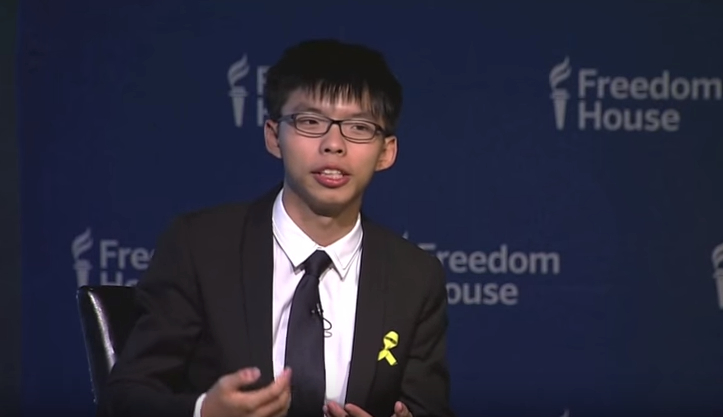 |
Joshua Wong in Washington D.C. attending a US State Department award ceremony held in his and other US-backed agitators’ honor |
At the award ceremony titled, “Three Hong Kong Heroes,” Lee would shuffle onto stage with an umbrella prop in hand, a virtual admission to his leadership role in the protests and confirmation that NED’s previous statement was intentionally false.
Wong’s political party, Demosisto, headed by Nathan Lee, is also tied directly to the US State Department’s NED.
 |
Nathan Law (left) with Carl Gershman of the US State Department’s National Endowment for Democracy (NED) |
Nathan Law in particular was featured on the US State Department’s National Endowment for Democracy (NED) website “World Movement for Democracy” in a post titled, “Democracy Courage Tribute Award Presentation.” In it, NED would write in regards to the award presented to Nathan Lee:
The Umbrella Movement’s bold call in the fall of 2014 for a free and fair election process to select the city’s leaders brought thousands into the streets to demonstrate peacefully. The images from these protests have motivated Chinese democracy activists on the mainland and resulted in solidarity between longtime champions of democracy in Hong Kong and a new generation of Hong Kong youth seeking to improve their city. The Hong Kong democracy movement will face further obstacles in the years to come, and their idealism and bravery will need to be supported as they work for democratic representation in Hong Kong.
The ceremony was yet another in a long line of post-Occupy Central award ceremonies the US State Department conducted, rewarding its proxies for their efforts in the streets of Hong Kong in 2014.
Joshua Wong Was Barred Entry into Malaysia for Similarly Inappropriate Political Pandering
In 2015, Malaysia too would confront Wong and his attempts to spread US-backed subversion across Asia.
That PBS would also report in an article titled, “HK student activist Joshua Wong denied entry to Malaysia,” that:
Immigration officials on Tuesday barred Hong Kong student activist Joshua Wong from entering Malaysia at the Penang International Airport in Bayan Lepas, The Star Online reported.
Wong was scheduled to attend a forum titled “The Uprising of Youth and New Social Activism in Singapore and Hong Kong” at Auditorium A in Komta on Tuesday night.
It is also worth noting that after Wong was denied entry, US-funded organisations posing as nongovernmental organisations (NGOs) immediately took to social media in an attempt to criticise the Malaysian government’s decision.
Malaysian online news service, The Star, in an article titled, “Hong Kong student activist Joshua Wong denied entry to Malaysia,” would further elaborate:
“Malaysia… explain why he is sent back to Hong Kong? Afraid of more street protests,” tweeted Bersih 2.0 chairman Maria Chin Abdullah.
Bersih, like Joshua Wong’s Demosisto, is openly funded by the US State Department and represents Washington’s, not the people of Malaysia’s interests. Bersih would be revealed in 2011 to have received funding and training from the US State Department via the National Democratic Institute (NDI), another NED subsidiary.
Democracy Means Self-Determination, Not Dictates from Washington & its Proxies
It is perhaps ironic that Wong himself and his supporters portray him as a “democracy activist,” considering that one of the central principles of democracy is the concept of self-determination. Self-determination means that a nation’s people themselves determine what course of action is in their best interests, free from the influence of foreign interests.
The concept of self-determination underpins the national identity of many nations across Southeast Asia, having had their respective national destinies dictated to them at various points throughout their history by European colonialism. Independence and self-determination across the region represent hard-fought achievements threatened by US-backed political fronts wielding “soft power” in place of the overt “gunboat diplomacy” practised by the British Empire in days past.
Worse than mere foreign backing, Wong and his Demosisto political party work ceaselessly to promote the parting demands made by British colonial administrators as Hong Kong was returned to China in 1997. These demands, including upholding the “one country, two systems” and “Basic Law” drafted just ahead of the British handover of Hong Kong, are echoed by the current governments of both the United States and the United Kingdom.
Thus, Wong and his political party, Demosisto, work contra to Hong Kong’s self-determination, promoting the parting policy of the British Empire imposed on a still emerging China in 1997.
By Wong meddling in the internal affairs of neighbouring Asian states, attempting to bolster US State Department efforts elsewhere to create proxy political fronts to serve Washington rather than local interests, he is also trampling the concept of regional self-determination, and thus of democracy itself.
In Thailand specifically, Wong sought to support anti-government agitators likewise seeking to subvert Thai sovereignty and return to power political parties loyal to Washington.
Wong’s admirers find among themselves a common denominator of affinity toward the United States and American politics. They believe themselves to be enlightened supporters of freedom, democracy and human rights, despite the reality of US foreign and domestic policy standing firmly against all three of these basic and essential principles.
From the invasion and occupation of foreign nations around the globe, to the detainment and torturing of people worldwide, to the violence and brutality American police deploy against the American population at home, to the invasive abuse of the American people’s right to privacy, American politics in reality exist separately from the ideals cadres of indoctrinated foreigners have been led into believing the US stands for.
Wong and his Demosisto political party and other US-backed political fronts like them, represent a danger to freedom, democracy and human rights, serving as a facade behind which US special interests hide their true, self-serving agenda and all of the abuse that surrounds it. By serving as a facade for foreign interests, merely posing as a proponent of democracy and self-determination, it is Wong and those like him that truly endanger democracy’s future in Asia, not those awaiting him at airports, turning him and his US-backed agitation away.
Follow The New Atlas on Facebook and Twitter.
US Lawmakers Lobby for Right-wing and US Intervention in Honduran, Salvadoran Elections
CISPES | November 8, 2013
On Saturday, October 16, US Congressmen Matt Salmon (R-AZ) and Albio Sires (D-NJ) from the House’s Foreign Affairs Western Hemisphere subcommittee wrote a letter to Secretary of State John Kerry using vague, fear-mongering rhetoric to delegitimize a potential left-wing victory in the upcoming presidential elections in Honduras and El Salvador, where the left candidates are leading in the polls. Explicitly denigrating two of the three leading Salvadoran candidates, Salmon and Sires exposed themselves as mouthpieces for the right-wing Nationalist Republican Alliance (ARENA) party, which has mounted an escalating smear campaign against its opposition in both El Salvador and the US.
In the letter—which was then republished in El Salvador—the congressional duo question the “democratic credentials” of both Honduran presidential candidate Xiomara Castro de Zelaya, wife of former President Manuel Zelaya ousted in the 2009 US-backed coup d’état, and Salvador Sánchez Cerén, the leftist candidate for the Farabundo Martí National Liberation Front (FMLN) in El Salvador, accusing them of being allies of late Venezuelan president Hugo Chávez. The congressmen also call out Salvadoran right-wing UNITY coalition candidate Tony Saca as corrupt, clearly demonstrating their preference for ARENA—the only other leading party in the race. In a particularly troubling gesture, they call for “heightened security to ensure that all candidates abide by the democratic rules of the game,” and tacitly request greater participation of the National Democratic Institute (NDI) and the International Republican Institute (IRI)— US institutions notorious for undermining democratic elections in the region.
This is not the duo’s first effort to intervene in the democratic process in El Salvador. In April, Salmon and Sires published a letter implying—falsely—that $300 million in US development aid from the Millennium Challenge Corporation was at risk because the US-backed Public-Private Partnership Law had not yet been approved by the Salvadoran legislature. Now, in questioning the democratic legitimacy of both Xiomara Castro and Sánchez Cerén, Sires and Salmon are setting the stage to delegitimize any leftist electoral victory from the US, and throwing their weight behind the ARENA party in El Salvador.
This is the same tactic recently employed by ultra-conservative lobbyist Otto Reich in his public comments against the FMLN, and was promptly followed by the November 4 publication of an article in the Spanish-language edition of the Miami Herald interviewing several ARENA party leaders claiming that Saca had made an agreement with the FMLN to divide the right-wing and bring socialism to El Salvador. The stakes are high in the upcoming presidential elections in Honduras and El Salvador, and ARENA and its allies are hard at work prevent any electoral outcome that conflicts with their vast economic interests in the region.
Related article
… The electoral contest takes place in the context of a Salvadoran social movement to end the impunity of war criminals who have thus far escaped justice due to a 1993 amnesty law whose constitutionality is now under examination by the Supreme Court of El Salvador. The issue has become especially intense since October 1, 2013, when the Catholic Archdiocese of San Salvador shut down the most important human rights archives in the country, Tutela Legal, and dismissed the employees, placing the very documents that would be used in war crimes tribunals at risk of being compromised. [3] These actions have provoked international solidarity with the thousands of Salvadorans, including those in the Salvadoran diaspora, who are at work recuperating the historical memory of the country and seeking justice for the more than 70,000 citizens killed during the war as well as the survivors of torture and other war crimes. …
Featured Video

America Racing to Strategic Defeat in Iran
or go to
Aletho News Archives – Video-Images
From the Archives
Should Europeans ‘Thank’ the Americans for Destroying Nord Stream?
By Robert Bridge | Strategic Culture Foundation | September 29, 2022
With an investigation continuing into the destruction of the Nord Stream gas pipeline that provided energy supplies to Europe from Russia, there appears to be just one prime suspect, and that should surprise nobody.
Following the sabotage of the Nord Stream 1 and 2 gas pipelines, former Polish Foreign Minister Radoslaw Sikorski already seemed to know the identity of the perpetrator when he tweeted out: “Thank you, USA.”
At first glance, it seemed that Sikorski was speaking sarcastically, berating Washington for carrying out an attack that will have severe repercussions for the people of Europe. After all, how could anyone see any good coming from the termination of Europe’s primary source of gas reserves with winter just around the corner? It was Sikorski’s homeland of Poland, after all, that urged its citizens to collect firewood in the face of dwindling gas reserves.
In fact, the Polish diplomat was speaking one-hundred percent literally… continue
Blog Roll
 Aletho News
- Growing insecurity, soaring prices fuel protests in north as regime bans evacuation: Sources
- Iran denies responsibility for ‘depraved’ attack on Kuwait desalination plant
- Bring The Troops Back. End This War Now!
- Can we please stop calling Israel the ‘only democracy in the Middle East’ now?
- US should start removing its troops for Germany, proposes AfD co-leader Chrupalla
- Iran Red Crescent: 600 educational centers attacked in US-Israeli ‘war crimes’
- Russian Oil Tanker Arrives in Cuba Amid U.S. Blockade
- America Racing to Strategic Defeat in Iran: Lt Col Daniel Davis
- FTC Warns Visa, Mastercard, PayPal, Stripe Over Political Debanking
- Russian tanker approaches Cuba despite US oil blockade
- If Americans Knew
- Israeli police block Catholic cardinal from entering Church of the Holy Sepulchre on Palm Sunday
- Israel is assassinating journalists again, more than any other nation, anywhere, ever – Not a ceasefire Day 170
- Over 300 US service members wounded, majority have brain injuries – Not a ceasefire Day 169
- Researchers at Human Rights Watch Resign Over Blocked Report on Palestinian Refugee Return
- Jewish Groups Are Backing a War Americans Don’t Want
- Eric Fingerhut Thinks He’s the President of the Jews
- Top Jewish Philanthropists, Rabbis Urge Israeli President to Take Action Against ‘Jewish Extremists’
- Don’t Be Fooled. Zionist Leaders Have Always Wanted to Control Southern Lebanon
- Israel’s widespread use of torture is a core element of its genocide against the Palestinian people
- In Israel’s War on Iran, Many Middle East US Bases Rendered “All But Uninhabitable”
- No Tricks Zone
- New Study Finds Warming Saves Lives…Cold Temperatures 12 Times More Deadly Than Excess Heat
- German Science Blog Accuses PIK Climate Institute Of Hallucinating Climate Tipping Points
- Devastating Assessment Of Comirnaty Vaccine By Former Senior Pfizer Europe Toxicologist
- New Study: CO2 Is ‘Effectively Negligible’ As An Explanatory Climate Change Factor Since 2000
- Former Pfizer Toxicologist Dr. Helmut Sterz Tells Bundestag Hearing Pfizer Vaccine Should Have Never Been Approved
- Energy Expert: Germany’s Nuclear Phaseout Was A “500 Billion Euro Mistake”
- New Research: South Australia’s Mid-Holocene Sea Surface Temperatures Were 4°C Warmer Than Today
- Storing Green Energy To Last Germany 10 Days Would Require A 60-Million Tonne Battery
- New Studies: UK Sea Levels Were 4 Meters Higher Than Today During The Mid-Holocene
- Destructive Green New Deal: German Energy And Metal Group Warns Of Drastic Crisis
 Aletho News