HOW TO WRITE A BAD ARTICLE ABOUT RUSSIA
By Paul Robinson | IRRUSSIANALITY | April 26, 2021
Several press articles I’ve seen in the past few days have annoyed me rather, but I think that they are useful as examples of how reporting on Russia is distorted. For they demonstrate the methods used by journalists to paint a picture of the world that is far from accurate.
The articles in question come from those bastions of balanced reporting, The New York Times and The Guardian. The first is from Sunday’s edition of the NYT, with the title ‘The Arms Dealer in the Crosshairs of Russia’s Elite Assassination Squad’. This discusses Bulgarian arms dealer Emilian Gebrev, whose weapons were destroyed in an explosion in the Czech Republic in 2014, allegedly by Russian secret agents.
The second article is also from the NYT. This one has the title ‘After Testing the World’s Limits, Putin Steps Back From the Brink,’ and analyzes what author Anton Troianovski calls Russia’s ‘escalatory approach to foreign policy’, as seen by the Russian military build up near the Ukrainian border.
The third and final piece is from The Guardian, and is about last week’s protests in support of jailed oppositionist Alexei Navalny. This is somewhat schizophrenic, on the one hand saying that the pro-Navalny movement is in trouble, but on the other hand portraying the protests as a relative success and ending on a confident note that however grim things look for the opposition now, this can change at any moment.
Anyway, as one reads these articles one notices certain techniques that are used to paint a distorted picture of reality. So if you want to be a journalist, here’s what the articles teach that you should do:
1. Make stuff up. In the Guardian article, authors Andrew Roth and Luke Harding (yes, he!) begin by telling readers that ‘The future looked unspeakably grim for Alexey Navalny’s supporters before this week’s protests’. But it then lifts our spirits with the following:
What followed was surprisingly normal: a core of tens of thousands of Navalny supporters rallied near the Kremlin, waving mobile phone torches and chanting “Putin is a thief!” The police stood back in Moscow (there was a violent crackdown in St Petersburg). For an evening, the crowd roved the streets of the capital at will.
“This feeling of enthusiasm, of overcoming fear, the protest ended on a positive note … It left me with the feeling that nothing is lost, it’s still not the final battle, and that street protests in Russia are not over forever,” said Ivan Zhdanov, the head of Navalny’s Anti-Corruption Foundation, in an interview from Europe.
Ah yes, the protests were a huge success, euphoric. There were ‘tens of thousands of Navalny supporters rallied near the Kremlin.’
Except that most reporters said that there was nothing of the sort, and that the turnout was far below expectations.
Estimates of the size of the protest crowd vary, but the Russian Interior Ministry reckoned the numbers as 14,000 across the entire country and only 6,000 in Moscow. Interior Ministry counts tend to be on the low size, so you can treat them with a pinch of salt, but Russian media outlets were claiming a crowd in Moscow of 10,000 to 15,000, , while Western journalists’ estimates were in the same ballpark. Max Seddon of the Financial Times, for instance, reckoned the number at about 10,000 and commented that it was much lower than in the last protests in January. So ‘tens of thousands’ as The Guardian claims? Apparently not.
The Guardian isn’t alone in providing misleading data. In its article about the Bulgarian arms dealer, The New York Times has the following to say:
After pro-democracy protestors toppled the Kremlin’s puppet government there [i.e. Ukraine], Russia special forces units wearing unmarked uniforms seized and annexed the Crimean peninsula and also instigated a separatist uprising that is still going on in the east.
Let’s unravel this a bit: Were the demonstrators in Kiev really ‘pro-democracy’? Debatable, though not provably 100% false. But definitely untrue is the idea that the Ukrainian government that was toppled in February 2014 was a ‘Russian puppet’. That’s simply false. As for Russian special forces ‘annexing’ Crimea, it’s true in a way, although not the whole story of what happened. But the claim that Russian special forces ‘instigated a separatist uprising’ in Donbass is without foundation. I know of no evidence of ‘Russian special forces’ having been present in Donbass in the early weeks of the uprising there. (Strelkov and his goons were not ‘Russian special forces’, and most analyses of the uprising show how it was overwhelmingly spontaneous and local in origin.)
So, again, making stuff up.
2. Mention that others have ‘reported’, ‘claimed’, or ‘alleged’ something without pointing out that the claim in question is dubious at best, or false at worst.
For example. The NYT piece about Mr Gebrev talks about the alleged Russian spy unit, Unit 29155, and tell us that:
Last year, the Times revealed a CIA assessment that officers from the unit may have carried out a secret operation to pay bounties to a network of criminal militants in Afghanistan in exchange for attacks on US and coalition troops.
This is superficially true in that the Times did reveal this assessment. But what it doesn’t tell you is that the US government only has low to medium confidence that the claim is true. That’s kind of important, don’t you think? Shouldn’t it be mentioned? By failing to do so, the Times makes out that something is true that probably isn’t.
It’s not the only example. Talking of Ukraine a little later, the same article tells us that after war broke out in Donbass,
Russian assassins fanned out across the country, killing senior Ukrainian military and intelligence officials who were central to the war effort, according to Ukrainian officials.
They did, did they? Well, maybe ‘according to Ukrainian officials’ they did. But I have to say that it’s the first I’ve ever heard of it, and if it were true wouldn’t there have been news of lots of dead Ukrainian military and intelligence officers? Given that there wasn’t any such news, why repeat the claim? Shouldn’t the Times at least check it first.
3. Cite only sources that back up the narrative you are trying to tell. Ignore alternative viewpoints.
This kind of follows on from the last. If you are writing about Ukraine, cite ‘Ukrainian officials’. But don’t cite rebel spokesmen. If you’re talking about Russia, cite oppositionists. Ignore pro-government analysts.
We can see this in the Guardian piece. This quotes a couple of members of Navalny’s team, a British professor, a pro-Navalny Russia high schooler, and then to finish off some completely random former advisor to one-time British foreign minister Robin Cook, whose connection to, and knowledge of, Russia is completely unexplained. The only reason for giving him the final word seems to be that he came up with some nice lines about how opposition movements can suddenly triumph even when they seem to be losing. Needless to say, dissenting viewpoints are nowhere to be heard in the article.
The NYT piece about Russia stepping ‘back from the brink’ is similarly loaded with carefully chosen sources. First up is the ever-present Gleb Pavlovsky, a one-time advisor to Vladimir Putin turned oppositionist, who seems to be the eternal go-to person for anti-Putin quotes. After him, the article gives us a quote from Navalny’s assistant Leonid Volkov, a statement from Ukrainian National Security Advisor Oleksiy Danilov, and a few words from the generally pretty anti-Putin Estonian analyst Kadri Liik. For a pretence of balance we also get a statement by Kremlin spokesman Dmitry Peskov and the opinion of Konstantin Remchukov, editor of Nezavisimaia Gazeta, a newspaper whose political stance isn’t 100% clear to me but strikes me as sort-of oppositional, sort of not (given that Remchukov ran the re-election campaign of Moscow mayor Sergei Sobyanin). All in all, the anti-government voices get the bulk of the space.
So there you have it. Make some stuff up. Reference ‘claims’ and ‘allegations’ without pointing out that they are unsubstantiated or even false. And throw in lots of quotes from pundits who support the chosen narrative. Easy as pie. A career as a journalist awaits you. Just don’t bother trying to be accurate. Understood?
Putin keeps the door open for diplomacy with the US; too bad it’s falling on deaf ears
By Scott Ritter | RT | April 22, 2021
Putin warns of Russia’s ‘red lines’, comparing the West’s actions to ‘The Jungle Book’, but says Moscow doesn’t want to burn bridges with anyone. His message falls on deaf ears in the US, largely thanks to establishment media.
In his annual address to the Federal Assembly – the Russian parliament – President Putin devoted most of his time to domestic issues. His comments regarding national security and foreign affairs were brief, but telling.
While many pundits had predicted he would use the occasion to announce major actions that would signify a decisive break with the West in the aftermath of the US imposing a new round of economic sanctions, Putin, while lamenting the “unfriendly actions” and “outright rudeness” of the US and its allies, highlighted the fact that Moscow wants to maintain good relations with them.
“We don’t want to burn bridges,” Putin declared.
Lest those in the West who were listening to the speech mistake Russia’s “good intentions as indifference or weakness,” Putin waxed poetic in putting down a marker that Russia would have none of it.
He alluded to Rudyard Kipling’s ‘The Jungle Book’ in describing the present situation vis-à-vis Russia and the West, observing that there are “all kinds of small Tabaquis [a reference to the sniveling jackal featured in the book] running around Shere Khan [a tyrannical Bengal tiger]… howling to gain the favor of their ruler.” While not naming names, Putin’s allusion is clear – the US (Shere Khan) and its Tabaquis (NATO) are harassing Russia (Mowgli, the unmentioned hero of the tale.)
The Jungle Book reference takes on a darker meaning when the Russian president warns those countries who have “made it a habit to pick on Russia,” that if “they want to burn bridges, or even blow up these bridges, they must know that Russia’s response will be asymmetric, swift and tough.”
It should be noted that in ‘The Jungle Book’, Tabaqui the jackal was killed by Mowgli’s allies, while Shere Khan died at the hands of Mowgli himself, led into a fiery trap – the ultimate form of asymmetrical combat.
To the would-be Shere Khans and Tabaquis listening to Putin’s address, the Russian president could not have made his message any clearer – do not provoke the Russian bear. “Russia has its interests which we defend and will defend within the framework of international law,” he declared.
While some observers have interpreted Putin’s brief comments on foreign and national security as ‘war-mongering’ and ‘bellicose’, it was anything but. Putin made it clear that diplomacy, not military action, was Russia’s preferred methodology, emphasizing Russia’s “good intentions” and its desire to keep the existing bridges linking it and the West open, as opposed to burning them down.
Putin’s posture was consistent with the evaluation contained in the US intelligence community’s Global Threat Assessment for 2021, which described Russian intent as follows: “We expect Moscow to seek opportunities for pragmatic cooperation with Washington on its own terms, and we assess that Russia does not want a direct conflict with US forces.”
The document further noted that “Russia seeks an accommodation with the United States on mutual noninterference in both countries’ domestic affairs and US recognition of Russia’s claimed sphere of influence over much of the former Soviet Union.”
There is no sunlight between this assessment and the tone and content of Putin’s address.
But to read the US media’s reaction to his speech, one would get the impression that America occupied an alternative reality where the constant threat posed to Russia by the real-life Shere Khans and Tabaquis of the world has been flipped, with the Russian government assuming the role of the predatory figure threatening the existence of ‘democracy’ – apparently personified in the form of the Western-backed opposition figure Alexey Navalny, and the perpetually victimized Ukraine.
While providing dismissive lip service to the content of Putin’s address, the Washington Post instead highlighted what it reported as “a wave of protests” which “started rolling across Russia’s Far East in support of imprisoned opposition leader Alexey Navalny.” The New York Times followed suit injecting the Navalny drama, while Newsweek took a different tack and ran an article with the inflammatory headline, “Ukraine President Zelensky Is Ready for War With Russia, Vows to ‘Stand to the Last Man.’” It covered a speech delivered by Volodymyr Zelensky as if it were the geopolitical equivalent of Putin’s address. “Does Ukraine want war?” Zelensky asked. “No. Is it ready for it? Yes,” he said, adding that while “Ukraine does not start a war first,” it “always stands to the last man.” Zelensky urged Putin to meet with him “anywhere in the Ukrainian Donbas where there is war” for peace talks.
By emphasizing Navalny and the conflict in the Donbass region while simultaneously giving short shrift to the content and intent of Putin’s address, the US media has continued a course which has sought to minimize Russian statesmanship and diplomacy in favor of a Hollywood-like narrative which paints that nation and its leader as the quintessential bad guys.
Given the role played by the US mainstream media in creating an environment that compels US leaders to craft policy which conforms to domestic political imperative as opposed to legitimate national security interests, this emphasis is unfortunate. The failure on the part of the US media, and by extension, the Biden administration, to recognize this reality is reflective of the suicidal hubris and arrogance that has gripped what passes for an understanding of modern-day Russia. Read ‘The Jungle book’; it’s not an ending any would-be Shere Khan should desire.
Scott Ritter is a former US Marine Corps intelligence officer and author of ‘SCORPION KING: America’s Suicidal Embrace of Nuclear Weapons from FDR to Trump.’ He served in the Soviet Union as an inspector implementing the INF Treaty, in General Schwarzkopf’s staff during the Gulf War, and from 1991-1998 as a UN weapons inspector.
Interventionist Hypocrisy on U.S. Deaths in Afghanistan
By Jacob G. Hornberger | FFF | April 21, 2021
I’m always fascinated by the sacrificial mindset that interventionists have toward the lives of U.S. soldiers who they want to do the intervening. A recent example is Brett Stephens, a columnist for the New York Times. In an op-ed entitled “Abandoning Afghanistan Is a Historic Mistake,” Stephens writes:
The U.S. has lost fewer than 20 service members annually in hostile engagements in Afghanistan since 2015. That’s heartbreaking for those affected, but tiny next to the number of troops who die in routine training accidents worldwide.
Yes, it’s heartbreaking and the number of deaths might be “tiny” compared to other things but the point that Stephens is making, whether he realizes it or not, is that it’s worth sacrificing the lives of those 20 men every year for the indefinite future.
The important question is: What are those soldiers being sacrificed for? According to Stephens, they are being sacrificed to prevent the Taliban from retaking control over Afghanistan. He points out that if the Taliban end up winning Afghanistan’s civil war, that will mean tyranny for the Afghan people.
Is the prevention of tyranny for the Afghan people worth sacrificing 20 U.S. soldiers per year indefinitely into the future? Indeed, is it worth sacrificing even one U.S. soldier to accomplish that goal?
Stephens would say yes. He says the prevention of a Taliban victory is that important.
But there is one big problem with Stephens’s reasoning: his own personal commitment to the cause. After all, if preventing a Taliban victory is so important, what is Stephens doing here at home? There is nothing to prevent him from traveling to Afghanistan and offering his services to the Afghan government to assist it in prevailing over the Taliban.
Stephens is only 47 years old. There are plenty of men in the Afghan army that are that age. Why does he choose to remain here at home living a cushy life writing for the New York Times instead of traveling to Afghanistan and helping the U.S.-installed regime prevail in the conflict?
There is one simple reason: Stephens places a higher value on his cushy life here at home than he does on preventing a Taliban victory over there. He’s not willing to give up what he has here at home to risk his life by traveling to Afghanistan and offering his services in order to prevent a Taliban victory.
But when it comes to the lives of those 20 soldiers a year, that’s a different story. In Stephens’s internal ranking of values, the lives of those soldiers are of secondary value compared to preventing a Taliban victory.
We saw this interventionist mindset, of course, during the Vietnam War, when more than 58,000 American men were sacrificed to prevent the communists in North Vietnam from prevailing in that country’s civil war. Interventionists said (and still say) that sacrificing those 58,000-plus American men sacrifice was worth it. In fact, if interventionists had had their way, American soldiers would still be in South Vietnam today, being sacrificed to prevent a communist takeover of South Vietnam.
There are lots of bad things that happen around the world. But that doesn’t mean that American soldiers should be sacrificed to prevent them. If interventionists are outraged over bad things that happen in the world, let’s just let them travel overseas to risk their lives to right the wrongs.
My hunch is that Stephens is one of those people who exhorts everyone to thank the troops for their service and sacrifice. I wonder how many U.S. soldiers can see through this interventionist hypocrisy, especially after 20 years of official lies and deception surrounding the U.S. war on Afghanistan.
NYT ‘bounties’ non-story shows US/UK media has got so used to blaming Russia, it’s now doing it out of habit
By Paul Robinson | RT | April 20, 2021
As holes predictably appear in claims that Russia paid the Taliban to kill American soldiers, questions arise as to why such erroneous stories keep appearing in the American press. Domestic US politics provide part of the answer.
“A Powerful Russian Weapon: The Spread of False Stories.” So ran a headline in the New York Times in August 2016. If it were only a Russian phenomenon, the world would be a much better place. Alas, the Times is far from immune from spreading “false stories” itself. From Walter Duranty’s reporting from the Soviet Union, through Judith Miller’s articles on Iraqi weapons of mass destruction, up to its coverage of accusations that US President Donald Trump had colluded with the Russian government, The New York Times has had its fair share of “fake news” experiences.
“A little tiny bit flat footed,” was how the Times executive editor Dean Baquet described the newspaper when the Mueller investigation failed to find Trump guilty of collusion. “I mean, that’s what happens when a story looks a certain way for two years. Right?” added Baquet.
You have to feel a bit for him. He really believed in collusion. In his eyes, it did “look a certain way.” It was rather embarrassing when he turned out to be completely wrong.
The New York Times’ iffy relationship with reality is back in the news today. US presidential spokesperson Jen Psaki admitted that the US intelligence community was not at all convinced by accusations first aired in the Times that the Russian government had paid bounties to the Taliban in Afghanistan to kill American soldiers. Rather, it had only “low to moderate confidence” that the story was true. Psaki explained:
“The reason that they have low to moderate confidence in this judgment is in part because it relies on detainee reporting, and due to the challenging environment and also due to the challenging operating environment in Afghanistan. So it’s challenging to gather this intelligence and this data.”
The accusation against Russia appeared in The New York Times in June last year. The Times then followed up with additional stories on the same topic. “Afghan Contractor Handed Out Russian Cash to Kill Americans, Official Say,”claimed the headline of a second article. “How Russia Built a Channel to the Taliban, Once an Enemy,” read the headline of a third.
Commentators soon pointed out problems. While the CIA had moderate faith in the claim, the National Security Agency didn’t. In any case, the primary sources of information were Afghan prisoners who hadn’t themselves been involved in the alleged transaction. Their claims needed to be treated with a fair degree of caution.
Others pointed out that the story didn’t make any sense from a Russian point of view. The Russian government values the stability of Afghanistan, and had consistently supported both the Afghan government and the US military presence there. There was no obvious motive for killing Americans.
Furthermore, it’s not as if the Taliban needed to be incentivised to fight America. They were already killing as many Americans as they were able to. Paying them to do what they were doing already would have been odd, to say the least.
Now, Ms. Psaki admits what people have long since suspected: that the accusation against Russia is not well-founded. But anyone with any sense realized that from the get-go. Why, then, did The New York Times report it?
The Times’ explanation is that the story was true. It didn’t say that the accusation was accurate; it merely reported the accusation. In an article on Thursday, Times reporter Charlie Savage notes that the newspaper had stated that the CIA had only “medium” confidence in the story and the NSA had “low” confidence. It had also reported that the Afghan prisoners who recounted the story hadn’t actually been present when the alleged meetings with Russians took place. In other words, The New York Times’ reporting was accurate.
Maybe so, but that begs a question – why report a story that makes an extremely explosive allegation if you’re not at all confident that the accusation is true? Isn’t there some responsibility to hold off from repeating libelous claims until such time as you can substantiate them?
Apparently not. It seems as if the Times wanted to believe the story. It “looked a certain way,” to use Dean Baquet’s phrase. Which in turn begs another question. Why did it look that way to the Times?
The obvious answer is that it fitted the political needs of the moment. For the real target of the Russian bounty story was never Russia but Trump. Its purpose was to show that the president had in some way betrayed America’s soldiers by continuing to talk to Russia even though he had evidence that the Russians were killing Americans.
The speaker of the House of Representatives, Nancy Pelosi, thus remarked, “The administration’s disturbing silence and inaction endanger the lives of our troops and our coalition partners.”Meanwhile, then presidential candidate and now president, Joe Biden, responded to the story by saying that Trump’s “entire presidency has been a gift to Putin, but this is beyond the pale. It’s a betrayal of the most sacred duty we bear as a nation to protect and equip our troops when we send them into harm’s way. It’s a betrayal of every single American family with a loved one serving in Afghanistan or anywhere overseas.”
Russia, in other words, was merely a pawn in an internal American political struggle. Sadly, though, this is far from an isolated incident. Furthermore, the Democratic Party and its backers in the USA have now become so habituated to spreading dubious stories about Russia that they seem to be unable to stop, even though the original political motivation has vanished. The Russian bounty wasn’t the first “false story” to appear, and it won’t be the last.
Paul Robinson is a professor at the University of Ottawa. He writes about Russian and Soviet history, military history, and military ethics, and is the author of the Irrussianality blog.
The Media Lied Repeatedly About Officer Brian Sicknick’s Death. And They Just Got Caught.
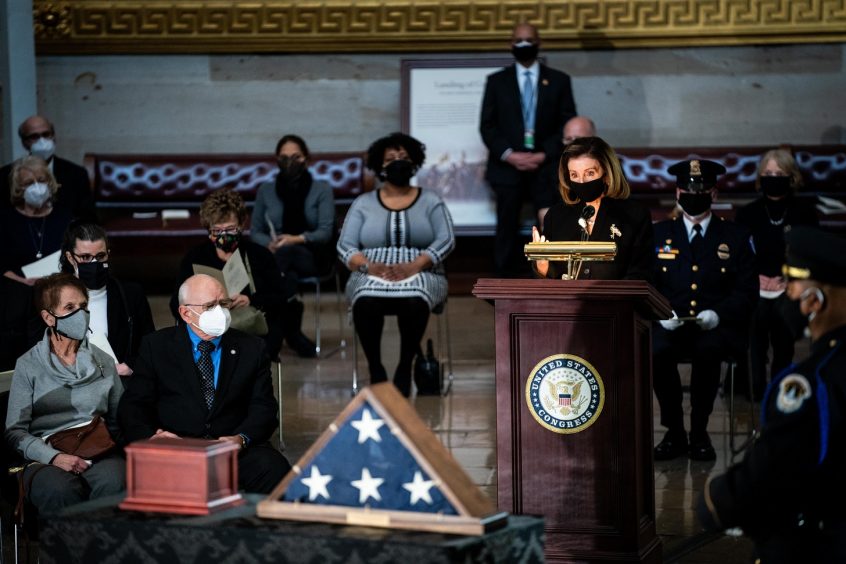
Nancy Pelosi at a congressional tribute to the late Capitol Police officer Brian Sicknick who lies in honor in the Rotunda of the U.S. Capitol on Feb. 3, 2021. (Photo by Erin Schaff-Pool/Getty Images)
By Glenn Greenwald | April 19, 2021
It was crucial for liberal sectors of the media to invent and disseminate a harrowing lie about how Officer Brian Sicknick died. That is because he is the only one they could claim was killed by pro-Trump protesters at the January 6 riot at the Capitol.
So The New York Times on January 8 published an emotionally gut-wrenching complete fiction that never had any evidence — that Officer Sicknick’s skull was savagely bashed in with a fire extinguisher by a pro-Trump mob until he died — and, just like the now-discredited Russian bounty story also unveiled by that same paper, cable outlets and other media platforms repeated this lie over and over in the most emotionally manipulative way possible. Just watch a part of what they did and how:
As I detailed over and over when examining this story, there were so many reasons to doubt this storyline from the start. Nobody on the record claimed it happened. The autopsy found no blunt trauma to the head. Sicknick’s own family kept urging the press to stop spreading this story because he called them the night of January 6 and told them he was fine — obviously inconsistent with the media’s claim that he died by having his skull bashed in — and his own mother kept saying that she believed he died of a stroke.
But the gruesome story of Sicknick’s “murder” was too valuable to allow any questioning. It was weaponized over and over to depict the pro-Trump mob not as just violent but barbaric and murderous, because if Sicknick weren’t murdered by them, then nobody was (without Sicknick, the only ones killed were four pro-Trump supporters: two who died of a heart attack, one from an amphetamine overdose, and the other, Ashli Babbitt, who was shot point blank in the neck by Capitol Police despite being unarmed). So crucial was this fairy tale about Sicknick that it made its way into the official record of President Trump’s impeachment trial in the Senate, and they had Joe Biden himself recite from the script, even as clear facts mounted proving it was untrue.

Articles on this Substack, Feb. 16, 2021 and Mar. 5, 2021
Because of its centrality to the media narrative and agenda, anyone who tried to point out the serious factual deficiencies in this story — in other words, people trying to be journalists — were smeared by Democratic Party loyalists who pretend to be journalists as “Sicknick Truthers,” white nationalist sympathizers, and supporters of insurrection.
For the crime of trying to determine the factual truth of what happened, my character was constantly impugned by these propagandistic worms, as was anyone else’s who tried to tell the truth about Sicknick’s tragic death. Because one of the first people to highlight the journalistic truth here was former Trump official Darren Beattie of Revolver News and one of the few people on television willing to host doubts about the official story was Tucker Carlson, any doubts about the false Sicknick story — no matter how well-grounded in truth, facts, reason and evidence — were cast as fascism and white supremacy, and those raising questions smeared as “truthers”: the usual dreary liberal insults for trying to coerce people into submitting to their lies:
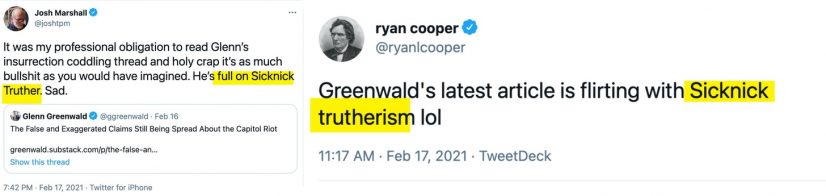
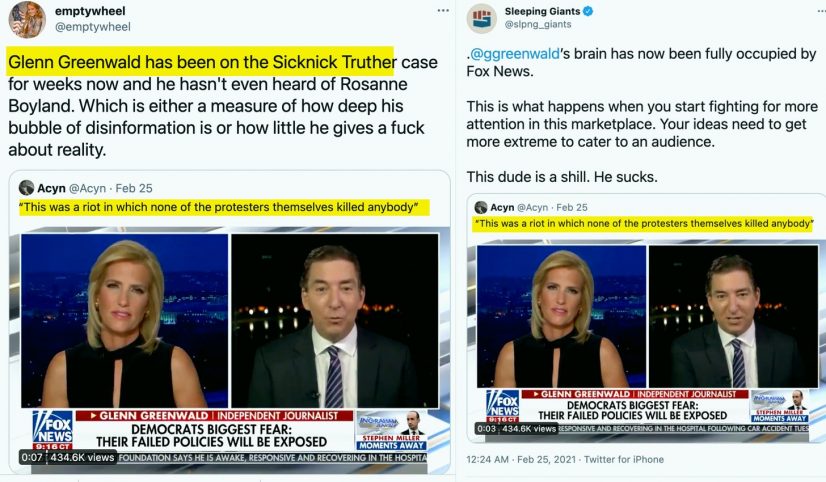
Because the truth usually prevails, at least ultimately, their lies, yet again, all came crashing down on their heads on Monday. The District of Columbia’s chief medical examiner earlier this morning issued his official ruling in the Sicknick case, and it was so definitive that The Washington Post — one of the media outlets that had pushed the multiple falsehoods — did not even bother to try to mask or mitigate the stark conclusion it revealed:
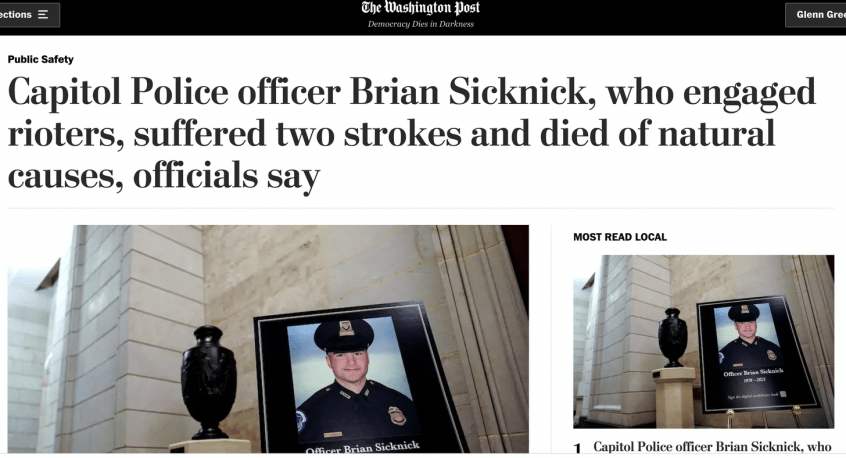
The first line tells much of the story: “Capitol Police officer Brian D. Sicknick suffered two strokes and died of natural causes a day after he confronted rioters at the Jan. 6 insurrection, the District’s chief medical examiner has ruled.” Using understatement, the paper added: “The ruling, released Monday, likely will make it difficult for prosecutors to pursue homicide charges in the officer’s death.”
This definitive finding from the medical examiner not only rids us of the Fire Extinguisher lie but also the second theory to which these media outlets resorted once they had to face the reality that they spent weeks spreading an outright lie (needless to say, they provided no real accountability or even acknowledgement for the fact that they did spread that Fire Extinguisher tale, instead just seamlessly moving to their next evidence-free claim). They changed their story to claim that pro-Trump protesters still murdered Sicknick, not with a fire extinguisher but with bear spray, which video shows at least one protester using in his vicinity.
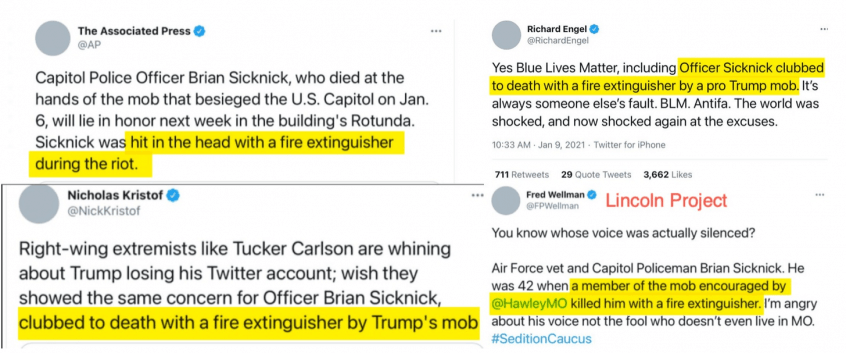
Clockwise: Tweet of Associated Press, Jan. 29; Tweet of NBC’s Richard Engel, Jan. 9; Tweet of the Lincoln Project’s Fred Willman, Jan. 29; Tweet of The New York Times’ Nicholas Kirstof, Jan. 9
The problem with that theory is that bear spray is not usually fatal, and the medical examiner’s findings ruled out the possibility that this is what caused his death:
In an interview with The Washington Post, Francisco J. Diaz, the medical examiner, said the autopsy found no evidence the 42-year-old officer suffered an allergic reaction to chemical irritants, which Diaz said would have caused Sicknick’s throat to quickly seize. Diaz also said there was no evidence of internal or external injuries…
Diaz said Sicknick suffered two strokes at the base of the brain stem caused by a clot in an artery that supplies blood to that area of the body. Diaz said he could not comment on whether Sicknick had a preexisting medical condition, citing privacy laws.
So there goes that second fairy tale. The Post did note the medical examiner’s observation regarding Sicknick’s participation in defending the Capitol that day that “all that transpired played a role in his condition.” That of course is true: just as it is true for the two pro-Trump supporters who had heart attacks that day and the other pro-Trump supporter who died from too much amphetamine in her system, having a stressful encounter as a police officer likely played a role in why someone would have two strokes the following day. But police officers are trained for stressful encounters, and that obviously is a far cry from being able to claim that any pro-Trump supporter murdered Sicknick.
I’ll have much more on this story as it unfolds. A significant amount of media accountability is warranted. But you’re seeing why there is so much resentment and so many attacks on platforms like this one that permit journalists to report and analyze facts and dissect media narratives without being constrained by liberal orthodoxies and pieties and while remaining immune from liberal pressure tactics: it’s one of the few ways that real dissent to their lies and propaganda can be aired.
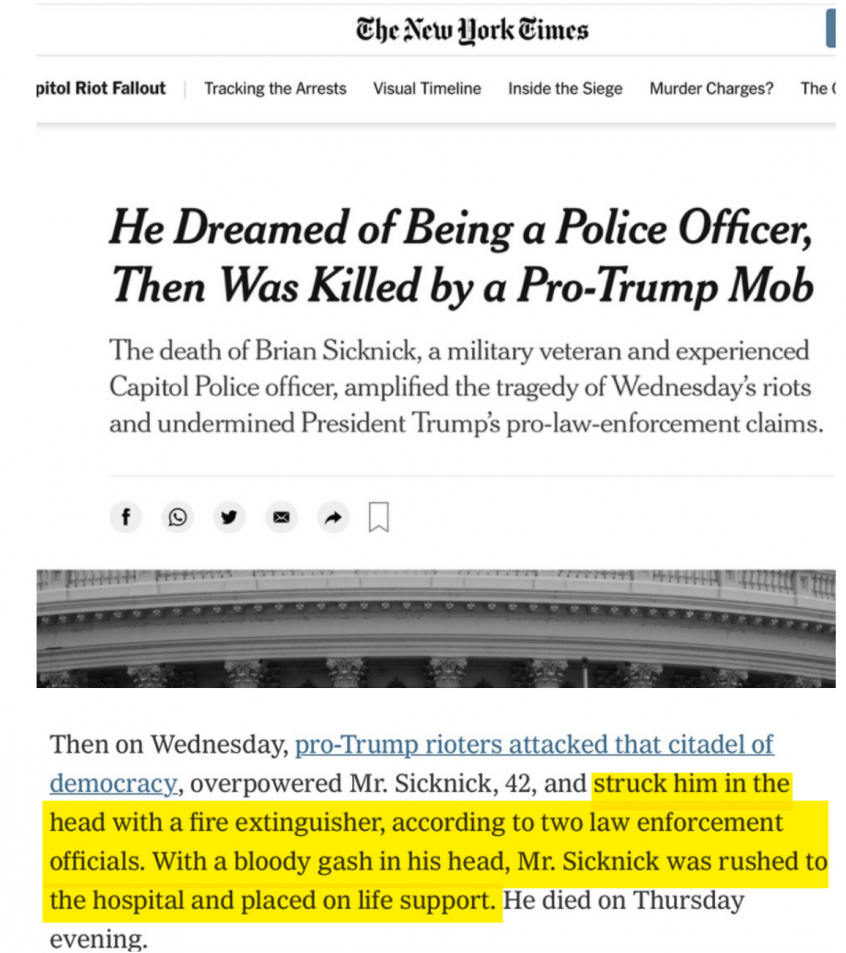
The New York Times, in a now-”updated” article, Jan. 8, 2021
Truth matters. Noble lies are never justified no matter the cause, especially in journalism. But these employees of corporate media outlets have been taught the exact opposite model: that their primary obligation is to please and flatter the partisan agenda and political sensibilities of their audience even if it means lying or recklessly spreading unproven theories to do it. That is their profit model. And they have trained their audiences to want and expect this and that is why they never feel compelled to engage in any self-critique or accountability when they get caught doing this: their audiences want to be lied to — they are grateful for it — and would prefer that they not admit they did it so that their partisan interests will not be undermined.
What is most depressing about this entire spectacle is that, this time, they exploited the tragic death of a young man to achieve their tawdry goals. They never cared in the slightest about Officer Brian Sicknick. They had just spent months glorifying a protest movement whose core view is that police officers are inherently racist and abusive. He had just become their toy, to be played with and exploited in order to depict the January 6 protest as a murderous orgy carried out by savages so primitive and inhuman that they were willing to fatally bash in the skull of a helpless person or spray them with deadly gases until they choked to death on their own lung fluids. None if it was true, but that did not matter — and it still does not to them — because truth, as always, has nothing to do with their actual function. If anything, truth is an impediment to it.
Journalists, Learning They Spread a CIA Fraud About Russia, Instantly Embrace a New One
By Glenn Greenwald | April 16, 2021
That Russia placed “bounties” on the heads of U.S. soldiers in Afghanistan was one of the most-discussed and consequential news stories of 2020. It was also, as it turns out, one of the most baseless — as the intelligence agencies who spread it through their media spokespeople now admit, largely because the tale has fulfilled and outlived its purpose.
The saga began on June 26, 2020, when The New York Times announced that unnamed “American intelligence officials” have concluded that “a Russian military intelligence unit secretly offered bounties to Taliban-linked militants for killing coalition forces in Afghanistan — including targeting American troops.” The paper called it “a significant and provocative escalation” by Russia. Though no evidence was ever presented to support the CIA’s claims — neither in that original story nor in any reporting since — most U.S. media outlets blindly believed it and spent weeks if not longer treating it as proven, highly significant truth. Leading politicians from both parties similarly used this emotional storyline to advance multiple agendas.
The story appeared — coincidentally or otherwise — just weeks after President Trump announced his plan to withdraw all troops from Afghanistan by the end of 2020. Pro-war members of Congress from both parties and liberal hawks in corporate media spent weeks weaponizing this story to accuse Trump of appeasing Putin by leaving Afghanistan and being too scared to punish the Kremlin. Cable outlets and the op-ed pages of The New York Times and Washington Post endlessly discussed the grave implications of this Russian treachery and debated which severe retaliation was needed. “This is as bad as it gets,” said House Speaker Nancy Pelosi. Then-candidate Joe Biden said Trump’s refusal to punish Russia and his casting doubt on the truth of the story was more proof that Trump’s “entire presidency has been a gift to Putin,” while Sen. Ben Sasse (R-NE) demanded that, in response, the U.S. put Russians and Afghans “in body bags.”
What was missing from this media orgy of indignation and militaristic demands for retaliation was an iota of questioning of whether the story was, in fact, true. All they had was an anonymous leak from “intelligence officials” — which The New York Times on Thursday admitted came from the CIA — but that was all they needed. That is because the vast majority of the corporate sector of the press lives under one overarching rule:
When the CIA or related security state agencies tell American journalists to believe something, we obey unquestioningly, and as a result, whatever assertions are spread by these agencies, no matter how bereft of evidence or shielded by accountability-free anonymity, they instantly transform, in our government-worshipping worldview, into a proven fact — gospel — never to be questioned but only affirmed and then repeated and spread as far and wide as possible.
That has been the dynamic driving the relationship between the corporate press and the CIA for decades, throughout the Cold War and then into the post-9/11 War on Terror and invasion of Iraq. But it has become so much more extreme in the Trump era. As the CIA became one of the leading anti-Trump #Resistance factions — a key player in domestic politics to subvert the presidency of the 45th President regarded by media figures as a Hitler-type menace — the bond between the corporate press and the intelligence community deepened more than ever. It is not an exaggeration to call it a merger: so much so that a parade of former security state officials from the CIA, NSA, FBI, DHS and others was hired by these news outlets to deliver the news. The partnership was no longer clandestine but official, out in the open, and proud.
John Brennan, James Clapper, Chuck Rosenberg, Michael Hayden, Frank Figliuzzi, Fran Townsend, Stephen Hall, Samantha Vinograd, Andrew McCabe, Josh Campbell, Asha Rangappa, Phil Mudd, James Gagliano, Jeremy Bash, Susan Hennessey, Ned Price, Rick Francona…
Also Michael Morell, John McLaughlin, John Sipher, Thomas Bossert, Clint Watts, James Baker, Mike Baker, Daniel Hoffman, Susan Rice, Ben Rhodes, David Preiss, Evelyn Farkas, Tony Blinken, Mike Rogers, “Alex Finley,” Malcolm Nance…
The first goal this story served was to weaponize it in the battle waged by pro-war House Democrats and their neocon GOP allies to stop Trump’s withdrawal plan from Afghanistan. How, they began demanding upon publication of the CIA/NYT story, can we possibly leave Afghanistan when the Russians are trying to kill our troops? Would that not be a reckless abdication to the Kremlin of this country that we own, and would withdrawal not be a reward to Putin after we learned he was engaged in such dastardly plotting to kill our sons and daughters?
In late June, this alliance of pro-war House Democrats — funded overwhelmingly by military contractors — and the Liz-Cheney-led neocon wing announced amendments to the military budget authorization process that would defund Trump’s efforts to withdraw troops from either Afghanistan or Germany (where they had been stationed for decades to defend Western Europe against a country, the Soviet Union, that ceased to exist decades ago). They instantly weaponized the NYT/CIA story as their primary argument.
The record-breaking $740 billion military budget was scheduled to be approved by the House Armed Services Committee in early July. In a joint statement with Rep. Mac Thornberry (R-TX) on June 29 — the day the NYT story appeared — Liz Cheney proclaimed that “we remain concerned about Russian activity in Afghanistan, including reports that they have targeted U.S. forces.” One of the Democrats’ most pro-war House members, Rep. Ruben Gallego (D-AZ), announced on July 1 (three days after the NYT story) his own amendment to block any troop withdrawal from Germany, citing “increasing Russian aggression.”
On July 1 and 2, the House Armed Services Committee held its hearings and votes — I watched all fourteen hours and reported on it in a series of articles and a 90-minute video report — and it not only approved this massive military budget but also both amendments to bar troop withdrawal. Over and over, the union of pro-war Democrats and Cheney-led neocon Republicans steamrolled the anti-war faction of left-wing and right-wing war opponents (led by Congressmembers Ro Khanna (D-CA), Tulsi Gabbard (D-HI) and Matt Gaetz (R-FL)), and repeatedly used the Russia bounty story to justify continuation of the longest war in America’s history. This little speech from Rep. Seth Moulton (D-MA) was illustrative of how this CIA story was used all day:
The U.S. media was somehow more militaristic and blindly trusting about this CIA story than even this pro-war union of lawmakers. That the CIA’s leaked claim to The New York Times should even be questioned at all — given that it was leaked anonymously and was accompanied by exactly zero evidence — is not something that even crossed their journalistic minds.
These people who call themselves “journalists” do not view pronouncements from the U.S. security state as something that prompts skepticism let alone requires evidence before believing. The officials who run those agencies are their friends, partners and colleagues — those they most revere — and their every utterance is treated as Gospel. If — after watching them behave this way the last five years without pause — you think that is an exaggeration, watch this short video compilation produced by The Daily Caller to see for yourself how they instantly converted this CIA “Russia bounty” leak into proven fact that nobody, least of all them, should question:
As usual, the media figure most loudly and dramatically enshrining the CIA leak about Russia as Proven Truth was the undisputed Queen of demented conspiracy theories, jingoistic rhetoric, and CIA propaganda: MSNBC’s Rachel Maddow.
Over and over, she devoted melodramatic segments to denouncing the unparalleled evil of Russian treachery in Afghanistan (because the U.S. would never pay bounties to kill Russian soldiers in Afghanistan), at no point pausing her histrionics for even a second or two to wonder whether evidence ought to be presented before telling the millions of #Resistance liberals who watch her show that she is vouching for the truth of this story.
Predictably, now that this CIA tale has served its purpose (namely, preventing Trump from leaving Afghanistan), and now that its enduring effects are impeding the Biden administration (which wants to leave Afghanistan and so needs to get rid of this story), the U.S. Government is now admitting that — surprise! — they had no convincing evidence for this story all along.
The Daily Beast on Thursday was the first to notice that “the Biden administration announced that U.S. intelligence only had ‘low to moderate’ confidence in the story after all.” The outlet added: “that means the intelligence agencies have found the story is, at best, unproven—and possibly untrue.” The Guardian also reported that “US intelligence agencies have only ‘low to moderate confidence’ in reports last year that Russian spies were offering Taliban militants in Afghanistan bounties for killing US soldiers.” NBC News went even further, citing Biden’s campaign attacks on Trump for failing to punish Putin for these bounties, and noting: “Such a definitive statement was questionable even then…. They still have not found any evidence, a senior defense official said Thursday.”
What made this admission particularly bizarre — aside from rendering weeks of decrees from media figures and politicians humiliatingly reckless and baseless — is that the Biden administration continued to assert this claim as truth as recently as Thursday. When announcing new sanctions aimed at Moscow and diplomatic expulsions of Russian diplomats — primarily in response to allegations of Russian hacking — the White House said “it was responding to reports that Russia encouraged Taliban fighters to injure or kill coalition forces in Afghanistan.” The official White House announcement of the retaliation said explicitly that “the Administration is responding to the reports that Russia encouraged Taliban attacks against U.S. and coalition personnel in Afghanistan based on the best assessments from the Intelligence Community (IC)” — a claim for which the IC itself admits it has only “low to moderate confidence” is even true.
When asked about this glaring contradiction yesterday, White House Press Secretary Jen Psaki gave an answer that barely rose to the level of cogency, yet she clearly admitted the lack of evidentiary basis for this long-standing CIA/media tale:
That there is no evidence for this media-laundered CIA story is not something we learned only yesterday. It has been obvious for many months. In September, NBC News — as Maddow was in the midst of her performative sadness and indignation over the story on its cable network — noted:
Two months after top Pentagon officials vowed to get to the bottom of whether the Russian government bribed the Taliban to kill American service members, the commander of troops in the region says a detailed review of all available intelligence has not been able to corroborate the existence of such a program.
“It just has not been proved to a level of certainty that satisfies me,” Gen. Frank McKenzie, commander of the U.S. Central Command, told NBC News. McKenzie oversees U.S. troops in Afghanistan. The U.S. continues to hunt for new information on the matter, he said.
“We continue to look for that evidence,” the general said. “I just haven’t seen it yet.
That was what made the refusal to question this story all along so maddening. Not only was no evidence presented to support the CIA’s assertions — something that, by itself, should have prevented every real journalist from endorsing its truth — but commanders in Afghanistan were saying months ago they could not find convincing evidence for it. That is what The Daily Beast meant in Thursday’s report when it said “there were reasons to doubt the story from the start” — not just the lack of evidence but also that “the initial stories emphasize[d] its basis on detainee reporting” and “the bounties represented a qualitative shift in recent Russian engagements with Afghan insurgents.” NBC News on Thursday also said that “such a definitive statement was questionable even then.”
But these doubts were virtually non-existent in most media reports. Indeed, one of the New York Times reporters who broke the story publicly attacked me as a conspiracy theorist back in September when I cited that NBC News story about the lack of evidence while pointing out what a crucial role this uncorroborated story played in stopping troop withdrawal from Afghanistan and claiming Trump was beholden to Putin. And while The Daily Beast on Thursday said there were reasons to doubt the story from the start, that same outlet was one of the most vocal and aggressive in pushing the story as true:

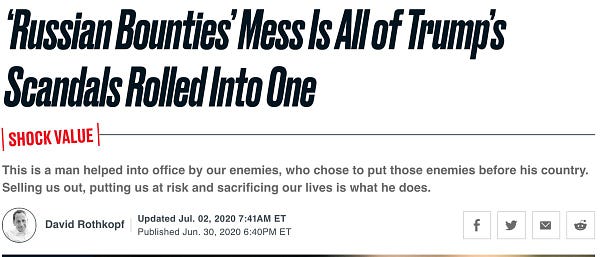
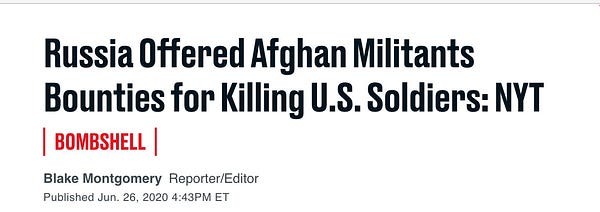
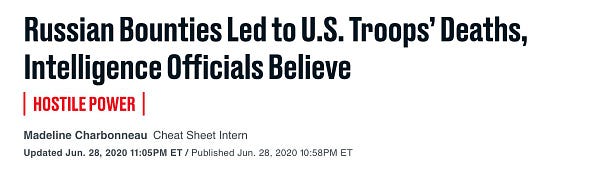
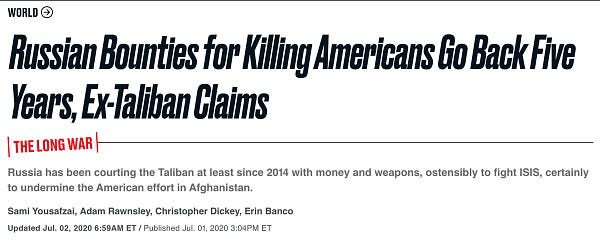
Even worse, other media outlets — led by The Washington Post — purported to have “independently confirmed” the NYT/CIA tale of Russian bounties. Twice in the last year, I have written about this bizarre practice where media outlets purport to “independently confirm” one another’s false stories by doing nothing more than going to the same anonymous sources who whisper to them the same things while providing no evidence. Yet they use this phrase “independent confirmation” to purposely imply that they obtained separate evidence corroborating the truth of the original story:

We have confirmed the @nytimes scoop: A Russian military spy unit offered bounties to Taliban-linked militants to attack coalition forces in Afghanistan. From @nakashimae @missy_ryan me and @shaneharris
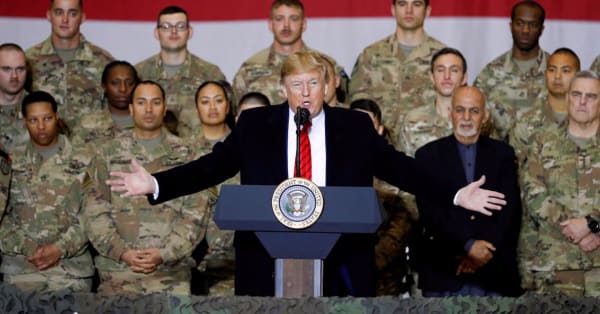
For months, pro-war members of both parties and leading members of the NYT/CNN/MSNBC media axis pushed a story — an inflammatory, dangerous one — based on nothing more than the say-so of anonymous CIA operatives. How can anyone do this who knows even the bare minimum about what this agency does and what its function is: to spread disinformation not just to foreign countries but the domestic population as well? It is both mystifying and toxic. But for people who call themselves “journalists” to repeat, over and over, evidence-free CIA claims, telling those who trust them to believe it, is nothing short of repulsive.
If you think that, upon learning yesterday’s news, there was any self-reflection on the part of the media figures who spread this, or that they felt chastened about it in any way, you would be very, very wrong. In fact, not only did few if any admit error, but they did exactly the same thing on Thursday about a brand new evidence-free assertion from the U.S. Government concerning Russia: they mindlessly assumed it true and then stated it to millions of people as fact. They are not embarrassed to get caught spreading false CIA propaganda. They see their role, correctly, as doing exactly that.
On Thursday, the U.S. Department of the Treasury, run by Biden’s Treasury Secretary Janet Yellen, issued a short Press Release about its targeting of Russian-Ukrainian political consultant, Konstantin Kilimnik, with new sanctions. One sentence of this press release asserted a claim that the Mueller investigation, after searching for eighteen months, never found: namely, that “Kilimnik provided the Russia intelligence services with sensitive information on polling and campaign strategy” that he received from then-Trump campaign manager Paul Manafort.
Is it true that Kilimnik passed this polling data to the Kremlin? Maybe. But there is no way for a rational person — let alone someone calling themselves a “journalist” — to conclude that it is true. Why? Because, like the CIA tale about Russian bounties — a claim they learned yesterday had no evidence — this is nothing more than a U.S. Government assertion that lacks any evidence.
Do you think journalists learned the lesson that they just had rubbed in their faces hours before about the foolishness of assuming official statements to be true with no evidence? Of course that is a rhetorical question: too many to count instantly proclaimed that this story was true without spending an ounce of mental energy to question if it was or apply any skepticism. Here’s Maddow’s MSNBC comrade showing how this is done:
Do you see what Hayes just did there? It is vital not to lose sight of how irresponsible and destructive this behavior is just because it is now so common. He saw a Press Release from a U.S. Government agency, read an assertion that it contained in one sentence, had no evidence that this assertion was true, but nonetheless “reported” it as if it were proven fact to millions of people in a predictably viral tweet.
Hayes was far from alone. I cannot count how many employees of corporate media outlets did the same: read the Treasury Department’s Press Release and, without pausing for a second, proclaimed it to be true. Indeed, the two MSNBC hosts who follow Hayes’s nightly news program explicitly described this evidence-free Press Release as “confirmation”— confirmation!

MSNBC’s Rachel Maddow and Lawrence O’Donnell celebrating an evidence-free Treasury Department Press Release as “confirmation,” Apr. 15, 2021
Let’s set aside the absurdity of treating this as some shocking revelation even if it were true. Just like the oozing historical ignorance of pretending that there would be something astonishing about Russians paying for the killing of U.S. troops in Afghanistan when the CIA just last week explicitly boasted of having done the same to Russian soldiers in Afghanistan, what is this Treasury Press Release supposed to prove that is so breathtaking and scandalous: that the Kremlin could not possibly have obtained polling data about the U.S. electorate had Manafort not provided it to them? That they never would have known that Wisconsin and Pennsylvania were swing states without an elaborate plot of collusion to learn this from the Trump campaign?
But the far more important point is the U.S. media’s willingness — their subservient eagerness — to obediently treat U.S. government pronouncements as Truth. Just like with the Russia bounty story, where there were ample reasons to doubt it from the start, the same is true of this Treasury Press Release. To begin with, if this were such a smoking gun “confirming” collusion, why did the Mueller investigation after eighteen months of highly aggressive subpoena-driven investigative activity not discover it?
Let’s express this as clearly as it can be expressed. Any journalist who treats unverified stories from the CIA or other government agencies as true, without needing any evidence or applying any skepticism, is worthless. Actually, they are worse than worthless: they are toxic influences who deserve pure contempt. Every journalist knows that governments lie constantly and that it is a betrayal of their profession to serve as mindless mouthpieces for these security agencies: that is why they will vehemently deny they do this if you confront them with this accusation. They know it is a shameful thing to do.
But just look at what they are doing: exactly this. These are not journalists. They are obsequious spokespeople for the CIA and other official authorities. Even when they learn that they deceived millions of people by uncritically repeating a story that the CIA told them was true, they will — on the very same day that they learn they did this — do exactly the same thing, this time with a one-paragraph Treasury Department Press Release. These are agents of disinformation: state media. And when they speak, you should listen to them with the knowledge of what they really are, and treat them accordingly.
White House admits lack of confidence in DEBUNKED story about Russian bounties – after Biden repeatedly used it to attack Trump
RT | April 15, 2021
With Donald Trump safely ousted, US intelligence agencies now admit they have only “low to moderate confidence” that Russia offered bounties on US troops in Afghanistan – yet still demand that the Kremlin answer for the crimes.
“The US intelligence community assesses with low to moderate confidence that Russian intelligence officers sought to encourage Taliban attacks against US coalition personnel in Afghanistan in 2019, including through financial incentives and compensation,” a senior Biden administration official told reporters on Thursday.
White House Press Secretary Jen Psaki confirmed the new assessment in a press briefing, saying reports on the bounties “were enough of a cause of concern that we wanted our intelligence community to look into” the matter. That assessment found “low to moderate confidence” that the allegations were true, she said.
The latest official view marks a sharp contrast to last June, when the New York Times reported as fact – based on anonymous sourcing – that Russia had offered such bounties for Taliban-linked militants to attack US forces. Other outlets “confirmed” the report – which in mainstream-media-speak means that anonymous sources reiterated the allegations to them, not that anything was verified to be true.
With election season heating up, Democratic presidential candidate Joe Biden and other politicians used the issue to bludgeon President Trump for failing to punish Russia. “His entire presidency has been a gift to [Russian President Vladimir] Putin, but this is beyond the pale,” Biden said in September. “It’s a betrayal of the most sacred duty we bear as a nation, to protect and equip our troops when we send them into harm’s way.”
Asked on Thursday whether President Biden – in light of the current doubts over the allegations against Russia – regretted using the bounty story to attack Trump, Psaki said, “I’m not going to speak to the previous administration.”
Trump and members of his administration had repeatedly pointed out that the bounty allegations were unverified. While the media reporting on the issue cited unidentified “intelligence” officials, the nation’s top intelligence and military chiefs said on the record that the claims were unverified. Director of National Intelligence John Ratcliffe, among other officials, told members of Congress in July that the allegations were unconfirmed.
Months of investigation by the US military failed to yield a different answer. Marine Corps General Frank McKenzie, the commander who oversees US troops in Afghanistan, said in September that the military had found nothing to corroborate the bounty allegations. At that point, the probe included a review of every attack on US troops in Afghanistan in the past several years, none of which were linked to Russian incentive payments.
And yet, even as the White House walked back the intelligence community’s assessment of the alleged bounties on Thursday, partly blaming “challenging operating environments,” Psaki suggested that Russia should still be forced to explain its conduct.
“This information really puts the burden on Russia and the Russian government to explain their engagement here,” she said. The unidentified senior official who briefed reporters added that Russia must “take steps to address this disturbing pattern of behavior,” although allegations of that behavior remain in doubt.
The new assessment was offered on the same day that Biden imposed new sanctions against Russian individuals and organizations, as well as expelling 10 Moscow diplomats. The unidentified senior official told reporters that the sanctions were for election interference and the SolarWinds hacking incident – the Kremlin has denied being involved in either case – and added that US concerns over the bounties have been conveyed to Russia in “strong direct messages” through diplomatic, intelligence, and military channels.
Observers on social media noted that the reassessment of the bounty story should further discredit MSM outlets for attacks on Trump that later proved to be false or dubious. Journalist Aaron Mate said today’s White House statements mark “another blockbuster humiliation” for “Russia-gate disinformation outlet” the Daily Beast.
CNN host Jake Tapper was another target of ridicule. “No one should be surprised that Jake Tapper was leading the charge on yet another nonsensical story fabricated by him and other resistance clowns in the media,” journalist Arthur Schwartz said on Twitter.
Schwartz also took a shot at the original purveyor of the story, tweeting: “Hey New York Times PR, you going to let the public know who lied to these reporters? Or did they make it up themselves.”
How Bellingcat Launders National Security State Talking Points into the Press
By Alan Macleod | MintPress News | April 9, 2021
AMSTERDAM — Investigative site Bellingcat is the toast of the popular press. In the past month alone, it has been described as “an intelligence agency for the people” (ABC Australia ), a “transparent” and “innovative” (New Yorker ) “independent news collective,” “transforming investigative journalism” (Big Think ), and an unequivocal “force for good” (South China Morning Post ). Indeed, outside of a few alternative news sites, it is very hard to hear a negative word against Bellingcat, such is the gushing praise for the outlet founded in 2014.
This is troubling, because the evidence compiled in this investigation suggests Bellingcat is far from independent and neutral, as it is funded by Western governments, staffed with former military and state intelligence officers, repeats official narratives against enemy states, and serves as a key part in what could be called a “spook to Bellingcat to corporate media propaganda pipeline,” presenting Western government narratives as independent research.
Citizen journalism staffed with spies and soldiers
An alarming number of Bellingcat’s staff and contributors come from highly suspect backgrounds. Senior Investigator Nick Waters, for example, spent three years as an officer in the British Army, including a tour in Afghanistan, where he furthered the British state’s objectives in the region. Shortly after leaving the service, he was hired by Bellingcat to provide supposedly bias-free investigations into the Middle East.
Former contributor Cameron Colquhoun’s past is even more suspect. Colquhoun spent a decade in a senior position in GCHQ (Britain’s version of the NSA), where he ran cyber and Middle Eastern terror operations. The Scot specializes in Middle Eastern security and also holds a qualification from the U.S. State Department. None of this, however, is disclosed by Bellingcat, which merely describes him as the managing director of a private intelligence company that “conduct[s] ethical investigations” for clients around the world — thus depriving readers of key information they need to make informed judgments on what they are reading.
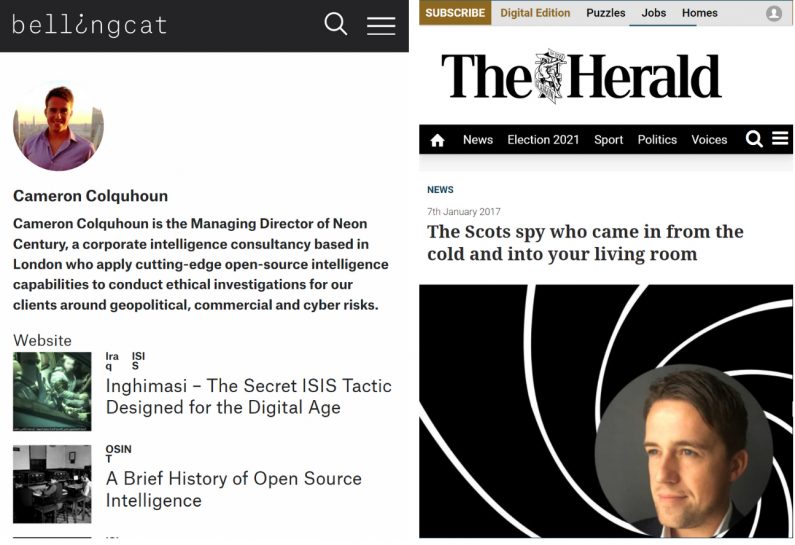
Bellingcat fails to inform its readers of even the most glaring conflicts of interest
There are plenty of former American spooks on Bellingcat’s roster as well. Former contributor Chris Biggers, who penned more than 60 articles for the site between 2014 and 2017, previously worked for the National Geospatial-Intelligence Agency — a combat support unit that works under the Department of Defense and the broader Intelligence Community. Biggers is now the director of an intelligence company headquartered in Virginia, on the outskirts of Washington (close to other semi-private contractor groups like Booz Allen Hamilton), that boasts of having retired Army and Air Force generals on its board. Again, none of this is disclosed by Bellingcat, where Biggers’s bio states only that he is a “public and private sector consultant based in Washington, D.C.”
For six years, Dan Kaszeta was a U.S. Secret Service agent specializing in chemical, biological and nuclear weapons, and for six more he worked as program manager for the White House Military Office. At Bellingcat, he would provide some of the intellectual ammunition for Western accusations about chemical weapons use in Syria and Russia’s alleged poisoning of Sergei Skripal.
Kaszeta is also a fellow at the Royal United Services Institute, a think tank funded by a host of Western governments as well as weapons contractors such as Airbus, Lockheed Martin and Raytheon. Its president is a British field marshal (the highest attainable military rank) and its senior vice president is retired American General David Petraeus. Its chairman is Lord Hague, the U.K.’s secretary of state between 2010 and 2015.
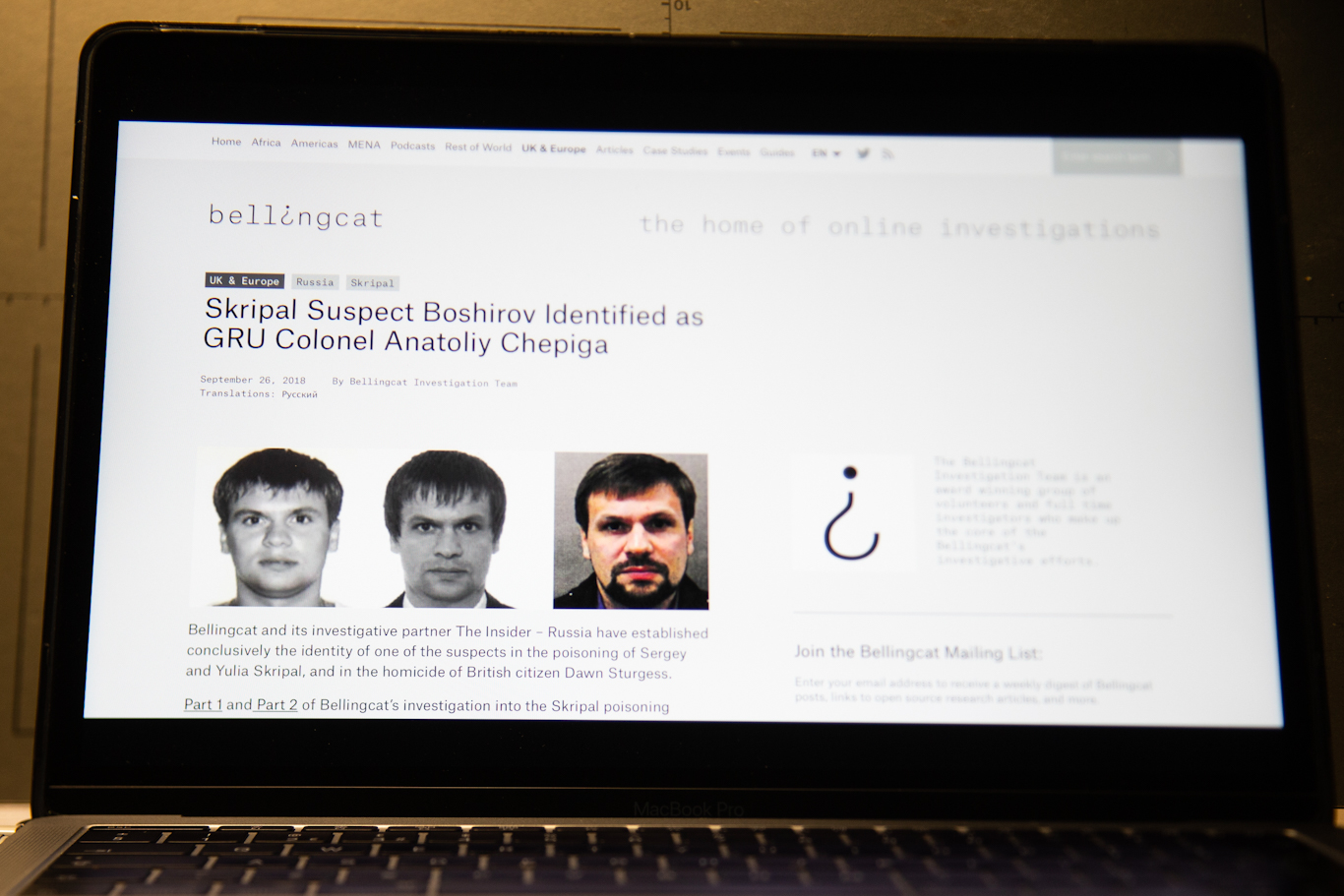
A Bellingcat article covering the alleged poisoning of Sergei Skripal, a story covered heavily by the organization. Alexander Zemlianichenko | AP
All of this matters if a group is presenting itself as independent when, in reality, their views align almost perfectly with the governments funding them. But yet again, Bellingcat fails to follow basic journalism ethics and inform readers of these glaring conflict of interests, describing Kaszeta as merely the managing director of a security company and someone with 27 years of experience in security and antiterrorism. This means that unless readers are willing to do a research project they will be none the wiser.
Other Bellingcat contributors have similar pasts. Nour Bakr previously worked for the British government’s Foreign and Commonwealth Office while Karl Morand proudly served two separate tours in Iraq with the U.S. 82nd Airborne Division.
Government and intelligence officials are the opposite of journalists. The former exist to promote the interests of power (often against those of the public) while the latter are supposed to hold the powerful to account on behalf of the people. That is why it is so inappropriate that Bellingcat has had so many former spooks on their books. It could be said that ex-officials who have renounced their past or blown the whistle, such as Daniel Ellsberg or John Kiriakou, have utility as journalists. But those who have simply made the transition into media without any change in positions usually serve only the powerful.
Who pays the piper?
Just as startling as its spooky staff is Bellingcat’s source of funding. In 2016 its founder, Eliot Higgins, dismissed the idea that his organization got money from the U.S. government’s National Endowment for Democracy (NED) as a ludicrous conspiracy theory. Yet, by the next year, he openly admitted the thing he had laughed off for so long was, in fact, true (Bellingcat’s latest available financial report confirms that they continue to receive financial assistance from the NED). As many MintPress readers will know, the NED was explicitly set up by the Reagan administration as a front for the CIA’s regime-change operations. “A lot of what we do today was done covertly 25 years ago by the CIA,” said the organization’s co-founder Allen Weinstein, proudly.
Higgins himself was a senior fellow at the Atlantic Council, NATO’s quasi-official think tank, from 2016 to 2019. The Atlantic Council’s board of directors is a who’s who of state power, from war planners like Henry Kissinger, Condoleezza Rice and Colin Powell to retired generals such as James “Mad Dog” Mattis and H.R. McMaster. It also features no fewer than seven former CIA directors. How Higgins could possibly see taking a paid position at an organization like this while he was still the face of a supposedly open and independent intelligence collective as being at all consistent is unclear.

Bana Alabed, an outsoken anti-Assad child activist, promotes Bellingcat at an Atlantic Council event. Photo | Twitter
Other questionable sources of income include the Human Rights Foundation, an international organization set up by Venezuelan activist Thor Halvorssen Mendoza. Halvorssen is the son of a former government official accused of being a CIA informant and a gunrunner for the agency’s dirty wars in Central America in the 1980s and the cousin of convicted terrorist Leopoldo Lopez. Lopez in turn was a leader in a U.S.-backed coup in 2002 and a wave of political terror in 2014 that killed at least 43 people and caused an estimated $15 billion worth of property damage. A major figure on the right-wing of Venezuelan politics, Lopez told journalists that he wants the United States to formally rule the country once President Nicolas Maduro is overthrown. With the help of the Spanish government, Lopez escaped from jail and fled to Spain last year.
Imagine, for one second, the opposite scenario: an “independent” Russian investigative website staffed partially with ex-KGB officials, funded by the Kremlin, with most of their research focused on the nefarious deeds of the U.S., U.K. and NATO. Would anyone take it seriously? And yet Bellingcat is consistently presented in corporate media as a liberatory organization; the Information Age’s gift to the people.
The Bellingcat to journalism pipeline
The corporate press itself already has a disturbingly close relationship with the national security state, as does social media. In 2019, a senior Twitter executive was unmasked as an active duty officer in the British Army’s online psychological operations unit. Coming at a time when foreign interference in politics and society was the primary issue in U.S. politics, the story was, astoundingly, almost completely ignored in the mainstream press. Only one U.S. outlet of any note picked it up, and that journalist was forced out of the profession weeks later.
Increasingly, it seems, Bellingcat is serving as a training ground for those looking for a job in the West’s most prestigious media outlets. For instance, former Bellingcat contributor Brenna Smith — who was recently the subject of a media storm after she successfully pressured a number of online payment companies to stop allowing the crowdfunding of the Capitol Building insurrectionists — announced last month she would be leaving USA Today and joining The New York Times. There she will meet up with former Bellingcat senior investigator Christiaan Triebert, who joined the Times’ visual investigations team in 2019.
The Times, commonly thought of as the United States’ most influential media outlet, has also collaborated with Bellingcat writers for individual pieces before. In 2018, it commissioned Giancarlo Fiorella and Aliaume Leroy to publish an op-ed strongly insinuating that the Venezuelan state murdered Oscar Perez. After he stole a military helicopter and used it to bomb government buildings in downtown Caracas while trying to ignite a civil war, Perez became the darling of the Western press, being described as a “patriot” (The Guardian ), a “rebel” (Miami Herald ), an “action hero” (The Times of London ), and a “liberator” (Task and Purpose ).
Until 2020, Fiorella ran an opposition blog called In Venezuela despite living in Canada. Leroy is now a full-time producer and investigator for the U.K.-government network, the BBC.
Bad news from Bellingcat
What we are uncovering here is a network of military, state, think-tank and media units all working together, of which Bellingcat is a central fixture. This would be bad enough, but much of its own research is extremely poor. It strongly pushed the now increasingly discredited idea of a chemical weapons attack in Douma, Syria, attacking the members of the OPCW who came forward to expose the coverup and making some bizarre claims along the way. For years, Higgins and other members of the Bellingcat team also signal-boosted a Twitter account purporting to be an ISIS official, only for an investigation to expose the account as belonging to a young Indian troll in Bangalore. A leaked U.K. Foreign Office document lamented that “Bellingcat was somewhat discredited, both by spreading disinformation itself, and by being willing to produce reports for anyone willing to pay.”
Ultimately, however, the organization still provides utility as an attack dog for the West, publishing research that the media can cite, supposedly as “independent,” rather than rely directly on intelligence officials, whose credibility with the public is automatically far lower.
Oliver Boyd-Barrett, professor emeritus at Bowling Green State University and an expert in the connections between the deep state and the fourth estate, told MintPress that “the role of Bellingcat is to provide spurious legitimacy to U.S./NATO pretexts for war and conflict.” In far more positive words, the CIA actually appears to agree with him.
“I don’t want to be too dramatic, but we love [Bellingcat],” said Marc Polymeropoulos, the agency’s former deputy chief of operations for Europe and Eurasia. “Whenever we had to talk to our liaison partners about it, instead of trying to have things cleared or worry about classification issues, you could just reference [Bellingcat’s] work.” Polymeropoulos recently attempted to blame his headache problems on a heretofore unknown Russian microwave weapon, a claim that remarkably became an international scandal. “The greatest value of Bellingcat is that we can then go to the Russians and say ‘there you go’ [when they ask for evidence],” added former CIA Chief of Station Daniel Hoffman.
Bellingcat certainly seems to pay particular attention to the crimes of official enemies. As investigative journalist Matt Kennard noted, it has only published five stories on the United Kingdom, 17 on Saudi Arabia, 19 on the U.S. (most of which are about foreign interference in American society or far-right/QAnon cults). Yet it has 144 on Russia and 244 under its Syria tag.
In his new book “We Are Bellingcat: An Intelligence Agency for the People,” the outlet’s boss Higgins writes: “We have no agenda but we do have a credo: evidence exists and falsehoods exist, and people still care about the difference.” Yet exploring the backgrounds of its journalists and its sources of funding quickly reveals this to be a badly spun piece of PR.
Bellingcat looks far more like a bunch of spooks masquerading as citizen journalists than a people-centered organization taking on power and lies wherever it sees them. Unfortunately, with many of its proteges travelling through the pipeline into influential media outlets, it seems that there might be quite a few masquerading as reporters as well.
Alan MacLeod is Senior Staff Writer for MintPress News. After completing his PhD in 2017 he published two books: Bad News From Venezuela: Twenty Years of Fake News and Misreporting and Propaganda in the Information Age: Still Manufacturing Consent, as well as a number of academic articles.
Inventing Pretexts to Bash Russia
By Stephen Lendman | April 9, 2021
Establishment media provide press agent services for US imperial interests.
Russia bashing again surfaced in support of political nobody, convicted embezzler Navalny.
Along with grand theft of millions of dollars for self-enrichment, he’s unindicted but guilty of sedition, serving as a CIA/NED asset, and operating as an unregistered US foreign agent — a nation waging war on Russia by other means that could turn hot by accident or intent.
Navalny got off easily. Instead of longterm imprisonment for betraying his country and grand theft, he was sentenced to 2.8 years imprisonment.
He’s interned in central Russia about 80 miles from Moscow.
According to the lying machine NYT, his imprisonment “poses a lethal risk to his health (sic).”
Calling him Putin’s “preeminent political opponent” reinvented reality, a Times specialty.
So is serial lying. Last summer en route to Moscow, he fell ill from a metabolic disorder, what Russian doctors diagnosed when treating and stabilizing him.
No “poisoning with a military nerve agent” occurred, no “assassination attempt,” no attempt to harm him in any way.
Just the opposite! Russian doctors saved him from what may have been severe hypoglycemia, or insulin shock, a serious health risk for anyone with diabetes like Navalny.
Nearly a week ago, he began hunger-striking over alleged failure by prison authorities to provide medical treatment sought.
On Monday, prison doctors diagnosed a respiratory ailment. In response, he was moved to an infirmary for treatment.
If poisoned by a military grade nerve agent, he’d have died in minutes.
If Russia wanted him dead, he’d have been eliminated long ago.
Despite his criminality and overall unacceptable action, Moscow respects the rule of law — polar opposite how the US-dominated West operates, waging endless wars on humanity at home and abroad.
Navalny fully recovered, returned to Moscow voluntarily, was arrested for violating terms of his suspended sentence, and is paying the price.
He warrants no leniency, sympathy, or support for his criminality.
Establishment media backing is all about inventing any pretext to bash Russia and Vladimir Putin personally — a preeminent world leader in stark contract to his unindicted Western counterparts for crimes of war, against humanity, and other criminality too serious to ignore.
Turning reality on its head like the Times, WaPo falsely claimed Navalny is being “slowly killed” by Russia (sic).
His temperature is slightly elevated at 100.5. He’s coughing, and may be suffering from a respiratory illness.
Saying he’ll continue hunger-striking despite being ill makes him responsible if his condition worsens.
Former US political prisoner Maria Butina visited Navalny’s prison ward with an RT camera crew, saying the following:
“I’m tired of the complaining. He is in one of the best penal colonies in Russia.”
His treatment is polar opposite Butina’s horrific ordeal — imprisoned and brutally mistreated for being a Russian national in police state USA at the wrong time.
US dirty war on Russia by other means takes many forms — including politicized arrests, imprisonments, and brutal mistreatment under harsh gulag conditions.
Arrested by the FBI in July 2018, Butina was detained without bond and falsely charged with operating as an unregistered Russian agent — a bald-faced Big Lie.
At the time, Russian Foreign Ministry spokeswoman Maria Zakharova denounced her arrest, detention, and mistreatment, calling it part of (a US) campaign to “stoke Russophobic hysteria.”
Despite innocent of bogus charges against her and posing no flight risk, she was denied bail, largely held in suffocating solitary confinement, and given no proper medical care – aiming to break her will by gross mistreatment.
Numerous other Russian nationals languish unjustly in Washington’s gulag longterm — guilty of nothing but their “wrong” nationality.
A Final Comment
Last October, Russia’s OPCW representative Alexander Shuglin said the following:
Despite unjustifiable demands by Russophobic Western officials, Moscow “does not owe anything to anybody” in response to groundless accusations of poisoning Navalny, adding:
“We do not need to explain ourselves to (Western officials) and we are not going to.”
“Until we receive documents, materials, samples, physical evidence that – as alleged by those accusing us – proving that a toxic agent was found in Alexei Navalny’s tests, until they sit down at the negotiating table with us for an engaged expert-level dialogue, we will treat everything that is going on in the context of this incident as a vociferous propaganda campaign of lies, or, simply, a low-grade provocation.”
To the present day, Russia never received information it requested from Berlin where Navalny was treated —nothing in cahoots with US dark forces to unacceptably bash Russia, part of their long war by other means.
They’re Not Even Trying to Make Sense Now
By Patrick Armstrong | Strategic Culture Foundation | March 31, 2021
The US intelligence community published a report on 10 March, widely reported in the US free speech news media, on foreign interference in the US election (how many oxymorons so far?). The report establishes a new level of idiocy on the long-running “Russiagate” nonsense.
The idiocy began when Trump, campaigning, remarked that it would be better to get along with Russia than not. A sentiment that would not have surprised Presidents Eisenhower, Kennedy, Nixon, Reagan or any of the others who recognised that, like it or not, Moscow was a fact. A fact that had to be dealt with, talked to, negotiated with so as to produce the best possible result. Why? Well, apart from the diplomatic reality that it is better to get on with your neighbours, the fact that the USSR/Russia was a nuclear power that could obliterate the USA was adequate reason to keep communications alive. If relations could be improved, all earlier US Presidents would agree, so much the better. But for Trump – the outsider – to dare to say so was an outrage. Or more accurately, a hook on which to hang enough simulated outrage to cost him the election. Then, upsetting all expectations, he won. Immediately pussy hat protests, blather about tax returns, Electoral College speculations, 25th Amendment, psychiatrists opining unfitness (COVFEFE: Bizarre Trump Behavior Raises More Mental Health Questions): an entire industry was created to get Trump out, or, if he couldn’t be got out, then at least prevented from doing any of the things he campaigned on. All the swamp creatures were mobilised. The most enduring of these efforts was the Russia allegation. A Special Counsel was created to investigate Russia, Trump and the election. Leaks from this and other investigations fuelled outrage and talk shows.
One of the indications that the story was actually an information operation and not based on fact was its imprecision. Was Trump merely too friendly with Putin, or was he his puppet? Was Trump just a fool to think that relations with Russia could be improved, or was he following instructions? In short, was he a dupe or a traitor? How exactly had Russia interfered in the election and to what effect? Had a few voters been influenced or had the result been completely determined by Moscow? In short was Moscow running the USA or just trying to? Proponents of these crackpot theories never quite specified what they were talking about – it was all suggestion, innuendo, rumours and promises of future devastating revelations. Some of the highlights of the campaign: Keith Olberman shouting Russian scum! Morgan Freeman solemnly intoning that we were at war, and, night after night, Rachel Maddow spewing conspiracies. Some media headlines: Opinion: Here are 18 reasons Trump could be a Russian asset. Trump is ‘owned by Putin’ and has been ‘laundering money’ for Russians, claims MSNBC’s Donny Deutsch. Mueller’s Report Shows All The Ways Russia Interfered In 2016 Presidential Election. A media firestorm as Trump seems to side with Putin over US intelligence. Trump and Putin, closer than ever. All signs point the same way: Vladimir Putin has compromising information on Donald Trump. And so on. Four years of non-stop nonsense promising, tomorrow, or the next day, the final revelation that would disgrace Trump and rid the country of him forever: my personal favourite is this mashup of TV hairstyles telling us that the walls were closing in. Information war. Propaganda. Fake news.
All this despite the fact that the story as presented simply made no sense at all. As I pointed out in December 2017, if Moscow had wanted to nobble Clinton, it had far more potent weapons at its disposal than a too-late revelation of finagling inside the DNC.
And it wasn’t just TV talking heads; the US intelligence community participated. There were two laughable “intelligence assessments”. The DHS/FBI report of 29 December 2016 carried this stunning disclaimer:
This report is provided “as is” for informational purposes only. The Department of Homeland Security (DHS) does not provide any warranties of any kind regarding any information contained within.
The DNI report of 6 January 2017 devoted nearly half its space to a four-year-old rant about RT and admitted that the one Agency that would really know had only “moderate confidence”. In short: ignore the first report, and don’t take the second one seriously. Were people inside these organisations trying to tell us it was all phoney? No matter, the anti-Trump conspiracy shrieked out the reports immediately.
One by one, it fell apart. Mueller, despite the prayer candles, came up with nothing. The “Dirty Dossier” was a fraud. The impeachment for something that Biden actually did failed. These dates should be remembered – Crowdstrike CEO Shawn Henry told the House committee that he had no evidence on 5 December 2017; this classified testimony was not made public until 7 May 2020. Simply put: the key allegation, the trigger for all the excitement and investigations that followed, was a lie, many people knew it was a lie, the lie was kept secret for 884 days. But the lie served its purpose.
There were no investigations of this fraud, only pseudo investigations that went nowhere. When the Republicans had a majority on the House of Representatives there were serious investigations but the testimonies – like Henry’s – were kept secret because they were “classified”. When the Democrats gained control, there were continual boasts that the evidence of collusion was overwhelming, but nothing happened either. Trump’s first Attorney General recused himself and the investigation was conducted by the conspirators. His second Attorney General promised much, set up a Special Counsel, but nothing happened. Well, not quite nothing: a junior conspirator had his knuckles rapped for faking a FISA warrant. In short, the Deep State ran the clock out: the swamp drained Trump.
Ran it out quite successfully too: relations with Russia got worse and Trump himself was hamstrung. His orders were ignored everywhere: on investigating the conspiracy and on removing troops; here’s an insider telling us that the Pentagon ignored his orders on Afghanistan. He was stonewalled on Syria: “We were always playing shell games to not make clear to our leadership how many troops we had there.” The “most powerful man in the world” was blocked on almost every initiative and the long false Russia connection story was a powerful weapon in the conspiracy to impede his attempts to change course.
In 2021 Trump left office and there was no need to mention any of it again. But here’s where it gets really stupid. In December 2020, the NYT solemnly told us: Russian Hackers Broke Into Federal Agencies, U.S. Officials Suspect: In one of the most sophisticated and perhaps largest hacks in more than five years, email systems were breached at the Treasury and Commerce Departments. Other breaches are under investigation. At the same time we were equally solemnly told by US officials “The November 3rd election was the most secure in American history”.
In short, we are supposed to believe that
in 2016 the Russian hacked nothing but the election
and in 2020 they hacked everything but the election.
How stupid do they think we are? Even stupider evidently. Instead of retiring the Trump/Russia/collusion/interference nonsense when it had achieved its purpose, the Intelligence Community Assessment on Foreign Threats to the 2020 US Federal Elections takes us right back down the rabbit hole. I haven’t read it and certainly don’t intend to (see oxymoron above), but Matt Taibbi has and eviscerates it here; he’s read far enough to have mined this gem “Judgments are not intended to imply that we have proof that shows something to be a fact”. (Is this a hint from insiders that it’s all fake?) The report claims that Putin authorised, and various Russian government entities conducted, a campaign to denigrate Biden. Specifically by using Ukrainian sources to talk about corruption of Biden and his son Hunter; despite the video of Biden boasting about firing the investigator, we’re assured that this is all disinformation. And the consumers of the NYT and CNN will believe what they were told. Or, actually, will believe what they weren’t told: the media kept quiet. (Now that’s interference and interference that actually might have changed votes.) The report goes on to say that China did something or other and Iran, Hezbollah, Cuba and Venezuela also chipped in. But fortunately no foreign actor did anything to affect the technical part of the election.
The US security organs expect us to believe,
giving no proof,
that there was lots of malign activity
which had no effect on the election whatsoever.
Which is telling us they think we’re even stupider. Russia swung the election four years ago but forgot how to this time? Putin’s attempt to keep Trump in was blocked by security measures adopted when his tool was President? This time Putin wanted Biden in? Russia’s efforts on behalf of Trump were countered by China’s on behalf of Biden and Iran’s interference broke the tie? But then, information operations don’t have to make sense, they just have to create an impression: Russia, China, Iran and Venezuela do bad things to good people.
Oh, and the latest is that Moscow cultivated Trump for over 40 years, Imagine that: in 1980 they were so perceptive as to see the future importance of a property developer; who’ve they got lined up in the wings now? And Rachel Maddow is back at the old stand pushing some conspiracy theory about Trump, Putin and COVID. I guess it’s not yet time to put away the tinfoil hats.
As I have said before, English needs a whole new set of words for the concept “stupid”: the old ones just don’t have the power any more.
Featured Video
Laith Marouf: Hezbollah’s position on US-Iran ceasefire
or go to
Aletho News Archives – Video-Images
From the Archives
Is Israel to blame for the Iraq War?
American Goy | March 10, 2008
I am so tired of this old canard that “Israel had nothing to do with USA’s war with Iraq – in fact, it officially advised America against it”.
Bullshit. … continue
Blog Roll
 Aletho News
- Laith Marouf: Hezbollah’s position on US-Iran ceasefire: What you’re not being told
- Israel’s priority lies in destroying chances of peace between Iran, US: Ex-UN nuclear chief
- Ceasefire for all or for none: Iran shuts Hormuz over Lebanon attacks
- Strait of Hormuz is Iran’s ‘nuclear weapon’ that forced US retreat: Medvedev
- Energy crisis will last for months – Kremlin envoy
- Europe’s quiet role in the war on Iran
- Forty days that shook the Empire: How Iran turned the tables on US and prevailed
- Netanyahu unilaterally declares Lebanon outside of ceasefire deal
- Israeli leaders: ‘Not a single goal’ achieved in war with Iran
- What on earth just happened? Trump, Iran, and the unlikely ceasefire
- If Americans Knew
- Gazans face a triple crisis: severe shortages of water and bread, healthcare in tatters
- NY Times reports how Netanyahu took the US into Iran War
- A sigh of relief over Iran, but Gaza and Lebanon in dire straits – Daily Update
- Thousands dead and neighborhoods razed to the ground: Aid agencies fear southern Lebanon is becoming the new Gaza
- The war the US is fighting for Israel could cost trillions
- ‘Cigarette Burns, Nail Wounds’: Toddler Tortured in Gaza to Coerce Father
- Trump Says US Sent ‘a Lot of Guns’ to Protesters in Iran
- Israeli forces destroy 17 UN peacekeeper cameras in south Lebanon
- US-Israeli strikes ‘completely destroy’ synagogue in Tehran
- Archbishop for US Military Says Iran War Is Unjust Under Catholic Teaching
- No Tricks Zone
- An Inconvenient Tree: Uncovered In Alps… Europe Much Warmer Than Today 6000 Years Ago
- New Study Reports A 60% Slowdown In Greenland’s Ice Loss Rate In The Last Decade
- Low Intensity Tornado Wrecks Major Solar Farm, Creating A Potential Toxic Dump
- New Study Finds Warming Saves Lives…Cold Temperatures 12 Times More Deadly Than Excess Heat
- German Science Blog Accuses PIK Climate Institute Of Hallucinating Climate Tipping Points
- Devastating Assessment Of Comirnaty Vaccine By Former Senior Pfizer Europe Toxicologist
- New Study: CO2 Is ‘Effectively Negligible’ As An Explanatory Climate Change Factor Since 2000
- Former Pfizer Toxicologist Dr. Helmut Sterz Tells Bundestag Hearing Pfizer Vaccine Should Have Never Been Approved
- Energy Expert: Germany’s Nuclear Phaseout Was A “500 Billion Euro Mistake”
- New Research: South Australia’s Mid-Holocene Sea Surface Temperatures Were 4°C Warmer Than Today
 Aletho News