Trump’s ‘Wag the Dog’ Moment
By Robert Parry | Consortium News | April 7, 2017
Just two days after news broke of an alleged poison-gas attack in northern Syria, President Trump brushed aside advice from some U.S. intelligence analysts doubting the Syrian regime’s guilt and launched a lethal retaliatory missile strike against a Syrian airfield.
Trump immediately won plaudits from Official Washington, especially from neoconservatives who have been trying to wrestle control of his foreign policy away from his nationalist and personal advisers since the days after his surprise victory on Nov. 8.
There is also an internal dispute over the intelligence. On Thursday night, Secretary of State Rex Tillerson said the U.S. intelligence community assessed with a “high degree of confidence” that the Syrian government had dropped a poison gas bomb on civilians in Idlib province.
But a number of intelligence sources have made contradictory assessments, saying the preponderance of evidence suggests that Al Qaeda-affiliated rebels were at fault, either by orchestrating an intentional release of a chemical agent as a provocation or by possessing containers of poison gas that ruptured during a conventional bombing raid.
One intelligence source told me that the most likely scenario was a staged event by the rebels intended to force Trump to reverse a policy, announced only days earlier, that the U.S. government would no longer seek “regime change” in Syria and would focus on attacking the common enemy, Islamic terror groups that represent the core of the rebel forces.
The source said the Trump national security team split between the President’s close personal advisers, such as nationalist firebrand Steve Bannon and son-in-law Jared Kushner, on one side and old-line neocons who have regrouped under National Security Adviser H.R. McMaster, an Army general who was a protégé of neocon favorite Gen. David Petraeus.
White House Infighting
In this telling, the earlier ouster of retired Gen. Michael Flynn as national security adviser and this week’s removal of Bannon from the National Security Council were key steps in the reassertion of neocon influence inside the Trump presidency. The strange personalities and ideological extremism of Flynn and Bannon made their ousters easier, but they were obstacles that the neocons wanted removed.
Though Bannon and Kushner are often presented as rivals, the source said, they shared the belief that Trump should tell the truth about Syria, revealing the Obama administration’s CIA analysis that a fatal sarin gas attack in 2013 was a “false-flag” operation intended to sucker President Obama into fully joining the Syrian war on the side of the rebels — and the intelligence analysts’ similar beliefs about Tuesday’s incident.
Instead, Trump went along with the idea of embracing the initial rush to judgment blaming Assad for the Idlib poison-gas event. The source added that Trump saw Thursday night’s missile assault as a way to change the conversation in Washington, where his administration has been under fierce attack from Democrats claiming that his election resulted from a Russian covert operation.
If changing the narrative was Trump’s goal, it achieved some initial success with several of Trump’s fiercest neocon critics, such as neocon Senators John McCain and Lindsey Graham, praising the missile strike, as did Israeli Prime Minister Benjamin Netanyahu. The neocons and Israel have long sought “regime change” in Damascus even if the ouster of Assad might lead to a victory by Islamic extremists associated with Al Qaeda and/or the Islamic State.
Wagging the Dog
Trump employing a “wag the dog” strategy, in which he highlights his leadership on an international crisis to divert attention from domestic political problems, is reminiscent of President Bill Clinton’s decision to attack Serbia in 1999 as impeachment clouds were building around his sexual relationship with intern Monica Lewinsky.
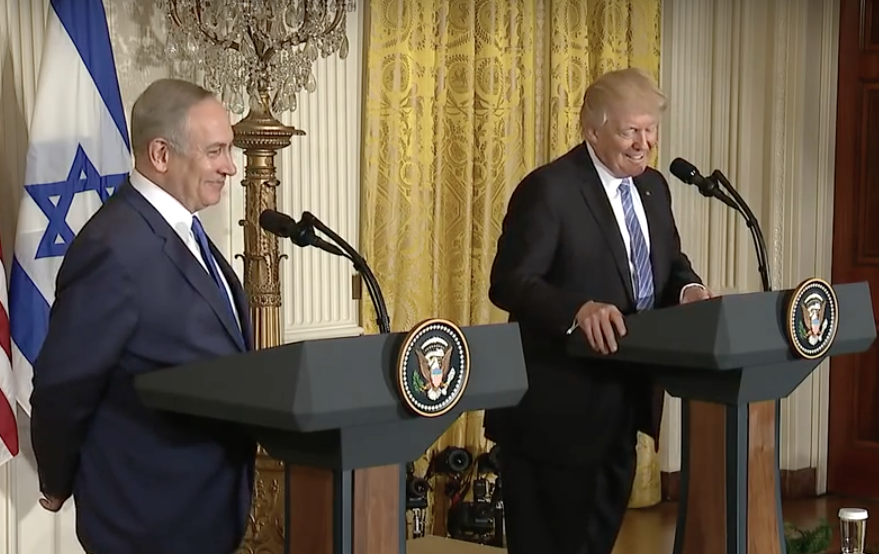
Screen shot from Whitehouse.gov
Trump’s advisers, in briefing the press on Thursday night, went to great lengths to highlight Trump’s compassion toward the victims of the poison gas and his decisiveness in bombing Assad’s military in contrast to Obama’s willingness to allow the intelligence community to conduct a serious review of the evidence surrounding the 2013 sarin-gas case.
Ultimately, Obama listened to his intelligence advisers who told him there was no “slam-dunk” evidence implicating Assad’s regime and he pulled back from a military strike at the last minute – while publicly maintaining the fiction that the U.S. government was certain of Assad’s guilt.
In both cases – 2013 and 2017 – there were strong reasons to doubt Assad’s responsibility. In 2013, he had just invited United Nations inspectors into Syria to investigate cases of alleged rebel use of chemical weapons and thus it made no sense that he would launch a sarin attack in the Damascus suburbs, guaranteeing that the U.N. inspectors would be diverted to that case.
Similarly, now, Assad’s military has gained a decisive advantage over the rebels and he had just scored a major diplomatic victory with the Trump administration’s announcement that the U.S. was no longer seeking “regime change” in Syria. The savvy Assad would know that a chemical weapon attack now would likely result in U.S. retaliation and jeopardize the gains that his military has achieved with Russian and Iranian help.
The counter-argument to this logic – made by The New York Times and other neocon-oriented news outlets – essentially maintains that Assad is a crazed barbarian who was testing out his newfound position of strength by baiting President Trump. Of course, if that were the case, it would have made sense that Assad would have boasted of his act, rather than deny it.
But logic and respect for facts no longer prevail inside Official Washington, nor inside the mainstream U.S. news media.
Intelligence Uprising
Alarm within the U.S. intelligence community about Trump’s hasty decision to attack Syria reverberated from the Middle East back to Washington, where former CIA officer Philip Giraldi reported hearing from his intelligence contacts in the field that they were shocked at how the new poison-gas story was being distorted by Trump and the mainstream U.S. news media.
Giraldi told Scott Horton’s Webcast: “I’m hearing from sources on the ground in the Middle East, people who are intimately familiar with the intelligence that is available who are saying that the essential narrative that we’re all hearing about the Syrian government or the Russians using chemical weapons on innocent civilians is a sham.”
Giraldi said his sources were more in line with an analysis postulating an accidental release of the poison gas after an Al Qaeda arms depot was hit by a Russian airstrike.
“The intelligence confirms pretty much the account that the Russians have been giving … which is that they hit a warehouse where the rebels – now these are rebels that are, of course, connected with Al Qaeda – where the rebels were storing chemicals of their own and it basically caused an explosion that resulted in the casualties. Apparently the intelligence on this is very clear.”
Giraldi said the anger within the intelligence community over the distortion of intelligence to justify Trump’s military retaliation was so great that some covert officers were considering going public.
“People in both the agency [the CIA] and in the military who are aware of the intelligence are freaking out about this because essentially Trump completely misrepresented what he already should have known – but maybe he didn’t – and they’re afraid that this is moving toward a situation that could easily turn into an armed conflict,” Giraldi said before Thursday night’s missile strike. “They are astonished by how this is being played by the administration and by the U.S. media.”
One-Sided Coverage
The mainstream U.S. media has presented the current crisis with the same profound neocon bias that has infected the coverage of Syria and the larger Middle East for decades. For instance, The New York Times on Friday published a lead story by Michael R. Gordon and Michael D. Shear that treated the Syrian government’s responsibility for the poison-gas incident as flat-fact. The lengthy story did not even deign to include the denials from Syria and Russia that they were responsible for any intentional deployment of poison gas.
The article also fit with Trump’s desire that he be portrayed as a decisive and forceful leader. He is depicted as presiding over intense deliberations of war or peace and displaying a deep humanitarianism regarding the poison-gas victims, one of the rare moments when the Times, which has become a reliable neocon propaganda sheet, has written anything favorable about Trump at all.
According to Syrian reports on Friday, the U.S. attack killed 13 people, including five soldiers at the airbase.
Gordon, whose service to the neocon cause is notorious, was the lead author with Judith Miller of the Times’ bogus “aluminum tube” story in 2002 which falsely claimed that Iraqi leader Saddam Hussein was reconstituting a nuclear-weapons program, an article that was then cited by President George W. Bush’s aides as a key argument for invading Iraq in 2003.
Regarding this week’s events, Trump’s desperation to reverse his negative media coverage and the dubious evidence blaming Assad for the Idlib incident could fit with the “Wag the Dog” movie from 1997 in which an embattled president creates a phony foreign crisis in Albania.
In the movie, the White House operation is a cynical psychological operation to convince the American people that innocent Albanian children, including an attractive girl carrying a cat, are in danger when, In reality, the girl was an actor posing before a green screen that allowed scenes of fiery ruins to be inserted as background.
Today, because Trump and his administration are now committed to convincing Americans that Assad really was responsible for Tuesday’s poison-gas tragedy, the prospects for a full and open investigation are effectively ended. We may never know if there is truth to those allegations or whether we are being manipulated by another “wag the dog” psyop.
Investigative reporter Robert Parry broke many of the Iran-Contra stories for The Associated Press and Newsweek in the 1980s.
Mainstream Media as Arbiters of Truth
By Robert Parry | Consortium News | April 4, 2017
The mainstream U.S. media is never more unctuous and unprofessional as when it asserts that it alone must be the arbiter of what is true and what is not, regardless of what the evidence shows or doesn’t show.
For instance, New York Times columnist Charles W. Blow declared on Monday that the public can no longer debate whether Russia leaked to WikiLeaks the emails from the Democratic National Committee and Hillary Clinton’s campaign chairman John Podesta despite the failure of the U.S. government or private researchers to present evidence that establishes that claim as fact.
Blow acknowledged that “We are still not conclusively able to connect the dots on the question of whether there was any coordination or collusion between members of Donald Trump’s campaign and the Russians … but those dots do continue to multiply at an alarming rate.”
But Blow also asserted that “It is absolutely clear that the Russians did interfere in our election. This is not a debatable issue. This is not fake news. This is not a witch hunt. This happened.”
Blow chastised people who still wanted evidence of this now non-debatable issue, seeing them at fault “because this fact [of the Russian meddling] keeps getting obscured in the subterfuge of deflection, misdirection and ideological finger-pointing about what has yet to be proven.”
So, if you insist on asking for proof of the core allegation in Russia-gate, you are guilty of “subterfuge…, misdirection and ideological finger-pointing.”
And if that indictment doesn’t quiet you up, there’s the column by The Washington Post’s E.J. Dionne Jr. who explains that the real victims in Russia-gate are the accusers who have promoted this guilt-by-association scandal that has impugned the integrity of a growing number of Americans who either talked to Russians or who expressed doubts about the investigation.
While the Russia-gate accusers have essentially deemed these Americans “traitors” or the Kremlin’s “useful idiots” or some other derogatory phrase, Dionne sees the much greater offense coming from the people so accused who have complained about what they see as McCarthyism. Dionne writes:
“These days, any liberal who raises alarms about Trump’s relationship with Russia confronts charges of McCarthyism, hysteria and hypocrisy. The inclination of many on the left to assail [Russian President Vladimir] Putin is often ascribed to partisan anger over his success in undermining Clinton’s candidacy.
“There’s no doubt that liberals are angry, but ask yourself: Shouldn’t everyone, left, right and center, be furious over Russia’s efforts to inject calumny and falsehood into the American political bloodstream?”
So, Dionne suggests that people who question the credibility of the Russia-gate allegations are somehow un-American by favoring the injection of “calumny and falsehood into the American political bloodstream.” But that mainstream hostility toward skepticism has been at the heart of the Russia-bashing campaign that we have witnessed for the past several years.
Blacklisting Journalists
And, that campaign indeed has been replete with McCarthyism. You even have The Washington Post promoting a blacklist of 200 Internet news sites (including Consortiumnews.com and other prominent independent-minded outlets) as guilty of “Russian propaganda” for reporting skeptically on some State Department claims about the New Cold War.
But Dionne also is dishonest in claiming that the alleged leaks blamed on Russia are “falsehoods”. The central allegation in Russia-gate is that the Russians obtained two batches of Democratic emails and released them to the American public via WikiLeaks. Even if that is the case, nothing in those emails was fabricated.
The emails represented real news including evidence that the DNC displayed improper bias against Sen. Bernie Sanders’s insurgent campaign; excerpts of Hillary Clinton’s paid speeches to Wall Street that she was trying to hide from the voters; and revelations about pay-to-play aspects of the Clinton Foundation’s dealing with foreign entities.
So, even if the Russians did give the emails to WikiLeaks – although WikiLeaks denies that the Russians were the source – the core reality is that the emails provided real information that the American people had a genuine right to know. But Dionne and the mainstream U.S. media have conflated this truth-telling with cases of “fake news,” i.e., made-up stories that investigations have shown had no connection to Russia, simply to sleazy entrepreneurs seeking to make some money via lots of clicks. In other words, Dionne is lying or engaging in “fake news” himself.
Such phony journalism is reminiscent of other shameful chapters of the mainstream media’s history of serving as propaganda conduits and marginalizing independent reporters who displayed professional skepticism toward the dangerous groupthinks of Official Washington.
A pivotal moment in the chaos that is now consuming the planet came on Feb. 6, 2003, when The Washington Post’s editorial and op-ed pages presented a solid phalanx of misguided consensus that ruled out any further dissent about the existence of Iraq’s WMD after Secretary of State Colin Powell presented his slam-dunk case before the United Nations the day before.
The Post’s editorial board – led by editorial page editor Fred Hiatt – judged Powell’s WMD case “irrefutable,” an opinion echoed across the Post’s op-ed page.
“The evidence he [Powell] presented to the United Nations – some of it circumstantial, some of it absolutely bone-chilling in its detail – had to prove to anyone that Iraq not only hasn’t accounted for its weapons of mass destruction but without a doubt still retains them,” wrote Post columnist Richard Cohen. “Only a fool – or possibly a Frenchman – could conclude otherwise.”
The Post’s senior foreign policy columnist Jim Hoagland then demanded the surrender of any WMD-doubting holdouts: “To continue to say that the Bush administration has not made its case, you must now believe that Colin Powell lied in the most serious statement he will ever make, or was taken in by manufactured evidence. I don’t believe that. Today, neither should you.”
This enforced WMD consensus contributed to arguably the most disastrous U.S. foreign policy decision in history as President George W. Bush launched an illegal invasion of Iraq that got nearly 4,500 U.S. soldiers killed along with hundreds of thousands of Iraqis and spread bloody chaos across the Middle East and now into Europe. There was also the problem that no hidden caches of WMD were discovered.
So, you might assume that editorial-page editor Fred Hiatt and other prominent mainstream journalists who pushed the bogus WMD claims and pushed the few dissenters to the fringes of the public debate, received some appropriate punishments – at least being unceremoniously fired in disgrace. Of course, if you thought that, you don’t understand how the U.S. mainstream media works. To this day, Fred Hiatt is still the editorial-page editor of The Washington Post.
Slandering Dr. King
One might note, however, that historically the mainstream U.S. media has performed no better than it has in recent years.

Fifty years ago, on April 4, 1967, at Riverside Church in New York City, Dr. Martin Luther King Jr. gave one of the most important speeches in U.S. history, taking to task American militarism and the Vietnam War. Famously and courageously, King denounced his own government as “the greatest purveyor of violence in the world today.”
King, whose life was increasingly at risk, was then put at even greater risk by being denounced by The New York Times and The Washington Post. The Post blasted King for spreading what today we might call “fake news,” accusing him of “sheer inventions of unsupported fantasy.” The Times chimed in that King’s words were “facile” and “slander” while urging him to focus instead on “the intractability of slum mores and habits,” i.e. those lazy and immoral black folks. (Exactly a year later, King was shot dead.)
But you might ask, don’t the Post and Times at least get the big investigative stories right and thus warn the American people about abuses to their democratic process? Well, not exactly.
Take, for example, the case of Richard Nixon conspiring with South Vietnamese leaders to sabotage President Lyndon Johnson’s Paris peace talks in fall 1968 so Nixon could eke out a victory over Vice President Hubert Humphrey. Nixon’s manipulation of that election – while half a million American soldiers were in the war zone – was treated by the Post and Times as a conspiracy theory for nearly half a century, even as honest journalists chipped away at Nixon’s denials by uncovering evidence of the deal that continued the war for another four years.
Some reporters, such as the Christian Science Monitor’s Beverly Deepe, were onto the story in real time. Others, including Seymour Hersh, advanced knowledge about these events over the decades. Five years ago, I uncovered a top secret file that Johnson’s National Security Adviser Walt Rostow dubbed “The X-Envelope” which contained wiretap proof of what Johnson called Nixon’s “treason.” Besides writing up the details, I posted the documents on the Internet so anyone could see for themselves.
Yet, as recently as last October, The New York Times ignored all this evidence when referencing the supposed “October Surprise” of 1968, citing — instead of Nixon’s peace-talk sabotage — the fact that Johnson had ordered a bombing halt of North Vietnam. In other words, the Times was still promoting Nixon’s version of the story nearly a half century later.
Only early this year, when a scholar uncovered some cryptic notes by Nixon’s chief of staff H.R. Haldeman that seemed to reference Nixon’s instructions regarding the sabotage did the Times finally deign to acknowledge the reality (because the Times published the finding on its op-ed page, which I guess makes it true). But the Times did so without acknowledging all the hard work that journalists had done over the years so the cryptic notes would fit into a complex puzzle that made sense.
Nor did the Times acknowledge its own role in obscuring this history for so long.
Rumor-Mongers
To add insult to the historical injury, the Times pretended that it was right to have ignored the earlier work. Times columnist Nicholas Kristof dismissively treated those decades of investigative journalism by writing: “Nixon’s initiative, long rumored but confirmed only a few months ago, was meant to improve his election chances that year.”
“Long rumored”? The reality was that Nixon’s perfidy had long ago been proven by independent-minded journalists but their work was ignored by The New York Times and pretty much everyone else in the mainstream media until the self-proclaimed truth monitors decided that the discovery of one new piece of the mosaic was the appropriate time to proclaim that the reality could now be accepted as a reality.
To explain the near half-century gap in the Times’ failure to investigate this historic act of treason, the Times then smeared the journalists who had done the investigating as rumor-mongers.
So, in light of the mainstream media’s dismal performance over the decades, what is one to make of the dictate now that we must accept that the Russians did leak the emails to WikiLeaks even if no one is showing us the evidence? It also appears that we are supposed to dismiss the contents of the emails as “fake news” (even though they are genuine) so that will buttress the narrative that Russia is undermining our democracy by disseminating “fake news.”
Perhaps getting people to accept this false narrative is crucial to giving credibility to the Times’ full-page ads professing the newspaper’s undying love of the truth and to The Washington Post’s new melodramatic slogan, “Democracy Dies in Darkness.”
While there’s no doubt that truth is important to an informed electorate, there is something scary when the mainstream media, which has such a checkered history of misreporting the truth, asserts that it is the one that gets to decide what the truth is.
Investigative reporter Robert Parry broke many of the Iran-Contra stories for The Associated Press and Newsweek in the 1980s.
Out in the Open: Jewish Power Rears Ugly Head in Censoring of UN Report

By Richard Edmondson | Fig Trees and Vineyards | March 20, 2017
Recent developments at the United Nations–(with regard to the censoring of a report on Israeli apartheid and the resignation of a high-ranking UN official who had been ordered to repudiate it)–should be viewed in the context of remarks made earlier this month by Alan Dershowitz.
Speaking at an anti-BDS conference in Los Angeles, the former Harvard Law School professor and now CNN contributor offered the following advice to his fellow Jews:
People say Jews are too powerful, we’re too strong, we’re too rich. We control the media. We have too much this. We have too much that. And we often apologetically deny our strength and our power. Don’t do that. Don’t do that. We have earned the right to influence public debate.
As you can tell from the above video, the event where Dershowitz made those remarks was sponsored by Stand With Us, a Zionist lobby organization based in Los Angeles. Entitled, “Combating the Boycott Movement Against Israel,” the conference took place March 4-6 and was billed as “the crucial counter BDS conference.” Admission was $500 per person for “regular attendees” and $1,000 for “VIPs.”
“All registration levels include five gourmet kosher meals, all sessions, and materials,” reads the online promotional brochure. “VIP rates also include a private reception with Alan Dershowitz and other BDS experts, preferred seating throughout the conference, and valet parking.”
The conference is said to have been attended by more than 250 people. Less than two weeks later, on March 15, a UN organization, the Economic and Social Commission for Western Asia, published a report concluding that Israel imposes a policy of apartheid against the Palestinians–hardly a controversial allegation in this day and age. Yet the New York Times described it as “a politically explosive assertion” and said that the release of the report had “led to furious denunciations by Israel and the United States.”
Two days later, on Friday, March 17, Rima Khalaf resigned as head of the ESCWA after being ordered by UN Secretary General Antonio Guterres to withdraw the report. That same day, the report was removed from the UN’s website. The Israeli lobby had once again given the world a not-so-subtle demonstration of its power.
You can go here to read an analysis of the report by Stephen Lendman and here to access an archived copy of the full report (how long it will remain archived at the location is unclear). The report seems well grounded in international law, drawing upon the International Convention on the Suppression and Punishment of the Crime of Apartheid and other international agreements for the basis of its conclusions. Its authors, Richard Falk and Virginia Tilley, both come from a legal and scholarly background, and both were commissioned by the ESCWA to produce the report.
“Although the term ‘apartheid’ was originally associated with the specific instance of South Africa, it now represents a species of crime against humanity under customary international law and the Rome Statute of the International Criminal Court,” they write in the report’s executive summary. They then proceed to quote the pertinent section of the Rome statute:
“The crime of apartheid” means inhumane acts… in the context of an institutionalized regime of systematic oppression and domination by one racial group over any other racial group or groups and committed with the intention of maintaining that regime.
As you can tell, the report was produced in a scholarly manner, but I’d like to return now to the comments of Dershowitz as shown in the video above. What he seems to be saying in effect is that Jews should no longer deny the power they hold. Better to be open about it, maybe even brag on it a little bit. The upside to this, presumably, is that it might help eliminate confusion about who really runs much of the world now. He also seems to feel that being open about Jewish power would enable Jews to more effectively use their power “in the interest of peace,” as he puts it.
Are Jews really using their power to promote peace in the world? In the paragraphs above I initiated what in essence amounts to a timeline beginning with the Stand With Us conference in L.A. That conference took place March 4-6. On March 15 came the UN report, followed by the resignation of Khalaf, on March 17, and the removal of the report from the UN’s website. That’s where I ended, but let’s expand the timeline a bit further and see what happens.
Also on March 17, Israeli war planes crossed into Syrian airspace and carried out a bombing raid at a site near the recently-liberated city of Palmyra. In response, Syria fired upon the Israeli planes using a Russian-supplied air defense system. Claims and counter-claims were made about the incident: Syria says it shot down one of the planes; Israel denies this.
But two days later, on March 19, Israeli Defense Minister Avigdor Lieberman warned that Israel will destroy Syria’s air defenses if it fires on any more Israeli planes. The implication seems to be that Israel assumes to itself the God-given right (and you’ll recall Dershowitz speaking about the “strength” putatively given by the Old Testament god Yahweh) to cross into another country’s airspace and carry out a missile attack whenever it feels like it. This in fact is a point that was made by a writer at Russia Insider :
“The serious exchange of missile fire between Israel and Syria early Friday morning reflects the Assad regime’s attempts to change the unofficial rules of the game.”
So begins a column published in Israel’s Haaretz.
The newspaper is of course referring to the Israeli jets that “breached Syrian air space early in the morning and attacked a military target near Palmyra”, apparently in an attempt to “aid” Islamic State forces.
According to reports, it’s suspected that the Syrian Army responded to this “breach” by firing off a few S-200 missiles.
The writer, Rudy Panko, then goes on to supply a direct quote from the Haaretz opinion piece:
Presumably the Syrian anti-aircraft salvo was a signal to Israel that the regime’s policy of restraint in the face of the airstrikes will not remain as it was. President Bashar Assad’s recent successes – first and foremost the conquest of Aleppo – have seemingly increased the dictator’s confidence. Israel will have to decide whether the operational need – to thwart advanced weapons shipments to Hezbollah – also justifies the possible risk of the downing of an Israeli fighter jet and a broader conflict developing with Syria.
There is an interesting question as to whether the aircraft detection radar system was deployed by Israel’s new great friend, Russia, precisely one week after Prime Minister Benjamin Netanyahu returned from Moscow after yet another successful visit to see President Vladimir Putin.
One can imagine that the intelligence community will also be interested to learn whether the Syrian decision to fire back was coordinated with Assad’s collaborators and partners: Russia, Iran and Hezbollah.
He then makes the point that “Syria’s decision to defend itself from hostile, foreign jets dropping bombs on Syria shows a lack of ‘restraint’ on Assad’s part, according to Haaretz.” A similar point was made by another writer at Russia Insider, who put it perhaps in an even more sarcastic vein:
The moral of this story is: Israeli military jets enjoy diplomatic immunity. Harming them under any circumstances is prohibited by the Geneva Convention, the U.N. Charter, and the U.S. Declaration of Independence.
Carrying the timeline a bit further–as far as we can carry it now–on March 19, the same day Lieberman threatened to destroy Syrian air defenses, an Israeli drone carried out an attack in Syria’s southern province of Quneitra, killing one person; on Monday, March 20, reports came out confirming that Russia had summoned the Israeli ambassador over the March 17 attack in Syria; and also today, news has emerged of yet another Israeli air attack inside Syria–the third in three days–said to have been carried out sometime during the night of March 19-20.
Does it appear, from all of this, that Jews are using their power in the interest of peace? Keep in mind, that the events cited here are from one 20-day period in but one month only. Let’s return to the words of Dershowitz:
“Never ever apologize for using our strength and our influence in the interest of peace,” he says, and then he cites “the psalmist” whom he quotes as saying, “God will give the Jewish people strength…only then will God give the Jewish people peace. Peace will come for the Jewish people and the Jewish nation only through strength. Never apologize for using your strength for peace.”
It’s hard to say which biblical passage Dershowitz is referring to (the word “Jewish” is not found anywhere in the Psalms), but I would venture a guess and say that perhaps it’s a reference to Psalm 118, which reads in part:
All the nations surrounded me, but in the name of the Lord I cut them down. They surrounded me on every side, but in the name of the Lord I cut them down. They swarmed around me like bees, but they were consumed as quickly as burning thorns; in the name of the Lord I cut them down. I was pushed back and about to fall, but the Lord helped me. The Lord is my strength and my defense; he has become my salvation.
The whole passage, and particularly the words “all the nations,” would suggest a tribe of people who are at war with the entire world. The notion that such people would use their power to bring about “peace” would seem preposterous and nonsensical.
When the UN report was first released, Israel rushed to invoke the holocaust. According to a Reuters report, “Israel fiercely rejects the allegation and likened the [UN] report to Der Sturmer – a Nazi propaganda publication that was strongly anti-Semitic.” There are two ironies here that need to be pointed out. The first is that Falk, one of the authors of the report, is Jewish. The second has to do with Khalef, a Semitic woman of Arab descent–and that such a woman would be accused of “anti-semitism” by those claiming to be Jews but who are not even Semites. How do people who are descended from the Khazars of southern Russia, who are not semitic, get away with accusing actual, genuine Semites of being “anti-Semitic”? Does any of this make sense? It doesn’t have to.
The likening of the report to the Nazi publication mentioned is a knee-jerk, emotional reaction that is devoid of logic–but this too is a manifestation of Jewish power: that accusations made by Jews don’t have to be logical. It is enough simply that it is a Jew making them. This alone renders them beyond question.
Below is a discussion on the issue of Israeli apartheid featured a couple of days ago on Press TV. You will note that one of the guests, Brent Budowsky, a columnist for The Hill, not only denies that Israel is an apartheid state, he even denies the existence of Jewish power.
Apparently Budowsky didn’t get the memo about Dershowitz’s speech at the Stand With Us Conference–or perhaps he did get it but had already previously internalized the unspoken principle that while it’s okay for Jews to discuss Jewish power, the same freedom of speech does not apply to Gentiles.
At any rate, Jewish power is real. It immerses us; we are swimming in it. A future awaits us in which we, Americans, could very well find ourselves facing jail time for criticizing Jews or Israel, much as Europeans now are jailed for questioning the holocaust.
But it could be even worse than that. Much worse. Israel is intent on expanding its boundaries from the Nile to the Euphrates, while Zionist Jews in America seem to have a fixation on an even larger goal: complete, total, unchecked and uninhibited global hegemony, and possibly, in the course of trying to achieve this ambition, nuclear war with Russia if it should come to that. Israeli apartheid, the “species of crime” now being committed against the Palestinians, could end up going global… unless we find a way to defeat it.

The Kagans Are Back; Wars to Follow
By Robert Parry | Consortium News | March 15, 2017
The Kagan family, America’s neoconservative aristocracy, has reemerged having recovered from the letdown over not gaining its expected influence from the election of Hillary Clinton and from its loss of official power at the start of the Trump presidency.
Back pontificating on prominent op-ed pages, the Family Kagan now is pushing for an expanded U.S. military invasion of Syria and baiting Republicans for not joining more enthusiastically in the anti-Russian witch hunt over Moscow’s alleged help in electing Donald Trump.
In a Washington Post op-ed on March 7, Robert Kagan, a co-founder of the Project for the New American Century and a key architect of the Iraq War, jabbed at Republicans for serving as “Russia’s accomplices after the fact” by not investigating more aggressively.
Then, Frederick Kagan, director of the Critical Threats Project at the neocon American Enterprise Institute, and his wife, Kimberly Kagan, president of her own think tank, Institute for the Study of War, touted the idea of a bigger U.S. invasion of Syria in a Wall Street Journal op-ed on March 15.
Yet, as much standing as the Kagans retain in Official Washington’s world of think tanks and op-ed placements, they remain mostly outside the new Trump-era power centers looking in, although they seem to have detected a door being forced open.
Still, a year ago, their prospects looked much brighter. They could pick from a large field of neocon-oriented Republican presidential contenders or – like Robert Kagan – they could support the establishment Democratic candidate, Hillary Clinton, whose “liberal interventionism” matched closely with neoconservatism, differing only slightly in the rationalizations used for justifying wars and more wars.
There was also hope that a President Hillary Clinton would recognize how sympatico the liberal hawks and the neocons were by promoting Robert Kagan’s neocon wife, Victoria Nuland, from Assistant Secretary of State for European Affairs to Secretary of State.
Then, there would have been a powerful momentum for both increasing the U.S. military intervention in Syria and escalating the New Cold War with Russia, putting “regime change” back on the agenda for those two countries. So, early last year, the possibilities seemed endless for the Family Kagan to flex their muscles and make lots of money.
A Family Business
As I noted two years ago in an article entitled “A Family Business of Perpetual War”: “Neoconservative pundit Robert Kagan and his wife, Assistant Secretary of State Victoria Nuland, run a remarkable family business: she has sparked a hot war in Ukraine and helped launch Cold War II with Russia and he steps in to demand that Congress jack up military spending so America can meet these new security threats.
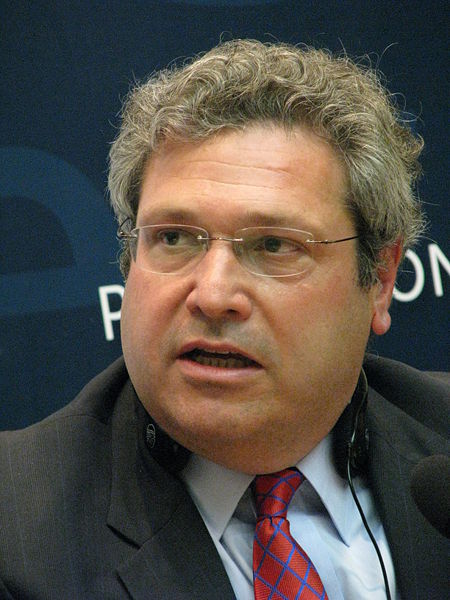
Robert Kagan (Photo credit: Mariusz Kubik)
“This extraordinary husband-and-wife duo makes quite a one-two punch for the Military-Industrial Complex, an inside-outside team that creates the need for more military spending, applies political pressure to ensure higher appropriations, and watches as thankful weapons manufacturers lavish grants on like-minded hawkish Washington think tanks.
“Not only does the broader community of neoconservatives stand to benefit but so do other members of the Kagan clan, including Robert’s brother Frederick at the American Enterprise Institute and his wife Kimberly, who runs her own shop called the Institute for the Study of War.”
But things didn’t quite turn out as the Kagans had drawn them up. The neocon Republicans stumbled through the GOP primaries losing out to Donald Trump and then – after Hillary Clinton muscled aside Sen. Bernie Sanders to claim the Democratic nomination – she fumbled away the general election to Trump.
After his surprising victory, Trump – for all his many shortcomings – recognized that the neocons were not his friends and mostly left them out in the cold. Nuland not only lost her politically appointed job as Assistant Secretary but resigned from the Foreign Service, too.
With Trump in the White House, Official Washington’s neocon-dominated foreign policy establishment was down but far from out. The neocons were tossed a lifeline by Democrats and liberals who detested Trump so much that they were happy to pick up Nuland’s fallen banner of the New Cold War with Russia. As part of a dubious scheme to drive Trump from office, Democrats and liberals hyped evidence-free allegations that Russia had colluded with Trump’s team to rig the U.S. election.
New York Times columnist Thomas L. Friedman spoke for many of this group when he compared Russia’s alleged “meddling” to Japan’s bombing of Pearl Harbor and Al Qaeda’s 9/11 terror attacks.
On MSNBC’s “Morning Joe” show, Friedman demanded that the Russia hacking allegations be treated as a casus belli: “That was a 9/11 scale event. They attacked the core of our democracy. That was a Pearl Harbor scale event.” Both Pearl Harbor and 9/11 led to wars.
So, with many liberals blinded by their hatred of Trump, the path was open for neocons to reassert themselves.
Baiting Republicans
Robert Kagan took to the high-profile op-ed page of The Washington Post to bait key Republicans, such as Rep. Devin Nunes, chairman of the House Intelligence Committee who was pictured above the Post article and its headline, “Running interference for Russia.”
Kagan wrote: “It would have been impossible to imagine a year ago that the Republican Party’s leaders would be effectively serving as enablers of Russian interference in this country’s political system. Yet, astonishingly, that is the role the Republican Party is playing.”
Kagan then reprised Official Washington’s groupthink that accepted without skepticism the claims from President Obama’s outgoing intelligence chiefs that Russia had “hacked” Democratic emails and released them via WikiLeaks to embarrass the Clinton campaign.
Though Obama’s intelligence officials offered no verifiable evidence to support the claims – and WikiLeaks denied getting the two batches of emails from the Russians – the allegations were widely accepted across Official Washington as grounds for discrediting Trump and possibly seeking his removal from office.
Ignoring the political conflict of interest for Obama’s appointees, Kagan judged that “given the significance of this particular finding [about Russian meddling], the evidence must be compelling” and justified “a serious, wide-ranging and open investigation.”
But Kagan also must have recognized the potential for the neocons to claw their way back to power behind the smokescreen of a New Cold War with Russia.
He declared: “The most important question concerns Russia’s ability to manipulate U.S. elections. That is not a political issue. It is a national security issue. If the Russian government did interfere in the United States’ electoral processes last year, then it has the capacity to do so in every election going forward. This is a powerful and dangerous weapon, more than warships or tanks or bombers.
“Neither Russia nor any potential adversary has the power to damage the U.S. political system with weapons of war. But by creating doubts about the validity, integrity and reliability of U.S. elections, it can shake that system to its foundations.”
A Different Reality
As alarmist as Kagan’s op-ed was, the reality was far different. Even if the Russians did hack the Democratic emails and somehow slipped the information to WikiLeaks – an unsubstantiated and disputed contention – those two rounds of email disclosures were not that significant to the election’s outcome.
Hillary Clinton blamed her surprise defeat on FBI Director James Comey briefly reopening the investigation into her use of a private email server while serving as Secretary of State.
Further, by all accounts, the WikiLeaks-released emails were real and revealed wrongdoing by leading Democrats, such as the Democratic National Committee’s tilting of the primaries against Sen. Bernie Sanders and in favor of Clinton. The emails of Clinton campaign chairman John Podesta disclosed the contents of Clinton’s paid speeches to Wall Street, which she was trying to hide from voters, as well as some pay-to-play features of the Clinton Foundation.
In other words, the WikiLeaks’ releases helped inform American voters about abuses to the U.S. democratic process. The emails were not “disinformation” or “fake news.” They were real news.
A similar disclosure occurred both before the election and this week when someone leaked details about Trump’s tax returns, which are protected by law. However, except for the Trump camp, almost no one thought that this illegal act of releasing a citizen’s tax returns was somehow a threat to American democracy.
The general feeling was that Americans have a right to know such details about someone seeking the White House. I agree, but doesn’t it equally follow that we had a right to know about the DNC abusing its power to grease the skids for Clinton’s nomination, about the contents of Clinton’s speeches to Wall Street bankers, and about foreign governments seeking pay-to-play influence by contributing to the Clinton Foundation?
Yet, because Obama’s political appointees in the U.S. intelligence community “assess” that Russia was the source of the WikiLeaks emails, the assault on U.S. democracy is a reason for World War III.
More Loose Talk
But Kagan was not satisfied with unsubstantiated accusations regarding Russia undermining U.S. democracy. He asserted as “fact” – although again without presenting evidence – that Russia is “interfering in the coming elections in France and Germany, and it has already interfered in Italy’s recent referendum and in numerous other elections across Europe. Russia is deploying this weapon against as many democracies as it can to sap public confidence in democratic institutions.”
There’s been a lot of handwringing in Official Washington and across the Mainstream Media about the “post-truth” era, but these supposed avatars for truth are as guilty as anyone, acting as if constantly repeating a fact-free claim is the same as proving it.
But it’s clear what Kagan and other neocons have in mind, an escalation of hostilities with Russia and a substantial increase in spending on U.S. military hardware and on Western propaganda to “counter” what is deemed “Russian propaganda.”
Kagan recognizes that he already has many key Democrats and liberals on his side. So he is taking aim at Republicans to force them to join in the full-throated Russia-bashing, writing:
“But it is the Republicans who are covering up. The party’s current leader, the president, questions the intelligence community’s findings, motives and integrity. Republican leaders in Congress have opposed the creation of any special investigating committee, either inside or outside Congress. They have insisted that inquiries be conducted by the two intelligence committees.
“Yet the Republican chairman of the committee in the House has indicated that he sees no great urgency to the investigation and has even questioned the seriousness and validity of the accusations. The Republican chairman of the committee in the Senate has approached the task grudgingly.
“The result is that the investigations seem destined to move slowly, produce little information and provide even less to the public. It is hard not to conclude that this is precisely the intent of the Republican Party’s leadership, both in the White House and Congress. …
“When Republicans stand in the way of thorough, open and immediate investigations, they become Russia’s accomplices after the fact.”
Lying with the Neocons
Many Democrats and liberals may find it encouraging that a leading neocon who helped pave the road to war in Iraq is now by their side in running down Republicans for not enthusiastically joining the latest Russian witch hunt. But they also might pause to ask themselves how they let their hatred of Trump get them into an alliance with the neocons.
On Wednesday in The Wall Street Journal, Robert Kagan’s brother Frederick and his wife Kimberly dropped the other shoe, laying out the neocons’ long-held dream of a full-scale U.S. invasion of Syria, a project that was put on hold in 2004 because of U.S. military reversals in Iraq.
But the neocons have long lusted for “regime change” in Syria and were not satisfied with Obama’s arming of anti-government rebels and the limited infiltration of U.S. Special Forces into northern Syria to assist in the retaking of the Islamic State’s “capital” of Raqqa.
In the Journal op-ed, Frederick and Kimberly Kagan call for opening a new military front in southeastern Syria:
“American military forces will be necessary. But the U.S. can recruit new Sunni Arab partners by fighting alongside them in their land. The goal in the beginning must be against ISIS because it controls the last areas in Syria where the U.S. can reasonably hope to find Sunni allies not yet under the influence of al Qaeda. But the aim after evicting ISIS must be to raise a Sunni Arab army that can ultimately defeat al Qaeda and help negotiate a settlement of the war.
“The U.S. will have to pressure the Assad regime, Iran and Russia to end the conflict on terms that the Sunni Arabs will accept. That will be easier to do with the independence and leverage of a secure base inside Syria. … President Trump should break through the flawed logic and poor planning that he inherited from his predecessor. He can transform this struggle, but only by transforming America’s approach to it.”
A New Scheme on Syria
In other words, the neocons are back to their clever word games and their strategic maneuverings to entice the U.S. military into a “regime change” project in Syria.
The neocons thought they had almost pulled off that goal by pinning a mysterious sarin gas attack outside Damascus on Aug. 21, 2013, on the Syrian government and mousetrapping Obama into launching a major U.S. air assault on the Syrian military.
But Russian President Vladimir Putin stepped in to arrange for Syrian President Bashar al-Assad to surrender all his chemical weapons even as Assad continued to deny any role in the sarin attack.
Putin’s interference in thwarting the neocons’ dream of a Syrian “regime war” moved Putin to the top of their enemies’ list. Soon key neocons, such as National Endowment for Democracy president Carl Gershman, were taking aim at Ukraine, which Gershman deemed “the biggest prize” and a steppingstone toward eventually ousting Putin in Moscow.
It fell to Assistant Secretary Victoria “Toria” Nuland to oversee the “regime change” in Ukraine. She was caught on an unsecured phone line in late January or early February 2014 discussing with U.S. Ambassador to Ukraine Geoffrey Pyatt how “to glue” or “to midwife” a change in Ukraine’s elected government of President Viktor Yanukovych.
Several weeks later, neo-Nazi and ultranationalist street fighters spearheaded a violent assault on government buildings forcing Yanukovych and other officials to flee for their lives, with the U.S. government quickly hailing the coup regime as “legitimate.”
But the Ukraine putsch led to the secession of Crimea and a bloody civil war in eastern Ukraine with ethnic Russians, events that the State Department and the mainstream Western media deemed “Russian aggression” or a “Russian invasion.”
So, by the last years of the Obama administration, the stage was set for the neocons and the Family Kagan to lead the next stage of the strategy of cornering Russia and instituting a “regime change” in Syria.
All that was needed was for Hillary Clinton to be elected president. But these best-laid plans surprisingly went astray. Despite his overall unfitness for the presidency, Trump defeated Clinton, a bitter disappointment for the neocons and their liberal interventionist sidekicks.
Yet, the so-called “#Resistance” to Trump’s presidency and President Obama’s unprecedented use of his intelligence agencies to paint Trump as a Russian “Manchurian candidate” gave new hope to the neocons and their agenda.
It has taken them a few months to reorganize and regroup but they now see hope in pressuring Trump so hard regarding Russia that he will have little choice but to buy into their belligerent schemes.
As often is the case, the Family Kagan has charted the course of action – batter Republicans into joining the all-out Russia-bashing and then persuade a softened Trump to launch a full-scale invasion of Syria. In this endeavor, the Kagans have Democrats and liberals as the foot soldiers.
Investigative reporter Robert Parry broke many of the Iran-Contra stories for The Associated Press and Newsweek in the 1980s.
WikiLeaks’ Latest CIA Data Dump Undermines Case Against Russia Election Hack
By Dave Lindorff | This Can’t Be Happening! |March 8, 2017
The so-called Deep State and Democratic Party campaign to demonize Russia for allegedly “hacking the US election,” and delivering the country into the hands of Donald Trump suffered a huge and probably mortal blow this week with the release by WikiLeaks of over 7000 secret CIA documents disclosing secret CIA hacking technologies.
The case being made against Russia as being the source of leaked emails of the Democratic National Committee and of Clinton Campaign Chair John Podesta — documents that proved that the DNC had been corrupting the primary process in favor of corporatist candidate Hillary Clinton and undermining the campaign of Vermont Senator Bernie Sanders, and that also revealed the embarrassing contents of Clinton’s highly paid secret speeches to a number of giant Wall Street banks — had always been tenuous, with no hard evidence ever presented. All the intelligence agencies would say was that they had a “high degree of certainty,” or “strong reason to believe” that the Russians were the source of the deeply damaging documents late in the campaign season.
Adding to doubts that Russia had actually hacked the DNC was WikiLeaks itself, which insisted that it had obtained the DNC and Podesta emails not from a hack of computers, but from an internal DNC staffer who actually pulled them off computers with a thumb drive and provided them to the organization — a person later identified as Seth Rich, who was mysteriously murdered on his way home from DNC headquarters in Washington, shot in the back at night in an unsolved case that the local police quickly labeled a “botched burglary,” although nothing was taken from his body by his assailant — not his wallet or watch even. (Wikileaks has offered a $20,000 reward for information that helps solve that uninvestigated case.)
But one thing the blame-Russia conspiracy theorists did have going for them was their assertion that the leaked DNC documents contained routing information and ISPs that pointed to Russia as the source of the hacks.
Now, however, the new CIA documents released by WikiLeaks — the first of a much larger trove of such documents that are reportedly going to be released as WikiLeaks goes through them to remove information that might jeopardize agents or national security — show that among the technologies and hacking tools that the CIA has been using to attack targeted computers, internet servers and even so-called “smart” appliances in people’s homes, like Samsung TV sets, are a number of Russian-developed hacking programs.
As the New York Times wrote in its article on the latest Wikileaks document release, which it is calling “Vault 7”:
Another program described in the documents, named Umbrage, is a voluminous library of cyber-attack techniques that the CIA has collected from malware produced by other countries, including Russia. According to the WikiLeaks release, the large number of techniques allows the CIA to mask the origin of some of its attack and confuse forensic investigators.
The WikiLeaks material includes lists of softward tools that the CIA uses to create exploits and malware to carry out hacking. Many of the tools are those used by developers around the world: coding languages, such as Python, and tools like Sublime Text, a program used to write code, and Git, a tool that helps developers collaborate.”
What this means is that current efforts by Democratic Party leaders and Deep State leakers in the government intelligence sector to pin the blame on Russia for hacking the election or for trying to help elect Trump as president, now must confront the counter-argument that the Deep State itself, in the form of the CIA, may have been behind the hacks, but is making it look like the Russians did it.
Why would the CIA do that? Well, if the concern was that Trump, as he stated throughout the campaign, wanted to end US hostility towards Russia, and to develop friendly relations with that country and its leader, President Vladimir Putin, what better way to toss a spanner into such plans than to make it look like Russia had tried to corrupt the US election?
That charge has been largely adopted unquestioningly by the corporate media in recent months, but it now founders on the new evidence that the CIA has the ability to pose as a Russian hacker!
It looks like the campaign to portray President Trump as a Putin puppet, and to portray Russia as an evil underminer of US democracy will have to come up with another way to attack the Trump administration, and to gin up a new Cold War with Russia. The current effort will no longer pass the laugh test. Democrats seeking to undermine Trump with the US public will have to do better — like maybe actually analyzing the reasons for their epic election defeat, and coming up with a genuinely populist, as opposed to corporatist, program to show ordinary Americans that the party has their interests at heart, and not just the interests of rich campaign contributors.
WikiLeaks and its founder Julian Assange, the latter holed up these past four years under threat of arrest in the Ecuadoran Embassy in London, have done it again.
Although the Deep State hasn’t given up. The NY Times, in its report today on the WikiLeaks documents, also includes the rather lame argument by James Lewis, described as “an expert on cybersecurity at the Center for Strategic and International Studies” (a Washington think-tank closely linked to the US defense and intelligence establishment), that the latest WikiLeaks documents “most likely” were provided not by a “conscience-stricken CIA whistleblower,” but rather via another source. Lewis then suggests that:
“… a foreign state, most likely Russia, stole the documents by hacking or other means and delivered them to WikiLeaks, which may not know how they were obtained.”
Lewis gives no real explanation as to why a Russian hack would be “more likely” than a whistle-blowing CIA employee or contractor to be the source of the leaked documents provided to WikiLeaks, but the Times and its intelligence establishment sources are putting that alternative out there anyhow, clearly in an effort to keep the crumbling anti-Russia campaign afloat.
It will be interesting to see how far the McCarthyite campaign to demonize Russia and to damage the Trump presidency by linking it to Russian perfidy will go, given this new information that the CIA was well-equipped to do its hacking work posing as a Russian entity.
The U.S. Government Did Not Revoke Khizr Khan’s ‘Travel Privileges’

By Peter Van Buren | We Meant Well | March 8, 2017
Here’s the anatomy of a fully made-up “news” story, abetted by a media that could care less to check any fact as long as the story feeds the preconceived notions of its audience.
You remember Khizr Khan (above), the guy who used his soldier son, killed in Iraq, as a prop at the Democratic National Convention to criticize Trump’s immigration policy and help elect Hillary Clinton? Well, like all good Americans, Khan exploited his exploitation into a minor media career. He was booked to talk in Canada by a speaker’s bureau called Ramsey Talks. A decent gig — tickets ran $89 a seat.
Then Trump supposedly struck. Ramsey Talks released a statement on its Facebook page saying:
Late Sunday evening Khizr Khan, an American citizen for over 30 years, was notified that his travel privileges are being reviewed. As a consequence, Mr. Khan will not be traveling to Toronto on March 7th to speak about tolerance, understanding, unity and the rule of law. Very regretfully, Ramsay Talks must cancel its luncheon with Mr. Khan. Guests will be given full refunds.
Mr. Khan offered his sincere apologies to all those who made plans to attend on March 7th. He said: “This turn of events is not just of deep concern to me but to all my fellow Americans who cherish our freedom to travel abroad. I have not been given any reason as to why. I am grateful for your support and look forward to visiting Toronto in the near future.
A major Canadian broadcast outfit (CTV) ran the story based solely, only, 100% on that single unverified and unsubstantiated Facebook posting, saying the Trump administration interfered with Khan’s “travel privileges” to prevent him from speaking, because of some sort of revenge for Khan’s statements this summer.
The Internet then, as expected, lost its shit.
Twitter boomed, and within an hour or two the story appeared in the New York Times, LA Times, Boston Herald, CNN, Maddow, and across the globe. Every one of those stories was based on nothing but that Facebook post. Reuters, the only outfit that apparently bothered to commit a minor act of journalism and reach out to Khan, was told by him no comment. All of the web’s many experts on stuff became experts on passport law, immigration, naturalization, and visa lore. Amazingly creative theories of “denaturalization of Muslims” were concocted out of thin air.
The only problem is that none of this is true. It in fact could not be true.
The U.S. has no law that deals with reviewing or rescinding “travel privileges.” No U.S. government agency calls people at home to tell them their travel privileges are under review. If, in very, very limited specific legal instances a court has ordered someone not to travel, their passport itself can be revoked in response to that court order. The U.S. Customs and Border Protection people, the State Department, and the government of Canada all eventually denied doing anything to Khan in any way or having anything to do with this story, so please stop calling them to ask.
Khan, or Ramsey Talks, seems to have made this all up.
Now, funny thing, this made-up story about Khan being denied travel hit just as Trump’s new Executive Order (“Muslin Ban 2.0”) was announced. Gee willikers Biff, you think this tale of a Muslim patriot denied travel was timed for that news cycle? Maybe so that when Khan’s speech is rescheduled tickets will be more expensive and sell out faster? Maybe so Khan and/or Ramsey Talks could get a zillion dollars of free publicity? Hah hah, coincidence, am I right?
As I write this, not one of the media outlets that ran with the false story has published a correction, update or apology. The Washington Post has semi-backed away, but left itself plenty of wiggle room in not admitting it was wrong.
The problem is if you Google Khan’s name, the story is still flowing around the web, and is now being cited in unrelated stories as “proof” of whatever else the writer believes is fascism and the end of freedom in America.
BONUS: A source inside CBP tells me that what is most likely to have happened is that Khan’s membership in one of the expedited processing programs was set to expire. These are programs run by private companies that gather information and submit members’ names for background checks to allow them to use expedited processing lanes at the airport when re-entering the United States from a foreign country. Khan/Ramsey likely confused, by accident or on purpose, the expiration of that membership with some nefarious U.S. government action, and the media took it from there. Khan’s only privilege under fire was that of standing in a shorter line at the airport.
Cheerleading for Israel
Everyone’s doing it

By Philip Giraldi • Unz Review • March 7, 2017
Those of us who voted for Donald Trump in hopes that he would turn out to be the peace candidate are facing disappointment. He has increased the already bloated military budget by $54 billion and has appointed an outspokenly anti-Russian and anti-Iranian active duty general as his National Security Advisor. A retired general with pretty much the same views heads the Pentagon. President Trump meanwhile vows to “extinguish” ISIS without presenting any plan regarding how exactly that might be accomplished.
The most important objective of all, resetting with Moscow to avoid World War 3, is in reverse gear, with the appointment of Fiona Hill, a critic of Vladimir Putin, as Russian specialist at the National Security Council. Meanwhile, our clueless United Nations Ambassador calls for Russia to withdraw from Crimea, where 58% of the population is Russian and only 24% is Ukrainian. Reports circulating in Washington suggest that the one phone call between Trump and Putin was a disaster, with the U.S. president demanding an end to the New START nuclear weapons reduction treaty, which the Kremlin wants to renew, before going off on a tangential monologue about his unexpected electoral victory.
In fact, even though the individual neocons have largely been outed from the foreign and security policy positions they once dominated it would not be completely inappropriate to suggest that their legacy of military interventionism lives on in terms of what the Trump administration has been so far promoting to keep America “safe.” Where all of this will go is anyone’s guess.
But if there is one constant in all of this it is the bright shining beacon of Israel, with Trump recently enthusing over the “unbreakable” bond between the two countries. One hopes that he misspoke and really meant “unbearable” or even “unspeakable” but it is clear from other indications that The Donald has succumbed to the inevitable Washington groupthink regarding America’s greatest ally and best friend in the whole wide world.
On Sunday New York Governor Andrew Cuomo met with Israeli Prime Minister Benjamin Netanyahu to discuss “trade and security issues” without anyone complaining that he was in violation of the Logan Act, which apparently only applies if you are talking to Russians. And a congressional delegation is in Israel right now studying the feasibility of moving the U.S. Embassy to Jerusalem, which most foreign policy pundits consider to be a very bad idea. Meanwhile at the United Nations, the U.S. has blocked the appointment of former Palestinian prime minister Salam Fayyad as special representative to Libya. U.S. Ambassador Nikki Haley explained the veto, saying irrelevantly “For too long the U.N. has been unfairly biased in favor of the Palestinian Authority to the detriment of our allies in Israel. The United States does not currently recognize a Palestinian state or support the signal this appointment would send within the United Nations.”
Ambassador Haley has also denounced the international body in general terms, stating that she was “underscore[ing] the ironclad support of the United States for Israel,” adding that “I am here to emphasize that United States is determined to stand up to the U.N.’s anti-Israel bias.” And if anyone failed to understand, on March 1st, U.S. envoy to the U.N. Human Rights Council in Geneva Erin Barclay told the group that it must drop its “obsession with Israel” or risk Washington withdrawing from the organization. The suggestion that the U.S. might consider departing came, incidentally, directly from Israeli Prime Minister Benjamin Netanyahu, who proposed such action to Donald Trump to “delegitimize” the U.N. body.
It is ironic that in the midst of a media and congressional feeding frenzy on foreign interference in the U.S., the one country in the world that consistently leads Washington by the nose is immune from criticism. The subservient role dutifully played by every U.S. president since JFK when dealing with Tel Aviv has resulted in defining United States national interests in terms of Israeli perceptions. The real irony is that even though Trump is giving the Israelis everything they want and is bowing to the Israel Lobby and Jewish groups at every opportunity, it is still not enough. It is never enough. That is because the neoconservatives, who are mostly Jewish and themselves complete Israel-firsters, hate him, having overwhelmingly favored Hillary Clinton as president due to their conviction that she would be the more aggressive president. They now believe that if they succeed in forcing Trump’s resignation or impeachment they will return to power in whatever new government formulation is put in place, so they continue to pile on.
Israel’s friends characteristically either run or have the ear of the media and they are supported by a formidable Washington based lobbying machine to get their point across. Whenever anything happens in the Middle East or elsewhere that is related to Israel’s perceived interests the machine goes to work with multiple position papers presented to every congressional office the next morning by runners from AIPAC, AEI, FPI, WINEP, JINSA and FDD. No one else has the clout of the Israel Lobby.
And Trump is also being battered by Jewish interests coming from the political left. France’s greatest living poseur-hypocrite Bernard-Henri Levy, described as a “philosopher, filmmaker and activist,” has hammered Trump twice recently, first in The New York Times on January 19th. Levy, who has described the brutal Israel Defense Forces as “a democratic army, which asks itself so many moral questions” and who was a war-on-Libya cheerleader, warns that Trump is a threat to all American Jews. Why? Because even though he has showered benefits on Israel his love for the Jewish people is “insufficient.” Levy explains, “This love is precisely what is required of an American president in dealings affecting Israel.”
The reader might well be astonished by the chutzpah of Levy in demanding love on top of the $38 billion already in the pipeline and wonder even more why the New York Times would print such garbage. But the French whiz kid does not really explain his remark, instead going on to denounce the “betrayal” of Israel by President Barack Obama at the United Nations before explaining that as Trump is “deeply unpopular” it would not do for American Jews to embrace him closely even if it appears he is doing good things for Israel. And Levy provides “evidence” that Trump might not be what he seems, citing inter alia his speech before the Republican Jewish Coalition in which he said he didn’t need their money. Levy sees this as a precursor to genuine, full blooded anti-Semitism, and speculates that Trump will take revenge against Jews to show “that he is indeed smarter than they are.” Why would he do that? Because he “respects only power, money and the perquisites of the palace.”
Levy’s second foray second foray, on CNN a month later, took Trump to task for his “incredible slip” on January 27th, Holocaust Remembrance Day, when he did not single out Jewish victims of Nazi crimes and instead cited all of those exterminated by the Germans. For Levy, Jewish deaths are intrinsically more memorable and valuable than those of others and the failure to grant them special status is a “tell-tale trope of Holocaust deniers” and a “hallmark of the new anti-Semitism.”
Bernard-Henri goes on to cite more evidence of Trump’s closet anti-Semitism, including the assertion that he has failed to address the reality of “Jewish children who go to school full of fear.” While it is possible to dismiss Levy as a completely self-serving bullshit artist who badly needs a haircut and a bath, he is far from alone. Also on the left there is the renowned Professor Alan Dershowitz of Harvard University.
Dershowitz, threatening to leave the Democratic Party if it elected Keith Ellison chair of the party’s central committee, appeared frequently on television and in the print media claiming that Ellison was an enemy of Israel and of the Jewish people. The threat to leave the Democrats produced numerous jokes directed at the abrasive and unpopular lawyer somewhat akin to those crafted at the expense of the Hollywood celebrities who promised to leave the country if Donald Trump were elected president. Unfortunately, I have to note that neither Dershowitz nor Barbra Streisand has yet departed.
Ellison was the preferred candidate of the Bernie Sanders liberal wing of the party and initial opinion polls suggested that he would likely win the position. While Dershowitz’s bombast could be regarded with some amusement, there was another, darker side to the campaign to sideline Ellison, who is black, a Muslim and not openly hostile to the Palestinians. This last attribute inevitably made it possible to start a whispering campaign labeling him as anti-Semitic and a number of Jewish Democratic fundraisers, to include Israeli Haim Saban of Hillary Clinton fame, privately made it known that they would end their donations to the party if Ellison were elected. Barack Obama and the Clintons also piled on, even working the phones to stop Ellison.
When Ellison lost in a close result, Dershowitz announced that he would not be leaving the party after all because the result was a “victory in the war against bigotry, anti-Semitism, [and] the anti-Israel push of the hard left within the Democratic Party.” As evidence of Ellison’s anti-Israel sentiment Dershowitz cited the congressman’s vote against funding Iron Dome, which is the Israel missile defense system. “Can you imagine any reasonable person voting against a missile system designed to protect innocent civilians against terrorist rocket attacks?”
Indeed Dersh, but maybe the Israelis should be paying for it, not the American taxpayer, which is actually the crux of the matter. I for one am tired of the perpetual whining of Alan Dershowitz and international professional Jews like Bernard-Henri Levi, who is frequently in the U.S. doing richly rewarded speaking tours on the so-called “Synagogue circuit.” And someone should wake U.N Ambassador Nikki Haley up to the fact that her job is to take care of the American people, not Israel. Quite frankly, if these folks are so much in love with Israel they should go live there and leave the rest of us as well as the U.S. Treasury alone.
If we are heading into yet another round of Israel-centric foreign policy we will be inevitably involved in new wars, starting with Iran which has always been Netanyahu’s enemy of choice. And then there is Syria, where the Israelis would prefer a continuation of chaos, presumably carried out by Washington which can pay the bills and take the casualties. As Bernard-Henri Levy has made clear and the Talmud asserts, Jewish lives are more important than those of gentiles, so it is fit and proper that Americans should fight and die to make sure that Israel might prosper.
Fake News Calls Russia’s Envoy to Washington a Spy
By Stephen Lendman | March 2, 2017
Reckless US Russia bashing is reminiscent of US propaganda preceding all its wars, vilifying targeted countries and their leaders before attacking them.
The possibility of the world’s dominant nuclear powers clashing militarily should terrify everyone. Nuclear armageddon could follow.
Permanent wars reflect longstanding US policy. The Russian Federation never attacked another nation, fostering world peace and stability instead, threatening no other countries, despite Big Lies claiming otherwise.
Russia’s ambassador to Washington, Sergey Kislyak, is a distinguished diplomat, not an intelligence agent. He joined the Soviet Foreign Affairs Ministry in 1977, serving in many positions – most recently as Deputy Foreign Affairs Minister from 2003 – 2008, since then as envoy to America.
Yet CNN outrageously called him “one of Russia’s top spies and spy-recruiters in Washington” – a disgraceful fake news accusation, related to its coverage of Attorney General Jeff Sessions, having spoken to Kislyak one or more times while serving on the Senate Armed Services Committee.
CNN’s alleged sources: the usual unnamed US officials, past and present, reporting no evidence, the aim part of a diabolical anti-Russia, anti-Trump plot.
The stakes are huge. If officials close to him are eliminated, he’ll be too weak to govern effectively, perhaps more vulnerable to impeachment and removal from office than already.
If he goes, the last vestiges of a free society will go with him, coup d’etat dictatorship replacing him.
If Russia bashing passes a threshold of no return, war between the world’s dominant nuclear powers could follow.
Most Americans are mindless about what’s going on, manipulated by relentless fake news, failing to distinguish between fact and fiction.
Most oppose Trump, according to polls. Most nonsensically believe Russia threatens America. The notion is pounded into the public mind constantly, in NYT and other broadsheet feature stories, round-the-clock on cable television.
Putin spokesman Dmitry Peskov blasted accusations about Kislyak, saying “(y)ou and I have not heard a single statement by the US special services about our ambassador” – just “bogus media speculations that keep fanning tensions,” adding:
“The only piece of advice that I can give is that in a situation like this, avoid reacting to all such anonymous, baseless fake news stories and rely only on official statements by genuine officials.”
If Americans don’t awaken to the clear and present dangers they face and resist, the price for their indifference will be full-blown tyranny – perhaps nuclear war to follow, the ultimate nightmare.
Of course Donald Trump’s phones were tapped!

Image from popularresistance.org
By Kit | OffGuardian | March 4, 2017
The ongoing clashes between the factions that make up the US political elite keep getting more and more absurd. And annoyingly, as no particular fan of Donald Trump, I keep finding myself in the position of having to fight his corner.
In this instance it is about wire-tapping. Donald Trump tweeted out that the Obama’s previous administration had pulled a Watergate and had his office phones monitored during the election. As yet there is no proof, something everyone from CNN to the Guardian to The NYT were very eager to point out.
In fact, every single MSM source that covered this story mentioned the lack of evidence in the headline:

Somebody get these guys a thesaurus.
Whilst simultaneously quoting the other side of the story, without feeling the need to be quite so thoroughly honest:

Don’t worry everyone… Obama denied it. So that settles that.
And honestly, yes, there is (as yet) no proof. There may not be any proof, ever. It’s a possibility that Trump simply made it up. Politicians make things up all the time. I doubt one word in fifty spoken in Washington DC has any kind of basis in fact.
There is, indeed, no proof. However, there is quite a large piece of evidence, one that the media seem to have neglected to mention.
This is where we need to have a quick reality check, because it seems our friends in the media have forgotten:
The Obama administration spied. A lot.
They spied on American civilians, foreign nationals, domestic political figures, and international heads of state. They monitored our internet histories and our phone calls and read our e-mails. None of this is disputed. Obama did one of his hokey phony apologies about it. He almost certainly used the word “folks”.
This was famously reported exclusively in the Guardian just 4 years ago. They stood by their serious journalism back then… right up until GCHQ told them to smash their hard drives with a sledgehammer. Edward Snowden (perhaps you remember him?) is currently hiding-out in Russia for telling us all about it. Luke Harding, a Guardian star reporter, wrote a not-very-good book about it. It seems odd they’ve all forgotten.
The refutation of Trump’s claim, offered by former Obama admin. officials went roughly as follows:
No President can order a wiretap. Those restrictions were put in place to protect citizens from people like you. https://t.co/lEVscjkzSw
— Ben Rhodes (@brhodes) March 4, 2017
There was also this statement from an Obama spokesperson.
The argument being that Barack Obama can’t have ordered a wire-tap on Donald Trump… because it would exceed his legal authority. Now, I’m all for living in a world where the US Government, and all the elected and unelected officials there-in, act only according to their legal authority. It would be a nice world…a lot of people would still be alive that, currently, are not.
But time has shown, hundreds (if not thousands) of times over the past few decades, that legality is not an obstacle to an American political establishment driven to protect their financial interests and military empire.
Torture camps, extraordinary renditions, drone executions, funding of terrorist groups, targeting of civilians, use of cluster munitions, use of chemical weapons, use of depleted uranium, terrorist attacks, mass surveillance and all out wars of conquest are all very, very illegal. That has never been a problem.
To suppose that adding illegal wire taps on presidential candidates to this list is a line they would not cross is naive to the point of insanity.
It is inherently ridiculous to openly acknowledge the existence of a massive (illegal) surveillance network, and not assume that bombastic, populist political opponents would be at the top the target list.
In summary: of course the Obama administration spied on Donald Trump. They spied on everybody.
It’s very important we don’t let them shove that fact down the memory-hole.
Featured Video

Elijah Magnier: Yemen’s strikes are shattering Saudi Arabia’s long-term strategy
or go to
Aletho News Archives – Video-Images
From the Archives
British weapons and personnel doing much of the killing in Yemen
Press TV – June 18, 2019
A detailed report published by the Guardian newspaper has shown how Britain is massively contributing to Saudi Arabia’s devastating war on Yemen as it suggests that London is not only supplying the bombs that fall on Yemenis, but it provides the personnel and expertise that keep the war going.
The comprehensive report by Arron Merat published on Tuesday showed that Britain was doing much of the killing in Yemen as the country continues to provide Saudi Arabia with everything it needs to turn its southern impoverished neighbor into a graveyard.
“Every day Yemen is hit by British bombs – dropped by British planes that are flown by British-trained pilots and maintained and prepared inside Saudi Arabia by thousands of British contractors,” said Merat in the report. … continue
Blog Roll
 Aletho News
- Netizens condemn Japanese drama for projecting Japan’s wartime atrocities onto Chinese characters
- Racist Seinfeld Dances for Joy as Bibi Unveils His New Map
- A West Bank War for Netanyahu’s Election Campaign, Could It Backfire?
- Yemen denounces European Parliament’s ‘hypocritical’ push to blacklist Ansarullah
- Qalibaf: UAE’s UN bid aims to ‘clear the runway’ for ‘Greater Israel’, whitewash genocide
- Pakistan reopens Iran border after boosting security: Report
- Why are so many Brazilians voting for Flávio Bolsonaro?
- Democrats Put Anti-Russia Agenda Ahead of American Workers
- Elijah Magnier: Yemen’s Strikes Are Shattering Saudi Arabia’s Long-Term Strategy
- Pentagon designates Chinese cultural centers national security threat
- If Americans Knew
- An error has occurred; the feed is probably down. Try again later.
- No Tricks Zone
- Sudden Stratospheric Warming, Powerful El Niño Combination May Lead To Extreme Europe Cold, Energy Crisis!
- Two New Studies Find Thwaites Glacier Melt Cannot Be Driven By Human Activity Or A Warming Ocean
- E-Cars Reduce CO2 Emissions By Only 41% Compared To Internal Combustion Engine Vehicles
- Predictions Made By Renowned Climate Professor Over Past Decades Have Been Proven To Be Poor
- New Study Suggests Large Regions Of The Pacific Ocean Have Been Cooling For The Last 80 Years
- Germany’s Green Energy Debacle: High Energy Costs Force Kahla Porzellan to Close After 182 Years!
- New Study: 50 Years Of The Most Aggressive ‘Net Zero’ Policies Can Only Affect The Global Climate By 0.03°C
- US September “Heat” Was No Record…Many Records Set Decades Ago
- Latest European Green Energy Debacle; Portugal’s Largest Flagship Solar Park Insolvent!
- Green Energy Debacle: German Expert Professor Fritz Vahrenholt Warns Of Severe Economic And Social Consequences

